Search Results: "charles"

21 December 2023

Russell Coker: Links December 2023

David Brin wrote an insightful blog post about the latest round of UFO delusion [1]. There aren t a heap of scientists secretly working on UFOs. David Brin wrote an informative and insightful blog post about rich doomsday preppers who want to destroy democracy [2]. Cory Doctorow wrote an interesting article about how ChatGPT helps people write letters and how that decreases the value of the letter [3]. What can we do to show that letters mean something? Hand deliver them? Pay someone to hand deliver them? Cory concentrates on legal letters and petitions but this can apply to other things too. David Brin wrote an informative blog post about billionaires prepping for disaster and causing the disaster [4]. David Brin wrote an insightful Wired article about ways of dealing with potential rogue AIs [5]. David Brin has an interesting take on government funded science [6]. Bruce Schneier wrote an insightful article about AI Risks which is worth reading [7]. Ximion wrote a great blog post about how tp use AppStream metadata to indicate what type of hardware/environment is required to use an app [8]. This is great for the recent use of Debian on phones and can provide real benefits for more traditional uses (like all those servers that accidentally got LibreOffice etc installed). Also for Convergence it will be good to have the app launcher take note of this, when your phone isn t connected to a dock there s no point offering to launch apps that require a full desktop screen. Russ Albery wrote an interesting summary of the book Going Infinite about the Sam Bankman-Fried FTX fiasco [9]. That summary really makes Sam sound Autistic. Cory Doctorow wrote an insightful article Microincentives and Enshittification explaining why Google search has to suck [10]. Charles Stross posted the text of a lecture he gave titles We re Sorry We Created the Torment Nexus [11] about sci-fi ideas that shouldn t be implemented. The Daily WTF has many stories of corporate computer stupidity, but The White Appliphant is one of the most epic [12]. The Verge has an informative article on new laws in the US and the EU to give a right to repair and how this explains the sudden change to 7 year support for Pixel phones [13].

25 August 2023

Debian Brasil: Debian Day 30 anos online no Brasil

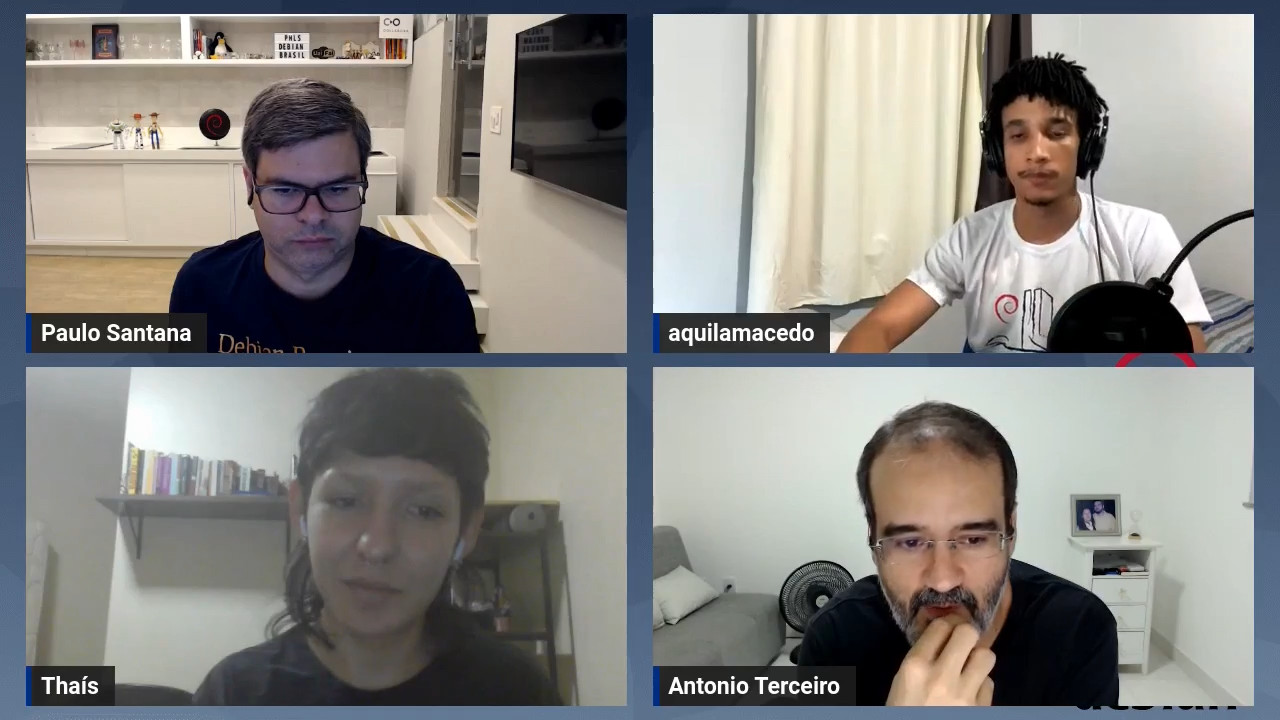
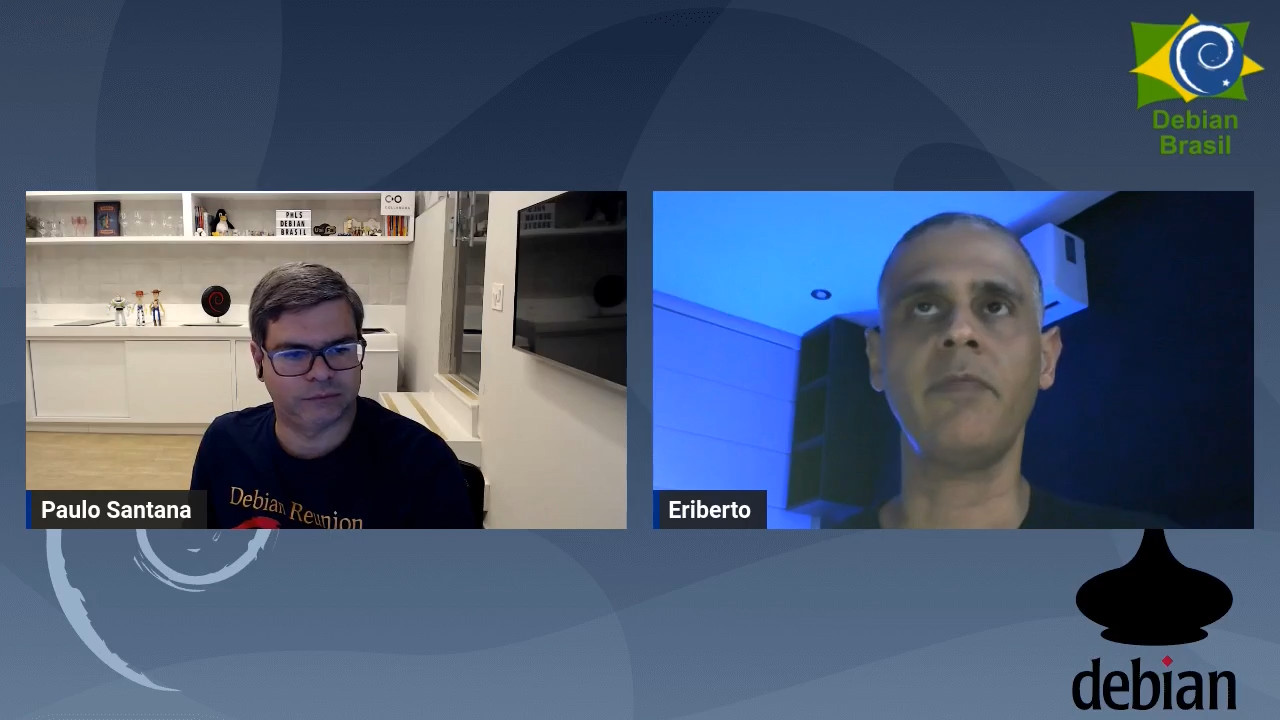
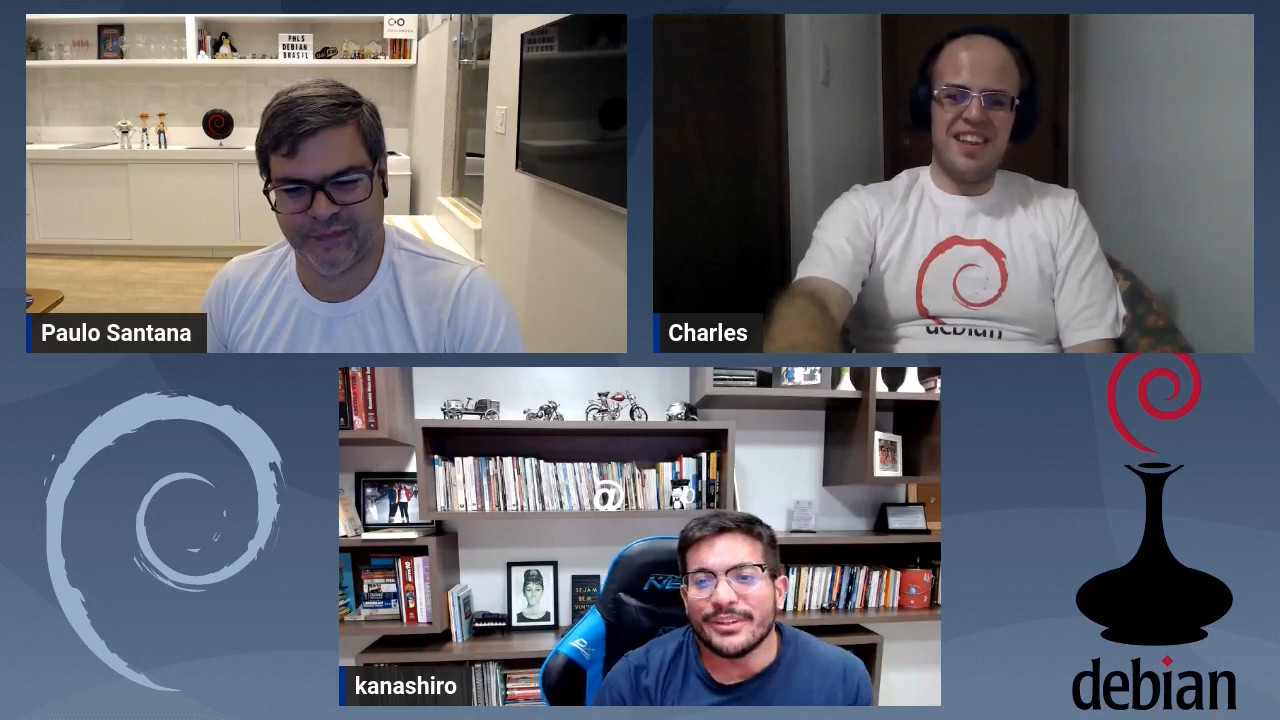
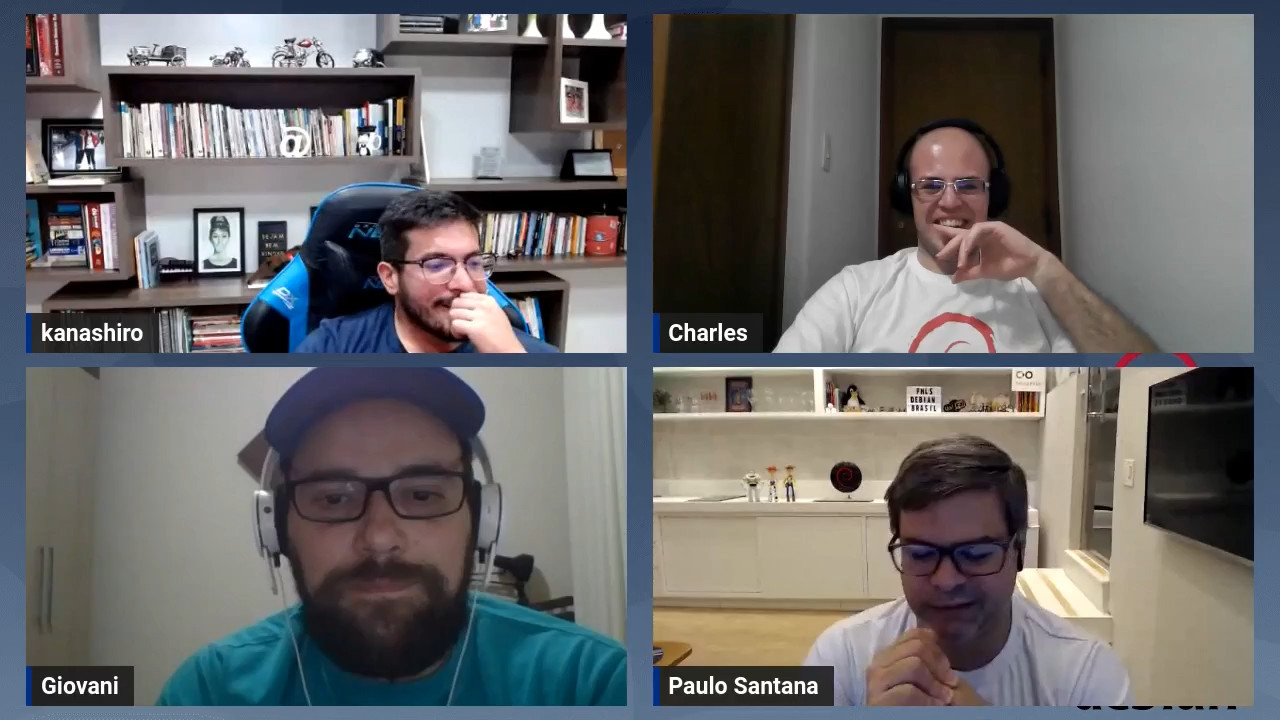
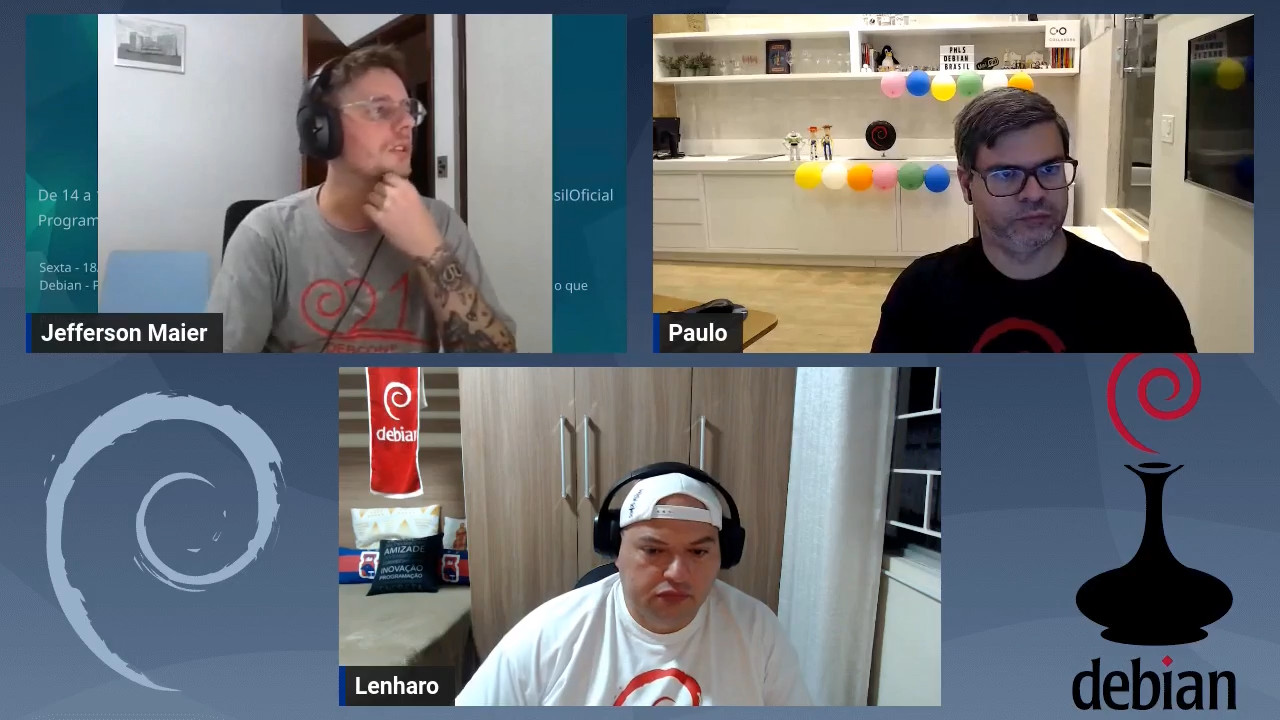
Em 2023 o tradicional Debian Day est sendo celebrado de forma especial, afinal no dia 16 de agostoo Debian completou 30 anos! Para comemorar este marco especial na vida do Debian, a comunidade Debian Brasil organizou uma semana de palestras online de 14 a 18 de agosto. O evento foi chamado de Debian 30 anos. Foram realizadas 2 palestras por noite, das 19h s 22h, transmitidas pelo canal Debian Brasil no YouTube totalizando 10 palestras. As grava es j est o dispon veis tamb m no canal Debian Brasil no Peertube. Nas 10 atividades tivemos as participa es de 9 DDs, 1 DM, 3 contribuidores(as). A audi ncia ao vivo variou bastante, e o pico foi na palestra sobre preseed com o Eriberto Mota quando tivemos 47 pessoas assistindo. Obrigado a todos(as) participantes pela contribui o que voc s deram para o sucesso do nosso evento. Veja abaixo as fotos de cada atividade: Nova gera o: uma entrevista com iniciantes no projeto Debian
Nova gera o: uma entrevista com iniciantes no projeto Debian Instala o personalizada e automatizada do Debian com preseed
Instala o personalizada e automatizada do Debian com preseed Manipulando patches com git-buildpackage
Manipulando patches com git-buildpackage debian.social: Socializando Debian do jeito Debian
debian.social: Socializando Debian do jeito Debian Proxy reverso com WireGuard
Proxy reverso com WireGuard Celebra o dos 30 anos do Debian!
Celebra o dos 30 anos do Debian! Instalando o Debian em disco criptografado com LUKS
Instalando o Debian em disco criptografado com LUKS O que a equipe de localiza o j  conquistou nesses 30 anos
O que a equipe de localiza o j conquistou nesses 30 anos Debian - Projeto e Comunidade!
Debian - Projeto e Comunidade! Design Gr fico e Software livre, o que fazer e por onde come ar
Design Gr fico e Software livre, o que fazer e por onde come ar

20 August 2023

Debian Brasil: Debian Day 30 years in Brazil

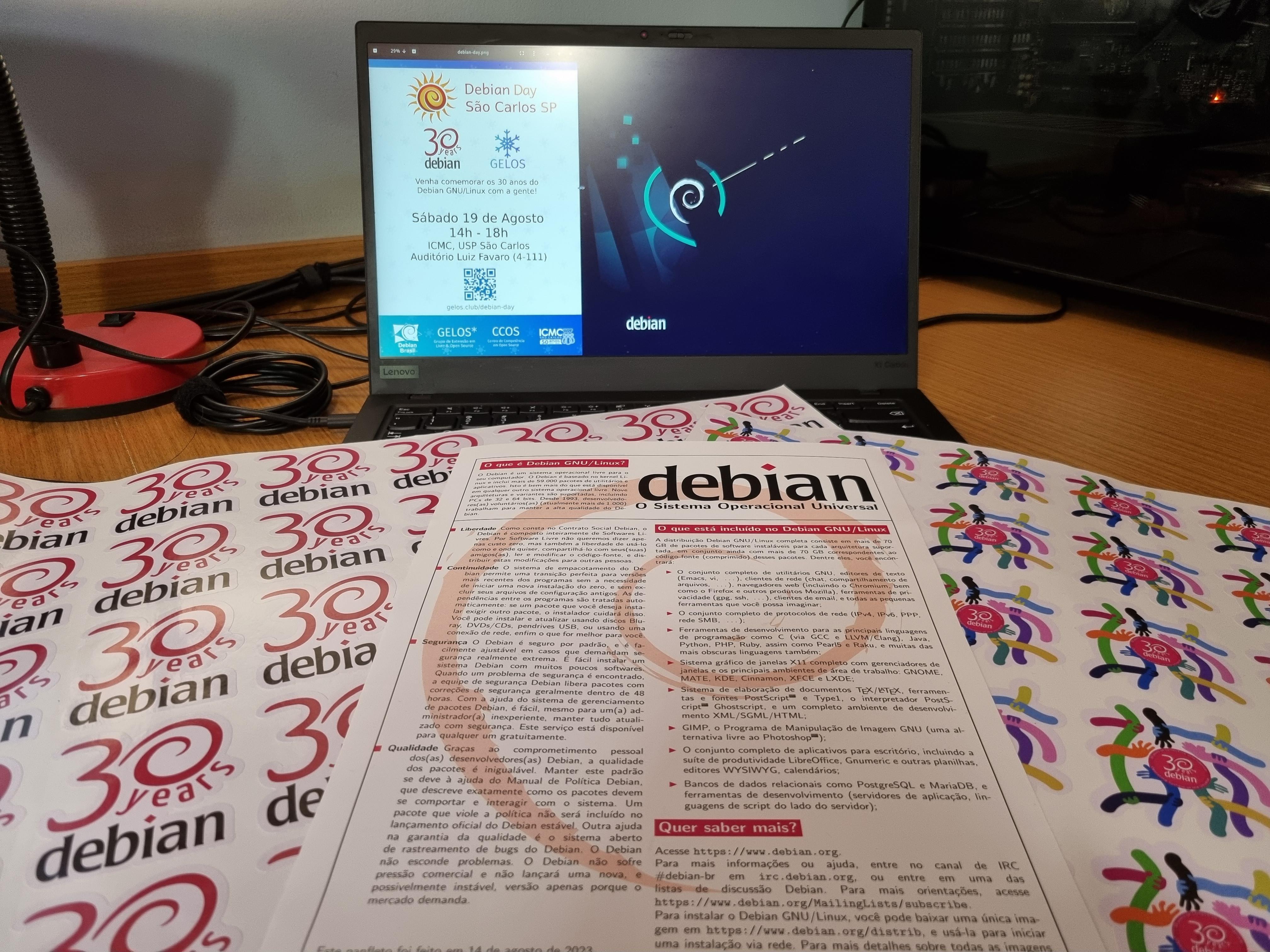
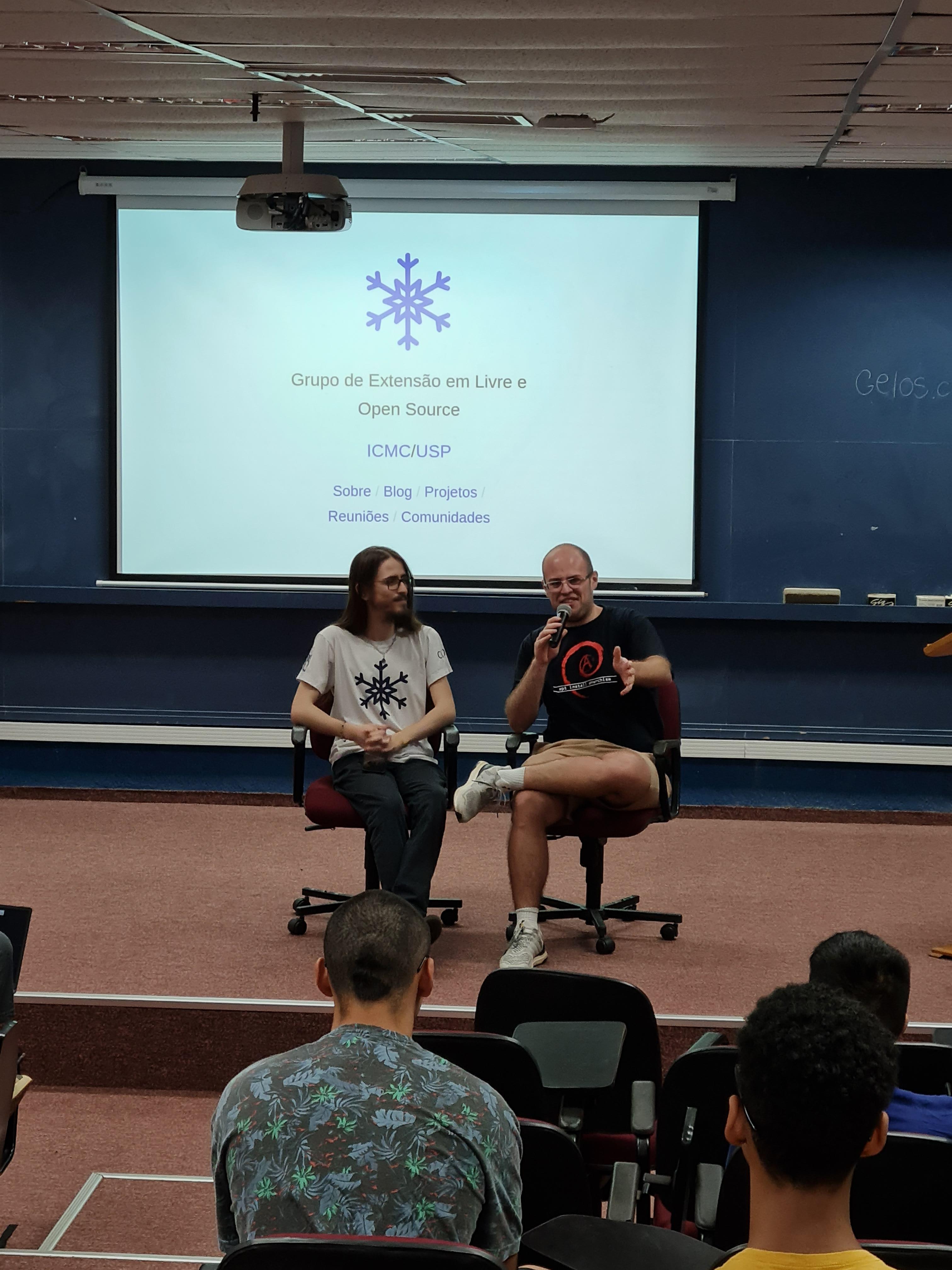
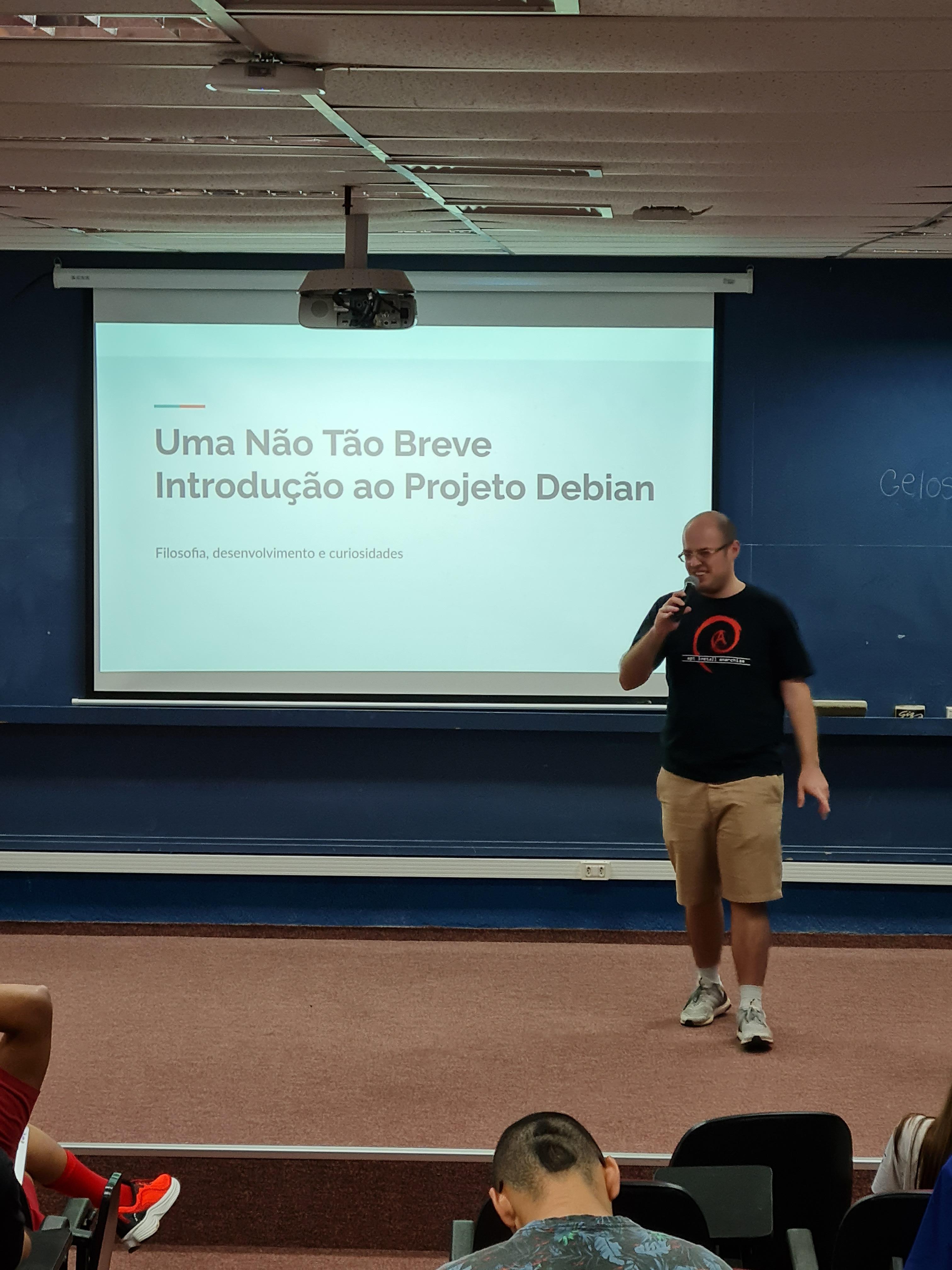
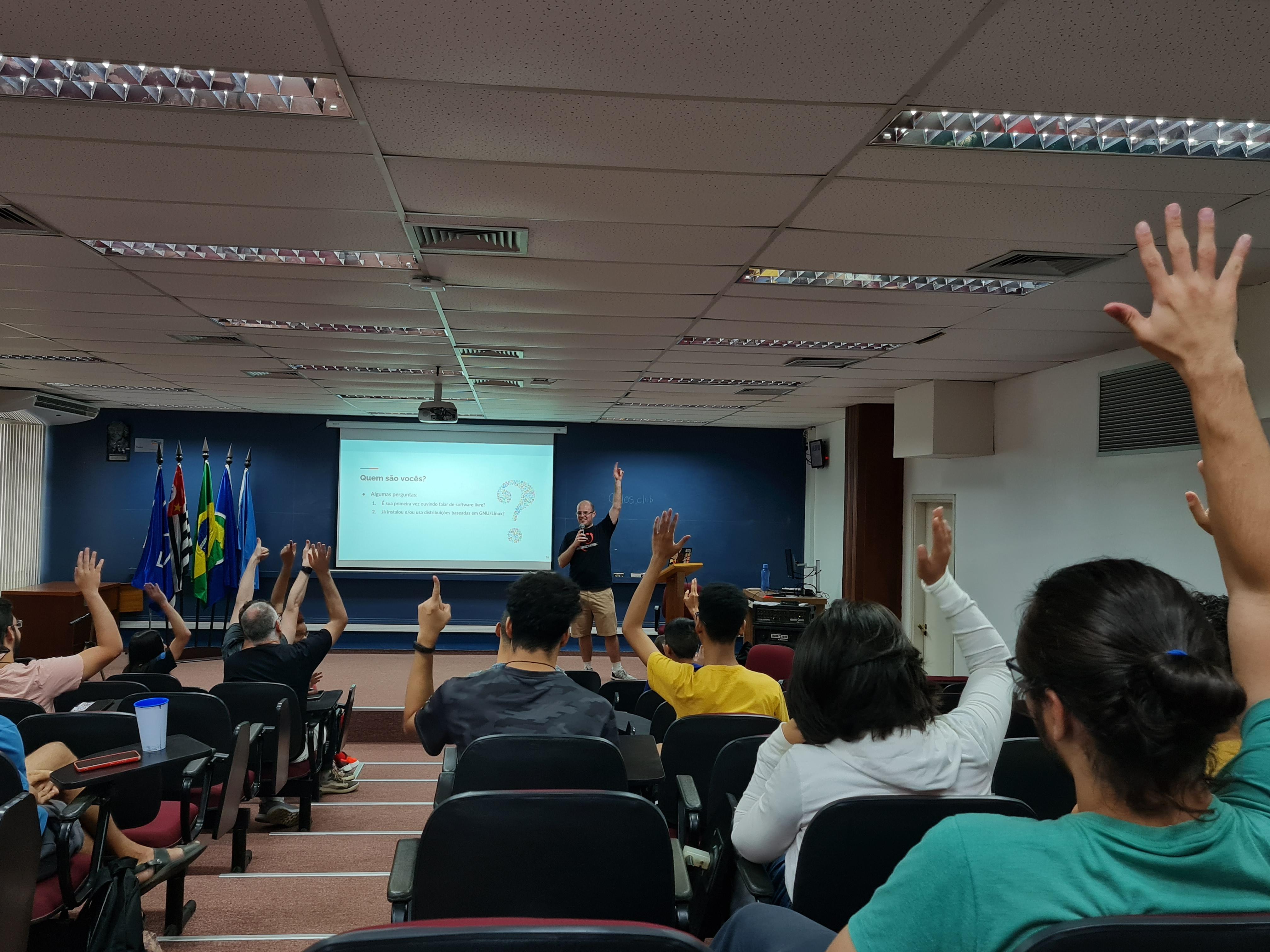
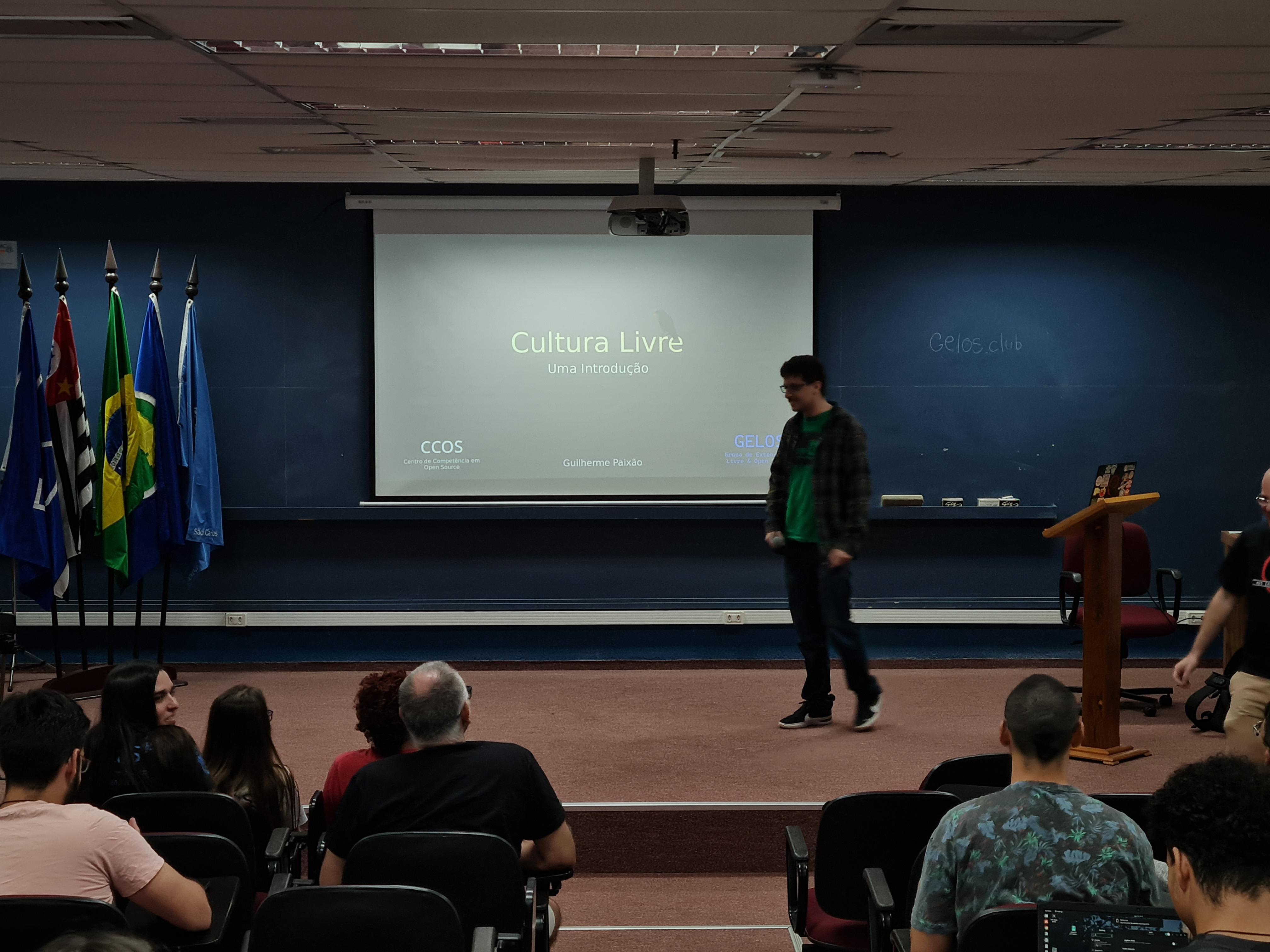
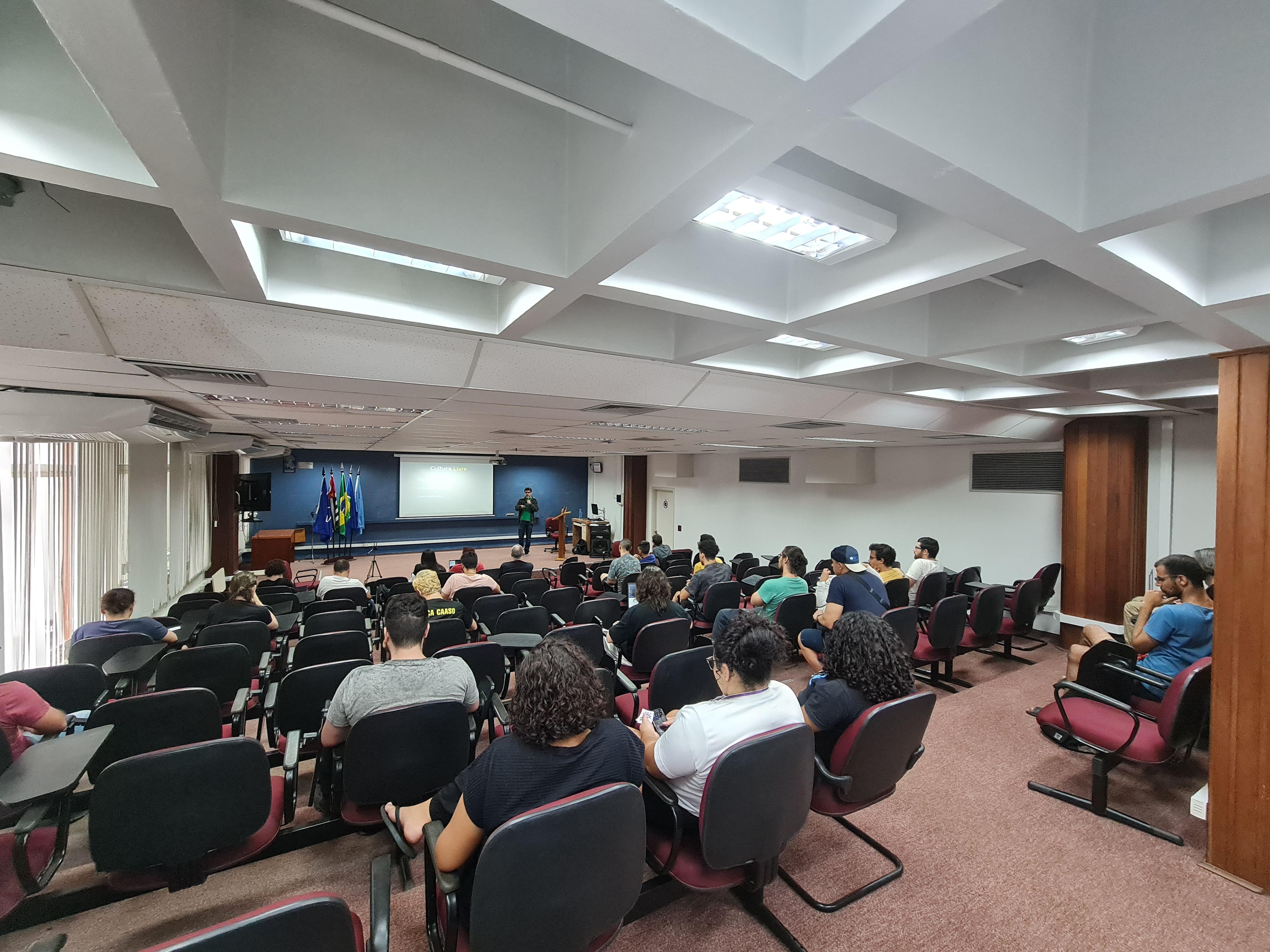
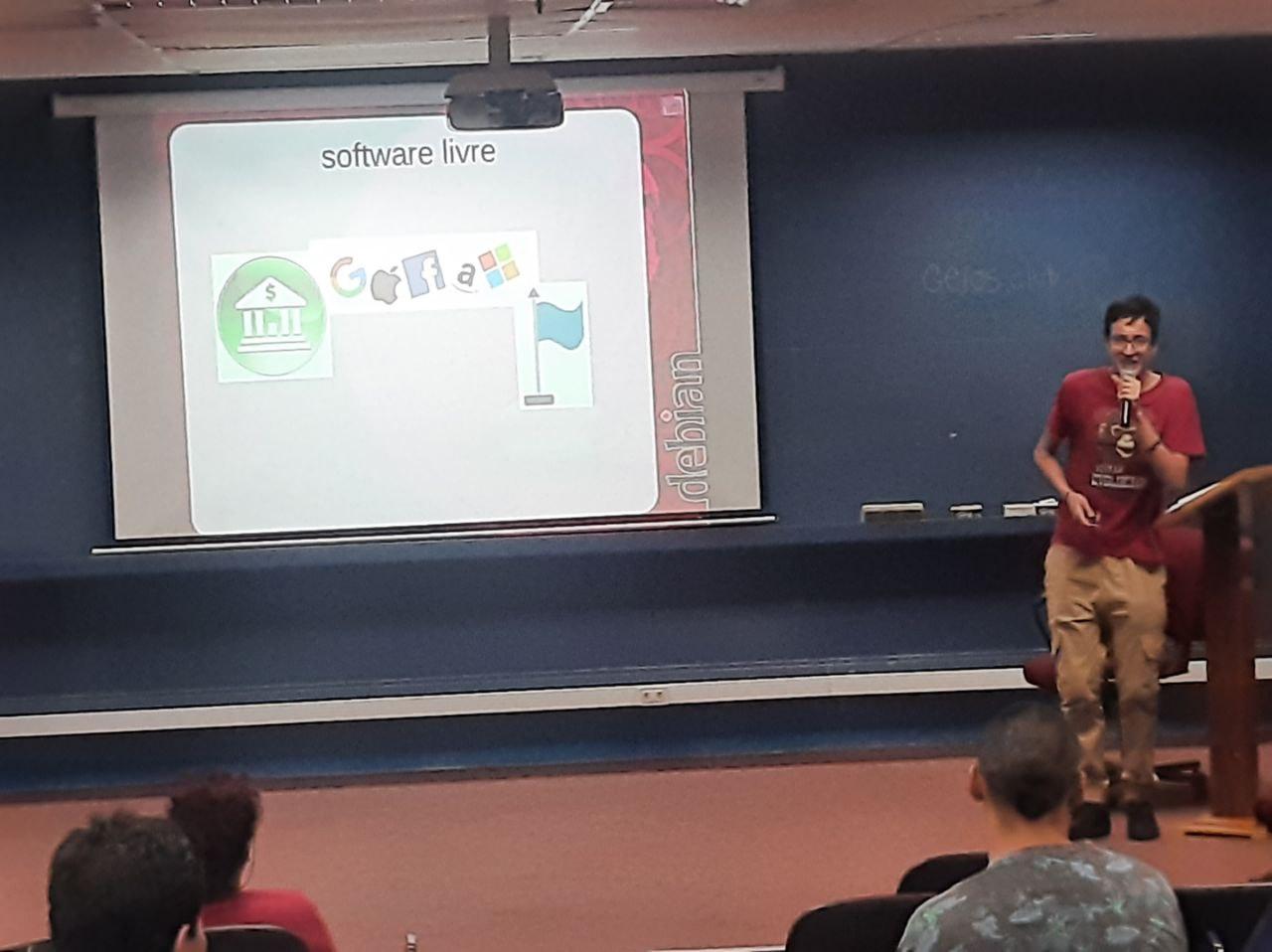
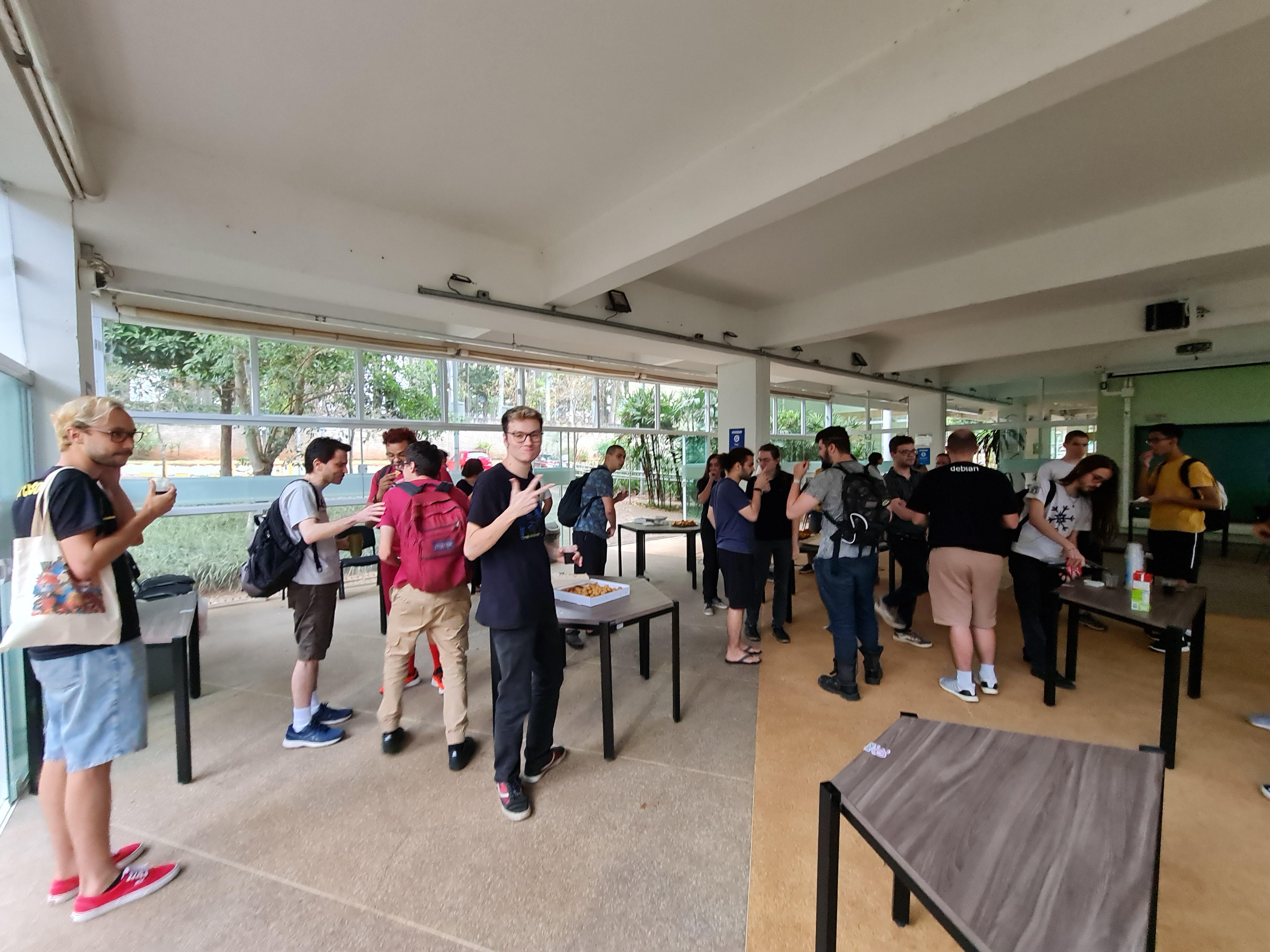
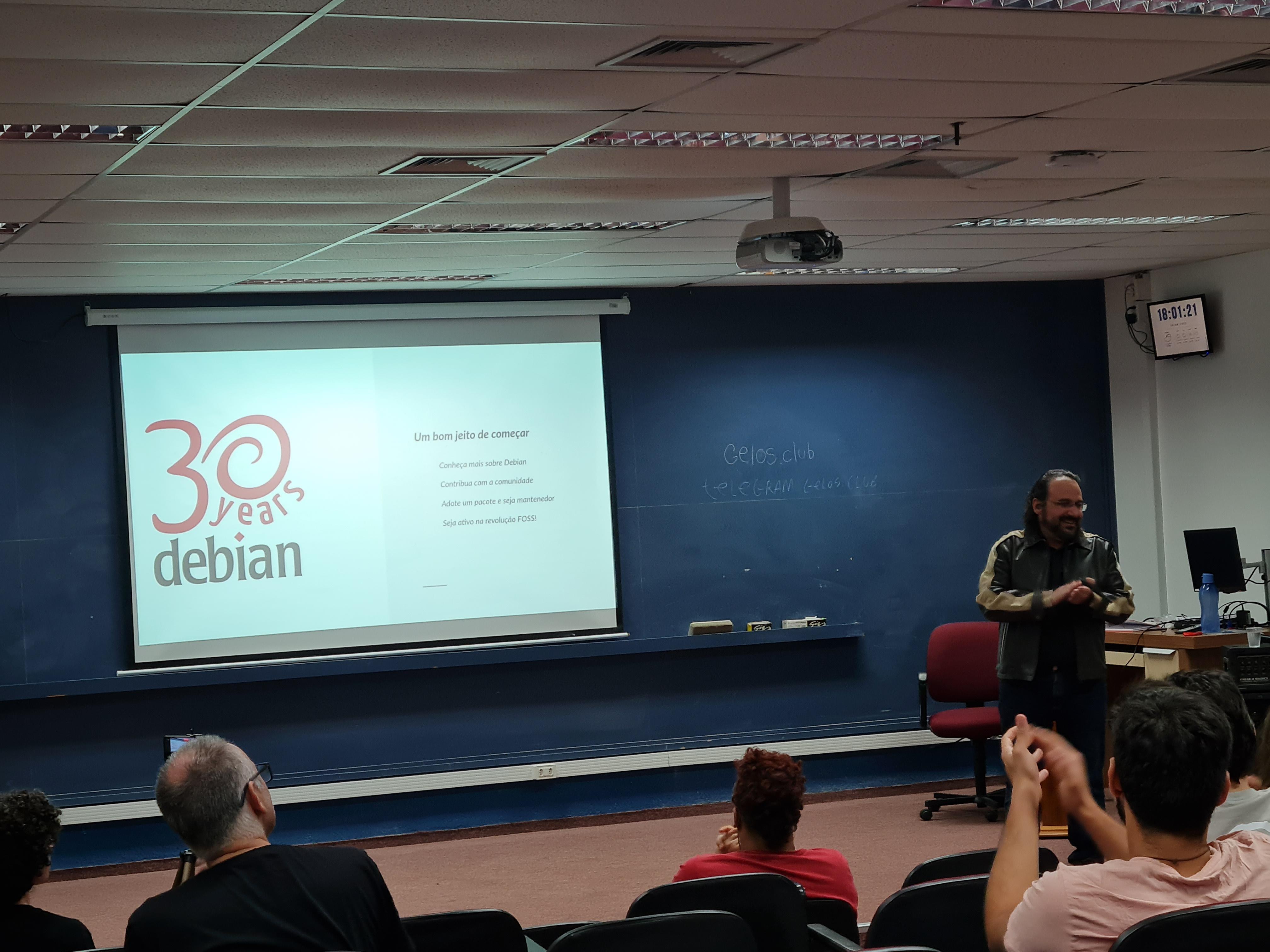
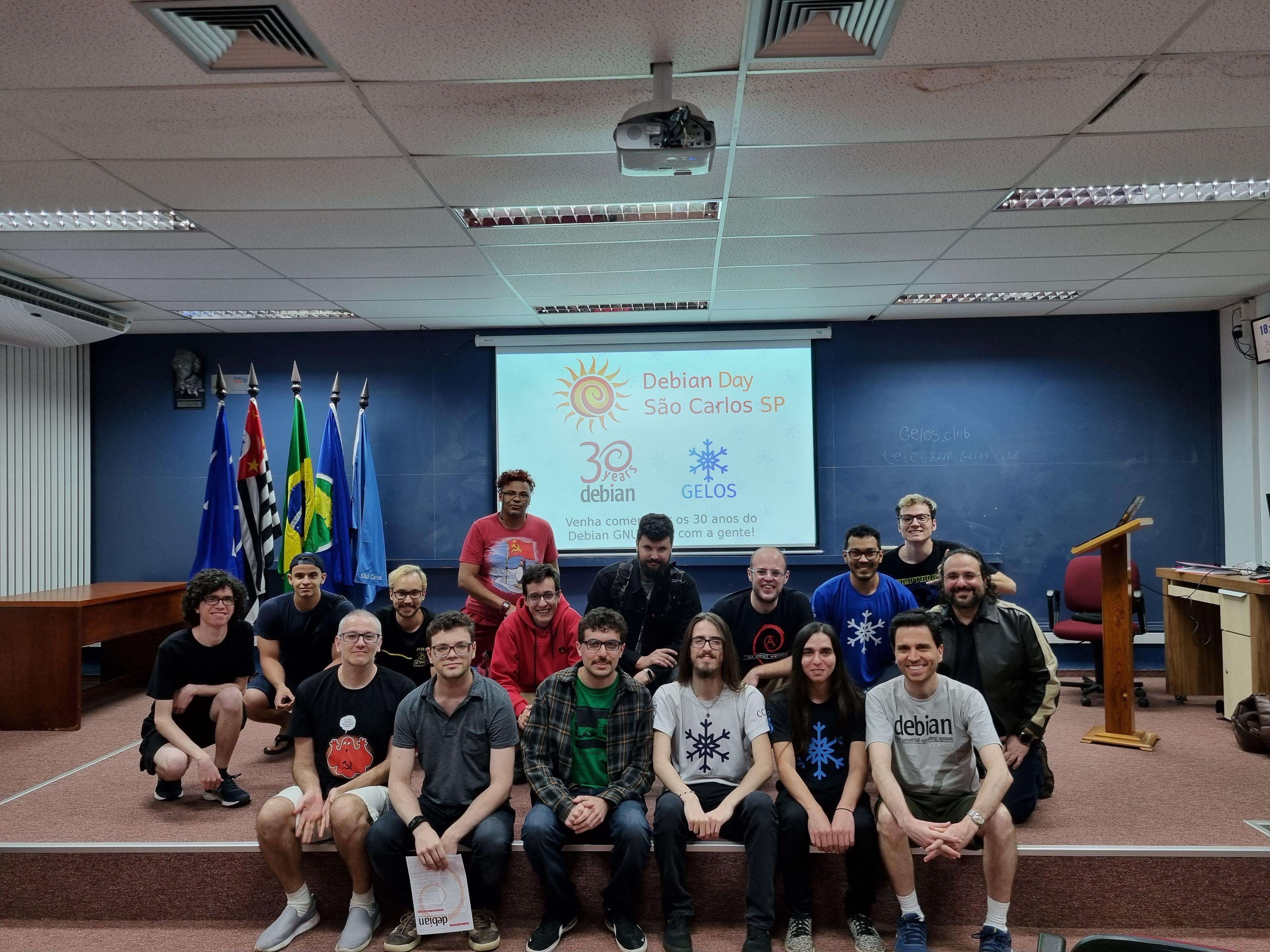
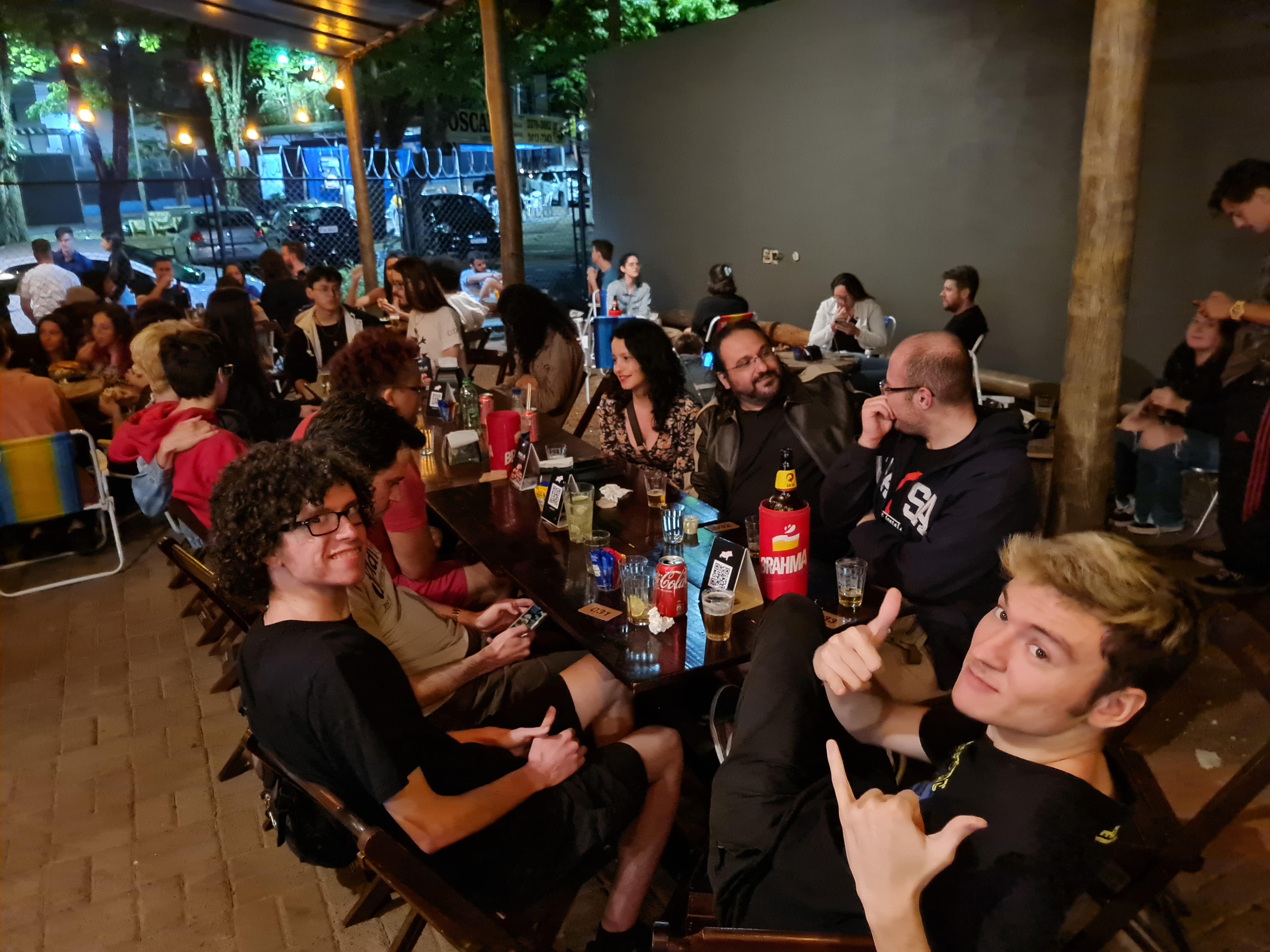
This year's Debian day was a pretty special one, we are celebrating 30 years! Giving the importance of this event, the Brazilian community planned a very special week. Instead of only local gatherings, we had a week of online talks streamed via Debian Brazil's youtube channel (soon the recordings will be uploaded to Debian's peertube instance). Nonetheless the local celebrations happened around the country and I've organized one in S o Carlos with the help of GELOS, the FLOSS group at University of S o Paulo. The event happened on August 19th and went on the whole afternoon. We had some talks about Debian and free software (see table below), a coffee break where we had the chance to talk, and finished with a group photo (check this one and many others below). Actually, it wasn't the end, we carried on the conversation about Debian and free software in a local bar :-) We had around 30 people in the event and reached a greater audience via the announcements across the university's press releases and emails sent to our Brazilian mailing lists. You can check some of them below. Below you can check the list of talks.
Time Author Title
14:10 GELOS Intro to GELOS
14:30 Carlos Melara (Charles) A not so Brief Introdution to the Debian Project
15:15 Guilherme Paix o Debian and the Free Culture
15:45 z Free Software: the paths to a free life
16:15 -- Coffee Break
17:15 Prof. Dr. Francisco Jos Monaco The FOSS Ecosystem and You
Here are some photos taken during the event! Preparation for Debian Day
Getting things ready for the event. Intro to GELOS
Intro to GELOS talk. Debian intro
A not so Brief Introdution to the Debian Project talk. Everyone knows Debian
Everyone already knew Debian! Free software
Debian and the Free Culture talk Auditorium
People in the auditorium space. Free software
Free Software: the paths to a free life talk Coffee Break
Coffee Break. FOSS Ecosystem
The FOSS Ecosystem and You talk. Group photo
Group photo. Celebration afterwards
Celebration goes on in the bar.

16 August 2023

Charles Plessy: I forgot about the make clean command.

Je ne me souviens plus de la derni re fois o j'ai utilis la commande make clean. Si j'empaqu te pour Debian, le travail se fait dans un d p t git, et j'utilise les commandes git clean -fdx ; git checkout . que je peux rappeler depuis mon historique des commandes via Ctrl-r la plupart du temps. Et dans les autres cas, si les sources ne sont pas d j dans git, alors les commandes git init . ; git add . ; git commit -m 'hopla' r glent le probl me.

2 August 2023

Debian Brasil: Participa o do Debian na Campus Party Brasil 2023

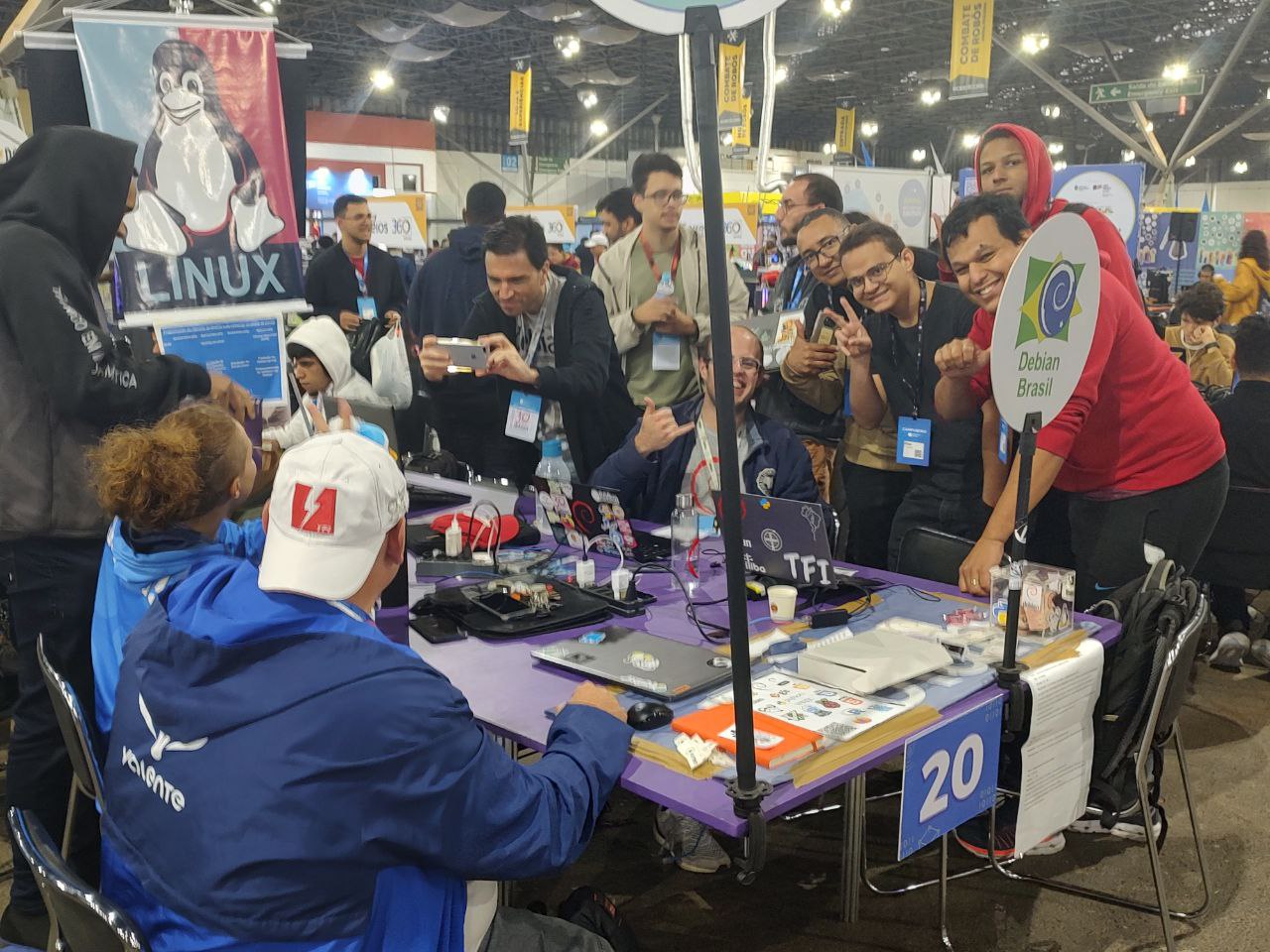
Mais uma edi o da Campus Party Brasil aconteceu na cidade de S o Paulo entre os dias 25 e 30 de Julho de 2023. Novamente a comunidade Debian Brasil se fez presente. Durante os dias no espa o disponibilizado, realizamos algumas atividades:
- Distribui o de brindes (adesivos, copos, cord o de crach );
- Mini oficina sobre como contribuir para a equipe de tradu o;
- Mini oficina sobre empacotamento;
- Assinatura de chaves;
- Informa es sobre o projeto; Durante todos os dias, havia sempre uma pessoa dispon vel para passar informa es sobre o que o Debian e as diversas formas de contribuir. Durante todo o evento, estimamos que ao menos 700 pessoas interagiram de alguma forma com nossa comunidade. Diversas pessoas, aproveitaram a oportunidade para aproveitar pelo excelente trabalho realizado pelo projeto no Debian 12 - Bookworm. Segue algumas fotos tiradas durante o evento! CPBR15
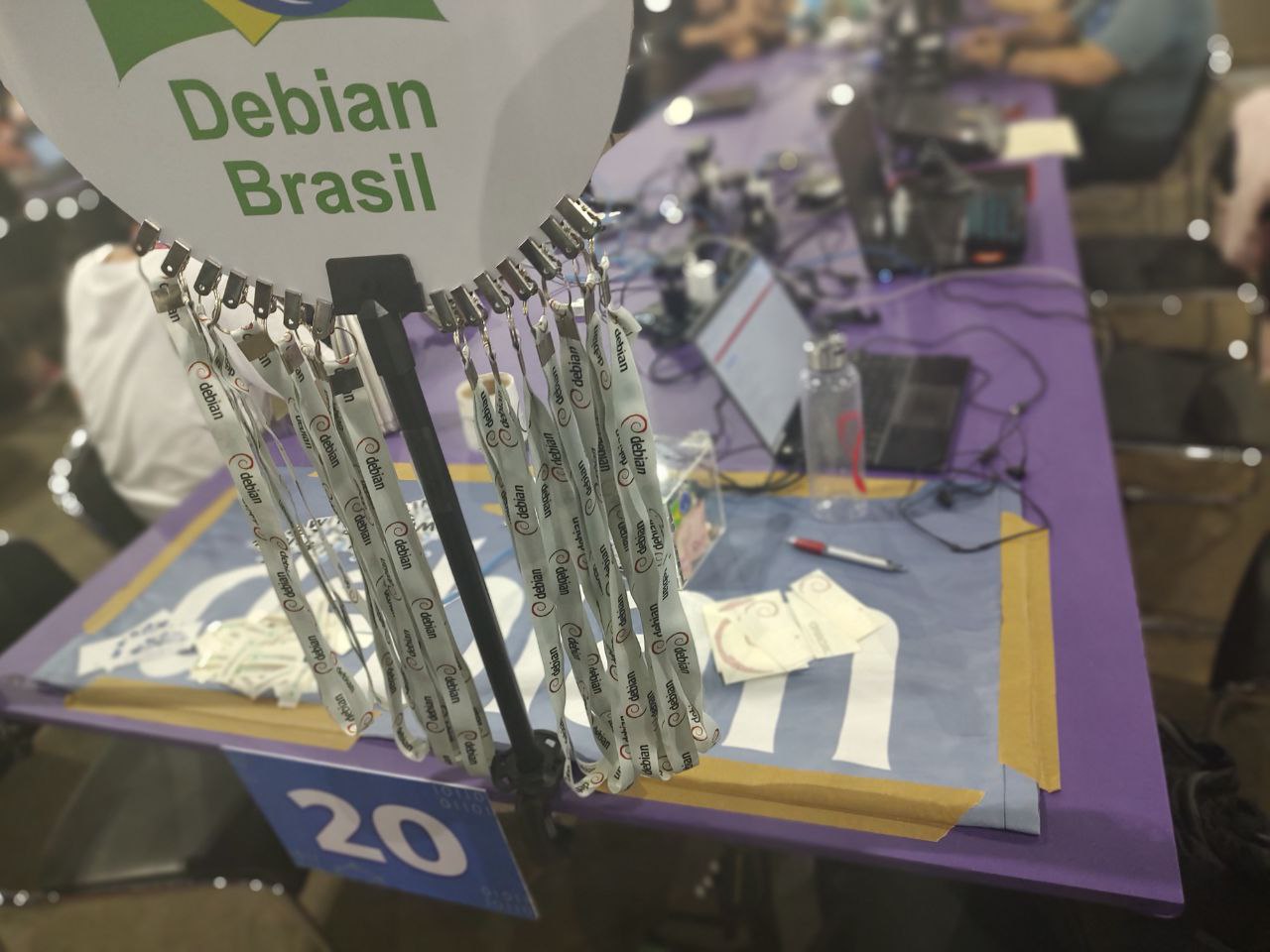
Espa o da Comunidade no Evento.
CPBR15
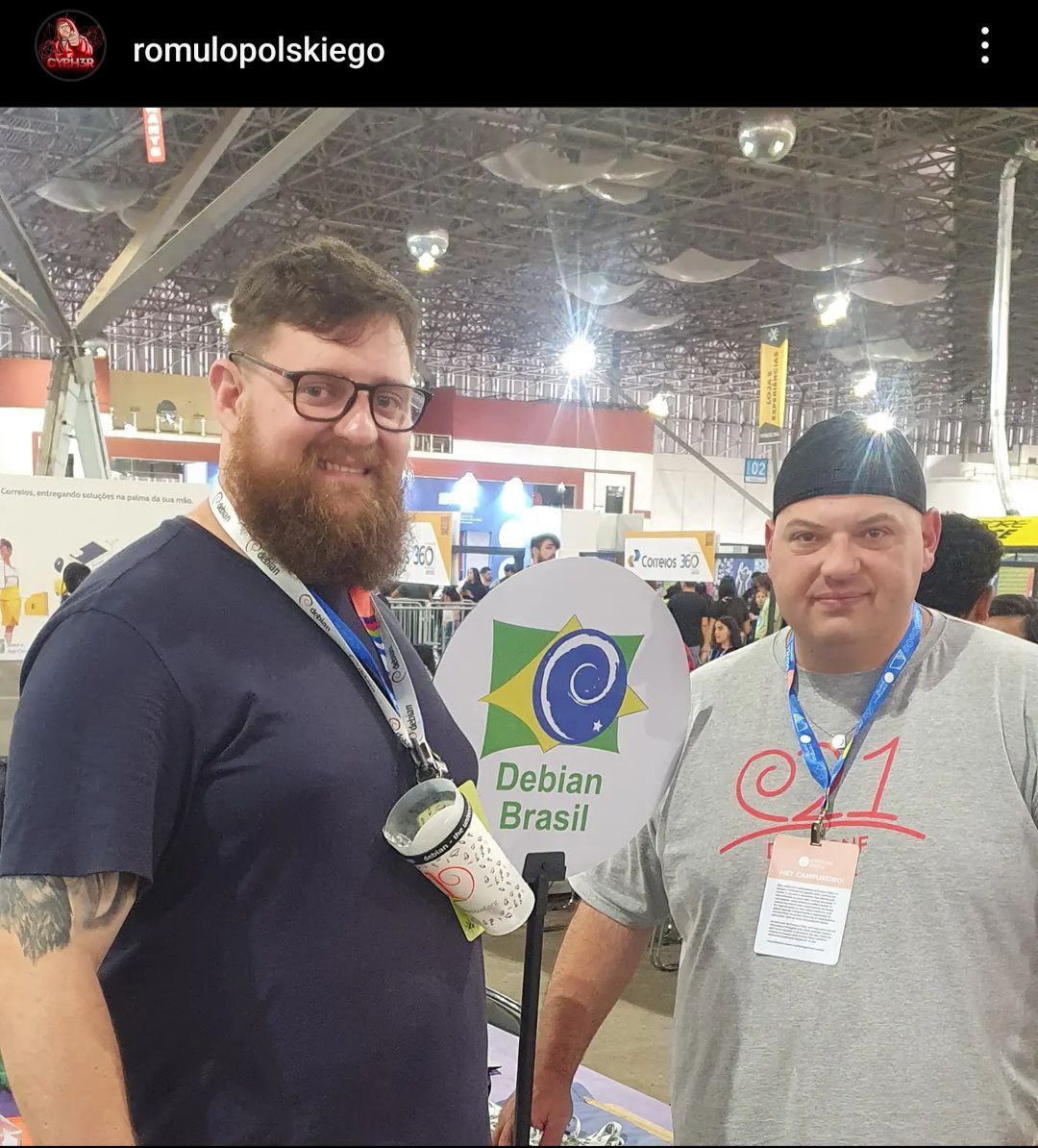
Romulo, visitante do espa o com Daniel Lenharo.
CPBR15
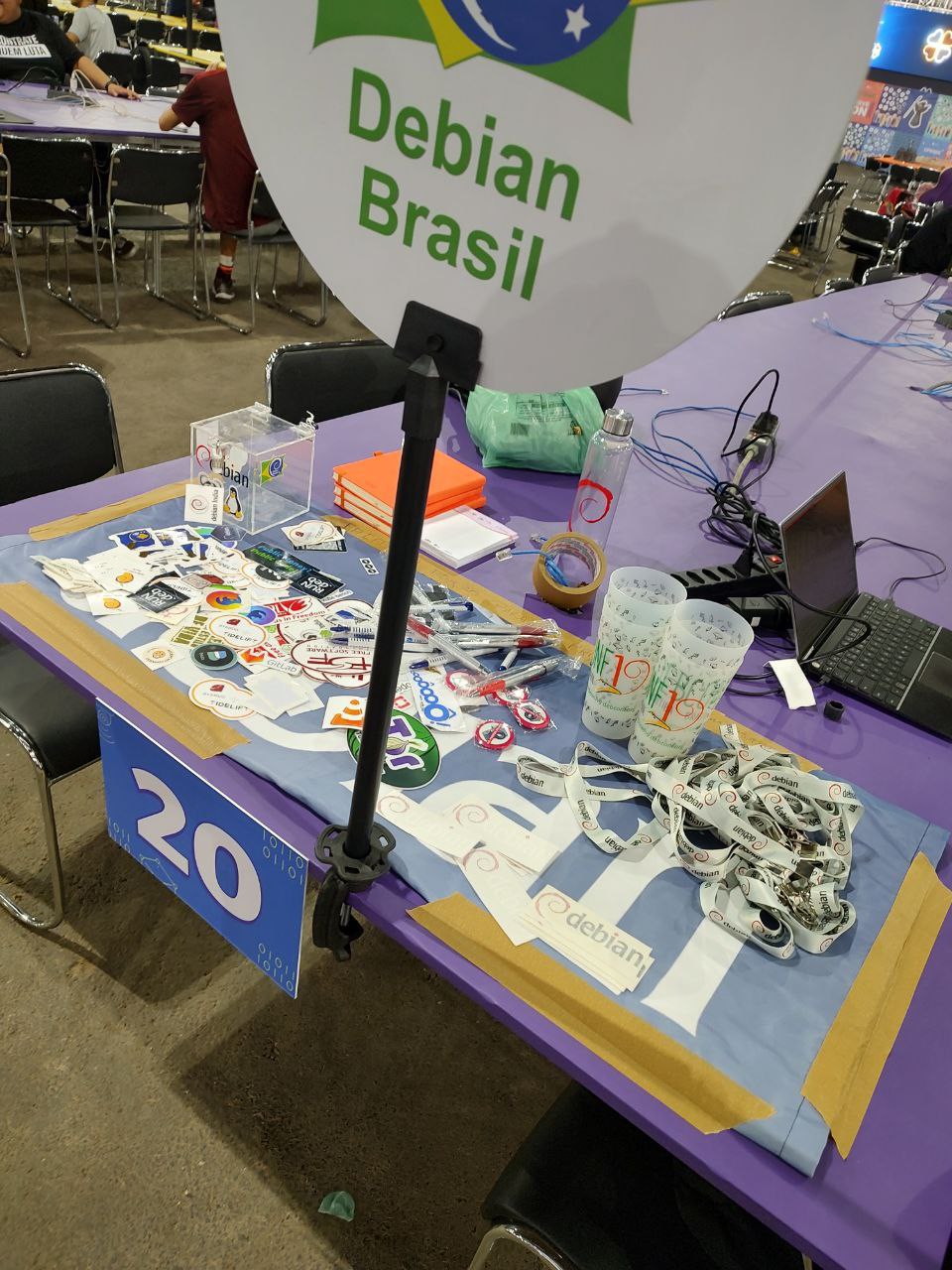
Alguns brindes que estavam a disposi o do p blico.
CPBR15
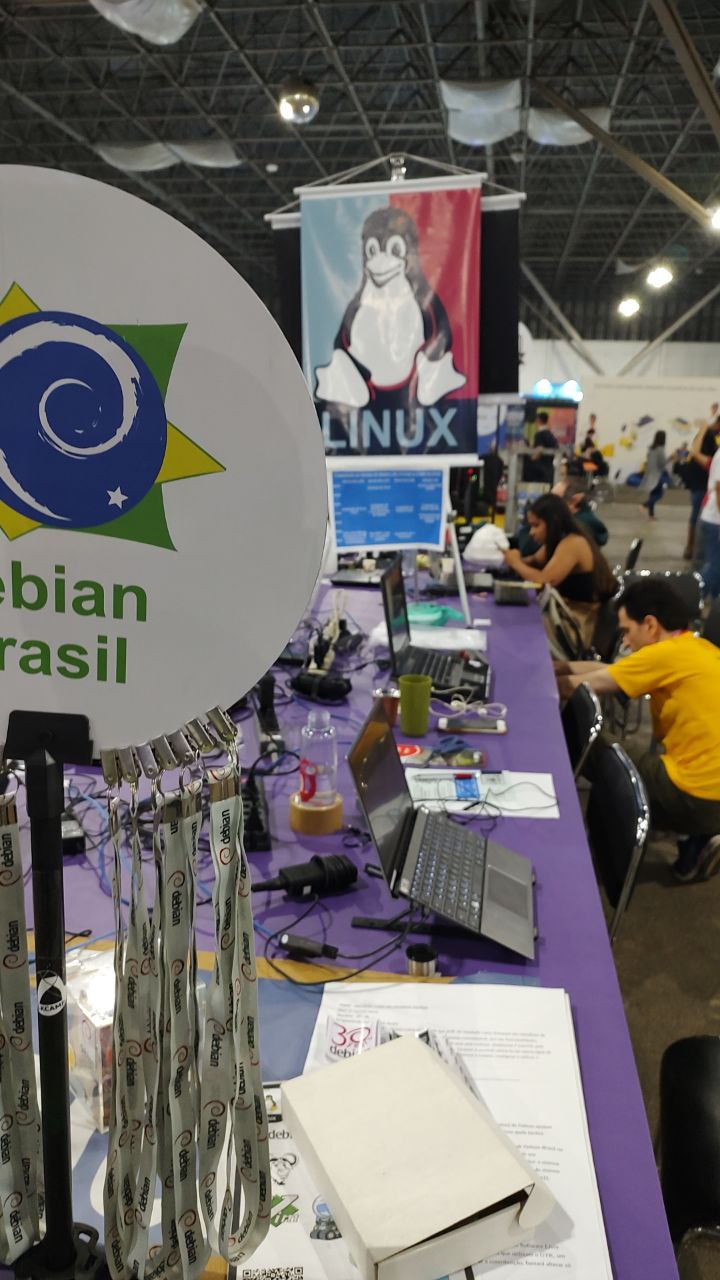
Vis o do espa o.
CPBR15
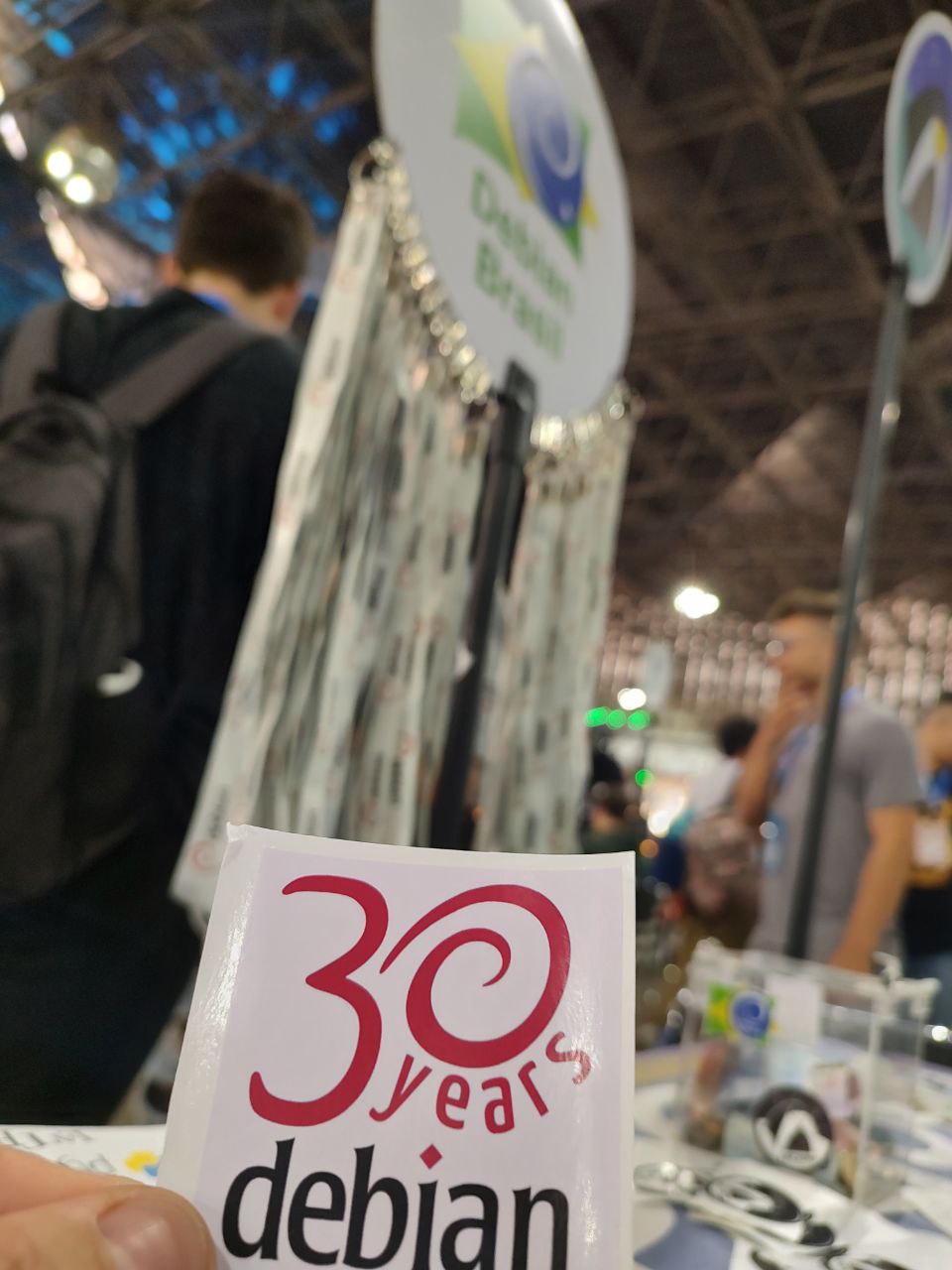
Adesivo com a Arte de 30 anos feita pelo Jefferson.
CPBR15
Pessoal no espa o da comunidade.
CPBR15
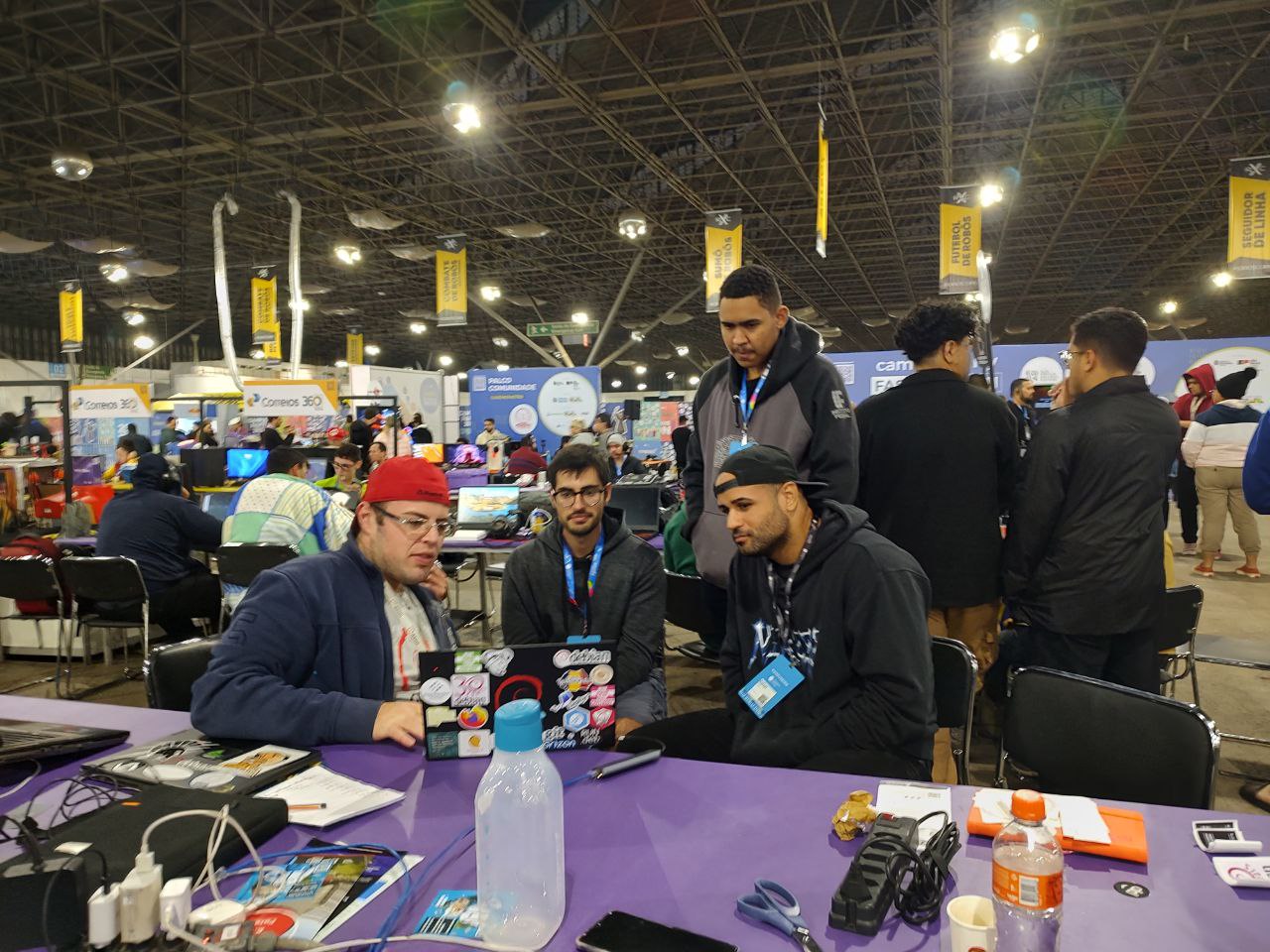
Mini curso de empacotamento, realizado pelo Charles.
CPBR15
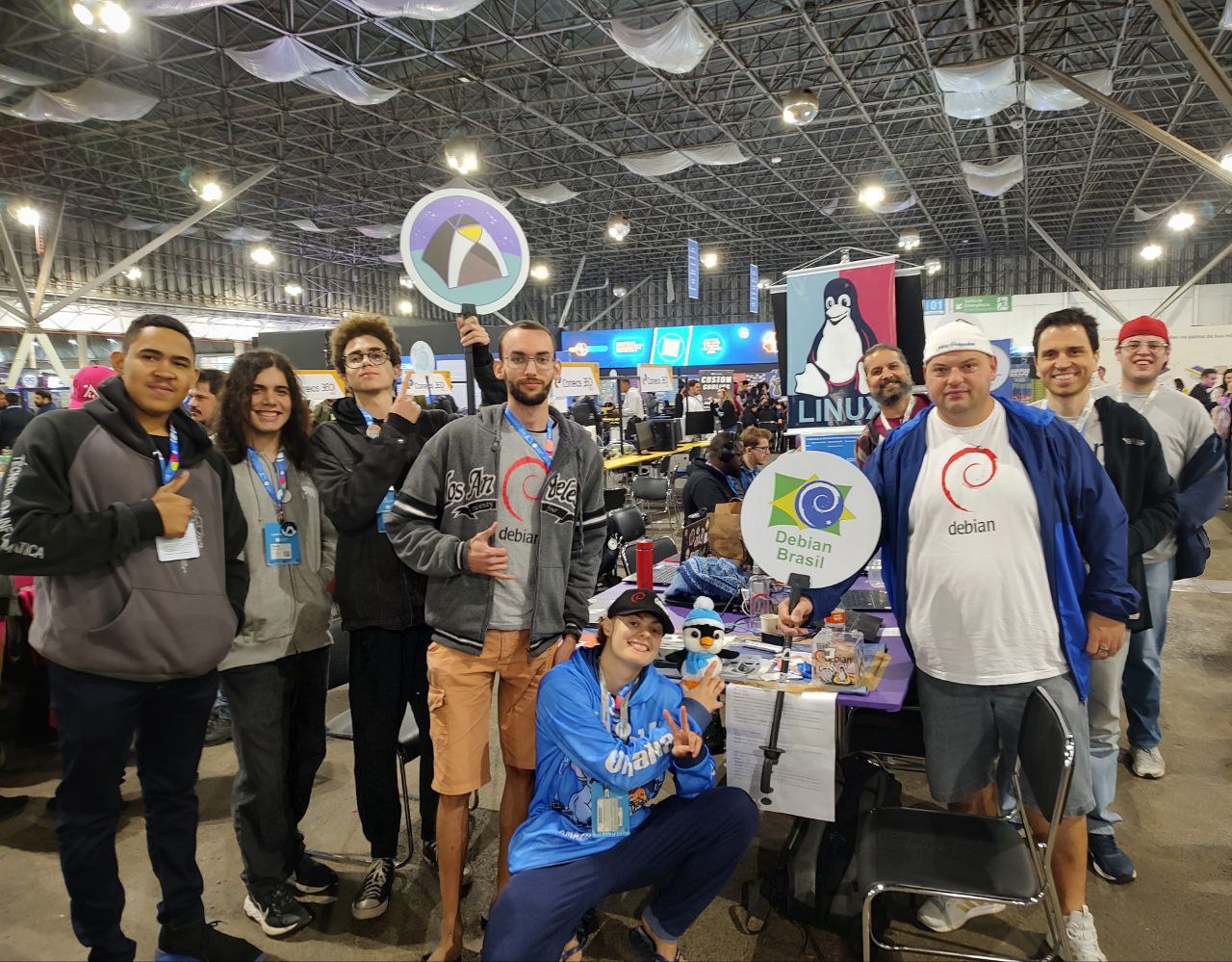
Pessoal que esteve envolvido nas atividades da comunidade.

Debian Brasil: Debian Brazil at Campus Party Brazil 2023

Another edition of Campus Party Brasil took place in the city of S o Paulo between the 25th and 30th of July 2023. One more time the Debian Brazil Community was present. During the days in the available space, we carry out some activities:
- Gifts for attends (stickers, cups, lanyards);
- Workshop on how to contribute to the translation team;
- Workshop on packaging;
- Key signing party;
- Information about the project; Every day, there was always someone available to pass on information about what Debian is and the different ways to contribute. During the entire event, we estimate that at least 700 people interacted in some way with our community. Several people took the opportunity to benefit from the excellent work done by the project on Debian 12 - Bookworm. Here are some photos taken during the event! CPBR15
Community Space at the Event.
CPBR15
Romulo, visitor from space with Daniel Lenharo.
CPBR15
Some gifts for attends.
CPBR15
Communit Space at the event.
CPBR15
Sticker made with Jefferson artwork.
CPBR15
People in the community space.
CPBR15
Packaging workshop, held by Charles.
CPBR15
people who were involved in the Community activities.

1 August 2023

Debian Brasil: Participa o do Debian na Campus Party Brasil 2023

Mais uma edi o da Campus Party Brasil aconteceu na cidade de S o Paulo entre os dias 25 e 30 de Julho de 2023. Novamente a comunidade Brasileira se fez presente. Durante os dias no espa o disponibilizado, realizamos algumas atividades:
- Distribui o de brindes (Adesivos, Copos, Cord o de crach );
- Mini oficina sobre como contribuir para a equipe de tradu o;
- Mini oficina sobre empacotamento;
- Informa es sobre o projeto; Durante todos os dias, havia sempre uma pessoa dispon vel para passar informa es sobre o que o Debian, formas de contribuir. Durante todo o evento, estimamos que ao menos 700 pessoas interagiram de alguma forma com nossa comunidade. Diversas pessoas, aproveitaram a oportunidade para aproveitar pelo excelente trabalho realizado pelo projeto no Debian 12 - Bookworm. Segue algumas fotos tiradas durante o evento! CPBR15
Espa o da Comunidade no Evento.
CPBR15
Romulo, visitante do espa o com Daniel Lenharo.
CPBR15
Alguns brindes que estavam a disposi o do p blico.
CPBR15
Vis o do espa o.
CPBR15
Adesivo com a Arte de 30 anos feita pelo Jefferson.
CPBR15
Pessoal no espa o da comunidade.
CPBR15
Mini curso de empacotamento, realizado pelo Charles.
CPBR15
Pessoal que esteve envolvido nas atividades da comunidade.

10 May 2023

Charles Plessy: Upvote to patch Firefox to render Markdown

I previously wrote that when Firefox receives a file whose media type is text/markdown, it prompts the user to download it, whereas other browsers display rendered results. Now it is possible to upvote a proposal on connect.mozilla.org asking that Firefox renders Markdown by default.

1 May 2023

Paul Wise: FLOSS Activities April 2023

Focus This month I didn't have any particular focus. I just worked on issues in my info bubble.

Changes

Issues
  • Security issue in secret manager (sent privately)
  • Broken symlinks in opencpn
  • Test problem in SPTAG
  • Debian migration unblock needed for evolution

Review

Administration
  • Debian IRC: fixed the #debian-mips channel topic
  • Debian wiki: unblock IP addresses, approve accounts
  • Debian QA services: deploy changes, investigate SourceForge uscan issue

Communication
  • Respond to queries from Debian users and contributors on the mailing lists and IRC

Sponsors The SPTAG work was sponsored. All other work was done on a volunteer basis.

1 April 2023

Debian Brasil: Primeira oficina de tradu o em 2023 da equipe pt_BR

The Brazilian translation team debian-l10n-portuguese realizou a primeira oficina de 2023 em fevereiro, com timos resultados: Nosso foco era completar as descri es dos 500 pacotes mais populares (popcon). Apesar de n o termos conseguido chegar 100% do ciclo de tradu o, grande parte dessas descri es est o em andamento e com um pouco mais de trabalho estar o dispon veis comunidade. Agrade o aos( s) participantes pelas contribui es. As oficinas foram bem movimentadas e, muito al m das tradu es em si, conversamos sobre diversas faces da comunidade Debian. Esperamos ter ajudado aos( s) iniciantes a contribuir com o projeto de maneira frequente. Agrade o em especial ao Charles (charles) que ministrou um dos dias da oficina, ao Paulo (phls) que sempre est a dando uma for a, e ao Fred Maranh o pelo seu incans vel trabalho no DDTSS. Equipe de tradu o do portugu s do Brasil

9 March 2023

Charles Plessy: If you work at Dreamhost, can you help us?

Update: thanks to the very kind involvment of the widow of our wemaster, we could provide enough private information to Dreamhost, who finally accepted to reset the password and the MFA. We have recovered evrything! Many thanks to everybody who helped us! Due to tragic circumstances, one association that I am part of, Sciencescope got locked out of its account at Dreamhost. Locked out, we can not pay the annual bill. Dreamhost contacted us about the payment, but will not let us recover the access to our account in order to pay. So they will soon close the account. Our website, mailing lists and archives, will be erased. We provided plenty of evidence that we are not scammers and that we are the legitimate owners of the account, but reviewing it is above the pay grade of the custommer support (I don't blame them) and I could not convince them to let somebody higher have a look at our case. If you work at Dreamhost and want to keep us as custommers instead of kicking us like that, please ask the support service in charge of ticket 225948648 to send the recovery URL to the secondary email adddresses (the ones you used to contact us about the bill!) in addition to the primary one (which nobody will read anymore). You can encrypt it for my Debian Developer key 73471499CC60ED9EEE805946C5BD6C8F2295D502 if you worry it gets in wrong hands. If you still have doubts I am available for calls any time. If you know somebody working at Dreamhost can you pass them the message? This would be a big, big, relief for our non-profit association.

10 January 2023

Matthew Garrett: Integrating Linux with Okta Device Trust

I've written about bearer tokens and how much pain they cause me before, but sadly wishing for a better world doesn't make it happen so I'm making do with what's available. Okta has a feature called Device Trust which allows to you configure access control policies that prevent people obtaining tokens unless they're using a trusted device. This doesn't actually bind the tokens to the hardware in any way, so if a device is compromised or if a user is untrustworthy this doesn't prevent the token ending up on an unmonitored system with no security policies. But it's an incremental improvement, other than the fact that for desktop it's only supported on Windows and MacOS, which really doesn't line up well with my interests.

Obviously there's nothing fundamentally magic about these platforms, so it seemed fairly likely that it would be possible to make this work elsewhere. I spent a while staring at the implementation using Charles Proxy and the Chrome developer tools network tab and had worked out a lot, and then Okta published a paper describing a lot of what I'd just laboriously figured out. But it did also help clear up some points of confusion and clarified some design choices. I'm not going to give a full description of the details (with luck there'll be code shared for that before too long), but here's an outline of how all of this works. Also, to be clear, I'm only going to talk about the desktop support here - mobile is a bunch of related but distinct things that I haven't looked at in detail yet.

Okta's Device Trust (as officially supported) relies on Okta Verify, a local agent. When initially installed, Verify authenticates as the user, obtains a token with a scope that allows it to manage devices, and then registers the user's computer as an additional MFA factor. This involves it generating a JWT that embeds a number of custom claims about the device and its state, including things like the serial number. This JWT is signed with a locally generated (and hardware-backed, using a TPM or Secure Enclave) key, which allows Okta to determine that any future updates from a device claiming the same identity are genuinely from the same device (you could construct an update with a spoofed serial number, but you can't copy the key out of a TPM so you can't sign it appropriately). This is sufficient to get a device registered with Okta, at which point it can be used with Fastpass, Okta's hardware-backed MFA mechanism.

As outlined in the aforementioned deep dive paper, Fastpass is implemented via multiple mechanisms. I'm going to focus on the loopback one, since it's the one that has the strongest security properties. In this mode, Verify listens on one of a list of 10 or so ports on localhost. When you hit the Okta signin widget, choosing Fastpass triggers the widget into hitting each of these ports in turn until it finds one that speaks Fastpass and then submits a challenge to it (along with the URL that's making the request). Verify then constructs a response that includes the challenge and signs it with the hardware-backed key, along with information about whether this was done automatically or whether it included forcing the user to prove their presence. Verify then submits this back to Okta, and if that checks out Okta completes the authentication.

Doing this via loopback from the browser has a bunch of nice properties, primarily around the browser providing information about which site triggered the request. This means the Verify agent can make a decision about whether to submit something there (ie, if a fake login widget requests your creds, the agent will ignore it), and also allows the issued token to be cross-checked against the site that requested it (eg, if g1thub.com requests a token that's valid for github.com, that's a red flag). It's not quite at the same level as a hardware WebAuthn token, but it has many of the anti-phishing properties.

But none of this actually validates the device identity! The entire registration process is up to the client, and clients are in a position to lie. Someone could simply reimplement Verify to lie about, say, a device serial number when registering, and there'd be no proof to the contrary. Thankfully there's another level to this to provide stronger assurances. Okta allows you to provide a CA root[1]. When Okta issues a Fastpass challenge to a device the challenge includes a list of the trusted CAs. If a client has a certificate that chains back to that, it can embed an additional JWT in the auth JWT, this one containing the certificate and signed with the certificate's private key. This binds the CA-issued identity to the Fastpass validation, and causes the device to start appearing as "Managed" in the Okta device management UI. At that point you can configure policy to restrict various apps to managed devices, ensuring that users are only able to get tokens if they're using a device you've previously issued a certificate to.

I've managed to get Linux tooling working with this, though there's still a few drawbacks. The main issue is that the API only allows you to register devices that declare themselves as Windows or MacOS, followed by the login system sniffing browser user agent and only offering Fastpass if you're on one of the officially supported platforms. This can be worked around with an extension that spoofs user agent specifically on the login page, but that's still going to result in devices being logged as a non-Linux OS which makes interpreting the logs more difficult. There's also no ability to choose which bits of device state you log: there's a couple of existing integrations, and otherwise a fixed set of parameters that are reported. It'd be lovely to be able to log arbitrary material and make policy decisions based on that.

This also doesn't help with ChromeOS. There's no real way to automatically launch something that's bound to localhost (you could probably make this work using Crostini but there's no way to launch a Crostini app at login), and access to hardware-backed keys is kind of a complicated topic in ChromeOS for privacy reasons. I haven't tried this yet, but I think using an enterprise force-installed extension and the chrome.enterprise.platformKeys API to obtain a device identity cert and then intercepting requests to the appropriate port range on localhost ought to be enough to do that? But I've literally never written any Javascript so I don't know. Okta supports falling back from the loopback protocol to calling a custom URI scheme, but once you allow that you're also losing a bunch of the phishing protection, so I'd prefer not to take that approach.

Like I said, none of this prevents exfiltration of bearer tokens once they've been issued, and there's still a lot of ecosystem work to do there. But ensuring that tokens can't be issued to unmanaged machines in the first place is still a step forwards, and with luck we'll be able to make use of this on Linux systems without relying on proprietary client-side tooling.

(Time taken to code this implementation: about two days, and under 1000 lines of new code. Time taken to figure out what the fuck to write: rather a lot longer)

[1] There's also support for having Okta issue certificates, but then you're kind of back to the "How do I know this is my device" situation

comment count unavailable comments

8 January 2023

Charles Plessy: Could somebody patch Firefox to display Markdown files?

When Firefox receives a file with media type text/markdown, it prompts the user to download it, while other browsers display it as plain text. In the ticket 1319262, it is proposed to display Markdown files by default, but there needs a patch

28 December 2022

Russell Coker: Links December 2022

Charles Stross wrote an informative summary of the problems with the UK monarchy [1], conveniently before the queen died. The blog post To The Next Mass Shooter, A Modest Proposal is a well written suggestion to potential mass murderers [2]. The New Yorker has an interesting and amusing article about the former CIA employee who released the Vault 7 collection of CIA attack software [3]. This exposes the ridiculously poor hiring practices of the CIA which involved far less background checks than the reporter writing the story did. Wired has an interesting 6 part series about the hunt for Alpha02 the admin of the Alphabay dark web marketplace [4]. The Atlantic has an interesting and informative article about Marjorie Taylor Greene, one of the most horrible politicians in the world [5]. Anarcat wrote a long and detailed blog post about Matrix [6]. It s mostly about comparing Matrix to other services and analysing the overall environment of IM systms. I recommend using Matrix, it is quite good although having a server with SSD storage is required for the database. Edent wrote an interesting thought experiment on how one might try to regain access to all their digital data if a lightning strike destroyed everything in their home [7]. Cory Doctorow wrote an interesting article about the crapification of literary contracts [8]. A lot of this applies to most contracts between corporations and individuals. We need legislation to restrict corporations from such abuse. Jared A Brock wrote an insightful article about why AirBNB is horrible and how it will fail [9]. Habr has an interesting article on circumventing UEFI secure boot [10]. This doesn t make secure boot worthless but does expose some weaknesses in it. Matthew Garrett wrote an interesting blog post about stewartship of the UEFI boot ecosystem and how Microsoft has made some strange and possibly hypocritical decisions about it [11]. It also has a lot of background information on how UEFI can be used and misused. Cory Doctorow wrote an interesting article Let s Make Amazon Into a Dumb Pipe [12]. The idea is to use the Amazon search and reviews to find a product and then buy it elsewhere, a reverse of the showrooming practice where people look at products in stores and buy them online. There is already a browser plugin to search local libraries for Amazon books. Charles Stross wrote an interesting blog post about the UK Tory plan to destroy higher education [13]. There s a lot of similarities to what conservatives are doing in other countries. Antoine Beaupr wrote an insightful blog post How to nationalize the internet in Canada [14]. They cover the technical issues to be addressed as well as some social justice points that are often missed when discussing such issues. Internet is not a luxuary nowadays, it s an important part of daily life and the governments need to treat it the same way as roads and other national infrastructure.

16 December 2022

Charles Plessy: Bad words in Debian.

A discussion on the debian-project mailing list caught my attention to an Italian word meaning something like would you be so kind to please go somewhere else? , but in a more direct and vulgar manner. I then used http://codesearch.debian.net to study its usage more in detail. I found it in: That was a refreshing and pleasant recreation in the Debian package universe.

8 December 2022

Shirish Agarwal: Wayland, Hearing aids, Multiverse & Identity

Wayland First up, I read Antoine Beaupr s Wayland to Sway migration with interest. While he said it s done and dusted or something similar, the post shows there s still quite a ways to go. I wouldn t say it s done or whatever till it s integrated so well that a person installs it and doesn t really need to fiddle with config files as an average user. For specific use-cases you may need to, but that should be outside of a normal user (layperson) experience. I have been using mate for a long long time and truth be told been very happy with it. The only thing I found about Wayland on mate is this discussion or rather this entry. The roadmap on Ubuntu Mate is also quite iffy. The Mate Wayland entry on Debian wiki also perhaps need an updation but dunno much as the latest update it shares is 2019 and it s 2022. One thing to note, at least according to Antoine, things should be better as and when it gets integrated even on legacy hardware. I would be interested to know how it would work on old desktops and laptops rather than new or is there some barrier? I, for one would have liked to see or know about why lightdm didn t work on Wayland and if there s support. From what little I know lightdm is much lighter than gdm3 and doesn t require much memory and from what little I have experienced works very well with mate. I have been using it since 2015/16 although the Debian changelog tells me that it has been present since 2011. I was hoping to see if there was a Wayland specific mailing list, something like debian-wayland but apparently there s not :(. Using mate desktop wayland (tried few other variations on the keywords) but search fails to find any meaningful answer :(. FWIW and I don t know the reason why but Archwiki never fails to amaze me. Interestingly, it just says No for mate. I probably would contact upstream in the coming days to know what their plans are and hopefully they will document what their plans are on integrating Wayland in both short-term and long-term with an update, or if there is something more recent they have documented elsewhere, get that update on the Debian wiki so people know. The other interesting thread I read was Russel Coker s Thinkpad X1 Carbon Gen5 entry. I would be in the market in a few months to find/buy a Thinkpad but probably of AMD rather than Intel because part of recent past history with Intel as well as AMD having a bit of an edge over Intel as far as graphics is concerned. I wonder why Russel was looking into Intel and not AMD. Would be interested to know why Intel and not AMD? Any specific reason ???

Hearing Aids I finally bought hearing aids about a couple of weeks back and have been practicing using them. I was able to have quite a few conversations although music is still I m not able to listen clearly but it is still a far cry from before and for the better. I am able to have conversations with people and also reply and they do not have to make that extra effort that they needed to. Make things easier for everybody. The one I bought is at the starting range although the hearing aids go all the way to 8 lakhs for a pair (INR 800,000), the more expensive ones having WiFi, Bluetooth and more channels, it all depends on how much can one afford. And AFAIK there is not a single Indian manufacturer who is known in this business.

One thing I did notice is while the hearing aids are remarkably sturdy if they fall down as they are small, yet you have to be careful of both dust and water . That does makes life a bit difficult as my house and city both gets sand quite a bit everyday. I don t think they made any India-specific changes, if they had, would probably make things better. I haven t yet looked at it, but it may be possible to hack it remotely. There may or may not be security issues involved, probably would try once I ve bit more time am bit more comfortable to try and see what I can find out. If I had bought it before, maybe I would have applied for the Debian event happening in Kerala, if nothing else, would have been to document what happened there in detail.  I probably would have to get a new motherboard for my desktop probably in a year or two as quite a few motherboards also have WiFi (WiFi 6 ?) think on the southbridge. I at least would have a look in new year and know more as to what s been happening. For last at least 2-3 years there has been a rumor which has been confirmed time and again that the Tata Group has been in talks with multiple vendors to set chip fabrication and testing business but to date they haven t been able to find one. They do keep on giving press conferences about the same but that s all they do :(. Just shared the latest one above.

The Long War Terry Pratchett, Stephen Braxter Long Earth Terry Pratchett, Stephen Braxter ISBN13: 9780062067777 Last month there was also a seconds books sale where I was lucky enough to get my hands on the Long War. But before I share about the book itself, I had a discussion with another of my friends and had to re-share part of that conversation. While the gentleman was adamant that non-fiction books are great, my point as always is both are equal. As I shared perhaps on this blog itself, perhaps multiple times, that I had seen a YT video in which a professor shared multiple textbooks of physics and shared how they are wrong and have been wrong and kept them in a specific corner. He took the latest book which he honestly said doesn t have any mistakes as far as he know and yet still kept in that same corner denoting that it is highly possible that future understanding will make the knowledge or understanding we know different. An example of physics in the nano world and how that is different and basically turns our understanding than what we know. Now as far as the book is concerned, remember Michael Crichton s Timeline. Now that book was originally written in the 1960 s while this one was written by both the honorable gentleman in 2013. So almost 50+ years difference between the two books, and that even shows how they think about things. In this book, you no longer need a big machine, but have something called a stepper machine which is say similar to a cellphone, that size and that frame, thickness etc. In this one, the idea of multiverse is also there but done a tad differently. In this, we do not have other humans or copy humans but have multiple earths that may have same or different geography as how evolution happened. None of the multiverse earths have humans but have different species depending on the evolution that happened there. There are something called as trolls but they have a much different meaning and way about them about how most fantasy authors portray trolls. While they are big in this as well, they are as gentle as bears or rabbits. So the whole thing is about real estate and how humans have spread out on multiple earths and the politics therein. Interestingly, the story was trashed or given negative reviews on Goodreads. The sad part is/was that it was written and published in 2013 when perhaps the possibility of war or anything like that was very remote especially in the States, but now we are now in 2022 and just had an insurrection happen and whole lot of Americans are radicalized, whether you see the left or the right depending on your ideology. An American did share few weeks ago how some shares are looking at Proportional Representation and that should make both parties come more towards the center and be a bit more transparent. What was interesting to me is the fact that states have much more rights to do elections and electioneering the way they want rather than a set model which everyone has common which is what happens in India. This also does poke holes into the whole Donald Trump stolen democracy drama but that s a different story altogether. One of the more interesting things I came to know about is that there are 4 books in the long series and this was the second book in itself. I do not want to dwell on the characters themselves as frankly speaking I haven t read all the four books and it would be gross injustice on my part to talk about the characters themselves. Did I enjoy reading the book, for sure. What was interesting and very true of human nature is that even if we have the ability or had the ability to have whole worlds to ourselves, we are bound to mess it up. And in that aspect, I don t think he is too far off the mark. If I had a whole world, wouldn t I try to exploit it to the best or worse of my ability. One of the more interesting topics in the book is the barter system they have thought of that is called as favors. If you are in multiple worlds, then having a currency, even fiat money is of no use and they have to find ways and means to trade with one another. The book also touches a bit on slavery but only just and doesn t really explore it as much as it could have.

Identity Now this has many meanings to it. Couple of weeks ago, saw a transgender meet. For the uninitiated or rather people like me, basically it is about people who are born in one gender but do not identify with it but the other and they express it first through their clothes and expression and the end of the journey perhaps is with having the organs but this may or may not be feasible, as such surgery is expensive and also not available everywhere. After section 377 was repealed few years ago, we do have a third gender on forms as well as have something called a Transgender Act but how much the needle has moved in society is still a question. They were doing a roadshow near my house hence I was able to talk with them with my new hearing aids and while there was lot of traffic was able to understand some of their issues. For e.g. they find it difficult to get houses on rent, but then it is similar for bachelor guys or girls also. One could argue to what degree it is, and that perhaps maybe. Also, there is a myth that they are somehow promiscuous but that I believe is neither here or there. Osho said an average person thinks about the opposite sex every few seconds or a minute. I am sure even Freud would have similar ideas. So, if you look in that way everybody is promiscuous as far as thought is concerned. The other part being opportunity but that again is function of so many other things. Some people are able to attract a lot of people, others might not. And then whether they chose to act on that opportunity or not is another thing altogether. Another word that is or was used is called gender fluid, but that too is iffy as gender fluid may or may not mean transgender. Also, while watching some nature documentary few days/weeks back had come to know that trees have something like 18 odd genders. That just blows me out of the mind and does re-question this whole idea of sexuality and identity to only two which seems somewhat regressive at least to me. If we think humans are part of nature, then we need to be open up perhaps a bit more. But identity as I shared above has more than one meaning. For e.g. citizenship, that one is born in India is even messier to know, understand and define. I had come across this article about couple of months back. Now think about this. Now, there have been studies and surveys about citizenship and it says something like 60% birth registrations are done in metro cities. Now Metro cities are 10 as defined by Indian state. But there are roughly an odd 4k cities in India and probably twice the number of villages and those are conservative numbers as we still don t record things meticulously, maybe due to the Indian oral tradition or just being lazy or both, one part is also that if you document people and villages and towns, then you are also obligated to give them some things as a state and that perhaps is not what the Indian state wants. A small village in India could be anywhere from few hundreds of people to a few thousand. And all the new interventions whether it is PAN, Aadhar has just made holes rather than making things better. They are not inclusive but exclusive. And none of this takes into account Indian character and the way things are done in India. In most households, excluding the celebs (they are in a world of pain altogether when it comes to baby names but then it s big business but that s an entire different saga altogether, so not going to touch that.) I would use or say my individual case as that is and seems to be something which is regular even today. I was given a nickname when I was 3 years old and given a name when I was 5-6 when I was put in school. I also came to know in school few kids who didn t like their names and couple of them cajoled and actually changed their names while they were kids, most of us just stayed with what we got. I do remember sharing about nakushi or something similar a name given to few girls in Maharashtra by their parents and the state intervened and changed their names. But that too is another story in itself. What I find most problematic is that the state seems to be blind, and this seems to be by design rather than a mistake. Couple of years back, Assam did something called NRC (National Register of Citizens) and by the Govt s own account it was a failure of massive proportions. And they still want to bring in CAA, screwing up Assam more. And this is the same Govt. went shown how incorrect it was, blamed it all on the High Court and it s the same Govt. that shopped around for judges to put somebody called Mr. Saibaba (an invalid 90 year adivasi) against whom the Govt. hasn t even a single proof as of date. Apparently, they went to 6 judges who couldn t give what the decision the Govt. wanted. All this info. is in public domain. So the current party ruling, i.e. BJP just wants to make more divisions rather than taking people along as they don t have answers either on economy, inflation or issues that people are facing. One bright light has been Rahul Gandhi who has been doing a padhyatra (walking) from Kanyakumari to Kashmir and has had tremendous success although mainstream media has showed almost nothing what he is doing or why he is doing that. Not only he had people following him, there are and were many who took his example and using the same values of inclusiveness are walking where they can. And this is not to do with just a political party but more with a political thought of inclusiveness, that we are one irrespective of what I believe, eat, wear etc. And that gentleman has been giving press conferences while our dear P.M. even after 8 years doesn t have the guts to do a single press conference. Before closing, I do want to take another aspect, Rahul Gandhi s mother is an Italian or was from Italy before she married. But for BJP she is still Italian. Rishi Sunak, who has become the UK Prime Minister they think of him as Indian and yet he has sworn using the Queen s name. And the same goes for Canada Kumar (Akshay Kumar) and many others. How the right is able to blind and deaf to what it thinks is beyond me. All these people have taken an oath in the name of the Queen and they have to be loyal to her or rather now King Charles III. The disconnect continues.

30 November 2022

Russell Coker: Links November 2022

Here s the US Senate Statement of Frances Haugen who used to work for Facebook countering misinformation and espionage [1]. She believes that Facebook is capable of dealing with the online radicalisation and promotion of bad things on it s platform but is unwilling to do so for financial reasons. We need strong regulation of Facebook and it probably needs to be broken up. Interesting article from The Atlantic about filtered cigarettes being more unhealthy than unfiltered [2]. Every time I think I know how evil tobacco companies are I get surprised by some new evidence. Cory Doctorow wrote an insightful article about resistance to rubber hose cryptanalysis [3]. Cory Doctorow wrote an interesting article When Automation Becomes Enforcement with a new way of thinking about Snapchat etc [4]. Cory Doctorow wrote an insightful and informative article Big Tech Isn t Stealing News Publishers Content, It s Stealing Their Money [5] which should be read by politicians from all countries that are trying to restrict quoting news on the Internet. Interesting articl;e on Santiago Genoves who could be considered as a pioneer of reality TV for deliberately creating disputes between a group of young men and women on a raft in the Atlantic for 3 months [6]. Matthew Garrett wrote an interesting review of the Freedom Phone, seems that it s not good for privacy and linked to some companies doing weird stuff [7]. Definitely worth reading. Cory Doctorow wrote an interesting and amusing article about backdoors for machine learning [8] Petter Reinholdtsen wrote an informative post on how to make a bootable USB stick image from an ISO file [9]. Apparently Lenovo provides ISO images to update laptops that don t have DVD drives. :( Barry Gander wrote an interesting article about the fall of Rome and the decline of the US [10]. It s a great concern that the US might fail in the same way as Rome. Ethan Siegel wrote an interesting article about Iapetus, a moon of Saturn that is one of the strangest objects in the solar system [11]. Cory Doctorow s article Revenge of the Chickenized Reverse-Centaurs has some good insights into the horrible things that companies like Amazon are doing to their employees and how we can correct that [12]. Charles Stross wrote an insightful blog post about Billionaires [13]. They can t do much for themselves with the extra money beyond about $10m or $100m (EG Steve Jobs was unable to extend his own life much when he had cancer) and their money is trivial when compared to the global economy. They are however effective parasites capable of performing great damage to the country that hosts them. Cory Doctorow has an interesting article about how John Deere is being evil again [14]. This time with potentially catastrophic results.

26 June 2022

Russ Allbery: Review: Feet of Clay

Review: Feet of Clay, by Terry Pratchett
Series: Discworld #19
Publisher: Harper
Copyright: October 1996
Printing: February 2014
ISBN: 0-06-227551-8
Format: Mass market
Pages: 392
Feet of Clay is the 19th Discworld novel, the third Watch novel, and probably not the best place to start. You could read only Guards! Guards! and Men at Arms before this one, though, if you wanted. This story opens with a golem selling another golem to a factory owner, obviously not caring about the price. This is followed by two murders: an elderly priest, and the curator of a dwarven bread museum. (Dwarf bread is a much-feared weapon of war.) Meanwhile, assassins are still trying to kill Watch Commander Vimes, who has an appointment to get a coat of arms. A dwarf named Cheery Littlebottom is joining the Watch. And Lord Vetinari, the ruler of Ankh-Morpork, has been poisoned. There's a lot going on in this book, and while it's all in some sense related, it's more interwoven than part of a single story. The result felt to me like a day-in-the-life episode of a cop show: a lot of character development, a few largely separate plot lines so that the characters have something to do, and the development of a few long-running themes that are neither started nor concluded in this book. We check in on all the individual Watch members we've met to date, add new ones, and at the end of the book everyone is roughly back to where they were when the book started. This is, to be clear, not a bad thing for a book to do. It relies on the reader already caring about the characters and being invested in the long arc of the series, but both of those are true of me, so it worked. Cheery is a good addition, giving Pratchett an opportunity to explore gender nonconformity with a twist (all dwarfs are expected to act the same way regardless of gender, which doesn't work for Cheery) and, even better, giving Angua more scenes. Angua is among my favorite Watch characters, although I wish she'd gotten more of a resolution for her relationship anxiety in this book. The primary plot is about golems, which on Discworld are used in factories because they work nonstop, have no other needs, and do whatever they're told. Nearly everyone in Ankh-Morpork considers them machinery. If you've read any Discworld books before, you will find it unsurprising that Pratchett calls that belief into question, but the ways he gets there, and the links between the golem plot and the other plot threads, have a few good twists and turns. Reading this, I was reminded vividly of Orwell's discussion of Charles Dickens:
It seems that in every attack Dickens makes upon society he is always pointing to a change of spirit rather than a change of structure. It is hopeless to try and pin him down to any definite remedy, still more to any political doctrine. His approach is always along the moral plane, and his attitude is sufficiently summed up in that remark about Strong's school being as different from Creakle's "as good is from evil." Two things can be very much alike and yet abysmally different. Heaven and Hell are in the same place. Useless to change institutions without a "change of heart" that, essentially, is what he is always saying. If that were all, he might be no more than a cheer-up writer, a reactionary humbug. A "change of heart" is in fact the alibi of people who do not wish to endanger the status quo. But Dickens is not a humbug, except in minor matters, and the strongest single impression one carries away from his books is that of a hatred of tyranny.
and later:
His radicalism is of the vaguest kind, and yet one always knows that it is there. That is the difference between being a moralist and a politician. He has no constructive suggestions, not even a clear grasp of the nature of the society he is attacking, only an emotional perception that something is wrong, all he can finally say is, "Behave decently," which, as I suggested earlier, is not necessarily so shallow as it sounds. Most revolutionaries are potential Tories, because they imagine that everything can be put right by altering the shape of society; once that change is effected, as it sometimes is, they see no need for any other. Dickens has not this kind of mental coarseness. The vagueness of his discontent is the mark of its permanence. What he is out against is not this or that institution, but, as Chesterton put it, "an expression on the human face."
I think Pratchett is, in that sense, a Dickensian writer, and it shows all through Discworld. He does write political crises (there is one in this book), but the crises are moral or personal, not ideological or structural. The Watch novels are often concerned with systems of government, but focus primarily on the popular appeal of kings, the skill of the Patrician, and the greed of those who would maneuver for power. Pratchett does not write (at least so far) about the proper role of government, the impact of Vetinari's policies (or even what those policies may be), or political theory in any deep sense. What he does write about, at great length, is morality, fairness, and a deeply generous humanism, all of which are central to the golem plot. Vimes is a great protagonist for this type of story. He's grumpy, cynical, stubborn, and prejudiced, and we learn in this book that he's a descendant of the Discworld version of Oliver Cromwell. He can be reflexively self-centered, and he has no clear idea how to use his newfound resources. But he behaves decently towards people, in both big and small things, for reasons that the reader feels he could never adequately explain, but which are rooted in empathy and an instinctual sense of fairness. It's fun to watch him grumble his way through the plot while making snide comments about mysteries and detectives. I do have to complain a bit about one of those mysteries, though. I would have enjoyed the plot around Vetinari's poisoning more if Pratchett hadn't mercilessly teased readers who know a bit about French history. An allusion or two would have been fun, but he kept dropping references while having Vimes ignore them, and I found the overall effect both frustrating and irritating. That and a few other bits, like Angua's uncommunicative angst, fell flat for me. Thankfully, several other excellent scenes made up for them, such as Nobby's high society party and everything about the College of Heralds. Also, Vimes's impish PDA (smartphone without the phone, for those younger than I am) remains absurdly good commentary on the annoyances of portable digital devices despite an original publication date of 1996. Feet of Clay is less focused than the previous Watch novels and more of a series book than most Discworld novels. You're reading about characters introduced in previous books with problems that will continue into subsequent books. The plot and the mysteries are there to drive the story but seem relatively incidental to the characterization. This isn't a complaint; at this point in the series, I'm in it for the long haul, and I liked the variation. As usual, Pratchett is stronger for me when he's not overly focused on parody. His own characters are as good as the material he's been parodying, and I'm happy to see them get a book that's not overshadowed by another material. If you've read this far in the series, or even in just the Watch novels, recommended. Followed by Hogfather in publication order and, thematically, by Jingo. Rating: 8 out of 10

21 May 2022

Dirk Eddelbuettel: #37: Introducing r2u with 2 x 19k CRAN binaries for Ubuntu 22.04 and 20.04

One month ago I started work on a new side project which is now up and running, and deserving on an introductory blog post: r2u. It was announced in two earlier tweets (first, second) which contained the two (wicked) demos below also found at the documentation site. So what is this about? It brings full and complete CRAN installability to Ubuntu LTS, both the focal release 20.04 and the recent jammy release 22.04. It is unique in resolving all R and CRAN packages with the system package manager. So whenever you install something it is guaranteed to run as its dependencies are resolved and co-installed as needed. Equally important, no shared library will be updated or removed by the system as the possible dependency of the R package is known and declared. No other package management system for R does that as only apt on Debian or Ubuntu can and this project integrates all CRAN packages (plus 200+ BioConductor packages). It will work with any Ubuntu installation on laptop, desktop, server, cloud, container, or in WSL2 (but is limited to Intel/AMD chips, sorry Raspberry Pi or M1 laptop). It covers all of CRAN (or nearly 19k packages), all the BioConductor packages depended-upon (currently over 200), and only excludes less than a handful of CRAN packages that cannot be built.
Usage Setup instructions approaches described concisely in the repo README.md and documentation site. It consists of just five (or fewer) simple steps, and scripts are provided too for focal (20.04) and jammy (22.04).

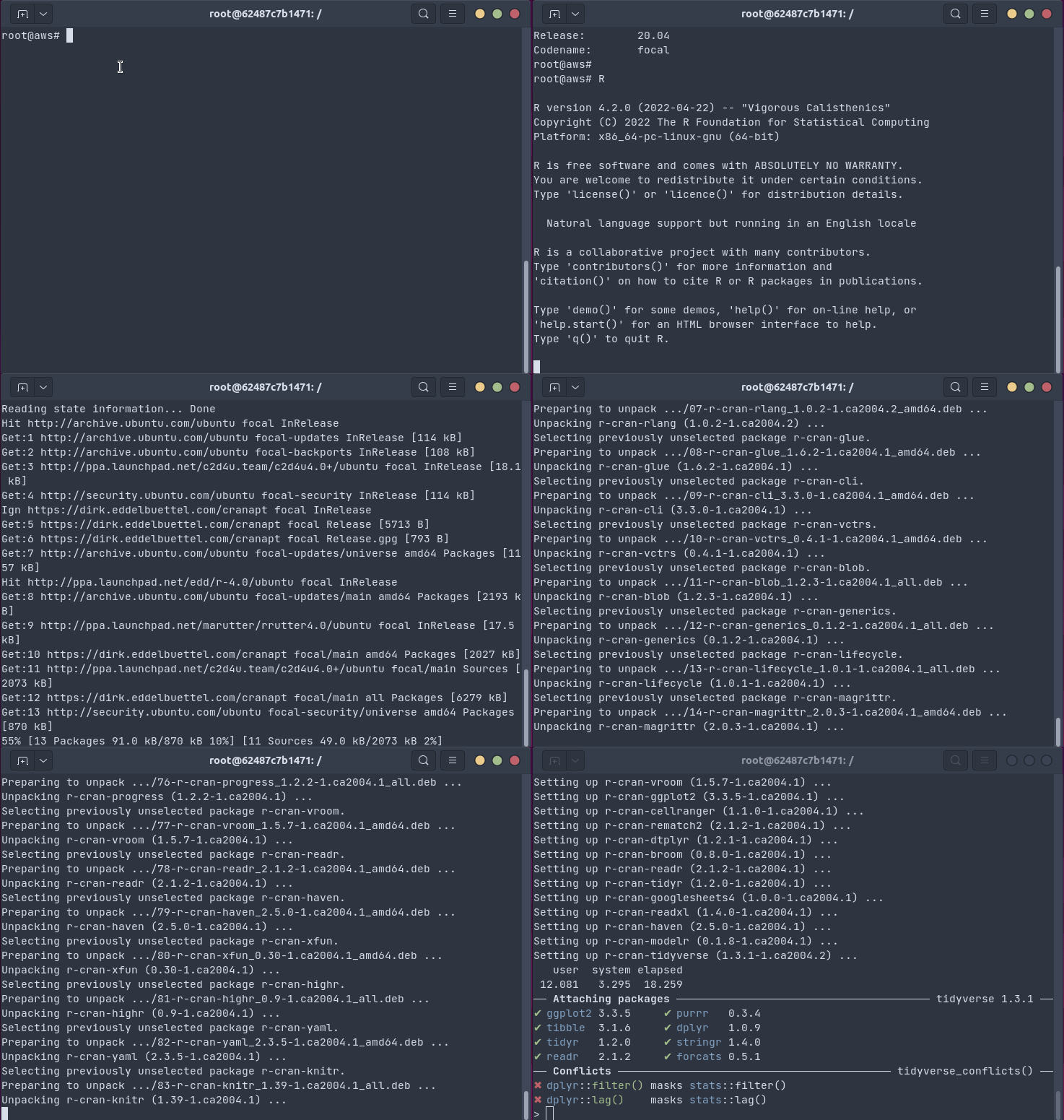
Demos Check out these two demos (also at the r2u site):

Installing the full tidyverse in one command and 18 seconds

Installing brms and its depends in one command and 13 seconds (and show gitpod.io)

Integration via bspm The r2u setup can be used directly with apt (or dpkg or any other frontend to the package management system). Once installed apt update; apt upgrade will take care of new packages. For this to work, all CRAN packages (and all BioConductor packages depended upon) are mapped to names like r-cran-rcpp and r-bioc-s4vectors: an r prefix, the repo, and the package name, all lower-cased. That works but thanks to the wonderful bspm package by I aki car we can do much better. It connects R s own install.packages() and update.packages() to apt. So we can just say (as the demos above show) install.packages("tidyverse") or install.packages("brms") and binaries are installed via apt which is fantastic and it connects R to the system package manager. The setup is really only two lines and described at the r2u site as part of the setup.

History and Motivation Turning CRAN packages into .deb binaries is not a new idea. Albrecht Gebhardt was the first to realize this about twenty years ago (!!) and implemented it with a single Perl script. Next, Albrecht, Stefan Moeller, David Vernazobres and I built on top of this which is described in this useR! 2007 paper. A most excellent generalization and rewrite was provided by Charles Blundell in an superb Google Summer of Code contribution in 2008 which I mentored. Charles and I described it in this talk at useR! 2009. I ran that setup for a while afterwards, but it died via an internal database corruption in 2010 right when I tried to demo it at CRAN headquarters in Vienna. This peaked at, if memory serves, about 5k packages: all of CRAN at the time. Don Armstrong took it one step further in a full reimplemenation which, if I recall correctly, coverd all of CRAN and BioConductor for what may have been 8k or 9k packages. Don had a stronger system (with full RAID-5) but it also died in a crash and was never rebuilt even though he and I could have relied on Debian resources (as all these approaches focused on Debian). During that time, Michael Rutter created a variant that cleverly used an Ubuntu-only setup utilizing Launchpad. This repo is still going strong, used and relied-upon by many, and about 5k packages (per distribution) strong. At one point, a group consisting of Don, Michael, G bor Cs rdi and myself (as lead/PI) had financial support from the RConsortium ISC for a more general re-implementation , but that support was withdrawn when we did not have time to deliver. We should also note other long-standing approaches. Detlef Steuer has been using the openSUSE Build Service to provide nearly all of CRAN for openSUSE for many years. I aki car built a similar system for Fedora described in this blog post. I aki and I also have a arXiv paper describing all this.

Details Please see the the r2u site for all details on using r2u.

Acknowledgements The help of everybody who has worked on this is greatly appreciated. So a huge Thank you! to Albrecht, David, Stefan, Charles, Don, Michael, Detlef, G bor, I aki and whoever I may have omitted. Similarly, thanks to everybody working on R, CRAN, Debian, or Ubuntu it all makes for a superb system. And another big Thank you! goes to my GitHub sponsors whose continued support is greatly appreciated.

This post by Dirk Eddelbuettel originated on his Thinking inside the box blog. Please report excessive re-aggregation in third-party for-profit settings.

24 February 2022

Charles Plessy: New media types in 2022

At the beginning of this year I updated a hundred of media types associated with file name extensions in the file called /etc/mime.types, distributed by the media-types package. Most changes are additions originating from recent submissions to the IANA. Amon the themes that caught my attention, there are telecommunications, computer security, commerce, healthcare and industrial automation. The vast majority of the update come from western provenance. Did the rest of the World decide to move ahead without us?

Next.

Previous.