Search Results: "blade"

24 July 2012

Gunnar Wolf: Ten theses in favor of free download of cultural goods on the Internet (by Enrique G. Gallegos)

This is one of the days where reading my everyday newspaper was worth more than just getting bitter at the news. I found this text in La Jornada, my usual newspaper. I liked it very much, and decided to translate it for a wider audience. Of course, if you can read Spanish, do yourself a favor and go to the original. It is not that the text is so easy to translate. And, after all, I'm not a native English writer. I'm trying to do a literal translation, even when disagreeing with the author. Ten theses in favor of free download of cultural goods on the Internet Enrique G. Gallegos Poet and philosopher. Currently a researcher in Universidad Aut noma Metropolitana-C
  1. Historical legacy. Criticists who promote the persecution of piracy and free downloads of cultural works from the Internet argue that the patrimonial rights have been wronged; they start off suposing that a cultural work is formed from a historical void, as if there was a "nothing" to begin with, and then a "something" appeared. Nothing more fallacious: All cultural products has its precedents, and thanks to these it generates part of its best forces.
  2. Opening towards the future. Human beings are projected into the future. As the main philosophies of the 20th century have explored, one of the singular characteristics of mankind is the ability to think and imagine the future. Products of culture are the best ways to think and project society, politics, love, hope, needs, failures A song, a poem, an essay, can trigger imaginary worlds with a transformative potential. To deny this to humanity with "patrimonial damage" as an argument is to mutilate man's temporal nature.
  3. Recognition of the present. Cultural works generate moments of reflection, criticism and pleasure; they can trigger actions demanding commitment, solidarity and strong indignation against injustice. If every cultural work is adscribed in some way to a historic tradition, and if cultural products anre necessary to imagine other possible worlds and open our future, it's not less true that they also allow us to recognize our present by making us more sensitive to others' ideas, sensations and emotions. Without culture, there is no present nor others' presence.
  4. Divulgation of the cultural heritage. If culture is "heritage of mankind", it should be also spread by any possible way. But not just spread, but actively sought for the biggest number of people to be able to effectively have access to it. In a potentially interconnected world, Internet is the most adequate world for it (despite its limitations). Therefore, penalizing free downloads means avoiding spreading it and restricting access to those groups who don't have enough economic resources.
  5. Preserving cultural heritage. If we agree that cultural works are heritage of mankind, we need to take every action needed to preserve them. But preserving culture does not only mean keeping the products in museums, galleries or never-polluted drawers; it rather means to keep them in the collective memory and in the flow of constant interpretations and appropiations. Said in other words, the genuine way to preserve culture is to allow universal access to cultural goods. That's why, holding that free copies and downloads of books, music, videos, etc. over the Internet are harmful, is an incompatible argument with the obligation to preserve cultural heritage.
  6. They are not goods. Cultural works are material and spiritual manifestations of mankind, concretions of its historicity; they are, also, expressions of emotions, ideas and projections of other lives and other worlds. That's why they cannot be equated to goods or inserted in patrimonialist logic. The market might want to cheat by giving a certain price to a painting by Orozco or auctioning a Baudelaire manuscript, but it will never be able to aprehend their true meaning as cultural works. And it's not that culture is not faluable, but taht its estimation criteria do not follow the rules of market, but those of the imponderable and unlimited.
  7. Price disproportion. Assuming we accept the possibility that intermediaries charge for the services they perform, the value of a book, record or movie should never exceed the daily wage of a worker or employee. But this ellection would only be one more option within the effective possibility that people opt to download or freely copy the cultural work. The final decision as to which media to go to should be a sovereign resolution of the culture-interested person.
  8. The principle of the most benefit. Even when copies and free downloads over Internet could generate a patrimonial "wrong" to third parties, the cultural benefit obtained by it will always be greater in as much that it carries out intensely the principle to foster, spread and access the cultural heritage of mankind. To think otherwise is to privilege the few over the many.
  9. The real evil is elsewhere. Murder, women- and children-trade, poverty and misery are the real evils that ache mankind. According to the United Nations, in 2010 there were 468 thousand murders in the world; the estimation is that 3500 million people live in poverty; in their 2009 inform, the UN found over 2400 victims of "people trade", kidnapped as sex slaves; in some regions in Africa, close to 30% of children suffer acute malnutrition and six people (between children and adults) die every day from hunger. That's why pretending that free download of cultural works is an evil is clearly a tricky and deceptive speech
  10. Against the intermediary-salesman. Culture does not need intermedieries that reduce cultural works to goods. Culture is too important to leavie it in the hands of salespeople that simplistly equate cultural goods with cakes. An intermediary of this kind will never understand the difference between a work of art and a disposable razor blade. What the world needs is more support from the government from every country to artists, creators and poets, as well as ensuring the conditions for the absolute mobility freedom for cultural works.

31 May 2012

Russell Coker: Links May 2012

Vijay Kumar gave an interesting TED talk about autonomous UAVs [1]. His research is based on helicopters with 4 sets of blades and his group has developed software to allow them to develop maps, fly in formation, and more. Hadiyah wrote an interesting post about networking at TED 2012 [2]. It seems that giving every delegate the opportunity to have their bio posted is a good conference feature that others could copy. Bruce Schneier wrote a good summary of the harm that post-911 airport security has caused [3]. Chris Neugebauer wrote an insightful post about the drinking culture in conferences, how it excludes people and distracts everyone from the educational purpose of the conference [4]. Matthew Wright wrote an informative article for Beyond Zero Emissions comparing current options for renewable power with the unproven plans for new nuclear and fossil fuel power plants [5]. The Free Universal Construction Kit is a set of design files to allow 3D printing of connectors between different types of construction kits (Lego, Fischer Technic, etc) [6]. Jay Bradner gave an interesting TED talk about the use of Open Source principles in cancer research [7]. He described his research into drugs which block cancer by converting certain types of cancer cell into normal cells and how he shared that research to allow the drugs to be developed for clinical use as fast as possible. Christopher Priest wrote an epic blog post roasting everyone currently associated with the Arthur C. Clarke awards, he took particular care to flame Charles Stross who celebrated The Prestige of such a great flaming by releasing a t-shirt [8]. For a while I ve been hoping that an author like Charles Stross would manage to make more money from t-shirt sales than from book sales, Charles is already publishing some of his work for free on the Internet and it would be good if he could publish it all for free. Erich Schubert wrote an interesting post about the utility and evolution of Favebook likes [9]. Richard Hartmann wrote an interesting summary of the problems with Google products that annoy him the most [10]. Sam Varghese wrote an insightful article about the political situation in China [11]. The part about the downside of allowing poorly educated people to vote seems to apply to the US as well. Sociological Images has an article about the increased rate of Autism diagnosis as social contagion [12]. People who get their children diagnosed encourage others with similar children to do the same. Vivek wrote a great little post about setting up WPA on Debian [13]. It was much easier than expected once I followed that post. Of course I probably could have read the documentation for ifupdown, but who reads docs when Google is available? Related posts:
  1. Links March 2012 Washington s Blog has an informative summary of recent articles about...
  2. Links April 2012 Karen Tse gave an interesting TED talk about how to...
  3. Links February 2012 Sociological Images has an interesting article about the attempts to...

7 April 2012

Bastian Blank: Booting Debian via AoE (ATA over Ethernet) and PXE

AoE is one of the protocols supported by Linux to access storage via network. It uses plain Ethernet for communication and includes a discovery mechanism to find all available targets. I use it to provide disk space to VMs running on different machines. Next step is to boot via AoE. It is no real problem to use AoE in running systems. However with some help it is even possible to actually boot disk-less machines via AoE. The PXE implementation iPXE provides the AoE support to actually boot from. I will describe the necessary parts.
Setup vblade The AoE target used it vblade. vblade needs access to raw sockets. As I prefer to not have run anything as root if it is not necessary, I use filesystem capabilities to allow it access to the network.
setcap cap_net_raw+ep /usr/sbin/vblade
vblade gets the mac address of the initiator, the shelf and slot number, the network device and the block device.
/usr/sbin/vblade -m $mac 0 0 eth0 $dev
Setup a tftp server and iPXE
apt-get install atftpd ipxe
ln -s /usr/lib/ipxe/undionly.kpxe /var/lib/tftpboot
Setup ISC dhcpd The dhcp server needs to be configured. It needs to hand out two distinct parameter sets. The first is used to chain-load iPXE into the normal PXE stack. The second is for iPXE and sets the root path to the AoE device. They are selected on the iPXE marker in the request.
if exists user-class and option user-class = "iPXE"  
  filename "";
  option root-path "aoe:e0.0";
  else  
  filename "undionly.kpxe";
 
Support AoE via initramfs-tools The initramfs needs to initialize AoE support. It needs to enable the network device used for communication with the AoE server and wait until it is up. After that it needs to load the aoe module and run aoe-discover. We should have all devices now. The root device can now be used like any other normal device. After the AoE device is initialized, it can be found via UUID and all the other ways. So no further modifications are necessary over the usage of local disks. The initramfs finds the device as usual and boots from it. The initramfs support is still a prototyp, but seems to work. For initramfs-tools it needs a hook to include all necessary stuff in the initramfs and a script to actually do the work. Both are shown here. /etc/initramfs-tools/hooks/aoe:
#!/bin/sh
case $1 in
prereqs)
  echo "udev"
  exit 0
  ;;
esac
. /usr/share/initramfs-tools/hook-functions
copy_exec /sbin/aoe-discover
manual_add_modules aoe
/etc/initramfs-tools/scripts/local-top/aoe:
#!/bin/sh
case $1 in
prereqs)
  echo "udev"
  exit 0
  ;;
esac
ifconfig eth0 up
sleep 10
modprobe aoe
aoe-discover
udevadm settle --timeout=30
Problems Not all parts of this works 100%. Some parts works not for all hardware.
  • My old notebook is not able to run Linux with this setup. grub loads the kernel via AoE and nothing comes later.
  • The network may need more time. Especially in large environments with spanning tree enabled, it may need half a minute until any packets will flow.
Some of the problems can be addressed later. Some can't.

5 April 2012

Steve Kemp: So I want a backup solution

I look after a lot of systems, and most of them want identical and simple backups taking of their filesystems. Currently I use backup2l which works but suffers from a couple of minor issues. In short I want to take a full filesystem backup (i.e. Backup "/"). I wish to only exclude a few directories and mounted filesystems. So my configuration looks like this:
# List of directories to make backups of.
# All paths MUST be absolute and start with a '/'!
SRCLIST=(  / /boot -xdev )
# The following expression specifies the files not to be archived.
SKIPCOND=( -path '/var/backups/localhost' -o -path '/var/run/' -o \
    -path '/tmp'  -o -path '/var/tmp' \
    -o -path '/dev' -o -path '/spam' \
    -o -path '/var/spool/' )
The only surprising thing here is that I abuse the internals of backup2l because I know that it uses "find" to build up a list of files - so I sneakily add int "-xdev" to the first argument. This means I don't accidentally backup any mounted gluster filesystem, mounted MySQL binary/log mounts, etc. backup2l then goes and does its jobs. It allows me to define things to run before and after the backup runs via code like this:
# This user-defined bash function is executed before a backup is made
PRE_BACKUP ()
 
   if [ -d /etc/backup2l/pre.d/ ]; then
      run-parts /etc/backup2l/pre.d/
   fi
 
So what is my gripe? Well I get a daily email, per-system, which shows lots of detail - but the key thing. The important thing. The thing I care about more than anything else, the actual "success" or "fail" result is only discoverable by reading the mail. If the backup fails, due to out of disk, I won't know unless I read the middle of the mail. If the pre/post-steps fail I won't know unless I examine the output. As I said to a colleague today in my view the success or failure of the backup is the combination of each of three distinct steps: If any of the three fail I want to know. If they succeed then ideally I don't want a mail at all - but if I get one it should have:
Subject: Backup Success - $(hostname) - $(date)
So I've looked around at programs such as backup-ninja, backup-manager and they seem similar. It is a shame as I mostly like backup2l, but in short I want to do the same thing on about 50-250 hosts: In my case it is usually the rsync-step that fails. Which is horrific if you don't notice (quota exceeded. connection reset by peer. etc). The local backups are good enough for 95% of recovery times - but if the hardware is fried having the backups be available, albeit slowly, is required. Using GNU Tar incrementally is trivial. If it weren't such a messy program I'd probably be inclined to hack on backup2l - but in 2012 I can't believe I need to. (Yes, backuppc rocks. So does duplicity. So does amanda. But they're not appropriate here. Sadly.) ObQuote: "Oh, I get it. I see now. You've been training for two years to take me out, and now here I am. Whew! " - Blade II - An example of a rare breed, a sequel that doesn't suck. No pun intended.

25 November 2011

Marco d'Itri: How to reset a confused iLO

Due to some still unknown bug, all the iLOs of two of my HP blade enclosures became confused and stopped accepting TCP connections. This not only made them unusable, but also prevented upgrading the firmware to an hopefully fixed version... My solution: reset them from the OS by running:
ipmitool mc reset cold
HP's support solution: remove and reseat each blade.

21 July 2011

Wouter Verhelst: On the beard, again...

It looks like I might actually lose it sooner than I was thinking in my previous blog post, a few days ago. On the 18th, Formateur Elio di Rupo had written a proposed document on which to start negotiations. Most parties agreed to that, except for N-VA and CD&V. Unfortunately, that was enough to make further negotiations useless, so di Rupo had offered his resignation as formateur to the King, who kept his response "under advisement". I thought I was going to end up like Andrew. Since he wasn't formally ex-formateur yet, however, he continued working. And today, merely a few days later, with an extra proposal and perhaps also partly due to the King's angry speech for today's national holiday CD&V has now been persuaded to join the negotiations. It's been over fourhundred days, and far too many weirdos, but they're actually sitting down to talk. Like, right now. I'll hold off on buying those razor blades for now, but we might yet get there.

29 January 2011

Adrian von Bidder: Sci-Fi classics (and other stuff)

I again find myself spending time watching movies ... catching up on all those friends who chastise me for not having seen whatever movie we're talking about. For example, the first three Terminator movies. I'm always fond of old style science fiction, so the first of these is quite cute. And then there's the liquid metal effect introduced in Judgment Day, which also is cool, and at the time certainly was at the bleeding edge of what was possible in CG. But by the third movie the concept itself is sure showing its age although it's still well made action, I didn't enjoy it as much. Haven't got hold of the Salvation nor Bruno Mattai's unofficial Terminator 2. Speaking about old fashioned Sci Fi: Blade Runner has a very nice retro look in the buildings and furnishings. And, although this is more because it also was made in the early 80s, very retro computer consoles :-) Fun to watch, but I'm not quite happy with how the plot turns out in the end. But then, it's a Hollywood production, so should I be surprised? But there's not only Sci Fi ... The Shawshank Redemption is a gripping story about an innocent serving a 20 years sentence for murder. A banker entering the rough world of prison, bets are taken how long he'll last. But obviously it turns out that he's really quite tough ... I'm getting good at this ... I thought Jim Jarmusch after about 20s of the opening credits of Down By Law. While it is (again) about innocent people in prison, the focus here is solely on the interaction of three people sharing a cell, excluding almost everything else. Done beautifully in black and white, and while it's not fast paced in any way, the plot has a steady flow to it.

2 January 2011

Lucas Nussbaum: Giving up on Ruby packaging

I have finally reached a decision regarding my involvement in the Debian Ruby packaging efforts. I have decided to stop. This has been a very hard decision to make. I have invested huge amounts of time in that work over the years. I still love the language, and will continue to use it on a daily basis for my own developments. I still hope that it will succeed. I know that some people will be disappointed by that decision (and that others will think your work was useless anyway, people should use RVM and rubygems ). But I also know that I won t be able to push for all the required changes alone. I just don t have the time, nor the motivation. For the record, here are the changes I would have liked to see in the Ruby community. The core Ruby development community should mature.
The core Ruby development community is still dominated by Japanese developers. While not a bad thing in itself, it is easily explained by the fact that the main development mailing list, where most of the important decisions are taken, is in japanese. ruby-dev@ should be closed, and all the technical discussions should happen on the english-speaking ruby-core@ list instead. The release management process should also improve. Currently, it looks like a total mess. The following Ruby development branches are actively maintained:
ruby_1_8 (106 commits over the last six months)
ruby_1_8_6 (4 commits over the last six months)
ruby_1_8_7 (35 commits over the last six months)
ruby_1_9_1 (4 commits over the last six months)
ruby_1_9_2 (227 commits over the last six months)
trunk (1543 commits over the last six months) While the state of the ruby_1_8_6 and ruby_1_9_1 branches is clear (very important bugfixes only), the state of all of the other branches is rather unclear.
What s the stable Ruby branch? 1.8 or 1.9? If it s 1.9, why are people still actively developing in the ruby_1_8 branch? How long will they continue to be maintained in parallel, dividing the manpower? Is a Ruby 1.8.8 release to be expected? Will it be ABI/API compatible with 1.8.7? Is the ruby_1_8_7 branch really bugfixes-only? How much testing of it has been done? If it s bugfixes-only and regression-free, I should push it to Debian squeeze, due to be released in a few weeks. But would you recommend that? Due to past breakages in the ruby_1_8_7 branch, it s unlikely that we will do it.
Is the ruby_1_9_2 a regression-free, bugfix-only branch? If yes, isn t 227 commits over 6 months a lot? What will be the version of the next release of trunk ? When is it expected? Will it be ABI-compatible with the current ruby_1_9_2 branch? API-compatible?
New releases in the 1.8.7 and 1.9.2 branches were done on december 25th. Why were they no betas or RCs allowing wider testing? How much testing has been done behind the scenes? Most of those questions have no clear answer. The Ruby development community should build a common understanding of the status of the various branches, and of their release expectations. Releasing on december 25th of each year sounds fun, but is releasing when everybody is on vacation really a good idea? It would be fantastic to have something similar to Python Enhancement Proposals in the Ruby community. But having open discussions in english about the major issues would already be great. Ruby is not just the interpreter.
The Ruby development community should clearly define what the Ruby platform is. There are some big players, like Rails, and newer interpreter releases should not be done before ensuring that those big players still work. Also, since we have alternative Ruby interpreters, like JRuby, Rubinius and MacRuby, we need a clear process on how they integrate with the rest of the ecosystem. For example, having each of them rely on their own outdated fork of the whole stdlib is ridiculous, since it s not where they compete. The Ruby community should acknowledge that RVM and Rubygems are not for everybody. People who say so should be laughed at. Of course, RVM and Rubygems are nice tools for some people. But it is completely wrong to believe that compiling from source using RVM should be the standard way of installing Ruby, or that all people interested in installing Redmine should know that Ruby has its own specific packaging system. The Ruby community should work with their target platforms to improve how Ruby is distributed instead of reinventing the wheel. That includes Debian, but also RedHat-based distros, for example. It is likely that it won t be possible to reach a one-size-fits-all situation. But that s real life. Some people in the Ruby community should stop behaving like assholes. As one of the Debian Ruby maintainers, I have been routinely accused of creating crippled packages on purpose (FTR, I don t think that the Debian packages are crippled, despite what the rumors says). Debian is not the only target of that. Just yesterday, someone called for abandonning YARV (the new Ruby VM in Ruby 1.9), calling it Yet Another Random Vailure. This kind of comments is really hurting the people who are investing their free time in Ruby, and is turning away people who consider getting involved. In Debian, we have had a lot of problems getting people to help with Ruby maintenance since they are getting shit from the community all the time. So, what s the future for Ruby in Debian? Update: there s also a number of interesting comments about this post on this site.
Update 2: First, thanks a lot for all the interesting comments. I will make some follow-up posts trying to summarize what was said. It seems that this post also triggered some reactions on ruby-core@, with Charles Olivier explaining the JRuby stdlib fork, and Yui Naruse clarifying that all questions are welcomed on ruby-core@. This is great, really.

26 November 2010

Leo 'costela' Antunes: My kingdom for a VGA cable

So you have two geeks in a university room after a relatively late and (at least for one of them) unproductive learning session. It s just natural that they decide to kick back and watch some mind-numbingly stupid geek series, which in this case happened to be Stargate SG-1 (so absurdly shitty its actually very entertaining).
The first lazy geek instinct is to just watch it on the laptop that has the file, which with its 11 display and shitty speakers doesn t turn out to be a great idea. The next try involves the other laptop, but a 13 screen isn t that big of an improvement.
Since the room our intrepid heroes are in happens to have a pretty decent built-in projector and a couple of small but still a lot better than a laptop s Bose speakers, the obvious next step would be using it. The only problem is the lack of a VGA cable. Inspired by the brief sight of MacGyver on the 11 screen, one particularly enterprising geek comes up with the challenge of making a VGA cable out of the only material available at the time: one horribly yellow cat5 ethernet cable.
Being the helpful little extra-dimensional entity that it is, the internet happily provided all the needed information and after some slight problems trying to appropriately deprive the cat5 of its connectors (no scissors and no blades of any kind in sight) and some annoying and manual sticking-cable-to-socket action what did you mother tell you about sticking things in sockets? our reluctant hackers get it right: it's ALIIIIIVEEEE!!! The final solution looked like this: nothing like cable salad for dinner And if you re wondering where those white wires came from, one final touch of ber-hackerdom: notepads have never been more useful This might seem like overkill, but after a nice nice 4 hour movies and series marathon, we can safely say it was totally worth it (but no, we didn t stand 4 hours of Stargate; even geeks have their limits). Just in case the Instructables page gets hosed at some point, here s the invaluable connection diagram, originally scraped off of a since dead Geocities page.

6 November 2010

Jurij Smakov: DVD media for SunBlade 1000

This might save someone a good deal of sifting through ancient posts on obscure forums: if you wonder why your SunBlade 1000 workstation refuses to boot off a freshly burned DVD, keep in mind that the standard-issue DVD drive in those machines (typically Toshiba SD-M1401) is pretty picky about the DVD media type used. Trying to boot off DVD-R discs invariably failed for me with a "read failed" error, while the same image burned onto a DVD+R blank worked like a charm.

2 November 2010

Sam Hartman: Review of Git DPM

I ve been looking at git dpm. It s a tool for managing Debian packages in git. The description promises the world: use of git to maintain both a set of patches to some upstream software along with the history of those patches both at the same time. It also promises the ability to let me share my development repositories. The overhead is much less than topgit. My feelings are mixed. It does deliver on its promise to allow you to maintain your upstream patches and to use git normallyish. It produces nice quilt patch series. In order to understand the down side, it s necessary to understand a bit about how it works. It maintains your normal branch roughly the way you do things today. There s also a branch that is rebased often that is effectively the quilt series. It starts from the upstream and has a commit for every patch in your quilt series containing exactly the contents of that patch. This branch is merged into your debian branch when you run git dpm update-patches. The down side is that it makes the debian branch kind of fragile. If you commit an upstream change to the Debian branch it will be reverted by the next git dpm update-patches. The history will not be lost, but unless you have turned that change into a commit along your patches branch, git dpm update-patches will remove the change without warning. This can be particularly surprising if the change in question is a merge from the upstream branch. In that case, the merged in changes will all be lost, but since the tip of the upstream branch is in your history, then future merges will not bring them back. If you either also merge your changes into the patches branch, or tell git dpm about a new upstream, then the changes will reappear at the next git dpm update-patches. The other fragility is that rebasing your debian branch can have really unpleasant consequences. The problem is that rebase removes merge commits: it assumes that the only changes introduced by merge commits are resolution of conflicts. However, git dpm synthesizes merge commits. In particular, it takes the debian directory from your debian branch, plus the upstream sources from your upstream branch, plus all the patches you applied and calls that your new debian branch. There s also a metadata file that contains pointers to the upstream branch and the quilt patch series branch. In addition, debian/patches gets populated. Discarding this commit completely would simply roll you back to the previous state of your patches. However, this loses history! There is no reference that is left pointing to the patches branch; the only reason it is still referenced is that it s a parent of the commit rebase is throwing away. This isn t really all that unusual; if you merged in any branch, deleted the branch and rebased away both the merge and the commits from the branch, you d lose history. I do find it a bit easier to do with git dpm. However, it s more likely that you ll manage to rebase and keep the commits from the patches branch. In particular, if the horizon of your rebase includes a merge of the patches branch,then for every patch that involves changes to the debian branch from the point where rebase starts rewriting history, you will see a commit included by your rebase. My suspicion is that this commit is more likely to generate conflicts than usual because it s a patch on top of the upstream sources being applied to a partially patched debian branch. However I have not fully worked through things: it may be that such a patch is exactly as likely to cause conflicts as it would in a git dpm update-patches operation. If that succeeds and you do not manage to fail to pick one of these commits, you ll end up with roughly the same debian sources you started with. There are two key exceptions: the git dpm metadata file is not updated and your debian/patches is not consistent with your sources. The first means you re in the state of the previous paragraph: git dpm update-patches will blow away your changes. The second means that any source package you produce is going to be kind of funky if not out right broken. It is possible to recover from git dpm plus rebase. I think if you git dpm checkout-patches, then cherry pick the patch related commits from your debian branch that were introduced by the rebase, then git dpm update-patches, you ll be in a sane state. Obviously you could also recover by finding the pre-rebase commit and resetting there. I m assuming though that you actually needed to rebase for some reason. Of course git dpm does involve a space penalty. You generate a commit for every patch in your quilt series for every version of the upstream sources you deal with. Also, you will introduce and store every version of the quilt series directly in your debian directory. The extra commits probably aren t a big deal: the blobs probably delta compress well. I m not sure though that the quilt patch blobs will compress well with other things. In my opinion the ability to get nice quilt patches is well worth the space penalty. In conclusion, git dpm is a sharp tool. Actually, I think that s understating things. Git dpm involves a bunch of rotating blades. You stick your face and foot between the blades, and if you use it correctly, there s exactly enough clearance that nothing gets damaged and you get some fairly neat results. Other outcomes are available. I m still trying to evaluate if it is worth it. I think the tradeoff might be different for something like the krb5 package which is maintained by two very experienced maintainers than say for Shibboleth which seems to involve several more maintainers. I m not sure that there is much git dpm can do to make things better. Even detecting loss-of-foot events might be kind of tricky.

3 October 2010

Petter Reinholdtsen: Links for 2010-10-03

22 June 2010

Craig Small: Book: Do Androids Dream of Electric Sheep?

Actually they're more interested in freedom, to be no longer slaves to humans. I don't think it's any spoiler to mention that an electric sheep does appear in the book.

This is a classic science fiction story of a dark not-so-distant future. In fact given that it's over 40 years old it could be set in some alternate now. Some disaster has occurred and many have either left earth or died. Some andriods, or andys have escaped and bounty hunters are after them.

You may not know the book by its correct title, but you may of heard the movie that is based upon it, called Blade Runner. Like most movies based on books, it takes some of the concepts and ideas of the book but in my opinion is a pale imitation.

I'm glad I read this book. It hasn't aged that much and it's very though provoking. Sci-Fi often uses some alternate reality to put a mirror up to what happens in the real world and this book is no exception.

And a token link to Debian, if you want you own electric sheep you can install the screensaver electricsheep package which draw pretty fractals on your screen.

<script defer="defer" src="http://static.zemanta.com/readside/loader.js" type="text/javascript"></script>

7 June 2010

Daniel Stone: and one more thing ...

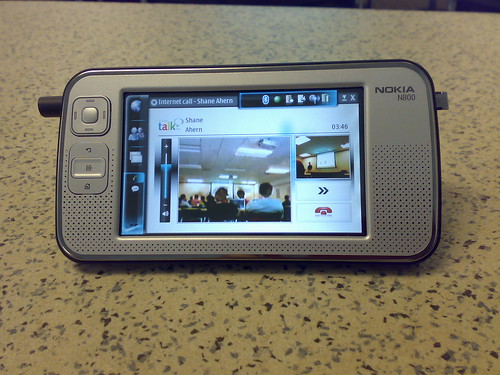
So, I spent an hour or two this afternoon following the iPhone 4 liveblog. It all looked fairly compelling (the screen!), right up until Steve's 'and one more thing': video calling.


HELLO I'M IN 2007, CAN YOU HEAR ME
(Photo of the Nokia N800, which shipped in January 2007, from rnair.)

The moral of the story? If you want to be four years ahead of the WWDC closing bombshell, email sales@collabora.co.uk. :)


PS: The 2010 'fuck it, we're going to fivefour blades' version; we also had a six-way video call going earlier today.

6 April 2010

Michael Prokop: Remote Console feature through Java applet failing?

I m working for a customer who s using IBM blades. Remote access isn t limited to e.g. SoL but also possible through a Remote Console feature using a Java applet. After migrating one of my 32bit systems to a fresh 64bit system I suddenly couldn t use this Remote Console feature any longer. The error message was (leaving it for search engines and help other affected users):
load: class vnc.VncViewer.class not found.
java.lang.ClassNotFoundException: vnc.VncViewer.class
	at sun.plugin2.applet.Applet2ClassLoader.findClass(Applet2ClassLoader.java:152)
	at java.lang.ClassLoader.loadClass(ClassLoader.java:303)
	at java.lang.ClassLoader.loadClass(ClassLoader.java:248)
	at sun.plugin2.applet.Plugin2ClassLoader.loadCode(Plugin2ClassLoader.java:447)
	at sun.plugin2.applet.Plugin2Manager.createApplet(Plugin2Manager.java:2880)
	at sun.plugin2.applet.Plugin2Manager$AppletExecutionRunnable.run(Plugin2Manager.java:1397)
	at java.lang.Thread.run(Thread.java:619)
Caused by: java.net.ConnectException: Network is unreachable
	at java.net.PlainSocketImpl.socketConnect(Native Method)
	at java.net.PlainSocketImpl.doConnect(PlainSocketImpl.java:333)
	at java.net.PlainSocketImpl.connectToAddress(PlainSocketImpl.java:195)
	at java.net.PlainSocketImpl.connect(PlainSocketImpl.java:182)
	at java.net.SocksSocketImpl.connect(SocksSocketImpl.java:366)
	at java.net.Socket.connect(Socket.java:525)
	at sun.net.NetworkClient.doConnect(NetworkClient.java:161)
	at sun.net.www.http.HttpClient.openServer(HttpClient.java:394)
	at sun.net.www.http.HttpClient.openServer(HttpClient.java:529)
	at sun.net.www.http.HttpClient.<init>(HttpClient.java:233)
	at sun.net.www.http.HttpClient.New(HttpClient.java:306)
	at sun.net.www.http.HttpClient.New(HttpClient.java:323)
	at sun.net.www.protocol.http.HttpURLConnection.getNewHttpClient(HttpURLConnection.java:860)
	at sun.net.www.protocol.http.HttpURLConnection.plainConnect(HttpURLConnection.java:801)
	at sun.net.www.protocol.http.HttpURLConnection.connect(HttpURLConnection.java:726)
	at sun.net.www.protocol.http.HttpURLConnection.getInputStream(HttpURLConnection.java:1049)
	at java.net.HttpURLConnection.getResponseCode(HttpURLConnection.java:373)
	at sun.plugin2.applet.Applet2ClassLoader.getBytes(Applet2ClassLoader.java:458)
	at sun.plugin2.applet.Applet2ClassLoader.access$000(Applet2ClassLoader.java:46)
	at sun.plugin2.applet.Applet2ClassLoader$1.run(Applet2ClassLoader.java:126)
	at java.security.AccessController.doPrivileged(Native Method)
	at sun.plugin2.applet.Applet2ClassLoader.findClass(Applet2ClassLoader.java:123)
	... 6 more
Exception: java.lang.ClassNotFoundException: vnc.VncViewer.class
The error message might not be obvious at a glance and that s why I m writing about it actually. It s NOT the:
load: class vnc.VncViewer.class not found.
why it s failing but instead the real reason for the failure is the:
java.net.ConnectException: Network is unreachable
As you can read in Debian s Bug Tracking System in bug #560044:
Netbase has recently introduced the sysctl-setting
net.ipv6.bindv6only=1 in /etc/sysctl.d/bindv6only.conf and this setting will probably be the default in squeeze. This setting breaks networking in java, and any traffic will always
result in a java.net.SocketException: Network is unreachable .
To quote /etc/sysctl.d/bindv6only.conf:
When disabled, IPv6 sockets will also be able to send and receive IPv4 traffic with addresses in the form ::ffff:192.0.2.1 and daemons listening on IPv6 sockets will also accept IPv4 connections. When IPV6_V6ONLY is enabled, daemons interested in both IPv4 and IPv6 connections must open two listening sockets.
To work around this issue you can either execute the Java process through "java -Djava.net.preferIPv4Stack=true" or to change the IPv6 behaviour system wide execute "sysctl -w net.ipv6.bindv6only=0". To make this setting permanent across reboots adjust the setting inside /etc/sysctl.d/bindv6only.conf. After applying this workaround the Remote Console should work again.

19 March 2010

MJ Ray: Co-ops at the North Somerset Initiative

On Wednesday, I went to a meeting of the Business Initiative for North Somerset for Cooperatives-SW (our regional cooperative cooperative). It was the first time anyone from the cooperative and mutual sector was present.

platform
Conference Bank of England The first speaker was Geoff Harding from the Bank of England, who talked through topics in their agents summary and related news. One interesting graph showed a steep rise in the percentage of household income being saved. Answers to questions suggested that more of that goes to mutuals and building societies, but they find it difficult to be competitive while the banks are keen to increase their balances. There was mention of employment hoarding businesses short-time working, redeploying or shutting down temporarily to keep trained workers under contract, rather than make them redundant and rehire later. People from both the Federation of Small Businesses and the Hoteliers Association made strong comments about the banks claiming to government that they are willing to lend, but still offering deeply unattractive depth-of-recession rates and terms. If the regional agents get details of such cases, they pass them to the central bank. South West Regional Development Agency The second main speaker was Ann O Driscoll, who covers business development for the West of England (what many people call CUBA Councils that Used to Be Avon). She introduced their four strategic priorities:-

  1. Low Carbon Economy apparenly our region has good wind, wave and solar experience. However, Vestas were mentioned and I know that when Vestas closed the UK s only wind turbine blade factories in August 2009, the RDAs were criticised for not acting against the subsidy-chasing, socially irresponsible conduct of Vestas and related companies continue to worry workers. If Vestas is one of the praised companies, I wonder whether we re attracting sustainable work to the region. On a related note, North Somerset Council and NS Enterprise Agency are organising a Climate Change forum on 1st April, but it s at Cadbury House Hotel, which is awkward to get to except by car: no footpath to the door, a mile-and-a-half walk along a busy road from a train station, bad roads for biking, wheelbending speedhumps on the drive, I can t remember if there is bicycle parking and its website doesn t say
  2. Successful Businesses SWRDA funds our rather poor Business Link service. Does someone in the South West have some good news about Business Link? If so, please leave a comment on this article.
  3. Prosperous Places intervention in areas like south Bristol or central Weston.
  4. United Approach co-ordinating with other regional groups.
The main activities introduced were: The questions were fascinating, except for mine. The best one was probably about the forthcoming election and the Conservatives pledge to shut down the RDAs and Business Links. The answer was that much of the work will still need to be done somehow, so it s more a question of who will do it, rather than what the name on the door says. So I don t think axing RDAs is going to achieve more than shuffling people between organisations. When allowed to ask a question, I got too excited and ranted a bit about how the Co-operative Group s co-operative enterprise hub is doing work that Business Link should have been funding, but the RDA doesn t understand social enterprise and treats it as a ghetto service. I ll try to take that up in a more coherent form later. Overview I think Cooperatives-SW were invited to the North Somerset Initiative largely because of pressure from software.coop for co-ops to be represented better in the Local Strategic Partnership, which has treated us badly. NSI holds one of the three business places on the partnership board, with the other two being held by NSEA and Bristol International Airport. I think it s a bit off that a private company and an enterprise agency are both represented by other groups and also have their own board seats while co-ops don t even have a collective seat, so that pressure for a representative organisation for co-operatives and mutuals to have a board place (in line with national government guidance) should continue, useful though the NSI meetings seem to be. The other thing which would really help is some funding for co-operative business development specialists to work in North Somerset at strategic tasks like this, instead of it being left to ordinary workers from other sectors. I don t know where that funding will come from and until then, I ll continue to try my best. We need to make sure that local strategy at least does no harm to the sector.

10 February 2010

Lucas Nussbaum: Debian Squeeze, Ubuntu Lucid and Ruby 1.9.2: NO!

Apparently, there s some hype in the Ubuntu community about Ruby 1.9.2, so let s clarify: it would be totally irresponsible to try to ship Ruby 1.9.2 in Debian Squeeze or Ubuntu Lucid. Ruby 1.9.2 has not been released yet: That s where we stand now. Even if surprises are possible, it s very unlikely that Ruby 1.9.2 will be released before Lucid s release (or, what the real requirement is, before Lucid s freeze). So we are sticking with 1.8.7 and 1.9.1 (1.9.0 will go away before the release). If you can point to specific commits that fix real bugs in 1.9.1, and could be backported to the Debian package, feel free to notify the Debian Ruby maintainers.

16 January 2010

C.J. Adams-Collier: AoE root for KVM guests

So. I m trying to get familiar with libvirt and friends. To this end, I ve set up a Lucid virtual machine booting from PXE into an initrd environment which does a pivot_root to an AoE block device. The #virt channel on irc.oftc.net told me that in order to have libvirt provide PXE capability, I would have to install a recent version of libvirt. I built version 0.7.5-3 from sid on my karmic laptop and it seems to be working okay. I decided to set up the pxe root directoy in /var/lib/tftproot just because that s what the example code had in it. I had to manually configure a virtual network. Here is the XML config file:
$ sudo virsh net-dumpxml netboot
<network>
  <name>netboot</name>
  <uuid>81ff0d90-c91e-6742-64da-4a736edb9a9b</uuid>
  <forward mode='nat'/>
  <bridge name='virbr1' stp='off' delay='1' />
  <domain name='example.com'/>
  <ip address='192.168.123.1' netmask='255.255.255.0'>
    <tftp root='/var/lib/tftproot' />
    <dhcp>
      <range start='192.168.123.2' end='192.168.123.254' />
      <bootp file='pxelinux.0' />
    </dhcp>
  </ip>
</network>
This, of course, depends on the pxelinux.0 file. Luckily, this is packaged up in syslinux and can be installed with a simple
$ sudo apt-get install syslinux
$ sudo mkdir /var/lib/tftproot
$ sudo cp /usr/lib/syslinux/pxelinux.0 /var/lib/tftproot
I had to create a pxelinux config file for the virtual machine (indexed by mac address). Note that I put a console=ttyS0,115200 argument on the kernel command line so that I can attach to the serial port from the host system for copy/paste debugging. Also of importance is the root=/dev/etherd/e0.1p1 argument, specifying which block device we ll be doing the pivot_root to eventually.
$ mkdir /var/lib/tftproot/pxelinux.cfg/
$ cat /var/lib/tftproot/pxelinux.cfg/01-52-54-00-44-34-67
DEFAULT linux
LABEL linux
SAY Now booting the kernel from PXELINUX...
KERNEL vmlinuz-lucid0
APPEND ro root=/dev/etherd/e0.1p1 console=ttyS0,115200 initrd=initrd.img-lucid0
I decided to use the karmic kernel for lucid initially. I ll eventually switch over to the lucid kernel ;)
$ sudo cp /boot/vmlinuz-2.6.31-17-generic /var/lib/tftproot/vmlinuz-lucid0
I copied /etc/initramfs-tools to ~/tmp/lucid so that I didn t mess up the system initrd scripts:
$ mkdir -p ~/tmp/lucid && cp -r /etc/initramfs-tools ~/tmp/lucid/
Since mkinitramfs doesn t currently have a system for AoE root, I had to do a bit of fiddling. I copied the NFS root boot script and made a couple of modifications.
$ diff -u /usr/share/initramfs-tools/scripts/nfs ~/tmp/lucid/initramfs-tools/scripts/aoe
--- /usr/share/initramfs-tools/scripts/nfs	2008-06-23 23:10:21.000000000 -0700
+++ /home/cjac/tmp/lucid/initramfs-tools/scripts/aoe	2010-01-15 14:56:28.098298027 -0800
@@ -5,59 +5,25 @@
 retry_nr=0
 # parse nfs bootargs and mount nfs
-do_nfsmount()
+do_aoemount()
  
-
 	configure_networking
-	# get nfs root from dhcp
-	if [ "x$ NFSROOT " = "xauto" ]; then
-		# check if server ip is part of dhcp root-path
-		if [ "$ ROOTPATH#*: " = "$ ROOTPATH " ]; then
-			NFSROOT=$ ROOTSERVER :$ ROOTPATH 
-		else
-			NFSROOT=$ ROOTPATH 
-		fi
-
-	# nfsroot=[<server-ip>:]<root-dir>[,<nfs-options>]
-	elif [ -n "$ NFSROOT " ]; then
-		# nfs options are an optional arg
-		if [ "$ NFSROOT#*, " != "$ NFSROOT " ]; then
-			NFSOPTS="-o $ NFSROOT#*, "
-		fi
-		NFSROOT=$ NFSROOT%%,* 
-		if [ "$ NFSROOT#*: " = "$NFSROOT" ]; then
-			NFSROOT=$ ROOTSERVER :$ NFSROOT 
-		fi
-	fi
+        ip link set up dev eth0
-	if [ -z "$ NFSOPTS " ]; then
-		NFSOPTS="-o retrans=10"
-	fi
+        ls /dev/etherd/
-	[ "$quiet" != "y" ] && log_begin_msg "Running /scripts/nfs-premount"
-	run_scripts /scripts/nfs-premount
-	[ "$quiet" != "y" ] && log_end_msg
+        echo > /dev/etherd/discover
-	if [ $ readonly  = y ]; then
-		roflag="-o ro"
-	else
-		roflag="-o rw"
-	fi
+        ls /dev/etherd/
-	nfsmount -o nolock $ roflag  $ NFSOPTS  $ NFSROOT  $ rootmnt 
+        mount $ ROOT  $ rootmnt 
  
-# NFS root mounting
+# AoE root mounting
 mountroot()
  
-	[ "$quiet" != "y" ] && log_begin_msg "Running /scripts/nfs-top"
-	run_scripts /scripts/nfs-top
-	[ "$quiet" != "y" ] && log_end_msg
-
-	modprobe nfs
-	# For DHCP
-	modprobe af_packet
+	modprobe aoe
 	# Default delay is around 180s
 	# FIXME: add usplash_write info
@@ -67,17 +33,13 @@
 		delay=$ ROOTDELAY 
 	fi
-	# loop until nfsmount succeds
+	# loop until aoemount succeds
 	while [ $ retry_nr  -lt $ delay  ] && [ ! -e $ rootmnt $ init  ]; do
 		[ $ retry_nr  -gt 0 ] && \
-		[ "$quiet" != "y" ] && log_begin_msg "Retrying nfs mount"
-		do_nfsmount
+		[ "$quiet" != "y" ] && log_begin_msg "Retrying AoE mount"
+		do_aoemount
 		retry_nr=$(( $ retry_nr  + 1 ))
 		[ ! -e $ rootmnt $ init  ] && /bin/sleep 1
 		[ $ retry_nr  -gt 0 ] && [ "$quiet" != "y" ] && log_end_msg
 	done
-
-	[ "$quiet" != "y" ] && log_begin_msg "Running /scripts/nfs-bottom"
-	run_scripts /scripts/nfs-bottom
-	[ "$quiet" != "y" ] && log_end_msg
  
(below is the full file in case udiff is less convenient)
$ cat ~/tmp/lucid/initramfs-tools/scripts/aoe
# NFS filesystem mounting			-*- shell-script -*-
# FIXME This needs error checking
retry_nr=0
# parse nfs bootargs and mount nfs
do_aoemount()
 
	configure_networking
        ip link set up dev eth0
        ls /dev/etherd/
        echo > /dev/etherd/discover
        ls /dev/etherd/
        mount $ ROOT  $ rootmnt 
 
# AoE root mounting
mountroot()
 
	modprobe aoe
	# Default delay is around 180s
	# FIXME: add usplash_write info
	if [ -z "$ ROOTDELAY " ]; then
		delay=180
	else
		delay=$ ROOTDELAY 
	fi
	# loop until aoemount succeds
	while [ $ retry_nr  -lt $ delay  ] && [ ! -e $ rootmnt $ init  ]; do
		[ $ retry_nr  -gt 0 ] && \
		[ "$quiet" != "y" ] && log_begin_msg "Retrying AoE mount"
		do_aoemount
		retry_nr=$(( $ retry_nr  + 1 ))
		[ ! -e $ rootmnt $ init  ] && /bin/sleep 1
		[ $ retry_nr  -gt 0 ] && [ "$quiet" != "y" ] && log_end_msg
	done
 
There was also a small modification to the initramfs.conf file:
$ diff -u /etc/initramfs-tools/initramfs.conf ~/tmp/lucid/initramfs-tools/initramfs.conf
--- /etc/initramfs-tools/initramfs.conf	2008-07-08 18:37:42.000000000 -0700
+++ /home/cjac/tmp/lucid/initramfs-tools/initramfs.conf	2010-01-15 14:33:38.088295207 -0800
@@ -47,14 +47,16 @@
 #
 #
-# BOOT: [ local   nfs ]
+# BOOT: [ local   nfs   aoe]
 #
 # local - Boot off of local media (harddrive, USB stick).
 #
 # nfs - Boot using an NFS drive as the root of the drive.
 #
+# aoe - Boot using an AoE drive as the root of the drive.
+#
-BOOT=local
+BOOT=aoe
 #
 # DEVICE: ...
I also needed to add aoe to the list of modules included in the initramfs:
$ echo aoe >> ~/tmp/lucid/initramfs-tools/modules
In order to generate the initrd.img file from this new config, I ran the following:
$ sudo mkinitramfs -d ~/tmp/lucid/initramfs-tools/ -o /var/lib/tftproot/initrd.img-lucid0
I created a lucid VM by installing from the desktop install disk. You can grab the ISO here: http://cdimage.ubuntu.com/daily-live/current/ I ll leave the creation of the virtual machine and installation as an exercise for the reader. I put the filesystem on an lvm volume group called vg0 in a logical volume called lucid0 (ie, /dev/vg0/lucid0). At this point, I created a new virtual machine called lucid0. Here is the xml for the domain:
$ sudo virsh dumpxml lucid0
<domain type='kvm' id='1'>
  <name>lucid0</name>
  <uuid>96fbad21-4f25-5700-ddd8-1a565c7170ee</uuid>
  <memory>524288</memory>
  <currentMemory>524288</currentMemory>
  <vcpu>1</vcpu>
  <os>
    <type arch='x86_64' machine='pc-0.11'>hvm</type>
    <boot dev='network'/>
  </os>
  <features>
    <pae/>
  </features>
  <clock offset='localtime'/>
  <on_poweroff>destroy</on_poweroff>
  <on_reboot>restart</on_reboot>
  <on_crash>restart</on_crash>
  <devices>
    <emulator>/usr/bin/kvm</emulator>
    <interface type='network'>
      <mac address='52:54:00:44:34:67'/>
      <source network='netboot'/>
      <target dev='vnet0'/>
    </interface>
    <serial type='pty'>
   <source path='/dev/pts/4'/>
      <target port='0'/>
    </serial>
  <console type='pty' tty='/dev/pts/4'>
   <source path='/dev/pts/4'/>
      <target port='0'/>
    </console>
    <input type='tablet' bus='usb'/>
    <input type='mouse' bus='ps2'/>
    <graphics type='vnc' port='5901' autoport='yes' listen='127.0.0.1' keymap='en-us'/>
    <sound model='es1370'/>
    <video>
      <model type='cirrus' vram='9216' heads='1'/>
    </video>
  </devices>
</domain>
Now we re ready to start the AoE target and launch the virtual machine. If you don t have vblade installed, do so now:
$ sudo apt-get install vblade
Start the target up with the following command:
$ sudo vbladed 0 1 virbr1 /dev/vg0/lucid0
Now, if all goes well, you should be able to watch the virtual machine boot up and do its thing like so:
$ sudo virsh start lucid0 && sudo screen -S lucid0 sudo virsh ttyconsole lucid0 115200
If you get errors about /dev/etherd/e0.1p1 not existing (these might look like this):
Begin: Retrying AoE mount ...
err         discover    interfaces  revalidate  flush
mount: mounting /dev/etherd/e0.1p1 on /root failed: No such file or directory
Done.
then you might want to try restarting vbladed like this:
$ sudo kill -9 ps auwx grep vblade grep -v grep awk ' print $2 ' && sudo vbladed 0 1 virbr1 /dev/vg0/lucid0
So. Now you should have a lucid gdm in your virt-manager console. Any questions? #virt on irc.oftc.net
<script>//<script language="javascript" src="http://reddit.com/button.js?t=1"></script>

7 January 2010

Marco d'Itri: What I want from a blade chassis switch

Why link aggregation? It is the only simple solution for having complete fault tolerance without configuring the STP in the servers (which is annoying, because Linux does not implement portfast) or even worse OSPF. That's it. I do not need routing protocols or even L3 routing at all, just a simple switch. But apparently the vendors would rather sell me an high end device...

1 January 2010

C.J. Adams-Collier: SAN configuration (AoE)

With the help of a couple of friends, we ve put a 4.5T RAID-5 machine on our network and I m trying to figure out how to share the storage with the rest of the hosts. In the past, I have used NFS and CIFS/Samba to provide access to remote hosts. This has generally worked okay so long as the server stays online. I don t know if the results are going to be much different, but I am now trying a different approach. I plan to run an iSCSI server, and I ve already configured AoE (ATA over Ethernet). I ve exported a block device on the network segment and mounted it on a remote host. This was pretty easy to configure. There is a bit of documentation on the internet already, but I ll give another quick overview. I gave the storage server the unoriginal name san0 . This host is running debian lenny. I am testing the configuration from my debian sid development host, which has the similarly unoriginal name dev0 . So, think server when you see san0 and client when you see dev0 . I assume that you ve already got an LVM volume group set up. Mine is called vg0 . Correct the following examples to account for any differences. You can use disk partitions instead of LVM logical volumes.
Create a logical volume to be exported: cjac@san0:~$ sudo lvcreate /dev/vg0 -n e0.1 -L 5G Load the AoE kernel module: cjac@san0:~$ sudo modprobe aoe Install the package containing the vblade block device export server: cjac@san0:~$ sudo apt-get install vblade Export the block device. Note that the ethernet bridge on which I export the device is called loc : cjac@san0:~$ sudo vbladed 0 1 loc /dev/vg0/e0.1 Install the AoE discovery tools on the client: cjac@dev0:~$ sudo apt-get install aoetools Load the AoE kernel module: cjac@dev0:~$ sudo modprobe aoe Probe for exported AoE devices: cjac@dev0:~$ sudo aoe-discover Verify that our exported device was discovered: cjac@dev0:~$ test -e /dev/etherd/e0.1 && echo "yep"
yep

You can now treat /dev/etherd/e0.1 as you would any other block device. You can format it directly, or partition it and format a partition, use it as a device in your software RAID array, use it as swap space (ha), or something completely different. Now to figure out this iSCSI stuff
<script>//<script language="javascript" src="http://reddit.com/button.js?t=1"></script>

Next.

Previous.