Search Results: "angel"

8 February 2026

Louis-Philippe V ronneau: Montreal Subway Foot Traffic Data, 2025 edition

Another year of data from Soci t de Transport de Montr al, Montreal's transit agency! A few highlights this year:
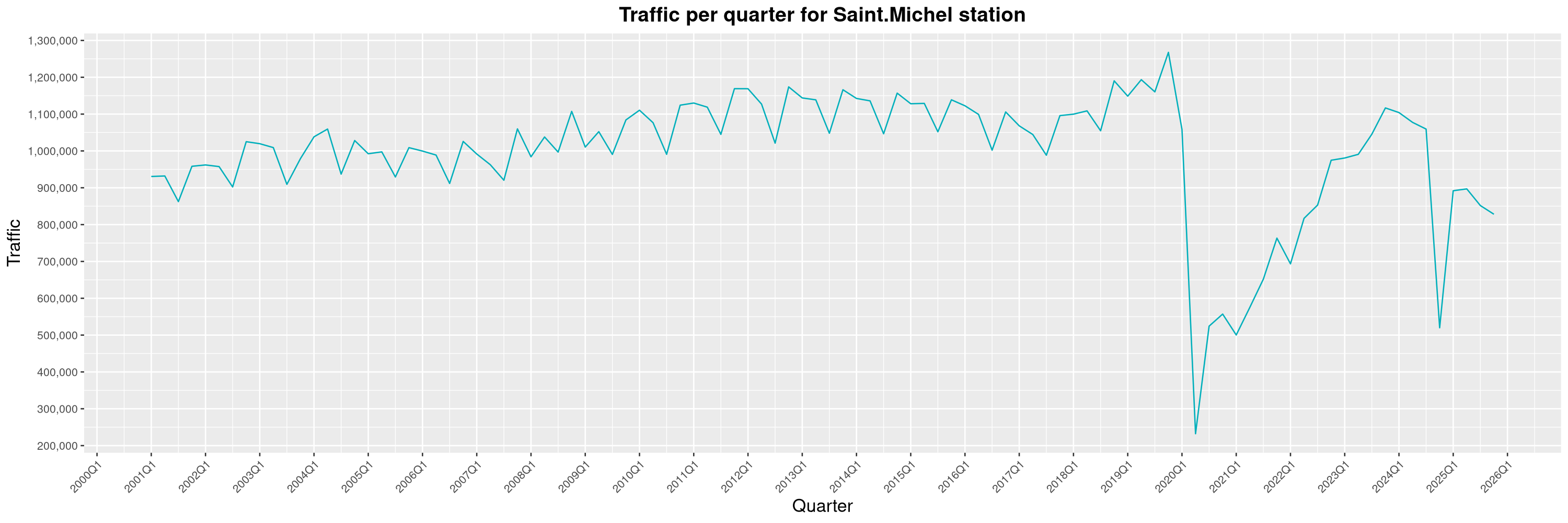
  1. Although the Saint-Michel station closed for emergency repairs in November 2024, traffic never bounced back to its pre-closure levels and is still stuck somewhere around 2022 Q2 levels. I wonder if this could be caused by the roadwork on Jean-Talon for the new Blue Line stations making it harder for folks in Montreal-Nord to reach the station by bus.
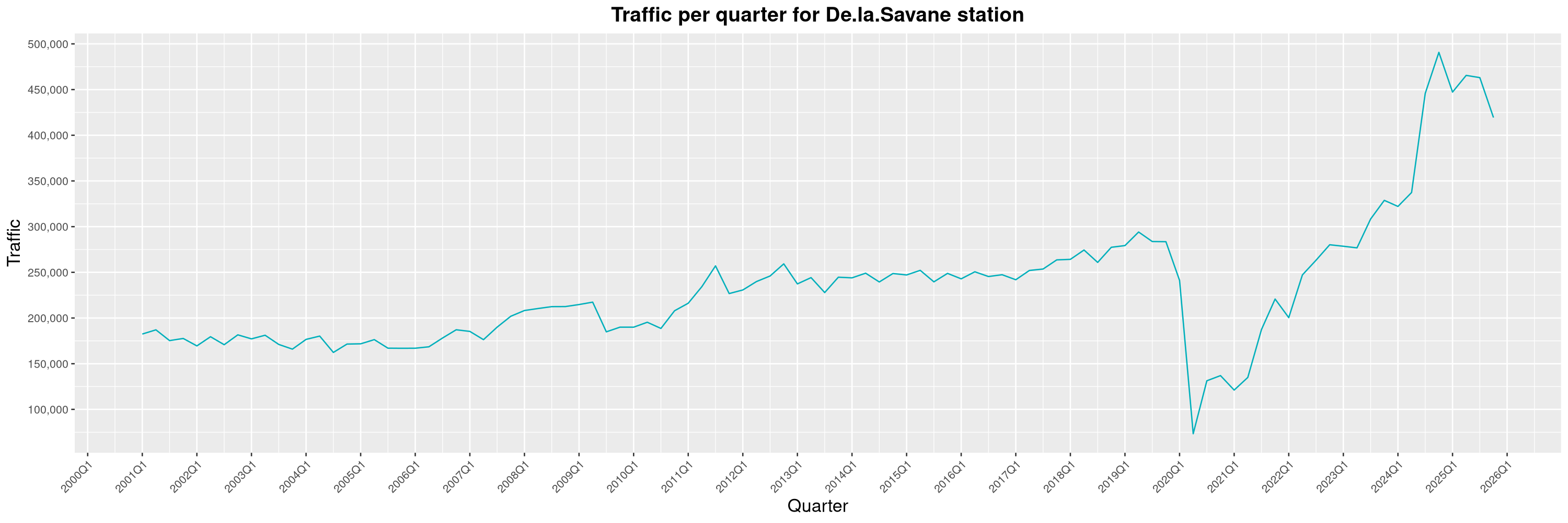
  2. The effects of the opening of the Royalmount shopping center has had a durable impact on the traffic at the De la Savane station. I reported on this last year, but it seems this wasn't just a fad.
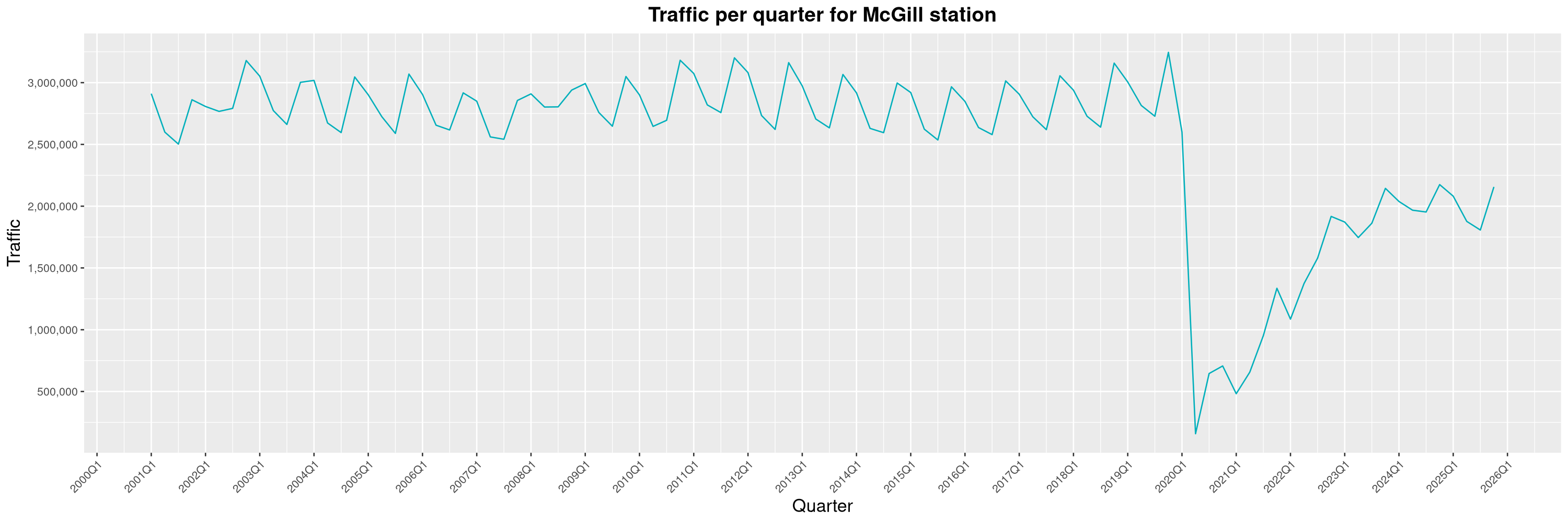
  3. With the completion of the Deux-Montagnes branch of the R seau express m tropolitain (REM, a light-rail, above the surface transit network still in construction), the transfer stations to the Montreal subway have seen major traffic increases. The douard-Montpetit station has nearly reached its previous all-time record of 2015 and the McGill station has recovered from the general slump all the other stations have had in 2025.
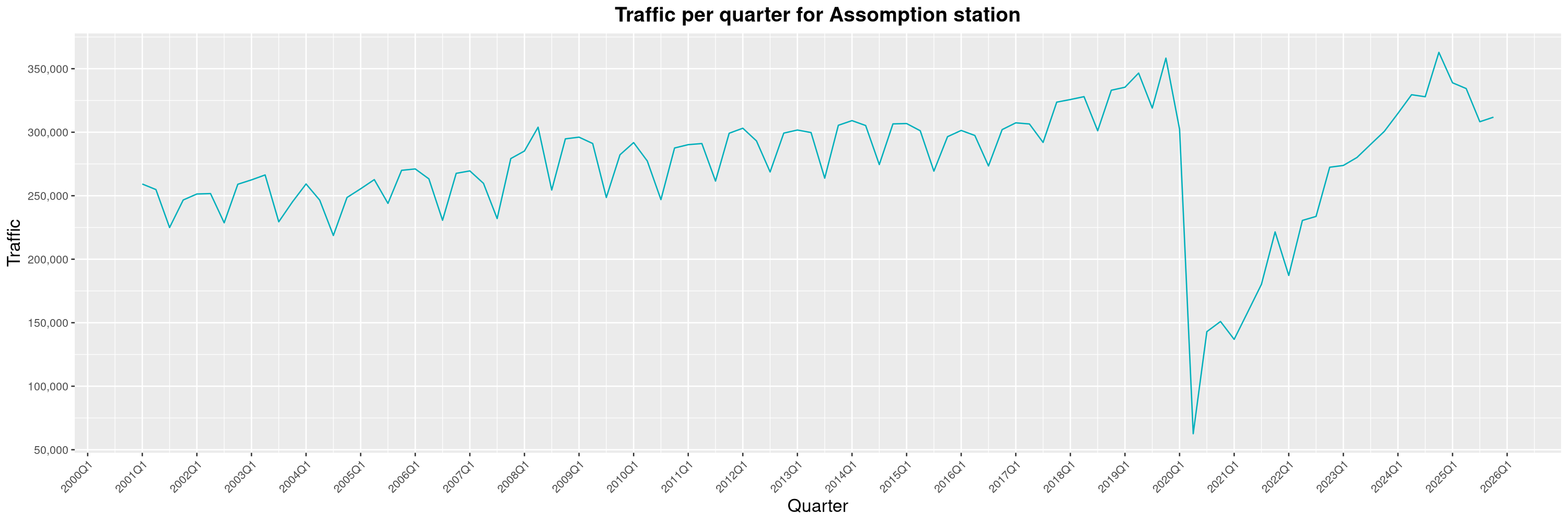
  4. The Assomption station, which used to have one of the lowest number of riders of the subway network, has had a tremendous growth in the past few years. This is mostly explained by the many high-rise projects that were built around the station since the end of the COVID-19 pandemic.
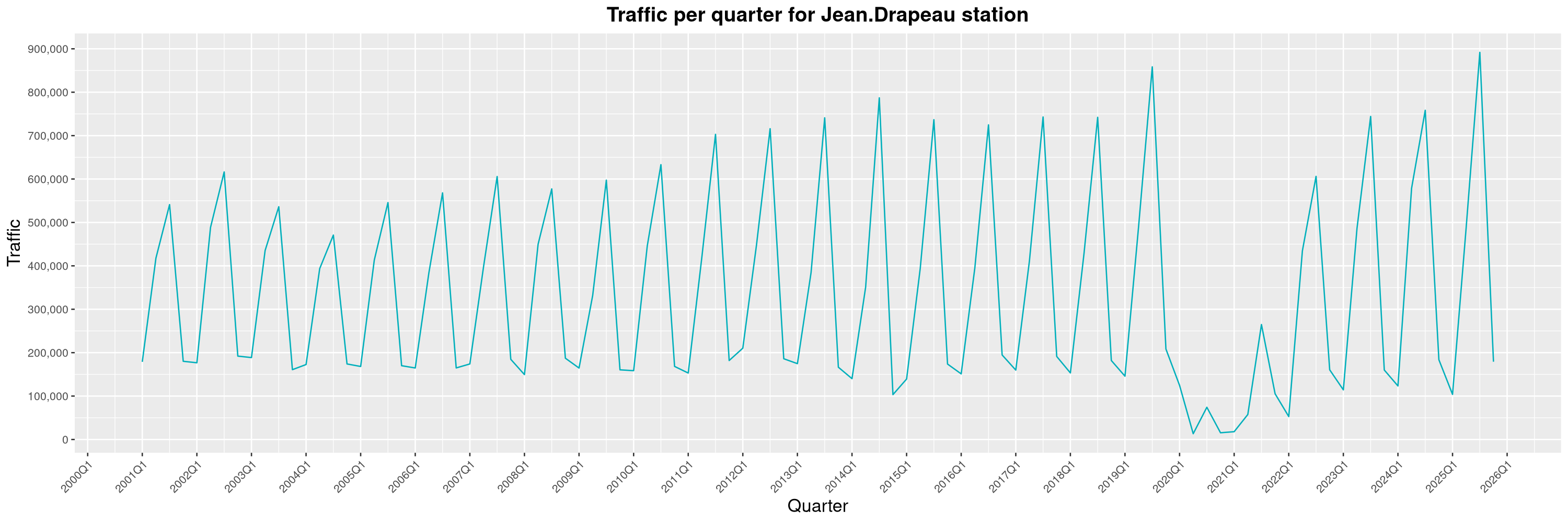
  5. Although still affected by a very high seasonality, the Jean-Drapeau station broke its previous record of 2019, a testament of the continued attraction power of the various summer festivals taking place on the Sainte-H l ne et Notre-Dame islands.
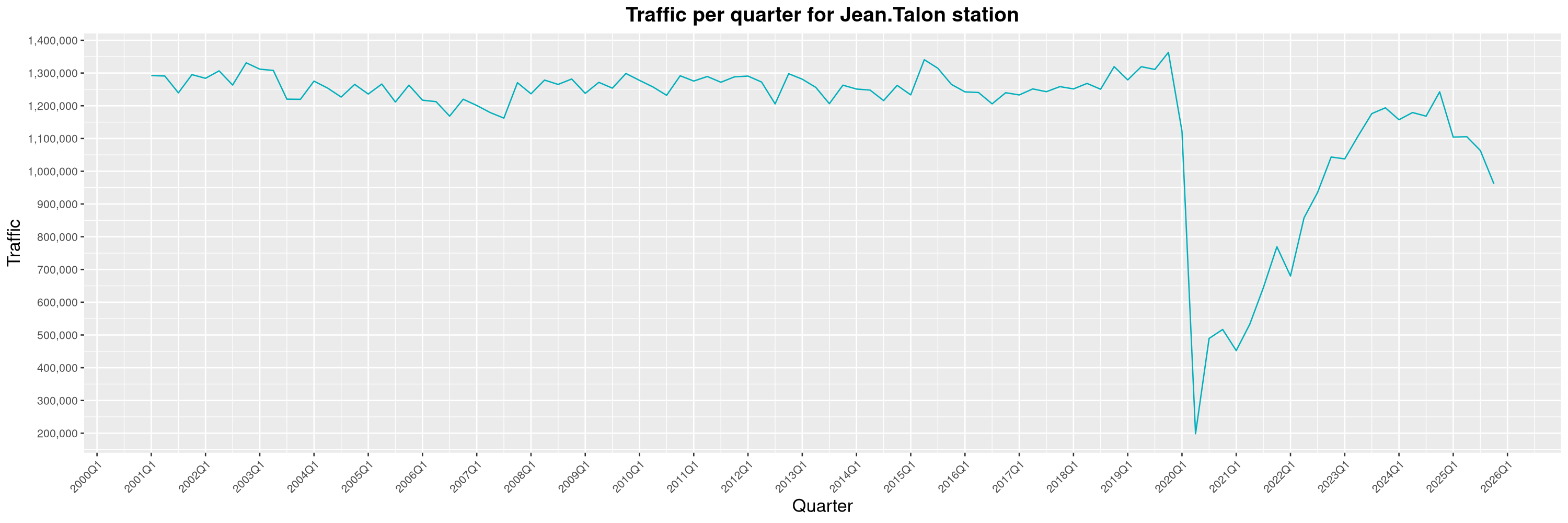
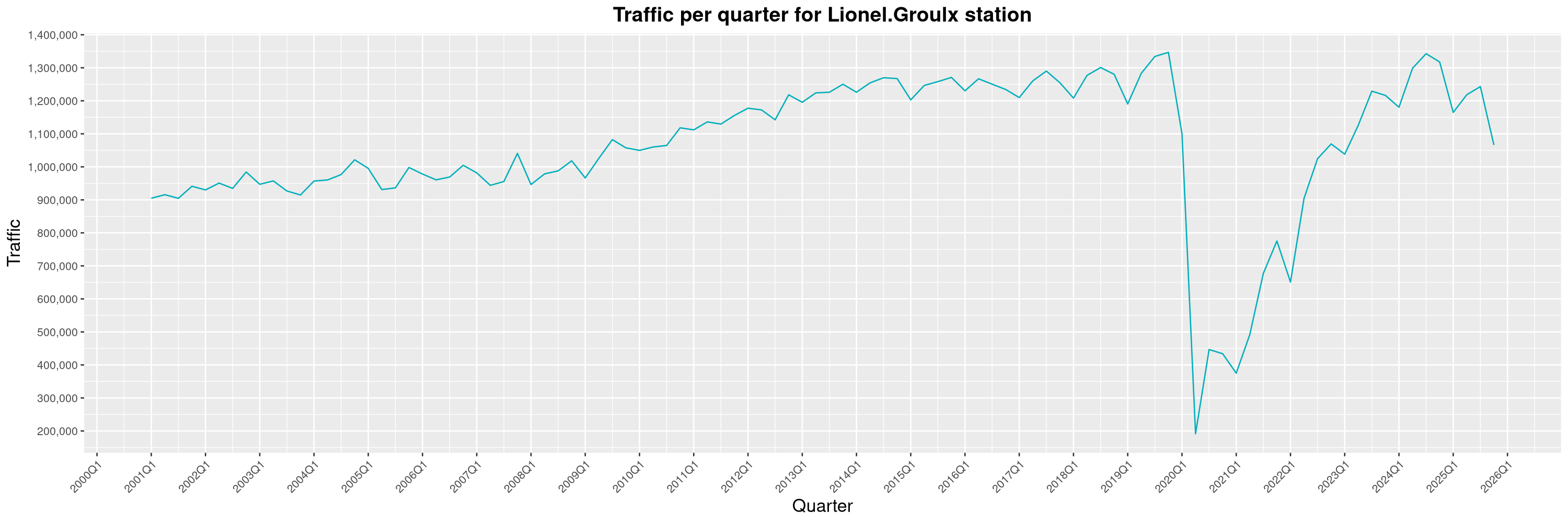
More generally, it seems the Montreal subway has had a pretty bad year. Traffic had been slowly climbing back since the COVID-19 pandemic, but this is the first year since 2020 such a sharp decline can be witnessed. Even major stations like Jean-Talon or Lionel-Groulx are on a downward trend and it is pretty worrisome. As for causes, a few things come to mind. First of all, as the number of Montrealers commuting to work by bike continues to rise1, a modal shift from public transit to active mobility is to be expected. As local experts put it, this is not uncommon and has been seen in other cities before. Another important factor that certainly turned people away from the subway this year has been the impacts of the continued housing crisis in Montreal. As more and more people get kicked out of their apartments, many have been seeking refuge in the subway stations to find shelter. Sadly, this also brought a unprecedented wave of incivilities. As riders' sense of security sharply decreased, the STM eventually resorted to banning unhoused people from sheltering in the subway. This decision did bring back some peace to the network, but one can posit damage had already been done and many casual riders are still avoiding the subway for this reason. Finally, the weekslong STM worker's strike in Q4 had an important impact on general traffic, as it severely reduced the opening hours of the subway. As for the previous item, once people find alternative ways to get around, it's always harder to bring them back. Hopefully, my 2026 report will be a more cheerful one... By clicking on a subway station, you'll be redirected to a graph of the station's foot traffic. Licences

  1. Mostly thanks to major improvements to the cycling network and the BIXI bikesharing program.

4 February 2026

Dirk Eddelbuettel: littler 0.3.23 on CRAN: More Features (and Fixes)

max-heap image The twentythird release of littler as a CRAN package landed on CRAN just now, following in the now twenty year history (!!) as a (initially non-CRAN) package started by Jeff in 2006, and joined by me a few weeks later. littler is the first command-line interface for R as it predates Rscript. It allows for piping as well for shebang scripting via #!, uses command-line arguments more consistently and still starts faster. It also always loaded the methods package which Rscript only began to do in later years. littler lives on Linux and Unix, has its difficulties on macOS due to some-braindeadedness there (who ever thought case-insensitive filesystems as a default were a good idea?) and simply does not exist on Windows (yet the build system could be extended see RInside for an existence proof, and volunteers are welcome!). See the FAQ vignette on how to add it to your PATH. A few examples are highlighted at the Github repo:, as well as in the examples vignette. This release, the first in about eleven months, once again brings two new helper scripts, and enhances six existing one. The release was triggered because it finally became clear why installGitHub.r ignored r2u when available: we forced the type argument to source (so thanks to I aki for spotting this). One change was once again contributed by Michael which is again greatly appreciated. The full change description follows.

Changes in littler version 0.3.22 (2026-02-03)
  • Changes in examples scripts
    • A new script busybees.r aggregates deadlined packages by maintainer
    • Several small updated have been made to the (mostly internal) 'r2u.r' script
    • The deadliners.r script has refined treatment for screen width
    • The install2.r script has new options --quiet and --verbose as proposed by Zivan Karaman
    • The rcc.r script passes build-args to 'rcmdcheck' to compact vignettes and save data
    • The installRub.r script now defaults to 'noble' and is more tolerant of inputs
    • The installRub.r script deals correctly with empty utils::osVersion thanks to Michael Chirico
    • New script checkPackageUrls.r inspired by how CRAN checks (with thanks to Kurt Hornik for the hint)
    • The installGithub.r script now adjusts to bspm and takes advantage of r2u binaries for its build dependencies
  • Changes in package
    • Environment variables (read at build time) can use double quotes
    • Continuous intgegration scripts received a minor update

My CRANberries service provides a comparison to the previous release. Full details for the littler release are provided as usual at the ChangeLog page, and also on the package docs website. The code is available via the GitHub repo, from tarballs and now of course also from its CRAN page and via install.packages("littler"). Binary packages are available directly in Debian as well as (in a day or two) Ubuntu binaries at CRAN thanks to the tireless Michael Rutter. Comments and suggestions are welcome at the GitHub repo.

This post by Dirk Eddelbuettel originated on his Thinking inside the box blog. If you like this or other open-source work I do, you can sponsor me at GitHub.

27 January 2026

Sergio Cipriano: Query Debian changelogs by keyword with the FTP-Master API

Query Debian changelogs by keyword with the FTP-Master API In my post about tracking my Debian uploads, I used the ProjectB database directly to retrieve how many uploads I had so far. I was pleasantly surprised to receive a message from Joerg Jaspert, who introduced me to the Debian Archive Kit web API (dak), also known as the FTP-Master API. Joerg gave the idea of integrating the query I had written into the dak API, so that anyone could obtain the same results without needing to use the mirror host, with a simple http request. I liked the idea and I decided to work on it. The endpoint is already available and you can try by yourself by doing something like this:
$ curl https://api.ftp-master.debian.org/changelogs?search_term=almeida+cipriano
WARNING: Check v2: https://people.debian.org/~gladk/blog/posts/202601_ftp-master-changelog-v2/
The query provides a way to search through the changelogs of all Debian packages currently published. The source code is available at Salsa. I'm already using it to track my uploads, I made this page that updates every day. If you want to setup something similar, you can use my script and just change the search_term to the name you use in your changelog entries. I m running it using a systemd timer. Here s what I ve got:
# .config/systemd/user/track-uploads.service
[Unit]
Description=Track my uploads using the dak API
StopWhenUnneeded=yes
[Service]
Type=oneshot
WorkingDirectory=/home/cipriano/public_html/uploads
ExecStart=/usr/bin/python3 generate.py
# .config/systemd/user/track-uploads.timer
[Unit]
Description=Run track-uploads script daily
[Timer]
OnCalendar=daily
Persistent=true
[Install]
WantedBy=timers.target
After placing every file in the right place you just need to run:
$ systemctl --user daemon-reload
$ systemctl --user enable --now track-uploads.timer
$ systemctl --user start track-uploads.service # generates the html now
If you want to get a bit fancier, I m also using an Ansible playbook for that. The source code is available on my GitLab repository. If you want to learn more about dak, there is a web docs available. I d like to thank Joerg once again for suggesting the idea and for reviewing and merging the change so quickly.

25 January 2026

Anton Gladky: Introducing v2/changelogs FTP-Master API

v2/changelogs FTP-Master API released and how can it be used to track your uploads

20 January 2026

Sahil Dhiman: Conferences, why?

Back in December, I was working to help organize multiple different conferences. One has already happened; the rest are still works in progress. That s when the thought struck me: why so many conferences, and why do I work for them? I have been fairly active in the scene since 2020. For most conferences, I usually arrive late in the city on the previous day and usually leave the city on conference close day. Conferences for me are the place to meet friends and new folks and hear about them, their work, new developments, and what s happening in their interest zones. I feel naturally happy talking to folks. In this case, people inspire me to work. Nothing can replace a passionate technical and social discussion, which stretches way into dinner parties and later. For most conference discussions now, I just show up without a set role (DebConf is probably an exception to it). It usually involves talking to folks, suggesting what needs to be done, doing a bit of it myself, and finishing some last-minute stuff during the actual thing. Having more of these conferences and helping make them happen naturally gives everyone more places to come together, meet, talk, and work on something. No doubt, one reason for all these conferences is evangelism for, let s say Free Software, OpenStreetMap, Debian etc. which is good and needed for the pipeline. But for me, the primary reason would always be meeting folks.

5 January 2026

Colin Watson: Free software activity in December 2025

About 95% of my Debian contributions this month were sponsored by Freexian. You can also support my work directly via Liberapay or GitHub Sponsors. Python packaging I upgraded these packages to new upstream versions: Python 3.14 is now a supported version in unstable, and we re working to get that into testing. As usual this is a pretty arduous effort because it requires going round and fixing lots of odds and ends across the whole ecosystem. We can deal with a fair number of problems by keeping up with upstream (see above), but there tends to be a long tail of packages whose upstreams are less active and where we need to chase them, or where problems only show up in Debian for one reason or another. I spent a lot of time working on this: Fixes for pytest 9: I filed lintian: Report Python egg-info files/directories to help us track the migration to pybuild-plugin-pyproject. I did some work on dh-python: Normalize names in pydist lookups and pyproject plugin: Support headers (the latter of which allowed converting python-persistent and zope.proxy to pybuild-plugin-pyproject, although it needed a follow-up fix). I fixed or helped to fix several other build/test failures: Other bugs: Other bits and pieces Code reviews

30 December 2025

Utkarsh Gupta: FOSS Activites in December 2025

Here s my monthly but brief update about the activities I ve done in the FOSS world.

Debian
Whilst I didn t get a chance to do much, here are still a few things that I worked on:
  • Prepared security update for wordpress for trixie and bookworm.
  • A few discussions with the new DFSG team, et al.
  • Assited a few folks in getting their patches submitted via Salsa.
  • Mentoring for newcomers.
  • Moderation of -project mailing list.

Ubuntu
I joined Canonical to work on Ubuntu full-time back in February 2021. Whilst I can t give a full, detailed list of things I did, here s a quick TL;DR of what I did:
  • Successfully released Resolute Snapshot 2!
    • This one was also done without the ISO tracker and cdimage access.
    • I think this one went rather smooth. Let s see what we re able to do for snapshot 3.
  • Worked on removing GPG keys from the cdimage instance. That took a while, whew!
  • Assisted a bunch of folks with my Archive Admin and Release team hats to:
    • review NEW packages for Ubuntu Studio.
    • remove old binaries that are stalling transition and/or migration.
    • LTS requalification of Ubuntu flavours.
    • bootstrapping dotnet-10 packages for Stable Release Updates.
  • With that, we ve entered the EOY break. :)
    • I was anyway on vacation for majority of this month. ;)

Debian (E)LTS
This month I have worked 72 hours on Debian Long Term Support (LTS) and on its sister Extended LTS project and did the following things:

Released Security Updates
  • ruby-git: Multiple vulnerabilities leading to command line injection and improper path escaping.
  • ruby-sidekiq: Multiple vulnerabilities leading to Cross-site Scripting (XSS) and Denial of Service in Web UI.
  • python-apt: Vulnerability leading to crash via invalid nullptr dereference in TagSection.keys().
    • [LTS]: Fixed CVE-2025-6966 via 2.2.1.1 for bullseye. This has been released as DLA 4408-1.
    • [ELTS]: Fixed CVE-2025-6966 via 1.8.4.4 for buster and 1.4.4 for stretch. This has been released as ELA 1596-1.
    • All of this was coordinated b/w the Security team and Julian Andres Klode. Julian will take care of the stable uploads.
  • node-url-parse: Vulnerability allowing authorization bypass through specially crafted URL with empty userinfo and no host.
  • wordpress: Multiple vulnerabilities in WordPress core, leading to Sent Data & Cross-site Scripting.
  • usbmuxd: Privilege escalation vulnerability via path traversal in SavePairRecord command.
    • [LTS]: Fixed CVE-2025-66004 via 1.1.1-2+deb11u1 for bullseye. This has been released as DLA 4417-1.
    • [ELTS]: Fixed CVE-2025-66004 via 1.1.1~git20181007.f838cf6-1+deb10u1 for buster and 1.1.0-2+deb9u1 for stretch. This has been released as ELA 1599-1.
    • All of this was coordinated b/w the Security team and Yves-Alexis Perez. Yves will take care of the stable uploads.
  • gst-plugins-good1.0: Multiple vulnerabilities in isomp4 plugin leading to potential out-of-bounds reads and information disclosure.
  • postgresql-13: Multiple vulnerabilities including unauthorized schema statistics creation and integer overflow in libpq allocation calculations.
  • gst-plugins-base1.0: Multiple vulnerabilities in SubRip subtitle parsing leading to potential crashes and buffer issues.

Work in Progress
  • ceph: Affected by CVE-2024-47866, using the argument x-amz-copy-source to put an object and specifying an empty string as its content leads to the RGW daemon crashing, resulting in a DoS attack.
  • knot-resolver: Affected by CVE-2023-26249, CVE-2023-46317, and CVE-2022-40188, leading to Denial of Service.
  • adminer: Affected by CVE-2023-45195 and CVE-2023-45196, leading to SSRF and DoS, respectively.
  • u-boot: Affected by CVE-2025-24857, where boot code access control flaw in U-Boot allowing arbitrary code execution via physical access.
    • [ELTS]: As it s only affected the version in stretch, I ve started the work to find the fixing commits and prepare a backport. Not much progress there, I ll roll it over to January.
  • ruby-rack: There were multiple vulnerabilities reported in Rack, leading to DoS (memory exhaustion) and proxy bypass.
    • [ELTS]: After completing the work for LTS myself, Bastien picked it up for ELTS and reached out about an upstream regression and we ve been doing some exchanges. Bastien has done most of the work backporting the patches but needs a review and help backporting CVE-2025-61771.

Other Activities
  • Frontdesk from 01-12-2025 to 07-12-2025.
    • Auto EOL d a bunch of packages.
    • Marked CVE-2025-12084/python2.7 as end-of-life for bullseye, buster, and stretch.
    • Marked CVE-2025-12084/jython as end-of-life for bullseye.
    • Marked CVE-2025-13992/chromium as end-of-life for bullseye.
    • Marked apache2 CVEs as postponed for bullseye, buster, and stretch.
    • Marked CVE-2025-13654/duc as postponed for bullseye and buster.
    • Marked CVE-2025-32900/kdeconnect as ignored for bullseye.
    • Marked CVE-2025-12084/pypy3 as postponed for bullseye.
    • Marked CVE-2025-14104/util-linux as postponed for bullseye, buster, and stretch.
    • Marked several CVEs for fastdds as postponed for bullseye.
    • Marked several CVEs for pytorch as postponed for bullseye.
    • Marked CVE-2025-2486/edk2 as postponed for bullseye.
    • Marked CVE-2025-6172 7,9 /golang-1.15 as postponed for bullseye.
    • Marked CVE-2025-65637/golang-logrus as postponed for bullseye.
    • Marked CVE-2025-12385/qtdeclarative-opensource-src ,gles as postponed for bullseye, buster, and stretch.
    • Marked TEMP-0000000-D08402/rust-maxminddb as postponed for bullseye.
    • Added the following packages to d,e la-needed.txt:
      • liblivemedia, sogo.
    • During my triage, I had to make the bin/elts-eol script robust to determine the lts_admin repository - did a back and forth with Emilio about this on the list.
    • I sent a gentle reminder to the LTS team about the issues fixed in bullseye but not in bookworm via mailing list: https://lists.debian.org/debian-lts/2025/12/msg00013.html.
  • I claimed php-horde-css-parser to work on CVE-2020-13756 for buster and did almost all the work only to realize that the patch already existed in buster and the changelog confirmed that it was intentionally fixed.
    • After speaking with Andreas Henriksson, we figured that the CVE ID was missed when the ELA was generated and so I fixed that via 87afaaf19ce56123bc9508d9c6cd5360b18114ef and 5621431e84818b4e650ffdce4c456daec0ee4d51 in the ELTS security tracker to reflect the situation.
  • Participated in a thread which I started last month around using Salsa CI for E/LTS packages and if we plan to sunset it in favor of using Debusine. The plan for now is to keep it around as it s still beneficial and Debusine is still in its early phase.
  • Did a lot of back and forth with Helmut about debusine uploads on #debian-elts.
    • While debugging a failure in dcut uploads, I ran into an SSH compatibility issue on deb-master.freexian.com that could be fixed on the server-side. I shared all my findings to Freexian s sysadmin team.
    • A minimal fix on the server side would be one of:
      PubkeyAcceptedAlgorithms -ssh-dss
      
      or explicitly restricting to modern algorithms, e.g.:
      PubkeyAcceptedAlgorithms
      ssh-ed25519,ecdsa-sha2-nistp256,rsa-sha2-512,rsa-sha2-256
      
  • Jelly on #debian-lts reported that all my DLA mails had broken GMail s DKIM signature. So I set up sending replies from @debian.org and that seems to have fixed that! \o/
  • [LTS] Attended a rather short monthly LTS meeting on Jitsi. Summary here.
  • [E/LTS] Monitored discussions on mailing lists, IRC, and all the documentation updates.

Until next time.
:wq for today.

3 December 2025

Reproducible Builds: Reproducible Builds in November 2025

Welcome to the report for November 2025 from the Reproducible Builds project! These monthly reports outline what we ve been up to over the past month, highlighting items of news from elsewhere in the increasingly-important area of software supply-chain security. As always, if you are interested in contributing to the Reproducible Builds project, please see the Contribute page on our website. In this report:

  1. 10 years of Reproducible Build at SeaGL
  2. Distribution work
  3. Tool development
  4. Website updates
  5. Miscellaneous news
  6. Software Supply Chain Security of Web3
  7. Upstream patches

10 years of Reproducible Builds at SeaGL 2025 On Friday 8th November, Chris Lamb gave a talk called 10 years of Reproducible Builds at SeaGL in Seattle, WA. Founded in 2013, SeaGL is a free, grassroots technical summit dedicated to spreading awareness and knowledge about free source software, hardware and culture. Chris talk:
[ ] introduces the concept of reproducible builds, its technical underpinnings and its potentially transformative impact on software security and transparency. It is aimed at developers, security professionals and policy-makers who are concerned with enhancing trust and accountability in our software. It also provides a history of the Reproducible Builds project, which is approximately ten years old. How are we getting on? What have we got left to do? Aren t all the builds reproducible now?

Distribution work In Debian this month, Jochen Sprickerhof created a merge request to replace the use of reprotest in Debian s Salsa Continuous Integration (CI) pipeline with debrebuild. Jochen cites the advantages as being threefold: firstly, that only one extra build needed ; it uses the same sbuild and ccache tooling as the normal build ; and works for any Debian release . The merge request was merged by Emmanuel Arias and is now active. kpcyrd posted to our mailing list announcing the initial release of repro-threshold, which implements an APT transport that defines a threshold of at least X of my N trusted rebuilders need to confirm they reproduced the binary before installing Debian packages. Configuration can be done through a config file, or through a curses-like user interface. Holger then merged two commits by Jochen Sprickerhof in order to address a fakeroot-related reproducibility issue in the debian-installer, and J rg Jaspert deployed a patch by Ivo De Decker for a bug originally filed by Holger in February 2025 related to some Debian packages not being archived on snapshot.debian.org. Elsewhere, Roland Clobus performed some analysis on the live Debian trixie images, which he determined were not reproducible. However, in a follow-up post, Roland happily reports that the issues have been handled. In addition, 145 reviews of Debian packages were added, 12 were updated and 15 were removed this month adding to our knowledge about identified issues. Lastly, Jochen Sprickerhof filed a bug announcing their intention to binary NMU a very large number of the R programming language after a reproducibility-related toolchain bug was fixed.
Bernhard M. Wiedemann posted another openSUSE monthly update for their work there.
Julien Malka and Arnout Engelen launched the new hash collection server for NixOS. Aside from improved reporting to help focus reproducible builds efforts within NixOS, it collects build hashes as individually-signed attestations from independent builders, laying the groundwork for further tooling.

Tool development diffoscope version 307 was uploaded to Debian unstable (as well as version 309). These changes included further attempts to automatically attempt to deploy to PyPI by liaising with the PyPI developers/maintainers (with this experimental feature). [ ][ ][ ] In addition, reprotest versions 0.7.31 and 0.7.32 were uploaded to Debian unstable by Holger Levsen, who also made the following changes:
  • Do not vary the architecture personality if the kernel is not varied. (Thanks to Ra l Cumplido). [ ]
  • Drop the debian/watch file, as Lintian now flags this as error for native Debian packages. [ ][ ]
  • Bump Standards-Version to 4.7.2, with no changes needed. [ ]
  • Drop the Rules-Requires-Root header as it is no longer required.. [ ]
In addition, however, Vagrant Cascadian fixed a build failure by removing some extra whitespace from an older changelog entry. [ ]

Website updates Once again, there were a number of improvements made to our website this month including:

Miscellaneous news

Software Supply Chain Security of Web3 Via our mailing list, Martin Monperrus let us know about their recently-published page on the Software Supply Chain Security of Web3. The abstract of their paper is as follows:
Web3 applications, built on blockchain technology, manage billions of dollars in digital assets through decentralized applications (dApps) and smart contracts. These systems rely on complex, software supply chains that introduce significant security vulnerabilities. This paper examines the software supply chain security challenges unique to the Web3 ecosystem, where traditional Web2 software supply chain problems intersect with the immutable and high-stakes nature of blockchain technology. We analyze the threat landscape and propose mitigation strategies to strengthen the security posture of Web3 systems.
Their paper lists reproducible builds as one of the mitigating strategies. A PDF of the full text is available to download.

Upstream patches The Reproducible Builds project detects, dissects and attempts to fix as many currently-unreproducible packages as possible. We endeavour to send all of our patches upstream where appropriate. This month, we wrote a large number of such patches, including:

Finally, if you are interested in contributing to the Reproducible Builds project, please visit our Contribute page on our website. However, you can get in touch with us via:

30 November 2025

Otto Kek l inen: DEP-18: A proposal for Git-based collaboration in Debian

Featured image of post DEP-18: A proposal for Git-based collaboration in DebianI am a huge fan of Git, as I have witnessed how it has made software development so much more productive compared to the pre-2010s era. I wish all Debian source code were in Git to reap the full benefits. Git is not perfect, as it requires significant effort to learn properly, and the ecosystem is complex with even more things to learn ranging from cryptographic signatures and commit hooks to Git-assisted code review best practices, forge websites, and CI systems. Sure, there is still room to optimize its use, but Git certainly has proven itself and is now the industry standard. Thus, some readers might be surprised to learn that Debian development in 2025 is not actually based on Git. In Debian, the version control is done by the Debian archive itself. Each commit is a new upload to the archive, and the commit message is the debian/changelog entry. The commit log is available at snapshots.debian.org. In practice, most Debian Developers (people who have the credentials to upload to the Debian archive) do use Git and host their packaging source code on salsa.debian.org the GitLab instance of Debian. This is, however, based on each DD s personal preferences. The Debian project does not have any policy requiring that packages be hosted on salsa.debian.org or be in version control at all.

Is collaborative software development possible without git and version control software? Debian, however, has some peculiarities that may be surprising to people who have grown accustomed to GitHub, GitLab or various company-internal code review systems. In Debian:
  • The source code of the next upload is not public but resides only on the developer s laptop.
  • Code contributions are plain patch files, based on the latest revision released in the Debian archive (where the unstable area is equivalent to the main development branch).
  • These patches are submitted by email to a bug tracker that does no validation or testing whatsoever.
  • Developers applying these patches typically have elaborate Mutt or Emacs setups to facilitate fetching patches from email.
  • There is no public staging area, no concept of rebasing patches or withdrawing a patch and replacing it with a better version.
  • The submitter won t see any progress information until a notification email arrives after a new version has been uploaded to the Debian archive.
This system has served Debian for three decades. It is not broken, but using the package archive just feels well, archaic. There is a more efficient way, and indeed the majority of Debian packages have a metadata field Vcs-Git that advertises which version control repository the maintainer uses. However, newcomers to Debian are surprised to notice that not all packages are hosted on salsa.debian.org but at various random places with their own account and code submission systems, and there is nothing enforcing or even warning if the code there is out of sync with what was uploaded to Debian. Any Debian Developer can at any time upload a new package with whatever changes, bypassing the Git repository, even when the package advertised a Git repository. All PGP signed commits, Git tags and other information in the Git repository are just extras currently, as the Debian archive does not enforce or validate anything about them. This also makes contributing to multiple packages in parallel hard. One can t just go on salsa.debian.org and fork a bunch of repositories and submit Merge Requests. Currently, the only reliable way is to download source packages from Debian unstable, develop patches on top of them, and send the final version as a plain patch file by email to the Debian bug tracker. To my knowledge, no system exists to facilitate working with the patches in the bug tracker, such as rebasing patches 6 months later to detect if they or equivalent changes were applied or if sending refreshed versions is needed. To newcomers in Debian, it is even more surprising that there are packages that are on salsa.debian.org but have the Merge Requests feature disabled. This is often because the maintainer does not want to receive notification emails about new Merge Requests, but rather just emails from bugs.debian.org. This may sound arrogant, but keep in mind that these developers put in the effort to set up their Mutt/Emacs workflow for the existing Debian process, and extending it to work with GitLab notifications is not trivial. There are also purists who want to do everything via the command-line (without having to open a browser, run JavaScript and maintain a live Internet connection), and tools like glab are not convenient enough for the full workflow.

Inefficient ways of working prevent Debian from flourishing I would claim, based on my personal experiences from the past 10+ years as a Debian Developer, that the lack of high-quality and productive tooling is seriously harming Debian. The current methods of collaboration are cumbersome for aspiring contributors to learn and suboptimal to use for both new and seasoned contributors. There are no exit interviews for contributors who left Debian, no comprehensive data on reasons to contribute or stop contributing, nor are there any metrics tracking how many people tried but failed to contribute to Debian. Some data points to support my concerns do exist:
  • The contributor database shows that the number of contributors is growing slower than Debian s popularity.
  • Most packages are maintained by one person working alone (just pick any package at random and look at the upload history).

Debian should embrace git, but decision-making is slow Debian is all about community and collaboration. One would assume that Debian prioritized above all making collaboration tools and processes simpler, faster and less error-prone, as it would help both current and future package maintainers. Yet, it isn t so, due to some reasons unique to Debian. There is no single company or entity running Debian, and it has managed to operate as a pure meritocracy and do-cracy for over 30 years. This is impressive and admirable. Unfortunately, some of the infrastructure and technical processes are also nearly 30 years old and very difficult to change for the same reason: the nature of Debian s distributed decision-making process. As a software developer and manager with 25+ years of experience, I strongly feel that developing software collaboratively using Git is a major step forward that Debian needs to take, in one form or another, and I hope to see other DDs voice their support if they agree.

Debian Enhancement Proposal 18 Following how consensus is achieved in Debian, I started drafting DEP-18 in 2024, and it is currently awaiting enough thumbs up at https://salsa.debian.org/dep-team/deps/-/merge_requests/21 to get into CANDIDATE status next. In summary, the DEP-18 proposes that everyone keen on collaborating should:
  1. Maintain Debian packaging sources in Git on Salsa.
  2. Use Merge Requests to show your work and to get reviews.
  3. Run Salsa CI before upload.
The principles above are not novel. According to stats at e.g. trends.debian.net, and UDD, ~93% of all Debian source packages are already hosted on salsa.debian.org. As of June 1st, 2025, only 1640 source packages remain that are not hosted on Salsa. The purpose of DEP-18 is to state in writing what Debian is currently doing for most packages, and thus express what among others new contributors should be learning and doing, so basic collaboration is smooth and free from structural obstacles. Most packages are also already allowing Merge Requests and using Salsa CI, but there hasn t been any written recommendation anywhere in Debian to do so. The Debian Policy (v.4.7.2) does not even mention the word Salsa a single time. The current process documentation on how to do non-maintainer uploads or salvaging packages are all based on uploading packages to the archive, without any consideration of using git-based collaboration such as posting a Merge Request first. Personally I feel posting a Merge Request would be a better approach, as it would invite collaborators to discuss and provide code reviews. If there are no responses, the submitter can proceed to merge, but compared to direct uploads to the Debian archive, the Merge Request practice at least tries to offer a time and place for discussions and reviews to happen. It could very well be that in the future somebody comes up with a new packaging format that makes upstream source package management easier, or a monorepo with all packages, or some other future structures or processes. Having a DEP to state how to do things now does not prevent people from experimenting and innovating if they intentionally want to do that. The DEP is merely an expression of the minimal common denominators in the packaging workflow that maintainers and contributors should follow, unless they know better.

Transparency and collaboration Among the DEP-18 recommendations is:
The recommended first step in contributing to a package is to use the built-in Fork feature on Salsa. This serves two purposes. Primarily, it allows any contributor to publish their Git branches and submit them as Merge Requests. Additionally, the mere existence of a list of Forks enables contributors to discover each other, and in rare cases when the original package is not accepting improvements, collaboration could arise among the contributors and potentially lead to permanent forks in the general meaning. Forking is a fundamental part of the dynamics in open source that helps drive quality and agreement. The ability to fork ultimately serves as the last line of defense of users rights. Git supports this by making both temporary and permanent forks easy to create and maintain.
Further, it states:
Debian packaging work should be reasonably transparent and public to allow contributors to participate. A maintainer should push their pending changes to Salsa at regular intervals, so that a potential contributor can discover if a particular change has already been made or a bug has been fixed in version control, and thus avoid duplicate work. Debian maintainers should make reasonable efforts to publish planned changes as Merge Requests on Salsa and solicit feedback and reviews. While pushing changes directly on the main Git branch is the fastest workflow, second only to uploading all changes directly to Debian repositories, it is not an inclusive way to develop software. Even packages that are maintained by a single maintainer should at least occasionally publish Merge Requests to allow new contributors to step up and participate.
I think these are key aspects leading to transparency and true open source collaboration. Even though this talks about Salsa which is based on GitLab the concepts are universal and will work also on other forges, like Forgejo or GitHub. The point is that sharing work-in-progress on a real-time platform, with CI and other supporting features, empowers and motivates people to iterate on code collaboratively. As an example of an anti-pattern, Oracle MySQL publishes the source code for all their releases and is license-compliant, but as they don t publish their Git commits in real-time, it does not feel like a real open source project. Non-Oracle employees are not motivated to participate as second-class developers who are kept in the dark. Debian should embrace git and sharing work in real-time, embodying a true open source spirit.

Recommend, not force Note that the Debian Enhancement Proposals are not binding. Only the Debian Policy and Technical Committee decisions carry that weight. The nature of collaboration is voluntary anyway, so the DEP does not need to force anything on people who don t want to use salsa.debian.org. The DEP-18 is also not a guide for package maintainers. I have my own views and have written detailed guides in blog articles if you want to read more on, for example, how to do code reviews efficiently. Within DEP-18, there is plenty of room to work in many different ways, and it does not try to force one single workflow. The goal here is to simply have agreed-upon minimal common denominators among those who are keen to collaborate using salsa.debian.org, not to dictate a complete code submission workflow. Once we reach this, there will hopefully be less friction in the most basic and recurring collaboration tasks, giving DDs more energy to improve other processes or just invest in having more and newer packages for Debian users to enjoy.

Next steps In addition to lengthy online discussions on mailing lists and DEP reviews, I also presented on this topic at DebConf 2025 in Brest, France. Unfortunately the recording is not yet up on Peertube. The feedback has been overwhelmingly positive. However, there are a few loud and very negative voices that cannot be ignored. Maintaining a Linux distribution at the scale and complexity of Debian requires extraordinary talent and dedication, and people doing this kind of work often have strong views, most of the time for good reasons. We do not want to alienate existing key contributors with new processes, so maximum consensus is desirable. We also need more data on what the 1000+ current Debian Developers view as a good process to avoid being skewed by a loud minority. If you are a current or aspiring Debian Developer, please add a thumbs up if you think I should continue with this effort (or a thumbs down if not) on the Merge Request that would make DEP-18 have candidate status. There is also technical work to do. Increased Git use will obviously lead to growing adoption of the new tag2upload feature, which will need to get full git-buildpackage support so it can integrate into salsa.debian.org without turning off Debian packaging security features. The git-buildpackage tool itself also needs various improvements, such as making contributing to multiple different packages with various levels of diligence in debian/gbp.conf maintenance less error-prone. Eventually, if it starts looking like all Debian packages might get hosted on salsa.debian.org, I would also start building a review.debian.org website to facilitate code review aspects that are unique to Debian, such as tracking Merge Requests across GitLab projects in ways GitLab can t do, highlighting which submissions need review most urgently, feeding code reviews and approvals into the contributors.debian.org database for better attribution, and so forth. Details on this vision will be in a later blog post, so subscribe to updates!

26 November 2025

Bits from Debian: New Debian Developers and Maintainers (September and October 2025)

The following contributors got their Debian Developer accounts in the last two months: The following contributors were added as Debian Maintainers in the last two months: Congratulations!

19 November 2025

Dirk Eddelbuettel: digest 0.6.39 on CRAN: Micro Update

Release 0.6.39 of the digest package arrived at CRAN today and has also been uploaded to Debian. digest creates hash digests of arbitrary R objects. It can use a number different hashing algorithms (md5, sha-1, sha-256, sha-512, crc32, xxhash32, xxhash64, murmur32, spookyhash, blake3,crc32c, xxh3_64 and xxh3_128), and enables easy comparison of (potentially large and nested) R language objects as it relies on the native serialization in R. It is a mature and widely-used package (with 86.8 million downloads just on the partial cloud mirrors of CRAN which keep logs) as many tasks may involve caching of objects for which it provides convenient general-purpose hash key generation to quickly identify the various objects. As noted last week in the 0.6.38 release note, hours after it was admitted to CRAN, I heard from the ever-so-tireless Brian Ripley about an SAN issue on arm64 only (and apparently non-reproducible elsewhere). He kindly provided a fix; it needed a cast. Checking this on amd64 against our Rocker-based ASAN and UBSAN containers (where is remains impossible to replicate, this issue is apparently known for some arm64 issues) another micro-issue (of a missing final argument NULL missing in one .Call()) was detected. Both issues were fixed the same day, and constitute the only change here. I merely waited a week to avoid a mechanical nag triggered when release happen within a week. My CRANberries provides a summary of changes to the previous version. For questions or comments use the issue tracker off the GitHub repo. For documentation (including the changelog) see the documentation site. If you like this or other open-source work I do, you can now sponsor me at GitHub.

This post by Dirk Eddelbuettel originated on his Thinking inside the box blog. Please report excessive re-aggregation in third-party for-profit settings.

12 November 2025

Dirk Eddelbuettel: digest 0.6.38 on CRAN: Several Updates

Release 0.6.38 of the digest package arrived at CRAN today and has also been uploaded to Debian. digest creates hash digests of arbitrary R objects. It can use a number different hashing algorithms (md5, sha-1, sha-256, sha-512, crc32, xxhash32, xxhash64, murmur32, spookyhash, blake3,crc32c, xxh3_64 and xxh3_128), and enables easy comparison of (potentially large and nested) R language objects as it relies on the native serialization in R. It is a mature and widely-used package (with 86.8 million downloads just on the partial cloud mirrors of CRAN which keep logs) as many tasks may involve caching of objects for which it provides convenient general-purpose hash key generation to quickly identify the various objects. This release, the first in about fifteen months, updates a number of items. Carl Pearson suggested, and lead, a cleanup of the C API in order to make more of the functionality accessibly at the source level of other packages. This is ongoing / not yet complete but lead to several nice internal cleanups, mostly done by Carl. Several typos were corrected, mostly in Rd files, by Bill Denney, who also improved the test coverage statistics. Thierry Onkelinx and I improved the sha1 functionality. Sergey Fedorov improved an endianness check that matter for his work on PowerPC. I updated the blake3 hasher, expanded the set of ORCID IDs for listed contributors, updated the continuous integration setup, reinstated code coverage reports, refreshed / converted the documentation site setup, and made general updates and edits to the documentation. The release was prepared a week ago, and held up a few days until an affected package was updated: it requested raw returns where none were previously delivered (for xxhash64) but now are so it needed to not reqest them. It was then seen that another package made some assumptions about our DESCRIPTION file; this has been addressed at its end via a pull request we submitted (that remains unmerged). This delayed processing at CRAN for a few days and as it happens, hours after the packages was updated at CRAN today I heard from the ever-so-tireless Brian Ripley about an SAN issue on arm64 only. He kindly provided a fix; it needed a cast. Checking this on amd64 against our Rocker-based ASAN and UBSAN containers (where is remains impossible to replicate, this issue is apparently known for some arm64 issues) another micro-issue (of a missing final argument NULL missing in one .Call()) was detected. I plan to fix both of these in a follow-up release next week. My CRANberries provides a summary of changes to the previous version. For questions or comments use the issue tracker off the GitHub repo. For documentation (including the changelog) see the documentation site. If you like this or other open-source work I do, you can now sponsor me at GitHub.

This post by Dirk Eddelbuettel originated on his Thinking inside the box blog. Please report excessive re-aggregation in third-party for-profit settings.

19 October 2025

Otto Kek l inen: Could the XZ backdoor have been detected with better Git and Debian packaging practices?

Featured image of post Could the XZ backdoor have been detected with better Git and Debian packaging practices?The discovery of a backdoor in XZ Utils in the spring of 2024 shocked the open source community, raising critical questions about software supply chain security. This post explores whether better Debian packaging practices could have detected this threat, offering a guide to auditing packages and suggesting future improvements. The XZ backdoor in versions 5.6.0/5.6.1 made its way briefly into many major Linux distributions such as Debian and Fedora, but luckily didn t reach that many actual users, as the backdoored releases were quickly removed thanks to the heroic diligence of Andres Freund. We are all extremely lucky that he detected a half a second performance regression in SSH, cared enough to trace it down, discovered malicious code in the XZ library loaded by SSH, and reported promtly to various security teams for quick coordinated actions. This episode makes software engineers pondering the following questions: As a Debian Developer, I decided to audit the xz package in Debian, share my methodology and findings in this post, and also suggest some improvements on how the software supply-chain security could be tightened in Debian specifically. Note that the scope here is only to inspect how Debian imports software from its upstreams, and how they are distributed to Debian s users. This excludes the whole story of how to assess if an upstream project is following software development security best practices. This post doesn t discuss how to operate an individual computer running Debian to ensure it remains untampered as there are plenty of guides on that already.

Downloading Debian and upstream source packages Let s start by working backwards from what the Debian package repositories offer for download. As auditing binaries is extremely complicated, we skip that, and assume the Debian build hosts are trustworthy and reliably building binaries from the source packages, and the focus should be on auditing the source code packages. As with everything in Debian, there are multiple tools and ways to do the same thing, but in this post only one (and hopefully the best) way to do something is presented for brevity. The first step is to download the latest version and some past versions of the package from the Debian archive, which is easiest done with debsnap. The following command will download all Debian source packages of xz-utils from Debian release 5.2.4-1 onwards:
$ debsnap --verbose --first 5.2.4-1 xz-utils
Getting json https://snapshot.debian.org/mr/package/xz-utils/
...
Getting dsc file xz-utils_5.2.4-1.dsc: https://snapshot.debian.org/file/a98271e4291bed8df795ce04d9dc8e4ce959462d
Getting file xz-utils_5.2.4.orig.tar.xz.asc: https://snapshot.debian.org/file/59ccbfb2405abe510999afef4b374cad30c09275
Getting file xz-utils_5.2.4-1.debian.tar.xz: https://snapshot.debian.org/file/667c14fd9409ca54c397b07d2d70140d6297393f
source-xz-utils/xz-utils_5.2.4-1.dsc:
Good signature found
validating xz-utils_5.2.4.orig.tar.xz
validating xz-utils_5.2.4.orig.tar.xz.asc
validating xz-utils_5.2.4-1.debian.tar.xz
All files validated successfully.
Once debsnap completes there will be a subfolder source-<package name> with the following types of files:
  • *.orig.tar.xz: source code from upstream
  • *.orig.tar.xz.asc: detached signature (if upstream signs their releases)
  • *.debian.tar.xz: Debian packaging source, i.e. the debian/ subdirectory contents
  • *.dsc: Debian source control file, including signature by Debian Developer/Maintainer
Example:
$ ls -1 source-xz-utils/
...
xz-utils_5.6.4.orig.tar.xz
xz-utils_5.6.4.orig.tar.xz.asc
xz-utils_5.6.4-1.debian.tar.xz
xz-utils_5.6.4-1.dsc
xz-utils_5.8.0.orig.tar.xz
xz-utils_5.8.0.orig.tar.xz.asc
xz-utils_5.8.0-1.debian.tar.xz
xz-utils_5.8.0-1.dsc
xz-utils_5.8.1.orig.tar.xz
xz-utils_5.8.1.orig.tar.xz.asc
xz-utils_5.8.1-1.1.debian.tar.xz
xz-utils_5.8.1-1.1.dsc
xz-utils_5.8.1-1.debian.tar.xz
xz-utils_5.8.1-1.dsc
xz-utils_5.8.1-2.debian.tar.xz
xz-utils_5.8.1-2.dsc

Verifying authenticity of upstream and Debian sources using OpenPGP signatures As seen in the output of debsnap, it already automatically verifies that the downloaded files match the OpenPGP signatures. To have full clarity on what files were authenticated with what keys, we should verify the Debian packagers signature with:
$ gpg --verify --auto-key-retrieve --keyserver hkps://keyring.debian.org xz-utils_5.8.1-2.dsc
gpg: Signature made Fri Oct 3 22:04:44 2025 UTC
gpg: using RSA key 57892E705233051337F6FDD105641F175712FA5B
gpg: requesting key 05641F175712FA5B from hkps://keyring.debian.org
gpg: key 7B96E8162A8CF5D1: public key "Sebastian Andrzej Siewior" imported
gpg: Total number processed: 1
gpg: imported: 1
gpg: Good signature from "Sebastian Andrzej Siewior" [unknown]
gpg: aka "Sebastian Andrzej Siewior <bigeasy@linutronix.de>" [unknown]
gpg: aka "Sebastian Andrzej Siewior <sebastian@breakpoint.cc>" [unknown]
gpg: WARNING: This key is not certified with a trusted signature!
gpg: There is no indication that the signature belongs to the owner.
Primary key fingerprint: 6425 4695 FFF0 AA44 66CC 19E6 7B96 E816 2A8C F5D1
Subkey fingerprint: 5789 2E70 5233 0513 37F6 FDD1 0564 1F17 5712 FA5B
The upstream tarball signature (if available) can be verified with:
$ gpg --verify --auto-key-retrieve xz-utils_5.8.1.orig.tar.xz.asc
gpg: assuming signed data in 'xz-utils_5.8.1.orig.tar.xz'
gpg: Signature made Thu Apr 3 11:38:23 2025 UTC
gpg: using RSA key 3690C240CE51B4670D30AD1C38EE757D69184620
gpg: key 38EE757D69184620: public key "Lasse Collin <lasse.collin@tukaani.org>" imported
gpg: Total number processed: 1
gpg: imported: 1
gpg: Good signature from "Lasse Collin <lasse.collin@tukaani.org>" [unknown]
gpg: WARNING: This key is not certified with a trusted signature!
gpg: There is no indication that the signature belongs to the owner.
Primary key fingerprint: 3690 C240 CE51 B467 0D30 AD1C 38EE 757D 6918 4620
Note that this only proves that there is a key that created a valid signature for this content. The authenticity of the keys themselves need to be validated separately before trusting they in fact are the keys of these people. That can be done by checking e.g. the upstream website for what key fingerprints they published, or the Debian keyring for Debian Developers and Maintainers, or by relying on the OpenPGP web-of-trust .

Verifying authenticity of upstream sources by comparing checksums In case the upstream in question does not publish release signatures, the second best way to verify the authenticity of the sources used in Debian is to download the sources directly from upstream and compare that the sha256 checksums match. This should be done using the debian/watch file inside the Debian packaging, which defines where the upstream source is downloaded from. Continuing on the example situation above, we can unpack the latest Debian sources, enter and then run uscan to download:
$ tar xvf xz-utils_5.8.1-2.debian.tar.xz
...
debian/rules
debian/source/format
debian/source.lintian-overrides
debian/symbols
debian/tests/control
debian/tests/testsuite
debian/upstream/signing-key.asc
debian/watch
...
$ uscan --download-current-version --destdir /tmp
Newest version of xz-utils on remote site is 5.8.1, specified download version is 5.8.1
gpgv: Signature made Thu Apr 3 11:38:23 2025 UTC
gpgv: using RSA key 3690C240CE51B4670D30AD1C38EE757D69184620
gpgv: Good signature from "Lasse Collin <lasse.collin@tukaani.org>"
Successfully symlinked /tmp/xz-5.8.1.tar.xz to /tmp/xz-utils_5.8.1.orig.tar.xz.
The original files downloaded from upstream are now in /tmp along with the files renamed to follow Debian conventions. Using everything downloaded so far the sha256 checksums can be compared across the files and also to what the .dsc file advertised:
$ ls -1 /tmp/
xz-5.8.1.tar.xz
xz-5.8.1.tar.xz.sig
xz-utils_5.8.1.orig.tar.xz
xz-utils_5.8.1.orig.tar.xz.asc
$ sha256sum xz-utils_5.8.1.orig.tar.xz /tmp/xz-5.8.1.tar.xz
0b54f79df85912504de0b14aec7971e3f964491af1812d83447005807513cd9e xz-utils_5.8.1.orig.tar.xz
0b54f79df85912504de0b14aec7971e3f964491af1812d83447005807513cd9e /tmp/xz-5.8.1.tar.xz
$ grep -A 3 Sha256 xz-utils_5.8.1-2.dsc
Checksums-Sha256:
0b54f79df85912504de0b14aec7971e3f964491af1812d83447005807513cd9e 1461872 xz-utils_5.8.1.orig.tar.xz
4138f4ceca1aa7fd2085fb15a23f6d495d27bca6d3c49c429a8520ea622c27ae 833 xz-utils_5.8.1.orig.tar.xz.asc
3ed458da17e4023ec45b2c398480ed4fe6a7bfc1d108675ec837b5ca9a4b5ccb 24648 xz-utils_5.8.1-2.debian.tar.xz
In the example above the checksum 0b54f79df85... is the same across the files, so it is a match.

Repackaged upstream sources can t be verified as easily Note that uscan may in rare cases repackage some upstream sources, for example to exclude files that don t adhere to Debian s copyright and licensing requirements. Those files and paths would be listed under the Files-Excluded section in the debian/copyright file. There are also other situations where the file that represents the upstream sources in Debian isn t bit-by-bit the same as what upstream published. If checksums don t match, an experienced Debian Developer should review all package settings (e.g. debian/source/options) to see if there was a valid and intentional reason for divergence.

Reviewing changes between two source packages using diffoscope Diffoscope is an incredibly capable and handy tool to compare arbitrary files. For example, to view a report in HTML format of the differences between two XZ releases, run:
diffoscope --html-dir xz-utils-5.6.4_vs_5.8.0 xz-utils_5.6.4.orig.tar.xz xz-utils_5.8.0.orig.tar.xz
browse xz-utils-5.6.4_vs_5.8.0/index.html
Inspecting diffoscope output of differences between two XZ Utils releases If the changes are extensive, and you want to use a LLM to help spot potential security issues, generate the report of both the upstream and Debian packaging differences in Markdown with:
diffoscope --markdown diffoscope-debian.md xz-utils_5.6.4-1.debian.tar.xz xz-utils_5.8.1-2.debian.tar.xz
diffoscope --markdown diffoscope.md xz-utils_5.6.4.orig.tar.xz xz-utils_5.8.0.orig.tar.xz
The Markdown files created above can then be passed to your favorite LLM, along with a prompt such as:
Based on the attached diffoscope output for a new Debian package version compared with the previous one, list all suspicious changes that might have introduced a backdoor, followed by other potential security issues. If there are none, list a short summary of changes as the conclusion.

Reviewing Debian source packages in version control As of today only 93% of all Debian source packages are tracked in git on Debian s GitLab instance at salsa.debian.org. Some key packages such as Coreutils and Bash are not using version control at all, as their maintainers apparently don t see value in using git for Debian packaging, and the Debian Policy does not require it. Thus, the only reliable and consistent way to audit changes in Debian packages is to compare the full versions from the archive as shown above. However, for packages that are hosted on Salsa, one can view the git history to gain additional insight into what exactly changed, when and why. For packages that are using version control, their location can be found in the Git-Vcs header in the debian/control file. For xz-utils the location is salsa.debian.org/debian/xz-utils. Note that the Debian policy does not state anything about how Salsa should be used, or what git repository layout or development practices to follow. In practice most packages follow the DEP-14 proposal, and use git-buildpackage as the tool for managing changes and pushing and pulling them between upstream and salsa.debian.org. To get the XZ Utils source, run:
$ gbp clone https://salsa.debian.org/debian/xz-utils.git
gbp:info: Cloning from 'https://salsa.debian.org/debian/xz-utils.git'
At the time of writing this post the git history shows:
$ git log --graph --oneline
* bb787585 (HEAD -> debian/unstable, origin/debian/unstable, origin/HEAD) Prepare 5.8.1-2
* 4b769547 d: Remove the symlinks from -dev package.
* a39f3428 Correct the nocheck build profile
* 1b806b8d Import Debian changes 5.8.1-1.1
* b1cad34b Prepare 5.8.1-1
* a8646015 Import 5.8.1
* 2808ec2d Update upstream source from tag 'upstream/5.8.1'
 \
  * fa1e8796 (origin/upstream/v5.8, upstream/v5.8) New upstream version 5.8.1
  * a522a226 Bump version and soname for 5.8.1
  * 1c462c2a Add NEWS for 5.8.1
  * 513cabcf Tests: Call lzma_code() in smaller chunks in fuzz_common.h
  * 48440e24 Tests: Add a fuzzing target for the multithreaded .xz decoder
  * 0c80045a liblzma: mt dec: Fix lack of parallelization in single-shot decoding
  * 81880488 liblzma: mt dec: Don't modify thr->in_size in the worker thread
  * d5a2ffe4 liblzma: mt dec: Don't free the input buffer too early (CVE-2025-31115)
  * c0c83596 liblzma: mt dec: Simplify by removing the THR_STOP state
  * 831b55b9 liblzma: mt dec: Fix a comment
  * b9d168ee liblzma: Add assertions to lzma_bufcpy()
  * c8e0a489 DOS: Update Makefile to fix the build
  * 307c02ed sysdefs.h: Avoid <stdalign.h> even with C11 compilers
  * 7ce38b31 Update THANKS
  * 688e51bd Translations: Update the Croatian translation
*   a6b54dde Prepare 5.8.0-1.
*   77d9470f Add 5.8 symbols.
*   9268eb66 Import 5.8.0
*   6f85ef4f Update upstream source from tag 'upstream/5.8.0'
 \ \
  *   afba662b New upstream version 5.8.0
   /
  * 173fb5c6 doc/SHA256SUMS: Add 5.8.0
  * db9258e8 Bump version and soname for 5.8.0
  * bfb752a3 Add NEWS for 5.8.0
  * 6ccbb904 Translations: Run "make -C po update-po"
  * 891a5f05 Translations: Run po4a/update-po
  * 4f52e738 Translations: Partially fix overtranslation in Serbian man pages
  * ff5d9447 liblzma: Count the extra bytes in LZMA/LZMA2 decoder memory usage
  * 943b012d liblzma: Use SSE2 intrinsics instead of memcpy() in dict_repeat()
This shows both the changes on the debian/unstable branch as well as the intermediate upstream import branch, and the actual real upstream development branch. See my Debian source packages in git explainer for details of what these branches are used for. To only view changes on the Debian branch, run git log --graph --oneline --first-parent or git log --graph --oneline -- debian. The Debian branch should only have changes inside the debian/ subdirectory, which is easy to check with:
$ git diff --stat upstream/v5.8
debian/README.source   16 +++
debian/autogen.sh   32 +++++
debian/changelog   949 ++++++++++++++++++++++++++
...
debian/upstream/signing-key.asc   52 +++++++++
debian/watch   4 +
debian/xz-utils.README.Debian   47 ++++++++
debian/xz-utils.docs   6 +
debian/xz-utils.install   28 +++++
debian/xz-utils.postinst   19 +++
debian/xz-utils.prerm   10 ++
debian/xzdec.docs   6 +
debian/xzdec.install   4 +
33 files changed, 2014 insertions(+)
All the files outside the debian/ directory originate from upstream, and for example running git blame on them should show only upstream commits:
$ git blame CMakeLists.txt
22af94128 (Lasse Collin 2024-02-12 17:09:10 +0200 1) # SPDX-License-Identifier: 0BSD
22af94128 (Lasse Collin 2024-02-12 17:09:10 +0200 2)
7e3493d40 (Lasse Collin 2020-02-24 23:38:16 +0200 3) ###############
7e3493d40 (Lasse Collin 2020-02-24 23:38:16 +0200 4) #
426bdc709 (Lasse Collin 2024-02-17 21:45:07 +0200 5) # CMake support for building XZ Utils
If the upstream in question signs commits or tags, they can be verified with e.g.:
$ git verify-tag v5.6.2
gpg: Signature made Wed 29 May 2024 09:39:42 AM PDT
gpg: using RSA key 3690C240CE51B4670D30AD1C38EE757D69184620
gpg: issuer "lasse.collin@tukaani.org"
gpg: Good signature from "Lasse Collin <lasse.collin@tukaani.org>" [expired]
gpg: Note: This key has expired!
The main benefit of reviewing changes in git is the ability to see detailed information about each individual change, instead of just staring at a massive list of changes without any explanations. In this example, to view all the upstream commits since the previous import to Debian, one would view the commit range from afba662b New upstream version 5.8.0 to fa1e8796 New upstream version 5.8.1 with git log --reverse -p afba662b...fa1e8796. However, a far superior way to review changes would be to browse this range using a visual git history viewer, such as gitk. Either way, looking at one code change at a time and reading the git commit message makes the review much easier. Browsing git history in gitk --all

Comparing Debian source packages to git contents As stated in the beginning of the previous section, and worth repeating, there is no guarantee that the contents in the Debian packaging git repository matches what was actually uploaded to Debian. While the tag2upload project in Debian is getting more and more popular, Debian is still far from having any system to enforce that the git repository would be in sync with the Debian archive contents. To detect such differences we can run diff across the Debian source packages downloaded with debsnap earlier (path source-xz-utils/xz-utils_5.8.1-2.debian) and the git repository cloned in the previous section (path xz-utils):
diff
$ diff -u source-xz-utils/xz-utils_5.8.1-2.debian/ xz-utils/debian/
diff -u source-xz-utils/xz-utils_5.8.1-2.debian/changelog xz-utils/debian/changelog
--- debsnap/source-xz-utils/xz-utils_5.8.1-2.debian/changelog 2025-10-03 09:32:16.000000000 -0700
+++ xz-utils/debian/changelog 2025-10-12 12:18:04.623054758 -0700
@@ -5,7 +5,7 @@
 * Remove the symlinks from -dev, pointing to the lib package.
 (Closes: #1109354)

- -- Sebastian Andrzej Siewior <sebastian@breakpoint.cc> Fri, 03 Oct 2025 18:32:16 +0200
+ -- Sebastian Andrzej Siewior <sebastian@breakpoint.cc> Fri, 03 Oct 2025 18:36:59 +0200
In the case above diff revealed that the timestamp in the changelog in the version uploaded to Debian is different from what was committed to git. This is not malicious, just a mistake by the maintainer who probably didn t run gbp tag immediately after upload, but instead some dch command and ended up with having a different timestamps in the git compared to what was actually uploaded to Debian.

Creating syntetic Debian packaging git repositories If no Debian packaging git repository exists, or if it is lagging behind what was uploaded to Debian s archive, one can use git-buildpackage s import-dscs feature to create synthetic git commits based on the files downloaded by debsnap, ensuring the git contents fully matches what was uploaded to the archive. To import a single version there is gbp import-dsc (no s at the end), of which an example invocation would be:
$ gbp import-dsc --verbose ../source-xz-utils/xz-utils_5.8.1-2.dsc
Version '5.8.1-2' imported under '/home/otto/debian/xz-utils-2025-09-29'
Example commit history from a repository with commits added with gbp import-dsc:
$ git log --graph --oneline
* 86aed07b (HEAD -> debian/unstable, tag: debian/5.8.1-2, origin/debian/unstable) Import Debian changes 5.8.1-2
* f111d93b (tag: debian/5.8.1-1.1) Import Debian changes 5.8.1-1.1
* 1106e19b (tag: debian/5.8.1-1) Import Debian changes 5.8.1-1
 \
  * 08edbe38 (tag: upstream/5.8.1, origin/upstream/v5.8, upstream/v5.8) Import Upstream version 5.8.1
   \
    * a522a226 (tag: v5.8.1) Bump version and soname for 5.8.1
    * 1c462c2a Add NEWS for 5.8.1
    * 513cabcf Tests: Call lzma_code() in smaller chunks in fuzz_common.h
An online example repository with only a few missing uploads added using gbp import-dsc can be viewed at salsa.debian.org/otto/xz-utils-2025-09-29/-/network/debian%2Funstable An example repository that was fully crafted using gbp import-dscs can be viewed at salsa.debian.org/otto/xz-utils-gbp-import-dscs-debsnap-generated/-/network/debian%2Flatest. There exists also dgit, which in a similar way creates a synthetic git history to allow viewing the Debian archive contents via git tools. However, its focus is on producing new package versions, so fetching a package with dgit that has not had the history recorded in dgit earlier will only show the latest versions:
$ dgit clone xz-utils
canonical suite name for unstable is sid
starting new git history
last upload to archive: NO git hash
downloading http://ftp.debian.org/debian//pool/main/x/xz-utils/xz-utils_5.8.1.orig.tar.xz...
downloading http://ftp.debian.org/debian//pool/main/x/xz-utils/xz-utils_5.8.1.orig.tar.xz.asc...
downloading http://ftp.debian.org/debian//pool/main/x/xz-utils/xz-utils_5.8.1-2.debian.tar.xz...
dpkg-source: info: extracting xz-utils in unpacked
dpkg-source: info: unpacking xz-utils_5.8.1.orig.tar.xz
dpkg-source: info: unpacking xz-utils_5.8.1-2.debian.tar.xz
synthesised git commit from .dsc 5.8.1-2
HEAD is now at f9bcaf7 xz-utils (5.8.1-2) unstable; urgency=medium
dgit ok: ready for work in xz-utils
$ dgit/sid   git log --graph --oneline
* f9bcaf7 xz-utils (5.8.1-2) unstable; urgency=medium 9 days ago (HEAD -> dgit/sid, dgit/dgit/sid)
 \
  * 11d3a62 Import xz-utils_5.8.1-2.debian.tar.xz 9 days ago
* 15dcd95 Import xz-utils_5.8.1.orig.tar.xz 6 months ago
Unlike git-buildpackage managed git repositories, the dgit managed repositories cannot incorporate the upstream git history and are thus less useful for auditing the full software supply-chain in git.

Comparing upstream source packages to git contents Equally important to the note in the beginning of the previous section, one must also keep in mind that the upstream release source packages, often called release tarballs, are not guaranteed to have the exact same contents as the upstream git repository. Projects might strip out test data or extra development files from their release tarballs to avoid shipping unnecessary files to users, or projects might add documentation files or versioning information into the tarball that isn t stored in git. While a small minority, there are also upstreams that don t use git at all, so the plain files in a release tarball is still the lowest common denominator for all open source software projects, and exporting and importing source code needs to interface with it. In the case of XZ, the release tarball has additional version info and also a sizeable amount of pregenerated compiler configuration files. Detecting and comparing differences between git contents and tarballs can of course be done manually by running diff across an unpacked tarball and a checked out git repository. If using git-buildpackage, the difference between the git contents and tarball contents can be made visible directly in the import commit. In this XZ example, consider this git history:
* b1cad34b Prepare 5.8.1-1
* a8646015 Import 5.8.1
* 2808ec2d Update upstream source from tag 'upstream/5.8.1'
 \
  * fa1e8796 (debian/upstream/v5.8, upstream/v5.8) New upstream version 5.8.1
  * a522a226 (tag: v5.8.1) Bump version and soname for 5.8.1
  * 1c462c2a Add NEWS for 5.8.1
The commit a522a226 was the upstream release commit, which upstream also tagged v5.8.1. The merge commit 2808ec2d applied the new upstream import branch contents on the Debian branch. Between these is the special commit fa1e8796 New upstream version 5.8.1 tagged upstream/v5.8. This commit and tag exists only in the Debian packaging repository, and they show what is the contents imported into Debian. This is generated automatically by git-buildpackage when running git import-orig --uscan for Debian packages with the correct settings in debian/gbp.conf. By viewing this commit one can see exactly how the upstream release tarball differs from the upstream git contents (if at all). In the case of XZ, the difference is substantial, and shown below in full as it is very interesting:
$ git show --stat fa1e8796
commit fa1e8796dabd91a0f667b9e90f9841825225413a
(debian/upstream/v5.8, upstream/v5.8)
Author: Sebastian Andrzej Siewior <sebastian@breakpoint.cc>
Date: Thu Apr 3 22:58:39 2025 +0200
New upstream version 5.8.1
.codespellrc   30 -
.gitattributes   8 -
.github/workflows/ci.yml   163 -
.github/workflows/freebsd.yml   32 -
.github/workflows/netbsd.yml   32 -
.github/workflows/openbsd.yml   35 -
.github/workflows/solaris.yml   32 -
.github/workflows/windows-ci.yml   124 -
.gitignore   113 -
ABOUT-NLS   1 +
ChangeLog   17392 +++++++++++++++++++++
Makefile.in   1097 +++++++
aclocal.m4   1353 ++++++++
build-aux/ci_build.bash   286 --
build-aux/compile   351 ++
build-aux/config.guess   1815 ++++++++++
build-aux/config.rpath   751 +++++
build-aux/config.sub   2354 +++++++++++++
build-aux/depcomp   792 +++++
build-aux/install-sh   541 +++
build-aux/ltmain.sh   11524 ++++++++++++++++++++++
build-aux/missing   236 ++
build-aux/test-driver   160 +
config.h.in   634 ++++
configure   26434 ++++++++++++++++++++++
debug/Makefile.in   756 +++++
doc/SHA256SUMS   236 --
doc/man/txt/lzmainfo.txt   36 +
doc/man/txt/xz.txt   1708 ++++++++++
doc/man/txt/xzdec.txt   76 +
doc/man/txt/xzdiff.txt   39 +
doc/man/txt/xzgrep.txt   70 +
doc/man/txt/xzless.txt   36 +
doc/man/txt/xzmore.txt   31 +
lib/Makefile.in   623 ++++
m4/.gitignore   40 -
m4/build-to-host.m4   274 ++
m4/gettext.m4   392 +++
m4/host-cpu-c-abi.m4   529 +++
m4/iconv.m4   324 ++
m4/intlmacosx.m4   71 +
m4/lib-ld.m4   170 +
m4/lib-link.m4   815 +++++
m4/lib-prefix.m4   334 ++
m4/libtool.m4   8488 +++++++++++++++++++++
m4/ltoptions.m4   467 +++
m4/ltsugar.m4   124 +
m4/ltversion.m4   24 +
m4/lt~obsolete.m4   99 +
m4/nls.m4   33 +
m4/po.m4   456 +++
m4/progtest.m4   92 +
po/.gitignore   31 -
po/Makefile.in.in   517 +++
po/Rules-quot   66 +
po/boldquot.sed   21 +
po/ca.gmo   Bin 0 -> 15587 bytes
po/cs.gmo   Bin 0 -> 7983 bytes
po/da.gmo   Bin 0 -> 9040 bytes
po/de.gmo   Bin 0 -> 29882 bytes
po/en@boldquot.header   35 +
po/en@quot.header   32 +
po/eo.gmo   Bin 0 -> 15060 bytes
po/es.gmo   Bin 0 -> 29228 bytes
po/fi.gmo   Bin 0 -> 28225 bytes
po/fr.gmo   Bin 0 -> 10232 bytes
To be able to easily inspect exactly what changed in the release tarball compared to git release tag contents, the best tool for the job is Meld, invoked via git difftool --dir-diff fa1e8796^..fa1e8796. Meld invoked by git difftool --dir-diff afba662b..fa1e8796 to show differences between git release tag and release tarball contents To compare changes across the new and old upstream tarball, one would need to compare commits afba662b New upstream version 5.8.0 and fa1e8796 New upstream version 5.8.1 by running git difftool --dir-diff afba662b..fa1e8796. Meld invoked by git difftool --dir-diff afba662b..fa1e8796 to show differences between to upstream release tarball contents With all the above tips you can now go and try to audit your own favorite package in Debian and see if it is identical with upstream, and if not, how it differs.

Should the XZ backdoor have been detected using these tools? The famous XZ Utils backdoor (CVE-2024-3094) consisted of two parts: the actual backdoor inside two binary blobs masqueraded as a test files (tests/files/bad-3-corrupt_lzma2.xz, tests/files/good-large_compressed.lzma), and a small modification in the build scripts (m4/build-to-host.m4) to extract the backdoor and plant it into the built binary. The build script was not tracked in version control, but generated with GNU Autotools at release time and only shipped as additional files in the release tarball. The entire reason for me to write this post was to ponder if a diligent engineer using git-buildpackage best practices could have reasonably spotted this while importing the new upstream release into Debian. The short answer is no . The malicious actor here clearly anticipated all the typical ways anyone might inspect both git commits, and release tarball contents, and masqueraded the changes very well and over a long timespan. First of all, XZ has for legitimate reasons for several carefully crafted .xz files as test data to help catch regressions in the decompression code path. The test files are shipped in the release so users can run the test suite and validate that the binary is built correctly and xz works properly. Debian famously runs massive amounts of testing in its CI and autopkgtest system across tens of thousands of packages to uphold high quality despite frequent upgrades of the build toolchain and while supporting more CPU architectures than any other distro. Test data is useful and should stay. When git-buildpackage is used correctly, the upstream commits are visible in the Debian packaging for easy review, but the commit cf44e4b that introduced the test files does not deviate enough from regular sloppy coding practices to really stand out. It is unfortunately very common for git commit to lack a message body explaining why the change was done, and to not be properly atomic with test code and test data together in the same commit, and for commits to be pushed directly to mainline without using code reviews (the commit was not part of any PR in this case). Only another upstream developer could have spotted that this change is not on par to what the project expects, and that the test code was never added, only test data, and thus that this commit was not just a sloppy one but potentially malicious. Secondly, the fact that a new Autotools file appeared (m4/build-to-host.m4) in the XZ Utils 5.6.0 is not suspicious. This is perfectly normal for Autotools. In fact, starting from XZ Utils version 5.8.1 it is now shipping a m4/build-to-host.m4 file that it actually uses now. Spotting that there is anything fishy is practically impossible by simply reading the code, as Autotools files are full custom m4 syntax interwoven with shell script, and there are plenty of backticks ( ) that spawn subshells and evals that execute variable contents further, which is just normal for Autotools. Russ Cox s XZ post explains how exactly the Autotools code fetched the actual backdoor from the test files and injected it into the build. Inspecting the m4/build-to-host.m4 changes in Meld launched via git difftool There is only one tiny thing that maybe a very experienced Autotools user could potentially have noticed: the serial 30 in the version header is way too high. In theory one could also have noticed this Autotools file deviates from what other packages in Debian ship with the same filename, such as e.g. the serial 3, serial 5a or 5b versions. That would however require and an insane amount extra checking work, and is not something we should plan to start doing. A much simpler solution would be to simply strongly recommend all open source projects to stop using Autotools to eventually get rid of it entirely.

Not detectable with reasonable effort While planting backdoors is evil, it is hard not to feel some respect to the level of skill and dedication of the people behind this. I ve been involved in a bunch of security breach investigations during my IT career, and never have I seen anything this well executed. If it hadn t slowed down SSH by ~500 milliseconds and been discovered due to that, it would most likely have stayed undetected for months or years. Hiding backdoors in closed source software is relatively trivial, but hiding backdoors in plain sight in a popular open source project requires some unusual amount of expertise and creativity as shown above.

Is the software supply-chain in Debian easy to audit? While maintaining a Debian package source using git-buildpackage can make the package history a lot easier to inspect, most packages have incomplete configurations in their debian/gbp.conf, and thus their package development histories are not always correctly constructed or uniform and easy to compare. The Debian Policy does not mandate git usage at all, and there are many important packages that are not using git at all. Additionally the Debian Policy also allows for non-maintainers to upload new versions to Debian without committing anything in git even for packages where the original maintainer wanted to use git. Uploads that bypass git unfortunately happen surpisingly often. Because of the situation, I am afraid that we could have multiple similar backdoors lurking that simply haven t been detected yet. More audits, that hopefully also get published openly, would be welcome! More people auditing the contents of the Debian archives would probably also help surface what tools and policies Debian might be missing to make the work easier, and thus help improve the security of Debian s users, and improve trust in Debian.

Is Debian currently missing some software that could help detect similar things? To my knowledge there is currently no system in place as part of Debian s QA or security infrastructure to verify that the upstream source packages in Debian are actually from upstream. I ve come across a lot of packages where the debian/watch or other configs are incorrect and even cases where maintainers have manually created upstream tarballs as it was easier than configuring automation to work. It is obvious that for those packages the source tarball now in Debian is not at all the same as upstream. I am not aware of any malicious cases though (if I was, I would report them of course). I am also aware of packages in the Debian repository that are misconfigured to be of type 1.0 (native) packages, mixing the upstream files and debian/ contents and having patches applied, while they actually should be configured as 3.0 (quilt), and not hide what is the true upstream sources. Debian should extend the QA tools to scan for such things. If I find a sponsor, I might build it myself as my next major contribution to Debian. In addition to better tooling for finding mismatches in the source code, Debian could also have better tooling for tracking in built binaries what their source files were, but solutions like Fraunhofer-AISEC s supply-graph or Sony s ESSTRA are not practical yet. Julien Malka s post about NixOS discusses the role of reproducible builds, which may help in some cases across all distros.

Or, is Debian missing some policies or practices to mitigate this? Perhaps more importantly than more security scanning, the Debian Developer community should switch the general mindset from anyone is free to do anything to valuing having more shared workflows. The ability to audit anything is severely hampered by the fact that there are so many ways to do the same thing, and distinguishing what is a normal deviation from a malicious deviation is too hard, as the normal can basically be almost anything. Also, as there is no documented and recommended default workflow, both those who are old and new to Debian packaging might never learn any one optimal workflow, and end up doing many steps in the packaging process in a way that kind of works, but is actually wrong or unnecessary, causing process deviations that look malicious, but turn out to just be a result of not fully understanding what would have been the right way to do something. In the long run, once individual developers workflows are more aligned, doing code reviews will become a lot easier and smoother as the excess noise of workflow differences diminishes and reviews will feel much more productive to all participants. Debian fostering a culture of code reviews would allow us to slowly move from the current practice of mainly solo packaging work towards true collaboration forming around those code reviews. I have been promoting increased use of Merge Requests in Debian already for some time, for example by proposing DEP-18: Encourage Continuous Integration and Merge Request based Collaboration for Debian packages. If you are involved in Debian development, please give a thumbs up in dep-team/deps!21 if you want me to continue promoting it.

Can we trust open source software? Yes and I would argue that we can only trust open source software. There is no way to audit closed source software, and anyone using e.g. Windows or MacOS just have to trust the vendor s word when they say they have no intentional or accidental backdoors in their software. Or, when the news gets out that the systems of a closed source vendor was compromised, like Crowdstrike some weeks ago, we can t audit anything, and time after time we simply need to take their word when they say they have properly cleaned up their code base. In theory, a vendor could give some kind of contractual or financial guarantee to its customer that there are no preventable security issues, but in practice that never happens. I am not aware of a single case of e.g. Microsoft or Oracle would have paid damages to their customers after a security flaw was found in their software. In theory you could also pay a vendor more to have them focus more effort in security, but since there is no way to verify what they did, or to get compensation when they didn t, any increased fees are likely just pocketed as increased profit. Open source is clearly better overall. You can, if you are an individual with the time and skills, audit every step in the supply-chain, or you could as an organization make investments in open source security improvements and actually verify what changes were made and how security improved. If your organisation is using Debian (or derivatives, such as Ubuntu) and you are interested in sponsoring my work to improve Debian, please reach out.

11 October 2025

John Goerzen: A Mail Delivery Mystery: Exim, systemd, setuid, and Docker, oh my!

On mail.quux, a node of NNCPNET (the NNCP-based peer-to-peer email network), I started noticing emails not being delivered. They were all in the queue, frozen, and Exim s log had entries like:
unable to set gid=5001 or uid=5001 (euid=100): local delivery to [redacted] transport=nncp
Weird. Stranger still, when I manually ran the queue with sendmail -qff -v, they all delivered fine. Huh. Well, I thought, it was a one-off weird thing. But then it happened again. Upon investigating, I observed that this issue was happening only on messages submitted by SMTP. Which, on these systems, aren t that many. While trying different things, I tried submitting a message to myself using SMTP. Nothing to do with NNCP at all. But look at this:
 jgoerzen@[redacted] R=userforward defer (-1): require_files: error for /home/jgoerzen/.forward: Permission denied
Strraaannnge . All the information I could find about this, even a FAQ entry, said that the problem is that Exim isn t setuid root. But it is:
-rwsr-xr-x 1 root root 1533496 Mar 29  2025 /usr/sbin/exim4
This problem started when I upgraded to Debian Trixie. So what changed there? There are a lot of possibilities; this is running in Docker using my docker-debian-base system, which runs a regular Debian in Docker, including systemd. I eventually tracked it down to Exim migrating from init.d to systemd in trixie, and putting a bunch of lockdowns in its service file. After a bunch of trial and error, I determined that I needed to override this set of lockdowns to make it work. These overrides did the trick:
ProtectClock=false
PrivateDevices=false
RestrictRealtime=false
ProtectKernelModules=false
ProtectKernelTunables=false
ProtectKernelLogs=false
ProtectHostname=false
I don t know for sure if the issue is related to setuid. But if it is, there s nothing that immediately jumps out at me about any of these that would indicate a problem with setuid. I also don t know if running in Docker makes any difference. Anyhow, problem fixed, but mystery not solved!

10 October 2025

John Goerzen: I m Not Very Popular, Thankfully. That Makes The Internet Fun Again

Like and subscribe! Help us get our next thousand (or million) followers! I was using Linux before it was popular. Back in the day where you had to write Modelines for your XF86Config file and do it properly, or else you might ruin your monitor. Back when there wasn t a word processor (thankfully; that forced me to learn LaTeX, which I used to write my papers in college). I then ran Linux on an Alpha, a difficult proposition in an era when web browsers were either closed-source or too old to be useful; all sorts of workarounds, including emulating Digital UNIX. Recently I wrote a deep dive into the DOS VGA text mode and how to achieve it on a modern UEFI Linux system. Nobody can monetize things like this. I am one of maybe a dozen or two people globally that care about that sort of thing. That s fine. Today, I m interested in things like asynchronous communication, NNCP, and Gopher. Heck, I m posting these words on a blog. Social media displaced those, right? Some of the things I write about here have maybe a few dozen people on the planet interested in them. That s fine. I have no idea how many people read my blog. I have no idea where people hear about my posts from. I guess I can check my Mastodon profile to see how many followers I have, but it s not something I tend to do. I don t know if the number is going up or down, or if it is all that much in Mastodon terms (probably not). Thank goodness. Since I don t have to care about what s popular, or spend hours editing video, or thousands of dollars on video equipment, I can just sit down and write about what interests me. If that also interests you, then great. If not, you can find what interests you also fine. I once had a colleague that was one of these plugged into Silicon Valley types. He would periodically tell me, with a mixture of excitement and awe, that one of my posts had made Hacker News. This was always news to me, because I never paid a lot of attention over there. Occasionally that would bring in some excellent discussion, but more often than not, it was comments from people that hadn t read or understood the article trying to appear smart by arguing with what it or rather, what they imagined it said, I guess. The thing I value isn t subscriber count. It s discussion. A little discussion in the comments or on Mastodon that s perfect, even if only 10 people read the article. I have the most fun in a community. And I ll go on writing about NNCP and Gopher and non-square DOS pixels, with audiences of dozens globally. I have no advertisers to keep happy, and I enjoy it, so why not?

2 October 2025

John Goerzen: A Twisty Maze of Ill-Behaved Bots

Like many, bot traffic has been causing significant issues for my hosted server recently. I ve been noticing a dramatic increase in bots that do not respect robots.txt, especially the crawl-delay I have set there. Not only that, but many of them are sending user-agent strings that are quite precisely matching what desktop browsers send. That is, they don t identify themselves. They posed a particular problem on two sites: my blog, and the lists.complete.org archives. The list archives is a completely static site, but it has many pages, so the bots that are ill-behaved absolutely hammer it following links. My blog runs WordPress. It has fewer pages, but by using PHP, doesn t need as many hits to start to bog down. Also, there is a Mastodon thundering herd problem, and since I participate on Mastodon, this hits my server. The solution was one of layers. I had already added a crawl-delay line to robots.txt. It helped a bit, but many bots these days aren t well-behaved. Next, I added WP Super Cache to my WordPress installation. I also enabled APCu in PHP and installed APCu Manager. Again, each step helped. Again, not quite enough. Finally, I added Anubis. Installing it (especially if using the Docker container) was under-documented, but I figured it out. By default, it is designed to block AI bots and try to challenge everything with Mozilla in its user-agent (which is most things) with a Javascript challenge. That s not quite what I want. If a bot is well-behaved, AI or otherwise, it will respect my robots.txt and I can more precisely control it there. Also, I intentionally support non-Javascript browsers on many of the sites I host, so I wanted to be judicious. Eventually I configured Anubis to only challenge things that present a user-agent that looks fully like a real browser. In other words, real browsers should pass right through, and bad bots pretending to be real browsers will fail. That was quite effective. It reduced load further to the point where things are ordinarily fairly snappy. I had previously been using mod_security to block some bots, but it seemed to be getting in the way of the Fediverse at times. When I disabled it, I observed another increase in speed. Anubis was likely going to get rid of those annoying bots itself anyhow. As a final step, I migrated to a faster hosting option. This post will show me how well it survives the Mastodon thundering herd! Update: Yes, it handled it quite nicely now.

22 September 2025

Russell Coker: More About the Colmi P80

The FOSS Android program for communicating with smart watches is Gadget Bridge which now has support for the Colmi P80 [1]. I first blogged about the Colmi P80 just over a month ago [2]. Now I have a couple of relatives using it happily on Android with the proprietary app. I couldn t use it myself because I require more control over which apps have their notifications go to the watch than the Colmi app offers. Also I m trying to move away from non-free software. Yesterday the f-droid repository informed me that there was a new version of Gadget Bridge and the changelog indicated support for the Colmi P80 so I connected the P80 and disconnected the PineTime. The first problem I noticed is that the vibrator on the P80 when on it s maximum setting is much weaker than that on the PineTime, so weak that I often didn t notice it. Maybe if I wore it for a few weeks I would teach myself to notice it but it should just be able to work with me on this. If it could be set to have multiple bursts of vibrating then that would work. The next problem is that the P80 by default does not turn the screen on when there s a notification and there seems to be no way to configure it to do so. I configured it to turn on when I raise my arm which can mostly work but that still relies on me noticing the vibration. Vibration and the screen light turning on would be harder to miss than vibration on it s own. I don t recall seeing any review of smart watches ever that stated whether the screen would turn on when there s a notification or whether the vibration was easy to notice. One problem with both the PineTime (running InfiniTime) and the P80 is that when the screen is turned on (through gesture, pushing the button, or a notification in the case of the Pinetime) it is active for swiping to change the settings. I would like to have some other action required before settings can be changed so that if the screen turns on when I m asleep my watch won t brush against something and change it s settings (which has happened). It s neat how Gadget Bridge supports talking to multiple smart watches at the same time. One useful feature for that would be to have different notification settings for each watch. I can imagine someone changing between a watch for jogging and a watch for work and wanting different settings. Colmi P80 Problems No authentication for Bluetooth connections. Runs non-free software so no chance to fix things. Battery life worse than PineTime (but not really bad). Vibration weak. Screen doesn t turn on when notification is sent. Conclusion I m using the PineTime as my daily driver again. While it works well enough for some people (even with the Colmi proprietary app) it doesn t do what I want. It is however a good test device for FOSS work on the phone side, it has a decent feature set and is cheap. Apart from lack of authentication and running non-free software the problems are mostly a matter of taste. Some people might think it s great the way it works.

18 September 2025

John Goerzen: Running an Accurate 80 25 DOS-Style Console on Modern Linux Is Possible After All

Here, in classic Goerzen deep dive fashion, is more information than you knew you wanted about a topic you ve probably never thought of. I found it pretty interesting, because it took me down a rabbit hole of subsystems I ve never worked with much and a mishmash of 1980s and 2020s tech. I had previously tried and failed to get an actual 80x25 Linux console, but I ve since figured it out! This post is about the Linux text console not X or Wayland. We re going to get the console right without using those systems. These instructions are for Debian trixie, but should be broadly applicable elsewhere also. The end result can look like this: Photo of a color VGA monitor displaying a BBS login screen (That s a Wifi Retromodem that I got at VCFMW last year in the Hayes modem case)

What s a pixel? How would you define a pixel these days? Probably something like a uniquely-addressable square dot in a two-dimensional grid . In the world of VGA and CRTs, that was just a logical abstraction. We got an API centered around that because it was convenient. But, down the VGA cable and on the device, that s not what a pixel was. A pixel, back then, was a time interval. On a multisync monitor, which were common except in the very early days of VGA, the timings could be adjusted which produced logical pixels of different sizes. Those screens often had a maximum resolution but not necessarily a native resolution in the sense that an LCD panel does. Different timings produced different-sized pixels with equal clarity (or, on cheaper monitors, equal fuzziness). A side effect of this was that pixels need not be square. And, in fact, in the standard DOS VGA 80x25 text mode, they weren t. You might be seeing why DVI, DisplayPort, and HDMI replaced VGA for LCD monitors: with a VGA cable, you did a pixel-to-analog-timings conversion, then the display did a timings-to-pixels conversion, and this process could be a bit lossy. (Hence why you sometimes needed to fill the screen with an image and push the center button on those older LCD screens) (Note to the pedantically-inclined: yes I am aware that I have simplified several things here; for instance, a color LCD pixel is made up of approximately 3 sub-dots of varying colors, and that things like color eInk displays have two pixel grids with different sizes of pixels layered atop each other, and printers are another confusing thing altogether, and and and . MOST PEOPLE THINK OF A PIXEL AS A DOT THESE DAYS, OK?)

What was DOS text mode? We think of this as the standard display: 80 columns wide and 25 rows tall. 80x25. By the time Linux came along, the standard Linux console was VGA text mode something like the 4th incarnation of text modes on PCs (after CGA, MDA, and EGA). VGA also supported certain other sizes of characters giving certain other text dimensions, but if I cover all of those, this will explode into a ridiculously more massive page than it already is. So to display text on an 80x25 DOS VGA system, ultimately characters and attributes were written into the text buffer in memory. The VGA system then rendered it to the display as a 720x400 image (at 70Hz) with non-square pixels such that the result was approximately a 4:3 aspect ratio. The font used for this rendering was a bitmapped one using 8x16 cells. You might do some math here and point out that 8 * 80 is only 640, and you d be correct. The fonts were 8x16 but the rendered cells were 9x16. The extra pixel was normally used for spacing between characters. However, in line graphics mode, characters 0xC0 through 0xDF repeated the 8th column in the position of the 9th, allowing the continuous line-drawing characters we re used to from TUIs.

Problems rendering DOS fonts on modern systems By now, you re probably seeing some of the issues we have rendering DOS screens on more modern systems. These aren t new at all; I remember some of these from back in the days when I ran OS/2, and I think also saw them on various terminals and consoles in OS/2 and Windows. Some issues you d encounter would be:
  • Incorrect aspect ratio caused by using the original font and rendering it using 1:1 square pixels (resulting in a squashed appearance)
  • Incorrect aspect ratio for ANOTHER reason, caused by failing to render column 9, resulting in text that is overall too narrow
  • Characters appearing to be touching each other when they shouldn t (failing to render column 9; looking at you, dosbox)
  • Gaps between line drawing characters that should be continuous, caused by rendering column 9 as empty space in all cases

Character set issues DOS was around long before Unicode was. In the DOS world, there were codepages that selected the glyphs for roughly the high half of the 256 possible characters. CP437 was the standard for the USA; others existed for other locations that needed different characters. On Unix, the USA pre-Unicode standard was Latin-1. Same concept, but with different character mappings. Nowadays, just about everything is based on UTF-8. So, we need some way to map our CP437 glyphs into Unicode space. If we are displaying DOS-based content, we ll also need a way to map CP437 characters to Unicode for display later, and we need these maps to match so that everything comes out right. Whew. So, let s get on with setting this up!

Selecting the proper video mode As explained in my previous post, proper hardware support for DOS text mode is limited to x86 machines that do not use UEFI. Non-x86 machines, or x86 machines with UEFI, simply do not contain the necessary support for it. As these are now standard, most of the time, the text console you see on Linux is actually the kernel driving the video hardware in graphics mode, and doing the text rendering in software. That s all well and good, but it makes it quite difficult to actually get an 80x25 console. First, we need to be running at 720x400. This is where I ran into difficulty last time. I realized that my laptop s LCD didn t advertise any video modes other than its own native resolution. However, almost all external monitors will, and 720x400@70 is a standard VGA mode from way back, so it should be well-supported. You need to find the Linux device name for your device. You can look at the possible devices with ls -l /sys/class/drm. If you also have a GUI, xrandr may help too. But in any case, each directory under /sys/class/drm has a file named modes, and if you cat them all, you will eventually come across one with a bunch of modes defined. Drop the leading card0 or whatever from the directory name, and that s your device. (Verify that 720x400 is in modes while you re at it.) Now, you re going to edit /etc/default/grub and add something like this to GRUB_CMDLINE_LINUX_DEFAULT:
video=DP-1:720x400@70
Of course, replace DP-1 with whatever your device is. Now you can run update-grub and reboot. You should have a 720x400 display. At first, I thought I had succeeded by using Linux s built-in VGA font with that mode. But it looked too tall. After noticing that repeated 0s were touching, I got suspicious about the missing 9th column in the cells. stty -a showed that my screen was 90x25, which is exactly what it would show if I was using 8x16 instead of 9x16 cells. Sooo . I need to prepare a 9x16 font.

Preparing a font Here s where it gets complicated. I ll give you the simple version and the hard mode. The simple mode is this: Download https://www.complete.org/downloads/CP437-VGA.psf.gz and stick it in /usr/local/etc, then skip to the Activating the font section below. The font assembled here is based on the Ultimate Oldschool PC Font Pack v2.2, which is (c) 2016-2020 VileR and licensed under Creative Commons Attribution-ShareAlike 4.0 International License. My psf file is derived from this using the instructions below.

Building it yourself First, install some necessary software: apt-get install fontforge bdf2psf Start by going to the Oldschool PC Font Pack Download page. Download oldschool_pc_font_pack_v2.2_FULL.zip and unpack it. The file we re interested in is otb - Bm (linux bitmap)/Bm437_IBM_VGA_9x16.otb. Open it in fontforge by running fontforge BmPlus_IBM_VGA_9x16.otb. When it asks if you will load the bitmap fonts, hit select all, then yes. Go to File -> generate fonts. Save in a BDF, no need for outlines, and use guess for resolution. Now you have a file such as Bm437_IBM_VGA_9x16-16.bdf. Excellent. Now we need to generate a Unicode map file. We will make sure this matches the system s by enumerating every character from 0x00 to 0xFF, converting it from CP437 to Unicode, and writing the appropriate map. Here s a Python script to do that:
for i in range(0, 256):
    cp437b = b'%c' % i
    uni = ord(cp437b.decode('cp437'))
    print(f"U+ uni:04x ")
Save that file as genmap.py and run python3 genmap.py > cp437-uni. Now, we re ready to build the psf file:
bdf2psf --fb Bm437_IBM_VGA_9x16-16.bdf \
  /dev/null cp437-uni 256 CP437-VGA.psf
By convention, we normally store these files gzipped, so gzip CP437-VGA.psf. You can test it on the console with setfont CP437-VGA.psf.gz. Now copy this file into /usr/local/etc.

Activating the font Now, edit /etc/default/console-setup. It should look like this:
# CONFIGURATION FILE FOR SETUPCON

# Consult the console-setup(5) manual page.

ACTIVE_CONSOLES="/dev/tty[1-6]"

CHARMAP="UTF-8"

CODESET="Lat15"
FONTFACE="VGA"
FONTSIZE="8x16"
FONT=/usr/local/etc/CP437-VGA.psf.gz

VIDEOMODE=

# The following is an example how to use a braille font
# FONT='lat9w-08.psf.gz brl-8x8.psf'
At this point, you should be able to reboot. You should have a proper 80x25 display! Log in and run stty -a to verify it is indeed 80x25.

Using and testing CP437 Part of the point of CP437 is to be able to access BBSs, ANSI art, and similar. Now, remember, the Linux console is still in UTF-8 mode, so we have to translate CP437 to UTF-8, then let our font map translate it back to CP437. A weird trip, but it works. Let s test it using the Textfiles ANSI art collection. In the artworks section, I randomly grabbed a file near the top: borgman.ans. Download that, and display with:
clear; iconv -f CP437 -t UTF-8 < borgman.ans
You should see something similar to but actually more accurate than the textfiles PNG rendering of it, which you ll note has an incorrect aspect ratio and some rendering issues. I spot-checked with a few others and they seemed to look good. belinda.ans in particular tries quite a few characters and should give you a good sense if it is working.

Use with interactive programs That s all well and good, but you re probably going to want to actually use this with some interactive program that expects CP437. Maybe Minicom, Kermit, or even just telnet? For this, you ll want to apt-get install luit. luit maps CP437 (or any other encoding) to UTF-8 for display, and then of course the Linux console maps UTF-8 back to the CP437 font. Here s a way you can repeat the earlier experiment using luit to run the cat program:
clear; luit -encoding CP437 cat borgman.ans
You can run any command under luit. You can even run luit -encoding CP437 bash if you like. If you do this, it is probably a good idea to follow my instructions on generating locales on my post on serial terminals, and then within luit, set LANG=en_us.IBM437. But note especially that you can run programs like minicom and others for accessing BBSs under luit.

Final words This gave you a nice DOS-type console. Although it doesn t have glyphs for many codepoints, it does run in UTF-8 mode and therefore is compatible with modern software. You can achieve greater compatibility with more UTF-8 codepoints with the DOS font, at the expense of accuracy of character rendering (especially for the double-line drawing characters) by using /usr/share/bdf2psf/standard.equivalents instead of /dev/null in the bdf2psf command. Or you could go for another challenge, such as using the DEC vt-series fonts for coverage of ISO-8859-1. But just using fonts extracted from DEC ROM won t work properly, because DEC terminals had even more strangeness going on than DOS fonts.

17 September 2025

John Goerzen: Installing and Using Debian With My Decades-Old Genuine DEC vt510 Serial Terminal

Six years ago, I was inspired to buy a DEC serial terminal. Since then, my collection has grown to include several DEC models, an IBM 3151, a Wyse WY-55, a Televideo 990, and a few others. When you are running a terminal program on Linux or MacOS, what you are really running is a terminal emulator. In almost all cases, the terminal emulator is emulating one of the DEC terminals in the vt100 through vt520 line, which themselves use a command set based on an ANSI standard. In short, you spend all day using a program designed to pretend to be the exact kind of physical machine I m using for this experiment! I have long used my terminals connected to a Raspberry Pi 4, but due to the difficulty of entering a root filesystem encryption password using a serial console on a Raspberry Pi, I am switching to an x86 Mini PC (with a N100 CPU). While I have used a terminal with the Pi, I ve never before used it as a serial console all the way from early boot, and I have never installed Debian using the terminal to run the installer. A serial terminal gives you a login prompt. A serial console gives you access to kernel messages, the initrd environment, and sometimes even the bootloader. This might be fun, I thought. I selected one of my vt510 terminals for this. It is one of my newer ones, having been built in 1993. But it has a key feature: I can remap Ctrl to be at the caps lock position, something I do on every other system I use anyhow. I could have easily selected an older one from the 1980s. A DEC vt510 terminal showing the Debian installer Kernel configuration To enable a serial console for Linux, you need to pass a parameter on the kernel command line. See the kernel documentaiton for more. I very frequently see instructions that are incomplete; they particularly omit flow control, which is most definitely needed for these real serial terminals. I run my terminal at 57600 bps, so the parameter I need is console=ttyS0,57600n8r. The r means to use hardware flow control (ttyS0 corresponds to the first serial port on the system; use ttyS1 or something else as appropriate for your situation). While booting the Debian installer, according to Debian s instructions, it may be useful to also add TERM=vt102 (the installer doesn t support the vt510 terminal type directly). The TERM parameter should not be specified on a running system after instlalation. Booting the Debian installer When you start the Debian installer, to get it into serial mode, you have a couple of options:
  1. You can use a traditional display and keyboard just long enough to input the kernel parameters described above
  2. You can edit the bootloader configuration on the installer s filesystem prior to booting from it
Option 1 is pretty easy. Option 2 is hard mode, but not that bad. On x86, the Debian installer boots in at least two different ways: it uses GRUB if you re booting under UEFI (which is most systems these days), or ISOLINUX if you are booting from the BIOS. If using GRUB, the file to edit on the installer image is boot/grub/grub.cfg. Near the top, add these lines:
serial --unit=0 --speed=57600 --word=8 --parity=no --stop=1
terminal_input console serial
terminal_output console serial
Unit 0 corresponds to ttyS0 as above. GRUB s serial command does not support flow control. If your terminal gets corrupted during the GRUB stage, you may need to configure it to a slower speed. Then, find the linux line under the Install menuentry. Edit it to insert console=ttyS0,57600n8r TERM=vt102 right after the vga=788. Save, unmount, and boot. You should see the GRUB screen displayed on your serial terminal. Select the Install option and the installer begins. If you are using BIOS boot, I m sure you can do something similar with the files in the isolinux directory, but haven t researched it. Now, you can install Debian like usual! Configuring the System I was pleasantly surprised to find that Debian s installer took care of many, but not all, of the things I want to do in order to make the system work nicely with a serial terminal. You can perform these steps from a chroot under the installer environment before a reboot, or later in the running system. First, while Debian does set up a getty (the program that displays the login prompt) on the serial console by default, it doesn t enable hardware flow control. So let s do that. Configuring the System: agetty with systemd Run systemctl edit serial-getty@ttyS0.service. This opens an editor that lets you customize the systemd configuration for a given service without having to edit the file directly. All you really need to do is modify the agetty command, so we just override it. At the top, in the designated area, write:
[Service]
ExecStart=
ExecStart=-/sbin/agetty --wait-cr -8 -h -L=always %I 57600 vt510
The empty ExecStart= line is necessary to tell systemd to remove the existing ExecStart command (otherwise, it will logically contain two ExecStart lines, which is an error). These arguments say: The systemd documentation refers to this page about serial consoles, which gives more background. However, I think it is better to use the systemctl edit method described here, rather than just copying the config file, since this lets things like new configurations with new Debian versions take effect. Configuring the System: Kernel and GRUB Your next stop is the /etc/default/grub file. Debian s installer automatically makes some changes here. There are three lines you want to change. First, near the top, edit GRUB_CMDLINE_LINUX_DEFAULT and add console=tty0 console=ttyS0,57600n8r. By specifying console twice, you allow output to go both to the standard display and to the serial console. By specifying the serial console last, you make it be the preferred one for things like entering the root filesystem password. Next, towards the bottom, make sure these two lines look like this:
GRUB_TERMINAL="console serial"
GRUB_SERIAL_COMMAND="serial --unit=0 --speed=57600 --word=8 --parity=no --stop=1"
Finally, near the top, you may want to raise the GRUB_TIMEOUT to somewhere around 10 to 20 seconds since things may be a bit slower than you re used to. Save the file and run update-grub. Now, GRUB will display on both your standard display and the serial console. You can edit the boot command from either. If you have a VGA or HDMI monitor attached, for instance, and need to not use the serial console, you can just edit the Linux command line in GRUB and remove the reference to ttyS0 for one boot. Easy! That s it. You now have a system that is fully operational from a serial terminal. My original article from 2019 has some additional hints, including on how to convert from UTF-8 for these terminals. Update 2025-09-17: It is also useful to set up proper locales. To do this, first edit /etc/locale.gen. Make sure to add, or uncomment:
en_US ISO-8859-1
en_US.IBM437 IBM437
en_US.UTF-8 UTF-8 
Then run locale-gen. Normally, your LANG will be set to en_us.UTF-8, which will select the appropriate encoding. Plain en_US will select ISO-8859-1, which you need for the vt510. Then, add something like this to your ~/.bashrc:
if [  tty  = "/dev/ttyS0" -o "$TERM" = "vt510" ]; then
        stty -iutf8
        # might add ixon ixoff
        export LANG=en_US
        export MANOPT="-E ascii"
        stty rows 25
fi
if [ "$TERM" = "screen" -o "$TERM" = "vt100" ]; then
    export LANG=en_US.utf8
fi
Finally, in my ~/.screenrc, I have this. It lets screen convert between UTF-8 and ISO-8859-1:
defencoding UTF-8
startup_message off
vbell off
termcapinfo * XC=B%, -,
maptimeout 5
bindkey -k ku stuff ^[OA
bindkey -k kd stuff ^[OB
bindkey -k kr stuff ^[OC
bindkey -k kl stuff ^[OD

16 September 2025

John Goerzen: I just want an 80 25 console, but that s no longer possible

Update 2025-09-18: I figured out how to do this, at least for many non-laptop screens. This post still contains a lot of good background detail, however. Somehow along the way, a feature that I ve had across DOS, OS/2, FreeBSD, and Linux and has been present on PCs for more than 40 years is gone. That feature, of course, is the 80 25 text console. Linux has, for awhile now, rendered its text console using graphic modes. You can read all about it here. This has been necessary because only PCs really had the 80 25 text mode (Raspberry Pis, for instance, never did), and even they don t have it when booted with UEFI. I ve lately been annoyed that: And, I wanted to run some software on the console that was designed with 80 25 in mind. And I d like to be able to plug in an old VGA monitor and have it just work if I want to do that. That shouldn t be so hard, right? Well, the old vga= option that you are used to doesn t work when you booted from UEFI or on non-x86 platforms. Most of the tricks you see online for changing resolutions, etc., are no longer relevant. And things like setting a resolution with GRUB are useless for systems that don t use GRUB (including ARM). VGA text mode uses 8 16 glyphs in 9 16 cells, where the pixels are non-square, giving a native resolution of 720 400 (which historically ran at 70Hz), which should have streched pixels to make a 4:3 image. While it is possible to select a console font, and 8 16 fonts are present and supported in Linux, it appears to be impossible to have a standard way to set 720 400 so that they present in a reasonable size, at the correct aspect ratio, with 80 25. Tricks like nomodeset no longer work on UEFI or ARM systems. It s possible that kmscon or something like it may help, but I m not even certain of that (video=eDP1:720 400 produced an error saying that 720 400 wasn t a supported mode, so I m unsure kmscon would be any better.) Not that it matters; all the kmscon options to select a font or zoom are broken, and it doesn t offer mode selection anyhow. I think I m going to have to track down an old machine. Sigh.

Next.

Previous.