Search Results: "ah"

11 July 2026

Reproducible Builds: Reproducible Builds in June 2026

Welcome to the June 2026 report from the Reproducible Builds project! In these reports, we outline the most important things that we have been up to over the past month. As a quick recap about what problem our project intends to solve, whilst anyone may inspect the source code of free software for malicious flaws, almost all software is distributed to end users as pre-compiled binaries. The motivation behind the reproducible builds effort is to ensure no flaws have been introduced during this compilation process by promising identical results are always generated from a given source, thus allowing multiple third-parties to come to a consensus on whether a build was compromised or not. If you are interested in contributing to the project, please visit our Contribute page on our website. In this month s report, we cover:

  1. Only installing reproducible packages with repro-threshold
  2. Distribution work
  3. diffoscope development
  4. From our mailing list
  5. Documentation updates
  6. Patches
  7. Four new scholarly papers


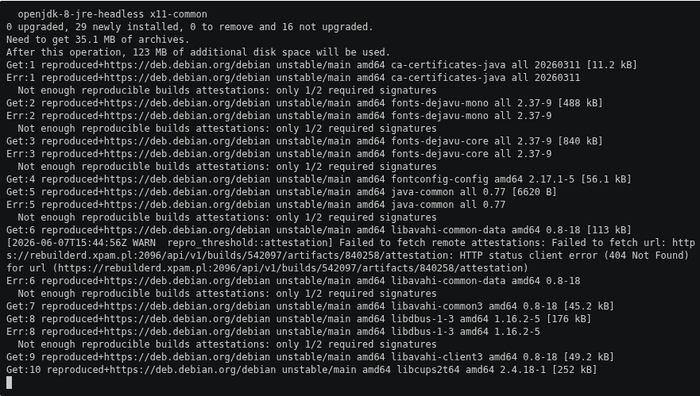
Only installing reproducible packages with repro-threshold A very interesting demonstration is now available showing how you might configure your Debian system to only install packages that have been reproduced by m/n rebuilders. This is implemented via a reproduced+https:// APT transport ( a mechanism for communicating between the APT client and its repository source commonly HTTP):
Every package download is intercepted by repro-threshold, which queries two independent rebuilders for a signed attestation before allowing installation to proceed. [It] is important to note that [an] install will only succeed if all package dependencies are also reproducible.
The demo gives examples of how to quickly experiment with this using a Docker container.

Distribution work In Debian this month: The IzzyOnDroid Android APK repository reached its next milestone this month, now covering 2 out of every 3 apps (66.7%) with reproducible builds. Their documentation for debugging and fixing failed builds has steadily grown as well. More clients have picked up showing reproducibility results (e.g. Droid-ify), and Neo Store now can be configured to stick to only reproducible applications. Further, an independent builder has been added to the build farm, increasing the trust level even more as APK builds can have multiple confirmations now. At the same time, IzzyOnDroid s rbtlog got several new features. The most outstanding is caching for frequently used resources such as reproducible-apk-tools, command-line tools and NodeJS in order to counter ongoing issues with GitHub availability, while at the same time saving bandwidth and build time. This change also enables some other some smaller enhancements such as being able to configure build timeouts per recipe for those builds running longer than the average, release pattern filtering for update checks or having a field for maintainer notes to shortly summing up e.g. why a reproducible build failed.
Lastly, Bernhard M. Wiedemann posted another openSUSE monthly update for their reproducibility work there.

diffoscope development diffoscope is our in-depth and content-aware diff utility that can locate and diagnose reproducibility issues. This month, Chris Lamb made the following changes, including preparing and uploading versions 319, 320, 321, 322 and 323 to Debian:
  • Debian adds an extra Flags: line in the output of ocamlobjinfo, so adjust the test for cross-distribution compatibility. [ ]
  • Bump debhelper compatibility level to 14. [ ]
  • Fix compatibility with Ocaml 5.4.1. [ ]
  • Use --long-form-style arguments when calling apktool in order to support apktool version 3. [ ]
  • Support Androguard version 4 and previous versions at the same time. [ ]
  • Update copyright years. [ ]
In addition, Jochen Sprickerhof added better header detection for the Sphinx documentation system [ ], Michael Daniels fixed the tests when run with zipdetails version 4.006 [ ] and Zbigniew J drzejewski-Szmek added a version of the deprecated os.path.commonprefix method [ ]. In addition, Vagrant Cascadian updated diffoscope in GNU Guix to version 321 and 323.
Chris Lamb also made the following changes to strip-nondeterminism, our tool to remove specific non-deterministic results from a completed build:
  • Skip symlinks when manually called via /usr/bin/strip-nondeterminism. (#1139000)
  • Update debian/watch format. [ ]
  • Drop Rules-Requires-Root: no and Priority: optional fields. [ ]
  • Bump Standards-Version to version 4.7.4. [ ]

From our mailing list On our mailing list this month:
  • kpcyrd posted to our mailing list regarding the waves of malware uploads to aur.archlinux.org . Curiously, every incident I looked at used npmjs.com for malware delivery , specifically where the npm package includes an (automatically executed) preinstall script that is an ELF binary.
  • kpcyrd also announced the release of debian-repro-status version 0.4.0, a tool written to give you an approximate idea of how viable it would be to enforce a reproducible packages only update policy for the computer system you ve built :
    The change updates dependencies to the latest versions, and adds support for multiple -H options, to query results from multiple rebuilderd instances. The results are also now fetched concurrently.
  • kpcyrd also reported that, whilst taking a screenshot for the above release, they noticed that the debian:sid container now is 100% reproducible.
  • Finally, kpcyrd also created a pull request against the add-determinism package to update the itertools and zip Python dependencies.

Documentation updates Yet again, there were a number of improvements made to our website this month including:

  • Chris Lamb added a reminder re. using the UTC variants of the Javascript Date methods. [ ]
  • Mattia Rizzolo moved OTF to the old sponsors list. Thank you for your support!. [ ]
  • kpcyrd updated the Rust documentation to recommend using the --release argument for consistency. [ ]

Patches The Reproducible Builds project detects, dissects and attempts to fix as many currently-unreproducible packages as possible. We endeavour to send all of our patches upstream where applicable or possible. This month, we wrote a large number of such patches, including:

Four new scholarly papers Kenichiro Muto and Kuniyasu Suzaki of the Institute of Information Security in Yokohama, Japan published an interesting paper this month titled Attestable Build Chain: Enabling Trust in Reproducible Builds (PDF). Their abstract is as follows: Ensuring trust in software supply chains requires verifying not only artifacts but also the processes that produce them. Although Reproducible Builds (R-B) require rebuilding to validate artifacts, they cannot verify whether the build was executed with the intended toolchain and inputs and may reproduce unintended or compromised builds without detection. We present Attestable Build Chain, a framework for externally verifying build-time execution without rebuilding. Rather than preventing compromise, it provides verifiable, tamper-evident evidence of actual build-time execution, enabling verification of build process integrity from observed file accesses during the build. [ ]

Julien Malka, Stefano Zacchiroli and Th o Zimmermann published a 50-page report detailing A Decade of Software Reproducibility in the Nix Package Ecosystem:
We find that functional package management enables extremely high rebuildability over time (near-universal ability to reconstitute historical build environments and rebuild software packages), while bitwise reproducibility has steadily improved and reaches a high point in recent years (up to 93% in 2024). Early years show substantially lower bitwise reproducibility, indicating that functional package management alone does not guarantee bitwise-identical outputs, and that the observed high level of bitwise reproducibility is not solely due to the package management approach. Common causes of unreproducibility, both in the rebuildability and bitwise reproducibility dimensions, include management of dates in build and test processes; we quantify their prevalence and other common causes using manual analysis of logs of rebuild failures and automated analysis of diffoscope.
A PDF of their report is available online

Tim Bastin of L3montree GmbH and Jacek Galowicz of Applicative Systems GmbH from DevGuard published a paper detailing How We Built a Sovereign, Reproducible Container Supply Chain for DevGuard:
This paper presents how the DevGuard project rebuilt its OCI container pipeline around reproducible Nix builds and independent dual-platform digest verification. DevGuard images are built hermetically from pinned source revisions, signed with Sigstore/Cosign, and verified through digest comparison across GitHub Actions and sovereign GitLab infrastructure hosted on container.gov.de. We describe the practical integration of reproducible OCI image builds into existing CI/CD workflows and argue that independently reproducible container digests provide a stronger integrity guarantee against build tampering than provenance alone. The paper further discusses remaining trust assumptions and the relevance of sovereign build infrastructure for government and regulated environments.
Finally, Yiseul Choi, Junga Kim, Jun-Ho Hong and Seongmin Kim of the Department of Convergence Security Engineering at the Sungshin Women s University in Seoul, Korea titled Attestation-based verification of SBOM integrity via consumer-side reproducibility:
Software bills of materials (SBOMs) support supply chain transparency, but they do not prove that a delivered SBOM reproducibly corresponds to its software artifact. Existing signing and provenance mechanisms protect integrity and traceability, yet lack consumer-side reproducible verification. We propose an SBOM integrity verification framework combining procedure disclosure, consumer-side reproduction, authority-generated reference evidence, and digest comparison. A trusted authority records a reference digest, and consumers compare it with locally reproduced and delivered SBOM digests. Experiments on 100 real-world container images show detection of artifact tampering, SBOM substitution, distribution modification, and adaptive tampering beyond signature-based approaches


Finally, if you are interested in contributing to the Reproducible Builds project, please visit our Contribute page on our website. However, you can get in touch with us via:

10 July 2026

Bits from Debian: New Debian Developers and Maintainers (May and June 2026)

The following contributors got their Debian Developer accounts in the last two months: The following contributors were added as Debian Maintainers in the last two months: Congratulations!

7 July 2026

Thorsten Alteholz: My Debian Activities in June 2026

Debian LTS/ELTS This was my hundred-forty-fourth month that I did some work for the Debian LTS initiative, started by Raphael Hertzog at Freexian. During my allocated time I uploaded or worked on: Besides fixing all CVEs of asterisk in Bullseye, I started to look at asterisk in other releases as well. Rather surprisingly asterisk is only part of Unstable and Bullseye. All other releases don t include any version of asterisk at all. So first things first, besides some security related RC bugs, asterisk did not migrate due to RC-bugs in dahdi-linux. As I maintain osmocom-dahdi-linux (which supports less/other hardware), I looked at the open issues and after some rounds I could upload a new upstream version, fixed some bugs and resolved issues with piuparts. dahdi-linux meanwhile migrated to testing, job done!
As a next step I looked at the open CVEs. Some of them had been already fixed in previous uploads but had not been marked accordingly. So I fixed all remaining ones and sent a debdiff to the maintainer. Unfortunately there was some kind of overlap in our work and he ignored my debdiff but uploaded a new upstream version. Anyway, job done as well, no open security issues anymore. The only thing that hinders asterisk from migrating to testing is the reproducible build. So if anybody has some spare time Other things I worked on were the regression update of rsync. Some of the elven new patches need to be backported, but I am confidentially to finish this month. I already reviewed the rsync uploads of Sylvain to Buster and Stretch, so I don t expect any big hurdles here. I am also making progress to find the correct patches for hplip and cups. Debian Printing This month I uploaded a new upstream versions: This work is generously funded by Freexian! Debian Lomiri This month new upstream versions of dozens of lomiri packages have been released and I uploaded lots of them to Debian. After they migrate to testing, I am also going to sync them to the Ubuntu PPA. This work is generously funded by Fre(i)e Software GmbH! Debian Astro This month I uploaded a new upstream version or a bugfix version of: Debian IoT This month I uploaded a new upstream version or a bugfix version of: Debian Mobcom This month I uploaded a new upstream version or a bugfix version of: misc This month I uploaded a new upstream version or a bugfix version of:

6 July 2026

Aigars Mahinovs: How to make a good group photo

Taking a good group photo consists of multiple aspects: I can say with confidence that nearly everything here comes from having failed to do these things right at least once, even on the latest attempts, so this is an ideal to reach towards, not something we expect to hit every time. The Goal The main goal of a big event group photo is capture both the moment itself and each individual person inside that moment. We want people, who were not there to see all the people involved and get an impression of what it was like being there. It needs to show the breadth and depth of people that make up this group, this project. And we want people who were there to be able to look back the next week, the next year or in ten years and remember - ah, yes, I was there, I was standing right there with this grin on my face next to this wonderful person and I was feeling great. Hardware Based on the goal we want to have high level photographic gear that is able to capture both a broad enough picture to encompass all the people and some of their surroundings to communicate the context (without undue distortions) and to deliver enough detail and resolution so that faces and facial expressions and underlying feelings of every single person in that group could be clearly seen and preserved. To both capture the context and minimise distortion the final picture should be just a bit wider than normal human field of view. That is about 50mm for a full-frame camera or 35mm for a typical 1.6 crop camera. You can go a bit wider if there are no better alternatives (as detailed in the scouting section), but be prepared that corners of the image will be distorted and not really usable (but we can fix that in processing step). Or you can go to unusual aspect ratios, like we did in Debconf 10. In the absence of a 100MP+ camera, you will need to be stitching together multiple frames to achieve resolution high enough to have enough pixels-per-face to see emotions clearly. This means that the photos you will actually be taking will be tighter than the overall field of view mentioned above. Still, a higher resolution camera body is preferable - nowadays 24MP-32MP cameras APS-C provide a good compromise between resolution and price, but 45-67MP full-frame cameras also exist on the market. Assume that we will be shooting in a bright environment, so most likely with quite low ISO settings, that means that high-ISO noise characteristics of more expensive cameras will not really play a role here. You will also not need very fast burst modes, even manual speed of one frame per second is sufficient. You will also want to get as much detail as possible out of your lens, and this is the most important part. You can do amazing work in all other steps of the process and have a great camera too, but if you pair it with a lens that is not sharp, then the end result will be disappointing. You want the lens that is sharpest corner-to-corner when stepped down to about f/8-f/11, that you can get for your system. You also want that lens to be about 85mm full-size sensor or 50mm for 1.6 crop size. Luckily that kind of range is also a great range for optical design and sharpest lenses are typically available in exactly these kinds of sizes. You absolutely want to have a fixed focal length lens, not a zoom lens. Even profession grade zoom lenses often deliver worse image quality compared to fixed lenses that cost less 1/10th of their price (when shooting in the same focal length). Newer design lenses are better than older lenses - optical design, coatings and precision manufacturing have advanced a lot over the decades. Retro look is great for mood, but not as good for actual resolution and clarity. You don't need to overpay for most expensive lenses because those often only improve image quality on lower F-stops. To encompass the whole group we will need to shoot at f/8 and in bright light, so the extra benefits of those f/1.2-capable super expensive lenses will not come into play here. We will have no use for a flash here. A tripod will be too restrictive when rapidly repositioning the camera between different parts of the panorama shoot. But a monopod might help with stability - I have not tried that myself, however. For my last photos I used a Canon EOS R7 (32.5MP) with Canon RF 50mm f/1.8 STM lens and considering an upgrade to Sigma 56mm f/1.4 DC DN for the next time. Scouting Scouting a good location for the group photo is another big chunk of a successful picture. The critical piece of the puzzle is lens-to-face distance. In order to keep everyone's face in-focus and have enough resolution on the farthest faces (without making nearest faces truly massive) we want to do everything possible to reduce the variance in lens-to-face distance - to reduce the difference in distance between closest and farthest face. The most effective way to do that is to have the photographer climb higher. To see this in action on the Debconf photos, compare Debconf6 (very high camera position, group on level ground - good) to Debconf10 (camera not too high, group on stairs, still good) and to Debconf17 (camera could not get high enough and the group is on flat ground - not great). Even the Debconf25 photo was suboptimal from this perspective. The Debconf23 photo was a very good example from the recent years - good height and also the group was positioned in a semi-circle so there were no people directly in front and very near to the camera. So you are looking for the highest point you could get to (even if that requires a special permission of key or a ladder) with a field large enough to fit the whole group comfortably. How to check that? Normally I simply take a photo from the top of the whole area and note down from there where the extreme corners of the group could be and still be fully seen in the shot - not blocked by trees, buildings and shadows. Then I go down and measure that space. Rule of thumb being - people in one horizontal line can stand 1 normal length step from each other and two horizontal lines can be half a step from each other vertically. So I can just measure a rough rectangle in steps, multiply the sides, multiply that by two and I have the rough number of people that can fit there for the photo. Once you have a candidate location or two, it is important to check them at the same time-of-day as you plan to do the photo (see organization section for that). You want to make sure that the whole area of the group is in the same illumination - if half of the group is in the sun and half in a shadow, then you will be having a very bad time later. The absolute ideal positioning for the group photo is to have everyone be in shadow, but still have enough bright skies and bright buildings in front of the people to give good illumination of the faces. Worst you can do is have the sun be behind the people (so all the faces are really dark) and second worst is have the sun be directly in front of the group, so that the faces are very well illuminated, but everyone's eyes are closed because they are being blinded by the sun. And sometimes all you can do is pray for some light clouds to provide for even and dispersed light. Debconf23 was very lucky that way. Another consideration is to how people are going to get to that place. You need to consider accessibility needs of people (it is ok, if it takes more effort or time, but it needs to be organized and communicated well in advance). And you need to consider how the big masses of people will be getting there - how to tell people where exactly it is and how to get there from various locations where people might be hanging out during the event? Having an alternate location indoors might be necessary if the weather report for the next days is not sufficiently predictable. We had to use that contingency in Debconf9, for example. Organization It's hard to take a good group photo if half of the group does not show up or is too late, so this needs some organization to happen smoothly. First of all you need to choose date and time for the photo. The photo does not take too much time from the schedule of the event and can be squeezed in after all the other events are already scheduled. In fact I prefer that as it allows you the flexibility of choosing the date based on weather conditions and time based on light and shadow conditions in potential photo spots. You don't want to choose the daytrip day as most people will be away and return times are not really predictable. You do not want to choose the morning after Cheese and Wine party for obvious reasons. First day and last two days are also sub-optimal as some people arrive late and some leave early for various personal reasons. Also you don't want it to happen just before Cheese and Wine either because then you'd have very little time and clarity to do the processing of the image on the same day. For timing, the best way, in my experience, is to schedule the photo directly after the end of talk sessions before a meal break - lunch or dinner. Typically in the Debconf schedule there are 2-3 daily breaks planned, say for Debconf25 there was lunch, afternoon break and dinner. Talks are planned to end ~10 minutes before those breaks (and meals) begin, so for example, afternoon break starts at 16:00 and all talks in the previous block end at 15:50. In such a case just schedule the "Group photo" event from 15:50 to 16:05. This gives people the info to go there directly from the end of all talks and that they will have sufficient time for break/meal afterwards. Do not forget to specify the location (as exactly as possible) in that event entry and make sure to post it at least two days in advance. People often want to wear something specific for the photo and thus need to know about it in advance. This also makes sure that people do not make alternate food plans for that specific break and don't leave the venue. Announce the date, time and the exact location as wide as possible, don't be shy. Announce and discuss mailing lists, IRC, Signal, Telegram, make sure the front desk knows in case anyone asks in-person, ... Check that it is again included in the announcements email on the day preceding the photo date. When the date has arrived, it is a good idea to check in early with people with special mobility needs to make sure they know where to go, how to get there and how much time they will need to be able to get there on time. As the final round of talks before the group photo is starting up, it is time to recruit "runners". I've had great success with this technique. The idea is pretty simple - for each room where people congregate (talk rooms, hacklabs, cafeteria, outside hackspace, front-desk, ...) go there and choose one person. You want to choose a person that you will recognise and remember among everyone else in the group, either because of who they are or what they are wearing, whatever works best for you. If they agree to help, instruct them to: "at end of talk, announce that the group photo happening now and the location, herd people towards the photo location, be the last person out, make sure there are no stragglers from this area behind you, when you arrive to the photo place I will assume that everyone else from this room is also now there, when you are there catch my attention and show this sign so I know for sure that it is all good and make sure that I did see it from you". With that sorted out all you will need to remember is how many runners you recruited and how many have reported in to figure out if everyone has now arrived or if we still have to wait for someone or some group. Then you will only have one last point of organization left - shaping the crowd into a group. People will not know what your vision for the group photo is, so you will have to give clear and LOUD instructions on where people should not be standing. Use clear, large gestures to support your words. You want to compact the group, have the people that just joined in the last moment and are standing to the side come deeper in and join the crowd. Have any holes in the middle of the crowd filled in. Forming a semi-circle instead of a blob helps with averaging face-to-lens distances. Make sure people are not in unexpected shadows. Make sure carried objects, like umbrellas of flags do not cover the faces of other people. Take the time to look at everyone face to make sure there are no people hiding behind someone's shoulder - typically they are not aware that their face is in fact not really visible. If there are such people, call them out and point directly at them and encourage them to step forward, if they wish to do so. You are the only one seeing the final picture now and only you can correct it before capturing the moment. So a few extra seconds here are worth taking, even if 300+ people are standing in scorching heat and waiting on you. When you are happy with what you are seeing, make sure to tell people clearly that you are now about to take the pictures and again remind them not to move and explicitly not to turn their heads to the side until you are done (this is the source of most of the extra work in processing). Be very loud and clear and make sure you have everyone's undivided attention before you start saying the important stuff. When done - say so. There will be other groups that will want to also have a photo taken after the main group is a bit more dispersed, so don't run away. Typically at least the T-shirt group will want a picture and also all the organizers. Final bit of organization during the group photo shooting itself is the sneaky self-insert. You may choose not to bother with it, or do it in the simplest way, like I did in Debconf6, but if you really want to blend in with the crowd, you need to have someone else take a photo of you in the exact same location at the same date and time from the same location. So you should already during shaping the crowd decide where you would fit in, it is easiest to blend in at the back of the crowd and to one or other side, so that it appears like you are just standing behind the shoulders of a couple peoples. Remember that spot - it is easiest if you stand in the exact same ground spot when your photo is taken. Just go down, recruit a volunteer to take your photo, make sure the settings are fixed to the same ones as for the group photo shots and have them take a handful of shots of you - one of you centered in the camera frame and a couple more with you more towards the corners of the frame. This distortion from being off-center in the frame may be important later. Preparation In addition to preparing the crowd for the photo, you also need to prepare yourself and the equipment. Make sure you have dusted your camera sensor and cleaned both inside and outside glass of your lens. It is usually a good idea to remove any filters from the lens. Install the hood, if that could help with blocking the sun flares. Make sure you have the right lens and that you have installed the right lens. For fixed settings I typically shoot in JPEG with RAW being there more like an emergency backup. The extra dynamic range of RAW could be used, but it is really complex to do that in combination with image blending and it is hard to get right, so I prefer an all-JPEG workflow and fix the dynamic range in the scene itself, before shooting. For Canon I am using the Standard profile that boosts the color saturation and sharpness a bit as I just enjoy that look and find it hard to get anything significantly better from RAW data even with a lot of effort. In any case make sure you have enough space on the cards to take at least 100 images and that you have a full battery. Do not use high speed burst setting because it is then too easy to take too many pictures at the start of the sequence and be stuck with your camera still in "Busy" state writing big RAW files to slowish SD cards and not allowing you to finish the full picture rapidly. You want to have the shutter speed at at least 1/100th of a second to prevent blur from both your hand movements and also from people in the shot moving around a bit (image stabilisation will not help you there). And you want to have the aperture to be around f/8 - lower apertures risk people in front or behind falling out of focus, make the lenses look less sharp. Higher apertures also start to become less sharp due to diffraction effects above f/8. ISO should stay as low as possible, ideally at ISO 100, but if there is not enough light then upping the ISO to 400 would be the first step that I would try to do and second would be decreasing the aperture to f/5.6. If there is too much light, then increasing the shutter speed should be the safe thing to do. As people start to arrive into the shooting location - check the exposure and nail down the settings, ideally in manual mode. Consider that left side could be a bit lighter or darker than right side. Err on the side of making the picture a bit too dark as there is more depth to darkness before cut-off compared to clipping on the high end. However, do not trust the exposure detection, instead take a picture and look specifically at skin tones in faces of people that already are standing in the photo area. Faces are the key bit and the exposure needs to be adjusted just to the faces and ignore darker of lighter clothing. Do some test shots and find settings where faces look not too bright, but also not very dark and fix those settings in manual mode. Now you are ready for the action. Shape the crowd, check the faces and the action can start! Execution During taking of the group photo you want to finish it fast, but at the same time you have to take the time to make it right. If you hurry too much under pressure, you risk being left with unusably blurry images and the whole effort wasted. Having already prepared and verified the manual settings makes it easier. When you are taking pictures, you have to remain as still as possible - even at very high shutter speeds even slow hand movements are still bad for image quality. So think of the movement as of biathlon athlete shooting the very middle of five, very separate targets - take a burst, reframe, then steady up for a second and only then take the next burst. 3 frames per burst are sufficient. 90% of the time the very first photo of a burst will be best. As you move from frame to frame, aim for just a bit more than half-frame overlap. This will give the opportunity to skip frames if all is good, but also have backup coverage of every face in case of problems. Proceed systematically, I typically start off on the top left of the crowd, then go right until the end of the line, then shift down half a frame and go left until the end and repeat until I am done with the crowd. After that it is very helpful to also immediately take photos of a "frame" around the whole crowd. Stitching process often distorts the frames in weird ways that leave holes in the resulting image that you can fill if you have a wide frame around the crowd. It is possible to compensate with creative cutouts in the final image (like Debconf9), but the more framing room you make, the more flexible you will be able to be with cropping of the final photo. The frame also gives you the opportunity to capture more of the context of the place and space. As an example, Debconf25 group photo in the end consisted from 9 images + 1 for sick people + 1 for me. I ended up missing the framing shots for bottom left, top left and top right corners. To get there I took 68 images. And in some years it was more than a hundred. Processing This part might be less stressful than taking the pictures from intensity perspective, but it lasts longer. Depending on you luck, skill and perfectionism it can take anywhere from 3 to 9 hours of work to complete. Before you start, however, you should first request things that you will need for other people. This can even be done before taking the actual group photo, but usually I forget. To finish the photo you will need three things: The first two you should be able to get from the respective organizers. The motto is harder. I typically try to ask the current DPL to come up with something describing the current mood of the project or of the event, but it is rare that it is that easy. Most of the time I came up with something as I was editing the photo and reflecting on what was the mood, the feeling, the mojo of this conference and of this year was like. Bend that around a recognisable phrase or expression, make it a bit more insider-relevant and you are on the right path. Some years this was the hardest part. For the panorama stitching I will describe the workflow that has served me good for years, but maybe there are better ways possible nowadays. Feel free to let me know! First I would save all photos taken and select one sharpest photo from every burst. Next I would select the minimal number of photos that appear to be covering the entire crowd. The fewer images you use, the better in the end because the most quality problems crop up in the areas where photos are getting stitched together. Fewer seams leads to fewer issues. Open Hugin (you will also need enblend and enfuse installed) and import your minimal set of images into it. Click the "Align" button and wait a while - the processor will be trying to figure out keypoints in each image and then try to match these points between the images to try to fit them all together into a single projection. To do that it will distort the images. This is the trial and error process part. You may need to add, remove or replace images to get the stitching to work or to work better. You may want to add more of the frame images to fill the ragged holes around the image. After initial alignment, go to "Move/Drag" tab and move the image a bit up in the projected field of view and make it a bit more central visually. That will help a bit with the distortions in the near-by people and people in the corners of the image. In the "Crop" tab set the initial crop - leave it generous, you can always crop more in later steps. Do not be afraid of leaving in sizable chunks of black homes, empty skies or grass. All of that can be filled in later as well. Go back to the "Assistant" tab and click "Create panorama". It is good enough to have JPEG output at 100% quality using exposure corrected low dynamic range output option. Make sure to check the "Keep intermediate images" option. This will not only generate the final, merged panorama, but also keep around the individual images after perspective correction and exposure blending steps. These are critical for fixing blending error in the next step. You might need to go back a forth a few times with a different sets of source images, maybe adding some image between other two, maybe removing another to reach a better starting point. The key part to pay attention - how many ugly stitches are there in the image. Check every face, the blending algorithms do not recognise faces and sometimes try to stitch one face from two or more images creating very weird effects. They can be fixed in the next step, but it is rather hard manual work, so the fewer such faces are in the blended image, the less work you will have. In some years I've managed to find a combination where all faces were good and in other years I had to manually fix 13-15 faces. Do not try to blend the extra pictures (like with you or with sick people) into the main panorama with Hugin - it will get very confused with the parts of the grass that it is able to see where other people were standing. The next is the final processing in GIMP. Think of it like a large and complex project - do as much as possible in separate layers, save often. Fixing wrongly stitched faces and also putting yourself into the photo are very similar activities in the end. Just the scale and the source differ. For yourself you just cut out yourself (upper torso is enough) from the separate photo. For corrupted face, choose one of two intermediate images that the Hugin created where the face is transformed, but not yet merged (with a different version of itself). In either case crop the photo to roughly the interesting size and put roughly in the right spot as a separate layer on top of the group photo background. Reduce the opacity of the small layer to 30-40% and zoom in to 400%. With that it is much simpler to position the layer with pixel precision. Then all you need to do is add a layer mask to this layer and paint it just right. Basically in layer mask black means transparent and white means non-transparent. So you need to just make everything that is you have white mask and everything that is not you have black mask. And smudge the border a bit with finger tool or blur to make the transition smoother. Easy to say. Hard to do. This is what takes most of the actual work hours in post-processing. You might miss someone. I am sure Phill is just thrilled to see me in the very middle of the Debconf25 final picture .... But do try to fix them all. Use large, sweeping geometric figures to cover up black holes, empty grass fields and other sub-optimal corner features. And then use that newly created free space to put in a large version of the logo of this years conference, decently sized motto and slightly smaller invitation to the next years conference. Do not forget to add a copyright and license statement somewhere in the corner in smaller, but still well readable font. I am using a text like: "Photo by: Full Name, Email: fullemail@debian.org, License: GPLv2+ or CCv3-BY" This ensures that this image may be used in any press coverage (with basic attribution) and also can be included in any GPL-licensed software, if that ever comes up. The same statement is also in the metadata of the image file (see Image-Metadata-Edit metadata in GIMP) along with information that states that this is "Debian Developer Conference Group photo, City, Country, Year". Image->Image properties->Comment is another place where GIMP hides this EXIF information. For ease of use, in addition to a full-resolution image it is also useful to make a lower resolution version that would still fit on a 4K screen at full resolution, so about 3840px wide. Some photo hosting services set other limits for image size as well, so it might be needed to scale the image down below 100Mpix to upload it to Google Photos, for example. Publishing So, it is finally 1AM and the group photo is ready! How do you push it out to people? Well, in all possible ways and places. Again - don't be shy, people do really want to see it. Push it to whatever you use for your shared photos. Push it to Debconf shared git (note that this is GIT-LFS repo, make sure you know how to add content to the LFS specifically). All permanent links to that in GroupPhotosAll wiki. And then send those links to IRC, Signal, Telegram groups, debconf-announce mailing list. Publish it in your blog and push that to Debian Planet. Push it in Threads, Bluesky and Mastodon. Send an email separately to Debconf orga team. And one to Debian Publicity Team so they can put it into the Debian Home Page and push via Debian micronews accounts. And that is about it. Now you can go back to enjoying the rest of the conference. Or running around doing other things that you think need to be done. It's up to you. You did it. This moment will remain with people for a very long time. And you helped. Questions? Feedback? Just ask here or here.

1 July 2026

Ben Hutchings: FOSS activity in June 2026

This month s work was dominated by the transition of Debian 12 bookworm to support by the LTS team, and by review of some large updates to Linux stable branches. Linux 6.12 is currently available in bookworm-backports, but that suite will stop accepting uploads after the last bookworm point release. I updated some supporting packages in bookworm in preparation for adding Linux 6.12 there. I also prepared for the possibility that bookworm-backports would close earlier. Since the LTS team is still also maintaining Debian 11 bullseye until August, I reviewed upstream changes for both Linux 5.10 and 6.1 stable branches and reported a number of regressions and other issues.

30 June 2026

Joey Hess: big loads offgrid with a small battery (sidelined)

No matter that the hype cycle wants you to think, the renewable energy transition is the biggest thing happening in tech and it's happening faster and faster. Despite being neck deep in it personally with offgrid solar projects, most recently solar hot water, increasingly it becomes clear I'm watching from the sidelines. In Australia, everyone gets 24 kwh of free daytime electric power now. That's without installing any solar panels of their own, the grid just has that much excess capacity. All it takes to save $thousands per year (and avoid emissions) is to schedule some big loads like the hot water heater and EV to charge during the day. To save more, drop in a home battery that charges for free and powers the home through the evening. In Germany, a 2 kwh plug-in home battery costs $350 and the electric company will pay you $130 per year to plug it into your wall. There are similar offers throughout Europe. In Cuba something something geopolitics, oil blockade, belt and road => suddenly 1GW of solar farms with another gigawatt on the way. I'll soon visit South Carolina where with no subsidies whatsoever from a decidedly renewable-unfriendly government, it made sense for my dad's house to get a whole home battery and double the solar array. The resulting system will be able to power the well pump and probably also the whole geothermal HVAC system through the kind of month-long grid down events that happened in Hurricane Helene. Myself, well, I've got a by modern standards small 4 kwh home battery that powers my house offgrid, and I've recently installed a heat pump hot water heater. That's after about a decade pondering what solution to use for solar hot water, to replace an aging and horrible propane instant water heater. I've in the past considered everything from evacuated tubes to special direct drive inverters to DC resistive MPTT dump loads. The solution turned out to be just a big enough solar array, and plugging in a 120v hot water heater that needs only 500 watts in heat pump mode. Plus a small amount of code to manage when it runs. In the time I was thinking about that, economies of scale and tech improvements just wiped all those other possibilities off the map, it's not economical to install and maintain a separate evactuated tube heat collector when a pile of solar panels costs so little and when electric hot water has gotten more than 200% efficient. I also recently completed my permanant EV charger installation, with a new inverter and conduit and proper wiring, and increased the car's charge rate to 2 kw. Eliminating the need to charge anywhere except at home except on road trips. Coordinating when these two big loads run, to maximize solar production and ensure that the house battery is full at the end of the day was ... not hard at all actually? The car charger amps can be dialed up and down to match incoming solar power fairly well, and leave some room for the hot water heater. They both operate as more or less dump loads. More or less because neither one can be cycled on or off very fast (to avoid wear and tear on the car's contactor and the heat pump's compressor), so it makes sense to leave them on and skate through short cloudy sections of the day, as long as the house battery doesn't get too low. How low is too low for the house battery? Depends on the time of day. The code it's currently using, which may get tweaked over winter:
    -- When the battery is charged enough to run major loads that may prevent
    -- charging it further.
    --
    -- This varies with the hour of day. Early in the day, the battery does not
    -- need to be as full to be considered well charged, since there is
    -- still plenty of time for it to charge up. Later in the day, with less
    -- time to charge, it needs to be more full.
    wellCharged :: Hour -> Percentage
    wellCharged (Hour hour)
              hour < 9 = Percentage 90 -- night
              pmhour <= 0 = Percentage 50
              pmhour <= 1 = Percentage 60
              pmhour <= 2 = Percentage 70
              pmhour <= 3 = Percentage 80
              pmhour <= 4 = Percentage 90
              otherwise = Percentage 95
      where
            pmhour = hour - 12
More complicated is, what to do it there's solar power to run one or the other, but not both? This is starting to get into the territory of microgrids now, or of demand response programs, so there's a whole industry or three out there doing industry things geared at the kind of no-brainer solutions I mentioned earlier. From what I've gathered, all of them involve proprietary protocols and gear. What I've done is to read the state of the hot water heater and car, and prioritize hot water over the car. Except, if the car is below 10% it urgently needs to charge. And I found a really simple way to decide when to run the low-priority load: Just check if the house battery's current charge will be considered wellCharged in an hour. So if it's 2 pm, the battery needs to be 80% charged to run the lower-priority load, and if it dips below that, that load will turn off but the high-priority load will keep running down to 70% battery. Unfortunately, getting any information out of my hot water heater relies on a vendor API server that is often down on weekends, and reverse engineered the web page of my EVSE[1] to control it, to say nothing of the nightmare of getting the car's state of charge from The Cloud. Anyway, I'm pleased with having easily tweakable code and how far I've taken this offgrid, and everything I've learned doing so, but like I said, I'm clearly observing from the sidelines over here while the most significant thing for all of us is going on over there. You might appreciate my code or method, but you'll eventually be plugging in a home battery or signing up for a free daytime power tarrif from your electric company, or having professionals install a whole home system for climate resiliance. So my question is, where does free software fit into all this? There are things like Home Assistant that do productize the kind of thing I'm doing enough to be useful more widely. But still niche. Meanwhile there are inverters and batteries that phone home to China, and every consumer facing install is either "use this device" or "integrate these 3 proprietary devices". I don't think focusing on these negatives is really useful though, I'm more trying to understand where all this is going and then maybe get out ahead of it in some useful way with free software. Your thoughts welcome.
[1] Obviously OpenEVSE exists, but it didn't meet my needs hardware wise. And I could set my EVSE to use an OCPP server but it was easier to do the screen scraping than find an appropriate one, and I have the feeling I would not appreciate learning any more about OCPP, in the same way I really don't want to know a lot about web browsers' tag soup mode.

26 June 2026

Russ Allbery: Review: Platform Decay

Review: Platform Decay, by Martha Wells
Series: Murderbot Diaries #8
Publisher: Tor
Copyright: 2026
ISBN: 1-250-82701-9
Format: Kindle
Pages: 245
Platform Decay is the eighth book in the Murderbot science fiction series. You absolutely should not start here, but you also don't need to remember the specifics of the previous books. As the story opens, Murderbot and a friend (the identity of whom is a spoiler for previous books) are infiltrating a Corporation Rim torus, a massive space station that encircles a mined-out planet. (Like most science fiction megastructures, this is more space than the plot really requires.) Murderbot's mission is to exfiltrate some of Dr. Mensah's family members who have become entangled in corporate shenanigans. The corporates are eager to get revenge for the events of System Collapse, not to mention the other times Preservation Station has upended corporate plans. Murderbot's job is to stop them. The group, in addition to one of Dr. Mensah's partners, includes an older woman and a young child. Murderbot is analytical and of course not at all emotional about children, which is reliably a good time. Also, the older woman is gruff, stubborn, and thoroughly enjoyable. There are, of course, complications that lead to picking up more children and going through rather more of the torus than Murderbot wanted to explore. Each section of the torus is run by a different corporation and has a different constructed environment and visual aesthetic, so there are a lot of opportunities for fights, daring escapes, and incidental trouble. Also, well:
So I had installed a mental health module. I know, I was surprised I did it too.
After the events of System Collapse, University Medical decided that Murderbot needed a bit more metal health support.
The only reason I agreed to it was that the mental health module didn't actually try to adjust my processing or core programming or anything; it just monitored my organic neural tissue. When my neural tissue started to generate weird chemicals and whatever, it would ping me to "check in with my emotional state." Seriously, I could have coded that myself. (I told Dr. Bharadwaj that, and she said, "Would you have ever coded that yourself?" which was totally unfair and also correct. I would never have done that.)
Speaking as someone whose neural tissue sometimes generates weird chemicals and whatever, I sympathize. The specific form this module takes is periodic "emotion check" parentheticals throughout the narration, which I found utterly delightful.
I ran that through risk assessment and it produced the equivalent of a shrug. (Emotion check: Shrug sigil right back at you, you piece of shit.)
This is otherwise an extended action movie sort of a book, much like several of the early novellas. There are no major political or interpersonal developments here and the usual cast (apart from Murderbot) is mostly absent. Instead, we get an extended, dangerous journey through a corporation-controlled habitat, mixed with Murderbot trying to interact with humans in a way that minimizes its annoyance while being hopefully reassuring. It's competence porn with awkward but surprisingly heartfelt emotional bonding, not that Murderbot in any way wants to bond or would appreciate that description. I doubt this will be anyone's favorite entry into the series since there are none of the big reveals or major leaps of character development there have been in the past few books. But, like all Murderbot books, the narrative tone is wonderful and all of the small asides and little moments of character interaction are an utter delight. If you've gotten this far in the series, you know what I mean and you'll be as happy to read more of it as I was. There is a part of me that is hoping for some major plot development, and I always want to see more of ART (who has no significant role in this book), but Wells has the narrative style down so perfectly that I would read and enjoy a book about Murderbot doing just about anything. If you're this far in the series, you probably don't need a review, and since this is an action-heavy adventure rather than a character growth novel, I don't have a lot more to add. There's a new short Murderbot novel out and you want to read it. Recommended to everyone who enjoys the series. Rating: 8 out of 10

19 June 2026

Wouter Verhelst: Agentic coding and Free Software

Through work, I have paid license to windsurf (recently renamed to "devin"), an application for LLM-based (aka, "Agentic") development. I hadn't been using it that much, but in an effort to more clearly understand how this whole AI development thing works, I decided to give it a closer look recently. My conclusions: In its current form, this whole LLM wave is problematic for multiple reasons. But ignoring that, and looking at the technology only, I can say that:

Problems Lest someone (incorrectly) assume that I am arguing in favour of the current state of affairs with regards to LLMs, let me state this first. The way LLMs are built today is highly parasitic. Websites are downloaded in whole, at unsustainable rates, regardless of the consent of the people who made the original content. The result is predictable: servers get overloaded, server administrators attempt to implement various mitigations. Some of these mitigations work; some do, for a while; some are entirely useless. In actual fact, the mitigations are an arms race -- if too many people implement the same mitigation, then the people who try to build yet another LLM so they can extract rent will just try to work around the mitigation, eventually they will succeed, and you'll just have to come up with another mitigation. It's a bit like spam; you introduce regex-based spam filters, they introduce spelling mistakes, you introduce bayesian filters, they add a large batch of markov chain-generated semi-nonsense words made invisible by markup, you add filters to block emails with such markup, they move the text into an image. We have working mitigations today, but eventually we'll run out of ideas. LLMs glob up everything they can while ignoring the license of the source material. The people who push those LLMs claim that pushing the source material through the machine learning algorithms makes the output of the algorithm distinct enough from the source material that the license no longer applies; I'm not so sure that this is true. I guess the New York Times v OpenAI lawsuit will teach us some of the answer to that question here, but even so the ethical questions about "is it OK to bring down another server just so we can download the internet for another for-pay LLM" are still open. And regardless of what the law states, my opinion on "you're using my copyleft code to generate code under a different license" is not something you might like if you agree with the rent seekers' opinion on the subject. That all being said and true, the technology works. You can have a "conversation" with an LLM that resembles a human one. If you pass it some data, you can use plain english to ask it questions about that data, which is a lot easier than to ask it about that in a formal way. You can request it to generate some code, and it will generate something that looks like what you need and that will be mostly correct for like 95% of the time. Now, yes, 95% of the time is not 100% of the time, and no, you can't ask it to "write me a piece of software that implements this 300-page requirements document and get back to me when you're done", because it will fail, and you won't know where it has failed, and you'll take it into production and expect everything to be fine because it won't and this one minor logic bug will cause half your servers to spin and consume credits with your infrastructure provider with nothing to show for it. But that doesn't mean you can't use an LLM to build a large piece of software. It just means you have to understand the LLMs limitations and strenghts, and use them correctly. Here's what an LLM is good at:
  • Generating plausible text
  • Interpreting text to figure out what a plausible meaning or summary of that text is
  • Giving vague indications as to what the probable context of a given body of text is.
It turns out that that's enough to use the LLM to build a reliable piece of software, provided you do it right.

Paradigm shift An LLM can generate text by the truckful. The generated text could be code. Given a good enough LLM, the generated text might even run and do something useful. You can try to blindly run the code, and if it doesn't run correctly, you can paste the error message to the LLM, and it can tell you what went wrong and how you could possibly fix it. This creates a feedback loop: you ask it for an amount of code, you run the code, you receive an error, you tell it that the code is problematic and give it the error message, it makes changes to the code, now you have something that at least no longer fails at startup. If you ask it to add tests to make sure that your code acts as per your specification, now you get an error if and when the code doesn't act as per your specification. Or, well, at least not as per the part of the specification that was correctly turned into a unit test by the LLM. LLMs have a context window, so if the error message is pasted in the same conversation as where the code was generated, it is able to reuse the earlier prompts to refine how it should interpret the error message that you received. You can't really paste the source code of an entire application into the prompt of your LLM, that would quickly overrun its context window. But LLMs also allow you to provide some form of background information -- a document, say -- on which you ask it to reason. It will interpret that document, but doing so uses less of the LLMs context window. So providing the LLM with your application's source code as background information can help it understand better how your code interacts. This is especially helpful if you only provide the LLM the background information relevant to the actual question. So now if you are able to:
  • Create background context with your application's source code
  • Have the LLM generate a first draft of your requested change, plus the tests to make sure it works
  • Compile (if applicable) the generated code (and tests) and run said tests
  • Return any error messages to the LLM with a request to correct the error
Then the combination of "getting it 95% right off the bat" and the above feedback loop means you can generate syntactically correct code, that probably does what you need, in minutes. I say "probably" for a reason. There are going to be cases where you specify a request without a number of details (because they are implied), and the LLM will get most of those details right but just not implement the one bit because it's an automaton and it doesn't think. Or you will ask it to make sure that two bits of the application look exactly the same, without specifying that they must act the same, now and in the future, and it will just generate the same block of code twice and then in a future change it will change one but not the other. But if you review the changes, and you have experience as a programmer, you will be able to spot most cases where the LLM got it wrong. And so it's possible, if not necessarily easy at first, to use an LLM to generate mostly correct code. There are certain places where "mostly correct" code is not desireable. But equally, there are also cases where, "mostly correct" is good enough. After all, most of the software you run today -- the bits of it that weren't, yet, generated by an LLM -- is only "mostly correct", too, because to err is human and we all make mistakes. If not, there wouldn't be any CVEs and your software would never do anything wrong. Now, doing the feedback loop described above is certainly something you could do manually. You could open an account on one of the LLM websites, upload the source code of your application, ask it to generate some new feature, download the newly generated feature, run it, and then copy/paste any error messages back into the LLM. But that's a lot of manual work of the type that computers are pretty good at. So that's what the "windsurf" tool helps you with: you run it inside your IDE -- either a VSCode-based tool that you download from their website which comes with their product preinstalled, or a separate JetBrains plugin that you can install. You can then open your entire relevant codebase in a workspace in your IDE. You then ask the LLM, through the IDE, to generate a new feature in your codebase, and to also generate the test while it's at it. It will use a mixture of LLM interpretation and non-LLM functionality to scoop out the relevant bits of your codebase to send to the LLM as background information, will send it your prompt, will download the generated code and patch or create files, will compile (if required) and run the newly generated code and tests, and will refine the generated code if the tests produce any errors. All mostly automatic; by default, running anything requires explicit confirmation. You can turn that off completely (probably not a good idea), or you can give it a whitelist of things that you don't want to confirm (perhaps OK), and the tool also passes standing instructions to the LLM to never generate any command that deletes a file (which, like with any LLM, can be overridden, but it requires you to be very stubborn and to use more credits than you'd probably like). All this put together means you can build something without writing any piece of code, provided you do it right.

A technically positive evolution Don't go and say, "here's a 300-page document, read it and write whatever the document says". It will get it wrong, it will write a massive test suite that it will only run at the end, it will choke itself up trying to interpret the massive amount of failures it encounters, it will fill up its context window and it will start to forget some of the requirements. That won't work. But what you can do -- what I did, in fact -- is this. First, create an empty workspace. Don't put any code in it. Then, tell the LLM to generate a backend framework using technology X and a frontend framework using technology Y that initially only says "hello, world". Also add tests to it, and run the tests. It will do that. You'll not get much, but it will work. Then, ask it to add some UI elements. A login page, perhaps. A navigation bar. Small things. Most of it doesn't have to be functional -- but tests must be there for the bits that are, and have it run the tests and evaluate the results. Rinse, repeat, until you have a working application. Importantly, in between the steps, you should also run the application yourself and see if the change was implemented correctly. Sometimes it won't be. Sometimes there will be a subtle bug -- I at one point had a the application hang after a few minutes. Sometimes you tell it that there's a subtle bug, and it will discover it more quickly than you could, and it will fix it, and in implementing the fix it will uncover another bug, and then you have to fix that one -- the fix it came up with for the hang was to move something to an async process on the server, which caused the application to start spinning while trying to create hundreds of async jobs (this is when I realized that the hang was a deadlock due to some part of the codebase doing something that indirectly triggered itself). Sometimes it will try to fix the bug you tell it about, and you'll see that it's going off on a tangent that has nothing to do with what you're seeing. It's important to keep an eye on what it's doing, so you can guide it back on track when that happens -- when I told it about the hang, it started investigating the part of the code which sends out emails, thinking that it could hang while waiting for sendmail to finish, but the hang was happening when the application was idle, not when it was sending out emails, and only when I told it about it happening when it was idle did it find the deadlock. So it's not a fully automatic process, and it needs to be guided by someone who knows what they're doing. But if that is the case, you can come up with something that works. I spent evenings and breaks for about a week, and I managed to create a working application which, had I written it by hand, would have taken me a few months of full-time work to come up with. And I now have a side project, fully complete and working, that I had been thinking about doing for more than a decade, but never got around to actually doing, because of all the work that would be involved and I just didn't see myself having the time for. It's not perfect code. But it's mostly good enough, and it will perform the job it needs to. And it looks far slicker than most of the side projects I've done in the past, because in the past I would prioritize between implementing new features or making something look slick, and I would decide that the new feature was more important because it's only for me and there's only me and nobody cares if it looks good or not and I don't have three weeks to come up with something that looks better. But here, I found myself sometimes spending 10 minutes writing a prompt with instructions on making things look better. Because what's 10 minutes when you just spent an hour writing down and refining specifications for functionality and tests? There are a number of other things in which an LLM can help a programmer. For instance. I received a bug report recently in a project I'm paid to maintain that I couldn't make heads or tails of. I opened the source code in my windsurf IDE, pasted the bug report in the prompt, and then requested the tool to analyze the source code and the associated logs and tell me how the described behavior could be happening. It turned out that I had overlooked something, but with the help of the tool, I found the bug in minutes. I was trying to understand a particular part of a large codebase that I didn't really grasp very well. I loaded the codebase in the tool, and asked it to explain to me how a particular action is performed by the code. I requested specific functions and line numbers. I now have a far better understanding of how the code works, and will be able to write that patch that I've been wanting to write for years -- without using the LLM. I have been struggling for, literally, years with understanding why another tool that I maintain was misbehaving in a particular way but only in Firefox. I opened the codebase in Firefox, explained the buggy behavior in plain English, and asked it to explain how this could be happening. It picked up some obscure corner case behavior of ffmpeg and mp4 containers that I was not aware of and that perfectly explained why things were misbehaving in the way that they were. At the same time, there are limitations. Giving an LLM a codebase that was originally generated by an LLM (either the same one or another one) seems to work well. Giving it a codebase that was written by a human and expecting it to correctly update it seems to be more error-prone. I did one or two of those as a trial, and it is more problematic than anything. An LLM is also not intelligent, notwithstanding the popular term of "Artificial Intelligence". On multiple occasions, I've asked it to write a test case for some code that was not set up to do so; and rather than suggesting a refactor is required, it would instead copy the code that needed to be tested and then test the copy, rather than the original. The tool has made multiple similar errors. I have sometimes people describe agentic coding as "similar to interacting with junior programmers", but that is not the case. A junior programmer will either fill in the gaps in your specifications, or ask for clarification when something seems off. The LLM will not do that; it will do what you ask, exactly that and nothing more. If you missed a corner case in your specification, then all bets are off. I remember learning about programming language generations in college. A first-generation language is "machine code", a second-generation language is "assembler", a third-generation language is any high-level language such as C, Perl, or Pascal. I've forgotten what set a 3rd-generation language apart from a 4th-generation language. But I remember the definition they gave me for a 5th-generation language: "you tell the computer what to do, and it will do it". At the time, I thought it was ridiculous. Nobody could ever write something like that. But it's here. And it's a threat to free software.

A threat to free software? Yes. There is the obvious part where most of the well-known LLMs are non-free software. I mean, there are some "open source" LLM models. The windsurf tool that I used doesn't allow you to use them (directly), but they're there. There are also open source applications that implement what the windsurf editor does. So it's definitely possible to work like this without resorting to non-free software and non-free services, even though the non-free LLMs might be a bit ahead of the curve of the free ones. But that's not what I mean. And there is also the obvious thing which I mentioned earlier in this post, which is that the people who try to build LLMs are doing it in unethical, disgusting ways, causing downtimes and disregarding licenses for whatever they can get their grubby hands on. Ideally we wouldn't be in that situation, and ideally this wouldn't be a problem, but we are where we are. And there's the obvious thing where the OSI sold itself out and declared that a machine learning program can be open source even when the very things it was built from -- the training data -- is not available. That's a major issue that the free software community needs to fight against, but there's not really anything that that is a threat to free software. You just build your own, free software, LLM, and you're done. The actual threat is in funding and developer support. Most large businesses do not care about free-as-in-freedom software. They like the free-as-in-beer part, and they appreciate that the free-as-in-freedom bits can make the software more customizable. They are (mostly) happy to do sponsorships of the free-as-in-freedom projects that they use if that means their free-as-in-beer usage of the software gets improved. But why would you care about all that when you can just generate the code you need, rather than interacting with an open source community that may or may not care about your business's interests?

Where to go from here Although I think the moral and environmental issues with LLMs are real and problematic, given the experiments I did I am not convinced that the concept of interacting with a computer system in natural language and to use it to generate code is necessarily deficient. There are pitfalls, but they can be managed. It is possible to use such a system to create throwaway, proof-of-concept type "good enough" code bases. It can be used to interpret code bases and to understand bug reports. I believe that the major issue with LLMs has to do with that saying about hammers and nails:
If all you have is a hammer, then everything looks like a nail.
LLMs are an outgrowth of machine learning, pushed by large corporations. These large corporations have a lot of money. If all you have is money, then every problem can be fixed by throwing more money at it. The initial language models were promising but not (yet) good enough, and it seemed that one way in which they could be improved was to increase the scale of the statistics: throw more hardware (and thus money) at it, and rather than improving the efficiency of the models, just scale up. Scaling up is something that megacorporations are very good at. It's only a money problem, after all. Does that mean that "scaling up" is the only way to improve the models, though? I'm not convinced. Some hardware, such as most modern Apple and Samsung devices, ship with accelerator hardware for machine learning algorithms. There are some models that are small enough to be able to run on these devices. I don't see why it should not be possible to create a small(er) language model that can do some useful part of the above-described use cases; if not locally, then at least on a server that one can run on-prem rather than requiring that you pay rent to one of the LLM companies. The Software Freedom Conservancy has published an aspirational statement on machine learning-assisted programming that, I think, gets a lot right. It's not quite a definition, but it's something to keep in mind. Perhaps that's the way forward? More questions than answers at this point, anyway.

Freexian Collaborators: Monthly report about Debian Long Term Support, May 2026 (by Santiago Ruano Rinc n)

The Debian LTS Team, funded by Freexian s Debian LTS offering, is pleased to report its activities for May.

Activity summary During the month of May, 21 contributors have been paid to work on Debian LTS (links to individual contributor reports are located below). The team released 56 DLAs fixing 877 CVEs. May was a much busier month than usual, especially due to the disclosed vulnerabilities on linux regarding Local Privilege Escalation (LPE), that included public proof-of-concept (PoC) exploits. These reports of course impacted Debian as a whole, and the situation warrants a special mention to the Kernel Team, especially Ben Hutching and Salvatore Bonaccorso, who faced the pace and released linux packages on a weekly basis. On the LTS side, the Front Desk team also triaged a significant flow of high severity CVEs. It is also important to note that Debian 12 ( bookworm ) will be handed over to the LTS Team on June 11th. If you benefit from Debian, especially during the full 5-year lifecycle, please consider subscribing as a sponsor of Debian LTS: https://www.freexian.com/lts/debian/. Moreover, Debian 11 ( bullseye ) will reach the end of the Debian LTS period on August 31st. After that, Freexian will continue the security support under the Extended LTS offer. The team published several notable updates:
  • As mentioned above, several exploitable LPE vulnerabilities in linux were published during May. Ben released the following DLAs for the Debian LTS versions:
  • exim update (DLA-4580-1), prepared by Thorsten, to address a vulnerability that may result in remote code execution.
  • gnutls28 update (DLA-4595-1) by Guilhem Moulin, fixes several vulnerabilities that may result in execution of arbitrary code, information leak, authentication bypass, among other impacts.
  • krb5 updates released as DLA-4603-1, fixing two vulnerabilities that may yield to a denial of service. Updated prepared by Emmanuel Arias
  • lemonldap-ng (DLA-4602-1), released by Abhijith PA, fixing multiple vulnerabilities
  • Two imagemagick updates (DLA-4559-1 and DLA-4609-1), prepared by Bastien Roucari s, fixing several vulnerabilities
  • openjdk-11 and openjdk-17 updates (DLA-4566-1 and DLA-4565-1), both prepared by Emilio, to fix seven vulnerabilities.
  • php7.4 update (DLA-4586-1) to fix six vulnerabilities that could result in remote code execution, information disclosure or denial of service. Update prepared by Guilhem Moulin.
  • python3.9 update (DLA-4583-1), prepared by Arnaud Rebillout, addressing multiple vulnerabilities.
Contributions from outside the LTS Team: We are greatly thankful for the contributions from people outside the LTS Team:
  • Colin Watson prepared an OpenSSH update, that was released by Santiago as DLA-4584-1.
  • Thomas Goirand handled a keystone update, whose advisory was done by Santiago and released as DLA-4611-1.
  • Christopher Obbard kindly prepared a sentry-python update, released as DLA-4612-1.
  • Christoph Goehre made two thunderbird updates (DLA-4562-1 and DLA-4582-1). As is customary, Emilio released the advisories.
The LTS Team has also contributed with updates to the latest Debian releases: Moreover, thanks to our partnership with Catalyst, it has been possible to extend the support for Samba 4.17, the version shipped with Debian 12. In May, several vulnerabilities were disclosed, and their patches were prepared by Catalyst. For Debian 12, the update was prepared by the Samba maintainer and released as DSA-6297-1.

Individual Debian LTS contributor reports

Thanks to our sponsors Sponsors that joined recently are in bold.

18 June 2026

Mike Gabriel: Commenting on the recent Ubuntu Touch review done by @SwitchandClickOfficial on Youtube

There has been a video blog post recently published with a review of Ubuntu Touch as an option to opt out of the Android world: https://www.youtube.com/watch?v=wTK6TS3pXgc Thanks to @SwitchandClick for spending time on this and publishing that video. Much appreciated. Many Issues amended in upcoming 24.04-2.0 Release When I watched that video referenced above, I continuously thought: ah... this is fixed in the next major release of Ubuntu Touch, or: ah... this is a known issue that we have on the roadmap..., or: ah... this is done in this ways by design (so it's a feature or basic functionality)... Let me just state, that most of the criticized aspects will be resolved in upcoming Ubuntu Touch release 24.04-2.0 (the tests in that video blog post have been run on Ubuntu Touch 24.04-1.x): The full feature preview of the 24.04-2.0 release can be found here: https://ubports.com/blog/ubports-news-1/ubuntu-touch-24-04-2-0-beta-is-n... Ubuntu Touch App Ecosystem The app ecosystem of Ubuntu Touch is quite specific, because many apps in Ubuntu Touch have been explicitly developed for Ubuntu Touch using a widget toolkit called Lomiri.Components. However, in Ubuntu Touch we also encourage developers to provide apps written with other convergent-capable toolkits, such as QQC2-based apps or Kirigami-based apps. One reason for the very different app ecosystem in Ubuntu Touch is that many service providers don't have Ubuntu Touch on their radar when investing in app development for their services. Some Ubuntu Touch App Developers work around this by either implementing unofficial client apps for web services (e.g. the Flow app for Deezer by Sander Klootwijk), others provide the web service via implementing a web app (will not work when offline, but at least will show up as an app in the launcher). The overall solution for making Open-Store.io more familiar to users who migrate from Android is that commercial service providers start honouring digital sovereignty and start providing apps for Linux. Not just for the Linux desktop, but also for mobile Linux platforms. This dual use case can easily achieved with an app development that bears convergence in mind. App Ecosystems are also a Matter of Perspective And one more minor note: whenever I open an Android appstore or can peak over someone's shoulder using an iOS device: I always wonder: what are all these apps about??? Never heard about them. So, familiarity really depends on perspective. And perspective depends on what you are used to. Change what you do and your perspective will follow. Ubuntu Touch's root filesystem (rootfs) is Immutable Only thing from that video blog post that we haven't fixed and won't do so in the midterm future is apt-get not working on the command line. The reason for this is: the Ubuntu Touch root file system is an immutable file system and thus shall not be changed via apt-get & friends by ordinary users. There are various discussions ongoing such as dpkg-divert'ing apt-get to a wrapper shell script that spits out an error message if rootfs is mounted read-only and someone tries to install packages the Debian/Ubuntu way. Other approaches are to mount some RAM disk over the rootfs, so apt-get can be used at runtime but changes to the system get reset at reboot. However, it is possible to mount the root filesystem read-write and test newer package versions (as UT core developers do regularly, in fact). If you tinker with this, it is recommended to reflash your device (don't wipe user data, when you reflash!) from time to time, because adding packages or package upgrades to your rootfs may over time corrupt the integrity of the rootfs. One reason for apt-get breaking the rootfs and thus your Ubuntu Touch development device is that the upgrade process of the rootfs image is incremental, so update tarballs sometimes contain only those parts that got changed between this and your previous upgrade (sometimes, upgrades contain a complete rootf image, depending on the interval between upgrades). If files from an incremental update tarball mix into a rootfs that got tinkered with via apt-get, you really end up on your own. Re-flashing will grab the complete rootfs tarball and wipe the whole rootfs and reinstall a fresh version of the newest rootfs image. Developers also do this in regular intervals to ensure their test device is clean again before running more/other tests.

16 June 2026

Mike Gabriel: Ubuntu Touch development - 24.04-2.0 Beta and Meaning of Branching-Off

The next Ubuntu Touch major release is approaching rapidly, yesterday we reached a major step in the preparation of the upcoming Ubuntu Touch 24.04-2.0 release: The branching-off (see below on what that is). Ubuntu Touch 24.04-2.0 Beta is Now Available Part of this development release step is the publication of the 24.04-2.0 Beta release images, for more details and information see:
https://ubports.com/blog/ubports-news-1/ubuntu-touch-24-04-2-0-beta-is-n... And additionally, find below some background information on how we maintain various Ubuntu Touch releases in parallel via Git(Lab). In fact, the release model of Ubuntu Touch has partially been adopted from how we in Debian maintains our various Debian versions in parallel, only that in Ubuntu Touch we use Git(Lab) for maintaining the different package versions and not, like in Debian, the APT archive itself. What does 'Branching-Off' Mean? Last Saturday, in the UBports Q&A, I explained Ubuntu Touch's "branching-off", an aspect of the Ubuntu Touch release workflow based on Git(Lab). To make this accessible to even more people, here it comes as a write-up: We host many Git repositories on GitLab, and our primary work is done on the main branches, which contain the bleeding-edge code. When a merge request is deemed critical for stable versions of Ubuntu Touch, we cherry-pick it into a release series branch. Currently, we land our changes in the main branches and then cherry-pick them to the ubports/24.04.1.x branches. The 'branching off' process for the upcoming 24.04-2.x release means that our current main branches will be copied over to create new branches for this release cycle, namely ubports/24.04-2.x. This has two major implications. First, any item that hasn't been translated by the time of the branch-off will not receive any more translation updates during the 24.04-2.x cycle. This is why it is crucial that translation work is completed before the branching-off. Warning of Breaking Changes arriving soon in 26.04-1.x Daily Development UT Images Second, looking ahead to the release after 24.04-2.x, we will be approaching 26.04-1.x. The OS base will change to Ubuntu 26.04 LTS, hopefully being ready for release to Ubuntu Touch users before the end of the year. We already have a list of features we want to land there. Because we plan to include various major changes, such as the switch from Mir 1 to Mir 2, new calendar and contacts backends, Qt6-based core apps and service components, etc., the likelihood of breaking changes at the beginning of the 26.04-1.x release cycle (which will become the next main branches' target) is very high. The Ubuntu Touch 24.04-2.0 Release Schedule The current release schedule is estimated to be: 25 May 2026 [done]
Platform stability freeze 24.04-2.x 25 May 2026 [done]
String freeze 24.04-2.x 15 June 2026 [done]
Branching-off (and unfreeze 26.04-1.x development), UT image release: 24.04-2.0 Beta 22 or 29 June 2026 [coming]
Final freeze for 24.04-2.x, UT image release: 24.04-2.0 RC 6 or 13 July 2026 [coming]
Release version 24.04-2.0

13 June 2026

Gunnar Wolf: Rey Ubu - Carro de Comedias, UNAM

Today we went to see a theater play in UNAM s Cultural Center, very near our home. No, not inside any of the theaters in the square just between Sala Nezahualc yotl, Foro Sor Juana and Sala Carlos Ch vez.. So, yes, not only we had fun, but we had fun for free! Announcement UNAM s El Carro de Comedias is an itinerant theater company that often presents in this same spot (but you can see the stage is foldable, and they do have presentations elsewhere, of this same play even). I went with my family, and we enjoyed a very fun adaptation of this great play (written by teenager Alfred Jarry in 1894). One of those plays that could be inspired any day by current geopolitical events I know most of the people that happen to stumble upon my blog are not in Mexico City. But if you happen to be here, do consider going to their function. Check their schedule; being it an itinerating show, they can also be found at other places, but they are scheduled at the same place we saw them, every Saturday and Sunday until June 28, 11:00AM. They mentioned they will likely continue during August, but AFAICT it is not confirmed (or, at least, announced) yet. Some pics, shot randomly by me throughout the play: Announcement First_call Accordion Mom Announce Plotting Audience Wenceslao Attack Grumpy Ministers Council Message Russian Soldiers All End

9 June 2026

Otto Kek l inen: SpacemiT K3 is a compelling RISC-V AI CPU, but difficult to buy

Featured image of post SpacemiT K3 is a compelling RISC-V AI CPU, but difficult to buyThe RISC-V CPU architecture has been gaining a lot of popularity since it launched in 2014, and now that the industry is standardizing on the RVA23 level that includes vector support as a mandatory extension, we are likely to see a lot more edge- and IoT devices with the ability to run local LLMs at reasonable speed, and most importantly at very compelling prices. SpacemiT is a Chinese RISC-V CPU manufacturer that launched on May 11th, 2026, their long-anticipated next-gen RISC-V AI chip K3. It is among the earliest RISC-V CPUs that adhere to the RVA23 standard and performance-wise it is quite capable, providing 130 KDMIPS general computing power, 60 TOPS on INT4 which translates to about 15 tokens per second when running a 30 billion parameter large language model. The aspect that really makes it stand out is: SpacemiT also develops their own Debian-based Linux distribution Bianbu OS, and seems to have collaboration going on with the wider community. Their community site seems active, and they also have a dedicated X account @spacemit_riscv and Reddit account r/spacemit_riscv posting relevant progress info on Linux kernel upstreaming activities. The X account is also responsive, as evidenced by its replies to my questions. Canonical lists the SpacemiT K3 pico-ITX and K3 CoM260 Kit on its official Ubuntu for RISC-V partner-built hardware page, which strengthens the perception that upstream Linux support is being taken seriously. The SpacemiT folks also gave an interesting talk at the 2026 Ubuntu Summit that includes a peek into their roadmap with future K3, K7 and K9 models. For technical details, see SpacemiT s K3 pico-ITX documentation, the Jetson Orin Nano-compatible K3 CoM260 board documentation and documentation of the K3 processor itself. The SpacemiT K3 pico-ITX board and the K3 CoM260 board side-by-side (not to scale)
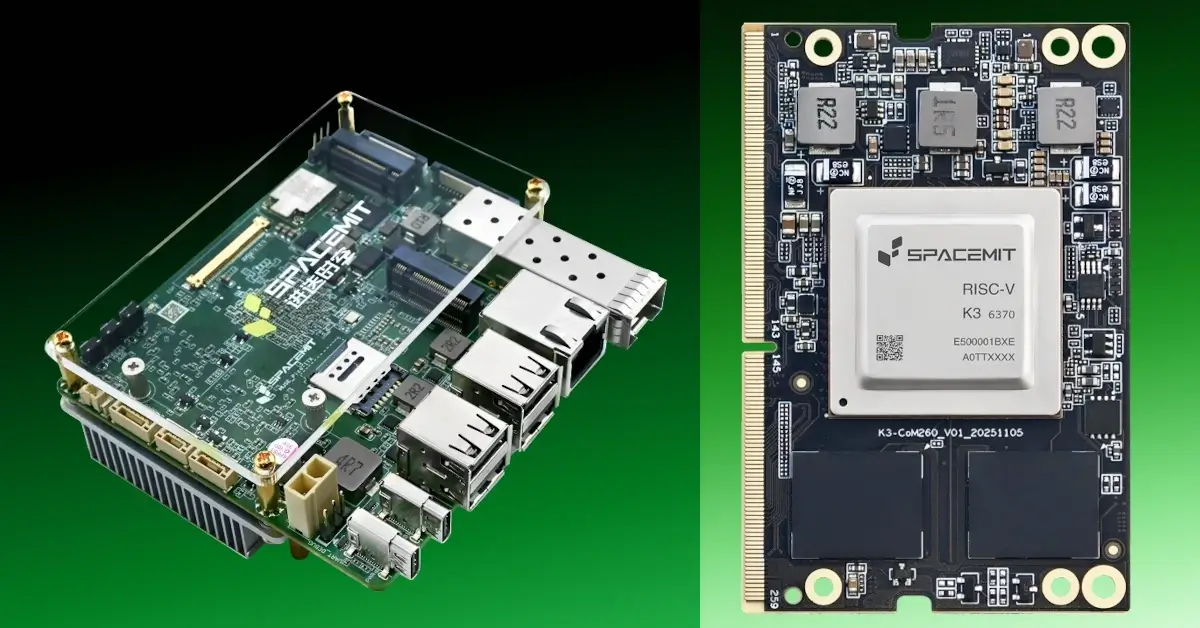
Comparing the resellers SpacemiT does not sell anything directly to consumers. Instead you need to buy a board that includes the K3 chip from an integrator. Currently the main resellers are: All of the above are Chinese companies that ship to customers both inside and outside China. DeepComputing stands out as the only one that actually has done real integration and ships the K3 on a custom board, while the others simply resell the SpacemiT-produced K3 pico-ITX and K3 CoM260 Kit.

Milk-V Milk-V is a RISC-V specialized integrator, as the name already implies. They sell the K3 under the name Jupiter2. Of all the K3 pico-ITX reseller product pages, the Jupiter2 presentation is the nicest and most detailed. Unfortunately their order page at arace.tech only states that it is a pre-order with no information about shipping schedule, taxes, or other details like what SSD is included (if any). Based on the pictures it does ship with a Milk-V branded case. The 32 GB RAM lists at 504 EUR, which is a very reasonable price. The @MilkV_Official account on X recently promoted the K3.

Documentation and support As of this writing, the Milk-V Jupiter2 documentation site is just a stub and has no actual content, and only two links to the SpacemiT K3 documentation site. For support there is a web forum with a dedicated Jupiter2 section. There is also a Matrix space, but unlike their other products, there is no dedicated Jupiter (neither v1 nor v2) channel.

Community size and open source involvement At least one prior Milk-V product was certified by Canonical, which indicates there is some collaboration in progress. Canonical also lists the Milk-V Titan on its official Ubuntu for RISC-V partner-built hardware page.

Sipeed The Sipeed K3 announcement is well written (in English) with all the relevant details and links to additional PDF manuals. However, their main page at sipeed.com says nothing about the K3, so one must know the subpage URL to access it. They offer both the K3 CoM260 kit compatible with Jetson Orin Nano carrier boards, and the stand-alone K3 pico-ITX-sized motherboard. The CoM260 kit is only 10 USD cheaper than the full pico-ITX motherboard, so choosing the latter is a no-brainer if starting from scratch. The pico-ITX model with 32 GB DDR5 RAM sells for 639 USD. The product page does not mention anything about hard disk size, so you don t really know exactly what you will be getting if placing an order. There is no indication about case, Wi-Fi antennas or power supply either, so most likely they are not included. Their store.sipeed.com website does not work at all, and their Taobao and AliExpress stores are not public and only accessible to registered users. The order page also says nothing about shipping time, delivery time, or taxes. The X account @SipeedIO is active and recently posted pictures of shipments in progress.

Documentation and support The main documentation wiki does not yet have any K3 content at the time of writing. There is a Discord channel for general RISC-V discussion, and their MaixHub also has a discussion board, but I didn t find anything K3-specific.

Community size and open source involvement Sipeed has had at least one of their previous devices certified by Canonical, which indicates they are active in the community. Note that the other RISC-V company SiFive that also has had hardware certified and officially supported by Canonical is a different company, despite the very similar name.

Banana Pi Banana Pi announced that they offer both the K3 CoM260 kit and the K3 pico-ITX motherboard version. Their product page for the K3 confusingly shows a MediaTek product in the page banner rather than the SpacemiT K3. Based on the product description and the fact they renamed the product as BPI-SM10, it seems to ship with some carrier board. The product pictures look identical to the SpacemiT documentation and there is no picture of the carrier board, and details are very sparse. The pico-ITX version with 8 GB RAM and 128 GB SSD sells for 293 USD and the CoM260 developer kit with the same specs sells for 287 USD and the 32 GB RAM with 128 GB SSD model sells for 595 USD. The shop page shows only five orders so far and items are currently out of stock. As there was no 32 GB RAM version of the pico-ITX available at all, this isn t an option for me as I want to run 30B parameter models that need the larger memory version. Of all of these resellers, the Banana Pi website seems the most outdated. It does not have a search feature, it is not mobile-friendly, pictures can t be pinched to zoom in and so forth. Product names are also almost all identical, and as the product listings only show the beginning of the product name, figuring out what product is what requires extra effort that just makes the online purchase experience plain bad.

Documentation and support I was only able to find the documentation page for the CoM260 kit, but none for the pico-ITX version. For support there is a forum, but the category list does not show any section for K3, and the forum search prohibits using the search term k3 as too short.

Community size and open source involvement Banana Pi has a long history in the ARM single-board computer market, but their presence in the RISC-V ecosystem is still growing. Their X account @sinovoip has posted only once about the K3 and otherwise promotes their ARM boards. However, their community culture page does express a commitment to open hardware in general, but there is no visible K3-specific community activity.

Firefly Firefly s K3 product page is comprehensive. Based on the details, they do not offer the K3 pico-ITX variant at all, but only the K3 CoM260 board inside the AIBOX-K3 Firefly RISC-V Edge Mini PC product. This is a feature-complete offering with a Jetson Orin Nano carrier board and case. The AIBOX-K3 with 32 GB RAM and 128 GB SSD in a case sells for 689 USD in their own Firefly.store. Unfortunately it only has HDMI and there is no USB-C with DisplayPort support, which is a deal-breaker for me personally. Interestingly, Firefly also offers rack-mounted servers with K3 as the CPU.

Documentation and support The wiki link on the product page is broken. The Firefly wiki does have a section for the AIBOX-K3, but it too has a broken link. It seems that as of the time of writing, there is no wiki section for this product yet. For support there is a web forum, which does have at least one K3 thread covering guides such as Hermes Agent installation, though broader K3-specific sections are still sparse.

Community size and open source involvement Firefly s X account @TeeFirefly has had no posts since 2024, and their GitLab/T-Firefly shows mostly 2024 activity, with only one repository updated in 2025 and nothing in 2026. Historically they have built a moderate community around their ARM-based Rockchip boards, with active forums and wiki contributions for those product lines. Their RISC-V K3 offerings are newer, and likely need a lot more polish to be attractive products overall.

DeepComputing Last, but certainly not least, is the laptop manufacturer DeepComputing that offers a Framework laptop compatible motherboard with the SpacemiT K3 chip. They also sell the plain motherboard, or with the Cooler Master case, which allows one to easily connect it to an external monitor and keyboard and use it as a desktop computer. The plain board with 32 GB RAM and no SSD sells for about 882 EUR. Shipping of the first batch is expected to start by end of June 2026. Their X account @DeepComputingio promotes this DC-ROMA RISC-V Mainboard III as their flagship product, so they seem to put a lot of effort into it. The overall product design and packaging seems good. Of all the K3 resellers and integrators that I was able to find, DeepComputing is the only one that actually designs their own boards with the K3 processor, while all the other vendors above are simply reselling the vanilla K3 boards with or without a case. After reviewing all these options I decided to buy the DC-ROMA RISC-V Mainboard III for Framework Laptop 13 with 32 GB RAM, 1 TB SSD and the Cooler Master case, totalling about 1100 EUR.

Documentation and support DeepComputing maintains product information for their RISC-V hardware at github.com/DC-DeepComputing/Framework, with documentation of the newest Mainboard III (FML13V05) still being finalized ahead of the first batch shipment. They provide community support through Discord and web forum, although the latter has very little activity.

Community size and open source involvement DeepComputing has established itself as a pioneer in RISC-V laptops, beginning with the DC-ROMA. I have seen their stand at FOSDEM, which shows they are genuinely active in the open source community. Canonical lists DeepComputing s first mainboard / FML13V01 on its official Ubuntu for RISC-V partner-built hardware page, and it seems likely that they will continue to collaborate with Canonical with the new model once it ships. While the underlying Linux enablement depends on SpacemiT s upstream efforts, DeepComputing s involvement helps bridge the gap between reference hardware and consumer-ready products. DeepComputing K3 board in the Cooler Master case

Conclusion After weighing all the options, I ended up placing an order with DeepComputing for their custom K3 board with the Cooler Master case. Despite the premium price, the active community support and the properly documented promise of a complete, working system made it easy to place an order with confidence. The SpacemiT K3 is poised to be one of the most significant RISC-V chips for local AI workloads, thanks to its RVA23 compliance and high tokens per second potential. Yet the buying experience in mid-2026 remains fragmented and incomplete. Hopefully this is just because the product is new, and they will get the purchase experience polished soon. What struck me most during this process was how poor the customer experience is across nearly all of these vendor websites: broken links, missing search functions, outdated product banners, pages that show the wrong product entirely, and no information about shipping times, stock levels, taxes, and so on. One wonders why these companies don t fully invest in their web presence. Personally I would assume they likely have enough customers already, primarily through domestic channels like Taobao and JD.com, that they do not feel any pressure to improve their international-facing sites. However, I did also review what was offered on Taobao, and the product details were very incomplete there too. Taobao, however, has a built-in live chat with almost all sellers, which can be used to ask questions and thus compensate for missing product details. I don t fully understand why the sales process seems unpolished. The websites feel almost like an afterthought a checkbox to claim global reach while the real business apparently happens elsewhere via closed platforms or via inaccessible reseller channels. It is a frustrating reminder that in the RISC-V hardware world, the technology may be open and global, but the purchase experience is less so.

2 June 2026

Ben Hutchings: FOSS activity in 2025

This was a particularly busy month for me in terms of Debian contributions. It started with a week in Hamburg for the MiniDebConf. I talked to many colleagues face-to-face and worked on various bugs and maintenance tasks. I m pleased to have finally found the time to reproduce and fix the boot-time crashes in the parallel port subsystem that have been reported many times recently. A series of easily exploited kernel LPE (local privilege execution) issues were published this month, mostly with very little coordination with distributions. Salvatore and I had to upload fixes for these at roughly weekly intervals. All of these fixes needed to be applied to 4 different upstream branches (currently 5.10, 6.1, 6.12, and 7.0) and 7 Debian branches (including backports).

Ben Hutchings: FOSS activity in May 2026

This was a particularly busy month for me in terms of Debian contributions. It started with a week in Hamburg for the MiniDebConf. I talked to many colleagues face-to-face and worked on various bugs and maintenance tasks. I m pleased to have finally found the time to reproduce and fix the boot-time crashes in the parallel port subsystem that have been reported many times recently. A series of easily exploited kernel LPE (local privilege execution) issues were published this month, mostly with very little coordination with distributions. Salvatore and I had to upload fixes for these at roughly weekly intervals. All of these fixes needed to be applied to 4 different upstream branches (currently 5.10, 6.1, 6.12, and 7.0) and 7 Debian branches (including backports).

1 June 2026

Amin Bandali: Free software activities in May 2026

Hello and welcome to my May 2026 free software activities report. A lot's been going on in my life offline so I took a bit of a hiatus from doing these reports, but I've had a fairly productive month of May so I thought it'd be nice to do another one for this month.

GNU & FSF
  • GNU Emacs:
    • ffs-0.2.2: I finally polished and published my ffs package for GNU Emacs on GNU ELPA. Many thanks to Protesilaos for rounds of code review and feedback for improving and polishing the package in preparation for submission to GNU ELPA.
    • bug#81101: Trying to visit https://www.emacswiki.org in EWW I noticed it fails with a Somebody wants you to give them money error due to the anti-bot challenge being served with a HTTP 402 (Payment Required) response. So I landed a patch 12eec781ed6 to no longer do that. Thanks to Emacs comaintainer Sean Whitton for reviewing and approving my proposed patch.
    • bug#81107: I noticed that in EWW, unlike <input type="submit"> HTML buttons, <button> elements were not tab-stoppable, leading to poorer usability and accessibility. So I landed a patch ec3d662de0b to fix that. Thanks to Emacs comaintainer Eli Zaretskii for reviewing, providing feedback, and accepting my proposed change.
    • Emacs Chat with Sacha Chua: I joined Sacha for a new episode of her Emacs Chat podcast, where we talked about Emacs and life. I gave a quick tour of my Emacs configuration, discussing at length my configurations for EXWM (Emacs X Window Manager) among other topics like Emacs's facility for visually indicating buffer boundaries in the fringe by setting indicate-buffer-boundaries and my convenience configuration macros.
  • maintainers@: I started the next long-overdue round of emails to GNU package maintainers to confirm the contact information we have on file for them and get a brief status update about their packages. Emails are sent in small batches to keep the workload of handling the responses manageable for assistant GNUisances.
  • GNU Spotlight: I prepared and sent the May GNU Spotlight to the FSF campaigns team for publication on the FSF's community blog and the monthly Free Software Supporter newsletter.

Debian
I've begun the work toward updating the Jami package in Debian unstable again, which means I need to package new releases of its direct and indirect dependencies. For OpenDHT, I need to update RESTinio, and to do that I first need to package expected-lite and sobjectizer for Debian:
  • #1120837: ITP: expected-lite expected objects for C++11 and later
  • #1137609: ITP: sobjectizer C++ implementation of Actor, Publish-Subscribe, and CSP models
I've been working on packaging both and hope to have them uploaded to the archive in the next days and weeks. That's it for this month's report. Take care, and so long for now.

18 May 2026

Sergio Durigan Junior: Fixing a 20+ year old bug in Debian curl

I have been helping co-maintain the Debian curl package for a few years now, and even though Samuel and Charles do most of the work, I'm happy to jump in and help when needed. This is one of those cases. Nowadays the package is maintained by 3 people (with help from others occasionally), but it hasn't always been like this. Samuel adopted the package back in 2021, and since then it has received a lot of love and care to make sure it lives up to Debian's standards. Again, kudos to both him and Charles who have been doing great work on this front. But a little more than 20 years ago, the situation in Debian (and curl!) was "a bit" different.

Once upon a time... According to d/changelog, the Debian curl maintainer in 2005 introduced changes to the packaging that allowed it to generate a version of libcurl for each TLS backend available: OpenSSL and GnuTLS. This meant that curl would have two binary library packages:
  • libcurl3-openssl and its respective -dev variant, for libcurl linked against OpenSSL; and
  • libcurl3-gnutls and its respective -dev variant, for libcurl linked against GnuTLS.
But then, around 2006/2007 or so, upstream curl decided to bump the SONAME version of libcurl from 3 to 4. At the time, they apparently did not version their library symbols like they do now, which was... less than ideal. I don't judge them: curl and a lot of other important projects have come a long way when we consider best practices to write shared libraries. Meanwhile, on Debian land, the release team was having trouble with other transitions going on at the time. For those who are not versed in Debian's vocabulary, a transition happens when a shared library gets its SONAME version bumped: when this happens, we have to make sure that all reverse dependencies of that library still build with the new version, and fix things that fail. The more reverse dependencies the library has, the harder this work gets. When upstream curl bumping the SONAME version of libcurl, the Debian curl maintainer at the time correctly renamed the binary packages from libcurl3- openssl,gnutls (and their -dev variants) to libcurl4- openssl,gnutls (and their -dev variants), which obviously triggered a transition. And a big one, because libcurl is used by several projects. Long story short, the Debian release team found themselves between a rock and a hard place. According to the late Steve Langasek at the time:
We talked a while back about the curl transition, and about how upstream's change from libcurl.so.3 to libcurl.so.4 is gratuitously painful for us in light of the large number of reverse dependencies. The libcurl transition has at this point gotten tangled with soname transitions in jasper, exiv2, kexiv2, and God only knows what else. So I'd like to revisit this question, because tracking this transition is costing the release team a lot of time that would be better spent elsewhere, and removing the need for a libcurl transition promises to reduce the complexity of the other components by an order of magnitude. On looking at the curl package, I've come to understand that the symbol versioning in place in this library is the result of a Debian-local patch. That's great news, because it suggests a solution to this quandary that doesn't require an unreasonable amount of developer time.
Yeah, it wasn't pretty. Here's what was proposed:
I am proposing the following:
  • Keep the library soname the same as it currently is upstream. Because upstream uses unversioned symbols, our package will be binary-compatible with applications built against the upstream libcurl regardless of what we do with symbol versioning, so leaving the soname alone minimizes the amount of patching to be done against upstream code here.
  • Revert the Debian symbol versioning to the libcurl3 version, and make libcurl.so.3 a symlink to libcurl.so.4. We have already established that libcurl.so.4 is still API-compatible with libcurl.so.3, in spite of the soname change upstream; reverting the symbol versioning will make it fully ABI-compatible with libcurl.so.3, and adding the symlink lets previously-built binaries find it.
  • Revert the Debian package names to the curl 7.15.5 versions. Because compatibility has been restored with libcurl3 and libcurl3-gnutls, restoring the package names provides the best upgrade path from etch to lenny; and because the symbol versions have been reverted, the libraries are not binary-compatible with the Debian packages currently named libcurl4/libcurl4-gnutls/libcurl4-openssl (in spite of being binary-compatible with upstream), so it would be wrong to keep the current names regardless.
  • Drop the SSL-less variant of the library, which was not present in curl 7.15.5; AFAICS, there is no use case where a user of curl needs to not have SSL support, so this split seems to be unnecessary overhead. Please correct me if I'm mistaken.
  • Leave the -dev package names alone otherwise, to simplify binNMUing of the reverse-dependencies (some packages have already added versioned build-deps on libcurl4.*-dev -- I have no idea why -- so reverting the names would mean more work to chase down those packages). Drop libcurl4-dev as a binary package, though, in favor of being Provided by libcurl4-gnutls-dev. Many of the packages currently build-depending on libcurl4-dev -- including some that wrongly used libcurl3-dev before -- are GPL, and these are apparently all packages where having SSL support missing in libcurl4 wasn't hurting them, so libcurl4-gnutls-dev seems to be the reasonable "default" here.
  • Schedule binNMUs for all reverse-dependencies.
Again, no judgement here: this was what needed to be done at the time, and I believe it was a good solution given the circumstances. In the end, the binary library packages got renamed again: from libcurl4- openssl,gnutls back to libcurl3- openssl,gnutls (but not their -dev variants!), but they continued shipping libcurl libraries whose SONAME version was 4. This solved the immediate problem of untangling the transitions mentioned by Steve, but introduced a technical debt that would stick with the package literally for decades. The situation at the end of 2007 was:
  • libcurl3-openssl with libcurl4-openssl-dev; and
  • libcurl3-gnutls with libcurl4-gnutls-dev.

More discrepancy is added Eventually the libcurl3-openssl package got renamed to libcurl3, but aside from that the situation with mismatched library names vs. SONAME versions stayed relatively unchanged until around 2018, when the Debian curl maintainer at the time (a different person) renamed libcurl3 to libcurl4 to fix a bug. This was the right thing to do for libcurl3, and at the time upstream curl was already properly versioning their symbols, but for some reason libcurl3-gnutls got left behind. So now we had:
  • libcurl4 with libcurl4-dev; and
  • libcurl3-gnutls with libcurl4-gnutls-dev.
In other words, we now have a discrepancy between the OpenSSL and GnuTLS variants' names. Yeah, confusing. And this is the situation right now, on May 2026, while I write this post. To make matters worse, the Debian curl package has been carrying a patch to facilitate the split of OpenSSL and GnuTLS flavours for decades now, and, for some reason I didn't bother to investigate, the patch pins the SONAME version of libcurl3-gnutls to CURL_GNUTLS_3, effectively overriding upstream's decision to version the symbols as CURL_GNUTLS_4.

A call to make things right Back in 2022, Simon McVittie filed a Debian bug to try and call our attention to the fact that we were shipping this messy set of curl packages. I had just started to get involved in the package maintenance and Samuel asked me to take a look at the bug. I noticed it was going to take more time than I had available, so I decided to put it in my TODO list (TM). Simon was generous enough to lay out a possible plan to tackle the problem, but I had a feeling that this was going to be harder than it looked. I kept postponing working on the bug, but also kept thinking about it now and then because it's an interesting thing to solve. Then, a month or so ago the Debian Brasil community got together for MiniDebConf Campinas 2026 and we decided to do a bug squashing party there. I started working on a few FTBFS bugs with GCC 16, but then got remembered about the curl bug and thought that that was the perfect time and place to start working on it, for a few reasons:
  • Samuel and Charles were also attending the conference, so I could talk to them about my plans and show them a PoC.
  • I was going to give a presentation about symbols (in pt_BR), so I could use this bug as an example of symbol versioning.
  • I wanted to have fun.

The initial plan The plan I had in mind was a variant of Simon's proposed plan:
  • I would have to adjust our GnuTLS-specific patch so that it did not override the SONAME version for libcurl-gnutls. Then,
  • For each symbol from libcurl3-gnutls I would have to:
    • Explicitly version it as curl_symbol_name@@CURL_GNUTLS_4.
    • Create an alias for the symbol (let's call it __curl_compat_symbol_name).
    • Explicitly version this alias as __curl_compat_symbol_name@CURL_GNUTLS_3.
  • Have a separate version of curl's linker script to make it possible to create a hierarchy between CURL_GNUTLS_3 and CURL_GNUTLS_4 symbols.
Note that this whole dance is needed because it is a hard requirement that programs linked against libcurl3-gnutls keep working when we ship libcurl4-gnutls, without needing to recompile them. Due to the fact that we will not really bump the SONAME of libcurl-gnutls (but instead fix the symbol versions shipped by it), we cannot expect programs to break given that they are actually using the exact same ABI as before. Unfortunately (as it is common with low level tools) the documentation for ld's versioning syntax is quite incomplete and hard to find. One of the best sources I found was this blog post. For this reason, let me quickly explain the different notations for symbol versioning used above.

curl_symbol_name@@CURL_GNUTLS_4 When we use curl_symbol_name@@CURL_GNUTLS_4 (note the @@) we are telling the linker that this should be considered the default version of curl_symbol_name. In other words, when a binary that links against libcurl-gnutls calls curl_symbol_name, the linker should use curl_symbol_name@@CURL_GNUTLS_4 to resolve the symbol. There are a few ways to specify a symbol version in C/C++:
__attribute__((__symver__("curl_symbol_name@@CURL_GNUTLS_4")))
void curl_symbol_name()
 
  /* ... */
 

/* or... */
void curl_symbol_name()
 
  /* ... */
 
__asm__(".symver curl_symbol_name, curl_symbol_name@@CURL_GNUTLS_4");

Function alias Creating an alias for a function is basically saying that a function can be called by another name. You can do that in C/C++ like:
void curl_symbol_name()
 
  /* ... */
 

void __curl_compat_symbol_name()
  __attribute__((alias("curl_symbol_name")));

__curl_compat_symbol_name@CURL_GNUTLS_3 Finally, when we use __curl_compat_symbol_name@CURL_GNUTL_3 (note the single @) we are telling the linker that this symbol exists, but it should not be used as the default symbol. In fact, this notation will basically hide the symbol and make it only available for those programs that have already been linked against it. It's a way of saying "don't offer this symbol when linking, but it's here in case a program needs it to run" (it's a bit more complicated than that, but you get the point). The reason I had to create an alias to the function before versioning the symbol with @CURL_GNUTLS_3 is because, once I've versioned the main symbol as @@CURL_GNUTLS_4, I can't create another version of it. It's also important to mention that to be able to create a version for the alias I also had to change its visibility to default. In the end, the alias ended up being defined as:
extern void __curl_compat_symbol_name()
  __attribute__((alias("curl_symbol_name"), visibility("default")));

First attempt and lessons learned For my PoC I decided to tackle a small subset of the problem. The symbols file for libcurl3-gnutls contains around 100 symbols that need to be fixed, so I chose two of them and started trying to write a patch to see if I could make things work. And after some time struggling with GCC's syntax and inspecting nm -D's output I finally got something that looked like it was going to work. The two symbols I had chosen to work with got correctly versioned (both as @@CURL_GNUTLS_4 and @CURL_GNUTLS_3), and a quick-and-dirty C program that used those symbols correctly compiled and ran with the expected symbols. I showed the results to Samuel and Charles, we got excited about what we saw, and then the conference ended.

Second attempt and some adjustments After getting back home I resumed the work on my branch and wrote an Emacs function that semi-automatically adjusted all 100+ symbols listed in the symbols file so that they all looked like:
__attribute__((__symver__("curl_symbol_name@@CURL_GNUTLS_4")))
void curl_symbol_name()
 
  /* ... */
 

extern void __curl_compat_symbol_name()
  __attribute__((alias("curl_symbol_name"), visibility("default"),
                 symver("__curl_compat_symbol_name@CURL_GNUTLS_3")));
The patch was big but mostly repetitive, and I was happy to have come up with a solution that looked clean. Until I tried to build the package, that is. I started seeing some strange errors that happened when ld was trying to link the final libcurl4-gnutls object (yes, at that point I had already renamed the binary package). This is one of the errors I was getting from ld (I got variants of this error as I was trying to fix the approach):
/usr/bin/x86_64-linux-gnu-ld.bfd: .libs/libcurl_gnutls_la-easy.o: in function  dupeasy_meta_freeentry':
./debian/build-gnutls/lib/./debian/build-gnutls/lib/easy.c:1024: multiple definition of  curl_easy_cleanup'; .libs/libcurl_gnutls_la-easy.o:./debian/build-gnutls/lib/./debian/build-gnutls/lib/easy.c:908: first defined here
/usr/bin/x86_64-linux-gnu-ld.bfd: .libs/libcurl-gnutls.so.4.8.0: version node not found for symbol curl_easy_duphandle@CURL_GNUTLS3
/usr/bin/x86_64-linux-gnu-ld.bfd: failed to set dynamic section sizes: bad value
This was strange. I did some tests with very simple versions of a shared library using the versioning mechanism I had implemented and it all worked. I could not reproduce the problem, and that's not a great feeling to have. Then, after reading a lot of documentation and blog posts throughout the internet I found something interesting. Apparently ld has a limitation when it comes to dealing with symbols versioned with @@. If there is a single symbol versioned like that in a source file (the actual term is TU, which means Translation Unit, but let's simplify), then ld is happy and generates the expected version without issues. But when we're dealing with multiple definitions of @@ symbols in a source file (which is exactly what happens in curl), then ld can get confused and start giving errors during the link stage. To solve that limitation, we have to resort to yet another symbol versioning notation: @@@. Yes, three at signs. For example:
void curl_symbol_name()
 
  /* ... */
 
__asm__(".symver curl_symbol_name, curl_symbol_name@@@CURL_GNUTLS_4");
Note that we have to use __asm__ because GCC's __attribute__ doesn't support the triple-at notation. What this does is tell the linker to create a versioned symbol for curl_symbol_name, set it as the default symbol when linking, but also remove the unversioned curl_symbol_name symbol. This makes ld happy and allows it to successfully link libcurl-gnutls. As usual, you won't find any mention of the @@@ notation inside ld's documentation. With libcurl-gnutls compiling again, I had to adjust libcurl's linker script to create a hierarchy between CURL_GNUTLS_3 and CURL_GNUTLS_4 symbols. Here's the final version of the file:
CURL_GNUTLS_3
 
  global:
    curl_easy_cleanup;
    /* lots of other symbols here */
  local: *;
 ;

CURL_GNUTLS_4
 
  global: curl_*;
  local: *;
  CURL_GNUTLS_3;

Debian package adjustments After getting the hard part out of the way, the rest was easy. It was time to finally rename libcurl3-gnutls to libcurl4-gnutls. Initially I was thinking that I'd need to ask the release team for a transition to happen, but as it turns out that won't be necessary. Because we are effectively shipping the same exact library/ABI and the only difference is the inclusion of the extra CURL_GNUTLS_4 versioned symbols, and given that we will be shipping CURL_GNUTLS_3 versioned symbols to guarantee backwards compatibility, packages won't need to get rebuild just to pick up the new dependency. Instead, we can safely turn libcurl3-gnutls into a transitional package that depends on libcurl4-gnutls.

Merge request and next steps This is the merge request where I am working on the fix. As of this writing it is in a draft state, but I expect to merge in the next couple of days. Once the fixed curl package is uploaded, we should keep an eye on the archive to make sure no unexpected bugs happen. I would like to carry this patch downstream at least until forky is released. It doesn't make sense to propose it upstream because this problem is Debian-specific and should be fixed there. We will need to make sure that all reverse dependencies of libcurl3-gnutls are recompiled before we can get rid of the transitional package, too. This was a fun bug to investigate and fix, and I am happy that we will finally have sensible names (and symbol versions!) for both of our libcurl variants. Stay tuned for the next challenge!

17 May 2026

Russ Allbery: Review: Unwinding Anxiety

Review: Unwinding Anxiety, by Judson Brewer
Publisher: Avery
Copyright: 2021
ISBN: 0-593-33045-5
Format: Kindle
Pages: 268
Unwinding Anxiety is a non-fiction self-help book about how to reduce anxiety. The author is a board-certified psychiatrist specializing in addiction and substance abuse, who has subsequently done clinical and research (and commercial, more on that later) work in anxiety. His previous book, The Craving Mind, was a pop science treatment of addiction research. This book is more deliberately structured as a self-help guide. (The cover will assure you that he has an M.D. and a Ph.D. I don't include honorifics and degrees in author listings as a small protest against the weird social rules about which degrees count and which don't.) There are a lot of self-help books out there about anxiety. There are a lot fewer that say something relatively original. I think this is one of the latter, but I certainly have not done a survey of the subgenre, and it's possible the ideas here are only new to me. Brewer makes three basic claims in this book, all of which I found personally useful:
  1. Anxiety can be usefully analyzed as a habit. The rumination loop and other related anxiety behaviors such as excessive analysis, reassurance-seeking, and negative anticipation take the form of deeply ingrained habits triggered by stimuli.
  2. Raw willpower is not a useful way to break habits in general and anxiety habits in particular. In order to displace the habit, you have to retrain the part of your brain that runs habits on autopilot. Attempting to override it with willful effort is exhausting and likely to fail.
  3. Habit loops in general, and anxiety loops in particular, can be defused and replaced using mindfulness techniques.
This is not the way Brewer lays out the book. He goes to some effort to lead the reader slowly through three techniques for handling anxiety (for which he uses the metaphor of "gears," like for a bicycle or car) by introducing them one at a time and encouraging the reader to become thoroughly familiar with each one before moving on to the next. Since this is a book review, I'm going to give you the whole argument at once so that you know where this book is going. This may be less helpful in practice; if you're trying to use this technique on your own anxiety, you may want to read the book instead and not jump ahead. Brewer's three gears are:
  1. Identify your habit loops and recognize when they're happening. (This part felt the most similar to traditional cognitive behavioral therapy to me.)
  2. Focus on how those habit loops make you feel. Rather than trying to force the habit loop to stop, let it happen but pay very close attention to the outcome and its effects on you.
  3. Find and focus on a different reaction that provides better rewards than the anxiety habit loop. Brewer suggests curiosity.
For me, the point where I thought "okay, you have my attention" is when Brewer described the way many people, particularly people without anxiety, tell people with anxiety to "just stop thinking about it" or "just do the thing you're anxious about anyway and you'll see it will be fine" and then described in detail why he believes that doesn't work. This is one of the few discussions of anxiety I've read where the author goes out of his way to stress that you cannot simply think your way out of anxiety and that repeatedly trying to do so and failing is exhausting and demoralizing. Everyone is different and I know some people find cognitive behavioral therapy very helpful, but I find the constant effort to challenge cognitive distortions more draining and demoralizing than useful. His second gear, of not directly confronting the habit loop but instead watching its effect and thinking about its outcome, feels so much more approachable to me. Assuming, of course, it works. Brewer's approach is essentially just mindfulness, although he mostly avoids the (to me at least) somewhat off-putting typical introduction to mindfulness via religious practice or general well-being and instead ties it to a theorized model of how habits work in the human brain. His contention is that habits, including anxiety, exist because at some point they provided a reward that was sufficiently compelling to make the habit-following part of your brain seek that reward. You were getting some benefit (a sense of control, a sense of being prepared, temporary reassurance, etc.) out of the anxiety reaction, which is why the anxiety habit formed in the first place. Once that habit is in place, it can continue without the reward. (Although in my experience there is probably still some short-term reward.) Rather than trying to force yourself to stop following the habit, Brewer instead suggests letting the habit happen but then focusing (via mindfulness) on how following the habit makes you feel, whether it improves your sense of well-being or worsens it, and whether other actions produce different feelings. The goal, in other words, is to undermine the assumption of reward and to challenge any short-term reward with the long-term discomfort that made you want to stop being anxious. This avoids using your conscious brain to exert direct willpower, which is exhausting and usually unsuccessful since the habit-following part of your brain is stronger (for various evolutionary psychology reasons he explains and that I found at least partly credible). Instead, you are using its strengths of observation and classification. You pay close attention to the ways in which the habit loop makes you feel bad, which in theory provides feedback to the habit-following part of your brain that can dislodge the habit. If the habit is recognized as no longer rewarding, it will weaken. Brewer's background is in addiction treatment, so he is predisposed to see addiction in everything and one should probably be a bit cautious about his enthusiasm. He claims a great deal of success with this approach in clinical settings, mostly with addiction but also with anxiety, but this is always hard to verify. (Few doctors who write self-help books rigorously document their failures.) He apparently also has a company that produces various phone apps that assist with this technique. I'm rather cynical about anyone who talks about products their company has produced in self-help books of this type, and I'm also rather cynical about anyone who calls himself "Dr. Jud," but the book doesn't seem to be a sales pitch and there's no direct information in it about how to get the apps. For me, the first two parts of the book were the most useful and the conception of anxiety reactions as habits made a surprising amount of intuitive sense. I thought the third part of the book, where he tries to describe a better in-the-moment reaction that you can try to build into a more beneficial habit, to be the weakest. It's mostly stock mindfulness advice that I've seen in other places, and you will be entirely unsurprised to learn that Brewer meditates and has studied meditation. I think it's clear that, for him, a feeling of curiosity works as an anxiety replacement; I'm not sure that's universal and I'm not sure it works for me. That core idea that anxiety reactions are a type of addictive habit that have outlived their useful rewards but continue because habits are hard to change felt both useful and at least a little bit true, though. Your mileage may, of course, vary, but I've been trying out various ideas from this book since I first started reading it, and I think it's helping. If any of this clicks with you and you're also prone to anxiety, it might be worth a read. One warning, though: Brewer's previous work on addiction includes binge eating, and while it's not a primary focus, he uses several weight loss and disordered eating examples and has a very traditional medical attitude towards weight. I'm somewhat dubious of the addiction model of weight gain in general, but more to the point, it's rather off-putting in a book supposedly about anxiety. It's something I was able to skim over, but be aware going in if you're likely to find this obnoxious. I do think this book is a case of an addiction researcher seeing everything through the lens of addiction, and I'm a little dubious this is the right model for everyone's anxiety. But this is one of the good reasons why there are a lot of books about anxiety: Different approaches suit different people. This one made more sense to me than most; maybe you are similar. I can't really recommend or not recommend a book like this, since I think so much will depend on whether you are one of the people for whom this specific explanation will click, but I'm glad that I read it and I think it's good to know that this model of anxiety exists. Rating: 8 out of 10

Otto Kek l inen: Balancing persistence vs pivoting is grit a virtue or wasteful?

Featured image of post Balancing persistence vs pivoting   is grit a virtue or wasteful?Being persistent, sticking to a plan and showing up to work every day is generally valued highly across all cultures as virtuous behavior. It is obvious that anything of value and worth achieving is also not easy, but requires significant and recurring effort. Learning a new language, winning a sports competition or building a successful business are all typical scenarios where grit plays a central role above everything else. However, sometimes the virtue of tenacity can result in just a waste of energy. The question is then: how does one recognize that true progress is being blocked by stubbornness and a pivot would be the correct decision, as opposed to being close to breakthrough where doing more of the same would actually be the right choice?

What is persistence actually? To think clearly about this topic, one must first grasp the concept of grit and what it looks like in practice. Research by psychologist Angela Duckworth on grit shows that sustained effort in the face of setbacks separates high achievers from those who quit too soon. Entrepreneurs who iterated through dozens of failed prototypes or writers who revised manuscripts for years understand this truth. Persistence builds resilience, deep expertise, and the kind of compounding results that shortcuts cannot deliver. It also protects against the distraction of shiny new ideas that pull focus from what actually works. Persistence is about:
  1. Believing in an outcome and working towards it despite people around you not sharing the belief, and despite your own work and experiments not being successful.
  2. Continuing to hold the belief and sticking to the decision despite other ideas, solutions and competing alternatives surfacing.
  3. The more time passes, the firmer the conviction becomes. Time, money, and emotional energy invested in a failing direction create psychological pressure to continue (sunk-cost fallacy).
Simply following through on a plan or upholding a contract is not true persistence. Grit is a personal trait one can cultivate to actually become more energized to do something precisely because it turns out to be harder than expected.

Pivoting: a calculated choice The opposite of being persistent is giving up. Pivoting is not about giving up, but about redirecting the energy and momentum towards a new goal. Pivoting requires coming to the realization that you were wrong, and going through the painful process of discovering a new truth. Ideas tend to be abundant, and doing something new isn t hard as such. The hard part is to abandon a previously held belief and adopt a new one with equal conviction. To have that conviction you need to have data and metrics. This is also the key to how to decide between persisting vs pivoting at any moment in time.

Key metrics of success Any decision is only as good as the information available at the time it was made. To be set up for success one needs to start by deciding on what the actual goal is, what one values and how progress is measured. Key metrics are usually easiest to discover by working backwards from the goal. If you want to build an electric car, you might decide that the goal is to have a car that costs 30,000 euros and can drive 300 km on one charge. From that goal you can break down what the cost structure should be, what volume of production is needed to break even, what raw materials are needed and what the battery chemistry needs to achieve to meet the goal. That can further be broken down into a rate of progress. Suppose the plan requires battery energy density to reach 150 Wh/kg to be viable. If the state of the art starts at 100 Wh/kg and funding lasts a maximum of five years, the team needs at least an 8% improvement every year (1.08^5 100 Wh/kg 150 Wh/kg). This can then be used as a guideline. Sometimes progress is not steady, but happens in jumps. Even in those cases there should be a trajectory to benchmark the jumps against. In an online business, the key metric could, for example, be one of these:
  • 7- or 30-day retention rate: Do new users who try the service actually like it?
  • Weekly or monthly active users: Is usage trending up?
  • Feature adoption rate: In an existing service, how many users are using the new feature?
  • Product-Market Fit Score (from Sean Ellis test): Percentage of users who say they would be very disappointed if the product disappeared. Above 40% is a strong early indicator. A number below that (after multiple iterations) is a good data point to pivot.
  • Revenue run rate or burn rate: The most generic metric everything eventually boils down to. Healthy markets reward good products.
Weekly metrics are better than monthly, as they make the feedback loop faster and allow you to get validation quickly and do minor course corrections along the way. A complete pivot should, however, be based on long-term data, driven by the key metric and supported by additional data points. Metrics are also needed because they can t be bribed or convinced to be anything other than what they are. Listening to other people is good, but just relying on the opinion of others is extremely dangerous because people are biased either for you or against you depending on whether they see you as a trusted leader or an outcast. Key metrics are of course domain-specific and everyone needs to come up with their own. However, you must have some key metric. You can t have the excuse that what you are doing can t be measured. If you are part of a larger organization and you need to advocate for a difficult decision for example, to kill your darlings when facing a pivot you need to have the metrics to back up your views, and those metrics need to have been established way before as something the organization values, and not cherry-picked just for this one decision. It does not matter if you are on a personal improvement journey, running a political campaign, inventing a new product, or growing a business you need to have some metric you can check at any given time to see if things are improving fast enough to predict success. Metrics can and should also be used in daily work to validate that you are on the correct path, and to optimize execution.

Famous examples of persistence and pivoting that led to breakthroughs In all of the cases below it is of course in hindsight easy to say they made the right decision. However, take a minute to try to imagine yourself in their shoes at the time of the decision. What metrics might they have had available to support their decision? What would you have wanted to measure or find out if you were in the same situation?
  • Frustrated that his vacuum lost suction, James Dyson spent five years and built thousands of failed prototypes in a backyard shed. He remortgaged his home, lived on savings, and faced rejection from every major manufacturer who wanted to protect their bag-replacement business. The 5,127th prototype based on an idea from a sawmill with a cyclone finally worked. Launched in 1993, the Dyson DC01 became Britain s best-selling vacuum within two years.
  • As a single mother on welfare in the mid-1990s, J.K. Rowling finished her manuscript for Harry Potter and the Philosopher s Stone while battling depression and poverty. She hand-typed copies and mailed them to publishers. Twelve rejected it outright, with comments like children s books about magic don t sell. She nearly quit multiple times but kept revising and submitting. Bloomsbury finally accepted it after the CEO s eight-year-old daughter read the first chapter and demanded the rest. The series has since sold hundreds of millions of copies worldwide.
  • Founded in 1997 as a mail-order DVD rental service, Netflix added unlimited subscriptions in 1999 to compete with Blockbuster. By 2007, broadband growth and declining DVD sales signaled a shift. CEO Reed Hastings pivoted aggressively toward streaming, investing in bandwidth deals and original content while de-emphasizing physical media. The move faced skepticism, but eventually changed the whole culture of how entertainment is consumed.
  • YouTube launched in 2005 as a video-dating site. Founders offered money to women who uploaded dating videos, but almost no one did. Meanwhile, users uploaded random clips. The team recognized the mismatch and pivoted within months to a general-purpose video-sharing platform with easy uploading. Google bought it just 18 months later.
  • Instagram began in 2010 as Burbn, a location-based check-in app that let users post plans, earn points, and share photos. Co-founders Kevin Systrom and Mike Krieger quickly noticed users ignored most features and mainly used it for photo-sharing. They made the tough call: scrap everything else. Within weeks, they rebuilt the app around clean, simple photography with filters. The pivot launched as Instagram in October 2010. It gained 1 million users in two months and was acquired by Facebook just 18 months later.

Insanity or conviction? English has several proverbs that warn against excessive persistence, such as banging your head against the wall . Insanity is commonly defined as Doing the same thing over and over again and expecting different results. In Finland, the national identity is practically built on the concept of sisu . It means much more than just grit . The word is derived from the word for inside or guts and represents an unexplained, almost superhuman force that makes one stoically take action despite seemingly impossible odds and somehow succeed anyway. It became a defining national mythos during the Winter War (1939 1940), where a force 10 times larger than the Finnish army tried to invade the country but was stopped and Finland just barely managed to keep its independence. The word sisu transitioned from a character trait to a pillar of national survival. I think Finns survived because the more you believe in persistence, the more likely you are to persist. I view persistence as a religion that requires faith, while pivoting is a science where you derive the truth from the numbers. When in doubt, I would always choose persistence over pivoting. Perhaps it is because of my genetic tendency towards having sisu , but I would also rather keep on going a bit more and try one more time before giving up and pivoting in order to get more data, so that when I pivot, I know it is absolutely the right thing to do at that point. Depending on the situation, the costs of postponing the pivot vary. Of course, if the main metric is the burn rate and a company is running out of money, a pivot must be done early enough that the remaining runway is enough to execute the pivot, and then some more. In some situations a business idea might simply be ahead of its time. If that is the conviction and the key metrics support it, the best way to navigate the situation is to cut down on costs and wait for competitors to appear, help build general awareness, and then ramp up again to ride the wave. Remember that success does not come from grit alone there is always an element of timing and luck as well. But if you are not persistent and stop showing up every day, you won t be able to seize the opportunities if and when they arise.

Failure is the likely outcome you have to avoid it at any cost One must also realize that most attempts end in failure. Failure is the baseline, and success is the exception. To reach a breakthrough, one must be stubbornly persistent. In particular, if you are a leader, you need to be so high in conviction that it almost becomes an aura that radiates to those around you. Postponing the decision to pivot allows you to get a bit more data for the decision, so that once you pivot, you have full belief in the new direction. Once you pivot, there is no looking back, otherwise you will undermine morale and most certainly fail with the new thing as people will execute it with hesitation. Failure is statistically always the more likely outcome. Most things end in failure and we never hear about them. If someone on your team does not believe in what you are doing, it is very easy for them to prove that something is a failure by spreading negativity, putting in less effort (perhaps unconsciously due to lack of conviction) and thus actually contributing to a self-fulfilling failure. In most areas of life, ideas are cheap and the only thing that matters is execution. To be good at executing, you need to be good at making decisions. When drafting plans it is good to have alternatives and a lot of consideration. However, when execution starts, there is no room for doubt, otherwise the chances of success decrease. Therefore, the best way of balancing persistence vs pivoting is to
  1. plan well ahead,
  2. establish the key metrics,
  3. have thresholds established for what would trigger a pivot, and
  4. do everything you can to move the metrics in the direction you want them to go.
Finally, if you decide to pivot, you must do so only with very high conviction, as you can t undo a pivot, and you should not be doing multiple pivots in a row either. If you are fully convinced yourself about the pivot, you will also be able to convince others about it, and carry the momentum.

Next.

Previous.