Search Results: "Stefano Zacchiroli"

16 November 2014

Stefano Zacchiroli: Debsources Participation in FOSS Outreach Program

Jingjie Jiang selected as OPW intern for Debsources I'm glad to announce that Jingjie Jiang, AKA sophiejjj, has been selected as intern to work on Debsources as part of the FOSS Outreach Program (formerly known as Outreach Program for Women, or OPW). I'll co-mentor her work together with Matthieu Caneill. I've just added sophiejjj's blog to Planet Debian, so you will soon hear about her work in the Debian blogosphere. I've been impressed by the interest that the Debsources proposal in this round of OPW has spawned. Together with Matthieu I have interacted with more than a dozen OPW applicants. Many of them have contributed useful patches during the application period, and those patches have been in production at http://sources.debian.net since quite a while now (see the commit log for details). A special mention goes to Akshita Jha, who has shown a lot of determination in tackling both simple and complex issues affecting Debsources. I hope there will be other chances to work with her in the future. OPW internship will begin December 9th, fasten your seat belts for a boost in Debsources development!

9 November 2014

Enrico Zini: fun-and-sanity

Fun and Sanity in Debian A friend of mine recently asked: "is there anything happening in Debian besides systemd?" Of course there is. He asked it 2 days after the freeze, which happened in time, and with an amazingly low RC bug count. The most visible thing right now seems to be this endless init system argument, but there are fun and sane things in Debian. Many of them. I think someone should put the spotlight on them, and here's my attempt. Yesterday I set up a gobby document asking "What is now happening in Debian that is exciting, fun and sane?", and passed the link around the Cambridge Miniconf and some IRC channels. Here are a few quotations that I collected:
The armhf and arm64 ports have for me been wonderful and exciting, and were a great time for me to start getting involved. (Jon "Aardvark" Ward) We have a way of tracking random contributors, and as far as I know no other project has anything like it. (Enrico Zini) codesearch.debian.net is an incredibly important resource, not just for us but for the free software community at large. (Ben Hutchings) sources.debian.net is a very useful resource with lots of interested contributors, it received 10 OPW applicants (Stefano Zacchiroli) It has never been easier to work on new infrastructure project thanks to the awesome work of the DSA team. We have dozens of contribution opportunities outside of just plain packaging. (Rapha l Hertzog) The work on reproducible builds has achieved excellent results with 61.3% of packages being reproducible. (Paul Wise) Porting arm64 has been (peversely) great fun. It's remarkably morish and I like nothing more than a tedious argument with autoconf macros. Working with lots of enthusiastic people from other teams, helping getting the port set up and build has been great - thank you everybody. (Wookey)
And here are random exciting things that were listed:

24 October 2014

Stefano Zacchiroli: Italy puts Free Software first in public sector

Debian participation in Italy's CAD68 committee (The initial policy change discussed in this document is a couple of years old now, but it took about the same time to be fully implemented, and AFAIK the role Debian played in it has not been documented yet.) In October 2012 the Italian government, led at the time by Mario Monti, did something rather innovative, at least for a country that is not usually ahead of its time in the area of information technology legislation. They decided to change the main law (the "CAD", for Codice dell'Amministrazione Digitale) that regulates the acquisition of software at all levels of the public administration (PA), giving an explicit preference to the acquisition of Free Software. The new formulation of article 68 of the CAD first lists some macro criteria (e.g., TCO, adherence to open standards, security support, etc.) that public administrations in Italy shall use as ranking criteria in software-related calls for tenders. Then, and this is the most important part, the article affirms that the acquisition of proprietary software solutions is permitted only if it is impossible to choose Free Software solutions instead; or, alternatively, to choose software solutions that have already being acquired (and paid for) by the PA in the past, reusing preexisting software. The combined effect of these two provisions is that all new software acquisitions by PAs in Italy will be Free Software, unless it is motivated in writing, challengable by a judge that it was impossible to do otherwise. Isn't it great? It is, except that such a law is not necessarily easy to adhere to in practice, especially for small public administrations (e.g., municipalities of a few hundred people, not uncommon in Italy) which might have very little clue about software in general, and even less so about Free Software. This is why the government also tasked the relevant Italian agency to provide guidelines on how to choose software in a way that conforms with the new formulation of article 68. The agency decided to form a committee to work on the guidelines (because you always need a committee, right? :-) ). To my surprise, the call for participation to be part of the committee explicitly listed representatives of Free Software communities as privileged software stakeholders that they wanted to have on the committee kudos to the agency for that. (The Italian wording on the call was: Costituir titolo di preferenza rivestire un ruolo di [ ] referenti di community del software a codice sorgente aperto.) Therefore, after various prods by fellow European Free Software activists that were aware of the ongoing change in legislation, I applied to be a volunteer CAD68 committee member, got selected, and ended up working over a period of about 6 months (March-September 2013) to help the agency writing the new software acquisition guidelines. Logistically, it hasn't been entirely trivial, as the default meeting place was in Rome, I live in Paris, and the agency didn't really have a travel budget for committee members. That's why I've sought sponsorship from Debian, offering to represent Debian views within the committee; Lucas kindly agreed to my request. So what did I do on behalf of Debian as a committee member during those months? Most of my job has been some sort of consulting on how community-driven Free Software projects like Debian work, on how the software they produce can be relied upon and contributed to, and more generally on how the PA can productively interact with such projects. In particular, I've been happy to work on the related work section of the guidelines, ensuring they point to relevant documents such as the French government guidelines on how to adopt Free Software (AKA circulaire Ayrault). I've also drafted the guidelines section on Free Software directories, ensuring that important resources such as FSF's Free Software Directory are listed as starting points for PAs that looking for software solutions for specific needs. Another part of my job has been ensuring that the guidelines do not end up betraying the principle of Free Software preference that is embodied in article 68. A majority of committee members came from a Free Software background, so that might not seem a difficult goal to accomplish. But it is important to notice that: (a) the final editor of the guidelines is the agency itself, not the committee, so having a "pro-Free Software" majority within the committee doesn't mean much per se; and (b) lobbying from the "pro-proprietary software" camp did happen, as it is entirely natural in these cases. In this respect I'm happy with the result: I do believe that the software selection process recommended by the guidelines, finally published in January 2014, upholds the Free Software preference principle of article 68. I credit both the agency and the non-ambiguity of the law (on this specific point) for that result. All in all, this has been a positive experience for me. It has reaffirmed my belief that Debian is a respected, non-partisan political actor of the wider software/ICT ecosystem. This experience has also given me a chance to be part of country-level policy-making, which has been very instructive on how and why good ideas might take a while to come into effect and influence citizen lives. Speaking of which, I'm now looking forward to the first alleged violations of article 68 in Italy, and how they will be dealt with. Abundant popcorn will certainly be needed. Links & press If you want to know more about this topic, I've collected below links to resources that have documented, in various languages, the publication of the CAD68 guidelines.

5 October 2014

Stefano Zacchiroli: je code

je.code(); promoting programming (in French) jecode.org is a nice initiative by, among others, my fellow Debian developer and university professor Martin Quinson. The goal of jecode.org is to raise awareness about the importance of learning the basics of programming, for everyone in modern societies. jecode.org targets specifically francophone children (hence the name, for "I code"). I've been happy to contribute to the initiative with my thoughts on why learning to program is so important today, joining the happy bunch of "codeurs" on the web site. If you read French, you can find them reposted below. If you also write French, you might want to contribute your thoughts on the matter. How? By forking the project of course!
Pourquoi codes-tu ? Tout d'abord, je code parce que c'est une activit passionnante, dr le, et qui permet de prouver le plaisir de cr er. Deuxi mement, je code pour automatiser les taches r p titives qui peuvent rendre p nibles nos vies num riques. Un ordinateur est con u exactement pour cela: lib rer les tres humains des taches stupides, pour leur permettre de se concentrer sur les taches qui ont besoin de l'intelligence humaine pour tre r solues. Mais je code aussi pour le pur plaisir du hacking, i.e., trouver des utilisations originelles et inattendues pour des logiciels existants. Comment as-tu appris ? Compl tement au hasard, quand j' tais gamin. 7 ou 8 ans, je suis tomb dans la biblioth que municipale de mon petit village, sur un livre qui enseignait programmer en BASIC travers la m taphore du jeu de l'oie. partir de ce jour j'ai utilis le Commodore 64 de mon p re beaucoup plus pour programmer que pour les jeux vid o: coder est tellement plus dr le! Plus tard, au lyc e, j'ai pu appr cier la programmation structur e et les avantages normes qu'elle apporte par rapport aux GO TO du BASIC et je suis devenu un accro du Pascal. Le reste est venu avec l'universit et la d couverte du Logiciel Libre: la caverne d'Ali Baba du codeur curieux. Quel est ton langage pr f r ? J'ai plusieurs langages pr f r s. J'aime Python pour son minimalisme syntactique, sa communaut vaste et bien organis e, et pour l'abondance des outils et ressources dont il dispose. J'utilise Python pour le d veloppement d'infrastructures (souvent quip es d'interfaces Web) de taille moyenne/grande, surtout si j'ai envie des cr er une communaut de contributeurs autour du logiciel. J'aime OCaml pour son syst me de types et sa capacit de capturer les bonnes propri t s des applications complexes. Cela permet au compilateur d'aider norm ment les d veloppeur viter des erreurs de codage comme de conception. J'utilise aussi beaucoup Perl et le shell script (principalement Bash) pour l'automatisation des taches: la capacit de ces langages de connecter d'autres applications est encore in gal e. Pourquoi chacun devrait-il apprendre programmer ou tre initi ? On est de plus en plus d pendants des logiciels. Quand on utilise une lave-vaisselle, on conduit une voiture, on est soign dans un h pital, quand on communique sur un r seau social, ou on surfe le Web, nos activit s sont constamment ex cut es par des logiciels. Celui qui contr le ces logiciels contr le nos vies. Comme citoyens d'un monde qui est de plus en plus num rique, pour ne pas devenir des esclaves 2.0, nous devons pr tendre le contr le sur le logiciel qui nous entoure. Pour y parvenir, le Logiciel Libre---qui nous permet d'utiliser, tudier, modifier, reproduire le logiciel sans restrictions---est un ingr dient indispensable. Aussi bien qu'une vaste diffusion des comp tences en programmation: chaque bit de connaissance dans ce domaine nous rende tous plus libres.

27 September 2014

DebConf team: Wrapping up DebConf14 (Posted by Paul Wise, Donald Norwood)

The annual Debian developer meeting took place in Portland, Oregon, 23 to 31 August 2014. DebConf14 attendees participated in talks, discussions, workshops and programming sessions. Video teams captured a lot of the main talks and discussions for streaming for interactive attendees and for the Debian video archive. Between the video, presentations, and handouts the coverage came from the attendees in blogs, posts, and project updates. We ve gathered a few articles for your reading pleasure: Gregor Herrmann and a few members of the Debian Perl group had an informal unofficial pkg-perl micro-sprint and were very productive. Vincent Sanders shared an inspired gift in the form of a plaque given to Russ Allbery in thanks for his tireless work of keeping sanity in the Debian mailing lists. Pictures of the plaque and design scheme are linked in the post. Vincent also shared his experiences of the conference and hopes the organisers have recovered. Noah Meyerhans adventuring to Debian by train, (Inter)netted some interesting IPv6 data for future road and railwarriors. Hideki Yamane sent a gentle reminder for English speakers to speak more slowly. Daniel Pocock posted of GSoC talks at DebConf14, highlights include the Java Project Dependency Builder and the WebRTC JSCommunicator. Thomas Goirand gives us some insight into a working task list of accomplishments and projects he was able to complete at DebConf14, from the OpenStack discussion to tasksel talks, and completion of some things started last year at DebConf13. Antonio Terceiro blogged about debci and the Debian Continuous Integration project, Ruby, Redmine, and Noosfero. His post also shares the atmosphere of being able to interact directly with peers once a year. Stefano Zacchiroli blogged about a talk he did on debsources which now has its own HACKING file. Juliana Louback penned: DebConf 2014 and How I Became a Debian Contributor. Elizabeth Krumbach Joseph s in-depth summary of DebConf14 is a great read. She discussed Debian Validation & CI, debci and the Continuous Integration project, Automated Validation in Debian using LAVA, and Outsourcing webapp maintenance. Lucas Nussbaum by way of a blog post releases the very first version of Debian Trivia modelled after the TCP/IP Drinking Game. Fran ois Marier s shares additional information and further discussion on Outsourcing your webapp maintenance to Debian. Joachim Breitner gave a talk on Haskell and Debian, created a new tool for binNMUs for Haskell packages which runs via cron job. The output is available for Haskell and for OCaml, and he still had a small amount of time to go dancing. Jaldhar Harshad Vyas was not able to attend DebConf this year, but he did tune in to the videos made available by the video team and gives an insightful viewpoint to what was being seen. J r my Bobbio posted about Reproducible builds in Debian in his recap of DebConf14. One of the topics at hand involved defining a canonical path where packages must be built and a BOF discussion on reproducible builds from where the conversation moved to discussions in both Octave and Groff. New helpers dh_fixmtimes and dh_genbuildinfo were added to BTS. The .buildinfo format has been specified on the wiki and reviewed. Lots of work is being done in the project, interested parties can help with the TODO list or join the new IRC channel #debian-reproducible on irc.debian.org. Steve McIntyre posted a Summary from the d-i / debian-cd BoF at DC14, with some of the session video available online. Current jessie D-I needs some help with the testing on less common architectures and languages, and release scheduling could be improved. Future plans: Switching to a GUI by default for jessie, a default desktop and desktop choice, artwork, bug fixes and new architecture support. debian-cd: Things are working well. Improvement discussions are on selecting which images to make I.E. netinst, DVD, et al., debian-cd in progress with http download support, Regular live test builds, Other discussions and questions revolve around which ARM platforms to support, specially-designed images, multi-arch CDs, and cloud-init based images. There is also a call for help as the team needs help with testing, bug-handling, and translations. Holger Levsen reports on feedback about the feedback from his LTS talk at DebConf14. LTS has been perceived well, fits a demand, and people are expecting it to continue; however, this is not without a few issues as Holger explains in greater detail the lacking gatekeeper mechanisms, and how contributions are needed from finance to uploads. In other news the security-tracker is now fixed to know about old stable. Time is short for that fix as once jessie is released the tracker will need to support stable, oldstable which will be wheezy, and oldoldstable. Jonathan McDowell s summary of DebConf14 includes a fair perspective of the host city and the benefits of planning of a good DebConf14 location. He also talks about the need for facetime in the Debian project as it correlates with and improves everyone s ability to work together. DebConf14 also provided the chance to set up a hard time frame for removing older 1024 bit keys from Debian keyrings. Steve McIntyre posted a Summary from the State of the ARM BoF at DebConf14 with updates on the 3 current ports armel, armhf and arm64. armel which targets the ARM EABI soft-float ARMv4t processor may eventually be going away, while armhf which targets the ARM EABI hard-float ARMv7 is doing well as the cross-distro standard. Debian is has moved to a single armmp kernel flavour using Device Tree Blobs and should be able to run on a large range of ARMv7 hardware. The arm64 port recently entered the main archive and it is hoped to release with jessie with 2 official builds hosted at ARM. There is talk of laptop development with an arm64 CPU. Buildds and hardware are mentioned with acknowledgements for donated new machines, Banana Pi boards, and software by way of ARM s DS-5 Development Studio - free for all Debian Developers. Help is needed! Join #debian-arm on irc.debian.org and/or the debian-arm mailing list. There is an upcoming Mini-DebConf in November 2014 hosted by ARM in Cambridge, UK. Tianon Gravi posted about the atmosphere and contrast between an average conference and a DebConf. Joseph Bisch posted about meeting his GSOC mentors, attending and contributing to a keysigning event and did some work on debmetrics which is powering metrics.debian.net. Debmetrics provides a uniform interface for adding, updating, and viewing various metrics concerning Debian. Harlan Lieberman-Berg s DebConf Retrospective shared the feel of DebConf, and detailed some of the work on debugging a build failure, work with the pkg-perl team on a few uploads, and work on a javascript slowdown issue on codeeditor. Ana Guerrero L pez reflected on Ten years contributing to Debian.

24 September 2014

Vincent Sanders: I wanted to go to Portland because it's a really good book town.

Plane at Heathrow terminal 5 taking me to America for Debconf 14Patti Smith is right, more than any other US city I have visited, Portland feels different. Although living in Cambridge, which sometimes feels like where books were invented, might give me a warped sense of a place.

Jo McIntyre getting on the tram at PDX
I have visited Portland a few times previously and I feel comfortable every time I arrive at PDX. Sure the place still suffers from the american obsession with the car but similar to New York you can rely on public transport to get about.

On this occasion my visit was for the Debian Conference which i was excited to attend having missed the previous one in Switzerland. This time the conference has changed its format to being 10 days long and mixing the developer time in with the more formal sessions.

The opening session gave Steve McIntyre and myself the opportunity to present a small token of our appreciation to Russ. The keynote speakers that afternoon were all very interesting both Stefano Zacchiroli and Gabriella Coleman giving food for thought on two very different subjects.

The sponsored accomodation rooms were plesent
Several conferences in the past have experienced issues with sponsored accommodation and food, I am very pleased to report that both were very good this time. The room I was in had a small kitchen area, en-suite bathroom, desks and most importantly comfortable beds.

Andy and Patty in the Ondine dining area
The food provision was in the form of a buffet in the Ondine facility. The menu was not greatly varied but catered to all requirements including vegetarian and gluten free diets.

Neil, Rob, Jo, Steve , Neil, Daniel and Andy dining under the planes
Some of us went on a visit to the Evergreen air and space museum to look at some rare aircraft and rockets. I can thoroughly recommend a visit if you are in the area.

These are just the highlights of the week though, the time in the hack-labs was productive with several practical achievements Including:
- Uploading new packages reducing the bug count
- Sorting out getting an updated key into the Debian keyring.

Overall I had a thoroughly enjoyable time and got a lot out of the conference this year. The new format suited me surprisingly well and as usual the social side was as valuable as the practical.

I hope the organisers have recovered enough to appreciate just how good a job they did and not get hung up on the small number of things that went wrong when the majority of things went perfectly to plan.

11 September 2014

Stefano Zacchiroli: debsources bugs and easy hacks

debsources debbugs oh My ongoing quest for lowering the barrier for contributing to Debsources continues.
In this chapter: What's your excuse for not contributing to Debsources, again?

3 September 2014

Stefano Zacchiroli: interview for the gnu linux setup

my setup, take #1 Among the various things I've catched up with during the summer, I've finally managed to set aside some time to answer a pending interview request for The [GNU/]Linux Setup: a blog run by Steven Ovadia that collects interviews about how people use GNU/Linux-based desktops. In the interview I discuss my day to day work-flow, from GNOME Shell to Mutt, from Emacs to Notmuch, and the various glue code tools I've written for integrating them. Enjoy! Feedback is most welcome.

31 August 2014

Stefano Zacchiroli: debsources hacking

Debsources now has a HACKING file Here at DebConf14 I have given a few talks. The second one has been a technical talk about recent and future developments on Debsources. Both the talk slides and video are available. After the talk, various DebConf participants have approached me and started hacking on Debsources, which is awesome! As a result of their work, new shiny features will probably be announced shortly. Stay tuned. When discussing with new contributors (hi Luciano, Raphael!), though, it quickly became clear that getting started with Debsources hacking wasn't particularly easy. In particular, doing a local deployment for testing purposes might be intimidating, due to the need of having a (partial) source mirror and whatnot. To fix that, I have now written a HACKING file for Debsources, which you can find at top-level in the Git repo. Happy Debsources hacking!

24 August 2014

Lucas Nussbaum: on the Dark Ages of Free Software: a Free Service Definition ?

Stefano Zacchiroli opened DebConf 14 with an insightful talk titled Debian in the Dark Ages of Free Software (slides available, video available soon). He makes the point (quoting slide 16) that the Free Software community is winning a war that is becoming increasingly pointless: yes, users have 100% Free Software thin client at their fingertips [or are really a few steps from there]. But all their relevant computations happen elsewhere, on remote systems they do not control, in the Cloud. That give-up on control of computing is a huge and important problem, and probably the largest challenge for everybody caring about freedom, free speech, or privacy today. Stefano rightfully points out that we must do something about it. The big question is: how can we, as a community, address it? Towards a Free Service Definition? I believe that we all feel a bit lost with this issue because we are trying to attack it with our current tools & weapons. However, they are largely irrelevant here: the Free Software Definition is about software, and software is even to be understood strictly in it, as software programs. Applying it to services, or to computing in general, doesn t lead anywhere. In order to increase the general awareness about this issue, we should define more precisely what levels of control can be provided, to understand what services are not providing to users, and to make an informed decision about waiving a particular level of control when choosing to use a particular service. Benjamin Mako Hill pointed out yesterday during the post-talk chat that services are not black or white: there aren t impure and pure services. Instead, there s a graduation of possible levels of control for the computing we do. The Free Software Definition lists four freedoms how many freedoms, or types of control, should there be in a Free Service Definition, or a Controlled-Computing Definition? Again, this is not only about software: the platform on which a particular piece of software is executed has a huge impact on the available level of control: running your own instance of WordPress, or using an instance on wordpress.com, provides very different control (even if as Asheesh Laroia pointed out yesterday, WordPress does a pretty good job at providing export and import features to limit data lock-in). The creation of such a definition is an iterative process. I actually just realized today that (according to Wikipedia) the very first occurrence of an attempt at a Free Software Definition was published in 1986 (GNU s bulletin Vol 1 No.1, page 8) I thought it happened a couple of years earlier. Are there existing attempts at defining such freedoms or levels of controls, and at benchmarking such criteria against existing services? Such criteria would not only include control over software modifications and (re)distribution, but also likely include mentions of interoperability and open standards, both to enable the user to move to a compatible service, and to avoid forcing the user to use a particular implementation of a service. A better understanding of network effects is also needed: how much and what type of service lock-in is acceptable on social networks in exchange of functionality? I think that we should inspire from what was achieved during the last 30 years on Free Software. The tools that were produced are probably irrelevant to address this issue, but there s a lot to learn from the way they were designed. I really look forward to the day when we will have: Exciting times!

3 August 2014

Bits from Debian: DebConf14 - schedule available

Debconf14 will be held in three weeks in Portland, OR, USA and we're happy to announce that the schedule is already available. Of course, it is still possible for some minor changes to happen! DebConf will open on Saturday, August 23 with the Welcome talk followed by two highlighted talks: There will also be also a plethora of social events, such as our traditional cheese and wine party, our group photo and our day trip. The complete schedule can be found at: https://summit.debconf.org/debconf14/ DebConf talks will be broadcast live on the Internet when possible, and videos of the talks will be published on the web along with the presentation slides.

6 June 2014

Stefano Zacchiroli: debsources paper at ESEM2014

Debsources: Live and Historical Views on Macro-Level Software Evolution The paper entitled Debsources: Live and Historical Views on Macro-Level Software Evolution, which I've co-authored with Matthieu Caneill, has been accepted at ESEM 2014: the 8th international symposium on Emprical Software Engineering and Measurement. In the paper we have described Debsources as a software platform for monitoring the evolution of Free Software through the lenses of Debian, and used the main Debsources instance (http://sources.debian.net) to replicate and extend a former study on macro-level software evolution. Now we "just" have to integrate all the nice charts and data we have extracted for the paper into Debsources' stats page... /o\

6 April 2014

Stefano Zacchiroli: historical overview of debian source code

moar, and moar, and moar debsources stats A while ago I've announced the availability of several stats about Debian source code on http://sources.debian.net. Since then the statistical basis of those stats has increased a lot, and now includes all Debian historical releases, from hamm (July 1998) onward. This allows to appreciate macro-level evolution trends in Free Software, over a period of more than 15 years, through the eyes of a distro that sits at the nice intersection of the eldest, largest, and most reputed distros. To get there I've added support for sticky suites to the plumbing layer of debsources, and then injected historical releases from http://archive.debian.org. The injection process took about a week (without any sort of parallelism, pretty slow disks, and computing sha256 checksums, ctags, and sloccount on all source files) and has been an "interesting" experience. When you go back decades in technology time, bit rot is just around the corner, and I've found my share while injecting archive.d.o into sources.d.n. In both cases the respective maintainers (Guillem and Ganneff, kudos) have been positive about and helpful in improving the situation, despite the low impact of the bugs I've found on the average user. That's quite important for the long-term preservation of digital information in general, and for the perennity of access to Free Software in the specific case of Debian. While we are it, I'm now maintaining a list of bugs affecting sources.d.n but belonging to other packages, in case you fancy helping out but are not a Python hacker. Interestingly enough, quite a bit of those bugs are related to the fact that tools debsources uses (e.g. ctags, sloccount) are also starting to show their age. You might wander why buzz, rex, and bo are still missing from sources.d.n. That's in fact for similar reasons. Before hamm Debian didn't have complete archive coverage in terms of Sources indexes and .dsc files. Given that debsources rely on both to extract source packages, it first needs to grow an additional abstraction layer that can cope with their absence. It's SMOP, and planned. And now let's have fun with ctags bombs. Yours truly,
Stefano Indiana Zacchiroli
(credits: KiBi, #debian-ftp)

27 February 2014

Stefano Zacchiroli: moar stats for sources.debian.net

Debian: watch your stats! Over the past few weeks, myself and Matthieu Caneill have worked quite a bit on Debsources. As we have now deployed most of the new features on http://sources.debian.net, it's time for another "What's new with Debsources?" blog post. Here is what's new: Want more? Sure, we'll be happy to! But it'll happen faster if you help. Speaking of which: we've got Debsources into the new contributors game (see announcement) and we're looking forward to mentor new contributors.

10 February 2014

Bits from Debian: skyrocketing how-can-i-help popcon count

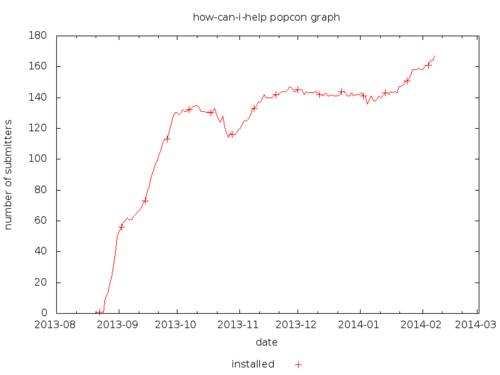
This is a repost from Stefano Zacchiroli's post how-can-i-help by Lucas Nussbaum is one of the best things that happened in the area of attracting contributions to Debian in quite a while. It can be used both as a standalone tool to list opportunities for contributing to Debian which are related to your installed packages, and as an APT hook (which is also the default configuration) that at each upgrade will inform you of new contribution opportunities. how-can-i-help is great for newbies who are looking for ways to give back to Debian which are a good match for their skills: among other things, how-can-i-help shows bugs tagged "gift" related to packages you use. how-can-i-help is also great for experienced developers, as it allows them to find out, in a timely manner, that packages they use are in dire need of help: RC bugs, pending removals, adoptions needed, requests for sponsor, etc. (As highly unscientific evidence: I've noticed a rather quick turnover of RFA/O/ITA bugs on packages installed on my machine. I suspect how-can-i-help is somehow responsible for that, due to the fact that it increases awareness of ongoing package issues directly with the people using them.) So, if you haven't yet, please apt-get install how-can-i-help RIGHT NOW. I daresay that we should aim at installing how-can-i-help by default on all Debian machines, but that might be an ambitious initial goal. In the meantime I'll settle for making how-can-i-help's popcon count skyrocket. As of today, it looks like this: Alt how-can-i-help popularity contest graph 10/02/2014 which is definitely too low for my taste. Please spread the word about how-can-i-help. And let's see what we can collectively do to that graph. how-can-i-help is just a tiny teeny helper, but I'm convinced it can do wonders in liberating dormant contributions to the Debian Project.

Stefano Zacchiroli: apt-get install how-can-i-help

skyrocketing how-can-i-help popcon count how-can-i-help by Lucas Nussbaum is one of the best things that happened in the area of attracting contributions to Debian in quite a while. It can be used both as a standalone tool to list opportunities for contributing to Debian which are related to your installed packages, and as an APT hook (which is also the default configuration) that at each upgrade will inform you of new contribution opportunities. how-can-i-help is great for newbies who are looking for ways to give back to Debian which are a good match for their skills: among other things, how-can-i-help shows bugs tagged "gift" related to packages you use. how-can-i-help is also great for experienced developers, as it allows them to find out, in a timely manner, that packages they use are in dire need of help: RC bugs, pending removals, adoptions needed, requests for sponsor, etc. (As highly unscientific evidence: I've noticed a rather quick turnover of RFA/O/ITA bugs on packages installed on my machine. I suspect how-can-i-help is somehow responsible for that, due to the fact that it increases awareness of ongoing package issues directly with the people using them.) So, if you haven't yet, please apt-get install how-can-i-help RIGHT NOW. I daresay that we should aim at installing how-can-i-help by default on all Debian machines, but that might be an ambitious initial goal. In the meantime I'll settle for making how-can-i-help's popcon count skyrocket. As of today, it looks like this:
how-can-i-help popularity contest graph, 10/02/2014
which is definitely too low for my taste. Please spread the word about how-can-i-help. And let's see what we can collectively do to that graph. how-can-i-help is just a tiny teeny helper, but I'm convinced it can do wonders in liberating dormant contributions to the Debian Project.

14 January 2014

Stefano Zacchiroli: forthcoming talks

Over the next few weeks I'll be on the road, attending a few Free Software events and giving talks. In particular: See you "there"?

17 October 2013

Stefano Zacchiroli: org-mutt ported to org-capture

org-mutt with org-mode >= 8 Thanks to Don I just remembered that I haven't yet announced org-mutt support for org-mode >= 8. Let's catch up! Since a few weeks I've been aware of the fact that my mutt/org-mode glue, AKA org-mutt, was no longer working with org-mode >= 8, due to the ditching of org-remember in favor of org-capture. Allegedly, org-capture should have been backward compatible, but it clearly is not. Before I had time to fix it myself, Mako came to my rescue and submitted a patch (now accepted) that does the needed porting. Free Software is truly amazing, isn't it? I've just updated the canonical org-mutt blog post, so that the documentation in there is up to date again. If you're using org-mutt, I suggest to refer to the Git repository as the canonical location for future updates, if any. Thanks Don, thanks Mako!

7 October 2013

Stefano Zacchiroli: so long F2C423BC

and thanks for all the sigs Bandwagoning just a bit, and only a few days past the 3-year anniversary of my 4096R GPG key, I've finally got my acts together and revoked my old 1024D GPG key. If you haven't yet switched to a GPG key stronger than 1024D, you definitely should.
Think of the kittens.

17 September 2013

Stefano Zacchiroli: sources.debian.net - advanced search and other news

all your ctag (and checksum) are belong to us A few months after the initial announcement, here are some news about the sources.d.n service. I've been late in blogging this, but most of it has been implemented by myself and Matthieu Caneill during DebConf13, which has been a great DebConf, totally exceeding my expectations (and they were already fairly high!). First, you might have noticed some user-visible changes: On the other hand, under the hood: As you usual, your bug reports (and patches!) are more than welcome, just check BUGS before reporting to avoid duplicates.
That's all!

Next.

Previous.