Search Results: "Michael Stapelberg"

17 January 2014

Michael Stapelberg: debmirror 6x speed-up, or how to fill a 1 GBps Rackspace link

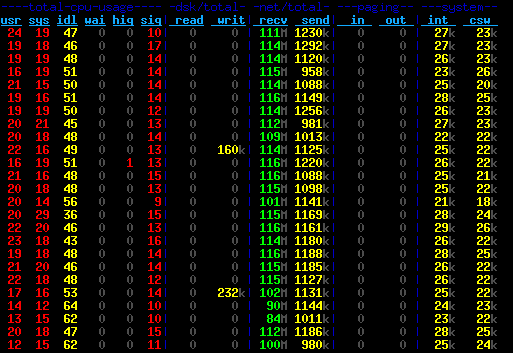
As explained in more detail in my my last blog post, Rackspace is providing hosting for Debian Code Search. For those of you who don t know, Rackspace is a cloud company that provides (among other services) a public cloud based on OpenStack. That means you can easily (and programmatically, if you want) bring up virtual servers, block storage volumes, configure the network between them, etc. As part of my initial performance experiments, I was running debmirror to clone a full Debian source mirror, and I noticed this took about one hour. Given that the peak network and storage write rates I have observed in my benchmarks are much higher, I wondered why it took so long. About 43 GB (that s how big the Debian sid sources are) in 60 minutes means 12 MB/s download rate, which is a bit more than a sustained 100 MBit/s connection. Luckily, at least the Rackspace servers I looked at are connected with 1 GBit/s to the internet, so more should be possible. Note that these are the old Rackspace servers. There is a new generation of servers, which I have not yet tried, that apparently offer even higher performance. After a brief look at the debmirror source code, I concluded that it can only use a single mirror and downloads files sequentially. There is some obvious potential for improvement here, and the fact that I could come up with a proof of concept written in Go to determine the files to download in a couple of minutes encouraged me to spend my saturday on this problem :-). About 7 hours later, my prototype had gone through various iterations and the code could sustain about 115 MB/s incoming bandwidth for most of the time. Here is a screenshot of dstat measuring the performance: Another 3 hours later, the most obvious bugs were weeded out and the code successfully cloned an entire mirror for the first time. I verified the correctness by running debmirror afterwards, and no files were downloaded that had not actually arrived on the mirror in the meantime. Features
  1. Parallel downloading from multiple mirrors.
    Of course, it is not guaranteed that the mirrors are consistent, but that is a solvable problem: whenever a non-200 HTTP response is encountered, the file is put back into the queue and gets rescheduled onto any mirror. Eventually, it will be rescheduled onto the mirror from which the sources.gz was downloaded, and that mirror has to have it.
  2. HTTP keep-alive and pipelining.
    debmirror also does HTTP keep-alive (I read that in the source, did not verify it), but it downloads files sequentially, i.e. it downloads one file, then sends the request for the next file. This means that after one file was received, no data is being received until another round-trip finished. For a lot of small files (think of .dsc and .debian.tar.gz files or small orig tarballs) that really adds up.
    Therefore, I use HTTP pipelining: I send 99 requests and then just receive all the responses at full speed. The magic number 99 comes from the fact that this is the smallest common denominator that all mirrors I have tested allow. nginx by default allows 100 requests.
  3. Request ordering.
    Instead of sending requests at random, I sort the download queue by size and make sure that the first request on each connection is for a big file. The intention is that TCP will adapt to that quickly and use a bigger window size as soon as possible instead of ramping up slower later on. Note that I have not actually measured the window sizes, so this is just a hunch.
    Another nice side-effect of the ordering is that the amount of data that is being sent through each connection is roughly equal. This means we don t waste TCP connections by sending 99 requests for small files only.
  4. (Goroutines).
    I m a bit hesitant to even write about it, so let s make it quick: Perl (and thus debmirror) is typically single-threaded, whereas Goroutines scale nicely on multi-core systems. I don t think it makes a big difference on the machines I am running this on as they have only two cores and are not maxed out on CPU usage at all. But maybe this will be more important for saturating 10 GBit/s? :-)
  5. (Mirror selection).
    It s not a feature of the code, but certainly relevant: of course I selected mirrors that are connected to the internet with at least a Gigabit link, serve files reasonably fast and have low latency to Rackspace s Chicago presence.
    Interestingly, while I used to think that universities have access to big uplinks and beefy machines, none of the mirrors that I use are located at a university. In fact, every mirror ending in .edu that I tried was really slow most of them providing something like 2-4 MB/s.
Results With the latest iteration of the code, I can clone an entire Debian source mirror with 43 GB of data in about 11.5 minutes, which corresponds to a 63 MB/s download rate:
GOMAXPROCS=20 ./dcs-debmirror -num_workers=20
68,24s user 384,90s system 66% cpu 11:25,97 total
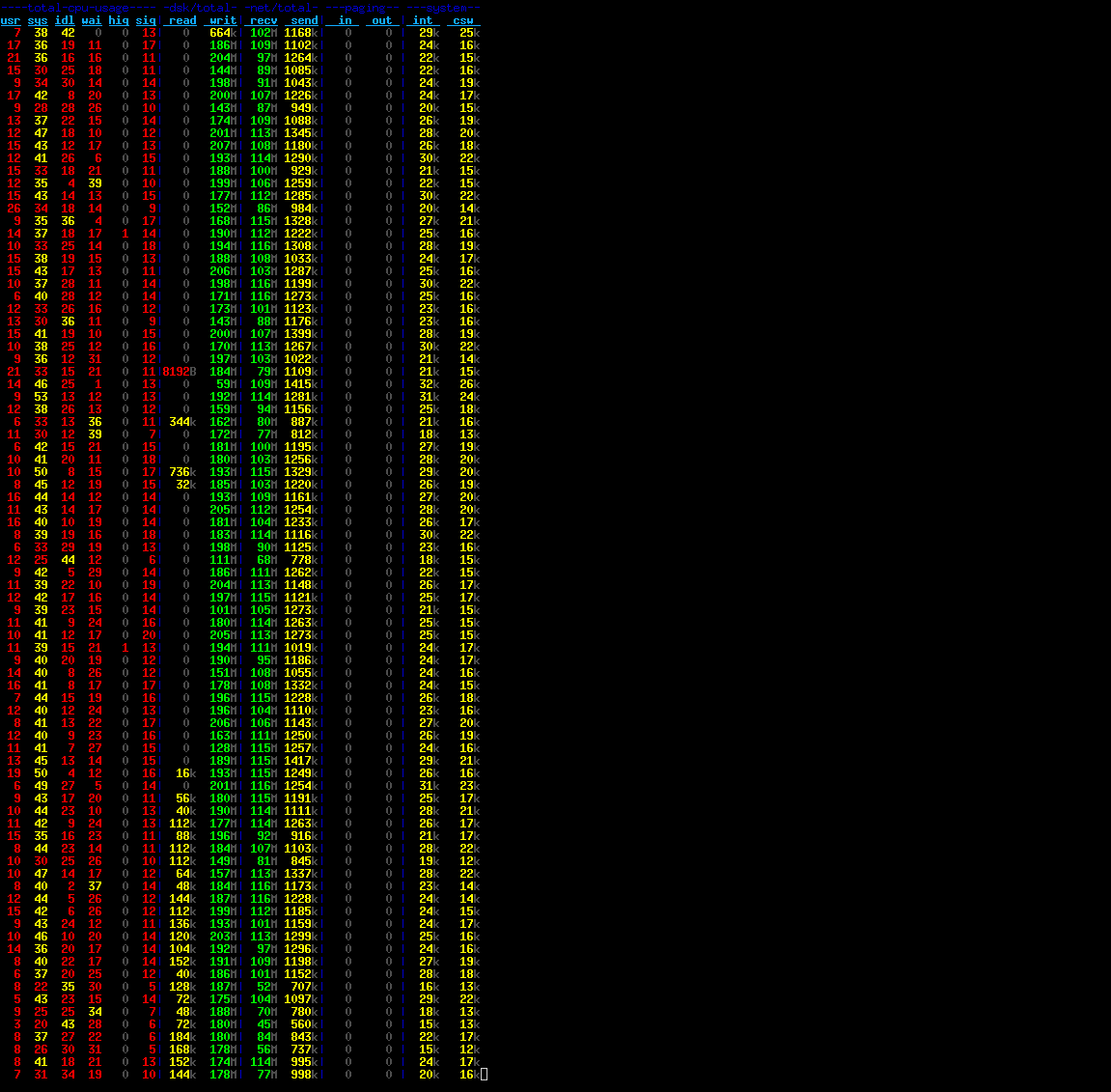
It should be noted that the download rate is very low in the first couple of seconds since the sources.gz file is downloaded from a single mirror, then unpacked and analyzed. The peak download rate is about 115 MB/s (= 920 MBit/s) which is reasonably close at what you can achieve with a Gigabit link, I think. If the entire uplink was available to me at all time, the Rackspace hardware would be able to saturate that easily, both in terms of reading from the network and in terms of writing to block storage. I tested this on an SSD volume, but I see about 113 MB/s throughput with the internal hard disk, so I think that should work, too. There is another dstat screenshot of the final version (writing to disk). Perhaps even more interesting to some readers is the time for an incremental update:
GOMAXPROCS=20 ./dcs-debmirror -tcp_conns=20
2013/10/13 11:09:55 Downloading 307 files (447 MB total)
 
2013/10/13 11:10:04 All 307 files downloaded in 9.105605931s. Download rate is 49.186567 MB/s
4,91s user 3,99s system 67% cpu 13,205 total
The wall clock time is higher than the time reported by the code because the code does not count the time for downloading and parsing the sources.gz file. The entire program is about 400 lines (not SLOC) of Go code. It s part of the Debian Code Search source. If you re interested, you can read dcs-debmirror.go in your browser. Conclusions The outcome of this experiment is that I now know (and have shown!) that there are significantly more efficient ways of cloning a Debian mirror than what debmirror does. Furthermore, I have a good grasp on what kind of performance the Rackspace cloud offers and I am fairly happy with the numbers :-). My code is useful to me in context of Debian Code Search, but unless you need a sid-only source-only mirror, it will not be useful to you directly. Of course you can take the ideas that I implemented and implement them elsewhere personally, I don t plan to do that. If you have hardware, bandwidth and a use-case for 10 GBit/s+ mirroring, I d like to hear about it! :-)

11 January 2014

David Moreno: i3 respect

Hey Michael Stapelberg, thanks for creating i3 and making me believe again that people have a clue and things can be done just right (specially when it comes to something easily done crappy like window managers). Thanks for just getting it all right, and not only from the software point of view, but also for the community, the style around it, etc. Kudos.

25 December 2013

Michael Stapelberg: Hosting for Debian Code Search provided by Rackspace

For a number of weeks now, I have been forwarding traffic being sent to codesearch.debian.net to an instance of Debian Code Search running at Rackspace s public cloud offering. I feel like it s overdue to announce how they have been supporting the project and what that means. Context First of all, let s provide some context. Debian Code Search was launched in November 2012, hosted entirely on my private server. Since DebConf 13, I am in contact with DSA in order to get Code Search running on a DSA-provided machine and make it an official Debian service. Code Search runs best on flash storage, and only with adequate resources can we enable some use cases (e.g. package-level results) and make sure the existing use cases work at all (we currently have timeouts for some queries). Unfortunately, flash storage is scarce in Debian, hence we couldn t get any for Code Search. At some point, I got the suggestion to ask Rackspace for help, since they are quite friendly to the Open Source community. They agreed to help us out with a generous amount of resources in their public cloud offering! This means I can run Code Search at Rackspace the way it is meant to be run: with the index sharded onto 6 different machines and the source code being searched on fast flash storage. Concerns Now, when using third-party infrastructure, there are always two big concerns: proprietary infrastructure and vendor lock-in. As for the proprietary aspect, Rackspace s public cloud offering is based on OpenStack, which is FOSS. Granted, they have a couple of extensions that are not (yet?) released in OpenStack, but those are minor details and any automation that we use can trivially be ported to any other OpenStack offering. Who knows, maybe in the future we use OpenStack in Debian, too? Given the OpenStack situation, I am not concerned about vendor lock-in. However, to specifically address this concern and err on the side of caution, attention will be paid to keep Code Search able to run on non-cloud infrastructure, such that we can run our own instance on DSA-provided hardware. My current intention is that this instance will be the fall-back that we can use should there ever be problems with Rackspace. So far, however, I am very happy with Rackspace s stability. Future There are a number of improvements waiting: for users in the United States, traffic first goes to my server in Europe and then back to Rackspace in the US. Eventually, we should get rid of this indirection. Perhaps we can also spin up another instance in Europe eventually. Furthermore, Rackspace recently announced new available hardware, which we are not yet making use of. I expect a big speed-up, but will have to do some careful benchmarking. Also, I have some interesting performance data, which will be shared in subsequent blog posts. Stay tuned :). Conclusion I d like to thank Rackspace very much for their generous support of the Debian project and Code Search in particular. I hope you look forward to the upcoming posts with more details. Also, to be perfectly clear about it: I also thank DSA for their help, and hope they will continue working with me to have our independent (yet slower) instance of Code Search running on Debian hardware.

27 November 2013

Michael Stapelberg: let s disable pdiffs already!

Richi s post about the pdiff-by-default agony resonates with me a lot. On EVERY Debian installation I have ever done in the last few years, without any exceptions, I have turned off pdiffs. Even on all the oddball cases (Raspberry Pi, account on a remote machine, ) where I don t run my install-configs script, I have ended up turning off pdiffs eventually, because it is just so insanely slow on modern internet connections. And by modern I mean even the DSL link my parents place has since 14 years. Let s disable pdiffs by default already.

7 November 2013

Michael Stapelberg: First Debian meetup in Z rich

Debian meetup Thanks to Axel Beckert (abe@), 12 people interested in Debian met last Tuesday in Z rich and celebrated the start of our monthly Debian meetup. New faces are always very welcome. If you live in Z rich, or if you re visiting, please feel free to attend our meetup no registration necessary. See the initial announcement, and subscribe to community@lists.debian.ch for updates. Thanks to everyone for the nice evening, see you next time!
Debian meetup

8 October 2013

Raphael Geissert: Faster, more stable and new opportunities

A new version of the code behind http.debian.net was deployed a few days ago. It has proved to be far more stable, faster, and scalable compared to the previous mod_perl-based deployment.

There were a couple of glitches during the earlier roll-out for IPv6 users, fixed thanks to the reports by Cyril Brulebois, Michael Stapelberg and Robert Drake.

What's behind?
The redirector is now a plack application (with no middlewere) running under the Starman server with an apache fronted. Requests are processed faster than before and there mod_perl-induced system overload is finally gone.

The redirector is now easier to test and develop. Deploying the live instance is not yet fully streamlined, but it has seen a lot of improvement. Some important changes to the way the redirector works are already on their way to see the light and I am going to be announcing them when they do. Fork the repository and hack a few changes, contributions are welcome :)

It's probably time to move it under debian.org, and finish making it the default everywhere. It's even made its way into the installation manual.

29 September 2013

Ian Campbell: qcontrol 0.5.2

I've just released qcontrol 0.5.2. Changes since the last release: Get it from gitorious or http://www.hellion.org.uk/qcontrol/releases/0.5.2/. The Debian package will be uploaded shortly.

30 August 2013

Michael Stapelberg: How git performs when you throw all of Debian at it

During DebConf, Asheesh presented the idea of using git instead of the file system for storing the contents of Debian Code Search. The hope was that it would lead to fewer disk seeks and less data due to gits delta-encoding. Maybe the reduction would be big enough that enough data could be held in RAM to allow for fast retrieval. Joey Hess helped me out with a couple of details: he revealed that using git repack -a -d will lead to a single packfile that optimally contains HEAD, not caring about the history. Also, he showed me how to use git cat-file. We did a small-scale experiment and the results were promising. I told him I ll do the experiment of just committing the entire unpacked source mirror to git and promised to follow up with the results, so here goes:
stapelberg@couper ~/unpacked master $ time cat <<EOT   git cat-file --batch >/dev/null
:linux_3.2.32-1/sound/pci/ice1712/aureon.c
:linux_3.2.32-1/sound/soc/codecs/sgtl5000.c
:linux_3.2.32-1/sound/pci/hda/patch_conexant.c
EOT
cat <<<''  0,00s user 0,00s system 62% cpu 0,006 total
git cat-file --batch > /dev/null  4,38s user 1,08s system 99% cpu 5,477 total
stapelberg@couper ~/unpacked master $ time cat linux_3.2.32-1/sound/pci/ice1712/aureon.c linux_3.2.32-1/sound/soc/codecs/sgtl5000.c linux_3.2.32-1/sound/pci/hda/patch_conexant.c >/dev/null
cat linux_3.2.32-1/sound/pci/ice1712/aureon.c   > /dev/null  0,00s user 0,00s system 69% cpu 0,006 total
stapelberg@couper ~/unpacked master $ time cat <<EOT   git cat-file --batch >/dev/null
:i3-wm_4.6-1/libi3/font.c
EOT
cat <<<':i3-wm_4.6-1/libi3/font.c'  0,00s user 0,00s system 51% cpu 0,008 total
git cat-file --batch > /dev/null  4,30s user 1,18s system 99% cpu 5,533 total
stapelberg@couper ~/unpacked master $ time cat i3-wm_4.6-1/libi3/font.c >/dev/null
cat i3-wm_4.6-1/libi3/font.c > /dev/null  0,00s user 0,00s system 0% cpu 0,004 total
Even after repeating those tests a couple of times to get a warm page cache, the result stays the same: git takes about 5 seconds to resolve the deltas in a large repository. Even if this was 5 seconds startup time and a very small amount of additional time per file, it would not be acceptable for our use case. The conclusion is that git is clearly not suitable for this kind of usage, which is not surprising after having heard a couple of times that git does not scale :-). For the curious, the .git/objects directory is 29 GiB for roughly 140 GiB of source code, so the delta encoding is quite impressive in terms of saving space. However, keep in mind that the compressed (!) Debian source archive is about 35 GiB, so the savings are not that huge.

16 August 2013

Michael Stapelberg: My DebConf13 talks are online

I gave two talks at this year s DebConf, both about systemd. A huge thanks goes to the video team for their excellent work and putting up the videos that quickly! Find the recordings and slides here:
  1. Making your package work with systemd (508 MiB ogv) (Slides ( 230 KiB PDF))
  2. systemd myths debunked! (456 MiB ogv) (Slides ( 230 KiB PDF))

8 August 2013

Michael Stapelberg: Going to DebConf

I will arrive at DebConf 2013 on Sunday afternoon. In case you are interested in Go (the programming language), systemd, i3 or getting your package reviewed, please talk to me! :-) Looking forward to meeting many of you in real life.
31 July 2013

Michael Stapelberg: dh-golang in unstable

Good news, everyone! dh-golang is now in Debian unstable. With this debhelper addon, packaging software written in Go is very simple. Have a look at the example/ directory in dh-golang to see how it is meant to be used. Essentially, export the DH_GOPKG variable containing the canonical upstream location of the package (e.g. github.com/stapelberg/godebiancontrol) and then use dh $@ --buildsystem=golang --with=golang. That s it! Now, given that this package is very new and only two packages use it so far (both of which are not yet in Debian, but real soon ), there are most likely bugs and missing features. This is where you come in: when packaging software written in Go, please contact me and tell me whether dh-golang worked for you and what could be improved. In case something does not work, definitely report it. Even if everything worked, I d be happy to have a look at your packaging before you upload. Also see https://wiki.debian.org/MichaelStapelberg/GoPackaging.

25 July 2013

Michael Stapelberg: Looking for a USB WLAN stick

Posting this on behalf of a friend of mine in the hope that you can help: I ve failed several times now to find a suitable WLAN USB dongle that works out of the box on Debian testing. Often manufacturers change the chipsets without changing the version numbers, the product pages are incomplete or even state wrong information. I turn to you, in the hopes that someone can give me helpful pointers. The dongle should have: If you have any hints, please send them directly to breunig AT uni-hd DOT de. Thanks!

20 July 2013

Michael Stapelberg: systemd 204 in Debian experimental

As of today, systemd 204 is available in Debian experimental. If you are interested in systemd, please install it and report any issues to the BTS merely reporting them on IRC is not sufficient, we need to have them in the BTS so we don t forget about them. In case you ve been using the unofficial 204 packages from http://people.debian.org/~biebl/systemd, please downgrade first to systemd 44-12 and udev 175-7.2, then upgrade to the versions in Debian experimental. This will ensure that during the upgrade all obsolete conffiles are upgraded properly. Thanks for helping with testing!

14 July 2013

Michael Stapelberg: Systemd support in Debian packages: how to help

Sometimes, people show up in our IRC channel #debian-systemd or on our mailing list pkg-systemd-maintainers@lists.alioth.debian.org and ask how they can help. This blog post answers that question. First of all, whatever you end up doing, please coordinate with us first! Saying hi in our IRC channel or on our mailing list and explaining what you intend to do is all we ask for. In the past, people have filed bug reports with service files that are not idiomatic, and we really need to avoid that. Currently, our biggest task is to add/improve systemd support to individual Debian packages, and this is where we can use a lot of help. We have a dashboard which contains two lists:
  1. Packages that ship a service file, but don t use dh-systemd yet.
    These need to be updated to get proper maintscripts (e.g. deb-systemd-helper enable/disable calls, possibly start/stop/restart calls).
  2. Packages that ship an init script but no service file yet.
    These need a service file plus dh-systemd support.
Adding a service file and dh-systemd support After you picked a service from the second list in our dashboard, first double-check that there is no bug filed against it yet (the dashboard might be a few hours behind). Then, search for a service file, either upstream or in other distributions such as Arch Linux, Fedora, Gentoo, etc. In case there is no service file yet, write one. Please carefully test the service file (e.g. does starting/stopping/restarting and reloading work) and send it to us for review. Be careful to avoid obvious regressions from the sysvinit init script. That is, don t just write a very simplistic service file that breaks a use-case which formerly worked. If in doubt, ask pkg-systemd-maintainers or chose a different package to work on. Afterwards, add systemd support by using the dh-systemd helper, see https://wiki.debian.org/Systemd/Packaging. The last step is to file a proper bug report against the package that uses our usertag and CCs pkg-systemd-maintainers. See http://bugs.debian.org/714190 for an example. Replacing custom maintscripts with dh-systemd Check if the package currently has any direct systemctl calls in its maintscripts and remove them if so (see http://bugs.debian.org/713853 for an example). Follow https://wiki.debian.org/Systemd/Packaging to add systemd support using the dh-systemd helper. Check whether the maintscripts look good and generate a debdiff to highlight the differences between the old and the new version:
debdiff --controlfiles=ALL OLD_amd64.changes NEW_amd64.changes
Then file a bug report which uses our usertag and CCs pkg-systemd-maintainers. See http://bugs.debian.org/713853 for an example. Thanks! Thank you for helping us and Debian in general!

Michael Stapelberg: How many packages does Debian Code Search contain?

The German computer magazine c't has covered Debsources in its most recent edition (c't 16/2013). In that article, they also state:
Debsources integriert auch eine Code-Suche, allerdings werden lediglich die
Quellen des Unstable-Zweigs durchsucht, der zirka ein Drittel des Quellcodes
von Debsources ausmacht.
This loosely translates to:
Debsources also integrates a code search engine, but it only searches the
sources of the unstable tree, which makes up for roughly one third of the
sources that Debsources covers.
I suspect the author of the article arrived at this conclusion because Debsources talks about 400 GiB of source code, whereas Debian Code Search talks about 130 GiB of source code. However, it still struck me as odd and giving the wrong impression. I thought that packages don t differ that much between stable, testing and unstable. So I fired up psql and pounded UDD until it revealed how many packages are different between stable, testing and unstable: Conclusion So, in conclusion, Debian Code Search covers 74% of wheezy, testing and unstable. Debsources also covers contrib and non-free, which explains the higher disk usage. In particular, there might be big blobs in non-free that account for a lot of disk space. Also, Debsources keeps sources around for a few weeks whereas Debian Code Search only keeps the most recent snapshot. Query
SELECT
  COUNT(*)
FROM
  (SELECT
     migrations.source,
     sources.version AS stable_version,
     testing_version,
     unstable_version
   FROM sources
   LEFT JOIN migrations
   USING (source)
   WHERE sources.release = 'wheezy') AS x
WHERE
  regexp_replace(stable_version::text, E'-([0-9.]+)$', '') = regexp_replace(testing_version::text, E'-([0-9.]+)$', '');

13 July 2013

Michael Stapelberg: Survey answers part 3: systemd is not portable and what this means for our ports

This blog post is the third of a series of posts dealing with the results of the Debian systemd survey. I intend to give a presentation at DebConf 2013, too, so you could either read my posts, or watch the talk, or both :-). The second-biggest concern in the survey results was that systemd is not portable to non-Linux systems, for example Debian GNU/kFreeBSD or Debian GNU/HURD. For convenience, I will from now on write kFreeBSD when I really mean all non-Linux ports. systemd not being portable is not an arbitrary decision Some people seem to think that the systemd upstream is just hostile to users of other operating systems when they hear that systemd is not portable. However, keep in mind that Lennart, Kay and other contributors have considerable experience with writing portable software such as Avahi and PulseAudio. The decision to only support Linux in systemd was thus not taken lightly. systemd s design requires many kernel features and certain semantics (e.g. procfs is not enough, /proc/$PID/exe needs to be supported), which are currently only available on Linux. Point 15 of Lennart s blog post 0pointer.de/blog/projects/the-biggest-myths.html contains an incomplete list of these features. Maintaining portable code increases complexity Since systemd is written in C, the canonical way to write portable code is by using conditional compilation, for example with ifdef statements. That makes the code harder to understand and reason about, but more importantly it blows up the test matrix. It also requires any new change to be tested on all supported systems, which is not feasible for most contributors. I think everybody agrees keeping complexity low is a good thing. What are the implications for our non-Linux ports? We, the Debian project, have two realistic options in my point of view:
  1. We stay with sysvinit, the least common denominator, forever.
  2. We use a modern init system such as systemd on Debian GNU/Linux.
In case we go with the first option, Debian will diverge more and more from virtually every other Linux distribution. This also means we are stuck with the limited features and capabilities that sysvinit has. A modern operating system needs to be able to adapt to a changing environment and the once static world in which sysvinit was developed has become much more dynamic. In our opinion, the only reasonable choice is the latter option: use systemd on Debian GNU/Linux. How will this work? For individual maintainers, this means they need to support two init systems. Luckily, systemd service files are usually really simple, but there still is additional maintenance work such as testing whether your service actually starts when using systemd. We think this maintenance overhead is justified due to the advantages a modern init system brings. Of course, not every maintainer can arrange it to install systemd and test his/her package. You are invited to contact us at pkg-systemd-maintainers@lists.alioth.debian.org at any time and we can help you out. Furthermore, automation can be introduced (and we have a proof of concept) to make it easier to spot mistakes and perform some simple tests, such as whether the service can be started. A concern that was voiced is that as sysvinit usage decreases, the init scripts would bit-rot and stop working at some point. If that happens, we rely on the users to file appropriate bug reports. This is no different from the situation today it is not feasible for maintainers to test every single combination of features all the time. Ports are different and that diversity is good The FreeBSD kernel and the Linux kernel are different, and each kernel provides distinct features that the other kernel does not have. As an example, Linux provides cgroups, which are heavily used by systemd. The FreeBSD kernel in turn offers the packet filter pf , which is not available on Linux. There certainly is value in having common infrastructure. But there also is value in providing the best features that each platform has to offer in case of Linux, that is clearly systemd as an init system IMO. Conclusion systemd is not portable because it relies on features only the Linux kernel provides an example is cgroups, which systemd uses to track processes in a reliable way. Not embracing these features and staying with sysvinit indefinitely is not a viable option if Debian wants to remain relevant for today s demands. In the short term, the migration to systemd will cause additional maintenance effort for individual package maintainers, but it will pay off in the long term.

2 July 2013

Bits from Debian: all Debian source are belong to us

This is a verbatim repost from Stefano Zacchiroli's post TL;DR: go to http://sources.debian.net and enjoy.
Debsources is a new toy I've been working on at IRILL together with Matthieu Caneill. In essence, debsources is a simple web application that allows to publish an unpacked Debian source mirror on the Web. You can deploy Debsources where you please, but there is a main instance at http://sources.debian.net (sources.d.n for short) that you will probably find interesting. sources.d.n follows closely the Debian archive in two ways:
  1. it is updated 4 times a day to reflect the content of the Debian archive
  2. it contains sources coming from official Debian suites: the usual ones (from oldstable to experimental), *-updates (ex volatile), *-proposed-updates, and *-backports (from Wheezy on)
Via sources.d.n you can therefore browse the content of Debian source packages with usual code viewing features like syntax highlighting. More interestingly, you can search through the source code (of unstable only, though) via integration with http://codesearch.debian.net. You can also use sources.d.n programmatically to query available versions or link to specific lines, with the possibility of adding contextual pop-up messages (example). In fact, you might have stumbled upon sources.d.n already in the past few days, via other popular Debian services where it has already been integrated. In particular: codesearch.d.n now defaults to show results via sources.d.n, and the PTS has grown new "browse source code" hyperlinks that point to it. If you've ideas of other Debian services where sources.d.n should be integrated, please let me know. I find Debsources and sources.d.n already quite useful but, as it often happens, there is still a lot TODO. Obviously, it is all Free Software (released under GNU AGPLv3). Do not hesitate to report new bugs and, better, to submit patches for the outstanding ones. Acknowledgements PS in case you were wondering: at present sources.d.n requires ~381 GB of disk space to hold all uncompressed source packages, plus ~83 GB for the local (compressed) source mirror

Stefano Zacchiroli: introducing sources.debian.net

all Debian source are belong to us TL;DR: go to http://sources.debian.net and enjoy.
Debsources is a new toy I've been working on at IRILL together with Matthieu Caneill. In essence, debsources is a simple web application that allows to publish an unpacked Debian source mirror on the Web. You can deploy Debsources where you please, but there is a main instance at http://sources.debian.net (sources.d.n for short) that you will probably find interesting. sources.d.n follows closely the Debian archive in two ways:
  1. it is updated 4 times a day to reflect the content of the Debian archive
  2. it contains sources coming from official Debian suites: the usual ones (from oldstable to experimental), *-updates (ex volatile), *-proposed-updates, and *-backports (from Wheezy on)
Via sources.d.n you can therefore browse the content of Debian source packages with usual code viewing features like syntax highlighting. More interestingly, you can search through the source code (of unstable only, though) via integration with http://codesearch.debian.net. You can also use sources.d.n programmatically to query available versions or link to specific lines, with the possibility of adding contextual pop-up messages (example). In fact, you might have stumbled upon sources.d.n already in the past few days, via other popular Debian services where it has already been integrated. In particular: codesearch.d.n now defaults to show results via sources.d.n, and the PTS has grown new "browse source code" hyperlinks that point to it. If you've ideas of other Debian services where sources.d.n should be integrated, please let me know. I find Debsources and sources.d.n already quite useful but, as it often happens, there is still a lot TODO. Obviously, it is all Free Software (released under GNU AGPLv3). Do not hesitate to report new bugs and, better, to submit patches for the outstanding ones. Acknowledgements PS in case you were wondering: at present sources.d.n requires ~381 GB of disk space to hold all uncompressed source packages, plus ~83 GB for the local (compressed) source mirror

1 July 2013

Michael Stapelberg: Survey answers part 2: the transition

This blog post is the second of a series of posts dealing with the results of the Debian systemd survey. I intend to give a presentation at DebConf 2013, too, so you could either read my posts, or watch the talk, or both :-). It seems that it is unclear how Debian s transition to systemd is intended to work. By transition , we mean going from the current state (sysvinit is the default and fully supported) to systemd is fully supported. Then by merely installing systemd by default and letting it provide /sbin/init, we can make it the default init system. If and when that happens is a different matter and it s not necessary for all packages to have systemd support. sysvinit compatibility systemd natively supports sysvinit scripts, meaning your existing package will work as-is but you cannot utilize all the features that systemd provides. The sysvinit support works very well, as you can try in a fresh Debian wheezy VM. In the output of systemctl list-units , every entry which has an LSB: prefix is actually a sysvinit script. The mechanism with which systemd decides whether to use an init script or a service file is by looking whether a service file with a corresponding name exists. That is, if e.g. apache2.service exists, systemd will prefer it over /etc/init.d/apache2. To make this crystal clear: it is not necessary to ship service files for all services in some kind of flag day. systemd supports a mixed installation where some services use init scripts and some services use service files. Adding systemd support to your package In a nutshell, it usually works like this:
  1. Install a service file to /lib/systemd/system/foo.service.
    Often, upstream already provides and installs a .service file.
    If not, you can place your file at debian/package.service
    Make sure that your service file name corresponds to the sysvinit script name
    (e.g. apache2.service for /etc/init.d/apache2)
  2. Ensure your service file(s) are enabled and started.
    We strongly recommend you to use our package dh-systemd.
    If you use dh(1), add --with=systemd in debian/rules and Build-Dep on dh-systemd
  3. Test your package, see the next section.
For details see wiki.debian.org/Systemd/Packaging. Testing systemd We carefully made sure that you can install the systemd Debian package on your machine alongside sysvinit without breaking anything. The systemd package does not conflict with any other packages, it will not replace /sbin/init and systemd will not be enabled right away. It is only after you specify the kernel parameter init=/bin/systemd in /etc/default/grub that you switch to systemd. In case you want to go back, simply boot without this kernel parameter. Conclusion In conclusion, the transition is straight-forward and the necessary infrastructure is in place. systemd is available in Debian and can be used today. Packages can add systemd support whenever their maintainer(s) feel like it. There is no need for a flag day. We can switch the default whenever we think we are ready.

17 June 2013

Michael Stapelberg: Talk about Debian Code Search

At this year s GPN13 I gave a talk about Debian Code Search. It was in German, so I spent a few hours creating english subtitles. You can watch the video at youtube.com/watch?v=n6DtW3zCTvk with english subtitles. In case you prefer to download the file(s), get http://ftp.ccc.de/events/gpn/gpn13/gpn13-debian-code-search.mp4 (84 MiB) and the corresponding subtitle file at http://t.zekjur.net/gpn13-debian-code-search.srt. Drop both files in the same directory, run mplayer gpn13-debian-code-search.mp4 and press v to enable subtitles. I intend to eventually put the (subtitled) video on YouTube and refer to it from codesearch.debian.net, but I wanted to post the video in its current form already. The presentation itself explains the motivation behind Debian Code Search and how it works. You don t need any knowledge of the system in order to understand the talk. Enjoy!

Next.

Previous.