It took some time, but now it s finally done: KDE has translations for AppStream upstream metadata!
AppStream is a Freedesktop project to extend metadata about the software projects which is available in distributions, especially regarding applications. Distributions compile a metadata file from data collected from packages, .desktop files and possibly other information sources, and create an AppStream XML file from it, which is then directly or via a Xapian cache read by software-center-like applications such as GNOME-Software or KDEs Apper.
Since the metadata available from current sources is not standardized and rather poor, upstream projects can ship small XML files, AppStream upstream metadata or AppData in short. These files contain additional information about a project, such as a long description and links to screenshots. They also provide hints about public interfaces a software provides, for example binaries and libraries, making it possible for distributors to give users exactly the right package name in case they are missing a software component.
So, in order to represent graphical KDE applications like they deserve it in the new software centers making use of AppStream, we need to ship AppData files, with long descriptions, screenshots and a few URLs.
But how can you create these metadata files? In case you want your graphical KDE app to ship an AppData file, there is now a help page on the Techbase Wiki which provides all information needed to get started!
For non-visual stuff or software which just wants to publish it s provided interfaces with AppStream metadata, there is a dedicated page for that as well. Shipping metadata for non-GUI apps will help programmers to satisfy depedencies in order to compile new software, enhance bash-completion for missing binaries and provides some other neat stuff (take a look at this blogpost to get a taste of it).
And if you want to read a FAQ about the metadata stuff and get the bigger picture, just go to the Techbase Wiki page about AppStream metadata as well.
The pages are not 100% final, so if you have questions, please write me a mail and I ll update the pages, or simply correct/refine it by yourself (it s a wiki afterall).
And now to the best thing: As soon as you ship an AppStream upstream metadata file (*.appdata.xml* for apps or *.metainfo.xml* for other stuff), the KDE l10n-script (Scripty!) will automatically start translating it, just like we already do with .desktop files. No further actions are necessary.
I already have a large amount of metadata files here, partially auto-generated, which show that we have about 160+ applications in KDE which could get an AppData file, not counting any frameworks or other non-GUI stuff yet. Since that is a bit much to submit via Reviewboard (which I originally planned to do), I hope I can commit the changes directly to the respective repositories, where the maintainers can take a look at it and adjust it to their liking. If that idea does not receive approval, I will just publish a set of data at some place for the KDE app maintainers to take as a reference (the auto-generated stuff needs some fixup to be commit-ready (which I d do in case I can just commit changes)). Either way, it is safe now to write and ship AppData files in KDE projects!
In order to get your stuff translated, it is necessary that you follow the AppStream 0.6 metadata specification, and not one of ther older revisions. You can easily detect 0.6 metadata by the <component> root node, instead of <application>, or by it having a metadata_license tag. We don t support the older versions simply because it s not necessary, as there were only two KDE projects shipping AppData before, which are now using 0.6 data as well. Since 0.6, the metadata XML format is guaranteed to be stable, and the only reason which could make me change it in an incompatible way is to prevent something as bad as the end of the world from happening (== won t happen $ sudo appstream-index --refresh |
$ appstream-index -s media |
Identifier: gnome-media-player.desktop [desktop-app] Name: GNOME Media Player Summary: A simple media player for GNOME Package: gnome-media-player ---- Identifier: mediaplayer-app.desktop [desktop-app] Name: Media Player Summary: Media Player Package: mediaplayer-app ---- Identifier: kde4__plasma-mediacenter.desktop [desktop-app] Name: Plasma Media Center Summary: A mediacenter user interface written with the Plasma framework Package: plasma-mediacenter ---- etc. |
$ appstream-index --get lyx.desktop |
Identifier: lyx.desktop [desktop-app] Name: LyX Summary: An advanced document processor with the power of LaTeX. Package: lyx-common Homepage: http://www.lyx.org/ Icon: lyx.png Description: LyX is a document processor that encourages an approach to writing based on the structure of your documents (WYSIWYM) and not simply their appearance (WYSIWYG). LyX combines the power and flexibility of TeX/LaTeX[...] Sample Screenshot URL: http://alt.fedoraproject.org/pub/alt/screenshots/f21/source/lyx-ea535ddf18b5c7328c5e88d2cd2cbd8c.png License: GPLv2+ |
appstream-index --what-provides -t lib -v libfoo.so.2 |
appstream-index --what-provides -t bin -v apper |
With the release of GNOME-Software 3.12, it s also time for another update about what is going on behind the scenes of Appstream, the project providing all the data needed to make software-centers work. So here is the long overdue update
Tanglu

While reading stuff posted by others about AppStream, and because of the discussion happening about AppData on kde-core-devel right now, I feel the need to clarify a few things. Especially because some are implementing AppStream in a way which is not really ideal right now. This is to some extend my fault, because I should have communicated this in a much more visible way.
To those people who don t know it already: AppStream is a Freedesktop project aiming at providing basic building blocks to create distro- and desktop-agnostic software centers.
So, let s answer some questions about AppStream!
Is AppStream GNOME or $distro specific?
No, not at all! It was originally created by people from at least 4 different distributions, and I took great care of it not becoming specific to any desktop or distribution. GNOME just happened to go ahead and implement the specs, which was absolutely necessary, since there was less progress in implementing AppStream for a long time.
How does AppStream actually work?
AppStream is a bunch of things, so I will only focus on what we have specified right now and what is working.
Basically, the distributor compiles a list of applications available in the repositories, and makes it available in some defined directories on the system. AppStream defines an XML specification for that, but since some peple don t want to use it or can t use it, there are also others ways to publish AppStream application data. For example, Debian will likely use YAML for that.
This data is taked by the AppStream software (running as a PackageKit plugin) and transformed into a Xapian database. This database is then in turn used by software-centers, in combination with PackageKit, to present applications.
This is the reason why it is bad to use the XML data directly it might not be available on every distribution. The Xapian database is what matters. The database can be accessed using libappstream, a GLib based library (so far, there was no need for a Qt version).
Why is GNOME using the XML data directly then?
The libappsream stuff was under heavy construction, and GNOME wanted to be fast and ship the stuff with Fedora in their next release. They ll likely switch to the Xapian db soon, or offer it as backend.
Is AppStream already used in KDE?
Yes, Apper can utilize it, see one of my previous blogposts.
What is AppData?
AppData is an initiative started by Richard Hughes in order to enhance the quality of applications descriptions shipped with AppStream. It defines a small file $appname.appdata.xml, which describes the application, sets screenshots etc. These files can be parsed at the distribution s side in order to enhance the app metadata. They can also be translated upstream.
AppData might be merged into the XDG AppStream pages later, but that is to be discussed.
Are application authors forced to ship AppData files?
No, nobody is forced
status information on the metapackage generator, which helps us in finding out which packages are available on the live-cds. Furthermore, information about the staging->devel migration process is provided, to answer the question why a package does not migrate (this still needs some improvements, but it is being worked on).
We also use some code from Ubuntu to monitor package versions in Debian and upstream, which helps to see if others have released newer versions of software shipped with Tanglu.
This already resulted in many improvements: The Tanglu Aequorea suite does not contain unbuildable packages (at least not due to build-dependency changed), and all live-cds are working well.
We will soon migrate the archive to a new server, which frees some server capacities we can use for automated QA and things like automatic live-CD building.
Live-CDs, Installer, Alpha-Releases
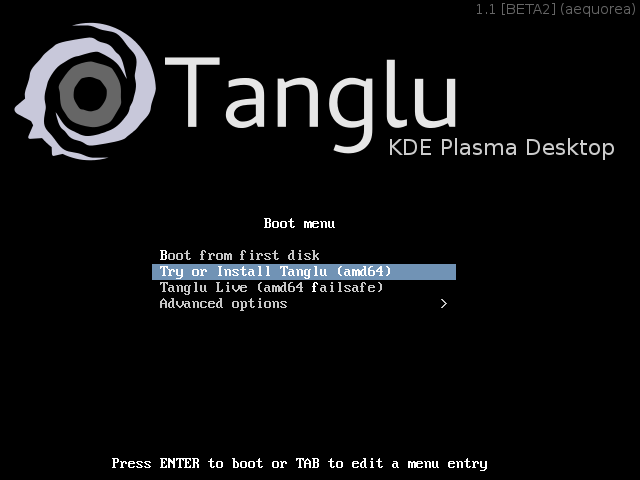
We currently don t do Alpha-Releases of Tanglu, but we create Live-CD snapshots of Tanglu, which are available at releases.tanglu.org (or mirror1, mirror2). These snapshots still have issues and are just early previews. They also ship without and installer, we are still working on that part. Please note that CD more or less means DVD or USB-Stick right now (and this won t change the expected image size will be around 800MB).
Release Planning
I am happy to announce that we will do a release this year, most likely in December. But what can you expect from the release?
KDE 4.11
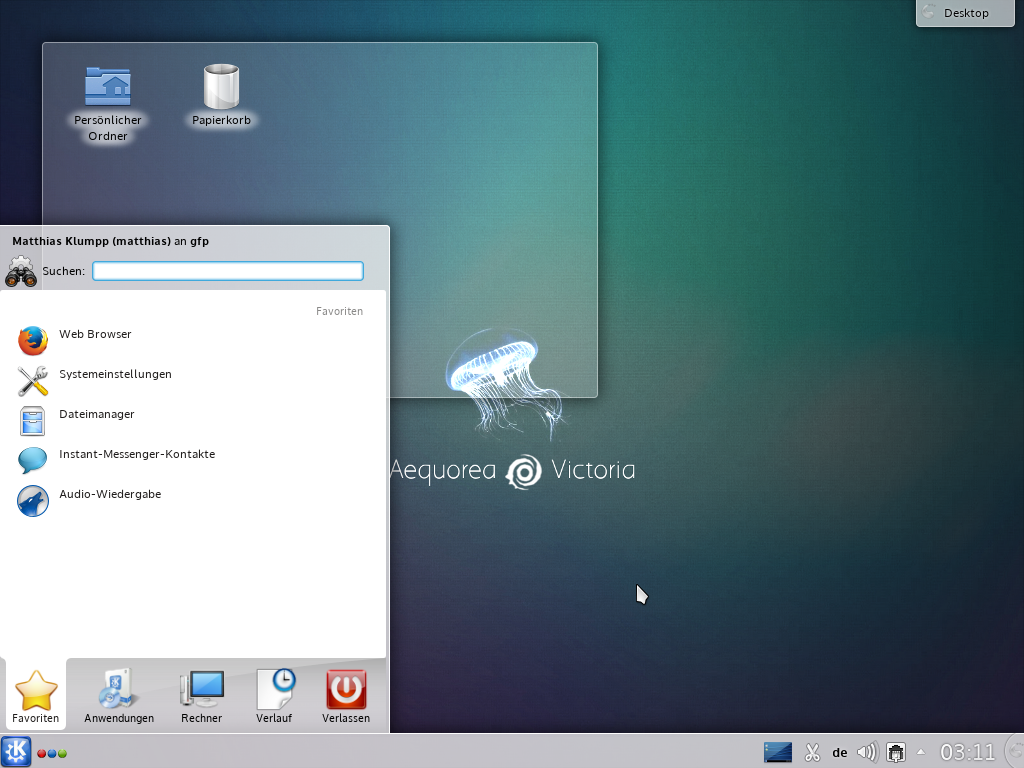
We will ship with KDE 4.11, which will be the only desktop we officially support so far. The reason is simply lack of manpower we could promise to support more, but that would just be not realistic for the small team. So we focus on KDE (Plasma Shells) right now, and try to make it awesome. Also, the team consists mostly of KDE people right now, which contributed to that decision
We will also provide images with GNOME. The problem with GNOME is, that the GNOME team does not have enough manpower to maintain the whole desktop or to upgrade it to the latest version (it is essentially just me looking at it from time to time). So GNOME will be available in a preview state. We invite everyone with GNOME knowledge to join the project and help improving Tanglu-GNOME GNOMErs, we want you!
systemd >= 204
We ship with systemd by default, which works nicely so far, although more testing needs to be done. The logind service will be used to replace ConsoleKit, if we manage to get everything in place and working in time (if there are issues, we might switch back to CK for one release). There are some plans to use a higher systemd version, due to some improvements made there, but if this will be done is still unclear (Debian will most likely stick to 204 for some time, because with systemd > 205, running it as pid 1 will be mandatory to use logind (and Debian is just in the process to decide which init-system we will use there)).
Systemd will run in SysVInit compatibility mode for most of the available services. This will improve in later Tanglu releases. Of course, systemd is usable, even if not every init-script has been converted to a service file. It just has an impact on startup times, so Tanglu will not be the distributions with the fastest startup times (yet
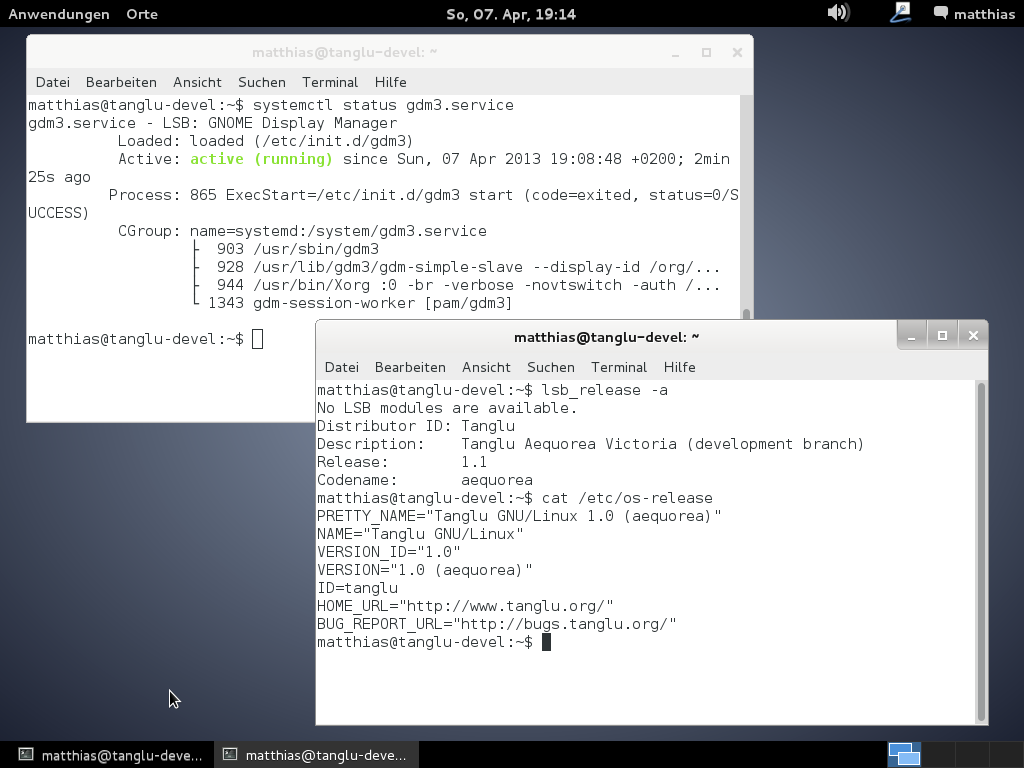
Tanglu consists mostly of packages from Debian Testing (Jessie), but we take full advantage of the Debian archive, so you will also find package versions from Unstable or even Experimental (where it made sense). A very small portion of packages has also been merged with Ubuntu. Although stuff has been changed, the incompatibilities with Debian are almost zero, so if you are installing Tanglu, it will currently feel like an more up-to-date Debian Testing with some extras.
Still, the differences are large enough that upgrading a Debian system to Tanglu might result in some issues.
Installer
Right now, the installer is a major field of work. Tanglu will most likely ship with the Debian-Installer, because it is the easiest thing to do right now.
For later releases, it is planned to also offer the Ubiquity installer (the thing Ubuntu uses), or a new installer with a similar UI and concept.
Other Cool Things
Tanglu will ship with a fully working Qt5 (which is currently being tested and updated) and the latest version of Wayland/Weston as a preview for developers to play around with.
We also ship with Perl 5.18 and Haskell GHC 7.6, as well as with GCC 4.8 as default compiler (although the whole distribution does not yet compile with GCC 4.8). We might ship with Linux 3.12, but this also depends on other things. The Linux kernel build will be the same as in Debian. There might be more things to come
archive mirrors, buildd-servers or by testing the distribution and providing feedback! (given the state the aequorea suite was in at the beginning, testing was a really frustrating activity but people still did it!)
So, if you would like to help, just find us on #tanglu-devel on Freenode or join the tg-devel mailinglist. We also really need some people taking care of the Tanglu website and updating it with some recent information from time to time, so people can see what is going on. Before we have the Tanglu policy finished and the Tanglu members and developers directory in place (a software which allows us to track all registered developers and gives them an @tanglu.org mailalias), the start might be a bit confusing, but we do our best to make it easy for new people to join. The best way is asking people.
Tanglu is still created by an incredibly small team, which has a large task to accomplish. Help is welcome
Long time since I published the last update about Tanglu. So here is a short summary about what we did meanwhile (even if you don t hear that much, there is lots of stuff going on!)
Better QA in the archive
We now use a modified version of Debian s Britney tool to migrate packages from the newly-created staging suite to our current development branch aequorea . This ensures that all packages are completely built on all architectures and don t break other packages.
New uploads and syncs/merges now happen through the staging area and can be tested there as well as being blocked on demand, so our current aequorea development branch stays installable and usable for development. People who want the *very* latest stuff, can embed the staging-sources into their sources.list (but we don t encourage you to do that).
Improved syncs from Debian
The Synchrotron toolset we use to sync packages with Debian recently gained the ability to sync packages using regular expressions. This makes it possible to sync many packages quickly which match a pattern.
Tons of infrastructure bugfixes
The infrastructure has been tweaked a lot to remove quirks, and it now works quite smoothly. Also, all Debian tools now work flawless in the Tanglu environment.
A few issues are remaining, but nothing really important is affected anymore (and some problems are merely cosmetic).
Long term we plan to replace the Jenkins build-infrastructure with the software which is running Paul Tagliamontes debuild.me (only the buildd service, the archive will still be managed by dak). This requires lots of work, but will result in software not only usable by Tanglu, but also by Debian itself and everyone who wants a build-service capable of building a Debian-distro.
KDE 4.10 and GNOME 3.8
Tanglu now offers KDE 4.10 by default, a sync of GNOME 3.8 is currently in progress. The packages will be updated depending on our resources and otherwise just be synced from Debian unstable/experimental (and made working for Tanglu).
systemd 204 & libudev1
Tanglu now offers systemd 204 as default init system, and we transitioned the whole distribution to the latest version of udev. This even highlighted a few issues which could be fixed before the latest systemd reached Debian experimental. The udev transition went nicely, and hopefully Debian will fix bug#717418 too, soon, so both distributions run with the same udev version (which obviously makes things easier for Tanglu ^^)
Artwork
We now have a plymouth-bootscreen and wallpapers and stuff is in progress
PackageKit is an incredibly successful project. With the 0.8.x series, it received many performance improvements, and has now the same speed on my computer than the distribution s native tools. PackageKit is used in almost all major Linux distributions, except for Ubuntu[1]. But even Ubuntu has written some compatibility layer, so most calls to PackageKit will work.
The only major distro where PackageKit is currently not available, seems to be Gentoo (and I am not sure about the shape of the Gentoo PackageKit backend too).
Debian Wheezy includes PackageKit by default, and in Jessy we are going to replace some distribution-specific tools with PackageKit frontends (mostly the old and unmaintained update-notifier and Software-Updater no worries, we are not going for a Synaptic replacement
applications. It contains stuff like a screenshot-service, ratings&reviews etc. The most important component is a Xapian database, storing information about all available applications in the distribution s repositories. The Xapian DB is distro-agnostik, but distributors need to provide data to fill it. AppStream offers an application-centric way to look at a package database)
The AppStream side doesn t look incredibly great, but the situation is improving. As far as I know, OpenSUSE is shipping AppStream XML to generate the database. Ubuntu ships the desktop-files, and I am working on AppStream support in Debian s Archive Kit. On the Fedora side, negotiations with the infrastructure-team are still going on. I haven t heard anything from Mageia and other AppStream participants yet.
Unfortunately, at least for OpenSUSE, the AppStream efforts seem to be stalled, due to people having moved to different tasks. But efforts to add the remaining missing things exist.
On the software side, Apper (KDE PackageKit frontend) has full support for AppStream. Apper just needs to be compiled with some extra flags to make it use the AppStream database.
On the GNOME-side, GNOME-Software is being developed. The tool will make use of the AppStream database, on distributions where it is available.
Also, a Software-Center for Elementary and other GTK+-based desktops is being developed, which is based on AppStream (already quite usable!).
Using the Ubuntu Software Center on not-Ubuntu-based distributions ist still not much fun, but with the AppStream database available and a working PackageKit 0.8.x with a backend which supports parallel transactions, it is possible to use it.
On the infrastructure side: I recently landed some patches in AppStream-Core, which will improve the search function a lot. AppStream-Core contains all tools necessary to generate the AppStream database. It also contains libappstream, a GObject-based library which can be used to access the AppStream database.
Also, we discuss dropping PackageKit s internal desktop-file-cache in favour of using the AppStream database. If we do that, we will also add software descriptions to the AppStream db, to improve search results and to speed up search for applications. Because we have to deprecate API for that, I expect this change to happen with PackageKit 0.9.x.
As soon as the Freedesktop-Wiki is alive again and my account is re-enabled, I will create compatibility-list, showing which distribution implements what of the PK/AS/LI stuff, especially focusing on components needed for AppStream.
Only a few distributions package AppStream-Core so far. Although it is beta-software, creating packages for it and shipping the required data to generate the AppStream database would be a very huge step forward.
Listaller
(Listaller is a cross-distro 3rd-party software installer, which integrates into
PackageKit and AppStream. It allows installing 3rd-party applications, which are not part of the distributor s repositories, using standard tools used also for native-package handling. Everything which uses PackageKit can make use of Listaller packages too. Listaller also allows sandboxing of new applications, and uses an AppDir-like approach for installing software.)
Listaller is currently undergoing it s last transition before a release with stable API and specifications can be made. Dependency solving will be improved a lot during the current release-cycle, making it less powerful, but working on all distributions instead. (Fedora always had an advantage in dependency-solving, due to RPM providing more package metadata for Listaller to use) This change was delayed due to discussing a possible use of ZeroInstall-feeds to provide missing dependencies with the ZeroInstall team. We did not come to a conclusion about extending the XML, so Listaller will contain an own format to define a dependency, which can reference a ZeroInstall feed. That should be a good solution for everyone.
All these changes will result in IPK1.2, a new version of the IPK spec with small changes in the pkoptions file syntax and huge changes in dependency-handling. The new code is slowly stabilizing in a separate branch, and will soon be merged into master.
The next Listaller release will be the last one of the 0.5.x series, we will start 0.6.x then. KDE currently has support for Listaller through Apper, which is enabled on a few distributions. In GNOME, optional Listaller support is being developed and will be available in one of the upcoming releases.
Currently, to my knowledge, only a few distributions package Listaller. This should improve, so it is easier for application developers to deploy IPK packages.
The upcoming changes in KDE and GNOME to build stable developer platforms will help Listaller a lot in finding matching dependencies, and for stuff which only depends on one software frameworks, installations should be a matter of seconds.
As you can see, lots of things are happening, and there is improvement in all components related to installing and presenting software on Linux machines. However, all these projects have a severe lack of manpower, especially AppStream and Listaller have the lowest number of developers working on the tools (at time, only two active developers). This is the main reason for the slow development. But I am confident that we will have something shipped in the next distribution releases. At least AppStream should be ready then.
[1]: I don t blame Ubuntu for that during the time they wrote an own solution, PackageKit did not have all the required features. (This situation has changed now, fortunately.)
NOTE: I might extend this post with feedback from the different distributions, as soon as I get it.
I like it very much
Working with dak is not exactly fun. The documentation is not that awesome, and dak contains many hardcoded stuff for Debian, e.g. it often expects the unstable suite to be present. Also, running dak on Debian Wheezy turned out to be a problem, as the Python module apt_pkg changed the API and dak naturally had problems with that. But with the great help of some Debian ftpmasters (many thanks to that!), dak is now working for Tanglu, managing the whole archive. There are still some quirks which need to be fixed, but the archive is in an usable state, accepting and integrating packages.
The work on dak is also great for Debian: I resolved many issues with non-Debian dak installations, and made many parts of dak Wheezy-proof. Also, I added a few functions which might also be useful for Debian itself. All patches have of course been submitted to upstream-dak.
This is also nearly finished
The Tanglu metapackages have been published in a first alpha version. We will support GNOME-3 and KDE4, as long as this is possible (= enough people working on the packaging). The Tanglu packages will also depend on systemd, which we will need in GNOME anyway, and which also allows some great new features in KDE.
Side-effect of using systemd is at least for the start that Tanglu boots a bit slow, because we haven t done any systemd adjustments, and because systemd is very old. We will have to wait for the systemd and udev maintainers to merge the packages and release a new version first, before this will improve. (I don t want to do this downstream in Tanglu, because I don t know the plans for that at Debian (I only know the information Tollef Fog Heen & Co. provided at FOSDEM))
The community
The community really surprised me! We got an incredible amount of great feedback on Tanglu, and most of the people liked the idea of Tanglu. I think we are one of the less-flamed new distributions ever started
Something else
I am involved in Debian for a very long time now, first as Debian Maintainer and then as Debian Developer and I never thought much about the work the Debian system administrators do. I didn t know how dak worked or how Wanna-build handles the buildds and what exactly the ftpmasters have to do. By not knowing, I mean I knew the very basic theory and what these people do. But this is something different than experiencing how much work setting up and maintaining the infrastructure is and what an awesome job the people do for Debian, keeping it all up and running and secure! Kudos for that, to all people maintaining Debian infrastructure! You rock! (And I will never ever complain about slow buildds or packages which stay in NEW for too long
)

Why do we need another one? Let me explain the concepts of that distro:
Tanglu will be based on Debian Testing and follow the Debian development closely. It will have a 6-months release-cycle and it s target audience are Linux desktop users. We will make installing and setting up the distro as easy as possible.
Tanglu will be usable for both developers of upstream software and the average Linux user and Linux newbie. This is possible because in our opinion developers and users don t have different needs for a desktop system. Both kinds of users like a polished desktop which just works . We will, hwever, not apply any kind of fancy modification on upstream software, we will basically just distribute what upstream created, so users can get an almost pure GNOME and KDE experience.
Tanglu is designed to be able to solve the issue that Debian is frozen for a long time and Debian Developers can t make new upstream versions available for testing easily. During a Debian freeze, DDs can upload their software to the current Tanglu development version and later start the new Debian cycle with already tested packages from Tanglu. The delta between Tanglu and Debian should be kept as minimal as possible. However, Tanglu is not meant as experimental distribution for Debian, so please upload experimental stuff to Experimental. Only packages good enough for a release should go into Tanglu.
Ideally, Tanglu and Debian should be working well together in mixed environments, where you for example have Debian servers and multiple Tanglu desktops with the new software, targeted at desktop user. Since the differences between Tanglu and Debian should not be very high, administering both systems should be very easy (if you know Debian).
Tanglu will be an open project, driven by community. At the beginning of each cycle, people can make suggestions for release goals they want to implement (similar to Fedora, but without FESCo). These proposals are discussed in public and are rejected if there are major technical concerns. If consensus about a certain proposal is lacking, a vote is done for it. The proposal can be accepted with absolute majority. If this does not happen, the proposal is postponed for the next release, where people can vote for it again. If nobody wants that function, it is rejected. In general, decisions made by Debian are superior and have to be followed.
We don t think we know every package and every software better than the original upstream. That s why it makes much sense to rely on feedback from others and to have a community-based and peer-reviewed distribution, instead of secretly developing stuff and dumping it on the community. Tanglu will have a highly predictable set of features, defined at the beginning of a cycle, so you will know what you can expect from the next release as soon as possible and plan for it.
Tanglu will make it easy to deploy applications for it. It will contain a software-center, similar to what Ubuntu has. We will also try to establish a solution for a Linux-AppCenter , a place for Linux applications, which will be open not only for Tanglu, but can be implemented in any other distribution too. Possible income will flow back into development of the platform.
Now, let s answer the FQA (Future Questions Asked):
Why don t you contribute to Debian directly and create yet another distribution?
First of all, we contribute to Debian Next.