Search Results: "Guillem Jover"

21 October 2012

Gregor Herrmann: RC bugs 2012/42

as zack has mentioned earlier today, the count of RC bugs is falling. & the release team is again proposing RC buggy packages for removal from testing.

these were my RC bug related activities during the last week:

13 October 2012

Johannes Schauer: Does it become harder to bootstrap Debian?

My last post explained how I retrieved and corrected data from snapshot.debian.org so that dose3 was able to parse it. In this post I will cover some surprising results I found when using my tools on those Packages and Sources files from 2005 until today. For each pair of Packages and Sources files I did the following:
  1. created a reduced distribution
  2. calculated the dependency graph
I call a reduced distribution the smallest set of binary and source packages with the following properties: Creating a reduced distribution first, greatly increases the execution speed of my algorithms as it reduces the amount of binary and source packages by an order of magnitude while still preserving the dependency cycle situation of the core packages. In many cases, once the packages of a reduced distribution are available, all the rest of Debian can be compiled from them without any dependency cycles. As also mentioned in earlier posts, there is always one central, big strongly connected component (SCC) in the dependency graph. I am especially interested in how the size of the reduced distribution and the SCC change over time as both are an indication of: Lets look at the plots I did from the data I gathered. The gray data points indicate that at that point in time, one or more of the core source packages (the ones in the reduced distribution) in Debian Sid was not compilable. This means that the resulting values cannot be fully trusted. But as it is mostly only a single source package that doesnt compile, it doesnt influence the overall result much and therefor I included them anyways. Red and green data points represent a fully successful run. The only thing that I do not yet understand is what happened in 2007... So while a potential porter in 2005 only had to look at a graph of 150 nodes, he now needs to solve a graph of nearly 1000 nodes. The amount of edges in the dependency graph grew even more dramatic from about 500 to over 8000 edges. While the dependency situation for Debian Sid in 2005 can easily be printed using xdot and visually solved, this in not possible anymore in 2012. While dependencies of only a few dozen source packages had to manually be dropped in 2005, now even dropping build dependencies from a few hundred source packages doesnt solve the dependency situation. So my assumption is, that due to a growing amount of interdependencies between source and binary packages (as both gain more features), bootstrapping Debian for a new architecture becomes harder over time. Is this also the perceived subjective impression of people that ported Debian in the past? If my assumption is correct, then there is a growing need for official support of droppable build dependencies (or "stage builds" or "profile builds") to break dependency cycles during the bootstrapping process. Work of a porter would be much easier if source packages would already contain information about what build dependencies can be dropped (if so needed). In the best case, a machine could use those annotations to calculate a build order automatically. As one can see in the graph above, there are currently 370 source packages in the main SCC. This means that no more than this amount of packages (but probably much less) have to be annotated to break the SCC into a directed acyclic graph. Discussion about what syntax to use to mark potentially droppable build dependencies currently happens in bug#661538 but should maybe be discussed by a wider audience. The currently favored solution was proposed in said bugreport by Guillem Jover and is called "build profiles". It has the advantage that it is not only trivial to implement (a patch exist for dpkg and dose3 already supports them) but would also be useful for other purposes like embedded builds. The format is similar to how architecture restrictions for individual dependencies are specified but uses "triangular brackets":
Build-Depends: huge (>= 1.0) [i386 arm] <!embedded !bootstrap>, tiny
The work Patrick McDermott did for his GSoC project over the summer already uses above syntax.

13 August 2012

Rapha&#235;l Hertzog: Looking back at 16 years of dpkg history with some figures

With Debian s 19th anniversary approaching, I thought it would be nice to look back at dpkg s history. After all, it s one of the key components of any Debian system. The figures in this article are all based on dpkg s git repository (as of today, commit 9a06920). While the git repository doesn t have all the history, we tried to integrate as much as possible when we created it in 2007. We have data going back to April 1996 In this period between April 1996 and August 2012: Currently the dpkg source tree contains 28303 lines of C, 14956 lines of Perl and 6984 lines of shell (figures generated by David A. Wheeler s SLOCCount ) and is translated in 40 languages (but very few languages managed to translate everything, with all the manual pages there are 3997 strings to translate). The top 5 contributors of all times (in number of commits) is the following (result of git log --pretty='%aN' sort uniq -c sort -k1 -n -r head -n 5):
  1. Guillem Jover with 2663 commits
  2. Rapha l Hertzog with 993 commits
  3. Wichert Akkerman with 682 commits
  4. Christian Perrier with 368 commits
  5. Adam Heath with 342 commits
I would like to point out that those statistics are not entirely representative as people like Ian Jackson (the original author of dpkg s C reimplementation) or Scott James Remnant were important contributors in parts of the history that were recreated by importing tarballs. Each tarball counts for a single commit but usually bundles much more than one change. Also each contributor has its own habits in terms of crafting a work in multiple commits. Last but not least, I have generated this 3 minutes gource visualization of dpkg git s history (I used Planet s head pictures for dpkg maintainers where I could find it). <iframe allowfullscreen="allowfullscreen" frameborder="0" height="281" src="http://www.youtube.com/embed/1x9-Etj1Ew4?fs=1&amp;feature=oembed" width="500"></iframe> Watching this video made me realize that I have been contributing to dpkg for 5 years already. I m looking forward to the next 5 years :-) And what about you? You could be the 147th contributor see this wiki page to learn more about the team and to start contributing.

No comment Liked this article? Click here. My blog is Flattr-enabled.

8 August 2012

Johannes Schauer: Bootstrappable Debian - How to help

TLDR: multiarch, multiarch, multiarch, cross buildability, staged build dependencies, wiki page, corrections/hints/requests to debian-bootstrap at lists.mister-muffin.de This summer (and this year's GSoC) is nearing its end and to make it easier for people to make use of the information my tools produced so far, I created a page in the Debian wiki. It lists not only the open issues I see but also statistics that I gathered using the output of my GSoC project. I want to use this blog post to make people aware of that page as well as to get some feedback on it and anything related to it. The biggest blocker my tools face, is that many packages are still missing multiarch information. As long as at least the basic packages do not have their cross build dependencies satisfied via multiarch for an existing foreign architecture, automated tools can not properly analyze the dependency situation in the bootstrapping case, when many packages of the new foreign architecture do not even exist yet. If Debian is supposed to be bootstrappable, then the first stage is to make a set of basic packages cross compile for an existing foreign architecture. Once this is possible, a tool of mine can analyze the cyclic build dependency situation that might occur when cross compiling for an architecture that does not exist yet. Then, staged cross builds can be used to cross compile a minimal foreign system. Due to missing multiarch classification, it is not known yet how big the cyclic build dependency situation is for the base packages. It is not only the conversion of packages to multiarch that is needed but also the adding of the :any (and rare cases :native) qualifier to build dependencies on M-A: allowed packages. Prominent build dependencies that should (but are not yet) be M-A: allowed are python and gettext. Both are needed as a build dependency by many packages of the base system. Unfortunately wanna-build does not understand qualifiers like :any and :native yet. Until it does, no package can be marked :any or :native and cross compilation of many base packages can not succeed. Once the point is reached, where a base system can be cross compiled from nothing, native compilation can start. Since native compilation doesnt depend on multiarch, the dependency situation when trying to natively compiling all of Debian from nothing is understood much better. Unfortunately, the cyclic build dependency situation is also much worse in the native case and there exists a big 1000 node strongly connected component of binary and source packages that all interdepend on each other. This dependency mess can be solved using three approaches: The wiki page gives many hints on how to find packages that each method can be applied to. Stage building is a tool that might be useful for cross building (we dont know for sure yet) but is definitely needed for native compilation. It is needed for native compilation because after all possible dependencies are moved to Build-Depends-Indep, the only other alternative to stage building for breaking dependency cycles is to cross build source packages. Since building a package without one of its build dependencies "staged" is often much easier than making the package in question cross compile, it is a preferred alternative. Once more packages have been made multiarch, it might be possible to prove that there is no alternative to introducing a notion of staged builds. Some people (wookey, Patrick McDermott, Guillem Jover, myself) decided that the following format to mark staged build dependencies would be preferred over others:
Build-Depends: huge (>= 1.0) [i386 arm] <!embedded !bootstrap>, tiny
The <> format was proposed by Guillem Jover in bug#661538. Patches for dpkg and dose3 are done. More people need to discuss about this format for a final decision on how to indicate staged build dependencies. For more information on the topic, have a look at the corresponding wiki page. Feel free to direct any comments/critique/hints to debian-bootstrap at lists.mister-muffin.de or directly to me.

30 July 2012

Johannes Schauer: port bootstrap build-ordering tool report 4

A copy of this post is sent to soc-coordination@lists.alioth.debian.org as well as to debian-bootstrap@lists.mister-muffin.de.

Diary

July 2
  • playing around with syntactic dependency graphs and how to use them to flatten dependencies

July 4
  • make work with dose 3.0.2
  • add linux-amd64 to source architectures
  • remove printing in build_compile_rounds
  • catch Not_found exception and print warning
  • use the whole installation set in crosseverything.ml instead of flattened dependencies
  • detect infinite loop and quit in crosseverything.ml
  • use globbing in _tags file
  • use wildcards and patsubst in makefile

July 5
  • throw a warning if there exist binary packages without source packages
  • add string_of_list and string_of_pkglist and adapt print_pkg_list and print_pkg_list_full to use them
  • fix and extend flatten_deps - now also tested with Debian Sid

July 6
  • do not exclude the crosscompiled packages from being compiled in crosseverything.ml
  • clean up basebuildsystem.ml, remove old code, use BootstrapCommon code
  • clean up basenocycles.ml, remove unused code and commented out code
  • add option to print statistics about the generated dependency graph
  • implement most_needed_fast_wrong as well as most_needed_slow_correct and make both available through the menu

July 7
  • allow to investigate all scc, not only the full graph and the scc containing the investigated package
  • handle Not_found in src_list_from_bin_list with warning message
  • handle the event of the whole archive actually being buildable
  • replace raise Failure with failwith
  • handle incorrectly typed package names
  • add first version of reduced_dist.ml to create a self-contained mini distribution out of a big one

July 8
  • add script to quickly check for binary packages without source package
  • make Debian Sid default in makefile
  • add *.d.byte files to .gitignore
  • README is helpful now
  • more pattern matching and recursiveness everywhere

July 9
  • fix termination condition of reduced_dist.ml
  • have precise as default ubuntu distribution
  • do not allow to investigate an already installable package

July 10
  • milestone: show all cycles in a graph
  • add copyright info (LGPL3+)

July 11
  • advice to use dose tools in README

July 16
  • write apt_pkg based python filter script replacing grep-dctrl

July 17
  • use Depsolver.listcheck more often
  • add dist_graph.ml
  • refactor dependency graph code into its own module

July 18
  • improve package selection for reduced_dist.ml
  • improve performance of cycle enumeration code

July 20
  • implement buildprofile support into dose3

July 22
  • let dist_graph.ml use commandline arguments

July 23
  • allow dose3 to generate source package lists without Build- Depends Conflicts -Indep

July 29
  • implement crosscompile support into dose3

Results

Readme There is not yet a writeup on how everything works and how all the pieces of the code work together but the current README file provides a short introduction on how to use the tools.
  • build and runtime dependencies
  • compile instructions
  • execution examples for each program
  • step by step guide how to analyze the dependency situation
  • explanation of general commandline options
A detailed writeup about the inner workings of everything will be part of a final documentation stage.

License All my code is now released under the terms of the LGPL either version 3, or (at your option) any later version. A special linking exception is made to the license which can be read at the top of the provided COPYING file. The exception is necessary because Ocaml links statically, which means that without that exception, the conditions of distribution would basically equal GPL3+.

reduced_dist.ml Especially the Debian archive is huge and one might want to work on a reduced selection of packages first. Having a smaller selection of the archive would be significantly faster and would also not add thousands of packages that are not important for an extended base system. I call a reduced distribution a set of source packages A and a set of binary packages B which fulfill the following three properties:
  • all source packages A must be buildable with only binary packages B being available
  • all binary packages B except for architecture:all packages must be buildable from source packages A
The set of binary packages B and source packages A can be retrieved using the reduced_dist program. It allows to either build the most minimal reduced distribution or one that includes a certain package selection. To filter out the package control stanzas for a reduced distribution from a full distribution, I originally used a call to grep-dctrl but later replaced that by a custom python script called filter-packages.py. This script uses python-apt to filter Packages and Sources files for a certain package selection.

dist_graph.ml It soon became obvious that there were not many independent dependency cycle situation but just one big scc that would contain 96% of the packages that are involved in build dependency cycles. Therefor it made sense to write a program that does not iteratively build the dependency graph starting from a single package, but which builds a dependency graph for a whole archive.

Cycles I can now enumerate all cycles in the dependency graph. I covered the theoretical part in another blog post and wrote an email about the achievement to the list. Both resources contain more links to the respective sourcecode. The dependency graph generated for Debian Sid has 39486 vertices. It has only one central scc with 1027 vertices and only eight other scc with 2 to 7 vertices. All the other source and binary packages in the dependency graph for the archive are degenerate components of length one. Obtaining the attached result took 4 hours on my machine (Core i5 @ 2.53GHz). 1.5 h of that were needed to build the dependency graph, the other 2.5 hours were needed to run johnson's algorithm on the result. Memory consumption of the program was at about 700 MB. It is to my joy that apparently the runtime of the cycle finding algorithm for a whole Debian Sid repository as well as the memory requirements are within orders of magnitude that are justifiable when being run on off-the-shelf hardware. It must also be noted that nothing is optimized for performance yet. A list of all cycles in Debian Sid up to length 4 can be retrieved from this email. This cycle analysis assumes that only essential packages, build-essential and dependencies and debhelper are available. Debhelper is not an essential or build-essential package but 79% of the archive build-depends on it. The most interesting cycles are probably those of length 2 that need packages that they build themselves. Noticeable examples for these situations are vala, python, mlton, fpc, sbcl and ghc. Languages seem love to need themselves to be built.

Buildprofiles There is a long discussion of how to encode staged build dependency information in source packages. While the initial idea was to use Build-Depends-StageN fields, this solution would duplicate large parts of the Build-Depends field, which leads to bitrot as well as it is inflexible to possible other build "profiles". To remedy the situation it was proposed to use field names like Build-Depends[stage1 embedded] but this would also duplicate information and would break with the rfc822 format of package description files. A document maintained by Guillem Jover gives even more ideas and details. Internally, Patrick and me decided for another idea of Guillem Jover to annotate staged build dependencies. The format reads like:
Build-Depends: huge (>= 1.0) [i386 arm] <!embedded !bootstrap>, tiny
So each build profile would follow a dependency in <> "brackets" an have a similar format as architecture options. Patrick has a patch for dpkg that implements this functionality while I patched dose3.

Dropping Build-Depends-Indep and Build-Conflicts-Indep When representing the dependencies of a source package, dose3 concatenates its Build-Depends and Build-Depends-Indep dependency information. So up to now, a source package could only be compiled, if it manages to compile all of its binary packages including architecture:all packages. But when bootstrapping a new architecture, it should be sufficient to only build the architecture dependent packages and therefor to only build the build-arch target in debian/rules and not the build-indep target. Only considering the Build-Depends field and dismissing the Build-Depends-Indep field, reduced the main scc from 1027 vertices to 979 vertices. The amount of cycles up to length four reduced from 276 to 206. Especially the cycles containing gtk-doc-tools, doxygen, debiandoc-sgml and texlive-latex-base got much less. Patrick managed to add a Build-Depends-Indep field to four packages so far which reduced the scc further by 14 vertices down to 965 vertices. So besides staged build dependencies and cross building there is now a third method that can be applied to break dependency cycles: add Build-Depends-Indep information to them or update existing information. I submitted a list of packages that have a binary-indep and/or a build-indep target in their debian/rules to the list. I also submitted a patch for dose3 to be able to specify to ignore Build-Depends-Indep and Build-Conflicts-Indep information.

Dose3 crossbuilding So far I only looked at dependency situations in the native case. While the native case contains a huge scc of about 1000 packages, the dependency situation will be much nicer when cross building. But dose3 was so far not able to simulate cross building of source packages. I wrote a patch that implements this functionality and will allow me to write programs that help analyze the cross-situation as well.

Debconf Presentation Wookey was giving a talk at debconf12 for which I was supplying him with slides. The slides in their final version can be downloaded here

Future Patrick maintains a list of "weak" build dependencies. Those are dependencies that are very likely to be droppable in either a staged build or using Build-Depends-Indep. I must make use of this list to make it easier to find packages that can easily be removed of their dependencies. I will have to implement support for resolving the main scc using staged build dependencies. Since it is unlikely that Patrick will be fast enough in supplying me with modified packages, I will need to create myself a database of dummy packages. Another open task is to allow to analyze the crossbuilding dependency situation. What I'm currently more or less waiting on is the inclusion of my patches into dose3 as well as a decision on the buildprofile format. More people need to discuss about it until it can be included into tools as well as policy. Every maintainer of a package can help making bootstrapping easier by making sure that as many dependencies as possible are part of the Build-Depends-Indep field.

6 July 2012

Christian Perrier: Debcamp work

It's still good to be at Debcamp before DebConf and I'm not running all day long, contrary to what you might think by reading my posts. Of course, I'm always busy with "social-like" activities such as doing my best for us to have a good Cheese and Wine Party as, now that I'm trapped into it, people expect it to be better and better each year. Or to revive the traditional Assassins game. But Debian is not only about killing cheese with socks and I try to also achieve a few things while being here. As of now, I can already count a few things: The only thing I nearly haven't worked on yet is....the talk I have on Sunday and that is supposed to explain newcomers how to join the crowd of localization fanatics. Oh, and I'm still jetlagged and go to bed daily at 10pm...:-)

7 February 2012

Rapha&#235;l Hertzog: Dpkg with multiarch support available in Debian experimental

As I announced on debian-devel, Guillem Jover uploaded a snapshot of dpkg s multiarch branch to experimental (version 1.16.2~wipmultiarch). Beware: There will
likely be some small interface changes between this version and the version that will be released later in unstable (possibly in the output of dpkg --get-selections, dpkg --list, maybe other commands). multiarch allows you to install packages from different architectures on the same machine. This can be useful if your computer can run programs from 2 architectures (eg. x86 CPU supporting i386 and amd64), or if you often need to cross-compile software and thus need the libraries of your target architecture. Test dpkg with multiarch support If you want to test multiarch support in dpkg, install the package from experimental (apt-get install dpkg/experimental assuming you have experimental in your sources.list). Then you can add a supplementary architecture to your system by doing sudo dpkg --add-architecture <arch> (e.g. i386 if you are on amd64, and vice-versa). APT will automatically pick up the new architecture and start downloading the Packages file for the new architecture (it uses dpkg --print-foreign-architectures to know about them). From there on you can install packages from the foreign architectures with apt-get install foo:<arch> . Many packages will not be installable because some of their dependencies have not yet been updated to work with in a multiarch world (libraries must be installed in a multiarch-compliant path so as to be co-installable, and then marked Multi-Arch: same ). Other dependencies might need to be marked Multi-Arch: foreign . See wiki.debian.org/Multiarch/Implementation for more HOWTO-like explanations. Now is a good time to see if you can install the foreign packages that you could need in such a setup and to help to convert the required libraries. You can also read Cyril Brulebois article which quickly shows how to hunt for the problematic packages which have not been converted to multiarch (in his sample, ucf is not ready. Since it s an Architecture: all package which can run on any architecture, it means that it s lacking a Multi-Arch: foreign field). Report bugs If you discover any bug in dpkg s multiarch implementation, please report it to the Bug Tracking System (against dpkg with the version 1.16.2~wipmultiarch ). If you notice important libraries or packages which are not yet multiarch ready, please open wishlist bug reports requesting the conversion and point the maintainers towards the wiki page linked above. Even better, prepare patches and submit those with your bug reports. Again, you can follow the lead of Cyril Brulebois who filed 6 bugs! Review the multiarch implementation If you re a C programmer and have some good knowledge of dpkg (or are willing to learn more of it), we would certainly benefit from more eyes reviewing the multiarch branch. If you want to discuss some design issues of the multiarch implementation in dpkg (or have questions related to your review), please get in touch via debian-dpkg@lists.debian.org. The latest version of the branch is pu/multiarch/master in Guillem s personal repository. I have my own version of the branch (pu/multiarch/full) which is usually a snapshot of Guillem s branch with my own submitted fixes.
$ git clone git://git.debian.org/dpkg/dpkg.git
$ cd dpkg
$ git remote add guillem git://git.hadrons.org/git/debian/dpkg/dpkg.git
$ git remote add buxy git://git.debian.org/~hertzog/dpkg.git
$ git fetch guillem && git fetch buxy
If you followed the instructions above, the relevant branches are thus guillem/pu/multiarch/master and buxy/pu/multiarch/full. Both branches are regularly rebased on top of master where Guillem merges progressively the commits from the multi-arch branch as his review progresses. Thank you in advance for your help bringing multiarch in shape for Debian Wheezy,

6 comments Liked this article? Click here. My blog is Flattr-enabled.

3 May 2011

Rapha&#235;l Hertzog: My Debian activities in April 2011

This is my monthly summary of my Debian related activities. If you re among the people who support my work, then you can learn how I spent your money. Otherwise it s just an interesting status update on my various projects. GNOME 3 packaging Right after the GNOME 3 release, I was eager to try it out so I helped the pkg-gnome team to update some of the packages. I did some uploads of totem, totem-pl-parser, gvfs, mutter, gnome-shell, gnome-screensaver. I also kept people informed via my blog and prepared a pinning file for adventurous users who wanted to try it out from experimental (like me). One month later, I m still using GNOME 3. There are rough edges still, but not so many. And I m starting to get used to it. Debian Rolling planning Debian Rolling is a project on my TODO list for quite some time. I decided it was time to do something about it and started a series of articles to help clarify my ideas while getting some early feedback. My goal was to prepare a somewhat polished proposal before posting it to a Debian mailing list. But as usual with Murphy s law, my plan did not work out as expected. Almost immediately after my first post the discussion started on debian-devel:

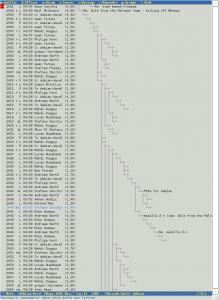
At this point it s a discussion thread of several hundreds of messages (there are several screens of messages like the one above). Many of the sub-threads have been interesting, but the general discussions mixed too many different things so that there s no clear outcome yet. Lucas Nussbaum tried to make a summary. Obviously I must adjust my plan, there s lots of feedback to process. I accepted to drive a DEP together with Sean Finney to help structure the part of the discussion that focuses on allowing development to continue during freezes. But I m also eager to fix the marketing problem of testing and have the project recognize that testing is a product in itself and that end-users should be encouraged to use it. Package Tracking System maintenance The Package Tracking System is an important tool for Debian developers, and it has been broken by some change on the Bug Tracking System. I worked around it quite quickly so that few people noticed the problem but Cron kept reminding me that I had to properly fix it. I ended up doing it last week-end. While working on the PTS, I took the opportunity to merge a patch from Jan Dittberner to enhance the news RSS feed that the PTS provides. And I also integrated information from backports.debian.org (thanks to Mehdi Dogguy for reminding me #549115). Multiarch update Not much new this month. I fixed two bugs in the multiarch dpkg branch thanks to bug reports from Ubuntu users (LP 767634, LP 756381). I m still waiting on Guillem Jover finishing his review of the multiarch branch. I m pinging him from time to time but it looks like multi-arch is no longer in his short term priority list. :-( I ve been running this code for more than 2 months and it works fine. I want to see it merged. I m ready to update my code should anything need to be changed to please Guillem. But without any feedback we re in a deadlock. Misc dpkg work While fixing a bug in update-alternatives (found in one of the valid reports on launchpad), I noticed that there was room for improvements in the error messages output by update-alternatives. I changed them to reuse the same strings that were already used in other parts of dpkg. The result is that there are a few strings less to translate (always a nice thing for the poor translators who have to deal with the thousands of strings that dpkg contains). I also tried to fix some of the most cryptic error messages in dpkg (see #621763) but that work is stalled at the request of Guillem. Book update We (me and Roland Mas) are almost done with the update of our French book for Debian Squeeze. It will hit the shelves in July or September. I m starting to prepare the fundraising campaign to make an English translation of it. We ll use ulule.com for this. On my blog I have been pleased to interview Meike Reichle, it s the first women that I have interviewed in the series but it s certainly not the last one. I also interviewed Adam D. Barratt, one of our tireless release managers. Thanks Many thanks to the people who gave me 180.35 in March and 235.37 in April. That represents 1.5 and 2 days of work for those months. See you next month for a new summary of my activities.

8 comments Liked this article? Click here. My blog is Flattr-enabled.

26 February 2011

Rapha&#235;l Hertzog: February 2011 wrap up

February has been again a busy month for me. Here s a quick summary of what I did: Multi-Arch work I have spent many days implementing and refining dpkg s Multi-Arch support with Guillem Jover (dpkg co-maintainer) and Steve Langasek (beta-tester of my code ;-) ). Early testers can try what s in my latest pu/multiarch/snapshot/* branch in my personal git repository. A Debian DVD shop I m always exploring new options to fund my Debian work (besides direct donations) and this month with the Debian Squeeze release I saw an opportunity in selling Debian DVD. Nobody provides DVD with included firmwares and quite a few people would like to avoid the SpaceFun theme. So I built unofficial Debian DVDs that integrate firmware and that install a system with the old theme (MoreBlue Orbit). Click here to learn more about my unofficial DVDs. On my blog In my People behind Debian series, I interviewed Mike Hommey (Iceweasel maintainer) and Maximiliam Attems (member of the kernel team). I started a Debian Cleanup Tip series and already published 4 installments: For contributors, I wrote two articles: the first gives a set of (suggested) best practices for sponsoring Debian packages and adapted my article as a patch for the Developers Reference. In the second article, I shared some personal advice for people who are considering participating on Debian mailing list: 7 mistakes to avoid when participating to Debian mailing lists.
Click here to subscribe to my free newsletter and get my monthly analysis on what s going on in Debian and Ubuntu. Or just follow along via the RSS feed, Identi.ca, Twitter or Facebook.

No comment Liked this article? Click here. My blog is Flattr-enabled.

21 February 2011

Steve Langasek: How you can help with multiarch today

Paul Wise called attention recently to the fact that there's renewed activity around multiarch in the face of the squeeze release. Although I fervently wish we could have gotten multiarch support into squeeze, it's better late than never; and real progress is being made now, thanks mostly to the efforts of wonderful package management experts like Raphael Hertzog, Guillem Jover, and David Kalnischkies. Don't believe it's finally coming? Here's some output from my amd64 multiarch chroot:
$ dpkg -l '*:i386'
Desired=Unknown/Install/Remove/Purge/Hold
  Status=Not/Inst/Conf-files/Unpacked/halF-conf/Half-inst/trig-aWait/Trig-pend
 / Err?=(none)/Reinst-required (Status,Err: uppercase=bad)
 / Name           Version        Description
+++-==============-==============-============================================
ii  gcc-4.5-base   4.5.2-3ubuntu2 The GNU Compiler Collection (base package)
ii  libc6          2.13-0ubuntu1+ Embedded GNU C Library: Shared libraries
ii  libdb4.8       4.8.30-5multia Berkeley v4.8 Database Libraries [runtime]
ii  libgcc1        1:4.5.2-3ubunt GCC support library
in  libpam-modules <none>         (no description available)
ii  libpam0g       1.1.2-2ubuntu1 Pluggable Authentication Modules library
ii  libselinux1    2.0.96-1multia SELinux runtime shared libraries
ii  libstdc++6     4.5.2-3ubuntu2 The GNU Standard C++ Library v3
iU  libuuid1       2.17.2-9.1ubun Universally Unique ID library
ii  selinux-utils  2.0.96-1multia SELinux utility programs
ii  zlib1g         1:1.2.3.4.dfsg compression library - runtime
If you're as excited about this making its way into Debian as I am, you might be wondering what you can do to help. That's great, because I'd love to tell you! Perhaps you happen to maintain a package that provides executables; and perhaps other packages depend on your package exclusively to use those executables; and perhaps some of those packages depending on your package are shared libraries. If all of the above is true, please consider declaring this package to be Multi-Arch: foreign as defined here. Note: it is very important that you not use this on any package that will provide architecture-dependent interfaces to its reverse-dependencies. So if you're shipping both shared libraries and executables in the same binary package, don't do this. But if your package does fit this description, this is one part of multiarch that you can safely start implementing today. This will go a long way towards getting the system ready to handle multiarch libraries when they land. My own efforts to help with getting Multi-Arch: foreign packages documented in the archive are trackable here.

26 January 2011

Rapha&#235;l Hertzog: My Debian related goals for 2011

Like last year, here s a list of Debian related projects that I d like to tackle this year. I might not do them all, but I like to write them down, I am more productive when I have concrete objectives.
  1. Translate my Debian book into English.
    I will run a fundraising campaign with Ulule.com and if enough people are interested, I will spend a few months with Roland Mas to translate the book. Hopefully this project can be completed until the summer.
  2. Finish multiarch support in dpkg.
    I m working on this with Guillem Jover right now, thanks to Linaro who is sponsoring my work.
  3. Make deb files use XZ compression by default.
    It s a simple change in dpkg-deb and it would literally save gigabytes of space on mirrors. It s particularly important so that single CD/DVD can have a more complete set of software. #556407 (on DAK) needs to be fixed first though and a project-wide discussion is in order. Some archs might want to have a different default.
  4. Be more reactive to review/merge dpkg patches.
    While we welcome help, we have a backlog of patches sitting in the BTS and it happened several times that we failed to review/merge submitted branches in a decent time. It s very frustrating for the contributor. I already tried to improve the situation by creating the Review/Merge Queue but nobody stepped up to help review and update the patches.
    As I am getting more familiar with the C part of dpkg, I hope to be able to jump in when Guillem doesn t have the time or the interest.
  5. Implement the rolling distribution proposed as part of the CUT project and try to improve the release process.
    I really want the new rolling distribution but it will inevitably have an impact on the release process. It can t be done as a standalone project. I would also like to see progress in the way we deal with transitions (see discussion here).
  6. Work more regularly on the developers-reference.
    Hopefully I will be able to combine this with my blog writing activities, i.e. write blog articles on the topics that the developers-reference shall cover and then adapt my articles with some docbook markup.
To the above list, I shall add a few supplementary goals related to funding my Debian work:
  1. Write a 10-lesson course called Smart Package Management .
    It will delivered by email to my newsletter subscribers.
  2. Create an information product (most likely an ebook or an online training) and sell it on my blog.
    The precise topic has not yet been defined although I have a few ideas. Is there something that you would like me to teach you? Leave your suggestions in a comment.
  3. By the end of the year, have at least 1/3 of my time funded by donations and/or earnings of my information products.
    More concretely it means 700 each month or a 9-fold increase compared to the current income level (around 80 /month mostly via Flattr).
That makes up lots of challenges for this year. You can help me reach those goals, join my Debian Supporters Guild and you ll be informed every time that I start something new or when you can help in specific ways.

6 comments Liked this article? Click here. My blog is Flattr-enabled.

26 March 2009

Rapha&#235;l Hertzog: Flights for Debconf

I have booked my flights for Debconf9 in July. I will arrive in Madrid on July 23th at 10:30 from Lyon Saint-Exup ry (LYS-MAD, flight AF5891) and I will leave on July 31th at 17:40 (MAD-LYS, flight AF5892). I plan to use the train to go to C ceres but it s too early to buy tickets on renfe.es. I also have no idea how far the train station is (from the airport) but it looks like I will have several hours transit time anyway. There aren t so many trains for C ceres. The train tickets will likely cost around 30 EUR each. I m glad that I can attend again this year. I m sure it will be very productive. At least concerning dpkg it will be good to meet Guillem Jover IRL. Partagez cet article / Share This

13 January 2008

Christian Perrier: Rant about useless changes in code

Here's what I found in the recent APT upload as changes to PO files:
 #: apt-pkg/cdrom.cc:678
 #, c-format
 msgid ""
-"Found %u package indexes, %u source indexes, %u translation indexes and %u "
-"signatures\n"
+"Found %zu package indexes, %zu source indexes, %zu translation indexes and %"
+"zu signatures\n"
The consequence of such changes is fuzzying translated strings, thus forcing translators to re-update their files and the translation coordinator to commit them. In short, valuable time wasted. One could object that translators shouldn't try to keep up 100% all time long. However, those who do not do so just end up with huge updates to do...which is sometimes demotivating. So many of us prefers keeping up with small updates. However, when one sees such updates that appear to be cosmetic, it's very hard to refrain hating developers (I even ranted about this in dpkg commit logs, which bringed some argument with Guillem Jover.... I certainly shouldn't have ranted in commit logs but that probably gives a good idea how upset I was). Please think about this next time you change a translatable string, particularly when you *know* that someone is taking care to coordinate *your* software translation work with translators. Side comment: bzr choke up on my local APT copy and I can't even cope with updates for APT. That will not really help me to love those DVCS. Update: many explained me that such changes are not useless which I'm ready to accept given my level of knowledge in programming. So, apologies to programmers who made these changes. I just hope this will however better give the translator's POV wrt such matters. We all know that translators *and* maintainers work really hard to give the best results and both always need to have a better knowledge of other's constraints....and limits! I've also been very wisely teached about possible ways to jiggle with VCS to work on defuzzification by reverting changes, unfuzzy, re-apply changes. Sure. At the expense of a lot of invested time to check how to do this properly with all these neat modern DVCS, I could. Yay, I so much love fiddling with VCS....and spending hours doing this is something that makes my days.

4 March 2006

Michael Banck: 3 Mar 2006

FOSDEM 2006 This year, the days before FOSDEM were the stressful ones, as I got to organize accomodation. Initially, we wanted to have similar appartments as last year, but by the time I was less busy at uni to actually look into it, most of them were already booked, so we had to put up with a youth hostel instead. The positive sides of this were the much lower expenses and a location in the city centre, making us actually look at Bruxelles a bit in detail this time. "Us" were the Hurd people, including Martin "earliest Hurd adopter present" Michlmayr. I got to FOSDEM by car again, picking up Marcus Brinkmann, Neal Walfield and Olaf Buddenhagen on the way in Cologne. Finding the youth hostel seemed to be pretty hard as we just had a street address and a map without street names, but we managed to find it pretty quickly to my great surprise (driving around in Bruxelles usually ended up being a complete disaster over the last years). After a strange encounter with a Guillem Jover lookalike in front of the hostel, we met the other guys (Thomas Schwinge, Marco Gerards, Stefan Siegl and Ognyan Kulev) and had a discussion about Neal's and Marcus' plan to move to a persistent system. After dinner, I met the other Debian people in the Roi d'Espagne and hat some longer chats with Jeroen van Wolffelaar, Rob Bradford, Martin Michlmayr and Jordi Mallach, who I finally met for the first time and who did not cop out of FOSDEM this year as usual... The pub is getting more and more crowded each year, all the hackers barely fit even though they opened the balustrade this time as well. It was great to see everybody again and have a few beers. Martin and I then managed to find the way back to the hostel by foot. We had no developer room, and no talks in the Debian room either, so FOSDEM was a pretty relaxed event this year. I met some more familiar faces like Noel Koethe and Andreas Mueller and listened to a couple of talks, most notably Richard Stallman's and Jeff Waugh's keynotes and Hanna Wallach's talk about FLOSSPOLS. Stefan Siegl also managed to get GNU Mach working for both my 3Com PCMCIA NIC and my Orinoco PCMCIA WLAN card, confirming his title as Hurd "hacker of the month". On Saturday evening, we (at this time, Guillem Jover, Gianluca Guida, Bas Wijnen and Jeroen Dekkers had joined) had dinner with the french Hurd guys (Manuel Menal, Marc Dequenes, Richard Braun, Arnaud Fontaine and others) in an italian restaurant. At 10:40 PM, the waiter told us in a rather unfriendly tone that they would close at 11 and presented us with the bill, along with handing out the menu again so that we could look up our share. By the time the bill arrived the french part of the table (at 10:55 PM), the guys were pretty surprised by this whole business and complained loudly that they did not have a dessert yet and insistent on having one. After some more minutes of discussion, the waiter gave in and served their desserts, after which each of them paid his share with his carte bleue. I believe we left the restaurant around 11:30. On Sunday evening, we had dinner again (the french guys had left Bruxelles already) and then drove back to Germany after having desserts and coffee in a bar. We left Bruxelles at around midnight and arrived in Duesseldorf at 2:30 PM, so we were glad that Neal offered us to stay at his place. We had breakfast the next morning with him and Isabel and then I proceeded to drive back to Frankfurt in the early afternoon. FOSDEM rocked, as usual. After being with the Debian crowd for the first three years or so, and mostly sticking with the Hurd crowd last year, I think I managed a pretty good balance between the two this year. This will not have been my last FOSDEM.

Next.

Previous.