Daniel Silverstone: A haiku about Haiku
 I know I don't mention a season, and I'm a few hours late for hallowe'en, but
here's a haiku about Haiku:
A death, once again,
The master sighs, and fixes,
It rises up, undead.
I know I don't mention a season, and I'm a few hours late for hallowe'en, but
here's a haiku about Haiku:
A death, once again,
The master sighs, and fixes,
It rises up, undead.
Over the past few years, a plethora of orchestration frameworks have been
exploding onto the scene. Many have been around for quite a while but not all
have the same sort of community behind them. For example there's a very
interesting option in Joey Hess' Propellor but that is hurt by needing
to be able to build Propellor on all the hosts you manage. On the other hand,
Ansible is able to operate without installing extra software on your target
hosts, but instead it ends up very latency-bound which can cause problems when
your managed hosts are "far away".
I have considered CFEngine, Chef, Puppet and Salt in addition
to the above mentioned options, but none of them feel quite right to me. I am
looking for a way to manage a small number of hosts, at least one of which is
not always online (my laptop) and all of which are essentially snowflakes whose
sparkleybits I want some reasonable control over.
I have a few basic requirements which I worry would be hard to meet -- I want
to be able to make changes to my hosts by editing a file and committing/pushing
it to a git server. I want to be able to manage a host entirely over SSH
from one or more systems, ideally without having to install the orchestration
software on the target host, but where if the software is present it will get
used to accelerate matters. I don't want to have to install Ruby or
PHP on any system in order to have orchestration, and some of the systems I
wish to manage simply can't compile Haskell stuff sanely. I'm not
desperately interested in learning yet more DSLs, but I appreciate that it
will be necessary, but I really don't want to have to learn more than one
DSL simply to run one frameworks.
I don't want to have to learn strange and confusing combinations of file
formats. For example, Ansible quite sensibly uses YAML for its
structured data except for its host/group lists. It uses Jinja2 for its
templating and looping, except for some things which it generates its own
looping constructs inside its YAML. I also personally find Ansible's
sportsball oriented terminology to be confusing, but that might just be me.
So what I'm hoping is that someone will be able to point me at a project which
combines all the wonderful features of the above, with a need to learn only
one DSL and which doesn't require to be installed on the managed host but
which can benefit from being so installed, is driven from git, and won't
hurt my already overly burdened brain.
Dear Lazyweb, pls. kthxbye.
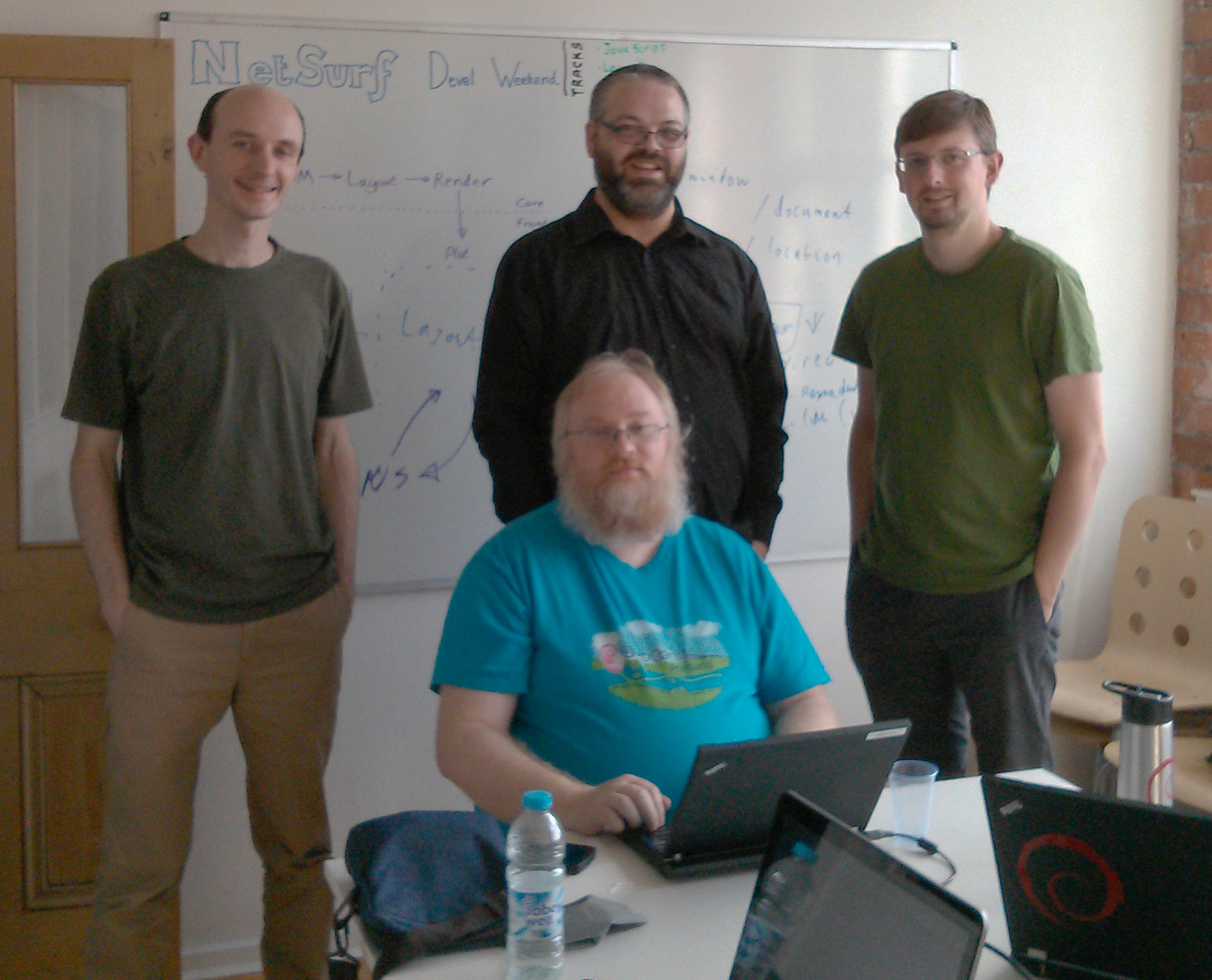 The fifth developer weekend was an opportunity for us to gather in a pleasant setting and work together in person. We were graciously hosted, once again, by Codethink in their Manchester offices.
Date: Wed, 01 Jul 2015 06:13:16 -0000
From: 123-reg <noreply@123-reg.co.uk>
To: dsilvers@digital-scurf.org
Subject: Tell us what you think for your chance to win
X-Mailer: MIME::Lite 3.027 (F2.74; T1.28; A2.04; B3.13; Q3.13)
Tell us what you think of 123-reg!
<!--
.style1  color: #1996d8
-->
curl sudo bash -.
We, the OS-development literati, have come out in droves to say "eww, nasty,
don't do that please" and yet we have brought this upon ourselves. Our
tendency to invent, and reinvent, at the very basic levels of distributions has
resulted in so many operating systems and so many ways to package software (if
not in underlying package format then in policy and process) that third party
application authors simply cannot keep up. Couple that with the desire of the
consumers to not have their chosen platform discounted, and if you provide
Debian packages, you end up needing to provide for Fedora, RHEL, SuSE, SLES,
CentOS, Mint, Gentoo, Arch, etc.etc; let alone supporting all the various BSDs.
This leads to the simple expedience of curl sudo bash -.
Nobody, not even those who are most vehemently against this mechanism of
installing software, can claim that it is not quick, simple for users, easy to
copy/paste out of a web-page, and leaves all the icky complexity of sorting
things out up to a script which the computer can run, rather than the nascent
user of the software in question. As a result, many varieties of software have
ended up using this as a simple installation mechanism, from games to
orchestration frameworks - everyone can acknowledge how easy it is to use.
Now, some providers are wising up a little and ensuring that the url you are
curling is at least an https:// one. Some even omit the sudo from the
copy/paste space and have it in the script, allowing them to display some basic
information and prompting the user that this will occur as root before going
ahead and elevating. All of these myriad little tweaks to the fundamental idea
improve matters but are ultimately just putting lipstick on a fairly sad
looking pig.
So, what can be done? Well we (again the OS-development literati) got
ourselves into this horrendous mess, so it's up to us to get ourselves back
out. We're all too entrenched in our chosen packaging methodologies,
processes, and policies, to back out of those; yet we're clearly not properly
servicing a non-trivial segment of our userbase. We need to do better.
Not everyone who currently honours a curl sudo bash - is capable of
understanding why it's such a bad idea to do so. Some education may reduce
that number but it will never eliminate it.
For a long time I advocated a switch to wget && review && sudo ./script
approach instead, but the above comment, about people who don't understand why
it might be a bad idea, really applies to show how few of those users would
even be capable of starting to review a script they downloaded, let alone able
to usefully judge for themselves if it is really safe to run. Instead we need
something better, something collaborative, something capable of solving the
accessibility issues which led to the curl sudo bash - revolt in the first
place.
curl sudo bash - or
easier. This might mean a particular URI format which can have os-specific
ways to handle standardised inputs, or it might mean a pervasive tool which
does something like that.curl sudo bash - as many platforms
as possible need to get involved. This means not only Debian, Ubuntu,
Fedora and SuSE; but also Arch, FreeBSD, NetBSD, CentOS etc. Maybe even
the OpenSolaris/Illumos people need to get involved.curl sudo bash - :-
just like we can never seem to be rid of that one odd person at the party,
noone knows who invited them, and noone wants to tell them to leave because
they do fill a needed role, but noone really seems to like.
Until then, let's suck it up and while we might not like it, let's just let
people keep on curl sudo bash -ing until someone gets hurt.
curl sudo bash - for the record.
I get quite a bit of recruitment spam, especially via my LinkedIn profile,
but today's Twitter-madness (recruiter scraped my twitter and then contacted
me) really took the biscuit. I include my response (stripped of identifying
marks) for your amusement:
On Tue, Jun 09, 2015 at 10:30:35 +0000, Silly Recruiter wrote:
> I have come across your profile on various social media platforms today and
> after looking through them I feel you are a good fit for a permanent Java
> Developer Role I have available.
Given that you followed me on Twitter I'm assuming you found a tweet or two in
which I mention how much I hate Java?
> I can see you are currently working at Codethink and was wondering if you
> were considering a change of role?
I am not.
> The role on offer is working as a Java Developer for a company based in
> Manchester. You will be maintaining and enhancing the company's core websites
> whilst using the technologies Java, JavaScript, JSP, Struts, Hibernate XML
> and Grails.
This sounds like one of my worst nightmares.
> Are you interested in hearing more about the role? Please feel free to call
> or email me to discuss it further.
Thanks, but no.
> If not, do you know someone that is interested? We offer a  500 referral fee
> for any candidate that is successful.
I wouldn't inflict that kind of Lovecraftian nightmare of a software stack on
anyone I cared about, sorry.
D.
 I then soaked and drained the cabbage in cold water...
 ...before sprinkling a total of one third of a cup of salt over the cabbage and
mixing it to distribute the salt.
 Then I returned to the cabbage every 30 minutes to re-mix it a total of three
times. After the cabbage had been salted for perhaps 1h45m or so, I rinsed it
out. Maangchi recommends washing the cabbage three times so that's what I did
before setting it out to drain in a colander.
 Maangchi then calls for the creation of a porridge made from
sweet rice flour which it turns out is very glutinous. Since I lack the
ability to get that flour easily I substituted cornflour which I hope will
be okay and then continued as before. One cup of water, one third of a cup
of cornflour was heated until it started to bubble and then one sixth of a cup
of sugar was added. Stirred throughout, once it went translucent I turned the
heat off and proceeded.
 One half of a red onion, a good thumb (once peeled) of ginger, half a bulb of
garlic and one third of a cup of fish sauce went into a mini-zizzer. I then
diagonal-chopped about five spring onions, and one leek, before cutting a fair
sized carrot into inch long pieces before halving and then thinly slicing it.
Maangchi calls for julienned carrots but I am not that patient.
 Into the cooled porridge I put two thirds of a cup of korean hot pepper flakes
(I have the coarse, but a mix of coarse and fine would possibly be better), the
zizzed onion/garlic/ginger/fish mix and the vegetables...
 ...before mixing that thoroughly with a spatula.
 Next came the messy bit (I put latex gloves on, and thoroughly washed my gloved
hands for this). Into my largest mixing bowl I put a handful of the drained
cabbage into the bowl and a handful of the pepper mix. Thoroughly mixing this
before adding another handful of cabbage and pepper mix I repeated until all
the cabbage and hot pepper mixed vegetables are well combined. I really got
your arms into it, squishing it around, separating the leek somewhat, etc.
 As a final task, I scooped the kimchi into a clicklok type box, pressing it
down firmly to try and remove all the air bubbles, before sealing it in for
a jolly good fermenting effort. I will have to remove a little tonight for
our dinner (beef strips marinated in onion, ginger and garlic, with kimchi
on rice) but the rest will then sit to ferment for a bit. Expect a part-2
with the report from tonight's dinner and a part-3 with the results after
fermentation.

#notsponsored)
Last night we tried the small amount of 'fresh kimchi' from my
epic kimchi making trial.
I marinaded some beef strips in a blended paste of onion, garlic, ginger, and
sesame oil for a few hours before frying that up, and serving on rice with
stir-fried carrots, leek and spring onion. A little fresh kimchi on the side
for flavour.
 I think the Kimchi was a success. Dearest Rob said
that it tasted of Kimchi. The flavours were not very well combined and quite
clearly underdeveloped, and the pepper flakes were still a little hard. I
expect this to resolve over the next few days as it begins to ferment.
All in all, experiment going well, expect part 3 when I know how it tastes
after fermentation begins.
Earlier this week I allowed some of my colleagues at work to try the Kimchi and
one of them (James) liked it enough to ask for a tub of it just for himself.
Being a lovely person I obliged.
My darling Rob decided that what he really wanted was Kimchiguk or Kimchijijae.
Being both wonderful and lacking in ingredients, I set to do achieving
something.
I read a few recipes, worked out that I lacked critical ingredients and so set
about simulating Kimchiguk. I grabbed two and a bit cupfuls of kimchi from the
box in the fridge, chopped it up more finely, popped it into a pot along with
about a pound of cubed pork belly, two teaspoons of hot pepper flakes, two
teaspoons of sugar, and two teaspoons of cornflour. I then topped that off
with five cups of water, mixed it up, brought it to the boil and simmered it
for 30 minutes. Then I cubed some tofu, popped that in and simmered it for
another 10 minutes while some rice cooked. Served in a bowl over rice, my
approximation of Kimchiguk turned out pretty well. (Note it fed both of us
and there was a serving left over.)
 With a do-over, I'd try harder to get pork shoulder (belly is quite fatty) and
given the option I'd wait until I had hot pepper paste because the malty
fermented sweetness of hot pepper paste is pretty much impossible to emulate
otherwise.
 After the OpenTAC session at Linaro Connect, we do now have a mailing list to support any and all discussions related to OpenTAC. Thanks to Daniel Silverstone for the list.
List archive: http://listmaster.pepperfish.net/pipermail/opentac-vero-apparatus.com
More information on OpenTAC: http://wiki.vero-apparatus.com/OpenTAC
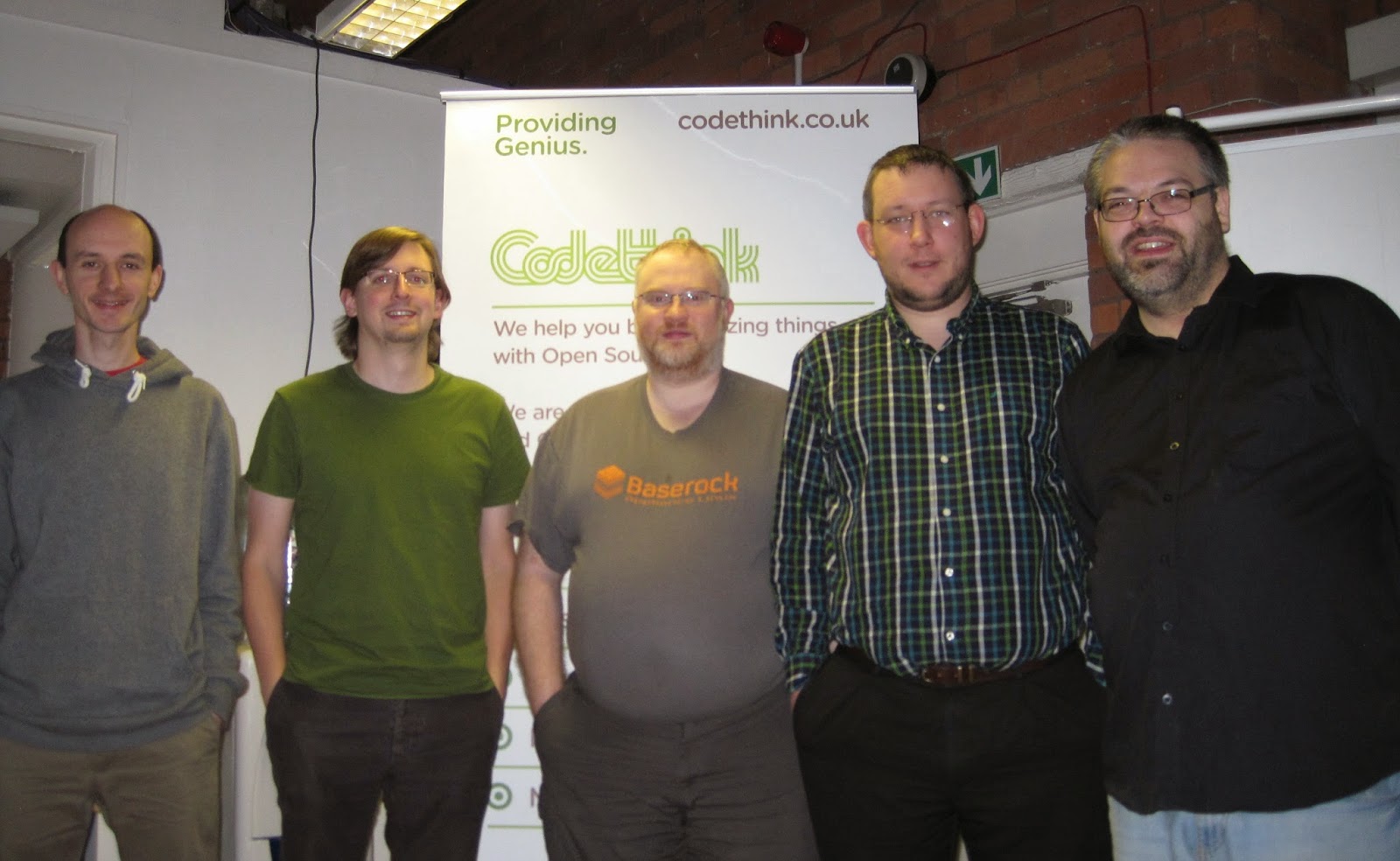

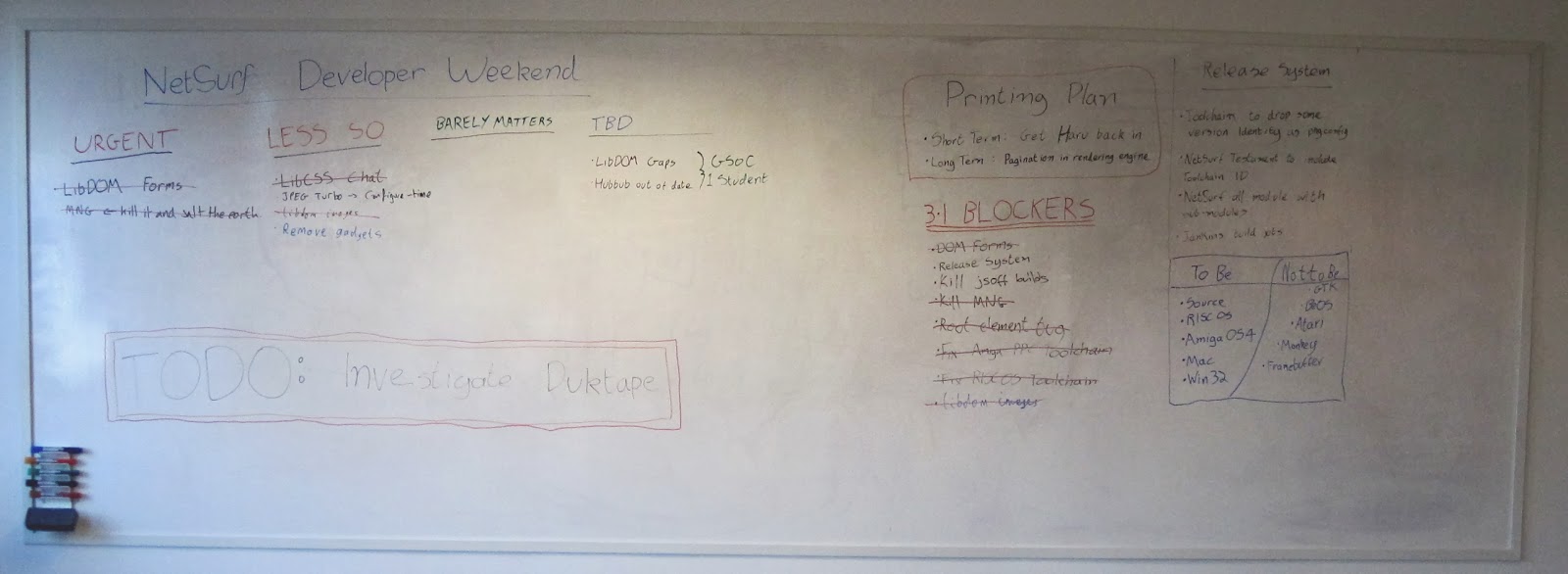
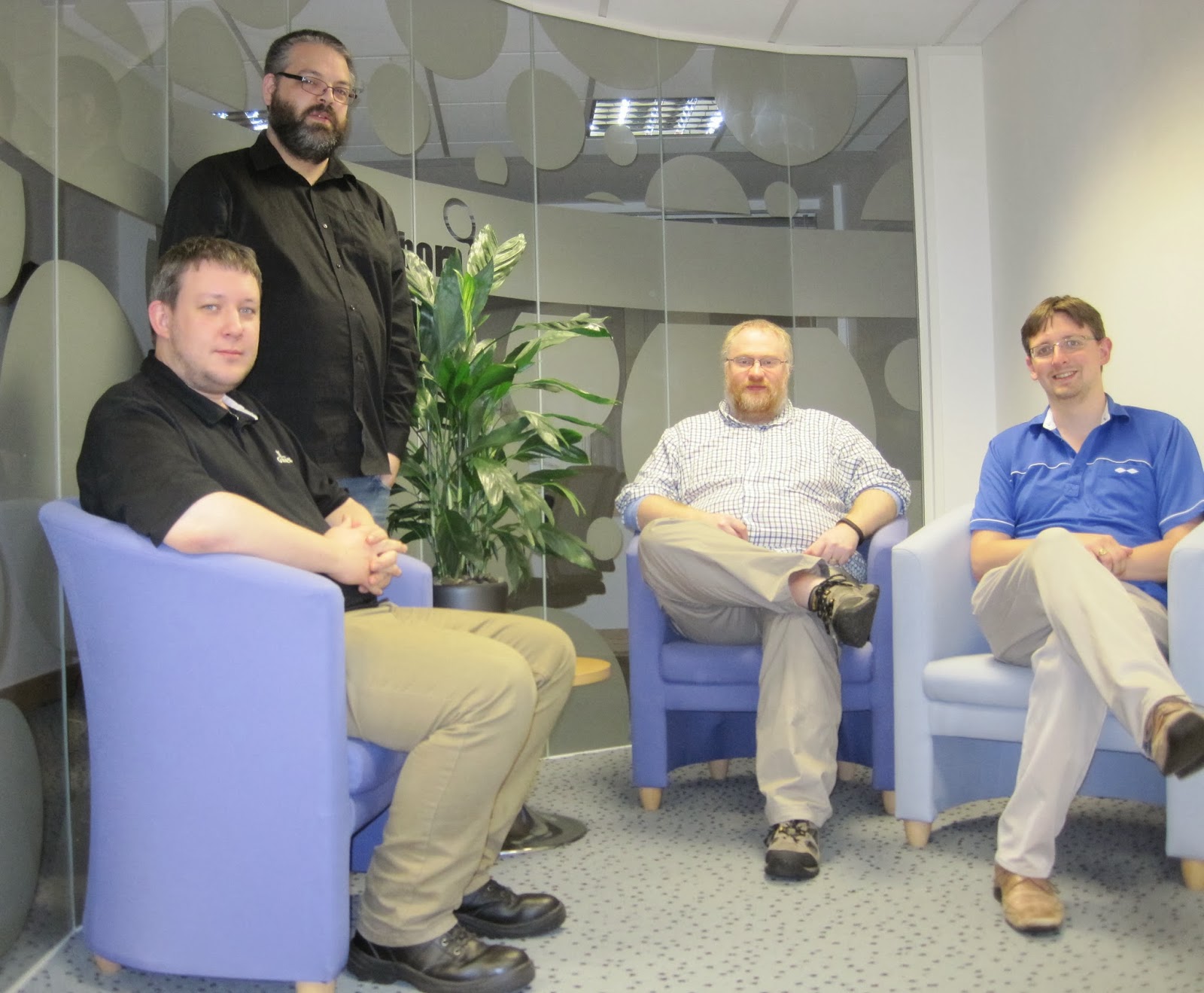 Once again the NetSurf developers congregated in Cambridge at the Collabora offices where we were made welcome in a nice environment for the event.
 I'm moving all my git repositories from Gitorious and
git.gitano.org.uk to my new Gitano instance at
git.liw.fi. Gitano is a git server written by
Daniel Silverstone, and it's wonderful.
I will be converting my non-git repositories to git,
on git.liw.fi, later on.
I've just pushed out the release files for Obnam version
1.3, my backup application, as well as Larch,
my B-tree library, and cliapp, my Python
framework for command line applications. They
are available via my home page (http://liw.fi/). Since Debian is
frozen, I am not uploading packages to Debian, but .deb files are
available from my personal apt repository
for the intrepid. (I will be uploading to Debian again after the
freeze. I am afraid I'm too lazy to upload to experimental, or do
backports. Help is welcome!)
From the Obnam NEWS file:
open(2) system call with
the O_EXCL flag to create the target file. This should allow things
to work with both NFS and VFAT.--log=syslog message format improvement by Daniel Silverstone.
No longer includes a timestamp, since syslog adds it anyway. Also,
the process name is now set on Linux.help,
unless one already exists.


I'm really sorry to inform you that my supervisor refused the share transfer request to the other account. He told me that we do not transfer products either in those cases. I deeply apologize since I thought it was possible. I thank you for your confidence in Gandi, and hope that this occurrence does not deter you from continuing with us.Now I must stress that Gandi are completely within their contractual rights to do this and are not obligated to provide any assistance to help make my blunder less costly to me, but they have firmly shown they have no willingness to be flexible in any way which means I know where I will not be spending my money in future.
 tl;dr: Version 1.0 of Obnam, my
snapshotting, de-duplicating, encrypting backup program is released.
See the end of this announcement for the details.
Where we see the hero in his formative years; parental influence
From the very beginning, my computing life has involved backups.
In 1984, when I was 14,
my father was an independent
telecommunications consultant, which meant he needed a personal computer
for writing reports. He bought a
Luxor ABC-802,
a Swedish computer with a Z80 microprocessor and two floppy drives.
My father also taught me how to use it. When I needed to
save files, he gave me not one, but two floppies, and explained
that I should store my files one one, and then copy them to the
other one every now and then.
Later on, over the years, I've made backups from a hard disk
(30 megabytes!) to
a stack of floppies, to a tape drive installed into
a floppy interface (400 megabytes!), to a DAT drive, and various other media.
It was always a bit tedious.
The start of the quest; lengthy justification for NIH
In 2004, I decided to do a full backup, by burning a copy of all my
files onto CD-R disks. It took me most of the day. Afterwards, I sat
admiring the large stack of disks, and realized that I would not ever
do that again. I'm too lazy for that. That I had done it once was an
aberration in the space-time continuum.
Switching to DVD-Rs instead CD-Rs would reduce to the number of disks to
burn, but not enough: it would still take a stack of them.
I needed something much better.
I had a little experience with tape drives, and that was enough to convince
me that I didn't want them. Tape drives are expensive hardware,
and the tapes also cost money. If the drive goes bad, you have to get
a compatible one, or all your backups are toast. The price per gigabyte
was coming down fast for hard drives, and it was clear that they were
about to be very competitive with tapes for price.
I looked for backup programs that I could use for disk based backups.
rsync, of course, was the obvious choice, but there were others.
I ended up doing what many geeks do: I wrote my own wrapper around
rsync. There's hundred, possibly thousands, of such wrappers around
the Internet.
I also got the idea that doing a startup to provide online backup
space would be a really cool thing. However, I didn't really do
anything about that until 2007. More on that later.
The rsync wrapper script I wrote used hardlinked directory trees
to provide a backup history, though not in the smart way that
backuppc does it.
The hardlinks were wonderful, because they were
cheap, and provided de-duplication. They were also quite cumbersome,
when I needed to move my backups to a new disk the first time. It
turned out that a lot of tools deal very badly with directory trees
with large numbers of hardlinks.
I also decided I wanted encrypted backups. This led me to find
duplicity, which is a nice program
that does encrypted backups, but I had issues with some of its
limitations. To fix those limitations, I would have had to re-design
and possibly re-implement the entire program. The biggest limitation
was that it treated backups as full backup, plus a sequence of
incremental backups, which were deltas against the previous backup.
Delta based incrementals make sense for tape drives. You run a full
backup once, then incremental deltas for every day. When enough time
has passed since the full backup, you do a new full backup, and then
future incrementals are based on that. Repeat forever.
I decided that this makes no sense for disk based backups. If I already
have backed up a file, there's no point in making me backup it again,
since it's already there on the same hard disk. It makes even less
sense for online backups, since doing a new full backup would require
me to transmit all the data all over again, even though it's already
on the server.
The first battle
I could not find a program that did what I wanted to do, and like
every good NIHolic,
I started writing my own.
After various aborted attempts, I started for real in 2006. Here is
the first commit message:
revno: 1
committer: Lars Wirzenius <liw@iki.fi>
branch nick: wibbr
timestamp: Wed 2006-09-06 18:35:52 +0300
message:
  Initial commit.
wibbr was the placeholder name for Obnam until we came up with
something better. We was myself and Richard Braakman, who was going
to be doing the backup startup with me. We eventually founded the
company near the end of 2006, and started doing business in 2007.
However, we did not do very much business, and ran out of money in
September 2007. We ended the backup startup experiment.
That's when I took a job with Canonical, and Obnam became a hobby
project of mine: I still wanted a good backup tool.
In September 2007, Obnam was working, but it was not very good.
For example, it was quite slow and wasteful of backup space.
That version of Obnam used deltas, based on the rsync algorithm, to
backup only changes. It did not require the user to do full and
incremental backups manually, but essentially created an endless
sequence of incrementals. It was possible to remove any generation,
and Obnam would manage the deltas as necessary, keeping the ones
needed for the remaining generations, and removing the rest.
Obnam made it look as if each generation was independent of each other.
The wasteful part was the way in which metadata about files was
stored: each generation stored the full list of filenames and their
permissions and other inode fields. This turned out to be bigger
than my daily delta.
The lost years; getting lost in the forest
For the next two years, I did a little work on Obnam, but I did not
make progress very fast. I changed the way metadata was stored, for
example, but I picked another bad way of doing it: the new way was
essentially building a tree of directory and file nodes, and any
unchanged subtrees were shared between generations. This reduced the
space overhead per generation, but made it quite slow to look up
the metadata for any one file.
The final battle; finding cows in the forest
In 2009 I decided to leave Canonical and after that, my Obnam hobby
picked up in speed again. Below is a table of the number of commits
per year, from the very first commit (bzr log -n0
awk '/timestamp:/ print $3 ' sed 's/-.*//' uniq -c
awk ' print $2, $1 ' tac):
2006 466
2007 353
2008 402
2009 467
2010 616
2011 790
2012 282
md5sum on steroids),
useful for verifying that files are restored correctlyunstable, and will
hopefully get into wheezy before the Debian freeze. I provide
packages built for squeeze on my own repository,
see the download page.
The changes in the 1.0 release compared to the previous one:
 Over the weekend we held the NetSurf developer workshop. The event was kindly hosted by Collabora at their Cambridge offices. The provided facilities were agreed to be excellent and contributed to the success of the event.
 We also took the opportunity to discuss and plan other issues including:
 The recurring issue of disc caching was raised again and we have come up with what we hope is a reasonably elegant solution to be implemented over the forthcoming months.
 Thanks to Daniel Silverstone, pepperfish.net is now hosting
a new mailing list for Obnam. See the mailman
page
for details.
(I used to write my own mailing list software. I'm done with that.
It's an awful hobby to have, and I don't even want to host any
lists myself anymore. So I'm grateful for Daniel for doing this for
me.)
Executive summary
Debian should consider:
.desktop file before the executable or its
data files are unpacked, and a user may notice the program in their
menu and start it, resulting in an error.
Upgrades suffer from additonal problems. Software that gets upgraded
may be running during the upgrade. Should the package manager replace
the software's data files with new versions, which may be in a format
that the old program does not understand? Or install new plugins that
will cause the old version of the program to segfault? If the package
manager does that, users may experience turbulence without having put
on their seat belts. If it doesn't do
that, it can't install the package, or it needs to wait, perhaps
for a very long time, for a safe time to do the upgrade.
These problems have usually been either ignored, or solved by using
package specific hacks. For example, plugins might be stored in a
directory that embeds the program's version number, ensuring that
the old version won't see the new plugins. Some people would like to
apply installs and upgrades only at shutdown or bootup, but that has
other problems.
None of the hacks solve the downgrade problem. The package managers
can replace a package with an older version, and often this works well.
However, in many cases, any package maintainer scripts won't be able
to deal with downgrades. For example, they might convert data files
to a new format or name or location upon upgrades, but won't try to
undo that if the package gets downgraded. Given the combinatorial
explosion of package versions, it's perhaps just as well that they
don't try.
For Baserock, we absolutely need to have downgrades. We need to be
able to go back to a previous version of the system if an upgrade
fails. Traditionally, this has been done by providing a "factory
reset", where the current version of the system gets replaced with
whatever version was installed in the factory. We want that, but we
also want to be able to choose other versions, not just the factory
one. If a device is running version X, and upgrades to X+1, but that
version turns out to be a dud, we want to be able to go back to X,
rather than all the way back to the factory version.
The approach we'll be taking with Baserock relies on btrfs and
subvolumes and snapshots. Each version of the system will be
installed in a separate subvolume, which gets cloned from the
previous version, using copy-on-write to conserve space. We'll
make the bootloader be able to choose a version of the system to
boot, and (waving hands here) add some logic to be able to automatically
revert to the previous version when necessary. We expect this
to work better and more reliably than the current package based one.
Making choices
Debian is pretty bad at making choices. Almost always, when faced
with a need to choose between alternative solutions for the same
problem, we choose all of them. For example, we support pretty much
every init implementation, various implementations of
/bin/sh, and we even have at least three entirely different kernels.
Sometimes this is non-choice is a good thing. Our users may need features
that only one of the kernels support, for example. And we certainly
need to be able to provide both mysql and postresql, since various
software we want to provide to our uses needs one and won't work with
the other.
At other times, the inability to choose causes trouble. Do we really
need to support more than one implemenation of /bin/sh? By supporting
both dash and bash for that, we double the load on testing and QA,
and introduce yet another variable to deal with into any debugging
situation involving shell scripts.
Especially for core components of the system, it makes sense to limit
the flexibility of users to pick and choose. Combinatorial explosion
d j vu. Every binary choice doubles the number of possible combinations
that need to be tested and supported and checked during debugging.
Flexibility begets complexity, complexity begets problems.
This is less of a problem at upper levels of the software stack.
At the very top level, it doesn't really matter if there are many
choices. If a user can freely choose between vi and Emacs, and this
does not add complexity at the system level,
since nothing else is affected by that
choice. However, if we were to add a choice between glibc, eglibc,
and uClibc for the system C library, then everything else in the
system needs to be tested three times rather than once.
Reducing the friction coefficient for system development
Currently, a Debian developer takes upstream code, adds packaging,
perhaps adds some patches (using one of several methods), builds
a binary package, tests it, uploads it, and waits for the build
daemons and the package archive and user-testers to report any
problems.
That's quite a number of steps to go through for the simple act
of adding a new program to Debian, or updating it to a new version.
Some of it can be automated, but there's still hoops to jump through.
Friction does not prevent you from getting stuff done, but the more
friction there is, the more energy you have to spend to get it done.
Friction slows down the crucial hack-build-test cycle of software
development, and that hurts productivity a lot. Every time a
developer has to jump through any hoops, or wait for anything,
he slows down.
It is, of course, not just a matter of the number of steps. Debian
requires a source package to be uploaded with the binary package.
Many, if not most, packages in Debian are maintained using version
control systems. Having to generate a source package and then wait
for it to be uploaded is unnecessary work. The build daemon could
get the source from version control directly. With signed commits,
this is as safe as uploading a tarball.
The above examples are specific to maintaining a single package.
The friction that really hurts Debian is the friction of making
large-scale changes, or changes that affect many packages. I've
already mention the difficulty of making large transitions above.
Another case is making policy changes, and then implementing them.
An excellent example of that is in Debian is the policy change to
use /usr/share/doc for documentation, instead of
/usr/doc. This took us many years to do. We are, I think, perhaps
a little better at such things now, but even so, it is something
that should not take more than a few days to implement, rather than
half a decade.
On the future of distributions
Occasionally, people say things like "distributions are not needed",
or that "distributions are an unnecessary buffer between upstream
developers and users". Some even claim that there should only be
one distribution. I disagree.
A common view of a Linux distribution is that it takes
some source provided by upstream, compiles that, adds an installer,
and gives all of that to the users. This view is too simplistic.
The important part of developing a distribution is choosing the
upstream projects and their versions wisely, and then integrating
them into a whole system that works well. The integration part is
particularly important. Many upstreams are not even aware of each
other, nor should they need to be, even if their software may need
to interact with each other. For example, not every developer of
HTTP servers should need to be aware of every web application, or
vice versa. (It they had to be, it'd be a combinatorial explosion
that'd ruin everything, again.)
Instead, someone needs to set a policy of how web apps and web
servers interface, what their common interface is, and what files
should be put where, for web apps to work out of the box, with
minimal fuss for the users. That's part of the integration work
that goes into a Linux distribution. For Debian, such decisions
are recorded in the Policy Manual and its various sub-policies.
Further, distributions provide quality assurance, particularly at
the system level. It's not realistic to expect most upstream projects to
do that. It's a whole different skillset and approach that is needed
to develop a system, rather than just a single component.
Distributions also provide user support, security support, longer
term support than many upstreams, and port software to a much wider
range of architectures and platforms than most upstreams actively
care about, have access to, or even know about.
In some cases, these are things that
can and should be done in collaboration with upstreams; if nothing
else, portability fixes should be given back to upstreams.
So I do think distributions have a bright future, but the way they're
working will need to change.
Next.