The diffoscope maintainers are pleased to announce the release of diffoscope
version 311. This version includes the following changes:
[ Chris Lamb ]
* Fix test compatibility with u-boot-tools 2026-01. Thanks, Jelle!
* Bump Standards-Version to 4.7.3.
* Drop implied "Priority: optional" from debian/control.
* Also drop implied "Rules-Requires-Root: no" entry in debian/control.
* Update copyright years.
The Debian LTS Team, funded by [Freexian s Debian LTS offering]
(https://www.freexian.com/lts/debian/), is pleased to report its activities for
December.
Activity summary
During the month of December, 18 contributors have been
paid to work on Debian LTS (links to individual
contributor reports are located below).
The team released 41 DLAs fixing 252 CVEs.
The team currently focuses on preparing security updates for Debian 11
bullseye , but also looks for contributing with updates for Debian 12
bookworm , Debian 13 trixie and even Debian unstable.
Notable security updates:
libsoup2.4 (DLA-4398-1),
prepared by Andreas Henrikson, fixing several vulnerabilities.
glib2.0 (DLA-4412-1),
published by Emilio Pozuelo Monfort, addressing multiple issues.
lasso (DLA-4397-1),
prepared by Sylvain Beucler, addressing multiple issues, including a critical
remote code execution (RCE) vulnerability
(CVE-2025-47151)
roundcube (DLA 4415-1),
prepared by Guilhem Moulin, fixing a cross-site-scripting (XSS)
(CVE-2025-68461)
and an information disclosure
(CVE-2025-68460)
vulnerabilities
mediawiki (DLA 4428-1),
published by Guilhem, fixing multiple vulnerabilities could lead to
information disclosure, denial of service or privilege escalation.
python-apt (DLA 4408-1), prepared by
Utkarsh Gupta, in coordination with the Debian Security Team and Julian
Andres Klode, the apt s maintainer.
libpng1.6 (DLA-4396-1),
published by Tobias Frost, completing the work started the previous month.
Notable non-security updates:
tzdata (DLA-4403-1),
prepared by Emilio, including the latest changes to the leap second list and
its expiry date, which was set for the end of December.
Contributions from outside the LTS Team:
Christoph Berg, co-maintainer of PostgreSQL in Debian, prepared a
postgresql-13 update, released as DLA-4420-1
The LTS Team has also contributed with updates to the latest Debian releases:
Andreas proposed trixie
and bookworm point updates for pgbouncer
Abhijith PA prepared a bookworm
point update for php-dompdf
Thorsten Alteholz prepared an unstable update and a
trixie point update for libcoap3
Thorsten prepared or completed different updates for unstable, trixie and
bookworm for packages related to cups: an
unstable update
of cups to fix several issues related to the latest security update, a
trixie point update for
libcupsfilters, and trixie and
bookworm point updates for cups-filter.
Welcome to the December 2025 from the Reproducible Builds project!
Our monthly reports outline what we ve been up to over the past month, highlighting items of news from elsewhere in the increasingly-important area of software supply-chain security. As ever, if you are interested in contributing to the Reproducible Builds project, please see the Contribute page on our website.
New orig-check service to validate Debian upstream tarballs
This month, Debian Developer Lucas Nussbaum announced the orig-check service, which attempts to automatically reproduce the generation upstream tarballs (ie. the original source component of a Debian source package), comparing that to the upstream tarball actually shipped with Debian.
As of the time of writing, it is possible for a Debian developer to upload a source archive that does not actually correspond to upstream s version. Whilst this is not inherently malicious (it typically indicates some tooling/process issue), the very possibility that a maintainer s version may differ potentially permits a maintainer to make (malicious) changes that would be misattributed to upstream.
This service therefore nicely complements the whatsrc.org service, which was reported in our reports for both April and August. The orig-check is dedicated to Lunar, who sadly passed away a year ago.
disorderfs updated to FUSE 3
disorderfs is our FUSE-based filesystem that deliberately introduces non-determinism into system calls to reliably flush out reproducibility issues.
This month, however, Roland Clobus upgraded disorderfs* from FUSE 2 to FUSE 3 after its package automatically got removed from Debian testing. Some tests in Debian currently require disorderfs to make the Debian live images reproducible, although disorderfs is not a Debian-specific tool.
Luca Di Maio announced stampdalf, a filesystem timestamp preservation tool that wraps arbitrary commands and ensures filesystem timestamp reproducibility :
stampdalf allows you to run any command that modifies files in a directory tree, then automatically resets all timestamps back to their original values. Any new files created during command execution are set to [the UNIX epoch] or a custom timestamp via SOURCE_DATE_EPOCH.
The project s GitHub page helpfully reveals that the project is pronounced: stamp-dalf (stamp like time-stamp, dalf like Gandalf the wizard) as it s a wizard of time and stamps .)
Lastly, Reproducible Builds developer cen1 posted to our list announcing that early/experimental/alpha support for FreeBSD was added to rebuilderd. In their post, cen1 reports that the initial builds are in progress and look quite decent . cen1 also interestingly notes that since the upstream is currently not technically reproducible I had to relax the bit-for-bit identical requirement of rebuilderd [ ] I consider the pkg to be reproducible if the tar is content-identical (via diffoscope), ignoring timestamps and some of the manifest files. .
Most package managers also generate a lockfile, which records the exact set of resolved dependency versions. Lockfiles are used to reduce build times; to verify the integrity of resolved packages; and to support build reproducibility across environments and time. Despite these beneficial features, developers often struggle with their maintenance, usage, and interpretation. In this study, we unveil the major challenges related to lockfiles, such that future researchers and engineers can address them. [ ]
While existing studies primarily focus on software supply chain attacks prevention and detection methods, there is a need for a broad overview of attacks and comprehensive risk assessment for software supply chain security. This study conducts a systematic literature review to fill this gap. By analyzing 96 papers published between 2015-2023, we identified 19 distinct SSC attacks, including 6 novel attacks highlighted in recent studies. Additionally, we developed 25 specific security controls and established a precisely mapped taxonomy that transparently links each control to one or more specific attacks. [ ]
[Achieving] reproducibility at scale remains difficult, especially in Java, due to a range of non-deterministic factors and caveats in the build process. In this work, we focus on reproducibility in Java-based software, archetypal of enterprise applications. We introduce a conceptual framework for reproducible builds, we analyze a large dataset from Reproducible Central, and we develop a novel taxonomy of six root causes of unreproducibility. [ ]
Robert Stupp made a number of useful changes, fixing and reorganising the Groovy / Kotlin pages [][][] as well adding a note about potential non-deterministic behaviour to the JVM page [].
Upstream patches
The Reproducible Builds project detects, dissects and attempts to fix as many currently-unreproducible packages as possible. We endeavour to send all of our patches upstream where appropriate. This month, we wrote a large number of such patches, including:
Finally, if you are interested in contributing to the Reproducible Builds project, please visit our Contribute page on our website. However, you can get in touch with us via:
Disappointments this year included 28 Years Later (Danny Boyle, 2025), Cover-Up (Laura Poitras & Mark Obenhaus, 2025), Bugonia (Yorgos Lanthimos, 2025) and Caught Stealing (Darren Aronofsky, 2025).
Older releases
ie. Films released before 2024, and not including rewatches from previous years.
The Debian LTS Team, funded by [Freexian s Debian LTS offering]
(https://www.freexian.com/lts/debian/), is pleased to report its activities for
November.
Activity summary
During the month of November, 18 contributors have been
paid to work on Debian LTS (links to individual
contributor reports are located below).
The team released 33 DLAs
fixing 219 CVEs.
The LTS Team kept going with the usual cadence of preparing security updates for Debian
11 bullseye , but also for Debian 12 bookworm , Debian 13 trixie and even
Debian unstable.
As in previous months, we are pleased to say that there have been multiple
contributions of LTS uploads by Debian Fellows outside the regular LTS Team.
Notable security updates:
Guilhem Moulin prepared DLA 4365-1
for unbound, a caching DNS resolver, fixing a cache poisoning vulnerability
that could lead to domain hijacking.
Another update related to DNS software was made by Andreas Henriksson. Andreas
completed the work on bind9, released as
DLA 4364-1 to fix
cache poisoning and Denial of Service (DoS) vulnerabilities.
Chris Lamb released DLA 4374-1
to fix a potential arbitrary code execution vulnerability in pdfminer, a tool
for extracting information from PDF documents.
Ben Hutchings published a regular security update for the linux 6.1 bullseye
backport, as DLA 4379-1.
A couple of other important recurrent updates were prepared by Emilio Pozuelo,
who handled firefox-esr and thunderbird (in collaboration with Christoph
Goehre), published as DLAs
DLA 4370-1 and
DLA 4372-1,
respectively.
Contributions from fellows outside the LTS Team:
Thomas Goirand uploaded a bullseye update for
keystone
and
swift
As mentioned above, Christoph Goehre prepared the
bullseye update for thunderbird.
Mathias Behrle provided feedback about the tryton-server and tryton-sao vulnerabilities that were disclosed last month, and helped to review the bullseye patches for tryton-server.
Other than the regular LTS updates for bullseye, the LTS Team has also
contributed updates to the latest Debian releases:
Bastien Roucari s prepared a bookworm update for
squid,
the web proxy cache server.
Carlos Henrique Lima Melara filed a bookworm point update
request for gdk-pixbuf to fix
CVE-2025-7345, a heap buffer overflow vulnerability that could lead to
arbitrary code execution.
Daniel Leidert prepared bookworm and
trixie updates for r-cran-gh to fix
CVE-2025-54956, an issue that may expose user credentials in HTTP responses.
Along with the bullseye updates for unbound mentioned above, Guilhem helped
to prepare the trixie update
for unbound.
In collaboration with Lukas M rdian, Tobias Frost prepared
trixie and
bookworm
updates for log4cxx, the C++ port of the logging framework for JAVA.
Jochen Sprickerhof prepared a bookworm update for syslog-ng.
Utkarsh completed the bookworm update
for wordpress, addressing multiple security issues in the popular blogging
tool.
Beyond security updates, there has been a significant effort in revamping our
documentation, aiming to make the processes more clear and consistent for all
the members of the team. This work was mainly carried out by Sylvain, Jochen
and Roberto.
We would like to express our gratitude to the sponsors for making the Debian
LTS project possible. Also, special thanks to the fellows outside the LTS
team for their valuable help.
Welcome to the report for November 2025 from the Reproducible Builds project!
These monthly reports outline what we ve been up to over the past month, highlighting items of news from elsewhere in the increasingly-important area of software supply-chain security. As always, if you are interested in contributing to the Reproducible Builds project, please see the Contribute page on our website.
In this report:
10 years of Reproducible Builds at SeaGL 2025
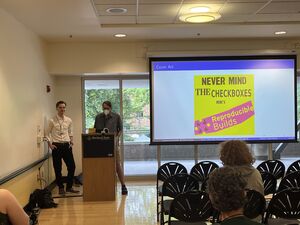
On Friday 8th November, Chris Lamb gave a talk called 10 years of Reproducible Builds at SeaGL in Seattle, WA.
Founded in 2013, SeaGL is a free, grassroots technical summit dedicated to spreading awareness and knowledge about free source software, hardware and culture. Chris talk:
[ ] introduces the concept of reproducible builds, its technical underpinnings and its potentially transformative impact on software security and transparency. It is aimed at developers, security professionals and policy-makers who are concerned with enhancing trust and accountability in our software. It also provides a history of the Reproducible Builds project, which is approximately ten years old. How are we getting on? What have we got left to do? Aren t all the builds reproducible now?
Distribution work
In Debian this month, Jochen Sprickerhof created a merge request to replace the use of reprotest in Debian s Salsa Continuous Integration (CI) pipeline with debrebuild. Jochen cites the advantages as being threefold: firstly, that only one extra build needed ; it uses the same sbuild and ccache tooling as the normal build ; and works for any Debian release . The merge request was merged by Emmanuel Arias and is now active.
kpcyrd posted to our mailing list announcing the initial release of repro-threshold, which implements an APT transport that defines a threshold of at least X of my N trusted rebuilders need to confirm they reproduced the binary before installing Debian packages. Configuration can be done through a config file, or through a curses-like user interface.
Holger then merged two commits by Jochen Sprickerhof in order to address a fakeroot-related reproducibility issue in the debian-installer, and J rg Jaspert deployed a patch by Ivo De Decker for a bug originally filed by Holger in February 2025 related to some Debian packages not being archived on snapshot.debian.org.
Elsewhere, Roland Clobus performed some analysis on the live Debian trixie images, which he determined were not reproducible. However, in a follow-up post, Roland happily reports that the issues have been handled. In addition, 145 reviews of Debian packages were added, 12 were updated and 15 were removed this month adding to our knowledge about identified issues.
Lastly, Jochen Sprickerhof filed a bug announcing their intention to binary NMU a very large number of the R programming language after a reproducibility-related toolchain bug was fixed.
Bernhard M. Wiedemann posted another openSUSEmonthly update for their work there.
Julien Malka and Arnout Engelen launched the new hash collection
server for NixOS. Aside from improved reporting to help focus reproducible builds
efforts within NixOS, it collects build hashes as individually-signed attestations
from independent builders, laying the groundwork for further tooling.
Tool development
diffoscope version 307 was uploaded to Debian unstable (as well as version 309). These changes included further attempts to automatically attempt to deploy to PyPI by liaising with the PyPI developers/maintainers (with this experimental feature). [][][]
In addition, reprotest versions 0.7.31 and 0.7.32 were uploaded to Debian unstable by Holger Levsen, who also made the following changes:
Do not vary the architecture personality if the kernel is not varied. (Thanks to Ra l Cumplido). []
Drop the debian/watch file, as Lintian now flags this as error for native Debian packages. [][]
Bump Standards-Version to 4.7.2, with no changes needed. []
Drop the Rules-Requires-Root header as it is no longer required.. []
In addition, however, Vagrant Cascadian fixed a build failure by removing some extra whitespace from an older changelog entry. []
Website updates
Once again, there were a number of improvements made to our website this month including:
Bernhard M. Wiedemann updated the SOURCE_DATE_EPOCH page to fix the Lisp example syntax. []
Web3 applications, built on blockchain technology, manage billions of dollars in digital assets through decentralized applications (dApps) and smart contracts. These systems rely on complex, software supply chains that introduce significant security vulnerabilities. This paper examines the software supply chain security challenges unique to the Web3 ecosystem, where traditional Web2 software supply chain problems intersect with the immutable and high-stakes nature of blockchain technology. We analyze the threat landscape and propose mitigation strategies to strengthen the security posture of Web3 systems.
Their paper lists reproducible builds as one of the mitigating strategies. A PDF of the full text is available to download.
Upstream patches
The Reproducible Builds project detects, dissects and attempts to fix as many currently-unreproducible packages as possible. We endeavour to send all of our patches upstream where appropriate. This month, we wrote a large number of such patches, including:
Finally, if you are interested in contributing to the Reproducible Builds project, please visit our Contribute page on our website. However, you can get in touch with us via:
Activity summary
During the month of October, 21 contributors have been
paid to work on Debian LTS (links to individual
contributor reports are located below).
The team released 37 DLAs fixing 893 CVEs.
The team has continued in its usual rhythm, preparing and uploading security
updates targeting LTS and ELTS, as well as helping with updates to oldstable,
stable, testing, and unstable. Additionally, the team received several
contributions of LTS uploads from Debian Developers outside the standing LTS
Team.
Notable security updates:
https-everywhere, prepared by Markus Koschany, deals with a problem created by ownership of the https-rulesets.org domain passing to a malware operator
openjdk-17 and openjdk-11, prepared by Emilio Pozuelo Monfort, fixes XML external entity and certificate validation vulnerabilities
intel-microcode, prepared by Tobias Frost, fixes a variety of privilege escalation and denial of service vulnerabilities
Notable non-security updates:
distro-info-data, prepared by Stefano Rivera, updates information concerning current and upcoming Debian and Ubuntu releases
Contributions from outside the LTS Team:
Lukas M rdian, a Debian Developer, provided an update of log4cxx
Andrew Ruthven, one of the request-tracker4 maintainers, provided an update of request-tracker4
Christoph Goehre, co-maintainer of thunderbird, provided an update of thunderbird
Beyond the typical LTS updates, the team also helped the Debian community more broadly:
Guilhem Moulin prepared oldstable/stable updates of libxml2, and an unstable update of libxml2.9
Bastien Roucari s prepared oldstable/stable updates of imagemagick
Daniel Leidert prepared an oldstable update of python-authlib, oldstable update of libcommons-lang-java and stable update of libcommons-lang3-java
Utkarsh Gupta prepared oldstable/stable/testing/unstable updates of ruby-rack
The LTS Team is grateful for the opportunity to contribute to making LTS a high quality for sponsors and users. We are also particularly grateful for the collaboration from others outside the time; their contributions are important to the success of the LTS effort.
The diffoscope maintainers are pleased to announce the release of diffoscope
version 308. This version includes the following changes:
[ Chris Lamb ]
* Attempt to fix automatic deployment to PyPi:
  - Separate out deploy-tag and deploy-pypi into different stages, and base
    the latter on debian:unstable.
  - Call apt-get update prior to attempting installing twine.
Welcome to the October 2025 report from the Reproducible Builds project!
Welcome to the very latest report from the Reproducible Builds project. Our monthly reports outline what we ve been up to over the past month, and highlight items of news from elsewhere in the increasingly-important area of software supply-chain security. As ever, if you are interested in contributing to the Reproducible Builds project, please see the Contribute page on our website.
In this report:
Farewell from the Reproducible Builds Summit 2025
Thank you to everyone who joined us at the Reproducible Builds Summit in Vienna, Austria!
We were thrilled to host the eighth edition of this exciting event, following the success of previous summits in various iconic locations around the world, including Venice, Marrakesh, Paris, Berlin, Hamburg and Athens. During this event, participants had the opportunity to engage in discussions, establish connections and exchange ideas to drive progress in this vital field. Our aim was to create an inclusive space that fosters collaboration, innovation and problem-solving.
The agenda of the three main days is available online however, some working sessions may still lack notes at time of publication.
One tangible outcome of the summit is that Johannes Starosta finished their rebuilderd tutorial, which is now available online and Johannes is actively seeking feedback.
Google s Play Store breaks reproducible builds for Signal
On the issue tracker for the popular Signal messenger app, developer Greyson Parrelli reports that updates to the Google Play store have, in effect, broken reproducible builds:
The most recent issues have to do with changes to the APKs that are made by the Play Store. Specifically, they add some attributes to some .xml files around languages are resources, which is not unexpected because of how the whole bundle system works. This is trickier to resolve, because unlike current expected differences (like signing information), we can t just exclude a whole file from the comparison. We have to take a more nuanced look at the diff. I ve been hesitant to do that because it ll complicate our currently-very-readable comparison script, but I don t think there s any other reasonable option here.
kpcyrd forwarded a fascinating tidbit regarding so-called ninja and samurai build ordering, that uses data structures in which the pointer values returned from malloc are used to determine some order of execution.
Arnout Engelen, Justin Cappos, Ludovic Court s and kpcyrd continued a conversation started in September regarding the Minimum Elements for a Software Bill of Materials . (Full thread)
Felix Moessbauer of Siemens posted to the list reporting that he had recently stumbled upon a couple of Debian source packages on the snapshot mirrors that are listed multiple times (same name and version), but each time with a different checksum . The thread, which Felix titled, Debian: what precisely identifies a source package is about precisely that what can be axiomatically relied upon by consumers of the Debian archives, as well as indicating an issue where we can t exactly say which packages were used during build time (even when having the .buildinfo files).
Luca DiMaio posted to the list announcing the release of xfsprogs 6.17.0 which specifically includes a commit that implements the functionality to populate a newly created XFS filesystem directly from an existing directory structure which makes it easier to create populated filesystems
without having to mount them [and thus is] particularly useful for reproducible builds . Luca asked the list how they might contribute to the docs of the System images page.
Reproducible Builds at the Transparency.dev summit
Holger Levsen gave a talk at this year s Transparency.dev summit in Gothenburg, Sweden, outlining the achievements of the Reproducible Builds project in the last 12 years, covering both upstream developments as well as some distribution-specific details. As mentioned on the talk s page, Holger s presentation concluded with an outlook into the future and an invitation to collaborate to bring transparency logs into Reproducible Builds projects .
The slides of the talk are available, although a video has yet to be released. Nevertheless, as a result of the discussions at Transparency.dev there is a new page on the Debian wiki with the aim of describing a potential transparency log setup for Debian.
Supply Chain Security for Go
Andrew Ayer has setup a new service at sourcespotter.com that aims to monitor the supply chain security for Go releases. It consists of four separate trackers:
A tool to verify that the Go Module Mirror and Checksum Database is behaving honestly and has not presented inconsistent information to clients.
A module monitor that records every module version served by the Go Module Mirror and Checksum Database, allowing you to monitor for unexpected versions of your modules.
A tool to verifies that the Go toolchains published in the Go Module Mirror can be reproduced from source code, making it difficult to hide backdoors in the binaries downloaded by the go command.
A telemetry config tracker that tracks the names of telemetry counters uploaded by the Go toolchain, to ensure that Go telemetry is not violating users privacy.
As the homepage of the service mentions, the trackers are free software and do not rely on Google infrastructure.
In March 2024, a sophisticated backdoor was discovered in xz, a core compression library in Linux distributions, covertly inserted over three years by a malicious maintainer, Jia Tan. The attack, which enabled remote code execution via ssh, was only uncovered by chance when Andres Freund investigated a minor performance issue. This incident highlights the vulnerability of the open-source supply chain and the effort attackers are willing to invest in gaining trust and access. In this article, I analyze the backdoor s mechanics and explore how bitwise build reproducibility could have helped detect it.
Although quantum computing is a rapidly evolving field of research, it can already benefit from adopting reproducible builds. This paper aims to bridge the gap between the quantum computing and reproducible builds communities. We propose a generalization of the definition of reproducible builds in the quantum setting, motivated by two threat models: one targeting the confidentiality of end users data during circuit preparation and submission to a quantum computer, and another compromising the integrity of quantum computation results. This work presents three examples that show how classical information can be hidden in transpiled quantum circuits, and two cases illustrating how even minimal modifications to these circuits can lead to incorrect quantum computation results.
The thesis focuses on providing a reproducible build process for two open-source E2EE messaging applications: Signal and Wire. The motivation to ensure reproducibility and thereby the integrity of E2EE messaging applications stems from their central role as essential tools for modern digital privacy. These applications provide confidentiality for private and sensitive communications, and their compromise could undermine encryption mechanisms, potentially leaking sensitive data to third parties.
Currently, there are numerous solutions and techniques available in the market to tackle supply chain security, and all claim to be the best solution. This thesis delves deeper by implementing those solutions and evaluates them for better understanding. Some of the tools that this thesis implemented are Syft, Trivy, Grype, FOSSA, dependency-check, and Gemnasium. Software dependencies are generated in a Software Bill of Materials (SBOM) format by using these open-source tools, and the corresponding results have been analyzed. Among these tools, Syft and Trivy outperform others as they provide relevant and accurate information on software dependencies.
In the wake of growing supply chain attacks, the FreeBSD developers are relying on a transparent build concept in the form of Zero-Trust Builds. The approach builds on the established Reproducible Builds, where binary files can be rebuilt bit-for-bit from the published source code. While reproducible builds primarily ensure verifiability, the zero-trust model goes a step further and removes trust from the build process itself. No single server, maintainer, or compiler can be considered more than potentially trustworthy.
Upstream patches
The Reproducible Builds project detects, dissects and attempts to fix as many currently-unreproducible packages as possible. We endeavour to send all of our patches upstream where appropriate. This month, we wrote a large number of such patches, including:
Bernhard Wiedemann and Zbigniew J drzejewski-Szmek extended ismypackagereproducibleyet.org with initial support for Fedora [].
In addition, a number of contributors added a series of notes from our recent summit to the website, including Alexander Couzens [], Robin Candau [][][][][][][][][] and kpcyrd [].
Tool development
diffoscope version 307 was uploaded to Debian unstable by Chris Lamb, who made a number of changes including fixing compatibility with LLVM version 21 [], an attempt to automatically attempt to deploy to PyPI by liaising with the PyPI developers/maintainers (with this experimental feature). [] In addition, Vagrant Cascadian updated diffoscope in GNU Guix to version 307.
Finally, if you are interested in contributing to the Reproducible Builds project, please visit our Contribute page on our website. However, you can get in touch with us via:
Tobias Frost
did 5.0h (out of 0.0h assigned and 8.0h from previous period), thus carrying over 3.0h to the next month.
Utkarsh Gupta
did 16.5h (out of 14.25h assigned and 6.75h from previous period), thus carrying over 4.5h to the next month.
Evolution of the situation
In September, we released 38 DLAs.
Notable security updates:
modsecurity-apache prepared by Adrian Bunk, fixes a cross-site scripting vulnerability
cups, prepared by Thorsten Alteholz, fixes authentication bypass and denial of service vulnerabilities
jetty9, prepared by Adrian Bunk, fixes the MadeYouReset vulnerability (a recent, well-known denial of service vulnerability)
python-django, prepared by Chris Lamb, fixes a SQL injection vulnerability
firefox-esr and thunderbird, prepared by Emilio Pozuelo Monfort, were updated from the 128.x ESR series to the 140.x ESR series, fixing a number of vulnerabilities as well
Notable non-security updates:
wireless-regdb prepared by Ben Hutchings, updates information reflecting changes to radio regulations in many countries
There was one package update contributed by a Debian Developer outside of the LTS Team: an update of node-tar-fs, prepared by Xavier Guimard (a member of the Node packaging team).
Finally, LTS Team members also contributed updates of the following packages:
libxslt (to stable and oldstable), prepared by Guilhem Moulin, to address a regression introduced in a previous security update
libphp-adodb (to stable and oldstable), prepared by Abhijith PA
cups (to stable and oldstable), prepared by Thorsten Alteholz
u-boot (to oldstable), prepared by Daniel Leidert and Jochen Sprickerhof
libcommongs-lang3-java (to stable and oldstable), prepared by Daniel Leidert
python-internetarchive (to oldstable), prepared by Daniel Leidert
One other notable contribution by a member of the LTS Team is that Sylvain Beucler proposed a fix upstream for CVE-2025-2760 in gimp2. Upstream no longer supports gimp2, but it is still present in Debian LTS, and so proposing this fix upstream is of benefit to other distros which may still be supporting the older gimp2 packages.
Thanks to our sponsors
Sponsors that joined recently are in bold.
Welcome to the September 2025 report from the Reproducible Builds project!
Welcome to the very latest report from the Reproducible Builds project. Our monthly reports outline what we ve been up to over the past month, and highlight items of news from elsewhere in the increasingly-important area of software supply-chain security. As ever, if you are interested in contributing to the Reproducible Builds project, please see the Contribute page on our website.
In this report:
Reproducible Builds Summit 2025
Please join us at the upcoming Reproducible Builds Summit, set to take place from October 28th 30th 2025 in Vienna, Austria!
We are thrilled to host the eighth edition of this exciting event, following the success of previous summits in various iconic locations around the world, including Venice, Marrakesh, Paris, Berlin, Hamburg and Athens. Our summits are a unique gathering that brings together attendees from diverse projects, united by a shared vision of advancing the Reproducible Builds effort.
During this enriching event, participants will have the opportunity to engage in discussions, establish connections and exchange ideas to drive progress in this vital field. Our aim is to create an inclusive space that fosters collaboration, innovation and problem-solving.
If you re interesting in joining us this year, please make sure to read the event page which has more details about the event and location. Registration is open until 20th September 2025, and we are very much looking forward to seeing many readers of these reports there!
Once the proper measurement points are known, we want to constrain the system such that what it does is simple enough to understand and easy to repeat. It is quite telling that the push for software that enables reproducible builds only really took off after an embarrassing widespread security issue ended up affecting the entire Internet. That there had already been 50 years of software development before anyone thought that introducing a few constraints might be a good idea is, well, let s just say it generates many emotions, none of them happy, fuzzy ones. []
Tool development
diffoscope version 306 was uploaded to Debian unstable by Chris Lamb. It included contributions already covered in previous months as well as some changes by Zbigniew J drzejewski-Szmek to address issues with the fdtump support [] and to move away from the deprecated codes.open method. [][]
strip-nondeterminism version 1.15.0-1 was uploaded to Debian unstable by Chris Lamb. It included a contribution by Matwey Kornilov to add support for inline archive files for Erlang s escript [].
kpcyrd has released a new version of rebuilderd. As a quick recap, rebuilderd is an automatic build scheduler that tracks binary packages available in a Linux distribution and attempts to compile the official binary packages from their (purported) source code and dependencies. The code for in-toto attestations has been reworked, and the instances now feature a new endpoint that can be queried to fetch the list of public-keys an instance currently identifies itself by. []
Lastly, Holger Levsen bumped the Standards-Version field of disorderfs, with no changes needed. [][]
Reproducibility testing framework
The Reproducible Builds project operates a comprehensive testing framework running primarily at tests.reproducible-builds.org in order to check packages and other artifacts for reproducibility. In August, however, a number of changes were made by Holger Levsen, including:
Setting up six new rebuilderd workers with 16 cores and 16 GB RAM each.
Move Debian live builds and some other Debian builds to the ionos10 node. []
Cleanup some legacy support from releases before Debian trixie. []
In addition, Jochen Sprickerhof made the following changes relating to reproduce.debian.net:
Do not expose pending jobs on the main site. []
Switch the frontpage to reference Debian forky [], but do not attempt to build Debian forky on the armel architecture [].
Use consistent and up to date rebuilder-debian.sh script. []
Fix supported worker architectures. []
Add a basic excuses page. []
Move to the pull184 branch. [][][][]
Fix a typo in the JavaScript. []
Update front page for the new v1 API. [][]
Lastly, Roland Clobus did some maintenance relating to the reproducibility testing of the Debian Live images. [][][][]
Upstream patches
The Reproducible Builds project detects, dissects and attempts to fix as many currently-unreproducible packages as possible. We endeavour to send all of our patches upstream where appropriate. This month, we wrote a large number of such patches, including:
Finally, if you are interested in contributing to the Reproducible Builds project, please visit our Contribute page on our website. However, you can get in touch with us via:
Tobias Frost
did 4.0h (out of 0.0h assigned and 12.0h from previous period), thus carrying over 8.0h to the next month.
Utkarsh Gupta
did 16.0h (out of 22.75h assigned), thus carrying over 6.75h to the next month.
Evolution of the situation
In August, we released 27 DLAs.
The month of August marked the release of Debian 13 (codename trixie ). This is worth noting because it brought with it the return of the customary fast development pace of Debian unstable, which included several contributions from LTS Team members. More on that below.
Of the many security updates which were published (and a few non-security updates as well), some notable ones are highlighted here.
Notable security updates:
gnutls28 prepared by Adrian Bunk, fixes several potential denial of service vulnerabilities
apache2, prepared by Bastien Roucari s, fixes several vulnerabilities including a potential denial of service and SSL/TLS-related access control
mbedtls (original update, regression update) prepared by Andrej Shadura, fixes several potential denial of service and information disclosure vulnerabilities
openjdk-17, prepared by Emilio Pozuelo Monfort, fixes several vulnerabilities which could result in denial of service, information disclosure or weakened TLS connections
Notable non-security updates:
distro-info-data, prepared by Stefano Rivera, adds information concerning future Debian and Ubuntu releases
ca-certificates-java, prepared by Bastien Roucari s, fixes some bugs which could disrupt future updates
The LTS Team continues to welcome the collaboration of maintainers from across the Debian community. The contributions of maintainers from outside the LTS Team include: postgresql-13 (Christoph Berg), sope (Jordi Mallach), thunderbird (Carsten Schoenert), and iperf3 (Roberto Lumbreras).
Finally, LTS Team members also contributed updates of the following packages:
redis (to stable), prepared by Chris Lamb
firebird3.0 (to oldstable and stable), prepared by Adrian Bunk
node-tmp (to oldstable, stable, and unstable), prepared by Adrian Bunk
openjpeg2 (to oldstable, stable, and unstable), prepared by Adrian Bunk
apache2 (to oldstable), prepared by Bastien Roucari s
unbound (to oldstable), prepared by Guilhem Moulin
luajit (to oldstable), prepared by Guilhem Moulin
golang-github-gin-contrib-cors (to oldstable and stable), prepared by Thorsten Alteholz
libcoap3 (to stable), prepared by Thorsten Alteholz
libcommons-lang-java and libcommons-lang3-java (both to unstable), prepared by Daniel Leidert
python-flask-cors (to oldstable), prepared by Daniel Leidert
The LTS Team would especially like to thank our many longtime friends and sponsors for their support and collaboration.
Thanks to our sponsors
Sponsors that joined recently are in bold.
Welcome to the August 2025 report from the Reproducible Builds project!
Welcome to the latest report from the Reproducible Builds project for August 2025. These monthly reports outline what we ve been up to over the past month, and highlight items of news from elsewhere in the increasingly-important area of software supply-chain security. If you are interested in contributing to the Reproducible Builds project, please see the Contribute page on our website.
In this report:
Reproducible Builds Summit 2025
Please join us at the upcoming Reproducible Builds Summit, set to take place from October 28th 30th 2025 in Vienna, Austria!**
We are thrilled to host the eighth edition of this exciting event, following the success of previous summits in various iconic locations around the world, including Venice, Marrakesh, Paris, Berlin, Hamburg and Athens. Our summits are a unique gathering that brings together attendees from diverse projects, united by a shared vision of advancing the Reproducible Builds effort.
During this enriching event, participants will have the opportunity to engage in discussions, establish connections and exchange ideas to drive progress in this vital field. Our aim is to create an inclusive space that fosters collaboration, innovation and problem-solving.
If you re interesting in joining us this year, please make sure to read the event page which has more details about the event and location. Registration is open until 20th September 2025, and we are very much looking forward to seeing many readers of these reports there!
Reproducible Builds and live-bootstrap at WHY2025
WHY2025 (What Hackers Yearn) is a nonprofit outdoors hacker camp that takes place in Geestmerambacht in the Netherlands (approximately 40km north of Amsterdam). The event is organised for and by volunteers from the worldwide hacker community, and knowledge sharing, technological advancement, experimentation, connecting with your hacker peers, forging friendships and hacking are at the core of this event .
At this year s event, Frans Faase gave a talk on live-bootstrap, an attempt to provide a reproducible, automatic, complete end-to-end bootstrap from a minimal number of binary seeds to a supported fully functioning operating system .
Frans talk is available to watch on video and his slides are available as well.
DALEQ Explainable Equivalence for Java Bytecode
Jens Dietrich of the Victoria University of Wellington, New Zealand and Behnaz Hassanshahi of Oracle Labs, Australia published an article this month entitled DALEQ Explainable Equivalence for Java Bytecode which explores the options and difficulties when Java binaries are not identical despite being from the same sources, and what avenues are available for proving equivalence despite the lack of bitwise correlation:
[Java] binaries are often not bitwise identical; however, in most cases, the differences can be attributed to variations in the build environment, and the binaries can still be considered equivalent. Establishing such equivalence, however, is a labor-intensive and error-prone process.
Jens and Behnaz therefore propose a tool called DALEQ, which:
disassembles Java byte code into a relational database, and can normalise this database by applying Datalog rules. Those databases can then be used to infer equivalence between two classes. Notably, equivalence statements are accompanied with Datalog proofs recording the normalisation process. We demonstrate the impact of DALEQ in an industrial context through a large-scale evaluation involving 2,714 pairs of jars, comprising 265,690 class pairs. In this evaluation, DALEQ is compared to two existing bytecode transformation tools. Our findings reveal a significant reduction in the manual effort required to assess non-bitwise equivalent artifacts, which would otherwise demand intensive human inspection. Furthermore, the results show that DALEQ outperforms existing tools by identifying more artifacts rebuilt from the same code as equivalent, even when no behavioral differences are present.
Reproducibility regression identifies issue with AppArmor security policies
Tails developer intrigeri has tracked and followed a reproducibility regression in the generation of AppArmor policy caches, and has identified an issue with the 4.1.0 version of AppArmor.
Although initially tracked on the Tails issue tracker, intrigeri filed an issue on the upstream bug tracker. AppArmor developer John Johansen replied, confirming that they can reproduce the issue and went to work on a draft patch. Through this, John revealed that it was caused by an actual underlying security bug in AppArmor that is to say, it resulted in permissions not (always) matching what the policy intends and, crucially, not merely a cache reproducibility issue.
Work on the fix is ongoing at time of writing.
Rust toolchain fixes
Rust Clippy is a linting tool for the Rust programming language. It provides a collection of lints (rules) designed to identify common mistakes, stylistic issues, potential performance problems and unidiomatic code patterns in Rust projects. This month, however, Sosth ne Gu don filed a new issue in the GitHub requesting a new check that would lint against non deterministic operations in proc-macros, such as iterating over a HashMap .
Dropping support for the armhf architecture. From July 2015, Vagrant Cascadian has been hosting a zoo of approximately 35 armhf systems which were used for building Debian packages for that architecture.
Holger Levsen also uploaded strip-nondeterminism, our program that improves reproducibility by stripping out non-deterministic information such as timestamps or other elements introduced during packaging. This new version, 1.14.2-1, adds some metadata to aid the deputy tool. ( #1111947)
Lastly, Bernhard M. Wiedemann posted another openSUSEmonthly update for their work there.
diffoscopediffoscope is our in-depth and content-aware diff utility that can locate and diagnose reproducibility issues. This month, Chris Lamb made the following changes, including preparing and uploading versions, 303, 304 and 305 to Debian:
Improvements:
Use sed(1) backreferences when generating debian/tests/control to avoid duplicating ourselves. []
Move from a mono-utils dependency to versioned mono-devel mono-utils dependency, taking care to maintain the [!riscv64] architecture restriction. []
Use sed over awk to avoid mangling dependency lines containing = (equals) symbols such as version restrictions. []
Bug fixes:
Fix a test after the upload of systemd-ukify version 258~rc3. []
Ensure that Java class files are named .class on the filesystem before passing them to javap(1). []
Do not run jsondiff on files over 100KiB as the algorithm runs in O(n^2) time. []
Don t check for PyPDF version 3 specifically; check for >= 3. []
Misc:
Update copyright years. [][]
In addition, Martin Joerg fixed an issue with the HTML presenter to avoid crash when page limit is None [] and Zbigniew J drzejewski-Szmek fixed compatibility with RPM 6 []. Lastly, John Sirois fixed a missing requests dependency in the trydiffoscope tool. []
Website updates
Once again, there were a number of improvements made to our website this month including:
Chris Lamb:
Write and publish a news entry for the upcoming summit. []
Add some assets used at FOSSY, such as the badges and the paper handouts. []
Reproducibility testing framework
The Reproducible Builds project operates a comprehensive testing framework running primarily at tests.reproducible-builds.org in order to check packages and other artifacts for reproducibility. In August, however, a number of changes were made by Holger Levsen, including:
Ignore that the megacli RAID controller requires packages from Debian bookworm. []
In addition,
James Addison migrated away from deprecated toplevel deb822 Python module in favour of debian.deb822 in the bin/reproducible_scheduler.py script [] and removed a note on reproduce.debian.net note after the release of Debian trixie [].
Jochen Sprickerhof made a huge number of improvements to the reproduce.debian.net statistics calculation [][][][][][] as well as to the reproduce.debian.net service more generally [][][][][][][][].
Mattia Rizzolo performed a lot of work migrating scripts to SQLAlchemy version 2.0 [][][][][][] in addition to making some changes to the way openSUSE reproducibility tests are handled internally. []
Lastly, Roland Clobus updated the Debian Live packages after the release of Debian trixie. [][]
Upstream patches
The Reproducible Builds project detects, dissects and attempts to fix as many currently-unreproducible packages as possible. We endeavour to send all of our patches upstream where appropriate. This month, we wrote a large number of such patches, including:
Finally, if you are interested in contributing to the Reproducible Builds project, please visit our Contribute page on our website. However, you can get in touch with us via:
The diffoscope maintainers are pleased to announce the release of diffoscope
version 304. This version includes the following changes:
[ Chris Lamb ]
* Do not run jsondiff on files over 100KiB as the algorithm runs in O(n^2)
  time. (Closes: reproducible-builds/diffoscope#414)
* Fix test after the upload of systemd-ukify 258~rc3 (vs. 258~rc2).
* Move from a mono-utils dependency to versioned "mono-devel   mono-utils"
  dependency, taking care to maintain the [!riscv64] architecture
  restriction. (Closes: #1111742)
* Use sed -ne over awk -F= to to avoid mangling dependency lines containing
  equals signs (=), for example version restrictions.
* Use sed backreferences when generating debian/tests/control to avoid DRY
  violations.
* Update copyright years.
[ Martin Joerg ]
* Avoid a crash in the HTML presenter when page limit is None.
Utkarsh Gupta
did 15.0h (out of 1.0h assigned and 14.0h from previous period).
Evolution of the situation
In July, we released 24 DLAs.
Notable security updates:
angular.js, prepared by Bastien Roucari s, fixes multiple vulnerabilities including input sanitization and potential regular expression denial of service (ReDoS)
tomcat9, prepared by Markus Koschany, fixes an assortment of vulnerabilities
mediawiki, prepared by Guilhem Moulin, fixes several information disclosure and privilege escalation vulnerabilities
php7.4, prepared by Guilhem Moulin, fixes several server side request forgery and denial of service vulnerabilities
This month s contributions from outside the regular team include an update to thunderbird, prepared by Christoph Goehre (the package maintainer).
LTS Team members also contributed updates of the following packages:
commons-beanutils (to stable and unstable), prepared by Adrian Bunk
djvulibre (to oldstable, stable, and unstable), prepared by Adrian Bunk
git (to stable), prepared by Adrian Bunk
redis (to oldstable), prepared by Chris Lamb
libxml2 (to oldstable), prepared by Guilhem Moulin
commons-vfs (to oldstable), prepared by Daniel Leidert
Additionally, LTS Team member Santiago Ruano Rinc n proposed and implemented an improvement to the debian-security-support package. This package is available so that interested users can quickly determine if any installed packages are subject to limited security support or are excluded entirely from security support. However, there was not previously a way to identify explicitly supported packages, which has become necessary to note exceptions to broad exclusion policies (e.g., those which apply to substantial package groups, like modules belonging to the Go and Rust language ecosystems). Santiago s work has enabled the notation of exceptions to these exclusions, thus ensuring that users of debian-security-support have accurate status information concerning installed packages.
DebCamp 25 Security Tracker Sprint
The previously announced security tracker sprint took place at DebCamp from 7-13 July. Participants included 8 members of the standing LTS Team, 2 active Debian Developers with an interest in LTS, 3 community members, and 1 member of the Debian Security Team (who provided guidance and reviews on proposed changes to the security tracker); participation was a mix of in person at the venue in Brest, France and remote. During the days of the sprint, the team tackled a wide range of bugs and improvements, mostly targeting the security tracker.
The sprint participants worked on the following items:
Continued work (which was in progress prior to the sprint) on improved tooling to support security releases of packages from language ecosystems that rely heavily on static linking
As can be seen from the above list, only a small number of changes were brought to completion during the sprint week itself. Given the very compressed timeframe involved, the broad scope of tasks which were under consideration, and the highly sensitive data managed by the security tracker, this is not entirely unexpected and in no way diminishes the great work done by the sprint participants. The LTS Team would especially like to thank Salvatore Bonaccorso of the Debian Security Team for making himself available throughout the sprint to answer questions, for providing guidance on the work, and for helping the work by reviewing and merging the MRs which were able to merged during the sprint itself.
In the weeks that follow the sprint, the team will continue working towards completing the in progress items.
Thanks to our sponsors
Sponsors that joined recently are in bold.
Welcome to the seventh report from the Reproducible Builds project in 2025. Our monthly reports outline what we ve been up to over the past month, and highlight items of news from elsewhere in the increasingly-important area of software supply-chain security. If you are interested in contributing to the Reproducible Builds project, please see the Contribute page on our website.
In this report:
Reproducible Builds Summit 2025
We are extremely pleased to announce the upcoming Reproducible Builds Summit, set to take place from October 28th 30th 2025 in Vienna, Austria!
We are thrilled to host the eighth edition of this exciting event, following the success of previous summits in various iconic locations around the world, including Venice, Marrakesh, Paris, Berlin, Hamburg and Athens. Our summits are a unique gathering that brings together attendees from diverse projects, united by a shared vision of advancing the Reproducible Builds effort.
During this enriching event, participants will have the opportunity to engage in discussions, establish connections and exchange ideas to drive progress in this vital field. Our aim is to create an inclusive space that fosters collaboration, innovation and problem-solving.
If you re interesting in joining us this year, please make sure to read the event page which has more details about the event and location. Registration is open until 20th September 2025, and we are very much looking forward to seeing many readers of these reports there!
[Everything] changed earlier this year when reproducible-builds for SLES-16 became an official goal for the product. More people are talking about digital sovereignty and supply-chain security now. [ ] Today, only 9 of 3319 (source) packages have significant problems left (plus 7 with pending fixes), so 99.5% of packages have reproducible builds.
There are numerous policy compliance and regulatory processes being developed that target software development but do they solve actual problems? Does it improve the quality of software? Do Software Bill of Materials (SBOMs) actually give you the information necessary to verify how a given software artifact was built? What is the goal of all these compliance checklists anyways or more importantly, what should the goals be? If a software object is signed, who should be trusted to sign it, and can they be trusted forever?
Hosted by the Software Freedom Conservancy and taking place in Portland, Oregon, USA, FOSSY aims to be a community-focused event: Whether you are a long time contributing member of a free software project, a recent graduate of a coding bootcamp or university, or just have an interest in the possibilities that free and open source software bring, FOSSY will have something for you . More information on the event is available on the FOSSY 2025 website, including the full programme schedule.
Vagrant and Chris also staffed a table, where they will be available to answer any questions about Reproducible Builds and discuss collaborations with other projects.
Automation to derive declarative build definitions for existing PyPI (Python), npm (JS/TS), and Crates.io (Rust) packages.
SLSA Provenance for thousands of packages across our supported ecosystems, meeting SLSA Build Level 3 requirements with no publisher intervention.
Build observability and verification tools that security teams can integrate into their existing vulnerability management workflows.
Infrastructure definitions to allow organizations to easily run their own instances of OSS Rebuild to rebuild, generate, sign, and distribute provenance.
One difference with most projects that aim for bit-for-bit reproducibility, OSS Rebuild aims for a kind of semantic reproducibility:
Through automation and heuristics, we determine a prospective build definition for a target package and rebuild it. We semantically compare the result with the existing upstream artifact, normalizing each one to remove instabilities that cause bit-for-bit comparisons to fail (e.g. archive compression).
The extensive post includes examples about how to access OSS Rebuild attestations using the Go-based command-line interface.
New extension of Python setuptools to support reproducible builds
Wim Jeantine-Glenn has written a PEP 517 Build backend in order to enable reproducible builds when building Python projects that use setuptools.
Called setuptools-reproducible, the project s README file contains the following:
Setuptools can create reproducible wheel archives (.whl) by setting SOURCE_DATE_EPOCH at build time, but setting the env var is insufficient for creating reproducible sdists (.tar.gz). setuptools-reproducible [therefore] wraps the hooks build_sdistbuild_wheel with some modifications to make reproducible builds by default.
diffoscopediffoscope is our in-depth and content-aware diff utility that can locate and diagnose reproducibility issues. This month, Chris Lamb made the following changes, including preparing and uploading versions 301, 302 and 303 to Debian:
Improvements:
Use Difference.from_operation in an attempt to pipeline the output of the extract-vmlinux script, potentially avoiding it all in memory. []
Memoize a number of calls to --version, saving a very large number of external subprocess calls.
Bug fixes:
Don t check for PyPDF version 3 specifically, check for versions greater than 3. []
Ensure that Java class files are named .class on the filesystem before passing them to javap(1). []
Mask stderr from extract-vmlinux script. [][]
Avoid spurious differences in h5dump output caused by exposure of absolute internal extraction paths. (#1108690)
Misc:
Use our_check_output in the ODT comparator. []
Update copyright years. []
In addition:
Siva Mahadevan made a change to use the --print-armap long option when calling nm(1) for wider compatibility. []
Lastly, Chris Lamb added a tmpfs to try.diffoscope.org so that diffoscope has a non-trivial temporary area to unpack archives, etc. []
Elsewhere in our tooling, however, reprotest is our tool for building the same source code twice in different environments and then checking the binaries produced by each build for any differences. This month, reprotest version 0.7.30 was uploaded to Debian unstable by Holger Levsen, chiefly including a change by Rebecca N. Palmer to not call sudo with the -h flag in order to fix Debian bug #1108550. []
New library to patch system functions for reproducibility
Nicolas Graves has written and published libfate, a simple collection of tiny libraries to patch system functions deterministically using LD_PRELOAD. According to the project s README:
libfate provides deterministic replacements for common non-deterministic system functions that can break reproducible builds. Instead of relying on complex build systems or apps or extensive patching, libfate uses the LD_PRELOAD trick to intercept system calls and return fixed, predictable values.
Describing why he wrote it, Nicolas writes:
I originally used the OpenSUSE dettrace approach to make Emacs reproducible in Guix. But when Guix switch to GCC@14, dettrace stopped working as expected. dettrace is a complex piece of software, my need was much less heavy: I don t need to systematically patch all sources of nondetermism, just the ones that make a process/binary unreproducible in a container/chroot.
One desirable property is that someone else should be able to reproduce the same git bundle, and not only that a single individual is able to reproduce things on one machine. It surprised me to see that when I ran the same set of commands on a different machine (started from a fresh git clone), I got a different checksum. The different checksums occurred even when nothing had been committed on the server side between the two runs.
Website updates
Once again, there were a number of improvements made to our website this month including:
Bernhard M. Wiedemann added an entry related to R-B-OS on the History page. []
Chris Lamb:
Replaced rbtlog run by Fay by rbtlog run by Benl on the Who is involved page. []
Debian contributors have made significant progress toward ensuring package builds produce byte-for-byte reproducible results. You can check the status for packages installed on your system using the new package debian-repro-status, or visit reproduce.debian.net for Debian s overall statistics for trixie and later. You can contribute to these efforts by joining #debian-reproducible on IRC to discuss fixes, or verify the statistics by installing the new rebuilderd package and setting up your own instance.
Reproducibility testing framework
The Reproducible Builds project operates a comprehensive testing framework running primarily at tests.reproducible-builds.org in order to check packages and other artifacts for reproducibility. In July, however, a number of changes were made by Holger Levsen, including:
Make the dsa-check-packages output more useful. []
Setup the ppc64el architecture again, has it has returned this time with a 2.7 GiB database instead of 72 GiB. []
In addition, Jochen Sprickerhof improved the reproducibility statistics generation:
Enable caching of statistics. [][][]
Add some common non-reproducible patterns. []
Change output to directory. []
Add a page sorted by diffoscope size. [][]
Switch to Python s argparse module and separate output(). []
Holger also submitted a number of Debian bugs against rebuilderd and rebuilderd-worker:
Config files and scripts for a simple one machine setup. [][]
Create a rebuilderd user. []
Create rebuilderd-worker user with sbuild. []
Lastly, Mattia Rizzolo added a scheduled job to renew some SSL certificates [] and Vagrant Cascadian performed some node maintenance [][].
Upstream patches
The Reproducible Builds project detects, dissects and attempts to fix as many currently-unreproducible packages as possible. We endeavour to send all of our patches upstream where appropriate. This month, we wrote a large number of such patches, including:
Finally, if you are interested in contributing to the Reproducible Builds project, please visit our Contribute page on our website. However, you can get in touch with us via:
The diffoscope maintainers are pleased to announce the release of diffoscope
version 303. This version includes the following changes:
[ Chris Lamb ]
* Don't check for PyPDF version 3 specifically, check for >= 3. Thanks,
  Vagrant, for the patch. (Closes: reproducible-builds/diffoscope#413)
* Ensure that Java class files are named .class on the filesystem before
  passing them to javap(1).
* Update copyright years.

 The Debian LTS Team, funded by [Freexian s Debian LTS offering]
(








 Here are my favourite books and movies that I read and watched throughout 2025.