Search Results: "tb"

15 March 2010

Joey Hess: pre to droid

in which the Pre unsuprisingly continues to suck My Palm Pre was killed by a forced over the air WebOS upgrade. You can't avoid those upgrades, even if you are sure they'll be bad news. The previous WebOS upgrade spared my Debian partition, but lost all other customizations (including Palm Pre privacy fixes), and wasted hours. When I went to use my phone and it didn't even boot, and displayed only "http://palm.com/rom", I knew that was the last straw. (Shouldn't forcing an upgrade that breaks a working phone to the point that it can't even call 911 be well, illegal?) switching cell providers in the US: suprisingly doable I thought about ditching the smart phone and using VOIP, but I seem to have gotten addicted. So I got a Droid. That meant switching cell phone companies. I've heard a lot about how horrible the US cell phone company contracts are. My experience has me wondering if all that is well... not overblown, but oversimplified. I was half a year into a two year contract. Today I got my closing statement, and I really got out of it with no early termination fee. The trick seems to be, switch to a different cell phone company. They'll be happy to get you out of your old contract, salivating at the chance of locking you in to a new one. They probably have a script to use when calling to cancel. Or "know a guy". Or claim to know a guy, then just use a script, and get lucky. Given the hard sells and vague promises they tried on me, I assume that these places are where all the car salesmen ended up. Trust == 0. But it worked. If you're good on the phone, and are looking for a new business idea: Start a business of getting people out of their cell phone contracts, for a reasonable fee and no other obligation. Use loopholes like rate changes. As long as the cell phone companies can raise their monthly rate 2 cents, and 99.9999% of their users accept it, and they make untold millions of dollars, for free, they seem to not care if the remaining fraction use a loophole to get out. Especially if they're able to take advantage of other comanies loopholes to switch over users. So there seems to be a niche there in which one could prosper. droid first impressions So now I have a slightly larger lump in my pocket and the Pre is on a shelf, and will either be used for future development and testing of Debian piggyback ideas, or donated to someone like Lennart who can make good use of it. Compared with the Pre, the droid's hardware is all superior. The keyboard, especially, is great, with arrow keys, and all the symbols I need. At the same time, the phone is bigger, and oddly clunky. But in an endearing way. Only thing I really dislike about the hardware is the "back" button is easy to accidentially swipe while typing on the keyboard. Compared with WebOS, the Android UI has some clunkiness and non-obvious things. Like the status bar at the top not doing anything when you click on it. And there being no way to close an app. Especially annoying is that this means opening the web browser returns to whatever page I was on last, which is never what I want. The UI is however much, much snappier. I don't use the Google email, etc services so can't comment on them; I assume the amount of info Google is gathering about me went up by a few percentage points; I've blocked their analytics on my network to knock it back down. (PS: DuckDuckGo now avoids logging IP addresses at all.) The best thing is the ConnectBot application, which is a very usable shell and ssh client. It's a terminal, in my pocket, which I can easily use for an hour without feeling like my interactions are feeding through a stifling soda straw. Between the keyboard and the app, the Pre has nothing at all that compares. Under the hood, Android annoys me terribly, with its lack of busybox, its kernel that does not even have the ext* filesystem, its hard-partitioned storage, and its general lack of every single thing I like in a Linux system. Compare this with the Pre, which has a package manager, a userspace based on busybox with a full standard Linux stack (all the way up to PulseAudio) and a kernel with lots of standard filesystems, and even LVM. Sigh. It's amazing that WebOS and Android have found such broadly different ways to suck. There is significant interest and activity around running a Debian chroot on the Droid. The best tries so far put it on a loop mounted ext2 filesystem (which means you need to get ahold of a matching ext2.ko somehow), living on the FAT formatted SSD. And there are apparently some bad problems with IO to that starving/locking the system, so I have not tried it.

Russell Coker: The Yubikey

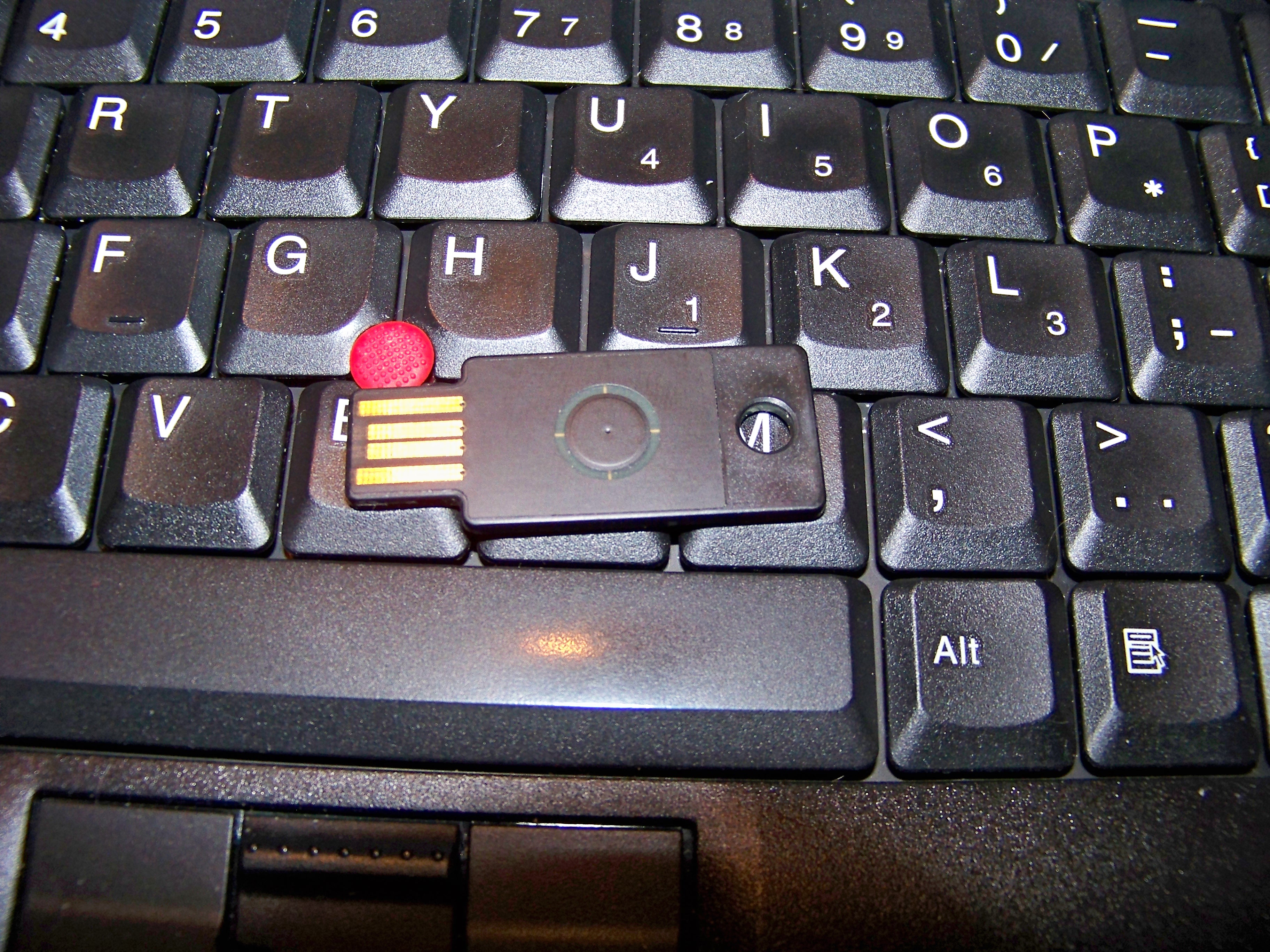
Picture of Yubikey Some time ago Yubico were kind enough to send me an evaluation copy of their Yubikey device. I ve finally got around to reviewing it and making deployment plans for buying some more. Above is a picture of my Yubikey on the keyboard of my Thinkpad T61 for scale. The newer keys apparently have a different color in the center of the circular press area and also can be purchased in white plastic. The Yubikey is a USB security token from Yubico [1]. It is a use-based token that connects via the USB keyboard interface (see my previous post for a description of the various types of token [2]). The Yubikey is the only device I know of which uses the USB keyboard interface, it seems that this is an innovation that they invented. You can see in the above picture that the Yubikey skips the metal that is used to surround most USB devices, this probably fails to meet some part of the USB specification but does allow them to make the key less than half as thick as it might otherwise be. Mechanically it seems quite solid. The Yubikey is affordable, unlike some token vendors who don t even advertise prices (if you need to ask then you can t afford it) and they have an online sales site. $US25 for a single key and discounts start when you buy 10. As it seems quite likely that someone who wants such a token will want at least two of them for different authentication domains, different users in one home, or as a backup in case one is lost or broken (although my experiments have shown that Yubikeys are very hardy and will not break easily). The discount rate of $20 will apply if you can find four friends who want to use them (assuming two each), or if you support several relatives (as I do). The next discount rate of $15 applies when you order 100 units, and they advise that customers contact their sales department directly if purchasing more than 500 units so it seems likely that a further discount could be arranged when buying more than 500 units. They accept payment via Paypal as well as credit cards. It seems to me that any Linux Users Group could easily arrange an order for 100 units (that would be 10 people with similar needs to me) and a larger LUG could possibly arrange an order of more than 500 units for a better discount. If an order of 500 can t be arranged then an order of 200 would be a good thing to get half black keys and half white ones you can only buy a pack of 100 in a single color. There is a Wordpress plugin to use Yubikey authentication [3]. It works, but I would be happier if it had an option to accept a Yubikey OR a password (currently it demands both a Yubikey AND a password). I know that this is less secure, but I believe that it s adequate for an account that doesn t have administrative rights. To operate the Yubikey you just insert it into a USB slot and press the button to have it enter the pass code via the USB keyboard interface. The pass code has a prefix that can be used to identify the user so it can replace both the user-name and password fields of course it is technically possible to use one Yubikey for authentication with multiple accounts in which case a user-name would be required. Pressing the Yubikey button causes the pass code to be inserted along with the ENTER key, this can take a little getting used to as a slow web site combined with a habit of pressing ENTER can result in a failed login (at least this has happened to me with Konqueror). As the Yubikey is use-based, it needs a server to track the usage count of each key. Yubico provides source to the server software as well as having their own server available on the net obviously it might be a bad idea to use the Yubico server for remote root access to a server, but for blog posting that is a viable option and saves some effort. If you have multiple sites that may be disconnected then you will either need multiple Yubikeys (at a cost of $20 or $15 each) or you will need to have one Yubikey work with multiple servers. Supporting a single key with multiple authentication servers means that MITM attacks become possible. The full source to the Yubikey utilities is available under the new BSD license. In Debian the base functionality of talking to the Yubikey is packaged as libyubikey0 and libyubikey-dev, the server (for validating Yubi requests via HTTP) is packaged as yubikey-server-c, and the utility for changing the AES key to use your own authentication server is packaged as yubikey-personalization thanks Tollef Fog Heen for packaging all this! The YubiPAM project (a PAM module for Yubikey) is licensed under the GPL [4]. It would be good if this could be packaged for Debian (unfortunately I don t have time to adopt more packages at the moment). There is a new model of Yubikey that has RFID support. They suggest using it for public transport systems where RFID could be used for boarding and the core Yubikey OTP functionality could be used for purchasing tickets. I don t think it s very interesting for typical hobbyist and sysadmin work, but RFID experts such as Jonathan Oxer might disagree with me on this issue.

Gerfried Fuchs: stable RC Bug Squashing, Part 2

A while ago I blogged about squashing release-critical bugs in stable. Yesterday we have reached a big milestone on that area: The amount of release-critical bugs in stable dropped below 1000 (blue graph). This might sound like it's still pretty high but given that we were well over 1600 RC bugs in stable a while ago I consider this quite a success. This is though no time for rest. There is still way too many RC bugs in stable, there are definitely still a lot of bugs that just aren't affecting stable and thus can be marked as such meaning no upload needs to get done for them. I'm taking a close look at those with higher numbers and most of those seem to be validly affecting stable too so they might require a bit more work than just tagging them. Thanks to all people who helped on that area, I can just remember a few names and don't want to make anyone else also working on stable to feel singled out, though I want to thank Lucas for tagging his FTBFS rounds with squeeze sid right from the start because the packages obviously have built before due to his regular rebuilds. Thanks to all, but like said, not the time to rest. The green squeeze graph is still around 250 bugs away from us!

Russell Coker: Types of Security Tokens

The Security Token Wikipedia page doesn t seem to clearly describe the types of token. Categories of Security Token It seems to me that the following categories encompass all security tokens:
  1. Biometric tokens which seems rather pointless to me. Having a device I control verify my biometric data doesn t seem to provide a benefit. The only possible benefit seems to be if the biometric token verifies the identity of the person holding it before acting as one of the other types of token.
  2. Challenge-response devices. The server will send a challenge (usually a random number) and will expect a response (usually some sort of cryptographically secure hash of the number and a shared secret). A challenge-response device may take a password from the user and combine it with the challenge from the server and the shared secret when calculating the response.
  3. Time-based tokens (one-time passwords). They will provide a new pseudo-random number that changes periodically, often a 30 second time interval is used and the number is presumably a cryptographically secure hash of the time and a shared secret. This requires a battery in the token and the token will become useless when the battery runs out. It also requires that the server have an accurate clock.
  4. Use-based tokens. They will give a new pseudo-random number every time a button is pressed (or some other event happens to indicate that a number has been used). These do not work well if you have multiple independent servers and an untrusted network.
Here is my analysis of the theory of token use, note that I am not sure how the implementations of the various token systems deal with these issues.
  1. Biometric security seems like a bad idea for most non-government use. I have seen a retina scanner in use at a government office that made some sense as the people being scanned were in a secure area (they had passed some prior checks) and they were observed (to prevent coercion and the use of fake eyes). Biometric authentication for logging in over the net just seems like a bad idea as you will never know if you can trust the scanner.
  2. It seems to me that challenge-response devices are by far the most secure option. CR is resistant to replay attacks provided that it is not possible to have re-used challenges. If the calculation of the response includes a password (which is performed on some tokens that resemble pocket calculators) then a CR token will meet the something you have and something you know criteria.
    One potential problem with CR systems is that of not including the server or account ID in the calculation. So if I was to use a terminal in an insecure location to login to a server or account with data that is not particularly important then it would be possible for an attacker who had compromised the terminal to perform a Man In The Middle (MITM) attack against other servers. Of course you are supposed to use a different password for each account, if you do this then a CR token that includes a password will be resistant to this attack but I expect that people who use tokens are more likely to use one password for multiple accounts.
  3. Time-based tokens have a weakness in that an attacker who can immediately discover the number used for one connection could then immediately login to other servers. One example of a potential attack using this avenue would be to compromise a terminal in an Internet cafe, steal a hash used for logging in to server A and then immediately login to server B. This means that it may not be safe to use the same token for logging in to servers (or accounts) that have different sensitivity levels unless a strong password was used as well I expect that people who have hardware tokens tend to use weaker passwords.
    Also one factor that will make some MITM attacks a lot easier is the fact that the combination of the hash from the token and the password are valid for a period of time so an attacker could establish a second connection within the 30 second interval. It seems that only allowing one login with a particular time-coded password is the correct thing to do, but this may be impossible if multiple independent servers use the same token.
    Time based tokens expire when the battery runs out. The measures taken to make them tamper-proof may make it difficult or impossible to replace the battery so a new token must be purchased every few years.
  4. Use-based tokens are very similar to time-based tokens, it s just a different number that is used for generating the hash. The difference in the token is that a time-based token needs a battery so that it can track the time while a use-based token needs a small amount of flash memory to store the usage count. The difference at the server end is that for a use-based token the server needs a database of the use count of each token, which is usually not overly difficult for a single server.
    One problem is the case of a restore from backup of the server which maintains the use count database. The only secure way of managing this is to either inspect every token (to discover it s use count) or to issue a new password (for using password plus token authentication). Either option would be really painful if you have many users at remote sites. Also it would be required to get the database transaction committed to disk before an authentication attempt is acknowledged so that a server crash could not lose the count this should be obvious but many people get these things wrong.
    An additional complication for use-based tokens comes with the case of a token that is used for multiple servers. One server needs to maintain the database of the usage counts and the other servers need to query it by secure links. If a login attempt with use count 100 has been made to server A then server B must not accept a login with a hash that has a use count less than or equal to 100. This is firstly to cover the case where a MITM attack is used to login to server B with credentials that were previously used for server A. The second aim of this is to cover the case where a token that is temporarily unguarded is used to generate dozens of hashes while the hashes could be immediately used it is desirable to have them expire as soon as possible, and having the next login update the use count and invalidate such hashes is a good thing.
    The requirement that all servers know the current use count requires that they all trust a single server. In some situations this may not be possible, so it seems that this only works for servers within a single authentication domain or for access to less important data.
Methods of Accessing Tokens It seems that the following are the main ways of accessing tokens. To avoid driver issues and allow the use on random machines it seems that the USB keyboard and manual entry types of token are best. While for corporate Intranet use it seems that a SmartCard is best as it can be used for opening doors as well, you could use a USB keyboard token (such as a Yubikey) to open doors but it would be slower and there is no off the shelf hardware. For low cost and ease of implementation it seems that use-based tokens that connect via the USB keyboard interface are best. For best security it seems that a smart-card or USB interface to a device with a keypad for entering a password is ideal.

Gregor Herrmann: RC bugs 2010/09, 2010/10

not many closed bugs in the last two weeks, & not even one RC bug per day worked on. anyway, here's my recent list:

13 March 2010

Marco Túlio Gontijo e Silva: Performance of IORef

I ve tried to see how slower can ghc be compared to gcc in compiling a simple
imperative program. I ve written this small test program in C:
/* loop.c */
#include 
int
main(int argc, char **argv)
 
    int i, j, k, t = 0;
    for(i = 0; i < 1000; i++)
        for(j = 0; j < 1000; j++)
            for(k = 0; k < 1000; k++)
                if(i * i + j * j + k * k % 7 == 0)
                    t++;
    printf("%d\n", t);
    return 0;
 
And a similar version in imperative Haskell, being as similar as possible to
the original C code:
-- loop.hs
import Control.Applicative
import Control.Monad
import Data.IORef
main :: IO ()
main
  = do
    i <- int
    j <- int
    k <- int
    t <- int
    for (i =: 0) (i <: 1000) (inc i)
      $ for (j =: 0) (j <: 1000) (inc j)
        $ for (k =: 0) (k <: 1000) (inc k)
          $ do
            i_ <- readIORef i
            j_ <- readIORef j
            k_  a -> IO ()
(=:) = writeIORef
( IORef a -> a -> IO Bool
i <: v = (< v)  readIORef i
inc :: Enum a => IORef a -> IO ()
inc i = modifyIORef i succ
for :: IO () -> IO Bool -> IO () -> IO () -> IO ()
for preface condition step code
  = preface >> for_ condition step code
for_ :: IO Bool -> IO () -> IO () -> IO ()
for_ condition step code
  = condition >>= flip when (code >> step >> for_ condition step code)
A functional version:
-- functional.hs
main :: IO ()
main
  = print
    $ length
      [i
          i <- [0 :: Int .. 999]
          , j <- [0 .. 999]
          , k <- [0 .. 999]
          , i * i + j * j + k * k  mod  7 == 0]
And a version using Template Haskell.
 -# LANGUAGE TemplateHaskell #- 
import Language.Haskell.TH.Syntax
main :: IO ()
main
  = print
    $ $(lift $ length
      [i
          i <- [0 :: Int .. 999]
          , j <- [0 .. 999]
          , k <- [0 .. 999]
          , i * i + j * j + k * k  mod  7 == 0])
The results:
$ time gcc -O3 -o loop -Wall loop.c
real    0m0.256s
user    0m0.148s
sys     0m0.040s
$ time ./loop
143
real    0m13.652s
user    0m11.629s
sys     0m0.052s
$ time ghc --make -O3 loop.hs
real    0m0.209s
user    0m0.160s
sys     0m0.020s
$ time ./loop
143
real    3m46.834s
user    3m24.313s
sys     0m0.712s
$ time ghc --make -O3 functional.hs
[1 of 1] Compiling Main             ( functional.hs, functional.o )
Linking functional ...
real    0m1.420s
user    0m1.016s
sys     0m0.220s
$ time ./functional
143
real    1m29.057s
user    1m25.809s
sys     0m0.224s
$ time ghc --make -O3 th.hs
[1 of 1] Compiling Main             ( th.hs, th.o )
Loading package ghc-prim ... linking ... done.
Loading package integer-gmp ... linking ... done.
Loading package base ... linking ... done.
Loading package array-0.3.0.0 ... linking ... done.
Loading package containers-0.3.0.0 ... linking ... done.
Loading package pretty-1.0.1.1 ... linking ... done.
Loading package template-haskell ... linking ... done.
real    90m54.226s
user    87m32.024s
sys     0m14.785s
marcot@zezinho:~/codigo/haskell$ time ./th
143
real    0m0.005s
user    0m0.000s
sys     0m0.004s
The time to build the code with TH is not the best, but the execution time
surely is. Maybe we could use this technic to improve the execution time of all
of the codes, interpreting a part of the code in build time automaticly,
without user indication. The results in a table:
Version Build time (s) Execution time (s)
C 0.256 13.652
Imperative Haskell (IORefs) 0.209 136.834
Functional Haskell 1.420 89.057
Template Haskell 5454.226 0.005

Lucas Nussbaum: RC bugs of the week

I just couldn t resist I joined the game, but did it the other way around. I could only file 51 new FTBFS (Fail To Build From Source) bugs this time. Looks like Squeeze is getting closer! I ve also been doing rebuilds of Ubuntu lucid. There are currently 561 packages that fail to build from source in lucid/amd64, versus 430 in sid/amd64 (I will start rebuilding squeeze instead of sid after the freeze). Surprisingly, only 131 packages fail in both. I would have expected that number to be much higher. The 51 new FTBFS bugs:
#573648: gnome-chemistry-utils: FTBFS: Nonexistent build-dependency: libgoffice-0-8-dev
#573649: /api/package-list is no longer compressed
#573650: /api/package-list is no longer compressed
#573651: virt-top: FTBFS: configure: error: Cannot find required OCaml package extlib
#573652: heartbeat: FTBFS: Nonexistent build-dependency: libcluster-glue-dev
#573653: abiword: FTBFS: Nonexistent build-dependency: libgoffice-0-8-dev
#573654: helium: FTBFS: Makefile: hGetLine: invalid argument (Invalid or incomplete multibyte or wide character)
#573655: mlton-cross: FTBFS: /bin/sh: wget: not found
#573656: pytest-xdist: FTBFS: ImportError: No module named setuptools
#573657: libfile-fu-perl: FTBFS: tests failed
#573658: libphysfs: FTBFS: docs/man/man3/PHYSFS_addToSearchPath.3: No such file or directory at /usr/bin/dh_installman line 127.
#573659: ecl: FTBFS: rm: cannot remove /build/user-ecl_10.2.1-1-amd64-S2bazb/ecl-10.2.1/debian/ecl/usr/share/info/dir : No such file or directory
#573660: /api/package-list is no longer compressed
#573661: libdbix-class-schema-loader-perl: FTBFS: tests failed
#573662: /api/package-list is no longer compressed
#573663: libthai: FTBFS: /usr/bin/install: cannot stat ./../doc/man/man3/th_render_text_tis.3 : No such file or directory
#573664: /api/package-list is no longer compressed
#573665: hunspell-dict-ko: FTBFS: build hangs
#573666: plexus-active-collections: FTBFS: missing junit:junit:jar:debian
#573667: nuapplet: FTBFS: Can t find gnutls library developpement files!
#573668: binutils-z80: FTBFS: /bin/sh: cannot open /build/user-binutils-z80_2.20-3-amd64-MwJBIl/binutils-z80-2.20/binutils-2.20.tar.bz2: No such file
#573669: keynav: FTBFS: keynav.c:799: error: too few arguments to function xdo_mousemove
#573670: moblin-panel-applications: FTBFS: moblin-netbook-launcher.c:1640: undefined reference to mx_scroll_view_get_vscroll_bar
#573671: tetradraw: FTBFS: /bin/bash: line 1: automake-1.7: command not found
#573672: beid: FTBFS: rm: cannot remove _src/eidmw/bin/eidmw_*.qm : No such file or directory
#573673: swfdec-gnome: FTBFS: Nonexistent build-dependency: libswfdec-0.8-dev
#573674: swfdec-mozilla: FTBFS: Nonexistent build-dependency: libswfdec-0.8-dev
#573675: jasmin-sable: FTBFS: Error: JAVA_HOME is not defined correctly.
#573676: corosync: FTBFS: Depends field, reference to libcorosync4 : error in version: version string is empty
#573677: banshee-extension-mirage: FTBFS: ./PlaylistGeneratorSource.cs(469,39): error CS0539: Banshee.PlaybackController.IBasicPlaybackController.Next in explicit interface declaration is not a member of interface
#573678: gnucash: FTBFS: Nonexistent build-dependency: libgoffice-0-8-dev
#573679: libwx-perl: FTBFS: xvfb-run: error: Xvfb failed to start
#573680: /api/package-list is no longer compressed
#573681: fso-usaged: FTBFS: fsobasics-2.0.vapi:110.2-110.84: error: FsoFramework already contains a definition for AsyncWorkerQueue
#573682: libiscwt-java: FTBFS: Nonexistent build-dependency: libswt-gtk-3.4-java
#573683: nordugrid-arc-nox: FTBFS: ld: cannot find -larccrypto
#573684: cssc: FTBFS: rm: cannot remove /build/user-cssc_1.2.0-1-amd64-XCK7aQ/cssc-1.2.0/debian/cssc/usr/share/info/dir* : No such file or directory
#573685: django-threaded-multihost: FTBFS: distutils.errors.DistutilsError: Could not find suitable distribution for Requirement.parse( setuptools-hg )
#573686: /api/package-list is no longer compressed
#573687: davical: FTBFS: /bin/sh: phpdoc: not found
#573688: gauche-gtk: FTBFS: gauche-gtk.c:450: error: too few arguments to function Scm_Apply
#573689: quilt: FTBFS: tests failed
#573690: pyabiword: FTBFS: Nonexistent build-dependency: libgoffice-0-8-dev
#573691: flumotion: FTBFS: configure: error: You need at least version 2.0.1 of Twisted
#573692: libnet-dns-zone-parser-perl: FTBFS: tests failed
#573693: nip2: FTBFS: Nonexistent build-dependency: libgoffice-0-8-dev
#573694: hedgewars: FTBFS: Error: Illegal parameter: -Nu
#573695: epsilon: FTBFS: FAILED (skips=5, expectedFailures=1, errors=7, successes=229)
#573696: python-glpk: FTBFS: Unsatisfiable build-dependency: libglpk-dev(inst 4.43-1 ! <= wanted 4.38.999)
#573697: libnanoxml2-java: FTBFS: cp: cannot stat /usr/share/doc/default-jdk-doc/api/package-list.gz : No such file or directory
#573698: doxia-maven-plugin: FTBFS: Reason: Cannot find parent: org.apache.maven.doxia:doxia

12 March 2010

Russell Coker: CAL Self-Serving and Useless

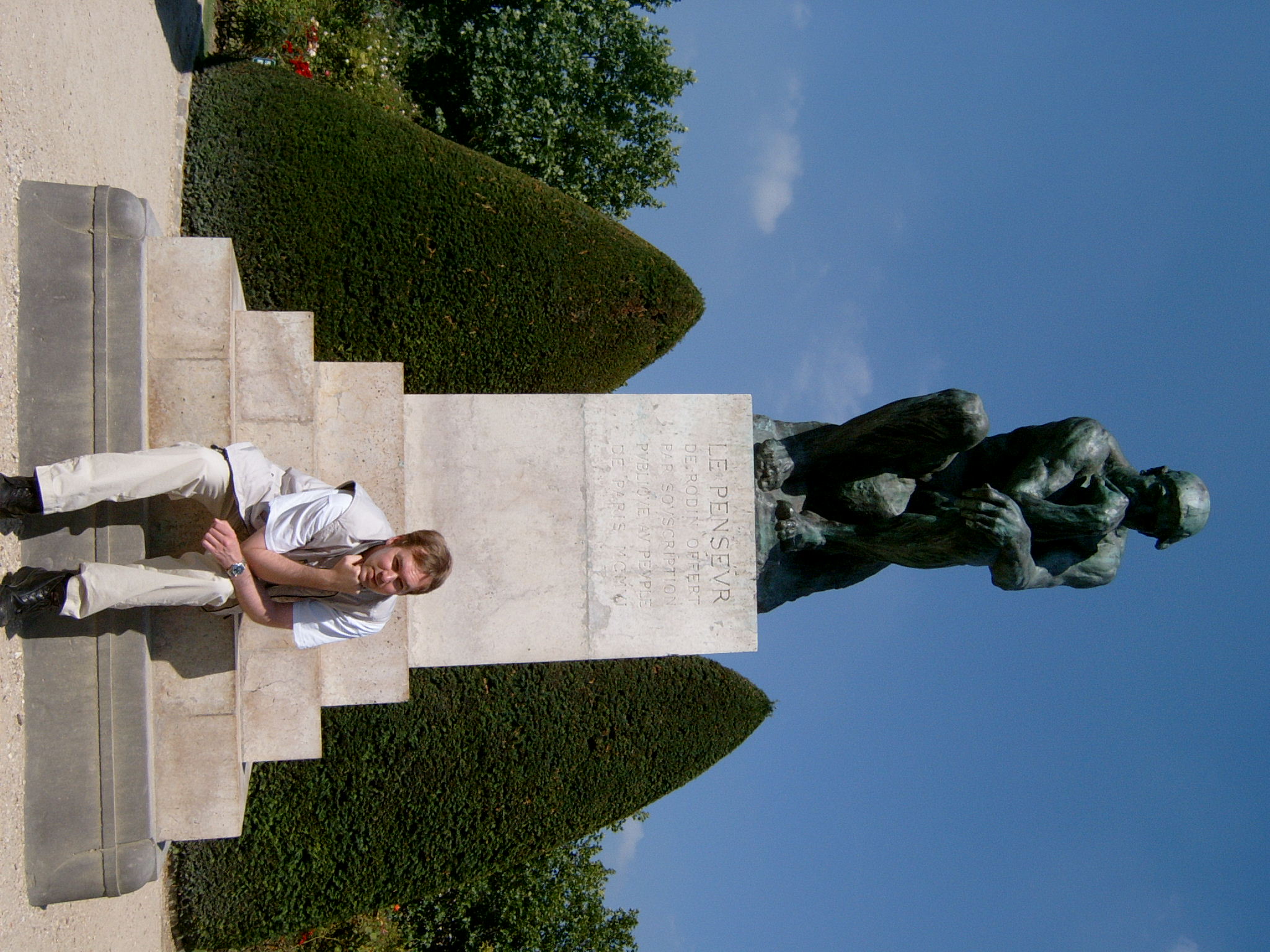
Me Thinking about Copyright in front of Le Pensevr Brendan Scott linked to a couple of articles about CAL (the Copyright Agency Limited) [1]. I have previously written about CAL and the way that they charge organisations for the work of others without their consent [2]. My personal dispute with CAL is that they may be charging people to use my work, I have not given them permission to act on my behalf and will never do so. If they ever bill anyone for my work then it will be an act of piracy. The fact that the government through some bad legislation permitted them to do such things doesn t prevent it from being piracy you can t disagree with this claim without supporting the past actions of China and other countries that have refrained from preventing factories from mass-producing unauthorised copies of software. The first article concerns the fact that last year CAL paid more than $9,400,000 in salary to it s employees (including $350,000 to it s CEO) while it only paid $9,100,000 directly to the authors [3]. It also spent another $300,000 to send it s executives to a junket in Barbados. It did give $76,000,000 to publishers on the assumption that a proportion of this money will be returned to authors of course said publishers could have used the money to have holidays in Barbados. CAL doesn t bother to check who ends up with shares of the $76,000,000 so it s anyone s guess where it ends up. The second article is by James Bradley who is an author and director of CAL [4]. He claims that much of the $76,000,000 was distributed to authors, although I m not sure how he would have any idea of how much it was which is presumably why he used the word much instead of some other word with a clearer meaning such as most . He also notes that CAL invested $1,000,000 in projects specifically designed to promote the development and dissemination of Australian writing , which sounds nice until you consider the fact that none of the authors (apart from presumably the few who sit on the CAL board) had any say in the matter. Can I take a chunk of the $9,400,000 that is paid to CAL employees and invest it in something? If not then why not? If they can invest money that was owed to other people then why can t I invest their salaries? James also says The issue of how well CAL serves rights-holders and authors and artists in particular is a vital one which is remarkably silly. He is entirely ignoring the fact that some rights holders don t want to be served by CAL at all. The fact that CAL can arbitrarily take money for other people s work is an infringement on their rights. He further demonstrates his ignorance by saying Without CAL and the licences we administer, users educational institutions, government agencies and corporate organisations, to name just a few would be required to seek permission every time they reproduced copyright material or run the risk of legal action for copyright infringement of course any educational institution can use Creative Commons licensed work [5]. I ve previously written about the CK12 project to develop CC licensed text books for free use [6]. There s no reason why the same thing can t be done for university text books. In the discussion following Claudine Chionh s LUV talk titled Humanities computing, Drupal and What I did on my holidays [7] it was suggested that it should be possible to gain credit towards a post-graduate degree based on work done to share information this could mean setting up a Drupal site and populating the database or it could mean contributing to CC licensed text books. Let s face it, a good CC text book will be read by many more people than the typical conference proceedings! James says that CAL is used Instead of having to track down individual rights-holders every time they want to reproduce copyright material . The correct solution to this problem would be to change the copyright law such that if a reasonable attempt to discover the rights-holder fails then work is deemed to be in the public domain. The solution to the problem of tracking down rights-holders is not to deny them their rights entirely and grant CAL the right to sub-license their work! He also makes the ridiculous claim Whereas in the age of the physical book schools and universities could have bought fewer books and made up the difference by using photocopies, it is now possible for an organisation to buy a single set of digital materials and reproduce them ad infinitum which implies that CAL is the only thing saving the profits of authors from unrestricted digital copying. Of course as CAL seems to have no active enforcement mechanisms and they apparently charge a per-student fee they really have no impact on the issue of a single licensed copy being potentially used a million times extra use apparently won t provide benefits to the author and use in excess of the licensing scheme won t be penalised. He asks the rhetorical question After all, why go to the expense of creating a textbook (or some form of digital course materials) if you are going to sell only a half-dozen copies to state education departments . The answer is obvious to anyone who has real-world experience with multiple licensing schemes you can sell one single copy and make a profit if the price is high enough. The smart thing for the education departments to do would be to pool their resources and pay text book companies for writing CC licensed texts (or releasing previously published texts under the CC). The average author of a text book would probably be very happy to earn $100,000 for their work, the editorial process probably involves a similar amount of work. So if the government was to offer $300,000 for the entire rights to a text book then I m sure that there would be more than a few publishers tendering for the contract. According to the CIA World Fact Book there are 2,871,482 people in Australia aged 0-14 [8], that means about 205,000 per year level. CAL charges $16 for each primary and secondary student so the government is paying about $3,280,000 every year per year level. Even in year 12 the number of text books used is probably not more than 10, so it seems to me that if all the money paid to CAL by schools in a single year was instead used to fund Creative Commons licensed text books then the majority of the school system would be covered! The universities have a much wider range of text books but they also have higher CAL fees of $40 per student. After cutting off the waste of taxpayer money on CAL fees for schools that money could be invested in the production of CC licensed university text books.

Stefano Zacchiroli: RC bugs of the week - issue 24

RCBW - #24 Some pause, and here we go with another RCBW issue. The pause has involved various Debian-related work, such as preparing OCaml batteries included for Squeeze and of course preparing my DPL platform. Without any further ado, here are this week's squashes: Random points:

11 March 2010

Obey Arthur Liu: Going to DebConf10 and more

Hi folks, I am coming to DebConf10! im_going_to_debconf10 In addition to New York, I ll also be in San Francisco and Seattle. And here s my travel plan to go with it: Day by Day Itinerary Depart: Zurich (ZRH), 19:45 CEST, Arrive: Paris (CDG), 21:10 CEST
Air France 5109 Aircraft Avro RJ85 Avroliner nonstop 1h, 25m 475 km Class K Depart: Paris (CDG), 10:40 CEST, Arrive: San Francisco (SFO), 12:50 PDT
Air France 84 Aircraft Boeing 747-400 nonstop 11h, 10m 8,958 km Class H seat 25A Depart: San Francisco (SFO), 07:00 PDT, Arrive: Seattle (SEA), 09:00 PDT
Virgin America 740 Aircraft Airbus A319 nonstop 2h, 00m 1,090 km Depart: Seattle (SEA), 07:00 PDT, Arrive: San Francisco (SFO), 09:15 PDT
Virgin America 751 Aircraft Airbus A319 nonstop 2h, 15m 1,090 km Depart: San Francisco (SFO), 23:05 PDT, Arrive: New York (JFK), 07:50 EDT(+1 day)
Virgin America 28 Aircraft Airbus A320-100/200 nonstop 5h, 45m 4,150 km DebCamp10! DebConf10! Depart: New York (JFK), 19:05 EDT, Arrive: Paris (CDG), 08:35 CEST(+1 day)
Air France 7 Aircraft 388 nonstop 7h, 30m 5,829 km Class V seat 86A To get an up to date version of my travel plans, visit the TripIt page: http://www.tripit.com/trip/public/id/4CE972068378 I m looking forward to getting as many of our Google Summer of Code students as possible at the DebConf. See you in the US! Update: Actually, I might attend DebCamp too.

Kartik Mistry: Debconf 10

* Unfortunately (with apologies to GIMP)

10 March 2010

John Goerzen: Numerous Updates

It s been awhile since I ve posted some family/home updates, so here they are, sorta random-like Jacob is 3.5 now, and Oliver is about 8 months old at this point. Jacob Jacob has a few trends going on lately: pretending to be a cat, and inventing new games to play. He has one game he likes to play with me called tunnels and slippers. He will have me sit on the couch, put my feet up on the footstool, and crawl on top of my legs. He ll want me to bounce him, then he can crawl underneath the tunnel. The slippers part came because he started to steal my slippers one time during winter. He d struggle furiously to get it off, then shriek with delight as he ran away, listing to my indignation at having a cold foot now. Then I was supposed to run after him, pick him up in the air, and get the slipper back. Here he is, trying to steal a slipper while I happened to be holding a camera: img_2345.jpg He s said quite a few memorable quotes this winter: Dec. 8: Jacob looked outside this morning and yelled, WOW! Look at that! , ran across the room and yelled, MOM! WOW! There is snow outside this window too! WOW! Snow is ALL OVER THE PLACE! January: When told his grandparents were going back to Indiana: The kitty doesn t like that. (the pretending to be a cat thing) The next morning when he remembered they were gone: Oh. My kitty is so very sad now. February: My name is kitty. Jacob Cat! March: I didn t realize the basketball could go so far! He s been starting to make his first attempts at sounding out words. He s been interested in 2- and 3-digit numbers, trying to figure out how to tell time, and asking me the German words for all sorts of things. (And showing some disappointment with my German vocabulary.) Jacob talks about Oliver as a sweet baby, and is often very caring about him. Jacob wants to make sure Oliver has *plenty* of toys. Though there have been some times when Jacob has pushed Oliver over. Here s the Christmas photo of the two of them: img_2367r And another: img_2357.jpg Jacob has also started to pick up an interest in singing: his favorite song is one that he made up, and it goes Engine, engine, passenger car I still sing a song to Jacob at bedtime each night, but Home On the Range doesn t cut it anymore. No, now I have a make up a song on the spot on a topic of Jacob s choosing each night. Last night he chose a song about the ceiling light and the smoke detector. Other nights, it s been about his toy butterfly, his night light, various smoke detectors (that s a popular one), or something from his day. Oliver img_2371.jpg Oliver recently has started being able to sit up by himself. He can also scoot all over the room. I think he s saying dad , but Terah disagrees and thinks he s just babbling. Her case wasn t helped the day I asked him, Are you saying Dad? He got a big smile after the question and laughed at me. He loves playing peek-a-boo, playing with us or playing by himself. Oliver has been eating the mashed-up baby food for awhile. Terah recently gave him a rice puff, and he put it in his mouth but wasn t sure what to do with it. He has been taking quite an interest in watching the rest of us eat, though, and sits at the table with us in his high chair.

8 March 2010

Jonathan McDowell: Fizz buzz

Inspired by a conversation about interview coding tasks from a list I'm on, I present the following - I considered it too long to email there. It took me longer than I expected to write; my x86 assembly is quite rusty. I'm not claiming it's pretty, but it fits in a single sector and most of the overhead is actually ELF structures.
; nasm -f elf fizzbuzz.asm
; ld -melf_i386 -s -o fizzbuzz fizzbuzz.o
; ./fizzbuzz
section .data
fizz	db	" fizz"
fizzlen	equ	$ - fizz
buzz	db	" buzz"
buzzlen	equ	$ - buzz
num	db	"   "
numend	equ	$ - 1
numlen	equ	$ - num
nl	db	0xa
nllen	equ	$ - nl
curnum	db 1
section .text
	global _start
_start:
	mov ax, [curnum]
	call printnum
	mov ax, [curnum]
	mov cx, 3
	xor dx, dx
	div cx
	cmp dx, 0
	jnz notfizz
	mov edx, fizzlen
	mov ecx, fizz
	call printstr
notfizz:
	mov ax, [curnum]
	mov cx, 5
	xor dx, dx
	div cx
	cmp dx, 0
	jnz notbuzz
	mov edx, buzzlen
	mov ecx, buzz
	call printstr
notbuzz:
	mov edx, nllen
	mov ecx, nl
	call printstr
	inc BYTE [curnum]
	cmp BYTE [curnum], 100
	jle _start
	xor ebx, ebx
	mov eax, 1
	int 0x80
printnum:
	mov edi, numend
	mov cx, 10
p1:
	xor edx, edx
	div cx
	add dx, '0'
	mov [edi], dl
	dec edi
	cmp ax, 0
	jne p1
	mov ecx, num
	mov edx, numlen
printstr:
	mov ebx, 1
	mov eax, 4
	int 0x80
	ret

Vincent Sanders: Music hath charms to soothe a savage breast, to soften rocks, or bend a knotted oak.

Since I last mentioned music back in January I have accumulated another ten albums and unlike last time where there were only a couple of stand outs, this time I have he opposite problem.

The unordered list:

Justin Sandercoe - "Small town eyes"

I am learning to play the guitar, I have been using Justins' course, it is very very good, this album? Also very good. If you like melodic guitar lead music with varied influences this is for you. A couple of tracks made me immediately think of some Crowded House riffs (which is not a bad thing). Only minor niggle is the uneven levels on some of the louder pieces, but it really is a minor observation on an otherwise fine first album.

Molly Lewis - "I made you a CD, but I eated it."

Although this is only a short selection of original material from Molly, it is a very promising first album. I really like her voice and although a ukulele is not generally the most well respected of instruments, in her hands, it has an odd charm. This album is available from DFTBA records.

Rhett and Link - "Up to this point"

A pair of talented comedians who use music very effectively to highlight their humour. I originally stumbled across them on youtube and decided to take a punt. The album is 27 short pieces which fit together surprisingly well. Difficult to categorise but think a cross between Flight of the Choncords and Jonathan Coulton with a dash of youtube immediacy.

They Might Be Giants - "Flood", "Apollo 18" and "John Henry"

Strictly a replacement of the old tapes which have completely disintegrated in the intervening couple of decades since first purchased. Flood is still one of my favourite albums ever, certainly in my top 10. If you do not know them TMBG are just ace, please try their music!

Seasick Steve - "Started out with nothin and i still got most of it left"

Well its a kinda fun album primarily based on blues electric "guitar" (some of the instruments are little more than a stick with a nail in and a guitar pickup.) Nothing bad, easy to get along with, definitely worth a listen.

La Roux - "La Roux"

This synth pop album was on remainder in ASDA and I took a gamble. Its OK I guess and for 3quid I cannot really complain.

Red Hot Chili Peppers - "By the way"

Not their best, but competent enough.

Aqua - "Aquarium" , "Aquarius"

Um...yes, I have a soft spot for 90's cheese OK? Nothing more than a gross self indulgence of my silly side. But they are fun ;-)


So that is my new music since January all 166 tracks of it . Most of it pretty good, certainly no lemons (well aside from the Aqua but that is supposed to be silly!)

Oh and The XX has really grown on me from last time and I am looking forward to their next release.


Russell Coker: Designing a Secure Linux System

The Threat Bruce Schneier s blog post about the Mariposa Botnet has an interesting discussion in the comments about how to make a secure system [1]. Note that the threat is considered to be remote attackers, that means viruses and trojan horses which includes infected files run from USB devices (IE you aren t safe just because you aren t on the Internet). The threat we are considering is not people who can replace hardware in the computer (people who have physical access to it which includes people who have access to where it is located or who are employed to repair it). This is the most common case, the risk involved in stealing a typical PC is far greater than the whatever benefit might be obtained from the data on it a typical computer user is at risk of theft only for the resale value of a second-hand computer. So the question is, how do can we most effectively use free software to protect against such threats? The first restriction is that the hardware in common use is cheap and has little special functionality for security. Systems that have a TPM seem unlikely to provide a useful benefit due to the TPM being designed more for Digital Restrictions Management than for protecting the user and due to TPM not being widely enough used. The BIOS and the Bootloader It seems that the first thing that is needed is a BIOS that is reliable. If an attacker manages to replace the BIOS then it could do exciting things like modifying the code of the kernel at boot time. It seems quite plausible for the real-mode boot loader code to be run in a VM86 session and to then have it s memory modified before it starts switches to protected mode. Every BIOS update is a potential attack. Coreboot replaces the default PC BIOS, it initialises the basic hardware and then executes an OS kernel or boot loader [2] (the Coreboot Wikipedia page has a good summary). The hardest part of the system startup process is initialising the hardware, Coreboot has that solved for 213 different motherboards. If engineers were allowed to freely design hardware without interference then probably a significant portion of the computers in the market would have a little switch to disable the write line for the flash BIOS. I heard a rumor that in the days of 286 systems a vendor of a secure OS shipped a scalpel to disable the hardware ability to leave protected mode, cutting a track on the motherboard is probably still an option. Usually once a system is working you don t want to upgrade the BIOS. One of the payloads for Coreboot is GRUB. The Grub Feature Requests page has as it s first entry Option to check signatures of the bootchain up to the cryptsetup/luksOpen: MBR, grub partition, kernel, initramfs [3]. Presumably this would allow a GPG signature to be checked so that a kernel and initrd would only be used if they came from a known good source. With this feature we could only boot a known good kernel. How to run User Space The next issue is how to run the user-space. There has been no shortage of Linux kernel exploits and I think it s reasonable to assume that there will continue to be a large number of exploits. Some of the kernel flaws will be known by the bad guys for some time before there are patches, some of them will have patches which don t get applied as quickly as desired. I think we have to assume that the Linux kernel will be compromised. Therefore the regular user applications can t be run against a kernel that has direct hardware access. It seems to me that the best way to go is to have the Linux kernel run in a virtual environment such as Xen or KVM. That means you have a hypervisor (Xen+Linux or Linux+KVM+QEMU) that controls the hardware and creates the environment for the OS image that the user interacts with. The hypervisor could create multiple virtual machines for different levels of data in a similar manner to the NSA NetTop project, not that this is really a required part of solving the general secure Internet terminal problem but as it would be a tiny bit of extra work you might as well do it. One problem with using a hypervisor is that the video hardware tends to want to use features such as bus-mastering to give best performance. Apparently KVM has IOMMU support so it should be possible to grant a virtual machine enough hardware access to run 3D graphics at full speed without allowing it to break free. Maintaining the Virtual Machine Image Google has a good design for the ChromiumOS in terms of security [4]. They are using CGroups [5] to control access to device nodes in jails, RAM, CPU time, and other resources. They also have some intrusion detection which can prompt a user to perform a hardware reset. Some of the features would need to be implemented in a different manner for a full desktop system but most of the Google design features would work well. For an OS running in a virtual machine when an intrusion is detected it would be best to have the hypervisor receive a message by some defined interface (maybe a line of text printed on the console ) and then terminate and restart the virtual machine. Dumping the entire address space of the virtual machine would be a good idea too, with typical RAM sizes at around 4G for laptops and desktops and typical storage sizes at around 200G for laptops and 2T for new desktops it should be easy to store a few dumps in case they are needed. The amount of data received by a typical ADSL link is not that great. Apart from the occasional big thing (like downloading a movie or listening to Internet radio for a long time) most data transfers are from casual web browsing which doesn t involve that much data. A hypervisor could potentially store the last few gigabytes of data that were received which would then permit forensic analysis if the virtual machine was believed to be compromised. With cheap SATA disks in excess of 1TB it would be conceivable to store the last few years of data transfer (with downloaded movies excluded) but such long-term storage would probably involve risks that would outweigh the rewards, probably storing no more than 24 hours of data would be best. Finally in terms of applying updates and installing new software the only way to do this would be via the hypervisor as you don t want any part of the virtual machine to be able to write to it s data files or programs. So if the user selects to install a new application then the request please install application X would have to be passed to the hypervisor. After the application is installed a reboot of the virtual machine would be needed to apply the change. This is a common experience for mobile phones (where you even have to reboot if the telco changes some of their network settings) and it s something that MS-Windows users have become used to but it would get a negative reaction from the more skilled Linux users. Would this be Accepted? The question is, if we built this would people want to use it? The NetTop functionality of having two OSs interchangeable on the one desktop would attract some people. But most users don t desire greater security and would find some reason to avoid this. They would claim that it lowered the performance (even for aspects of performance where benchmarks revealed no difference) and claim that they don t need it. At this time it seems that computer security isn t regarded as a big enough problem for users. It seems that the same people who will avoid catching a train because one mugging made it to the TV news will happily keep using insecure computers in spite of the huge number of cases of fraud that are reported all the time.

Russell Coker: Storage vs RAM Size

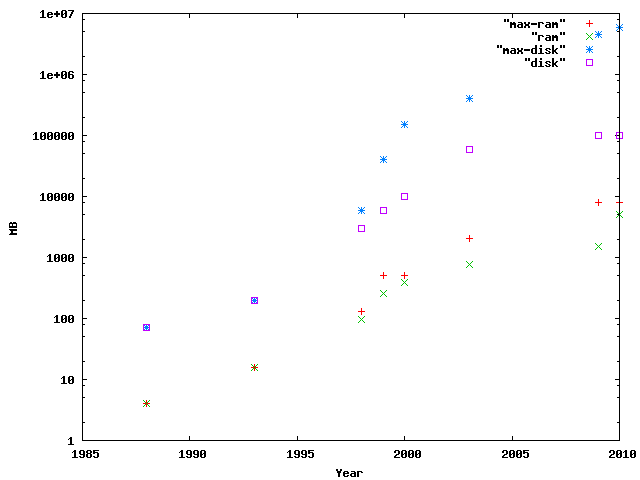
In a comment on my post Shared Objects and Big Applications about memlockd [1] mic said that they use memlockd to lock the entire root filesystem in RAM. Here is a table showing my history of desktop computers with the amounts of RAM, disk capacity, and CPU power available. All systems better than a 386-33 are laptops a laptop has been my primary desktop system for the last 12 years. The columns for the maximum RAM and disk are the amounts that I could reasonably afford if I used a desktop PC instead of a laptop and used the best available technology of the day I m basing disk capacity on having four hard drives (the maximum that can be installed in a typical PC without extra power cables and drive controller cards) and running RAID-5. For the machines before 2000 I base the maximum disk capacity on not using RAID as Linux software RAID used to not be that good (lack of online rebuild for starters) and hardware RAID options have always been too expensive or too lame for my use.
Year CPU RAM Disk Maximum RAM Maximum Disk
1988 286-12 4M 70M 4M 70M
1993 386-33 16M 200M 16M 200M
1998 Pentium-M 233 96M 3G 128M 6G
1999 Pentium-2 400 256M 6G 512M 40G
2000 Pentium-2 600 384M 10G 512M 150G
2003 Pentium-M 1700 768M 60G 2048M 400G
2009 Pentium-M 1700 1536M 100G 8192M 4500G
2010 Core 2 Duo T7500 2200 5120M 100G 8192M 6000G
graph of RAM/disk sizes from the above table The above graph shows how the modern RAM capacities have overtaken older disk capacities. So it seems that a viable option on modern systems is to load everything that you need to run into RAM. Locking it there will save spinning up the hard drive on a laptop. With a modern laptop it should be possible to lock most of the hard drive contents that are regularly used (IE the applications) into RAM and run with /home on a SD flash storage device. Then the hard drive would only need to be used if something uncommon was accessed or if something large (like a movie) was needed. It also shows that there is potential to run diskless workstations that copy the entire contents of their root filesystem when they boot so that they can run independently of the server and only access the server for /home. Note that the size of the RAM doesn t need to be larger than the disk capacity of older machines (some of the disk was used for swap, /home, etc). But when it is larger it makes it clear that the disk doesn t need to be accessed for routine storage needs. I generated the graph with GnuPlot [2], the configuration files I used are in the directory that contains the images and the command used was gnuplot command.txt . I find the GnuPlot documentation to be difficult to use so I hope that this example will be useful for other people who need to produce basic graphs I m not using 1% of the GnuPlot functionality.

7 March 2010

Emilio Pozuelo Monfort: RCBW #1 Me too!

After fixing some bugs this week, I ve noticed they ve been one per day (on average) so I think I m joining Stefano Zacchiroli on this RCBW thingie let s see if I can keep up! These are this week s bugs: #561645 gdesklets Doesn t work with python2.6 (thanks to Andrew Starr-Bochicchio)
#571488 gedit FTBFS with Python 2.6 as default
#571517 totem FTBFS with Python 2.6 as default
#571510 rhythmbox FTBFS with Python 2.6 as default
#533836 spe FTBFS with Python 2.6 as default
#569378 gnet FTBFS
#551215 gtkmm-documentation FTBFS I ve also sponsored gnome-dvb-daemon for Sebastian Reichel, which fixes two more RC bugs: #566949 gnome-dvb-daemon FTBFS with Python 2.6 as default
#569480 gnome-dvb-daemon FTBFS It s interesting to note that all of the above bugs except for the spe one are from pkg-gnome packages. We still have a few more, although they are the hard ones so it s not gonna be that easy for the next week

Gunnar Wolf: Authoral rights in the editorial world seminar

I must confess I don't remember who I got this invitation from. Anyway, if you are in the right geographic area, you might be interested. I will try to participate: This is a year-long seminar that will be held the second Thursday every month at Fonoteca Nacional (a place I have wanted to visit for a long time!), in Barrio de Santa Catarina, Coyoac n. Among the organizers they have Creative Commons Mexico. Free entrance (but limited space - so they ask interested people to confirm their presence by mail to bvallarta@conaculta.gob.mx). [update] I went with Pooka to the first session. We arrived almost 1hr late (due to me mistaking the schedule :-/ ) but it was interesting. Of course, quite biased towards the Google viewpoints, but interesting. We got the program for the next sessions So, mostly for myself to keep handy, here it goes:
Date Title Speakers
2010-03-11 Google and copyright Manuel Tamez, Hugo Contreras, Mar a Fernanda Mendoza
2010-04-08 Generalities about rights on intelectual property Jes s Parets, Guillermo Sol rzano, Jorge Mier y Concha
2010-05-13 Copyright's nature and competent authorites Carmen Arteaga, Luis Schmidt, C sar Callejas
2010-06-10 Moral and patrimonial rights Guillermo Pous, Eduardo de la Parra, Ram n Ob n
2010-07-08 Reproduction rights for audible material lvaro Hegewisch, scar Javier Solorio, Marco Antonio Morales, Jos Ram n C rdeno
2010-08-12 Licenses and patrimonial right transmission. Works for hire, works done under laboral relationship, or carried out in official service Dolores Franco, Jes s Mej a, Ra l Pastor
2010-09-09 Limits to explotation rights and literary plagiarism Carmen Arteaga, Juan Ram n Ob n, Jorge Mier y Concha, C sar Callejas
2010-10-14 Copyright in a digital setting Jes s Parets, Gast n Esquivel
2010-11-11 Law-regulated intelectual property rights Rosalba Elizalde, Salvador Ortega, Gast n Esquivel, Manrique Moheno
2010-12-09 International protection and collective gestive societies Horacio Rangel, Luis Schmidt, Jes s Mej a

Thorsten Glaser: CLT 2010

Quite surprisingly, I ll attend the Chemnitzer Linuxtage 2010 in Eastern Germany. This is a happenstance, I managed to get fast transportation (via my boss) and accomodation (in a hotel). I will try to help staffing the booth of Debian this time (so I cannot be called Traitor any longer). Schedule, due to the spontaneousness of this, no, though. I may not even be there on Sunday, dunno No RCBD (or night) though, some real life and a new release (with fix of an FTBFS-on-hurd-i386 bug) though:
RMD160 (/MirOS/dist/mir/makefs/makefs-20100306.tar.gz) = f65bd8ef5cf3306a9112587dd4915b6255e479fe
This version pulls in NetBSD changes (Acorn Archimedes support, for one), but I ve also coded support for boot-info-table (J rg compatible), as well as setting the PVD dates (used by GNU GRUB 2 for UUID s). On MirBSD, cdio(1) can now be used to burn (TAO) and blank (quick) CD-RW media (I backported some OpenBSD changes) too.

4 March 2010

Russell Coker: Opera and Trusting Applications vs Trusting Servers

The Opera-Mini Dispute I have just read an interesting article about the Opera browser [1]. The article is very critical of Opera-Mini on the iPhone for many reasons most of which don t interest me greatly. There are lots of technical trade-offs that you can make when designing an application for a constrained environment (EG a phone with low resolution and low bandwidth). What does interest me is the criticism of the Opera Mini browser for proxying all Internet access (including HTTPS) through their own servers, this has been getting some traction around the Internet. Now it is obvious that if you have one server sitting on the net that proxies connections to lots of banks then there will be potential for abuse. What apparently isn t obvious to as many people is the fact that you have to trust the application. Causes of Software Security Problems When people think about computer security they usually think about worms and viruses that exploit existing bugs in software and about Trojan horse software that the user has to be tricked into running. These are both significant problems. But another problem is that of malicious software releases. I think that this is significantly different from Trojan horses because instead of having an application which was written for the sole purpose of tricking people (as is most similar to Greek history) you have an application that was written by many people who genuinely want to make a good product but you have a single person or small group that hijacks it. Rumor has it that rates well in excess of $10,000 are sometimes paid for previously unknown security vulnerabilities in widely used software. It seems likely that a programmer who was in a desperate financial situation could bolster their salary by deliberately putting bugs in software and then selling the exploits, this would not be a trivial task (making such bugs appear to be genuine mistakes would take some skill) but there are lots of people who could do it and plausibly deny any accusation other than carelessness. There have been many examples of gambling addicts who have done more foolish things to fund their habit. I don t think it s plausible to believe that every security flaw which has been discovered in widely used software was there purely as the result of a mistake. Given the huge number of programmers who have the skill needed to deliberately introduce a security flaw into the source of a program and conceal it from their colleagues I think it s quite likely that someone has done so and attempted to profit from it. Note that even if it could be proven that it was impossible to profit from creating a security flaw in a program that would not be sufficient to prove that it never happened. There is plenty of evidence of people committing crimes in the mistaken belief that it would be profitable for them. Should We Trust a Proprietary Application or an Internet Server? I agree with the people who don t like the Opera proxy idea, I would rather run a web browser on my phone that directly accesses the Internet. But I don t think that the web browser that is built in to my current smart-phone is particularly secure. It seems usual for a PC to need a security update for the base OS or the web browser at least once a year while mobile phones have a standard service life of two years without any updates. I suspect that there is a lot of flawed code running on smart phones that never get updated. It seems to me that the risks with Opera are the single point of failure of the proxy server in addition to the issues of code quality while the risks with the browser that is on my smart-phone is just the quality of the code. I suspect that Opera may do a better job of updating their software to fix security issues so this may mitigate the risk from using their proxy. At the moment China is producing a significant portion of the world s smart-phones. Some brands like LG are designed and manufactured in China, others are manufactured in China for marketing/engineering companies based in Europe and the US. A casual browse of information regarding Falun Gong makes the character of the Chinese leadership quite clear [2], I think that everything that comes out of China should be considered to be less trustworthy than equivalent products from Europe and the US. So I think that anyone who owns a Chinese mobile phone and rails against the Opera Mini hasn t considered the issue enough. I don t think it s possible to prove that an Opera Mini with it s proxy is more or less of a risk than a Chinese smart-phone. I m quite happy with my LG Viewty [3] but I wouldn t use it for Internet banking or checking my main email account. Also we have to keep in mind that mobile phones are really owned by telephone companies. You might pay for your phone or even get it unlocked so you can run it on a different network, but you won t get the custom menus of your telco removed. Most phones are designed to meet the needs of telcos not users and I doubt that secure Internet banking is a priority for a telco. Update: You can buy unlocked mobile phones. But AFAIK the Android is the only phone which might be described as not being designed for the needs of the telcos over the needs of the users. So while you can get a phone without custom menus for a telco, you probably can t get a phone that was specifically designed for what you want to do. The Scope of the Problem Mobile phones are not the extent of the problem, I think that anyone who buys a PC from a Chinese manufacturer and doesn t immediately wipe the hard drive and do a fresh OS install is taking an unreasonable risk. The same thing goes for anyone who buys a PC from a store where it s handled by low wage employees, I can imagine someone on a minimum income accepting a cash payment to run some special software on every PC before it goes out the door that wouldn t be any more difficult or risky than the employees who copy customer credit card numbers (a reasonably common crime). It s also quite conceivable that any major commercial software company could have a rogue employee who is deliberately introducing bugs into it s software. That includes Apple. If the iPhone OS was compromised before it shipped then the issue of browser security wouldn t matter much. I agree that having the minimum possible number of potential security weak points is a good idea. They should allow Opera Mini users to select that HTTPS traffic should not be proxied. But I don t think that merely not using a proxy would create a safe platform for Internet banking. In terms of mobile phones most things are done in the wrong way to try and get more money out of the users. Choose whichever phone or browser you want and it will probably still be a huge security risk. Harald Welte is doing some really good work on developing free software for running a GSM network [4]. But until that project gets to the stage of being widely usable I think that we just have to accept a certain level of security risk when using mobile phones.

Next.

Previous.