Search Results: "sto"

8 March 2016

Dirk Eddelbuettel: gtrendsR 1.3.3

A very nice new update to the gtrendsR package by Philippe and myself is now avilable via CRAN. I had only blogged about the initial 1.3.0 release, and we have added a whole slew of new features and fixes. Philippe rewrote a lot of the parsing to make it more robust to different encodings, and to add other features. So in no particular order, we can now sub-group by regions more finely, withstand various misfeatures in returned data sets, generally do better on connections, and more --- and also allow for intra-day, daily and weekly queries! That last part is pretty fun. Here is the code I ran last Saturday to look at the query for Donald Drumpf, a name brought to us via a beautiful John Oliver episode worth watching which ran about nine days ago. So last Saturday, when we were still within the seven day window, I ran
library(gtrendsR)
dp <- gtrends("Donald Drumpf", res="7d")
plot(dp) + ggplot2::ggtitle("The Drumpf") + ggplot2::theme(legend.position="none")
which resulted in the following chart Donald Drump query which highlights another nice feature: the ggplot2 object created by the plotting function is returned, so we can locally modify and tune it. Here we set a title and suppress the default legend. As I had not blogged about the interim bug-fix releases 1.3.1 and 1.3.2, here is the set of NEWS entries for the last three releases:

gtrendsR 1.3.3
  • A ggplot2 object can now be returned for further customization. plot(gtrends("NHL")) + ggtitle("NHL trend") + theme(legend.position="none")
  • Support for hourly and daily data (#67). For example, it is now possible to have hourly data for the last seven days with gtrends("nhl", geo = "CA", res = "7d"). Use ?gtrends for more information about the time resolution supported by the package.
  • Support for categorties (#46). Ex.: gtrends("NHL", geo = "US", cat = "0-20") will search only in the sport category.
  • Some countries (ex: Hong Kong) were missing from the list (#69).
  • Various typos and documentation work.

gtrendsR 1.3.2
  • Added support for sub-countries (#25). Ex.: gtrends("NHL", geo = "CA-QC") will return trends data for Qu bec province in Canada. The list of supported sub-countries can be obtained via data(countries).
  • Data parsing should work for any data returned by Google Trends (i.e. countries independent).
  • Better support for queries using keywords in different languages (#50, #57). Ex.: gtrends(" ", geo = "TW")
  • Now able to specify up to five countries (#53) via gtrends("NHL", geo = c("CA", "US"))
  • Fixing issue #51 allowing UK-based queries via geo = "GB"

gtrendsR 1.3.1
  • Fixing issue #34 where connection verification was not done properly.
  • Now able to use more latin character in query. For example: gtrends("montr al").
  • Can now deal with data returned other than in English language.

Courtesy of CRANberries, there is also a diffstat report for the this release. As always, more detailed information is on the gtrendsR repo where questions, comments etc should go via the issue tickets system.

This post by Dirk Eddelbuettel originated on his Thinking inside the box blog. Please report excessive re-aggregation in third-party for-profit settings.

Edited 2016-03-08: Corrected code snipped and one grammar instance

Michal &#268;iha&#345;: Weekly phpMyAdmin contributions 2016-W09

The last week was mostly spent on bugfixing and cleanup after security releases. Hopefully the amount of security reports will go down now. Most of the bug fixes were in the SQL parser which influences quite a lot of parts of phpMyAdmin. It is responsible for splitting queries on import, generating queries for export or linting the queries as users type them. Additionally Debian packages were also updated, for both unstable and testing and for Ubuntu PPA. Handled issues:

Filed under: Debian English phpMyAdmin 0 comments

Bits from Debian: Hewlett Packard Enterprise Platinum Sponsor of DebConf16

HPElogo We are very pleased to announce that Hewlett Packard Enterprise (HPE) has committed support to DebConf16 as a Platinum sponsor. "We're excited to support Debian's annual conference which brings together Debian contributors from all around the world. In addition to our sponsorship, we will actively participate in DebConf", said Steve Geary, Senior Director at Hewlett Packard Enterprise. HPE is one of the largest computer companies in the world, providing a wide range of products and services, such as servers, storage, networking, consulting and support, software, and financial services. HPE is also a development partner of Debian, and provides hardware for port development, Debian mirrors, and other Debian services (hardware donations are listed in the Debian machines page). With this additional commitment as Platinum Sponsor, HPE contributes to make possible our annual conference, and directly supports the progress of Debian and Free Software helping to strengthen the community that continues to collaborate on Debian projects throughout the rest of the year. Thank you very much Hewlett Packard Enterprise, for your support of DebConf16! Become a sponsor too! DebConf16 is still accepting sponsors. Interested companies and organizations may contact the DebConf team through sponsors@debconf.org, and visit the DebConf16 website at http://debconf16.debconf.org.

Guido G nther: Debian Fun in February 2016

Debian LTS February was the tenth month I contributed to Debian LTS under the Freexian umbrella. In total I spent 7 hours (of allocated 11.15 hours) working on squeeze-lts: and to make sure we have fewer issues that are fixed in squeeze-lts but affect wheezy On non LTS time I cooked up a script to make it simpler to check if a package has security support in a certain release. Now that squeeze-lts is history I'd like to thank the Debian Security Team for their help and answers to all the questions related to security tracker, DSAs, DLAs and whatnot. I'm looking forward to wheezy-lts now Other Debian stuff

7 March 2016

Holger Levsen: 20160307-TorDevMeeting and InternetFreedomFestival

Some impressions from the TorDevMeeting and the Internet Freedom Festival (IFF) in Valencia Overheard at the Tor Dev meeting in Valencia, from people speaking about online identities: "You were on top of the list of the people I thought were you." It was really good to be there as my plan to meet people and work on torbrowser-launcher issues worked out nicely: in total seven bugs got fixed upstream and resulted in an torbrowser-launcher upload to sid after the meeting. So now only three bugs are open in sid and it's clear how to fix #811499 in stable so that torbrowser-launcher doesn't stop working on May 3rd 2016. So yay. At the IFF we also had a small reproducible builds Debian meeting, where I took these raw notes: (please ask for clarifications, how to help or correct me if you think other things are blockers right now as well!) Too bad IFF was not really well known in advance amongst some local free software advocates, I hope this improves next year!

Ritesh Raj Sarraf: Laptop Mode Tools 1.69 Released

Today is an auspicious day. For those who know (or follow) the Hindu religion will be familiar; Today is Maha Shivaratri On this day, It is great delight for me to be able to release Laptop Mode Tools, version 1.69 This release adds on many bug fixes and some enhancements. There is a new module (disabled by default) for cpuhotplug. The release tarball also includes a basic PolicyKit file for convenience, that packagers can use for the Laptop Mode Tools Graphical Configuration Interface. Apart from the policykit file, the graphical invocation script has been slightly fine tuned to work under pkexec and sudo. Some defaults have been tuned based on user requests - This should improve in situations where your External USB Mouse/Keyboard used to suspend after idle time periods. In January this year, I had the pleasure of meeting Bart Samwel in person at his office in Amsterdam. For those who don't know, Bart started off Laptop Mode Tools around 2004, and I took over maintenance around 2008. Meeting in person has been a delight, especially with the ones you work over email for years; This is something I cherished last year at Debconf 15 too. IMPORTANT:- Until now, Laptop Mode Tools project was hosted on Bart's webserver. Now, as you read, the homepage and mailing lists have changed. I'd urge all users to subscribe to the new mailing list and update their bookmarks. Homepage: https://github.com/rickysarraf/laptop-mode-tools/wiki Mailing List: https://groups.google.com/d/forum/laptop-mode-tools Note: For users who are not comfortable with creating a google a/c for mailing list subscription, you should still be able to subscribe with your personal email address. Please follow the steps in the mentioned homepage. Since last couple releases, I've also been providing RPM packages for Opensuse Tumbleweed and Fedora. The same should be available on the github release page. The Debian package will follow shortly in the Debian repository. Thank you and a Happy Maha Shivaratri. Har Har Mahadev.
1.69 - Mon Mar  7 17:44:42 IST 2016
    * Wait for all forked modules to complete
    * Add new module: cputhotplug
    * CPU online/offine is reverse here
    * Fix shell syntax
    * Install policykit file
    * Detach polling daemon from main process
    * Do NOT touch speed if throttling is not set
    * Restore to MAX speed when back to AC Power
    * Fix manpage about DISABLE_ETHERNET_ON_BATTERY setting
    * Update documentation about ENABLE_LAPTOP_MODE_ON_AC setting
    * Change powersaving default for USB class devices
    * Drop usbhid from default (black)list
    * Add usb keyboard driver to the list default list
    * Be consistent with passing args to LMT from different invokers
    * Honor device plug/unplug events on a per device basis;
      like how Chromium initially submitted this patch
    * Also be consistent with option in the event parser
    * Update links in README.md
    * Update new github homepage location
    * Add lmt-config-gui shell script

Categories:

Keywords:

Like:

Hideki Yamane: Debian meeting in Tokyo (2016 March)

5th March, we've held Debian (Debian meeting) in Tokyo. (Cybozu, Inc.) kindly provides their office for meeting, thanks for folks in Cybozu.


This time, three talks were given:

    • Kentaro is "groonga"(an open-source fulltext search engine and column store) upstream author and package maintainer in Debian and Fedora. This talk is about his experience how to use Debian "porterbox" for non-DDs.
  • "Porting Debian to tilegx" by @wskoka
    • About his experience porting Debian to tilegx architecture, multicore processor family by Tilera. He is not porting expert ("I'm sale person", he said :), but did try&error and now apt is working on that machine.
  • "Introduction to Debian Ports" by John Paul Adrian Glaubitz
    • Adrian comes from Germany(!) and gave a talk about debian-ports.


During break time, did some discussion, GPG keysigning and enjoyed coffee and sweets provided by Cybozu, thanks!

And thanks for all participates!

4 March 2016

Mike Gabriel: My FLOSS activities in February 2016

February 2016 has been a very active month regarding me contributing to the FLOSS world.
  • Finalizing MATE uploads to Debian with regards to the Beta 1 Freeze of Ubuntu 16.04
  • Work on RDP related packages in Debian
  • Work on Debian Edu related packages
  • Work on Debian LTS
  • Work on nx-libs (NX v3)
Honouring my Sponsors I am happy to share that this month's FLOSS work has been sponsored by various sponsors.
  • Work on the packages mate-dock-applet, topmenu-gtk and getting GIR-support back into libwnck has been sponsored by Martin Wimpress, the main driving force (AFAIK) behind Ubuntu MATE [1].
  • Work on Debian LTS has been sponsored by the various Debian LTS sponsors proxied through Freexian SARL (thanks to Raphael Hertzog for organizing the paid LTS contributors team via his company) [2].
  • Work on nx-libs has been sponsored by the Qindel Group [3].
Thanks to all people and companies sponsoring my work on FLOSS projects. This month's MATE uploads to Debian With regards to the Beta 1 Freeze date of Ubuntu 16.04 LTS (18th Feb 2016), Martin Wimpress, Vangelis Mouhtsis and I performed quite some work on Debian MATE. Uploads to Debian unstable:
  • caja 1.12.4-2 [4]
  • mate-menu 5.6.8-1 [5]
  • mate-panel 1.12.2-1 [6]
  • mate-dock-applet 0.67-3 (NEW) [7]
  • mate-polkit 1.12.0-3 [8]
  • eom 1.12.2-1 [9]
  • pluma 1.12.2-1 [10]
  • topmenu-gtk 0.2.1+git20151210.8c6108f-2 (NEW) [11]
  • mate-tweak 3.5.7-1 (latest upload on 2nd of March) [12]
The Debian MATE Packaging Team also took over maintenance of the GTK-2+ legacy package libwnck [13]. The first upload introducing some major changes and package clean-ups caused a slight wave [14] because of a missing dependency in libwnck-dev (that fell victim to some clean-ups in debian/control). Those issues have been addressed immediately and have now been settled. The main reason for working on a legacy package like libwnck was the need for having gir1.2-wnck-1.0 (back) in Debian. The new MATE dock applet requires the libwnck GIR package to be present at runtime. One of the novelties in Ubuntu MATE 16.04 LTS will be the option to adapt the look and feel of the MATE desktop to how a Unity-based desktop looks like. Martin Wimpress is giving intense work to providing a dock applet and topmenu support as one alternative among the various Ubuntu MATE desktop experiences provided. The alternative desktop layouts can be configured with the MATE Tweak tool. Work on RDP related packages Work on FreeRDP 1.1 as currently in Debian I finally managed to give some priority (and thus time) to fixing various issues in the freerdp package in Debian [15]. Many people had provided patches and solutions to open issues and I tried to honour as many of those, as possible. Please note that I had to disable the GStreamer support in FreeRDP for the recent uploads, as the currently used Git snapshot of FreeRDP only supports GStreamer 0.10's API whereas the security team is in the process of having gstreamer0.10-* packages removed from the Debian stretch/unstable archives. Work on FreeRDP 2.0, coming to Debian soon Furthermore, Bernhard Miklautz is currently working on a freerdp2 package, which will bring the latest Git snapshot of FreeRDP upstream into Debian (and also re-introduce GStreamer support, based on GStreamer 1.0). Bernhard invested a lot of time on pushing the current HEAD of FreeRDP upstream [16] towards a FreeRDP 2.x version. Starting with FreeRDP 2.x it will be possible to install different FreeRDP versions on one system without file naming conflicts. For March 2016, I have doing the final freerdp2 reviewing on my todo list (possibly together with H ctor Or n Mart nez who is highly interested in the RDP backend support in Wayland/Weston), so that we can provide first uploads to Debian experimental sometime the coming month. The packaging progress is continuously discussed on the #freerdp channel on Freenode and can also be viewed on Github [17]. Review of revised XRDP package Recently, Dominik George from Teckids e.V. [18] contacted me about reviewing their effort of updating the Debian package xrdp, which currently is in ITA state [19]. Feedback has been provided and I am waiting for a ping from his side so that I can take some (ideally) final looks at the package and sponsor the upload. Work on Debian Edu related packages This month, I spent a couple of hours of work on several Debian Edu related tasks, some of them induced by problems at local school sites we support.
  • Fix the gosa package in Debian unstable [20]
  • Document a switch-over to systemd-networkd for Debian Edu jessie notebooks [21]
  • Help out in fixing outstanding issues in ldap2bind [22]
  • Upload a new shutdown-at-night package version to Debian unstable [23]
  • Fix some icon issues in the italc package [24]
  • Take a first glance at packaging terminal-quest [25]
  • Playing with the Lego Mindstorm (NXT) tools
Work on Debian LTS My 8h-portion of work for the Debian LTS Project, I performed at the very end of February. With the Debian squeeze LTS EOL date on 29th February, I saw to finalizing my personal open todos regarding Debian squeeze LTS, which basically was getting two CVE issues fixed in the lxc package [26]. The rest of the work hours has been spent on helping out the Security Team of Debian with open CVE issues in Debian wheezy packages:
  • Providing a .debdiff for gosa in Debian wheezy (addressing CVE-2015-8771 and CVE-2014-9760)
  • Investigating an open issue in smarty3 (CVE-2014-8350) and providing a recommendation on how to handle that (which is: pick the latest smarty3 3.1.21-1 from Debian jessie and provide that to users of Debian wheezy)
  • Taking a first look at pdns regarding a fix for CVE-2014-7210 in Debian wheezy
The gosa .debdiff has been approved by a member of the Security Team, the upload will happen today. With my LTS frontdesk hat on (during week 9 / 2016) I also spent some time providing help regarding SVN checkout problems and raised a couple of questions on how to coordinate the work phase between the Debian squeeze LTS EOL and the official launch of the Debian wheezy LTS project phase [27]. Work on nx-libs At the end of February, I finally managed to propose a way of dropping the libNX_Xrender.so bundled library from the nx-libs code base. I filed a PR [28] against nx-libs that proposes its removal and provides a patch for using X.Org's libXrender.so version. As a preview for nx-libs work in March 2016... I have started with removing the complete libNX_X11.so library from nx-libs and using X.Org's X11 client library. This will introduce a code removal of around 160.000 lines of code to nx-libs. More to come on this later... light+love,
Mike [1] http://ubuntu-mate.org/
[2] https://www.freexian.com/
[3] http://www.qindel.com/ [4] (caja)
https://lists.debian.org/debian-devel-changes/2016/02/msg00468.html
https://lists.debian.org/debian-devel-changes/2016/02/msg02080.html
https://lists.debian.org/debian-devel-changes/2016/02/msg02086.html
https://lists.debian.org/debian-devel-changes/2016/02/msg02183.html [5] (mate-menu)
https://lists.debian.org/debian-devel-changes/2016/02/msg00469.html [6] (mate-panel)
https://lists.debian.org/debian-devel-changes/2016/02/msg01900.html [7] (mate-dock-applet)
https://lists.debian.org/debian-devel-changes/2016/02/msg01935.html
https://lists.debian.org/debian-devel-changes/2016/02/msg02481.html
https://lists.debian.org/debian-devel-changes/2016/02/msg03097.html [8] (mate-polkit)
https://lists.debian.org/debian-devel-changes/2016/02/msg01936.html
https://lists.debian.org/debian-devel-changes/2016/02/msg02395.html [9] (eom)
https://lists.debian.org/debian-devel-changes/2016/02/msg02073.html [10] (pluma)
https://lists.debian.org/debian-devel-changes/2016/02/msg02128.html [11] (topmenu-gtk)
https://lists.debian.org/debian-devel-changes/2016/02/msg02399.html
https://lists.debian.org/debian-devel-changes/2016/02/msg02501.html [12] (mate-tweak)
https://lists.debian.org/debian-devel-changes/2016/02/msg03086.html [13] (libwnck)
https://lists.debian.org/debian-devel-changes/2016/02/msg01248.html
https://lists.debian.org/debian-devel-changes/2016/02/msg01404.html
https://lists.debian.org/debian-devel-changes/2016/02/msg01825.html [14] https://bugs.debian.org/cgi-bin/bugreport.cgi?bug=814585
https://bugs.debian.org/cgi-bin/bugreport.cgi?bug=814588
https://bugs.debian.org/cgi-bin/bugreport.cgi?bug=814697 [15] (freerdp)
https://lists.debian.org/debian-devel-changes/2016/02/msg02487.html
https://lists.debian.org/debian-devel-changes/2016/02/msg02630.html [16] https://github.com/FreeRDP/FreeRDP
[17] https://github.com/bmiklautz/debian-freerdp2 [18] https://www.teckids.org/ [19] https://bugs.debian.org/cgi-bin/bugreport.cgi?bug=719624 [20] (gosa)
https://lists.debian.org/debian-devel-changes/2016/02/msg01554.html
https://lists.debian.org/debian-devel-changes/2016/02/msg01954.html [21] https://sunweavers.net/blog/node/34 [22] (ldap2zone)
https://lists.debian.org/debian-devel-changes/2016/02/msg01966.html
https://lists.debian.org/debian-devel-changes/2016/02/msg01967.html [23] (shutdown-at-night)
https://lists.debian.org/debian-devel-changes/2016/02/msg03605.html [24] (italc)
https://lists.debian.org/debian-devel-changes/2016/02/msg01944.html [25] https://bugs.debian.org/cgi-bin/bugreport.cgi?bug=815948 [26] (lxc, Debian squeeze LTS)
https://lists.debian.org/debian-lts-changes/2016/02/msg00037.html [27] https://lists.debian.org/debian-lts/2016/02/msg00155.html
(The thread continues in March 2016) [28] https://github.com/ArcticaProject/nx-libs/pull/93

Arturo Borrero Gonz lez: How are we training to climb Mulhacen

Alcazaba, Punta de la Cornisa and Mulhac n 3.479 m

I have been in some adventures with a group of friends for a couple of years now. We call ourselves Los Extraviaos (a quick translation to english is perhaps The Wanderers).

We like nature adventures. During summer we use to do water adventures (like rivers trekking, waterfall climbing, snorkeling, canyoning, rafting, kayaking and so on). During winter and spring, we use to do trekking, hiking and mountaineering (low altitudes, keep reading).

For this sport season, one of our main milestones is to climb the second most prominent mountain in Spain: Mulhacen, with 3.479 m over sea level, during summer (June).
From an alpinist point of view, this isn't a very big deal, since most of the mountain's snow and ice is completely melted and the altitude is not that high.
However, from our amateur mountaineering point of view we will be taking a lot of kilometres to walk and a lot of elevation gain uphill (almost 1.600 m), which is in fact a thing to take into account.
Anyway, Mulhacen is considered 'high mountaineering' and all cautions should be taken both during preparation/training and during the climbing of the mountain itself.

To train our bodies and minds we are climbing lower mountains. We have climbed 3 or 4 already, and will continue to climb more in upcoming moths until we go to Mulhacen.
Also, it's important to climb mountains in different weather conditions. We need to train how to overcome wind, snow, storm, cold, night situations. The way we learn most is facing new, challenging situations.

We started by going to the summit of 'El Aljibe', 1.094 m over sea level, with about 500 m elevation gain uphill during 13 km.
This time, the weather was very windy. A video of the summit moment:


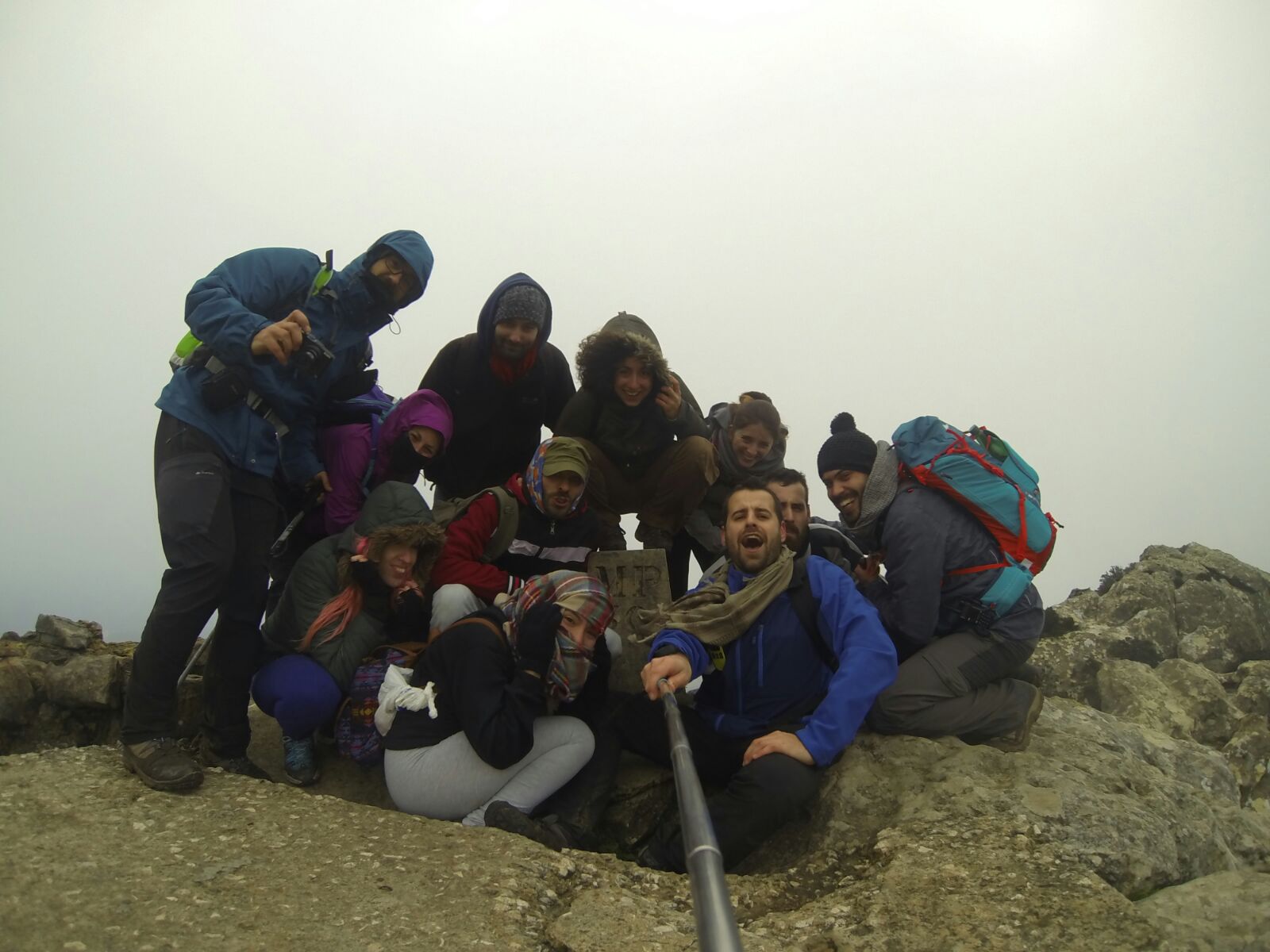
A pic of the group:


Next was the 'Torrecilla' peak. The summit is at 1.919 m over sea level, with about 900 m elevation gain uphill during 15 km.
This time we faced a snowy trekking.
Here a music video of that day:


The Torrecilla peak is in fact challenging with snow, so we went a second time, with even more snow and wind:


This second time we faced winds of 70km/h which, due to wind-chill, resulted in a very cold day.

We also went to Sierra de Grazalema Natural Park, in a hard trekking under snowfall:


This time we walked about 15 km with about 500m elevation gain uphill, while enjoying this kind of environment:


What's next: more mountains! We plan to reach 2.069 m over sea level next week in 'La Maroma' and keep doing steep trekking in upcoming months until we go in June to Mulhacen.

It should be very funny to do some FLOSS contribution from the summit of a mountain. Do you know of someone who did that?

3 March 2016

Simon Richter: Why sysvinit?

As most distributions have switched to systemd as default "init", some people have asked why we actually keep sysvinit around, as it's old and crusty, and systemd can do so much more. My answer is: systemd and sysvinit solve entirely different problems, and neither can ever replace the other fully. The big argument in favour of systemd is integration: when you keep everything in one process, it is easy to make sure that components talk to each other. That is nice, but kind of misses the point: integration could be done via IPC as well, and systemd uses a lot of it to separate privileges anyway. The tighter integration comes from something else: the configuration format. Where sysvinit uses a lot of shell scripts ("imperative" format), systemd uses explicit keywords ("descriptive" format), and this is the important design decision here: descriptive formats cannot do anything unanticipated, neither good nor bad. This is important for UI programmers: if there is a button that says "if I close the lid switch, suspend the laptop", then this needs to be connected to functionality that behaves this way, and this connection needs to work in both directions, so the user will find the active setting there when opening the dialog. So, we need to limit ourselves to a closed set of choices, so the UI people can prepare translations. This is the design tradeoff systemd makes: better integration in exchange for less flexibility. Of course, it is simple to allow "custom" actions everywhere, but that starts to break the "well-integrated" behaviour. There is an old blog post from Joey Hess about how to implement a simple alarm clock, using systemd, and this shows both how powerful and how limited the system is. On one hand, the single line WakeSystem=true takes care of the entire dependency chain attached to making sure the system is actually on -- when the system is going to suspend mode, some program needs to determine that there are scheduled jobs that should wake up the system, determined which of these is the next one, program the wakeup time into the hardware and only then allow the suspend to continue. On the other hand, the descriptive framework already breaks down in this simple example, because the default behaviour of the system is to go to sleep if the lid switch is closed, and the easiest way to fix this is to tell systemd to ignore the lid switch while the program is running. The IPC permissions disallow scheduled user jobs from setting this, so a "custom" action is taken that sets up the "ignore the lid switch" policy, changes to an unprivileged user, and runs the actual job. So, it is possible to get back flexibility, but this is traded for integration: while the job is running, any functionality that the "suspend laptop when the lid is closed" button had, is broken. For something simple as a switch on a personal laptop that breaks if the user configures something that is non-standard, that is acceptable. However, the keywords in the service unit files, the timer files, etc. are also part of a descriptive framework, and the services using them expect that the things they promise are kept by the framework, so there is a limit to how many exceptions you can grant. SystemV init really comes from the other direction here. Nothing is promised to init scripts but a vague notion that they will be run with sufficient privileges. There is no dependency tracking that ensures that certain services will always start before others, just priorities. You can add a dependency system like insserv if you like and make sure that all the requirements for it to work (i.e. services declaring their dependencies) are given, and there is a safe fallback of not parallelizing so we can always play it safe. Because there is so little promised to scripts, writing them becomes a bit tedious -- all of them have a large case statement where they parse the command line, all of them need to reimplement dropping privileges and finding the PID of a running process. There are lots of helpers for the more common things, like the LSB standard functions for colorful and matching console output, and Debian's start-stop-daemon for privilege and PID file handling, but in the end it remains each script's responsibility. Systemd will never be able to provide the same flexibility to admins while at the same time keeping the promises made in the descriptive language, and sysvinit will never reach the same amount of easy integration. I think it is fairly safe to predict both of these things, and I'd even go a step further: if any one of them tried, I'd ask the project managers what they were thinking. The only way to keep systems as complex as these running is to limit the scope of the project. With systemd, the complexity is kept in the internals, and it is important for manageability that all possible interactions are well-defined. That is a huge issue when writing adventure games, where you need to define interaction rules for each player action in combination with each object, and each pair of objects that can be combined with the "Use" action. Where adventure games would default to "This doesn't seem to work." or "I cannot use this.", this would not be a helpful error message when we're trying to boot, so we really need to cut down on actions and object types here. Sysvinit, on the other hand, is both more extreme in limiting the scope to very few actions (restart, wait, once) and only one object type (process that can be started and may occasionally terminate) in the main program, and a lot more open in what scripts outside the main program are allowed to do. The prime example for this is that the majority of configuration takes place outside the inittab even -- a script is responsible for the interface that services are registered by dropping init scripts into specific directories, and scripts can also create additional interfaces, but none of this is intrinsic to the init system itself. Which system is the right choice for your system is just that: your choice. You would choose a starting point, and customize what is necessary for your computer to do what you want it to do. Here's the thing: most users will be entirely happy with fully uncustomized systemd. It will suspend your laptop if you close the lid, and even give your download manager veto power. I fully support Debian's decision to use systemd as the default init for new installs, because it makes sense to use the default that is good for the vast majority of users. However, my opening statement still stands: systemd can never support all use cases, because it is constrained by its design. Trying to change that would turn it into an unmaintainable mess, and the authors are right in rejecting this. There are use cases that define the project, and use cases that are out of scope. This is what we need sysvinit for: the bits that the systemd project managers rightfully reject, but that are someone's use case. Telling these users to get lost would be extremely bad style for the "universal operating system." For example, if someone needs a service that asks a database server for a list of virtual machines to start, runs each in its private network namespace that is named after replacing part of the virtual machine name with the last two octets of the host machine's IP address, then binds a virtual Ethernet device into the network namespace and sets up a NAT rule that allows devices to talk to the public Internet and a firewall rule to stop VMs from talking to each other. Such a beast would live outside of systemd's world view. You can easily start it, but systemd would not know how to monitor it (as long as there is some process still running, is that a good sign), not know how to shut down one instance, not know how to map processes to instances and so on. SystemV init has the advantage here that none of these things are defined by the system, and as long as my init script has some code to handle "status", I can easily check up on my processes with the same interface I'd use for everything else. This requires me to have more knowledge of how the init system works, that is true, however I'd also venture that the learning curve for sysvinit is shallower. If you know shell scripting, you can understand what init scripts do, without memorizing special rules that govern how certain keywords interact, and keeping track of changes to these rules as the feature set is expanded. That said, I'm looking at becoming the new maintainer of the sysvinit package so we can continue to ship it and give our users a choice, but I'd definitely need help, as I only have a few systems left that won't run properly with systemd because of its nasty habit to keep lots of code in memory where sysvinit would unload it after use (by letting the shell process end), and these don't make good test systems. The overall plan is to set up a CI system that
  • tests sysvinit -> systemd transition
  • tests systemd -> sysvinit transition
  • tests debootstrap with systemd
  • tests debootstrap with sysvinit
  • tests whether service start works for a list of services, so we can catch regressions
  • scans packages that have systemd unit files for init scripts, and vice versa
Ideally, I'd like to reach a state where we can actually ensure that the default configuration is somewhat similar regardless of which init system we use, and that it is possible to install with either (this is a nasty regression in jessie: bootstrapping a foreign-architecture system broke). This will take time, and step one is probably looking at bugs first -- I'm grateful for any help I can get here, primarily I'd like to hear about regressions via bug reports. tl;dr: as a distribution, we need both systemd and sysvinit. If you suggest that systemd can replace sysvinit, I will probably understand that you think that the systemd maintainers don't know project management. I'm reluctantly looking at becoming the official maintainer because I think it is important to keep around.

Antonio Terceiro: Debian Ruby Sprint 2016 - day 3: Ruby 2.3 in unstable, Reproducible Builds, and Data Structures for Dinner Booths

Day 3 was again a full of useful work. Since the beginning of the sprint, we were able to fix more than 50 FTBFS bugs, alongside general quality improvements in the packages.
in the Debian jargon, FTBFS means that a package fails to build from source , which in Debian is a critical bug because users need to be able to produce binary packages from their source code to fully exercise the free software principles.
An important milestone that was also achieved on day 3 was the upload of ruby-defaults 1:2.3.0+1, making ruby2.3 the new default version of Ruby. That is the version that will shipped in the next Debian release, codenamed stretch. This is the culmination of a joint effort between the Ruby team and Debian Release Team that involves rebuilding a little more than 130 packages that use the Ruby C API to make sure everything will just work on upgrades, both from the previous stable release, and from earlier snapshots of the current development release. Another small change that will have a big impact for Debian and for free software was an improvement to gem2deb that fixes a reproducibility issue in Ruby packages and will help currently more than 100 Ruby packages become reproducible. The full list of items that have been worked on is this:
  • sponsor ruby-github-linguist. Closes: #815908. Thanks balasankar
  • rebuild remaining failing packages 55 remaining!
  • uploaded ruby-em-synchrony (FTBFS #800029)
  • day 2 report blog post
  • ruby-certificate-authority-0.1.6-1 (#816506)
  • filed for ruby-grack removal
  • uploaded ruby-em-synchrony
  • uploaded ruby-mathml (FTBS #800029)
  • uploaded new upstream version of ruby-redis which claims better ruby2.2 support
  • uploaded pry (0.10.3-2), hoping it will build correctly on the buildd
  • uploaded ruby-hashery
  • rails security issues: CVE-2016-2098, CVE-2016-2097
    • fixed in unstable on 2:4.2.5.2-1
    • contacted security team for jessie update
  • uploaded ruby-ruby-engine, ruby-ruby-version, ruby-rspec-pending-for to NEW
  • updated ruby-hashie to new upstream version
  • ruby-remcached (fix FTBFS)
  • made the switch to ruby2.3 in unstable *********
  • filed https://bugs.ruby-lang.org/issues/12137 as ruby-awesome-print triggers this
  • uploaded ruby-rspec 3.4
  • uploaded ruby-rspec-rails 3.4
  • uploaded ruby-grack 2.0.2-2 (fix FTBFS)
  • ruby-memcache-client (#797256) => RoM ruby-memcache-client (#816538) + https://github.com/rack/rack/issues/1025
  • upload ruby-acts-as-lists (Closes: FTBS #816482)
  • ruby-beautify: fixed and uploaded
  • filed for ruby-foreigner removal (+ fixed diaspora dependency)
  • uploaded newer ruby-origin to fix FTBFS
  • uploaded ruby-responders
  • gem2deb hacking
    • dh-make-ruby will not overwrite debian/copyright anymore
    • force generated gemspecs to use date from debian/changelog. fixes https://tests.reproducible-builds.org/issues/unstable/timestamps_in_gemspec_files_issue.html
    • uploaded version 0.27 to unstable
  • make ruby-riddle tests run and work during build
  • ruby-flexmock 2.0.4-1 -> uploaded
  • RoM ruby-memcache-client (done #816538)
  • upload nanoc 4.1.4 and fix tests for ruby2.3
  • Upload new upstream version of ruby-test-after-commit
  • uploaded newer upstream for ruby-origin fixing FTBFS bug
The day ended at Outback, where we had an amount of beer that led us to formulate what we will now call the One-Sided Dinner Booth Problem. In a party arranged like above, when the people closest to wall need to go alleviate themselves of some beer, you basically have to perform a removal from the bottom of a stack, which requires popping all the elements at the top. When they come back, you have to options:
  • place them back at their original position, in which case
    • the people who stayed have to either stay standing or get up all over again (not sure what is worse)
    • the odds are that the next person to leave will require less effort from the others
  • shift everyone to places against the wall and place the one coming back at the very end of the bench away from the wall, in which case
    • the people who stayed are perhaps less annoyed, but you have to rearrange plates and pints
    • it is less likely that the next time will require less effort from the others
The One-Sided Dinner Booth Problem is finding the optimal data structure and algorithm for this situation. It is postulated that this is an NP-complete problem, and that only probabilistic solutions are cost-effective.

Ben Hutchings: Last week 'flu by

Last Monday, I began a new project at Codethink - working on kernel support for the next generation of an interactive system fitted in some high-performance cars. I travelled up to Manchester the night before, and on Monday I met Codethink's team (most of whom I was familiar with). My first chore was to set up VPN access to the development resources (source control, wiki, etc.). I sandboxed the proprietary VPN client in a VM with a systemd unit to run it at boot, so I can control it by starting and stopping that VM. I then set to work on unpacking and exploring the SoC vendor's evaluation module (EVM), starting by looking at serial output - of which there was none. Nothing on the LCD panel or network port either. A frustrating day. On Tuesday, the architect from our immediate customer, already a friend of mine, joined us in Manchester. As for the EVM, without any obvious change in cabling it was now reliably spitting out the expected u-boot and kernel boot messages, unfortunately ending with errors from the touchscreen driver intermingled with messages from various graphics drivers. I looked at the u-boot environment to see how the kernel parameters were controlled and started tweaking them with the aim of working around the errors. None of this worked. I looked for more documentation on the EVM, but found none beyond the quick start guide. Had I been given the wrong kernel or device tree? They matched the available downloads though the device tree looked very different from the upstream version. I started trying to edit the vendor's device tree to remove the troublesome devices before realising that the decompiled tree was full of absolute cross-references that would be invalid after recompiling. So, a second day of frustration. In the evening I started to feel a cold coming on. I slept poorly, and just dragged myself out of bed in time for 11:00 checkout. In the office, I remembered that u-boot had commands for manipulating device trees in memory. I tried stepping through the boot script and then removing device tree nodes for the touchscreen and graphics hardware before booting the kernel. Success! I got a login prompt where of course username:root, password:[empty] worked. (It doesn't run sshd, but does run telnetd.) Then it was time for a team lunch at the excellent Samsi, though I hesitated to go as I was feeling quite poorly. Shortly after lunch I found myself falling asleep at my desk in the middle of reading documentation. I had to take a nap on the sofa. I got a little more work done that day, but I got progressively feebler. The train journey home was thankfully uneventful. I arrived home at midnight and soon went to sleep. I spent most of Thursday in a high fever, dreaming of abstract entities and their relationships that I struggled to name, but in retrospect might correspond to various kinds of software component. It was incredibly tedious. I had no appetite and little ability to process the real world. Nattie tended to me as she could. I called my mum to cancel her visit planned for the next day. On Friday my fever started to recede and I drank some soup. I was able to look after myself to some extent, though I sorely missed Nattie when she went out. I spent most of the day watching comedy and music docs on the BBC iPlayer, something far too passive for me to do normally. On Saturday morning I felt well enough to tackle the meze platter that Nattie brought back from her previous evening's outing. It tasted pretty damn good. I felt better hour by hour, and in the evening we both went out to a group dinner in a pub. Hot food smelled and tasted even more amazing! I was able to start catching up on email and some real work, preparing kernel stable updates. I even migrated DNS service for decadent.org.uk late that night, driven by anger at the incompetence of my previous provider that had prevented my mails reaching bugs.debian.org. Despite the awfulness of Thursday and the symptoms I still have (tickly throat and runny nose), this bout of the 'flu has been a positive experience for me, but I'll explain why that is in a subsequent entry.

2 March 2016

Antonio Terceiro: Debian Ruby Sprint 2016 - day 2: Japanese cuisine, bug fixes, and Mini Cheese&Wine Party

Day 1 ended with dinner at a Yamato, my preferred Japanese restaurant in the city. Curitiba has a very large Japanese community, and lots of Japanese restaurants. Yamato, however, is the only one were you will stumble upon senior Japanese people, probably first or second generation immigrants, what I guess says something about its authenticity. Right after breaking for lunch, but before actually going out, we made what so far is official group photo (I might try again as the shot was not a really good one). Of course the most interesting part was the actual work that was done, and day 2 list is not less impressive than the day before:
  • ruby-albino 1.3.3-4 (#813644) @sbadia
  • #816256: ruby-versionomy: FTBFS: require : cannot load such file blockenspiel/unmixer_mri (LoadError)
  • investiage ruby2.1 removal
  • upload ruby-beautify
  • upload ruby-aws-sdk
  • made ruby-blockenspiel arch:all again
  • filed RC bug against pcs depending on ruby2.1-dev
  • ruby-dev in experimental now supports pkg-config ruby so packages can use pkg-config to build against the current default Ruby
  • ruby-libxml (some tests skipped)
  • fixed FTBFS #804794 in subtle delaying ruby2.1 removal (now in DELAYED/2)
  • mailed debian-ruby and ask people to test ruby2.3 as default
  • #816162: ruby-zentest: FTBFS: Failure: TestZenTest#test_testcase9
  • ruby-sshkit 1.9.0~rc1-1 (795118)
    • capistrano 3.4.0-1 + ruby-sshkit 1.9.0~rc1-1 => http://paste.debian.net/plain/410699
  • filed for ruby-patron removal
  • updated and uploaded ruby-pygments.rb updated + patch for tests (fix #812940)
  • discussed dependency cycle resolution
    • will keep cycle between ruby2.3 and rake (as they really need each other)
    • will break cycle from pure ruby packages to ruby when they are depended on by ruby2.3
    • for same package set, enable Multi-Arch: foreign when needed
  • uploaded ruby-power-assert (M-A foreign, break ruby cycle)
  • uploaded ruby-did-you-mean (M-A foreign, break ruby cycle)
  • uploaded ruby-minitest (M-A foreign, break ruby cycle)
  • uploaded ruby-test-unit (M-A foreign, break ruby cycle)
  • uploaded rake (M-A foreign)
  • uploaded ruby-net-telnet (M-A foreign)
  • discussed removal of libruby metapackage, filed bug against dh-make-drupal (only rdep) #816417
  • uploaded yard (Closes: #812809)
  • rerun failed builds
  • closed #798539 (not applicable on current version of ruby-webmock)
  • closed #816321 fixed by ruby2.3 upload
  • uploaded ruby-cliver (by @lucasmoura)
  • uploaded ruby-celluloid-supervision ( closes: #810770)
  • uploaded ruby-celluloid-fsm ( closes: #815107)
  • uploaded ruby-raindrops
  • investigated status of dhelp, ruby-mysql again
  • ruby-http-form-data (1.0.1+gemwatch-1) @sbadia
  • nmu ohcount (DELAYED/2)
  • updated trocla to newest upstream, fixing #816257
  • reassign #816358 from ruby-safe-yaml to ruby2.3
  • close #816120 (transient bug in ruby-default-value-for, waiting for ruby-sqlite3 binNMU)
  • upload updated ruby-rc4
  • uploaded new upstream version of pry, fixing FTBFS with ruby2.3
  • ruby-rb-inotify , required to new ruby-listen( need ruby-rb-inotify >= 0.9.7)
  • applied patch from upstream to ruby2.3 for #816358
  • uploaded new upstream version for coderay supporting ruby2.3
On Monday C dric told us that he and Sebastien had brought a bottle of French wine and some smelly French cheeses, and suggested that in the best Debian tradition we should have a Mini Cheese and Wine Party . Sure thing! Luckily there is a farmer s market 2 blocks from home on Tuesdays mornings, where I usually buy my fruits, vegetables, and cheese & friends, so the timing was perfect. I went shopping early in the morning, and bought a few things, and was back before it was the time to go to UTFPR. After the day-long hacking session we stopped by another store nearby to buy a few extra bottles of wine and other snacks. At night, in my place, I ended up playing cheese master. There was enough food that at the end we were all very full. And with the spokesperson task of the day done, off to hacking I am!

1 March 2016

Vincent Sanders: Hope is tomorrow's veneer over today's disappointment.

Recently I have been very hopeful about the 96boards Hikey SBC and as Evan Esar predicted I have therefore been very disappointed. I was given a Hikey after a Linaro connect event some time ago by another developer who could not get the system working usefully and this is the tale of what followed.
The Standard Design
This board design was presented as Linaro creating a standard for the 64bit Single Board Computer (SBC) market. So I had expected that a project with such lofty goals would have considered many factors and provided at least as good a solution as the existing 32bit boards.

The lamentable hubris of creating a completely new form factor unfortunately sets a pattern for the whole enterprise. Given the aim towards "makers" I would have accepted that the system would not be a ATX PC size motherboard, but mini/micro/nano and pico ITX have been available for several years.

If opting for a smaller "credit card" form factor why not use one of the common ones that have already been defined by systems such as the Raspberry Pi B+? Instead now every 96Board requires special cases and different expansion boards.

Not content with defining their own form factor the design also uses a 8-18V supply, this is the only SBC I own that is not fed from a 5V supply. I understand that a system might require more current than a micro USB connector can provide, but for example the Banana Pi manages with a DC barrel jack readily capable of delivering 25W which would seem more than enough

The new form factor forced the I/O connectors to be placed differently to other SBC, given the opportunity to concentrate all connectors on one edge (like ATX designs) and avoid the issues where two or three sides are used. The 96board design instead puts connectors on two edges removing any possible benefit this might have given.

The actual I/O connectors specified are rather strange. There is a mandate for HDMI removing the possibility of future display technology changes. The odd USB arrangement of two single sockets instead of a stacked seems to be an attempt to keep height down but the expansion headers and CPU heatsink mean this is largely moot.

The biggest issue though is mandating WIFI but not Ethernet (even as an option), everything else in the design I could logically understand but this makes no sense. It means the design is not useful for many applications without adding USB devices.

Expansion is presented as a 2mm pitch DIL socket for "low speed" signals and a high density connector for "high speed" signals. The positioning and arrangement of these connectors proffered an opportunity to improve upon previous SBC designs which was not taken. The use of 2mm pitch and low voltage signals instead of the more traditional 2.54mm pitch 3.3v signals means that most maker type applications will need adapting from the popular Raspberry Pi and Arduino style designs.

In summary the design appears to have been a Linaro project to favour one of their members which took a Hisilicon Android phone reference design and put it onto a board with no actual thought beyond getting it done. Then afterwards attempted to turn that into a specification, this has simply not worked as an approach.

My personal opinion is that this specification is fatally flawed and, is a direct cause of, the bizarre situation where the "consumer" specification exists alongside the "enterprise" edition which itself has an option of microATX form factor anyhow!
The ImplementationIf we ignore the specification appearing to be nothing more than a codification of the original HiKey design we can look at the HiKey as an implementation.

Initially the board required modifying to add headers to attach a USB to 1.8V LVTTL serial adaptor on the UART0 serial port. Once Andy Simpkins had made this change for me I was able to work through the instructions and attempt to install a bootloader and OS image.

The initial software was essentially HiSilicon vendor code using the Android fastboot system to configure booting. There was no source and the Ubuntu OS images were an obvious afterthought to the Android images. Just getting these images installed required a great deal of effort, repetition and debugging. It was such a dreadful experience this signalled the commencement one of the repeated hiatuses throughout this project, the allure of 64 bit ARM computing has its limits even for me.

When I returned to the project I attempted to use the system from the on-board eMMC but the pre-built binary only kernel and OS image were very limited. Building a replacement kernel , or even modules for the existing one proved fruitless and the system was dreadfully unstable.

I wanted to use the system as a builder for some Open Source projects but the system instability ruled this out. I considered attempting to use virtualisation which would also give better system isolation for builder systems. By using KVM running a modern host kernel and OS as a guest this would also avoid issues with the host systems limitations. At which point I discovered the system had no virtualisation enabled apparently because the bootloader lacked support.

In addition to these software issues there were hardware problems, despite forcing the use of USB for all additional connectivity the USB implementation was dreadful. For a start all USB peripherals have to run at the same speed! One cannot mix full (12Mbit) and high speed (480Mbit) devices which makes adding a USB Ethernet and SATA device challenging when you cannot use a keyboard.

And because I needed more challenges only one of the USB root hubs was functional. In effect this made the console serial port critical as it was the only reliable way to reconfigure the system without a keyboard or network link (and WIFI was not reliable either)
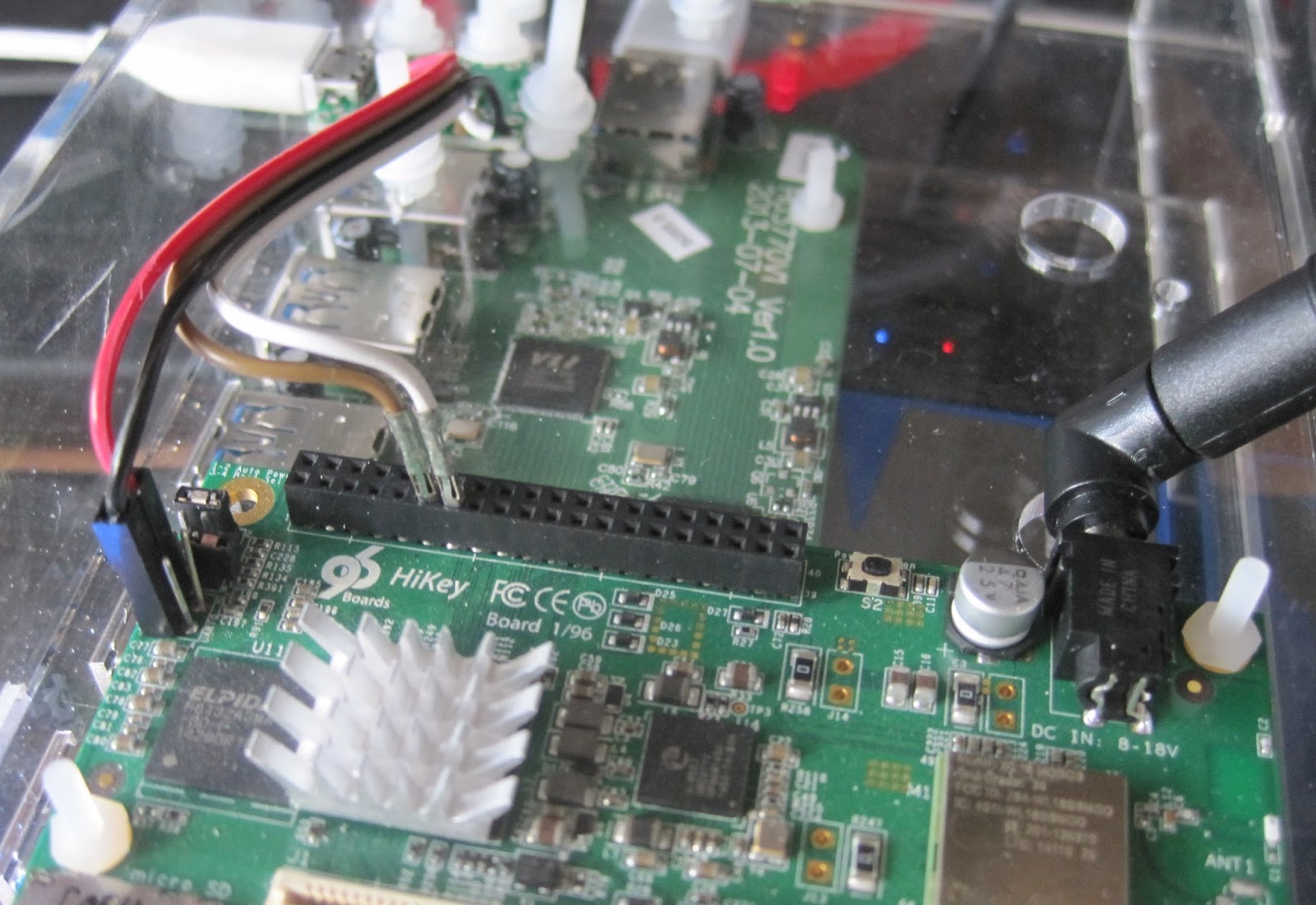
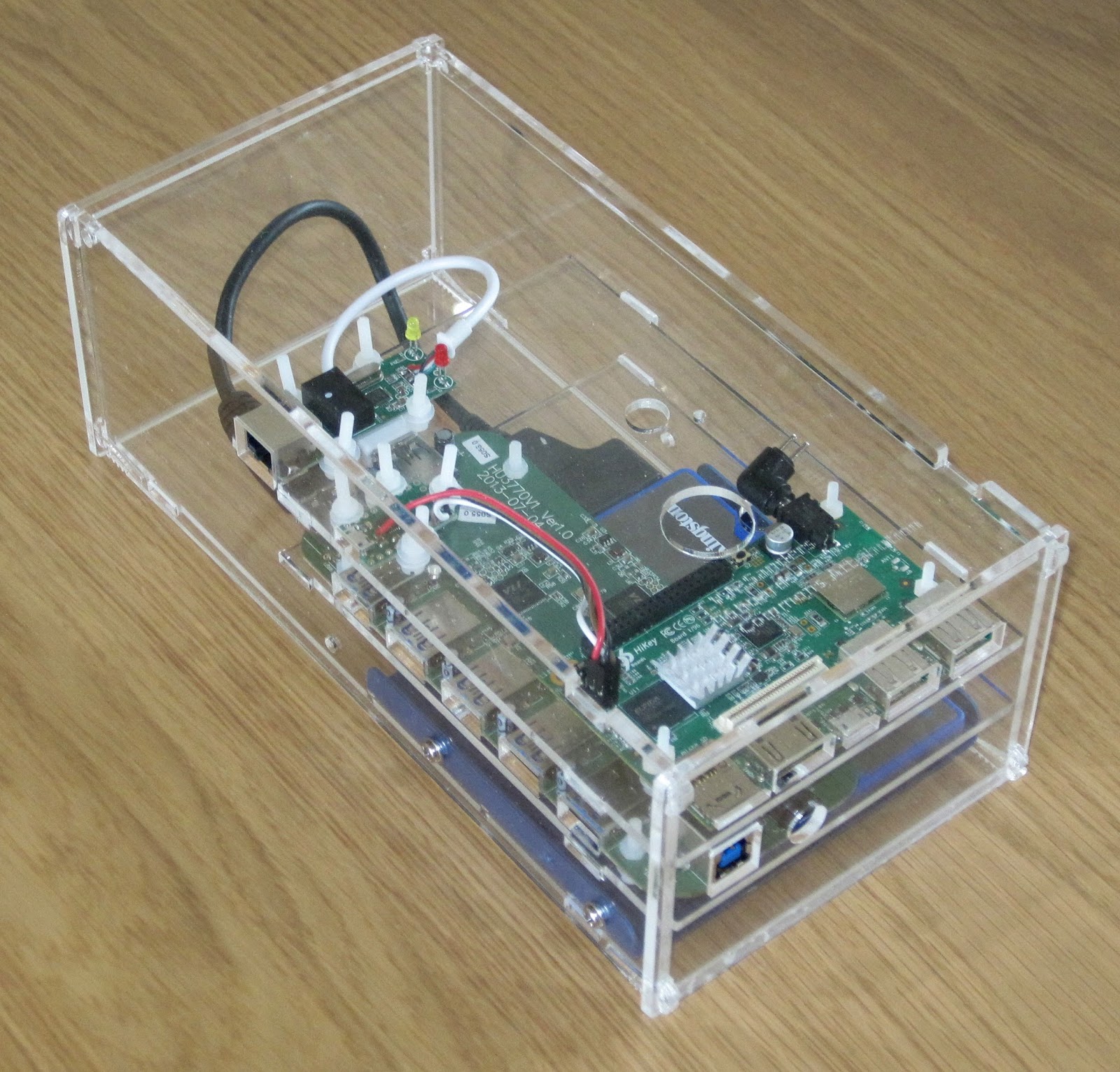
After another long pause in proceedings I decided that I should house all the components together and that perhaps being out on my bench might be the cause of some instability. I purchased a powered Amazon basics USB 2 hub, an Ethernet adaptor and a USB 2 SATA interface in the hope of accessing some larger mass storage.

The USB hub power supply was 12V DC which matched the Hikey requirements so I worked out I could use a single 4A capable supply and run a 3.5inch SATA hard drive too. I designed a laser cut enclosure and mounted all the components. As it turned out I only had a 2.5inch hard drive handy so the enclosure is a little over size. If I were redoing this design I would attempt to make it fit in 1U of height and be mountable in a 19inch rack instead it is an 83mm high (under 2U) box.

A new software release had also become available which purported to use an UEFI bootloader after struggling to install this version unsuccessfully, made somewhat more problematic by the undocumented change from UART0 (unpopulated header) to UART3 on the low speed 2mm pitch header. The system seemed to start the kernel which panicked and hung either booting from eMMC or SD card. Once again the project went on hold after spending tens of hours trying to make progress.
Third time's a charmAs the year rolled to a close I once again was persuaded to look at the hikey, I followed the much improved instructions and installed the shiny new November software release which appears to have been made for the re-release of the Hikey through LeMaker. This time I obtained a Debian "jessie" system that booted from the eMMC.

Having a booted system meant I could finally try and use it. I had decided to try and use the system to host virtual machines used as builders within the NetSurf CI system.

The basic OS uses a mixture of normal Debian packages with some replacements from Linaro repositories. I would have prefered to see more use of Debain packages even if they were from the backports repositories but on the positive side it is good to see the use of Debian instead of Ubuntu.

The kernel is a heavily patched 3.18 built in a predominantly monolithic (without modules) manner with the usual exceptions such as the mali and wifi drivers (both of which appear to be binary blobs). The use of a non-mainline capable SoC means the standard generic distribution kernels cannot be used and unless Linaro choose to distribute a kernel with the feature built in it is necessary to compile your own from sources.

The default install has a linaro user which I renamed to my user and ensured all the ssh keys and passwords on the system were changed. This is an important step when using this pre-supplied images as often a booted system is identical to every other copy.

To access mass storage my only option was via USB, indeed to add any additional expansion that is the only choice. The first issue here is that the USB host support is compiled in so when the host ports are initialised it is not possible to select a speed other than 12MBit. The speed is changed to 480Mbit by using a user space application found in the users home directory (why this is not a tool provided by a package and held in sbin I do not know).

When the usb_speed tool is run there is a chance that the previously enumerated devices will be rescanned and what was /dev/sda has become /dev/sdb if this happens there is a high probability that the system must be rebooted to prevent random crashes due to the "zombie" device.

Because the speed change operation is unreliable it cannot be reliably placed in the boot sequence so this must be executed by hand on each boot to get access to the mass storage.

NetSurf project already uses a x86_64 virtual host system which runs an LLVM physical volume from which we allocate logical volumes for each VM. I initially hoped to do this with the hikey but as soon as I tried to use the logical volume with a VM the system locked up with nothing shown on console. I did not really try very hard to discover why and instead simply used files on disc for virtual drives which seemed to work.

To provide reliable network access I used a USB attached Ethernet device, this like the mass storage suffered from unreliable enumeration and for similar reasons could not be automated requiring manually using the serial console to start the system.

Once the system was started I needed to install the guest VM. I had hoped I might be able to install locally from Debian install media as I do for x86 using the libvirt tools. After a great deal of trial and error I finally was forced to abandon this approach when I discovered the Linaro kernel is lacking iso9660 support so installing from standard media was not possible.

Instead I used the instructions provided by Leif Lindholm to create a virtual machine image on my PC and copied the result across. These instructions are great except I used version 2.5 of Qemu instead of 2.2 which had no negative effect. I also installed the Debian backports for Jessie to get an up to date 4.3 kernel.

After copying the image to the Hikey I started it by hand from the command line as a four core virtual machine and was successfully able to log in. The guest would operate for up to a day before stopping with output such as

$
Message from syslogd@ciworker13 at Jan 29 07:45:28 ...
kernel:[68903.702501] BUG: soft lockup - CPU#0 stuck for 27s! [mv:24089]

Message from syslogd@ciworker13 at Jan 29 07:45:28 ...

kernel:[68976.958028] BUG: soft lockup - CPU#2 stuck for 74s! [swapper/2:0]

Message from syslogd@ciworker13 at Jan 29 07:47:39 ...
kernel:[69103.199724] BUG: soft lockup - CPU#3 stuck for 99s! [swapper/3:0]

Message from syslogd@ciworker13 at Jan 29 07:53:21 ...
kernel:[69140.321145] BUG: soft lockup - CPU#3 stuck for 30s! [rs:main Q:Reg:505]

Message from syslogd@ciworker13 at Jan 29 07:53:21 ...
kernel:[69192.880804] BUG: soft lockup - CPU#0 stuck for 21s! [jbd2/vda3-8:107]

Message from syslogd@ciworker13 at Jan 29 07:53:21 ...
kernel:[69444.805235] BUG: soft lockup - CPU#3 stuck for 22s! [swapper/3:0]

Message from syslogd@ciworker13 at Jan 29 07:55:21 ...
kernel:[69570.177600] BUG: soft lockup - CPU#1 stuck for 112s! [systemd:1]

Timeout, server 192.168.7.211 not responding.

After this output the host system would not respond and had to be power cycled never mind the guest!

Once I changed to single core operation the system would run for some time until the host suffered from the dreaded kernel OOM killer. I was at a loss as to why the oom killer was running as the VM was only allocated half the physical memory (512MB) allowing the host what I presumed to be an adequate amount.

By adding a 512MB swapfile the system was able to push the few hundred kilobytes it wanted to swap and the system was now stable! The swapfile of course has to be started by hand as the external storage is unreliable and unavailable at boot.

I converted the qemu command line to a libvirt config using the virsh tool
virsh domxml-from-native qemu-argv cmdln.args
The converted configuration required manual editing to get a working system but now I have a libvirt based VM guest I can control along with all my other VM using the virt-manager tool.

This system is now stable and has been in production use for a month at time of writing. The one guest VM is a single core 512MB aarch64 system which takes over 1100 seconds (19 minutes) to do what a Banana Pi 2 dual core 1GB memory 32bit native ARM system manages in 300 seconds.

It seems the single core limited memory system with USB SATA attached storage is very, very slow.

I briefly attempted to run the CI system job natively within the host system but within minutes it crashed hard and required a power cycle to retrieve, it had also broken the UEFI boot. I must thank Leif for walking me through recovering the system otherwise I would have needed to start over.
ConclusionsI must stress these conclusions and observations are my own and do not represent anyone else.

My main conclusions are:

  • My experience is of a poorly conceived, designed and implemented product rushed to market before it was ready.
  • It was the first announced 64bit ARM single board computer to market but that lead was squandered with issues around availability, reliability and software.
  • Value for money appears poor. Product is 70 plus an additional 50 for USB hubs, power supplies, USB Ethernet and USB SATA. Other comparable SBC are around the 30 mark and require fewer extras.
  • The limited I/O within the core product yields a heavy reliance on USB
  • The USB system is poorly implemented resulting in large additional administrative burdens.
  • Limited memory of 1Gigabyte reduces the scope for making use of the benefits of 64bit processors.
  • Recent change to UEFI bootloader is very welcome and something I would like to see across all aarch64 platforms. This is the time for there to be a single unified boot method, having to deal with multiple bad copies of bootloaders in the 32bit world was painful, perhaps this mistake can be avoided in the future.
  • The kernel provision is abysmal and nothing like the quality I would expect from Linaro. The non-upstream kernel combined with missing features after almost a year of development is inexplicable.
  • The Pine64 with 2G of memory and the Raspberry Pi 3 with its de-facto standard form factor are both preferable despite their limitations in other areas.
This project has taken almost a year to get to the final state and has been one of the least enjoyable within that time. The only reason I have a running system at the end of it is sheer bloody mindedness because after spending hundreds of hours of my free time I was not prepared to see it all go to waste.

To be fair, the road I travelled is now much smoother and if the application is suited to having a mobile phone without a screen then the Hikey probably works as a solution. For me, however, the Hikey product with the current hardware and software limitations is not something I would recommend in preference to other options.

Ritesh Raj Sarraf: Linux Power Savings 2016

Having moved to a new place, now at times, I also have to deal with power outages. As heat increases, the power outages will be much longer and more frequent. So much, that UPS and Power Inverters run out. Such are ideal times to measure idle power consumption for my laptop. Here's what my default (and idle) OS looks like. It should be standard to most "typical" users. Some minor odds could be apport, dnsmasq, and maybe, tor. Also, thanks to systemd, there are some native services which are now converted to socket activation based ones. There's also Laptop Mode Tools for userspace power savings. But huge thanks to Intel's work in making the kernel more power efficient. With things like Runtime PM and Intel P-State, we can now define, default and aggressive power-savings modes, helping conserve more power. We still have challenges with things like binary-only drivers; and also stock GPL drivers but with an external firmware blob. There have been many instances when my previous machines (which had both) ran into severe power drain. The challenge with power savings is that it is not just the job of the kernel. All components, kernel and userspace, need to be made aware of, and work in unison. Otherwise, one ill behaving web browser tab can be the cause of power drain. P-State driver seems to already be doing some scale down of CPU resources. And with CGroups maturing moe I think we'll eventually have all Desktop Environments making use of it.
systemd-+-ModemManager-+- gdbus 
                        - gmain 
         -NetworkManager-+- gdbus 
                          - gmain 
         -accounts-daemon-+- gdbus 
                           - gmain 
         -agetty
         -apport-notifyd
         -atd
         -avahi-daemon---avahi-daemon
         -bluetoothd
         -colord-+- gdbus 
                  - gmain 
         -cron
         -dbus-daemon
         -dnsmasq
         -evolution-+- book-client-dbu 
                     - dconf worker 
                     -7*[ evolution ]
                     - gdbus 
                     - gmain 
         -gdm3-+-gdm-session-wor-+-gdm-x-session-+-Xorg
                                                  -gnome-session-b-+-gnome-settings--+- dconf worker 
                                                                                      - gdbus 
                                                                                      - gmain 
                                                                                      - pool 
                                                                                      - threaded-ml 
                                                                    -gnome-shell-+-ibus-daemon-+-ibus-dconf-+- dconf worker 
                                                                                                             - gdbus 
                                                                                                             - gmain 
                                                                                                -ibus-engine-sim-+- gdbus 
                                                                                                                  - gmain 
                                                                                                - gdbus 
                                                                                                - gmain 
                                                                                  - JS GC Helper 
                                                                                  - JS Sour~ Thread 
                                                                                  - dconf worker 
                                                                                  - gdbus 
                                                                                  - gmain 
                                                                                  - threaded-ml 
                                                                    - dconf worker 
                                                                    - gdbus 
                                                                    - gmain 
                                                  - gdbus 
                                                  - gmain 
                                  - gdbus 
                                  - gmain 
                -gdm-session-wor-+-gdm-x-session-+-Xorg
                                                  -gnome-session-b-+-evolution-alarm-+- cal-client-dbus 
                                                                                      - dconf worker 
                                                                                      - evolution-alarm 
                                                                                      - gdbus 
                                                                                      - gmain 
                                                                    -gnome-settings--+- dconf worker 
                                                                                      - gdbus 
                                                                                      - gmain 
                                                                                      - pool 
                                                                                      - threaded-ml 
                                                                    -gnome-shell-+-2*[redshift-+- gdbus ]
                                                                                                - gmain ]
                                                                                  - JS GC Helper 
                                                                                  - JS Sour~ Thread 
                                                                                  - dconf worker 
                                                                                  - gdbus 
                                                                                  - gmain 
                                                                                  - threaded-ml 
                                                                    -parcimonie
                                                                    -parcimonie-appl-+- gdbus 
                                                                                      - gmain 
                                                                    -python3---libinput-debug-
                                                                    -ssh-agent
                                                                    -tracker-extract-+- dconf worker 
                                                                                      - gdbus 
                                                                                      - gmain 
                                                                                      -10*[ pool ]
                                                                    -tracker-miner-a-+- gdbus 
                                                                                      - gmain 
                                                                    -tracker-miner-f-+- dconf worker 
                                                                                      - gdbus 
                                                                                      - gmain 
                                                                    -tracker-miner-u-+- gdbus 
                                                                                      - gmain 
                                                                    - dconf worker 
                                                                    - gdbus 
                                                                    - gmain 
                                                  - gdbus 
                                                  - gmain 
                                  - gdbus 
                                  - gmain 
                - gdbus 
                - gmain 
         -geoclue-+- gdbus 
                   - gmain 
         -gnome-keyring-d-+- gdbus 
                           - gmain 
                           - timer 
         -gpg-agent
         -gsd-printer-+- gdbus 
                       - gmain 
         -ibus-daemon-+-ibus-dconf-+- dconf worker 
                                    - gdbus 
                                    - gmain 
                       -ibus-engine-sim-+- gdbus 
                                         - gmain 
                       - gdbus 
                       - gmain 
         -ibus-x11-+- gdbus 
                    - gmain 
         -iio-sensor-prox-+- gdbus 
                           - gmain 
         -inetd---leafnode
         -libvirtd---15*[ libvirtd ]
         -lvmetad
         -master-+-pickup
                  -qmgr
                  -tlsmgr
         -mcelog
         -minissdpd
         -mount.ntfs
         -onboard-+- dconf worker 
                   - gdbus 
                   - gmain 
         -packagekitd-+- gdbus 
                       - gmain 
         -polkitd-+- gdbus 
                   - gmain 
         -2*[pulseaudio-+-gconf-helper]
                         - alsa-sink-ALC23 ]
                         - alsa-sink-HDMI  ]
                         - alsa-sink-pcspe ]
                         - alsa-source-ALC ]
         -rtkit-daemon---2*[ rtkit-daemon ]
         -systemd-+-(sd-pam)
                   -at-spi-bus-laun-+-dbus-daemon
                                     - dconf worker 
                                     - gdbus 
                                     - gmain 
                   -at-spi2-registr-+- gdbus 
                                     - gmain 
                   -dbus-daemon
                   -dconf-service-+- gdbus 
                                   - gmain 
                   -goa-daemon-+- dconf worker 
                                - gdbus 
                                - gmain 
                   -goa-identity-se-+- gdbus 
                                     - gmain 
                                     - pool 
                   -gvfs-afc-volume-+- gdbus 
                                     - gmain 
                                     - gvfs-afc-volume 
                   -gvfs-goa-volume-+- gdbus 
                                     - gmain 
                   -gvfs-gphoto2-vo-+- gdbus 
                                     - gmain 
                   -gvfs-mtp-volume-+- gdbus 
                                     - gmain 
                   -gvfs-udisks2-vo-+- gdbus 
                                     - gmain 
                   -gvfsd-+- gdbus 
                           - gmain 
                   -gvfsd-fuse-+- gdbus 
                                - gmain 
                                - gvfs-fuse-sub 
                                -2*[ gvfsd-fuse ]
                   -gvfsd-metadata-+- gdbus 
                                    - gmain 
                   -mission-control-+- dconf worker 
                                     - gdbus 
                                     - gmain 
         -systemd-+-(sd-pam)
                   -at-spi-bus-laun-+-dbus-daemon
                                     - dconf worker 
                                     - gdbus 
                                     - gmain 
                   -at-spi2-registr-+- gdbus 
                                     - gmain 
                   -dbus-daemon
                   -gconfd-2
         -systemd-+-(sd-pam)
                   -at-spi-bus-laun-+-dbus-daemon
                                     - dconf worker 
                                     - gdbus 
                                     - gmain 
                   -at-spi2-registr-+- gdbus 
                                     - gmain 
                   -dbus-daemon
                   -dconf-service-+- gdbus 
                                   - gmain 
                   -evolution-addre-+-2*[evolution-addre-+- dconf worker ]
                                                          - evolution-addre ]
                                                          - gdbus ]
                                                          - gmain ]
                                     - dconf worker 
                                     - evolution-addre 
                                     - gdbus 
                                     - gmain 
                   -evolution-calen-+-evolution-calen-+- dconf worker 
                                                       - evolution-calen 
                                                       - gdbus 
                                                       - gmain 
                                                       -6*[ pool ]
                                     -evolution-calen-+- book-client-dbu 
                                                       - dconf worker 
                                                       - evolution-calen 
                                                       - gdbus 
                                                       - gmain 
                                                       - pool 
                                     -2*[evolution-calen-+- dconf worker ]
                                                          - evolution-calen ]
                                                          - gdbus ]
                                                          - gmain ]
                                     - dconf worker 
                                     - evolution-calen 
                                     - gdbus 
                                     - gmain 
                   -evolution-sourc-+- dconf worker 
                                     - gdbus 
                                     - gmain 
                   -gconfd-2
                   -gnome-shell-cal-+- cal-client-dbus 
                                     - dconf worker 
                                     - gdbus 
                                     - gmain 
                                     - gnome-shell-cal 
                   -gnome-terminal--+-bash---pstree
                                     -bash
                                     - dconf worker 
                                     - gdbus 
                                     - gmain 
                   -goa-daemon-+- dconf worker 
                                - gdbus 
                                - gmain 
                   -goa-identity-se-+- gdbus 
                                     - gmain 
                                     - pool 
                   -gpaste-daemon-+- dconf worker 
                                   - gdbus 
                                   - gmain 
                   -gvfs-afc-volume-+- gdbus 
                                     - gmain 
                                     - gvfs-afc-volume 
                   -gvfs-goa-volume-+- gdbus 
                                     - gmain 
                   -gvfs-gphoto2-vo-+- gdbus 
                                     - gmain 
                   -gvfs-mtp-volume-+- gdbus 
                                     - gmain 
                   -gvfs-udisks2-vo-+- gdbus 
                                     - gmain 
                   -gvfsd-+- gdbus 
                           - gmain 
                   -gvfsd-burn-+- gdbus 
                                - gmain 
                   -gvfsd-dnssd-+- gdbus 
                                 - gmain 
                   -gvfsd-fuse-+- gdbus 
                                - gmain 
                                - gvfs-fuse-sub 
                                -2*[ gvfsd-fuse ]
                   -gvfsd-metadata-+- gdbus 
                                    - gmain 
                   -gvfsd-network-+- dconf worker 
                                   - gdbus 
                                   - gmain 
                   -gvfsd-trash-+- gdbus 
                                 - gmain 
                   -mission-control-+- dconf worker 
                                     - gdbus 
                                     - gmain 
                   -nautilus-+-gedit
                              - dconf worker 
                              - gdbus 
                              - gmain 
                   -tracker-store-+- dconf worker 
                                   - gdbus 
                                   - gmain 
                                   -4*[ pool ]
         -systemd-journal
         -systemd-logind
         -systemd-network
         -systemd-timesyn--- sd-resolve 
         -systemd-udevd
         -thermald--- thermald 
         -tor
         -udisksd-+- cleanup 
                   - gdbus 
                   - gmain 
                   - probing-thread 
         -upowerd-+- gdbus 
                   - gmain 
         -wpa_supplicant
So I used the standard power measurement tool, powertop. Below is a screenshot of PowerTop claiming 9 - 10 hours of possible battery backup. This is idle state. "Idle" would mean when the user is not interacting with the machine. When under basic usage (email, web), the actual battery backup I've sensed is somewhere around 6-7 hrs, which is still good from what we got a couple years ago. There's one oddity in the screenshot though. The estimated power consumption reported is 4.55W, where as, the power consumption of just the wifi card is reported 6.17W. That too, when the wifi was disconnected. This reminded me of the bug report against PowerTop, which is now more than 2 years old. We've still not concluded in that bug report, so if anyone can shed some light on PowerTop's reporting, please do share it in the bug report. Note: Please ignore the terminal's title in the screenshot. That is wrong and I've not bothered to figure out why it is displaying the title name constructed from an outdated session, which is already terminated.


Categories:

Keywords:

Like:

Erich Schubert: Stop abusing lambda expressions - this is not functional programming

I know, all the Scala fanboys are going to hate me now. But:
Stop overusing lambda expressions.
Most of the time when you are using lambdas, you are not even doing functional programming, because you often are violating one key rule of functional programming: no side effects.
For example:
collection.forEach(System.out::println);
is of course very cute to use, and is (wow) 10 characters shorter than:
for (Object o : collection) System.out.println(o);
but this is not functional programming because it has side effects.
What you are doing are anonymous methods/objects, using a shorthand notion. It's sometimes convenient, it is usually short, and unfortunately often unreadable, once you start cramming complex problems into this framework.
It does not offer efficiency improvements, unless you have the propery of side-effect freeness (and a language compiler that can exploit this, or parallelism that can then call the function concurrently in arbitrary order and still yield the same result).
Here is an examples of how to not use lambdas:
DZone Java 8 Factorial (with boilerplate such as the Pair class omitted):
Stream<Pair> allFactorials = Stream.iterate(
  new Pair(BigInteger.ONE, BigInteger.ONE),
  x -> new Pair(
    x.num.add(BigInteger.ONE),
    x.value.multiply(x.num.add(BigInteger.ONE))));
return allFactorials.filter(
  (x) -> x.num.equals(num)).findAny().get().value;
When you are fresh out of the functional programming class, this may seem like a good idea to you... (and in contrast to the examples mentioned above, this is really a functional program).
But such code is a pain to read, and will not scale well either. Rewriting this to classic Java yields:
BigInteger cur = BigInteger.ONE, acc = BigInteger.ONE;
while(cur.compareTo(num) <= 0)  
  cur = cur.add(BigInteger.ONE); // Unfortunately, BigInteger is immutable!
  acc = acc.multiply(cur);
 
return acc;
Sorry, but the traditional loop is much more readable. It will still not perform very well (because of BigInteger not being designed for efficiency - it does not even make sense to allow BigInteger for num - the factorial of 2**63-1, the maximum of a Java long, needs 1020 bytes to store, i.e. about 500 exabyte.
For some, I did some benchmarking. One hundred random values num (of course the same for all methods) from the range 1 to 1000.
I also included this even more traditional version:
BigInteger acc = BigInteger.ONE;
for(long i = 2; i <=x; i++)  
  acc = acc.multiply(BigInteger.valueOf(i));
 
return acc;
Here are the results (Microbenchmark, using JMH, 10 warum iterations, 20 measurement iterations of 1 second each):
functional    1000     100  avgt   20  9748276,035   222981,283  ns/op
biginteger    1000     100  avgt   20  7920254,491   247454,534  ns/op
traditional   1000     100  avgt   20  6360620,309   135236,735  ns/op
As you can see, this "functional" approach above is about 50% slower than the classic for-loop. This will be mostly due to the Pair and additional BigInteger objects created and garbage collected.
Apart from being substantially faster, the iterative approach is also much simpler to follow. (To some extend it is faster because it is also easier for the compiler!)
There was a recent blog post by Robert Br utigam that discussed exception throwing in Java lambdas and the pitfalls associated with this. The discussed approach involves abusing generics for throwing unknown checked exceptions in the lambdas, ouch.

Don't get me wrong. There are cases where the use of lambdas is perfectly reasonable. There are also cases where it adheres to the "functional programming" principle. For example, a stream.filter(x -> x.name.equals("John Doe")) can be a readable shorthand when selecting or preprocessing data. If it is really functional (side-effect free), then it can safely be run in parallel and give you some speedup.
Also, Java lambdas were carefully designed, and the hotspot VM tries hard to optimize them. That is why Java lambdas are not closures - that would be much less performant. Also, the stack traces of Java lambdas remain somewhat readable (although still much worse than those of traditional code). This blog post by Takipi showcases how bad the stacktraces become (in the Java example, the stream function is more to blame than the actual lambda - nevertheless, the actual lambda application shows up as the cryptic LmbdaMain$$Lambda$1/821270929.apply(Unknown Source) without line number information). Java 8 added new bytecodes to be able to optimize Lambdas better - earlier JVM-based languages may not yet make good use of this.
But you really should use lambdas only for one-liners. If it is a more complex method, you should give it a name to encourage reuse and improve debugging.
Beware of the cost of .boxed() streams!
And do not overuse lambdas. Most often, non-Lambda code is just as compact, and much more readable. Similar to foreach-loops, you do lose some flexibility compared to the "raw" APIs such as Iterators:
for(Iterator<Something>> it = collection.iterator(); it.hasNext(); )  
  Something s = it.next();
  if (someTest(s)) continue; // Skip
  if (otherTest(s)) it.remove(); // Remove
  if (thirdTest(s)) process(s); // Call-out to a complex function
  if (fourthTest(s)) break; // Stop early
 
In many cases, this code is preferrable to the lambda hacks we see pop up everywhere these days. Above code is efficient, and readable.
If you can solve it with a for loop, use a for loop!
Code quality is not measured by how much functionality you can do without typing a semicolon or a newline!
On the contrary: the key ingredient to writing high-performance code is the memory layout (usually) - something you need to do low-level.
Instead of going crazy about Lambdas, I'm more looking forward to real value types (similar to a struct in C, reference-free objects) maybe in Java 9 (Project Valhalla), as they will allow reducing the memory impact for many scenarios considerably. I'd prefer a mutable design, however - I understand why this is proposed, but the uses cases I have in mind become much less elegant when having to overwrite instead of modify all the time.

Russ Allbery: Review: The Lost Steersman

Review: The Lost Steersman, by Rosemary Kirstein
Series: Steerswomen #3
Publisher: Rosemary Kirstein
Copyright: 2003, 2014
Printing: 2014
ISBN: 0-9913546-2-1
Format: Kindle
Pages: 432
This is the third book in the Steerswomen series and a direct follow-up to the events of The Outskirter's Secret. It does, marvel of marvels, feature an in-character summary of the events of the series to date! I do love when authors do this; it helps immensely if you come back to a series after a bit of a break between books. But this whole series is so good, and the emotional tone and development of Rowan as a character is so strong, that I recommend against starting here. After the events of the last book, Rowan has returned to the Inner Lands. She's sent her report back to the Archives, but stopped at the Annex in Alemeth. This is an auxiliary library that should have copies of the journals and other research that Rowan wants to search, and stopping there saves substantial travel time. However, she finds the steerswoman who was custodian of the Annex is deceased and the Annex is, from Rowan's perspective, a mess. Nothing is organized, the books aren't properly cared-for, and Mira's interactions with the townsfolk were far different than Rowan's natural attitude. The start of this book was a surprising shift. After the large-scale revelations at the end of The Outskirter's Secret, and the sense of escalating danger, Rowan's return to small-town life in the Inner Lands comes as a shock. That's true for both the reader and for Rowan, and the parallels make it a remarkably effective bit of writing. At the beginning of the story, the reader is already familiar with Rowan (at least if you've read the previous books) and how she thinks of being a steerswoman. Rowan is very much on edge and in a hurry given what's going on in the broader world. But the town is used to Mira: a gregarious socializer who cared far more about town gossip and her role as coordinator of it than she cared about most of her steerswoman duties. (At least as seen from Rowan's perspective. By the end of the book, we have a few hints that something else might be going on, but the damage to the books at least feels unforgivable.) Rowan is resented and even disliked at first, particularly by Steffie and Gwen who did most of the chores at the Annex and were closest to Mira. One of the reasons why I love this series so much is that Kirstein has a gift for characterization. Rowan (and Bel, who largely doesn't appear in this book) are brilliant characters, but it's not just them. At the start of this book, the reader tends to share Rowan's opinion of the town: a sort of half-bemused, half-exasperated indifference. Even as the characters start to grow on one, it seems like a backwater and a diversion from the larger story. But it becomes clear that Rowan is very on-edge from her experience in the Outskirts, that she's underestimated the relevance of Mira to at least the town's happiness, and she's greatly underestimated the ability of the townsfolk to help her. Steffie, in particular, is a wonderful character; by the end of the book, he had become one of my favorite people in the series so far. He doesn't think he's particularly smart, and his life before Rowan is very simple, but there are depths to him that no one, including him, expected. There is a plot here, apart from small town politics and Rowan's slow relaxation. (Although those were so compelling that I'm not sure I would have minded if that were the entire book.) The lost steersman of the title is an old student friend of Rowan that she unexpectedly meets in town, a former steersman who quit the order and refused to explain why. Rowan, of course, cannot resist trying to fix this situation. The second plot driver is a dangerous invasion of Outskirts monsters into the town. Those who have read the previous books will have some immediate guesses as to why this might be, and Rowan does as well. But there's more going on than it might first appear. This book is not entirely a diversion. It returns to the main plot of the series by the end of the book, and we learn much more about Rowan's world. But, somewhat surprisingly, that was my least favorite part of the book. It has some nice bits of exploration and puzzle-solving, and Rowan is always a delight to spend time with. But the last section of the book is similar to many other genre books I've read before well-written, to be sure, but not as unique. It also features a rather long section following a character who is severely physically ill, which is something I always find very hard to read (a personal quirk). But there's a lot of meat here for the broader plot, and I have no idea what will happen in the next book. The part of The Lost Steersman that I'm going to remember, though, are the town bits, up through the arrival of Zenna (another delightful character who adds even more variety to Kirstein's presentation of steerswomen). Kirstein is remarkably good at mixing small-town characters with the scientific investigation of the steerswomen and letting them bounce off of each other to reveal more about the character of both. If it weren't for the end of the book, which bothered me for partly idiosyncratic reasons, I think this would have been my favorite book of the series. Followed by The Language of Power, and be warned that this book ends on something close to a cliffhanger. Rating: 8 out of 10

29 February 2016

Chris Lamb: Free software activities in February 2016

Here is my monthly update covering a large part of what I have been doing in the free software world (previously):
  • Various improvements to django-slack, a library to easily post messages to the Slack group-messaging utility from projects using the Django web development framework:
    • Added explicit support to send messages asynchronously via the Celery distributed task queue. (#29)
    • Worked with Patrick Clope to add an escapeslack template filter to ensure the correct characters for Slack's API are escaped using Django's built-in safe is too invasive. (#36)
    • Corrected an issue where custom endpoints and channel names were incompatible. (#27)
    • Overhaul of the field/option/block parsing. (49ff3c4)
    • Moved away from using a django.template.Context instance, preventing a deprecation warning. (#31)
  • Added a create-folders subcommand to my tickle-me-email Getting Things Done (GTD) email toolbox to create numbered folders for the rotate "tickler" functionality. (#3)
  • Wrote and released a Django template tag to collapse multiple whitespace/newline characters in order to correctly format, for example, plaintext emails that make extensive use of for-loops. These would normally require careful and fragile placement of the % for .. % and % endfor % tags. (Repo)
  • Pushed a number of updates to my Strava Enhancement Suite, a Chrome extension that improves and fixes annoyances in the web interface of the Strava cycling and running tracker:
    • Fix unit conversion where the element was wrapped in an another HTML element. (#48)
    • Hide premium indicator from top-level navigation. (#45)
    • Correct matching of the "shop" link in top-level navigation and footer module. (#47 & #46)
    • Remove "premium" pages on Club pages. (#44)
  • Added a security-oriented warning to Ansible's documentation regarding the behaviour if an UFW firewall application profile is added and subsequently removed. (#1740)
  • Added support to my django-staticfiles-dotd "staticfiles" library which concatenates Javascript and CSS files from .d-style directories to support an arbitrary file rendering method. This allows the use of media pre-processors such as SASS within such directories. (#1)
  • Corrected my Chrome extension for the FastMail web interface to correctly hook into the internal "send" mechanism. (#2)
  • Moved my stravabot IRC bot to use dh-virtualenv and systemd, improving security and reliability. (1c48709)
  • Updated django-pedantic-http-methods a tool to raise an exception during development when attempting to perform side effects in GET and HEAD HTTP methods to support the latest version of Django. (#1)

Debian
  • Updated travis.debian.net a hosted script to easily test and build Debian packages on the Travis CI continuous integration platform to support:
    • Automatic bumping of the version number in debian/changelog based on TRAVIS_BUILD_NUMBER. (#14)
    • Security repositories. Thanks to Stefan Jenkner for the initial pull request. These are additionally now enabled by default. (#15)
    • The backports repositories. (#13)
  • Applied #812830 and #812830 from James Clark to the Debian Archive Kit to improve the interface of various webpages it generates.
  • Updated the SSL certificate for try.diffoscope.org, a hosted version of the diffoscope in-depth and content-aware diff utility. Thanks to Bytemark for sponsoring the hardware.
  • Worked on my slides for Reproducible Builds - fulfilling the original promise of free software, to be presented at FOSSASIA '16.
My work in the Reproducible Builds project was also covered in more depth in Lunar's weekly reports (#40, #41, #42, #43)
LTS

This month I have been paid to work 18 hours on Debian Long Term Support (LTS). In that time I did the following:
  • "Frontdesk" duty for the week of 22nd 28th, triaging CVEs, etc.
  • Proofread announcements, etc. for the upcoming migration to wheezy-lts.
  • Issued DLA 417-1 for xdelta3 to fix a buffer overflow that allowed arbitrary code execution from input files.
  • Issued DLA 420-1 for libmatroska, correcting a heap information leak.
  • Issued DLA 428-1 for websvn fixing a cross-site scripting vulnerability.
  • Issued DLA 429-1 for pixman fixing a buffer overflow issue.
  • Issued DLA 430-1 & DLA 431-1 for libfcgi and libfcgi-perl respectfully, fixing a remote denial-of-service (DoS) vulnerability.

Uploads
  • redis (2:3.0.7-2) Correcting my SOURCE_DATE_EPOCH reproducibility patch as the conditional was accidentally inverted. Thanks to Reiner Herrmann (deki).
  • disque (1.0~rc1-5) Making the parallel SOURCE_DATE_EPOCH patch change and additionally tidying the packaging after introducing procps as a build-dependency.


RC bugs


I also filed 137 FTBFS bugs against aac-tactics, angular.js, astyle, bcftools, blacs-mpi, bogofilter, boxes, caldav-tester, ccdproc, ckeditor, coq-float, cqrlog, dasher, django-recurrence, dspdfviewer, eclipse-egit, ess, etcd, felix-latin, fio, flexml, funny-manpages, gap-atlasrep, garmin-plugin, gitlab, gnome-mines, graphicsmagick, haskell-nettle, healpy, hg-git, hunspell, hwloc, ijs, ipset, janest-core-extended, jpathwatch, kcompletion, kcompletion, keyrings.alt, kodi-pvr-hts, kodi-pvr-vdr-vnsi, libcommons-compress-java, libgnome2-wnck-perl, libkate, liblrdf, libm4ri, libnet-server-mail-perl, libsis-jhdf5-java, libspectre, libteam, libwnck, libwnckmm, libxkbcommon, lombok, lombok-patcher, mako, maven-dependency-analyzer, mopidy-mpris, mricron, multcomp, netty-3.9, numexpr, ocaml-textutils, openimageio, openttd-openmsx, osmcoastline, osmium-tool, php-guzzle, php-net-smartirc, plexus-component-metadata, polari, profitbricks-client, pyentropy, pynn, pyorbital, pypuppetdb, python-aioeventlet, python-certifi, python-hglib, python-kdcproxy, python-matplotlib-venn, python-mne, python-mpop, python-multipletau, python-pbh5tools, python-positional, python-pydot-ng, python-pysam, python-snuggs, python-tasklib, r-cran-arm, r-cran-httpuv, r-cran-tm, rjava, ros-geometry-experimental, ros-image-common, ros-pluginlib, ros-ros-comm, rows, rr, ruby-albino, ruby-awesome-print, ruby-default-value-for, ruby-fast-gettext, ruby-github-linguist, ruby-gruff, ruby-hipchat, ruby-omniauth-crowd, ruby-packetfu, ruby-termios, ruby-thinking-sphinx, ruby-tinder, ruby-versionomy, ruby-zentest, sbsigntool, scikit-learn, scolasync, sdl-image1.2, signon-ui, sisu-guice, sofa-framework, spykeutils, ssreflect, sunpy, tomcat-maven-plugin, topmenu-gtk, trocla, trocla, tzdata, verbiste, wcsaxes, whitedune, wikidiff2, wmaker, xmlbeans, xserver-xorg-input-aiptek & zeroc-icee-java.

FTP Team

As a Debian FTP assistant I ACCEPTed 107 packages: androguard, android-platform-dalvik, android-platform-development, android-platform-frameworks-base, android-platform-frameworks-native, android-platform-libnativehelper, android-platform-system-core, android-platform-system-extras, android-platform-tools-base, android-sdk-meta, apktool, armci-mpi, assertj-core, bart, bind9, caja, caldav-tester, clamav, class.js, diamond, diffoscope, django-webpack-loader, djangocms-admin-style, dnsvi, esptool, fuel-astute, gcc-6-cross, gcc-6-cross-ports, gdal, giella-core, gnupg, golang-github-go-ini-ini, golang-github-tarm-serial, gplaycli, gradle-jflex-plugin, haskell-mountpoints, haskell-simple, hurd, iceweasel, insubstantial, intellij-annotations, jetty9, juce, keyrings.alt, leptonlib, libclamunrar, libdate-pregnancy-perl, libgpg-error, libhtml5parser-java, libica, libvoikko, linux, llvm-toolchain-3.8, lombok-patcher, mate-dock-applet, mate-polkit, mono-reference-assemblies, mxt-app, node-abab, node-array-equal, node-array-flatten, node-array-unique, node-bufferjs, node-cors, node-deep-extend, node-original, node-setimmediate, node-simplesmtp, node-uglify-save-license, node-unpipe, oar, openjdk-8, openjdk-9, pg8000, phantomjs, php-defaults, php-random-compat, php-symfony-polyfill, pnetcdf, postgresql-debversion, pulseaudio-dlna, pyconfigure, pyomo, pysatellites, python-fuelclient, python-m3u8, python-pbh5tools, python-qtpy, python-shellescape, python-tunigo, pyutilib, qhull, r-cran-rjsonio, r-cran-tm, reapr, ruby-fog-dynect, scummvm-tools, symfony, talloc, tesseract, twextpy, unattended-upgrades, uwsgi, vim-command-t, win-iconv, xkcdpass & xserver-xorg-video-ast. I additionally REJECTed 4 packages.

Tom Marble: is-slfc-shooting-open-source-in-the-foot

Is SFLC Shooting Open Source in the Foot? The academic article by SFLC about ZFS is troubling and may unintentionally shoot free software licensing in the foot. When I was at Sun (as part of the team that released the Java Programming Language by starting the OpenJDK project) I often heard community concerns about the CDDL license. At the time the big complaint was about the "Choice of Venue" clause. I got involved because Sun had developed many essential Java libraries and distributed them under CDDL. The community requested a more permissive license and I was able to convince internal project leaders (and Sun's lawyers) to make a licensing change for a handful of these projects. And there was much rejoicing. Based on my experience in helping Java to become open source I came to appreciate the legal hacks on copyright which make open source possible. It's the free software license which uses copyright to enable sharing (vs. the default of disabling sharing).

Open Source Licenses
And so I have appreciated many of the writings and speeches from SFLC on the mechanisms of software freedom. I was particularly moved by the talks about the "Freedom Box" concept. That's why this SFLC post on ZFS sounds so off key: if open source works because of free software licenses it seems weird to weaken that foundation by prioritizing the "equity" (or intended spirit) of the license. Allow me to mention that as I do most of my computing these days on GNU/Linux I miss the super cool features of ZFS from Solaris. I did try an early version of btrfs and was quite disappointed (but that's another story). In this happy case the source code for ZFS is available, but what about the future, when we aren't so lucky and someone asserts in court that the "you know, the software license was really about the spirit of sharing and that means we are allowed to use it -- and not be held to the pesky details as written in the license". A lawyer I respect called this out: "Equity" has no place in US law. The point is that for lawyers software licenses work because they have clear, written rules to guarantee the spirit is upheld; but spirit doesn't work in front of a judge -- clear rules do. Free and open source software has made so much progress in all facets of life why on earth would we second guess the licensing tools that made it possible? And why would SFLC try to shift the spotlight (and in this case the legal burden) to "a good-faith belief that the conduct falls within the equity of the license". Especially given the earlier comment which clearly states "[the combination] is inconsistent with the literal meaning of GPLv2 section 2(b)."
Wat?

The entire raison d' tre for open source software licenses was so that developers (and users) would have clarity and wouldn't have to ask permission to use the software!!! As stated elsewhere (and like I did with those Java libraries) the easy solution is to have the ZFS copyright holder (now Oracle) reclicense (or dual license) the code under a compatible license (permissive or copyleft). If OpenSolaris was still a thing I might understand some hesitancy, but why not liberate ZFS now? So we have to wonder what could possibly be motivating this odd "spirit of the license" position on the part of SFLC? Fortunately charities that enjoy non-profit status are required to make public filings of their income in something called a "Form 990". The latest SFLC 990 I could find shows SFLC getting 78% (or just over $5 million) from "non public support" (see page 14). A number with "two commas" would even be interesting to for-profit companies. Just whom is making these "donations" and what exactly do they get in return? Apparently I'm not the only one wondering about this question. On one hand it's important to know if SFLC as a non-profit is, indeed, acting in the public interest (as the IRS requires). Yet the even bigger issue here is would "asking for a consensus about the spirit" trump the written copyright license and set a scary precedent for open source software in general?

Daniel Silverstone: Kicad hacking - Intra-sheet links and ERC

This is a bit of an odd posting since it's about something I've done but is also here to help me explain why I did it and thus perhaps encourage some discussion around the topic within the Kicad community...
Recently (as you will know if you follow this blog anywhere it is syndicated) I have started playing with Kicad for the development of some hardware projects I've had a desire for. In addition, some of you may be aware that I used to work for a hardware/software consultancy called Simtec, and there I got to play for a while with an EDA tool called Mentor Designview. Mentor was an expensive, slow, clunky, old-school EDA tool, but I grew to understand and like the workflow. I spent time looking at gEDA and Eagle when I wanted to get back into hardware hacking for my own ends; but neither did I really click with. On the other hand, a mere 10 minutes with Kicad and I knew I had found the tool I wanted to work with long-term. I designed the beer'o'meter project (a flow meter for the pub we are somehow intimately involved with) and then started on my first personal surface-mount project -- SamDAC which is a DAC designed to work with our HiFi in our study at home. As I worked on the SamDAC project, I realised that I was missing a very particular thing from Mentor, something which I had low-level been annoyed by while looking at other EDA tools -- Kicad lacks a mechanism to mark a wire as being linked to somewhere else on the same sheet. Almost all of the EDA tools I've looked at seem to lack this nicety, and honestly I miss it greatly, so I figured it was time to see if I could successfully hack on Kicad. Kicad is written in C++, and it has been mumble mumble years since I last did any C++, either for personal hacking or professionally, so it took a little while for that part of my brain to kick back in enough for me to grok the codebase. Kicad is not a small project, taking around ten minutes to build on my not-inconsiderable computer. And while it beavered away building, I spent time looking around the source code, particularly the schematic editor eeschema. To skip ahead a bit, after a couple of days of hacking around, I had a proof-of-concept for the intra-sheet links which I had been missing from my days with Mentor, and some ERC (electrical rules checking) to go alongside that to help produce schematics without unwanted "sharp corners". In total, I added:
  • an "intra-sheet link" schematic element, including: Intra-sheet linking tool
    • the schematic element itself
    • loading and saving of the element (which required a bump in schematic file format versioning)
    • UI for adding intra-sheet links to your schematic
    • netlist build support to ensure that the links found their way into the internal netlist content.
  • an ERC tickybox "Strict wiring checks" and behind that I hid: Strict wiring checks
    • checks for wires with dangling ends (dangles are bad)
    • junctions which have no point in being present (pointless junctions are confusing to readers)
    • checks that intra-sheet links exist in groups of two or more on any given net, since individual links are pointless.
I forked the Kicad mirror on Github and pushed my own branch with this work to my Kicad fork. All of this is meant to allow schematic capture engineers to more clearly state their intentions regarding what they are drawing. The intra-sheet link could be thought of like a no-connect element, except instead of saying "this explicitly goes nowhere" we're saying "this explicitly goes somewhere else on this sheet, you can go look for it". Obviously, people who dislike (or simply don't want to use) such intra-sheet link elements can just disable that ERC tickybox and not be bothered by them in the least (well except for the toolbar button and menu item I suppose). Whether this work gets accepted into Kicad, or festers and dies on the vine, it was good fun developing it and I'd like to illustrate how it could help you, and why I wrote it in the first place:

A contrived story
Note, while this story is meant to be taken seriously, it is somewhat contrived, the examples are likely electrical madness, but please just think about the purpose of the checks etc.
To help to illustrate the feature and why it exists, I'd like to tell you a somewhat contrived story about Fred. Fred is a schematic capture engineer and his main job is to review schematics generated by his colleagues. Fred and his colleagues work with Kicad (hurrah) but of late they've been having a few issues with being able to cleanly review schematics. Fred's colleagues are not the neatest of engineers. In particular they tend to be quite lazy when it comes to running busses, which are not (for example) address and data busses, around their designs and they tend to simply have wires which end in mid-space and pick up somewhere else on the sheet. All this is perfectly reasonable of course, and Kicad handles it with aplomb. Sadly it seems quite error prone for Fred's workplace. As an example, Fred's colleague Ben has been designing the power supply for a particular board. As with most power supplies, plenty of capacitors are needed to stabilise the regulators and smooth the output. In the example below, the intent is that all of the capacitors are on the FOO net. Contrived problem example 1 Sadly there's a missing junction and/or slightly misplaced label in the upper section which means that C2 and C3 simply don't join to the FOO net. This could easily be missed, but the ERC can't spot it at all since there's more than one thing on each net, so the pins of the capacitors are connected to something. Fred is very sad that this kind of problem can sometimes escape notice by the schematic designer Ben, Fred himself, and the layout engineer, resulting in boards which simply do not work. Fred takes it upon himself to request that the strict wiring checks ERC is made mandatory for all designs, and that the design engineers be required to use intra-sheet link symbols when they have signals which wander off to other parts of the sheet like FOO does in the example. Without any further schematic changes, strict wiring checks enabled gives the following points of ERC concern for Ben to think about: Contrived problem example 2 As you can see, the ERC is pointing at the wire ends and the warnings are simply that the wires are dangling and that this is not acceptable. This warning is very like the pin-not-connected warnings which can be silenced with an explicit no-connect schematic element. Ben, being a well behaved and gentle soul, obeys the design edicts from Fred and seeks out the intra-sheet link symbols, clearing off the ERC markers and then adding intra-sheet links to his design: Contrived problem example 3 This silences the dangling end ERC check, which is good, however it results in another ERC warning: Contrived problem example 4 This time, the warning for Ben to deal with is that the intra-sheet links are pointless. Each exists without a companion to link to because of the net name hiccough in the top section. It takes Ben a moment to realise that the mistake which has been made is that a junction is missing in the top section. He adds the junction and bingo the ERC is clean once more: Contrived problem example 5 Now, this might not seem like much gain for so much effort, but Ben can now be more confident that the FOO net is properly linked across his design and Fred can know, when he looks at the top part of the design, that Ben intended for the FOO net to go somewhere else on the sheet and he can look for it.

Why do this at all? Okay, dropping out of our story now, let's discuss why these ERC checks are worthwhile and why the intra-sheet link schematic element is needed.
Note: This bit is here to remind me of why I did the work, and to hopefully explain a little more about why I think it's worth adding to Kicad...
Designers are (one assumes) human beings. As humans we (and I count myself here too) are prone to mistakes. Sadly mistakes are often subtle and could easily be thought of as deliberate if the right thought processes are not followed carefully when reviewing. Anyone who has ever done code review, proofread a document, or performed any such activity, will be quite familiar with the problems which can be introduced by a syntactically and semantically valid construct which simply turns out to be wrong in the greater context. When drawing designs, I often end up with bits of wire sticking out of schematic sections which are not yet complete. Sadly if I sleep between design sessions, I often lose track of whether such a dangling wire is meant to be attached to more stuff, or is simply left because the net is picked up elsewhere on the sheet. With intra-sheet link elements available, if I had intended the latter, I'd have just dropped such an element on the end of the wire before I stopped for the day. Also, when drawing designs, I sometimes forget to label a wire, especially if it has just passed through a filter or current-limiting resistor or similar. As such, even with intra-sheet link elements to show me when I mean for a net to go bimbling off across the sheet, I can sometimes end up with unnamed nets whose capacitors end up not used for anything useful. This is where the ERC comes in. By having the ERC complain if a wire dangles -- the design engineer won't forget to add links (or check more explicitly if the wire is meant to be attached to something else). By having junctions which don't actually link anything warned about, the engineer can't just slap a junction blob down on the end of a wire to silence that warning, since that doesn't mean anything to a reviewer later down the line. By having the ERC warn if a net has exactly one intra-sheet link attached to it, missing net names and errors such as that shown in my contrived example above can be spotted and corrected. Ultimately this entire piece of work is about ensuring that the intent of the design engineer is captured clearly in the schematic. If the design engineer meant to leave that wire dangling because it's joining to another bit of wire elsewhere on the sheet, they can put the intra-sheet links in to show this. The associated ERC checks are there purely to ensure that the validation of this intent is not bypassed accidentally, or deliberately, in order to make the use of this more worthwhile and to increase the usefulness of the ERC on designs where signals jump around on sheets where wiring them up directly would just create a mess.

Next.

Previous.