Search Results: "nic"

2 December 2014

Raphaël Hertzog: My Free Software Activities in November 2014

My monthly report covers a large part of what I have been doing in the free software world. I write it for my donators (thanks to them!) but also for the wider Debian community because it can give ideas to newcomers and it s one of the best ways to find volunteers to work with me on projects that matter to me. Debian LTS This month I have been paid to work 18 hours on Debian LTS (14h allocated by Freexian + 4h I did not spend last month). I did the following tasks: Updating the linux source package took a good half of the allocated time. We opted to update the kernel to the upstream version 2.6.32.64. I integrated the upstream patches and identified about 130 patches that we had to disable (because they were already integrated upstream). Then I updated our openvz flavor patch to apply on top of the new kernel. This required quite a bit of manual conflict resolution and there are even parts where I was not sure that I took the correct decision. I was not able to find an upstream openvz git tree on this kernel version to to double check. Instead I asked Ben Hutchings to review my patch. He told me that he did not volunteer to work on LTS, but that he would be open to contribute to it for money. Following this remark, as the coordinator of Freexian s offer, I offered him to join to the set of paid LTS contributors to take care of the kernel and he accepted. So hopefully we will be able to wrap this linux upload in the first week of december. We had no uploads of the kernel in Squeeze since July so it s good to know that we now have someone who will be able to handle it in priority. Distro Tracker No new developments this month. Instead I spent some time to import old historic news so that when you lookup removed packages you have some actual content instead of a 404 error. For example you can look at python2.1. Another thing that I did is to tag some bugs with the newly-announced tag newcomer . Those are easy bugs that are ideal targets for new contributors who d like to get started: here s the list. It s up to you now! ;-) DEP-14: Recommended layout for Git packaging repositories I have drafted an initial version of a document called Recommended layout for Git packaging repositories and submitted it for discussion on debian-devel. The discussion has been interesting and constructive (yes this is still possible in Debian!). I have a bunch of improvements in my local copy and needs to process a few more feedback before submitting an updated draft. It s not a revolution but it s a good step to try to standardize tags and branches naming conventions. Systemd, the tech-ctte and our mailing lists As an old-timer, I care a lot about the governance of Debian and it s annoying to see how the systemd debate brought back some of our old daemons in terms of hostile atmosphere on our mailing lists. We can disagree on a lot of things, but we must respect each other and we are here to work together on solutions for everybody. As such I wrote to the persons who cross the line to invite them to behave better. And I m glad that our listmasters are backing up our calls with bans when appropriate. I believe we must go further in that direction and I shared an idea (on a debian-private thread that should have never existed, much like most of the traffic on that list) that I shall formalize and share on debian-project@l.d.o at some point. At the same time, we also had another governance-related discussion with the idea to impose some turnover in the technical committee. I m glad to see that we will soon vote on this topic. This is a good thing in general even though we just had 3 tech-ctte members who retired. Misc stuff I sponsored an upload of galette and of 3 of its plugins. I reviewed jitsi-videobridge and jitsi-meet on mentors.debian.net. I filed a few bugs: Thanks See you next month for a new summary of my activities.

No comment Liked this article? Click here. My blog is Flattr-enabled.

1 December 2014

NOKUBI Takatsugu: 120th Tokyo area debian seminar

I had attend 120th Tokyo area Debian seminar at Shinjuku. An attendee brought hp Jornada 780 and tried to install Debian, so I helped him. Using a kernel, boot loader and userland from Lenny on j720 page and it worked fine, except PCMCIA NIC. His NIC is Corga PCC-TD is not listed in /etc/pcmcia/*. I didn t have enough time to write it, so I couldn t check it. However, later releases after Lenny don t have arm architecuture, so it should be hard to upgrade it. I don t know recent Linux kernel work on Jornada 780. The configuration and code for jonrnada 780 are still in the kernel, but it wouldn t be tested anyone.

30 November 2014

Enrico Zini: cxx11-talk-notes

C++11 talk notes On 2014-11-27 I gave a talk about C++ and new features introduced with C++11: these are the talk notes. See cxx11-talk-examples for the examples. (note: I had to add U+2063 INVISIBLE SEPARATOR to prevent noreturn statements to be misinterpreted by the blog formatter. If you copypaste the code and encounter issues, you may want to delete the noreturn statements and retype them) Overview of programming languages
It has to be as fast as possible, so interpreted languages are out. You don't want to micro manage memory, so C is out. You don't want to require programmers to have a degree, so C++ is out. You want fast startup and not depend on a big runtime, so Java is out. [...] (Bram Moolenaar)
C++ secret cultist protip
Do not call up what you cannot put down.
C++ is a compiled language It is now possible to use the keyword constexpr to mark functions and objects that can be used at compile time:
/*
 * constexpr tells the compiler that a variable or function can be evaluated at
 * compile time.
 *
 * constexpr functions can also be run at run time, if they are called with
 * values not known at compile time.
 *
 * See http://en.cppreference.com/w/cpp/language/constexpr for more nice examples
 *
 * It can be used to avoid using constants in code, and using instead functions
 * for computing hardware bitfields or physical values, without losing in
 * efficiency.
 */
#include <iostream>
using namespace std;
constexpr int factorial(int n)
 
    return n <= 1 ? 1 : (n * factorial(n-1));
 
int main()
 
    cout << "Compile time factorial of 6: " << factorial(6) << endl;
    cout << "Enter a number: ";
    int a;
    cin >> a;
    cout << "Run time factorial of " << a << ": " << factorial(a) << endl;
 
See also this for more nice examples. See this and this for further discussion. Multiline strings
        const char* code = R"--(
          printf("foo\tbar\n");
          return 0;
        )--";
See this. C++ memory management protip RAII: Resource Acquisition Is Instantiation This is not new in C++11, but in my experience I have rarely seen it mentioned in C++ learning material, and it does make a huge difference in my code. See this and this for details. Constructors and member initializer lists Initializers in curly braces now have their own type: std::initializer_list:
#include <string>
#include <iostream>
#include <unordered_set>
using namespace std;
// std::initializer_list< >
//   will have as its value all the elements inside the curly braces
string join(initializer_list<string> strings)
 
    string res;
    for (auto str: strings)
     
        if (!res.empty())
            res += ", ";
        res += str;
     
    return res;
 
int main()
 
    unordered_set<string> blacklist  ".", "..", ".git", ".gitignore"  ;
    cout << join(  "antani", "blinda"  ) << endl;
 
See this for details, including the new uniform initialization trick of omitting parentesis in constructors so that you can call normal constructors and initializer_list constructors with the same syntax, which looks like an interesting thing when writing generic code in templates. Type inference I can now use auto instead of a type to let the compiler automatically compute the value of something I assign to:
        auto i = 3 + 2;
        // See also https://github.com/esseks/monicelli
        vector<string> names  "antani", "blinda", "supercazzola"  ;
        for (auto i = names.cbegin(); i != names.cend(); ++i)
            cout << i;
        template<typename T>
        T frobble(const T& stuff)
         
             // This will work whatever type is returned by stuff.read()
             auto i = stuff.read();
             //  
         
See this for more details. Range-based for loop C++ now has an equivalent of the various foreach constructs found in several interpreted languages!
        for (auto i: list_of_stuff)
                cout << i << endl;
        for (auto n:  0,1,2,3,4,5 )
                cout << n << endl;
        // This construct:
        for (auto i: stuff)
        // If stuff is an array, it becomes:
        for (i = stuff, i < stuff + sizeof(stuff) / sizeof(stuff[0]); ++i)
        // If stuff has .begin() and .end() methods it becomes:
        for (i = stuff.begin(); i != stuff.end(); ++i)
        // Otherwise it becomes:
        for (i = begin(stuff); i != end(stuff); ++i)
        // And you can define begin() and end() functions for any type you
        // want, at any time
See this and this for details. Lambda functions and expressions Lambdas! Closures! Something like this:
// JavaScript
var add = function(a, b)   return a + b;  
# Python
add = lambda a, b: a + b
Becomes this:
auto add = [](int a, int b)   return a + b;  
And something like this:
// JavaScript
var a = 0;
$.each([1, 2, 3, 4], function(idx, el)   a += el  );
Becomes this:
unsigned a = 0;
std::for_each(  1, 2, 3, 4  , [&a](int el)   return a += el;  );
See this, this and this. Tuple types C++ now has a std::tuple type, that like in Python can be used to implement functions that return multiple values:
        tuple<int, string, vector<string>> parse_stuff()
         
                return make_tuple(id, name, values);
         
        string name; vector<string> values;
        // std::ignore can be used to throw away a result
        tie(ignore, name, values) = parse_stuff();
        // std::tie can also be used to do other kind of
        // multi-operations besides assignment:
        return tie(a, b, c) < tie(a1, b1, c1);
        // Is the same as:
        if (a != a1) return a < a1;
        if (b != b1) return b < b1;
        return c < c1;
See here, here and here. Regular expressions We now have regular expressions!
        std::regex re(R"((\w+)\s+(\w+))");
        string s("antani blinda");
        smatch res;
        if (regex_match(s, res, re))
            cout << "OK " << res[1] << " -- " << res[2] << endl;
The syntax is ECMAScript by default and can be optionally changed to basic, extended, awk, grep, or egrep. See here and here. General-purpose smart pointers There is std::unique_ptr to code memory ownership explicitly, and std::shared_ptr as a reference counted pointer, and smart pointers can have custom destructors:
    unique_ptr<dirent, std::function<void(void*)>> dirbuf((dirent*)malloc(len), free);
See here and here. Miscellaneous other cool things Standard attribute specifiers
string errno_str(int error)
 
    char buf[256];
#if (_POSIX_C_SOURCE >= 200112L   _XOPEN_SOURCE >= 600) && ! _GNU_SOURCE
    strerror_r(errno, buf, 256);
    string res(buf);
#else
    string res(strerror_r(errno, buf, 256));
#endif
    return res;
 
[ [noreturn]] void throw_libc_error(int error)
 
    throw runtime_error(errno_str(error));
 
See here. Hash tables See here and look at the new containers unordered_set, unordered_map, unordered_multiset, and unordered_multimap. Multithreading There is a standard threading model, with quite a bit of library support: see here, here, here, and here for atomic data structures. Variadic templates Templates can now take variable number of arguments, and that opens possibilities for interesting code generation, like implementing a generic, type-safe printf statement, or something like this:
db.query(R"(
   INSERT INTO table NAMES (id, name, description)
     VALUES (?, ?, ?)
)", 4, "genio", "fantasia, intuizione, decisione, e velocit  di esecuzione");
See here and here. Essential tools You need at least g++ 4.8 or clang 3.3 to have full C++11 support. They will be both available in jessie, and for wheezy you can use the nightly clang packages repository. I cannot think of a good excuse not to use -Wall on new code. scan-build from clang is another nice resource for catching even more potential problems at compile time. valgrind is a great tool for runtime code analysis: valgrind --tool=memcheck (the default) will check your program for wrong memory accesses and memory leaks. valgrind --tool=callgrind will trace function calls for profiling, to be analyzed with kcachegrind. valgrind --tool=helgrind can check multi-threaded programs for suspicious concurrent memory accesse patterns. And of course gdb: a nice trick with C++ is to issue catch throw to get a breakpoint at the point where an exception is being thrown. help catch provides a list of other interesting catch examples. Coredump tips: ulimit -c to enable core dumps, triggering a core dump with ^\, opening a core with gdb program core, and more details on man 5 core. An extra gdb tip, which is not related to C++ but helped me considerably recently, is that it can be attached to running python programs to get a live Python traceback.

29 November 2014

Laura Arjona: Debian meeting in Madrid, GPG keysigning

Yesterday some Debian people in Madrid we met to have a drink together and GPG keysigning.I have received 2 signs already #oleole! :)Some minutes ago, I signed all the keys and sent the corresponding emails. Since I have to dedicate some minutes to verify fingerprints and emails, I have dedicated some time to remember each person too: his face, the topics that we talked about, etc. (we were 8 people!).
It s been nice to meet Debian people in person, in Madrid (it was the first time I attended). I like to speak Spanish in a Debian context (and different than the translators mailing list), it s kind of funny, relaxing. It has been also an opportunity to meet new people that can be very different from me, and so, open my mind to new thoughts. I hope we meet more often so we strengthen not only the web of trust but also the face-to-face social network :)
Filed under: Uncategorized Tagged: Communities, Debian, encryption, English, gpg, social networks

28 November 2014

Ian Wienand: rstdiary

I find it very useful to spend 5 minutes a day to keep a small log of what was worked on, major bugs or reviews and a general small status report. It makes rolling up into a bigger status report easier when required, or handy as a reference before you go into meetings etc. I was happily using an etherpad page until I couldn't save any more revisions and the page got too long and started giving javascript timeouts. For a replacement I wanted a single file as input with no boilerplate to aid in back-referencing and adding entries quickly. It should be formatted to be future-proof, as well as being emacs, makefile and git friendly. Output should be web-based so I can refer to it easily and point people at it when required, but it just has to be rsynced to public_html with zero setup. rstdiary will take a flat RST based input file and chunk it into some reasonable looking static-HTML that looks something like this. It's split by month with some minimal navigation. Copy the output directory somewhere and it is done. It might also serve as a small example of parsing and converting RST nodes where it does the chunking; unfortunately the official documentation on that is "to be completed" and I couldn't find anything like a canonical example, so I gathered what I could from looking at the source of the transformation stuff. As the license says, the software is provided "as is" without warranty! So if you've been thinking "I should keep a short daily journal in a flat-file and publish it to a web-server but I can't find any software to do just that" you now have one less excuse.

27 November 2014

Stefano Zacchiroli: CTTE nomination

Apparently, enough fellow developers have been foolish enough to nominate me as a prospective member of the Debian Technical Committee (CTTE), that I've been approached to formally accept/decline the nomination. (Accepted nominees would then go through a selection process and possibly proposed to the DPL for nomination.) I'm honored by the nominations and I thank the fellow developers that have thrown my name in the hat. But I've respectfully declined the nomination. Given my current involvement in an ongoing attempt to introduce a maximum term limit for CTTE membership, it would have been highly inappropriate for me to accept the nomination at this time. I have no doubt that the current CTTE and the DPL will fill the empty seats with worthy project members.

26 November 2014

Francois Marier: Hiding network disconnections using an IRC bouncer

A bouncer can be a useful tool if you rely on IRC for team communication and instant messaging. The most common use of such a server is to be permanently connected to IRC and to buffer messages while your client is disconnected. However, that's not what got me interested in this tool. I'm not looking for another place where messages accumulate and wait to be processed later. I'm much happier if people email me when I'm not around. Instead, I wanted to do to irssi what mosh did to ssh clients: transparently handle and hide temporary disconnections. Here's how I set everything up.

Server setup The first step is to install znc:
apt-get install znc
Make sure you get the 1.0 series (in jessie or trusty, not wheezy or precise) since it has much better multi-network support. Then, as a non-root user, generate a self-signed TLS certificate for it:
openssl req -x509 -sha256 -newkey rsa:2048 -keyout znc.pem -nodes -out znc.crt -days 365
and make sure you use something like irc.example.com as the subject name, that is the URL you will be connecting to from your IRC client. Then install the certificate in the right place:
mkdir ~/.znc
mv znc.pem ~/.znc/
cat znc.crt >> ~/.znc/znc.pem
Once that's done, you're ready to create a config file for znc using the znc --makeconf command, again as the same non-root user:
  • create separate znc users if you have separate nicks on different networks
  • use your nickserv password as the server password for each network
  • enable ssl
  • say no to the chansaver and nickserv plugins
Finally, open the IRC port (tcp port 6697 by default) in your firewall:
iptables -A INPUT -p tcp --dport 6697 -j ACCEPT

Client setup (irssi) On the client side, the official documentation covers a number of IRC clients, but the irssi page was quite sparse. Here's what I used for the two networks I connect to (irc.oftc.net and irc.mozilla.org):
servers = (
   
    address = "irc.example.com";
    chatnet = "OFTC";
    password = "fmarier/oftc:Passw0rd1!";
    port = "6697";
    use_ssl = "yes";
    ssl_verify = "yes";
    ssl_cafile = "~/.irssi/certs/znc.crt";
   ,
   
    address = "irc.example.com";
    chatnet = "Mozilla";
    password = "francois/mozilla:Passw0rd1!";
    port = "6697";
    use_ssl = "yes";
    ssl_verify = "yes";
    ssl_cafile = "~/.irssi/certs/znc.crt";
   
);
Of course, you'll need to copy your znc.crt file from the server into ~/.irssi/certs/znc.crt. Make sure that you're no longer authenticating with the nickserv from within irssi. That's znc's job now.

Wrapper scripts So far, this is a pretty standard znc+irssi setup. What makes it work with my workflow is the wrapper script I wrote to enable znc before starting irssi and then prompt to turn it off after exiting:
#!/bin/bash
ssh irc.example.com "pgrep znc   znc"
irssi
read -p "Terminate the bouncer? [y/N] " -n 1 -r
echo
if [[ $REPLY =~ ^[Yy]$ ]]
then
  ssh irc.example.com killall -sSIGINT znc
fi
Now, instead of typing irssi to start my IRC client, I use irc. If I'm exiting irssi before commuting or because I need to reboot for a kernel update, I keep the bouncer running. At the end of the day, I say yes to killing the bouncer. That way, I don't have a backlog to go through when I wake up the next day.

25 November 2014

Enrico Zini: mock-webserver

A mock webserver to use for unit testing HTTP clients With python -m SimpleHTTPServer it's easy to bring up an HTTP server to use to test HTTP client code, however it only supports GET requests, and I needed to test an HTTP client that needs to perform a file upload. It took way more than I originally expected to put this together, so here it is, hopefully saving other people (including future me) some time:
#!/usr/bin/python3
import http.server
import cgi
import socketserver
import hashlib
import json
PORT = 8081
class Handler(http.server.SimpleHTTPRequestHandler):
    def do_POST(self):
        info =  
            "method": "POST",
            "headers":   k: v for k, v in self.headers.items()  ,
         
        # From https://snipt.net/raw/f8ef141069c3e7ac7e0134c6b58c25bf/?nice
        form = cgi.FieldStorage(
            fp=self.rfile,
            headers=self.headers,
            environ= 'REQUEST_METHOD':'POST',
                     'CONTENT_TYPE':self.headers['Content-Type'],
                      )
        postdata =  
        for k in form.keys():
            if form[k].file:
                buf = form.getvalue(k)
                postdata[k] =  
                    "type": "file",
                    "name": form[k].filename,
                    "size": len(buf),
                    # json.dumps will not serialize a byte() object, so we
                    # return the shasum instead of the file body
                    "sha256": hashlib.sha256(buf).hexdigest(),
                 
            else:
                vals = form.getlist(k)
                if len(vals) == 1:
                    postdata[k] =  
                        "type": "field",
                        "val": vals[0],
                     
                else:
                    postdata[k] =  
                        "type": "multifield",
                        "vals": vals,
                     
        info["postdata"] = postdata
        resbody = json.dumps(info, indent=1)
        print(resbody)
        resbody = resbody.encode("utf-8")
        self.send_response(200)
        self.send_header("Content-type", "application/json")
        self.send_header("Content-Length", str(len(resbody)))
        self.end_headers()
        self.wfile.write(resbody)
class TCPServer(socketserver.TCPServer):
    # Allow to restart the mock server without needing to wait for the socket
    # to end TIME_WAIT: we only listen locally, and we may restart often in
    # some workflows
    allow_reuse_address = True
httpd = TCPServer(("", PORT), Handler)
print("serving at port", PORT)
httpd.serve_forever()

Chris Lamb: Validating Django model attribute assignment

Ever done the following?
>>> user = User.objects.get(pk=102)
>>> user.superuser = True
>>> user.save()
# Argh, why is this user now not a superuser...
Here's a dirty hack to validate these:
import sys
from django.db import models
from django.conf import settings
FIELDS =  
EXCEPTIONS =  
    'auth.User': ('backend',),
 
def setattr_validate(self, name, value):
    super(models.Model, self).__setattr__(name, value)
    # Real field names cannot start with underscores
    if name.startswith('_'):
        return
    # Magic
    if name == 'pk':
        return
    k = '%s.%s' % (self._meta.app_label, self._meta.object_name)
    try:
        fields = FIELDS[k]
    except KeyError:
        fields = FIELDS[k] = set(
            getattr(x, y) for x in self._meta.fields
            for y in ('attname', 'name')
        )
    # Field is in allowed list
    if name in fields:
        return
    # Field is in known exceptions
    if  name in EXCEPTIONS.get(k, ()):
        return
    # Always allow Django internals to set values (eg. aggregates)
    if 'django/db/models' in sys._getframe().f_back.f_code.co_filename:
        return
    raise ValueError(
        "Refusing to set unknown attribute '%s' on %s instance. "
        "(Did you misspell %s?)" % (name, k, ', '.join(fields))
    )
# Let's assume we have good test coverage
if settings.DEBUG:
    models.Model.__setattr__ = setattr_validate
Now:
>>> user = User.objects.get(pk=102)
>>> user.superuser = True
...
ValueError: Refusing to set unknown attribute 'superuser' on auth.User instance. (Did you misspell 'username', 'first_name', 'last_name', 'is_active', 'email', 'is_superuser', 'is_staff', 'last_login', 'password', 'id', 'date_joined')
(Django can be a little schizophrenic on this Model.save()'s update_fields keyword argument validates its fields, as does prefetch_related, but it's taking select_related a little while to land.)

Erich Schubert: Installing Debian with sysvinit

First let me note that I am using systemd, so these things here are untested by me. See e.g. Petter's and Simon's blog entries on the same overall topic.
According to the Debian installer maintainers, the only accepted way to install Debian with sysvinit is to use preseeding. This can either be done at the installer boot prompt by manually typing the magic spell:
preseed/late_command="in-target apt-get install -y sysvinit-core"
or by using a preseeding file (which is a really nice feature I used for installing my Hadoop nodes) to do the same:
d-i preseed/late_command string in-target apt-get install -y sysvinit-core
If you are a sysadmin, using preseeding can save you a lot of typing. Put all your desired configuration into preseeding files, put them on a webserver (best with a short name resolvable by local DNS). Let's assume you have set up the DNS name d-i.example.com, and your DHCP is configured such that example.com is on the DNS search list. You can also add a vendor extension to DHCP to serve a full URL. Manually enabling preseeding then means adding
auto url=d-i
to the installer boot command line (d-i is the hostname I suggested to set up in your DNS before, and the full URL would then be http://d-i.example.com/d-i/jessie/./preseed.cfg. Preseeding is well documented in Appendix B of the installer manual, but nevertheless will require a number of iterations to get everything work as desired for a fully automatic install like I used for my Hadoop nodes.

There might be an easier option.
I have filed a wishlist bug suggesting to use the tasksel mechanism to allow the user to choose sysvinit at installation time. However, it got turned down by the Debian installer maintainers quire rudely in a "No." - essentially this is a "shut the f... up and go away", which is in my opinion an inappropriate to discard a reasonable user wishlist request.
Since I don't intend to use sysvinit anymore, I will not be pursuing this option further. It is, as far as I can tell, still untested. If it works, it might be the least-effort, least-invasive option to allow the installation of sysvinit Jessie (except for above command line magic).
If you have interest in sysvinit, you (because I don't use sysvinit) should now test if this approach works.
  1. Get the patch proposed to add a task-sysvinit package.
  2. Build an installer CD with this tasksel (maybe this documentation is helpful for this step).
  3. Test whether the patch works. Report results to above bug report, so that others interested in sysvinit can find them easily.
  4. Find and fix bugs if it didn't work. Repeat.
  5. Publish the modified ("forked") installer, and get user feedback.
If you are then still up for a fight, you can try to convince the maintainers (or go the nasty way, and ask the CTTE for their opinion, to start another flamewar and make more maintainers give up) that this option should be added to the mainline installer. And hurry up, or you may at best get this into Jessie reloaded, 8.1. - chance are that the release manager will not accept such patches this late anymore. The sysvinit supporters should have investigated this option much, much earlier instead of losing time on the GR.
Again, I won't be doing this job for you. I'm happy with systemd. But patches and proof-of-concept is what makes open source work, not GRs and MikeeUSA's crap videos spammed to the LKML...
(And yes, I am quite annoyed by the way the Debian installer maintainers handled the bug report. This is not how open-source collaboration is supposed to work. I tried to file a proper wishlist bug reporting, suggesting a solution that I could not find discussed anywhere before and got back just this "No. Shut up." answer. I'm not sure if I will be reporting a bug in debian-installer ever again, if this is the way they handle bug reports ...)
I do care about our users, though. If you look at popcon "vote" results, we have 4179 votes for sysvinit-core and 16918 votes for systemd-sysv (graph) indicating that of those already testing jessie and beyond - neglecting 65 upstart votes, and assuming that there is no bias to not-upgrade if you prefer sysvinit - about 20% appear to prefer sysvinit (in fact, they may even have manually switched back to sysvinit after being upgraded to systemd unintentionally?). These are users that we should listen to, and that we should consider adding an installer option for, too.

24 November 2014

Rog rio Brito: Problems with Emacs 24.4

This is, essentially, a call for help, as I don't really know which program is at a fault here. Given that Emacs's upstream converted their repository from bzr to git, all the commits in mirror repositories became "invalid" in relation to the official repository. What does this mean in practical terms, in my case? Well, bear with me while I try to report my steps.
Noticing a regression and reporting a bug There is a regression with Emacs 24.4 relative to 24.3, which I discovered after Emacs 24.4 became available in Debian's sid. The regression in particular is that Emacs 24.4 doesn't seem to respect my Xresources, while 24.3 does (and this is 100% reproducible: I kept the binary packages of version 24.3 of emacs24 and I can install and reinstall things). When I reported this to upstream, I received a reply that it worked fine with another person that was using XFCE with unstable.

Testing various Desktop environments As I am using the MATE desktop environment, I proceeded to test this assertion by installing XFCE. Emacs 24.4 read my Xresources. I went ahead and installed LXDE. It worked again. I tried once more with GNOME 3, but "regular" GNOME 3 just crashed. I tried with GNOME 3 Classic and Emacs 24.4 just worked again.

Going deep into the rabbit's hole Then, I got more curious and I tried to see why things worked the way that they did and given that there was a mirror of the Emacs repo on github, I cloned it and started to git bisect to find the first problematic commit (I have no idea if bzr even offers something like git's bisect and I wouldn't really know how to do it as quickly as I do with git). To cut short a long story, after many recompiles, many wasted hours, a lot of wasted electrical energy, I found a bad commit and reported it. I received no response after that.

The new repo enters in action Of course, all my hard work bisecting things was completely invalidated after the transition to the new repository went live. To make things relevant again, I used the awesome powers of git, restricting the changes of the newly cloned repository to the e-mail of the committer in question (Chong Yidong) and, from there, I proceeded to another painful process of git bisects. And, sure enough, the first bad commit was the same one that I found with the previous tree. Semi-blindly reverting this commit, and also semi-blindly resolving the conflicts make Emacs's from master work again on my system, but I highly suspect that (given the way that I did it), it would not really be appropriate for upstream. But given also that I failed to receive feedback after my original report, I am not too confident that this bug can be solved soon (even if it doesn't qualify for being fixed in Debian 8). After all this, I don't really know what else to do. I even filed a bug report (more like a request for help) to the Debian MATE maintainers. As a side note, I would have filed a bug to upstream MATE, but it is not really clear what the proper procedure to report bugs to them is---they seem to use github's issues system, but given that they have separate repositories for each component of the project, and that I don't know precisely what repository to report to (or even if it applies to MATE after all), I am more or less paralyzed.

A side note I must say that the conversion was well done by Eric Raymond, because the whole .git repository of the new repo is only about 200MB, with history going back to 1985, while the other repository had about 800GB.

John Goerzen: My boys love 1986 computing

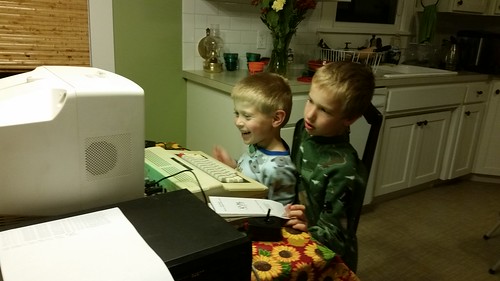
Yesterday, Jacob (age 8) asked to help me put together a 30-year-old computer from parts in my basement. Meanwhile, Oliver (age 5) asked Laura to help him learn cursive. Somehow, this doesn t seem odd for a Saturday at our place. 2014-11-22 18.58.36 Let me tell you how this came about. I ve had a project going on for a while now to load data from old floppies. It s been fun, and had a surprise twist the other day: my parents gave me an old TRS-80 Color Computer II (aka CoCo 2 ). It was, in fact, my first computer, one they got for me when I was in Kindergarten. It is nearly 30 years old. I have been musing lately about the great disservice Apple did the world by making computers easy to learn namely the fact that few people ever bother to learn about them. Who bothers to learn about them when, on the iPhone for instance, the case is sealed shut, the lifespan is 1 or 2 years for many purchasers, and the platform is closed in lots of ways? I had forgotten how finicky computers used to be. But after some days struggling with IDE incompatibilities, booting issues, etc., when I actually managed to get data off a machine that had last booted in 1999, I had quite the sense of accomplishment, which I rarely have lately. I did something that was hard to do in a world where most of the interfaces don t work with equipment that old (even if nominally they are supposed to.) The CoCo is one of those computers normally used with a floppy drive or cassette recorder to store programs. You type DIR, and you feel the clack of the drive heads through the desk. You type CLOAD and you hear the relay click closed to turn on the tape motor. You wiggle cables around until they make contact just right. You power-cycle for the times when the reset button doesn t quite do the job. The details of how it works aren t abstracted away by innumerable layers of controllers, interfaces, operating system modules, etc. It s all right there, literally vibrating your desk. So I thought this could be a great opportunity for Jacob to learn a few more computing concepts, such as the difference between mass storage and RAM, plus a great way to encourage him to practice critical thinking. So we trekked down to the basement and came up with handfulls of parts. We brought up the computer, some joysticks, all sorts of tangled cables. We needed adapters, an old TV. Jacob helped me hook everything up, and then the moment of truth: success! A green BASIC screen! I added more parts, but struck out when I tried to connect the floppy drive. The thing just wouldn t start up right whenever the floppy controller cartridge was installed. I cleaned the cartridge. I took it apart, scrubbed the contacts, even did a re-seat of the chips. No dice. So I fired up my CoCo emulator (xroar), and virtually saved some programs to cassette (a .wav file). I then burned those .wav files to an audio CD, brought up an old CD player from the basement, connected the cassette in plug to the CD player s headphone jack, and presto instant programs. (Well, almost. It takes a couple of minutes to load a program from audio codes.) The picture above is Oliver cackling at one of the very simplest BASIC programs there is: number find. The computer picks a random number between 1 and 2000, and asks the user to guess it, giving a too low or too high clue with each incorrect guess. Oliver delighted in giving invalid input (way too high numbers, or things that weren t numbers at all) and cackled at the sarcastic error messages built into the program. During Jacob s turn, he got very serious about it, and is probably going to be learning about how to calculate halfway points before too long. But imagine my pride when this morning, Jacob found the new CD I had made last night (correcting a couple recordings), found my one-line instruction on just part of how to load a program, and correctly figured out by himself all the steps to do in order (type CLOAD on the CoCo, advance the CD to the proper track, press play on the player, wait for it to load on the CoCo, then type RUN). I ordered a replacement floppy controller off eBay tonight, and paid $5 for a coax adapter that should fix some video quality issues. I rescued some 5.25 floppies from my trash can from another project, so they should have plenty of tools for exploration. It is so much easier for them to learn how a disk drive works, and even what the heck a track is, when you can look at a floppy drive with the cover off and see the heads move. There are other things we can do with more modern equipment Jacob has shown a lot of interest in Arduino projects but I have so far drawn a blank on ways to really let kids discover how a modern PC (let alone a modern phone or tablet) works. Update Nov. 24: Every so often, the world surprises me by deciding to, well, read one of my random blog posts. For the benefit of those of you that don t already know my boys, you might want to know that among their common play activites are turning trees into pretend trains, typing at a manual typewriter, reading, writing their own books, using a cassette recorder, building a PC and learning to use bash or xmonad, making long paper tapes with an adding machine, playing records on a record player, building electric gizmos, and even making mud balls. I am often asked about the role of the computer in the lives, given that my hobby and profession involves computers. The answer: less than that of most of their peers. I look for opportunities for them to learn by doing, discovering, playing, or imagining. I make no presumption that they will develop the passion for computers that I did. What I want is for them to have the curiosity and drive to learn everything there is to know about whatever they do develop a passion for, so they will be great at it.

23 November 2014

Iustin Pop: Debian, Debian

Due to some technical issues, I've been without access to my lists subscription email for a bit more than a week. Once I regained access and proceeded to read the batch of emails, I was - once again - shocked. Shocked at the amount of emails spent on the systemd issue, shocked at the number of people resigning, shocked at the amount of mud thrown. I just hope that the GR results finally will mean silence and getting over the last 3-6 months. For the record: However, some of the more recent emails on -private give me more hope, so I'm looking forward to the next 6 months. I wonder how this will all look in two years? (Side-note: emacs-nox shows me the italic word above as italic in text mode: I never saw that before, and didn't know, that it's possible to have italic fonts in xterm! What is this trickery it seems to be related to the font I use, fun!)

22 November 2014

Steve Kemp: Lumail 2.x ?

I've continued to ponder the idea of reimplementing the console mail-client I wrote, lumail, using a more object-based codebase. For one thing having loosely coupled code would allow testing things in isolation, which is clearly a good thing. I've written some proof of concept code which will allow the following Lua to be evaluated:
-- Open the maildir.
users = Maildir.new( "/home/skx/Maildir/.debian.user" )
-- Count the messages.
print( "There are " .. users:count() .. " messages in the maildir " .. users:path() )
--
-- Now we want to get all the messages and output their paths.
--
for k,v in ipairs( users:messages()) do
    --
    -- Here we could do something like:
    --
    --   if ( string.find( v:headers["subject"], "troll", 1, true ) ) then v:delete()  end
    --
    -- Instead play-nice and just show the path.
    print( k .. " -> " .. v:path() )
end
This is all a bit ugly, but I've butchered some code together that works, and tried to solicit feedback from lumail users. I'd write more but I'm tired, and intending to drink whisky and have an early night. Today I mostly replaced pipes in my attic. (Is it "attic", or is it "loft"? I keep alternating!) Fingers crossed this will mean a dry kitchen in the morning.

Daniel Pocock: rtc.debian.org updated for latest browsers

I've just updated rtc.debian.org with the latest versions of JSCommunicator and JsSIP. The version of JsSIP that had been on the site was actually quite old, from February 2014 and the browsers have evolved a lot since then. If you've tried it before and it didn't work consistently please try again and feel free to share any feedback you have.

21 November 2014

Richard Hartmann: Release Critical Bug report for Week 47

There's a BSP this weekend. If you're interested in remote participation, please join #debian-muc on irc.oftc.net. The UDD bugs interface currently knows about the following release critical bugs: How do we compare to the Squeeze release cycle?
Week Squeeze Wheezy Jessie
43 284 (213+71) 468 (332+136) 319 (240+79)
44 261 (201+60) 408 (265+143) 274 (224+50)
45 261 (205+56) 425 (291+134) 295 (229+66)
46 271 (200+71) 401 (258+143) 427 (313+114)
47 283 (209+74) 366 (221+145) 342 (260+82)
48 256 (177+79) 378 (230+148)
49 256 (180+76) 360 (216+155)
50 204 (148+56) 339 (195+144)
51 178 (124+54) 323 (190+133)
52 115 (78+37) 289 (190+99)
1 93 (60+33) 287 (171+116)
2 82 (46+36) 271 (162+109)
3 25 (15+10) 249 (165+84)
4 14 (8+6) 244 (176+68)
5 2 (0+2) 224 (132+92)
6 release! 212 (129+83)
7 release+1 194 (128+66)
8 release+2 206 (144+62)
9 release+3 174 (105+69)
10 release+4 120 (72+48)
11 release+5 115 (74+41)
12 release+6 93 (47+46)
13 release+7 50 (24+26)
14 release+8 51 (32+19)
15 release+9 39 (32+7)
16 release+10 20 (12+8)
17 release+11 24 (19+5)
18 release+12 2 (2+0)
Graphical overview of bug stats thanks to azhag:

Gunnar Wolf: Status of the Debian OpenPGP keyring November update

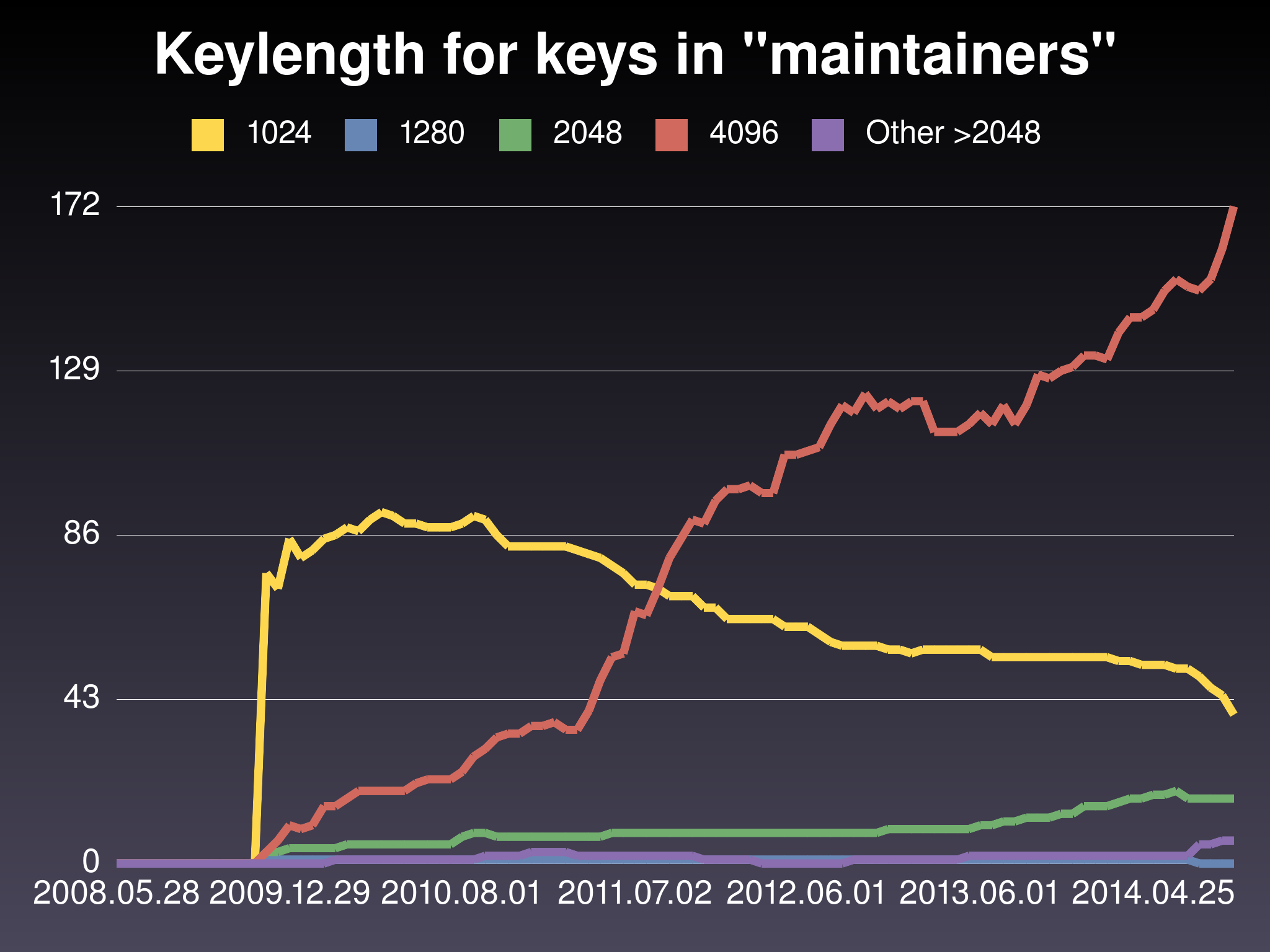
Almost two months ago I posted our keyring status graphs, showing the progress of the transition to >=2048-bit keys for the different active Debian keyrings. So, here are the new figures. First, the Non-uploading keyring: We were already 100% transitioned. You will only notice a numerical increase: That little bump at the right is our dear friend T ssia finally joining as a Debian Developer. Welcome! \o/ As for the Maintainers keyring: We can see a sharp increase in 4096-bit keys. Four 1024-bit DM keys were migrated to 4096R, but we did have eight new DMs coming in To them, also, welcome \o/. Sadly, we had to remove a 1024-bit key, as Peter Miller sadly passed away. So, in a 234-key universe, 12 new 4096R keys is a large bump! Finally, our current-greatest worry If for nothing else, for the size of the beast: The active Debian Developers keyring. We currently have 983 keys in this keyring, so it takes considerably more effort to change it. But we have managed to push it noticeably. This last upload saw a great deal of movement. We received only one new DD (but hey welcome nonetheless! \o/ ). 13 DD keys were retired; as one of the maintainers of the keyring, of course this makes me sad but then again, in most cases it's rather an acknowledgement of fact: Those keys' holders often state they had long not been really involved in the project, and the decision to retire was in fact timely. But the greatest bulk of movement was the key replacements: A massive 62 1024D keys were replaced with stronger ones. And, yes, the graph changed quite abruptly: We still have a bit over one month to go for our cutoff line, where we will retire all 1024D keys. It is important to say we will not retire the affected accounts, mark them as MIA, nor anything like that. If you are a DD and only have a 1024D key, you will still be a DD, but you will be technically unable to do work directly. You can still upload your packages or send announcements to regulated mailing lists via sponsor requests (although you will be unable to vote). Speaking of votes: We have often said that we believe the bulk of the short keys belong to people not really active in the project anymore. Not all of them, sure, but a big proportion. We just had a big, controversial GR vote with one of the highest voter turnouts in Debian's history. I checked the GR's tally sheet, and the results are interesting: Please excuse my ugly bash, but I'm posting this so you can play with similar runs on different votes and points in time using the public keyring Git repository:
  1. $ git checkout 2014.10.10
  2. $ for KEY in $( for i in $( grep '^V:' tally.txt
  3. awk ' print "<" $3 ">" ' )
  4. do
  5. grep $i keyids cut -f 1 -d ' '
  6. done )
  7. do
  8. if [ -f debian-keyring-gpg/$KEY -o -f debian-nonupload-gpg/$KEY ]
  9. then
  10. gpg --keyring /dev/null --keyring debian-keyring-gpg/$KEY \
  11. --keyring debian-nonupload-gpg/$KEY --with-colons \
  12. --list-key $KEY 2>/dev/null \
  13. head -2 tail -1 cut -f 3 -d :
  14. fi
  15. done sort uniq -c
  16. 95 1024
  17. 13 2048
  18. 1 3072
  19. 371 4096
  20. 2 8192
So, as of mid-October: 387 out of the 482 votes (80.3%) were cast by developers with >=2048-bit keys, and 95 (19.7%) were cast by short keys. If we were to run the same vote with the new active keyring, 417 votes would have been cast with >=2048-bit keys (87.2%), and 61 with short keys (12.8%). We would have four less votes, as they retired:
  1. 61 1024
  2. 14 2048
  3. 2 3072
  4. 399 4096
  5. 2 8192
So, lets hear it for November/December. How much can we push down that pesky yellow line? Disclaimer: Any inaccuracy due to bugs in my code is completely my fault!

Daniel Pocock: PostBooks 4.7 packages available, xTupleCon 2014 award

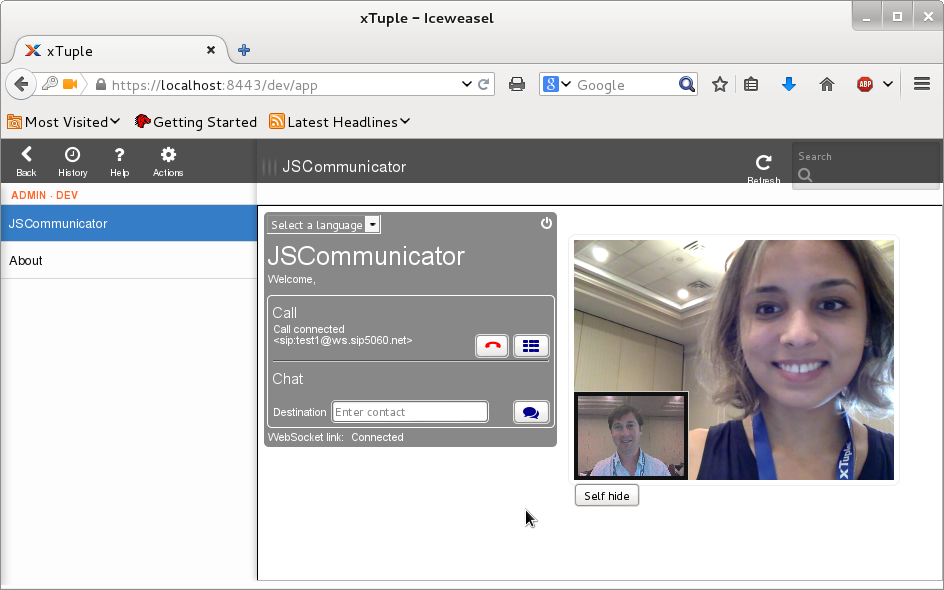
I recently updated the PostBooks packages in Debian and Ubuntu to version 4.7. This is the version that was released in Ubuntu 14.10 (Utopic Unicorn) and is part of the upcoming Debian 8 (jessie) release. Better prospects for Fedora and RHEL/CentOS/EPEL packages As well as getting the packages ready, I've been in contact with xTuple helping them generalize their build system to make packaging easier. This has eliminated the need to patch the makefiles during the build. As well as making it easier to support the Debian/Ubuntu packages, this should make it far easier for somebody to create a spec file for RPM packaging too. Debian wins a prize While visiting xTupleCon 2014 in Norfolk, I was delighted to receive the Community Member of the Year award which I happily accepted not just for my own efforts but for the Debian Project as a whole. Steve Hackbarth, Director of Product Development at xTuple, myself and the impressive Community Member of the Year trophy This is a great example of the productive relationships that exist between Debian, upstream developers and the wider free software community and it is great to be part of a team that can synthesize the work from so many other developers into ready-to-run solutions on a 100% free software platform. Receiving this award really made me think about all the effort that has gone into making it possible to apt-get install postbooks and all the people who have collectively done far more work than myself to make this possible: Here is a screenshot of the xTuple web / JSCommunicator integration, it was one of the highlights of xTupleCon: and gives a preview of the wide range of commercial opportunities that WebRTC is creating for software vendors to displace traditional telecommunications providers. xTupleCon also gave me a great opportunity to see new features (like the xTuple / Drupal web shop integration) and hear about the success of consultants and their clients deploying xTuple/PostBooks in various scenarios. The product is extremely strong in meeting the needs of manufacturing and distribution and has gained a lot of traction in these industries in the US. Many of these features are equally applicable in other markets with a strong manufacturing industry such as Germany or the UK. However, it is also flexible enough to simply disable many of the specialized features and use it as a general purpose accounting solution for consulting and services businesses. This makes it a good option for many IT freelancers and support providers looking for a way to keep their business accounts in a genuinely open source solution with a strong SQL backend and a native Linux desktop interface.

Julien Danjou: Distributed group management and locking in Python with tooz

With OpenStack embracing the Tooz library more and more over the past year, I think it's a good start to write a bit about it. A bit of history A little more than year ago, with my colleague Yassine Lamgarchal and others at eNovance, we investigated on how to solve a problem often encountered inside OpenStack: synchronization of multiple distributed workers. And while many people in our ecosystem continue to drive development by adding new bells and whistles, we made a point of solving new problems with a generic solution able to address the technical debt at the same time. Yassine wrote the first ideas of what should be the group membership service that was needed for OpenStack, identifying several projects that could make use of this. I've presented this concept during the OpenStack Summit in Hong-Kong during an Oslo session. It turned out that the idea was well-received, and the week following the summit we started the tooz project on StackForge. Goals Tooz is a Python library that provides a coordination API. Its primary goal is to handle groups and membership of these groups in distributed systems. Tooz also provides another useful feature which is distributed locking. This allows distributed nodes to acquire and release locks in order to synchronize themselves (for example to access a shared resource). The architecture If you are familiar with distributed systems, you might be thinking that there are a lot of solutions already available to solve these issues: ZooKeeper, the Raft consensus algorithm or even Redis for example. You'll be thrilled to learn that Tooz is not the result of the NIH syndrome, but is an abstraction layer on top of all these solutions. It uses drivers to provide the real functionalities behind, and does not try to do anything fancy. All the drivers do not have the same amount of functionality of robustness, but depending on your environment, any available driver might be suffice. Like most of OpenStack, we let the deployers/operators/developers chose whichever backend they want to use, informing them of the potential trade-offs they will make. So far, Tooz provides drivers based on: All drivers are distributed across processes. Some can be distributed across the network (ZooKeeper, memcached, redis ) and some are only available on the same host (IPC). Also note that the Tooz API is completely asynchronous, allowing it to be more efficient, and potentially included in an event loop. Features Group membership Tooz provides an API to manage group membership. The basic operations provided are: the creation of a group, the ability to join it, leave it and list its members. It's also possible to be notified as soon as a member joins or leaves a group. Leader election Each group can have a leader elected. Each member can decide if it wants to run for the election. If the leader disappears, another one is elected from the list of current candidates. It's possible to be notified of the election result and to retrieve the leader of a group at any moment. Distributed locking When trying to synchronize several workers in a distributed environment, you may need a way to lock access to some resources. That's what a distributed lock can help you with. Adoption in OpenStack Ceilometer is the first project in OpenStack to use Tooz. It has replaced part of the old alarm distribution system, where RPC was used to detect active alarm evaluator workers. The group membership feature of Tooz was leveraged by Ceilometer to coordinate between alarm evaluator workers. Another new feature part of the Juno release of Ceilometer is the distribution of polling tasks of the central agent among multiple workers. There's again a group membership issue to know which nodes are online and available to receive polling tasks, so Tooz is also being used here. The Oslo team has accepted the adoption of Tooz during this release cycle. That means that it will be maintained by more developers, and will be part of the OpenStack release process. This opens the door to push Tooz further in OpenStack. Our next candidate would be write a service group driver for Nova. The complete documentation for Tooz is available online and has examples for the various features described here, go read it if you're curious and adventurous!

Next.

Previous.