Search Results: "ina"

4 February 2017

Dirk Eddelbuettel: nanotime 0.1.1

A new version of the nanotime package for working with nanosecond timestamps is now on CRAN. nanotime uses the RcppCCTZ package for (efficient) high(er) resolution time parsing and formatting, and the bit64 package for the actual integer64 arithmetic. This release adds an improved default display format always showing nine digits of fractional seconds. It also changes the print() method to call format() first, and we started to provide some better default Ops methods. These fixes were suggested by Matt Dowle. We also corrected a small issue which could lead to precision loss in formatting as pointed out by Leonardo Silvestri.

Changes in version 0.1.1 (2017-02-04)
  • The default display format now always shows nine digits (#10 closing #9)
  • The default print method was updated to use formated output, and a new new converter as.integer64 was added
  • Several 'Ops' method are now explicitly defined allowing casting of results (rather than falling back on bit64 behaviour)
  • The format routine is now more careful about not loosing precision (#13 closing #12)

We also have a diff to the previous version thanks to CRANberries. More details and examples are at the nanotime page; code, issue tickets etc at the GitHub repository.

This post by Dirk Eddelbuettel originated on his Thinking inside the box blog. Please report excessive re-aggregation in third-party for-profit settings.

Ross Gammon: My Monthly Update for January 2017

It has been a quiet start to the year due to work keeping me very busy. Most of my spare time (when not sitting shattered on the sofa) was spent resurrecting my old website from backups. My son had plenty of visitors coming to visit as well, which prompted me to restart work on my model railway in the basement. Last year I received a whole heap of track, and also a tunnel formation from a friend at work. I managed to finish the supporting structure for the tunnel, and connect one end of it to the existing track layout. The next step (which will be a bit harder) is to connect the other end of the tunnel into the existing layout. The basement is one of the favourite things for me to keep my son and his friends occupied when there is a visit. The railway and music studio are very popular with the little guests. Debian Ubuntu Other Plan status from last month & update for next month Debian Before the 5th February 2017 Debian Stretch hard freeze I hope to: For the Debian Stretch release: Generally: Ubuntu Other

3 February 2017

Holger Levsen: Going to FOSDEM after switching away from Debian

So last weekend I attended Devconf.cz in Brno and together with Dennis Gilmore gave a talk about Reproducible Builds and Fedora (Slides) which was fun and - I think - pretty well received. Then on the following Tuesday, so three days ago, after using Debian as the primary OS on my primary computer for more than two decades, I finally made the long anticipated switch and I must say, so far I'm really happy with my new environment, even though I'm not yet again using a tiled window manager (but instead Xfce), cannot yet do all the things I could do before and even have to reconfigure a VM twice and restart another to get back wireless network after suspend and resume So what have I done? Nothing too dramatic: I've switched to Qubes OS and now I'm running Debian jessie and stretch and Fedora and Whonix on my primary computer, just not as my primary OS :-) IOW: hardware is basically software and while I want the red pill, who knows what's really inside the box? If you have no idea what I'm talking about, this intro about Qubes OS might be helpful. Or you dive directly into this six year old post, where Joanna Rutkowska described how she partitioned her digital life using Qubes. I'm not sure where this journey will lead me to, but I'm confident this is the right direction. And in case you wondered, I'll keep working on Debian, as far as I know now ;-)

Benjamin Mako Hill: New Dataset: Five Years of Longitudinal Data from Scratch

Scratch is a block-based programming language created by the Lifelong Kindergarten Group (LLK) at the MIT Media Lab. Scratch gives kids the power to use programming to create their own interactive animations and computer games. Since 2007, the online community that allows Scratch programmers to share, remix, and socialize around their projects has drawn more than 16 million users who have shared nearly 20 million projects and more than 100 million comments. It is one of the most popular ways for kids to learn programming and among the larger online communities for kids in general.
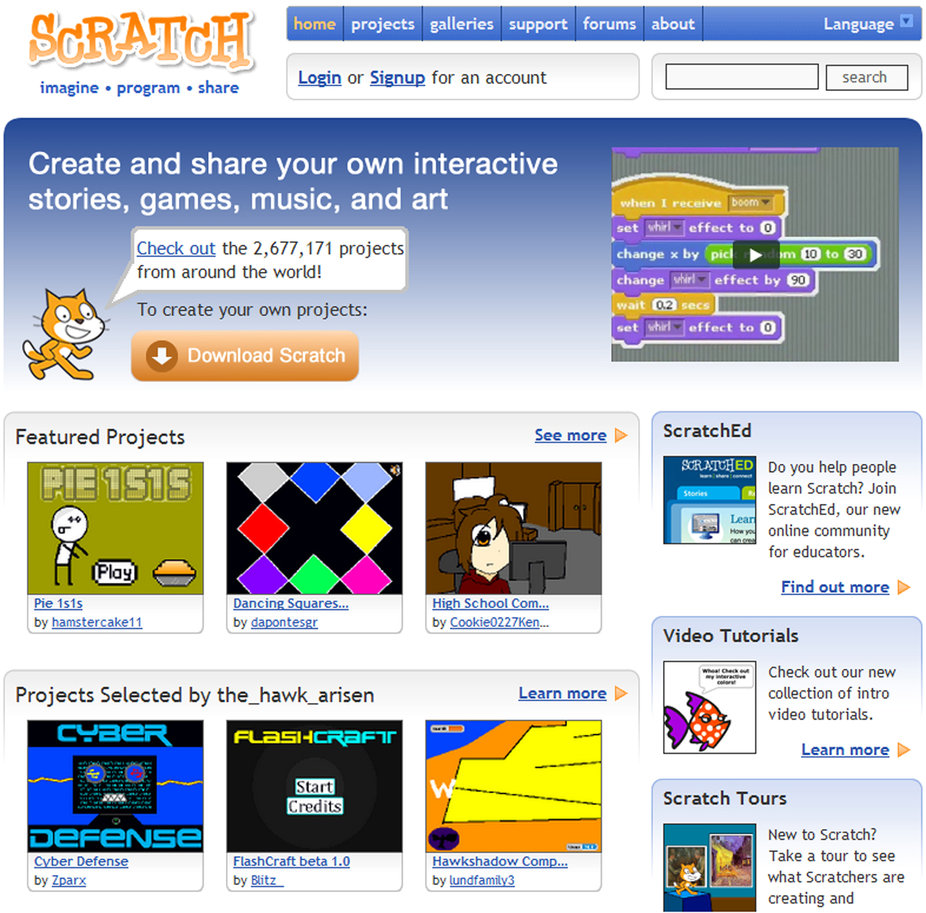
Front page of the Scratch online community (https://scratch.mit.edu) during the period covered by the dataset.
Since 2010, I have published a series of papers using quantitative data collected from the database behind the Scratch online community. As the source of data for many of my first quantitative and data scientific papers, it s not a major exaggeration to say that I have built my academic career on the dataset. I was able to do this work because I happened to be doing my masters in a research group that shared a physical space ( The Cube ) with LLK and because I was friends with Andr s Monroy-Hern ndez, who started in my masters cohort at the Media Lab. A year or so after we met, Andr s conceived of the Scratch online community and created the first version for his masters thesis project. Because I was at MIT and because I knew the right people, I was able to get added to the IRB protocols and jump through the hoops necessary to get access to the database. Over the years, Andr s and I have heard over and over, in conversation and in reviews of our papers, that we were privileged to have access to such a rich dataset. More than three years ago, Andr s and I began trying to figure out how we might broaden this access. Andr s had the idea of taking advantage of the launch of Scratch 2.0 in 2013 to focus on trying to release the first five years of Scratch 1.x online community data (March 2007 through March 2012) most of the period that the codebase he had written ran the site. After more work than I have put into any single research paper or project, Andr s and I have published a data descriptor in Nature s new journal Scientific Data. This means that the data is now accessible to other researchers. The data includes five years of detailed longitudinal data organized in 32 tables with information drawn from more than 1 million Scratch users, nearly 2 million Scratch projects, more than 10 million comments, more than 30 million visits to Scratch projects, and much more. The dataset includes metadata on user behavior as well the full source code for every project. Alongside the data is the source code for all of the software that ran the website and that users used to create the projects as well as the code used to produce the dataset we ve released. Releasing the dataset was a complicated process. First, we had navigate important ethical concerns about the the impact that a release of any data might have on Scratch s users. Toward that end, we worked closely with the Scratch team and the the ethics board at MIT to design a protocol for the release that balanced these risks with the benefit of a release. The most important features of our approach in this regard is that the dataset we re releasing is limited to only public data. Although the data is public, we understand that computational access to data is different in important ways to access via a browser or API. As a result, we re requiring anybody interested in the data to tell us who they are and agree to a detailed usage agreement. The Scratch team will vet these applicants. Although we re worried that this creates a barrier to access, we think this approach strikes a reasonable balance. Beyond the the social and ethical issues, creating the dataset was an enormous task. Andr s and I spent Sunday afternoons over much of the last three years going column-by-column through the MySQL database that ran Scratch. We looked through the source code and the version control system to figure out how the data was created. We spent an enormous amount of time trying to figure out which columns and rows were public. Most of our work went into creating detailed codebooks and documentation that we hope makes the process of using this data much easier for others (the data descriptor is just a brief overview of what s available). Serializing some of the larger tables took days of computer time. In this process, we had a huge amount of help from many others including an enormous amount of time and support from Mitch Resnick, Natalie Rusk, Sayamindu Dasgupta, and Benjamin Berg at MIT as well as from many other on the Scratch Team. We also had an enormous amount of feedback from a group of a couple dozen researchers who tested the release as well as others who helped us work through through the technical, social, and ethical challenges. The National Science Foundation funded both my work on the project and the creation of Scratch itself. Because access to data has been limited, there has been less research on Scratch than the importance of the system warrants. We hope our work will change this. We can imagine studies using the dataset by scholars in communication, computer science, education, sociology, network science, and beyond. We re hoping that by opening up this dataset to others, scholars with different interests, different questions, and in different fields can benefit in the way that Andr s and I have. I suspect that there are other careers waiting to be made with this dataset and I m excited by the prospect of watching those careers develop. You can find out more about the dataset, and how to apply for access, by reading the data descriptor on Nature s website.

Dirk Eddelbuettel: RPushbullet 0.3.0

RPpushbullet demo A major new update of the RPushbullet package is now on CRAN. RPushbullet interfacing the neat Pushbullet service for inter-device messaging, communication, and more. It lets you easily send alerts like the one to the to your browser, phone, tablet, ... -- or all at once. This release owes a lot to Seth Wenchel who was instrumental in driving several key refactorings. We now use the curl package instead of relying on system() calls to the binary. We also switched from RJSONIO to jsonlite. A new helper function to create the required resourcefile was added, and several other changes were made as detailed below in the extract from the NEWS.Rd file.

Changes in version 0.3.0 (2017-02-03)
  • The curl binary use was replaced by use of the curl package; several new helper functions added (PRs #30, #36 by Seth closing #29)
  • Use of RJSONIO was replaced by use of jsonlite (PR #32 by Seth closing #31)
  • A new function pbSetup was added to aid creating the resource file (PRs #34, #37 by Seth and Dirk)
  • The package intialization was refactored so that non-loading calls such as RPushbullet::pbPost(...) now work (#33 closing #26)
  • The test suite was updated and extended
  • The Travis script was updated use run.sh
  • DESCRIPTION, README.md and other files were updated for current R CMD check standards
  • Deprecated parts such as 'type=address' were removed, and the documentation was updated accordingly.
  • Coverage support was added (in a 'on-demand' setting as automated runs would need a Pushbullet API token)

Courtesy of CRANberries, there is also a diffstat report for this release. More details about the package are at the RPushbullet webpage and the RPushbullet GitHub repo.

This post by Dirk Eddelbuettel originated on his Thinking inside the box blog. Please report excessive re-aggregation in third-party for-profit settings.

Petter Reinholdtsen: A day in court challenging seizure of popcorn-time.no for #domstolkontroll

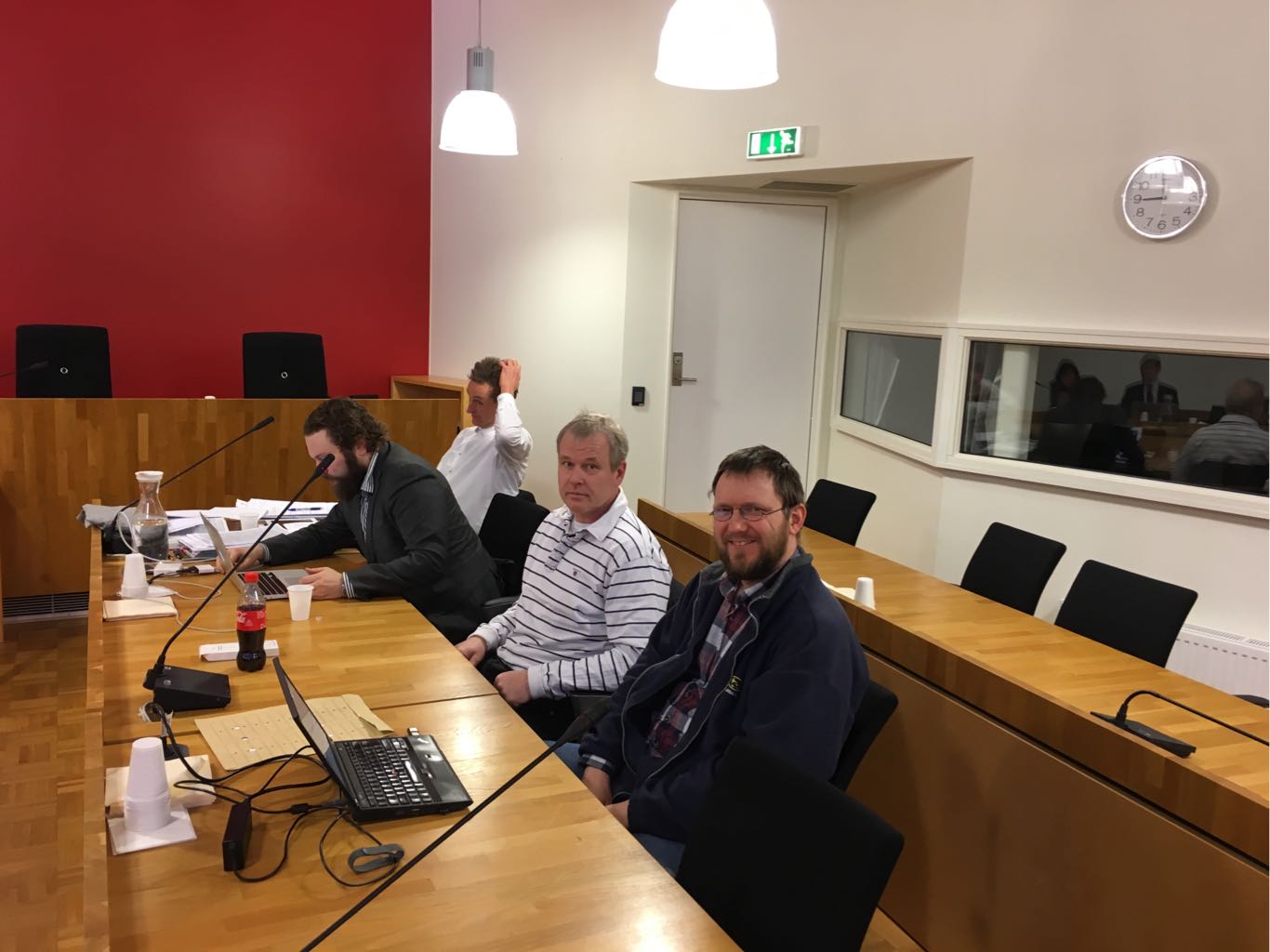
On Wednesday, I spent the entire day in court in Follo Tingrett representing the member association NUUG, alongside the member association EFN and the DNS registrar IMC, challenging the seizure of the DNS name popcorn-time.no. It was interesting to sit in a court of law for the first time in my life. Our team can be seen in the picture above: attorney Ola Tellesb , EFN board member Tom Fredrik Blenning, IMC CEO Morten Emil Eriksen and NUUG board member Petter Reinholdtsen. The case at hand is that the Norwegian National Authority for Investigation and Prosecution of Economic and Environmental Crime (aka kokrim) decided on their own, to seize a DNS domain early last year, without following the official policy of the Norwegian DNS authority which require a court decision. The web site in question was a site covering Popcorn Time. And Popcorn Time is the name of a technology with both legal and illegal applications. Popcorn Time is a client combining searching a Bittorrent directory available on the Internet with downloading/distribute content via Bittorrent and playing the downloaded content on screen. It can be used illegally if it is used to distribute content against the will of the right holder, but it can also be used legally to play a lot of content, for example the millions of movies available from the Internet Archive or the collection available from Vodo. We created a video demonstrating legally use of Popcorn Time and played it in Court. It can of course be downloaded using Bittorrent. I did not quite know what to expect from a day in court. The government held on to their version of the story and we held on to ours, and I hope the judge is able to make sense of it all. We will know in two weeks time. Unfortunately I do not have high hopes, as the Government have the upper hand here with more knowledge about the case, better training in handling criminal law and in general higher standing in the courts than fairly unknown DNS registrar and member associations. It is expensive to be right also in Norway. So far the case have cost more than NOK 70 000,-. To help fund the case, NUUG and EFN have asked for donations, and managed to collect around NOK 25 000,- so far. Given the presentation from the Government, I expect the government to appeal if the case go our way. And if the case do not go our way, I hope we have enough funding to appeal. From the other side came two people from kokrim. On the benches, appearing to be part of the group from the government were two people from the Simonsen Vogt Wiik lawyer office, and three others I am not quite sure who was. kokrim had proposed to present two witnesses from The Motion Picture Association, but this was rejected because they did not speak Norwegian and it was a bit late to bring in a translator, but perhaps the two from MPA were present anyway. All seven appeared to know each other. Good to see the case is take seriously. If you, like me, believe the courts should be involved before a DNS domain is hijacked by the government, or you believe the Popcorn Time technology have a lot of useful and legal applications, I suggest you too donate to the NUUG defense fund. Both Bitcoin and bank transfer are available. If NUUG get more than we need for the legal action (very unlikely), the rest will be spend promoting free software, open standards and unix-like operating systems in Norway, so no matter what happens the money will be put to good use. If you want to lean more about the case, I recommend you check out the blog posts from NUUG covering the case. They cover the legal arguments on both sides.

2 February 2017

Steinar H. Gunderson: Not going to FOSDEM but a year of Nageru

It's that time of the year :-) And FOSDEM is fun. But this year I won't be going; there was a scheduling conflict, and I didn't really have anything new to present (although I probably could have shifted around priorities to get something). But FOSDEM 2017 also means there's a year since FOSDEM 2016, where I presented Nageru, my live video mixer. And that's been a pretty busy year, so I thought I'd do a live cap from high up above. First of all, Nageru has actually been used in production we did Solskogen and Fyrrom, and both gave invaluable input. Then there have been some non-public events, which have also been useful. The Nageru that's in git right now is evolved considerably from the 1.0.0 that was released last year. diffstat shows 19660 insertions and 3543 deletions; that's counting about 2500 lines of vendored headers, though. Even though I like deleting code much more than adding it, the doubling (from ~10k to ~20k lines) represents a significant amount of new features: 1.1.x added support for non-Intel GPUs. 1.2.x added support for DeckLink input cards (through Blackmagic's proprietary drivers), greatly increasing hardware support, and did a bunch of small UI changes. 1.3.x added x264 support that's strong enough that Nageru has really displaced VLC as my go-to tool for just video-signal-to-H.264-conversion (even though it feels overkill), and also added hotplug support. 1.4.x added multichannel audio support including support for MIDI controllers, and also a disk space indicator (because when you run out of disk during production without understanding that's what happens, it really sucks), and brought extensive end-user documentation. And 1.5.x, in development right now, will add HDMI/SDI output, which, like all the previous changes, requires various rearchitecting and fixing. Of course, there are lots of things that haven't changed as well; the basic UI remains the same, including the way the theme (governing the look-and-feel of the finished video stream) works. The basic design has proved sound, and I don't think I would change a lot if I were to design something like 1.0.0 again. As a small free software project, you have to pick your battles, and I'm certainly glad I didn't start out doing something like network support (or a distributed architecture in general, really). So what's for the next year of Nageru? It's hard to say, and it will definitely depend on the concrete needs of events. A hot candidate (since I might happen to need it) is chroma keying, although good keying is hard to get right and this needs some research. There's also been some discussion around other concrete features, but I won't name them until a firm commitment has been made; priorities can shift around, and it's important to stay flexible. So, enjoy FOSDEM! Perhaps I'll return with a talk in 2018. In the meantime, I'll preparing the stream for the 2017 edition of Fyrrom, and I know for sure there will be more events, more features and more experiences to be had. And, inevitably, more bugs. :-)

Paul Wise: FLOSS Activities January 2017

Changes

Issues

Review

Administration
  • Debian: reboot 1 non-responsive VM, redirect 2 users to support channels, redirect 1 contributor to xkb upstream, redirect 1 potential contributor, redirect 1 bug reporter to mirror team, ping 7 folks about restarting processes with upgraded libs, manually restart the sectracker process due to upgraded libs, restart the package tracker process due to upgraded libs, investigate failures connecting to the XMPP service, investigate /dev/shm issue on abel.d.o, clean up after rename of the fedmsg group.
  • Debian mentors: lintian/security updates & reboot
  • Debian packages: deploy 2 contributions to the live server
  • Debian wiki: unblacklist 1 IP address, whitelist 10 email addresses, disable 18 accounts with bouncing email, update email for 2 accounts with bouncing email, reported 1 Debian member as MIA, redirect 1 user to support channels, add 4 domains to the whitelist.
  • Reproducible builds: rescheduled Debian pyxplot:amd64/unstable for themill.
  • Openmoko: security updates & reboots.

Debian derivatives
  • Send the annual activity ping mail.
  • Happy new year messages on IRC, forward to the list.
  • Note that SerbianLinux does not provide source packages.
  • Expand URL shortener on SerbianLinux page.
  • Invite PelicanHPC, Netrunner, DietPi, Hamara Linux (on IRC), BitKey to the census.
  • Add research publications link to the census template
  • Fix Symbiosis sources.list
  • Enquired about SalentOS downtime
  • Fixed and removed some 404 BlankOn links (blog, English homepage)
  • Fixed changes to AstraLinux sources.list
  • Welcome Netrunner to the census

Sponsors I renewed my support of Software Freedom Conservancy. The openchange 1:2.2-6+deb8u1 upload was sponsored by my employer. All other work was done on a volunteer basis.

1 February 2017

Iustin Pop: The snow is gone

Almost all traces of the snow are gone. After a very dry December, January was an awesome month. Lots of snow, even in the city, that held for (I think) three weeks very rare for Z rich. This happened because the temperature never went above -5 C, even during the day proper winter for the city! It was awesome to bike in these conditions. At first fresh snow (best! but slow), then packed snow, it never actually became dangerous ice. And then, at the end of last week, temperatures started climbing. First near zero, then 1-2 C above, then it finally started going warm (above freezing even during the night). And the snow started melting a bit, then more, and then it started raining. And it rained for three days. The worst thing, seeing snow being rained upon. Dirty grey snow, slowly melting away I don't like this picture. At least now the snow is gone, and the streets are almost dry, and we can look to either some more snow (I wish ) or spring. I'd rather take -2 C global average temperatures than +2 C. I'm not sure what -5 would mean, but compared to no winter

Daniel Pocock: Going to FOSDEM, Brussels this weekend

This weekend I'm going to FOSDEM, one of the largest gatherings of free software developers in the world. It is an extraordinary event, also preceded by the XSF / XMPP Summit For those who haven't been to FOSDEM before and haven't yet made travel plans, it is not too late. FOSDEM is a free event and no registration is required. Many Brussels hotels don't get a lot of bookings on weekends during the winter so there are plenty of last minute offers available, often cheaper than what is available on AirBNB. I was speaking to somebody in London on Sunday who commutes through St Pancras (the Eurostar terminal) every day and didn't realize it goes to Brussels and only takes 2 hours to get there. One year I booked a mini-van at the last minute and made the drive from the UK with a stop in Lille for dinner on the way back, for 5 people that was a lot cheaper than the train. In other years I've taken trains from Switzerland through Paris or Luxembourg. Real-time Communication (RTC) dev-room on Saturday, 4 February On Saturday, we have a series of 23 talks about RTC topics in the RTC dev-room, including SIP, XMPP, WebRTC, peer-to-peer (with Ring) and presentations from previous GSoC students and developers coming from far and wide. The possibilities of RTC with free software will also be demonstrated and discussed at the RTC lounge in the K building, near the dev-room, over both Saturday and Sunday. Please come and say hello. Please come and subscribe to the Free-RTC-Announce mailing list for important announcements on the RTC theme and join the Free-RTC discussion list if you have any questions about the activities at FOSDEM, dinners for RTC developers on Saturday night or RTC in general. Software Defined Radio (SDR) and the Debian Hams project At 11:30 on Saturday I'll be over at the SDR dev-room to meet other developers of SDR projects such as GNU Radio and give a brief talk about the Debian Hams project and the relationship between our diverse communities. Debian Hams (also on the Debian Ham wiki) provides a ready-to-run solution for ham radio and SDR is just one of its many capabilities. If you've ever wondered about trying the RTL-SDR dongle or similar projects Debian Hams provides a great way to get started quickly. I've previously given talks on this topic at the Vienna and Cambridge mini-DebConfs (video). Ham Radio (also known as amateur radio) offers the possibility to gain exposure to every aspect of technology from the physical antennas and power systems through to software for a range of analog and digital communications purposes. Ham Radio and the huge community around it is a great fit with the principles and philosophy of free software development. In a world where hardware vendors are constantly exploring ways to limit their users with closed and proprietary architectures, such as DRM, a broad-based awareness of the entire technology stack empowers society to remain in control of the technology we are increasingly coming to depend on in our every day lives.

Russ Allbery: Review: A Closed and Common Orbit

Review: A Closed and Common Orbit, by Becky Chambers
Series: Wayfarers #2
Publisher: Harper Voyager
Copyright: October 2016
ISBN: 0-06-256942-2
Format: Kindle
Pages: 384
A Closed and Common Orbit has two threads, one that takes place twenty years in the past and one that happens simultaneously with the very end of The Long Way to a Small, Angry Planet. That second part is the motivating plot thread, but it's unfortunately impossible to talk about in any depth without seriously spoiling the previous book. You could otherwise read them out of order, but I think the previous book is too good to spoil, so you want to carefully avoid reading any descriptions of this book until after you've read The Long Way to a Small, Angry Planet. Per my normal review policy, I'm going to try to avoid spoilers, but just about everything about half of this book would give away spoilers if you're paying attention. So you may want to just go read the other book before reading this review. (It's excellent!) The part that I can safely say is that half this book is about Pepper, her partner Blue, Pepper's store and Blue's art, and her attempt to help a friend find a place and a sense of identity that she'd never asked for or expected, while keeping a very dangerous secret. That friend starts somewhat passive, but one of the things I liked the most about this story is that Pepper is neither always right in her advice nor always wrong. Sidra is wrong about some of the limitations that she thinks she has and some of the things she thinks she wants, but she's also right about other things where Pepper is wrong. She has a complicated, careful, and courageous journey. The best part of this book for me, though, was the other half, told in alternating chapters with Sidra's story. This is Pepper's own backstory, which is rather awful (although Chambers does avoid being too graphic about the most horrible parts), but is also an amazing story of someone finding her own power, her own skills, and her own identity. And building a relationship that's something quite special. At first, this seems only vaguely related to Sidra's story and the other half of the book, but they both come together in a way that's both heartbreaking and wonderful. I found this story particularly wonderful because one of my favorite SF tropes is sentient computers or sentient ships, which play a significant role in Pepper's backstory. And one of my favorite characters to read about is the technician who can cobble together fixes to things and who is always finding something to repair. Pepper is a delight, her story explains so much about how she became the person she is (and adds so much emotional heft to it), and she has a relentless, practical determination that I loved reading about. A Closed and Common Orbit doesn't have the sprawling cast of The Long Way to a Small, Angry Planet. The story is tightly focused on five characters. I think I liked that even better than the previous book, even when I was finding Sidra a bit too passive and not as interesting. Chambers's characters have so much depth, thoughtfulness, and basic decency, while still being uniquely themselves, that I feel like I could read about them for months and keep uncovering new, interesting facets. I particularly loved the occasional excerpts from the chat system where Pepper hangs out (and would have loved about three times more of them). Speaking as someone who spends a lot of time in chat, Chambers got the tone just about perfect. Just about the only complaint I have about this book is that I thought the ending was too abrupt. It's so important, the climax of Pepper's story and a hugely significant piece of character development, and I wanted more than the short scene and aftermath we got. I really wanted to spend some time feeling with the characters, savoring the emotional release. Another three or four pages would have been greatly appreciated. The Long Way to a Small, Angry Planet was a happy surprise in 2015. A Closed and Common Orbit is fully as good, if not better. If you liked the previous book, you will definitely want to read this. I pre-ordered it and then read it within months after it was released, something that I almost never do. I can hardly wait to read whatever Chambers writes next. Rating: 9 out of 10

Antoine Beaupr : Testing new hardware with Stressant

I got a new computer and wondered... How can I test it? One of those innocent questions that brings hours and hours of work and questionning...

A new desktop: Intel NUC devices After reading up on Jeff Atwood's blog and especially his article on the scooter computer, I have discovered a whole range of small computers that could answer my need for a faster machine in my office at a low price tag and without taking up too much of my precious desk space. After what now seems like a too short review I ended up buying a new Intel NUC device from NCIX.com, along with 16GB of RAM and an amazing 500GB M.2 hard drive for around 750$. I am very happy with the machine. It's very quiet and takes up zero space on my desk as I was able to screw it to the back of my screen. You can see my review of the hardware compatibility and installation report in the Debian wiki. I wish I had taken more time to review the possible alternatives - for example I found out about the amazing Airtop PC recently and, although that specific brand is a bit too expensive, the space of small computers is far and wide and deserves a more thorough review than just finding the NUC by accident while shopping for laptops on System76.com...

Reviving the Stressant project But this, and Atwood's Is Your Computer Stable? article, got me thinking about how to test new computers. It's one thing to build a machine and fire it up, but how do you know everything is actually really working? It is common practice to do a basic stress test or burn-in when you get a new machine in the industry - how do you proceed with such tests? Back in the days when I was working at Koumbit, I wrote a tool exactly for that purpose called Stressant. Since I am the main author of the project and I didn't see much activity on it since I left, I felt it would be a good idea to bring it under my personal wing again, and I have therefore moved it to my Gitlab where I hope to bring it back to life. Parts of the project's rationale are explained in an "Intent To Package" the "breakin" tool (Debian bug #707178), which, after closer examination, ended up turning into a complete rewrite. The homepage has a bit more information about how the tool works and its objectives, but generally, the idea is to have a live CD or USB stick that you can just plugin into a machine to run a battery of automated tests (memtest86, bonnie++, stress-ng and disk wiping, for example) or allow for interactive rescue missions on broken machines. At Koumbit, we had Debirf-based live images that we could boot off the network fairly easily that we would use for various purposes, although nothing was automated yet. The tool is based on Debian, but since it starts from boot, it should be runnable on any computer. I was able to bring the project back to life, to a certain extent, by switching to vmdebootstrap instead of debirf for builds, but that removed netboot support. Also, I hope that Gitlab could provide with an autobuilder for the images, but unfortunately there's a bug in Docker that makes it impossible to mount loop images in Docker images (which makes it impossible to build Docker in Docker, apparently).

Should I start yet another project? So there's still a lot of work to do in this project to get it off the ground. I am still a bit hesitant in getting into this, however, for a few reasons:
  1. It's yet another volunteer job - which I am trying to reduce for health and obvious economic reasons. That's a purely personal reason and there isn't much you can do about it.
  2. I am not sure the project is useful. It's one thing to build a tool that can do basic tests on a machine - I can probably just build an live image for myself that will do everything I need - it's another completely different thing to build something that will scale to multiple machines and be useful for more various use cases and users.
(A variation of #1 is how everything and everyone is moving to the cloud. It's become a common argument that you shouldn't run your own metal these days, and we seem to be fighting an uphill economic battle when we run our own datacenters, rack or even physical servers these days. I still think it's essential to have some connexion to metal to be autonomous in our communications, but I'm worried that focusing on such a project is another of my precious dead entreprises... ) Part #2 is obviously where you people come in. Here's a few questions I'd like to have feedback on:
  1. (How) do you perform stress-testing of your machines before putting them in production (or when you find issues you suspect to be hardware-related)?
  2. Would a tool like breakin or stressant be useful in your environment?
  3. Which tools do you use now for such purposes?
  4. Would you contribute to such a project? How?
  5. Do you think there is room for such a project in the existing ecology of projects) or should I contribute to an existing project?
Any feedback here would be, of course, greatly appreciated.

Antoine Beaupr : My free software activities, January 2017

manpages.debian.org launched The debmans package I had so lovingly worked on last month is now officially abandoned. It turns out that another developer, Michael Stapelberg wrote his own implementation from scratch, called debiman. Both software share a similar design: they are both static site generators that parse an existing archive and call another tool to convert manpages into HTML. We even both settled on the same converter (mdoc). But while I wrote debmans in Python, debiman is written in Go. debiman also seems much faster, being written with concurrency in mind from the start. Finally, debiman is more feature complete: it properly deals with conflicting packages, localization and all sorts redirections. Heck, it even has a pretty logo, how can I compete? While debmans was written first and was in the process of being deployed, I had to give it up. It was a frustrating experience because I felt I wasted a lot of time working on software that ended up being discarded, especially because I put so much work on it, creating extensive documentation, an almost complete test suite and even filing a detailed core infrastructure best practices report In the end, I think that was the right choice: debiman seemed clearly superior and the best tool should win. Plus, it meant less work for me: Michael and Javier (the previous manpages.debian.org maintainer) did all the work of putting the site online. I also learned a lot about the CII best practices program, flask, click and, ultimately, the Go programming language itself, which I'll refer to as Golang for brievity. debiman definitely brought Golang into the spotlight for me. I had looked at Go before, but it seemed to be yet another language. But seeing Michael beat me to rebuilding the service really made me look at it again more seriously. While I really appreciate Python and I will probably still use it as my language of choice for GUI work and smaller scripts, but for daemons, network programs and servers, I will seriously consider Golang in the future. The site is now online at https://manpages.debian.org/. I even got credited in the about page which makes up for the disappointment.

Wallabako downloads Wallabag articles on my Kobo e-reader This obviously brings me to the latest project I worked on, Wallabako, my first Golang program ever. Wallabako is basically a client for the Wallabag application, which is a free software "read it later" service, an alternative to the likes of Pocket, Pinboard or Evernote. Back in April, I had looked downloading my "unread articles" into my new ebook reader, going through convoluted ways like implementing OPDS support into Wallabag, which turned out to be too difficult. Instead, I used this as an opportunity to learn Golang. After reading the quite readable golang specification over the weekend, I found the language to be quite elegant and simple, yet very powerful. Golang feels like C, but built with concurrency and memory (and to a certain extent, type) safety in mind, along with a novel approach to OO programming. The fact that everything can be compiled in one neat little static binary was also a key feature in selecting golang for this project, as I do not have much control over the platform my E-Reader is running: it is a Linux machine running under the ARM architecture, but beyond that, there isn't much available. I couldn't afford to ship a Python interpreter in there and while there are solutions there like pyinstaller, I felt that it may be so easy to deploy on ARM. The borg team had trouble building a ARM binary, restoring to tricks like building on a Raspberry PI or inside an emulator. In comparison, the native go compiler supports cross-compilation out of the box through a simple environment variable. So far Wallabako works amazingly well: when I "bag" a new article in Wallabag, either from my phone or my web browser, it will show up on my ebook reader then next time I open the wifi. I still need to "tap" the screen to fake the insertion of the USB cable, but we're working on automating that. I also need to make the installation of the software much easier and improve the documentation, because so far it's unlikely that someone unfamiliar with Kobo hardware hacking will be able to install it.

Other work According to Github, I filed a bunch of bugs all over the place (25 issues in 16 repositories), sent patches everywhere (13 pull requests in 6 repositories), and tried to fix everythin (created 38 commits in 7 repositories). Note that excludes most of my work, which happens on Gitlab. January was still a very busy month, especially considering I had an accident which kept me mostly offline for about a week. Here are some details on specific projects.

Stressant and a new computer I revived the stressant project and got a new computer. This is be covered in a separate article.

Linkchecker forked After much discussions, it was decided to fork the linkchecker project, which now lives in its own organization. I still have to write community guidelines and figure out the best way to maintain a stable branch, but I am hopeful that the community will pick up the project as multiple people volunteer to co-maintain the project. There has already been pull requests and issues reported, so that's a good sign.

Feed2tweet refresh I re-rolled my pull requests to the feed2tweet project: last time they were closed before I had time to rebase them. The author was okay with me re-submitting them, but he hasn't commented, reviewed or merged the patches yet so I am worried they will be dropped again. At that point, I would more likely rewrite this from scratch than try to collaborate with someone that is clearly not interested in doing so...

Debian uploads

Debian Long Term Support (LTS) This is my 10th month working on Debian LTS, started by Raphael Hertzog at Freexian. I took two months off last summer, which means it's actually been a year of work on the LTS project. This month I worked on a few issues, but they were big issues, so they took a lot of time. I have done a lot of work trying to backport the heading sanitization patches for CVE-2016-8743. The full report explain all the gritty details, but I ran out of time and couldn't upload the final version either. The issue mostly affects Apache servers in proxy configurations so it's not so severe as to warrant an immediate upload anyways. A lot of my time was spent battling the tiff package. The report mentions fixes for 15 CVEs and I uploaded the result in the DLA-795-1 advisory. I also worked on a small update to graphics magic for CVE-2016-9830 that is still pending because the issue is minor and we're waiting for more to pile up. See the full report for details. Finally, there was a small discussion surrounding tools to use when building and testing update to LTS packages. The resulting conversation was interesting, but it showed that we have a big documentation problem in the Debian project. There are a lot of tools, and the documentation is old and distributed everywhere. Every time I want to contribute something to the documentation, I never know where to start or go. This is why I wrote a separate debian development guide instead of contributing to existing documentation...

31 January 2017

Enrico Zini: Links for February 2017

On Progress and Historical Change [archive]
Is progress inevitable? Is it natural? Is it fragile? Is it possible? Is it a problematic concept in the first place? Many people are reexamining these kinds of questions as 2016 draws to a close, so I thought this would be a good moment to share the sort-of zoomed out discussions the subject that historians like myself are always having.
A projection of the ISS live feed as a night light [archive]
I always wanted the ISS live feed as a "night light" / ambiance to fall asleep to on my ceiling how to build a "night light" that is actually a small video projector projecting the ISS live feed
Vatican Climate Forest [archive]
The Vatican Climate Forest, to be located in the B kk National Park, Hungary, was donated to the Vatican City by a carbon offsetting company. The forest is to be sized to offset the carbon emissions generated by the Vatican during 2007. The Vatican's acceptance of the offer, at a ceremony on July 5, 2007, was reported as being "purely symbolic", and a way to encourage Catholics to do more to safeguard the planet. No trees have been planted under the project and the carbon offsets have not materialised. I'm fascinated by how purely symbolic "purely symbolic" can be.

Chris Lamb: Free software activities in January 2017

Here is my monthly update covering what I have been doing in the free software world (previous month):
Reproducible builds

Whilst anyone can inspect the source code of free software for malicious flaws, most software is distributed pre-compiled to end users. The motivation behind the Reproducible Builds effort is to permit verification that no flaws have been introduced either maliciously or accidentally during this compilation process by promising identical results are always generated from a given source, thus allowing multiple third-parties to come to a consensus on whether a build was compromised. (I have previously been awarded a grant from the Core Infrastructure Initiative to fund my work in this area.) This month I:
I also made the following changes to our tooling:
diffoscope

diffoscope is our in-depth and content-aware diff utility that can locate and diagnose reproducibility issues.

  • Comparators:
    • Display magic file type when we know the file format but can't find file-specific details. (Closes: #850850).
    • Ensure our "APK metadata" file appears first, fixing non-deterministic tests. (998b288)
    • Fix APK extration with absolute filenames. (Closes: #850485).
    • Don't error if directory containing ELF debug symbols already exists. (Closes: #850807).
    • Support comparing .ico files (Closes: #850730).
    • If we don't have a tool (eg. apktool), don't blow up when attempting to unpack it.
  • Output formats:
    • Add Markdown output format. (Closes: #848141).
    • Add RestructuredText output format.
    • Use an optimised indentation routine throughout all presenters.
    • Move text presenter to use the Visitor pattern.
    • Correctly escape value of href="" elements (re. #849411).
  • Tests:
    • Prevent FTBFS by loading fixtures as UTF-8 in case surrounding terminal is not Unicode-aware. (Closes: #852926).
    • Skip tests if binutils can't handle the object file format. (Closes: #851588).
    • Actually compare the output of text/ReST/Markdown formats to fixtures.
    • Add tests for: Comparing two empty directories, HTML output, image.ICOImageFile, --html-dir, --text-color & no arguments (beyond the filenames) emits the text output.
  • Profiling:
    • Count the number of calls, not just the total time.
    • Skip as much profiling overhead when not enabled for a ~2% speedup.
  • Misc:
    • Alias an expensive Config() lookup for a 10% optimisation.
    • Avoid expensive regex creation until we actually need it, speeding up diff parsing by 2X.
    • Use Pythonic logging functions based on __name__, etc.
    • Drop milliseconds from logging output.

buildinfo.debian.net

buildinfo.debian.net is my experiment into how to process, store and distribute .buildinfo files after the Debian archive software has processed them.

  • Store files directly onto S3.
  • Drop big unique_together index to save disk space.
  • Show SHA256 checksums where space permits.


Debian LTS

This month I have been paid to work 12.75 hours on Debian Long Term Support (LTS). In that time I did the following:
  • "Frontdesk" duties, triaging CVEs, etc.
  • Issued DLA 773-1 for python-crypto fixing a vulnerability where calling AES.new with an invalid parameter could crash the Python interpreter.
  • Issued DLA 777-1 for libvncserver addressing two heap-based buffer overflow attacks based on invalid FramebufferUpdate data.
  • Issued DLA 778-1 for pcsc-lite correcting a use-after-free vulnerability.
  • Issued DLA 795-1 for hesiod which fixed a weak SUID check as well as removed the hard-coding of a fallback domain if the configuration file could not be found.
  • Issued DLA 810-1 for libarchive fixing a heap buffer overflow.

Uploads
  • python-django:
    • 1:1.10.5-1 New upstream stable release.
    • 1:1.11~alpha1-1 New upstream experimental release.
  • gunicorn (19.6.0-10) Moved debian/README.Debian to debian/NEWS so that the recent important changes will be displayed to users when upgrading to stretch.
  • redis:
    • 3:3.2.6-2 & 4:4.0-rc2-2 Tidy patches and rename RunTimeDirectory to RuntimeDirectory in .service files. (Closes: #850534)
    • 3:3.2.6-3 Remove a duplicate redis-server binary by symlinking /usr/bin/redis-check-rdb. This was found by the dedup service.
    • 3:3.2.6-4 Expand the documentation in redis-server.service and redis-sentinel.service regarding the default hardening options and how, in most installations, they can be increased.
    • 3:3.2.6-5, 3:3.2.6-6, 4:4.0-rc2-3 & 4:4.0-rc2-4 Add taskset calls to try and avoid build failures due to parallelism in upstream test suite.

I also made the following non-maintainer uploads:
  • cpio:
    • 2.12+dfsg-1 New upstream release (to experimental), refreshing all patches, etc.
    • 2.12+dfsg-2 Add missing autoconf to Build-Depends.
  • xjump (2.7.5-6.2) Make the build reproducible by passing -n to gzip calls in debian/rules. (Closes: #777354)
  • magicfilter (1.2-64.1) Make the build reproducible by passing -n to gzip calls in debian/rules. (Closes: #777478)


Benjamin Mako Hill: Supporting children in doing data science

As children use digital media to learn and socialize, others are collecting and analyzing data about these activities. In school and at play, these children find that they are the subjects of data science. As believers in the power of data analysis, we believe that this approach falls short of data science s potential to promote innovation, learning, and power. Motivated by this fact, we have been working over the last three years as part of a team at the MIT Media Lab and the University of Washington to design and build a system that attempts to support an alternative vision: children as data scientists. The system we have built is described in a new paper Scratch Community Blocks: Supporting Children as Data Scientists that will be published in the proceedings of CHI 2017. Our system is built on top of Scratch, a visual, block-based programming language designed for children and youth. Scratch is also an online community with over 15 million registered members who share their Scratch projects, remix each others work, have conversations, provide feedback, bookmark or love projects they like, follow other users, and more. Over the last decade, researchers including us have used the Scratch online community s database to study the youth using Scratch. With Scratch Community Blocks, we attempt to put the power to programmatically analyze these data into the hands of the users themselves. To do so, our new system adds a set of new programming primitives (blocks) to Scratch so that users can access public data from the Scratch website from inside Scratch. Blocks in the new system gives users access to project and user metadata, information about social interaction, and data about what types of code are used in projects. The full palette of blocks to access different categories of data is shown below.

Project metadata
User metadata
Site-wide statistics
The new blocks allow users to programmatically access, filter, and analyze data about their own participation in the community. For example, with the simple script below, we can find whether we have followers in Scratch who report themselves to be from Spain, and what their usernames are.
Simple demonstration of Scratch Community Blocks
In designing the system, we had two primary motivations. First, we wanted to support avenues through which children can engage in curiosity-driven, creative explorations of public Scratch data. Second, we wanted to foster self-reflection with data. As children looked back upon their own participation and coding activity in Scratch through the project they and their peers made, we wanted them to reflect on their own behavior and learning in ways that shaped their future behavior and promoted exploration. After designing and building the system over 2014 and 2015, we invited a group of active Scratch users to beta test the system in early 2016. Over four months, 700 users created more than 1,600 projects. The diversity and depth of users creativity with the new blocks surprised us. Children created projects that gave the viewer of the project a personalized doughnut-chart visualization of their coding vocabulary on Scratch, rendered the viewer s number of followers as scoops of ice-cream on a cone, attempted to find whether love-its for projects are more common on Scratch than favorites , and told users how talkative they were by counting the cumulative string-length of project titles and descriptions. We found that children, rather than making canonical visualizations such as pie-charts or bar-graphs, frequently made information representations that spoke to their own identities and aesthetic sensibilities. A 13-year-old girl had made a virtual doll dress-up game where the player s ability to buy virtual clothes and accessories for the doll was determined by the level of their activity in the Scratch community. When we asked about her motivation for making such a project, she said:
I was trying to think of something that somebody hadn t done yet, and I didn t see that. And also I really like to do art on Scratch and that was a good opportunity to use that and mix the two [art and data] together.
We also found at least some evidence that the system supported self-reflection with data. For example, after seeing a project that showed its viewers a visualization of their past coding vocabulary, a 15-year-old realized that he does not do much programming with the pen-related primitives in Scratch, and wrote in a comment, epic! looks like we need to use more pen blocks. :D.
Doughnut visualization
Ice-cream visualization
Data-driven doll dress up
Additionally, we noted that that as children made and interacted with projects made with Scratch Community Blocks, they started to critically think about the implications of data collection and analysis. These conversations are the subject of another paper (also being published in CHI 2017). In a 1971 article called Teaching Children to be Mathematicians vs. Teaching About Mathematics , Seymour Papert argued for the need for children doing mathematics vs. learning about it. He showed how Logo, the programming language he was developing at that time with his colleagues, could offer children a space to use and engage with mathematical ideas in creative and personally motivated ways. This, he argued, enabled children to go beyond knowing about mathematics to doing mathematics, as a mathematician would. Scratch Community Blocks has not yet been launched for all Scratch users and has several important limitations we discuss in the paper. That said, we feel that the projects created by children in our the beta test demonstrate the real potential for children to do data science, and not just know about it, provide data for it, and to have their behavior nudged and shaped by it.
This blog post and the paper it describes are collaborative work with Sayamindu Dasgupta. We have also received support and feedback from members of the Scratch team at MIT (especially Mitch Resnick and Natalie Rusk), as well as from Hal Abelson. Financial support came from the US National Science Foundation. The paper itself is open access so anyone can read the entire paper here. This blog post was also posted on Sayamindu Dasgupta s blog, on the Community Data Science Collective blog, and in several other places.

Reproducible builds folks: Reproducible Builds: week 92 in Stretch cycle

Here's what happened in the Reproducible Builds effort between Sunday January 22 and Saturday January 28 2017: Media coverage Upcoming Events Reproducible work in other projects John Gilmore wrote an interesting mail about how Cygnus.com worked on reproducible builds in the early 1990s. It's eye opening to see how the dealt with basically the very same problems we're dealing with today, how they solved them and then to realize that most of this has been forgotten and bit-rotted in the last 20 years. How will we prevent history repeating itself here? Toolchain development and fixes Christoph Biedl wrote a mail describing an interesting problem in to the way binNMUs are done in Debian. Guillem Jover made a number of changes to dpkg that affect the Reproducible Builds effort within Debian: Packages reviewed and fixed, and bugs filed Chris Lamb: Dhole: Reviews of unreproducible packages 17 package reviews have been added, 4 have been updated and 6 have been removed in this week, adding to our knowledge about identified issues. 2 issue types have been added: 1 issue type has been removed: Weekly QA work During our reproducibility testing, the following FTBFS bugs have been detected and reported by: diffoscope development reprotest development buildinfo.debian.net development tests.reproducible-builds.org Misc. This week's edition was written by Chris Lamb and Holger Levsen & reviewed by a bunch of Reproducible Builds folks on IRC & the mailing lists.

Dirk Eddelbuettel: gunsales 0.1.2

An update to the gunsales package is now on the CRAN network. As in the last update, some changes are mostly internal. We removed the need to import two extra packages with were used in one line each -- easy enough to be replaced with base R. We also update the included data sets, and update a few things for current R packaging standards. Courtesy of CRANberries, there is also a diffstat report for the most recent release.

This post by Dirk Eddelbuettel originated on his Thinking inside the box blog. Please report excessive re-aggregation in third-party for-profit settings.

30 January 2017

Marc 'Zugschlus' Haber: openssh authorized_keys "restrict" option lessens worries

Starting with OpenSSH 7.2, a new restrict option for authorized_keys lines has become available. It sets all available restrictions that the current OpenSSH version can do (like no-agent-forwarding, no-x11-forwarding etc). One can individually turn on those features again by corresponding new options. This saves one from sorrows when a new capability of OpenSSH is introduced through an update which is enabled by default, since one has to remember that restricted authorized_keys lines are in unse and then to manually add the restrictions. On the downside, Debian jessie and CentOS 7 don t have a recent enough OpenSSH. So we ll have to continue worrying about new features being inadvertendly enabled for a while. P.S.: Yes, I haven t blogged about Linux and Debian in English in a while.

Shirish Agarwal: Different strokes

Delhi Metro - courtesy wikipedia.org Statutory warning It s a long read. I start by sharing I regret, I did not hold onto the Budget and Economics 101 blog post for one more day. I had been holding/thinking on to it for almost couple of weeks before posting, if I had just waited a day more, I would have been able to share an Indian Express story . While I thought that the work for the budget starts around 3 months before the budget, I came to learn from that article that it takes 6 months. As can be seen in the article, it is somewhat of a wasted opportunity, part of it probably due to the Government (irrespective of any political party, dynasty etc.) mismanagement. What has not been stated in the article is what I had shared earlier, reading between the lines, it seems that the Government isn t able to trust what it hears from its advisers and man on the street. Unlike Chanakya and many wise people before him who are credited with advising about good governance, that a good king is one who goes out in disguise, learns how his/er subjects are surviving, seeing what ills them and taking or even not taking corrective steps after seeing the problem from various angles. Of course it s easier said then done, though lot of Indian kings did try and ran successful provinces. There were also some who were more interested in gambling, women and threw/frittered away their kingdoms. The 6-month things while not being said in the Express article is probably more about checking and re-checking figures and sources to make sure they are able to read whatever pattern the various Big Businesses, Industry, Social Welfare schemes and people are saying I guess. And unless mass digitalization as well as overhaul of procedures, Right to Information (RTI) happens, don t see any improvement in the way the information is collected, interpreted and shared with the public at large. It would also require people who are able to figure out how things work sharing the inferences (right or wrong) through various media so there is discussion about figures and policy-making. Such researchers and their findings are sadly missing in Indian public discourses and only found in glossy coffee table books :(. One of the most basic question for instance is, How much of any policy should be based on facts and figures and how much giving fillip to products and services needed in short to medium term ? Also how much morality should play a part in Public Policy ? Surprisingly, or probably not, most Indian budgets are populist by nature with some scientific basis but most of the times there is no dialog about how the FM came to some conclusion or Policy-making. I am guessing a huge part of that has also to do with basic illiteracy as well as Economic and Financial Illiteracy. Just to share a well-known world-over example, one of the policies where the Government of India has been somewhat lethargic is wired broadband penetration. As have shared umpteen times, while superficially broadband penetration is happening, most of the penetration is the unreliable and more expensive mobile broadband penetration. While this may come as a shock to many of the users of technology, BSNL, a Government company who provides broadband for almost 70-80% of the ADSL wired broadband subscribers gives 50:1 contention ratio to its customers. One can now understand the pathetic speeds along with very old copper wiring (20 odd years) on which the network is running. The idea/idiom of running network using duct-tape seems pretty apt in here  Now, the Government couple of years ago introduced FFTH Fiber-to-the-home but because the charges are so high, it s not going anywhere. The Government could say 10% discount in your Income Tax rates if you get FFTH. This would force people to get FFTH and would also force BSNL to clean up its act. It has been documented that a percentage increase in broadband equals a similar percentage rise in GDP. Having higher speeds of broadband would mean better quality of streaming video as well as all sorts of remote teaching and sharing of ideas which will give a lot of fillip to all sorts of IT peripherals in short, medium and long-term as well. Not to mention, all the software that will be invented/coded to take benefit of all that speed. Although, realistically speaking I am cynical that the Government would bring something like this  Moving on Behind a truck - Courtesy TheEconomist.com Another interesting story which I had shared was a bit about World History Now the Economist sort of confirmed how things are in Pakistan. What is and was interesting that the article is made by a politically left-leaning magazine which is for globalization, business among other things . So, there seem to be only three options, either I and the magazine are correct or we both are reading it wrong. The third and last option is that the United States realize that Pakistan can no longer be trusted as Pakistan is siding more and more with Chinese and Russians, hence the article. Atlhough it seems a somewhat far-fetched idea as I don t see the magazine getting any brownie points with President Trump. Unless, The Economist becomes more hawkish, more right-wingish due to the new establishment. I can t claim to have any major political understanding or expertise but it does seem that Pakistan is losing friends. Even UAE have been cautiously building bridges with us. Now how this will play out in the medium to long-term depends much on the personal equations of the two heads of state, happenings in geopolitics around the world and the two countries, decisions they take, it is a welcome opportunity as far they (the Saudis) have funds they want to invest and India can use those investments to make new infrastructure. Now, I need a bit of help of Java and VCS (Version control system) experts . There is a small game project called Mars-Sim. I asked probably a few more questions than I should have and the result was that I was made a member of the game team even though I had shared with them that I m a non-coder. I think such a game is important as it s foss. Both the game itself is foss as well as its build-tools with a basic wiki. Such a game would be useful not only to Debian but all free software distributions. Journeying into the game Unfortunately, the game as it is currently, doesn t work with openjdk8 but private conversations with the devs. have shared they will work on getting it to work on OpenJDK 9 which though is sometime away. Now as it is a game, I knew it would have multiple multimedia assets. It took me quite sometime to figure out where most of the multimedia assets are. I was shocked to find that there aren t any tool/s in Debian as well a GNU/Linux to know about types of content is there inside a directory and its sub-directories. I framed it in a query and found a script as an answer . I renamed the script to file-extension-information.sh (for lack of imagination of better name). After that, I downloaded a snapshot of the head of the project from https://sourceforge.net/p/mars-sim/code/HEAD/tree/ where it shows a link to download the snapshot. https://sourceforge.net/code-snapshots/svn/m/ma/mars-sim/code/mars-sim-code-3847-trunk.zip unzipped it and then ran the script on it [$] bash file-extension-information.sh mars-sim-code-3846-trunk
theme: 1770
dtd: 31915
py: 10815
project: 5627
JPG: 762476
fxml: 59490
vm: 876
dat: 15841044
java: 13052271
store: 1343
gitignore: 8
jpg: 3473416
md: 5156
lua: 57
gz: 1447
desktop: 281
wav: 83278
1: 2340
css: 323739
frag: 471
svg: 8948591
launch: 9404
index: 11520
iml: 27186
png: 3268773
json: 1217
ttf: 2861016
vert: 712
ogg: 12394801
prefs: 11541
properties: 186731
gradle: 611
classpath: 8538
pro: 687
groovy: 2711
form: 5780
txt: 50274
xml: 794365
js: 1465072
dll: 2268672
html: 1676452
gif: 38399
sum: 23040
(none): 1124
jsx: 32070
It gave me some idea of what sort of file were under the repository. I do wish the script defaulted to showing file-sizes in KB if not MB to better assess how the directory is made up but not a big loss . The above listing told me that at the very least theme, JPG, dat, wav, png, ogg and lastly gif files. For lack of better tools and to get an overview of where those multimedia assets used ncdu [shirish@debian] - [~/games/mars-sim-code-3846-trunk] - [10210]
[$] ncdu mars-sim/
--- /home/shirish/games/mars-sim-code-3846-trunk/mars-sim --------------------------------------------------------------------------------------
46.2 MiB [##########] /mars-sim-ui
15.2 MiB [### ] /mars-sim-mapdata
8.3 MiB [# ] /mars-sim-core
2.1 MiB [ ] /mars-sim-service
500.0 KiB [ ] /mars-sim-main
188.0 KiB [ ] /mars-sim-android
72.0 KiB [ ] /mars-sim-network
16.0 KiB [ ] pom.xml
12.0 KiB [ ] /.settings
4.0 KiB [ ] mars-sim.store
4.0 KiB [ ] mars-sim.iml
4.0 KiB [ ] .project
I found that all the media is distributed randomly and posted a ticket about it. As I m not even a java newbie, could somebody look at mokun s comment and help out please ? On the same project, there has been talk of migrating to github.com Now whatever little I know of git, it makes a copy of the whole repository under .git/ folder/directory so having multimedia assets under git is a bad, bad idea, as each multimedia binary format file would be unique and no possibility of diff. between two binary files even though they may be the same file with some addition or subtraction from earlier version. I did file a question but am unhappy with the answers given. Can anybody give some definitive answers if they have been able to do how I am proposing , if yes, how did they go about it ? And lastly Immigrants of the United States in 2000 by country of birth America was founded by immigrants. Everybody knows the story about American Indians, the originals of the land were over-powered by the European settlers. So any claim, then and now that immigration did not help United States is just a lie. This came due to a conversation on #debconf by andrewsh
[18:37:06] I d be more than happy myself to apply for an US tourist not transit visa when I really need it, as a transit visa isn t really useful, is just as costly as a tourist visa, and nearly as difficult to get as a tourist visa
[18:37:40] I m not entirely sure I wish to transit through the US in its Trumplandia incarnation either
[18:38:07] likely to be more difficult and unfun
FWIW I am in complete agreement with Andrew s assessment of how it might be with foreigners. It has been on my mind and thoughts for quite some time although andrewsh put it eloquently. But as always I m getting ahead of myself. The conversation is because debconf this year would be in Canada. For many a cheap flight, one of the likely layovers/stopover can be the United States. I actually would have gone one step further, even if it was cheap transit visa, it would equally be unfun as it would discriminate. About couple of years back, a friend of mine while explaining what visa is, put it rather succinctly the visa officer looks at only 3 things a. Your financial position something which tells that you can take care of your financial needs if things go south b. You are not looking to settle there unlawfully c. You are not a criminal. While costs do matter, what is disturbing more is the form of extremism being displayed therein. While Indians from the South Asian continent in US have been largely successful, love to be in peace (one-off incidents do and will happen anywhere) if I had to take a transit or tourist visa in this atmosphere, it would leave a bad taste in the mouth. When one of my best friends is a Muslim, 20% of the population in India is made of Muslims and 99% of the time both of us co-exist in peace I simply can t take any alternative ideology. Even in Freakonomics 2.0 the authors when they shared that it s less than 0.1 percent of Muslims who are engaged in terrorist activities, if they were even 1 percent than all the world s armed forces couldn t fight them and couldn t keep anyone safe. Which simply means that 99.99% of even all Muslims are good. This resonates strongly with me for number of reasons. One of my uncles in early to late 80 s had an opportunity for work to visit Russia for official work. He went there and there were Secret Police after him all the time. While he didn t know it, I later read it, that it was SOP (Standard Operating Procedure) when all and any foreigners came visiting the country, and not just foreigners, they had spies for their own citizens. Russka a book I read several years ago explained the paranoia beautifully. While U.S. in those days was a more welcoming place for him. I am thankful as well as find it strange that Canada and States have such different visa procedures. While Canada would simply look at the above things, probably discreetly inquire about you if you have been a bad boy/girl in any way and then make a decision which is fine. For United States, even for a transit visa I probably would have to go to Interview where my world view would probably be in conflict with the current American world view. Interestingly, while I was looking at conversations on the web and one thing that is missing there is that nobody has talked about intelligence community. What Mr. Trump is saying in not so many words is that our intelligence even with all the e-mails we monitor and everything we do, we still can t catch you. It almost seems like giving a back-handed compliment to the extremists saying you do a better job than our intelligence community. This doesn t mean that States doesn t have interesting things to give to the world, Star Trek conventions, Grand Canyon (which probably would require me more than a month or more to explore even a little part), NASA, Intel, AMD, SpaceX, CES (when it s held) and LPC (Linux Plumber s conference where whose who come to think of roadmap for GNU/Linux). What I wouldn t give to be a fly in the wall when LPC, CES happens in the States. What I actually found very interesting is that in the current Canadian Government, if what I read and heard is true, then Justin Trudeau, the Prime Minister of Canada made 50 of his cabinet female. Just like in the article, studies even in Indian parliament have shown that when women are in power, questions about social justice, equality, common good get asked and policies made. If I do get the opportunity to be part of debconf, I would like to see, hear, watch, learn how the women cabinet is doing things. I am assuming that reporting and analysis standards of whatever decisions are more transparent and more people are engaged in the political process to know what their elected representatives are doing. Mountain biking in British Columbia, Canada - source wikipedia.org One another interesting point I came to know is that Canada is home to bicycling paths. While I stopped bicycling years ago  as it has been becoming more and more dangerous to bicycle here in Pune as there is no demarcation for cyclists, I am sure lot of Canadians must be using this opportunity fully. Lastly, on the debconf preparation stage, things have started becoming a bit more urgent and hectic. From a monthly IRC meet, it has now become a weekly meet. Both the wiki and the website are slowly taking up shape. http://deb.li/dc17kbp is a nice way to know/see progress of the activities happening . One important decision that would be taken today is where people would stay during debconf. There are options between on-site and two places around the venue, one 1.9 km around, the other 5 km. mark. Each has its own good and bad points. It would be interesting to see which place gets selected and why.
Filed under: Miscellenous Tagged: #budget, #Canada, #debconf organization, #discrimination, #Equal Opportunity, #Fiber, #svn, #United States, #Version Control, Broadband, Git, Pakistan, Subversion

Next.

Previous.