Search Results: "ean"

16 July 2014

Dirk Eddelbuettel: Introducing RcppParallel: Getting R and C++ to work (some more) in parallel

A common theme over the last few decades was that we could afford to simply sit back and let computer (hardware) engineers take care of increases in computing speed thanks to Moore's law. That same line of thought now frequently points out that we are getting closer and closer to the physical limits of what Moore's law can do for us. So the new best hope is (and has been) parallel processing. Even our smartphones have multiple cores, and most if not all retail PCs now possess two, four or more cores. Real computers, aka somewhat decent servers, can be had with 24, 32 or more cores as well, and all that is before we even consider GPU coprocessors or other upcoming changes. And sometimes our tasks are embarassingly simple as is the case with many data-parallel jobs: we can use higher-level operations such as those offered by the base R package parallel to spawn multiple processing tasks and gather the results. I covered all this in some detail in previous talks on High Performance Computing with R (and you can also consult the Task View on High Performance Computing with R which I edit). But sometimes we can't use data-parallel approaches. Hence we have to redo our algorithms. Which is really hard. R itself has been relying on the (fairly mature) OpenMP standard for some of its operations. Luke Tierney's (awesome) keynote in May at our (sixth) R/Finance conference mentioned some of the issues related to OpenMP. One which matters is that OpenMP works really well on Linux, and either not so well (Windows) or not at all (OS X, due the usual issue with the gcc/clang switch enforced by Applem but the good news is that the OpenMP toolchain is expected to make it to OS X is some more performant form "soon"). R is still expected to make wider use of OpenMP in future versions. Another tool which has been around for a few years, and which can be considered to be equally mature is the Intel Threaded Building Blocks library, or TBB. JJ recently started to wrap this up for use by R. The first approach resulted in a (now superseded, see below) package TBB. But hardware and OS issues bite once again, as the Intel TBB is not really building that well for the Windows toolchain used by R (and based on MinGW). (And yes, there are two more options. But Boost Threads requires linking which precludes easy use as e.g. via our BH package. And C++11 with its threads library (based on Boost Threads) is not yet as widely available as R and Rcpp which means that it is not a real deployment option yet.) Now, JJ, being as awesome as he is, went back to the drawing board and integrated a second threading toolkit: TinyThread++, a small header-only library without further dependencies. Not as feature-rich as Intel Threaded Building Blocks, but at least available everywhere. So a new package RcppParallel, so far only on GitHub, wraps around both TinyThread++ and Intel Threaded Building Blocks and offers a consistent interface available on all platforms used by R. Better still, JJ also authored several pieces demonstrating this new package for the Rcpp Gallery: All four are interesting and demonstrate different aspects of parallel computing via RcppParallel. But the last article is key. Based on a question by Jim Bullard, and then written with Jim, it shows how a particular matrix distance metric (which is missing from R) can be implemented in a serial manner in both R, and also via Rcpp. The key implementation, however, uses both Rcpp and RcppParallel and thereby achieves a truly impressive speed gain as the gains from using compiled code (via Rcpp) and from using a parallel algorithm (via RcppParallel) are multiplicative! Between JJ's and my four-core machines the gain was between 200 and 300 fold---which is rather considerable. For kicks, I also used a much bigger machine at work which came in at an even larger speed gain (but gains become clearly sublinear as the number of cores increases; there are however some tuning parameters). So these are exciting times. I am sure there will be lots more to come. For now, head over to the RcppParallel package and start playing. Further contributions to the Rcpp Gallery are not only welcome but strongly encouraged.

Wouter Verhelst: Reprepro for RPM

Dear lazyweb, reprepro is a great tool. I hand it some configuration and a bunch of packages, and it creates the necessary directory structure, moves the packages to the right location, and generates a (signed) Debian package repository. Obviously it would be possible to all that reprepro does by hand by calling things like cp and dpkg-scanpackages and gpg and other things by hand but it's easy to forget a step when doing so, and having a tool that just does things for me is wonderful. The fact that it does so only on request (i.e., when I know something has changed, rather than "once every so often") is also quite useful. At work, I currently need to maintain a bunch of package repositories. The Debian package archives there are maintained with reprepro, but I currently maintain the RPM archives pretty much by hand: create the correct directories, copy the right files to the right places, run createrepo over the correct directories (and in the case of the OpenSUSE repository, also run gpg), and a bunch of other things specific to our local installation. As if to prove my above point, apparently I forgot to do a few things there, meaning, some of the RPM repositories didn't actually work correctly, and my testing didn't catch on. Which makes me wonder how RPM package repositories are usually maintained. When one needs to maintain just a bunch of packages for a number of servers, well, running createrepo manually isn't too much of a problem. When it gets beyond own systems, however, and when you need to support multiple builds for multiple versions of multiple distributions, having to maintain all those repositories by hand is probably not the best idea. So, dear lazyweb: how do large RPM repositories maintain state of the packages, the distributions they belong to, and similar things? Please don't say "custom scripts" ;-)

Jon Dowland: Mac

My job exposes me to a large variety of computing systems and I regularly use Mac, Windows and Linux desktops. My main desktop environment at home and work has been Debian GNU/Linux for over 10 years. However every now and then I take a little "holiday" and use something else for a few weeks. Often I'm spurred on by some niggle or other on the GNOME desktop, or burn-out with whatever the current contentious issue of the moment is in Debian. Usually I switched to Windows and I used it as an excuse to play some computer games. Last November I had just such an excuse to take a holiday but this time I opted to go for Mac. I had a back-log of Mac issues to investigate at work anyway. I haven't looked back. It appears I have switched for good. I've been meaning to write about this for some time, but I couldn't quite get the words right. I doubted I could express my frustrations in a constructive, helpful way, even if I think that my experiences are useful and my discoveries valuable, perhaps I would put them across in a way that seemed inciteful rather than insightful. I wasn't sure anyone cared. Certainly the GNOME community doesn't seem interested in feedback. I turns out that one person that doesn't care is me: I didn't realise just how broken the F/OSS desktop is. The straw that broke the camel's back was the file manager replacing type-ahead find with a search but (to seemlessly switch metaphor) it turns out I'd been cut a thousand times already. I'm not just on the other side of the fence, I'm several fields away. Sometimes community people write about their concerns with whether they're going in the right direction, or how to tell the difference between legitimate complaints, trolls and whiners. When I look at conferences now, the sea of Thinkpads was replaced with a sea of Apple Macs a long time ago now, and the Thinkpads haven't come back. I'd suggest: don't worry about the whiners. Worry about the leavers. What does this mean for my Debian involvement? Well, you can't help but have noticed that I've done very little this year. I've written nearly exclusively about music so far. the good news is: I still regularly use Debian, and I still intend to stay involved, just not on the desktop. I'm essentially only maintaining two packages now, lhasa and squishyball. I might pick up a few more (possibly archivemail if the situation doesn't improve) but I'm happy with a low package load; I'd like to make sure the ones I do maintain are maintained well. The sum of all my Debian efforts this year have been to get these two (or three) ship-shape. I have a bunch of other things I'd like to achieve in Debian which are not packages, and a larger package load would just distract from them. (We really are too package-oriented in Debian).

13 July 2014

Russ Allbery: Review: Neptune's Brood

Review: Neptune's Brood, by Charles Stross
Series: Freyaverse #2
Publisher: Ace
Copyright: July 2013
ISBN: 1-101-62453-1
Format: Kindle
Pages: 325
Neptune's Brood is set in the same universe as Saturn's Children, but I wouldn't call it a sequel. It takes place considerably later, after substantial expansion of the robot civilization to the stars, and features entirely different characters (or, if there was overlap, I didn't notice). It also represents a significant shift in tone: while Saturn's Children is clearly a Heinlein pastiche and parody, Neptune's Brood takes its space opera more seriously. There is some situational humor assault auditors, for example but this book is played mostly straight, and I detected little or no Heinlein. This is Stross fleshing out his own space opera concept. This being Stross, that concept is not exactly conventional. This is a space opera about economics. Specifically, it's a space opera about interstellar economics, a debt pyramid, and a very interesting remapping of the continual growth requirements of capitalism to the outward expansion of colonization. The first-person protagonist comes from a "family" (as in Saturn's Children, the concept exists but involves rather more aggressive control of the instantiated "children") of bankers, but she is a forensic accountant and historian who specializes in analysis of financial scams. As you might expect, this is a significant clue about the plot. Neptune's Brood opens with Krina in search of her sister. She is supposed to be an itinerant scholar, moving throughout colonized space to spend some time with various scattered sisters, spreading knowledge and expanding her own. But it's clear from the start of the book that something else is going on, even before an assassin with Krina's face appears on her trail. Unfortunately, it takes roughly a third of the book to learn just what is happening beneath the surface, and most of that time is spent in a pointless interlude on a flying cathedral run by religious fanatics. The religion is a callback to Saturn's Children: robots who are trying to spread original humanity (the Fragiles) to the stars. This mostly doesn't go well, and is going particularly poorly for the ship that Krina works for passage on. But this is a brief gag that I thought went on much too long. The plot happens to Krina for this first section of the book rather than the other way around, little of lasting significance other than some character introductions occurs, and the Church itself, while playing a minor role in the later plot, is not worth the amount of attention that it gets. The best parts of the early book are the interludes in which Krina explains major world concepts to the reader. These are absolutely blatant infodumping, and I'm not sure how Stross gets away with them, but somehow he does, at least for me. They remind me of some of his blog posts, except tighter and fit into an interesting larger structure. Thankfully, once Krina finally arrives on Shin-Tethys, the plot improves considerably. There was a specific moment for me when the book became interesting: when Krina finds her sib's quarters in Shin-Tethys and analyzes what she finds there. It's the first significant thing in the book that she does rather than have done to her or thrust upon her, and she's a much better character when she's making decisions. This is also about the point where Stross starts fully explaining slow money, which is key to both the economics and the plot, and the plot starts to unwind its various mysteries and identify the motives of the players. Even then, Krina suffers from a lack of agency. Only at rare intervals does she get a chance to affect the story. Most of what she did of relevance to this book she did in the past, and while those descriptions of the backstory are interesting, they don't entirely make up for a passive protagonist. Thankfully, the other characters are varied and interesting enough, and the political machinations and cascading revelations captivating enough, that the last part of the book was very satisfying even with Krina on for the ride. This is a Stross novel, so it's full of two-dollar technical words mixed with technobabble. However, it shares with Saturn's Children the recasting of robots as the norm and fleshy humans as the exception, which means much of the technobabble is a straight substitution for our normal babble about meaty bodies and often works as an alienation technique. That makes it a bit more tolerable for me, although I still wished Stross would turn down the manic vocabulary in places. This bothers some people more than others; if you had no trouble with Accelerando, Neptune's Brood will pose no problems. I don't think the first section of this book was successful, but I liked the rest well enough to recommend it. If you like your space opera with a heavy dose of economics, a realistic attitude towards deep space exploration without faster-than-light technology, and a realistic perspective on the hostility of alien planets to Earth life, Neptune's Brood is a good choice. And any book that quotes David Graeber's Debt, and whose author has clearly paid attention to its contents, wins bonus points from me. Rating: 8 out of 10

12 July 2014

Paul Tagliamonte: Satuday's the new Sunday

Hello, World! For those of you who enforce my Sundays on me (keep doing that, thank you!), I ll be changing my Saturdays with my Sundays. That s right! In this new brave world, I ll be taking Saturdays off, not Sundays. Feel free to pester me all day on Sunday, now! This means, as a logical result, I will not be around tomorrow, Saturday. Much love.

11 July 2014

Russ Allbery: Net::Duo 1.00

This is the first release of Net::Duo, which provides an object-oriented Perl interface for the Duo Security REST APIs. It attempts to abstract some of the API details and provide an object-oriented view of the returned objects in order to make use of the API in Perl code more natural than dealing with JSON data structures directly. Currently, some parts of the Auth and Admin APIs are implemented alongside with generic methods to call any of the JSON-based APIs. The approach I took with this module was a bit of a science experiment, and I'm still not entirely sure what I think about the results. Duo Security offers sample Perl code that provides the equivalent of the call and call_json Net::Duo methods but stops there. One sends in data structures and gets back data structures from JSON and manipulates everything in that format. I prefer a more object-oriented style, and want the module to do a bit more of the work for me, so this implementation wraps some of the APIs in objects with method calls. For updates, there are setters for the object itself and then a commit method to push the changes to Duo. This requires more implementation effort, and each API that should get richer treatment has to be modelled, but the resulting code looks like more natural object-oriented code. I wasn't completely sure going in if the effort to reward tradeoff made sense, and having finished the module sufficiently for Stanford's immediate needs, I'm still not sure. It was certainly more effort to write the base module this way, but on the other hand it also meant that I could map Perl notions of true and false to Duo's and provide much simpler methods for common operations. I still think this will make the code more maintainable in the long run, but I think it's within the margin of difference of opinion. Regardless, you can get the latest version from the Net::Duo distribution page and shortly from CPAN as well.

10 July 2014

Russell Coker: Taxing Inferior Products

I recently had a medical appointment cancelled due to a computer crash . Apparently the reception computer crashed and lost all bookings for a day and they just made new bookings for whoever called and anyone who had a previous booking just missed out. I ll probably never know whether they really had a computer problem or just used computer problems as an excuse when they made a mistake. But even if it wasn t a real computer problem the fact that computers are so unreliable overall that computer crash is an acceptable excuse indicates a problem with the industry. The problem of unreliable computers is a cost to everyone, it s effectively a tax on all business and social interactions that involve computers. While I spent the extra money on a server with ECC RAM for my home file storage I have no control over the computers purchased by all the companies I deal with which are mostly the cheapest available computers. I also have no option to buy a laptop with ECC RAM because companies like Lenovo have decided not to manufacture them. It seems to me that the easiest way of increasing overall reliability of computers would be to use ECC RAM everywhere. In the early 90 s all IBM compatible PCs had parity RAM, that meant that for each byte there was one extra bit which would report 100% of single-bit errors and 50% of errors that involved random memory corruption. Then manufacturers decided to save a tiny amount of money on memory by using 8/9 the number of chips for desktop/laptop systems and probably make more money on selling servers with ECC RAM. If the government was to impose a 20% tax on computers that lack ECC RAM then manufacturers would immediately start using it everywhere and the end result would be no price increase overall as it s cheaper to design desktop systems and servers with the same motherboards apparently some desktop systems have motherboard support for ECC RAM but don t ship with suitable RAM or advertise the support for such RAM. This principle applies to many other products too. One obvious example is cars, a car manufacturer can sell cheap cars with few safety features and then when occupants of those cars and other road users are injured the government ends up paying for medical expenses and disability pensions. If there was a tax for every car that has a poor crash test rating and a tax for every car company that performs badly in real world use then it would give car companies some incentive to manufacture safer vehicles. Now there are situations where design considerations preclude such features. For example implementing ECC RAM in mobile phones might involve technical difficulties (particularly for 32bit phones) and making some trucks and farm equipment safer might be difficult. But when a company produces multiple similar products that differ significantly in quality such as PCs with and without ECC RAM or cars with and without air-bags there would be no difficulty in making them all of them higher quality. I don t think that we will have a government that implements such ideas any time soon, it seems that our government is more interested in giving money to corporations than taxing them. But one thing that could be done is to adopt a policy of only giving money to companies if they produce high quality products. If a car company is to be given hundreds of millions of dollars for not closing a factory then that factory should produce cars with all possible safety features. If a computer company is going to be given significant tax breaks for doing R&D then they should be developing products that won t crash.

9 July 2014

Sune Vuorela: CMake and library properties

When writing libraries with CMake, you need to set a couple of properties, especially the VERSION and SOVERSION properties. For library libbar, it could look like:
set_property(TARGET bar PROPERTY VERSION 0.0.0 )
set_property(TARGET bar PROPERTY SOVERSION 0 )
This will give you a libbar.so => libbar.so.0 => libbar.so.0.0.0 symlink chain with a SONAME of libbar.so.0 encoded into the library. The SOVERSION target property controls the number in the middle part of the symlink chain as well as the numeric part of the SONAME encoded into the library. The VERSION target property controls the last part of the last element of the symlink chain This also means that the first part of VERSION should match what you put in SOVERSION to avoid surprises for others and for the future you. Both these properties control Technical parts and should be looked at from a technical perspective. They should not be used for the version of the software , but purely for the technical versioning of the library. In the kdeexamples git repository, it is handled like this:
set(BAR_VERSION_MAJOR 1)
set(BAR_VERSION_MINOR 2)
set(BAR_VERSION_PATCH 3)
set(BAR_VERSION $ BAR_VERSION_MAJOR .$ BAR_VERSION_MINOR .$ BAR_VERSION_PATCH )
And a bit later:
set_target_properties(bar PROPERTIES VERSION $ BAR_VERSION
SOVERSION $ BAR_VERSION_MAJOR )
which is a fine way to ensure that things actually matches. Oh. And these components is not something that should be inherited from other external projects. So people, please be careful to use these correct.

8 July 2014

Wouter Verhelst: HP printers require systemd, apparently

printer-driver-postscript-hp Depends: hplip
hplip Depends: policykit-1
policykit-1 Depends: libpam-systemd
libpam-systemd Depends: systemd (= 204-14)
Since the last in the above is a versioned dependency, that means you can't use systemd-shim to satisfy this dependency. I do think we should migrate to systemd. However, it's unfortunate that this change is being rushed like this. I want to migrate my personal laptop to systemd but not before I have the time to deal with any fallout that might result, and to make sure I can properly migrate my configuration. Workaround (for now): hold policykit-1 at 0.105-3 rather than have it upgrade to 0.105-6. That version doesn't have a dependency on libpam-systemd. Off-hand questions: All this feels like another case of overengineering, like most of the *Kit thingies. Update: so the systemd package doesn't actually cause systemd to be run, there are other packages that do that, and systemd-shim can be installed. I misread things. Of course, the package name is somewhat confusing... but that's no excuse.

7 July 2014

Jan Wagner: Monitoring Plugins release ahead

It seems to be a great time for monitoring solutions. Some of you may have noticed that Icinga has released it's first stable version of the completely redeveloped Icinga 2. After several changes in the recent past, where the Team maintaining the Plugins used for several Monitoring solutions was busy moving everything to new infrastructure, they are now back on track. The recent development milestone is reached and a call for testing was also sent out. In the meanwhile I prepared the packaging for this bigger move. The packages are now moved to the source package monitoring-plugins, the whole packaging changes can be observed in the changelog. With this new release we have also some NEWS, which might be useful to check. Same counts for upstream NEWS. You can give the packages a go and grab them from my 'unstable' and 'wheezy-backports' repositories at http://ftp.cyconet.org/debian/. Right after the stable release, the packages will be uploaded into debian unstable, but might get delayed by the NEW queue due the new package names.

6 July 2014

Dominique Dumont: Status and next step on lcdproc automatic configuration upgrade with Perl and Config::Model

Back in March, I uploaded a Debian s version of lcdproc with a unique feature: user and maintainer configurations are merged during package upgrade: user customizations and developers enhancements are both preserved in the new configuration file. (See this blog for more details). This avoids tedious edition of the configuration LCDd.conf file after every upgrade of lcdproc package. At the beginning of June, a new version of lcdproc (0.5.7-1) was uploaded. This triggered another round of automatic upgrades on user s systems. According to the popcon rise of libconfig-model-lcdproc-perl, about 100 people have upgraded lcdproc on their system. Since automatic upgrade has an opt-out feature, one cannot say for sure that 100 people are actually using automatic upgrade, but I bet a fair portion are them are. So far, only one people has complained: a bug report was filed about the many dependencies brought by libconfig-model-lcdproc-perl. The next challenge for lcdproc configuration upgrade is brought by a bug reported on Ubuntu: the device file provided by imon kernel module is a moving target: The device file created by the kernel can be /dev/lcd0 or /dev/lcd1 or even /dev/lcd2. Static configuration files and moving target don t mix well. The obvious solution is to provide a udev rule so that a symbolic link is created from a fixed location (/dev/lcd-imon) to the moving target. Once the udev rule is installed, the user only has to update LCDd.conf file to use the symlink as imon device file and we re done. But, wait The whole point of automatic configuration upgrade is to spare the user this kind of trouble: the upgrade must be completely automatic. Moreover, the upgrade must work in all cases: whether udev is available (Linux) or not. If udev is not available, the value present in the configuration file must be preserved. To know whether udev is available, the upgrade tool (aka cme) will check whether the file provided by udev (/dev/lcd-imon) is present or not. This will be done by lcdproc postinst script (which is run automatically at the end of lcdproc upgrade). Which means that the new udev rule must also be
activated in the postinst script before the upgrade is done. In other words, the next version of lcdproc (0.5.7-2) will: In the lcdproc configuration model installed by libconfig-model-lcdproc-perl, the imon device parameter is enhanced so that running cme check lcdproc or cme migrate lcdproc issues a warning if /dev/lcd-imon exists and if imon driver is not configured to use it. This way, the next installation of lcdproc will deliver a fix for imon and cme will fix user s configuration file without requiring user input. The last point is admittedly bad marketing as users will not be aware of the magic performed by Config::Model Oh well In the previous section, I ve briefly mentioned that imon_device parameter is enhanced in lcdproc configuration model. If you re not already bored, let s lift the hood and see what kind of enhancements was added. Let s peek in lcdproc configuration file, LCDd.conf file which is used to generate lcdproc configuration model. You may remember that the formal description of all LCDd.conf parameters and their properties is generated from LCDd.conf to provide lcdproc configuration model. The comments in LCDd.conf follow a convention so that most properties of the parameters can be extracted from the comments. In the example below, the comments show that NewFirmware is a boolean value expressed as yes or no, the latter being the default :
# Set the firmware version (New means >= 2.0) [default: no; legal: yes, no]
NewFirmware=no
Back to the moving target. In LCDd.conf, imon device file parameter is declared this way:
# Select the output device to use
Device=/dev/lcd0
This means that device is a string where the default value is /dev/lcd0. Which is wrong once the special udev rule provided with Debian packages is activated. With this rule, the default value must be /dev/lcd-imon. To fix this problem, a special comment is added in the Debian version of LCDd.conf to tune further the properties of the device parameter:
# select the device to use
#  %
#   default~
#   compute
#     use_eval=1
#     formula="my $l = '/dev/lcd-imon'; -e $l ? $l : '/dev/lcd0';"
#     allow_override=1 -
#   warn_if:not_lcd_imon
#     code="my $l = '/dev/lcd-imon';defined $_ and -e $l and $_ ne $l ;"
#     msg="imon device does not use /dev/lcd-imon link."
#     fix="$_ = undef;"
#   warn_unless:found_device_file
#     code="defined $_ ? -e : 1"
#     msg="missing imon device file"
#     fix="$_ = undef;"
#   - % 
Device=/dev/lcd0
This special comment between % and % follows the syntax of Config::Model::Loader. A small configuration model is declared there to enhance the model generated from LCDd.conf file. Here are the main parts: In both warn_unless and warn_if parts, the fix code snippet is run when by the command cme fix lcdproc and is used to repair the warning condition. In this case, the fix consists in resetting the device configuration value so the computed value above can be used. cme fix lcdproc is triggered during package post install script installed by dh_cme_upgrade. Come to think of it, generating a configuration model from a configuration file can probably be applied to other projects: for instance, php.ini and kdmrc are also shipped with detailed comments. May be I should make a more generic model generator from the example used to generate lcdproc model Well, I will do it if people show interest. Not in the form yeah, that would be cool , but in the form, yes, I will use your work to generate a configuration model for project [...] . I ll let you fill the blank ;-)
Tagged: Config::Model, configuration, debian, lcdproc, Perl, upgrade

Russell Coker: Desktop Publishing is Wrong

When I first started using computers a word processor was a program that edited text. The most common and affordable printers were dot-matrix and people who wanted good quality printing used daisy wheel printers. Text from a word processor was sent to a printer a letter at a time. The options for fancy printing were bold and italic (for dot-matrix), underlines, and the use of spaces to justify text. It really wasn t much good if you wanted to include pictures, graphs, or tables. But if you just wanted to write some text it worked really well. When you were editing text it was typical that the entire screen (25 rows of 80 columns) would be filled with the text you were writing. Some word processors used 2 or 3 lines at the top or bottom of the screen to display status information. Some time after that desktop publishing (DTP) programs became available. Initially most people had no interest in them because of the lack of suitable printers, the early LASER printers were very expensive and the graphics mode of dot matrix printers was slow to print and gave fairly low quality. Printing graphics on a cheap dot matrix printer using the thin continuous paper usually resulted in damaging the paper a bad result that wasn t worth the effort. When LASER and Inkjet printers started to become common word processing programs started getting many more features and basically took over from desktop publishing programs. This made them slower and more cumbersome to use. For example Star Office/OpenOffice/LibreOffice has distinguished itself by remaining equally slow as it transitioned from running on an OS/2 system with 16M of RAM in the early 90 s to a Linux system with 256M of RAM in the late 90 s to a Linux system with 1G of RAM in more recent times. It s nice that with the development of PCs that have AMD64 CPUs and 4G+ of RAM we have finally managed to increase PC power faster than LibreOffice can consume it. But it would be nicer if they could optimise for the common cases. LibreOffice isn t the only culprit, it seems that every word processor that has been in continual development for that period of time has had the same feature bloat. The DTP features that made word processing programs so much slower also required more menus to control them. So instead of just having text on the screen with maybe a couple of lines for status we have a menu bar at the top followed by a couple of lines of toolbars , then a line showing how much width of the screen is used for margins. At the bottom of the screen there s a search bar and a status bar. Screen Layout By definition the operation of a DTP program will be based around the size of the paper to be used. The default for this is A4 (or Letter in the US) in a portrait layout (higher than it is wide). The cheapest (and therefore most common) monitors in use are designed for displaying wide-screen 16:9 ratio movies. So we have images of A4 paper with a width:height ratio of 0.707:1 displayed on a wide-screen monitor with a 1.777:1 ratio. This means that only about 40% of the screen space would be used if you don t zoom in (but if you zoom in then you can t see many rows of text on the screen). One of the stupid ways this is used is by companies that send around word processing documents when plain text files would do, so everyone who reads the document uses a small portion of the screen space and a large portion of the email bandwidth. Note that this problem of wasted screen space isn t specific to DTP programs. When I use the Google Keep website [1] to edit notes on my PC they take up a small fraction of the screen space (about 1/3 screen width and 80% screen height) for no good reason. Keep displays about 70 characters per line and 36 lines per page. Really every program that allows editing moderate amounts of text should allow more than 80 characters per line if the screen is large enough and as many lines as fit on the screen. One way to alleviate the screen waste on DTP programs is to use a landscape layout for the paper. This is something that all modern printers support (AFAIK the only printers you can buy nowadays are LASER and ink-jet and it s just a big image that gets sent to the printer). I tried to do this with LibreOffice but couldn t figure out how. I m sure that someone will comment and tell me I m stupid for missing it, but I think that when someone with my experience of computers can t easily figure out how to perform what should be a simple task then it s unreasonably difficult for the vast majority of computer users who just want to print a document. When trying to work out how to use landscape layout in LibreOffice I discovered the Web Layout option in the View menu which allows all the screen space to be used for text (apart from the menu bar, tool bars, etc). That also means that there are no page breaks! That means I can use LibreOffice to just write text, take advantage of the spelling and grammar correcting features, and only have screen space wasted by the tool bars and menus etc. I never worked out how to get Google Docs to use a landscape document or a single webpage view. That s especially disappointing given that the proportion of documents that are printed from Google Docs is probably much lower than most word processing or DTP programs. What I Want What I d like to have is a word processing program that s suitable for writing draft blog posts and magazine articles. For blog posts most of the formatting is done by the blog software and for magazine articles the editorial policy demands plain text in most situations, so there s no possible benefit of DTP features. The ability to edit a document on an Android phone and on a Linux PC is a good feature. While the size of a phone screen limits what can be done it does allow jotting down ideas and correcting mistakes. I previously wrote about using Google Keep on a phone for lecture notes [2]. It seems that the practical ability of Keep to edit notes on a PC is about limited to the notes for a 45 minute lecture. So while Keep works well for that task it won t do well for anything bigger unless Google make some changes. Google Docs is quite good for editing medium size documents on a phone if you use the Android app. Given the limitations of the device size and input capabilities it works really well. But it s not much good for use on a PC. I ve seen a positive review of One Note from Microsoft [3]. But apart from the fact that it s from Microsoft (with all the issues that involves) there s the issue of requiring another account. Using an Android phone requires a Gmail account (in practice for almost all possible uses if not in theory) so there s no need to get an extra account for Google Keep or Docs. What would be ideal is an Android editor that could talk to a cloud service that I run (maybe using WebDAV) and which could use the same data as a Linux-X11 application. Any suggestions?

Matthew Palmer: Witness the security of this fully DNSSEC-enabled zone!

After dealing with the client side of the DNSSEC puzzle last week, I thought it behooved me to also go about getting DNSSEC going on the domains I run DNS for. Like the resolver configuration, the server side work is straightforward enough once you know how, but boy howdy are there some landmines to be aware of. One thing that made my job a little less ordinary is that I use and love tinydns. It s an amazingly small and simple authoritative DNS server, strong in the Unix tradition of do one thing and do it well . Unfortunately, DNSSEC is anything but small and simple and so tinydns doesn t support DNSSEC out of the box. However, Peter Conrad has produced a patch for tinydns to do DNSSEC, and that does the trick very nicely. A brief aside about tinydns and DNSSEC, if I may Poor key security is probably the single biggest compromise vector for crypto. So you want to keep your keys secure. A great way to keep keys secure is to not put them on machines that run public-facing network services (like DNS servers). So, you want to keep your keys away from your public DNS servers. A really great way of doing that would be to have all of your DNS records somewhere out of the way, and when they change regenerate the zone file, re-sign it, and push it out to all your DNS servers. That happens to be exactly how tinydns works. I happen to think that tinydns fits very nicely into a DNSSEC-enabled world. Anyway, back to the story. Once I d patched the tinydns source and built updated packages, it was time to start DNSSEC-enabling zones. This breaks down into a few simple steps:
  1. Generate a key for each zone. This will produce a private key (which, as the name suggests, you should keep to yourself), a public key in a DNSKEY DNS record, and a DS DNS record. More on those in a minute. One thing to be wary of, if you re like me and don t want or need separate Key Signing and Zone Signing keys. You must generate a Key Signing key this is a key with a flags value of 257. Doing this wrong will result in all sorts of odd-ball problems. I wanted to just sign zones, so I generated a Zone Signing key, which has a flags value of 256. Big mistake. Also, the DS record is a hash of everything in the DNSKEY record, so don t just think you can change the 256 to a 257 and everything will still work. It won t.
  2. Add the key records to the zone data. For tinydns, this is just a matter of copying the zone records from the generated key into the zone file itself, and adding an extra pseudo record (it s all covered in the tinydnssec howto).
  3. Publish the zone data. Reload your BIND config, run tinydns-sign and tinydns-data then rsync, or do whatever it is PowerDNS people do (kick the database until replication starts working again?).
  4. Test everything. I found the Verisign Labs DNSSEC Debugger to be very helpful. You want ticks everywhere except for where it s looking for DS records for your zone in the higher-level zone. If there are any other freak-outs, you ll want to fix those because broken DNSSEC will take your domain off the Internet in no time.
  5. Tell the world about your DNSSEC keys. This is simply a matter of giving your DS record to your domain registrar, for them to add it to the zone data for your domain s parent. Wherever you d normally go to edit the nameservers or contact details for your domain, you probably want to do to the same place and look for something about DS or Domain Signer records. Copy and paste the details from the DS record in your zone into there, submit, and wait a minute or two for the records to get published.
  6. Test again. Before you pat yourself on the back, make sure you ve got a full board of green ticks in the DNSSEC Debugger. if anything s wrong, you want to rollback immediately, because broken DNSSEC means that anyone using a DNSSEC-enabled resolver just lost the ability to see your domain.
That s it! There s a lot of complicated crypto going on behind the scenes, and DNSSEC seems to revel in the number of acronyms and concepts that it introduces, but the actual execution of DNSSEC-enabling your domains is quite straightforward.

5 July 2014

Mario Lang: I love my MacBookAir with Debian

In short: I love my MacBook Air. It is the best (laptop) hardware I ever owned. I have seen hardware which was much more flaky in the past. I can set the display backlight to zero via software, which saves me a lot of battery life and also offers a bit of anti-spy-acroos-my-shoulder support. WLAN and bluetooth work nicely. And I just love the form-factor and the touch-feeling of the hardware. I even had the bag I use to carry my braille display modified so that the Air just fits in. I can't say how it behaves with X11. Given how flaky accessibility with graphical desktops on Linux is, I have still not made the switch. My MacBookAir is my perfect mobile terminal, I LOVE it. I am sort of surprised about the recent rant of Paul about MacBook Hardware. It is rather funny that we perceive the same technology so radically different. And after reading the second part of his rant I am wondering if I am no longer allowed to consider myself part of the "hardcore F/OSS world", because I don't consider Apple as evil as apparently most others. Why? Well, first of all, I actually like the hardware. Secondly, you have to show me a vendor first that builds usable accessibility into their products, and I mean all their products, without any extra price-tag attached. Once the others start to consider people with disabilities, we can talk about apple-bashing again. But until then, sorry, you don't see the picture as I do. Apple was the first big company on the market to take accessibility seriously. And they are still unbeaten, at least when it comes to bells and whistles included. I can unbox and configure any Apple product sold currently completely without assisstance. With some products, you just need to know a signle keypress (tripple-press the home button for touch devices and Cmd+F5 for Mac OS/X), and with others, during initial bootup, a speech synthesizer even tells you how to enable accessibility in case you need it. And after that is enabled, I can perform the setup of the device completely on my own. I don't need help from anyone else. And after the setup is complete, I can use 95% of the functionality provided by the operating system. And I am blind, part of a very small margin group so to speak. In Debian circles, I have even heard the sentiment that we supposedly have to accept that small margin groups are ignored sometimes. Well, as long as we think that way, as long as we strictly think economically, we will never be able to go there, fully. And we will never be the universal operating system, actually. Sorry to say that, but I think there is some truth to it. So, who is evil? Scratch your own itch doesn't always work to cover everything. How do we motivate contributors to work on things they don't personally need (yet)? How can we ensure that complicated but seldomly used features stay stable and do not fall to dust just because some upstream decides to rewrite an essential subcomponent of the dependency tree? I don't know. All I know is that these issues need to be solved in an universal operating system.

4 July 2014

Matthew Garrett: Self-signing custom Android ROMs

The security model on the Google Nexus devices is pretty straightforward. The OS is (nominally) secure and prevents anything from accessing the raw MTD devices. The bootloader will only allow the user to write to partitions if it's unlocked. The recovery image will only permit you to install images that are signed with a trusted key. In combination, these facts mean that it's impossible for an attacker to modify the OS image without unlocking the bootloader[1], and unlocking the bootloader wipes all your data. You'll probably notice that.

The problem comes when you want to run something other than the stock Google images. Step number one for basically all of these is "Unlock your bootloader", which is fair enough. Step number two is "Install a new recovery image", which is also reasonable in that the key database is stored in the recovery image and so there's no way to update it without doing so. Except, unfortunately, basically every third party Android image is either unsigned or is signed with the (publicly available) Android test keys, so this new recovery image will flash anything. Feel free to relock your bootloader - the recovery image will still happily overwrite your OS.

This is unfortunate. Even if you've encrypted your phone, anyone with physical access can simply reboot into recovery and reflash /system with something that'll stash your encryption key and mail your data to the NSA. Surely there's a better way of doing this?

Thankfully, there is. Kind of. It's annoying and involves a bunch of manual processes and you'll need to re-sign every update yourself. But it is possible to configure Nexus devices in such a way that you retain the same level of security you had when you were using the Google keys without losing the freedom to run whatever you want. Here's how.

Note: This is not straightforward. If you're not an experienced developer, you shouldn't attempt this. I'm documenting this so people can create more user-friendly approaches.

First: Unlock your bootloader. /data will be wiped.
Second: Get a copy of the stock recovery.img for your device. You can get it from the factory images available here
Third: Grab mkbootimg from here and build it. Run unpackbootimg against recovery.img.
Fourth: Generate some keys. Get this script and run it.
Fifth: zcat recovery.img-ramdisk.gz cpio -id to extract your recovery image ramdisk. Do this in an otherwise empty directory.
Sixth: Get DumpPublicKey.java from here and run it against the .x509.pem file generated in step 4. Replace /res/keys from the recover image ramdisk with the output. Include the "v2" bit at the beginning.
Seventh: Repack the ramdisk image (find . cpio -o -H newc gzip > ../recovery.img-ramdisk.gz) and rebuild recovery.img with mkbootimg.
Eighth: Write the new recovery image to your device
Ninth: Get signapk from here and build it. Run it against the ROM you want to sign, using the keys you generated earlier. Make sure you use the -w option to sign the whole zip rather than signing individual files.
Tenth: Relock your bootloader
Eleventh: Boot into recovery mode and sideload your newly signed image.

At this point you'll want to set a reasonable security policy on the image (eg, if it grants root access, ensure that it requires a PIN or something), but otherwise you're set - the recovery image can't be overwritten without unlocking the bootloader and wiping all your data, and the recovery image will only write images that are signed with your key. For obvious reasons, keep the key safe.

This, well. It's obviously an excessively convoluted workflow. A *lot* of it could be avoided by providing a standardised mechanism for key management. One approach would be to add a new fastboot command for modifying the key database, and only permit this to be run when the bootloader is unlocked. The workflow would then be something like which seems more straightforward. Long term, individual projects could do the signing themselves and distribute their public keys, resulting in the install process becoming as easy as which is actually easier than the current requirement to install an entirely new recovery image.

I'd actually previously criticised Google on the grounds that using custom keys wasn't possible on Android devices. I was wrong. It is, it's just that (as far as I can tell) nobody's actually documented it before. It's important that users not be forced into treating security and freedom as mutually exclusive, and it's great that Google have made that possible.

[1] This model fails if it's possible to gain root on the device. Thankfully this would never hold on what's that over there is that a distraction?

comment count unavailable comments

3 July 2014

Hideki Yamane: Open Source Conference 2014 Hokkaido

Oh, time flies... (= I'm lazy)

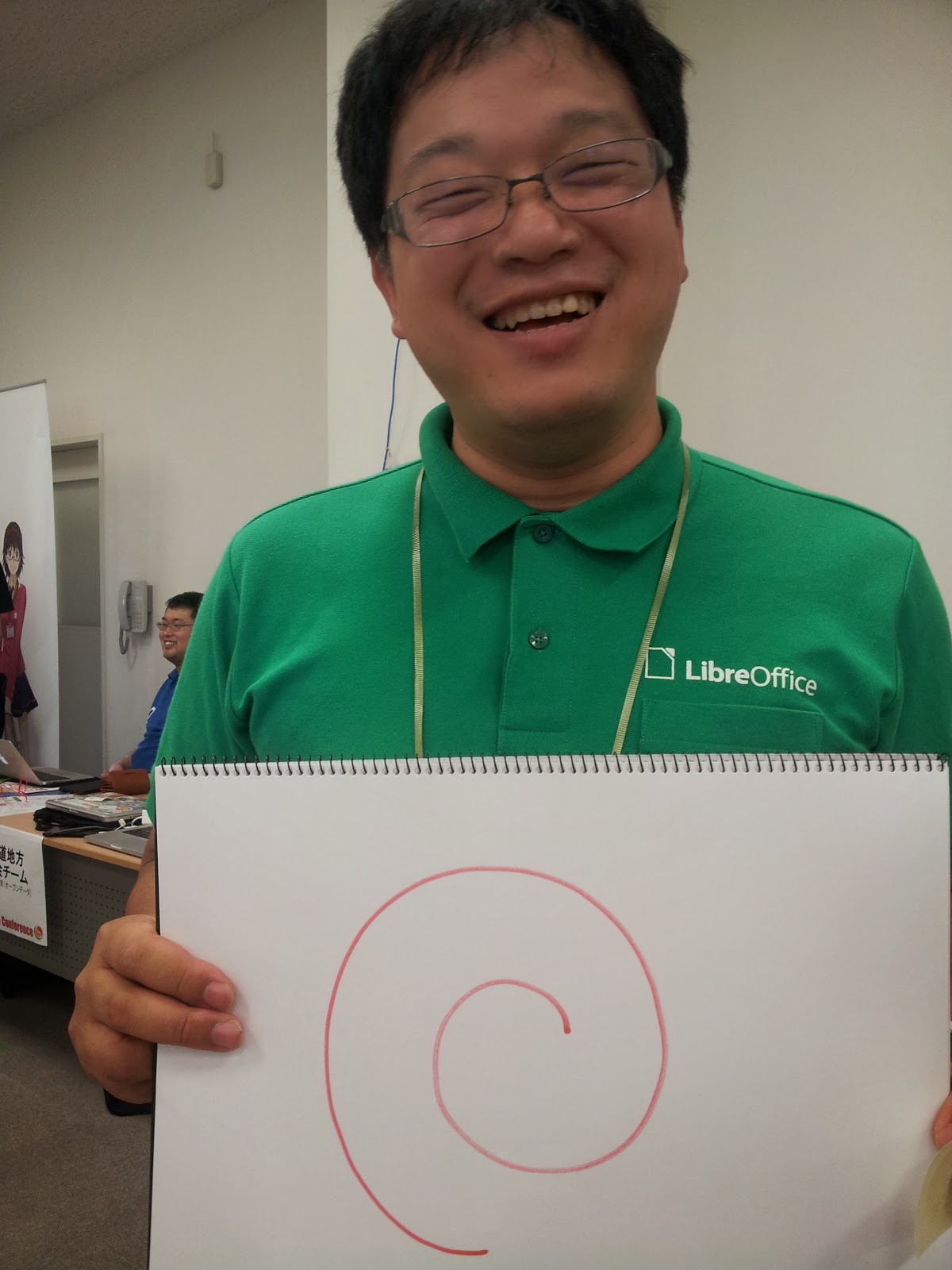
14th June, I've participated to OSC (Open Source Conference) 2014 Hokkaido in Sapporo, Hokkaido (sorry openSUSE folks, OSC does not mean openSUSE Conference ;) OSC has 10 years history in Japan, so don't blame me...)

Hokkaido is northan island of Japan (it has 4 major islands - Hokkaido, Honshu, Shikoku and Kyushu), takes 1.5 hours from Tokyo (HND-CTS) and debian-mirror.sakura.ne.jp is also there.

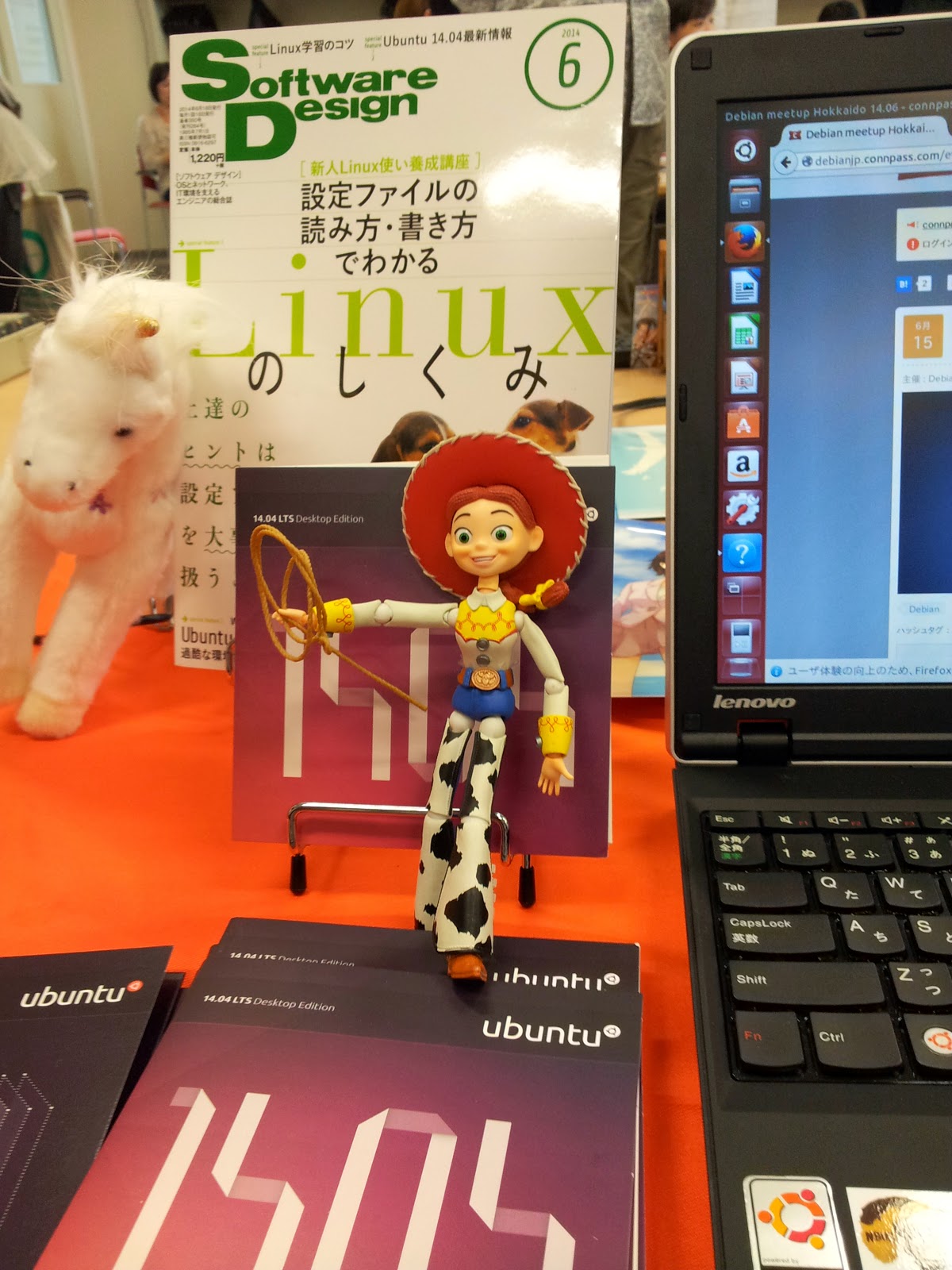
As always, we show the Debian booth with Debian lovers, Squeeze, Woody and Jessie.


And I gave talk about Debian a little,
mostly how it is developed and distribute, and shapes in Jessie at that time (PDF/odf is my page on Debian Wiki as usual).

Does Cowgirl Dream of Red Swirl? from Hideki Yamane


After that, Enjoyed food, beer (sure! :) and chatting in party.


Folks, see you in #osc15do again!

Steve Kemp: And so it begins ...

1. This weekend I will apply to rejoin the Debian project, as a developer. 2. In the meantime I've been begun releasing some some code which powers the git-based DNS hosting site/service. 3. This is the end of my list. 4. I lied. This is the end of my list. Powers of two, baby.

DebConf team: Second set of talks accepted; 3 days left to submit yours (Posted by Ana Guerrero Lopez)

There are only left 3 days to submit your talk. Submit yours before it s too late. From the submissions from the last week, we have accepted a second batch of talks: If your talk is not on the list, it doesn t mean that it is not accepted. The talks team will go through the list of talks again, and will publish the final list of talks towards the end of the month. We ll keep the submission of talks open after the deadline. Talks submitted after the deadline still have the possibility of being scheduled as ad-hoc talks. We ll publish more information about this closer to the conference.

Russ Allbery: rra-c-util 5.5

The most significant change in this release is a somewhat embarassing bug fix: the network_read and network_write functions introduced in version 4.2 to support timeouts didn't correctly handle a timeout interrupted by a signal. This is now fixed by restarting the calls on EINTR. Also in this release is a general cleanup for integer overflows during memory allocation. rra-c-util now provides a replacement for reallocarray for systems that don't have it, and calloc and reallocarray are used internally where a size is calculated with multiplication. The util library also now provides a checked xreallocarray function. There are also a few minor fixes: portable/system.h guarantees the inclusion of inttypes.h and limits.h, portable/pam.h will now build with a C++ compiler, the Kerberos Autoconf probes provide a Makefile variable that can be used to suppress warnings from Kerberos headers by forcing them to be system headers, and the util/messages-krb5 test will be skipped when not built with Kerberos support. You can get the latest version from the rra-c-util distribution page.

2 July 2014

Osamu Aoki: debmake -- checking source against DEP-5 copyright

It has been already more than a year after my initial uploading of the debmake package which offers semi-automatic generation of the DEP-5 copyright file.

One recent feature addition is the "debmake -k" command which audits debian/copyright contents against the latest source. If, for example, the upstream changed the license from GPL-2.0+ to 3,0+, this command will tell you this change. (In the debian/copyright, the more specific entry should be listed after the generic entry since parser uses the last definition as the valid one.)

I admit that this package had some regressions in some previous versions. It is now a stable tool to help making multiarch aware Debian packages of any types. If you had negative experiences, please try this again.

Let me quote from its documentation for the features. (Also available in the package.)
The debmake command is intended to replace functions offered historically by deb-make and dh_make commands. Its features include:
  • use of dh syntax under the new debhelper (> 9.0) package
    • extensive check of copyright for DEP-5 (debian/copyright)
    • substvar supports for binary packages (debian/control)
    • support of compiler hardening options (debian/rules)
  • keep pre-existing Debian package configuration files untouched
    • automatic generation of the missing template packaging files
    • easy verification of the debian/copyright file against the current source. (-k option)
  • easy packaging command line UI supporting
    • non-stop execution with clean results
    • direct operation on the tarball archive
    • direct operation on the source tree from VCS
    • the multiarch Debian package
    • the multi binary Debian package
    • the non-native Debian packages from the VCS snapshot
    • seamless work with debuild, pdebuild, etc.
Note
I wrote this debmake command because there was no easy command like "python setup.py bdist_deb" to create the Debian binary package. Now "debmake -d -s -b":python" -i debuild" does the job for me.
This documentation comes with detailed packaging examples, too.

Next.

Previous.