Search Results: "dom"

10 November 2008

MJ Ray: Bloggers Unite to Reunite Refugees

Bloggers Unite

Unite to Reunite Refugees

We celebrate Software Cooperative News being reunited with its .coop domain by celebrating this Bloggers Unite event. If you’re not aware of it already, please find out more about the problem of refugee separation from Refugees United. Thank you.

Biella Coleman: Epic Lulz will be had (aka: I am giving a talk)


Screenshot-coleman-scientology-slides - OpenOffice.org Impress -1, originally uploaded by the biella.
“Old and New Net Wars over Free Speech, Freedom and Secrecy or How to Understand the Lulz battle against the C0$ Gabriella Coleman, Assistant Professor, New York University Thursday November 13: noon - 2:00pm
Columbia University Communications Colloquium
270B IAB (International Affairs Building update Open the public! You may need ID to get into the building but I am not sure. This is the case with NYU…

9 November 2008

Simon McVittie: Spec-writing On A Plane

(Written on Friday 16th, posted on Monday)

As I write this, I'm on a plane off the coast of the Netherlands, on the way back from a couple of days designing APIs with Rob McQueen and the RTCom people at NRC Helsinki (who we work with on the chat and VoIP functionality for Nokia internet tablets).

We've had a very useful couple of days, mainly designing the next-generation channel requesting and dispatch API for Telepathy (the same APIs I've been doing preparatory work for on the Telepathy mailing list in the last couple of weeks). API sketches for review and comment are either on are on Merge Monkey or on the way there.

Before even reaching Nokia, Rob and I did a lot of design on the plane over to Helsinki, and I took some notes: here they are, by way of a glimpse at how the Telepathy design process works when we don't have a whiteboard[1] :-)

  • Geoloc looks good in principle, needs some more work
    • add more docstrings
    • add a way to ask people for uncached info (RequestLocations)
    • move access control to Co.I.Presence, call it RichPresenceAccessControl?
  • DeliveryReporting looks good, ish
    • improve wording of delivery-echo and rationale
    • when sending a delivery report, add a reason for the status (using Channel_Text_Send_Error?)
  • Uniqueness requirement for (channel, handle_type != 0, handle) is in the way - let's drop it
  • MSN should use "authentic" 1-1 chats, and use Ch.I.UpgradeableToRoom (name tbd) to migrate the underlying switchboard to be a room
  • XMPP should use Ch.I.UpgradeableToRoom too, but the 1-1 channel may also stay open
  • Mutable handle => handle 0 must stay (for requestotron's benefit)
  • bundles ftw
  • renaming: we want SelfHandleChanged in the core
  • TpC* - add ability to subscribe to ifaces ay construct time (blocks Ready) or later
  • Dispatching: when registering a c'handler, specify everything it can handle
  • If a new bundle can be handled in its entirety by the same handler (call it 'the bundle handler'), do it. Otherwise split it up completely (there is no 'bundle handler').
  • If a channel in an existing bundle can be handled by the bundle handler, send it there, else send to the default handler.
  • Group - add SelfHandleChanged, maybe? Also Connection
  • Add HandleOwners: prop a uu , HandleOwnersChanged(a uu , au)
  • Use TargetHandleType, TargetHandle
  • Stringified initiator handle as a separate property
  • Maybe even a FirstMessage property, although this stretches the definition of "immutable"
  • org.freedesktop.Telepathy.Client interface

Nokia's Mikhail Zabaluev kindly took notes for some further discussion we had with him and Alberto Mardegan about the dispatch API, which he already posted to the mailing list.

We hope this API will make it possible to integrate Telepathy into the desktop better - it should make it a lot easier to share connections between processes in a useful way and hand out incoming channels to the appropriate handlers, which was always a major goal for Telepathy. It should also let us and others implement exciting new notification mechanisms (hi to the people on IRC and the mailing list wanting to patch their media players to integrate with Telepathy! :-)
[1]When we do have a whiteboard, the design process is: "Robot101 scribbles on a whiteboard, smcv writes down <tp:rationale> elements"

Simon McVittie: \o/

I'm now a full Debian developer! Slightly too late to vote for my landlord as project leader, but it's OK, he got in anyway :-)

Thanks to the NM team, the newly delegated keyring maintainer, and the previous DPL's eleventh-hour redelegation for making this happen!

Simon McVittie: Implementing D-Bus services with telepathy-glib

(Part 1 of an ongoing series: shiny things in telepathy-glib)
16:46 < epmf> tp-glib is made of magic

—#telepathy, 2008-04-15

Rob pointed out today that I'd been promising to blog about telepathy-glib for several months and still haven't done so. I think there's too much to cover in one blog post, so I'll start with the oldest part - implementing a service (typically a Telepathy connection manager).

While telepathy-glib is (obviously) intended for Telepathy implementors, I think the ideas we've been implementing are likely to be useful for any D-Bus API, particularly flexible/complex APIs where an object implements many interfaces.
Introduction to telepathy-glib telepathy-glib started out as a collection of code extracted from our XMPP connection manager, telepathy-gabble, but at some point it grew beyond that into a wrapper around/partial replacement for dbus-glib. We've been quite pleased with it, really :-) My first major round of work on telepathy-glib, during the first half of 2007, was to split it out from telepathy-gabble (versions up to 0.5.9 were released as part of Gabble 0.5.x tarballs, in fact), leading to the release of the 0.6.x stable branch in late September. This was very helpful for implementing connection managers - Salut, Idle and telepathy-sofiasip (our connection managers for link-local XMPP, IRC and SIP) all started off by forking/cargo-culting from Gabble, and achieved huge code reductions by porting to telepathy-glib. Also, Will Thompson used it in his Summer of Code project, telepathy-haze, to go from nothing to a working and useful Telepathy implementation based on libpurple in a matter of a few months. The second major round of work, which I'll discuss in a later article, added client code to telepathy-glib, obsoleting the older/worse libtelepathy and allowing client programs like Empathy and telepathy-stream-engine to be written using telepathy-glib. In the process, I accidentally reinvented DBusGProxy :-) More details to come later!
Some background: service-side code generation
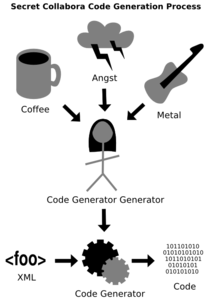
The secret Collabora code-generation process

(credit: daf)

Supporting D-Bus in the GObject world has always involved quite a lot of code generation. The core API of dbus-glib is heavily reliant on varargs functions, which aren't type-safe and are easy to get wrong. dbus-glib contains a program called dbus-binding-tool, which is meant to generate reasonably sane GObject APIs for D-Bus objects. Unfortunately, it seems to be intended to generate a whole GObject at a time. Early versions of telepathy-gabble used dbus-binding-tool plus a script called gengobject.py to generate API stubs for the exported objects; developers then filled in the blanks, and hey presto, we had a GObject on D-Bus. This was fine up to a point, but had a couple of major drawbacks. Whenever we changed the D-Bus API (quite common during the early development of Telepathy), there was a very laborious and error-prone merging process. We ended up with the following process:
  • copy the D-Bus introspection XML from the telepathy-spec repository into a directory xml/pristine (actually, the canonical form for the spec was Python for a while, and we had a script that exported a contrived object onto D-Bus and introspected itself to get the XML - but that's another story!)
  • preprocess the introspection XML to add the dbus-glib CFunctionName annotation, resulting in a directory xml/modified
  • run dbus-binding-tool and a Python script gengobject.py to generate C source in xml/src
  • three-way-diff the old version of xml/src, the new version of xml/src, and the real C code in src to create a new version of src
  • pray that the diff process hadn't randomly exchanged functions' implementations
  • update the resulting code in src so it worked
  • check the whole mess back into darcs
  • hope that nobody else had made changes that would result in darcs conflicts
If you haven't yet gathered, this was a bit of a nightmare. Also, it was very easy to return the wrong thing from a method without noticing - because all the APIs were varargs, the compiler didn't notice, and the first we'd know about it was a mysterious segfault under certain circumstances.
How telepathy-glib fixes code generation telepathy-glib improves on this by taking advantage of this innocuous-looking feature in dbus-glib:
commit 355ef78d98d6fc65715845d56232199162cab12a
Author: Steve Fr cinaux <steve istique net>
Date:   Thu Aug 17 11:48:20 2006 +0200
    Interface support for bindings.
Instead of running dbus-binding-tool or creating GObjects with D-Bus interfaces, we put the entire Telepathy spec through glib-ginterface-gen.py, a distant descendant of Gabble's gengobject.py. For each interface in the spec, we generate a GInterface that mirrors the D-Bus interface. Any GObject that implements the GInterface automatically gets the D-Bus interface if it's exported onto D-Bus. There are a few non-obvious refinements, though:
  • The signature of the method implementation is always in the mode that dbus-glib calls "asynchronous", where the method implementation can either send a reply message before or after it returns. For "slow" methods, this is the only thing you can do. For instance, many Telepathy D-Bus methods can't return anything until some TCP round-trips to the server have happened. This is also the only thing you can do if you want to extract extra information, like the sender's unique name, from the method-call message (dbus-glib's "synchronous" API doesn't allow this to be done). For "fast" methods, sending a reply message before returning is just as easy as using the "synchronous" API (it's just a difference of syntax), and has an API consistent with that of the "slow" methods, making it easier for service authors.

  • The layout of the GInterface vtable is private, and (auto-generated) accessor functions are used to fill in implementations. This means our ABI doesn't change just because we re-ordered functions in the spec.

  • If no implementation is provided for a method, we just raise an appropriate error (org.freedesktop.Telepathy.Errors.NotImplemented), rather than suffering an assertion failure. This means we can safely add methods to an interface.

  • While we're generating code anyway, we generate some static inline wrapper functions which wrap dbus_g_method_return(), to have type-safe method returns. You can easily check that a method replies with correct types, by checking that the implementation of Foo() replies by calling tp_svc_some_interface_return_from_foo().

  • Similarly, we generate wrapper functions to emit signals, to get type-safe signal emission.

Not all interfaces are stable enough to be included in telepathy-glib's stable API and ABI, so some of our other projects include a copy of the telepathy-glib code-generation tools, and generate their own "mini-telepathy-glib" (traditionally in a /extensions/ directory) for their implementation-specific (drafts of) interfaces. This isn't yet as polished as it ought to be (mainly because we don't want to freeze the augmented-introspection-XML format that we write the Telepathy spec in, because it's rather ad-hoc and hackish in places) but it works quite well in practice. To see what this looks like in practice, have a look at the examples in telepathy-glib, or at a Telepathy connection manager like telepathy-gabble.
Mixins and base classes Another feature of telepathy-glib which makes life easier for connection manager authors is that it provides "mixins" and base classes which implement some of the GInterfaces. There's absolutely nothing magic about the base classes - they don't have any access to private implementation details of the GInterfaces, they just implement them like everyone else does. The "mixins" are only slightly more magical - they store some extra state inside the structures representing GObjects and their classes, and use it to provide default implementations of some or all of the methods on a particular interface (or two interfaces, in the case of the new TpMessageMixin). I'll leave it up to Rob to explain those in greater detail, since I seem to remember that he invented them :-P The examples and regression tests in telepathy-glib are quite good examples of how these work in practice.

Simon McVittie: Here's how it works

Daf recently described a large part of my job, in diagrammatic form: The secret Collabora code-generation process

(source)

Simon McVittie: A magical xrandr incantation

Here's a handy incantation I use with the Intel X.org graphics driver on my laptop.

Put this script somewhere convenient:

#!/bin/sh
if xrandr   grep '^VGA connected' >/dev/null
then
    #echo "VGA connected"
    xrandr --output VGA --above LVDS --auto
    xrandr --output LVDS --auto
else
    #echo "VGA not connected"
    xrandr --auto
fi 2>&1   logger -t xrandr-hotkey

and bind it to your "switch video mode" key, e.g. Fn+F7 on my Thinkpad X60s. For instance, I run xbindkeys, so I saved it as autoxrandr and put this in ~/xbindkeysrc:

"exec /home/smcv/bin/autoxrandr"
    XF86Display

Now if you press the "switch video mode" key with a monitor plugged in, you'll get the external monitor appearing above the laptop panel (my preferred configuration - I've balanced my monitor on an N800 box to get the bottom of the screen level with the top of my laptop's screen). If you press that key again after unplugging the VGA cable, the laptop will turn off the VGA output and pull all the windows onto the built-in screen.

Simon McVittie: Encrypted root filesystem on a Debian laptop

I've been meaning to document this for ages... My laptop is set up with an encrypted root filesystem using LVM and dmcrypt. It also has a small Debian stable system for recovery purposes (I don't have a CD drive, so if everything goes horribly wrong, I can't just boot from a live CD). Here's how to set up something similar:

Step 1. Set up the recovery system Start the Debian lenny (beta) installer as usual. (I originally used etch, but these instructions are for lenny - either should work.) When you get to "Partition disks", choose "Manual". Here's the partitioning scheme to use:
  • main partition for LVM, taking up the whole disk minus 1GB or so. select "Do not use", for now
  • 1GB recovery partition at the end of the disk (this will also be the main system's /boot, since /boot needs to be unencrypted anyway). Use the defaults: ext3 mounted at /.
Finish partitioning and write changes to disk, and wait for the base system to install. Say yes to installing Grub to the MBR for now (it might be possible to do the install more cleanly by installing Grub to the recovery partition's boot sector instead - I haven't tested that). Reboot into the freshly installed recovery system and satisfy yourself that it works.

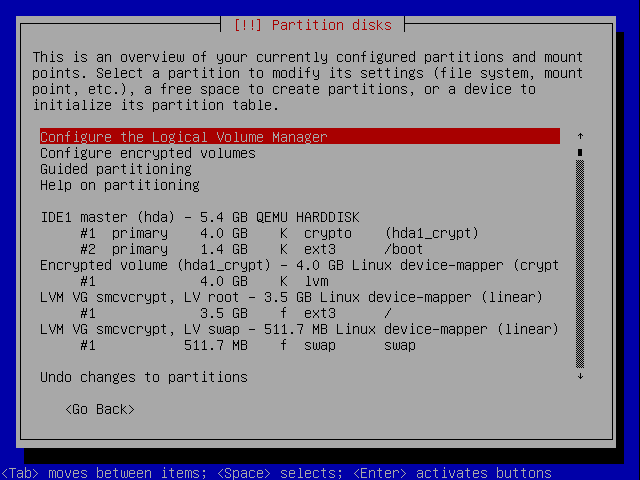
Step 2. Set up the main system Now boot the Debian installer again. This time it's for your installed system. At the "Partition disks" stage, choose "Manual" again. Select the main partition and choose "Use as: physical volume for encryption". Next select "Configure encrypted volumes". Your main partition will now be randomized - this is slow - and some time later you'll be asked for a passphrase. You'll have to type this in at each boot. Select the contents of the "disk" Encrypted volume (hda1_crypt) and choose Use as: physical volume for LVM. Now "Configure the Logical Volume Manager" and create a Volume Group. I always use the laptop's hostname as the VG name (this reduces confusion if you ever plug the disk into another machine for disaster recovery). Create a Logical Volume called swap, the size you want your swap space to be. If you plan to use suspend-to-disk, this needs to be at least as large as your RAM. Create a Logical Volume called root, for the root filesystem. If you want separate "partitions" for things like /home, now is a good time to create them too; if you want to use my schroot howto, leave some unallocated space in the VG for that. Set your swap LV to be used as a swap area, and your root LV to be used as ext3 mounted at /. If you wanted extra LVs, set them up too. Also set your recovery partition to be used as ext3, mounted on /boot, and not reformatted. It should now look something like this (smcvcrypt is the name of a KVM virtual machine in which I've been testing these instructions, normally you'd have the laptop's hostname there). Screenshot from d-i Proceed with the installation. Install Grub to the MBR - this will temporarily make the recovery system unbootable, but shrug never mind. Finish the installation and reboot into your new main system.
Step 3. Make them dual-boot Within the main system your recovery system is also visible, at /boot. Bind-mount /dev onto /boot/dev, chroot into /boot, and run "update-grub /dev/hda2", where hda2 is the partition where the recovery partition is. Leave the chroot. Edit /boot/grub/menu.lst and put this right at the end:
title Go to recovery system
root (hd0,1)
chainloader +1
(Replace (hd0,1) with what Grub thinks the recovery partition is - the second number is the partition number starting from 0, so /dev/hda5 would be (hd0,4) and so on.) Also edit /boot/boot/grub/menu.lst and put this right at the end:
title Back to main system
root (hd0)
chainloader +1
Also, still in /boot/boot/grub/menu.lst, go to the top of the file and change the colour scheme to something else (I used a red background) to indicate that this boot menu is for the recovery system. Reboot and try it out. You should now have an extra boot menu option, "Recovery system". Selecting it will switch to the recovery system's boot menu, which has an option to switch back, and so on. Each boot menu also has some entries for kernels, any of which will boot with the appropriate root filesystem (encrypted root for the main system, unencrypted for the recovery system). Success!

Simon McVittie: Integrating Enemies of Carlotta with Postfix

From the "doing sysadmin over wobbly 3G while waiting for our plane to be allowed to take off" department comes this bit of mailing list setup. By his own admission, Rob is better at configuring Postfix than he is at making blog posts, so I get to be the one posting this...
09:58 <@Robot101> my postfix -> eoc integration is basically ninja, if I might 
                  say so myself
09:58 <@Robot101> so, an eoc transport in master.cf:
09:58 <@Robot101> eoc       unix  -       n       n       -       10      pipe 
                  user=list argv=/usr/bin/enemies-of-carlotta --quiet 
                  --incoming --sender=$ sender  --recipient=$ recipient 
09:59 <@Robot101> then in main.cf:
09:59 <@Robot101> eoc_destination_recipient_limit = 1
09:59 <@Robot101> virtual_mailbox_domains = lists.collabora.co.uk
09:59 <@Robot101> virtual_mailbox_maps = pcre:/etc/postfix/list_transports
09:59 <@Robot101> transport_maps = pcre:/etc/postfix/list_transports
09:59 <@Robot101> then a script/cron:
09:59 <@Robot101> su -c "enemies-of-carlotta --show-lists" list   sed 
                  's,\(.*\)@\(.*\),/^\1(-[^@]*)?@\2$/ eoc,' 
                  >/etc/postfix/list_transports
09:59 <@Robot101> giving list_transports like this:
09:59 <@Robot101> /^test(-[^@]*)?@lists.collabora.co.uk$/ eoc
09:59 <@Robot101> (thanks to smcv for assistance with regexp-generation regexp)
...
10:01 <@wjt> ten points for using the best -named mlm
10:01 <@Robot101> 2000 points for not having a mailing list system held 
                  together with procmail, shell, duct tape, gash and string

Simon McVittie: Speeding up builds with ccache and icecc

Here's a script I use to speed up compilation at work. Since I work at Collabora, I call it collaboratively. It's a prefix to a command (used in the same way as sudo or nice) which sets up icecc (Icecream) and ccache to work nicely together.
#!/bin/sh
# ~/bin/collaboratively
# Typical usage: collaboratively make check
PATH=/usr/lib/ccache:/usr/lib/icecc/bin$(echo :$PATH   sed -e s@:/usr/lib/ccache@@g)
export PATH
MAKEFLAGS='-j -l3'
export MAKEFLAGS
exec "$@"
Some more explanation of what it does: apt-get install icecc-monitor and run icemon to see whether this is all working - if it is, you should see compile jobs going off to other hosts.

8 November 2008

Steve McIntyre: 3rd Free Software Congress in Valencia

I spent much of this week in Alicante. It was wonderful to have a few days away from the beginnings of Winter in Cambridge - Alicante's in South West Spain, right on the Mediterranean. It's a lovely city, although it was very quiet due to the time of year. I was invited down to Alicante by organisers of the Congr s de Programari Lliure, Comunitat Valenciana, to present a talk about Debian. That I did, and as always my slides and photos are available in case people are interested. I wasn't too sure about what level to aim the talk, so I deliberately went for a general introduction to Debian. That seems to have been the correct level - nobody threw anything at me, and nobody was visibly falling asleep. *grin* It's also the first time I've ever given a talk with official translators, which is a weird experience! The main topic for the conference was the new release of Lliurex, Valencia's own GNU/Linux distribution targeted primarily at use in schools. The conference was massive; I was told there were about 1500 attendees in all, most of whom were teachers who wanted to come and learn more about Free Software. There was a good spread of talks and workshops, covering topics from development through to deployment in the classroom. The level of enthusiasm for Free Software here was immense - lots of people were keen to learn more about it and get involved. I was told that out of the 15 regions/states of Spain, 11 of them have now started their own distributions to use in schools! Extremadura were the first region to experiment with Free Software like this, and their success with LinEx was a clear inspiration to their neighbours elsewhere in Spain. As well as the obvious cost advantages of moving from proprietary to Free Software, the local governments also love the freedom to use and modify their software however they like - including the ability to provide their own translations. Conference welcome I met up with a lot of cool people at the conference too. The local education minister (Alejandro Font de Mora) was keen to talk with all the speakers and very enthusiastic about the future of Free Software in his schools. As is increasingly common at FS events around the world, there were of course quite a few Debian people around too. Luciano and Miriam were also giving talks, and I bumped into Rene and Miguel and a whole bunch of others whose names I'm too crap to remember - sorry! I also spoke a lot with Kurt Gramlich, the mega-enthusiastic Skolelinux developer who was also happy to push Debian to everybody he spoke to *grin*. Jon "Maddog" Hall had some excellent ideas that I'm sure we'll all hear more about soon, and his talk was excellent. He did a very good job of explaining how Free Software makes such a difference, including how it helps people to make money. He also explained that due to travel he had missed Halloween at home and he wanted to share the experience of scary masks with the people at the conference: Maddog Bush I had a great time in Alicante, and I'm very grateful for the invitation to go there. I wish that the UK was as far as advanced as Spain in the use of Free Software in education - they've done a huge amount of good work in this area and I'm glad we can help them.

Joerg Jaspert: Debian mirror scripts

With a small mail to our mirrors-announce list, I just opened the work of more than one month to the public. Even better, I strongly encourage every mirror admin to use my scripts, or at least scripts that follow a minimal set of rules I wrote down… Some long time (somewhere in April or May this year) I got added to the Debian mirroradm group. First it was only to get some problems with packages.debian.org solved, but later on I started doing more. This group is basically the one that handles the archvsync user on .debian.org machines and also manages the official Debian mirrors listing. As the archvsync user exists on multiple .debian.org machines, and many of them do mirror a copy of our archive for various reasons, all of them had some version of a mirroring script, and sometimes also a version of a pushmirror script. Unfortunately, as they all had been maintained mostly on their own per machine - they sometimes had evolved a bit different. Additionally all of them had a few problems which could leave us with a broken mirror behind, despite it looking all well. So on Sept. 26 I decided to trash it all and rewrite the script and put it all in a VCS (and selected git). For that I set myself a few goals, like (in no particular order) Now, 109 commits and more than a month later, I was finally able to open the scripts to the wide public. (Had multiple people test them before this, but thats always different than a real “release”). The scripts are in use on all .debian.org machines and some other mirrors already, so I’m fairly sure they work.
As I already wrote, Debian mirror admins are strongly encouraged to use this scriptset and not to invent their own. In case you miss a feature either send me a mail describing it, or better, a patch implementing it. I’m happy to implement as much as possible (and sensible :) ) And while it is discouraged to use own scripts, sometimes people have reasons to have their own, so there is now a minimal set of functionality that such a script MUST support. All of those requirements are easy to fulfill. Well, at least the MUST ones. The first one is basically a given, all scripts I know are doing this already. The second one sounds more complicated, but actually might just be about 4 lines of actual code changes. Just touch an extra file before you gain a lockfile (to avoid two scripts running at the same time) and then rerun rsync as long as that extra file is around. (It helps to rm this trigger file right before you call rsync :) ). The should directive is actually a little more work to implement correctly. I won’t show source here, read the ftpsync script if you want to see it, but I try some small explanation. Background: Debian mirror synchronisation is usually done by scripts that get started via ssh. As mirror operators (understandably) do not like their upstream mirror to be able to login, this is done using “ssh triggers”, a feature I wrote about earlier. Those are sshkeys using a forced command, so nothing else than this command will be run, ever. SSH, if used with such forced commands, has the helpful feature that it sets the environment variable SSH_ORIGINAL_COMMAND containing the original arguments. Which means that, if the mirror pushes you with “ssh yourhost -l mirror sleep 1” you will see *sleep 1 in that variable. It is what many mirror operators currently use when pushing their downstreams. Now, we can use that to tell the receiving end all things we want it to know. If you look in my script you will see that I defined a little more than the minimal arguments. But none of the additional ones are a requirement, they only make life much easier. My script currently understands, additional to the 3 minimal ones:
As if that wasn’t enough, I also had to rewrite the runmirrors script. The old 10-line one just didn’t cope with the more general approach. This script is used to “push” your downstream mirrors, telling them that they need to update. (Which is the only sane way to run a mirror. cron is just not made for mirrors that can update at random times!). One nice new feature of it is the ability to update multiple mirrors nearly at the same time. This is extremely helpful in case of DNS Round Robin entries like security.debian.org (multiple hosts offering the same archive under one hostname). You do not want to have such hosts out of sync. Not even for a minute, if you can avoid that. So we now push the mirrors with sync:stage1 as argument. Then we wait until all of them have finished the stage1 sync before we push them all again, this time with sync:stage2 as argument. This will erase any update delays thanks to network latency / low bandwidth one of the security mirrors might have, as the large transfers (all the binary and source packages) are done in stage1. They can take time, a normal user won’t notice it - the Package and Source indices are not transferred yet. They arevery small and as such transfered pretty fast whenever stage1 is done everywhere and we tell mirrors to do stage2.
All in all it was a pretty nice exercise writing those scripts. Comments: 0

7 November 2008

Axel Beckert: e-mail.is-not-s.ms

When I first read http://two.sentenc.es/ in (if I remember correctly) madduck’s signature, I thought something like “This can’t be! Why are people castrating themself?” Although I really understand that the inventor has good reasons for such a personal policy, I notice how much time I waste by trying to fit all the information I want to transmit in the 160 characters a short messages allows — or, even worse, into the 140 characters microblogging services like identi.ca or Twitter allow. So I had to oppose something to this, but even to only reach the coolness level of the domain “sentenc.es” is hard, you probably can’t top it at all. For luck, I’m not alone and Venty had the right idea for a hostname which has at least some geeky niveau. So here it is, our pleading for e-mails as long and detailed as necessary:

http://e-mail.is-not-s.ms/ A German version will be available soon at http://e-mail.ist-nicht-s.ms/. Feel free to add either URL to your e-mail signature. :-) Oh, and thanks to the Government of Montserrat which allows strangers to register .ms domains without any hassles. :-) Update / FAQ Seems to be necessary to make a few things clear…

  1. No, I do not think that everyone using two.sentenc.es has neither style nor knows anything about grammar or punctuation. What I say is that the site two.sentenc.es itself with its comparision to short messages (and especially without reading the author’s blog post about the site’s background) indirectly suggests to drop grammar, punctuation and style by cramming all information into a limit number of characters as often done with short messages or microblogging. And the limitation in senctences leads to tapeworm sentences which I try to avoid since they’re considered bad style, too.
  2. And yes, it’s consciously written and designed to be the opposite of two.sentenc.es — even the colors and the font — and therefore is of course very close to the original. See it as it parody or satire if the closeness makes you angry.
  3. And no, I currently don’t care if the site makes less sense if you don’t know two.sentenc.es — people usually can follow hyperlinks on websites.
  4. We weren’t the first ones who noticed that e-mail is not SMS. An example of the problem described above from 2001.

6 November 2008

Mike Hommey: Another tool to mount virtual disk images

Vboxmount is public, says Christian Kellner. It is a tool using VirtualBox APIs to bring virtual disks (not sure if it is limited to VirtualBox format or works for any format VirtualBox knows) as block devices under linux, using the network block device driver (nbd). I have to say there are 2 things I don’t like about nbd. First, it adds useless overhead, since it has to go through the network stack, even when the whole thing is local. Second, I have had bad experience with nbd stability, though I must say I only tested on old stuff. A while ago, VMware ESX 2.5 had a tool, named vmware-mount, that would basically do what Vboxmount does, for ESX vmdk files, on the ESX service console (a 2.4.something kernel). The fact is, the whole thing would bring the whole server down (kernel panic or deadlock, I can’t remember) more often than not. Which is why the tool has not been provided since ESX 3.0. This tool was using nbd. There are IMHO better ways to implement something like this, though the nicest doesn’t exist yet.

4 November 2008

Russell Coker: Basics of EC2

I have previously written about my work packaging the tools to manage Amazon EC2 [1]. First you need to login and create a certificate (you can upload your own certificate - but this is probably only beneficial if you have two EC2 accounts and want to use the same certificate for both). Download the X509 private key file (named pk-X.pem) and the public key (named cert-X.pem). My Debian package of the EC2 API tools will look for the key files in the ~/.ec2 and /etc/ec2 directories and will take the first one it finds by default. To override the certificate (when using my Debian package) or to just have it work when using the code without my package you set the variables EC2_PRIVATE_KEY and EC2_CERT. This Amazon page describes some of the basics of setting up the client software and RSA keys [2]. I will describe some of the most important things now: The command “ec2-add-keypair gsg-keypair > id_rsa-gsg-keypair” creates a new keypair for logging in to an EC2 instance. The public key goes to amazon and the private key can be used by any ssh client to login as root when you creat an instance. To create an instance with that key you use the “-k gsg-keypair” option, so it seems a requirement to use the same working directory for creating all instances. Note that gsg-keypair could be replaced by any other string, if you are doing something really serious with EC2 you might use one account to create instances that are run by different people with different keys. But for most people I think that a single key is all that is required. Strangely they don’t provide a way of getting access to the public key, you have to create an instance and then copy the /root/.ssh/authorized_keys file for that. This Amazon page describes how to set up sample images [3]. The first thing it describes is the command ec2-describe-images -o self -o amazon which gives a list of all images owned by yourself and all public images owned by Amazon. It’s fairly clear that Amazon doesn’t expect you to use their images. The i386 OS images that they have available are Fedora Core 4 (four configurations with two versions of each) and Fedora 8 (a single configuration with two versions) as well as three other demo images that don’t indicate the version. The AMD64 OS images that they have available are Fedora Core 6 and Fedora Core 8. Obviously if they wanted customers to use their own images (which seems like a really good idea to me) they would provide images of CentOS (or one of the other recompiles of RHEL) and Debian. I have written about why I think that this is a bad idea for security [4], please make sure that you don’t use the ancient Amazon images for anything other than testing! To test choose an i386 image from Amazon’s list, i386 is best for testing because it allows the cheapest instances (currently $0.10 per hour). Before launching an instance allow ssh access to it with the command “ec2-authorize default -p 22“. Note that this command permits access for the entire world. There are options to limit access to certain IP address ranges, but at this stage it’s best to focus on getting something working. Of course you don’t want to actually use your first attempt at creating an instance, I think that setting up an instance to run in a secure and reliable manner would require many attempts and tests. As all the storage of the instance is wiped when it terminates (as we aren’t using S3 yet) and you won’t have any secret data online security doesn’t need to be the highest priority. A sample command to run an instance is “ec2-run-instances ami-2b5fba42 -k gsg-keypair” where ami-2b5fba42 is a public Fedora 8 image available at this moment. This will give output similar to the following: RESERVATION r-281fc441 999999999999 default
INSTANCE i-0c999999 ami-2b5fba42 pending gsg-keypair 0 m1.small 2008-11-04T06:03:09+0000 us-east-1c aki-a71cf9ce ari-a51cf9cc The parameter after the word INSTANCE is the serial number of the instance. The command “ec2-describe-instances i-0c999999” will provide information on the instance, once it is running (which may be a few minutes after you request it) you will see output such as the following: RESERVATION r-281fc441 999999999999 default
INSTANCE i-0c999999 ami-2b5fba42 ec2-10-11-12-13.compute-1.amazonaws.com domU-12-34-56-78-9a-bc.compute-1.internal running gsg-keypair 0 m1.small 2008-11-04T06:03:09+0000 us-east-1c aki-a71cf9ce ari-a51cf9cc The command “ssh -i id_rsa-gsg-keypair root@ec2-10-11-12-13.compute-1.amazonaws.com” will then grant you root access. The part of the name such as 10-11-12-13 is the public IP address. Naturally you won’t see 10.11.12.13, it will instead be public addresses in the Amazon range - I replaced the addresses to avoid driving bots to their site. The name domU-12-34-56-78-9a-bc.compute-1.internal is listed in Amazon’s internal DNS and returns the private IP address (in the 10.0.0.0/8 range) which is used for the instance. The instance has no public IP address, all connections (both inbound and outbound) run through some sort of NAT. This shouldn’t be a problem for HTTP, SMTP, and most protocols that are suitable for running on such a service. But for FTP or UDP based services it might be a problem. The part of the name such as12-34-56-78-9a-bc is the MAC address of the eth0 device. To halt a service you can run shutdown or halt as root in the instance, or run the ec2-terminate-instances command and give it the instance ID that you want to terminate. It seems to me that the best way of terminating an instance would be to run a script that produces a summary of whatver the instance did (you might not want to preserve all the log data, but some summary information would be useful), and give all operations that are in progress time to stop before running halt. A script could run on the management system to launch such an orderly shutdown script on the instance and then uses ec2-terminate-instances if the instance does not terminate quickly enough. In the near future I will document many aspects of using EC2. This will include dynamic configuration of the host, dynamic DNS, and S3 storage among other things.

3 November 2008

Adeodato Sim : Software that rocks

From the “Software that recently rocked my pants” department: I also thank Martin F. Krafft for helpfully updating the encryption howto I followed for my previous laptop to mention that using a single encrypted device and LVM on top of it is (possibly) preferred nowadays. And to Simon McVittie for his idea of a small unencrypted Debian installation for recovery purposes in laptops without an optical drive. P.S.: I can’t believe this shit about blogging every day in November.

Russell Coker: Types of Cloud Computing

The term Cloud Computing seems to be poorly defined at the moment, as an example the Wikipedia page about it is rather incoherent [1]. The one area in which all definitions of the term agree is that a service is provided by a varying number of servers of which the details are unknown to the people who use the services - including the people who program them. There seem to be four main definitions of cloud computing. The first one is Distributed Computing [2] (multiple machines in different administrative domains being used to perform a single task or several tasks), this definition does not seem to be well accepted and will probably disappear. The next one is Software As A Service [3] which is usually based on the concept of outsourcing the ownership and management of some software and accessing it over the Internet. An example is the companies that offer outsourced management of mail servers that are compatible with MS Exchange (a notoriously difficult system to manage). For an annual fee per email address you can have someone else run an Exchange compatible mail server which can talk to Blackberries etc. The main benefit of SAAS is that it saves the risk and expense of managing the software, having the software deployed at a central location is merely a way of providing further cost reductions (some companies that offer SAAS services will also install the software on your servers at greater expense). The last two definitions are the ones that I consider the most interesting, that is virtual machines (also known as Cloud Infrastructure [4]) and virtual hosting of applications (also known as Cloud Platforms [5]). The Amazon EC2 (Elastic Cloud Computing) service [6] seems to be the leading virtual machine cloud service at the moment. Google App Engine [7] seems to be the leading cloud application hosting service at the moment. It is also claimed that “Cloud Storage” is part of cloud computing. It seems to me that storing data on servers all over the world is something that was done long before the term “Cloud Computing” was invented, so I don’t think it’s deserving of the term.

2 November 2008

John Goerzen: Politics and the Church

My church is one in which politics are checked at the door. Some church members wear their politics on their yard, or on their blog -- and just about every opinion is represented in the church. But you rarely hear politics mentioned in church. When it is mentioned, it's issue-oriented rather than candidate-oriented or policy-oriented -- we'll hear updates on efforts to create a peace tax fund, for instance.

But today, hearing about politics is just about unavoidable.

The relationship between Christianity and government has been uneasy and troubled all the way back to the religion's founding. Many Christians, and I count myself in this, believe that our first loyalty is to Jesus, and on those grounds, refuse to say the pledge of allegiance. What, we wonder, would our word be worth if we were forced to disobey our government because of a law that was unjust or immoral? How could we even say the words "one nation, under God, with liberty and justice for all" when those words were written at a time when the KKK was active, lynchings were common, and are said today at a time when people treat Muslims and immigrants with modern disdain?

In short, we believe we are called to be citizens of a different kingdom first.

So, today, our pastor deliberately picked a difficult scripture passage for us: Romans 13:1-7, which reads, in part:

Everyone must submit himself to the governing authorities. . . The authorities that exist have been established by God. . . Consequently, he who rebels against the authority is rebelling against what God has instituted, and those who do so will bring judgment on themselves. For rulers hold no terror for those who do right, but for those who do wrong. . . Therefore, it is necessary to submit to the authorities, not only because of possible punishment but also because of conscience.


What an extraordinary set of statements. This was written during the time of the Roman Empire, which could hardly be said to have been a just and benign government. It's hard for me to imagine the Roman Legion being established by God.

In more modern times, it would seem to denounce the American revolution as a rebellion against authority and therefore a rebellion against God. It would also seem to denounce the protests that we see all over the world -- striking workers in France, human rights seekers in Burma, war protesters in the United States. Would it even have condemned the protests in the 1960s over civil rights in this country, or the protests against war today?

One commentator notes that "Paul is not stating that this will always be true but is describing the proper, ideal function of rulers. When civil rulers overstep their proper function, the Christian is to obey God rather than human authorities" -- a theme Paul mentioned more than once in Acts.

What relevance does this have for us today? It seems that we are to help our rulers act in a just way, even if we disagree with them -- no matter who wins the election. It is also a reminder that a superficial reading of the Bible, taken out of context and without a deep understanding to understand the author's point, can potentially lead to very strange conclusions.

The American National Council of Churches has issued a non-partisan voting guide, which we found in our bulletin today. It is an interesting read, and probably not what you think; it begins with, "War is contrary to the will of God." Thought-provoking stuff.

I find it interesting that there are a lot of people out there that say that religion is responsible for a lot of ill in this country, then proceed to hold pretty much the same opinions I do for pretty much the same reasons. I just point out that the Bible is deeper than intolerance and submission.

Kurt Roeckx: DKIM: Useful?

I've been looking at DomainKeys Identified Mail (DKIM) to see if it's useful. My main interest is reducing bounced mail that I didn't send and other people receiving less spam that appears to come from me. It seems there isn't a lot of documentation about it around, and I had to go and read some of the RFCs and drafts to understand things. So I hope this is useful for someone. According to the wikipedia article it can be used to verify that the message comes from the domain that it claims to have come from. On the other hand the DKIM FAQ says it's all about the reputation of the organization the messages passed by. There is a project that creates a reputation database that then can be used in anti-spam software like spamassassin. So I at first sight this didn't look useful at all to me. It basically seems like a way to verify the Received lines in the message header. And it seems that that is what most of the software is doing. But there also seems to be an Author Domain Signing Practices (ADSP). It allows you to say that if the message isn't signed it can be dropped because it's spam. There is nothing else in DKIM other than reputation on which you can base that something might be spam or not. So I started looking in software that supported that. It seems that dkim-milter is the only software available in Debian that implements it. But it seems to be using the _asp._domainkey DNS entry from an old draft instead of the _adsp._domainkey as used in latest draft. Older drafts even used _ssp._domainkey. So it seems to me that it's not useful yet and I'll wait until the ADSP RFC is actually published and there is software available that supports it. Update:
It seems that dkim-milter from version 2.7.0 now uses _adsp._domainkey, but we currently only have 2.6.0 in Debian. But the wizard of sendmail.org still generates the _asp._domainkey. I've filed enhancement requests for spamassassin and dkimproxy / Mail::DKIM.

Next.

Previous.
