Search Results: "ema"

9 May 2013

Paul Tagliamonte: Hylang updates

We ve got all sorts of spiffy changes lined up and another major release! We ve got Hy version 0.9.7 released. The website is updated with the latest cut of the hylang, and y all should check it out.
Sadly, we ve not attracted any women interested in hacking on hy, so I d like to re-iterate that I m quite disappointed to see that, and encourage female hackers to check out the source and see what they can do with it. As always, the source is over at https://github.com/hylang/hy - star it, hack it, fork it, use it!

8 May 2013

Steve Langasek: Plymouth is not a bootsplash

Congrats to the Debian release team on the new release of Debian 7.0 (wheezy)! Leading up to the release, a meme making the rounds on Planet Debian has been to play a #newinwheezy game, calling out some of the many new packages in 7.0 that may be interesting to users. While upstart as a package is nothing new in wheezy, the jump to upstart 1.6.1 from 0.6.6 is quite a substantial change. It does bring with it a new package, mountall, which by itself isn't terribly interesting because it just provides an upstart-ish replacement for some core scripts from the initscripts package (essentially, /etc/rcS.d/*mount*). Where things get interesting (and, typically, controversial) is the way in which mountall leverages plymouth to achieve this. What is plymouth? There is a great deal of misunderstanding around plymouth, a fact I was reminded of again while working to get a modern version of upstart into wheezy. When Ubuntu first started requiring plymouth as an essential component of the boot infrastructure, there was a lot of outrage from users, particularly from Ubuntu Server users, who believed this was an attempt to force pretty splash screen graphics down their throats. Nothing could be further from the truth. Plymouth provides a splash screen, but that's not what plymouth is. What plymouth is, is a boot-time I/O multiplexer. And why, you ask, would upstart - or mountall, whose job is just to get the filesystem mounted at boot - need a boot-time I/O multiplexer? Why use plymouth? The simple answer is that, like everything else in a truly event-driven boot system, filesystem mounting is handled in parallel - with no defined order. If a filesystem is missing or fails an fsck, mountall may need to interact with the user to decide how to handle it. And if there's more than one missing or broken filesystem, and these are all being found in parallel, there needs to be a way to associate each answer from the user to the corresponding question from mountall, to avoid crossed signals... and lost data. One possible way to handle this would be for mountall to serialize the fsck's / mounts. But this is a pretty unsatisfactory answer; all other things (that is, boot reliability) being equal, admins would prefer their systems to boot as fast as possible, so that they can get back to being useful to users. So we reject the idea of solving the problem of serializing prompts by making mountall serialize all its filesystem checks. Another option would be to have mountall prompt directly on the console, doing its own serialization of the prompts (even though successful mounts / fscks continue to be run in parallel). This, too, is not desirable in the general case, both because some users actually would like to have pretty splash screens at boot time, and this would be incompatible with direct console prompting; and because mountall is not the only piece of software that need to prompt at boot time (see also: cryptsetup). Plymouth: not just a pretty face Enter plymouth, which provides the framework for serializing requests to the user while booting. It can provide a graphical boot splash, yes; ironically, even its own homepage suggests that this is its purpose. But it can also provide a text-only console interface, which is what you get automatically when booting without a splash boot argument, or even handle I/O over a serial console. Which is why, contrary to the initial intuitions of the s390 porters upon seeing this package, plymouth is available for all of Debian's Linux architectures in wheezy, s390 and s390x included, providing a consistent architecture for boot-time I/O for systems that need it - which is any machine using a modern boot system, such as upstart or systemd. Room for improvement Now, having a coherent architecture for your boot I/O is one thing; having a bug-free splash screen is another. The experience of plymouth in Ubuntu has certainly not been bug-free, with plymouth making significant demands of the kernel video layer. Recently, the binary video driver packages in Ubuntu have started to blacklist the framebuffer kernel driver entirely due to stability concerns, making plymouth splash screens a non-starter for users of these drivers and regressing the boot experience. One solution for this would be to have plymouth offload the video handling complexity to something more reliable and better tested. Plymouth does already have an X backend, but we don't use that in Ubuntu because even if we do have an X server, it normally starts much later than when we would want to display the splash screen. With Mir on the horizon for Ubuntu, however, and its clean separation between system and session compositors, it's possible that using a Mir backend - that can continue running even after the greeter has started, unlike the current situation where plymouth has to cede the console to the display manager when it starts - will become an appealing option. This, too, is not without its downsides. Needing to load plymouth when using crypted root filesystems already makes for a bloated initramfs; adding a system compositor to the initramfs won't make it any better, and introduces further questions about how to hand off between initramfs and root fs. Keeping your system compositor running from the initramfs post-boot isn't really ideal, particularly for low-memory systems; whereas killing the system compositor and restarting it will make it harder to provide a flicker-free experience. But for all that, it does have its architectural appeal, as it lets us use plymouth as long as we need to after boot. As the concept of static runlevels becomes increasingly obsolete in the face of dynamic systems, we need to design for the world where the distinction between "booting" and "booted" doesn't mean what it once did.

7 May 2013

Jo Shields: Windows 8: Blood from a Stone

Ordinarily, I m a big believer that it is important to keep up to date with what every piece of software which competes with yours is doing, to remain educated on the latest concepts. Sometimes, there are concepts that get added which are definitely worth ripping off. We ve ripped off plenty of the better design choices from Windows or Mac OS, over the years, for use in the Free Desktop. So, what about Windows 8, the hip new OS on everyone s lips? Well, here s the thing I ve been using it on and off for a few months now for running legacy apps, and I can t for the life of me find anything worth stealing. Let s take the key change Windows 8 has apps built with a new design paradigm which definitely isn t called Metro. Metro apps don t really have windows in the traditional sense they re more modeled on full-screen apps from smartphones or tablets than on Windows 1.0 -> 7. Which is fine, really, if you re running Windows 8 on a tablet or touchscreen device. But what if you re not? What about the normal PC user? As Microsoft themselves ask:

How do you multitask with #windows8? The answer to that is, well, you sorta don t. Metro apps can exist in three states fullscreen, almost fullscreen, or vertical stripe. You re allowed to have two apps at most at the same time one mostly full screen, and one vertical stripe. So what happens if you try to *use* that? Let s take a fairly common thing I do watch a video and play Minesweeper. In this example, the video player is the current replacement for Windows Media Player, and ships by default. The Minesweeper game isn t installed by default, but is the only Minesweeper game in the Windows 8 app store which is gratis and by Microsoft Game Studios. Here s option A:

Unusable Windows 8 option 1 And for contrast, here s option B:

Unusable Windows 8 option 2 Which of these does a better job of letting me play Minesweeper and watch a video at the same time? Oh, here s option C, dumping Microsoft s own software, and using a third-party video player and third party Minesweeper implementation:

Windows 7 flavour It s magical almost as if picking my own window sizes makes the experience better. So, as you can see above, the old OS is still hiding there, in the form of a Windows 8 app called Desktop . Oh, sorry, didn t I say? Metro apps, and non-Metro apps, are segregated. You can run both (the Desktop app can also be almost-fullscreen or a vertical strip), but they get their own lists of apps when multitasking. Compare the list on the left with the list at the bottom:

Needs moar task lists And it s even more fun for apps like Internet Explorer, which can be started in both modes (and you often need both modes). Oh, and notice how the Ribbon interface from Office 2007 has invaded Explorer, filling the view with large buttons to do things you never want to do under normal circumstances. So, that s a short primer on why Windows 8 is terrible. Is there really nothing here worth stealing? Actually, yes, there is! After much research, I have discovered Windows 8 s shining jewel:

win8multitasking-004 The new Task Manager is lovely. I want it on my Linux systems. But that s it.

Timo Jyrinki: Qt 5 in Debian and Ubuntu, patches upstreaming

PackagesI quite like the current status of Qt 5 in Debian and Ubuntu (the links are to the qtbase packages, there are ca. 15 other modules as well). Despite Qt 5 being bleeding edge and Ubuntu having had the need to use it before even the first stable release came out in December, the co-operation with Debian has gone well. Debian is now having the first Qt 5 uploads done to experimental and later on to unstable. My work contributed to pkg-kde git on the modules has been welcomed, and even though more work has been done there by others, there haven't been drastic changes that would cause too big transition problems on the Ubuntu side. It has of course helped to ask others what they want, like the whole usage of qtchooser. Now with Qt 5.0.2 I've been able to mostly re-sync all newer changes / fixes to my packaging from Debian to Ubuntu and vice versa.

There will remain some delta, as pkg-kde plans to ask for a complete transition to qtchooser so that all Qt using packages would declare the Qt version either by QT_SELECT environment variable (preferable) or a package dependency (qt5-default or qt4-default). As a temporary change related to that, Debian will have a debhelper modification that defaults QT_SELECT to qt4 for the duration of the transition. Meanwhile, Ubuntu already shipped the 13.04 release with Qt 5, and a shortcut was taken there instead to prevent any Qt 4 package breakage. However, after the transition period in Debian is over, that small delta can again be removed.

I will also need to continue pushing any useful packaging I do to Debian. I pushed qtimageformats and qtdoc last week, but I know I'm still behind with some "possibly interesting" git snapshot modules like qtsensors and qtpim.

PatchesMore delta exists in the form of multiple patches related to the recent Ubuntu Touch efforts. I do not think they are of immediate interest to Debian let's start packaging Qt 5 apps to Debian first. However, about all of those patches have already been upstreamed to be part of Qt 5.1 or Qt 5.2, or will be later on. Some already were for 5.0.2.

A couple of months ago Ubuntu did have some patches hanging around with no clear author information. This was a result of the heated preparation for the Ubuntu Touch launches, and the fact that patches flew (too) quickly in place into various PPA:s. I started hunting down the authors, and the situation turned out to be better than I thought. About half of the patches were already upstreamed, and work on properly upstreaming the other ones was swiftly started after my initial contact. Proper DEP3 fields do help understanding the overall situation. There are now 10 Canonical individuals in the upstream group of contributors, and in the last week's sprint it turned out more people will be joining them to upstream their future patches.

Nowadays about all the requests I get for including patches from developers are stuff that was already upstreamed, like the XEmbed support in qtbase. This is how it should be.

One big patch still being Ubuntu only is the Unity appmenu support. There was a temporary solution for 13.04 that forward-ported the Qt 4 way of doing it. This will be however removed from the first 13.10 ('saucy') upload, as it's not upstreamable (the old way of supporting Unity appmenus was deliberately dropped from Qt 5). A re-implementation via QPA plugin support is on its way, but it may be that the development version users will be without appmenu support for some duration. Another big patch is related to qtwebkit's device pixel ratio, which will need to be fixed. Apart from these two areas of work that need to be followed through, patches situation is quite nice as mentioned.
ConclusionFree software will do world domination, and I'm happy to be part of it.

6 May 2013

Sylvestre Ledru: Follow up on Debian & Clang

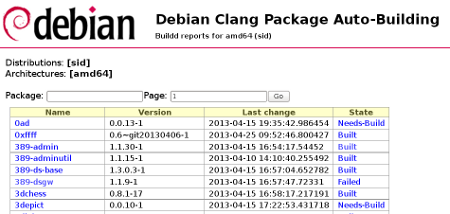
A week after the Euro LLVM conference, I am glad to share the results I presented and discussed during the event. 1) Parallel building infrastructure using clang instead of gcc Based on the work that Alexander Pashaliyski and I did during the GSoC 2012, we are now able to automatically rebuild each package uploaded in Unstable transparently. Results are published here:
http://buildd-clang.debian.net/
This provides a quick and easy way to any Debian contributors or upstream packaged in Debian to check how the package behaves with clang.
For Debian Developer and maintainer, a per maintainer view is also provided. This will list all packages maintained by a Debian packager. My page as example Here is an example of the list of package:
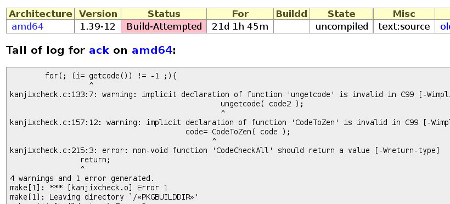
And an example of package failing:
At time of writing, most of the packages in unstable have been rebuilt (16 % are remaining). However, due to resource constraints, only amd64 packages are built. Contact me if you have resources to share for other architectures. Thanks to Paul Wise, the PTS (Debian package tracking system) proposes a link to the clang build logs (failing or not). A repository will be automatically updated with the results of these builds (once I find the time to get into buildd). 2) clang-built repository
Thanks to the Amazon Cloud, with our new DPL (Debian Project Leader), Lucas Nussbaum, we rebuilt unstable last April and published it at the following address:
deb http://clang.debian.net/repository-2013-04-07/ unstable-clang main
This allows some cool stuff like:
$ echo "deb http://clang.debian.net/repository-2013-04-07/ unstable-clang main">>/etc/apt/sources.list
$ apt-get update
$ apt-get install coreutils/unstable-clang
$ ls
$ awk
Note that this repository was only one-shoot and does not get updated. Quality of the binary produced (performance and size) can be tested thanks to this repository. Feedbacks are welcome!

5 May 2013

Michael Banck: 5 May 2013

Debian 7.0 "wheezy" has been released this weekend!

Quite a few new Debichem packages are now available in a stable Debian release for the first time:

Vasudev Kamath: CDBS Packaging: package relationship management

(It took me a while to come up with new CDBS packaging series post not because I stopped using CDBS just because I was procrastinating myself as busy) This is the second post in the CDBS packaging series. In this series I'm going to talk about package relationship management. The better example where this feature is useful is packages where build-depends and run-time dependencies overlap. Most of the Perl modules which have test suites have build-depend and run-time dependency intersection. So let me take example of a Perl module. First lets see control file of a Perl package which is not using CDBS and then let me explain how CDBS can help you improve the situation. I choose libxml-libxml-perl lets see part of control file which includes Build-Depends Depends Suggests Recommends.
Source: libxml-libxml-perl
Maintainer: Debian Perl Group <pkg-perl-maintainers@lists.alioth.debian.org>
Uploaders: Jonathan Yu <jawnsy@cpan.org>,
 gregor herrmann <gregoa@debian.org>,
 Chris Butler <chrisb@debian.org>
Section: perl
Priority: optional
Build-Depends: perl (>= 5.12),
 debhelper (>= 9.20120312),
 libtest-pod-perl,
 libxml2-dev,
 libxml-namespacesupport-perl,
 libxml-sax-perl,
 zlib1g-dev
Standards-Version: 3.9.4
Vcs-Browser: http://anonscm.debian.org/gitweb/?p=pkg-perl/packages/libxml-libxml-perl.git
Vcs-Git: git://anonscm.debian.org/pkg-perl/packages/libxml-libxml-perl.git
Homepage: https://metacpan.org/release/XML-LibXML/
Package: libxml-libxml-perl
Architecture: any
Depends: $ shlibs:Depends , $ misc:Depends , $ perl:Depends ,
 libxml-namespacesupport-perl,
 libxml-sax-perl
Breaks: libxml-libxml-common-perl
Replaces: libxml-libxml-common-perl
Description: Perl interface to the libxml2 library
 XML::LibXML is a Perl interface to the GNOME libxml2 library, which provides
 interfaces for parsing and manipulating XML files. This module allows Perl
 programmers to make use of the highly capable validating XML parser and the
 high performance Document Object Model (DOM) implementation. Additionally, it
 supports using the XML Path Language (XPath) to find and extract information.
So 2 packages are both in Build-Depends and Depends field
  1. libsax-xml-perl
  2. libxml-namespacesupport-perl
So in this situation there is a possibility that we miss to add one or both of these packages into Depends field, I'm not saying we will surely miss but we might after all we are all human beings. So how can we improve the situation using CDBS? Let me go through step by step on what we need to do.
  1. Create a file called control.in with same above contents but slight modification in Build-Depends and Depends section. I will display the diff below to avoid re-pasting entire file again and again.
--- debian/control      2013-04-28 23:08:11.930082600 +0530
+++ debian/control.in   2013-05-04 20:51:18.849680419 +0530
@@ -5,13 +5,7 @@
  Chris Butler <chrisb@debian.org>
 Section: perl
 Priority: optional
-Build-Depends: perl (>= 5.12),
- debhelper (>= 9.20120312),
- libtest-pod-perl,
- libxml2-dev,
- libxml-namespacesupport-perl,
- libxml-sax-perl,
- zlib1g-dev
+Build-Depends: @cdbs@
 Standards-Version: 3.9.4
 Vcs-Browser: http://anonscm.debian.org/gitweb/?p=pkg-perl/packages/libxml-libxml-perl.git
 Vcs-Git: git://anonscm.debian.org/pkg-perl/packages/libxml-libxml-perl.git
@@ -20,8 +14,7 @@
 Package: libxml-libxml-perl
 Architecture: any
 Depends: $ shlibs:Depends , $ misc:Depends , $ perl:Depends ,
- libxml-namespacesupport-perl,
- libxml-sax-perl
+ $ cdbs:Depends 
 Breaks: libxml-libxml-common-perl
 Replaces: libxml-libxml-common-perl
 Description: Perl interface to the libxml2 library
@@ -30,4 +23,3 @@
  programmers to make use of the highly capable validating XML parser and the
  high performance Document Object Model (DOM) implementation. Additionally, it
  supports using the XML Path Language (XPath) to find and extract information.
-
  1. Next we need to have something like below in the rule files
#!/usr/bin/make -f
include /usr/share/cdbs/1/rules/debhelper.mk
include /usr/share/cdbs/1/rules/utils.mk
include /usr/share/cdbs/1/rules/upstream-tarball.mk
include /usr/share/cdbs/1/class/perl-makemaker.mk
pkg = $(DEB_SOURCE_PACKAGE)
deps = libxml-libxml-perl libxml-sax-perl
deps-test = libtest-pod-perl
CDBS_BUILD_DEPENDS +=, $(deps), $(deps-test)
CDBS_BUILD_DEPENDS +=, zlib1g-dev, libxml2-dev, perl (>= 5.12)
CDBS_DEPENDS_$(pkg) = , $(deps)
So basically we moved all Build-Depends and Depends to rules file. The common ones are placed in deps variable and assigned to both Build-Depends and Depends. CDBS uses following variables for package relationship management.
  1. CDBS_BUILD_DEPENDS: This variable helps you manage Build-Depends field and all you need to do is in your control.in files Build-Depends field put place holder @cdbs@
  2. CDBS_DEPENDS: This field can be used to manage Depends field of binary package for each binary package you need to have one CDBS_DEPENDS_pkgname variable with depends assigned to it. And in your control.in append $ cdbs:Depends to Depends field.
  3. CDBS_PROVIDES, CDBS_BREAKS, CDBS_RECOMMENDS, CDBS_PREDEPENDS, CDBS_SUGGESTS, CDBS_REPLACES: all these does the job what you think it does :-).
Other than CDBS_BUILD_DEPENDS all other variables work using substvars i.e. CDBS will put the respective substitutions in pkgname.substvars file which will be used during deb creation to replace things in control file. So to make CDBS generate new control file run the below command
DEB_MAINTAINER_MODE=1 fakeroot debian/rules debian/control
Basically this command needs to be executed before starting build process if you miss your changes will not be reflected into debian/control. Additionally this feature is Maintainer Mode helper tool because Debian policy prohibits change of debian/control during normal package build. So what is the benefit of using this feature of CDBS? I've listed some of them which I felt are obvious.
  1. When there is intersection in Build-Depends and Depends this feature from CDBS is helpful. As I shown above put all intersecting dependencies in common variable and appropriately assign them wherever it is required. Thus we can avoid possible missing of some of run-time dependencies due to human error.
  2. It is also possible that newer version of package requires specific version of some package (mostly libraries) and we updated build dependencies but we might forget to do the same in Depends, by using this feature we can make sure we will not miss such minute details.
One last thing I want to point out is if you are NMUing a CDBS package
NMUs need not (but are encouraged to) make special use of these tools. In particular, the debian/control.in file can be completely ignored.
Before closing down the post, If you find some mistake in the post please let me know either through comments or through the email. Soon I will be back with new CDBS recipes till then cya.

4 May 2013

Russ Allbery: Review: Democracy at Work

Review: Democracy at Work, by Richard Wolff
Publisher: Haymarket
Copyright: 2012
ISBN: 1-60846-247-1
Format: Kindle
Pages: 220
I've been reading (mostly on-line) and thinking quite a bit lately about workplace governance models, economic structure, and why the current organization of the US workplace bothers me so intensely, partly triggered by reading John Kenneth Galbraith's The Affluent Society. The economic monoculture has made that process particularly frustrating. It's rare to find a discussion, even in the context of organizational strategies that are considered radical, that avoids the standard frame of productivity and business value. Most discussion is long on tactics and short on strategy and examination of goals. Wolff's appearance on Moyers & Company was a rare breath of fresh air, enough so that I grabbed his book shortly afterwards. Wolff is a Marxian economist (meaning that he makes use of Marxist analysis of economics and capitalism while separating them from Marxist politics and Marx's advocacy of revolutionary socialism), which for me was part of the interest. Marxist thought of any branch is not common in the United States; we're regularly deprived of several sides in the international conversation on economic models. I was taught Marxist theory in elementary and high school (in retrospect, surprisingly even-handedly and well, despite the biases of my schooling), but none of the later developments of Marxist thought. I think that's a typical experience here; in the United States, Marxism culminated in Mao and Stalin, and no further development of the underlying theories is ever mentioned. Democracy at Work is subtitled A Cure for Capitalism and does indeed advocate a concrete alternative to capitalist business structures. But this is only the last third of the book (and in some ways the least useful, as I'll discuss in a moment). The first two-thirds of the book is basically a remedial education in modern, as opposed to historic, Marxian economics for US readers like myself who have never heard it before, cast in the context of the current financial crisis. This may well be old hat for Europeans, but if you've been wondering what (at least some) modern-day Marxists actually believe, or are saying to yourself "there are modern-day Marxists after the collapse of the Soviet Union?", I recommend this book to your attention. It's an excellent summary, which I read with the delightful feeling of an expanding viewpoint and the discovery of new directions from which to look at a problem. There's quite a bit in this section that's worth thinking about, including another take on the nature of the recent economic collapse and how that fits into a Marxian analysis of capitalist crises. But there was one point in Wolff's explanation that I found particularly helpful. He completely restructured my understanding of the Marxian analysis of worker exploitation and profit allocation. There are two angles of Marxist economic thought and socialist economics that get a great deal of attention, at least in the United States, in history and economics classes: the role (or lack thereof) of markets in price setting, and the ownership of the means of production. Defenders of capitalism like to focus on the former, since it's quite easy to identify the advantages of theoretical free markets in finding ideal prices and balancing supply and demand, whereas central planning of prices and production has resulted in some catastrophic and deadly failures. (Although I will note, with passing interest, that those failures predate large-scale computing, and there are now large corporations that manage budgets larger than some countries via centralized command-and-control economic practices.) Defenders of socialism are more likely to focus on the ownership of the means of production, since it's easy to show prima facie unfairness in owners of capital extracting vast profits without having to do any work themselves, only be lucky enough to start with large quantities of money. Wolff, however, argues that both of these focuses misses a core critique by Marx of the workplace structure in capitalism, and that, by ignoring that critique, supposedly Marxist countries did not create anything that was actually Marxist in implementation. The Soviet Union was just as much a capitalist country as the United States is. It was state capitalism rather than private capitalism, but the core capitalist structure was intact. Wolff arrives at this conclusion, which may be well-trodden ground in parts of the world that include active Marxist thought but which was quite startling to this American, by treating the ownership of capital as a partial distraction. He focuses on a more direct question and practical question: who determines what a worker does on a day-to-day basis and how that product is used? Who determines what profits are collected and how they are spent? In private capitalism, this is done by the owners of the capital: large shareholders, major investors, and the managerial class that they hire. In Soviet state capitalism, this is done by national politicians, bureaucrats, and the managerial class that they hire. In neither model is it done by the workers themselves. The Soviet model gives theoretical ownership of the capital to the workers, but that ownership is diffused, centralized, and politicized, redirected through the mechanisms of the state, and therefore is effectively ignored. Ownership and control is entirely captured by the political class. Both of these systems are capitalist in Wolff's view of Marx: there is a class of owners and managers, who control the terms and nature of work and who allocate the profits, and a class of workers, who have to do what they're told, are not paid full value for their labor, and don't have a say in how the profits their work generates are spent. At the most important level of day-to-day autonomy and empowerment, they are functionally identical. They are both equally hierarchical and exploitative; the only difference is in whether the system is controlled by rich individuals or by well-connected politicians. (And, as any study of modern politics quickly reveals, the distinction between those two groups in most countries is murky at best.) Wolff convincingly recasts modern economic history as a constant pendulum swing between private capitalism and state capitalism. Crises in one system push countries towards the other system; subsequent crises push the country back towards the first system. Regulation grows and shrinks, companies are nationalized and then privatized, but both systems are united in excluding the worker from any meaningful control over their work life. The first two-thirds of the book was full of insights like this for me. I didn't agree with all of it, but all of it was worthwhile and thought-provoking. But I was a bit leery of Wolff's proposed solution. My past experience with critics of capitalism is that the critique is often quite compelling, but the proposed solution is much less believable. And, sadly, that concern was warranted here as well. The core of Wolff's proposal is predictable but possibly sound: a restructuring of the workplace to be radically democratic. The business would be owned entirely and exclusively by the people who work for it, equally regardless of the job of the worker, and the workers would decide democratically or via elected repesentatives from among the workers how to allocate the profits of the business, what standards and business practices should be followed, and how the work is to be done. I was particularly interested to hear that this model (workers' self-directed enterprises) has apparently been successful in Spain in the form of the Mondragon Cooperative. Given all the tricky, small details that have to be resolved in an actual workplace, an existence proof is worth more than pounds of theory. Unfortunately, like a lot of proposed alternatives, Wolff's description of WSDEs is quite fuzzy and involves a lot of hand-waving. I was never able to build, from this book, a coherent and complete mental model of how such a workplace would function. Wolff tends to surround every specific in a halo of contingencies, possibilities, and alternative models, and is maddeningly nonspecific on such practical matters as how line management would work, how such a business would do financial planning or project approval, how competing interests in different parts of the organization would be balanced, and other practical governance matters that fill my work life. Maybe the answer to all of that is just "democracy," but I'm dubious. Democracy has a number of well-known flaws that I thought weren't adequately addressed. For example, democracies are often quite happy to further and reinforce existing prejudice (such as sexism or racism), and are prone to yielding control to the most charismatic. Democracies also have an informed voter problem, which seems like it would be particularly acute if democracy is going to make detailed business decisions. And, for larger organizations, control by pre-existing money could re-enter the equation via propaganda and campaigning around votes. Some of this gap in the book could be addressed via a more in-depth look at how Mondragon and any other real-life examples work, but that is sadly missing here. (I am interested enough now, though, that I'd read a good popular treatment of the history and methodology of Mondragon, although I don't think I'm up to working through an academic study.) The hierarchical, dictatorial management structure imposed by capitalism is so awful that WSDEs don't have a particularly high bar to meet to be fairer and more empowering than what we have today. The question, rather, is would they function sufficiently well that the business would be able to make effective decisions, and that's unclear to me from this book. This is, as Wolff spends some time discussing, particularly difficult when in direct competition with capitalist enterprises. This sort of endeavor will probably trade some degree of economic efficiency and raw marketplace power for improvements to fairness and empowerment, but that means it's going to require support from the surrounding society, which is a huge obstacle. I doubt there's a free lunch here: true fairness and equity also leading to improved economic efficiency in a capitalist context is a nice dream, but not horribly practical. Wolff also seems to suffer from something else I associate with Marxist thought: a preferential focus on a very narrowly-defined type of productive worker, apparently left over from Marx's original critique in the context of industrialization. Wolff inserts a very odd and quite awkward distinction in his WSDE model between workers who directly produce the product that's sold, and who in his model therefore produce the profits of the business, and all other workers in the business. He then gives special privileges to the former group to decide how much profit to return in worker compensation and how much to use for other purposes, thus making the supporting workers second-class citizens within this supposedly equal workplace. Speaking as someone who works in IT, and hence would be classified by Wolff into the supporting rather than directly productive category, I do not find this division at all convincing, and Wolff never provides a coherent explanation for why he introduced it. He only says that it's necessary for the governance of the business to not be exploitative, which seems to assume that there is a special economic role played by the workers who work directly on a saleable product. Maybe there is some analysis that could convince me of this, but, if so, it's not present in this book. It struck me as a recipe for continuing the exploitation of the most invisible and powerless workers in capitalism: janitors, groundskeepers, and other low-paid service jobs. I wish the whole book were as insightful and pointed as the first two-thirds, but alas I found the WSDE discussion to be somewhat muddled and utopian. "How do we get there from here" is always the hardest part of this type of discussion, and Wolff has no special skill in that department. But, despite that, I got a lot of fascinating ideas and new conceptual frameworks out of this book, and I'm tempted to read it again. I suspect some of this, similar to my discovery of promises and infinite streams in programming, is filling in of odd gaps in my personal education rather than a discovery of unusual, new ideas. But if you too have gotten your political education within the US capitalism ber alles bubble, this book may fill in similar gaps in your knowledge. If so, it's a very rewarding experience. If you're curious about a preview of Wolff's perspective without paying for the book, I recommend watching the first episode of Moyers & Company in which he appeared. Wolff is a clear and engaging speaker, and his interview provides a good feel for his discussion style and his general perspective. Rating: 8 out of 10

3 May 2013

Richard Hartmann: Release Critical Bug report for Week 18

Releezy Tomorrow morning at around 0900 UTC, a lot of very dedicated people will start working on the actual release of Debian 7.0 (wheezy). A huge thank you to everyone who worked on getting Debian to this point. I for one welcome our new penguin overlord! Housekeeping These will obviously be the last rc bug stats in this release cycle. I am still unsure what to do with this particular series until the next freeze and feedback would be appreciated. Possible approaches are continuing as is, putting this into its own specific feed, decreasing the frequency to once a month, or to simply stop until jessie is frozen. An ikiwiki poll may be overkill. Or not. Remaining bugs As of right now, there are two bugs open: Both relate to weird behaviour by apt when upgrading from squeeze to wheezy. These bugs will not be truly closed, but merely ignored, for wheezy's release. If you happen to encounter the message above, it's best to consult the release notes for possible workarounds. Stats The UDD bugs interface currently knows about the following release critical bugs: How do we compare to the Squeeze release cycle?
Week Squeeze Wheezy Diff
43 284 (213+71) 468 (332+136) +184 (+119/+65)
44 261 (201+60) 408 (265+143) +147 (+64/+83)
45 261 (205+56) 425 (291+134) +164 (+86/+78)
46 271 (200+71) 401 (258+143) +130 (+58/+72)
47 283 (209+74) 366 (221+145) +83 (+12/+71)
48 256 (177+79) 378 (230+148) +122 (+53/+69)
49 256 (180+76) 360 (216+155) +104 (+36/+79)
50 204 (148+56) 339 (195+144) +135 (+47/+90)
51 178 (124+54) 323 (190+133) +145 (+66/+79)
52 115 (78+37) 289 (190+99) +174 (+112/+62)
1 93 (60+33) 287 (171+116) +194 (+111/+83)
2 82 (46+36) 271 (162+109) +189 (+116/+73)
3 25 (15+10) 249 (165+84) +224 (+150/+74)
4 14 (8+6) 244 (176+68) +230 (+168/+62)
5 2 (0+2) 224 (132+92) +222 (+132/+90)
6 release! 212 (129+83) +212 (+129/+83)
7 release+1 194 (128+66) +194 (+128/+66)
8 release+2 206 (144+62) +206 (+144/+62)
9 release+3 174 (105+69) +174 (+105/+69)
10 release+4 120 (72+48) +120 (+72/+48)
11 release+5 115 (74+41) +115 (+74/+41)
12 release+6 93 (47+46) +93 (+47/+46)
13 release+7 50 (24+26) +50 (+24/+26)
14 release+8 51 (32+19) +51 (+32/+19)
15 release+9 39 (32+7) +39 (+32/+7)
16 release+10 20 (12+8) +20 (+12/+8)
17 release+11 24 (19+5) +24 (+19/+5)
18 release+12 2 (2+0) +2 (+2/+0)
Graphical overview of bug stats thanks to azhag:

Clint Adams: Tartufo i batalo

There were two competing free software projects, doing more or less the same thing. Project B was in active development 3 years before Project R showed up, and then the two competed for quite some time. While Project B seemed to operate as part of the gift economy, Project R was developed by folks who had received some monetary funding, and once their funding began to wane, they began to complain. Eventually fundraising campaigns were held. The community was happy to participate in polite fictions: Project B didn't really exist; the only people who could possibly fix the bugs in Project R were the people demanding money; there would be no conflict of interest between the gatekeepers of Project R. Gradually, all development ceased on Project B and never resumed. The leader of Project R kept jumping up and down and demanding more money, until finally he declared it insufficient. Then there were two dead codebases.

2 May 2013

Russ Allbery: Review: The System of the World

Review: The System of the World, by Neal Stephenson
Series: The Baroque Cycle #3
Publisher: William Morrow
Copyright: 2004
ISBN: 0-06-052387-5
Format: Hardcover
Pages: 892
This is the third book of the three-volume Baroque Cycle. I think you could, if you really wanted, read it without reading the previous volumes; Stephenson is certainly long-winded enough that you can pick up most of what's going on while you read. It's been a year since I read the second volume, and I only resorted to Wikipedia a couple of times to remember plot elements (and mostly from the first book). However, I wouldn't recommended starting here. Many of the character relationships, and most of the underpinning of the plot, is established in the previous volumes and given more significance by them. You would also miss The Confusion, which is the best book of the series, although none of this series rises to the level at which I'd recommend it except under specific circumstances. Quicksilver establishes the characters of Daniel Waterhouse, a fictional Puritan whose family was close to Cromwell and who became a friend to Isaac Newton in the days following the Restoration; Jack Shaftoe, a vagabond who wanders Europe in a sequence of improbable adventures; and Eliza, who becomes a friend to Leibniz and a spy for William of Orange. The Waterhouse sections are prominent in Quicksilver: full of the early history of the Royal Society, alchemy, and a small amount of politics. Of those three characters, Eliza is by far the most interesting, which meant that I was delighted when The Confusion dropped Waterhouse almost entirely and mixed Eliza's further story with more improbable but entertaining sea adventures of Jack Shaftoe. You will immediately sense my root problem with The System of the World when you hear that it is almost entirely about Daniel Waterhouse. While Eliza and Jack both appear, they play supporting roles at best, and Eliza's wonderful sharp intelligence and pragmatic survival skills are left out almost entirely. Instead, this is a novel about Waterhouse's return to England after spending quite a bit of time in the American colonies working on calculating machines. He is almost immediately entangled in dangerous politics from multiple directions: the precarious national politics in England near the end of the reign of Queen Anne, Isaac Newton's attempts to maintain the currency of England as Master of the Mint, and a bombing attempt that may have been aimed at him, may have been aimed at Newton, and may have been aimed at someone else entirely. Much of the book consists of an extended investigation of this bombing plot, skullduggery involving counterfeiters, and attempts to use the currency and the Mint as part of the political conflict between Whigs and Tories, mixed in with attempts to construct a very early computer (this is Stephenson, after all). Leibniz and Eliza come into this only as confidants of the Hanoverians. All this may sound exciting, and there are parts of it that hold the attention. But this book sprawls as badly as Quicksilver did. There's just too much detail without either enough plot or enough clarity. Stephenson tries to make you feel, smell, and hear the streets of London and the concerns of an idiosyncratic group of semi-nobles during one of the more interesting junctures of British history, but he does that by nearly drowning you in it, and without providing enough high-level guidance. For most of the book, I felt like I was being given a tour of a house on my hands and knees with a magnifying glass. It's a bad sign when the reader of a historical novel is regularly resorting to Wikipedia, not to follow interesting tangents of supporting material, but to try to get a basic sense of the players and the politics involved because the author never explains them clearly. If you're more familiar with the details of British history than I am, and can more easily follow the casual intermixing of two or three forms of address for the same historical figure, you may not have that problem. But I think other structural issues remain, and one of the largest is Waterhouse himself. Jack Shaftoe, and particularly Eliza, are more interesting characters because they're characters. They're not always particularly believable, but they attack the world with panache and are constantly squirming into the center of things. Stephenson's portrayals of Newton, Leibniz, the Duke of Marlborough, Sophia of Hanover, Peter the Great, and the other historical figures who show up here are interesting for different reasons: Stephenson has history to draw on and elaborate, and it's fascinating to meet those people from a different angle than dry lists of accomplishments. History has a way of providing random details that are too bizarre to make up; Isaac Newton, for example, actually did disguise himself to infiltrate London criminal society in pursuit of counterfeiters while he was Master of the Mint! Waterhouse, for me, has none of these advantages. He is an invented character in whom I have no pre-existing interest. He drifts through events largely through personal connections, all of which seem to be almost accidental. He's welcome in the councils of the Royal Society because he's apparently a scientist, but the amount of actual science we see him doing is quite limited. His nonconformist background allies him squarely with the Whigs, but his actual position on religious matters seems much less set than the others around him. What he seems to want, more than anything else, is to help Leibniz in the development of a computer and to reconcile Newton and Leibniz. And he's not particularly effective at either. In short, he has little in the way of memorable character or dynamism, despite being the primary viewpoint character, and seems to exist mostly to know everyone and be everywhere that's important to the story. He feels like an authorial insertion more than a character. It's quite easy to believe that Stephenson himself would have loved to be in exactly the role and situation that Waterhouse finds himself in throughout the book, in the middle of the councils of the wise and powerful, in just the right position to watch the events of history. I can sympathize, but it doesn't make for engrossing reading. Novels live and die by the strength of their characters, particularly their protagonists; I want more than just a neutral viewpoint. The third major structural problem that I had with this book is that I think Stephenson buries his lede. After finishing it, I think this is a book with a point, a central premise around which all the events of the story turn, and which is the philosophical culmination of The Baroque Cycle as a whole. But Stephenson seems oddly unwilling to state that premise outright until the very end of the book. For the first half, one could be forgiven in thinking this is a story about alchemy and the oddly heavy gold that's been a part of the story since The Confusion, or perhaps about foundational but forgotten work on computation that preceded Babbage by a century. But those all turn out to be side stories, sometimes even without a proper conclusion. I appreciate honoring the intelligence of the reader, and I presume that Stephenson would like to guide the reader through the same process of realization that the characters go through, but I think he takes this much too far and fails to make the realization clear. I'll therefore state what I believe is the premise outright, since I think it's a stronger book with this idea in mind: The System of the World is a continuation of the transformational economics shown in The Confusion into the realm of politics. Specifically, it's about the replacement of people with systems, about the journey towards Parliamentary supremacy, central banking, and the persistent state, and about the application of scientific principles of consistency and reproducibility to politics and economics (however fitfully and arbitrarily). Quicksilver was about the rise of science; The Confusion was, in retrospect, about the rise of economics; and The System of the World tries to be about the rise of technocratic modern politics, barely perceptible among the squabbles between Tories and Whigs. I think that's a fascinating premise, and I would have loved to read a book that tackles it head-on. That's a concept that is much more familiar from the late 19th and early 20th centuries in the context of Marxism, early socialism, technological utopianism, and similar attempted applications of scientific analysis to political and human behavior for the betterment of human civilization. Shifting that 200 years earlier and looking at a similar question from the perspective of the giants of the Enlightenment feels full of of potential. There are moments when I think Stephenson captures the sense of a seismic shift in how economies are run, knowledge is established, and civilizations are knit together. But, most of the time, it just isn't clear. There's so much other stuff in this book, and in the whole series: so many false starts, digressions, abandoned plots, discarded characters, and awkward attempts at romance (as much as I like the characters, Stephenson's portrayal of the relationship between Eliza and Jack is simply ridiculous and not particularly funny) that the whole weight of the edifice crushes what I think is the core concept. Stephenson is never going to be sparse. When you start a Stephenson novel, you know it's going to be full of chunks of partly digested encyclopedia and random research findings that may have nothing to do with the plot. But his best books (Snow Crash, The Diamond Age, even Cryptonomicon) have an underlying structure off of which all of those digressions are hung. You can see the bones beneath the flesh, and the creature they create is one you want to get to know. I'm not sure there are any bones here, and that may be the peril, for Stephenson, of writing historical fiction. I wonder if he felt that the structure of history would provide enough structure by itself that he could wrap a few plots around the outside of it and call it good. If so, it didn't work, at least for me. A lot of things happen. Some of them are even exciting and tense. A lot of people meet, interact, and show off their views of the world. A great deal of history, research, and sense of place is described in painstaking detail. But at the end of the book, I felt like I had to reach for some sort of point and try to retrofit it to the story. Lots happened, but there wasn't a novel. And that makes it quite hard to get enthused by the book. If you adored Quicksilver, I suspect you will also like this. I think they're the most similar. If, like I did, you thought The Confusion was a significant step up in enjoyment in the series and were hoping the trend will continue, I'm sad to report that it didn't. If you were considering whether to read the whole series and were waiting to see what I thought of the end, my advice is to give The Baroque Cycle a pass unless you absolutely love Stephenson's digressions, don't care if they're about history instead of current technology, and cannot live without 3,000 pages of them. It's not that they're bad books, but they're very long books, they take a significant investment of time and attention, and I think that, for most readers, there are other books that would repay a similar investment with more enjoyment. Rating: 5 out of 10

Paul Tagliamonte: Me, as an Ubuntu Community Member

Recently, some folks have brought it to my attention that I m not so good at making my work with Ubuntu known. I d like to clarify my role. Yes, I m still an Ubuntu member. Yes, I m still active. Yes, I care about Ubuntu. A lot. To insinuate otherwise is wholly wrong. I ve been with Ubuntu for just about 5 years now, and to misrepresent that would be a damn shame. I mostly do work in Debian these days, where I make sure packages upstream support Ubuntu, and work to help create a solid Debian, which provides a strong base for Ubuntu to work from.

Every Debian developer is also an Ubuntu developer, because one way to contribute to Ubuntu is to contribute to Debian.

- SABDFL

I also spend time to make sure Ubuntu / Debian relations remain strong, and that Debian folks know they can count on a friendly face to interface with the Ubuntu ers, or the Ubuntu ers knowing they can count on a friend to help.

To be clear; I m not active in the Ubuntu community channels anymore. I m still very much active with Ubuntu on the whole.

Hope that clears things up for folks.

1 May 2013

Daniel Pocock: British Telecom attacks free software with patent demands

The Register is reporting that British Telecom is now attacking the VoIP industry by claiming that it has patents over the IETF standardised Session Initition Protocol (SIP RFC 3261) SIP is widely implemented in free software, in standalone products such as Lumicall and in Linux distributions such as Debian that carry a wide variety of SIP servers, SIP proxies and SIP clients, including the default chat client Empathy It remains to be seen whether they will engage in a similar attack on related protocols like XMPP / Jabber Many of the VoIP companies under attack are heavy users of free software

30 April 2013

Gunnar Wolf: Activities facing the next round of Trans-Pacific Partnership negotiations ( #yaratpp )

Excuse me for the rush and lack of organization... But this kind of things don't always allow for proper planning. So, please bear with my chaos ;-) What is the Trans-Pacific Partnership? Yet another secretely negotiated international agreement that, among many chapters, aims at pushing a free-market based economy, as defined by a very select few Most important to me, and to many of my readers: It includes important chapters on intellectual property and online rights. Hundreds of thousands of us along the world took part in different ways on the (online and "meat-space") demonstrations against the SOPA/PIPA laws back in February 2012. We knew back then that a similar project would attempt to bite us back: Well, here it is. Only this time, it's not only covering copyright, patents, trademark, reverse engineering, etc. TPP is basically a large-scale free trade agreement on steroids. The issue that we care about now is just one of its aspects. Thus, it's way less probable we can get a full stop for TPP as we got for SOPA. But we have to get it on the minds of as many people as possible! Learn more with this infography distributed by the EFF. Which countries? The countries currently part of TPP are Chile, Peru, New Zealand, Australia, Malaysia, Brunei, Singapore, Vietnam And, of course, the USA. Mexico, Canada and Japan are in the process of joining the partnership. A group of Mexican senators are travelling to Lima to take part of this round. Image by Colin Beardon (It's Our Future, NZ) What are we doing about it? As much as possible! I tried to tune in with Peru's much more organized call The next round of negotiations will be in Lima, Peru, between May 14 and 24. Their activities are wildly more organized than ours: They are planning a weekend-long Camping for Internet freedom, with 28 hours worth of activities. As for us, our activities will be far more limited, but I still hope to have an interesting session: Poster design by Gacela. Thanks! This Friday, we will have Aula Magna, Facultad de Ingenier a, UNAM, M xico DF, from 10AM and until 3PM. We do not have a clear speakers program, as the organization was quite rushed. I have invited several people who I know will be interesting to hear, and I expect a good part of the discussion to be a round table. I expect we will:

  1. Introduce people working on different corners of this topic
  2. Explain in some more detail what TPP is about
  3. Come up with actions we can take to influence Mexico's joining of TPP
  4. And this will be at Facultad de Ingenier a. Another explicit goal of this session will be, of course, to bring the topic closer to the students!
We want you! So... I am posting this message also as a plead for help. Do you think you can participate here? Were you among the local organizers for the anti-SOPA movement? Do you have some insight on TPP you can share? Do you have some gear to film+encode the talks? (as they will surely be interesting!) Or, is the topic just interesting for you? Well, please come and join us! So, again: Friday, 2012-05-03, 10:00-15:00
AttachmentSize
Poster. Desgin by Gacela Thanks!457.49 KB
Infography about TPP distributed by the EFF392.45 KB
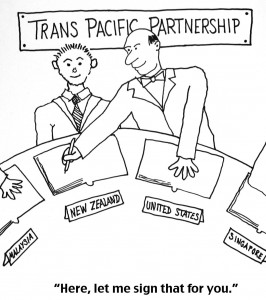
"Here, let me sign this for you". Image by Colin Beardon.27.08 KB

Gunnar Wolf: Activities facing the next round of Trans-Pacific Partnership negotiations ( #yaratpp #tpp #internetesnuestra )

Excuse me for the rush and lack of organization... But this kind of things don't always allow for proper planning. So, please bear with my chaos ;-) What is the Trans-Pacific Partnership? Yet another secretely negotiated international agreement that, among many chapters, aims at pushing a free-market based economy, as defined by a very select few Most important to me, and to many of my readers: It includes important chapters on intellectual property and online rights. Hundreds of thousands of us along the world took part in different ways on the (online and "meat-space") demonstrations against the SOPA/PIPA laws back in February 2012. We knew back then that a similar project would attempt to bite us back: Well, here it is. Only this time, it's not only covering copyright, patents, trademark, reverse engineering, etc. TPP is basically a large-scale free trade agreement on steroids. The issue that we care about now is just one of its aspects. Thus, it's way less probable we can get a full stop for TPP as we got for SOPA. But we have to get it on the minds of as many people as possible! Learn more with this infography distributed by the EFF. Which countries? The countries currently part of TPP are Chile, Peru, New Zealand, Australia, Malaysia, Brunei, Singapore, Vietnam And, of course, the USA. Mexico, Canada and Japan are in the process of joining the partnership. A group of Mexican senators are travelling to Lima to take part of this round. Image by Colin Beardon (It's Our Future, NZ) What are we doing about it? As much as possible! I tried to tune in with Peru's much more organized call The next round of negotiations will be in Lima, Peru, between May 14 and 24. Their activities are wildly more organized than ours: They are planning a weekend-long Camping for Internet freedom, with 28 hours worth of activities. As for us, our activities will be far more limited, but I still hope to have an interesting session: Poster design by Gacela. Thanks! This Friday, we will have Aula Magna, Facultad de Ingenier a, UNAM, M xico DF, from 10AM and until 3PM. We do not have a clear speakers program, as the organization was quite rushed. I have invited several people who I know will be interesting to hear, and I expect a good part of the discussion to be a round table. I expect we will:

  1. Introduce people working on different corners of this topic
  2. Explain in some more detail what TPP is about
  3. Come up with actions we can take to influence Mexico's joining of TPP
  4. And this will be at Facultad de Ingenier a. Another explicit goal of this session will be, of course, to bring the topic closer to the students!
We want you! So... I am posting this message also as a plead for help. Do you think you can participate here? Were you among the local organizers for the anti-SOPA movement? Do you have some insight on TPP you can share? Do you have some gear to film+encode the talks? (as they will surely be interesting!) Or, is the topic just interesting for you? Well, please come and join us! Some more informative links BE THERE! So, again: Friday, 2012-05-03, 10:00-15:00 [Update] So, 2012-05-03 came and went. And thankfully, Alfredo was there to record most of the talk! So, you can download the video: Gunnar Wolf, Salvador Alc ntar: Qu es TPP? Por qu me debe preoucpar? Qu podemos hacer?
AttachmentSize
Poster. Design by Gacela Thanks!457.49 KB
Infography about TPP distributed by the EFF392.45 KB
"Here, let me sign this for you". Image by Colin Beardon.27.08 KB

Steve Kemp: After you've started it seems like a bad idea?

To recap: given the absence of other credible alternatives I had two options: I think there is room for a new console client, because mutt is showing its age and does feel like it should have a real extension language - be it guile, lisp, javascript(!), Lua, or something else. So I distilled what I thought I wanted into three sections: So how did I do? I wrote a ncurses-based client which has Lua backed into it. You can fully explore the sidebar-mode - which lets you select multiple folders. From there you can view the messages in a list. What you can't do is anything "real": For a two-day hack it is remarkably robust, and allowing scripting shows awesomeness. Consider this:

--
-- show all folders in the Maildir-list.
--
function all()
   -- ensure that the sidebar displays all folders
   sidebar_mode = "all";
   -- we're going to be in "maildir browsing mode"
   cmail_mode = "sidebar";
   reset_sidebar();
   refresh_screen();
end
--
-- Test code, show that the pattern-searching works.
--
-- To use this press ":" to enter the prompt, then enter "livejournal".
--
-- OR press "l" when in the sidebar-mode.
--
function livejournal()
   sidebar_pattern = "/.livejournal.2";
   sidebar_mode = "pattern";
   reset_sidebar();
   refresh_screen();
end
--
-- There is a different table for each mode.
--
keymap =  
keymap['sidebar'] =  
keymap['index']   =  
keymap['message'] =  
--
-- In the sidebar-mode "b" toggles the sidebar <-> index.
--
-- ":" invokes the evaluator.
-- "q" quits the browser and goes to the index-mode.
-- "Q" quits the program entirely.
--
keymap['sidebar'][':'] = "prompt-eval"
keymap['sidebar']['b'] = "toggle"
keymap['sidebar']['q'] = "toggle"
keymap['sidebar']['Q'] = "exit"
-- show all/unread/livejournal folders
keymap['sidebar']['a'] = "all"
keymap['sidebar']['u'] = "unread"
keymap['sidebar']['l'] = "livejournal"
Neat, huh? See the cmail.lua file on github for more details. My decision hasn't really progressed any further, though I can see that if this client were complete I'd love to use it. Its just that the remaining parts are the fiddly ones. I guess I'll re-hack mutt, and keep this on the back-burner. The code is ropey in places, but should you wish to view: And damn C is kicking my ass.

28 April 2013

Mart&iacute;n Ferrari: Moving my stuff away from home

TL;DR version: I want to get rid of the small server running at home, I tell you here about the service I've chosen, and why I like it. In following posts, I'll explain how did I set it up remotely. Disclaimer: I am in now way affiliated with the companies I mention here (except for Picasa, as I am a Google employee), and don't get any bonuses for this post. I am only sharing this because I think it might be useful information for other people.
Being a frequent migrant means possessions are a burden. In my previous place of residence (in France), I originally intended to only stay for 6 months, and so I arrived with just a couple of suitcases, and in the end that was enough for me to live for almost 2 years. The last time, on the other hand, I was removing my stuff completely from Argentina. I emptied my house, gave away some stuff, send some boxes to my parents' place, and carried the rest with me. That was a lot of stuff, but since the company was paying for the relocation, it was not much of a problem. Later I realised my mistake, and knowing that my time in Ireland is limited, I started to try and get rid of stuff I don't need. I know I will just sell or give away much of my stuff when I finally leave, but there are some things that are not so easy to part with. The main one being my home server, which hosts this website, my VCS repositories, pictures, and many other things I need to have on the net. This all used to be located in a home-made PC tucked in a data centre, co-located by a friendly company. But that computer died almost 2 years ago, and so canterville became abhean, and my stuff started being hosted with my aDSL connection. It worked well for some time, but now I realised I had to revert that change. With this in mind I set off to find a cheap place to host my stuff. I had a few requirements: I don't have that many photos, nor they are too big, but these requirements made it clear that most VPS offerings were not going to work for me. For some reason I fail to understand, local storage in VPS offerings is usually prohibitively expensive. This is OK for most use cases, but not for mine. A friend of mine, with a similar use case, is a happy VPS customer. He told me his trick: he only hosts in the server low-quality versions of the pictures, and keeps the originals (and back-ups) at home. This was a great idea, but with two fatal flaws: I want to only carry around a laptop and one or two external hard drives; and I want to have back-ups that are not physically with me. I was starting to think about hosting my files in Amazon s3 or something like that, since most dedicated servers are way too expensive. But then I heard about two French companies offering dirt-cheap servers: OVH and Online.net. Both of them offered small servers for about 12 a month, cheaper than most VPS offerings! Online seems to mainly cater to the French market, and for some silly reason, they charge a 50 set-up fee to customers outside of France. OVH, on the other hand, has many local branches, including an Irish one, so I went with them. The offering is a low-cost line called Kimsufi, and the smallest one is still very decent for a personal server: Once I had paid the fee for one month, it took a while for it to be activated (their payment system is pretty bad), but it finally was enabled about 24h later. Then the real fun started. On one hand, I was happy to see a wide selections of operating systems to choose from, including Debian stable and testing, and a web console with many functionalities, including some basic monitoring; but on the other hand, I realised that the installed image was not pristine, the online docs are not very good, and the web application is a bit buggy and really awkward to navigate. Having sub-par docs is not something I would usually care much about, but it made it a bit more difficult to me to understand some of the very cool functionalities their system offers (more on that in a bit), and more importantly, it made it clear to me that I won't trust their image: the procedures detailed there were not exactly best-practices, and they allow themselves to log-in as root into my server. I want to describe here what I think are their most interesting features, that made it possible to me to do risky operations, like encrypting the root partition, and setting up a firewall; and being able to fix problems that would usually require physical access. These are found in their web console: a hardware reset, and configurable netboot support with many offered images, including a rescue image based on Ubuntu and one that serves as a virtual KVM. (It is surprising that these servers don't have a serial console, but at least the kernel does not detect any). With these in hand, I didn't have to fear being locked out of my server for ever. Just set up a netboot image and hard-reboot the machine! Also, it made it very simple to install my system from scratch with debootstrap. The virtual KVM is a very interesting trick. It is a netboot image that runs some tests, and fires up a web browser. You get an email with the URL and a password to access it, and then you open a page that offers you what is basically a Qemu connected to a VNC server which will boot from your real hard drive. It is super slow, but that allows you to get console access to your server, which can be very handy to debug booting problems, unless it is some issue with the real hardware. It also offers the possibility of downloading an ISO image off the network and booting that, so it can be used to run a stock installer CD too. In another post I'll describe how I reinstalled my server remotely, and some of the pitfalls that I've encountered in the process.

Next.

Previous.