Search Results: "bod"

2 June 2008

Jonathan McDowell: Finally rid of the millstone

Just before the New Year we accepted an offer on our house in Norwich, which had been up for sale since September. It was a bit lower than we'd hoped for, but the buyer was an investor and so we hoped it would be quick and not involve too much hassle.

How wrong we were. We finally completed on Friday, with the money hitting our account today (thanks to the Ulster Bank being a bit shit about telling our solicitor how much was outstanding on the mortgage). I'd become convinced that it was going to fall through, that we wouldn't be able to find a new buyer and that we were going to end up having to rent out a house that it wasn't convenient for us to check up on (due to the radioactive body of water between us and it). So I am somewhat relieved to finally be rid of it.

Fabio Tranchitella: Am I doing it wrong?

When I moved in Hungary in 2006, I started a direct marketing company. In fact, it is the local local branch of an Italian marketing company where I worked since 2003. The company is growing very slowly: we faced a lot of issues with the local market (I'll probably talk about this topic in another post) and only in the last months things started going on the right path.

I still remember the old days when I spent the whole working day alone, in the office, struggling to find the good motivation to work on something which almost everybody around me considered a failure even before starting. I always considered my company as a family, where trust and respect are the glue for the team members. I remember the old times when Aron, my first employee and now business partner, started learning the internals of the direct marketing: he trusted me, sharing with me the duties of starting up the company.  Looking back I feel proud of what we did and more conscious about what we can do in the future.

Growing also means enlarging the team. To say the truth, I didn't expect to have so many problems looking for new people to add to our team: I interviewed a lot of people for our "python programmer" position, spending a lot of time and energy. I know that living in Hungary also means dealing with a local, small, atypical environment, but we offer the possibility to learn and develop IT and non-IT skills in a young, international environment.

We finally found an interesting guy, with PHP experiences but willing to learn Python. He told us that he could leave his job by the 16th of June, and he could work with us part-time till that date. Everything worked fine for three weeks then, suddenly, he disappeared. For one week, his mobile phone rang, but nobody picked up the line. No answer to e-mails, IRC, MSN or any other communication channel. I was worried, I hoped he was fine somewhere. This morning he called Aron telling him that he was sick, he had an issue with his eye. He visited a lot of doctors. He was busy. So busy that he couldn't call us to tell us so. For one week. After he started working with us four weeks ago. What is more annoying is that he didn't appear worried about his position, about our project, about our company. If I'd have quit from my job, I'd be very very worried about my new employer who is looking for me for one whole week without being able to reach me.

We are a growing company based on a small team, without a strict organigram and a horizontal structure. I trust my workmates, I trust them so much to put in their hands my investments, my reputation, my customers. The best team members knows that errors in this phase (eg. lost customers) can influence the company future and their job position

In this case, I gave out trust, but I didn't get back respect. I'm starting to think that being friendly and building a collaborative environment, a horizontal structure is not helping but damaging the company. Maybe if I'd be a boss with strong authority, then people wouldn't behave in this way.

And yes, of course, the problem with the eye was just an excuse.

1 June 2008

Axel Beckert: How to get Network Manager working with ratpoison

Using GNOME Network Manager is a neat way to connect to wireless or virtual private networks from a laptop running Debian Lenny, Sid, Etch with Backports or any of the *buntu distributions. You can control everything from the system tray. But not all window managers have a system tray. And with some window managers it’s not obvious how to make them work with one of those lean third party trays and panels. Especially my favourite window manager for small displays as on the EeePC – ratpoison – insolently puts any panel or tray in the middle of the screen by default. It took me a moment to find out how to make ratpoison work with my favourite third party system tray trayer (which can handle transparency and is only a system tray, no taskbar). First we need to make ratpoison ignore the trayer on the one hand and and reserve space for it on the screen. Fiddling around with preconfigured frames didn’t work well and the following way is also more straight forward:
  1. trayer always has “panel” as window title, so adding the following line to your .ratpoisonrc makes ratpoison ignore trayer:
    unmanage panel
  2. Now all windows overlap the trayer, so we need to configure the space for it. Trayer in the default configuration shows up at the bottom and has a height of 26 pixels, so we tell ratpoison to add a padding of 26 pixels at the bottom of the screen by adding the following line to the .ratpoisonrc:
    set padding 0 0 0 26
Now we are confronted with the problem that these settings only apply to new windows, not ones which were already running when ratpoison starts. I usually start my X session using an .xinitrc or an .Xsession which calls the window manager using exec at the end. We can start the trayer later though by spawning a subshell in the background with a sleep at the beginning. Also the Network Manager applet (nm-applet) can be started that way. In my case the end of the .Xsession looks like this:
( sleep 1; \
  trayer --align right --edge bottom --distance 0 \
	 --expand true \
	 --transparent true --alpha 128 --tint 0 \
	 --SetDockType true --SetPartialStrut true & 
  nm-applet & ) &
exec ratpoison
The result could look like this:
My EeePC desktop with ratpoison, trayer and two aterms
The other programs in the system tray are from right to left: nm-applet (GNOME Network Manager), Twitux (GTK Twitter Client), Audacious, Opera, Pidgin (formerly known as GAIM), Icedove (unbranded Mozilla Thunderbird). The clock on the bottom left is from the package osdclock. Oh, and although I’m fine with trayer: if anybody knows a possibility to control the GNOME Network Manager without the need for a system tray, I would be very happy if you could tell me. :-)

30 May 2008

Craig Sanders: I m sick of all the whinging about petrol prices

Really, who cares? 1. How much petrol do people actually use, anyway? People whinge and bitch and moan about petrol going up a few cents, and queue up for ages to try to buy petrol at the low point of the weekly price cycle - and for what? A tank will hold less than 100 litres. Typically around 50, but let’s say it’s 100 litres. That means that a price difference of 1 cent is worth a whole $1.00. A price difference of 5 cents is a measly $5.00, less than the price of a cheap bought lunch. For the average driver, they’ll buy 100 litres once or maybe twice per week. Who gives a damn? If $1.00 or even $5.00 makes such a difference to someone’s budget then they’re in serious financial trouble anyway - so much trouble that they shouldn’t even think about having a car, because they can’t afford it. Here’s a novel thought: they could drive less, make their kids walk to school, catch public transport, ride a bike, walk to the milkbar rather than drive, make sandwiches to take to work/school, and so on. They could also buy less of the worthless crap they buy (like biscuits and cakes and bottles of coke and other rubbish). There are thousands of things people could do so that they don’t have to give a damn about a few cents per litre. Even better, if people reduce demand enough, they can seriously hurt the speculator bastards who have driven oil prices up so much in recent months….at least a quarter of the current price per barrel of oil is due to commodity speculators driving the price up. Hit the bastards where it hurts, drop demand so much that they lose serious money. If the price of petrol bothers you, don’t whinge, get revenge. Actually, I’m entirely unconvinced that the general public actually care all that much about petrol prices anyway. It looks and feels much more like an astro-turfing campaign by the oil companies and petrol distributors - especially the recent crap about reducing the excise by 5c/litre, anyone can see that if the government does that the petrol companies will, within weeks, increase prices so that THEY get the 5c/litre rather than the government, resulting in yet another transfer of wealth from the public purse to private corporations. Same for all the bullshit about the fuel price watch program - it’s obvious that the opposition to that comes directly from the petrol companies who don’t want buyers to have good information to base their purchasing decisions on. It’s also a useful distraction and pretend-debate for the government and the opposition - they can rant and rave and score points over a trivial, bullshit non-issue like this, and nobody will notice that nothing of any real substance or worth ever gets debated in parliament…and the media are either colluding in this or are too stupid to avoid getting sucked in. 2. We have the fourth-cheapest petrol in the world. So all this moaning is not about petrol being more expensive than it should be, it’s about not being quite as unreasonably privileged as we were in the past. 3. Oil prices are *inevitably* going up, they’re *never* coming back down. Get used to it, it’s only going to get worse from here - much worse. Instead of endlessly whining about the inevitable, focus on alternatives - like *DEMANDING* that the government start paying more than just empty tokenistic lip-service to the idea of alternative/renewable energy sources. 4. IMO, the sooner petrol hits $5.00 per litre or more, the better. By then we’ll really have to have functional alternative energy sources in place. Because if we don’t, we’re completely screwed. Syndicated from Craig Sanders' Errata: Tech Notes and Miscellaneous Thoughts I’m sick of all the whinging about petrol prices

Y Giridhar Appaji Nag: Alumni mail service moves to Hotmail

I knew better when I neither advertised nor used my IITG Alumni forwarding email address, and I suppose I'll not do that, ever.

For one, the ID given was ridiculous, connected to my name in a rather weird fashion with a number thrown into it and nobody bothered to reply when I asked if I could change it. And now the domain-name part of the email ID has been changed forcing people to tell all their contacts about the change, but this takes the cake -- the service has been moved to Hotmail with 2GB free space.

Huh! Thanks but no thanks.

I really disapprove of such widespread services (which should really not have a commercial angle to them) being taken over by the Googles, Ciscos and the Microsofts of the world.

27 May 2008

Erich Schubert: Fitness

When people think of computer scientists, they think of someone with bad health, a bad skin color and no fitness at all. While there probably are some like that, I actually don't know many. Instead I know people who do things like fighting with sword and rapier. My main sports is advanced lindy hop dancing (which does include occasional aerials and such, but mostly involves 'jumping' around at high speeds). I like dancing most because of the social aspects of it.Myselfi, I can claim to be the very opposite: I just came back from 5 hours of sports, and I'm not even exhausted, just very hungry. The 5 hours include riding about 13 km in half an hour through the city (and we're suffering from a heat wave these days, with winds from the sahara desert reaching germany), then two full training sessions (that really used to stress me when I started), then the ride back of 13 km again.My body mass index is 18.something, so I'm slightly underweight, but I actually eat a lot - but I also eat healthy and diverse. Most of my food I cook myself, so I know it's fresh and where I got it from. I'm not vegetarian, I do eat meat about two times a week. I also try to have some variety there, pork, beef, lamb, deer, chicken, ... I don't drink much alcohol and I do not smoke.So don't stick to that prejudice that computer science people or geeks are physically in a bad shape. You can be both a geek, soical and athletic. The people I know how are in really bad shape actually watch too much TV and such, they neither engage their body nor their mind, nor leave their house much to meet other people.

Michal Čihař: My cycle computer got crazy

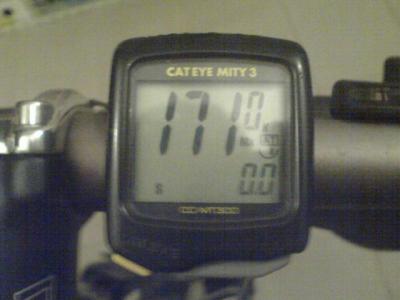
After today short ride, I just wanted to look at how fast I was (well rather slow as my body is slowly getting used to usual travel distances). There was nothing surprising in most values, but maximal speed did really impress me: 171 km/h on bicycle I just hope that it is really mistake of the computer and I did not really go that fast at some point ;-).

24 May 2008

John Goerzen: How to Start Bicycling to Work

Yesterday, I wrote about bicycling to work, pointing out that it's a safe, inexpensive, way for many people (including office workers without access to showers) to get to work. There were a lot of thoughtful comments there too.

Today I'd like to provide some tips for getting started commuting on a bicycle. As I'm just getting started on this, these are mainly things I've learned from poking around online, so I'll be including lots of links.

The Bicycle

This varies from person to person, but as a general rule: if you have a very short ride -- say a mile or less -- you can probably just use any old bike and a bicycling helmet. Don't try to use a motorcycle helmet. It won't vent your head, so you could overheat. Also, it won't be comfortable.

Most people will have a longer ride and will want to get a bike that works specifically for them. Each model of bicycle comes in different frame sizes. It's important to get a bicycle that is the right size for you. Also, you'll want to get a quality bicycle that will let you be fast and won't break down along the way.

For all these reasons, I -- and every single other person I've ever seen talk about this -- highly recommend that you buy your bicycle from a bicycle shop. Don't buy a bicycle from a "big box" store like Walmart or Target. They may be cheaper up front, but you'll pay for it in the long run because they won't last as long, won't fit you as well, and may even be unsafe. Bike shop staff will help you find a bike that fits you, which is important for avoiding aches and pains and even injury. They'll be able to help you find appropriate accessories for your bike, as well as repair it. Here is a helpful article on this topic, written by a bike shop.

Generally speaking, bike shops can repair bikes bought at any other bike shops. However, they can instantly recognize bikes bought at big box stores. Many will repair those too, but some refuse to work on some of those bikes on the grounds that it is impossible to bring them to the level of service they expect their mechanics to do.

Aches and Pains

With any sport, when you start it, you can expect a little bit of aches and pains at first, as you start using muscles that you may not have really used at first. Bicycling is no exception, but it's easy to deal with.

Your first stop if you have aches and pains might be the where does it hurt page. It provides detailed, helpful advice. There are also some common things that go wrong for people.

First on the list is wrong size of bike or improper adjustment of your bike. You want a bike frame that is the right size for you, and you want the seat and handlebars adjusted properly for you. A bike shop can help you get this done easily. If your feet can reach the ground while you're on the seat, you almost certainly have the seat too low, which is a common mistake.

Sometimes the way you position yourself on the bike, or your technique, could be to blame.

Also, clothing can be a problem. A good place to start here is with some cycling shorts. Another common complaint from new cyclists appears to be blisters on the feet. This can be caused by improper positioning on the pedals, or by using the wrong type of sock. Typical socks absorb moisture and trap it next to the skin; bicycling socks will wick it away and let it evaporate. In fact, cycling clothes: socks, shorts, and jerseys (shirts) are all designed to wick moisture away from you and let it evaporate, which keeps you cooler and more comfortable. Bicycling gloves are cheap and can help your hands stay comfortable.

Expense

You can easily save thousands of dollars by riding a bicycle instead of driving a car. Bicycles do need periodic maintenance, just like a car. Usually you can do a lot of that yourself. It probably will pay off to take your bike in to the shop for an annual tuneup. If you have no bicycling equipment at all, and buy your equipment at a bike shop new, you can probably get started for around $500. Even that will probably pay for itself in less than a year if you average riding your bike at least a few times a week.

Safety

Safety on a bicycle can usually be summed up with three rules: be visible, be predictable, and ride with traffic.

Unless there are dedicated bicycle-only lanes or paths, the safest way (in the United States) to ride your bike is on the road, riding with traffic (acting like a car). Don't ride on a sidewalk, and never ride against traffic. This may sound counter-intuitive, but it is backed up by solid research. It all has to do with being predictable. Nobody is looking for something the speed of a bicycle to emerge from a sidewalk to cross a road or driveway. Sidewalks often aren't that visible and frequently don't provide enough room to pass. Sidewalk-riding cyclists get into accidents all the time with cars backing pulling out of driveways, making turns, or even just driving down a road where the cyclist cuts in front of them to cross a street.

A great book for learning how to ride in traffic can be viewed free online: the Bicycling Street Smarts book. There are also some safety videos online that are helpful.

Staying visible is certainly important. In some places, like cities where cyclists are common, drivers are going to be on the lookout for you already. In my case, I'm riding on rural roads that have some hills, where cyclists are rare, so I'm putting extra effort into this.

Staying visible in the day or at night starts with high-visibility clothing. A "screaming yellow" jersey or an ANSI safety reflective vest (less than $10) are good ways to do that. Several people recommend a Cateye TL-LD1100 flashing tail light for use at night, or even for daytime use when visibility is critical (such as my situation). If you will ever ride at night, laws require you to have the proper reflectors on your bike. And, you must also have a white headlight that does not cover up your front reflector (in some locations, you may also be required to have a red tail light that doesn't cover up your reflector). Companies like Cateye carry those products as well.

Other tips: avoid drainage covers; they sometimes have slats that a bicycle tire could fall into.

Accessories

Here are some suggestions you might consider as a commuter.

Start with pannier bags. They mount over your rear tire and are cooler for you than a backpack because your back can still breathe. They're more aerodynamic than a front basket. You can get bags suitable for carrying papers, laptops, a change of clothes, etc.

Next on your list might be a bicycle lock, to help keep it from being stolen. Your local bike shop can make suggestions here.

You might want to consider a spare inner tube (about $5) and tire-changing tools (also about $5) to carry with you in your bag. You wouldn't want to have to walk 5 miles if you get a flat.

Along with that goes an air pump. I suggest a frame pump -- it's a small pump that can clip on to your bicycle's frame, so you always have it handy. Obviously you will need this if you have to change a tube, but it could be handy even if you don't.

You can find some more suggestions from bicycling.about.com and from Mike or your local bike shop.

Where to buy

Besides your local bike shop, you can buy a lot of accessories online. I wouldn't suggest buying a bicycle online, because you really want to get a good fit at a bike shop.

When I asked at bikeforums.net, readers suggested three online stores:

www.pricepoint.com
www.bikenashbar.com
www.performancebike.com

You can also find some bicycling accessories at general-purpose stores like Amazon or sporting goods stores like REI. I personally wouldn't recommend local "big box" sporting goods stores any more than I would Walmart or Target for this stuff, though.

More info

For more information, check out my bicycling links at del.icio.us.

23 May 2008

Russell Coker: School Bag Weight

Matt Bottrell has written about some issues related to the acceptable weight of laptops for school use [1]. Matt cites a reference from the Victorian government stating that a school bag should not be heavier than 10% of the body weight of the child who carries it [2]. So the next thing we need to do is to calculate what a student can carry without being at risk of spinal injuries. Firstly we need to determine what children weigh, if we restrict this to the 14+ age range (the older children have more need of computers) then children are almost as heavy as they will be when they are 18 and can carry significantly heavier bags than those in the 10+ age range. Also it seems reasonable to consider the 25th percentile weight (the weight which is exceeded by 75% of children). Of course this means that 25% would be carrying overly heavy bags but it does give us a bit more weight allowance. The 25th percentile weight for white girls in the US is 48Kg [3]. The 25th percentile weight for white boys in the US is also 48Kg [4]. When considering the Australian situation it seems that white children in the US will be most similar (in terms of genetics and diet). The 25th percentile weights at age 18 are 53Kg for girls and 64Kg for boys. So the acceptable bag weights would be 4.8Kg for 14yos, 5.3Kg for 18yo girls, and 6.4Kg for 18yo boys. The next step is to determine the weight carried to school. The weight of one of my laptop bags is almost 1Kg, I think that a school-bag would have a similar weight. When I was at school I recall that the worst days for carrying baggage were when I had PE (Physical Education - sports), the weight of PE gear was a significant portion of the overall weight I carried. I tried to estimate this by weighing a track-suit top, a t-shirt, and a pair of board-shorts (the only shorts I could find at short notice), and it was almost 1Kg. While the board-shorts might weigh more than PE uniform shorts I didn’t include the weight of track-suit pants. Assuming that a female PE uniform has the same weight as a male uniform is the least of my assumptions. The weight of a good pair of sneakers (suitable for playing basketball and other school sports) that is in my size is just over 1Kg. To get a rough estimate of the weight of lunch I put six slices of bread and a small apple in a lunch box and found that it weighed 500g. A real lunch would probably include four slices of bread but the other things would weigh at least as much as the extra two slices. If a drink was included then it could be more than 500g. So the total is 3.5Kg for bare essentials (including PE gear) without including any books! It seems that it would be impossible to stick to the government recommendations for school bag weight if a full set of PE gear is included. Probably the best thing that could be done would be to make a school uniform allow wearing sneakers which removes 1Kg from the overall bag weight. So a bag with lunch and PE gear (minus sneakers) is about 2.5Kg, leaving 2.3Kg for books etc at age 14. As text books for 14yo children are considerably thinner than those for 18yo children, it seems that this might be achievable. Fitting a couple of text books and an EeePC into the 2.3Kg weight budget should be achievable. But fitting a full size laptop (which seems to start at about 1.8Kg) and some text books into a 2.3Kg budget will be a challenge - it might be possible to do that but wouldn’t leave any budget for the random junk that children tend to carry around. For an 18yo girl, the weight budget (after the basics have been deducted) is 2.8Kg, it seems likely that on occasion the weight of year-12 text books will exceed that. Therefore it seems that the only way of avoiding spinal injuries in year-12 girls would be to have text books stored in digital form on a light laptop such as an EeePC. Rather than avoiding the use of laptops because of weight (as some people suggest), laptops with electronic text books should be used to replace traditional text books! An EeePC weighing less than 1Kg will give a significant amount of extra capacity for any other things that need to be carried. If there is little other stuff to be carried then 75% of 18yo girls should be able to carry a full size laptop plus PE gear without risk of back injuries. If digital text books are used then if in any journey two text books (which according to my previous measurements can be as much as 1.6Kg [5]) can be replaced with an EeePC then overall something like 600g is saved (depending on the configuration of the EeePC, if one battery was stored at home and another at school then it could save more than that). It seems that a year 12 girl who has PE and three science subjects scheduled on the same day would be most likely to exceed the recommended weight in the current situation (even without having to carry a spare pair of shoes), and that carrying a laptop with digital text books would be the only way of avoiding back injury. For an 18yo boy the weight budget is 3.9Kg after the basics have been deducted. So if they don’t carry other random stuff in their bag (I probably had 1Kg of random junk in my bag on occasion) then they could carry PE gear, a full sized laptop, AND a full set of text books. It seems to me that there is no situation where children would be unable to have a laptop within the reasonable weight allowance if digital text books were used. The only way that the weight of a laptop could be a problem would be if it was carried in addition to all the text books. One final point, it would be good if books from the Gutenberg project were used for studying English literature, that’s one easy way of reducing weight (and cost). Also it would be good if there was an option for a non-literature based English subject. Knowledge of English literature is of no value to most students. It would be better to teach students how to write while using topics that interest them. Maybe have blogging as an English project. ;)

Edd Dumbill: Badges, blogging and bragging

Back from my travels, it's time for a few updates. I've mostly blogged about these elsewhere, so I'll just give some pointers here. The launch of magnetic-stripe cards at Where 2.0 went well. We had some initial teething issues with Linux talking to the card printers, which was resolved by backing down to Linux kernel 2.6.22 from 2.6.24. I'm not entirely sure what's up with 2.6.24, but it exhibited strange behavior talking to the card printers over ethernet — as if there were MTU misconfigurations. It's a big nuisance, as 2.6.24 is the default kernel shipped with Ubuntu Hardy, an otherwise excellent release. I've been paying some attention to OpenID 2.0 recently, as it's time for me to upgrade my OpenID accepting websites to use the new release of the specification — if for no other reason than Yahoo! OpenIDs are 2.0-only. This investigation led me to notice XRIs again, which are the confusing underbelly of the OpenID specs. The W3C Technical Architecture Group recently advised against using XRIs. I wrote about this over on my XML.com blog. I've not used for that blog for a long time, but will try to do so more. I've realized that I've still got a lot to say about the web, XML and open standards, and the XML.com blog seems like a good place to say it. Finally, to brag for a short moment. Another XTech has been and gone, and this year's was a great experience for everybody involved. This quote from attendee Paul Smith summed things up nicely, as it tells me I succeeded in my main goal for the conference:
What I really liked about this conference was the mix of attendees and presenters, both from academia, and the commercial world both and small. It made it feel much more valid, and it really felt like everyone was there for the right reasons - not trying to sell anything, but out of a genuinely altruistic wish to make the web better.
My sincere thanks to everybody involved in XTech this year.

22 May 2008

Michal Čihař: Most interesting things on my blog

It sometimes funny to review web server stats to see what people are looking for in my blog. I usually expect something like my name and projects I participate on. But there are some surprises:
  1. cihar
  2. gammu
  3. dosbox games
  4. pissing
  5. mpd sonata
  6. wammu
  7. phpmyadmin
  8. project names
  9. sound juicer mp3
  10. phpmyadmin themes
For most of them I'm in first page in Google results, even though I have no idea why are my posts ranked so high even for such generic things as "product names", but I don't care. What surprises me most is "pissing". I guess I know what are people looking for when they enter this word to Google ;-). But according to Google webmaster tools, I'm somewhere near 110th position. Why the hell does somebody look so deep in results? And why does he go to one line blog post? I really don't understand this. Maybe I should focus on this word and bring my post to first page of Google results ;-).

20 May 2008

Jacobo Tarrío Barreiro: No Galician translations of Mozilla, apparently

It’s not every day that your work is ignored by a founder of Mozilla Europe. From El Pa s:
En Espa a un 23,5% de visitas se dan en Firefox, un ndice que es superior al de EE UU, pero que no llega a los ndices de Polonia donde el 40% del tr fico se da en el navegador de Mozilla. A pesar de estos aceptables datos [Tristan] Nitot ha recordado y pr cticamente hecho un llamamiento para crear una versi n del navegador en gallego: “Hay una versi n en catal n de Firefox construidas por voluntarios que les importa su idioma, al igual que la hay de euskera. Pero a n no hay una versi n en Galicia, muchas veces me lo preguntan y mi respuesta es que si nadie de Galicia se presenta no habr una versi n en gallego, estamos dispuestos a que la gente trabaje con nosotros".
Loosely translated:
“There’s a Catalan version of Firefox built by volunteers who care about their language, and there’s another one in Basque. But there’s no Galician version yet, I get asked this very often, and my answer is that if nobody from Galicia steps up there will be no Galician version. We would like people to work with us".
So, apparently, there’s no Galician translation of Mozilla. I guess that my more than three years’ worth of work were wasted (Dec 2001 - Jul 2004 and Jan 2006 - Aug 2006), that Xis and Galego21 did nothing back in the nineties and noughties, and that what mancomun.org is hosting is an empty XPI file. To not speak of the paralysed/paralysing bureaucracy of the Mozilla Foundation when several groups of volunteers, one after the other, tried to reinstate the official Galician l10n team. I would be pissed off if I cared about Galician. Because, you know, from reading my blog it’s obvious I don’t.

19 May 2008

Gunnar Wolf: Proud as a father would be

The recent OpenSSL incident can not be hidden. It was a very important blow to the Debian project's public face and reputation. A major hole slipped under the door in the form of a bugfix - and with all the good intention. This was not a deliberate attack, nor was it the result of a bad or sloppy maintainer - It was a honest, although painful, human mistake.
Several people started laughing at our processes and supposed strengths right away. I do, however, feel this shows how Debian is stronger security-wise than any other system. And it also shows how this saying, with enough eyeballs, all bugs are shallow, not only didn't lose validity, but was reaffirmed. Free Software development was also proved to be better than security through obscurity again.
Why?
Because were it not because of OpenSSL (and in this case in particular, Debian's packaging) being Free and subject to a code audit, this problem would have never been found. I have been asking to some friends who are part of different black-hat groups, and looking for this kind of information on the Web, it seems that -were it not for Luciano's work, we would still be running cryptographically weakened versions of OpenSSL for a long time. After all, 32768 possible keys is still quite a lot for a black-hat group to find as uneven noise, as a lead to showing the undeniable weakness.
It took two years to find the bug, yes. But it was found doing quality assurance work on publicly available source code. It was promptly fixed, mitigating (as far as possible) as much damage as could be caused. Tools for finding and fixing the defective keys were crafted and freed together with the announcement. Yes, there will be some compromises due to this, I'm sure, but an embarassing hole has been dealt with in the best way possible.
Anyway... I am very happy - I was going over Luciano's NM report, and found something I only suspected but was not sure about. I can now state clearly: I have never been so happy to advocate somebody to become a DD.
Luciano wrote a very good blog post (in Spanish) with his viewpoints on the Debian OpenSSL incident. If you happen to understand Spanish and are reading this blog, please drop over Luciano's.
Luciano: Once again, my hat goes off for you :-)

17 May 2008

Kartik Mistry: Inhumanity


* Somebody told that ‘This is inhuman‘. Now, please someone please preach similar to China!

Patrick Winnertz: cowdancer in unstable - no longer support for stable release?!

Cowdancer is activly developed in debian, that's very nice. it's really a cool tool to build packages for unstable but also for backporting efforts. I'm using it on a daily basis to build debian etch packages of lustre. However three days ago cowdancer stopped working with my etch chroot after an upgrade of my unstable system:
dpkg-source: info: building lustre in lustre_1.6.5~rc3-1.dsc
dpkg-genchanges -S >../lustre_1.6.5~rc3-1_source.changes
dpkg-genchanges: including full source code in upload
dpkg-buildpackage: source only upload (original source is included)
chroot: cannot run command  cowdancer-ilistcreate': No such file or directory
W: cowdancer-ilistcreate failed to run within chroot, falling back to old method
 -> Running in no-targz mode
I: using fakeroot in build.
Current time: Sat May 17 12:18:30 CEST 2008
pbuilder-time-stamp: 1211019510
 -> copying local configuration
 -> mounting /proc filesystem
 -> mounting /dev/pts filesystem
 -> policy-rc.d already exists
Obtaining the cached apt archive contents
Installing the build-deps
cowdancer: .ilist size unexpected
Can't open perl script "/usr/bin/dpkg-architecture": Cannot allocate memory
 -> Attempting to satisfy build-dependencies
 -> Creating pbuilder-satisfydepends-dummy package
cowdancer: .ilist size unexpected
sh: /tmp/satisfydepends-aptitude/pbuilder-satisfydepends-dummy/DEBIAN/control: Cannot allocate memory
E: pbuilder-satisfydepends failed.
Copying back the cached apt archive contents
 -> unmounting dev/pts filesystem
 -> unmounting proc filesystem
 -> Copying COW directory
 -> Invoking pbuilder
 -> Cleaning COW directory
Command /bin/sh -c pdebuild "--pbuilder" "cowbuilder" "--" "--basepath" "/var/cache/pbuilder/etch.cow" failed

After some research I found that a change of cowdancer (something related to .ilist) is responible for this issue. After that I asked on #debian-devel if someone else had this problem and were told that removing an re-creating the chroot will help. But that results in the same error msg. After that I decided to wrote a bugreport against cowdancer, since this is in my eyes a major defect in this software to do not support the latest stable release. I filled this report as RC Bug and got very fast a answer:
severity 481344 wishlist
retitle 481344  provide cowdancer etch backport
[ ... ]

I think this is the wrong way to fix a problem in unstable with a backport of a software. Providing a fallback for older debian releases would be the better way. Is anybody else having this problems?

15 May 2008

MJ Ray: Posting Ahead

I'm convinced by The Argument for Posting Ahead [Network Blogging] so why didn't I set it up for my recent trip? Well, a while ago, I had a bit of an email discussion with Steve about delayed posting features for Chronicle which I think ended with the addition of chronicle-spooler to the released files. I initially suggested ignoring a post when its Date is in the future, like Wordpress does, but I think that wouldn't be backwards-compatible and isn't as flexibile as it could be. chronicle-spooler works by moving files from a spool dir into a live dir. I'd forgotten how much it confuses me when files on a "static" site start moving themselves around. It means I have to merge before upload, which isn't a big change, but still annoying. So, I've added the following lines to chronicle to skip entries with a Publish header in the future:-
--- chronicle-2.7/bin/chronicle.orig	2008-05-15 10:13:55.000000000 +0100
+++ chronicle-2.7/bin/chronicle	2008-05-15 10:13:43.000000000 +0100
@@ -607,7 +607,8 @@
         #  Read the entry and store all the data away as a
         # hash element keyed upon the (unique) filename.
         #
-        $results  $file   = readBlogEntry($file);
+        my $result =  readBlogEntry($file);
+        if ($result)   $results  $file   = $result;  
      
 
     #
@@ -1479,7 +1480,7 @@
     my $tags    = "";    # entry tags.
     my $body    = "";    # entry body.
     my $date    = "";    # entry date
-    my $publish = "";    # entry publish date - *ignored*
+    my $publish = "";    # entry publish date
 
     open( ENTRY, "<", $filename ) or die "Failed to read $filename $!";
     while ( my $line = <ENTRY> )
@@ -1527,6 +1528,14 @@
      
     close(ENTRY);
 
+    # MJR - embargo stuff until its publish date.
+    # Steve recommends using chronicle-spooler,
+    # but I want uploaded files to stay where I put them,
+    # else I get my local copy confused.
+    if (($publish ne "") && (str2time($publish) > time()))  
+    	return 0;
+     
+
     #
     #  Determine the input format to use.
     #
I think that's compatible with chronicle-spooler, too...

14 May 2008

MJ Ray: Strategy on Strategies

[SNR Event Welcome Slide]
Anyone seen this before? Today, I went to an event about the Sub-National Review Consultation (as a substitute for someone else AIUI). I'd not heard about this before, but if you're in England and you've any interest in our regional planning system (which I think you should, if you have your main home here or run a business here), you have six weeks left to comment on the UK Government's suggested changes. As I understand it, it will move the second-highest tier of planning control from democratically-accountable regional bodies to the business-led Regional Development Agencies, with some oversight by MPs and the very- indirectly-accountable council leaders. I've posted more detail on Co-opNet. When I asked about local involvement and cooperatives, I was directed towards Local Strategic Partnerships, but I'm pessimistic about how easy it will be to influence regional planning through those: a few weeks ago, I was at the launch of the North Somerset Partnership Sustainable Community Strategy for 2008-2026. It's a 72-page A4 glossy book which I've still not found time to read properly. I think the size says something about its sustainability. I've posted a little more detail on WsMForum. I'll try to answer questions about either of them on this blog or those forums...

Steve Kemp: I still don't know why I'm here

I wasn't going to comment on the recent openssl security update, because too many people have already done so. Personally I thought that Aigars Mahinovs made the best writeup I've seen so far. However I would like to say that having 20+ people all mailing security[at]debian.org to say the webpage we referenced in the security advisory is currently blank is not useful, or ask for details already released in the advisory they replied to, or ask for even more details is not so much fun. Having people immediately start mailing questions like "Huh? What can I do" is only natural, but you can't expect a response when things are as hectic as they have been recently. Ideally people would sit on their hands and bite their tongues. Realistically that isn't going to happen, and realistically this post will make no difference either... Had the issue not leaked to unstable so quickly (and inappropriately IMHO) then we'd have had a little more time. But once an issue is reported you need to coordinate with other distributions, and etc. Handling something as severe as this is not fun, and random mails from users are a distraction, and a resource-hog. I should say I was not in any way involved in the discovery, the reporting, the preparation of the fix(es), or the releasing of the update. I knew it was coming, but everybody else seemed to have it well in hand. When there are mails going back and forth for 5+ days with ever-growing Cc: lists, and mailing lists being involved I figure one more cook wouldn't be useful. So in conclusion:
a. Bad hole. b. Fixing this will take years, probably. c. 50+ mails to the security team within an hour of the advisory going public complaining of missing information is not helpful, not useful, and quite irritating. (Albeit understandable). d. People who don't know the details of an attack, or issue, shouldn't speculate and start panic, fear, and confusion. Esp. when details are a little vague. e. I still like pies.
Once again thanks to everybody who was involved and put in an insane amount of work. Yes this is only the start - our users have to suffer the pain of regenerating everything - but we did good. Really. Debian did good. It might not look like it right now, but it could have been so much worse, and Debian did do good. ObQuote: X-Men: The Last Stand

John Goerzen: Thoughtfulness on the OpenSSL bug

By now, I'm sure you all have read about the OpenSSL bug discovered in Debian.

There's a lot being written about it. There's a lot of misinformation floating about, too. First thing to do is read this post, which should clear up some of that.

Now then, I'd like to think a little about a few things people have been saying.

People shouldn't try to fix bugs they don't understand.

At first, that sounds like a fine guideline. But when I thought about it a bit, I think it's actually more along the lines of useless.

First of all, there is this problem: how do you know whether or not you understand it? Obviously, sometimes you know you don't understand code well. But there are times when you think you do, but don't. Especially when we're talking about C and its associated manual memory management and manual error handling. I'd say that, for a C program of any given size, very few people really understand it. Especially since you may be dealing with functions that call other functions 5 deep, and one of those functions modifies what you thought was an input-only parameter in certain rare cases. Maybe it's documented to do that, maybe not, but of course documentation cannot always be trusted either.

I'd say it's more useful to say that people should get peer review of code whenever possible. Which, by the way, did occur here.

The Debian maintainer of this package is an idiot, should be fired, should be banned

I happen to know that the Debian programmer that made this patch is a very sharp individual. I have worked with him on several occasions and I would say that kicking him out of maintaining OpenSSL would be a quite stupid thing to do.

He is, like the rest of us, human. We might find that other people are considerably less perfect than he.

Nobody that isn't running Debian or Ubuntu has any need to worry. This is all Debian's fault.

I guess you missed the part of the advisory that mentioned that it also fixed an OpenSSL upstream bug (that *everyone* is vulnerable to) that permitted arbitrary code execution in a certain little-used protocol? OpenSSL has a history of security bugs over the years.

Of course, the big keygen bug is a Debian-specific thing.

Debian should send patches upstream

This is general practice in Debian. It happens so often, in fact, that the Debian bug-tracking system has had -- for probably more than a decade -- a feature that lets a Debian developer record that a bug reported to Debian has been forwarded to an upstream developer or bug-tracking system.

It is routine to send both bug reports and patches upstream. Some Debian developers are more closely aligned with upstream than others. In some cases, Debian developers are part of the upstream team. In others, upstream may be friendly and responsive enough that Debian developers run any potential patches to upstream code by them before committing them to Debian. (I tend to do this for Bacula). In some cases, upstream is busy and doesn't respond fast or reliably or helpfully enough to permit Debian to make security updates or other important fixes in a timely manner. And sometimes, upstream is plain AWOL.

Of course, it benefits Debian developers to send patches upstream, because then they have a smaller diff to maintain when each new version comes out.

In this particular case, communication with upstream happened, but the end result just fell through the cracks.

Debian shouldn't patch security-related stuff itself, ever

Well, that's not a very realistic viewpoint. Every Linux distribution does this, for several reasons. First, a given stable release of a distribution may be older than the current state of the art upstream software, and some upstreams are not interested in patching old versions, while the new upstream versions introduce changes too significant to go into a security update. Secondly, some upstreams do not respond in a timely manner, and Debian wants to protect its users ASAP. Finally, some upstreams are simply bad at security, and having smart folks from Debian -- and other distributions -- write security patches is a benefit to the community.

13 May 2008

Erich Schubert: The Debian OpenSSL disaster

I've read some more about this and especially had a look at some of the source code, so I've completely revised this blog post.There is no doubt that the Debian Maintainer who added this patch screwed up, seriously. But he's not the only one to blame: I'm really sick of hearing comments like "Still, whoever took out the entire initialization should not be trusted with security intensive code." (guest comment on LWN). Yes, he screwed up there. But you bet he's going to be a lot more careful with any change in the future: he has learned his lesson. Better than having someone else screw up in a similar way again. And actually he didn't do this change half as easy-hearted as many people suggest, if you look at the discussions on the bug report and mailing lists. He was trying to fix the valgrind bug, and he talked to several people on how to do it properly.The best way the bug could have been avoided was if the OpenSSL upstream developers had cared more about the valgrind issue themselves. (E.g. by teaching valgrind to ignore the issue, documenting in the source code why this is intentional and not an issue, ...)P.S. in the previous version of this blog post I had asked why OpenSSL apparently relies on uninitialized data for security. It doesn't; the same lines exist in two places, and it's the other change that caused the problems. One place will 'usually' generate the warning, and it's not important (that's the place where you could just remove the line). The other place will generate the same warning when someone passes uninitialized data into the RNG. As long as the RNG is sufficiently seeded with other random data that isn't much of a problem. So if you take a buffer of 1024 bytes and fill it with 1000 bytes of good random data (e.g. from a hardware randomness source) and feed the whole buffer to the RNG, it will be seeded quite well, but the warning will be generated. The 24 uninitizialized bytes won't take the entropy away.(This blog does intentionally not have a comment function. Sorry.)

Next.

Previous.