Search Results: "edd"

2 February 2007

David Welton: I Spy

Well, not really, but some people might think so, or feel intruded on... To back up a bit, and put that in context, I'm currently contemplating ways of making Stuff To Do, my web based todo list/time tracker/work organizer more able to track when a user is active. Currently, it marks you as active if you do anything at all in its web page. The reason I adopted this approach is that I want the program to help the user out, not make the user a slave to the program (ok, switching tasks, hit start..stop...stop stop start stop start start...bleagh!). However, even this approach relies on the user keeping the window open, and visiting it every now and then, which is less likely if you get 'in the zone' and are concentrating on your own work. A couple of methods for dealing with this come to mind: Thoughts? Would you use any of these, or consider any or all of them too high a price to pay to keep track of your hours?

MJ Ray: Bad Tech Links for 2007-02-02

"Guidelines for the Secure Operation of the Internet" (RFC1281)
Read it and weep.
Techblogging: DoSing spammers
I've done this in the past, by having a CGI rabbit-hole in a semi-hidden link near the start of the page which just generated 1000s of invalid email addresses. For bonus points, use addresses with MX servers which will never be online again, or maybe with a MX that tarpits and rejects all mail eventually. Get enough points and the spammer will either stop scanning your site or waste a lot of time on you.
Google scanned by spammers [Techblogging]
I don't use pingomatic, but a few of my pages are ranked high enough to attract spammers every time I update them. I think blog spammers probably are using subscription tools to find the most active/most syndicated sites to spam. Can we redesign the tools to defeat them?
BBC News Technology UK Edition: Ads help Google profits triple
But hey, why should Google care about spammers when their externalisation to date is making Google rich?
Techblogging: Web 2.0 security issues incoming
I dislike Web 2.0 so far because it is often inaccessible - this suggests it's often insecure too.
Software Patents Petition
Need more brains... come on, sign the petition, even if it has a bit of hyperbole/invective and a typo or two. Last I heard, it's behind adopting Spandau Ballet's Gold as national anthem, for crying out loud!
The Irascible Professor-commentary of the day 06-07-06. Calculator dependence.
Parents, don't let your children grow up to be calculator junkies!
Zugschlusbeobachtungen: Which kind of software suspend?
I think I heard Matthew Garrett give an interview somewhere (LUG Radio?) which summarised the suspend situation as something like "it works well except when it doesn't." My computer usually software-suspends, but sometimes it crashes and sometimes is often enough to deter me from suspending it often. I really ought to debug it, but it's not a priority yet.
'Cheap and tacky' wedding email that went global - 19 Nov 2006 - National
"The marquee company's CEO, Klaus Jorgensen, said he had sacked the employee responsible - who turned out to be his wife"
NoDaddy.Com - Exposing the Many Reasons Not to Trust GoDaddy with Your Domain Names
"They didn't give me a chance to dispute or resolve the problem -- just a voicemail saying my domain was scheduled for suspension , followed up by a Domain Suspension Notice exactly 52 seconds later. Note that neither of these included a phone number for the abuse department or a reason for the shutdown."
The 'Ow' starts now / freedom bits / greve / Fellows / The Fellowship - Fellowship of FSFE
FSFE's Georg Greve won't be upgrading to Vista, which I saw called "Windows Fista" on the BBC's site - disgruntled journo, over-aggressive MS PR or typo?
BBC NEWS Have Your Say Will you be getting Microsoft Vista?
Nearly 2000 comments, most "No" AFAIS
Microsoft files for patent on "modular operating system"
Microsoft patents Linux?
Hacking gadflies: Marechal, A dystopian future''
Another comment on the MS patent.
BBC NEWS Technology Triple threat targets Word users
While I'm boggling at Microsoft, I hope all their customers saw this little Christmas present from 20 December.
BBC News Technology UK Edition: Sony CD compensation agreed
No Christmas for Sony, remember? They pay out a year or so late.
BBC Trust - On-demand Services' consultation
A remarkable consultation that includes a question "How important is it that the proposed seven-day catch-up service over the internet is available to consumers who are not using Microsoft software?", but the questionnaire doesn't work in all browsers. Do you think this biases the responses? Yes, yes or yes?
Digg - Pressure the BBC to embrace open standards, not just Microsoft technology!
Digg is the new slashdot. Just add hot grits.
BBC News Technology UK Edition: Vista has speech recognition hole
"for the flaw to be exploited the speech recognition feature would need to be activated and configured and both microphone and speakers would have to be switched on." Well, my speakers are embedded in the screen, my microphone doesn't have an on/off switch and I leave it switched on in the mixer so that I can answer the softphone quickly... I doubt I'm the only one who doesn't switch the mic off after every use. Are Microsoft living in the real world any more?

1 February 2007

Christian Perrier: Solutions Linux 2007

(update: numerous typos removed) This year, attending the whole Solutions Linux event wasn't compatible with my paid work (for those who care, I'm since September head of the Personal and departmental computing unit in the Networks and Information Department of ONERA, the French Aerospace Lab). Despite this, I booked at least yesterday afternoon to visit the expo and more particularly the Debian booth. It is always a pleasure to meet again French developers and contributors as well as all these old dinosaurs which I learned electronic communications with 1200bps modems with, some time ago. The Debian booth was as crowded as usual. It was still featuring a Babelbox, built in one night by Pierre Habouzit and Julien Blache. Congratulations, you did an awful job here. I'm glad I saw all those good people. I was tempted to cite everybody and will finally refrain because I'm too afraid of forgetting one of you guys. For our international readers, this includes several of the people I may have had a few flamy discussions and even blog "wars" with in the recent past (I'm just missing you, Joss, being told that you couldn't attend that Wednesday). As usual, we all survived very well. The other "big" event was also the first formal meeting of the Debian France non-profit organisation. Everything is pretty young but the hidden creation work done by the founding members has been huge and the base is now here. Debian now officially exists in France. I'll do my best to play my part in this action and work with other members of the board to fit the organisation goals and bring Debian more prevalence in our country. I also had a very long talk with Bruno Cornec and Louis Bouchard from HP. We discussed about HP customers needs for official support for Debian on HP machines, and not only servers (ONERA has an internal project to deploy a few hundreds of workstations aimed at being the scientific platform for ONERA scientists and PhD students. We already have more than 100 of these, based on RHEL and guess what are my mid-term plans for them? :-)). We just need some official commitment from HP to support using Debian to unlock the internal fears. It sounds like HP could go this way if customers show enough interest. Of course, ONERA's project is pretty small but we are one of the key players in out domain in the country so that could be kind of interesting marketing for HP...and Debian..:-). Bdale, I need to talk with you soon.... Back to work now, for a few days. Then, I'll take 3 days off next week to attend the 3rd Free Software World Conference in Badajoz and present the results of the Extremadura i18n session we held in September, along with other people who held some of these sessions, namely Frans Pop (about the D-I session), Wookey (about the Embedded Debian session), Knut Yrvin (about the Debian-Edu session) and Martin Michlmayr (about the QA session). All people who I will be very glad to meet again.

Miriam Ruiz: Trying JSON for config files

Defining a grammatical structure for configuration files is a bit of a headache. The most easy way to get something to work is probably using INI files, but they’re somehow very limited for setting up configurations that are not quite trivial. The next obvious file format to look at are probably XML files, which are extremelly powerful for defining data structures, and are really fashion. While this might probably be the best choice when programming in certain languages, like Java or C#, especially if you use editors that are XML-oriented, it might not be the best for me. I’ve also seen that some projects read their configuration from script-languages files, such as lua. This might be quite interesting if you also allow embedded functions in that language in your code, for defining event responses, macros, or conditional configurations. Some other projects define their own grammar, maybe using Flex lexical analyser and GNU bison. I’ve recently come across JSON, which is a lightweight data-interchange format that is defined from a subset of the object literal notation of JavaScript. It is text-based and easily readable by humans, and suitable for representing objects and other data structures. There are libraries for reading these kind of files from many languages, and even though it seems to be very oriented towards structured data transmission over network connections (serialization), it might be useful for describing the initial setup of a program. I plan to use json-c from C. Lets see what comes out from there.

David Nusinow: Bits From The XSF

This has been a little overdue, but here it is. Lots of less than glamorous stuff has been going on in the XSF, and a few more exciting things are in the pipeline.

Among the less glamorous stuff, our resident release junkie/alpha porter, Steve Langasek, fixed #392500 which was our major RC bug on the alpha arch. Aside from that bug, there's been a whole host of bug triage by our newest team member, Brice Goglin. Brice has taken on the unenviable task of going through the massive list of bugs owned by the XSF. I've been traditionally less than responsible about handling bug reports like I should, and Brice is dealing with the mess I've left behind. Before he started, we were at over 2000 outstanding bugs, and as of this writing we're down to 1646 bugs, which is a huge amount of work. Hopefully this will go a long way towards making our little corner of the BTS usable for mere mortals. Aside from that, there's been an enormous amount of small cleanups and bug fixes by the whole team, most notably Julien Cristau (who's been doing more actual release management than yours truly), Thierry Redding, and Drew Parsons. Perhaps most important among these are miscellaneous last minute driver fixes that will enable a fair number of people to actually run Etch without backports. Michel D nzer has continued to be his usual awesome self, responding to the tough DRI bugs that the rest of us are terrified to approach.

Some of the more exciting stuff from a user perspective has been the various updates and new packaging going on. Thierry has taken on mesa, which is an incredibly daunting task, and he's done and incredible job of it so far. He and Julien cooperated on getting the newest mesa release, 6.5.2, in to experimental. That's a huge step on the way to getting the 7.2 release in to the archive. Thierry has also packaged up the newest compiz and some additional plugins ported from beryl, both of which are waiting in NEW right now for our overworked ftp masters to find time to have a look at them. Speaking of beryl, we also have that more or less complete and packaged. Our second-newest XSF member, Shawn Starr, has taken on beryl, and done a great job of getting the packages ready for experimental. They came back from review with a few minor comments, so he's busy getting those last issues resolved, so beryl should be winging its way over to NEW again for re-review soon. Finally, Josh Triplett and Jamie Sharp, who are both Debian and XCB developers, have put XCB in to experimental for you to test and play with. Expect to hear more about this when the Lenny development cycle starts.

The other huge thing that's been going on, and what I've been devoting most of my time to (aside from reading all the mail from Brice's bug triage), is transitioning the XSF over to git. Thierry has written major chunk of infrastructure to help move us over. I've done most of the conversion locally, and have been putting things up on git.debian.org as I go. As of now, we've got a very large chunk of X in git now, and using svn for those bits is officially closed. I'm hoping to complete the move in the next two weeks or so. If you want the above software that's not yet in the archive (beryl, compiz, compiz-extra, etc) you can clone it from the git repositories and build away. The other major thing that I've been doing is writing up a XSF git policy. This required a lot of input from the team, and we had to come up with a reasonable way of working the archive so that we could easily work with an upstream that was also using git, which as far as I know is a unique situation right now. It's in pretty good shape right now and we're just starting to put it in to real use. I've proposed a talk for Debconf on the XSF roadmap for Lenny, and I'll be sure to talk about our experiences using git if it gets accepted. In addition, we've all been learning the ins and outs of git, which is a whole other post in itself. I think that the XSF will end up being a really good resource for people in Debian who are looking to use git, as we'll have a lot of real world experience with a tool that relatively few people actually seem to know. Since I think git usage will only grow in the future, hopefully this will end up being valuable for Debian as a whole.

30 January 2007

Eddy Petrișor: Mentioned on DWN

Heh, I have been mentioned on Debian Weekly News for my very first time :-) . Still, I must make a correction and admit I didn't do a full install due to #407702.

In spite of that, installs over PPPoE have been confirmed and are working properly (with ppp-udeb 2.4.4rel-5) by appending modules=ppp-udeb to the D-I boot command.

Installation guide text proposal is tracked by bug #408340.

26 January 2007

David Pashley: Eddie 0.2 RSS and Atom Parser

I noticed today that Mark Pilgrim linked to Eddie, my liberal RSS and Atom parsing library for Java, so I figured I should make a new release. It's been a few months since I did any serious work on the parser, but in the last few days I've reduced the number of test case failures to less than 100 out of 3502 test cases which come as part of Mark's Feedparser parser for python. The majority of the failures are in the date parsing routines and due to bugs in the Jython library which cause literal dictionaries not to match with classes inherited fro PyDictionary. Improvements in this version include:
  • Massively improved support for different character encodings. With Java 6, it also has support for UTF32 feeds.
  • CDF Support.
  • Optional support of TagSoup for sanitizing of HTML in entries.
  • Improved support for different input sources including String, InputStream and byte[].
  • Numerous bug fixes, with 97% of test cases passing, up from 90%
If you use Eddie, drop me an email. I'd like to thank Mark Pilgrim again for providing the community with a fantastic and comprehensive suite of test cases, extensive documentation and a first class Python library.

25 January 2007

David Pashley: Speedy Java 6

I was quietly minding my own business, fixing some encoding bugs in Eddie, my liberal RSS and Atom parser, when I noticed that Java 6 included support for UTF-32, which is one of the encoding tests that was failing. I downloaded and installed the Ubuntu packages and installed it, and decided to run a quick benchmark using my unit tests. First up was the Sun Java 5 JVM. I'd been running the unit tests all night, but timed it this time,and got these results:
Ran 3502 tests
Passed 3322 tests
Failed 180 tests
real    1m10.293s
user    0m40.375s
sys     0m3.632s
Next I tried the Sun Java 6 JVM, using the same jar files and got;
Ran 3502 tests
Passed 3326 tests
Failed 176 tests
real    0m56.059s
user    0m39.198s
sys     0m4.212s
One thing to note was that it spend a couple of seconds noticing new jars to read, so I decided to run it again and got:
Ran 3502 tests
Passed 3326 tests
Failed 176 tests
real    0m45.317s
user    0m34.770s
sys     0m3.516s
Wow, I'd gone from 70 seconds to 45 seconds using the new runtime, and interestingly enough, past 4 more tests in the process. I'm assuming they are the UTF-32 tests, although I have't checked yet. The other thing for me to try is recompiling the code to see if that has any additional benefits. Update: Got around to checking what Java 6 fixed and it turned out it was the additional support for koi-u and cspc862latinhebrew encodings. After I fixed the UTF32 support in Eddie, it passed an additional 16 tests. Down to just 160 out of 3502. I just wish they would add support for some of the stranger encodings. Maybe this will happen when it's open source.

Eddy Petrișor: pppoe testers needed (ppp-udeb) - take 2

I am renewing my call for testing installations over PPPoE, after fixing an issue reported on both my blog's comments section and also on debian-boot. Thanks for those tests.

So please, make the same tests I asked previously, but with the new image:

http://users.alioth.debian.org/~eddyp-guest/ppp-2.4.4rel-5/mini-with-ppp-udeb-20070124-1.iso


(This image is also signed and the md5sums file is updated and signed, too.)

24 January 2007

Eddy Petrișor: pppoe testers needed (ppp-udeb)

(Stop the tests for now, it seems I made a mistake. Will fix it tonight and make an update.)

I have been working recently on an update to the ppp-udeb package (responsible for configuring PPPoE networking in D-I and the target system).

I think I have finished fixing the last bad bits from the ppp-udeb package[*], but currently I am unable to do a test of a complete installation due to bug #407702 in qemu. Still, I am confident it should just work.

So I am asking if there are people interested in testing the image I have prepared with the new ppp-udeb package. The image can be downloaded from:


http://users.alioth.debian.org/~eddyp-guest/ppp-2.4.4rel-5/mini-with-ppp-udeb-20070124.iso


(Security concerned people can check the signature and md5sums and go on, if they trust me :-) )

How to test

In order to test, just boot the image (no boot parameters are needed) and try to do a basic installation via PPPoE.

What should be (or would be nice to be :-) ) checked:

Please respond as soon as possible (eddy.petrisor at_sign gmail.com).

[*] I did some tests myself but I can't test everything due to bug #407702 in qemu; some screen shots I made in qemu can be found at http://users.alioth.debian.org/~eddyp-guest/ppp-2.4.4rel-5/screen%20shots/


Update: thanks to some people that did the test, I found out that I made some wrong assumptions in my code. I will make another image tonight and make another call. This will hopefully fix the issue.

23 January 2007

Raphaël Hertzog: More fun with Linux and serial ports on slow hardware

This is a never ending story for me. The first time I’ve had problems with Linux’s handling of serial UART dates back to 2005 (see my previous blog post on buffer overruns). At that time I could improve the situation by applying two patches (kernel-preempt and low latency). One year later, I have a situation where the buffer overruns are again easily reproducible at slower baudrate (54 kbauds), arguably there’s more than a serial application running this time, and it looks like the load generated by other processes (mainly watching digital I/O) renders the system less reliable with respect to its handling of serial ports. This time I follow the advice to try out the 2.6 kernel because many “real-time improvements” (coming from the -rt branch, check its wiki) and “embedded improvements” (coming from linux-tiny) have been merged. So I tried the stock kernel with very bad result. Results are better than the stock 2.4 but they are worse than the patched 2.4. So I decide to try the -rt patch on 2.6, but this patch doesn’t work on my CPU card and my bugreport didn’t lead to any fix (nobody responded even though I tried hard to include the necessary information and I was ready to do whatever I would have been asked to try). At the same time I explain my problem on the linux-kernel mailing list. The discussion doesn’t answer my questions but still brings two ideas to try out. In the end, with two simple tweaks to the stock 2.6 kernel (mainly configuring the UART to send the interrupt as soon as the first character arrives, instead of waiting for 8 chars to accumulate in the FIFO) I have been able to get something better than the patched 2.4. And it turns out my first choices for the 2.6 kernel configuration have not been very wise so the comparison between stock 2.4 and stock 2.6 above doesn’t mean much. Unfortunately, even if better than the patched Linux 2.4, it still doesn’t give good results in some conditions. So my primary question remains: is there a way to patch my kernel so that it will handle the serial related tasks (servicing interrupts from the UART mainly) as its primary job ? I don’t mind if such a change impact negatively the speed of the system if I can make sure that my serial exchanges are reliable. And by reliable I mean of course no buffer overruns, but there’s a second similar problem that has been discovered: when using software handshake, the system can send out between 10 and 25 characters after the partner has sent its XOFF. Sending up to 6 characters after the XOFF is ok, more is asking for troubles because the UART on the other side will probably encounter a buffer overrun… If you have any idea on how to resolve my problems, by any means, let me know.

22 January 2007

Eddy Petrișor: Is bad ...

...when you promote bad attitudes. Is worse if you make it visible. Even worse if you are proud of your bad attitude.

John Goerzen: We're Home

We had some wonderful weather yesterday. I've always said that I like snow. It can completely change the landscape in an instant. And it looks so beautiful.

Yesterday we had a nice snowstorm all day. Large, wet flakes. It was the most snow we've had at once in a few years right around here. It was beautiful just like always. It started early in the morning before we got up and continued until almost midnight. This morning, I went out into a big open area and measured the snow -- 7.5".

There are two problems with snow. One is that it's difficult to get anywhere. The other is that it blows into everything.

And guess what -- yesterday was our moving day.

Fortunately, on Friday evening, most of the furniture that needed to go in a pickup did. But we still had to wrap some things in plastic on Saturday. We didn't get everything moved that we wanted to. Between icy ground outside, travel at less than half the usual speed on the roads, and snow blowing everywhere, things were slow. But that's fine; we'll get the rest later.

This was the scene during the move:


Not long after that picture was taken, it was announced that church was canceled today. We kept moving things though.

Although we didn't get everything moved that we had hoped to, we got enough moved to consider ourselves moved in. We have one fully-functional bathroom. Jacob's bedroom and our bedroom are done. The kitchen will get its floor Monday and we'll get appliances Thursday. The only big thing left is guttering, plus there are still a few doorknobs and light fixtures pending. But it was enough that the three of us spent our first night here last night!

We're very appreciative of the help we got from family & friends, who helped us move and brought us food (since we don't have a fridge for the next few days).

Jacob doesn't like change very much (he cried when he noticed that some clutter in our apartment living room was gone). But he likes to learn about his environment. So today, he woke up at 6AM (and got us up at 6AM), spent an hour happily looking around, then promptly started fussing. That's how the day has been for him -- interest and crying.

At about 7:30AM, we were shocked to see a road maintainer plowing our road. Why shocked? Well, nobody else lives on this road for a couple of miles. It's not exactly a popular spot. And it hadn't been in all that great of shape before winter.

Later in the day, I went out to take some pictures. Here's one of our driveway:


Doesn't it look fun?

I decided to see if we could get out. The short answer is yes. The long answer is "yes, if you have patience." After rocking the car back and forth to get it turned around in the yard, I was able to keep up enough speed to get to the road and back. So Terah and I had lunch with my parents, then went into town to get another carload of stuff. There were children out playing everywhere, and well-worn sledding paths down hillsides. Too bad Jacob isn't old enough to enjoy this!

It was last April when we first started thinking about this. By June we had bought the property out here, and in October we moved to the apartment. It's been a long time feeling like we were living somewhere temporarily.

And, right now, it is great to be home.

20 January 2007

Eddy Petrișor: ... and it works from D-I like a charm!

Yes, I started D-I with "install modules=ppp-udeb" and it detected the concentrator, I gave the user name and the password and it connected! Yippee!

For non-belivers or voyeurists:
http://users.alioth.debian.org/~eddyp-guest/pppoe_tests_with_qemu.png

Eddy Petrișor: HOWTO test PPPoE without having PPPoE (long)

I don't have an ISP which uses PPPoE or more than a laptop on my desk, but still, thanks to free software, I can test PPPoE installations (to some degree).

I have set up with qemu machines a virtual LAN that is made totally in user space via a TCP socket on port 1234. I needed this in order to test the changes I am working on for the ppp-udeb Debian installer module that supports (or should I say, should support) configuration of PPPoE connections.

These are the tools whose authors and maintainers deserve kudos:


This is the tutorial I followed to configure the PPPoE server http://www.freeantennas.com/PPPoE-Server-HOWTO.html, but until then I had to make the network.

In case someone is interested, here's how I did it (these are Debian centric instructions, but I don't see anything that would stop someone to do the same even on a windows machine).
I won't repeat that tutorial, but now I can create a virtual machine (well, I'll use an existing virtual machine) and test my custom D-I images and test the changes done in ppp-udeb.

Rock on!

Eddy Petrișor: RC bugs, what about important ones?

I was wondering if is right to our users that we are following only the RC bugs before a release. I think not. Don't get me wrong, I don't want important bugs count to be 0, or something similar; that would be insane to have as a goal.

I am thinking that we should (during the freeze) poke more of those important bugs that our and/or others' packages have. If you are like me, you will feel that you can't do anything/too much to improve the quality of the release during the freeze since some of the RC bugs are corner cases, not reproducible on your arch, already taken or you don't have the knowledge to fix them.

Many of the important bugs are broken functionalities that affect the users on a daily basis, and living 2 years with the same set of bugs is a pain. I don't know how that would feel, but I can imagine. I used Woody for only a half an year and after 2 months I started using backports. After 3, I started pulling things from Sarge (at the time it was testing). At the end of that half of year I was using mostly Sarge stuff and decided to go entirely into testing.


So, what do I propose? Maybe we should make some pages in the style of the RC bugs count pages which follow the important bugs.

As a bonus we might see some interesting things like bugs which were downgraded from RC - the RC graph would go down, while the important graph would rise. Of course, that wouldn't mean too much since that would be the product of badly assigned severities or downgraded and judged as non-RC bugs, but it would interesting to follow such tendencies.

18 January 2007

Dirk Eddelbuettel: New ip

In the middle of last night, Comcast once again decided to move 'us' (and presumably gazillion others) to a new IP address. In the process we moved from the 24.14.* subnet back to 67.174.*.*.* subnet. For once, I didn't seem to have blogged about the last chance but it feels like the previous assignment had held up forever, i.e. a couple of months. Thanks to the good and quick dns service at Gandi, my two domains eddelbuettel.com and quantian.org were again visible within minutes of me finally noticing the chance this morning. Sorry for any service interruptions in the meantime.

17 January 2007

Edd Dumbill: External SATA storage for the Macbook Pro

Here's a mini-review of my new external storage arrangements for the Macbook Pro.Thanks to my music collection, an appetite for shooting photos in RAW format, and general untidiness I'm not exactly blessed with spare space. Something had to be done.
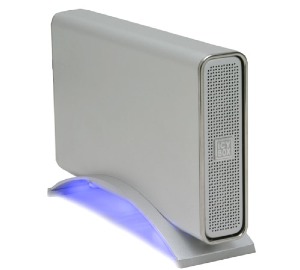
The solution I came up with was an IcyBox IB-360StUS-BL external SATA/USB2 enclosure, wired to a Sonnet Tempo Express 34 SATA adapter. Icybox HD enclosure
Icybox IB-360StUS-BL enclosureEnclosure The IcyBox is such an affordable little box that it seems silly not to have one to hand as a precaution, especially given the cheapness of hard drives these days. The enclosure is convection cooled, so has no noisy fan, and is an a reasonably attractive alumnium package that fits in with the look of the Macbook Pro quite well. The blue LED is switchable, just in case you don't want that bling look on your desktop.Inside the enclosure there's both PATA and SATA connectors. I chose to use a SATA drive, a Samsung HD400LJ. There are two headers for connecting a SATA drive. One goes to the USB 2 adapter, one straight to the outside of the enclosure for wiring to a SATA port on the computer.Four screws secure the hard drive in its tray. The tray then slides into the frame and is secured by four screws in the base. I didn't find it that easy to get these in, but they seemed secure enough once screwed in.The IcyBox comes with plenty of cables, including a SATA-SATA cable, a bracket to relocate an internal SATA port to the PCI card cover on a regular PC, and a USB cable. The power supply is of the external brick sort. SATA adapterThe other half of the equation is the Sonnet Tempo Express 34 SATA adapter. This fits into the Macbook Pro's Express Card port — you knew that something had to eventually, eh? The Tempo card features two eSATA ports, which are of a different design to the  SATA ports featured on the Icybox. This means you need to buy an eSATA-SATA cable. You can either spend $20 on one from Sonnet themselves, or get a cheaper unbranded one for about the tenth of the price: just make sure its reasonably well shielded.Once plugged in, the external drive shows up on the Mac as a SCSI device, and behaves like any removable media. As such, it needs to be unmounted from the desktop before you eject the Tempo card.The only bug with the Tempo card I've found is that things don't seem to work that well if you boot the machine with the card inserted. The very helpful people from Sonnet tell me this is an issue with the underlying Silicon Image chipset, and they're working on sorting it out. (I was very impressed with the technical knowledge, friendliness and speed of response from Sonnet's support department.)PerformanceI'm no benchmarking guru, but it's clear that the external Samsung HD400LJ outperforms my internal 7200rpm SATA drive on the Macbook Pro. Brief experiments with XBench suggested that this performance boost was probably between 20 and 40%. It's certainly vastly preferable to the performance hit you get when you use a USB or Firewire 400 drive with the MBP.ConclusionIt's early days yet, but I'm happy with my new setup. The extra port on the Tempo adapter allows for the connection of another drive, or if I use Sonnet's own products, up to 10 drives! I feel happier knowing the disk isn't competing for attention with all the other USB gadgets I have plugged in. The other big plus point for me is the quietness of the Icybox/Samsung combination.Links: 

Eddy Petrișor: disable the pcspkr - hacks

I blogged 5 days ago about the annoying beeper and different methods that were supposed to turn it off.

I asked for a clean solution, but I received suggestions for some hacks. Now I decided to make a new post since there was a comment added today and I remembered about a possible hack (dpkg-divert) I was thinking about.

Now here are some of those hacks and the reason behind rejecting them.

Still, the question remains, why don't the originally proposed methods work, especially blacklisting?

Update: the headphones jack works with some small changes, bug submitted (#407252)

16 January 2007

Eddy Petrișor: sleep schedule

Currrently I am having trouble with my sleep schedule. Is really messed up; recently I ended up going to sleep at 3, 4 or even 5 in the morning and waking up around 11. That is not good.

This affects everything: job, RL, my energy level during the day, Debian releated work, social life etc.

So I asked my GF to call me when she wakes up, so I can repair my sleep schedule. Today the phone rang at 8:00am sharp. 45 minutes later I was up. Not too bad for the first attempt.

Next.

Previous.