Search Results: "ean"

16 August 2014

Matthias Klumpp: AppStream/DEP-11 Debian progress

There hasn t been a progress-report on DEP-11 for some time, but that doesn t mean there was no work going on on it. DEP-11 is Debian s implementation of AppStream, as well as an effort to enhance the metadata available about software in Debian. While initially, AppStream was only about applications, DEP-11 was designed with a larger scope, to collect data about libraries, binaries and things like Python modules. Now, since AppStream 0.6, DEP-11 and AppStream have essentially the same scope, with the difference of DEP-11 metadata being described in YAML, while official AppStream data is XML. That was due to a request by our ftpmasters team, which doesn t like XML (which is also not used anywhere in Debian, as opposed to YAML). But this doesn t mean that people will have to deal with the YAML file format: The libappstream library will just take DEP-11 data as another data source for it s Xapian database, allowing anything using libappstream to access that data just like the XML stuff. Richards libappstream-glib will also receive support for the DEP-11 format soon, filling it s in-memory data cache and enabling the use of GNOME-Software on Debian. So, what has been done so far? The past months, my Google Summer of Code student. Abhishek Bhattacharjee, was working hard to integrate DEP-11 support into dak, the Debian Archive Kit, which maintains the whole Debian archive. The result will be an additional metadata table in our internal Postgres database, storing detailed information about the software available in a Debian package, as well as Components-<arch>.yml.gz files in the Debian repositories. Dak will also produce an application icon-cache and a screenshots repository. During the time of the SoC, Abhishek focused mainly on the applications part of things, and less on the other components (like extracting data about Python modules or libraries) these things can easily be implemented later. The remaining steps will be to polish the code and make it merge-ready for Debian s dak (as soon as it has received enough testing, we will likely give it a try on the Tanglu Debian derivative). Following that, Apt will be extended to fetch the DEP-11 data on-demand on systems where it is useful (which is currently mostly desktop-systems) if you want to save a little bit of space, you will be able to disable downloading this extra metadata in Apt. From there, libappstream will take the data for it s Xapian db. This will lead to the removal of the much-hated (from ftpmasters and maintainers side) app-install-data package, which has not been updated for two years and only contains a small fraction of the metadata provided by DEP-11. What Debian will ultimately gain from this effort is support for software-centers like GNOME-Software, and improved support for tools like Apper and Muon in displaying applications. Long-term, with more metadata being available, It would be cool to add support for it to specialized package managers , like Python s pip, npm or gem, to make them fetch information about available distribution software and install that instead of their own copies from 3rd-party repositories, if possible. This should ultimatively lead to less code duplication on distributions and will likely result in fewer security issues, since the officially maintained and integrated distribution packages can easily be used, if possible. This is no attempt to make tools like pip obsolete, but an attempt to have the different tools installing software on your machine communicate better, instead of creating parallel worlds in terms of software management. Another nice sideeffect of more metadata will be options to search for tools handling mimetypes in the software repos (in case you can t open a file), smart software centers installing missing firmware, and automatic suggestions for developers which software they need to install in order to build a specific software package. Also, the data allows us to match software across distributions, for that, I will have some news soon (not sure how soon though, as I am currently in thesis-writing-mode, and therefore have not that much spare time). Since the goal is to have these features available on all distributions supporting AppStream, it will take longer to realize but we are on a good way. So, if you want some more information about my student s awesome work, you can read his blogpost about it. He will also be at Debconf 14 (Portland). (I can t make it this time, but I surely won t miss the next Debconf) Sadly, I only see a very small chance to have the basic DEP-11 stuff land in-time for Jessie (lots of review work needs to be done, and some more code needs to be written), but we will definitively have it in Jessie+1. A small example on how this data will look like can be found here a larger, actual file is available here. Any questions and feedback are highly appreciated.

15 August 2014

Aurelien Jarno: Intel about to disable TSX instructions?

Last time I changed my desktop computer I bought a CPU from the Intel Haswell family, the one available on the market at that time. I carefully selected the CPU to make sure it supports as many instructions extensions as possible in this family (Intel likes segmentation, even high-end CPUs like the Core i7-4770k do not support all possible instructions). I ended-up choosing the Core i7-4771 as it supports the Transactional Synchronization Extensions (Intel TSX) instructions, which provide transactional memory support. Support for it has been recently added in the GNU libc, and has been activated in Debian. By choosing this CPU, I wanted to be sure that I can debug this support in case of bug report, like for example in bug#751147. Recently some computing websites started to mention that the TSX instructions have bugs on Xeon E3 v3 family (and likely on Core i7-4771 as they share the same silicon and stepping), quoting this Intel document. Indeed one can read on page 49:
HSW136. Software Using Intel TSX May Result in Unpredictable System Behavior

Problem: Under a complex set of internal timing conditions and system events, software using the Intel TSX (Transactional Synchronization Extensions) instructions may result in unpredictable system behavior.
Implication: This erratum may result in unpredictable system behavior.
Workaround: It is possible for the BIOS to contain a workaround for this erratum.
And later on page 51:
Due to Erratum HSw136, TSX instructions are disabled and are only supported for software development. See your Intel representative for details.
The same websites tell that Intel is going to disable the TSX instructions via a microcode update. I hope it won t be the case and that they are going to be able to find a microcode fix. Otherwise it would mean I will have to upgrade my desktop computer earlier than expected. It s a bit expensive to upgrade it every year and that s a the reason why I skipped the Ivy Bridge generation which didn t bring a lot from the instructions point of view. Alternatively I can also skip microcode and BIOS updates, in the hope I won t need another fix from them at some point.

13 August 2014

Ian Donnelly: The New Deal: ucf Integration

Hi Everybody, A few days ago I posted an entry on this blog called dpkg Woes where I explained that due to a lack of response, we were abandoning our plan to patch dpkg for my Google Summer of Code project, and I explained that we had a new solution. Well today I would like to tell you about that solution. Instead of patching dpkg, which would take a long time and seemed like it would never make it upstream, we have added some new features to ucf which will allow my Google Summer of Code project to be realized. If you don t know, ucf, which stands for Update Configuration File, is a popular Debian package whose goal is to preserve user changes to config files. It is meant to act as an alternative to considering a configuration file a conffile on systems that use dpkg. Instead, package maintainers can use ucf to handle these files in a conffile-like way. Where conffiles must work on all systems, because they are shipped with the package, configuration files that use ucf can be handled by maintainer scripts and can vary between systems. ucf exists as a script that allows conffile-like handling of non-conffile configuration files and allows much more flexibility than dpkg s conffile system. In fact, ucf even includes an option to perform a three-way merge on files it manages, it currently only uses diff3 for the task though. As you can see, ucf has a goal that while different than ours, seems naturally compatible to our goal of automatic conffile merging. Obviously, since ucf is a different tool than dpkg we had to re-think how we were going to integrate with ucf. Luckily, integration with ucf proved to be much more simple than integration with dpkg. All we had to do to integrate with ucf was to add a generic hook to attempt a three way merge using any tool created for the task such as Elektra and kdb merge. Felix submitted a pull request with the exact code almost a week ago and we have talked with Manoj Srivastava, the developer for ucf, and he seemed to really like the idea. The only changes we made are to add an option for a three-way merge command, and if one is present, the merge is attempted using the specified command. It s all pretty simple really. Since we decided to include a generic hook for a three-way merge command instead of an Elektra-specific one (which would be less open and would create a dependency on Elektra), we also had to add functionality to Elektra to work with this hook. We ended up writing a new script, called elektra-merge which is now included in our repository. All this script does is act as a liaison between the ucf --three-way-merge-command option and Elektra itself. The script automatically mounts the correct files for theirs and base and dest using the new remount command. Since the only parameters that are passed to the ucf merge command are the paths of ours, theirs, base and result, we were missing vital information on how to mount these files. Our solution was to create the remount command which mirrors the backend configuration of an existing mountpoint to create a new mountpoint using a new file. So if ours is mounted to system/ours using ini, kdb remount /etc/theirs system/theirs system/ours will mount /etc/theirs to system/theirs using the same backend as ours. Since theirs, base, and result should all have the same backend as ours, we can use remount to mount these files even if all we know is their paths. Now, package maintainers can edit their scripts to utilize this new feature. If they want, package maintainers can specify a command to use to merge files using ucf during package upgrades. I will soon be posting a tutorial about how to integrate this feature into a package and how to use Elektra in your scripts in order to allow for automatic three-way merges during package upgrade. I will post a link to the tutorial here once it is published. Sincerely,
Ian S. Donnelly

Riku Voipio: Booting Linaro ARMv8 OE images with Qemu

A quick update - Linaro ARMv8 OpenEmbbeded images work just fine with qemu 2.1 as well:

$ http://releases.linaro.org/14.07/openembedded/aarch64/Image
$ http://releases.linaro.org/14.07/openembedded/aarch64/vexpress64-openembedded_lamp-armv8-gcc-4.9_20140727-682.img.gz
$ qemu-system-aarch64 -m 1024 -cpu cortex-a57 -nographic -machine virt \
-kernel Image -append 'root=/dev/vda2 rw rootwait mem=1024M console=ttyAMA0,38400n8' \
-drive if=none,id=image,file=vexpress64-openembedded_lamp-armv8-gcc-4.9_20140727-682.img \
-netdev user,id=user0 -device virtio-net-device,netdev=user0 -device virtio-blk-device,drive=image
[ 0.000000] Linux version 3.16.0-1-linaro-vexpress64 (buildslave@x86-64-07) (gcc version 4.8.3 20140401 (prerelease) (crosstool-NG linaro-1.13.1-4.8-2014.04 - Linaro GCC 4.8-2014.04) ) #1ubuntu1~ci+140726114341 SMP PREEMPT Sat Jul 26 11:44:27 UTC 20
[ 0.000000] CPU: AArch64 Processor [411fd070] revision 0
...
root@genericarmv8:~#
Quick benchmarking with age-old ByteMark nbench:
Index Qemu Foundation Host
Memory 4.294 0.712 44.534
Integer 6.270 0.686 41.983
Float 1.463 1.065 59.528
Baseline (LINUX) : AMD K6/233*
Qemu is upto 8x faster than Foundation model on Integers, but only 50% faster on Math. Meanwhile, the Host pc spends 7-40x slower emulating ARMv8 than executing native instructions.

12 August 2014

Ian Donnelly: How-To: kdb import

Hi everybody, Today I wanted to go over what I think is a very useful command in the kdb tool, kdb import. As you know, the kdb tool allows users to interact with the Elektra Key Database (KDB) via the command line. Today I would like to explain the import function of kdb. The command to use kdb import is:

kdb import [options] destination [format]
In this command, destination is where the imported Keys should be stored below. For instance, kdb import system/imported would store all the keys below system/imported. This command takes Keys from stdin to store them into KDB. Typically, this command is used with a pipe to read in the Keys from a file. The format argument you see above can be a very powerful option to use with kdb import. The format argument allows a user to specify which plug-in is used to import the Keys into the Key Database. The user can specify any storage plug-in to serve as the format for the Keys to be imported. For instance, if a user wanted to import a /etc/hosts file into KDB without mounting it, they could use the command cat /etc/hosts kdb import system/hosts hosts. This command would essentially copy the current hosts file into KDB, like mounting it. Unlike mounting it, changes to the Keys would not be reflected in the hosts file and vise versa. If no format is specified, the format dump will be used instead. The dump format is the standard way of expressing Keys and all their relevant information. This format is intended to be used only within Elektra. The dump format is a good means of backing up Keys from the Key Database for use with Elektra later such as reimporting them later. As of this writing, dump is the only way to fully preserve all parts of the KeySet. It is very important to note that the dump does not rename keys by design. If a user exports a KeySet using dump using a command such as kdb export system/backup > backup.ecf, they can only import that keyset back into system/backup using a command like cat backup.ecf kdb import system/backup. The kdb import command only takes one special option:

-s --strategy

which is used to specify a strategy to use if Keys already exist in the specified destination.
The current list of strategies are:

preserve any keys already in the destination will not be overwritten
overwrite any keys already in the destination will be overwritten if a new key has the same name
cut all keys already in the destination will be removed, then new keys will be imported

If no strategy is specified, the command defaults to the preserve strategy as to not be destructive to any previous keys. An example of using the kdb import is as follows:

cat backup.ecf kdb import system/restore

This command would import all keys stored in the file backup.ecf into the Key Database under system/restore. In this example, backup.ecf was exported from the KeySet using the dump format by using the command:
kdb export system/backup > backup.ecf backup.ecf contains all the information about the keys below system/backup:

$cat backup.ecf
kdbOpen 1
ksNew 3
keyNew 19 0
system/backup/key1
keyMeta 7 1
binary
keyEnd
keyNew 19 0
system/backup/key2
keyMeta 7 1
binary
keyEnd
keyNew 19 0
system/backup/key3
keyMeta 7 1
binary
keyEnd
ksEnd
Before the import command, system/backup does not exists and no keys are contained there.
After the import command, running the command kdb ls system/backup prints:

system/backup/key1
system/backup/key2
system/backup/key3
As you can see, the kdb import command is a very useful tool included as part of Elektra. I also wrote a tutorial on the kdb export command. Please go read that as well because those two commands go hand in hand and allow some very powerful usage of Elektra. Sincerely,
Ian S. Donnelly

Ian Donnelly: How-To: kdb export

Hi everybody, I recently posted a tutorial on the kdb import command. Well I also wanted to go over it s sibling function, kdb export. These two commands work very similarly, but there are some differences. First of all, the command to use kdb export is:

kdb export [options] source [format]
In this command, source is the root key of which Keys should be exported. For instance, kdb export system/export would export all the keys below system/export. Additionally, this command exports keys under the system/elektra directory by default. It does this so that information about the keys stored under this directory will be included if the Keys are later imported into an Elektra Key Database. This command export Keys to stdout to store them into the Elektra Key Database. Typically, the export command is used with redirection to write the Keys to a file. As we discussed already, the format argument can be a very powerful option to use with kdb export. Just like with kdb import the format argument allows a user to specify which plug-in is used to export the Keys from the Key Database. The user can specify any storage plug-in to serve as the format for the exported Keys. For instance, if a user mounted their hosts file to system/hosts using kdb mount /etc/hosts system/hosts hosts they would be able to export these Keys using the hosts format by using the command kdb export system/hosts hosts > hosts.ecf. This command would essentially create a backup of their current /etc/hosts file in a valid format for /etc/hosts. If no format is specified, the format dump will be used instead. The dump format is the standard way of expressing Keys and all their relevant information. This format is intended to be used only within Elektra. The dump format is a good means of backing up Keys from the Key Database for use with Elektra later such as reimporting them later. As of this writing, dump is the only way to fully preserve all parts of the KeySet. The kdb export command takes one special option, but it s different than the one for kdb import, that option is:

-E --without-elektra which omits the system/elektra directory of keys
An example of using the kdb export is as follows:

kdb export system/backup > backup.ecf
This command would export all keys stored under system/backup, along with relevant Keys in system/elektra, into a file called backup.ecf. As you can see, the kdb export command is a very useful tool just like it s sibling, kdb import. If you haven t yet, please go read the tutorial I wrote for kdb import because these two commands are best used together and can enable some really great features of Elektra. Sincerely,
Ian S. Donnelly

11 August 2014

Ian Donnelly: dpkg Woes

Hi Everybody, The original plan for my Google Summer of Code project involved creating a merge tool for Elektra including a kdb merge command, that part is all finished and integrated into the newest release of Elektra, 0.8.7 already. The next step was to patch dpkg to add an option for conffile merging. The basic overview of how this would work is: Obviously, all of these things require patching dpkg, although not in too large away. Luckily, we found a previous attempt to patch dpkg for a three-way merge hook, however it is a few years old and was never included in dpkg. Felix decided to update this patch to work with the new versions of dpkg and cleaned up a bit of redundancy, he then resubmitted it to see if the dpkg maintainers would be interested in such a patch, and to start a dialogue about including all the patches we need. Unfortunately there has been no response from the dpkg team, any many bugs on their tracker have been sitting unanswered for years. Additionally, dpkg s source can be quite complex and it would require a ton of effort for us to make all these patches with no guarantee of integration. As a result, we have decided to go another route (which I will be posting about soon). I just wanted to update anybody interested on the progress of my Google Summer of Code Project by letting them know the experience with dpkg. We have come up with a new solution that is already looking great and you will hear a lot more about it this final week of Google Summer of Code. Stay Tuned!
- Ian S. Donnelly

10 August 2014

Cyril Brulebois: Why is my package blocked?

A bit of history: A while ago udeb-producing packages were getting frozen on a regular fashion, when a d-i release was about to be cut. While I wasn t looking at the time, I can easily understand the reasons behind that: d-i is built upon many components, it takes some time to make sure it s basically in shape for a release, and it s very annoying when a regression sneaks in right before the installation images get built. I took over d-i release maintenance in May 2012 and only a few uploads happened before the wheezy freeze. I was only discovering the job at the time, and I basically released whatever was in testing then. The freeze began right after that (end of June), so I started double checking things affecting d-i (in addition to or instead of the review performed by other release team members), and unblocking packages when changes seemed safe, or once they were tested. A few uploads happened after the wheezy release and there s already a Jessie Alpha 1 release. I was about to release Jessie Beta 1 after some fair bits of testing, a debian-installer upload, and the only remaining bits were: building installation images (hello Steve), and of course communication (mail announce and website update). Unfortunately a new upstream release reached testing in the meanwhile, breaking the installer in several ways. I ll give details below, of course not because I want to point finger at the maintainer, but to illustrate the ramifications that a single package s migrating to testing can induce. Since I d like to avoid such experience in the future, I ll probably reintroduce the old method and freeze all udeb-producing packages during next d-i releases. So you know why it might happen. Your next question might be: What to do when your package is getting caught in that net? . In that case, please get in touch with both debian-release@ and debian-boot@ asking for an unblock. I ll then review your particular package, and either let it migrate to testing, or delay it until after the release. Update: official announcement.

9 August 2014

Steve Kemp: Rebooting the CMS

I run a cluster for the Debian Administration website, and the code is starting to show its age. Unfortunately the code is not so modern, and has evolved a lot of baggage. Given the relatively clean separation between the logical components I'm interested in trying something new. In brief the current codebase allows: It crossed my mind the other night that it might make sense to break this code down into a number of mini-servers - a server to handle all article-related things, a server to handle all poll-related things, etc. If we have a JSON endpoint that will allow: Then we could have a very thin shim/server on top of that whihc would present the public API. Of course the internal HTTP overhead might make this unworkable, but it is an interesting approach to the problem, and would allow the backend storage to be migrated in the future without too much difficulty. At the moment I've coded up two trivial servers, one for getting user-data (to allow login requests to succeed), and one for getting article data. There is a tiny presentation server written to use those back-end servers and it seems like an approach that might work. Of course deployment might be a pain.. It is still an experiment rather than a plan, but it could work out: http://github.com/skx/snooze/.

Russ Allbery: A new challenge

Those reading this journal may have noticed that my rate of posting has dropped a bit in the past few years, and quite a lot in the past year. One of the major reasons for this was work, which had been getting more bureaucratic, more stressful, less trusting, and more fearful. After this got drastically worse in the past six months, I finally decided enough was enough and took advantage of a good opportunity to do something different. I will be joining Dropbox's site reliability engineering team in a week and a half (which means that I'll be working on their servers, not on the product itself). It will take a few months to settle in, but hopefully this will mean a significant improvement to my stress levels and a lot of interesting projects to work on. I'm taking advantage of this change to inventory the various things I'm currently committed to and let go of some projects to make more space in my life. There are also a variety of software projects that I was maintaining as part of my job at Stanford, and I will be orphaning many of those packages. I'll make another journal post about that a bit later. For Debian folks, I am going to be at Debconf, and hope to meet many of you there. (It's going to sort of be my break between jobs.) In the long run, I'm hoping this move will let me increase my Debian involvement. In the long run, I expect most of my free software work, my reviews, and the various services I run to continue as before, or even improve as my stress drops. But I've been at Stanford for a very long time, so this is quite the leap into the unknown, and it's going to take a while before I'm sure what new pattern my life will fall into.

8 August 2014

Ian Donnelly: The Line Plug-In

Hi Everybody, As you may have noticed I wrote a new plug-in for Elektra called line . I used it for a lot of examples in my tutorial, How-To: Write a Plug-In. The line plug-in is a very simple storage plug-in for Elektra. This plug-in stores files into the Elektra Key Database creating a new Key for each line and setting the string value of the Key to the string value of the line of that file. So if we have a file called hello.txt :

Hello
World!

And we mount it to kdb like so: kdb mount ~/line.txt system/hello_line line. The output of kdb ls system/hello_line the output would be:

system/hello_line/#1
system/hello_line/#
2

With the getString values of #1 and #2 being Hello and World! respectively. If this seems like a very simple plug-in, that s because it is. Obviously, this plug-in isn t a great showcase for the robustness of Elektra, any data structure could store a file line by line relatively easy, so why did we add a line plug-in at all? The answer is that we included a line plug-in to allow any line-based file to use functions of Elektra, particularly the new Merge function. My Google Summer of Code project is to allow for automatic three-way merge of Debian conffiles during package upgrades as opposed to the current prompt and manual merging a user must do if a conffile is edited. Using Elektra and the new mergecode we can mount a conffile with the best plug-in for it, (the ini plug-in for Samba s smb.conf for instance) and that allows for a very powerful merging ability with a lot more success than a simple diff merge. However, there are a lot of conffiles that don t use any particular standard (such as ini, xml, or JSON) to store data. That is where the line plug-in comes in. We can still mount these files using the line plug-in and attempt a merge. Of course it is much more likely to have conflicts, and this type of merge is still susceptible to many of the same flaws as regular file merges (such as not being able to detect when a line has been moved), but it simple cases, the merge may succeed which would reduce the overall number of times a user would be prompted during an upgrade. Basically, I wrote a line plug-in for Elektra as a fallback for conffile merges when we can t mount the conffile in any more meaningful way. While merges using KeySets that were mounted using line are more likely to fail than other, more specialized plug-ins, there are cases that these merges will succeed and the user will not have to deal with a confusing prompt. The whole point of my Google Summer of Code project is to make upgrading packages and dealing with conffiles much smoother and easier than it is now by including a three-way mere and this line plug-in will help with this goal. Sincerely,
Ian S. Donnelly

Richard Hartmann: Microsoft Linux: Debian

Huh... Source (Yes, I am on Debian's trademark team and no, I have no idea what that means. Yet.) Update: Thanks to Marcin and Steven Chamberlain for this find: It seems Debian Red is an actual name used by desginers.

7 August 2014

Jordi Mallach: A pile of reasons why GNOME should be Debian jessie s default desktop environment

GNOME has, for some reason or another, always been the default desktop environment in Debian since the installer is able to install a full desktop environment by default. Release after release, Debian has been shipping different versions of GNOME, first based on the venerable 1.2/1.4 series, then moving to the time-based GNOME 2.x series, and finally to the newly designed 3.4 series for the last stable release, Debian 7 wheezy . During the final stages of wheezy s development, it was pointed out that the first install CD image would not longer hold all of the required packages to install a full GNOME desktop environment. There was lots of discussion surrounding this bug or fact, and there were two major reactions to it. The Debian GNOME team rebuilt some key packages so they would be compressed using xz instead of gzip, saving the few megabytes that were needed to squeeze everything in the first CD. In parallel, the tasksel maintainer decided switching to Xfce as default desktop was another obvious fix. This change, unannounced and two days before the freeze, was very contested and spurred the usual massive debian-devel threads. In the end, and after a few default desktop flip flops, it was agreed that GNOME would remain as the default for the already frozen wheezy release, and this issue would be revisited later on during jessie s development. And indeed, some months ago, Xfce was again reinstated as Debian s default desktop for jessie as announced:
Change default desktop to xfce.
This will be re-evaluated before jessie is frozen. The evaluation will
start around the point of DebConf (August 2014). If at that point gnome
looks like a better choice, it ll go back as the default.
Some criteria for that choice will include:
* Popcon numbers for gnome on jessie. If gnome installations continue to
  rise fast enough despite xfce being the default (compared with, say
  kde installations), then we ll know that users prefer gnome.
  Currently we have no data about how many users would choose gnome when
  it s not the default. Part of the reason for switching to xfce now
  is to get such data.
* The state of accessability support, particularly for the blind.
* How well the UI works for both new and existing users. Gnome 3
  seems to be adding back many gnome 2 features that existing users
  expect, as well as making some available via addons. If it feels
  comfortable to gnome 2 (and xfce) users, that would go a long way
  toward switching back to it as the default. Meanwhile, Gnome 3 is also
  breaking new ground in its interface; if the interface seems more
  welcoming to new users, or works better on mobile devices, etc, that
  would again point toward switching back.
* Whatever size constraints exist for CD or other images at the time.
--
Hello to all the tech journalists out there. This is pretty boring.
Why don t you write a story about monads instead?
Joey Hess in dfca406eb694e0ac00ea04b12fc912237e01c9b5.
Suffice to say that the Debian GNOME team participants have never been thrilled about how the whole issue is being handled, and we ve been wondering if we should be doing anything about it, or just move along and enjoy the smaller amount of bug reports against GNOME packages that this change would bring us, if it finally made it through to the final release. During our real life meet-ups in FOSDEM and the systemd+GNOME sprint in Antwerp, most members of the team did feel Debian would not be delivering a graphical environment with the polish we think our users deserve, and decided we at least should try to convince the rest of the Debian project and our users that Debian will be best suited by shipping GNOME 3.12 by default. Power users, of course, can and know how to get around this default and install KDE, Xfce, Cinnamon, MATE or whatever other choice they have. For the average user, though, we think we should be shipping GNOME by default, and tasksel should revert the above commit again. Some of our reasons are: In short, we think defaulting to GNOME is the best option for the Debian release, and in contrast, shipping Xfce as the default desktop could mean delivering a desktop experience that has some incomplete or rough edges, and not on par with Debian quality standards for a stable release. We believe tasksel should again revert the change and be uploaded as soon as possible, in order to get people testing images with GNOME the sooner the better, with the freeze only two months away. We would also like that in the future, changes of this nature will not be announced in a git commit log, but widely discussed in debian-project and the other usual development/decision channels, like the change of init system happened recently. We will, whichever the final decision is, continue to package GNOME with great care to ensure our users get the best possible desktop experience Debian can offer.

Niels Thykier: Recent improvements to Britney2

As mentioned by Rapha l Hertzog, I have been spending some time on improving Britney2. Just the other day I submitted a second branch for review that I expect to merge early next week. I also got another set patches coming up soon. Currently, none of them are really user visible, so unless you are hosting your own version of Britney, these patches are probably not all that interesting to you. The highlights:
  1. Reduce the need for backtracking by finding semantically equivalent packages.
  2. Avoid needing to set up a backtrack point in some cases.
    • This has the side-effect of eliminating some O(e^n) runtime cases.
  3. Optimise installability testing of packages affected by a hinted migration.
    • This has the side-effect of avoiding some O(e^n) runtime cases when the post-hint state does not trigger said behaviour.
    • There is a follow-up patch for this one coming in the third series to fix a possible bug for a corner-case (causing a valid hint to be incorrectly rejected when it removed an uninstallable package).
  4. Reduce the number of affected packages to test when migrating items by using knowledge about semantically equivalent packages.
    • In some cases, Britney can now do free migrations when all binaries being updated replace semantically equivalent packages.
  5. (Merge pending) Avoid many redundant calls to sort_actions() , which exhibits at least O(n^2) runtime in some cases.
    • For the dataset Rapha l submitted, this patch shaves off over 30 minutes runtime. In the particular case, each call to sort_actions takes 3+ minutes and it was called at least 10 times, where it was not needed.
    • That said, sort_actions have a vastly lower runtime in the runs for Debian (and presumably also Ubuntu, since no one complained from their side so far).
The results so far: After the first patch series was merged, the Kali dataset (from Rapha l) could be processed in only ~2 hours. With the second patch series merged, the dataset will drop by another 30-50 minutes (most of which are thanks to the change mentioned in highlight #5). The third patch series currently do not have any mention-worthy performance related changes. It will probably be limited to bug fixes and some refactoring. Reflections: The 3 first highlights only affects the new installability tester meaning that the Britney2 instances at Ubuntu and Tanglu should be mostly unaffected by the O(n^2) runtime. Although those cases will probably just fail with several AIEEE s. :) The 5th highlight should equally interesting to all Britney2 instances though. For me, the most interesting part is that we have never observed the O(n^2) behaviour in a daily sid -> testing run. The dataset from Rapha l was basically a stable -> testing/sid run, which is a case I do not think we have ever done before. Despite our current updates, there is still room for improvements on that particular use case. In particular, I was a bit disheartened at how poorly our auto hinter(s) performed on this dataset. Combined they only assisted with the migration of something like 28 items . For comparison, the main run migrated ~7100 items and 9220 items were unable to migrate. Furthermore, the Original auto hinter spend the better part of 15 minutes computing hints at least it results in 10 items migrating. Links to the patches:

Craig Small: WordPress 3.9.2 for Debian

WordPress released today a security release 3.9.2 which they fix several security issues, including a denial of service issue around XML. The corresponding Debian package 3.9.2+dfsg-1 is currently being uploaded to the Debian ftp-master server as I write this and should be available on the mirrors soon. Unfortunately at the time of writing, there are no CVE identifiers to match these problems up with, but refer to the wordpress page for details about these bugs. Andrew Nacin from WordPress has kindly outlined what versions are susceptible and it looks like the Debian squeeze (3.6.1+dfsg-1~deb6u4) and wheezy (3.6.1+dfsg-1~deb7u3) are vulnerable to at least some of these bugs which means for me its patch reading and back-porting time

6 August 2014

Chris Lamb: Strava Enhancement Suite update

https://chris-lamb.co.uk/wp-content/2014/strava/chrome_web_store.png I've been told I don't blog about my projects often enough, so here's a feature update on my Chrome Extension that adds various improvements to the Strava.com fitness tracker. All the features are optional and can be individually enabled in the options panel.

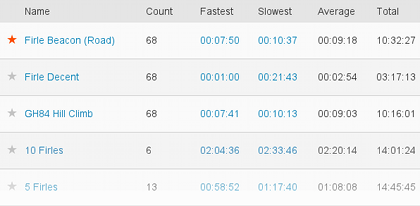
Repeated segments This adds aggregate data (fastest, slowest, average, etc.) when segments are repeated within an activity. It's particularly useful for laps or like this Everesting attempt hill repeats: https://chris-lamb.co.uk/wp-content/2014/strava/repeated_segments3.png

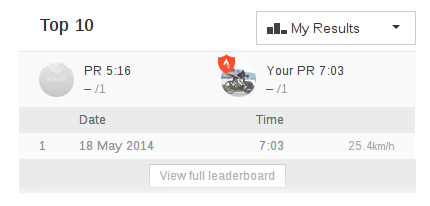
Leaderboard default Changes the default leaderboard away from "Overall" when viewing a segment effort. The most rewarding training often comes from comparing your own past performances rather than those of others, so viewing your own results by default can make more sense. You can select any of Men, Women, I'm Following or My Results: https://chris-lamb.co.uk/wp-content/2014/strava/leaderboard_default.png

Hide feed entries Hides various entry types in the activity feed that can get annoying. You currently have the option of hiding challenges, route creations, goals created or club memberships: https://chris-lamb.co.uk/wp-content/2014/strava/hide_challenge_feed_entries.png

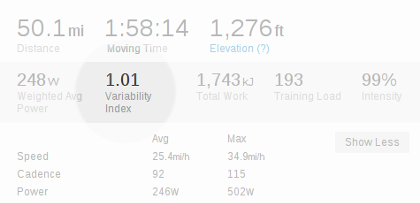
Variability Index Calculates a Variability Index (VI) from the weighted average power and the average power, an indication of how "smooth" a ride was. Required a power meter. A VI of 1.0 would mean a ride was paced "perfectly", with very few surges of effort: https://chris-lamb.co.uk/wp-content/2014/strava/variability_index.png

Infinite scroll Automatically loads more dashboard entries when reaching the bottom, saving a tedious click on the "More" button: https://chris-lamb.co.uk/wp-content/2014/strava/infinite_scroll.png

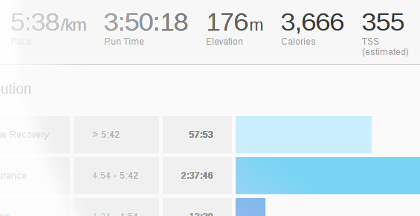
Running TSS Estimates a run's Training Stress Score (TSS) from its Grade Adjusted Pace distribution, a measure of that workout's duration and intensity relative to the athletes's capability, providing an insight into correct recovery time and overall training load over time: https://chris-lamb.co.uk/wp-content/2014/strava/running_tss.png

Hide "find friends" Hides social networking buttons, including invitations to invite or find further friends: https://chris-lamb.co.uk/wp-content/2014/strava/hide_invite_friends.png

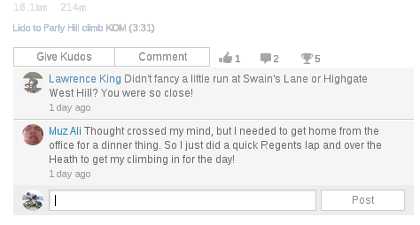
"Enter" posts comment Immediately posts comment when pressing Enter/Return key in the edit box rather than adding a newline: https://chris-lamb.co.uk/wp-content/2014/strava/comment_post_on_enter.png

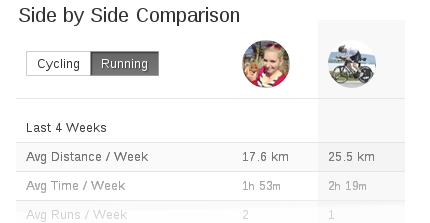
Compare running Changes the default sport for the "Side by Side comparison" module to running when viewing athlete profiles: https://chris-lamb.co.uk/wp-content/2014/strava/side_by_side_running.png

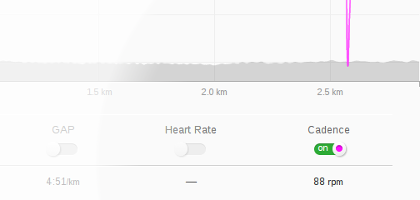
Running cadence Shows running cadence by default in the elevation profile: https://chris-lamb.co.uk/wp-content/2014/strava/running_cadence.png

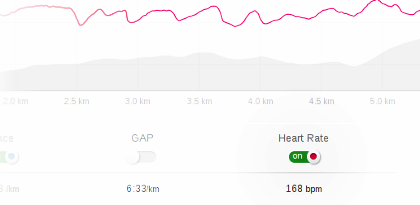
Running heart rate Shows running heart rate by default in elevation profile: https://chris-lamb.co.uk/wp-content/2014/strava/running_heart_rate.png

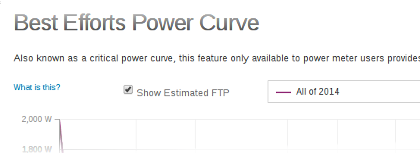
Estimated FTP Selects "Show Estimated FTP" by default on the Power Curve page: https://chris-lamb.co.uk/wp-content/2014/strava/estimated_ftp.png

Standard Google map Prefer the "Standard" Google map over the "Terrain" view: https://chris-lamb.co.uk/wp-content/2014/strava/standard_google_map.png

Let me know if you have any comments, suggestions or if you have any other feedback. If you find this software useful, please consider donating via Paypal to support further development. You can also view the source and contribute directly on GitHub. https://chris-lamb.co.uk/wp-content/2014/strava/chrome_web_store.png

5 August 2014

Andrew Pollock: [geek] Lifehacking with NFC, Tasker and HabitRPG

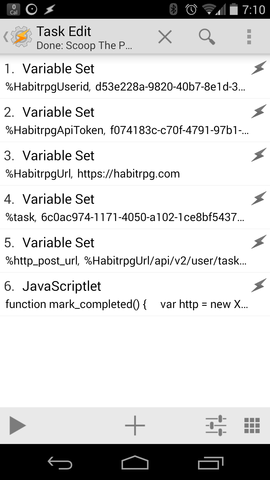
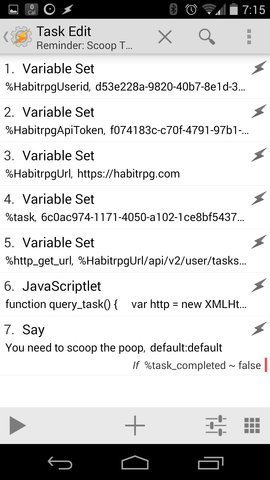
Oh man, I'm such a geek... Being a single parent has required a considerable amount of self-discipline on my behalf. I find I do best in an environment with routine to make sure stuff gets done. One of the things I did to try and make sure stuff got done was to form positive habits. To help and make this a bit more "fun", I started using HabitRPG, an online role-playing game based on habits. I've only ever used it in a half-arsed manner, and as a result, I die a lot. Often I'll do my dailies, but then forget to mark them off. Sometimes I just fall off the habit wagon altogether. And die. One of my dailies is to scoop my cat's litterboxes. For whatever reason, I find this a tad onerous, and had found myself falling out of the habit of doing it on a daily basis. My cat deserves better than this, so I wanted to get back on the habit wagon, but make it a bit more "fun" as well. I love NFC, I've been a big NFC weenie for a long time. It's a solution looking for a problem. I have a huge collection of NFC tags, and I've finally found a problem I could use them with. I wanted to make it more frictionless to mark a task as completed in HabitRPG. I didn't want to have to take out my phone, unlock it, open the HabitRPG app and check off the daily task. I just wanted to wave my phone at an NFC tag. Here's how I did it. The inimitable Paul Fenwick, who first inspired me to use HabitRPG, has a way more complicated set up to achieve something similar. The Site Reliability Engineer in me wanted the least number of moving parts and third-parties to have to get from my phone to HabitRPG. After some hunting around, I found this wiki page on integrating Tasker with HabitRPG's API, so based on that breadcrumb, I got hacking. I'd not used Tasker before. I was already using AutomateIt to do some other, reasonably dumb automation on my phone, though. Tasker is a little bit obtuse, and it took me a couple of days of casual fiddling with it to wrap my head around it's usage model. The fact that it can run arbitrary JavaScript, and that NFC Tools integrates with it is where the real awesome lies. So based off the wiki, I crafted a couple of bits of JavaScript, one to mark daily tasks as complete on HabitRPG, and one to query HabitRPG to see if they have been marked as complete. For the former, it was trivial, using NFC Tools, to write an NFC tag that then runs the Tasker task to call the HabitRPG API to mark a daily task as complete. That goal was now complete. The equally satisfying part was also having Tasker do a time-based conditional nag based on the state of the daily task in HabitRPG. So now if it gets to 4:45pm and I haven't scooped the litterboxes, my phone literally tells me I'd better go do it. I've also done the same thing with putting the dishwasher on. I've stuck an NFC tag on the dishwashing powder bottle lid, and I get a conditional reminder before bed time. It used to be an unconditional reminder with AutomateIt, and it was dumb, because I rarely forget to put the dishwasher on. Now, I can use HabitRPG to keep state on it instead. The hunk of JavaScript to update HabitRPG is very simple:
function mark_completed()   
  var http = new XMLHttpRequest();
  http.open("POST", http_post_url, false);
  http.setRequestHeader("x-api-user", global('HabitrpgUserid'));
  http.setRequestHeader("x-api-key", global('HabitrpgApiToken'));
  http.send();
  return(http.responseText); 
 
try   
  var result = mark_completed(); 
  catch(e)   
  var error = e.message; 
 
All of the interesting stuff is defined in variables preceding the JavaScript in the task definition. Here's a screenshot of the Task in Tasker that tells a thousand words: Screenshot of Tasker task that uses HabitRPG API to mark a task complete Similarly, to query HabitRPG, I'm using:
function query_task()   
  var http = new XMLHttpRequest();
  http.open("GET",http_get_url,false);
  http.setRequestHeader("x-api-user", global('HabitrpgUserid'));
  http.setRequestHeader("x-api-key", global('HabitrpgApiToken'));
  http.send();
  var p = JSON.parse(http.responseText);
  return p['completed'];
 
try   
  var task_completed = query_task(); 
  catch(e)   
  var error = e.message; 
 
It's only slightly trickier because you have to parse the JSON blob that comes back. Again, a screenshot. Screenshot of Tasker task that uses HabitRPG API to query task state Now maybe I'll stop dying so much in HabitRPG, my cat will have the clean toilet she deserves, and I'll stop getting reminded about putting the dishwasher on when I already have. Better living through automation, that's my motto.

4 August 2014

Russ Allbery: Review: Parasite

Review: Parasite, by Mira Grant
Series: Parasitology #1
Publisher: Orbit
Copyright: October 2013
ISBN: 0-316-21893-6
Format: Kindle
Pages: 504
It's 2027, and a company named Symbogen has revolutionized medicine and health. They manufacture a genetically-engineered parasite based on a tapeworm that can stabilize and protect the health of just about anyone. It can synthesize medication, fix chronic medical problems, and be adapted to different conditions. (Yes, I know biological systems don't work this way. That's not going to be the only suspension of disbelief problem.) This has made Symbogen one of the most powerful corporations in the country, aided by the skill at marketing and self-promotion shown by one of the founders. Sal, the protagonist of the novel, is one of Symbogen's most famous success stories. Sally was the victim of a horrible car crash that put her into an apparently irreversible coma. But as her family was debating whether to turn off life support, she woke up. She had no memory of her previous life at all, and had to relearn fine motor control, reading, and many other skills. She was essentially a new person. But she was alive; her symbiont had saved her. When the story proper starts, Sal is still a ward of her parents. She has generally adult skills despite still struggling with reading, but she still has occasional attacks and is under intensive monitoring by Symbogen. That means periodic mandatory appointments with Symbogen, which she hates, but she's otherwise started building a life for herself: a job in an animal shelter, an interest in exotic predatory plants, and, most notably, a boyfriend. There are things about her life she doesn't like, and she wants to be free of Symbogen, but she doesn't have a bad life. But then a mysterious illness begins sweeping through the population, causing people to go blank, apparently lose their minds, and then start attacking those near them. Some of you have doubtless already figured out the key plot revelation. It's not hard; even if you didn't from the summary, you will probably figure it out shortly into the book. And therein lies a large problem with this novel: it's hopelessly predictable. Creepy evil corporation that supposedly has your best interests at heart, check. Plucky mad scientist opposition who understands exactly what's going on, check. Well-meaning but heavy-handed government agents who try to get involved but mostly make everything worse, check. (Although it's unusual to have those agents as part of the protagonist's family, and I thought that added some additional depth.) Mostly clueless protagonist sucked into the plot and becoming critical to its resolution, check. Very few readers are going to be surprised by this story. This is not, by itself, a fatal flaw. Predictable story structures can carry satisfying variations, or introduce the reader to enjoyable characters. And I think Grant manages both here. Seanan McGuire, both as herself and under her Mira Grant pseudonym, tends to write damaged and struggling characters. Both her Newsflesh and October Daye series feature protagonists that have been hurt badly, but are coping and muddling through in their own ways. In Parasite, I think she takes a more daring and intriguing approach: a protagonist that other people in the story perceive as damaged and struggling, but who actually isn't. Sal is not a badly injured Sally, and she's quite a bit healthier than those around her think she is. Her thought processes don't work quite the same as those around her, but that's not because she's hurt. That's because she's a different person. This makes Parasite partly a novel about identity, about Sal claiming ownership of her own life. Grant drags this out longer than I wish she had, but I liked the idea. In Sal, she strikes a good balance between gratitude and genuine affection for her family and the need to become her own person unconstrained by other people's expectations. As with the Newsflesh series, Grant uses quotes and excerpts from interviews to fill in the world background: a few at the start of each chapter, and more around each part boundary. I like this technique, and Grant uses it well. By the end of the book, the Rolling Stone interview with the head of Symbogen has added a lot of insight into how Symbogen manages its public relations. Grant also throws in a few of her trademark dangerously off-beat characters: hyper-competent, wise-cracking, but eerily skewed. I loved those in Blackout and I loved Tansy and Dr. Cale here. (Adam was much less successful.) A whole book from Tansy's perspective wouldn't work, since she needs Sal as a straight woman, but I thought she stole every scene she was in. However, I agree wholeheartedly with Tansy on another point: Sal is remarkably, irritatingly dim about what is apparently intended to be the critical revelation of the book. I won't state it outright; given its significant presence in the final scene, apparently it is intended to be a spoiler. But I figured it out about 50 pages into the book. Grant telegraphs this revelation heavily, and Tansy considers it painfully obvious (with quite a bit of justification). But Sal doesn't figure it out for the entire book, ignores all the signs, and is apparently willfully blind. In a book written from the first-person perspective by an otherwise-reliable narrator, this is highly annoying. It significantly undermined my enjoyment of the book. I spent much of the novel ahead of the narrator in my understanding of the plot and waiting, in vain, for her to get on with it already. That unfortunately makes Parasite a mixed bag. I really liked many of the characters, and I think Grant did some interesting things with family dynamics and with claiming one's own identity. But this is undermined by a very predictable plot, the protagonist deciding to be dumber than a sack of hammers about a critical plot point, and some rather dubious world logic. (For example, why is Sal terrified of bad driving? It makes sense as a post-traumatic stress reaction... except it's a critical point to her characterization that she never went through that stress.) Sometimes I wanted to like this book and sometimes I wanted to shake it, and sometimes I felt both reactions at the same time. I like Grant's writing and characterization well enough that I will probably read the sequel, but this is more like the later books in the Newsflesh series than it is like the spectacular Feed. Worth reading, at least for me, but it could have been better. Rating: 7 out of 10

31 July 2014

Craig Small: Linux Capabilities

I was recently updating some code that uses fping. Initially it used exec() that was redirected to a temporary file but I changed it to use popen. While it had been a while since I ve done this sort of thing, I do recall there was an issue with running popen on setuid binary. A later found it is mainly around setuid scripts which are very problematic and there are good reasons why you don t do this. Anyhow, the program worked fine which surprised me. Was fping setuid root to get the raw socket?
$ ls -l /usr/bin/fping
-rwxr-xr-x 1 root root 31464 May  6 21:42 /usr/bin/fping
It wasn t which at first all I thought ok, so that s why popen is happy . The way that fping and other programs work is they bind to a raw socket. This socket sits below the normal type sockets such as the ones used for TCP and UDP and normal users cannot use them by default. So how did fping work it s magic and get access to this socket? It used Capabilities. Previously getting privileged features had a big problem; it was an all or nothing thing. You want access to a raw socket? Sure, be setuid but that means you also could, for example, read any file on the system or set passwords. Capabilites provide a way of giving programs some better level of access, but not a blank cheque. The tool getcap is the way of determining what capabilities are found on a file. These capabilities are attributes on the file which, when the file is run, turn into capabilities or extra permissions. fping has the capability cap_net_raw+ep applied to it. This gives access to the RAW and PACKET sockets which is what fping needs. The +ep after the capability name means it is an Effective and Permitted capability, which describes what happens with child processes and dropping privileges. I hadn t seen these Capabilities before. They are a nice way to give your programs the access they need, but limiting the risk of something going wrong and having a rouge program running as root.

Russell Coker: BTRFS Status July 2014

My last BTRFS status report was in April [1], it wasn t the most positive report with data corruption and system hangs. Hacker News has a brief discussion of BTRFS which includes the statement Russell Coker s reports of his experiences with BTRFS give me the screaming heebie-jeebies, no matter how up-beat and positive he stays about it [2] (that s one of my favorite comments about my blog). Since April things have worked better. Linux kernel 3.14 solves the worst problems I had with 3.13 and it s generally doing everything I want it to do. I now have cron jobs making snapshots as often as I wish (as frequently as every 15 minutes on some systems), automatically removing snapshots (removing 500+ snapshots at once doesn t hang the system), balancing, and scrubbing. The fact that I can now expect that a filesystem balance (which is a type of defragment operation for BTRFS that frees some chunks ) from a cron job and expect the system not to hang means that I haven t run out of metadata chunk space. I expect that running out of metadata space can still cause filesystem deadlocks given a lack of reports on the BTRFS mailing list of fixes in that regard, but as long as balance works well we can work around that. My main workstation now has 35 days of uptime and my home server has 90 days of uptime. Also the server that stores my email now has 93 days uptime even though it s running Linux kernel 3.13.10. I am rather nervous about the server running 3.13.10 because in my experience every kernel before 3.14.1 had BTRFS problems that would cause system hangs. I don t want a server that s an hour s drive away to hang The server that runs my email is using kernel 3.13.10 because when I briefly tried a 3.14 kernel it didn t work reliably with the Xen kernel 4.1 from Debian/Wheezy and I had a choice of using the Xen kernel 4.3 from Debian/Unstable to match the Linux kernel or use an earlier Linux kernel. I have a couple of Xen servers running Debian/Unstable for test purposes which are working well so I may upgrade my mail server to the latest Xen and Linux kernels from Unstable in the near future. But for the moment I m just not doing many snapshots and never running a filesystem scrub on that server. Scrubbing In kernel 3.14 scrub is working reliably for me and I have cron jobs to scrub filesystems on every system running that kernel. So far I ve never seen it report an error on a system that matters to me but I expect that it will happen eventually. The paper An Analysis of Data Corruption in the Storage Stack from the University of Wisconsin (based on NetApp data) [3] shows that nearline disks (IE any disks I can afford) have an incidence of checksum errors (occasions when the disk returns bad data but claims it to be good) of about 0.42%. There are 18 disks running in systems I personally care about (as opposed to systems where I am paid to care) so with a 0.42% probability of a disk experiencing data corruption per year that would give a 7.3% probability of having such corruption on one disk in any year and a greater than 50% chance that it s already happened over the last 10 years. Of the 18 disks in question 15 are currently running BTRFS. Of the 15 running BTRFS 10 are scrubbed regularly (the other 5 are systems that don t run 24*7 and the system running kernel 3.13.10). Newer Kernels The discussion on the BTRFS mailing list about kernel 3.15 is mostly about hangs. This is correlated with some changes to improve performance so I presume that it has exposed race conditions. Based on those discussions I haven t felt inclined to run a 3.15 kernel. As the developers already have some good bug reports I don t think that I could provide any benefit by doing more testing at this time. I think that there would be no benefit to me personally or the Linux community in testing 3.15. I don t have a personal interest in RAID-5 or RAID-6. The only systems I run that have more data than will fit on a RAID-1 array of cheap SATA disks are ones that I am paid to run and they are running ZFS. So the ongoing development of RAID-5 and RAID-6 code isn t an incentive for me to run newer kernels. Eventually I ll test out RAID-6 code, but at the moment I don t think they need more bug reports in this area. I don t have a great personal interest in filesystem performance at this time. There are some serious BTRFS performance issues. One problem is that a filesystem balance and subtree removal seem to take excessive amounts of CPU time. Another is that there isn t much support for balancing IO to multiple devices (in RAID-1 every process has all it s read requests sent to one device). For large-scale use of a filesystem these are significant problems. But when you have basic requirements (such as a mail server for dozens of users or a personal workstation with a quad-core CPU and fast SSD storage) it doesn t make much difference. Currently all of my systems which use BTRFS have storage hardware that exceeds the system performance requirements by such a large margin that nothing other than installing Debian packages can slow the system down. So while there are performance improvements in newer versions of the BTRFS kernel code that isn t an incentive for me to upgrade. It s just been announced that Debian/Jessie will use Linux 3.16, so I guess I ll have to test that a bit for the benefit of Debian users. I am concerned that 3.16 won t be stable enough for typical users at the time that Jessie is released.

Next.

Previous.