Search Results: "ron"

1 April 2015

Benjamin Mako Hill: RomancR: The Future of the Sharing-Your-Bed Economy

romancer_logo Today, Aaron Shaw and I are pleased to announce a new startup. The startup is based around an app we are building called RomancR that will bring the sharing economy directly into your bedrooms and romantic lives. When launched, RomancR will bring the kind of market-driven convenience and efficiency that Uber has brought to ride sharing, and that AirBnB has brought to room sharing, directly into the most frustrating and inefficient domain of our personal lives. RomancR is Uber for romance and sex. Here s how it will work: Of course, there are many existing applications like Tinder and Grindr that help facilitate romance, dating, and hookups. Unfortunately, each of these still relies on old-fashion intrinsic ways of motivating people to participate in romantic endeavors. The sharing economy has shown us that systems that rely on these non-monetary motivations are ineffective and limiting! For example, many altruistic and socially-driven ride-sharing systems existed on platforms like Craigslist or Ridejoy before Uber. Similarly, volunteer-based communities like Couchsurfing and Hospitality Club existed for many years before AirBnB. None of those older systems took off in the way that their sharing economy counterparts were able to! The reason that Uber and AirBnB exploded where previous efforts stalled is that this new generation of sharing economy startups brings the power of markets to bear on the problems they are trying to solve. Money both encourages more people to participate in providing a service and also makes it socially easier for people to take that service up without feeling like they are socially in debt to the person providing the service for free. The result has been more reliable and effective systems for proving rides and rooms! The reason that the sharing economy works, fundamentally, is that it has nothing to do with sharing at all! Systems that rely on people s social desire to share without money projects like Couchsurfing are relics of the previous century. RomancR, which we plan to launch later this year, will bring the power and efficiency of markets to our romantic lives. You will leave your pitiful dating life where it belongs in the dustbin of history! Go beyond antiquated non-market systems for finding lovers. Why should we rely on people s fickle sense of taste and attractiveness, their complicated ideas of interpersonal compatibility, or their sense of altruism, when we can rely on the power of prices? With RomancR, we won t have to! Note: Thanks to Yochai Benkler whose example of how leaving a $100 bill on the bedside table of a person with whom you spent the night can change the nature of the a romantic interaction inspired the idea for this startup.

31 March 2015

Zlatan Todori : Interviews with FLOSS developers: Francesca Ciceri

Debian and FLOSS community don't only occupy coding developers. They occupy people who write news, who talk about FLOSS, who help on booths and conferences, who create artistic forms of the community and so many others that contribute in countless ways. A lady, that is doing many of that is Francesca Ciceri, known in Debian as MadameZou. She is non-packaging Debian Developer, a fearless warrior for diversity and a zombie fan. Although it sounds intimidating, she is deep caring and great human being. So, what has MadaZou to tell us? Picture of MadameZou Who are you? My name is Francesca and I'm totally flattered by your intro. The fearless warrior part may be a bit exaggerated, though. What have you done and what are you currently working on in FLOSS world? I've been a Debian contributor since late 2009. My journey in Debian has touched several non-coding areas: from translation to publicity, from videoteam to www. I've been one of the www.debian.org webmasters for a while, a press officer for the Project as well as an editor for DPN. I've dabbled a bit in font packaging, and nowadays I'm mostly working as a Front Desk member. Setup of your main machine? Wow, that's an intimate question! Lenovo Thinkpad, Debian testing. Describe your current most memorable situation as FLOSS member? Oh, there are a few. One awesome, tiring and very satisfying moment was during the release of Squeeze: I was member of the publicity and the www teams at the time, and we had to pull a 10 hours of team work to put everything in place. It was terrible and exciting at the same time. I shudder to think at the amount of work required from ftpmaster and release team during the release. Another awesome moment was my first Debconf: I was so overwhelmed by the sense of belonging in finally meeting all these people I've been worked remotely for so long, and embarassed by my poor English skills, and overall happy for just being there... If you are a Debian contributor I really encourage you to participate to Debian events, be they small and local or as big as DebConf: it really is like finally meeting family. Some memorable moments from Debian conferences? During DC11, the late nights with the "corridor cabal" in the hotel, chatting about everything. A group expedition to watch shooting stars in the middle of nowhere, during DC13. And a very memorable videoteam session: it was my first time directing and everything that could go wrong, went wrong (including the speaker deciding to take a walk outside the room, to demonstrate something, out of the cameras range). It was a disaster, but also fun: at the end of it, all the video crew was literally in stitches. But there are many awesome moments, almost too many to recall. Each conference is precious on that regard: for me the socializing part is extremely important, it's what cements relationships and help remote work go smoothly, and gives you motivation to volunteer in tasks that sometimes are not exactly fun. You are known as Front Desk member for DebConf's - what work does it occupy and why do you enjoy doing it? I'm not really a member of the team: just one of Nattie's minions! You had been also part of DebConf Video team - care to share insights into video team work and benefits it provides to Debian Project? The video team work is extremely important: it makes possible for people not attending to follow the conference, providing both live streaming and recording of all talks. I may be biased, but I think that DebConf video coverage and the high quality of the final recordings are unrivaled among FLOSS conferences - especially since it's all volunteer work and most of us aren't professional in the field. During the conference we take shifts in filming the various talks - for each talk we need approximately 4 volunteers: two camera operators, a sound mixer and the director. After the recording, comes the boring part: reviewing, cutting and sometimes editing the videos. It's a long process and during the conference, you can sometimes spot the videoteam members doing it at night in the hacklab, exhausted after a full day of filming. And then, the videos are finally ready to be uploaded, for your viewing pleasure. During the last years this process has become faster thanks to the commitment of many volunteers, so that now you have to wait only few days, sometimes a week, after the end of the conference to be able to watch the videos. I personally love to contribute to the videoteam: you get to play with all that awesome gear and you actually make a difference for all the people who cannot attend in person. You are also non-packaging Debian Developer - how does that feel like? Feels awesome! The mere fact that the Debian Project decided - in 2009 via a GR - to recognize the many volunteers who contribute without doing packaging work is a great show of inclusiveness, in my opinion. In a big project like Debian just packaging software is not enough: the final result relies heavily on translators, sysadmins, webmasters, publicity people, event organizers and volunteers, graphic artists, etc. It's only fair that these contributions are deemed as valuable as the packaging, and to give an official status to those people. I was one of the firsts non-uploading DD, four years ago, and for a long time it was just really an handful of us. In the last year I've seen many others applying for the role and that makes me really happy: it means that finally the contributors have realized that they deserve to be an official part of Debian and to have "citizenship rights" in the project. You were the leading energy on Debian's diversity statement - what gave you the energy to drive into it? It seemed the logical conclusion of the extremely important work that Debian Women had done in the past. When I first joined Debian, in 2009, as a contributor, I was really surprised to find a friendly community and to not be discriminated on account of my gender or my lack of coding skills. I may have been just lucky, landing in particularly friendly teams, but my impression is that the project has been slowly but unequivocally changed by the work of Debian Women, who raised first the need for inclusiveness and the awareness about the gender problem in Debian. I don't remember exactly how I stumbled upon the fact that Debian didn't have a Diversity Statement, but at first I was very surprised by it. I asked zack (Stefano Zacchiroli), who was DPL at the time, and he encouraged me to start a public discussion about it, sending out a draft - and helped me all the way along the process. It took some back and forth in the debian-project mailing list, but the only thing needed was actually just someone to start the process and try to poke the discussion when it stalled - the main blocker was actually about the wording of the statement. I learned a great deal from that experience, and I think it changed completely my approach in things like online discussions and general communication within the project. At the end of the day, what I took from that is a deep respect for who participated and the realization that constructive criticism does require certainly a lot of work for all parts involved, but can happen. As for the statement in itself: these things are as good as you keep them alive with best practices, but I think that are better stated explicitly rather than being left unsaid. You are involved also with another Front Desk, the Debian's one which is involved with Debian's New Members process - what are tasks of that FD and how rewarding is the work on it? The Debian Front Desk is the team that runs the New Members process: we receive the applications, we assign the applicant a manager, and we verify the final report. In the last years the workflow has been simplified a lot by the re-design of the nm.debian.org website, but it's important to keep things running smoothly so that applicants don't have too lenghty processes or to wait too much before being assigned a manager. I've been doing it for a less more than a month, but it's really satisfying to usher people toward DDship! So this is how I feel everytime I send a report over to DAM for an applicant to be accepted as new Debian Developer: Crazy pic How do you see future of Debian development? Difficult to say. What I can say is that I'm pretty sure that, whatever the technical direction we'll take, Debian will remain focused on excellence and freedom. What are your future plans in Debian, what would you like to work on? Definetely bug wrangling: it's one of the thing I do best and I've not had a chance to do that extensively for Debian yet. Why should developers and users join Debian community? What makes Debian a great and happy place? We are awesome, that's why. We are strongly committed to our Social Contract and to users freedom, we are steadily improving our communication style and trying to be as inclusive as possible. Most of the people I know in Debian are perfectionists and outright brilliant in what they do. Joining Debian means working hard on something you believe, identifying with a whole project, meeting lots of wonderful people and learning new things. It ca be at times frustrating and exhausting, but it's totally worth it. You have been involved in Mozilla as part of OPW - care to share insights into Mozilla, what have you done and compare it to Debian? That has been a very good experience: it meant have the chance to peek into another community, learn about their tools and workflow and contribute in different ways. I was an intern for the Firefox QA team and their work span from setting up specific test and automated checks on the three version of Firefox (Stable, Aurora, Nightly) to general bug triaging. My main job was bug wrangling and I loved the fact that I was a sort of intermediary between developers and users, someone who spoke both languages and could help them work together. As for the comparison, Mozilla is surely more diverse than Debian: both in contributors and users. I'm not only talking demographic, here, but also what tools and systems are used, what kind of skills people have, etc. That meant reach some compromises with myself over little things: like having to install a proprietary tool used for the team meetings (and getting crazy in order to make it work with Debian) or communicating more on IRC than on mailing lists. But those are pretty much the challenges you have to face whenever you go out of your comfort zone . You are also volunteer of the Organization for Transformative Works - what is it, what work do you do and care to share some interesting stuff? OTW is a non profit organization to preserve fan history and cultures, created by fans. Its work range from legal advocacy and lobbying for fair use and copyright related issues, developing and maintaining AO3 -- a huge fanwork archive based on open-source software --, to the production of a peer-reviewed academic journal about fanworks. I'm an avid fanfiction reader and writer, and joining the OTW volunteers seemed a good way to give back to the community - in true Debian fashion . As a volunteer, I work for the Translation Committee: we are more than a hundred people - divided in several language teams - translating the OTW website, the interface of AO3 archive, newsletter, announcements and news posts. We have a orga-wide diversity statement, training for recruits, an ever growing set of procedures to smooth our workflow, monthly meetings and movie nights. It's an awesome group to work with. I'm deeply invested in this kind of work: both for the awesomeness of OTW people and for the big role that fandom and fanworks have in my life. What I find amazing is that the same concept we - as in the FLOSS ecosystem - apply to software can be applied to cultural production: taking a piece of art you love and expand, remix, explore it. Just for the fun of it. Protect and encourage the right to play in this cultural sandbox is IMO essential for our society. Most of the participants in the fandom come from marginalised group or minorities whose point of view is usually not part of the mainstream narratives. This makes the act of writing, remixing and re-interpreting a story not only a creative exercise but a revolutionary one. As Elizabeth Minkel says: "My preferred explanation is the idea that the vast majority of what we watch is from the male perspective authored, directed, and filmed by men, and mostly straight white men at that. Fan fiction gives women and other marginalised groups the chance to subvert that perspective, to fracture a story and recast it in her own way." In other words, "fandom is about putting debate and conversation back into an artistic process". On a personal side - you do a lot of DIY, handmade works. What have you done, what joy does it bring to you and share with us a picture of it? I like to think that the hacker in me morphs in a maker whenever I can actually manipulate stuff. The urge to explore ways of doing things, of create and change is probably the same. I've been blessed with curiousity and craftiness and I love to learn new DIY techniques: I cannot describe it, really, but if I don't make something for a while I actually feel antsy. I need to create stuff. Nowadays, I'm mostly designing and sewing clothes - preferably reproductions of dresses from the 40s and the 50s - and I'm trying to make a living of that. It's a nice challenge: there's a lot of research involved, as I always try to be historically accurate in design, sewing tecniques and material, and many hours of careful attention to details. I'm right in the process of make photoshoots for most of my period stuff, so I'll share with you something different: a t-shirt refashion done with the DebConf11 t-shirt! (here's the tutorial) T-shirt pic

Laura Arjona: Upgrading my home server (HP Microserver N54L G7) to Debian Jessie

Note: this is a long overdue post. I upgraded some months ago but I promised myself to blog about my selfhosting adventures, so here you are.
You may know the story TL;DR After searching a bit for information about my problem and not finding anything helpful, I began to think that maybe upgrading to Jessie could fix it (recent versions of kernel and cryptsetup ). And the Jessie freeze was almost there, and I also thought that trying to make my MediaGoblin work in Jessie now that I still didn t upload lots of content, would be a nice idea And, I wanted to feel the adventure! Whatever. I decided to upgrade to Jessie. This is the glory of free software at home : you only waste your time (and probably not, because you can learn something, at least, what not to do). Upgrading my system to Jessie, and making it boot! I changed sources.list, updated, did a safe-upgrade, and then upgrade. Then reboot and the system didn t boot. What happened? I m not sure, everything looked ok during the upgrade But now, my system even was not asking for the passphrase to unlock the encrypted disk. It was trying to access the physical volume group as if it was in an unencrypted disk, and so, failing. The boot process left me in a initramfs console in which I didn t know what to do. I asked help from @luisgf, the system administrator of mipump.es (a Pump.io public server) and mijabber.es (an XMPP public server). We met via XMPP and with my thinking aloud and his patient listening and advice, we solved the problem, as you will see: I tried to boot my rescue system (a complete system installed in different partitions in a different disk) and it booted. I tried then to manually unencrypt the encrypted disk (cryptsetup luksopen /dev/xxx), and it worked, and I could list the volume group and the volumes, and activate them, and mount the partitions. Yay! my (few) data was safe. I rebooted and in the initramfs console I tried to do the same, but cryptsetup was not present in my initramfs. Then I tried to boot in the old Wheezy kernel: it didn t asked for the passphrase to unencrypt the disk, but in that initramfs console, cryptsetup was working well. So after manually unencrypt the system, activate the volumes and mount the partitions, I could exit the console and the system was booting #oleole! So, how to tell the boot process to ask for the encryption password? Maybe reinstalling the kernel was enough I tried to reinstall the 3.16 kernel package. It (re)generated /boot/initrd.img-3.16.0-4-amd64 and then I restarted the system, and the problem was solved. It seems that the first time, the kernel didn t generate the initrd image correctly, and I didn t notice about that. Well, problem solved. My system was booting again! No other boot problems and Jessie seemed to run perfectly. Thanks @luisgf for your help! In addition to that, since then, my password has been accepted in every reboot, so it seems that the original problem is also gone. A note on systemd After all the noise of last months, I was a bit afraid that any of the different services that run on my system would not start with the migration to systemd.
I had no special tweaks, just two handmade init scripts (for MediaGoblin, and for NoIP), but I didn t write them myself (I just searched about systemd init scripts for the corresponding services), so if it was any problem there I was not sure that I could solve it. However, everything worked fine after the migration. Thanks Debian hackers to make this transition as smooth as possible! Reinstalling MediaGoblin My MediaGoblin was not working, and I was not sure why. Maybe it was just that I need to tune nginx or whatever, after the upgrade But I was not going to spend time trying to know what part of the stack was the culprit, and my MediaGoblin sites were almost empty So I decided to follow again the documentation and reinstall (maybe update would be enough, who knows). I reused the Debian user(s), the PostgreSQL users and databases, and the .ini files and nginx configuration files. So it was quick, and it worked. Updating Jessie I have updated my Jessie system several times since then (kernel updates, OpenSSL, PostgreSQL, and other security updates and RC bugs fixes, with the corresponding reboots or service restarts) and I didn t experience the cryptsetup problem again. The system is working perfectly. I m very happy. Using dropbear to remotely provide the cryptsetup password The last thing I made in my home server was setting up dropbear so I can remotely provide the encryption password, and then, remotely reboot my system. I followed this guide and it worked like a charm. Some small annoyances and TODO list
[  0.203617] [Firmware Bug]: ACPI: BIOS _OSI(Linux) query ignored
[  0.214828] ACPI: Dynamic OEM Table Load:
[  0.214841] ACPI: OEMN 0xFFFF880074642000 000624 (v01 AMD  NAHP  00000001 INTL 20051117)
[  0.226879] \_SB_:_OSC evaluation returned wrong type
[  0.226883] _OSC request data:1 1f 
[  0.227055] ACPI: Interpreter enabled
[  0.227062] ACPI Exception: AE_NOT_FOUND, While evaluating Sleep State [\_S1_] (20140424/hwxface-580)
[  0.227067] ACPI Exception: AE_NOT_FOUND, While evaluating Sleep State [\_S2_] (20140424/hwxface-580)
[  0.227070] ACPI Exception: AE_NOT_FOUND, While evaluating Sleep State [\_S3_] (20140424/hwxface-580)
[  0.227083] ACPI: (supports S0 S4 S5)
[  0.227085] ACPI: Using IOAPIC for interrupt routing
[  0.227298] HEST: Table parsing has been initialized.
[  0.227301] PCI: Using host bridge windows from ACPI; if necessary, use "pci=nocrs" and report a bug
And this one
[  1.635130] ERST: Failed to get Error Log Address Range.
[  1.645802] [Firmware Warn]: GHES: Poll interval is 0 for generic hardware error source: 1, disabled.
[  1.645894] GHES: APEI firmware first mode is enabled by WHEA _OSC.
And this one, about the 250GB disk (it came with the server, it s not in the RAID):
[    3.320913] ata6: SATA link up 3.0 Gbps (SStatus 123 SControl 300)
[    3.321551] ata6.00: failed to enable AA (error_mask=0x1)
[    3.321593] ata6.00: ATA-8: VB0250EAVER, HPG9, max UDMA/100
[    3.321595] ata6.00: 488397168 sectors, multi 0: LBA48 NCQ (depth 31/32)
[    3.322453] ata6.00: failed to enable AA (error_mask=0x1)
[    3.322502] ata6.00: configured for UDMA/100
A note about RAID Some people commented about the benefits of the software RAID (mainly, not to depend on a particular, proprietary firmware, what happens if my motherboard dies and I cannot find a compatible replacement?). Currenty I have a RAID 1 (mirror) using the capabilities of the motherboard. The problem is that, frankly, I am not sure about how to migrate the current setup (BIOS RAID + cryptsetup + LVM + partitions) to the new setup (software RAID + cryptsetup + LVM + partitions, or better other order?). As you see, lots of things to read/think/try I hope I can find time for my home server more often! Comments? You can comment on this pump.io thread.
Filed under: My experiences and opinion Tagged: Debian, encryption, English, Free Software, libre software, MediaGoblin, Moving into free software, N54L, selfhosting, sysadmin

30 March 2015

Carl Chenet: Verify the backups of backup-manager

Follow me on Identi.ca or Twitter or Diaspora*diaspora-banner Backup-manager is a tool creating backups and storing them locally. It s really usefult to keep a regular backup of a quickly-changing trees of files (like a development environment) or for traditional backups if you have a NFS mount on your server. Backup-managers is also able to send backup itself to another server by FTP. In order to verify the backups created by backup-manager, we will use also Backup Checker (stars appreciated :) ), the automated tool to verify backups. For each newly-created backup we want to control that: Installing what we need We install backup-manager and backup checker. If you use Debian Wheezy, just use the following command:
apt-key adv --keyserver pgp.mit.edu --recv-keys 2B24481A \
&& echo "deb http://debian.mytux.fr wheezy main" > /etc/apt/sources.list.d/mytux.list \
&& apt-get update \
&& apt-get install backupchecker backup-manager
Backup Checker is also available for Debian Squeeze, Debian Sid, FreeBSD. Check out the documentation to install it from PyPi or from sources. Configuring Backup-Manager Backup-manager will ask what directory you want to store backups, in our case we choose /home/joe/dev/wip In the configuration file /etc/backup-manager.conf, you need to have the following lines:
export BM_BURNING_METHOD="none"
export BM_UPLOAD_METHOD="none"
export BM_POST_BACKUP_COMMAND="backupchecker -c /etc/backupchecker -l /var/log/backupchecker.log"
Configuring Backup Checker In order to configure Backup Checker, use the following commands:
# mkdir /etc/backupchecker && touch /var/log/backupchecker.log
Then write the following in /etc/backupchecker/backupmanager.conf:
[main]
name=backupmanager
type=archive
path=/var/archives/laptop-home-joe-dev-wip.%Y%m%d.master.tar.gz
files_list=/etc/backupchecker/backupmanager.list
You can see we re using placeholders for the path value, in order to match each time the latest archive. More information about Backup Checker placeholders in the official documentation. Last step, the description of your controls on the backup:
[files]
wip/data  type d
wip/config/accounts  md5 27c9d75ba5a755288dbbf32f35712338
wip/dump/dump.sql  >100mb
Launch Backup Manager Just launch the following command:
# backup-manager
After Backup Manager is launched, Backup Checker is automatically launched and verify the new backup of the day where Backup Manager stores the backups. Possible control failures Lets say the dump does not have the expected size. It means someone may have messed up with the database! Backup Checker will warn you with the following message in /var/log/backupchecker.log:
$ cat /var/log/backupchecker.log
WARNING:root:1 file smaller than expected while checking /var/archives/laptop-home-joe-dev-wip-20150328.tar.gz: 
WARNING:root:wip/dump/dump.sql size is 18. Should have been bigger than 104857600.
Other possible failures : someone created an account without asking anyone. The hash sum of the file will change. Here is the alert generated by Backup Checker:
$ cat /var/log/backupchecker.log
WARNING:root:1 file with unexpected hash while checking /var/archives/laptop-home-joe-dev-wip-20150328.tar.gz:
WARNING:root:wip/config/accounts hash is 27c9d75ba5a755288dbbf32f35712338. Should have been 27c9d75ba3a755288dbbf32f35712338.
Another possible failure: someone accidentally (or not) removed the data directory! Backup Checker will detect the missing directory and warn you:
$ cat /var/log/backupchecker.log
WARNING:root:1 file missing in /var/archives/laptop-home-joe-dev-wip-20150328.tar.gz: 
WARNING:root:wip/data
Awesome isn t it? The power of a backup tool combined with an automated backup checker. No more surprise when you need your backups. Moreover you spare the waste of time and efforts to control the backup by yourself. weneedyou What about you? Let us know what you think of it. We would be happy to get your feedbacks. The project cares about our users and the outdated feature was a awesome idea in a feature request by one of the Backup Checker user, thanks Laurent!

Matthias Klumpp: Limba Project: Another progress report

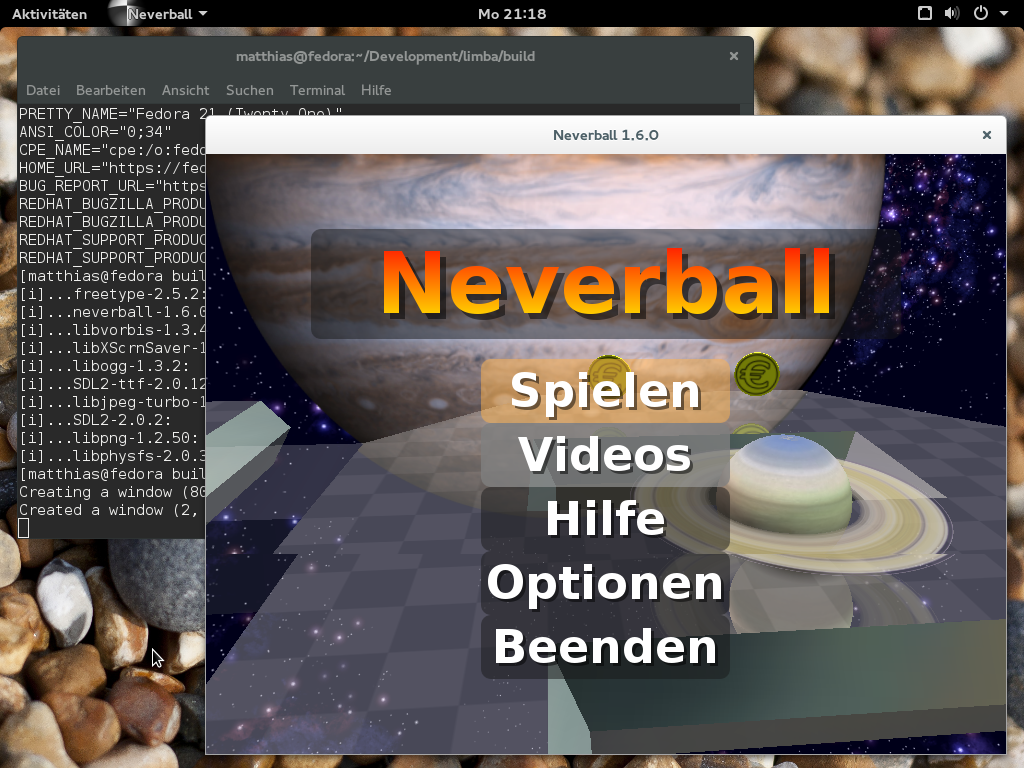
And once again, it s time for another Limba blogpost :-)limba-small Limba is a solution to install 3rd-party software on Linux, without interfering with the distribution s native package manager. It can be useful to try out different software versions, use newer software on a stable OS release or simply to obtain software which does not yet exist for your distribution. Limba works distribution-independent, so software authors only need to publish their software once for all Linux distributions. I recently released version 0.4, with which all most important features you would expect from a software manager are complete. This includes installing & removing packages, GPG-signing of packages, package repositories, package updates etc. Using Limba is still a bit rough, but most things work pretty well already. So, it s time for another progress report. Since a FAQ-like list is easier to digest. compared to a long blogpost, I go with this again. So, let s address one important general question first: How does Limba relate to the GNOME Sandboxing approach? (If you don t know about GNOMEs sandboxes, take a look at the GNOME Wiki Alexander Larsson also blogged about it recently) First of all: There is no rivalry here and no NIH syndrome involved. Limba and GNOMEs Sandboxes (XdgApp) are different concepts, which both have their place. The main difference between both projects is the handling of runtimes. A runtime is the shared libraries and other shared ressources applications use. This includes libraries like GTK+/Qt5/SDL/libpulse etc. XdgApp applications have one big runtime they can use, built with OSTree. This runtime is static and will not change, it will only receive critical security updates. A runtime in XdgApp is provided by a vendor like GNOME as a compilation of multiple single libraries. Limba, on the other hand, generates runtimes on the target system on-the-fly out of several subcomponents with dependency-relations between them. Each component can be updated independently, as long as the dependencies are satisfied. The individual components are intended to be provided by the respective upstream projects. Both projects have their individual up and downsides: While the static runtime of XdgApp projects makes testing simple, it is also harder to extend and more difficult to update. If something you need is not provided by the mega-runtime, you will have to provide it by yourself (e.g. we will have some applications ship smaller shared libraries with their binaries, as they are not part of the big runtime). Limba does not have this issue, but instead, with its dynamic runtimes, relies on upstreams behaving nice and not breaking ABIs in security updates, so existing applications continue to be working even with newer software components. Obviously, I like the Limba approach more, since it is incredibly flexible, and even allows to mimic the behaviour of GNOMEs XdgApp by using absolute dependencies on components. Do you have an example of a Limba-distributed application? Yes! I recently created a set of package for Neverball Alexander Larsson also created a XdgApp bundle for it, and due to the low amount of stuff Neverball depends on, it was a perfect test subject. One of the main things I want to achieve with Limba is to integrate it well with continuous integration systems, so you can automatically get a Limba package built for your application and have it tested with the current set of dependencies. Also, building packages should be very easy, and as failsafe as possible. You can find the current Neverball test in the Limba-Neverball repository on Github. All you need (after installing Limba and the build dependencies of all components) is to run the make_all.sh script. Later, I also want to provide helper tools to automatically build the software in a chroot environment, and to allow building against the exact version depended on in the Limba package. Creating a Limba package is trivial, it boils down to creating a simple control file describing the dependencies of the package, and to write an AppStream metadata file. If you feel adventurous, you can also add automatic build instructions as a YAML file (which uses a subset of the Travis build config schema) This is the Neverball Limba package, built on Tanglu 3, run on Fedora 21: Limba-installed Neverball Which kernel do I need to run Limba? The Limba build tools run on any Linux version, but to run applications installed with Limba, you need at least Linux 3.18 (for Limba 0.4.2). I plan to bump the minimum version requirement to Linux 4.0+ very soon, since this release contains some improvements in OverlayFS and a few other kernel features I am thinking about making use of. Linux 3.18 is included in most Linux distributions released in 2015 (and of course any rolling release distribution and Fedora have it). Building all these little Limba packages and keeping them up-to-date is annoying Yes indeed. I expect that we will see some bigger Limba packages bundling a few dependencies, but in general this is a pretty annoying property of Limba currently, since there are so few packages available you can reuse. But I plan to address this. Behind the scenes, I am working on a webservice, which will allow developers to upload Limba packages. This central ressource can then be used by other developers to obtain dependencies. We can also perform some QA on the received packages, map the available software with CVE databases to see if a component is vulnerable and publish that information, etc. All of this is currently planned, and I can t say a lot more yet. Stay tuned! (As always: If you want to help, please contact me) Are the Limba interfaces stable? Can I use it already? The Limba package format should be stable by now since Limba is still Alpha software, I will however, make breaking changes in case there is a huge flaw which makes it reasonable to break the IPK package format. I don t think that this will happen though, as the Limba packages are designed to be easily backward- and forward compatible. For the Limba repository format, I might make some more changes though (less invasive, but you might need to rebuilt the repository). tl;dr: Yes! Plase use Limba and report bugs, but keep in mind that Limba is still in an early stage of development, and we need bug reports! Will there be integration into GNOME-Software and Muon? From the GNOME-Software side, there were positive signals about that, but some technical obstancles need to be resolved first. I did not yet get in contact with the Muon crew they are just implementing AppStream, which is a prerequisite for having any support for Limba[1]. Since PackageKit dropped the support for plugins, every software manager needs to implement support for Limba.
So, thanks for reading this (again too long) blogpost :) There are some more exciting things coming soon, especially regarding AppStream on Debian/Ubuntu! [1]: And I should actually help with the AppStream support, but currently I can not allocate enough time to take that additional project as well this might change in a few weeks. Also, Muon does pretty well already!

Dimitri John Ledkov: Boiling frog, or when did we loose it with /etc ?

$ sudo find /etc -type f wc -l
2794

StatelessWhen was the last time you looked at /etc and thought - "I honestly know what every single file in here is". Or for example had a thought "Each file in here is configuration changes that I made". Or for example do you have confidence that your system will continue to function correctly if any of those files and directories are removed?

Traditionally most *NIX utilities are simple enough utilities, that do not require any configuration files what's so ever. However most have command line arguments, and environment variables to manipulate their behavior. Some of the more complex utilities have configuration files under /etc, sometimes with "layer" configuration from user's home directory (~/). Most of them are generally widely accepted. However, these do not segregate upstream / distribution / site administrator / local administrator / user configuration changes. Most update mechanisms created various ways to deal with merging and maintaining the correct state of those. For example both dpkg & RPM (%config) have elaborate strategies and policies and ways to deal with them. However, even today, still, they cause problems: prompting user for whitespace changes in config files, not preserving user changes, or failing to migrate them.

I can't find exact date, but it has now been something like 12 years since XDG Base directory specification was drafted. It came from Desktop Environment requirements, but one thing it achieves is segregation between upstream / distro / admin / user induced changes. When applications started to implement Base directory specification, I started to feel empowered. Upstream ships sensible configs in /usr, distribution integrators ship their overlay tweaks packaged in /usr, my site admin applies further requirements in /etc, and as I user I am free to improve or brake everything with configs in ~/. One of the best things from this setup - no upgrade prompts, and ease of reverting each layer of those configs (or at least auditing where the settings are coming from).

However, the uptake of XDG Base directory spec is slow / non-existing among the core components of any OS today. And at the same time /etc has grown to be a dumping ground for pretty much everything under the sun:
  • Symlink farms - E.g. /etc/rc*.d/*, /etc/systemd/system/*.wants/*, /etc/ssl/certs/*
  • Cache files - E.g. /etc/ld.so.cache
  • Empty (and mandatory) directories
  • Empty (and mandatory) "configuration" files. - E.g. whitespace & comments only
Let's be brutally honest and say that none of the above belongs in /etc. /etc must be for end-user configuration only, made by the end user alone and nobody else (or e.g. an automation tool driven by the end-user, like puppet).

Documentation of available configuration options and syntax to specify those in the config files should be shipped... in the documentation. E.g. man pages, /usr/share/doc, and so on. And not as the system-wide "example" config files. Absence of the files in /etc must not be treated as fatal, but a norm, since most users use default settings (especially for the most obscure options). Lastly compiled-in defaults should be used where possible, or e.g. layer configuration from multiple locations (e.g. /usr, /etc, ~/ where appropriate).

Above observations are not novel, and shared by most developers and users in the wider open source ecosystem. There are many projects and concepts to deal with this problem by using automation (e.g. puppet, chef), by migrating to new layouts (e.g. implementing / supporting XDG base dir spec), using "app bundles" (e.g. mobile apps, docker), or fully enumerating/abstracting everything in a generic manner (e.g. NixOS). Whilst fixing the issue at hand, these solutions do increase the dependency on files in /etc to be available. In other words we grew a de-facto user-space API we must not break, because modifications to the well known files in /etc are expected to take effect by both users and many administrator tools.

Since August last year, I have joined Open Source Technology Center at Intel, and have been working on Clear Linux* Project for Intel Architecture. One of the goals we have set out is to achieve stateless operation - that is to have empty /etc by default, reserved for user modification alone, yet continuing to support all legacy / well-known configuration paths. The premise is that all software can be patched with auto-detection, built-in defaults or support for layered configuration to achieve this. I hope that this work would interest everyone and will be widely adopted.

Whilst the effort to convert everything is still on going, I want to discuss a few examples of any core system.

ShadowThe login(1) command, whilst having built-in default for every single option exits with status 1, if it cannot stat(2) login.defs(5) file.

The passwd(1) command will write out the salted/hashed password in the passwd(5) file, rather than in shadow(5), if it cannot stat the shadow(5) file. There is similar behavior with gshadow. I found it very ironic, that upstream project "shadow" does not use shadow(5) by default.

Similarly, stock files manipulated by passwd/useradd/groupadd utilities are not created, if missing.

Some settings in login.defs(5) are not applicable, when compiled with PAM support, yet present in the default shipped login.defs(5) file.

Patches to resolve above issues are undergoing review on the upstream mailing list.
DBusIn xml based configuration, includedir' elements are mandatory to exist on disk, that is empty directory must be present, if referenced. If these directories are non-existant, the configuration fails to load and the system or session bus are not started.

Similarly, upstream have general agreement with the stateless concept and patches to move all of dbus default configurations from /etc to /usr are being reviewed for inclusion at the bug tracker. I hope this change will make into the 1.10 stable release.

GNU Lib CToday, we live in a dual-stack IPv4 and IPv6 world, where even the localhost has multiple IP addresses. As a slightly ageist time reference, the first VCS I ever used was git. Thus when I read below, I get very confused:
$ cat /etc/host.conf
# The "order" line is only used by old versions of the C library.
order hosts,bind
multi on
Why not simply do this:
--- a/resolv/res_hconf.c
+++ b/resolv/res_hconf.c
@@ -309,6 +309,8 @@ do_init (void)
if (hconf_name == NULL)
hconf_name = _PATH_HOSTCONF;

+ arg_bool (ENV_MULTI, 1, "on", HCONF_FLAG_MULTI);
+
fp = fopen (hconf_name, "rce");
if (fp)

There are still many other packages that needed fixes similar to above. Stay tuned for further stateless observations about Glibc, OpenSSH, systemd and other well known packages.

In the mean time, you can try out https://clearlinux.org/ images that implement above and more already. If you want to chat about it more, comment on G+, find myself on irc - xnox @ irc.freenode.net #clearlinux and join our mailing list to kick the conversation off, if you are interested in making the world more stateless.

ps.
I am a professional Linux Distribution developer, currently employed by Intel, however the postings on this site are my own and don't necessarily represent Intel's or any other past/present/future employer positions, strategies, or opinions.

* Other names and brands may be claimed as the property of others


Steve McIntyre: UEFI Debian installer work for Jessie, part 6

One final update on my work for UEFI improvements in Jessie! All of my improvements have been committed into the various Debian packages involved, and the latest release candidate for Jessie's debian-installer build (RC2) works just as well as my test builds on the Bay Trail system I've been using (Asus X205TA). Job done! :-) I'm still hoping to maybe get more hardware support for this particular hardware included in Jessie, but I can't promise. The mixed EFI work has also improved things for a lot of Mac users, and I'm planning to write up a more comprehensive list of supported machines in the Debian wiki (for now). There's now no need to use any of the older test installer images - please switch to RC2 for now. See http://cdimage.debian.org/cdimage/jessie_di_rc2/ for the images. If you want to install a 64-bit system with the 32-bit UEFI support, make sure you use the multi-arch amd64/i386 netinst or DVD. Otherwise, any of the standard i386 images should work for a 32-bit only system. Upstreaming My kernel patch to add the new /sys file was accepted upstream a while back, and has been in Linus' master branch for some time. It'll be in 4.0 unless something goes horribly wrong, and as it's such a tiny piece of code it's trivial to backport to anything remotely recent too. I've also just seen that my patch for grub2 to use this new /sys file has been accepted upstream this week. Again, the change is small and self-contained so should be easy to copy across into other trees too. Mixed EFI systems should now have better support across all distros in the near future, I hope.

28 March 2015

Matt Zimmerman: What I think about thought

Only parts of us will ever
touch o n l y parts of others
one s own truth is just that really one s own truth.
We can only share the part that is u n d e r s t o o d b y within another s knowing acceptable t o t h e o t h e r t h e r e f o r e so one
is for most part alone.
As it is meant to be in
evidently in nature at best t h o u g h perhaps it could make
our understanding seek
another s loneliness out.
unpublished poem by Marilyn Monroe, via berlin-artparasites This poem inspired me to put some ideas into words this morning, an attempt to summarize my current working theory of consciousness. Ideas travel through space and time. An idea that exists in my mind is filtered through my ability to express it somehow (words, art, body language, ), and is then interpreted by your mind and its models for understanding the world. This shifts your perspective in some way, some or all of which may be unconscious. When our minds encounter new ideas, they are accepted or rejected, reframed, and integrated with our existing mental models. This process forms a sort of living ecosystem, which maintains equilibrium within the realm of thought. Ideas are born, divide, mutate, and die in the process. Language, culture, education and so on are stable structures which form and support this ecosystem. Consciousness also has analogues of the immune system, for example strongly held beliefs and models which tend to reject certain ideas. Here again these can be unconscious or conscious. I ve seen it happen that if someone hears an idea they simply cannot integrate, they will behave as if they did not hear it at all. Some ideas can be identified as such a serious threat that ignoring them is not enough to feel safe: we feel compelled to eliminate the idea in the external world. The story of Christianity describes a scenario where an idea was so threatening to some people that they felt compelled to kill someone who expressed it. A microcosm of this ecosystem also exists within each individual mind. There are mental structures which we can directly introspect and understand, and others which we can only infer by observing our thoughts and behaviors. These structures communicate with each other, and this communication is limited by their ability to speak each other s language . A dream, for example, is the conveyance of an idea from an unconscious place to a conscious one. Sometimes we get the message, and sometimes we don t. We can learn to interpret, but we can t directly examine and confirm if we re right. As in biology, each part of this process introduces uncountable errors , but the overall system is surprisingly robust and stable. This whole system, with all its many minds interacting, can be thought of as an intelligence unto itself, a gestalt consciousness. This interpretation leads to some interesting further conclusions: Naturally, this is by no means an original idea (can such a thing exist?). It is my own take on the subject, informed both consciously and unconsciously by my own study, first-hand experience, conversations I ve had with others, and so on. It s informed by the countless thinkers who have influenced me. Its expression is limited by my ability to write about it in a way that makes sense to other people.
Maybe some of this makes sense to you, and maybe I seem insane, or maybe both. Hopefully you don t find that you have an inexplicable unconscious desire to kill me!

27 March 2015

Olivier Berger: New short paper : Designing a virtual laboratory for a relational database MOOC with Vagrant, Debian, etc.

Here s a short preview of our latest accepted paper (to appear at CSEDU 2015), about the construction of VMs for the Relational Database MOOC using Vagrant, Debian, PostgreSQL (previous post), etc. :

Designing a virtual laboratory for a relational database MOOC Olivier Berger, J Paul Gibson, Claire Lecocq and Christian Bac Keywords: Remote Learning, Virtualization, Open Education Resources, MOOC, Vagrant Abstract: Technical advances in machine and system virtualization are creating opportunities for remote learning to provide significantly better support for active education approaches. Students now, in general, have personal computers that are powerful enough to support virtualization of operating systems and networks. As a conse- quence, it is now possible to provide remote learners with a common, standard, virtual laboratory and learning environment, independent of the different types of physical machines on which they work. This greatly enhances the opportunity for producing re-usable teaching materials that are actually re-used. However, configuring and installing such virtual laboratories is technically challenging for teachers and students. We report on our experience of building a virtual machine (VM) laboratory for a MOOC on relational databases. The architecture of our virtual machine is described in detail, and we evaluate the benefits of using the Vagrant tool for building and delivering the VM. TOC :
  • Introduction
    • A brief history of distance learning
    • Virtualization : the challenges
    • The design problem
  • The virtualization requirements
    • Scenario-based requirements
    • Related work on requirements
    • Scalability of existing approaches
  • The MOOC laboratory
    • Exercises and lab tools
    • From requirements to design
  • Making the VM as a Vagrant box
    • Portability issues
    • Delivery through Internet
    • Security
    • Availability of the box sources
  • Validation
    • Reliability Issues with VirtualBox
    • Student feedback and evaluation
  • Future work
    • Laboratory monitoring
    • More modular VMs
  • Conclusions
Bibliography
  • Alario-Hoyos et al., 2014
    Alario-Hoyos, C., P rez-Sanagust n, M., Kloos, C. D., and Mu oz Merino, P. J. (2014).
    Recommendations for the design and deployment of MOOCs: Insights about the MOOC digital education of the future deployed in Mir adaX.
    In Proceedings of the Second International Conference on Technological Ecosystems for Enhancing Multiculturality, TEEM 14, pages 403-408, New York, NY, USA. ACM.
  • Armbrust et al., 2010
    Armbrust, M., Fox, A., Griffith, R., Joseph, A. D., Katz, R., Konwinski, A., Lee, G., Patterson, D., Rabkin, A., Stoica, I., and Zaharia, M. (2010).
    A view of cloud computing.
    Commun. ACM, 53:50-58.
  • Billingsley and Steel, 2014
    Billingsley, W. and Steel, J. R. (2014).
    Towards a supercollaborative software engineering MOOC.
    In Companion Proceedings of the 36th International Conference on Software Engineering, pages 283-286. ACM.
  • Brown and Duguid, 1996
    Brown, J. S. and Duguid, P. (1996).
    Universities in the digital age.
    Change: The Magazine of Higher Learning, 28(4):11-19.
  • Bullers et al., 2006
    Bullers, Jr., W. I., Burd, S., and Seazzu, A. F. (2006).
    Virtual machines an idea whose time has returned: Application to network, security, and database courses.
    SIGCSE Bull., 38(1):102-106.
  • Chen and Noble, 2001
    Chen, P. M. and Noble, B. D. (2001).
    When virtual is better than real [operating system relocation to virtual machines].
    In Hot Topics in Operating Systems, 2001. Proceedings of the Eighth Workshop on, pages 133-138. IEEE.
  • Cooper, 2005
    Cooper, M. (2005).
    Remote laboratories in teaching and learning-issues impinging on widespread adoption in science and engineering education.
    International Journal of Online Engineering (iJOE), 1(1).
  • Cormier, 2014
    Cormier, D. (2014).
    Rhizo14-the MOOC that community built.
    INNOQUAL-International Journal for Innovation and Quality in Learning, 2(3).
  • Dougiamas and Taylor, 2003
    Dougiamas, M. and Taylor, P. (2003).
    Moodle: Using learning communities to create an open source course management system.
    In World conference on educational multimedia, hypermedia and telecommunications, pages 171-178.
  • Gomes and Bogosyan, 2009
    Gomes, L. and Bogosyan, S. (2009).
    Current trends in remote laboratories.
    Industrial Electronics, IEEE Transactions on, 56(12):4744-4756.
  • Hashimoto, 2013
    Hashimoto, M. (2013).
    Vagrant: Up and Running.
    O Reilly Media, Inc.
  • Jones and Winne, 2012
    Jones, M. and Winne, P. H. (2012).
    Adaptive Learning Environments: Foundations and Frontiers.
    Springer Publishing Company, Incorporated, 1st edition.
  • Lowe, 2014
    Lowe, D. (2014).
    MOOLs: Massive open online laboratories: An analysis of scale and feasibility.
    In Remote Engineering and Virtual Instrumentation (REV), 2014 11th International Conference on, pages 1-6. IEEE.
  • Ma and Nickerson, 2006
    Ma, J. and Nickerson, J. V. (2006).
    Hands-on, simulated, and remote laboratories: A comparative literature review.
    ACM Computing Surveys (CSUR), 38(3):7.
  • Pearson, 2013
    Pearson, S. (2013).
    Privacy, security and trust in cloud computing.
    In Privacy and Security for Cloud Computing, pages 3-42. Springer.
  • Prince, 2004
    Prince, M. (2004).
    Does active learning work? A review of the research.
    Journal of engineering education, 93(3):223-231.
  • Romero-Zaldivar et al., 2012
    Romero-Zaldivar, V.-A., Pardo, A., Burgos, D., and Delgado Kloos, C. (2012).
    Monitoring student progress using virtual appliances: A case study.
    Computers & Education, 58(4):1058-1067.
  • Sumner, 2000
    Sumner, J. (2000).
    Serving the system: A critical history of distance education.
    Open learning, 15(3):267-285.
  • Watson, 2008
    Watson, J. (2008).
    Virtualbox: Bits and bytes masquerading as machines.
    Linux J., 2008(166).
  • Winckles et al., 2011
    Winckles, A., Spasova, K., and Rowsell, T. (2011).
    Remote laboratories and reusable learning objects in a distance learning context.
    Networks, 14:43-55.
  • Yeung et al., 2010
    Yeung, H., Lowe, D. B., and Murray, S. (2010).
    Interoperability of remote laboratories systems.
    iJOE, 6(S1):71-80.

26 March 2015

Zlatan Todori : Random bits

Gogs I installed today Gogs and configured it with mysql (yes, yes, I know - use postgres you punk!). I will not post details of how I did it because:
  • It still has "weird" coding as pointed already by others
  • It doesn't have fork and pull request ability yet
And there was end of journey. When they code in fork/PR , I will close my eyes on other coding stuff and try it again because Gitlab is not close to my heart and installing their binary takes ~850MB of space which means a lot of ruby code that could go wrong way. It would be really awesome to have in archive something to apt install and have github-like place. It would be great if Debian infrastructure would have the possibility to have that.

Diaspora* Although I am thrilled about it finally reaching Debian archive, it still isn't ready. Not even closely. I couldn't even finish installation of it and it's not suitable for main archive as it takes files from github repo of diaspora. Maybe poking around Bitnami folks about how they did it.

The power of Free software Text Secure is was an mobile app that I thought it could take on Viber or WhatsUp. Besides all its goodies it had chance to send encrypted SMS to other TS users. Not anymore. Fortunate, there is a fork called SMSSecure which still has that ability.

Trolls So there is this Allwinner company that does crap after crap. Their latest will reach wider audience and I hope it gets resolved in a matter how they would react if some big proprietary company was stealing their code. It seems Allwinner is a pseudo for Alllooser. Whoa, that was fun!

A year old experiment So I had a bet with a friend that I will run for a year Debian Unstable mixed with some packages from experimental and do some random testings on packages of interest to them. Also I promised to update aggressively so it was to be twice a day. This was my only machine so the bet was really good as it by theory could break very often. Well on behalf of Debian community, I can say that Debian hasn't had a single big breakage. Yay! The good side: on average I had ~3000 packages installed (they were in range from 2500-3500). I had for example xmonad, e17, gnome, cinnamon, xfce, systemd from experimental, kernels from experimental, nginx, apache, a lot of heavy packages, mixed packages from pip, npm, gems etc. So that makes it even more incredible that it stayed stable. There is no bigger kudos to people working on Debian, then when some sadist tries countless of ways to break it and Debian is just keeps running. I mean, I was doing my $PAID_WORK on this machine! The bad side: there were small breakages. It's seems that polkit and systemd-side of gnome were going through a lot of changes because sometimes system would ask password for every action (logout, suspend, poweroff, connect to network etc), audio would work and would not work, would often by itself just mute sound on every play or it would take it to 100% (which would blow my head when I had earplugs), bluetooth is almost de facto not working in gnome (my bluetooth mice worked without single problem in lenny, squeeze, in wheezy it maybe had once or twice a problem, but in this year long test it's almost useless). System would also have random hangs from time to time. The test: in the beginning my radeon card was too new and it was not supported by FLOSS driver so I ended up using fglrx which caused me a lot of annoyance (no brightness control, flickering of screen) but once FLOSS driver got support I was on it, and it performed more fluid (no glitches while moving windows). So as my friends knew that I have radeon and they want to play games on their machines (I play my Steam games on FLOSS driver) they set me the task to try fglrx driver every now end then. End result - there is no stable fglrx driver for almost a year, it breaks graphical interface so I didn't even log into DE with it for at least 8 months if not more. On the good side my expeditions in flgrx where quick - install it, boot into disaster, remove it, boot into freedom. Downside seems to be that removing fglrx driver, leaves a lot of its own crap on system (I may be mistaking but it seems I am not). Debian with love Well, that's all for today. I think so. You can never be sure.

25 March 2015

Richard Hartmann: Visiting Hongkong and Shenzhen

TSDgeos had a good idea: Lazyweb travel recommodations. So, dear lazyweb: What are things to do or to avoid in Hongkong and Shenzhen if you have one and a half week of holiday before and after work duties? Any hidden gems to look at? What electronic markets are good? Should I take a boat trip around the waters of Hongkong? If you have any decent yet affordable sleeping options for 2-3 nights in Hongkong, that would also be interesting as my "proper" hotel stay does not start immediately. Not much in ways of comfort is needed as long as I have a safe place to lock my belongings. In somewhat related news, this Friday's bug report stats may be early or late as I will be on a plane towards China on Friday.

Francois Marier: Keeping up with noisy blog aggregators using PlanetFilter

I follow a few blog aggregators (or "planets") and it's always a struggle to keep up with the amount of posts that some of these get. The best strategy I have found so far to is to filter them so that I remove the blogs I am not interested in, which is why I wrote PlanetFilter.

Other options In my opinion, the first step in starting a new free software project should be to look for a reason not to do it :) So I started by looking for another approach and by asking people around me how they dealt with the firehoses that are Planet Debian and Planet Mozilla. It seems like a lot of people choose to "randomly sample" planet feeds and only read a fraction of the posts that are sent through there. Personally however, I find there are a lot of authors whose posts I never want to miss so this option doesn't work for me. A better option that other people have suggested is to avoid subscribing to the planet feeds, but rather to subscribe to each of the author feeds separately and prune them as you go. Unfortunately, this whitelist approach is a high maintenance one since planets constantly add and remove feeds. I decided that I wanted to follow a blacklist approach instead.

PlanetFilter PlanetFilter is a local application that you can configure to fetch your favorite planets and filter the posts you see. If you get it via Debian or Ubuntu, it comes with a cronjob that looks at all configuration files in /etc/planetfilter.d/ and outputs filtered feeds in /var/cache/planetfilter/. You can either:
  • add file:///var/cache/planetfilter/planetname.xml to your local feed reader
  • serve it locally (e.g. http://localhost/planetname.xml) using a webserver, or
  • host it on a server somewhere on the Internet.
The software will fetch new posts every hour and overwrite the local copy of each feed. A basic configuration file looks like this:
[feed]
url = http://planet.debian.org/atom.xml
[blacklist]

Filters There are currently two ways of filtering posts out. The main one is by author name:
[blacklist]
authors =
  Alice Jones
  John Doe
and the other one is by title:
[blacklist]
titles =
  This week in review
  Wednesday meeting for
In both cases, if a blog entry contains one of the blacklisted authors or titles, it will be discarded from the generated feed.

Tor support Since blog updates happen asynchronously in the background, they can work very well over Tor. In order to set that up in the Debian version of planetfilter:
  1. Install the tor and polipo packages.
  2. Set the following in /etc/polipo/config:
     proxyAddress = "127.0.0.1"
     proxyPort = 8008
     allowedClients = 127.0.0.1
     allowedPorts = 1-65535
     proxyName = "localhost"
     cacheIsShared = false
     socksParentProxy = "localhost:9050"
     socksProxyType = socks5
     chunkHighMark = 67108864
     diskCacheRoot = ""
     localDocumentRoot = ""
     disableLocalInterface = true
     disableConfiguration = true
     dnsQueryIPv6 = no
     dnsUseGethostbyname = yes
     disableVia = true
     censoredHeaders = from,accept-language,x-pad,link
     censorReferer = maybe
    
  3. Tell planetfilter to use the polipo proxy by adding the following to /etc/default/planetfilter:
     export http_proxy="localhost:8008"
     export https_proxy="localhost:8008"
    

Bugs and suggestions The source code is available on repo.or.cz. I've been using this for over a month and it's been working quite well for me. If you give it a go and run into any problems, please file a bug! I'm also interested in any suggestions you may have.

24 March 2015

Daniel Pocock: The easiest way to run your own OpenID provider?

A few years ago, I was looking for a quick and easy way to run OpenID on a small web server. A range of solutions were available but some appeared to be slightly more demanding than what I would like. For example, one solution required a servlet container such as Tomcat and another one required some manual configuration of Python with Apache. I came across the SimpleID project. As the name implies, it is simple. It is written in PHP and works with the Apache/PHP environment on just about any Linux web server. It allows you to write your own plugin for a user/password database or just use flat files to get up and running quickly with no database at all. This seemed like the level of simplicity I was hoping for so I created the Debian package of SimpleID. SimpleID is also available in Ubuntu. Help needed Thanks to a contribution from Jean-Michel Nirgal Vourg re, I've just whipped up a 0.8.1-14 package that should fix Apache 2.4 support in jessie. I also cleaned up a documentation bug and the control file URLs. Nonetheless, it may be helpful to get feedback from other members of the community about the future of this package:
  • Is it considered secure enough?
  • Have other people found it relatively simple to install or was I just lucky when I tried it?
  • Are there other packages that now offer such a simple way to get OpenID for a vanilla Apache/PHP environment?
  • Would anybody else be interested in helping to maintain this package?
  • Would anybody like to see this packaged in other distributions such as Fedora?
  • Is anybody using it for any online community?
Works with HOTP one-time-passwords and LDAP servers One reason I chose SimpleID is because of dynalogin, the two-factor authentication framework. I wanted a quick and easy way to use OTP with OpenID so I created the SimpleID plugin for dynalogin, also available as a package. I also created the LDAP backend for SimpleID, that is available as a package too. Works with Drupal I tested SimpleID for login to a Drupal account when the OpenID support is enabled in Drupal, it worked seamlessly. I've also tested it with a few public web sites that support OpenID.

Russ Allbery: Review: Fukushima

Review: Fukushima, by David Lochbaum, et al.
Author: David Lochbaum
Author: Edwin Lyman
Author: Susan Q. Stranahan
Author: Union of Concerned Scientists
Publisher: The New Press
Copyright: 2014
ISBN: 1-59558-927-9
Format: Kindle
Pages: 320
This is a very interesting book, and I can recommend it, but there are two things you should be aware of up-front. The packaging does not necessarily make clear what expectations you should have of it going in. First, the subtitle (The Story of a Nuclear Disaster) should have appended to it And Its Implications for US Nuclear Power Policy. This book is very concerned with the impact of the Fukushima disaster on US policy and nuclear regulation, to the point where I think more than half of the book is about US agencies, nuclear regulatory history, and US reaction. There's nothing wrong with that, of course: the US should take a hard look at its own nuclear energy policy given the events at Fukushima, and it's a worthy topic for a book. But if you go into this book expecting a broader perspective, you will be disappointed. For example, I think the fact that France has a lot of nuclear power was mentioned maybe twice in the whole book, and French reaction was never discussed at all. There is a very detailed examination of exactly what happened at Fukushima (more on that in a moment), but most of the policy implications are examined purely from a US perspective. Even Japanese nuclear policy gets somewhat short shrift. Second, note that the fourth listed co-author is the Union of Concerned Scientists. For those not familiar with US environmental groups, the UCS has a reputation as an anti-nuclear advocacy organization. I don't think that's entirely fair; I think the UCS's position on nuclear power is better summarized as holding that it is theoretically possible to run a nuclear power plant safely, but the actual US nuclear power industry is not very close to that standard, and it would require much tighter regulation and more investment in safety systems to reach that standard. But be aware that the authors of this book have a clear position on the adequacy of current nuclear power safety standards, namely that they aren't. And they don't try to conceal that position in this book. Personally, I prefer authors to be open about their perspective in books like this, but your mileage may vary. There, disclaimers out of the way. I bought this book for a specific reason: I had followed some of the news coverage at the time of the earthquake and tsunami, and then (like many people, I suspect) lost track of the final outcome as the story fell out of the news and I started ignoring people who didn't understand how large the Pacific Ocean is. Now that we've had the benefit of several years of analysis and thoughtful reconstruction of events, I wanted to know what had actually happened. I'm happy to say that this book delivers quite well on that front. Roughly the first half of the book is a detailed blow-by-blow description of exactly what happened at Fukushima, at least as well as we've been able to reconstruct, told as an engrossing and dramatic narrative. There may be a little too much interleaving of reactions within the US government, which I suspect will particularly annoy non-US readers, but the level of factual detail is excellent, clear, and well-explained. What I wasn't expecting, but was pleasantly surprised by, is that it's also a great story. There's tension, conflict, heroism, hard choices, and moral quandries, and the authors do a great job conveying factual information while still giving the reader the sense of being in the middle of the unfolding drama. They resist the urge to disclose all the results of later analysis in the middle of the story, which may provide a slightly less clear view of the disaster, but which makes the telling far more compelling. I usually read non-fiction more slowly than fiction, but Fukushima dragged me in. I found myself grabbing moments to read just another few pages. Unfortunately, this is only about half the book. The other half is a mix of other things that won't have as broad of appeal: an analysis of the challenges of US nuclear regulation, a history of the US nuclear power industry, and a presentation of the authors' opinions about the best path forward for regulation of nuclear power in the US. Since I'm a US citizen and resident with an interest in both nuclear power and regulation of nuclear power in my country, I found this interesting, if not as engrossing as the rest of the book. But it felt a bit oddly tacked on, and I think it's a stretch to say that it's part of the story of Fukushima. The authors try to draw that link by presenting the Japanese nuclear power industry as heavily influenced by their US counterparts, and their regulatory problems as similar to the problems in the US, but there is nowhere near enough detail about Japanese regulatory practices here to support that conclusion. I think the largest weakness, and the most obvious gap, in this book is the lack of detailed analysis of the history and players in the Japanese nuclear regulatory environment. This is an odd miss. If one is concerned about regulatory inadequacy, Japanese government policy is far more obviously part of the story of Fukushima than US policy. I can only speculate that the authors had inside sources for the US policy discussions but not for the Japanese policy discussions (and, sadly, fall back on painting with a rather broad brush and making unsupported generalizations about Japanese regulatory approaches in a few spots). The result feels like two partly-unrelated books stacked and partly shuffled together. So, there are parts of Fukushima that are rather disappointing, particularly for non-US readers. But I still recommend it as a great detailed history of the actual incident and a summary of what we now think happened. That summary is unfortunately sketchy and still very unclear, but I don't think that's the fault of the authors. The inside of a nuclear power plant during a meltdown is a very difficult environment to measure or analyze, and there's a lot of data that we will probably never have. Some details may never be known. But what we do know, and how that knowledge unfolded, is told very well. This is the only book-length treatment on Fukushima I've read, so I can't compare it against other books on the same topic. But it satisfied my curiousity nicely. If you have a similar curiosity, I recommend this book to your attention, although be aware of its approach and its US-centric analysis going in so that you're not surprised by a mismatch of expectations. Rating: 8 out of 10

23 March 2015

Martin-Éric Racine: This and That

I haven't blogged anything in months and figured that now might be a good time to get around that. Here it goes:
Free Software
While I occasionally upgrade the packaging of the software I maintain at Debian to keep up with best practices, my activity downsizing goes on. Simply put: I never had any ambition to become a Debian Developer. My involvement has always remained pragmatic and mostly from the perspective of packaging software that I found useful. Even then, my motivation for doing that keeps on dwindling into nothingness, because key pieces of software keep on breaking, whenever someone upstream decides to reinvent the wheel.
For instance, GNOME no longer works at all on Geode chipsets and it barely works on Nouveau chipsets. This happened as soon as GNOME 3.14 was uploaded into unstable, right before the freeze started. Then again, I wouldn't jump to a conclusion that GNOME itself might be at fault, since Plymouth also stopped working on the same two video platforms at the same time. For all we know, this could be caused by some changes in the X.Org server code. Bugs were filed, additional information was provided, but no fix has taken place.
Given how Geode and Nouveau represent 80% of my hardware investment (my Intel laptop being the sole exception), it essentially means that the upcoming Debian "stable" is useless for me. Now try and remain motivated, even just as a mere Free Software end-user. At this point, I'm done.
Politics
Finland is holding national elections this April. I still have no idea who I'll vote for this time. The guy I voted for last time has become a career politician with an inflated ego and zero connection to the average Finn's aspirations and worries. Meanwhile, two friends are standing as candidates: one who is a razor-sharp fact finder and who is a proven pragmatic decision-maker, but whose values are slightly off with mine, and one whose actions come straight from the heart but whose concept of today's Finnish reality leaves a lot to be desired.
National Defence
There's been a lot of recent articles about how former hardware and locations of the Finnish defence forces and border guards have been sold, often for peanuts, to Russian interests. In some cases, we're only talking about buildings formerly used for on-site staff accommodations. In other cases, former patrol boats and navy harbours changed hands. Now, to top it all, it appears that our north-western neighbour, Norway, has sold a former submarine base to German investors who, in turn, leased it to you guessed it Russian interests.
Looking at Russian actions in Ukraine, I cannot help but feel great concern that strategic locations are falling into potentially dangerous hands. Just seeing the picture of a former navy harbour with a handful of patrol boats on standby, right on the Finnish coastline, half-way between Helsinki and Turku, was a sobering experience. While the whole idea of shooting at people even invading armies gives me the creeps, at this point, I cannot help but start pondering whether defending this country might in fact be an occupation worth training for.
Employment
It has now been 6 years since I held my last dayjob. Since then, the only thing I've found is an unpaid training in the national bureaucracy. I've also freelanced as an actor and model, but that barely brought me pocket change, if even that. Seeing my face on posters advertising a movie I participated in last year was indeed nice, getting some media attention in connection to that too, but it hasn't lead to additional gigs. As far as I can tell, this was just my Warholian 15 minutes of fame.
However, there's a larger issue at stake. Newspapers recently published an employment statistics map for Nordic countries and the truth couldn't be more bleak: while Norway and Sweden's employment figures are nearly spotless for almost every province, those of Finland are save for a couple of mildly successful provinces outright catastrophic. Given this and despite feeling relatively happy living in Finland and having developed a will to defend this country from an eventual Russian assault, I've come to the conclusion that I would be better off going West, with a strong preference for Norway.
Now, the main question is, doing what? 6 years later, I have strong doubts that I would be remotely considered for any high-tech job. Besides, come to think of it, I wouldn't want any new office job. Off the top of my head, my idea of a cool job that would allow me to stay physically fit would be working as a tourist guide in Lapland. However, if Norway is anything like Finland, someone probably needs a dozen of permits of all sorts (first aid certification, C or even D class driving license, college degree in tourism, etc.) that I cannot afford. What then?

Mario Lang: Why is Qt5 not displaying Braille?

While evaluating the cross-platform accessibility of Qt5, I stumbled across this deficiency:
#include <QApplication>
#include <QTextEdit>
int main(int argv, char **args)
 
  QApplication app(argv, args);
  QTextEdit textEdit;
  textEdit.setText(u8"\u28FF");
  textEdit.show();
  return app.exec();
 
(compile with -std=c++11). On my system, this "application" does not show the correct glyph always. Sometimes, it renders a a white square with black border, i.e., the symbol for unknown glyph. However, if I invoke the same executable several times, sometimes, it renders the glyph correctly. In other words: The glyph choosing mechansim is apparently non-deterministic!!! UPDATE: Sune Vuorela figured out that I need to set QT_HARFBUZZ=old in the environment for this bug to go away. Apparently, harfbuzz-ng from Qt 5.3 is buggy.

Jonathan Dowland: Linux music players, 2015 edition

Now I'm back to Linux on the Desktop for my dayjob, I was slightly nervous about checking out the state of the art for Linux music players; an area I've never felt the Linux desktop was very strong on. However for the time being I've largely side-stepped the issue by listening to BBC 6 Music for most of the day. For better or worse, I scrobble, and somebody has written a neat web app for scrobbling along to radio stations. When I want to listen to something different for a change, I've been trying out a trial of Google Play Music, for which somebody has written a Chrome extension to scrobble. On the rare occasions I listen to local music, I'm using VLC. Google Play Music seems pretty good, but I'm not getting a lot from my trial because 6 Music is generally fantastic. Scrobbling 6 Music has revealed a bit of a disconnect for how I use last.fm, and how website thinks you should use it. Within a day or two, my "music compability" with 6 Music was (predictably) "SUPER". Looking at my "Top artists", right near the top are 6 Music's current playlist favourites Courtney Barnett and Nadine Shah, who I can (at least) recall the songs that have been played; just below them are Young Fathers, who I cannot. A little lower are Hot Chip and Slaves: both artists who have current singles out which I enjoyed for a while, but the relentless BBC playlist policy is overdoing them and I'm inclined to switch over when they come on now. If I listen to a whole album in a given week, then the artist will likely (and rightly) be sat at the top of "last 7 days"; if I don't, then it could be something I can't even remember listening to.

22 March 2015

Rhonda D'Vine: Yasmo

Friday the 13th was my day. In so many different ways. I received a package which was addressed to Rhonda D'Vine with a special hoodie in it. The person at the post office desk asked me whether it was for my partner, my response was a (cowardly) "no, it's my pseudonym" but that settled any further questions and I got my package. Later I received an email which made me hyper happy (but which I can't share right now, potentially later). In the evening there was the WortMacht FemSlam (WordMight FemSlam) poetry slam to which the host asked me to attend just the day before. I was hyper nervous about it. The room was fully packed, there were even quite some people who didn't have a place to sit and were standing at the side. I presented Mermaids because I wasn't able to write anything new on the topic. One would think I am attached enough to the poem by now to not be nervous about it, but it was the environment that made my legs shake like hell while presenting. Gladly I hope it wasn't possible to see it enough under my skirt, but given that it was the first time that I presented it in my home town instead of the "anonymous" internet made me extra anxious. In the end I ended up in place 5 of 7 attendees, which I consider a success given that it was the only text presented in English and not in typical poetry slam style.
(Small addition to the last part: I've been yesterday to the Free Hugs Vienna event at the Schloss Sch nbrunn, and one of the people I hugged told me I know you, I've seen you at the FemSlam!. That was extra sweet. :)) I'm happy that I was notified about the FemSlam on such short notice, it was a great experience. So today's entry goes out to the host of that event. This is about Yasmo. One can just be envious about what she already accomplished in her still young life. And she is definitely someone to watch out for in the years to come. I have to excuse to my readers who don't understand German yet again, but I'll get back to something English next time, I promise. :) Like always, enjoy!

/music permanent link Comments: 0 Flattr this

Next.

Previous.