Search Results: "nic"

2 January 2015

Tim Retout: Decluttering

Kate's been reading some book or other by KonMari. Hence we've rehomed lots of clothes, books and DVDs to charity and various places. I am told the key is to ask, "Does this item bring me joy?" Then if it doesn't bring you enough joy, it goes. The nice thing was, it was actually exciting to reveal the gems among my bookshelves, which were previously hidden by a load of second-rate books. True story: I was sitting downstairs deciding whether to splash out 25 for a particular book. Was called upstairs to make some 'joy decisions', and saw the very same book on the shelf already. Fast delivery!

DebConf team: Happy New DebConf15 Year! (Posted by Laura Arjona Reina)

Happy New Year! 2015 is the year of DebConf15 in Heidelberg. We are working hard on another awesome Debian Conference. How about making a new year s resolution to join us? You can think about giving a talk: expect the call for papers soon! Or convince somebody to present one (it s always nice to see new speakers!). What about joining any of the DebConf teams for the preparation? Or support your Debian friends that are already in some team and helping them a little Another way of contributing is to talk with some of the companies or institutions around you and ask them to become sponsors, or making a donation yourself. And of course, we also appreciate the promotion of the conference in your networks, or any other contribution or idea you can share :) We wish that your 2015 is full of good times, and we hope we share some of them together at DebConf15! Happy hacking!

Jeff Licquia: Happy 2015!

[en] Look, it s 2015. How d that happen? Blogging has been pretty much nonexistent this year, apart from a public service announcement about the Heartbleed bug and a public statement about boring encryption stuff. (Which, if you re actually interested in that sort of thing: I did finally get the requisite number of signatures and replaced my key in Debian just in time to avoid the Great Key Purge of 2014.) It s a new world. Social media has made blogs obsolete, supposedly, except that they re now too busy competing with each other (and, sometimes, their own fans) to be terribly useful. I ve tried to write a blog post about that a few times, only to delete it out of frustration and long-windedness. So there s a resolution for 2015: get past these social media issues and get back to regular communication. Maybe what I need is a good social media rant. I m sure you re all waiting on pins and needles for that one. Lots has been going on. I m an empty-nester now; the youngest kid started college this fall. I ve been busy at work and busy at skill freshening, including getting on this funky Haskell bandwagon that seems to be all the rage among the cool kids. And plenty of other things going on, some of which probably deserve their own blog posts. Maybe those will get written in 2015. Plan: write. Journey of a thousand miles starting with single steps, and all that.

John Goerzen: Sound players: Adventures with Ampache, mpd, pulseaudio, Raspberry Pi, and Logitech Media Server

I finally decided it was about time to get my whole-house sound project off the ground. As an added bonus, I d like to be able to stream music from my house to my Android phone. Some Background It was about 2.5 years ago that I last revisited the music-listening picture on Linux. I used Spotify for awhile, but the buggy nature of its support for local music eventually drove me up the wall. I have a large collection of music that will never be on Spotify (local choirs, for instance) and this was an important feature. When Google Play Music added the feature of uploading your local collection, I used that; it let me stream music from my phone in my car (using the Bluetooh link to the car). I could also listen at home on a PC, or plug my phone into various devices to play. But that was a hassle, and didn t let me have music throughout the house. Google Play is reasonable for that, but it has a number of really glaring issues. One is that it often gets album artwork wrong; it doesn t use the ID3 tags embedded in the files, but rather tries to guess . Another is that the sync is only add . Move files to another place in your collection, or re-rip them to FLAC and replace your old MP3s, and suddenly they re in Google Play twice. It won t ever see updated metadata, either quite a hassle for someone that uses Musicbrainz and carefully curates metadata. My Hardware I already have an oldish PC set up as a entertainment box running MythTV. It is a diskless system (boots PAE over the network and has NFS root) and very quiet. It has video output to my TV, and audio output via S/PDIF to my receiver. It is one logical audio frontend. My workstation in my office is another obvious place. My kitchen has a radio with a line in jack, and I also have a small portable speaker with a line in jack to make the last two options. I also have a Raspberry Pi model B that I bought awhile ago and was looking for a purpose, so I thought this should be cheap and easy, right? Well. Cheap, yes. Easy, not so much. First attempt: Ampache The Ampache project produces quite a nice piece of software. Ampache has matured significantly in the last 2.5 years, and the usability of its web-interface with HTML5 and Flash players as options is quite impressive. It is easily as usable as Google s, though its learning curve is rather more steep. There are multiple Android apps for Ampache to stream remotely. And, while most are terribly buggy and broken, there is at least one that seems to work well. Ampache can also output m3u/pls files for a standalone player. It does on-the-fly transcoding. There are some chinks in the armor, however. The set of codecs that are transcoded or passed through is a global setting, not a per-device setting. The bitrates are per-account, so you can t easily have it transcode FLAC into 320Kbps mp3 for streaming on your LAN and 128Kbps MP3 for streaming to your phone. (There are some hacks involving IP address ranges and multiple accounts, but they are poorly documented and cumbersome.) Ampache also has a feature called localplay in which it drives local players instead of remote ones. I tried to use this in combination with mpd to drive music to the whole house. Ampache s mpd interface is a bit odd; it actually loads things up into mpd s queue. Sadly it shares the same global configs as the rest. Even though mpd is perfectly capable of handling FLAC audio, the Ampache web player isn t, so you have to either make it transcode mp3 for everything or forego the web player (or use a second account that has transcode everything set). Frustratingly, not one of the Android clients for Ampache is even remotely compatible with Localplay, and some will fail in surprising ways if you have been using Localplay on the web client. So let s see how this mpd thing worked out. Ampache with mpd for whole-house audio The primary method here is to use mpd s pulseaudio driver. I configured it like so:
audio_output
type "pulse"
name "MPD stream"
#server "remote_server" # optional
sink "rtp" # optional
mixer_type "software"

Then in /etc/pulse/system.pa:
load-module module-null-sink sink_name=rtp format=s16be channels=2 rate=44100 sink_properties="device.description='RTP Multicast Sink'"
load-module module-rtp-send source=rtp.monitor
This tells Pulse to use multicast streaming to the LAN for the audio packets. Pulse is supposed to have latency synchronization to achieve perfect audio everywhere. In practice, this works somewhat poorly. Plus I have to install pulse everywhere, which inserts its tentacles way too deeply into the ALSA stack for my taste. (alsamixer suddenly turns useless by default, for instance.) But I gave it a try. After much fiddling Pulse is rather poorly documented and the interactions of configuration tools with it even more so I found a working configuration. On my MythTV box, I added:
load-module module-rtp-recv
load-module module-native-protocol-tcp auth-ip-acl=127.0.0.1;x.x.x.x
The real annoyance was getting it to set the output through the S/PDIF digital port. Finally I figured out the magic potion:
set-card-profile 0 output:iec958-stereo+input:analog-stereo
This worked reasonably well. The Raspberry Pi was a much bigger challenge, however. I put Raspbian on it easily enough, and installed Pulse. But apparently it is well-known in the Pulse community that Pulse s RTP does not work well with wifi. Multicast itself works poorly with wifi in general, and Pulse won t do unicast RTP. However, Pulse assumes very low latency and just won t work well with wifi at all. Morever, pulseaudio on the rpi is something of a difficult beast to tame. It has crackling audio, etc. I eventually got it working decently with: daemon.conf:
realtime-scheduling = yes
realtime-priority = 5
resample-method = src-sinc-fastest
default-sample-rate = 44100
default-fragments = 4
default-fragment-size-msec=20
and in system.pa, commented out the module-udev-detect and module-detect, and added:
load-module module-alsa-card device_id=0 tsched=0 fragments=10 fragment_size=640 tsched_buffer_size=4194384 tsched_buffer_watermark=262144
plus the rtp-recv and tcp protocol lines as before. This got it working with decent quality, but it was always out of sync by at least a few tenths of a second, if not a whole second, with the other rooms. Brief diversion: mplayer Many players besides pulseaudio can play the RTP streams that pulseaudio generates. mplayer, for instance, can. I found this worked on the Raspberry Pi:
mplayer -really-quiet -cache 64 -cache-min 95 -demuxer rawaudio -rawaudio format=0x20776172 rtp://224.0.0.56:46510
But this produced even worse sync. It became clear that Ampache was not going to be the right solution. Logitech Media Server I have looked at this a few times over the years, but I ve somehow skipped it. But I looked at it again now. It is an open source (GPL) server, and was originally designed to work with Logitech hardware. There are now all sorts of software clients out there. There is a helpful wiki about it, although Logitech has rebranded the thing so many times, it s not even consistent internally on what the heck it s called (is it LMS? or Squeezebox Server? or Slimserver? The answer is: yes.) LMS does no web-based streaming. At all. But I thought I d give it a try. Installation is a little weird (its .deb packages up binary perl modules for things that are already in Debian, for half a dozen architectures and many Perl versions.) I had some odd issues but eventually it worked. It scanned my media collection. I installed squeezelite on my workstation as my first player, and things worked reasonably well out of the box. I proceeded to install squeezelite on the Raspberry Pi and MythTV server (where I had to compile libsoxr for wheezy, due to an obscure error I couldn t find the cause of until I used strace). Log in to the LMS web interface, tell it to enable synchronization, and bam! Perfect synchronization! Incredible. But I ran into two issues: one was that it used a lot of CPU even on my workstation (50% or more, even when idle). Strangely, it used far less CPU on the pi than did pulseaudio. Secondly, I d get annoying clicks from it from time to time. Some debugging and investigation revealed that they were both somewhat related; it was getting out of sync with the pi and correcting. Initially I assumed this to be an issue with the pi, but tracked it down to something else. I told it to upsample to 48kHz and this made the problem go away. My command on PC hardware is:
squeezelite -a 200:10 -o dmix -u hLX -z
And on the Raspberry Pi:
squeezelite -a 800:10:16:0 -n kitchen -z
It is working perfectly now. LMS even has an Android remote control app that can control all devices together, queue up playlists, etc. Very slick. The Raspberry Pi The Raspberry Pi, even the model B+, apparently has notoriously bad audio output. I noticed this first as very low volume on the output. I found a $11 USB DAC on Amazon that seems to do the trick, so we will see. I am also using the $10 Edimax USB Wifi and it seems to work well. Other Options The big-name other option here is Sonos. They have perfect sync audio already working. But they re pricy, closed, and proprietary; you have to buy Sonos speakers, transmitters, etc. for the entire house. Their receivers start at $200, and it s at least $350 to integrate an existing stereo into the system. I d be shelling out over $1000 to use Sonos for this setup. As it is, I ve bought less than $100 of equipment (a second Pi and its accessories) and getting output that, while no doubt not quite as pristine, it still quite nice and acceptable. Quite nice. Update: LMS with Apache It turns out that Logitech Media Server can automatically save created playlists to a spot where Ampache can find them. So an Ampache streaming player can be used to access the same collection LMS uses, with full features. Nice!

1 January 2015

Russ Allbery: 2014 Book Reading in Review

This year, after a series of catastrophically horrible and unethical management decisions, I walked away from my job of seventeen years and found a new job. As you might expect, reading wasn't the top priority for much of the year. I'm moderately surprised that I read as much as I did. The good side is that I'm now in a much better place both professionally and personally and no longer have to put up with draining and demoralizing nonsense happening on a regular basis. The downside for my review output is that the new job is more engrossing and is, in some ways, harder work, so I expect my reading totals going forward to stabilize somewhere below where they were in the past (although it's possible that the daily commute will change that equation somewhat). As mentioned last year, I had a feeling that something like this would happen (although not that it would be anywhere near this bad), so I had no specific reading goals for the year. Next year, I'm going to see how it goes for the first few months, and might then consider setting some goals if I want to encourage myself to take more time for reading. The below statistics are confined to the books I reviewed in 2014. I read three more books that I've not yet reviewed, partly because the end of the year isn't as packed with vacation as it was at Stanford. Those will be counted in 2014. Despite the low reading totals for the year, I read two 10 out of 10 books. My favorite book of the year was Ann Leckie's Ancillary Justice, which was one of the best science fiction novels I've ever read. Highly recommended if you like the space opera genre at all. A close second was my favorite non-fiction book of the year and the other 10 out of 10: Allie Brosh's collection Hyperbole and a Half. Those of you who have read her blog already know her brilliant and insightful style of humor. Those who haven't are in for a treat. I read a lot of non-fiction this year and not as much fiction, partly for mood reasons, so I don't have honorable mentions in the fiction department. In the non-fiction department, though, there are four more books worth mentioning. Cryptography Engineering, by Niels Ferguson, Bruce Schneier, and Tadayoshi Kohno, was the best technical book that I read last year, and a must-read for anyone who works on security or crypto software. David Graeber's Debt was the best political and economic book of the year and the book from which I learned the most. It changed the way that you think about debt and loans significantly. A close second, though, was David Roodman's Due Diligence, which is a must-read for anyone who has considered investing in microfinance or is curious about the phenomenon. We need more data-driven, thoughtful, book-length analysis like this in the world. Finally, The Knowledge, by Lewis Dartnell, is an entertaining and quixotic project. The stated goal of the book is to document the information required to rebuild civilization after a catastrophe, with hopefully fewer false starts and difficult research than was required the first time. I'm dubious about its usefulness for that goal, but it's a fascinating and entertaining book in its own right, full of detail about industrial processes and the history of manufacturing and construction that are otherwise hard to come by without extensive (and boring) research. Recommended, even if you're dubious about the efficacy of the project. The full analysis includes some additional personal reading statistics, probably only of interest to me.

Dirk Eddelbuettel: New Year's Run 2015

Nice, crisp and pretty cold morning for the 2015 New Year's 5k. I had run this before with friends: 2003, 2005, 2006 and 2007. Needless to say, I am a little slower now: A hand-stopped 23:13 for a 7:27 min/mile pace is fine by me given the weather, lack of speedwork in the last few months, and generally reduced running---but also almost a minute slower than the last time I ran this. In case you're a fellow running geek and into this, Strava has my result nicely aggregated.

This post by Dirk Eddelbuettel originated on his Thinking inside the box blog. Please report excessive re-aggregation in third-party for-profit settings.

Junichi Uekawa: Hello 2015.

Hello 2015. Wondering what'll come of this year.

31 December 2014

Riku Voipio: Crowdfunding better GCompris graphics

GCompris is the most established open source kids educational game. Here we practice use of mouse with an Efika smartbook. In this subgame, mouse is moved around to uncover a image behind.

While GCompris is nice, it needs nice graphics badly. Now the GCompris authors are running a indiegogo crowfund exactly for that - to get new unified graphics.

Why should you fund? Apart from the "I want to be nice for any oss project", I see a couple of reasons specific for this crowdfund.

First, to show kids that apps can be changed! Instead of just using existing iPad apps as a consumer, Gcompris allows you to show kids how games are built and modified. With the new graphics, more kids will play longer, and eventually some will ask if something can be changed/added..

Second, GCompris has recently become QT/QML based, making it more portable than before. Wouldn't you like to see it in your Jolla tablet or a future Ubuntu phone? The crowfund doesn't promise to make new ports, but if you are eager to show your friends nice looking apps on your platform, this probably one of the easiest ways to help them happen.

Finally, as a nice way to say happy new year 2015 :)

30 December 2014

Michal Čihař: Gammu 1.34.0

Gammu 1.34.0 has been just released. It has been more than year from last Gammu release and it's time to release all new features and bugfixes. Full list of changes: You can download it from http://wammu.eu/download/. I will not make any promises for future releases (if there will be any) as the tool is not really in active development.

Filed under: English Gammu Wammu 0 comments Flattr this!

29 December 2014

Neil Williams: OpenTAC hardware in manufacture

A bit of news on the development of OpenTAC the Open Hardware Test Automation Controller. I ve talked about this at the MiniDebConf 2014 in Cambridge. (Video available). The development is being tracked on the Vero-Apparatus wiki and as this is Open Hardware, the files are attached to the wiki (All files are CC BY-SA 4.0). Andy completed the schematics at the start of November, allowing work to start on the routing. With routing completed, orders were placed for manufacture of the first PCBs on the 19th December 2014. Whilst waiting for the PCBs to arrive we re working on the device tree database (my first real experience with creating a device tree) which will underpin the PDU and serial console services available to the user as well as the admin interface for control of the USB subsystems, fan control, power control and thermal monitoring. The first thing we need to do is create a data dictionary a table to correlate software identifiers with the real hardware pins. We ll then follow that through with a default device tree overlay that will leave all the associated I/O lines in a safe initial state. Once we have some code, I ll be pushing to a branch on GitHub. We ve also got an internal git repo on vero-apparatus for OpenTAC files which we will add to in due course. Image of the board as rendered prior to prototype production: OpenTAC_2V00_Model More to come once we have the hardware on the desk

28 December 2014

Ian Donnelly: New Release and Farewell to Planet Debian

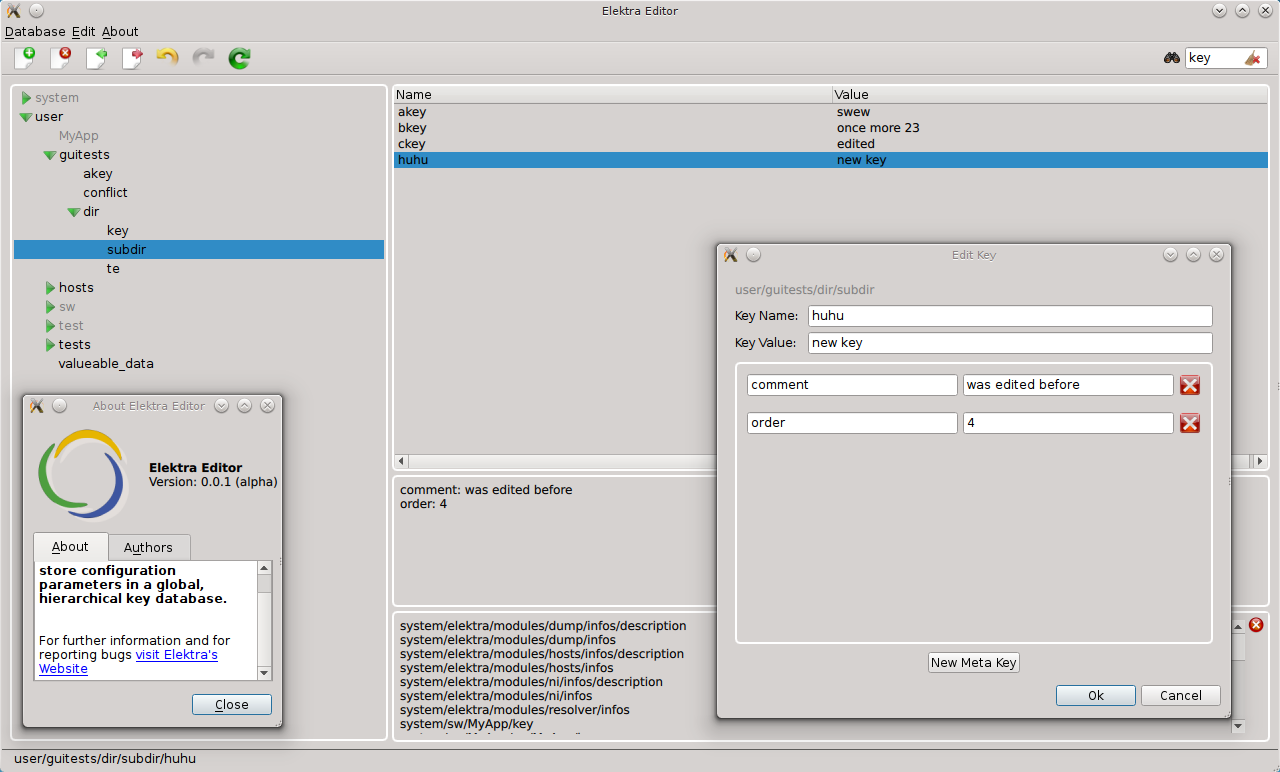
Hi Everyone, So first I want to say, that I appreciate all the interest in our project from the folks who read our posts at Planet Debian. This will be our last post there for now, I hope you enjoyed the posts about my Google Summer of Code project and other info about Elektra we posted there. To stay informed about Elektra s releases, please subscribe to this RSS feed. Today I want to thank you all and tell you about the latest exciting Elektra news, our newest release 0.8.10! This new release brings many exciting updates and features, since I didn t to a post for Elektra 0.8.9, this post will cover changes and additions from Elektra 0.8.8 to 0.8.10. First of all, there is now a new gui for KDB! A big thanks goes out to Raffael Pancheri for developing this GUI! Once included in your Elektra build, this gui can be run using the command kdb qt-gui. It is very important to note that the gui is in version 0.0.2, meaning it is an alpha project and shouldn t be considered stable yet! This GUI is a convenient tool that lets you mount, unmount, search, import and export configurations. We are very excited about this tool and we hope it makes Elektra more accessible to all users. Check out the screenshot below to see this new GUI in action:

A screenshot of the new qt-gui tool

A few other new features are that Felix added support for multi-line into the ini plugin. Users are able to turn this feature on or off for each configuration. Additionally, Kai-Uwe added support for Windows 7 to Elektra! The Windows 7 port relies on a new resolver called wresolver which is a simpler version of the regular resolver which is compatible with Windows. Additionally, there is a new Java binding, so now Elektra is compatible with applications and plugins written in Java! On top of these features, a new hosts plugin and a new rename plugin have been written. The new hosts in conjunction with improvements to the ini plugin allows for multiple styles of comments (because some ini dialects allow ; and # to be used to differentiate comments) to be used and preserved in configuration files. Additionally, this new hosts plugin is compatible with and differentiates between ipv4 and ipv6 entries. There have also been a huge number of under-the-hood improvements, changes, and fixes; there have been so many in-fact that I am going to list them: There are many more new changes that I could not mention here. Please keep up-to-date with Elektra news and releases by subscribing to this RSS feed and following our news page on GitHub. As always feel free to comment on our posts and I will get back to you as soon as possible. Again, thanks for reading our blog, enjoy the new release! Sincerely,
Ian S. Donnelly P.S. Happy New Year to everybody!

Russ Allbery: Review: Some Remarks

Review: Some Remarks, by Neal Stephenson
Publisher: William Morrow
Copyright: June 2013
ISBN: 0-06-202444-2
Format: Trade paperback
Pages: 336
This is going to be another weird review, since I read this essay collection about three months ago, and I borrowed it from a friend. So this is both from fading memory and without a handy reference other than Internet searches. Apologies in advance for any important details that I miss. The advantage is that you'll see what parts of this collection stuck in my memory. Some Remarks is, as you might guess from the title, a rather random collection of material. There's one long essay that for me was the heart of the book (more on that in a moment), two other longer essays, two short stories, and thirteen other bits of miscellaneous writing of varying lengths. I found most of the short essays unremarkable. Stephenson uses a walking desk because sitting is bad for you that sentence contains basically all of the interesting content of one of the essays. I think it takes a large topic and some running room before Stephenson can get up to speed and produce something that's more satisfying than technological boosterism. That means the most interesting parts of this book are the three longer works. "In the Kingdom of Mao Bell" was previously published in Wired and is still available. Some Remarks contains only excerpts; Stephenson says that some of the original essay is no longer that interesting. I had mixed feelings about this one. Some of the sense of place he creates was fun to read, but Stephenson can't seem to quite believe that the Chinese don't care about "freedom" according to his definitions in the same way and therefore don't have the same political reaction to hacker culture that he does. This could have been an opportunity for him to question assumptions, but instead it's mostly an exercise in dubious, sweeping cultural evaluation, such as "the country has a long history of coming up with technologies before anyone else and then not doing a lot with them." A reminder that the detail with which Stephenson crams his writing is not always... true. Stronger is "Atoms of Cognition: Metaphysics in the Royal Society 1715 2010," which covers material familiar to readers of Stephenson's Baroque Cycle. The story of Newton, Leibniz, their rivalry, and the competing approaches to thinking about mathematics and science was my favorite part of that series, and in some ways the non-fiction treatment is better than the fictional one. If you liked the Baroque Cycle, this is worth reading. But the highlight of the book for me was "Mother Earth Mother Board." This is a long essay (50,000 words, practically a small book and the largest part of this collection) about the laying of undersea fiber-optic cables. Those who have read Cryptonomicon will recognize some of the themes here, but there's way more to this essay than there was to the bits about undersea cables in Cryptonomicon. It's mostly about technology, rather than people, which puts Stephenson on firmer ground. The bit about people reads more like a travelogue, full of Stephenson's whole-hearted admiration of people who build things and make things work. There's a bit of politics, a bit of history, a bit of tourism, and a lot of neat trivia about a part of the technological world that I'd not known much about before. I would say this is worth the price of the collection, but it too was previously published in Wired, so you can just read it online. Those reading this review on my web site will notice that I filed it in non-fiction. There are a couple of stories, but they're entirely forgettable (in fact, I had entirely forgotten them, and had to skim them again). But, for the record, here are short reviews of those: "Spew": This originally appeared in Wired and can still be read on-line. The protagonist takes a job as a sort of Internet marketing inspector who looks for deviations from expected profiles. While tracing down an anomaly, though, he finds another use of the Internet that's outside of the marketing framework he's using. It's unlikely that anyone who's been online for long will find much new in this story. Some of that is because it was originally published in 1994, but most of it is just that this isn't a very good story. Stephenson seems to have turned up his normal manic infodump to 11 to satisfy the early Wired aesthetic, and the result is a train wreck of jargon, bad slang, and superficial social observation. (3) "The Great Simoleon Caper": Originally published in TIME, this story too is still available online. It's primarily interesting because it's a story about Bitcoin (basically), written in 1995. And it's irritating for exactly the same reason that Bitcoin enthusiasm often tends to be irritating: the assumption that cryptocurrency is somehow a revolutionary attack on government-run currency systems. I'm not going to get into the ways in which this doesn't make sense given how money is used socially (David Graeber's Debt is the book to read if you want more information); just know that the story follows that path and doesn't engage with any of the social reasons why that outcome is highly unlikely. Indeed, the lengths to which the government tries to go to discredit cryptocurrency in this story are rather silly. Apart from that, this is typical early Stephenson writing. It's very in love with ideas, not as much with characterization, and consists mostly of people explaining things to each other. Sometimes this is fun, but when focused on topics about which considerably more information has become available, it doesn't age very well. (5) Overall, there was one great essay and a few interesting bits, but I wouldn't have felt I was missing much if I'd never read this collection. I borrowed Some Remarks from a friend, and I think that's about the right level of effort. If it falls into your hands, or you see it in a library, some of the essays, particularly "Mother Earth Mother Board," are worth reading, but given that the best parts are available on-line for free, I don't think it's worth a purchase. Rating: 6 out of 10

27 December 2014

Richard Hartmann: Release Critical Bug report for Week 52

Sadly, I am a day late. This post brought to you by download speeds of ~2-9kb/s and upload speeds of 1 kb/s. Even though I am only a few kilometers away from Munich, I have worse Internet connection here than I had in the middle of nowhere in Finland Also, the bug count jumped up by about 40 between Thursday and today. Else, we would have been ahead of squeeze. The UDD bugs interface currently knows about the following release critical bugs: How do we compare to the Squeeze release cycle?
Week Squeeze Wheezy Jessie
43 284 (213+71) 468 (332+136) 319 (240+79)
44 261 (201+60) 408 (265+143) 274 (224+50)
45 261 (205+56) 425 (291+134) 295 (229+66)
46 271 (200+71) 401 (258+143) 427 (313+114)
47 283 (209+74) 366 (221+145) 342 (260+82)
48 256 (177+79) 378 (230+148) 274 (189+85)
49 256 (180+76) 360 (216+155) 226 (147+79)
50 204 (148+56) 339 (195+144) ???
51 178 (124+54) 323 (190+133) 189 (134+55)
52 115 (78+37) 289 (190+99) 147 ((112+35))
1 93 (60+33) 287 (171+116)
2 82 (46+36) 271 (162+109)
3 25 (15+10) 249 (165+84)
4 14 (8+6) 244 (176+68)
5 2 (0+2) 224 (132+92)
6 release! 212 (129+83)
7 release+1 194 (128+66)
8 release+2 206 (144+62)
9 release+3 174 (105+69)
10 release+4 120 (72+48)
11 release+5 115 (74+41)
12 release+6 93 (47+46)
13 release+7 50 (24+26)
14 release+8 51 (32+19)
15 release+9 39 (32+7)
16 release+10 20 (12+8)
17 release+11 24 (19+5)
18 release+12 2 (2+0)
Graphical overview of bug stats thanks to azhag:

26 December 2014

Sven Hoexter: on call one-liner: Who is sitting in my swap space?

A "nearly out of swap"-alarm during on call duty led me to quickly assemble a one-liner to grab a list of PIDs and the amount of memory swapped out from /proc/[pid]/smaps. That one-liner later got a bit polishing from my colleague H. to look like this:
for x in $(ps -eo pid h); do s=/proc/$ x /smaps; [ -e $ s  ] && awk -vp=$ x  'BEGIN   sum=0   /Swap:/   sum+=$2   END   if (sum!=0) print sum " PID " p ' $ s ; done   sort -rg
After I shared this one with some friends V. came up with a faster version (and properly formatted output :), that relies on the "VMSwap" value in /proc/[pid]/status. Since the one-liner above has to add up one "Swap" value per memory segment it's obvious why it's very slow on systems with many processes and a lot of memory.
awk 'BEGIN printf "%-7s %-16s %s (KB)\n", "PID","COMM","VMSWAP"   
if($1 == "Name:") n=$2 
if($1 == "Pid:") p=$2 
if($1 == "VmSwap:" && $2 != "0") printf "%-7s %-16s %s\n", p,n,$2   "sort -nrk3" 
 ' /proc/*/status
Drawback of this second version is that it relies on the "VmSwap" value which is only part of Linux 2.6.34 and later. It also ended up in the 2.6.32 based kernel of RHEL 6, so this one should work from RHEL 6 and Debian/wheezy onwards. The first version also works on RHEL 5 and Debian/squeeze since both have a (default) kernel with "CONFIG_PROC_PAGE_MONITOR" enabled, which is what you need to enable /proc/[pid]/smaps. Update: C.R. pointed out via mail that there is a versatile Python script smem. It's available in Debian and at least EPEL 6 and 7. Thanks for the hint. The usefulness of swap and why there is no automatic ressource assignment check and bookkeeping, based on calculations around things like the JVM -Xmx settings and other input, is a story on its own. There is room for improvement. A CMDB (Chapter 10.7) would be a starting point.

Russ Allbery: pam-krb5 4.7

It's been a long, long time since the last upstream release. Rather too long, as the changes to the portability and test framework were larger than the changes to the module itself. But there are a few bug fixes here and one new feature. The new feature is a new option, no_update_user, which disables the normal update of PAM_USER for the rest of the PAM stack to the canonicalized local username. This allows users to do things like enter Kerberos principals into the login prompt and have the right thing happen, but sometimes it's important to keep the authentication credentials as originally entered and not canonicalize, even if there's a local canonicalization available. This new option allows that. In the bug-fix department, the module now suppresses spurious password prompts from Heimdal while using PKINIT and understands more Kerberos errors for purposes of try_first_pass support and returning better PAM errors. The documentation now notes next to each option the version of pam-krb5 at which it was introduced with its current meaning. You can get the latest version from the pam-krb5 distribution page.

Vasudev Kamath: Notes: LXC How-To

LXC - Linux Containers allows us to run multiple isolated Linux system under same control host. This will be useful for testing application without changing our existing system. To create an LXC container we use the lxc-create command, it can accepts the template option, with which we can choose the OS we would like to run under the virtual isolated environment. On a Debian system I see following templates supported

[vasudev@rudra: ~/ ]% ls /usr/share/lxc/templates
lxc-alpine*    lxc-archlinux*  lxc-centos*  lxc-debian*    lxc-fedora*  lxc-openmandriva*  lxc-oracle*  lxc-sshd*    lxc-ubuntu-cloud*
lxc-altlinux*  lxc-busybox*    lxc-cirros*  lxc-download*  lxc-gentoo*  lxc-opensuse*      lxc-plamo*   lxc-ubuntu*
For my application testing I wanted to create a Debian container for my By default the template provided by lxc package creates Debian stable container. This can be changed by passing the option to debootstrap after -- as shown below.
sudo MIRROR=http://localhost:9999/debian lxc-create -t debian \
     -f   container.conf -n container-name -- -r sid
-r switch is used to specify the release, MIRROR environment variable is used to choose the required Debian mirror. I wanted to use my own local approx installation, so I can save some bandwidth. container.conf is the configuration file used for creating the LXC, in my case it contains basic information on how container networking should b setup. The configuration is basically taken from LXC Debian wiki
lxc.utsname = aptoffline-dev
lxc.network.type = veth
lxc.network.flags = up
lxc.network.link = br0.1
lxc.network.name = eth0
lxc.network.ipv4 = 192.168.3.2/24
lxc.network.veth.pair = vethvm1
I'm using VLAN setup described in Debian wiki: LXC VLAN Networking page. Below is my interfaces file.
iface eth0.1 inet manual
iface br0.1  inet manual
   bridge_ports eth0.1
   bridge_fd 0
   bridge_maxwait 0
Before launching the LXC make sure you run below command
sudo ifup eth0.1
sudo ifup br0.1
# Also give ip to bridge in same subnet as lxc.network.ipv4
sudo ip addr add 192.168.3.1/24 dev br0.1
I'm giving ip address to bridge so that I can communicate with container from my control host, once it comes up. Now start the container using below command
sudo lxc-start -n container -d -c tty8
We are starting lxc in daemon mode and attaching it to console tty8. If you want, you can drop -d and -c option to start lxc in foreground. But its better you start it in background and attach using lxc-console command shown below.
sudo lxc-console -n container -t tty8
You can detach from console using Ctrl+a q combination and let lxc execute in background. Its also possible to simply ssh into the running container since we have enabled networking. Stopping the container should be done using lxc-stop command, but without -k switch (kill) this command never returned. Even with timeout container is not stopped.
sudo lxc-stop -n container
-r can be used for reboot of container. Since I couldn't get clean shutdown I normally attach the console and issue a halt command in container itself. Not sure if this is the right way, but it gets the thing done. I consider Linux container as a better alternative for spawning a virtual Linux environment instead of running a full blown VM like Virtualbox or VMware.

25 December 2014

Russ Allbery: Review: Bad Pharma

Review: Bad Pharma, by Ben Goldacre
Publisher: Faber and Faber
Copyright: 2012, 2013
Printing: 2014
ISBN: 0-86547-806-6
Format: Trade paperback
Pages: 397
If you have previously read Bad Science by Ben Goldacre, it's doubtful you need me to do anything other than point out that he has a new book. Oh, and it's subtitled How Drug Companies Mislead Doctors and Harm Patients, and it's written with the same indignant determination, clear explanation, and appreciation for real science as Bad Science. If you haven't read Bad Science, I recommend it. You don't have to read it before Bad Pharma, but it's a more approachable start, and a funnier book. Bad Science opens with some obviously horrible examples, and slowly develops the tools required to analyze more advanced and deceptive quackery. Bad Pharma jumps straight into the deep end of statistical biases in data, how and why they're introduced, and why they undermine your health care. This is a more serious book than Bad Science, since it lacks the medical quackery that is so ludicrous it's funny. Everything in Bad Science is successfully sold to someone there are people who believe in candling but most readers of the book can laugh a bit that anyone would believe in such things before getting to the parts of the book where the quackery is widespread and kills people. Bad Pharma focuses on the mainstream pharmaceutical industry and the way that it distorts the scientific process, which leads to serious consequences quite quickly. Goldacre is more pointedly on a mission here than in his previous book. This is not just an expos . It includes detailed recommendations for how to make the drug evaluation process better, and some specific ethical recommendations for doctors to avoid being unduly influenced by drug company marketing. But before that, he provides the best detailed explanation of how the drug research and approval process is supposed to work that I've seen. There's also a lot of good information about how to detect trials and related studies that haven't been done properly, and how to separate marketing language from scientific evidence. Goldacre wisely does not get into all the details of how to do a trial properly, which would be way beyond the scope of this book, but he does provide valuable rules of thumb and red flags that indicate when someone is probably not doing the trial properly. A point that's both frustrating and enlightening, and made very well by this book, is that fixing many of the problems with the drug approval process is not that difficult. Fixing all of them would be exceedingly difficult, of course, since they involve humans, complex financial motivations, the effectiveness of propaganda, and talented people who are paid well to create favorable impressions for new drugs. But we could get quite significant benefits from a few straightforward enhancements of the existing drug approval process, such as requiring that all clinical trials be pre-registered and all trial results published as a prerequisite for any drug approval. Goldacre makes his case for these changes forcefully and persuasively, and with justified anger. The current situation is bad enough for people like me who are only potential patients with no urgent medical issues. For a practicing doctor like Goldacre, it's infuriating to be actively denied the information required to effectively save people's lives. Normally, I find books like this interesting, but depressing and frustratingly limited. It's easy to write books about abuses that currently exist, or the limitations of the current approach. It's much harder to do what Goldacre does here: clearly describe the goals and ideals of drug testing for the lay reader, detail how the current approaches fall short of that goals, and then propose practical and concrete ways to correct the situation. And keep the details interesting and entertaining enough that I enjoyed reading every page of a nearly 400 page book. This is not a book that will fill you with trust or enthusiasm for the medical establishment (anywhere in the world). But it's still oddly comforting: we do know how to do these things properly, and occasionally we even act on that knowledge. These problems are serious, but they should provoke outrage partly because they're correctable and yet aren't being corrected. And there are doctors like Goldacre who are trying to push medicine towards proper use of evidence, research, and knowledge, instead of commercial manipulation. Recommended if you have any interest at all in how medicine or scientific research is actually done, and what its pitfalls look like. Rating: 8 out of 10

24 December 2014

Chris Lamb: find(1), trailing slashes and symbolic links to directories

Here's a nice little "gotcha" in find(1). First, let's create a directory and a symlink to that directory. We'll add an empty file just underneath to illustrate what is going on:
$ mkdir a
$ ln -s a b
$ touch a/file
If we invoke find with a trailing slash, everything works as expected:
$ find a/
a/
a/file
$ find b/
b/
b/file
... but if we omit the trailing slash, find does not traverse the symlink:
$ find a
a
a/file
$ find b
b
This implies that any normal-looking invokation of find such as:
find /path/to/dir -name 'somefile.ext' ...
... is subtly buggy as it won't accomodate the sysadmin replacing that path with a symlink.
This is, of course, well-covered in the find(1) manpage (spoiler: the safest option is to specify -H, or simply to append the trailing slash), but I would still class this as a "gotcha" because of the subtle difference between the trailing and non-trailing slash variants. Putting it another way, it's completely reasonable that find doesn't follow symlinks, but when this behaviour based on the presence of the trailing slash a usually meaningless syntactic distinction it crosses the rubicon to being counter-intutive.

Joey Hess: generating shell scripts from haskell using a shell monad

Shell script is the lingua franca of Unix, it's available everywhere and often the only reasonable choice to Get Stuff Done. But it's also clumsy and it's easy to write unsafe shell scripts, that forget to quote variables, typo names of functions, etc. Wouldn't it be nice if we could write code in some better language, that generated nicely formed shell scripts and avoided such gotchas? Today, I've built a Haskell monad that can generate shell code. Here's a fairly involved example. This demonstrates several features, including the variadic cmd, the ability to define shell functions, to bind and use shell variables, to build pipes (with the -:- operator), and to factor out generally useful haskell functions like pipeLess and promptFor ...
santa = script $ do
    hohoho <- func $
        cmd "echo" "Ho, ho, ho!" "Merry xmas!"
    hohoho
    promptFor "What's your name?" $ \name -> pipeLess $ do
        cmd "echo" "Let's see what's in" (val name <> quote "'s") "stocking!"
        forCmd (cmd "ls" "-1" (quote "/home/" <> val name)) $ \f -> do
            cmd "echo" "a shiny new" f
            hohoho
    cmd "rm" "/table/cookies" "/table/milk"
    hohoho
pipeLess :: Script () -> Script ()
pipeLess c = c - - cmd "less"
promptFor :: T.Text -> (Var -> Script ()) -> Script ()
promptFor prompt cont = do
    cmd "printf" (prompt <> " ")
    var <- newVar "prompt"
    readVar var
    cont var
When run, that haskell program generates this shell code. Which, while machine-generated, has nice indentation, and is generally pretty readable.
#!/bin/sh
f1 ()   :
    echo 'Ho, ho, ho!' 'Merry xmas!'
 
f1
printf 'What'"'"'s your name?  '
read '_prompt1'
(
    echo 'Let'"'"'s see what'"'"'s in' "$_prompt1"''"'"'s' 'stocking!'
    for _x1 in $(ls '-1' '/home/'"$_prompt1")
    do :
        echo 'a shiny new' "$_x1"
        f1
    done
)   (
    less
)
rm '/table/cookies' '/table/milk'
f1
Santa has already uploaded shell-monad to hackage and git. There's a lot of things that could be added to this library (if, while, redirection, etc), but I can already see using it in various parts of propellor and git-annex that need to generate shell code.

Gunnar Wolf: More on Debian as a social, quasi-familiar project

I have long wanted to echo Gregor's beautiful Debian Advent Calendar posts. Gregor is a dear project member and a dear friend to many of us Debianers, who has shown an amount of stamina and care for the project that inspires everybody; this year, after many harsh flamefests in the project (despite which we are moving at a great rate towards a great release!), many people have felt the need to echo how Debian even as often seen from the outside as a hostile mass of blabbering geeks is actually a great place to work together and to create a deep, strong social fabric And that's quite probably what binds the project together and ensures it will continue existing and excelling for a long time. As for the personal part: This year, my Debian involvement has once again reduced. Not because I care less about Debian, much to the contrary, but because I have taken several responsabilities which require my attention and time. Technically, I'm basically maintaining a couple of PHP-based packages I use for work (most prominently, Drupal7). I have stepped back of most of my DebConf responsabilities, although I stay (and will stay, as it's an area of the project I deeply enjoy doing) involved. And, of course, my current main area of involvement is keyring-maint (for which I have posted here several status updates). I have to say that we expected having a much harder time (read: Stronger opposition and discussions) regarding the expiry of 1024D keys. Of course, many people do have a hard time connecting anew to the web of trust, and we will still face quite a bit of work after January 1st, but the migration has been a mostly pleasant (although clearly intensive) work. Jonathan has just told me we are down to only 306 1024D keys in the keyring (which almost exactly matches the "200-300" I expected back at DC14). Anyway: People predicting doomsday scenarios for Debian do it because they are not familiar with how deep the project runs in us, how important it is socially, almost at a family level, to us that have been long involved in it. Debian is stronger than a technical or political discussion, no matter how harsh it is. And, as a personal thank-you: Gregor, your actions (the GDAC, the RC bug reports) inspire us to stay active, to do our volunteer work better, and remind us of how great is it to be a part of a global, distributed will to Do It Right. Thanks a lot!

Next.

Previous.