Search Results: "mak"

12 July 2016

Joey Hess: twenty years of free software -- part 13 past and future

This series has focused on new projects. I could have said more about significant work that didn't involve starting new projects. A big example was when I added dh to debhelper, which led to changes in a large percentage of debian/rules files. And I've contributed to many other free software projects. I guess I've focused on new projects becuase it's easier to remember things I've started myself. And because a new project is more wide open, with more scope for interesting ideas, especially when it's free software being created just because I want to, with no expectations of success. But starting lots of your own projects also makes you responsible for maintaining a lot of stuff. Ten years ago I had dozens of projects that I'd started and was still maintaining. Over time I started pulling away from Debian, with active projects increasingly not connected with it. By the end, I'd left and stopped working on the old projects. Nearly everything from my first decade in free software was passed on to new maintainers. It's good to get out from under old projects and concentrate on new things. I saved propellor for last in this series, because I think it may point toward the future of my software. While git-annex was the project that taught me Haskell, propellor's design is much more deeply influenced by the Haskell viewpoint. Absorbing that viewpoint has itself been a big undertaking for me this decade. It's like I was coasting along feeling at the top of my game and wham got hit by the type theory bus. And now I see that I was stuck in a rut before, and begin to get a feeling of many new possibilities. That's a good feeling to have, twenty years in.

11 July 2016

Niels Thykier: mips64el added to Debian testing

Today, we have completed our first Britney run with mips64el enabled in testing. :) At the current time, the set of packages in mips64el are not very connected (and you probably cannot even install build-essential yet[1]). Hopefully this will change over the next few days. For now, Britney does not enforce installability of packages on mips64el in general, so do not expect the architecture to be stable at the moment. Cheat sheet for package maintainers: We will slowly remove these special cases for mips64el as it matures in testing. [1] Update on this: mips64el currently does not have a libc library yet, so build-essential is definitely not installable at the moment. It will hopefully migrate very soon.
Filed under: Debian, Release-Team

Daniel Pocock: Let's Encrypt torpedoes cost and maintenance issues for Free RTC

Many people have now heard of the EFF-backed free certificate authority Let's Encrypt. Not only is it free of charge, it has also introduced a fully automated mechanism for certificate renewals, eliminating a tedious chore that has imposed upon busy sysadmins everywhere for many years. These two benefits - elimination of cost and elimination of annual maintenance effort - imply that server operators can now deploy certificates for far more services than they would have previously. The TLS chapter of the RTC Quick Start Guide has been updated with details about Let's Encrypt so anybody installing SIP or XMPP can use Let's Encrypt from the outset. For example, somebody hosting basic Drupal or Wordpress sites for family, friends and small community organizations can now offer them all full HTTPS encryption, WebRTC, SIP and XMPP without having to explain annual renewal fees or worry about losing time in their evenings and weekends renewing certificates manually. Even people who were willing to pay for a single certificate for their main web site may have snubbed their nose at the expense and ongoing effort of having certificates for their SMTP mail server, IMAP server, VPN gateway, SIP proxy, XMPP server, WebSocket and TURN servers too. Now they can all have certificates. Early efforts at SIP were doomed without encryption In the early days, SIP messages would be transported across the public Internet in UDP datagrams without any encryption. SIP itself wasn't originally designed for NAT and a variety of home routers were created with "NAT helper" algorithms that would detect and modify SIP packets to try and work through NAT. Sadly, in many cases these attempts to help actually clash with each other and lead to further instability. Conversely, many rogue ISPs could easily detect and punish VoIP users by blocking their calls or even cutting their DSL line. Operating SIP over TLS, usually on the HTTPS port (TCP port 443) has been an effective way to quash all of these different issues. While the example of SIP is one of the most extreme, it helps demonstrate the benefits of making encryption universal to ensure stability and cut out the "man-in-the-middle", regardless of whether he is trying to help or hinder the end user. Is one certificate enough? Modern SIP, XMPP and WebRTC require additional services, TURN servers and WebSocket servers. If they are all operated on port 443 then it is necessary to use different hostnames for each of them (e.g. turn.example.org and ws.example.org. Each different hostname requires a certificate. Let's Encrypt can provide those additional certificates too, without additional cost or effort. The future with Let's Encrypt The initial version of the Let's Encrypt client, certbot, fully automates the workflow for people using popular web servers such as Apache and nginx. The manual or certonly modes can be used for other services but hopefully certbot will evolve to integrate with many other popular applications too. Currently, Let's Encrypt's certbot tool issues certificates to servers running on TCP port 443 or 80. These are considered to be a privileged ports whereas any port over 1023, including the default ports used by applications such as SIP (5061), XMPP (5222, 5269) and TURN (5349), are not privileged ports. As long as certbot maintains this policy, it is generally necessary to either run a web server for the domain associated with each certificate or run the services themselves on port 443. There are other mechanisms for domain validation and various other clients supporting different subsets of them. Running the services themselves on port 443 turns out to be a good idea anyway as it ensures that RTC services can be reached through HTTP proxy servers who fail to let the HTTP CONNECT method access any other ports. Many configuration tasks are already scripted during the installation of packages on a GNU/Linux distribution (such as Debian or Fedora) or when setting up services using cloud images (for example, in Docker or OpenStack). Due to the heavily standardized nature of Let's Encrypt and the widespread availability of the tools, many of these package installation scripts can be easily adapted to find or create Let's Encrypt certificates on the target system, ensuring every service is running with TLS protection from the minute it goes live. If you have questions about Let's Encrypt for RTC or want to share your experiences, please come and discuss it on the Free-RTC mailing list.

10 July 2016

Simon D saulniers: [GSOC] Week 5&6 Report

During week 5 and 6, I have been to the debian conference 2016. It was really interesting meeting with a lot of people all so involved in Debian.

Key signing party Each year, this is a really important tradition: people gather together and exchange GPG public key fingerprint and sign each other s keys. This contributes greatly to the growth of the web of trust.
I did exchange public key fingerprint with others. It was the first opportunity become more connected in the PGP web of trust. I think this is something that needs to make its way to the less technical people so that everyone can benefit from the network privacy features. There is support for some mail clients like Thunderbird, but I think there is still work to do there and mostly there is work to do about the opinion or point of view people have about encryption ; people don t care enough and they don t really know what encryption can do for them (digital signature, trust and privacy).

Ring now part of Debian During the first week at debcamp, Alexandre Viau, an employee at Savoir-Faire Linux and a also a Debian developer (DD for short), has packaged Ring for Debian. Users can now install Ring like so:
$ sudo apt-get install ring
This is an important moment as more people are now going to easily try Ring and potentially contribute to it.

Presentating Ring Alexandre Viau and I have been thinking about presenting Ring at debconf 2016. We finally did it.

Ritesh Raj Sarraf: Leprosy in India

During my recent travel, I had quite a long layover at the Doha International Airport in Qatar. While killing time, I watched an interesting programme on the Al Jazeera network. The program aired on Al Jazeera is Lifelines. This special episode I watched, covered about "Leprosy in India". After having watched the entire programme, I felt the urge to blog about it. First of all, it was quite depressing to me, to know through the programme, that the Govt. of India had officially marked "Leprosy" eradicated from India in 2005. As per Wikipedia, "Globally in 2012, the number of chronic cases of leprosy was 189,000, down from some 5.2 million in the 1980s. The number of new cases was 230,000. Most new cases occur in 16 countries, with India accounting for more than half." Of the data presented on Lifelines, they just covered a couple of districts from 2 States (of the 28+ States) of India. So, with many states remaining, and unserveyed, and uncounted, we are far away from making such statements. Given that the Govt., on paper, has marked Leprosy eradicated; so does WHO. Which means that there is no more funding to help people suffering from the disease. And with no Govt. (or International) funding, it is a rather disappointing situation. I come from a small town on the Indo-Nepal intl. border, named Raxaul. And here, I grew up seeing many people who suffered from Leprosy. As a child, I never much understood the disease, because as is mentioned in the programme, I was told it was a communicable disease. Those suffering, were (and are) tagged as Untouchables (Hindi: ). Of my small town, there was and still is a sub-town, named Sunderpur. This town houses patients suffering from Leprosy, from around multiple districts closeby. I've never been there, but have been told that it is run by an NGO, and helps patients fight the disease. Lifelines also reported that fresh surveys done by the Lepra society, just a 3 day campaign, resulted in 3808 new cases of people suffering from Leprosy. That is a big number, given accessibility to small towns only happens once a week on market day. And in 3 days the team hardly covered a couple of district towns. My plea to the Media Houses of India. Please spend some time to look beyond the phony stuff that you mostly present. There are real issues that could be brought to a wider audience. As for the government, it is just depressing to know how rogue some/most of your statements are.

Categories:

Keywords:

Like:

Joey Hess: twenty years of free software -- part 12 propellor

Propellor is my second big Haskell program. I recently described the motivation for it like this, in a proposal for a Linux.Conf.Au talk:
The configuration of Linux hosts has become increasingly declarative, managed by tools like puppet and ansible, or by the composition of containers. But if a server is a collection of declarative properties, how do you make sure that changes to that configuration make sense? You can test them, but eventually it's 3 AM and you have an emergency fix that needs to go live immediately. Data types to the rescue! While data types are usually used to prevent eg, combining an Int and a Bool, they can be used at a much more abstract level, for example to prevent combining a property that needs a Debian system with a property that needs a Red Hat system. Propellor leverages Haskell's type system to prove the consistency of the properties it will apply to a host.
The real origin story though, is that I wanted to finally start using configuration management, but the tools for it all seemed very complicated and built on shaky foundations (like piles of yaml), and it seemed it would be easier to write my own than deal with that. Meanwhile, I had Haskell burning a hole in my pocket, ready to be used in a second large project after git-annex. Propellor has averaged around 2.5 contributions per month from users since it got started, but increasing numbers recently. That's despite having many fewer users than git-annex, which remember gets perhaps 1 patch per month. Of course, I've "cheated" by making sure that propellor's users know Haskell, or are willing to learn some. And, propellor is very compositional; adding a new property to it is not likely to be complicated by any of the existing code. So it's easy to extend, if you're able to use it. At this point propellor has a small community of regular contributors, and I spend some pleasant weekend afternoons reviewing and merging their work. Much of my best work on propellor has involved keeping the behavior of the program the same while making its types better, to prevent mistakes. Propellor's core data types have evolved much more than in any program I worked on before. That's exciting! Next: twenty years of free software -- part 13 past and future

Simon D saulniers: [GSOC] Week 3&4 Report

I have finally made a version of the queries code that can viably be integrated into the master branch of OpenDHT. I am awaiting my mentor s approval and/or comments.

What s done Queries. The library will provide the additional following functions in its API:
void get(InfoHash id, GetCallbackSimple cb, DoneCallback donecb= , Value::Filter f = Value::AllFilter(), Where w =  )  
void query(const InfoHash& hash, QueryCallback cb, DoneCallback done_cb =  , Query q =  );
The structure Where in the first signature will allow the user to narrow the set of values received through the network those that verify the where statement. The Where actually encapsulates a statement of the following SQL-ish form: SELECT * WHERE <some_field>=<some_field_value>. Also, the DhtRunner::query function will let the user do something similar to what s explained in the last paragraph, but where the returned data is encapsulated in FieldValueIndex structure instead of Value. This structure has a std::map<Value::Field, FieldValue>. You can think of the FieldValueIndex as a subset of fields of a given Value. The Query structure then allows you to create both Select and Where statements .

What s next
  • Value pagination. I have begun working on this and I now have a more clear idea of the first step to accomplish. I have to redesign the get operation callbacks calling process by making a callback execution per SearchNode instead of per Search (list of SearchNode). This will let us properly write the value pagination code with node concurrency in mind. This will therefor make sure we don t request a value from a node if it doesn t stores it;
  • Optimizing announce operations;

Sune Vuorela: Let Qt models meet std::vector<std::tuple< >>

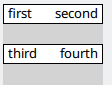
The problem So. I was stuck with a container of tuples that I wanted to see in a Qt view (QTableView, QtQuick ListView or similar). So how to do that? Another problem: I haven t been doing fun things with templates recently. A solution? After a bit of hacking, it seems like it can just be done like
typedef std::tuple<std::string, QString> Element;
typedef std::vector List;
List list =   std::make_tuple("first", "second"), 
              std::make_tuple("third", "fourth")  ;
std::unique_ptr<TableModel> magic = createTableModel(list);
QTableView view;
view.setModel(magic->model());
and tada:
QTableView Of course, we are also QtQuick friendly
std::unique_ptr<ListModel>List>> magic = createListModel(list);
// expose magic->model() to your quickview
and a delegate containing the following
Text  
    text: role0
 
Text  
    text: role1
 
can give:
ListView But enough about creation. Whattabout manipulation? Luckily we got you covered. Insert two extra rows at position 1?
auto lines =   std::make_tuple("extra", "extra"),
               std::make_tuple("extra2","extra2")  ;
magic->insertRows(1,lines.begin(), lines.end());
Append a row?
magic->appendRow(std::make_tuple("",""));
Remove 2 rows at position 3?
magic->removeRow(3,2);
Replace the underlying list?
List newList;
// fill list
magic->reset(newList);
Read-only looping over the elements?
for(const Element& e : magic->list())
 
    ...
 
The Qt model of course also accepts setData calls. Future? If anyone is interested I will polish the code a bit and publish it. If that s the case, how should I name this thing? And I did get around doing fun things with templates again.

9 July 2016

Matthew Garrett: "I recieved a free or discounted product in return for an honest review"

My experiences with Amazon reviewing have been somewhat unusual. A review of a smart switch I wrote received enough attention that the vendor pulled the product from Amazon. At the time of writing, I'm ranked as around the 2750th best reviewer on Amazon despite having a total of 18 reviews. But the world of Amazon reviews is even stranger than that, and the past couple of weeks have given me some insight into it.

Amazon's success is fairly phenomenal. It's estimated that there's over 50 million people in the US paying $100 a year to get free shipping on Amazon purchases, and combined with Amazon's surprisingly customer friendly service there's a lot of people with a very strong preference for choosing Amazon rather than any other retailer. If you're not on Amazon, you're hurting your sales.

And if you're an established brand, this works pretty well. Some people will search for your product directly and buy it, leaving reviews. Well reviewed products appear higher up in search results, so people searching for an item type rather than a brand will still see your product appear early in the search results, in turn driving sales. Some proportion of those customers will leave reviews, which helps keep your product high up in the results. As long as your products aren't utterly dreadful, you'll probably maintain that position.

But if you're a brand nobody's ever heard of, things are more difficult. People are unlikely to search for your product directly, so you're relying on turning up in the results for more generic terms. But if you're selling a more generic kind of item (say, a Bluetooth smart bulb) then there's probably a number of other brands nobody's ever heard of selling almost identical objects. If there's no reason for anybody to choose your product then you're probably not going to get any reviews and you're not going to move up the search rankings. Even if your product is better than the competition, a small number of sales means a tiny number of reviews. By the time that number's large enough to matter, you're probably onto a new product cycle.

In summary: if nobody's ever heard of you, you need reviews but you're probably not getting any.

The old way of doing this was to send review samples to journalists, but nobody's going to run a comprehensive review of 3000 different USB cables and even if they did almost nobody would read it before making a decision on Amazon. You need Amazon reviews, but you're not getting any. The obvious solution is to send review samples to people who will leave Amazon reviews. This is where things start getting more dubious.

Amazon run a program called Vine which is intended to solve this problem. Send samples to Amazon and they'll distribute them to a subset of trusted reviewers. These reviewers write a review as normal, and Amazon tag the review with a "Vine Voice" badge which indicates to readers that the reviewer received the product for free. But participation in Vine is apparently expensive, and so there's a proliferation of sites like Snagshout or AMZ Review Trader that use a different model. There's no requirement that you be an existing trusted reviewer and the product probably isn't free. You sign up, choose a product, receive a discount code and buy it from Amazon. You then have a couple of weeks to leave a review, and if you fail to do so you'll lose access to the service. This is completely acceptable under Amazon's rules, which state "If you receive a free or discounted product in exchange for your review, you must clearly and conspicuously disclose that fact". So far, so reasonable.

In reality it's worse than that, with several opportunities to game the system. AMZ Review Trader makes it clear to sellers that they can choose reviewers based on past reviews, giving customers an incentive to leave good reviews in order to keep receiving discounted products. Some customers take full advantage of this, leaving a giant number of 5 star reviews for products they clearly haven't tested and then (presumably) reselling them. What's surprising is that this kind of cynicism works both ways. Some sellers provide two listings for the same product, the second being significantly more expensive than the first. They then offer an attractive discount for the more expensive listing in return for a review, taking it down to approximately the same price as the original item. Once the reviews are in, they can remove the first listing and drop the price of the second to the original price point.

The end result is a bunch of reviews that are nominally honest but are tied to perverse incentives. In effect, the overall star rating tells you almost nothing - you still need to actually read the reviews to gain any insight into whether the customer actually used the product. And when you do write an honest review that the seller doesn't like, they may engage in heavy handed tactics in an attempt to make the review go away.

It's hard to avoid the conclusion that Amazon's review model is broken, but it's not obvious how to fix it. When search ranking is tied to reviews, companies have a strong incentive to do whatever it takes to obtain positive reviews. What we're left with for now is having to laboriously click through a number of products to see whether their rankings come from thoughtful and detailed reviews or are just a mass of 5 star one liners.

comment count unavailable comments

8 July 2016

Reproducible builds folks: Managing container and environment state

Author: ceridwen With some more help from Martin Pitt, it became clear to me that my previous mental model of how autopkgtest worked is very different from how it does work. I'll illustrate by borrowing my previous example. I know that schroot has the following behavior:
The default behaviour is as follows (all directory paths are inside the chroot). A login shell is run in the current working directory. If this is not available, it will try $HOME (when --preserve-environment is used), then the user's home directory, and / inside the chroot in turn. A command is always run in the current working directory inside the chroot. If none of the directories are available, schroot will exit with an error status.
I was naively thinking that the way autopkgtest would work is that it would set the current working directory of the schroot call and the ensuing subprocess call would thus take place in that directory inside the schroot. That is not how it works. If you want to change directories inside the virtual server, you have to use cd. The same is true of, at least, environment variables, which have their own specific handling in the adt_testbed.Testbed methods but have to be passed as strings, and umask. I'm assuming this is because the direct methods with qemu images or LXC containers don't work. What this means is that I was thinking about the problem the wrong way: what reprotest needs to do is generate shell scripts. This is how autopkgtest works. If this goes beyond laying out commands linearly one after another, for instance if it demands conditionals or other nested constructs, the right way to do it is to build an abstract syntax tree representation of the shell script and then convert it to code. Whether I need more complicated shell scripts depends on my approach to handling state in the containers. I need to know what state persists across separate command executions: if I call adt_testbed.Testbed.execute() twice, what if any changes I make to the container will carry forward from the first to the second? There are three categories here. First, some properties of a system aren't preserved even from one command execution to the next, like working directory and environment variables. (I thought working directory would be preserved, but it's not). The second is state that persists while the testbed is open and is then automatically reverted when it's closed, like files copied into temporary directories on the tesbed. The third is state that persists across different sessions on the same container and must be cleaned up by reprotest. It's worth noting that which state falls into which category may vary by the container in question, though for the most part I can either do unnecessary cleanup or issue unnecessary commands to handle the differences. autopkgtest itself has a very different approach to cleanup, as it relies almost entirely on the builtin reversion capabilities from some of its containers. I would prefer to avoid doing the same, partly because I know that some of the modifications I need to make, for instance creating new users or mounting disorderfs, can't be reverted by the faster, simpler containers like schroot. From discussions with Lunar, I think that the variations that correspond to environment variables (captures_environment, home, locales, path, and timezone) fall into the first category, but because of the special handling for them they don't require sending a separate command. The shell (bash foo) accepts a script or command as an argument so it also doesn't need a separate command. Setting the working directory and umask require separate commands that have to be joined. On Linux, setarch also accepts a command/script as an argument so can be handled like the shell, but there's no unified POSIX protocol for mocking uname so other OSes will require different approaches. Users, groups, file ordering, host, and domain will require cleanup in all containers except for (maybe) qemu. If I want to handle the cleanup in the shell scripts themselves, I need conditionals so that for instance the shell script only tries to unmount disorderfs if disorderfs was successfully mounted. This approach would simplify the error handling problems I've had before, where when a build crashes cleanup code run from Python doesn't get run until after the testbed stop accepting commands. Lunar suggested the Plumbum library to me, and I think I can use it to avoid writing my own shell AST library. It has a method that converts the Python representation of a shell script into a string that can be passed to Testbed.command(). Integrating Plumbum to generate the necessary scripts is where I'm going in the next week. Any feedback on any of this is welcome. I'm also curious what other projects are using autopkgtest code. Holger brought to my attention piuparts, which brings the list up to four that I'm aware of, autopkgtest itself, sbuild, piuparts, and now reprotest.

Mike Hommey: Are all integer overflows equal?

Background: I ve been relearning Rust (more about that in a separate post, some time later), and in doing so, I chose to implement the low-level parts of git (I ll touch the why in that separate post I just promised). Disclaimer: It s friday. This is not entirely(?) a serious post. So, I was looking at Documentation/technical/index-format.txt, and saw:
32-bit number of index entries.
What? The index/staging area can t handle more than ~4.3 billion files? There I was, writing Rust code to write out the index.
try!(out.write_u32::<NetworkOrder>(self.entries.len()));
(For people familiar with the byteorder crate and wondering what NetworkOrder is, I have a use byteorder::BigEndian as NetworkOrder) And the Rust compiler rightfully barfed:
error: mismatched types:
 expected  u32 ,
    found  usize  [E0308]
And there I was, wondering: mmmm should I just add as u32 and silently truncate or hey what does git do? And it turns out, git uses an unsigned int to track the number of entries in the first place, so there is no truncation happening. Then I thought but what happens when cache_nr reaches the max? Well, it turns out there s only one obvious place where the field is incremented. What? Holy coffin nails, Batman! No overflow check? Wait a second, look 3 lines above that:
ALLOC_GROW(istate->cache, istate->cache_nr + 1, istate->cache_alloc);
Yeah, obviously, if you re incrementing cache_nr, you already have that many entries in memory. So, how big would that array be?
        struct cache_entry **cache;
So it s an array of pointers, assuming 64-bits pointers, that s ~34.3 GB. But, all those cache_nr entries are in memory too. How big is a cache entry?
struct cache_entry  
        struct hashmap_entry ent;
        struct stat_data ce_stat_data;
        unsigned int ce_mode;
        unsigned int ce_flags;
        unsigned int ce_namelen;
        unsigned int index;     /* for link extension */
        unsigned char sha1[20];
        char name[FLEX_ARRAY]; /* more */
 ;
So, 4 ints, 20 bytes, and as many bytes as necessary to hold a path. And two inline structs. How big are they?

struct hashmap_entry  
        struct hashmap_entry *next;
        unsigned int hash;
 ;
struct stat_data  
        struct cache_time sd_ctime;
        struct cache_time sd_mtime;
        unsigned int sd_dev;
        unsigned int sd_ino;
        unsigned int sd_uid;
        unsigned int sd_gid;
        unsigned int sd_size;
 ;
Woohoo, nested structs.
struct cache_time  
        uint32_t sec;
        uint32_t nsec;
 ;
So all in all, we re looking at 1 + 2 + 2 + 5 + 4 32-bit integers, 1 64-bits pointer, 2 32-bits padding, 20 bytes of sha1, for a total of 92 bytes, not counting the variable size for file paths. The average path length in mozilla-central, which only has slightly over 140 thousands of them, is 59 (including the terminal NUL character). Let s conservatively assume our crazy repository would have the same average, making the average cache entry 151 bytes. But memory allocators usually allocate more than requested. In this particular case, with the default allocator on GNU/Linux, it s 156 (weirdly enough, it s 152 on my machine). 156 times 4.3 billion 670 GB. Plus the 34.3 from the array of pointers: 704.3 GB. Of RAM. Not counting the memory allocator overhead of handling that. Or all the other things git might have in memory as well (which apparently involves a hashmap, too, but I won t look at that, I promise). I think one would have run out of memory before hitting that integer overflow. Interestingly, looking at Documentation/technical/index-format.txt again, the on-disk format appears smaller, with 62 bytes per file instead of 92, so the corresponding index file would be smaller. (And in version 4, paths are prefix-compressed, so paths would be smaller too). But having an index that large supposes those files are checked out. So let s say I have an empty ext4 file system as large as possible (which I m told is 2^60 bytes (1.15 billion gigabytes)). Creating a small empty ext4 tells me at least 10 inodes are allocated by default. I seem to remember there s at least one reserved for the journal, there s the top-level directory, and there s lost+found ; there apparently are more. Obviously, on that very large file system, We d have a git repository. git init with an empty template creates 9 files and directories, so that s 19 more inodes taken. But git init doesn t create an index, and doesn t have any objects. We d thus have at least one file for our hundreds of gigabyte index, and at least 2 who-knows-how-big files for the objects (a pack and its index). How many inodes does that leave us with? The Linux kernel source tells us the number of inodes in an ext4 file system is stored in a 32-bits integer. So all in all, if we had an empty very large file system, we d only be able to store, at best, 2^32 22 files And we wouldn t even be able to get cache_nr to overflow. while following the rules. Because the index can keep files that have been removed, it is actually possible to fill the index without filling the file system. After hours (days? months? years? decades?*) of running
seq 0 4294967296   while read i; do touch $i; git update-index --add $i; rm $i; done
One should be able to reach the integer overflow. But that d still require hundreds of gigabytes of disk space and even more RAM. Ok, it s actually much faster to do it hundreds of thousand files at a time, with something like:
seq 0 100000 4294967296   while read i; do j=$(seq $i $(($i + 99999))); touch $j; git update-index --add $j; rm $j; done
At the rate the first million files were added, still assuming a constant rate, it would take about a month on my machine. Considering reading/writing a list of a million files is a thousand times faster than reading a list of a billion files, assuming linear increase, we re still talking about decades, and plentiful RAM. Fun fact: after leaving it run for 5 times as much as it had run for the first million files, it hasn t even done half more One could generate the necessary hundreds-of-gigabytes index manually, that wouldn t be too hard, and assuming it could be done at about 1 GB/s on a good machine with a good SSD, we d be able to craft a close-to-explosion index within a few minutes. But we d still lack the RAM to load it. So, here is the open question: should I report that integer overflow? Wow, that was some serious procrastination. Edit: Epilogue: Actually, oops, there is a separate integer overflow on the reading side that can trigger a buffer overflow, that doesn t actually require a large index, just a crafted header, demonstrating that yes, not all integer overflows are equal.

Lior Kaplan: First uses of the PHP 5.4 security backports

I recently checked the Debian PHP 5.4 changelog and found out this message (5.4.45-0+deb7u3 and 5.4.45-0+deb7u4):
* most patches taken from https://github.com/kaplanlior/php-src
Thanks a lot to Lior Kaplan for providing them.
I was very pleased to see my work being used, and I hope this would save other time while providing PHP long term support. Also, while others do similar work (e.g. Remi from RedHat), it seems I m the only when that make this over GIT and with full references (e.g. commit info, CVE info and bug number). Comments and suggestions are always welcome either mail or even better a pull request.
Filed under: Debian GNU/Linux, PHP

7 July 2016

Matthew Garrett: Bluetooth LED bulbs

The best known smart bulb setups (such as the Philips Hue and the Belkin Wemo) are based on Zigbee, a low-energy, low-bandwidth protocol that operates on various unlicensed radio bands. The problem with Zigbee is that basically no home routers or mobile devices have a Zigbee radio, so to communicate with them you need an additional device (usually called a hub or bridge) that can speak Zigbee and also hook up to your existing home network. Requests are sent to the hub (either directly if you're on the same network, or via some external control server if you're on a different network) and it sends appropriate Zigbee commands to the bulbs.

But requiring an additional device adds some expense. People have attempted to solve this in a couple of ways. The first is building direct network connectivity into the bulbs, in the form of adding an 802.11 controller. Go through some sort of setup process[1], the bulb joins your network and you can communicate with it happily. Unfortunately adding wifi costs more than adding Zigbee, both in terms of money and power - wifi bulbs consume noticeably more power when "off" than Zigbee ones.

There's a middle ground. There's a large number of bulbs available from Amazon advertising themselves as Bluetooth, which is true but slightly misleading. They're actually implementing Bluetooth Low Energy, which is part of the Bluetooth 4.0 spec. Implementing this requires both OS and hardware support, so older systems are unable to communicate. Android 4.3 devices tend to have all the necessary features, and modern desktop Linux is also fine as long as you have a Bluetooth 4.0 controller.

Bluetooth is intended as a low power communications protocol. Bluetooth Low Energy (or BLE) is even lower than that, running in a similar power range to Zigbee. Most semi-modern phones can speak it, so it seems like a pretty good choice. Obviously you lose the ability to access the device remotely, but given the track record on this sort of thing that's arguably a benefit. There's a couple of other downsides - the range is worse than Zigbee (but probably still acceptable for any reasonably sized house or apartment), and only one device can be connected to a given BLE server at any one time. That means that if you have the control app open while you're near a bulb, nobody else can control that bulb until you disconnect.

The quality of the bulbs varies a great deal. Some of them are pure RGB bulbs and incapable of producing a convincing white at a reasonable intensity[2]. Some have additional white LEDs but don't support running them at the same time as the colour LEDs, so you have the choice between colour or a fixed (and usually more intense) white. Some allow running the white LEDs at the same time as the RGB ones, which means you can vary the colour temperature of the "white" output.

But while the quality of the bulbs varies, the quality of the apps doesn't really. They're typically all dreadful, competing on features like changing bulb colour in time to music rather than on providing a pleasant user experience. And the whole "Only one person can control the lights at a time" thing doesn't really work so well if you actually live with anyone else. I was dissatisfied.

I'd met Mike Ryan at Kiwicon a couple of years back after watching him demonstrate hacking a BLE skateboard. He offered a couple of good hints for reverse engineering these devices, the first being that Android already does almost everything you need. Hidden in the developer settings is an option marked "Enable Bluetooth HCI snoop log". Turn that on and all Bluetooth traffic (including BLE) is dumped into /sdcard/btsnoop_hci.log. Turn that on, start the app, make some changes, retrieve the file and check it out using Wireshark. Easy.

Conveniently, BLE is very straightforward when it comes to network protocol. The only thing you have is GATT, the Generic Attribute Protocol. Using this you can read and write multiple characteristics. Each packet is limited to a maximum of 20 bytes. Most implementations use a single characteristic for light control, so it's then just a matter of staring at the dumped packets until something jumps out at you. A pretty typical implementation is something like:

0x56,r,g,b,0x00,0xf0,0x00,0xaa

where r, g and b are each just a single byte representing the corresponding red, green or blue intensity. 0x56 presumably indicates a "Set the light to these values" command, 0xaa indicates end of command and 0xf0 indicates that it's a request to set the colour LEDs. Sending 0x0f instead results in the previous byte (0x00 in this example) being interpreted as the intensity of the white LEDs. Unfortunately the bulb I tested that speaks this protocol didn't allow you to drive the white LEDs at the same time as anything else - setting the selection byte to 0xff didn't result in both sets of intensities being interpreted at once. Boo.

You can test this out fairly easily using the gatttool app. Run hcitool lescan to look for the device (remember that it won't show up if anything else is connected to it at the time), then do gatttool -b deviceid -I to get an interactive shell. Type connect to initiate a connection, and once connected send commands by doing char-write-cmd handle value using the handle obtained from your hci dump.

I did this successfully for various bulbs, but annoyingly hit a problem with one from Tikteck. The leading byte of each packet was clearly a counter, but the rest of the packet appeared to be garbage. For reasons best known to themselves, they've implemented application-level encryption on top of BLE. This was a shame, because they were easily the best of the bulbs I'd used - the white LEDs work in conjunction with the colour ones once you're sufficiently close to white, giving you good intensity and letting you modify the colour temperature. That gave me incentive, but figuring out the protocol took quite some time. Earlier this week, I finally cracked it. I've put a Python implementation on Github. The idea is to tie it into Ulfire running on a central machine with a Bluetooth controller, making it possible for me to control the lights from multiple different apps simultaneously and also integrating with my Echo.

I'd write something about the encryption, but I honestly don't know. Large parts of this make no sense to me whatsoever. I haven't even had any gin in the past two weeks. If anybody can explain how anything that's being done there makes any sense at all[3] that would be appreciated.

[1] typically via the bulb pretending to be an access point, but also these days through a terrifying hack involving spewing UDP multicast packets of varying lengths in order to broadcast the password to associated but unauthenticated devices and good god the future is terrifying

[2] For a given power input, blue LEDs produce more light than other colours. To get white with RGB LEDs you either need to have more red and green LEDs than blue ones (which costs more), or you need to reduce the intensity of the blue ones (which means your headline intensity is lower). Neither is appealing, so most of these bulbs will just give you a blue "white" if you ask for full red, green and blue

[3] Especially the bit where we calculate something from the username and password and then encrypt that using some random numbers as the key, then send 50% of the random numbers and 50% of the encrypted output to the device, because I can't even

comment count unavailable comments

Lior Kaplan: Anonymous CVE requests

A year ago I ve blogged about people requesting CVE without letting upstream know. On the other hand, per requests from Debian, I m working on improving PHP upstream CVE request process. For the last few release this means I ask the security list members which issues they think should have CVE and ask for them in parallel to the release being made (usually in the space between the release being tagged publicly and is actually announced). In the last week, I ve encountered a case where a few CVE were assigned to old PHP issues without any public notice. The fixes for these issues have been published a year ago (August 2015). And I find out about these assignment through warning published by the distributions (mostly Debian, which I m close to). Sometimes things fall between the chairs, and it s perfectly OK to ask for CVE to make sure security issues do get attention even if time has passed. But after the issues (and fixes) are public, I don t see a reason to do so without making the request itself public as well. And even if the request wasn t public, at least notify upstream so this info can be added to the right places. Most of these bug were found out when I started to add sequential number into the CVE search after getting an a notice from Debian for two of the issues. And while working on processing these issues for PHP, I also notice they weren t updated for libGD where appropriate (including recent issues). Beyond keeping the eco-system up to date, another aspect of publicity is getting opinions from other parties. For example, in the case of CVE-2015-8879, RedHat doesn t agree with the classification of the bug as security. To give an example of a way things should happen is the request of CVE for PHP 5.5.34 in April, in which the Gentoo security team asked for assignment without upstream knowledge, Debian representative CCs upstream (Thanks!) and also asks CVE for issues covered by Ubuntu, to which the Ubuntu guy then adds some details. I hope this blog post will reach the anonymous people behind these CVE requests, and also the people assigning them. Without transparency and keeping things in synchronization, the idea of having a centralized location for security warning is not going to accomplish its goals.
Filed under: Debian GNU/Linux, PHP

Joey Hess: twenty years of free software -- part 10 shell-monad

shell-monad is a small project, done over a couple days and not needing many changes since, but I'm covering it separately because it was a bit of a milestone for me. As I learned Haskell, I noticed that the libraries were excellent and did things to guide their users that libraries in other languages don't do. Starting with using types and EDSLs and carefully constrained interfaces, but going well beyond that, as far as applying category theory. Using these libraries push you toward good solutions. shell-monad was a first attempt at building such a library. The shell script it generates should always be syntactically valid, and never forgets to quote a shell variable. That's only the basics. It goes further by making it impossible to typo the name of a shell variable or shell function. And it uses phantom types so that the Haskell type checker can check the types of shell variables and functions match up. So I think shell-monad is pretty neat, and I certianly learned a lot about writing Haskell libraries making it. Including how much I still have to learn! I have not used shell-monad much, but keep meaning to make propellor and git-annex use it for some of their shell script needs. And ponder porting etckeeper to generate its shell scripts using it. Next: twenty years of free software -- part 11 concurrent-output

Sean Whitton: Kant and tear gas

Over the past year I ve been refining my understanding of the core claims of Kantian ethics. I ve realised that I have deeply Kantian intuitions about a lot of issues, and I understand these intuitions better now that I can put them in Kantian terms. Consider two exercises of state power: riot police suppressing protesters by non-lethal means, and soldiers shooting protesters to death. I feel more uncomfortable thinking about the first: there s something altogether more sinister about it than the second, even though the second is much more sad. I think that the reason is that non-lethal weaponry is designed to take away people s agency, and it often achieves this aim by means of emotional manipulation. Riot police use so-called baton charges to incite fearful retreat. Protesters have reasoned that in their political situation, they have a duty to resist the incumbent government. Riot police seek to unseat this conviction and cause fear to determine what the protesters will do. In Kantian terms, the riot police fail to respect the moral agency of the protesters by seeking to unseat the moral personality s determination of what the protester will do. A controversial example that Kant uses to make this point is the axe murderer case. Kant asks us to imagine that someone bangs on our front door and begs us to hide him in our house, because someone who wishes to kill him is coming up behind them. We do so. When the axe murderer arrives, he goes door-to-door and asks us whether the intended victim is in each house. Kant says that it is morally wrong to lie to the axe murderer and say that the victim is not in your house. How could this be? Surely there is a moral duty to protect the victim from being killed? Indeed there is, but when it comes into conflict with the duty not to lie, that second duty wins out. That s because respecting the moral agency of individuals is paramount. In this case, we would fail to respect the murderer s agency if we didn t allow him to take the decision to murder or not murder the victim; by lying to him we (disrespectfully) bypass his choice as to whether to do it. It s obviously crazy to say that we are morally required to give up the victim. Kant gives the wrong answer in this case. However, the case definitely reveals a requirement to respect other people s view of what they should do, and give them a chance to do it. Similarly it seems like we shouldn t give semi-automatics to our riot police, but there s something wrong with a lot of what they do. During the recent campaigns about Britain s EU referendum, some criticised Jeremy Corbyn s campaigning on the grounds that he failed to make an emotional appeal, instead asking people to make their own rational decision when they come to cast their vote. So he lost out the emotional appeals other people were making. It seems that he was successfully respecting individual agency. You ve got to give people a chance to live up to their own idea of what they should do. I m not sure how to reconcile these various ideas, and I m not sure what it says about me that I find non-lethal weaponry as uncomfortable as I do.

Markus Koschany: My Free Software Activities in June 2016

My monthly report covers what I have been doing for Debian. I write it for Debian s Long Term Support sponsors but also for the wider free software community in the hope that it might inspire people to get more involved with Debian or free software in general. Debian Android Debian Games Debian Java Debian LTS This was my fifth month as a paid contributor and I have been paid to work 19,75 hours on Debian LTS. In that time I did the following: QA uploads
6 July 2016

Daniel Pocock: Avoiding SMS vendor lock-in with SMPP

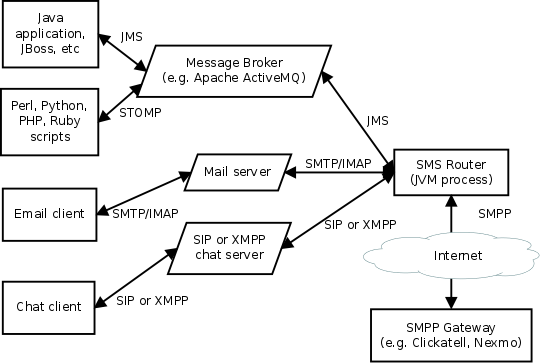
There is increasing demand for SMS notifications about monitoring alerts, trading notifications, flight delays and other events. Various companies are offering SMS transmission services to meet this demand and many of them aggressively pushing their own proprietary interfaces to the SMS world rather than using the more open and widely supported SMPP. There is good reason for this: if users write lots of of scripts to access the REST API of an SMS service, the users won't be able to change their service provider without having to change all their code. Well, that is good if you are an SMPP vendor but not if you are their customer. If an SMS gateway company goes out of business or has a system meltdown, the customers linked to their REST API will have a much bigger effort to migrate to a new provider than those using SMPP. The HTTP REST APIs offered by many vendors hide some details of the SMS protocol and payload. At first glance, this may feel easier. In fact, this leads to unpredictable results when delivering messages to users in different countries and different character sets/languages. It is better to start with SMPP from the beginning and avoid discovering those pitfalls later. The SMS Router free/open source software project helps overcome the SMPP learning curve by using APIs you are already familiar with. More troublesome for large organizations, some of the REST APIs offered by SMS gateways want to make callbacks to your own servers: this means your servers need public IP addresses accessible from the Internet. In some organizations that can take months to organize. SMPP works over one or more outgoing TCP connections initiated from your own server(s) and doesn't require any callback connections from the SMPP gateway. SMS Router lets SMS users have the best of both worlds: the flexibility of linking to any provider who supports SMPP and the convenience of putting messages into the system using any of the transports supported by an Apache Camel component. Popular examples include camel-jms (JMS) for Java and J2EE users, STOMP for scripting languages, camel-mail (SMTP and IMAP) for email integration and camel-sip (SIP) or camel-xmpp (XMPP) for chat/instant messaging systems. If you really want to, you can also create your own in-house HTTP REST API too using camel-restlet for internal applications. In all these cases, SMS Router always uses standard SMPP to reach any gateway of your choice. Architecture overview SMS Router is based on Apache Camel. Multiple instances can be operated in parallel for clustering, load balancing and high availability. It can be monitored using JMX solutions such as JMXetric. The SMPP support is based on the camel-smpp component which is in turn based on the jSMPP library, which comprehensively implements the SMPP protocol in Java. camel-smpp can be used with minimal configuration but for those who want to, many SMPP features can be tweaked on a per-message basis using various headers. The SMPP gateway settings can be configured and changed at will using the sms-router.properties file. The process doesn't require any other files or databases at runtime. The SMS Router is ready-to-run with one queue for sending messages and another queue for incoming messages. The routing logic can be customized by editing the RouteBuilder class to use other Camel components or any of Camel's wide range of functions for inspecting, modifying and routing messages. For example, you can extend it to failover to multiple SMPP gateways using Camel's load-balancer pattern. SMS Router based projects are already used successfully in production, for example, the user registration mechanism for the Lumicall secure VoIP app for Android. Getting started See the README for instructions. Feel free to ask questions about this project on the Camel users mailing list. Disclaimer SMS is not considered secure, the SMS Router developers and telecommunications industry experts discourage the use of this technology for two-factor authentication. Please see the longer disclaimer in the README file and my earlier blog about SMS logins: an illusion of security. The bottom line: if your application is important enough to need two-factor authentication, do it correctly using smart cards or tokens. There are many popular free software projects based on these full cryptographic solutions, for example, the oath-toolkit and dynalogin.

Mike Gabriel: [Arctica Project] Release of nx-libs (version 3.5.99.0)

Introduction NX is a software suite which implements very efficient compression of the X11 protocol. This increases performance when using X applications over a network, especially a slow one. NX (v3) has been originally developed by NoMachine and has been Free Software ever since. Since NoMachine obsoleted NX (v3) some time back in 2013/2014, the maintenance has been continued by a versatile group of developers. The work on NX (v3) is being continued under the project name "nx-libs". History Until January 2015, nx-libs was more mainly a redistribution approach of the original NX (v3) software. We (we as in mainly a group of X2Go developers) kept changes applied to the original NoMachine sources as minimal as possible. We also kept the original files and folders structure. Patches had been maintained via the quilt utility on top of a Git repository, the patches had always been kept separate. That was the 3.5.0.x series of nx-libs. In January 2015, the characteristics of nx-libs as maintained by the X2Go project between 2011 and 2015 changed. A decision was reached: This effort is now about to be released as "nx-libs 3.6.0.0". Contributors Since 2011, the nx-libs code base has to a great extent been maintained in the context of the X2Go Project [1]. Qindel Group joining in... In 2014, developers from the Qindel Group [2] joined the nx-libs maintenance. They found X2Go's work on nx-libs and suggested joining forces as best as possible on hacking nx-libs. The Arctica Project comming up... Starting in January 2015, the development on the 3.6.x branch of the project was moved into a new project called the Arctica Project [3]. Development Funding by Qindel In September 2015, a funding project was set up at Qindel. Since then, the Qindel group greatly supports the development of nx-libs 3.6.x monetarily and with provided man power. The funding project officially is a cooperation between Qindel and DAS-NETZWERKTEAM (business run by Mike Gabriel, long term maintainer of nx-libs). The funding is split into two subprojects and lasts until August 2017: The current nx-libs development effort is coordinated in the context of the Arctica Project (by Mike Gabriel), with use cases in Arctica, X2Go and TheQVD (VDI product worked on at Qindel) in mind. People involved There are various people involved in nx-libs 3.6.x maintenance and development, some of them shall be explicitly named here (in alphabetical order of surnames): Some other people have contributed, but have left the project already. Thanks for your work on nx-libs: A big thanks to everyone involved!!! Special thanks go to Stefan Baur for employing Mihai Moldovan and handling all the bureaucracy, so that Mihai can work on this project and get funded for his work. Achievements of nx-libs 3.5.99.0 We are very close to our self-defined release goal 3.6.0. The below tasks have already been (+/-) completed for version 3.5.99.0: In a previous blog post [4], the code reduction in nx-libs has already been discussed. With this announcement, we want to give a status update about our effort of shrinking the nx-libs code base:
    [mike@minobo nx-libs (3.6.x)]$ cloc --match-f '.*\.(c cpp h)' .
        1896 text files.
        1896 unique files.                                          
        7430 files ignored.
    http://cloc.sourceforge.net v 1.60  T=5.88 s (307.3 files/s, 143310.5 lines/s)
    -------------------------------------------------------------------------------
    Language                     files          blank        comment           code
    -------------------------------------------------------------------------------
    C                              958          68574          74891         419638
    C/C++ Header                   730          25683          33957         130418
    C++                            120          17007          11721          61292
    -------------------------------------------------------------------------------
    SUM:                          1808         111264         120569         611348
    -------------------------------------------------------------------------------
The previous statistics had these sums in the last line. First the nx-libs 3.5.0.x code tree (where we came from):
    -------------------------------------------------------------------------------
    SUM:                          5614         329279         382337        1757743
    -------------------------------------------------------------------------------
Then the nx-libs 3.6.x status as it was on May 9th 2016:
    -------------------------------------------------------------------------------
    SUM:                          1922         118581         126783         662635
    -------------------------------------------------------------------------------
Another 50.000 lines of code have been removed over the past two months. Work pending for the final 3.6.0 release goal Known Issues There are several open issues on the nx-libs Github project space, see https://github.com/ArcticaProject/nx-libs/issues. Testing the nx-libs 3.5.99.0 We are currently working on provisioning release builds and nightly builds of nx-libs for various recent Linux distributions. Please stay tuned and watch Mike Gabriel's blog [5]. We already have nightly builds of nx-libs for Debian and Ubuntu [6], but there are more to come soon. Until now, please use the build recipes provided in the README.md file of the nx-libs source tree [7]. References

Next.

Previous.