Search Results: "bod"

13 July 2008

Matthew Garrett: My trip to Istanbul by Matthew Garrett aged 28 and 4/365ths

Saturday

Arrive at Heathrow. Richard gets to be my special lounge buddy - we later discover Bastien sitting outside looking like a lost puppy. Flight is delayed by a mere hour, so we get to the hotel with little trouble and check in. Dinner with Luis and co on pillows on the street. This becomes a recurring theme. Drinking is involved. This also becomes a recurring theme. People complain about my shortcut finding skills.

Sunday

See beautiful things. Thankful to finally get to see buildings older than my old college. Dinner under some bridge with Red Hat folks where we discover the joys of the "special price". People once more complain about my shortcut finding skills. Suspect pillows are involved, but hazy recollections.

Monday

Arrive at the university by taxi. More to the point, arrive at the university by taxi without taking a 30km detour. Dinner with Canonical people, then a party in some overpriced bar on the top of a very big hill. Discover that taxi drivers in Istanbul either have no fucking clue where anything in the entire world is, or that driving tourists to bizarre locations is a national pastime. Avoid this fate and arrive home at something like 4AM.

Tuesday

Corporate whoring continues with dinner with Collabora people (delayed by two and a half hours because Christian values getting sweaty with other men over eating, or something), followed by more drinks on the pillows. Am vindicated when it turns out that my route back to the hotel would in fact be the shortest possible route back if people didn't keep insisting on making random left turns when we're almost there.

Wednesday

Fascinating (and increasingly drunken) discussion of the neurobiological aspects of colour spaces with Pippin precedes drinks on the roof of the university. Narrowly prevent Luis' attempt to leave the foundation open to flagrant copyright violation suits. More pillows.

Thursday

Wake up with a twisted ankle and a broken laptop. I had a good birthday, it seems. Collabora host a party on a boat. Miraculously, nobody falls off the boat. We head back to the pillows while others trudge up the hill to Taksim. Aaron wins the inaugural Aaron Bockover award for services to the GNOME community.

Friday

Dinner with Novell, demonstrating my even-handedness when it comes to accepting corporate favours. Miguel reveals his true nature as a Microsoft shill by admitting to owning an XBox. I advise him to raise his free software credentials by getting a Freerunner - as a bonus it'll crash whenever anyone tries to call him, preventing Microsoft from whispering more sweet nothings in his ear. A foolproof plan. Party paid for by Google. Ear bleedingly loud. Some drinking involved. Return to bizarro deviant pillows where we are treated to the spectacle of child labour. Spend some time wondering why Planet Fedora is discussing upskirt photos and decide that hating the entire human race is probably the best option.

Saturday

Turns out that while the Grand Bazaar is effectively just a shopping centre, it's a fucking giant shopping centre that sells nothing I can find any excuse to want. Wander over to Asia for dinner. Conversation with Lennart about using cgroups as a mechanism for providing application latency requirements and how the current lack of standardisation of mountpoints and exposure of irritating implementation details makes it almost impossible to use them for anything. Fascinating diversion into how to deal with getting a SIGBUS when your mmap()ed soundcard gets hotswapped, including deciding that the easiest way of getting a reliable indication of your current process maps is by, erm, parsing /proc/self/maps. Final pillows trip. Emotional farewells (by which I mean more drinking)

Sunday

Airport. Plane. Train. Home. Transfer hard drive into laptop with working screen. Discover that productivity not actually enhanced by having more than a 300x200 pixel area of functionality. Decide to write libelous article about previous week instead.

8 July 2008

Jeff Bailey: Body updates

Angie spent ages trying to convince me that muscle pain was good - that the hurt that comes from actually exercising is a good thing.

I think it's taken me undergoing a live dissection to actually have a clue what she was talking about.

Some recent firsts:
* I've lifted Leif a couple of times to keep him from climbing up and over the child gate. I'm allowed to lift him in emergencies. I didn't need to crawl away and cuddle my Oxycodone after.

* I didn't take extra Tramadol in the morning this past weekend in order to cope with playing with him. This would've been a bright move had it been a 2 day weekend. As it was, I did wind up pulling a muscle near the end of the third day.

* I biked home today for the first time in 7 months.

I still haven't kicked the last pain killer in the evening. Every time I get brave enough to try it again, I up my activity level instead. So, keeping to a full dose this week. Maybe cutting to a half dose next week. There's travel coming up, and I want to make sure I don't screw myself for that.

6 July 2008

Christian Perrier: Acronyms

It's never too late. Today, I finally figured out that "TIA", which I see here and there in mails, is meaning "Thanks in advance". After about 20 years of electronic communication, it was about time. This is a great time for this as I recently figured out "IANAL" and "TTBOMK". Always learning, finally. Time for me to use these now. I think I'll use their French version (which nobody uses) to make this as cryptic as those acronyms were for me:

Martín Ferrari: How to organise DebConf and remain sane

Forget it, there's no fucking way in hell to accomplish that. The last 6 months of my life had been turned upside-down, it's too much work, too much pressure... My performance at the University (which was never too good) degraded, sometimes I took too much time from my paid work, not to mention the abandon of almost all my other Debian duties. That is enough to drive you nuts, but there's more: a couple of event at my jobs resulted in lots of overwork around March-April and even more in the last month... Sum all this up, and you find that the only way to keep doing things is to rob precious sleeping hours: to finish pending work, to prepare the exams, and from time to time to have a little fun. The result is a grumpy mood, a aching back, and a tendency to get into arguments easily. My apologies to all the people that I mistreated, specially Marga, who's in a similar state of madness. So I really hope that DC8 turn out to be a great conference, and that everybody will have a good time. So all this would be justified. Tags: Planet Debian, Planet Lugfi

Mike Hommey: webkit 1.0.1 in unstable

There has finally been an official webkit release for the Gtk+ port, and I finally took the necessary time to package it. As you can guess from the screenshot above, it now has plugins support. It is also ber fast. You can compare with previous results for both gecko and webkit.

3 July 2008

Antti-Juhani Kaijanaho: SF encyclopedic wiki?

I sometime wish I had access to an encyclopedia, written in wiki style so that it could be updated by anybody, that had an article about every SF story and novel ever written, and every fictional concept (like ansible, hyperspace etc) ever used in an SF story, and which crosslinked these in a useful manner. Often, once I’ve had a worldbuilding idea, I want to go read some of the key stories that use the same or a similar idea, so that I could see what others have already done with the idea. Only it turns out there are no indexes that tell me “antigravity has been used in these ways in SF stories, and it is a central concept in these stories” etc. Anybody know of something like this?

Craig Sanders: Introduction to Linux Signals 101

or ^C doesn’t kill processes, SIGINT does On the LUV mailing list recently, the perils of tty handling when booting with “init=/bin/bash” came up, and somebody asked why running ‘ping’ (without remembering to run stty or openvt first) will result in you having to reboot. i.e. “why doesn’t ^C work in emergency mode”? I wrote a fairly detailed, but comprehensible to a novice, answer and a friend suggested i should have written it as a blog post - which was the point of me setting up a blog in the first place. So here’s a slightly edited version of it: > Couldn’t you just open another console, run “top” and find the PID for
> ping and kill it? Or ps aux grep ping and kill it? Is a reboot the
> only way to kill a ping where ^C is not available? there’s nothing special about ^C except that by long convention it is mapped to the interrupt signal aka intr aka SIGINT. So, ^C itself doesn’t kill a program, the fact that it generates an interrupt signal does. If you’ve rebooted for emergency maintenance (e.g. “init=/bin/bash” on the LILO or GRUB command line) then all you get is ONE instance of /bin/bash. Nothing else is running and nothing else has been run (because you’ve overriden the usual init with /bin/bash). No setup has been done on the terminal, and no other virtual terminals have been opened. The emergency environment is minimal (and deliberately so - you asked for it, you got it). It’s up to you to do whatever is needed to set up the environment so that you can do the required maintenance/repair work. So if you run ping *before* remembering to set up the terminal (’stty sane’) then ^C doesn’t work because ^C doesn’t generate SIGINT so there’s no way of telling ping to quit, and if you haven’t opened another virtual terminal with openvt (aka “open” - it got renamed some time ago) then there is no other shell available to run top or ps or kill. BTW, it’s not just ping. You’ll see the same problem in the same environment with ANY program that runs continuously until it gets a signal to terminate it. ping’s just the most obvious and common example. Most programs, especially simple programs like ping, don’t have a ^C handler. They don’t need one. They have a signal handler which, amongst other things, handles SIGINT however it’s generated - it can be generated by pressing ^C in a normal tty environment, or by sending the program a SIGINT (e.g. “kill -2″). That, BTW, is a core difference between a SIGTERM (just plain ‘kill’ or ‘kill -15′) and SIGKILL (’kill -9′). SIGTERM is usually handled by the program by setting up a signal handler for it, and it voluntarily terminates when it receives the signal (usually cleaning up, closing files, etc before it does so). If the program hasn’t set up a handler for SIGTERM then the default action is to just terminate. A program can set up a handler which does nothing on SIGTERM, which effectively just ignores the signal. SIGKILL is handled by the kernel and it just kills the process immediately - it can not be blocked or intercepted by the program. (By common convention, SIGHUP or ‘kill -1′ tells a long running daemon process to just reload it’s config files. It’s also generated when the tty that the program is running on is terminated - e.g. you log out or the modem hangs up or the ssh session dies, hence the name “HUP” aka “HANGUP”. That’s why you need to use something like nohup or screen if you want a program to continue running after you log out) In a way, ‘kill’ is a bit of a misnomer. It’s actually a generic tool for sending signals to running processes, but the default action for most of those signals is to terminate the program. Here’s a list of the signals which can be sent.
$ kill -l
 1) SIGHUP	 2) SIGINT	 3) SIGQUIT	 4) SIGILL
 5) SIGTRAP	 6) SIGABRT	 7) SIGBUS	 8) SIGFPE
 9) SIGKILL	10) SIGUSR1	11) SIGSEGV	12) SIGUSR2
13) SIGPIPE	14) SIGALRM	15) SIGTERM	16) SIGSTKFLT
17) SIGCHLD	18) SIGCONT	19) SIGSTOP	20) SIGTSTP
21) SIGTTIN	22) SIGTTOU	23) SIGURG	24) SIGXCPU
25) SIGXFSZ	26) SIGVTALRM	27) SIGPROF	28) SIGWINCH
29) SIGIO	30) SIGPWR	31) SIGSYS	34) SIGRTMIN
35) SIGRTMIN+1	36) SIGRTMIN+2	37) SIGRTMIN+3	38) SIGRTMIN+4
39) SIGRTMIN+5	40) SIGRTMIN+6	41) SIGRTMIN+7	42) SIGRTMIN+8
43) SIGRTMIN+9	44) SIGRTMIN+10	45) SIGRTMIN+11	46) SIGRTMIN+12
47) SIGRTMIN+13	48) SIGRTMIN+14	49) SIGRTMIN+15	50) SIGRTMAX-14
51) SIGRTMAX-13	52) SIGRTMAX-12	53) SIGRTMAX-11	54) SIGRTMAX-10
55) SIGRTMAX-9	56) SIGRTMAX-8	57) SIGRTMAX-7	58) SIGRTMAX-6
59) SIGRTMAX-5	60) SIGRTMAX-4	61) SIGRTMAX-3	62) SIGRTMAX-2
63) SIGRTMAX-1	64) SIGRTMAX
See the man pages for init(8), kill(1), and especially signal(7) for more info on this topic. Syndicated from Craig Sanders' Errata: Tech Notes and Miscellaneous Thoughts Introduction to Linux Signals 101

1 July 2008

Neil Williams: Right of reply??

Problems with hmrc.gov.uk - the new non-PDF format of the tax return is a complete mess and very misleading. I wanted a PDF so that I could compare the generated return with an actual return from previous years, so I sent this feedback:

"The Help and FAQ claim that a colour PDF is available and I'm
assuming that the PDF will be a closer match to the paper based form
which I need to be able to compare this return against last year. The
option to obtain a PDF has disappeared. (I am able to process PDF
without needing any software from Adobe as that is the main point of a
Portable Document Format so if this is because the site is checking for
Adobe software on my computer, it should stop doing so and simply
provide a link to the PDF file.) "

The response shows that nobody actually reads the comment:

"Thank you for your online enquiry.

To print your return in PDF format you are required to have Adobe Acrobat Reader 4.0 or above. If you do not have this on your computer please logon http://www.adobe.com/products/acrobat/readstep.html to download a copy. Please be aware that this download can take a long time."

i.e. Her Majesty's Government requires that you allow them to interrogate your computer to find a specific executable file or registry ID and if this is not found, certain services will be refused to you without further comment.

Instead of just generating the PDF on the server and providing a link to it.

The worst part is, the "secure gateway" used by HMRC doesn't even allow replies!

The only option is delete!!

More bias from government departments against free software. I refuse to use anything under an Adobe licence when there are perfectly capable PDF clients available under a free licence. (Let alone the discriminatory download licence). (I'm a British national but I still object to a licence that would prevent someone with dual British-Iraqi nationality, for example, obtaining a service from HMRC.) Besides which, I somehow doubt that the site would be able to correctly identify the Unix version of Adobe Acrobat Reader.

I receive notification of all my taxable income via PDF so why is the taxman different??

30 June 2008

Marc 'Zugschlus' Haber: Serial Console Server for the Poor III

This is the third installment of my article about the Serial Console Server for the Poor. First installment here, Second installment here. The first part of the article having covered the hardware and the udev part creating the device nodes, and the second part explaining how to solve the software part using ser2net, this part explains why ser2net was ditched in favor of cereal and how the console server operates with cereal now. Cereal (which I was pointed to on IRC as a reaction to article II) is a nifty combination of runit’s runsv and screen. One of the less-known features of screen is that screen can also connect to a serial port instead of a “real” console. cereal makes use of this feature, putting up with the fact that screen can only set a baud rate. I have not seen a serial application with other parameters than 8n1 (8 data bits, no parity, 1 stop bit) in a decade, so I cannot comment whether this is a real disadvantage. I guess that it might be possible to set the serial port to the desired set of parameters before starting up screen, but I didn’t actually try it since I do not need it. Cereal uses a set of configuration parameters and processes called a “session” to associate a serial port with a baud rate and a set of user/group settings to control who is able to start, stop, attach or detach a session. It doesn’t have a “real” configuration file. Instead, it has an admin program, cereal_admin, which takes the parameters associated with a session and writes them to an (intentionally? undocumented?) set of config files in /var/lib/cereal. Only a single user is able to attach to a session read/write, while an entire group can attach to a session read-only and can thus access the logs. A session is automatically started when the sysem boots and can be stopped and started using cereal_admin as well. Once a session is running, a specially configured screen process runs attached to the serial port, and users simply attach and detach to and from it as one would to a normally running screen. That way, one can scroll back and examine what was shown on the serial port while nobody was attached. This is quite handy when the device connected to the port prints out warnings, errors and status information to its serial port. The screen configuration that is used is rather sophisticated. So, a permanent log file is written, which is also used for read-only access to the serial session. Also, a very informative status line is configured. Unfortunately, one of screen’s biggest disadvantages applies here as well: User X cannot attach to a session started by User Y unless Y has access privileges for X’s pty (or vice versa, I never can remember), which can be a security risk. Additionally, it is not possible to su or sudo to X and then to attach to the session - one needs to have the original pty opened by the correct user, which usually means that one needs to do a “real” log in with the correct account (via /bin/login or sshing in to the box). If one has the privileges necessary, one can use the cereal executeable to attach to the screen (which gives read-write access) or to tail -F the log file (giving timestamped read-only access). That way, one never knows that one is actually working with an appropriately configured screen that is kept running by runit. The restrictions coming with cereal suggest a setup similiar to what I did with ser2net previously: Each session has its own user account, which forces an attach to the appropriately named cereal shell on login:
my-device-name:x:1801:1801:my-device-name,,,:/home/my-device-name:/usr/local/sbin/cerealshell
$ cat /usr/local/sbin/cerealshell
#!/bin/bash
set -eu
cereal attach $(id --user --name)
$
You can see that I decided to name the sessions after the actual device name, allowing the unterlying ttyUSB device name to change without change in the user interface. The actual users and sessions were created with a small shell script:
#!/bin/bash
createconsole()  
  NAME=“$1”
  PORT=“$2”
  BAUD=“$3”
  MUID=“$ PORT/USBserial/180 ”
  echo sudo addgroup --force-badname --gid $MUID $NAME
  echo sudo adduser --force-badname --gecos “$NAME,,,” --ingroup $NAME --uid $MUID --disabled-password
$NAME
  echo sudo adduser $NAME dialout
  echo sudo mkdir -p /home/$NAME/.ssh
  echo sudo chmod 755 /home/$NAME/.ssh
  echo sudo touch /home/$NAME/.ssh/authorized_keys
  echo sudo chmod 644 /home/$NAME/.ssh/authorized_keys
  echo sudo chown $NAME:$NAME /home/$NAME/.ssh /home/$NAME/.ssh/authorized_keys
  echo sudo cereal-admin create $1 /dev/$2 $3 $1 $1
  echo sleep 2
    echo sudo cereal-admin start $1
  echo echo -----
 
createconsole my-device-1 USBserial1 9600
createconsole my-device-2 USBserial3 115200
Note that the script also uses a hardcoded UID range which might need adaption to your local needs (and breaks for more than ten serial ports), and that it also takes care of creating an empty authorized_keys file with correct permissions. That way one can simply ssh to my-devlce-1@consoleserver and find oneself immediately connected to the serial console, seeing the last things that happened on the serial port, and immediately being able to work with the device. That’s fine, comfortable and useable. I actually like that better than what I built with ser2net previously.

Matthew Garrett

If airlines were like software, then nobody would ever fly because they'd be put off by the fact that everyone who did ended up as a small pile of charcoal.

CAN HAS WORKING INTERWUB AND WEB BROWSER AND PACKAGING SYSTEM?

NOT FOR ME :(

28 June 2008

John Goerzen: A response to "7 Ways Religion is Detrimental to Science"

I read 7 Ways Religion is Detrimental to Science, and thought it would be an interesting read. It was, but I don't think it really made sense. Let's look at the 7 ways they highlighted:

1. Faith and the Scientific Method are Opposites

The article states:

Faith is a belief in an idea regardless of the evidence for or against it.


Actually, that's not true at all, at least for traditional Christianity. (Note that traditional Christianity is not the same as fundamentalism). Marcus J. Borg describes faith in four ways:

Fiducia -- trusting in God. Borg says, "Faith . . . [means] we trust in God as the one upon whom we rely, as our support and foundation and ground, as our safe place."

Fidelitas -- loyalty, or "the comment of the self at its deepest level, the commitment of the 'heart'. Faith as fidelitas does not mean faithfulness to statements about God. . . Fidelitas refers to a radical centering in God."

Visio -- a way of seeing -- "a way of seeing the whole, a way of seeing 'what is'. . . the ability to love and to be present to the moment. It generates a 'willingness to spend and be spent' for the sake of a vision that goes beyond ourselves."

Assensus -- perhaps the closest to what the author meant, is "faith as belief." Borg goes on to add:

The notion that Christian faith is primarily . . . about belief, about a "head" matter, is recent. . . For many, Christian faith began to mean believing questionable things to be true. . . this is the most widespread contemporary understanding of "belief".

This is very different from what faith as assensus meant. . . A deep but humble (and therefore imprecise) understanding of Christian faith as assensus, as involving affirmation of the centrality of God as known in the Bible and Jesus, is very close to faith as vision. It is a way of seeing reality.


As a Christian, I do not find the scientific method to be a problem. I find it to be enlightening in all sorts of matters, including even the history of religion in some instances. Christian faith is not about believing in certain ideas (such as the world being created in 6 literal 24-hour days), though there are those that distort it to be so. Rather, Christian faith is about living your life a certain way, about the meaning of life, about our duties to make the world a better place.

2. People Vote Base on Religious Ideas

The author says that "Stem Cells weren t the first time a body of research didn t get proper funding because some religious wack-jobs." Well, I agree that that was a problem. Non-religious people can vote in odd ways too. I argue that the rejection of stem-cell research goes against Christian teaching; after all, we are to help the least among us, and do not people with Alzheimer's qualify?

I think the author's point should have been "exremists have odd views." Extremists can be atheist, Christian, Muslim, Buddhist, or other religions. Religion does not have a monopoly on them.

3. Religion Removes the Need For Science

The author says:

When people are content to believe in something that explains why they are here, even if it is wrong, they become less interested in other ideas. Religion often leads people to believe that they have all the answers. Science is self-correcting in that nobody assumes they are absolutely correct.


That is incorrect on several levels. First, science cannot explain why we are here. It can explain some of the mechanics. As an example, let us take for granted that modern scientific thought on the origin of humanity is correct: that there was a Big Bang, that single-celled creatures evolved on earth, and that human life eventually evolved through a complex process of evolution and natural selection. Fine; this does not contradict religion in any way. Science and religion answer different questions. Science answers "how". Religion answers "why". Science cannot answer the question "Why was there a big bang?" or "Did the evolution of humanity serve a larger purpose?"

Moreover, religion should not assume that they have all the answers, either. The canonical Christian Bible was mostly fixed within a few centuries AD. Life in 200AD was a lot different from life today. Part of the reason there are many different groups of Christians is the complexity of applying the stories in the Bible to modern life. The ideas in any given denomination evolve over time, too. I think it would be the height of hubris for anyone, religious or not, to claim that he or she had all the answers. Again, I know that some religious people act that way, but then so do some atheists or agnostics.

4. People Lean on Religion, When They Could Benefit From Science

The author of "7 Ways" cites the quite rare case where a child dies of a curable disease while his/her parents pray, refusing medical care. This is an extreme position that is not shared by the vast majority of religious people. Most religious people are perfectly content to use the latest medical care.

Meditation or prayer does not replace medical care; it supplements it. Scientific studies have even demonstrated its effectiveness.

5. The Church Takes Up Natural Resources

The original author states that "The land that churches take up around the world could be used to build schools, homes, recreational buildings and commercial operations." This is perhaps the most frivolous of arguments. Putting aside the fact that many churches operate schools, churches are often one of the few ways that modern city dwellers have to form a sense of community. They are not just places to engage in religion. They are places to meditate, to get away from it all, to meet your neighbors, to vote.

6. The Church Takes Up Monetary Resources

The original author says "if people donated to scientific advancement like they did to the church, imagine where we would be today." It's not a pleasant picture. Religion, and institutions supported primarily because of the teaching of religion, are the people that feed the hungry after natural disasters, that operate food pantries (our church operates the only one in our community, and it's open to anyone without any questions or talk about religion), that operate schools in disadvantaged areas, that have spread the whole idea of fair trade for third-world artisans, etc.

It is true that acts of evil have been committed in the name of the church, too. It is also unquestionably true that some church groups spend money more carefully than others. As with any donation, people should be careful where they give. Government-operated research studies are not necessarily a good use of money, either.

7. Religion is A Strong Meme

The author of the original story seems to be responding to a particular brand of Christianity: what Borg calls "literal-factual" religion. There are quite a few people that take that stand. They are sometimes inaccurately referred to as "evangelicals" or the "religious right"; while there is some overlap between the groups, they are not one and the same. The people with the literal-factual view are not representative of the whole.

More interestingly, Borg points out that the literal-factual view was actually a response to the development of the scientific method during the Enlightenment. As the modern idea of truth moved to literal, factual, provable truth, some Christians grew defensive about their faith, and started to look for "scientific" ways to prove that the world was created in 6 days, etc. in an attempt to show the world that Christianity fit their new notion of truth.

That makes a compelling argument that the scientific method is the stronger meme in today's Western world -- so strong that the author of the rant against religion has apparently forgotten the more prevalant -- both throughout history and today -- view of Christianity that is "more than" Science, not at odds with science.

Martin F. Krafft: Shortcomings of the Nokia E51

I put the Nokia E51, which I had previously acquired, onto Ebay last night, and it sold within minutes. Even though I made a 50 loss on the whole affair, this made me very happy! The phone is crap in so many ways that it made me quite angry. I now consider those 50 the investment I had to make to bring you this post: First of all, the reason why I bought the phone was because it sports wireless LAN as well as Voice-over-IP. Since I ve recently gotten into VoIP, I was looking for reasonable VoIP phones and even though the Siemens C450IP DECT phone works very well, it only does so at home, or where I find a switch port for it. So my theory was to get this Wifi+VoIP phone and be able to use my VoIP infrastructure from anywhere around the world. Penny has the Nokia E65 and loves it, so I went for the E51, a newer model that promised to address some of the issues she had with hers. All of the following is based on the E51 with the 100.34.20 firmware dated 29 September 2007, which runs the (crippled) Symbian S60r3 operating system.

Good things Let s start with the few good things up front: the E51 comes with a regular USB jack, allowing you to plug it into any computer and use it as mass storage device without the need for any Nokia-specific cables. I also liked the remote lock functionality: in the event of a stolen phone, you could send it a pre-defined passphrase that would cause the phone to lock itself. Also, the phone could be configured to lock itself (like a screensaver) after a given amount of idle time. Other than that, I could not find anything outstanding, so let s turn to the downsides, of which there are many more:

VoIP/SIP shortcomings I had previously dismissed the E series phones for good reasons, but both the E65 and the E51 improved their SIP clients a fair bit, and with the SIP VoIP settings utility, it was even possible to configure STUN. But unfortunately, the SIP client, while a nice toy, ended up being unusable in production. Here are some of the reasons: I got VoIP working at home and in some other places, but definitely not everywhere. It may be that some of those networks blocked the SIP port (5060/udp), or that the phone didn t feel well on the day, but in the majority of cases, I could not get the SIP client to connect. And there was no way to find out what was going on, as the client would just claim that registration failed without any additional information. It was also hard to retry, often requiring the phone to be restarted. Whenever if failed, the client would helpfully tell me that it could not establish a connection to the connection network . To get the phone to log on to the SIP server automatically, I had to define a home network for the SIP profile. Changing the access point for that network required a phone reboot to get SIP working again. It was possible to define multiple SIP profiles with different access points and add them all to the one, global VoIP profile, and theoretically get auto-login to work across multiple Wifi networks; unfortunately, I cannot say that this worked, there were always some problems requiring me to change defaults and shift things around. Also, after I had defined a few of those profiles and needed to make a change to the SIP settings (move the SIP port to 53/udp), I had to modify all profiles in turn; it was not possible to share settings. On the other hand, NAT traversal settings and timeouts, which can only be configured with the aforementioned SIP VoIP settings utility, applied to a VoIP profile and thus to all SIP profiles, without exception. I found it mildly annoying that I couldn t use # and * as part of the number/SIP address to call, nor was it possible to dial single-digit extensions the phone will ask you to associate a quick dial number with the key, even if quick dial has been explicitly disabled). I could also not dial a SIP address ad-hoc if I wanted to call sip:someone@sip.somewhere.org, I had to define a contact and add the Internet phone address. One can define Internet calls to be the default call type, thus routing all calls via VoIP if available. Unfortunately, once I dialed a number, the event was hardwired to the call type: I could not redial a number used previously for a VoIP call when all I had available was GSM coverage.

Gripes with the IMAP client The IMAP client, while an interesting addition to my day, turned out to be pretty unusable. The first mistake I made was to tell it to synchronise all messages in some of my larger mailboxes, which caused the phone to take tens of seconds until it switched a folder, and a few seconds just to scroll to the next screen in any given folder. I found that once any mailbox accumulates more than 100 messages, the client turns useless (Nokia s default is to synchronise 30 messages). I could tell the client to synchronise every hour, but only if I locked it to an access point, the home network . If I roamed to a different Wifi network, I could no longer connect to the IMAP server, as this access point would not be found. The phone would not let me use a different access point unless I changed the home access point, but changing that turned off the automatic mail sycnhronisation. If I say mail synchronisation, I mean header synchronisation. Even though there is an option for Headers only , it only applies to POP3; it is impossible to have the phone download message bodies automatically, only manually and then only per-message or per-folder, not for all folders at once. The IMAP client could delete messages, but it could not move a message to a different folder, nor create or delete folders. And even though I could turn off the message tone the phone would play when it received new email, it insisted on vibrating nevertheless. The only other IMAP client I found for Symbian phones is ProfiMail, which looked interesting and much more powerful, but which would randomly crash on me while browsing or operating on larger mailboxes.

Connection hickups While the an application was running that was using the network, the Wifi connection stayed open, but I could not make it stay open between sessions. The phone would obtains an IP, do what I asked it to, and then immediately close the connection. From a power management perspective, this makes sense, but not from the usability angle. I could not make the phone connect to a Wifi network that advertised both, WPA and WPA2 and had to disable WPA at home to let it connect. At times, it was not possible to reuse an existing connection. I haven t been able to figure out the details, but it seemed to me that whenever an application like the IMAP client was locked to an access point, it would be unable to make a connection to the IMAP server, even if e.g. the VoIP client was connected to the server by way of exactly the same access point. The phone would just say that a connection was already active and that I should close it and try again . I had a really hard time working with SSL-enabled websites and IMAP servers, because even though the phone presented me with the server certificate and offered the choice of accepting it permanently, it didn t and would ask the question again and again (which made the phone pretty unusable if the IMAP client was running in the background). Only after I had found out how to import the CACert root certificates, did this problem become irrelevant.

Other pet-peeves The phone came with a lot of smaller issues that made me ask the question of whether its designed ever had to use it too often. Possibly the most annoying aspect of the phone was its speed. It s a lot faster than the E61, but it still takes on the order of seconds to update screens or display simple text messages. Speaking of text messages, I am a little spoiled by the Sony Ericsson K610i (to which I now return), which would offer the contacts with whom I d recently interacted instead of presenting me with the full list, like the E51 does. I could filter the full list, but only by typing the start of the name substring matching was not implemented. It was impossible to receive text files via bluetooth and have them put onto the filesystem. On receipt, the phone just said text file saved , and it took me a while to figure out that it had stored them into the notepad, from where it could not be exported. To get my SSH identity onto the filesystem for PuTTY to use required me to access the phone via USB. The phone could receive vCards with new contacts, but it only offered to import the first contact, even though the standard allows for an arbitrary number of contacts per file. What s even worse though is that the phone silently failed to import contacts with non-ASCII characters in their name, such as or they just didn t show up even though the phone gave every indication of a successful import; creating such contacts on the phone worked, on the other hand. Each time I started the phone, the Nokia greeting screen would show up, accompanied with the Nokia tune, which could not be disabled. Enough said. The last problem I feel worth mentioning is hardly a Nokia or Symbian problem: battery life. With Wifi turned on, the phone would last about 24 hours on standby, which makes it pretty unusable for roaming Wifi or even VoIP usage.

Summing up I am happy to have sold the phone and look forward to returning to my Sony Ericsson K610i. After checking out the E61/E71 a bit, playing with the E65, and trying the E51 out for several weeks, I can conclude that Nokia has a long way to go before they can offer a usable smartphone with Wifi/VoIP capability. It would be a good step forward if they would open-source the Symbian operating system, but until that s done, I am going to look at the OpenMoko FreeRunner next. The E51 once again made it perfectly clear for me that proprietary software is no alternative for my use case. NP: Fat Freddy s Drop: Live at the Matterhorn

27 June 2008

Wouter Verhelst: Passports...

Today, I went to the Ekeren district house[1] to get me a passport, in order to be able to fly to Argentina in about a month. As I was queueing at the desk, I realized that I'd forgotten some pictures of myself, so I left the queue, found the closest photo shop, and had them take some pictures of me. When I returned to the district house, gave them my new pictures and my identity card, with the request to furnish me a passport, the lady behind the desk told me that I apparently still had a passport. While no longer valid, I still need to hand that in before I can be given a new passport. Or, alternatively, I could go to the police office, tell them that I cannot find the passport anymore, and use the document they'd give me to get me a new passport. That, too, would work. So that's the option I decided to take. I quickly went to the police office, which is rather close to the district house; luckily nobody was queueing before me there. By the time I got back to the district house, it was about 14:50, while they close at 15:00. So I went ahead and started queueing again. Suddenly, I notice that my pictures were gone. For some reason, the idiots at the photo shop have deviced an "envelope" that does not hold the pictures -- they have three places where they can easily leave the "envelope". And that's exactly what had happened: no more pictures. So I ask the lady behind the desk whether she'd be willing to wait a few more minutes after their official closing time, so that I'd be able to go and look for them. She didn't mind. Unfortunately, I only found one picture. The other five were nowhere to be found... and with only one picture, the district office can't help me; they need two of them. So, now, I've not only lost an hour of my life, but I've also lost 8.00 for pictures that are now no longer useful to me. And I'll have to do all of this again, some time next week. Dammit. [1] although I don't live in Ekeren anymore, officially I do: the apartment where I live does not exist according to the Mechelen city administration. Before I can officially move there, the landlord needs to deal with that, which apparently involves quite some bureaucracy. For one thing, he needs 6—yes, six—copies of the building plans, along with a particular form with a particular number. Probably needs to jump through a number of hoops, too—I wouldn't be surprised.

Mike Hommey: Firefox and the untrusted SSL warning , even more to it

There seem to be some heat about the new Firefox feature that only allows you to open https urls with untrusted certificate after 5 clicks. The situation is actually worse than what is depicted. Why? Because not only did they put crap to their users, and actually, if they want to, that’s their problem, but they also imposed their crap on embedders. Yes, this means applications such as epiphany, kazehakase, galeon, and others *must* use this crap. I know, there is a browser.xul.error_pages.enabled to disable the error page (note it also disables standard network connection error messages). But, the alternative is not any better: It opens a dialog, with raw HTML in it, allowing to… do nothing. That’s it, you can only acknowledge you’ve been denied access to the so-called untrusted site. The best part is that these applications can’t (or maybe they can, but in several months nobody found how) make the exception dialog work properly: the user will have to enter, himself, the url to add the exception for. And before even reaching the state where you can get the dialog to open from the error page, or even get the buttons to be displayed in the error page itself, you have to add clutter to your application code. For those still wondering what happened to the Gecko platform or whatever you call it (xulrunner, libxul, mozilla-embed, etc.), here is your answer: Gecko evolves with what Firefox needs. If your application needs something else, well, too bad for you. Firefox developers obviously have a big problem taking embedders into consideration when they change the Gecko API, and while it can be fixed afterwards, it’s not a good thing to “tag” a Gecko milestone at the same time as a Firefox release under such conditions. Anyways, what I did in the xulrunner-1.9 package is to forward-port the old interfaces (nsIBadCertListener) allowing embedders to have their own UI for this. While it was certainly far from perfect (and displaying as many dialogs as different errors on a certificate is definitely not something nice), it is still better than something not working at all.

26 June 2008

Uwe Hermann: Configure Firefox/Iceweasel 3 to be more secure / usable / bearable

Today seems to be Firefox/Iceweasel 3 Bashing Day on Planet Debian, so let me join the fun :) I agree with most other people that the default Firefox/Iceweasel 3 config is not ideal, so here's what I did to fix it. Some of these items improve performance, some remove annoyances, some remove privacy issues, some remove security issues. Not everything here may be desirable for people other than me. General Preferences Select "Edit / Preferences". Main: Tabs: Content: Privacy: Security: Advanced:

25 June 2008

Gunnar Wolf: Firefox suckyness

I have to agree with Wouter regarding Firefox Iceweasel 3's suckyness. It might be a superior product in many fronts (I prefer it overall to its predecesor), but were it not for the usefulness of its many available extensions (most notably Web Developer, which has become an integral part of my everyday life), I'd have jumped ship for basically any other browser.
I'm just... adding an <AOL>ME TOO!</AOL> on Wouter's comments... WTF, just go to about:config...

So... Are you telling me that Firefox (even if it were the original, Mozilla-blessed version) has a warranty? No? Didn't think so... Go to about:license. You will see the very familiar and expected:
7. Disclaimer of warranty
Covered code is provided under this license on an "as is" basis, without warranty of any kind, either expressed or implied, including, without limitation, warranties that the covered code is free of defects (...)
Other than this downright stupid issue (which by and large goes against the regular Free Software culture), my main gripe is the number of active regions in the location-entry boxes - Yes, I can jump straight to the search box with Ctrl-K and to the location bar with Ctrl-L, but if I happen to try to move between them with good ol' Tab, why must it be inconsistent?
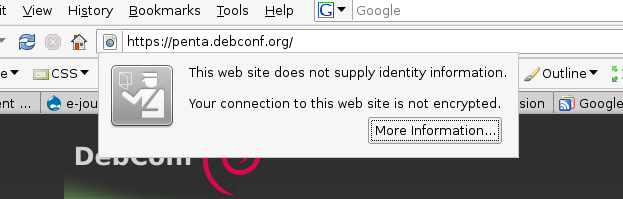
What do I mean? Go to the search field, press Tab. As expected, you are in the Location entry. Now, press Shift-Tab. For 5 points, where are you now? Bzzzt, no, you are not back where you began - You are in a stupid button which looks like your favicon giving you the identity information about the page you are looking at.
Having this button is a great idea - but why does it have to sit in the way of my tabulation? Were it because, in an inspired moment, the Firefox interface designers decided that buttons should be keyboard-accessible, I'd be most happy (it is by far my most mouse-intensive application, and I hate that... But it's just a button embedded in what should be a clean text-entry box.
And for that matter, it is not even a consistent button - Shift-tabbing from the search field will not get you to the search engine selector. And no key combination will lead you to the noisy (and also, mutually inconsistent) iconic buttons at the far right of both fields... Which, again, have no reason to be inside a text entry field!
Oh, and I found another pretty little jewel: Go to any site which has a self-signed SSL certificate. Of course, Firefox will go to great lengths to make sure you understand how unsafe is it for you to trust anybody who didn't pay big bucks to Verisign... But this is enough reason for me to send a bug report:

I am connecting through a crypted HTTPS connection. The site is providing identity information - not certified, right, but it does provide something. And the connection is crypted. Firefox/Iceweasel 2 showed me the URL in a light-yellow background showing the connection was secure - Now it just denies penta.debconf.org the right to call itself secure.
(Yes, I am not an interface designer... But it seems neither are they)
[update]Bug filed. Any comments will be welcome in Bugzilla. The bug with the Debconf site (and I do regard it as a bug) is that Iceweasel displays that Your connection to this web site is not encrypted because some of the elements (i.e. the CSS, images..) are sent in the clear - Even though the real information is crypted. Ever heard of data/visualization decoupling?

Clint Adams: Relaxation

I was misled. That much is probably true. I certainly had no idea what I was getting myself into. Enough of that though; there's narrative fading away. The part I should take responsibility for is the decision I made to stray off the map. Perhaps it was not so much a decision as a compulsion. I looked at the map. I saw the suspicious unmarked area at the edge, and concluded immediately that there was something good there, something the people wanted to keep hidden from me. I was correct, but I presumed far too much about the terrain. I thought I would make a quick exploration of the secret place, then backtrack to the more mapped area and get back with the program. Enough of that though; I've nearly forgotten the story. First I should point out that, had the map been to scale, it should have taken me an leisurely fifteen minutes to get to my first destination. It should have, assuming the land would be as flat as the map that represented it. Instead, it turned out to be something one could cover in fifteen minutes if one had, say, a jetpack and spring boots. I'm probably wrong; I'd probably injure myself in the process and take longer. Anyway, the average incline was close to 45 , and luckily was mostly uphill. Luckily. When I got to a resting place, I was able to conclude that my supply of fluids was almost certainly insufficient for me to continue. On the other hand, there was probably no way I would return if I went back for more drink. I told myself that there would likely be a beverage-selling shack out in the middle of nowhere around the next bend or so. Having solved this probability problem, I pressed on into the blazing sun. I came to a path leading down to the sea. It was unclear what was down there, but it was clear that it seemed to be a million miles down, and that that path might be the only way back. Given my current state of exhaustion and hydration, I decided to pass on this opportunity. After continuing for a while, the features at the bottom of that path became visible. A very pretty cove was down there, and almost certainly no shack o' drinks. I then came upon a fork. A wide path led downward: to what, I could not see. To its left, a narrow and rough path led straight. Knowing that a descent probably meant climbing four to eight times the altitude back somehow, and assuming the less pleasant-looking path led somewhere better, I went left. After a while, the land began to slope down, ever so slightly. Little clusters of bottles and newspapers were left on the rocks here and there. Then came a sofa under a tent. I began to wonder what hippies were traveling this path. The slope grew greater, and I passed a bench in a tent. Then I came to a giant staircase, almost straight down. It was covered in weeds and insects. Some were vegan, some wanted my flesh. As I got toward the bottom I thought about how glad I was that I had come that way from the top and not the other way around. Oh, I was very glad. At the bottom was something resembling a plastic bottle graveyard and barrels among barrels filled with water. Rubber hoses seemed to run randomly between certain barrels. A kitchen stood at the edge of some barrels. I suddenly got the feeling that I was not supposed to be here. After discovering that a couple of escape routes were actually dead ends, I proceeded to descend a small staircase to a terraced garden. Hoses lay about the rows, presumably for watering the plants. A cot under a tent lay empty, and I hurried past hoping I would not encounter the owner. Then I was at the ocean. The coast was lined with huge boulders, and a wooden bridge led me to the first one, and another wooden bridge took me to the second. Then the bridges stopped. In the distance, I could see that pretty little cove from before. I took stock. I could either return whence I came, up that horrifying staircase, or I could try to traverse the rocky coast over to the cove, then maybe do a faceplant on the beach and let the tide drown me rather than climbing back up. It seemed like a no-brainer, so I began making my way toward the cove. It got harder. Several times I became very afraid, either of falling and smashing my head against a rock or falling into the water below, or some sequential combination thereof. In the end I turned out to be more afraid of going back, at least until I got to what I judged the point of no return. I was reasonably close to where I imagined the sandy beach started, but there was a huge and impassable boulder in the way. Also, if I went further there was no way I would be able to climb back up in case I needed to retreat. I was thinking I would need to retreat, because unless there was some magical hidden toehold, I would be forced to jump into the water and swim around. I did not want to jump into the water. I wanted my phone to stay unfried in the event that I would need to use it to get rescued. I also did not want to call anyone to get rescued, especially since I didn't really know how to explain where I was. With a heavy sigh, I gave up, turned, and went back. This time I moved more quickly, though incurring more damage to my hands and feet. No humans were visible at the crazy farm/garden and makeshift reservoir, but plenty of bugs were visible on the staircase. I made the mistake of trying to lean against the railing to catch my breath. When I finally got to the bench in the tent, I understood exactly what it was for. I sat down, took a sip of my remaining water, ate an apple, and kept going up. When I got to the couch, I sat again. This time I sat and tried to figure out a plan. I still clung to the belief that once I got back to somewhere less wild I'd be able to buy a drink. I noted that I only had a little bit of water left, that I was dehydrated, that I was sunburned, that my pulse was about 180, and that there were no dogs or Russian people wandering past me. I ate a pear and drank my last few drops of water. I kept sitting until my pulse was down to around 150, then I figured I needed to keep moving. I was experiencing most of the effects of caffeine, and for free. Oddly, I passed a dog a few steps later. It was just standing by a rock, looking at me. I decided not to converse. When I had nearly reached the fork again, a couple came my way. I thought about begging them for water. I decided not to be rude. I have no idea what happened to them. I'm betting they wisely decided not to go down the steps. Resolving that the only sane option was to go back all the way to where I absolutely knew I could buy something potable, I headed in that direction. Still, I took two risks. Instead of going up the exact way I had come, or taking a well-travelled path down, I took a narrow and flat dirt path. It was actually a bit of a dilemma. I started down the latter two more than once each. Finally I saw that the down path was rather V shaped, and I concluded correctly that the straight path would bypass that angular-half-pipe-like construct. When I finally got to a point I recognized, it was smooth sailing the rest of the way down. I bought water and a snack, since I had had almost nothing to eat that day. At this point it would have been prudent to call it quits and go off and gorge myself on seafood or something, but no, I was now in the mapped area and surely it would all be roses and manna. Finishing one bottle, I bought two more. Five minutes later I bought another. I had now overcompensated, but I was playing it safe. I continued my explorations. Bicyclists kept nearly running into me, and, aside from the obvious, I viewed this as a good sign. Bicyclists, especially those that can't seem to steer straight for some reason, avoid difficult terrain. This is why they take their bikes on subways, trains, and buses. I don't like bike-riding, but if I had my druthers, I would always go downhill. No up, no flat, just down. Like downhill skiing, just down. It is a good thing I don't ride a bike. Once I got to the point where the bicycles thinned out to nonexistence, I was at an intersection. The way I wanted to go was up. The way I didn't want to go, but was a reasonable option, was only very slightly up. Additional factors complicated this decision point. [elision] This passage has been marked friends-only and you will not be able to view it without logging in. Moving hurriedly away from there, I headed upward. After a couple of turns, I ran into Catholics. First there were dead Catholics. Then there were Catholics pre-occupied with dead Catholics. Then there were Catholics waiting to die. Then there were seminarians. Then there were teens with prayer books. When I reached the next pinnacle, there were more teens with prayer books. There were benches, and there were no teens on them, for the teens were standing or sitting on the ground, quietly contemplating the Word. Unfortunately, they had decided that the benches were more suitable for holding all their bags, so there was nowhere for me to sit. I considered interrupting their reverie, but decided it wouldn't be very Christian of me to disturb them, so I just placed an ancient Drasnian curse on them and plodded down the hill toward a small beach. I really didn't need any more sun, but at least there probably wouldn't be anyone praying there. The water was tempting, but I'm always paranoid about my belongings when swimming alone, and if my phone were taken I wouldn't be able to call anybody to come rescue me at the next crisis point, sure to come. So I skirted the coastline and arrived at a much larger beach, one with facilities and services. Opting to save money but complicate things by using the public changing rooms and showers, I made a discovery. [elision] This passage has been marked friends-only and you will not be able to view it without logging in. Nonetheless, I changed into my swimming trunks, stuffed everything else but my towel, sunglasses, and a disgusting sugary drink I never should have bought into my bag, and went barefoot a few buildings down to rent a locker. The locker was ridiculously large for a single person, which is good to know should I ever want to kidnap a family and torture them at this place. The proprietor informed me that they were closing at some specific time, about an hour from then. I had no timekeeping device outside of the locker, so I had to wing it, and erring heavily on the side of caution, I had a short beach diversion. Given that large swathes of my epidermis were turning bright red, it's probably for the best. Handling the shower, locker, and changing in the other direction was slightly more complicated, but I did it and then I headed inland, figuring I should have a substantial meal for once that day. On my way to find dinner is when things got really crazy. [elision] This passage has been marked friends-only and you will not be able to view it without logging in. I wandered over to a bench to eat my newly-acquired snack, and did not exercise enough caution, because the flimsy paper bag ripped and I got sauce all over my pants and a little on my shirt. Unfortunately I had used my napkin in that earlier episode, and I'm not sure how much it would have helped anyway. Thus I continued on, looking like a slobby retard. Then I made an obviously-poor decision and ended up having a subpar dinner. What happened after that is a story for another time.

24 June 2008

William Pitcock: E-mail autoresponders suck. Please stop using them.

I find it particularly annoying, when I write a mail to a list, like say, the NANOG list, and get emails in reply like:
From: EMAIL ELIDED
To: William Pitcock <EMAIL ELIDED>
Subject: NAME ELIDED is out of the office.
Date: Tue, 24 Jun 2008 12:02:35 -0400 (11:02 CDT) I will be out of the office starting 06/23/2008 and will not return until 06/26/2008. If this matter is urgent please contact NAME ELIDED at XXX-XXX-XXXX or XXX-XXX-XXXX
This really sucks, for multiple reasons. Mostly, that: So please, for the good of all of the Internet, stop using autoresponders, because they are hideously lame. Or, at least, put something like AUTO-REPLY in your autoresponder so we can just delete the spam you insist on sending us. Thanks lazyweb.

Pablo Lorenzzoni: Ruby security advisory and fix

Debian 4.0 version of Ruby is open to the, now widely known, Ruby security vulnerabilities. The bug is reported as 487238 in Debian s BTS, and is closed, since the version now in sid (version 1.8.7.22-1) is already fixed. Users of stable can apply the patch provided by Daniel Franke (it doesn t seem to fix all, but goes a long way). Apparently, this brought up (again) the rants over full disclosure. Indeed, what is vulnerable is not that hard to find, as Zed Shaw showed us, so, why not talk about it in a plain and bold form? Why just provide the CVE numbers and ask for everybody to upgrade? Zed goes more deep about the quality of C code, but that is not the issue I want to talk about As a Free and Open Source Software supporter (and developer), I can see the benefits of full disclosure. As a not-full-time webmaster, I can see the benefits of not having a proof-of-concept piece of code attached to the vulnerability report. Of course, there s a lot of things a webmaster can do to prevent having a machine completely compromised in case a security advisory is published with a proof-of-concept code in it (think about chrooting, randomized memory protection, security libraries, grsecurity, SELinux, etc) and my machines, although vulnerable to the bug, would not be fully compromised if exploited. I guess one should be prepared to whatever comes from the Internet Full disclosure, in this sense, have more pros than cons, IMHO. For instance it was not clear if Debian 4.0 were vulnerable There were no security advisory coming from Debian (and there s still not), and it is not promptly obvious if the version packaged is affected. I know that at least I wanted to run a proof-of-concept to check if my server is vulnerable or not before going all the way into packaging a fix (or backporting the sid version), and it was not until I read Matasano Chargen Blog that I could test older versions. But different people have different ideas

23 June 2008

Benjamin Mako Hill: Property!

I've always been bothered by those "Property Of Blank University" t-shirts that used to actually be the loaned (or stolen) property of college athletic departments but have now become popular enough that you can find them, for sale, in nearly any university store or gift shop in the US. Few people would assume that somebody with a "Property of" shirt had stolen their clothing. In fact, it's often impossible to find the shirts except on sale anymore -- and rarely from universities themselves. Here's my response. /copyrighteous/images/property_of_pj.png For those that don't know (and that's certainly many), Pierre-Joseph Proudhon is the nineteenth century French anarchist and mutualist most famous for saying, "La propri t , c'est le vol!" In English: "Property is theft!" You can buy my t-shifts (red on black, where possible), in my Printfection store. Source SVG is here. Please share variations in a comment.

Next.

Previous.