Axel Beckert: Can't resist this meme
 Just stumbled over this meme at Adrian (the meme
seems to be started by madduck involuntarily), and since I’m fascinated by
how people choose hostnames since my early years at university, I
can’t resist to add my two cents to this meme.
To be exact, I have two schemes, one for servers out there somewhere
(Hetzner, xencon, etc.) and they’re all wordplays on their domain name
noone.org, e.g. symlink.to.noone.org (short name “sym” :-),
gateway.to.noone.org (usually an alias for one of the machines below),
virtually.noone.org (always a virtual machine, initially UML, soon a
Xen DomU), etc. So nothing for a quiz here.
My other scheme is for all my machines at home and my mobile machines.
I’ll start this list with the not so obvious hostnames, so the earlier
you guess the scheme, the better you are (or the better you know me
;-). One more hint in advance: “(*)” means this attribute or fact made
me choose the name for the machine and therefore can be used as hint
for the scheme. :-)
- azam
- My first PC at all, a 386 with 25 MHz and MS-DOS. (Got named retroactively(*). Hadn’t hostnames at that time.)
- ak (pronounced as letters)
- Got it from my brother after he didn’t need it anymore. It initially was identical to azam, but once was upgraded to a 486. Still have the 386 board, though.
- azka
- My first self-bought computer, a pure SCSI system with a AMD K5-PR133 and 32 MB RAM. Initially had SuSE 4.4 and Windows 95 on. Still my last machine which had a Windows installed! :-)
- m35
- Same case and same speed as azka. Used it for experimenting(*) with Sid years ago.
- azu
- Initially also an AMD K5-PR133, later replaced by a Pentium 90 and used as DSL router.
- azl
- An HP Vectra 386/25N book size mini desktop I saved from the scrapyard at Y_Plentyn before his (first) move to Munich. The cutest(*) 386 I ever saw.
- ayce
- A 386 with 387 co-processor(*) and solded 8 MB of RAM.
- ayca
- A 1992 Toshiba T6400C 486 laptop bought at VCFe 5.0.
- bijou
- My 1996 ThinkPad 760ED, which is still working and running Debian GNU/Linux 5.0 Lenny (I started with Debian 3.0 Woody on it and always dist-upgraded it! :-)
- gsa (pronounced as letters)
- My long-time desktop after azka. A Pentium II with 400 MHz and 578 MB of RAM at the end. Bought used at LinuxTag 2003, it worked until end of last year when it started to suddenly switch off more and more often and now refuses to boot at all. Hasn’t been replaced yet though. I mostly use my laptops at home since then.
- gsx (pronounced as letters)
- An AMD K6 with 500 MHz I got from maol and which was used as Symlink test server more than once. (It was the machine initially named symlink.to.noone.org because of that.)
- hy
- My 32 bit Sparc, a Hamilton Hamstation.
- hz (pronounced as letters)
- My 64 bit Sparc, an UltraSparc 5.
- tub
- An HP Apollo 9000 Series 400, model 400t from 1990.
- tpv (pronounced as letters, too ;-)
- My Zaurus SL-5500G.
- colani
- A big tower from the early 90s designed by Colani.
- rosalie
- A very compact Toshiba T1000LE 8086 laptop running ELKS and FreeDOS.
- amisuper
- Also an old Symlink test server from maol. He named it “dual”. 2x(*) Pentium I with 166 MHz. Unfortunately doesn’t boot anymore.
- visa
- An IBM NetVista workstation running Debian GNU/kFreeBSD. My current IRC host.
- nemo
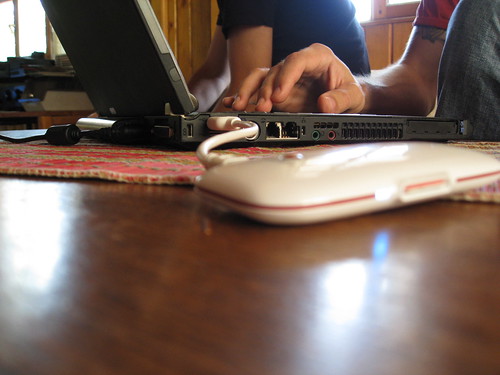
- My ASUS EeePC running Debian 5.0 Lenny.
- pluriel
- My current WLAN router running FreeWRT.
- c1
- My MicroClient JrSX, an embedded 486SX compatible machine with 300 Mhz for VESA mountings.
- c2
- My MicroClient Jr, an embedded Pentium MMX compatible machine with 200 Mhz for VESA mountings.
- c-crosser
- My Lenovo ThinkPad T61 running Debian 5.0 Lenny.
- c-cactus and c-metisse
- The KVM based virtual(*) machines on c-crosser running Sid and Debian GNU/kFreeBSD.
- jumper
- My NAS(*) at home, currently a TheCus N4100. Soon to be replaced by some Mini-ITX box.
All the machines are named after Citroëns. Old machines after old Citroëns, current hardware after current Citroën models or prototypes. Those names starting with “A” are 2CV derivatives since the 2CV was Citroëns “A” model. “AZ” was the 2CV, AZU and AK were 2CV vans and everything starting with AY (e.g. AYA, AYA2, AYB – but those don’t sound that nice ;-) is Dyane based, but I currently only use Méhara names (AYCA is the normal Méhari, AYCE the 4x4 version). Interestingly not everything starting with AYC is a Méhari: AYCD was the Acadiane, the Dyane van. HY and HZ are variants of Citroëns “H van” (HX, HW and H1600 as well, but they don’t sound that nice), TUB was the pre-WWII “H van” prototype and later the nickname of the “H van” in France. TPV was the name of the pre-WWII 2CV prototype and an abbreviation for Toute Petite Voiture (French for “Very Small Car”), hence the Zaurus, my smallest Linux box, got that name. Rosalie was the nickname of a rear-wheel drive pre-WWII Citroën. M35 was a Wankel engine prototype of the Ami 8 and the Ami Super was the 4 cylinder version of the Ami 8. Bijou was a 2CV based coupé build by Citroën UK in the late 50s and early 60s. Visa and LNA were 2CV predecessors which were available with 2CV engines, but were stopped before the 2CV. GSA and GSX are GS late derivatives. C1, C2, (C3) Pluriel, C-Crosser, Jumper and Nemo are current Citroën models and C-Cactus and C-Métisse are recent Citroën prototypes and show cars. The 2CV Dagonet was an aerodynamically optimised 2CVs by Jean Dagonet in the 50s. The Tryane is an aerodynamic and fuel efficient, three wheeled car by Friend Wood based on the 2CV and with a body of wood. And Colani once dressed a 2CV so that it broke several efficiency world records. The Namco Pony was a 2CV based light utility truck (similar to the Méhari, but with steel body) built in Greece under license in many variants. And Loadrunner is the name of some CX six-wheeler conversions.Some links about the naming items:
- Tryane II
- An original Loadrunner and a just recently built Loadrunner. I even saw the base of exactly that one in RL shortly before it was converted into a Loadrunner.
- Luigi Colani
- Dagonet
- Namco Pony
- C1, C2, C-Crosser, C-Cactus, C-Métisse, Pluriel, Nemo, Visa, LNA, GSA, Ami Super, Rosalie
- AZAM, AZL, AZKA, AZU, AK, AYCD, Bijou, TPV
- HY, HZ, TUB.
Now playing: Willi Astor — Gwand Anham Ära
 After a short discussion time, my proposals have been ACK'ed and we will have 63 languages supported, including English, in Debian Installer for Lenny. Etch had 58 supported languages.
The final winners are (alphabetical order of ISO code):
Amharic, Arabic, Belarusian, Bulgarian, Bengali, Bosnian, Catalan,
Czech, Welsh, Danish, German, Dzongkha, Greek, English, Esperanto,
Spanish, Basque, Finnish, French, Irish, Galician, Gujarati, Hebrew,
Hindi, Croatian, Hungarian, Indonesian, Italian, Japanese, Georgian,
Khmer, Korean, Kurdish, Lithuanian, Latvian, Macedonian, Malayalam,
Marathi, Norwegian Bokm l, Nepali, Dutch, Norwegian Nynorsk, Punjabi,
Polish, Portuguese, Brazilian Portuguese, Romanian, Russian, Northern
Sami, Slovak, Slovenian, Albabian, Serbian, Swedish, Tamil, Thai,
Tagalog, Turkish, Ukrainian, Vietnamese, Wolof, Simplified Chinese,
Traditional Chinese
Newcomers for Lenny are:
Amharic, Welsh (back), Irish, Marathi, Northern Sami, Serbian
We lost Estonian which was in Etch.
Those that missed the deadline are of course all other languages of the world. We will put focus on languages where an effort started at some moment but could not be complete enough:
Afrikaans, Estonian, Persian, Armenian, Icelandic, Kazakh, Kannada,
Kashmiri, Lao, Malagasy, Malay, Sanskrit, Secwepemctsin, Telugu, Urdu, Xhosa
Many thanks to all translators for this final effort. Thanks also to
all people who urgently popped up last week to complete the
translations for languages that were "orphaned". I hope this will
bring us more translators...:-)
I keep special thanks to Frans Pop here. He is, along with me, the
author of the code that allows us to split D-I translations in
"sublevels", allowing translators to focus on the most "important"
messages. He also implemented prior warnings when users pick up a
language where some less important screens aren't translated. This
also allows us to more easily keep partly complete translations, or
activate languages earlier. Without this, 11 languages should have
been dropped.

 A common way to debug a network server is to use 'telnet' or 'nc' to
connect to the server and issue some commands in the protocol to verify
whether everything is working correctly. That obviously only works for
ASCII protocols (as opposed to binary protocols), and it obviously also
only works if you're not using any encryption.
But that doesn't mean you can't test an encrypted protocol in a
similar way, thanks to openssl's s_client:
 I just released the final version of
 So I thought it would be an interesting project to do something similar, albeit just focusing in the ‘word sketching’ part, as described in
 Dear lazyweb,
I need a tool to mirror a website locally (so I can browse it offline). Requirements:
 Dear Lazyweb,
do you know how to translate QT4 applications with gettext? Looks like QT4 now uses it’s own mechanism (lupdate -> .ts -> linguist -> .ts -> lrelease -> .qm) for translating strings, which makes things a bit complicated if the rest of your application (the non GUI part) still uses gettext.
The background is — as some of you may have noticed — that rng’s GUI isn’t properly translated anymore since the switch from QT3 to QT4. I don’t know if I just should adopt QT4’s translation mechanism, but for now it would be very nice if I just could use my .po files for the QT4 stuff.

 I see Martin is