Search Results: "agi"

30 December 2010

Stefano Zacchiroli: how to contribute to Debian

... looking for an HOWTO? These days, possibly because it's holiday in several countries around the world, I'm receiving a higher number of "how can I help Debian?" mails than usual. This is good and makes me happy! Those mails show we have a community who cares about giving back to Free Software, in exchange of what they have received via Debian. Routinely, in my replies, I point people to the following list of documentation we have on how to contribute to Debian: Am I missing something? At the same time, it happens that I reply to people who clearly went through (at least some of) the above resources, but which are still blocked at the "what I do next?" step. I guess this is because some of the day to day practices of Debian life are not described in the documentation we have. For instance, I find scarce references to "cultural" aspects of Debian technical life such as: And I'm sure I'm missing quite some other cultural/folklore traits, which look obvious to longstanding members of the Debian community, but which are probably not so obvious to external people. So, dear lazyweb, have you started contributing to Debian and remember your experience? If so, I'd like to hear from you. In particular, I'd like to hear your suggestions on how we can improve our documentation on the matter (patches welcome, as usual!). Bonus point. Of the various pieces of documentation we have, it seems that a sufficiently detailed HOWTO-style document, covering both technical and cultural aspects, is missing. If you are into writing for Debian, that might be an experiment worth trying.

28 December 2010

John Goerzen: Christmas Gatherings, a Piano, and a Pickup

Perhaps I am not very imaginative. Or perhaps insufficiently adventurous. But when I woke up today, a day that would actually get a little bit above freezing, I didn t have a thought of riding without a coat in the bed of a pickup. Nor did I expect to be involved with moving a piano. I didn t have any thought of listening to piano music outdoors. And I certainly didn t anticipate the fun to be had doing all of these things simultaneously. Now, let me back up and set the scene. This was our annual Goerzen Christmas today. We already ate and exchanged gifts. Here s the thing about moving pianos, especially the old heavy ones with the cast iron frame inside: it s not something where a group of people just get together, count to 3, and that s that. No, you ve got to start the project out right. You have to break the news that people will be moving a piano gently. And then, of course, you get a room full of people usually mostly men and at this point, before any lifting happens, you ve got to plan. Tape measures must be produced, measurements taken, plans made for how to lift and who should lift where. Differing points of view have to be considered carefully. Then, of course, you have too many people for each one to actually help lift so each person not lifting has to find a job. And then when things actually start going, you realize that not one of the plans fully accounted for the unprecedented weight and maddening stubbornness of the piano, and you have to stop every few feet to plan anew. I don t think I ve ever seen a piano move happen in any other fashion. So, today, my uncle, whose house our gathering was at this year, said, Ahh good, lots of young backs. Just what I need. Mildly concerned glances pass between my brothers, my cousins, and I. One brother looks like he s pretending not to have heard. We have a few things to move. Anticipation. A small couch probably not too bad, right? An upholstered chair maybe a bit unruly but still not too bad. And an old piano is going to a neighbor. Full alert now more glances, a pause for a second, and then acceptance: Oh! Uhm great! My uncle s friend Ken teaches music at the local college, and on the side, Ken also teaches children how to play piano. One of Ken s students didn t have a piano at home, and my uncle and aunt had an old one they weren t using, which they would give to the family of the student just a couple of blocks away. All that remained was moving it. There was the inevitable measuring, planning, re-planning, until we got it out of the house and onto the back of my uncle s pickup. We have about 8 men involved, plus my aunt. Most of us rode in the back of the pickup with the piano. And of course, there came the inevitable request: Ken, play for us! So Ken sat on the edge of the pickup, at the piano, playing as we and the piano went through town in the open air. He started with Joplin s Entertainer, then broke out into some Christmas music We Wish You a Merry Christmas, followed by Nun Ist Sie Erschienen and a few others. It must be said that small towns in Kansas are probably not accustomed to their Christmas carolers having a piano with them, much less being played from the bed of a pickup. But there we were, mostly laughing too hard or enjoying the ride too much to sing. To add excitement, or perhaps embarrassment, my uncle was sounding the horn. Some thought that his intent was to have it in time with the piano music from the back, but I ll give him the benefit of the doubt and say that he meant to sound the horn in that rather random fashion. Eventually we got to the neighbor s house, and my dad and another uncle who hadn t been on the pickup came running up. We hopped down and asked them where they wanted the piano. Upstairs! That got repeated among everyone there, producing laughter each time. More tape measures were produced, as it was a narrow staircase. The conclusion was that the piano could make it with about an inch (2.54cm) to spare. So we got it out of the pickup and onto the porch, then into the house. Now, how to get it upstairs? This called for an extra helping of planning and calculating. Ken, the unofficial piano moving boss, kept reminding us in jest that I grew up on a farm . He said he could be alone at the top of the piano while we pushed. This quickly turned out to not be practical; due to the incline, the weight at the bottom was just too much to get it up over the stairs. Ken then went and picked up a wooden contraption they use to move pianos at the college. We tried that, but its supports underneath got stuck on the steps as well. Various ideas were tossed around at this point, until I pointed out that four of us on the bottom couldn t get it up over a step, so when we get it into the stairway only wide enough for 2 we won t be able to get it up anyhow. That being considered a good point, various other ideas were tossed around. They all seemed to be wanting either for practicality or, perhaps, safety. Though the idea of having a dozen Goerzens stand at the top of the staircase pulling it up by a rope did have some excellent humor value. In the end, perhaps wanting our group of free, highly ambitious, but somewhat less effective piano movers out of their house, the neighbors found a place for it on the ground floor. We all piled back into the pickup for the ride back, which was rather more quiet due to lack of horn and piano music. So there you have it. The most fun I have ever had moving a piano. (Really, the only fun I have ever had moving a piano.)

23 December 2010

Matt Zimmerman: Rejoining Debian

A couple of months ago, Debian project membership voted, after extensive discussion, to implement a fundamental change in the Debian community: to welcome as members people who make a valuable contribution to the project, even if they are contributing something other than source code. This was a tremendous milestone for Debian, and one which made me feel proud to have been a part of the project. Historically, only developers had been eligible for membership, including voting and other formal privileges. Although other kinds of contributions were welcome, this disparity gave the impression that they were less valued than code contributions. It seemed to me at the time that Debian s mission was to package all of the free software in the world, and if one s efforts didn t go directly to improving packages, they just weren t as important. I don t remember when I first installed Debian, but I made my first contributions to the project in 1999, and officially joined as a developer in 2000. After several fun and rewarding years of packaging and development, I started a very demanding day job, and spent more and more of my energy into that, and less and less coding for Debian as a volunteer. However, my job with Canonical involved working with Debian, and that was a primary reason why it was interesting to me. It was an opportunity to introduce a whole new population of people to the things I loved about Debian. The reality, of course, was more complicated. Following the launch in 2004, Ubuntu grew quickly in popularity and scope, diverged from Debian in significant ways, and relations between Debian and Ubuntu became strained. Canonical grew quickly as well, and the combination of a growing community, a growing company and growing user adoption was a challenge for everyone concerned. As a Canonical manager and a Debian developer, I felt the strain as much as anyone. Meanwhile, and I felt more and more alienated from Debian. Debian developers who had been friendly in the past became suspicious of Ubuntu and me and I quickly became an outsider. My code contributions to Debian continued to decline, and I was no longer maintaining any packages. In Debian at the time, that meant that I didn t exist. I saw it as an important part of my job to work with my counterparts in Debian, in a coordinating role, but found this increasingly impractical. In 2007, I received an inquiry from the Debian Account Manager, who had noticed I wasn t actively involved in packaging, and wished to disable my account for security reasons if I wasn t using it. Although I wanted to remain active in the Debian community, I had to agree that it wasn t good security practice for me to hold onto my developer privileges. I relinquished my upload rights, with the option to come back if I resumed my development work, and officially became a nobody: I lost the right to vote, my email address and mailing list subscriptions, and all other official ties with Debian, except for the record of my GPG key in a special emeritus keyring for informational purposes. Last month, Enrico Zini announced instructions for contributors to apply for membership under the new guidelines, which recognize many kinds of contributions, not only code. Today, after a three year hiatus, I am proud to be the first Debian member to be accepted through this new process. I expect to continue to submit the occasional patch, but my primary interest is in healing the rift which still exists between Debian and Ubuntu by contributing in a more personal way. Please feel free to contact me if you d like to work together on this. You can reach me as mdz at either debian.org or ubuntu.com, or on IRC. I would like to thank Stefano Zacchiroli, for proposing the General Resolution which enabled Debian to make this transition, and for all of his other work as Debian Project Leader to help Debian grow and improve. I also appreciate Enrico Zini, Jonathan McDowell and Martin Zobel-Helas for expediently processing me and working through the technical changes needed to implement the resolution correctly. It s good to be back.

Julien Viard de Galbert: Triage X Bugs of the Christmas Week (TXBW7)

For some reason1 bug #607242 did not make it to the debian-x@d.o mailing list, I got aware of it only by the message shirish sent to my blog.
If he didn t write to me, this bug will have waited for what about 3 years until I got all the 800+ bugs triaged ? So please you can help triaging X bugs, first subscribe to the debian-x mailing list so you can get the feeling of what to respond to some bugs, and join the TXBW effort ;) The X Strike Force (still) needs you ! You can have a look at the X Strike Force Bug Closing Procedure and check XSF unstable bugs sorted by date. Note 1: The Xorg.0.log file was so huge that the mailing list did not accept the mail.

Raphaël Hertzog: People behind Debian: Mehdi Dogguy, release assistant

Mehdi Dogguy

Picture of Mehdi taken by Antoine Madet

Mehdi is a Debian developer for a bit more than a year, and he s already part of the Debian Release Team. His story is quite typical in that he started there by trying to help while observing the team do its work. That s a recurrent pattern for people who get co-opted in free software teams. Read on for more info about the release team, and Mehdi s opinion on many topics. My questions are in bold, the rest is by Mehdi (except for the additional information that I inserted in italics). Who are you? I m 27 years old. I grew up in Ariana in northern Tunisia, but have been living in Paris, France, since 2002. I m a PhD Student at the PPS laboratory where I study synchronous concurrent process calculi. I became interested in Debian when I saw one of my colleagues, Samuel Mimram (first sponsor and advocate) trying to resolve #440469, which is a bug reported against a program I wrote. We have never been able to resolve it but my intent to contribute was born there. Since then, I started to maintain some packages and help where I can. What s your biggest achievement within Debian? I don t think I had time to accomplish a lot yet :) I ve been mostly active in the OCaml team where we designed a tool to compute automatically the dependencies between OCaml packages, called dh-ocaml. This was a joint work with St phane Glondu, Sylvain Le Gall and Stefano Zacchiroli. I really appreciated the time spent with them while developing dh-ocaml. Some of the bits included in dh-ocaml have been included upstream in their latest release. I ve also tried to give a second life to the Buildd Status Pages because they were (kind of) abandoned. I intend to keep them alive and add new features to them. If you had a wand and could change one thing in Debian, what would that be? Make OCaml part of a default Debian installation :D But, since I m not a magician yet, I d stick to more realistic plans:
  1. A lot of desktop users fear Debian. I think that the Desktop installation offered by Debian today is very user-friendly and we should be able to attract more and more desktop users. Still, there is some work to be done in various places to make it even more attractive. The idea is trying to enhance the usability and integration of various tools together. Each fix could be easy or trivial but the final result would be an improved Desktop experience for our users. Our packaged software run well. So, each person can participate since the most difficult part is to find the broken scenarios. Fixes could be found together with maintainers, upstream or other interested people.

    I ll try to come up with a plan, a list of things that need polishing or fixes and gather a group of people to work on it. I d definitely be interested in participating in such a project and I hope that I ll find other people to help. If the plan is clear enough and has well described objectives and criteria, it could be proposed to the Release Team to consider it as a Release Goal for Wheezy.

  2. NMUs are a great way to make things move forward. But, sometimes, an NMU could break things or have some undesirable effects. For now, NMUers have to manually track the package s status for some time to be sure that everything is alright. It could be a good idea to be auto-subscribed to the bugs notifications of NMUed packages for some period of time (let s say for a month) to be aware of any new issues and try to fix them. NMUing a package is not just applying a patch and hitting enter after dput. It s also about making sure that the changes are correct and that no regressions have been introduced, etc

  3. Orphaned packages: It could be considered as too strict and not desired, but what about not keeping orphaned and buggy packages in Testing? What about removing them from the archive if they are buggy and still unmaintained for some period? Our ftp archive is growing. It could make sense to do some (more strict) housekeeping. I believe that this question can be raised during the next QA meeting. We should think about what we want to do with those packages before they rot in the archive.
[Raphael Hertzog: I would like to point out that pts-subscribe provided by devscripts makes it easy to temporarily subscribe to bug notifications after an Non-Maintainer Upload (NMU).] You re a Debian developer since August 2009 and you re already an assistant within the Release Management team. How did that happen and what is this about? In the OCaml team, we have to start a transition each time we upload a new version of the OCaml compiler (actually, for each package). So, some coordination with the Release Team is needed to make the transition happen. When we are ready to upload a new version of the compiler, we ask the Release Team for permission and wait for their ack. Sometimes, their reply is fast (e.g. if their is no conflicting transition running), but it s not always the case. While waiting for an ack, I used to check what was happening on debian-release@l.d.o. It made me more and more interested in the activities of the Release Team. Then (before getting my Debian account), I had the chance to participate in DebConf9 where I met Luk and Phil. It was a good occasion to see more about the tools used by the Release Team. During April 2010, I had some spare time and was able to implement a little tool called Jamie to inspect the relations between transitions. It helps us to quickly see which transitions can run in parallel, or what should wait. And one day (in May 2010, IIRC), I got offered by Adam to join the team. As members of the Release Team, we have multiple areas to work on:
  1. Taking care of transitions during the development cycle, which means making sure that some set of packages are correctly (re-)built or fixed against a specific (to each transition) set of packages, and finding a way to tell Britney that those packages can migrate and it would be great if she also shared the same opinion. [Raphael Hertzog: britney is the name of the software that controls the content of the Testing distribution.]
  2. Paying attention to what is happening in the archive (uploads, reported RC bugs, etc ). The idea is to try to detect unexpected transitions, blocked packages, make sure that RC bug fixes reach Testing in a reasonable period of time, etc
  3. During a freeze, making sure that unblock requests and freeze exceptions are not forgotten and try to make the RC bug count decrease.
There are other tasks that I ll let you discover by joining the game. Deciding what goes (or not) in the next stable release is a big responsibility and can be incredibly difficult at times. You have to make judgement calls all the time. What are your own criteria? That s a very hard to answer question (at least, for me). It really depends on the case . I try to follow the criteria that we publish in each release update. Sometimes, an unblock request doesn t match those criteria and we have to decide what to accept from the set of proposed changes. Generally, new features and non-fixes (read new upstream versions) changes are not the kind of changes that we would accept during the freeze. Some of them could be accepted if they are not intrusive, easy and well defended. When, I m not sure I try to ask other members of the Release Team to see if they share my opinion or if I missed something important during the review. The key point is to have a clear idea on what s the benefit of the proposed update, and compare it to the current situation. For example, accepting a new upstream release (even if it fixes some critical bugs) is taking a risk to break other features and that s why we (usually) ask for a backported fix. It s also worth noticing that (most of the time) we don t decide what goes in, but (more specifically) what version of a given package goes in and try to give to the contributors an idea on what kind of changes are acceptable during the freeze. There are some exceptions though. Most of them are to fix a critical package or feature. Do you have plans to improve the release process for Debian Wheezy? We do have plans to improve every bit in Debian. Wheezy will be the best release ever. We just don t know the details yet :) During our last meeting in Paris last October, the Release Team agreed to organize a meeting after Squeeze s release to discuss (among other questions) Wheezy s cycle. But the details of the meeting are not fixed yet (we still have plenty of time to organize it and other more important tasks to care about). We would like to be able to announce a clear roadmap for Wheezy and enhance our communication with the rest of the project. We certainly want to avoid what happened for Squeeze. Making things a bit more predictable for developers is one of our goals. Do you think the Constantly Usable Testing project will help? The original idea by Joey Hess is great because it allows d-i developers to work with a stable version of the archive. It allows them to focus on the new features they want to implement or the parts they want to fix (AIUI). It also allows to have constantly available and working installation images. Then, there is the idea of having a constantly usable Testing for users. The idea seems nice. People tend to like the idea behind CUT because they miss some software disappearing from Testing and because of the long delays for security fixes to reach Testing. If the Release Team has decided to remove a package from Testing, I think that there must be a reason for that. It either means that the software is broken, has unfixed security holes or was asked for the removal by its maintainer. I think that we should better try to spend some time to fix those packages, instead of throwing a broken version in a new suite. It could be argued that one could add experimental s version in CUT (or sid s) but every user is free to cherry-pick packages from the relevant suite when needed while still following Testing as a default branch. Besides, it s quite easy to see what was removed recently by checking the archive of debian-testing-changes or by querying UDD. IMO, It would be more useful to provide a better interface of that archive for our users. We could even imagine a program that alerts the user about installed software that got recently removed from Testing, to keep the user constantly aware any issue that could affect his machine. About the security or important updates, one has to recall the existence of Testing-security and testing-proposed-updates that are used specifically to let fixes reach Testing as soon as possible when it s not possible to go through Unstable. I m sure that the security team would appreciate some help to deal with security updates for Testing. We also have ways to speed migrate packages from Unstable to Testing. I have to admit that I m not convinced yet by the benefits brought by CUT for our users.
Thank you to Mehdi for the time spent answering my questions. I hope you enjoyed reading his answers as I did. Subscribe to my newsletter to get my monthly summary of the Debian/Ubuntu news and to not miss further interviews. You can also follow along on Identi.ca, Twitter and Facebook.

2 comments Liked this article? Click here. My blog is Flattr-enabled.

19 December 2010

Jonathan Wiltshire: The perfect gpg-agent setup

When I first started using Debian properly, I played with gpg-agent and pinentry but I didn t really understand the various bash initialisation scripts, and my botched setup annoyed me so much I disabled it again quite quickly (for example, if I left the machine logged in to GDM at home then logged in through SSH, pinentry dialogs stayed in GDM and had to be killed). Now I ve finally had time to get it sorted out, and this is part aide-memoire and part idiot check (hello, lazyweb). The brief: I assume appropriate packages are already installed at a minimum, gpg-agent and whichever pinentry you prefer. Installing gpg-agent drops a hook into /etc/X11/Xsession.d, but now there are both gpg-agent and ssh-agent running. Disable ssh-agent because we re going to let gpg-agent take care of everything: in /etc/X11/Xsession.options, comment out the line use-ssh-agent. In /etc/X11/Xsession.d/90gpg-agent, add the enable-ssh-support parameter so the STARTUP variable looks something like:
STARTUP="$GPGAGENT --daemon --sh --enable-ssh-support --write-env-file=$PID_FILE $STARTUP"
and also disable ssh in gnome-keyring:
$ gconftool-2 --set -t bool /apps/gnome-keyring/daemon-components/ssh false
Now (after restarting your X session) you can use ssh-add to import a key into gpg-agent, and you should see a pinentry dialog asking for a password. That takes care of X sessions, but it won t work for SSH. This is where the different bash login scripts matter: ~/.bashrc is run for all non-login shells (that is, ones spawned from e.g. gnome-terminal) but ~/.profile is only run for login shells (that is, ones where you have to authenticate, such as SSH connections). So, at the bottom of ~/.profile, we just start another gpg-agent who doesn t know about X:
eval $(gpg-agent --enable-ssh-support --daemon)
After restarting your SSH session and triggering a key operation, like signing a document, pinentry-curses should ask for your passphrase at the SSH shell and not leave dialogs stranded in the X session. Finally, that second agent shouldn t be left hanging around after we ve finished, or there ll be hundreds of them soon. Fortunately, the PID is recorded in the environment variable GPG_AGENT_INFO, but parsing that is a bit awkward when it s also recorded alone in SSH_AGENT_PID. So in ~/.bash_logout, we just
kill $SSH_AGENT_PID
(Most of the pointers for this setup came from http://wiki.kumina.nl/index.php/Managing_ssh_keys_with_gpg-agent and http://stefaanlippens.net/bashrc_and_others)
Comments flattr this!

18 December 2010

Russell Coker: Locked Down Phones and Horrible Telcos

Choosing a PhoneI was considering renewing my Three contract and getting a HTC Desire HD [1]. What I need is a phone that is good for being a ssh client on 3G networks, has a good camera, and has all the fancy Google Apps.In the comments Lon recommended a Norwegian review of phone cameras which gave the Sony Ericsson Xperia X10 a much better review than the HTC Desire HD [2] the Xperia was the highest rating Android camera phone while the Nokia N8 was the best overall.Also the Xperia is a lot cheaper, I can get it on a $29 monthly cap from Virgin as opposed to $44 per month from Three. So just on hardware and price the Xperia beats the Desire HD.One of the advantages of the Xperia from Virgin being cheap is that my wife and I can use the same model of phone. This avoids having to solve two sets of phone related problems and also allows us to do things like swap batteries between the phones based on who can most conveniently charge their phone.The Need for RootBut one problem with e Xperia is that the CyanogenMod images for rooted Android phones can t be installed on an Xperia because the boot loader hasn t yet been cracked [3]. I would like to run CyanogenMod so I can get wireless proxy support, and support for tunneling IP over DNS, ICMP, and OpenVPN.The Three web site claims that they have 3G phone and net access in Bendigo, but on a recent holiday my phone said that it was roaming all the time and I couldn t get net access. I ended up having to use McDonalds Wifi net access which had ports such as 22 blocked and thus forced me to use Iodine IP over DNS to get proper net access. To avoid having to talk my mother through rebooting servers in future I need to have a mobile ssh client that can use all possible protocols. I could carry my EeePC with me all the time, but sometimes it s good to travel light.OTOH, as I feel compelled to fiddle with all my computers it would probably give me a more reliable mobile experience if I was unable to mess with my phone.Why Buying a Phone Outright Isn t ViableA $29 monthly plan is probably the cheapest plan that will do for anyone who uses a phone regularly, I have had a Three $29 plan for the last four years which allows up to $150 of calls to be made in a month and typically use about $60. So any plan which doesn t have such a cap will have to be no more than half the price of Three on a per-minute basis to compete. If I m going to pay $29 per month ($696 over a 24 month contract) then I can use a free phone. If I was to buy a phone then it would cost at least $500 for anything that I like and maybe a lot more.Buying a phone independently of a contract would about double the cost of owning a phone. It s really not a viable option.Therefore I am compelled to buy a phone that is on offer from a Telco. Things like the Nokia N900 are nice devices but as the Telcos don t offer them I can t consider them.No Discount if you Don t get a PhoneThe annoying thing is that the Telcos don t offer a discount if you choose not to get a phone. Obviously buying the hardware costs them some money, so a $29 cap with a phone included should have a matching offer of something less than $29 if you choose not to get the phone from them. I currently have a $29 per month contract with Three, I can renew that for another two years at the same rate and get a half-decent phone for free or I can renew for two years on a $19 per month contract and get a low-end phone for free but I can t get a price that is lower than $19 per month if I decide to keep my current phone.If Three was to offer such a discount then I would consider buying a phone outright over the net and staying with them. But as it is they don t provide good deals for buying a phone and give me an economic incentive to go to another provider. So I will probably use Virgin when my contract runs out in January.Locked PhonesMany Telcos still sell locked phones on a contract. When that happens it s really difficult to get a phone unlocked as the Telco employees usually aren t very helpful. There are a variety of web sites claiming to generate unlock codes for phones, most seem to charge $10 or more for this service and the free ones have a very small range of phones, so getting the unlock code from the Telco seems to be the only option for a phone at the end of it s contract period as it s not worth enough to justify the $10 expense.While some Telcos sell unlocked phones on plans the ones that lock their phones have a chilling effect on the industry. Most people don t test whether their old phone can be used with a different provider they just throw it out the phone stores conveniently provide bins for old phones that are apparently recycled for some good cause.ConclusionIf you make serious use of mobile phones (EG being ready to fix errors reported by Nagios 24*7) then choosing a new phone and plan is one of the most difficult things there is to do. All the plans are quite complicated and every Telco offers a different set of phones. The Telco web sites are usually poorly done, most of them don t have an option to search for Android phones or for phones with a certain minimum resolution they usually don t even state the resolution and use terms such as WQVGA which don t even have a fixed meaning in pixels. When it comes to choosing a plan most Telcos don t have a clear comparison of the different plans, writing your own spreadsheet comparing plan costs is a good idea.The fact that Telcos such as Virgin and Three/Vodaphone allow free calls to other people using the same company makes it even more tricky. I have to discuss my phone plans with several relatives as there is a good incentive for everyone to use the same provider.I think that we need government regulation on the way that phones are bundled. The market for phones that aren t associated with Telco contracts has been destroyed by the anti-competitive behavior of the Telcos.

Guido G nther: git-buildpackage tip #1: using gbp-clone to clone a remote repo

Let's say you want to clone a git repository that has the debian packaging on master and the upstream source is kept on upstream/master (since it tracks upstream's master branch). You can simply use git clone or you can do a
gbp-clone --upstream-branch=upstream/master --pristine-tar git://git.debian.org/git/pkg-lvm/multipath-tools.git
This will additionally set up master, upstream/master and pristine-tar to track the corresponding remote branches. There's no --debian-branch option in the above example since master is the default. If you want to safely update these branches at a later point invoke
gbp-pull --upstream-branch=upstream/master --pristine-tar
from inside the repository. This will only update the branches if they can be fast-forwarded. If the repository has a debian/gbp.conf describing the branch layout a call to
gbp-pull
is enough.

Felipe Sateler: CDBS -- An introduction

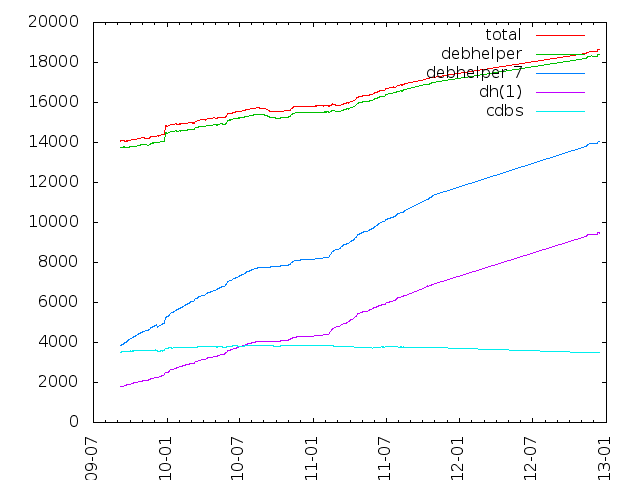
It seems the current trend is to use short-form dh. Some people have even thought that dh has superseded CDBS. Since I prefer CDBS for my own packaging, I will say that no, CDBS is not being deprecated and in fact has been active. Packaging with CDBS is very simple. I'll try to explain how it works, and how to package with it. This may turn into a blog post series, but I won't promise anything.

CDBS is a set of makefiles that do several tasks that are common while packaging software, so that you don't have to repeat them over and over on each package. The makefiles are classified into 2 groups: classes and rules. Classes implement the rules required for building and installing software. These are classes because they can and do inherit from others. For example, there is the makefile class, and the autotools, qmake and cmake classes inherit from it, and the gnome and kde (which is for kde 3) classes inherits from the autotools class. Rules implement several other general purpose rules that don't depend on the toolchain used to build the package. For example, there is the debhelper rules file, which takes care of creating the debian package using the usual dh_* commands. There are several rules files which do all sorts of useful stuff, from running license checks to downloading new upstream releases. If this post transforms into a series, we may look into some of them. For now, I'll demonstrate how to use CDBS to package some simple software (only the debian/rules file, of course).

The first task while running creating debian/rules is determining which build system the software uses. I will use qutecsound package as a guide. So, first things first, we start using CDBS!
#!/usr/bin/make -f

# Uncomment this to turn on verbose mode.
#export DH_VERBOSE=1

include /usr/share/cdbs/1/rules/debhelper.mk
include /usr/share/cdbs/1/class/qmake.mk


Now this would be all that is required if qutecsound where a standard qmake package where nothing needs to be customized. Alas, this is not the case. First, there are some variables that need to be passed to qmake to appropriately configure the build. Also, the projects .pro file is not standard-named. How do we fix this? The CDBS way of overriding this kind of behavior is through the use of variables. Since we are using the qmake class, we will be overriding variables named DEB_QMAKE_*:
DEB_QMAKE_CONFIG_VAL += build64
DEB_QMAKE_ARGS = qcs.pro


We add a configuration value (because CDBS is setting other config values), and we set the extra arguments to qmake.

Now, there is a problem: the resulting binary is not created with the name we want. How do we change that? We could patch the source to avoid that, but it is far easier to add a rule to the makefile to do that. We will modify the build to rename the file at the end (and then clean it up on clean because the upstream makefile will not spot it):
build/qutecsound::
[ -f bin/qutecsound ] mv bin/qutecsound-d bin/qutecsound

clean::
rm -f bin/qutecsound


So what did we just do? We extended the build and clean rules with extra stuff to do. In CDBS each package listed in debian/control gets a build/package rule (and several others at different stages of the build) so that one can add stuff specific to each package (this will be much more useful when dpkg finally learns about build-arch and build-indep).

For the final touch, we want to do a few more things. First, we want to ensure that we are using QT4's qmake, because the build will fail if QT3's is used. Second, since I created a manpage for the command, I want to install it. Finally, we want to use parallel building when the user has specified it, to build the project faster. How to do that? Again, via variables:
QMAKE = qmake-qt4
DEB_BUILD_PARALLEL = 1
DEB_INSTALL_MANPAGES_qutecsound = debian/qutecsound.1


CDBS creates several variables for each of the packages listed in debian/control, so we can customize each package build. In our case, this variable is passed to dh_installman from the debhelper rules file (CDBS will invoke the debhelper tools once for each binary package).

After all this we now have the complete debian/rules of a relatively simple package. How does it look like? Like this:
#!/usr/bin/make -f

# Uncomment this to turn on verbose mode.
#export DH_VERBOSE=1

include /usr/share/cdbs/1/rules/debhelper.mk
include /usr/share/cdbs/1/class/qmake.mk

QMAKE = qmake-qt4
DEB_QMAKE_CONFIG_VAL += build64
DEB_QMAKE_ARGS = qcs.pro
DEB_BUILD_PARALLEL = 1

DEB_INSTALL_MANPAGES_qutecsound = debian/qutecsound.1

build/qutecsound::
[ -f bin/qutecsound ] mv bin/qutecsound-d bin/qutecsound

clean::
rm -f bin/qutecsound

Tags: cdbs, packaging

John Goerzen: Alternatives to Delicious

I ve used Delicious (del.icio.us) for some time now for managing bookmarks. I have never really used its social features, just its management features. With word that it is closing (sigh, just after I had to leave Bloglines, too) I m looking for something else. There are a somewhat bewildering array of new options available, and I m wondering if people have had experience with them. My requirements are:

17 December 2010

Pietro Abate: debian git packaging with git upstream

Update There is an easier method to do all this using gbp-clone as described here. Ah ! Then to build the package, you just need to suggest git-buildpackage where to find the pristin-tar :
git-buildpackage --git-upstream-branch=upstream/master
or you could simply describe (as suggested) the layout in debian/gbp.conf. Easy !!!
I've found a lot of different recipes and howtos about git debian packaging, but I failed to find one simple recipe to create a debian package from scratch when upstream is using git. Of course the following is a big patchwork from many different sources. First we need to do a bit of administrative work to setup the repository :
mkdir yourpackage
cd yourpackage
git init --shared
Then, since I'm interested in tracking upstream development branch I'm going to add a remote branch to my repo:
git remote add upstream git://the.url/here.git
at this point I need to fetch upstream and create a branch for it.
git fetch upstream
git checkout -b upstream upstream/master
Now in my repo I have a master branch and an upstream branch. So far, so good. Let's add the debian branch based on master:
git checkout master
git checkout -b debian master
It's in the debian branch where I'm going to keep the debian related files. I'm finally read for hacking git add / git commit / git remove ... When I'm done, I can switch to master, merge the debian branch into it and use git-buildpackage to build the package.
git checkout master
git branch
debian
* master
upstream

git merge debian
git-buildpackage
Suppose I want to put everything on gitourious for example. I'll create an acocunt, set up my ssh pub key and then I've to add an origin ref in my .git/config . Something like :
[remote "origin"]
url = git@gitorious.org:debian-stuff/yourpackage.git
fetch = +refs/heads/*:refs/remotes/origin/*
[branch "master"]
remote = origin
merge = refs/heads/master
The only thing left to do is to push everything on gitourious. the --all is important.
git push --all
People willing to pull your work from girourious have to follow the following script :
$git clone git@gitorious.org:debian-stuff/yourpackage.git
$cd yourpackage
$git branch -a
* master
remotes/origin/HEAD -> origin/master
remotes/origin/debian
remotes/origin/master
remotes/origin/upstream
$git checkout -t origin/debian
$git checkout -t origin/upstream
$git branch -a
debian
master
* upstream
remotes/origin/HEAD -> origin/master
remotes/origin/debian
remotes/origin/master
remotes/origin/upstream
$git checkout master
$git-buildpackage
Maybe there is an easier way to pull all remote branches at once, but I'm not aware of it. Any better way ?

Alexander Reichle-Schmehl: About non-free firmware

Paul Wise just pointed me to a very good explanation of the issue with non-free firmware files:
Updated qlogic 2400 and 2500 firmware to 5.03.13. What does 5.03.13 do? No one knows, except for QLogic, and they're not telling. I asked, and they told me that information was only available under NDA. So, I encourage you to imagine what this firmware does, and the bugs it fixes. While you're at it, imagine a world where vendors release source code for their firmware.
The source? No, not some ideologist, not even someone involved in Debian. It's a comment about an update of a firmware package in Fedora.

Bernhard R. Link: C Code to avoid

One of the bad aspects of the the C Programing language is that it silently allows many bad C programs. Together with the widespread use of an architecture that is very bad at catching errors (i386), this sometimes leads to common ideoms that are only working accidentially. This is bad as they often break on other architectures and can break with every new optimisations or new feature the compiler adds. Take for example a look at the code there (I tried to leave a comment there but did not succeed): If you see something like this:
     char buffer[1000];
     struct thingy *header;
     header = (struct thingy *)buffer;
then it is time to run. I hope you do not depend on this software, because it is a pure accident if this is doing anything at all. While you can cast a char * to a struct, that is only allowed if that memory actually was this struct (or one compatible, like a struct with the same initial part and you are only accessing that part). In this case it is obviously not (it's just an array of char), so you might see bus errors or random values if the compiler does no optimisations and you are on a architecture where alignment matters. Or the compiler might optimize it to whatever it wants to, because the C compiler is allowed to do everything with code like that. The next problem is the one that post was about: You are not allowed to access an array after its end. Something like
 struct thingy  
     int magic;
     char data[4];
  
means you may only access the first 4 bytes of data. If you access more than that it may work now on your machine, but it can stop tomorrow with the next revision of the compiler or on another machine. If you have a struct with a variable length data block, then you can use the new C99 feature of char data[] or the old gcc extension of char data[0]. Or you can use unions. (Or in some case use the behaviour of structs with the same initial parts). If you use C code with undefined semantics then every new compiler might break it with some optimisation. There is often the tempting option of just using a slightly different code that currently works. But in the not too distant future the compiler (or even some processor) might again get some new optimisations and the code will break again. Fixing it properly might be harder but it's less likely it will fail to compile again and it also reduces the chances that it will not fail to compile but simply do something you did not expect.

Raphaël Hertzog: Avoid a newbie packager mistake: don t build your Debian packages with dpkg -b

In the last years, I have seen many people try to use dpkg --build to create Debian packages. Indeed, if you look up dpkg s and dpkg-deb s manual pages, this option seems to be what you have to use:
-b, --build directory [archive directory] Creates a debian archive from the filesystem tree stored in directory. directory must have a DEBIAN subdirectory, which contains the control information files such as the control file itself. This directory will not appear in the binary package s filesystem archive, but instead the files in it will be put in the binary package s control information area.
And indeed, dpkg-deb is what ultimately creates the .deb files (aka binary packages). But it s a low-level tool that you should not call yourself. If you want to properly package a new software, you should rather create a Debian source package that will transform upstream source code into policy-compliant binary packages. Creating a source package also involves preparing a directory tree (but with a debian sub-directory), it s probably more complicated than calling dpkg -b on a manually crafted directory. But the result is much more versatile: the tools used bring value by dynamically analyzing/modifying the files within your package (for example, the dependencies on C libraries that your package needs are automatically inserted). If this is news to you, you might want to check out the New Maintainers Guide and the Debian Policy.
Found it useful? Be sure to not miss other packaging tips (or lessons), click here to subscribe to my free newsletter and get new articles by email.

10 comments Liked this article? Click here. My blog is Flattr-enabled.

Kees Cook: gcc-4.5 and -D_FORTIFY_SOURCE=2 with header structures

Recently gcc (4.5) improved its ability to see the size of various structures. As a result, the FORTIFY protections have suddenly gotten a bit stricter. In the past, you used to be able to do things like this:

struct thingy  
    int magic;
    char data[4];
 
void work(char *input)  
    char buffer[1000];
    int length;
    struct thingy *header;
    header = (struct thingy *)buffer;
    length = strlen(input);
    if (length > sizeof(buffer) - sizeof(*header) - 1) abort();
    strcpy(header->data, input);
    header->magic = 42;
    do_something_fun(header);
 
The problem here is that gcc thinks that header->data is only 4 bytes long. But gcc doesn t know we intentionally overruled this (and even did length checking), so due to -D_FORTIFY_SOURCE=2, the strcpy() checks kick in when input is more than 4 bytes. The fix, in this case, is to use memcpy() instead, since we actually know how long our destination is, we can replace the strcpy(...) line with:
    memcpy(header->data, input, length + 1); /* take 0-term too */
This kind of header and then data stuff is common for protocol handlers. So far, things like Wine, TFTP, and others have been experiencing problems with the change. Please keep an eye out for it when doing testing.

15 December 2010

Raphaël Hertzog: Howto to rebuild Debian packages

Being able to rebuild an existing Debian package is a very useful skill. It s a prerequisite for many tasks that an admin might want to perform at some point: enable a feature that is disabled in the official Debian package, rebuild a source package for another suite (for example build a Debian Testing package for use on Debian Stable, we call that backporting), include a bug fix that upstream developers prepared, etc. Discover the 4 steps to rebuild a Debian package. 1. Download the source package The preferred way to download source packages is to use APT. It can download them from the source repositories that you have configured in /etc/apt/sources.list, for example:
deb-src http://ftp.debian.org/debian unstable main contrib non-free
deb-src http://ftp.debian.org/debian testing main contrib non-free
deb-src http://ftp.debian.org/debian stable main contrib non-free
Note that the lines start with deb-src instead of the usual deb . This tells APT that we are interested in the source packages and not in the binary packages. After an apt-get update you can use apt-get source publican to retrieve the latest version of the source package publican . You can also indicate the distribution where the source package must be fetched with the syntax package/distribution . apt-get source publican/testing will grab the source package publican in the testing distribution and extract it in the current directory (with dpkg-source -x, thus you need to have installed the dpkg-dev package).
$ apt-get source publican/testing
Reading package lists... Done
Building dependency tree
Reading state information... Done
NOTICE: 'publican' packaging is maintained in the 'Git' version control system at:
git://git.debian.org/collab-maint/publican.git
Need to get 727 kB of source archives.
Get:1 http://nas/debian/ squeeze/main publican 2.1-2 (dsc) [2253 B]
Get:2 http://nas/debian/ squeeze/main publican 2.1-2 (tar) [720 kB]
Get:3 http://nas/debian/ squeeze/main publican 2.1-2 (diff) [4728 B]
Fetched 727 kB in 0s (2970 kB/s)
dpkg-source: info: extracting publican in publican-2.1
dpkg-source: info: unpacking publican_2.1.orig.tar.gz
dpkg-source: info: unpacking publican_2.1-2.debian.tar.gz
$ ls -dF publican*
publican-2.1/                 publican_2.1-2.dsc
publican_2.1-2.debian.tar.gz  publican_2.1.orig.tar.gz
If you don t want to use APT, or if the source package is not hosted in an APT source repository, you can download a complete source package with dget -u dsc-url where dsc-url is the URL of the .dsc file representing the source package. dget is provided by the devscripts package. Note that the -u option means that the origin of the source package is not verified before extraction. 2. Install the build-dependencies Again APT can do the grunt work for you, you just have to use apt-get build-dep foo to install the build-dependencies for the last version of the source package foo. It supports the same syntactic sugar than apt-get source so that you can run apt-get build-dep publican/testing to install the build-dependencies required to build the testing version of the publican source package. If you can t use APT for this, enter the directory where the source package has been unpacked and run dpkg-checkbuilddeps. It will spit out a list of unmet build dependencies (if there are any, otherwise it will print nothing and you can go ahead safely). With a bit of copy and paste and a apt-get install invocation, you ll install the required packages in a few seconds. 3. Do whatever changes you need I won t detail this step since it depends on your specific goal with the rebuild. You might have to edit debian/rules, or to apply a patch. But one thing is sure, if you have made any change or have recompiled the package in a different environment, you should really change its version number. You can do this with dch --local foo (again from the devscripts package), replace foo by a short name identifying you as the supplier of the updated version. It will update debian/changelog and invite you to write a small entry documenting your change. 4. Build the package The last step is also the simplest one now that everything is in place. You must be in the directory of the unpacked source package.
Now run either debuild -us -uc (recommended, requires the devscripts package) or directly dpkg-buildpackage -us -uc . The -us -uc options avoid the signature step in the build process that would generate a (harmless) failure at the end if you have no GPG key matching the name entered in the top entry of the Debian changelog.
$ cd publican-2.1
$ debuild -us -uc
 dpkg-buildpackage -rfakeroot -D -us -uc
dpkg-buildpackage: export CFLAGS from dpkg-buildflags (origin: vendor): -g -O2
dpkg-buildpackage: export CPPFLAGS from dpkg-buildflags (origin: vendor):
dpkg-buildpackage: export CXXFLAGS from dpkg-buildflags (origin: vendor): -g -O2
dpkg-buildpackage: export FFLAGS from dpkg-buildflags (origin: vendor): -g -O2
dpkg-buildpackage: export LDFLAGS from dpkg-buildflags (origin: vendor):
dpkg-buildpackage: source package publican
dpkg-buildpackage: source version 2.1-2rh1
dpkg-buildpackage: source changed by Rapha l Hertzog <hertzog>
 dpkg-source --before-build publican-2.1
dpkg-buildpackage: host architecture i386
[...]
dpkg-deb: building package  publican' in  ../publican_2.1-2rh1_all.deb'.
 dpkg-genchanges  >../publican_2.1-2rh1_i386.changes
dpkg-genchanges: not including original source code in upload
 dpkg-source --after-build publican-2.1
dpkg-buildpackage: binary and diff upload (original source NOT included)
Now running lintian...
Finished running lintian.
The build is over, the updated source and binary packages have been generated in the parent directory.
$ cd ..
$ ls -dF publican*
publican-2.1/                    publican_2.1-2rh1.dsc
publican_2.1-2.debian.tar.gz     publican_2.1-2rh1_i386.changes
publican_2.1-2.dsc               publican_2.1-2rh1_source.changes
publican_2.1-2rh1_all.deb        publican_2.1.orig.tar.gz
publican_2.1-2rh1.debian.tar.gz
Do you want to read more tutorials like this one? Click here to subscribe to my free newsletter, you can opt to receive future articles by email.

11 comments Liked this article? Click here. My blog is Flattr-enabled.

13 December 2010

Joey Hess: snow and stats

It's been an intense couple of days out at the Hollow. Did it only start to snow yesterday? It feels like a long time in winter. Yesterday was the first day that the solar panels produced no power, it was too cloudy and snowing most of the time. I cleaned an inch of slushy snow off the panels to no avail, and wondered if the power would last. But the wood stove has kept it nice and warm, so yesterday was spent cosily in the living room enjoying the snowfall, nethack, and podcasts. Also, I'm very much enjoying cooking on the wood stove. I've never been in a position to cook on one before; when I lived at Wortroot the stove was in the cabin, and the cold kitchen in a different building. So cooking on the stove, or even keeping a kettle on, was mostly only done in emergencies. Here, I am constantly using it, and the propane stove is still on its first 20 pound tank. Long slow cooked beany or roastish stuff does especially well. Yesterday I did a great pork loin roast with homemade quick sauerkraut. Today, after cleaning another 3 inches of snow off the solar panels, and scraping off a layer of ice, I am getting a decent amount of power for a cloudy day with some snow still falling. Turns out it was good I cleaned them yesterday after all, since a part I missed has a inch+ layer of hard ice, which I don't dare chip away at for fear of damaging the panels. I'd not want to live someplace where it snowed a lot with solar panels that didn't have some kind of a heating system. I wish I had a camera to show the long walk down the driveway, through the winter woods, and past the field where the wind blows gusts of snow into the air. But my cell phone is on a Caribbean cruise. I have been recording data ever since the fall equinox, and it's almost to the winter solstice now. Time to geek out with some graphs! Solar production has surely been falling off with the waning days, but it seems like it will get through the shortest day with enough, and from then on, no worries.
Highest watt production seen each day I've been here.
Zero all day yesterday.
Power system voltages.
Charge controller limits it to a maximum of 15 volts during the day.
Originally, it was limiting it to 13 volts.

Gustavo Noronha Silva: WebKitGTK+ hackfest 2010!

Last week I attended the WebKitGTK+ 2010 hackfest. It was a great opportunity to meet up with the other developers, discuss some plans for the future, hack away at WebKitGTK+. But, most importantly, play Street Figher 2 =). Thanks to Collabora and Igalia for sponsoring the hackfest, Igalia for hosting and organizing it (well done!), and the GNOME foundation for having sponsored my trip to Coru a! Unlike last year we didn t find any big design issues hurting our work (page cache, I m looking at you!) on new futures. I also didn t have any huge plans for new API, although we did manage to get some new stuff in there, like the plugins management API Xan created, and the further work done by Dan in soup. This meant, from my point of view the hackfest has been a great oportunity to look at refactorings that we could do to further simplify understanding the code, changing it, and even sharing it =). Besides pushing the debian packaging of the 1.3.x series a bit further. Coru a was great as always, and I enjoyed going around, eating and hacking there, although I got a cold on the last days which kinda hindered my ability to stare at the screen for too long, some times. Now that I m at the hot brazilian summer again I ll hopefully get better soon =) Cheers \o/ Sponsored by the GNOME Foundation

12 December 2010

Neil Williams: Free software under the bus

Sometimes, free software isn't better than proprietary, it's true - and one of the principal reasons is that the majority of free software does not use the full power of the freedom of the software. Far too many free software projects are single-developer projects. Many single-developer projects at SourceForge or Savannah and elsewhere have a single maintainer for the distribution providing the packages too and some (including nearly all of my own) have one person doing both jobs. In other words, there is no collaboration upstream or in packaging, so there is little or no benefit to the code of being free software...

It begs the question of what happens when the omnipresent developer-under-a-bus risk actually bites.

When comparing free software and proprietary, considering end-of-life effects can be very illuminating, especially when considering the interests of third-parties who come to rely upon the output of the project. When a proprietary software producer declares a software product to be end-of-life (whether due to collapse/purchase of the company or some other restructuring) third parties are left high and dry. In effect, all proprietary software is directly equivalent to a single developer writing free software. The more important the software, the worse this gets because at least if the single free software developer does disappear, the third party can try and pick up the pieces.

The bigger problem for free software is the common failure to actually collaborate. This has been my main upstream bug bear for a long time now. The model must change. New contributors must be dissuaded from writing new code just because they prefer one language over another. Distributions need to change their guidelines for new developers to actively discourage new packagers from starting with new upstream code. We are in danger of undermining the main appeal of free software by not stamping harder on the NotInventedHere (NIH) syndrome. NIH is pernicious, NIH is dangerous and there is even an argument for considering NIH as an anti-feature.
New is considered harmful
New is not necessarily a good idea, new can be positively harmful to the interests of the wider software community. New promotes reinventing the wheel. It's another incidence of "Just because we can, does not mean we should."

If free software advocates neglect to counteract the poison of NIH, then free software will lose the argument by losing the fundamental merit of free software. A freedom which is not utilised is akin to not having that freedom at all. Yes, someone can pick up a free software project after the single developer abandons it but, in practise, what actually happens is that someone else comes along whilst the single developer is struggling along alone and decides to fall prey to NIH simply because the original is written in C and their preferred language is Python or Ruby or Haskell or whatever.

The "choice" argument is simply invalid - providing another implementation of program foo in a different language is just a way of reinventing the bugs already fixed in foo in new ways in a new language - and then adding some more which are unique to that language. Yes, the new developer might argue that the new code is more active but for how long? Long enough to become just as stable as the abandoned code? What benefit is that? In a few years time we will have two abandoned codebases in two different languages written by two different developers who never collaborated on the actual problem both of them were trying to solve independently. Lunacy.

The dilemma for distributions like Debian is that the list of Debian Packages that Need Lovin' is a burden to Debian during a release freeze yet provides an ideal launchpad for new developers to refresh stale code. I've long thought that Debian needs to be more strict on removing such packages, yet at the same time I cannot help but feel that this tends to encourage more NIH behaviour.

It's a common mantra amongst free software developers that many eyes make all bugs shallow. The problem for free software is that outside certain key teams, there are simply too few eyes and the community is not doing enough to shine a light on existing code before dancing to the sound of the NIH drum.

Far too much free software is at risk from that omnipresent bus called "RealLife" and this makes far too much free software little better than proprietary software. Pandering to the fashions of NIH only makes things worse.

This isn't a technical problem that can be solved with a new cool tool (which itself is subject to the NIH poison), it is a social problem and, sadly, the free software community has a history of failing to tackle purely social problems successfully.

There is a small role for existing technical solutions to make it easier to spot NIH tendencies, including sites like SourceForge and Savannah having greater scrutiny about new projects and distributors like Debian being more averse to adding yet more ITP bugs (or closing them automatically unless something happens within a month). Fundamentally, it comes down to how new and existing members of the free software community decide to handle their own projects and bugs. The model of "do it this way because that's more fun" has got us so far, the challenge is to remove NIH tendencies without removing that fun.

11 December 2010

David Bremner: Converting META.yml to META.json

Before I discovered you could just point your browser at http://search.cpan.org/meta/Dist-Name-0.007/META.json to automagically convert META.yml and META.json, I wrote a script to do it.
Anyway, it goes with my "I hate the cloud" prejudices :).
use CPAN::Meta;
use CPAN::Meta::Converter;
use Data::Dumper;
my $meta = CPAN::Meta->load_file("META.yml");
my $cmc = CPAN::Meta::Converter->new($meta);
my $new=CPAN::Meta->new($cmc->convert(version=>"2"));
$new->save("META.json");

Next.

Previous.