Search Results: "ag"

22 October 2021

Enrico Zini: Scanning for imports in Python scripts

I had to package a nontrivial Python codebase, and I needed to put dependencies in setup.py. I could do git grep -h import sort -u, then review the output by hand, but I lacked the motivation for it. Much better to take a stab at solving the general problem The result is at https://github.com/spanezz/python-devel-tools. One fun part is scanning a directory tree, using ast to find import statements scattered around the code:
class Scanner:
    def __init__(self):
        self.names: Set[str] = set()
    def scan_dir(self, root: str):
        for dirpath, dirnames, filenames, dir_fd in os.fwalk(root):
            for fn in filenames:
                if fn.endswith(".py"):
                    with dirfd_open(fn, dir_fd=dir_fd) as fd:
                        self.scan_file(fd, os.path.join(dirpath, fn))
                st = os.stat(fn, dir_fd=dir_fd)
                if st.st_mode & (stat.S_IXUSR   stat.S_IXGRP   stat.S_IXOTH):
                    with dirfd_open(fn, dir_fd=dir_fd) as fd:
                        try:
                            lead = fd.readline()
                        except UnicodeDecodeError:
                            continue
                        if re_python_shebang.match(lead):
                            fd.seek(0)
                            self.scan_file(fd, os.path.join(dirpath, fn))
    def scan_file(self, fd: TextIO, pathname: str):
        log.info("Reading file %s", pathname)
        try:
            tree = ast.parse(fd.read(), pathname)
        except SyntaxError as e:
            log.warning("%s: file cannot be parsed", pathname, exc_info=e)
            return
        self.scan_tree(tree)
    def scan_tree(self, tree: ast.AST):
        for stm in tree.body:
            if isinstance(stm, ast.Import):
                for alias in stm.names:
                    if not isinstance(alias.name, str):
                        print("NAME", repr(alias.name), stm)
                    self.names.add(alias.name)
            elif isinstance(stm, ast.ImportFrom):
                if stm.module is not None:
                    self.names.add(stm.module)
            elif hasattr(stm, "body"):
                self.scan_tree(stm)
Another fun part is grouping the imported module names by where in sys.path they have been found:
    scanner = Scanner()
    scanner.scan_dir(args.dir)
    sys.path.append(args.dir)
    by_sys_path: Dict[str, List[str]] = collections.defaultdict(list)
    for name in sorted(scanner.names):
        spec = importlib.util.find_spec(name)
        if spec is None or spec.origin is None:
            by_sys_path[""].append(name)
        else:
            for sp in sys.path:
                if spec.origin.startswith(sp):
                    by_sys_path[sp].append(name)
                    break
            else:
                by_sys_path[spec.origin].append(name)
    for sys_path, names in sorted(by_sys_path.items()):
        print(f" sys_path or 'unidentified' :")
        for name in names:
            print(f"   name ")
An example. It's kind of nice how it can at least tell apart stdlib modules so one doesn't need to read through those:
$ ./scan-imports  /himblick
unidentified:
  changemonitor
  chroot
  cmdline
  mediadir
  player
  server
  settings
  static
  syncer
  utils
 /himblick:
  himblib.cmdline
  himblib.host_setup
  himblib.player
  himblib.sd
/usr/lib/python3.9:
  __future__
  argparse
  asyncio
  collections
  configparser
  contextlib
  datetime
  io
  json
  logging
  mimetypes
  os
  pathlib
  re
  secrets
  shlex
  shutil
  signal
  subprocess
  tempfile
  textwrap
  typing
/usr/lib/python3/dist-packages:
  asyncssh
  parted
  progressbar
  pyinotify
  setuptools
  tornado
  tornado.escape
  tornado.httpserver
  tornado.ioloop
  tornado.netutil
  tornado.web
  tornado.websocket
  yaml
built-in:
  sys
  time

Maybe such a tool already exists and works much better than this? From a quick search I didn't find it, and it was fun to (re)invent it. Updates: Jakub Wilk pointed out to an old python-modules script that finds Debian dependencies. The AST scanning code should be refactored to use ast.NodeVisitor.

Reproducible Builds (diffoscope): diffoscope 188 released

The diffoscope maintainers are pleased to announce the release of diffoscope version 188. This version includes the following changes:
* Add support for Python Sphinx inventory files, usually named objects.inv.
* Fix Python bytecode decompilation tests with Python 3.10+.
  (Closes: reproducible-builds/diffoscope#278)
You find out more by visiting the project homepage.

21 October 2021

Lisandro Dami n Nicanor P rez Meyer: CMake toolchain files with Debian's cross compilers

Almost a year ago I added a script made by Helmut Grohne that is able to create a CMake toolchain file pre-filled with Debian-specifics ross compilers. The tool is installed by the cmake package and located at /usr/share/cmake/debtoolchainfilegen. It's usage is simple:
debtoolchainfilegen (arch) > cmake_toolchain_<arch>.cmake
Where $arch can be any of the Debian supported architectures, like arm64 (aka aarch64):
$ /usr/share/cmake/debtoolchainfilegen arm64 > /tmp/cmake_toolchain_aarch64
dpkg-architecture: warning: specified GNU system type aarch64-linux-gnu does not match CC system type x86_64-linux-gnu, try setting a correct CC environment variable
$ cat /tmp/cmake_toolchain_aarch64
# Use it while calling CMake:
#   mkdir build; cd build
#   cmake -DCMAKE_TOOLCHAIN_FILE="/path/to/cmake_toolchain_<arch>.cmake" ../
#
set(CMAKE_SYSTEM_NAME "Linux")
set(CMAKE_SYSTEM_PROCESSOR "aarch64")
set(CMAKE_C_COMPILER "aarch64-linux-gnu-gcc")
set(CMAKE_CXX_COMPILER "aarch64-linux-gnu-g++")
set(PKG_CONFIG_EXECUTABLE "aarch64-linux-gnu-pkg-config")
set(PKGCONFIG_EXECUTABLE "aarch64-linux-gnu-pkg-config")
set(QMAKE_EXECUTABLE "aarch64-linux-gnu-qmake")
Note: I kept the warnings, which can be ignored and won't end up on the final file. As you might have noticed the file itself has instructions on how to use it. Of course we will need the requires cross toolchain for the selected arch. For example using arm64:
$ apt install crossbuild-essential-arm64
That's it, we can now start cross building our cmake-based software.

Norbert Preining: KDE/Plasma 5.23 25th Anniversary Edition for Debian

In the last week, KDE released version 5.23 25th Anniversary Edition of the Plasma desktop with the usual long list of updates and improvements. This release celebrates 25 years of KDE, and Plasma 5.23.0 was released right on the day 25 years ago Matthias Ettrich sent an email to the de.comp.os.linux.misc newsgroup explaining a project he was working on. And Plasma 5.23 (with the bug fix 5.23.1) is now available for all Debian releases. (And don t forget KDE Gears/Apps 21.08!) As usual, I am providing packages via my OBS builds. If you have used my packages till now, then you only need to change the plasma522 line to read plasma523. To give full details, I repeat (and update) instructions for all here: First of all, you need to add my OBS key say in /etc/apt/trusted.gpg.d/obs-npreining.asc and add a file /etc/apt/sources.lists.d/obs-npreining-kde.list, containing the following lines, replacing the DISTRIBUTION part with one of Debian_11 (for Bullseye), Debian_Testing, or Debian_Unstable:

deb https://download.opensuse.org/repositories/home:/npreining:/debian-kde:/other-deps/DISTRIBUTION/ ./
deb https://download.opensuse.org/repositories/home:/npreining:/debian-kde:/frameworks/DISTRIBUTION/ ./
deb https://download.opensuse.org/repositories/home:/npreining:/debian-kde:/plasma523/DISTRIBUTION/ ./
deb https://download.opensuse.org/repositories/home:/npreining:/debian-kde:/apps2108/DISTRIBUTION/ ./
deb https://download.opensuse.org/repositories/home:/npreining:/debian-kde:/other/DISTRIBUTION/ ./
The sharp eye might have detected also the apps2108 line, yes the KDE Gear suite of packages hgas been updated to 21.08 some time ago and is also available in my OBS builds (and in Debian/experimental). Uploads to Debian Plasma 5.23.0 has been uploaded to Debian, and is currently in transition to testing. Due to incorrect/insufficient Break/Depends, currently Debian/testing with the official packages for Plasma are broken. And as it looks this situation will continue for considerable time, considering that kwin is blocked by mesa, which in turn is blocked by llvm-toolchain-12, which has quite some RC bugs preventing it from transitioning. What a bad coincidence. KDE Gears 21.08 are all in Debian Unstable and Testing, so the repositories here are mostly for users of Debian Bullseye (stable). Krita beta Krita has released the second beta of Krita 5.0, and this is available from the krita-beta repository, but only for amd64 architectures. Just add
deb https://download.opensuse.org/repositories/home:/npreining:/debian-kde:/krita-beta/DISTRIBUTION/ ./
Enjoy the new Plasma!

20 October 2021

Ian Jackson: Going to work for the Tor Project

I have accepted a job with the Tor Project. I joined XenSource to work on Xen in late 2007, as XenSource was being acquired by Citrix. So I have been at Citrix for about 14 years. I have really enjoyed working on Xen. There have been a variety of great people. I'm very proud of some of the things we built and achieved. I'm particularly proud of being part of a community that has provided the space for some of my excellent colleagues to really grow. But the opportunity to go and work on a project I am so ideologically aligned with, and to work with Rust full-time, is too good to resist. That Tor is mostly written in C is quite terrifying, and I'm very happy that I'm going to help fix that!

comment count unavailable comments

Arturo Borrero Gonz lez: Iterating on how we do NFS at Wikimedia Cloud Services

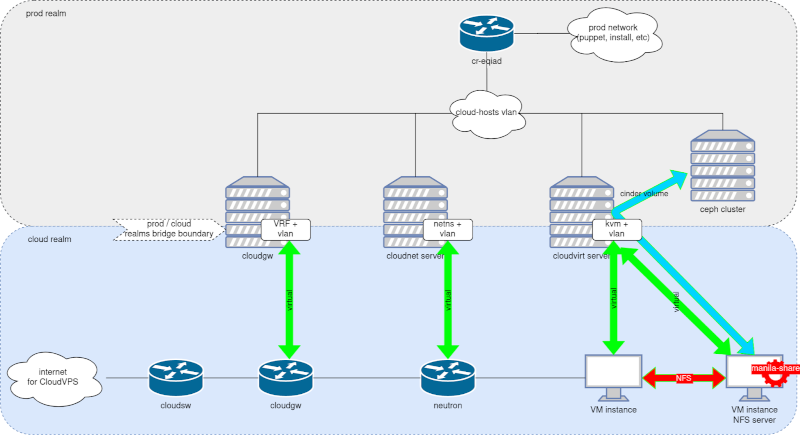
Logos This post was originally published in the Wikimedia Tech blog, authored by Arturo Borrero Gonzalez. NFS is a central piece of infrastructure that is essential to services like Toolforge. Recently, the Cloud Services team at Wikimedia had been reviewing how we do NFS. The current situation NFS is a central piece of technology for some of the services that the Wikimedia Cloud Services team offers to the community. We have several shares that power different use cases: Toolforge user home directories live on NFS, and Cloud VPS users can also access dumps using this protocol. The current setup involves several physical hardware servers, with about 20TB of storage, offering shares over 10G links to the cloud. For the system to be more fault-tolerant, we duplicate each share for redundancy using DRBD. Running NFS on dedicated hardware servers has traditionally offered us advantages: mostly on the performance and the capacity fields. As time has passed, we have been enumerating more and more reasons to review how we do NFS. For one, the current setup is in violation of some of our internal rules regarding realm separation. Additionally, we had been longing for additional flexibility managing our servers: we wanted to use virtual machines managed by Openstack Nova. The DRBD-based high-availability system required mostly a hand-crafted procedure for failover/failback. There s also some scalability concerns as NFS is easy to grow up, but not to grow horizontally, and of course, we have to be able to keep the tenancy setup while doing so, something that NFS does by using LDAP/Unix users and may get complicated too when growing. In general, the servers have become too big to fail , clearly technical debt, and it has taken us years to decide on taking on the task to rethink the architecture. It s worth mentioning that in an ideal world, we wouldn t depend on NFS, but the truth is that it will still be a central piece of infrastructure for years to come in services like Toolforge. Over a series of brainstorming meetings, the WMCS team evaluated the situation and sorted out the many moving parts. The team managed to boil down the potential service future to two competing options: Then we decided to research both options in parallel. For a number of reasons, the evaluation was timeboxed to three weeks. Both ideas had a couple of points in common: the NFS data would be stored on our Ceph farm via Cinder volumes, and we would rely on Ceph reliability to avoid using DRBD. Another open topic was how to back up data from Ceph, to store our important bits in more than one basket. We will get to the back up topic later. The manila experiment The Wikimedia Foundation was an early adopter of some Openstack components (Nova, Glance, Designate, Horizon), but Manila was never evaluated for usage until now. Our approach for this experiment was to closely follow the upstream guidelines. We read the documentation and tried to understand the different setups you can build with Manila. As we often feel with other Openstack components, the documentation doesn t perfectly describe how to introduce a given component in your particular local setup. Here we use an admin-controller flat-topology Neutron network. This network is shared by all tenants (or projects) in our Openstack deployment. Also, Manila can use many different driver backends, for things like NetApps or CephFS that we don t use , yet. After some research, the generic driver was the one that seemed to better fit our use case. The generic driver leverages Nova virtual machines instances plus Cinder volume to create and manage the shares. In general, Manila supports two operational modes, whether it should create/destroy the share servers (i.e, the virtual machine instances) or not. This option is called driver_handles_share_server (or DHSS) and takes a boolean value. We were interested in trying with DHSS=true, to really benefit from the potential of the setup. Manila diagram NFS idea 6, original image in Wikitech So, after sorting all these variables, we moved on with our initial testing. We built a PoC setup as depicted in the diagram above, with the manila-share component running in a virtual machine inside the cloud. The PoC led to us reporting several bugs upstream: In some cases we tried to address these bugs ourselves: It s worth mentioning that the upstream community was extra-welcoming to us, and we re thankful for that. However, at the end of our three-week period, our Manila setup still wasn t working as expected. Your experience may change with other drivers perhaps the ZFSonLinux or the CephFS ones. In general, we were having trouble making the setup work as expected, so we decided to abandon this approach in favor of the other option we were considering at the beginning. Simple virtual machine serving NFS The alternative was to create a Nova virtual machine instance by hand and to configure it using puppet. We have been investing in an automation framework lately, so the idea is to not actually create the server by hand. Anyway, the data would be decoupled from the instance into Cinder volumes, which led us to the question we left for later: How should we back up those terabytes of important information? Just to be clear, the backup problem was independent of the above options; with Manila we would still have had to solve the same challenge. We would like to see our data be backed up somewhere else other than in Ceph. And that s exactly where we are at right now. We ve been exploring different backup strategies and will finally use the Cinder backup API. Conclusion The iteration will end with the dedicated NFS hardware servers being stopped, and the shares being served from within the cloud. The migration will take some time to happen because we will check and double-check that everything works as expected (including from the performance point of view) before making definitive changes. We already have some plans to make sure our users experience as little service impact as possible. The most troublesome shares will be those related to Toolforge. At some point we will need to disallow writes to the NFS share, rsync the data out of the hardware servers into the Cinder volumes, point the NFS clients to the new virtual machines, and then enable writes again. The main Toolforge share has about 8TB of data, so this will take a while. We will have more updates in the future. Who knows, perhaps our next-next iteration, in a couple of years, will see us adopting Openstack Manila for good. Featured image credit: File:(from break water) Manila Skyline panoramio.jpg, ewol, CC BY-SA 3.0 This post was originally published in the Wikimedia Tech blog, authored by Arturo Borrero Gonzalez.
19 October 2021

Rapha&#235;l Hertzog: Freexian s report about Debian Long Term Support, September 2021

A Debian LTS logo
Like each month, have a look at the work funded by Freexian s Debian LTS offering. Debian project funding Folks from the LTS team, along with members of the Debian Android Tools team and Phil Morrel, have proposed work on the Java build tool, gradle, which is currently blocked due to the need to build with a plugin not available in Debian. The LTS team reviewed the project submission and it has been approved. After approval we ve created a Request for Bids which is active now. You ll hear more about this through official Debian channels, but in the meantime, if you feel you can help with this project, please submit a bid. Thanks! This September, Freexian set aside 2550 EUR to fund Debian projects. We re looking forward to receive more projects from various Debian teams! Learn more about the rationale behind this initiative in this article. Debian LTS contributors In September, 15 contributors have been paid to work on Debian LTS, their reports are available: Evolution of the situation In September we released 30 DLAs. September was also the second month of Jeremiah coordinating LTS contributors. Also, we would like say that we are always looking for new contributors to LTS. Please contact Jeremiah if you are interested! The security tracker currently lists 33 packages with a known CVE and the dla-needed.txt file has 26 packages needing an update. Thanks to our sponsors Sponsors that joined recently are in bold.

Dirk Eddelbuettel: RVowpalWabbit 0.0.16: One More CRAN Request

Another maintenance RVowpalWabbit released brings us to version 0.0.16 on CRAN. This is last package for which configure.ac needed an update to current standards (see the updates of corels, RcppGSL, RQuantLib, and littler). The make matters more interesting we also had to address one UBSAN issue we could not reproduce locally (which, it turns out, was our fault because we had not rebuilt one package dependency under UBSAN). But Prof Ripley confirmed the issue as addressed so all is good for now. As noted before, there is a newer package rvw based on the excellent GSoC 2018 and beyond work by Ivan Pavlov (mentored by James and myself) so if you are into Vowpal Wabbit from R go check it out. CRANberries provides a summary of changes to the previous version. More information is on the RVowpalWabbit page. Issues and bugreports should go to the GitHub issue tracker. If you like this or other open-source work I do, you can now sponsor me at GitHub.

This post by Dirk Eddelbuettel originated on his Thinking inside the box blog. Please report excessive re-aggregation in third-party for-profit settings.

18 October 2021

Gunnar Wolf: raspi.debian.net now hosted on Debian infrastructure

So, since I registered the URL for serving the unofficial Debian images for the Raspberry computers, raspi.debian.net, in April 2020, I had been hosting it in my Dreamhost webspace. Over two years ago yes, before I finished setting it up in Dreamhost Steve McIntyre approached me and invited me to host the images under the Debian cdimages user group. I told him I d first just get the setup running, and later I would approach him for finalizing the setup. Then, I set up the build on my own server, hosted on my Dreamhost account and forgot about it for many months. Last month, there was a not particularly happy flamewar in debian-arm@lists.debian.org finished with me stating I would be moving the hosting to Debian infrastructure soon. Well It took me a bit over a month to get this sorted out, together with several days of half-broken links, but it is finally done: raspi.debian.net is a CNAME for ftp.acc.umu.se, which is the same system that hosts cdimage.debian.org. And, of course it is also reachable as https://cdimage.debian.org/cdimage/unofficial/raspi/ looks more official, but is less memorable Thanks a lot to Steve for the nudging, and to maswan to help finalizing the setup. What next? Well, the images are being built on my server. I d love to move the builder over to Debian machines as well. When? How? That s still in the air.

Russ Allbery: rra-c-util 10.0

It's been a while since I pushed out a release of my collection of utility libraries and test suite programs, so I've accumulated quite a lot of chanages. Here's a summary; for more, see the NEWS file. You can get the latest version from the rra-c-util distribution page.

Dirk Eddelbuettel: dang 0.0.14: Several Updates

A new release of the dang package arrived at CRAN a couple of hours ago, exactly eight months after the previous release. The dang package regroups a few functions of mine that had no other home as for example lsos() from a StackOverflow question from 2009 (!!), the overbought/oversold price band plotter from an older blog post, the market monitor from the last release as well the checkCRANStatus() function recently tweeted about by Tim Taylor. This release regroups a few small edits to several functions, adds a sample function for character encoding reading and conversion using a library already used by R (hence look Ma, no new depends ), adds a weekday helper, and a sample usage (computing rolling min/max values) of a new simple vector class added to tidyCpp (and the function and class need to get another blog post or study ), and an experimental git sha1sum and date marker (as I am not the fan of autogenerated binaries from repos as opposed to marked released meaning: we may see different binary release with the same version number). The full NEWS entry follows.

Changes in version 0.0.14 (2021-10-17)
  • Updated continuous integration to run on Linux only.
  • Edited checkNonAscii.cpp for readability.
  • More robust title display in intradayMarketMonitor.R.
  • New C++-based function to read and convert encoding via the R-supplied iconv library, noted a potential variability.
  • New function wday returning day of the week as integer.
  • The signature to as.data.table was standardized.
  • A new function rollMinMax was added illustrating use of the NumVec class from tidyCpp.
  • The configure script can record the last commit date and sha1 to automate timestamping builds, but not activated in this release.
  • checkCRANStatus() now works correctly for single-package lookups (Jordan Mark Barbone in #4).

Courtesy of my CRANberries, there is a comparison to the previous release. For questions or comments use the issue tracker off the GitHub repo. If you like this or other open-source work I do, you can now sponsor me at GitHub.

This post by Dirk Eddelbuettel originated on his Thinking inside the box blog. Please report excessive re-aggregation in third-party for-profit settings.

17 October 2021

Russ Allbery: pam-krb5 4.11

The primary change in this release of my Kerberos PAM module is support for calling pam_end with PAM_DATA_SILENT. I had not known that the intent of this flag was to signal that only process resources were being cleaned up and external resources should not be (in part because an older version of the man page doesn't make this clear). This flag is used when a proces forks with an open PAM library handle and wants to clean it up in the child process. In previous versions, this would delete the user's ticket cache, which is not the desired behavior. This version correctly leaves the ticket cache alone. The implementation required some improvements to the PAM testing framework to support this case as well. The other significant change in this release is that the build system no longer attempts to guess the correct PAM module installation path and instead documents that to install the module in a Linux system PAM module path, you will probably need to set --libdir explicitly. The logic used to decide between Debian and Red Hat multiarch paths broke in the presence of Debian usrmerge systems and was incredibly fragile even before that, so I've now dropped it completely. You can get the latest version from the pam-krb5 distribution page.

15 October 2021

Sven Hoexter: ThinkPad P15v Gen1, Xorg and a Samsung QHD Display

Wasted quite some hours until I found a working Modeline in this stack exchange post so the ThinkPad works with a HDMI attached Samsung QHD display. Internal display of the ThinkPad is a FHD display detected as eDP-1, the external one is DP-3 and according to the packaging known by Samsung as S24A600NWU. The auto deteced EDID modes for QHD - 2560x1440 - did not work at all, the display simply stays dark. After a lot of back and forth with the i915 driver vs nouveau vs nvidia/nvidia-drm with and without modesetting, the following Modeline did the magic:
xrandr --newmode 2560x1440_54.97  221.00  2560 2608 2640 2720  1440 1443 1447 1478  +HSync -VSync
xrandr --addmode DP-3 2560x1440_54.97
xrandr --output DP-3 --mode 2560x1440_54.97 --right-of eDP-1 --primary
Modelines for 50Hz and 60Hz generated with cvt 2560 1440 60 did not work, neither did the one extracted with edid-decode -X from the hex blob found in .local/share/xorg/Xorg.0.log. From the auto-detected Modelines FHD - 1920x1080 - did work. In case someone struggles with a similar setup, that might be a starting point. Fun part, if I attach my several years old Dell E7470 everything is just fine out of the box. But that one just has an Intel GPU and not the unholy combination I've here:
$ lspci grep -E "VGA 3D"
00:02.0 VGA compatible controller: Intel Corporation CometLake-H GT2 [UHD Graphics] (rev 05)
01:00.0 3D controller: NVIDIA Corporation GP107GLM [Quadro P620] (rev ff)

13 October 2021

Dirk Eddelbuettel: GitHub Streak: Round Eight

Seven years ago I referenced the Seinfeld Streak used in an earlier post of regular updates to to the Rcpp Gallery:
This is sometimes called Jerry Seinfeld s secret to productivity: Just keep at it. Don t break the streak.
and then showed the first chart of GitHub streaking 366 days:
github activity october 2013 to october 2014github activity october 2013 to october 2014
And six years ago a first follow-up appeared in this post about 731 days:
github activity october 2014 to october 2015github activity october 2014 to october 2015
And five years ago we had a followup at 1096 days
github activity october 2015 to october 2016github activity october 2015 to october 2016
And four years ago we had another one marking 1461 days
github activity october 2016 to october 2017github activity october 2016 to october 2017
And three years ago another one for 1826 days
github activity october 2017 to october 2018github activity october 2017 to october 2018
And two year another one bringing it to 2191 days
github activity october 2018 to october 2019github activity october 2018 to october 2019
And last year another one bringing it to 2257 days
github activity october 2019 to october 2020github activity october 2019 to october 2020
And as today is October 12, here is the newest one from 2020 to 2021 with a new total of 2922 days:
github activity october 2020 to october 2021github activity october 2020 to october 2021

Again, special thanks go to Alessandro Pezz for the Chrome add-on GithubOriginalStreak.

This post by Dirk Eddelbuettel originated on his Thinking inside the box blog. Please report excessive re-aggregation in third-party for-profit settings.

Dirk Eddelbuettel: RcppQuantuccia 0.0.4 on CRAN: Updated Calendar

A new release of RcppQuantuccia arrived on CRAN earlier today. RcppQuantuccia brings the Quantuccia header-only subset / variant of QuantLib to R. At the current stage, it mostly offers date and calendaring functions. This release is the first in two years and brings a few internal updates (such as a swift to continuous integration to the trusted r-ci setup) along with a first update of the United States calendar. Which, just like RQuantLib, now knows about two new calendars LiborUpdate and FederalReserve. So now we can for example look for holidays during June of next year under the Federal Reserve calendar and see
> library(RcppQuantuccia)
> setCalendar("UnitedStates/FederalReserve")
> getHolidays(as.Date("2022-06-01"), as.Date("2022-06-30"))
[1] "2022-06-20"
> 
that Juneteenth 2022 will be observed on (Monday) June 20th. We should note that Quantuccia itself was a bit of a trial balloon and is not actively maintained so we may concentrate on these calendaring functions to keep them in sync with QuantLib. Being a header-only subset is good, and the removal of the (very !!) expensive (in terms of compiled library size) Sobol sequence-based RNG in release 0.0.3 was the right call. So time permitting, a leaner, meaner RcppQuantuccia with a calendaring focus may emerge. The complete list changes follows.

Changes in version 0.0.4 (2021-10-12)
  • Allow for 'Null' calendar without weekends or holidays
  • Switch CI use to r-ci
  • Updated UnitedStates calendar to current QuantLib calendar
  • Small updates to DESCRIPTION and README.md

Courtesy of CRANberries, there is also a diffstat report relative to the previous release. More information is on the RcppQuantuccia page. Issues and bugreports should go to the GitHub issue tracker. If you like this or other open-source work I do, you can now sponsor me at GitHub.

This post by Dirk Eddelbuettel originated on his Thinking inside the box blog. Please report excessive re-aggregation in third-party for-profit settings.

12 October 2021

Antonio Terceiro: Triaging Debian build failure logs with collab-qa-tools

The Ruby team is working now on transitioning to ruby 3.0. Even though most packages will work just fine, there is substantial amount of packages that require some work to adapt. We have been doing test rebuilds for a while during transitions, but usually triaged the problems manually. This time I decided to try collab-qa-tools, a set of scripts Lucas Nussbaum uses when he does archive-wide rebuilds. I'm really glad that I did, because those tols save a lot of time when processing a large number of build failures. In this post, I will go through how to triage a set of build logs using collab-qa-tools. I have some some improvements to the code. Given my last merge request is very new and was not merged yet, a few of the things I mention here may apply only to my own ruby3.0 branch. collab-qa-tools also contains a few tools do perform the builds in the cloud, but since we already had the builds done, I will not be mentioning that part and will write exclusively about the triaging tools. Installing collab-qa-tools The first step is to clone the git repository. Make sure you have the dependencies from debian/control installed (a few Ruby libraries). One of the patches I sent, and was already accepted, is the ability to run it without the need to install:
source /path/to/collab-qa-tools/activate.sh
This will add the tools to your $PATH. Preparation The first think you need to do is getting all your build logs in a directory. The tools assume .log file extension, and they can be named $ PACKAGE _*.log or just $ PACKAGE .log. Creating a TODO file
cqa-scanlogs   grep -v OK > todo
todo will contain one line for each log with a summary of the failure, if it's able to find one. collab-qa-tools has a large set of regular expressions for finding errors in the build logs It's a good idea to split the TODO file in multiple ones. This can easily be done with split(1), and can be used to delimit triaging sessions, and/or to split the triaging between multiple people. For example this will create todo into todo00, todo01, ..., each containing 30 lines:
split --lines=30 --numeric-suffixes todo todo
Triaging You can now do the triaging. Let's say we split the TODO files, and will start with todo01. The first step is calling cqa-fetchbugs (it does what it says on the tin):
cqa-fetchbugs --TODO=todo01
Then, cqa-annotate will guide you through the logs and allow you to report bugs:
cqa-annotate --TODO=todo01
I wrote myself a process.sh wrapper script for cqa-fetchbugs and cqa-annotate that looks like this:
#!/bin/sh
set -eu
for todo in $@; do
  # force downloading bugs
  awk ' print(".bugs." $1) ' "$ todo "   xargs rm -f
  cqa-fetchbugs --TODO="$ todo "
  cqa-annotate \
    --template=template.txt.jinja2 \
    --TODO="$ todo "
done
The --template option is a recent contribution of mine. This is a template for the bug reports you will be sending. It uses Liquid templates, which is very similar to Jinja2 for Python. You will notice that I am even pretending it is Jinja2 to trick vim into doing syntax highlighting for me. The template I'm using looks like this:
From:   fullname   <  email  >
To: submit@bugs.debian.org
Subject:   package  : FTBFS with ruby3.0:   summary  
Source:   package  
Version:   version   split:'+rebuild'   first  
Severity: serious
Justification: FTBFS
Tags: bookworm sid ftbfs
User: debian-ruby@lists.debian.org
Usertags: ruby3.0
Hi,
We are about to enable building against ruby3.0 on unstable. During a test
rebuild,   package   was found to fail to build in that situation.
To reproduce this locally, you need to install ruby-all-dev from experimental
on an unstable system or build chroot.
Relevant part (hopefully):
 % for line in extract % >   line  
 % endfor % 
The full build log is available at
https://people.debian.org/~kanashiro/ruby3.0/round2/builds/3/  package  /  filename   replace:".log",".build.txt"  
The cqa-annotate loop cqa-annotate will parse each log file, display an extract of what it found as possibly being the relevant part, and wait for your input:
######## ruby-cocaine_0.5.8-1.1+rebuild1633376733_amd64.log ########
--------- Error:
     Failure/Error: undef_method :exitstatus
     FrozenError:
       can't modify frozen object: pid 2351759 exit 0
     # ./spec/support/unsetting_exitstatus.rb:4:in  undef_method'
     # ./spec/support/unsetting_exitstatus.rb:4:in  singleton class'
     # ./spec/support/unsetting_exitstatus.rb:3:in  assuming_no_processes_have_been_run'
     # ./spec/cocaine/errors_spec.rb:55:in  block (2 levels) in <top (required)>'
Deprecation Warnings:
Using  should  from rspec-expectations' old  :should  syntax without explicitly enabling the syntax is deprecated. Use the new  :expect  syntax or explicitly enable  :should  with  config.expect_with(:rspec)    c  c.syntax = :should   instead. Called from /<<PKGBUILDDIR>>/spec/cocaine/command_line/runners/backticks_runner_spec.rb:19:in  block (2 levels) in <top (required)>'.
If you need more of the backtrace for any of these deprecations to
identify where to make the necessary changes, you can configure
 config.raise_errors_for_deprecations! , and it will turn the
deprecation warnings into errors, giving you the full backtrace.
1 deprecation warning total
Finished in 6.87 seconds (files took 2.68 seconds to load)
67 examples, 1 failure
Failed examples:
rspec ./spec/cocaine/errors_spec.rb:54 # When an error happens does not blow up if running the command errored before execution
/usr/bin/ruby3.0 -I/usr/share/rubygems-integration/all/gems/rspec-support-3.9.3/lib:/usr/share/rubygems-integration/all/gems/rspec-core-3.9.2/lib /usr/share/rubygems-integration/all/gems/rspec-core-3.9.2/exe/rspec --pattern ./spec/\*\*/\*_spec.rb --format documentation failed
ERROR: Test "ruby3.0" failed:
----------------
ERROR: Test "ruby3.0" failed:      Failure/Error: undef_method :exitstatus
----------------
package: ruby-cocaine
lines: 30
------------------------------------------------------------------------
s: skip
i: ignore this package permanently
r: report new bug
f: view full log
------------------------------------------------------------------------
Action [s i r f]:
You can then choose one of the options: When there are existing bugs in the package, cqa-annotate will list them among the options. If you choose a bug number, the TODO file will be annotated with that bug number and new runs of cqa-annotate will not ask about that package anymore. For example after I reported a bug for ruby-cocaine for the issue listed above, I aborted with a ctrl-c, and when I run my process.sh script again I then get this prompt:
----------------
ERROR: Test "ruby3.0" failed:      Failure/Error: undef_method :exitstatus
----------------
package: ruby-cocaine
lines: 30
------------------------------------------------------------------------
s: skip
i: ignore this package permanently
1: 996206 serious ruby-cocaine: FTBFS with ruby3.0: ERROR: Test "ruby3.0" failed:      Failure/Error: undef_method :exitstatus  
r: report new bug
f: view full log
------------------------------------------------------------------------
Action [s i 1 r f]:
Chosing 1 will annotate the TODO file with the bug number, and I'm done with this package. Only a few other hundreds to go.

10 October 2021

Ben Hutchings: Debian LTS work, September 2021

In September I was assigned 12.75 hours of work by Freexian's Debian LTS initiative and carried over 18 hours from earlier months. I worked 2 hours and will carry over the remainder. I started work on an update to the linux package, but did not make an upload yet.

Norbert Preining: TeX Live contrib archive available via CTAN mirrors

The TeX Live contrib repository has been for many years now a valuable source of packages that cannot enter proper TeX Live due to license restrictions etc. I took over maintenance of it in 2017 from Taco, and since then the repository has been available via my server. Since a few weeks, tlcontrib is now available via the CTAN mirror network, the Comprehensive TeX Archive Network. Thanks to the team of CTAN who offered to mirror the tlcontrib, users can get much faster (and reliable) access via the mirror, by adding tlcontrib as additional repository source for tlmgr, either permanently via:
tlmgr repository add https://mirrors.ctan.org/systems/texlive/tlcontrib tlcontrib
or via a one-shot
tlmgr --repository https://mirrors.ctan.org/systems/texlive/tlcontrib install PACKAGE
The list of packages can be seen here, and includes besides others: (and much more!). You can install all packages from the repository by installing the new collection-contrib. Thanks to the whole CTAN team, and please switch your repositories to the CTAN mirror to get load of my server, thanks a lot! Enjoy.

9 October 2021

Thorsten Alteholz: My Debian Activities in September 2021

FTP master This month I accepted 224 and rejected 47 packages. This is almost thrice the rejects of last month. Please, be more careful and check your package twice before uploading. The overall number of packages that got accepted was 233. Debian LTS This was my eighty-seventh month that I did some work for the Debian LTS initiative, started by Raphael Hertzog at Freexian. This month my all in all workload has been 24.75h. During that time I did LTS and normal security uploads of: I also started to work on exiv2 and faad2. Last but not least I did some days of frontdesk duties. Debian ELTS This month was the thirty-ninth ELTS month. Unfortunately during my allocated time I could not process any upload. I worked on openssl, curl and squashfs-tools but for one reason or another the prepared packages didn t pass all tests. In order to avoid regressions, I postponed the uploads (meanwhile an ELA for curl was published ). Last but not least I did some days of frontdesk duties. Other stuff On my neverending golang challenge I again uploaded some packages either for NEW or as source upload. As Odyx took a break from all Debian activities, I volunteered to take care of the printing packages. Please be merciful when somethings breaks after I did an upload. My first printing upload was hplip

Ritesh Raj Sarraf: Lotus to Lily

The Lotus story so far My very first experience with water flowering plants was pretty good. I learnt a good deal of things; from setting up the pond, germinating the lotus seeds, setting up the right soil, witnessing the growth of the lotus plant, fish eco-system to take care of the pond. Overall, a lot of things learnt. But I couldn t succeed in getting the Lotus flower. A lot many reasons. The granite container developed some leakage, which I had to fix by emptying it, which might have caused some shock to the lotus. But more than that, in my understanding, the reason for not being able to flower the lotus, was the amount of sunlight. From what I have learned, these plants need a minimum of 6-8 hrs of sunlight to really give you with the flowering result, whereas the setup of my pond was on the ground with hardly 3-4 hrs of sun. And that too, with all the plants growing, resulted in indirect sunlight.

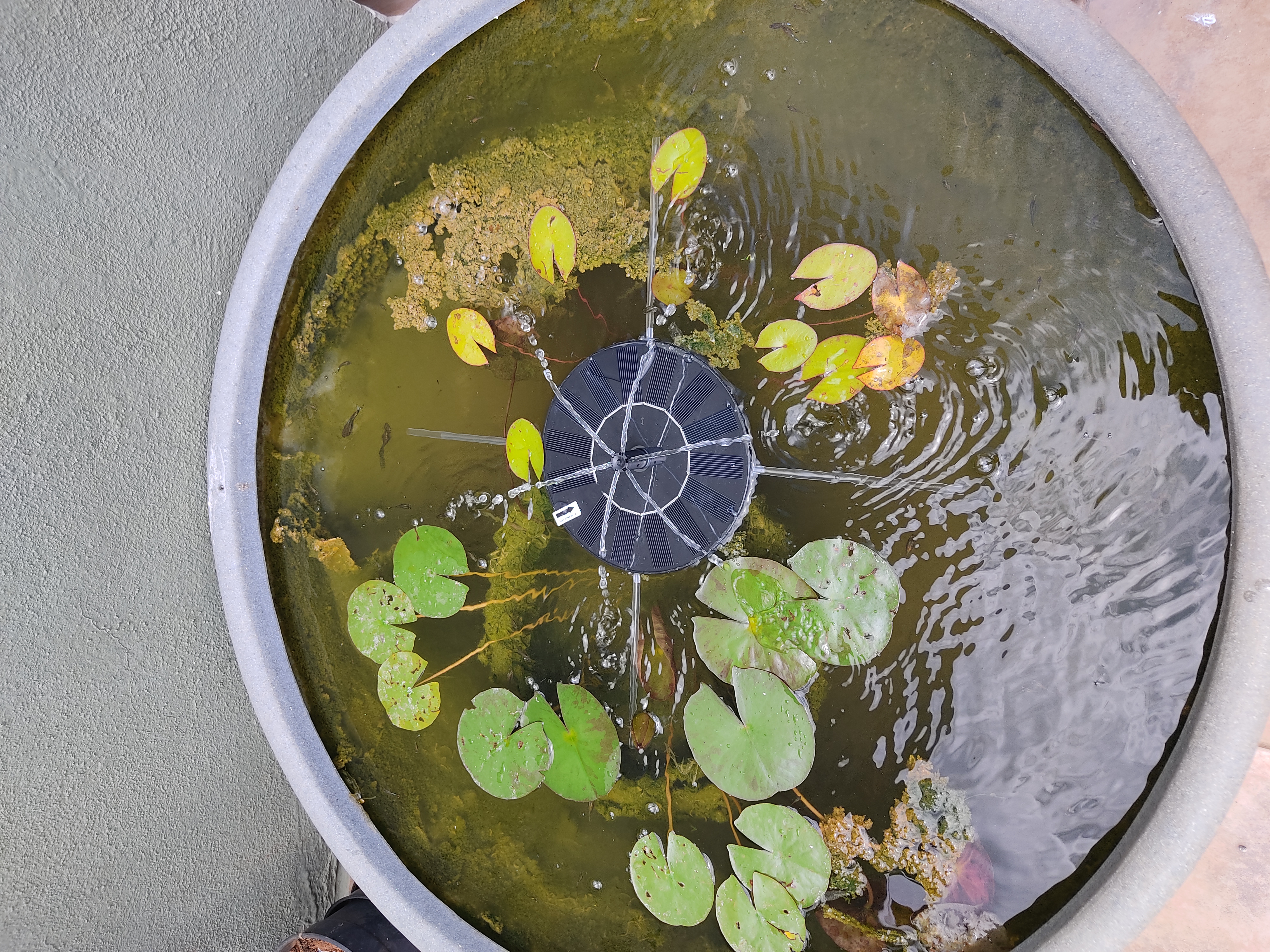
Lotus to Lily For my new setup, I chose a large oval container. And this one, I placed on my terrace, carefully choosing a spot where it d get 6-8 hrs of very bright sun on usual days. Other than that, the rest of the setup is pretty similar to my previous setup in the garden. Guppies, Solar Water Fountain etc.
Initial lily pond setup
The good thing about the terrace is that the setup gets ample amount of sun. You can see that in the picture above, with the amount of algae that has been formed. Something that is vital for the plant s ecosystem. I must thank my wonderful neighbor who kindly shared a sapling from their lily plant. They already had had success with flowering the lily. So I had high hopes to see the day come when I d be happy to write down my experience in this blog post. Though, a lot of patience is needed. I got the lily some time in January this year. And it blossomed now, in October. So, here s me sharing my happiness here, in particular order of how I documented the process.
Monday morning greeted with a blossomed lily
Lily Blossom Closeup
Beautiful water reflection

Dawn to Dusk The other thing that I learned in this whole lily episode is that the flower goes back to sleeping at dusk. And back to flowering again at dawn. There s so much to learn in the surrounding, only if you spare some time to the little things with mother nature.
Lily status at dusk
Lily status at dusk
Lily the next day
Lily the next day
Not sure how long this phenomenon is to last, but overall witnessing this whole process has been mesmerizing. This past week has been great.

Next.

Previous.