Search Results: "will"

30 October 2016

Iain R. Learmonth: Powers to Investigate

The Communication Data Bill was draft legislation introduced first in May 2012. It sought to compel ISPs to store details of communications usage so that it can later be used for law enforcement purposes. In 2013 the passage of this bill into law had been blocked and the bill was dead. In 2014 we saw the Data Retention and Investigatory Powers Act 2014 appear. This seemed to be in response to the Data Retention Directive being successfully challenged at the European Court of Justice by Digital Rights Ireland on human rights grounds, with a judgment given in 2014. It essentially reimplemented the Data Retention Directive along with a whole load of other nasty things. The Data Retention and Investigatory Powers Act contained a sunset clause with a date set for 2016. This brings us to the Investigatory Powers Bill which it looks will be passing into law shortly. Among a range of nasty powers, this legislation will be able to force ISPs to record metadata about every website you visit, every connection you make to a server on the Internet. This is sub-optimal for the privacy minded, with my primary concern being that this is a treasure trove of data and it s going to be abused by someone. It s going to be too much for someone to resist. The existence of this power in the bill seemed to confuse the House of Lords:
It is not for me to explain why the Government want in the Bill a power that currently does not exist, because internet connection records do not exist, and which the security services say they do not want but which the noble and learned Lord says might be needed in the future. It is not for me to justify this power; I am saying to the House why I do not believe it is justified. The noble and learned Lord and the noble Lord, Lord Rosser, made the point that this is an existing power, but how can you have an existing power to acquire something that will not exist until the Bill is enacted? Lord Paddick (link)
Of course, the internet connection records are meaningless when your traffic is routed via a proxy or VPN, and there is a Kickstarter in progress that I would love to succeed: OnionDSL. The premise of OnionDSL is that instead of having an IPv4/IPv6 connection to the Internet, you join a private network that does not provide any routing to the global Internet and instead provides only a Tor bridge. I cannot think of anything that I do from home that I cannot do via Tor and have been considering switching to Qubes OS as the operating system on my day-to-day laptop to allow me to direct basically everything through Tor. The idea of provisioning a non-IP service via DSL is not new to me, I ve come across it before with cjdns which provides an encrypted IPv6 network using public key cryptography for network address allocation and a distributed hash table for routing. Peering between cjdns nodes can be performed over Ethernet and cjdns over Ethernet could be provisioned in place of the traditional PPP over Ethernet (PPPoE) to provide access directly to cjdns without providing any routing to the global Internet. If OnionDSL is funded, I think it s very likely I would be considering becoming a customer. (Assuming the government doesn t attempt to also outlaw Tor).

29 October 2016

Lars Wirzenius: Obnam 1.20 released

I have just released version 1.20 of Obnam, my backup program. It's been nine months since the previous release, and that's a long time: I've had an exciting year, and not entirely in a good way. Unfortuntely that's eaten up a lot of my free time and enthusiasm for my hobby projects. See below for a snippet of NEWS, with a summary of the user-visible changes. A lot of the effort has gone into improving FORMAT GREEN ALBATROSS, but that isn't documented in the NEWS file. I've received patches and actionable bug reports from a number of people, and I'm grateful for those. I try to credit them by name in the NEWS file. Obnam NEWS This file summarizes changes between releases of Obnam. NOTE: Obnam has an EXPERIMENTAL repository format under development, called green-albatross-20160813. It is NOT meant for real use. It is likely to change in incompatible ways without warning. DO NOT USE it unless you're willing to lose your backup. Version 1.20, released 2016-10-29 Minor changes: Bug fixes:

Iain R. Learmonth: live-wrapper 0.4 released!

Last week saw the quiet upload of live-wrapper 0.4 to unstable. I would have blogged at the time, but there is another announcement coming later in this blog post that I wanted to make at the same time. live-wrapper is a wrapper around vmdebootstrap for producing bootable live images using Debian GNU/Linux. Accompanied by the live-tasks package in Debian, this provides the toolchain and configuration necessary for building live images using Cinnamon, GNOME, KDE, LXDE, MATE and XFCE. There is also work ongoing to add a GNUstep image to this. Building a live image with live-wrapper is easy:
sudo apt install live-wrapper
sudo lwr
This will build you a file named output.iso in the current directory containing a minimal live-image. You can the test this in QEMU:
qemu-system-x86_64 -m 2G -cdrom live.iso
You can find the latest documentation for live-wrapper here and any feedback you have is appreciated. So far it looks that booting from CD and USB with both ISOLINUX (BIOS) and GRUB (EFI) are all working as expected on real hardware. The second announcement that I wanted to accompany this announcement is that we will be running a vmdebootstrap sprint where we will be working on live-wrapper at the MiniDebConf in Cambridge. I will be working on installer integration while Ana Custura will be investigating bootloaders and their customisation. I d like to thank the Debian Project and those who have given donations to it for supporting our travel and accomodation costs for this sprint.

28 October 2016

Russ Allbery: Term::ANSIColor 4.06

A small maintenance release to my Perl module for generating and manipulating ANSI color escape sequences. In 4.00, I added 256-color support, using ansi0 through ansi15 for the colors that match the normal 16 colors and then rgbNNN and greyN names for the RGB and greyscale colors. One module user requested the ability to address all of the colors via ansi0 through ansi255 so that there's a consistent naming scheme for all the colors. This release adds that. (The more specific names are still returned by uncolor() when reversing escape sequences.) This module tends to get included all over the place, so I did spend a bit of time when preparing this release trying to determine if adding a bunch more entries to various internal hash tables and arrays would noticably increase memory usage, since Perl is notoriously bad about memory consumption. It does cause a small increase, but it's on the order of about 100KB, and a minimum Perl program to load the module requires about 5.5MB of memory (aie), so it wasn't enough for me to do anything about. It does look like if I lazily added entries to the built-in hash tables and instead added some more code to calculate escape sequences on the fly, I could save about 300KB of memory usage in the module. Not sure if it's worth it given how small the memory usage is compared to Perl itself, but maybe I'll look at that later when I'm feeling like fiddling with the module again. (Oh, and all the documentation was regenerated by DocKnot, since I'm still having fun with that. It needed a few new features, which will be in an upcoming 1.01 release.) You can get the latest version from the Term::ANSIColor distribution page.

27 October 2016

Russ Allbery: DocKnot 1.00

I'm a bit of a perfectionist about package documentation, and I'm also a huge fan of consistency. As I've slowly accumulated more open source software packages (alas, fewer new ones these days since I have less day-job time to work on them), I've developed a standard format for package documentation files, particularly the README in the package and the web pages I publish. I've iterated on these, tweaking them and messing with them, trying to incorporate all my accumulated wisdom about what information people need. Unfortunately, this gets very tedious, since I have dozens of packages at this point and rarely want to go through the effort of changing every one of them every time I come up with a better way of phrasing something or change some aspect of my standard package build configuration. I also have the same information duplicated in multiple locations (the README and the web page for the package). And there's a lot of boilerplate that's common for all of my packages that I don't want to keep copying (or changing when I do things like change all eyrie.org URLs to HTTPS). About three years ago, I started seriously brainstorming ways of automating this process. I made a start on it during one self-directed day at my old job at Stanford, but only got it far enough to generate a few basic files. Since then, I keep thinking about it, keep wishing I had it, and keep not putting the work into finishing it. During this vacation, after a week and a half of relaxing and reading, I finally felt like doing a larger development project and finally started working on this for long enough to build up some momentum. Two days later, and this is finally ready for an initial release. DocKnot uses metadata (which I'm putting in docs/metadata) that's mostly JSON plus some documentation fragments and generates README, the web page for the package (in thread, the macro language I use for all my web pages), and (the other thing I've wanted to do and didn't want to tackle without this tool) README.md, a Markdown version of README that will look nice on GitHub. The templates that come with the package are all rather specific to me, particularly the thread template which would be unusable by anyone else. I have no idea if anyone else will want to use this package (and right now the metadata format is entirely undocumented). But since it's a shame to not release things as free software, and since I suspect I may need to upload it to Debian since, technically, this tool is required to "build" the README file distributed with my packages, here it is. I've also uploaded it to CPAN (it's my first experiment with the App::* namespace for things that aren't really meant to be used as a standalone Perl module). You can get the latest version from the DocKnot distribution page (which is indeed generated with DocKnot). Also now generated with DocKnot are the rra-c-util and C TAP Harness distribution pages. Let me know if you see anything weird; there are doubtless still a few bugs.

26 October 2016

Christoph Egger: Installing a python systemd service?

As web search engines and IRC seems to be of no help, maybe someone here has a helpful idea. I have some service written in python that comes with a .service file for systemd. I now want to build&install a working service file from the software's setup.py. I can override the build/build_py commands of setuptools, however that way I still lack knowledge wrt. the bindir/prefix where my service script will be installed. Solution Turns out, if you override the install command (not the install_data!), you will have self.root and self.install_scripts (and lots of other self.install_*). As a result, you can read the template and write the desired output file after calling super's run method. The fix was inspired by GateOne (which, however doesn't get the --root parameter right, you need to strip self.root from the beginning of the path to actually make that work as intended). As suggested on IRC, the snippet (and my software) no use pkg-config to get at the systemd path as well. This is a nice improvement orthogonal to the original problem. The implementation here follows bley.

def systemd_unit_path():
    try:
        command = ["pkg-config", "--variable=systemdsystemunitdir", "systemd"]
        path = subprocess.check_output(command, stderr=subprocess.STDOUT)
        return path.decode().replace('\n', '')
    except (subprocess.CalledProcessError, OSError):
        return "/lib/systemd/system"
class my_install(install):
    _servicefiles = [
        'foo/bar.service',
        ]
    def run(self):
        install.run(self)
        if not self.dry_run:
            bindir = self.install_scripts
            if bindir.startswith(self.root):
                bindir = bindir[len(self.root):]
            systemddir = "%s%s" % (self.root, systemd_unit_path())
            for servicefile in self._servicefiles:
                service = os.path.split(servicefile)[1]
                self.announce("Creating %s" % os.path.join(systemddir, service),
                              level=2)
                with open(servicefile) as servicefd:
                    servicedata = servicefd.read()
                with open(os.path.join(systemddir, service), "w") as servicefd:
                    servicefd.write(servicedata.replace("%BINDIR%", bindir))
Comments, suggestions and improvements, of course, welcome!

Steinar H. Gunderson: Why does software development take so long?

Nageru 1.4.0 is out (and on its way through the Debian upload process right now), so now you can do live video mixing with multichannel audio to your heart's content. I've already blogged about most of the interesting new features, so instead, I'm trying to answer a question: What took so long? To be clear, I'm not saying 1.4.0 took more time than I really anticipated (on the contrary, I pretty much understood the scope from the beginning, and there was a reason why I didn't go for building this stuff into 1.0.0); but if you just look at the changelog from the outside, it's not immediately obvious why multichannel audio support should take the better part of three months of develoment. What I'm going to say is of course going to be obvious to most software developers, but not everyone is one, and perhaps my experiences will be illuminating. Let's first look at some obvious things that isn't the case: First of all, development is not primarily limited by typing speed. There are about 9,000 lines of new code in 1.4.0 (depending a bit on how you count), and if it was just about typing them in, I would be done in a day or two. On a good keyboard, I can type plain text at more than 800 characters per minute but you hardly ever write code for even a single minute at that speed. Just as when writing a novel, most time is spent thinking, not typing. I also didn't spend a lot of time backtracking; most code I wrote actually ended up in the finished product as opposed to being thrown away. (I'm not as lucky in all of my projects.) It's pretty common to do so if you're in an exploratory phase, but in this case, I had a pretty good idea of what I wanted to do right from the start, and that plan seemed to work. This wasn't a difficult project per se; it just needed to be done (which, in a sense, just increases the mystery). However, even if this isn't at the forefront of science in any way (most code in the world is pretty pedestrian, after all), there's still a lot of decisions to make, on several levels of abstraction. And a lot of those decisions depend on information gathering beforehand. Let's take a look at an example from late in the development cycle, namely support for using MIDI controllers instead of the mouse to control the various widgets. I've kept a pretty meticulous TODO list; it's just a text file on my laptop, but it serves the purpose of a ghetto bugtracker. For 1.4.0, it contains 83 work items (a single-digit number is not ticked off, mostly because I decided not to do those things), which corresponds roughly 1:2 to the number of commits. So let's have a look at what the ~20 MIDI controller items went into. First of all, to allow MIDI controllers to influence the UI, we need a way of getting to it. Since Nageru is single-platform on Linux, ALSA is the obvious choice (if not, I'd probably have to look for a library to put in-between), but seemingly, ALSA has two interfaces (raw MIDI and sequencer). Which one do you want? It sounds like raw MIDI is what we want, but actually, it's the sequencer interface (it does more of the MIDI parsing for you, and generally is friendlier). The first question is where to start picking events from. I went the simplest path and just said I wanted all events anything else would necessitate a UI, a command-line flag, figuring out if we wanted to distinguish between different devices with the same name (and not all devices potentially even have names), and so on. But how do you enumerate devices? (Relatively simple, thankfully.) What do you do if the user inserts a new one while Nageru is running? (Turns out there's a special device you can subscribe to that will tell you about new devices.) What if you get an error on subscription? (Just print a warning and ignore it; it's legitimate not to have access to all devices on the system. By the way, for PCM devices, all of these answers are different.) So now we have a sequencer device, how do we get events from it? Can we do it in the main loop? Turns out it probably doesn't integrate too well with Qt, but it's easy enough to put it in a thread. The class dealing with the MIDI handling now needs locking; what mutex granularity do we want? (Experience will tell you that you nearly always just want one mutex. Two mutexes give you all sorts of headaches with ordering them, and nearly never gives any gain.) ALSA expects us to poll() a given set of descriptors for data, but on shutdown, how do you break out of that poll to tell the thread to go away? (The simplest way on Linux is using an eventfd.) There's a quirk where if you get two or more MIDI messages right after each other and only read one, poll() won't trigger to alert you there are more left. Did you know that? (I didn't. I also can't find it documented. Perhaps it's a bug?) It took me some looking into sample code to find it. Oh, and ALSA uses POSIX error codes to signal errors (like nothing more is available ), but it doesn't use errno. OK, so you have events (like controller 3 was set to value 47 ); what do you do about them? The meaning of the controller numbers is different from device to device, and there's no open format for describing them. So I had to make a format describing the mapping; I used protobuf (I have lots of experience with it) to make a simple text-based format, but it's obviously a nightmare to set up 50+ controllers by hand in a text file, so I had to make an UI for this. My initial thought was making a grid of spinners (similar to how the input mapping dialog already worked), but then I realized that there isn't an easy way to make headlines in Qt's grid. (You can substitute a label widget for a single cell, but not for an entire row. Who knew?) So after some searching, I found out that it would be better to have a tree view (Qt Creator does this), and then you can treat that more-or-less as a table for the rows that should be editable. Of course, guessing controller numbers is impossible even in an editor, so I wanted it to respond to MIDI events. This means the editor needs to take over the role as MIDI receiver from the main UI. How you do that in a thread-safe way? (Reuse the existing mutex; you don't generally want to use atomics for complicated things.) Thinking about it, shouldn't the MIDI mapper just support multiple receivers at a time? (Doubtful; you don't want your random controller fiddling during setup to actually influence the audio on a running stream. And would you use the old or the new mapping?) And do you really need to set up every single controller for each bus, given that the mapping is pretty much guaranteed to be similar for them? Making a guess bus button doesn't seem too difficult, where if you have one correctly set up controller on the bus, it can guess from a neighboring bus (assuming a static offset). But what if there's conflicting information? OK; then you should disable the button. So now the enable/disable status of that button depends on which cell in your grid has the focus; how do you get at those events? (Install an event filter, or subclass the spinner.) And so on, and so on, and so on. You could argue that most of these questions go away with experience; if you're an expert in a given API, you can answer most of these questions in a minute or two even if you haven't heard the exact question before. But you can't expect even experienced developers to be an expert in all possible libraries; if you know everything there is to know about Qt, ALSA, x264, ffmpeg, OpenGL, VA-API, libusb, microhttpd and Lua (in addition to C++11, of course), I'm sure you'd be a great fit for Nageru, but I'd wager that pretty few developers fit that bill. I've written C++ for almost 20 years now (almost ten of them professionally), and that experience certainly helps boosting productivity, but I can't say I expect a 10x reduction in my own development time at any point. You could also argue, of course, that spending so much time on the editor is wasted, since most users will only ever see it once. But here's the point; it's not actually a lot of time. The only reason why it seems like so much is that I bothered to write two paragraphs about it; it's not a particular pain point, it just adds to the total. Also, the first impression matters a lot if the user can't get the editor to work, they also can't get the MIDI controller to work, and is likely to just go do something else. A common misconception is that just switching languages or using libraries will help you a lot. (Witness the never-ending stream of software that advertises written in Foo or uses Bar as if it were a feature.) For the former, note that nothing I've said so far is specific to my choice of language (C++), and I've certainly avoided a bunch of battles by making that specific choice over, say, Python. For the latter, note that most of these problems are actually related to library use libraries are great, and they solve a bunch of problems I'm really glad I didn't have to worry about (how should each button look?), but they still give their own interaction problems. And even when you're a master of your chosen programming environment, things still take time, because you have all those decisions to make on top of your libraries. Of course, there are cases where libraries really solve your entire problem and your code gets reduced to 100 trivial lines, but that's really only when you're solving a problem that's been solved a million times before. Congrats on making that blog in Rails; I'm sure you're advancing the world. (To make things worse, usually this breaks down when you want to stray ever so slightly from what was intended by the library or framework author. What seems like a perfect match can suddenly become a development trap where you spend more of your time trying to become an expert in working around the given library than actually doing any development.) The entire thing reminds me of the famous essay No Silver Bullet by Fred Brooks, but perhaps even more so, this quote from John Carmack's .plan has struck with me (incidentally about mobile game development in 2006, but the basic story still rings true):
To some degree this is already the case on high end BREW phones today. I have a pretty clear idea what a maxed out software renderer would look like for that class of phones, and it wouldn't be the PlayStation-esq 3D graphics that seems to be the standard direction. When I was doing the graphics engine upgrades for BREW, I started along those lines, but after putting in a couple days at it I realized that I just couldn't afford to spend the time to finish the work. "A clear vision" doesn't mean I can necessarily implement it in a very small integral number of days.
In a sense, programming is all about what your program should do in the first place. The how question is just the what , moved down the chain of abstractions until it ends up where a computer can understand it, and at that point, the three words multichannel audio support have become those 9,000 lines that describe in perfect detail what's going on.

Daniel Pocock: FOSDEM 2017 Real-Time Communications Call for Participation

FOSDEM is one of the world's premier meetings of free software developers, with over five thousand people attending each year. FOSDEM 2017 takes place 4-5 February 2017 in Brussels, Belgium. This email contains information about:
  • Real-Time communications dev-room and lounge,
  • speaking opportunities,
  • volunteering in the dev-room and lounge,
  • related events around FOSDEM, including the XMPP summit,
  • social events (the legendary FOSDEM Beer Night and Saturday night dinners provide endless networking opportunities),
  • the Planet aggregation sites for RTC blogs
Call for participation - Real Time Communications (RTC) The Real-Time dev-room and Real-Time lounge is about all things involving real-time communication, including: XMPP, SIP, WebRTC, telephony, mobile VoIP, codecs, peer-to-peer, privacy and encryption. The dev-room is a successor to the previous XMPP and telephony dev-rooms. We are looking for speakers for the dev-room and volunteers and participants for the tables in the Real-Time lounge. The dev-room is only on Saturday, 4 February 2017. The lounge will be present for both days. To discuss the dev-room and lounge, please join the FSFE-sponsored Free RTC mailing list. To be kept aware of major developments in Free RTC, without being on the discussion list, please join the Free-RTC Announce list. Speaking opportunities Note: if you used FOSDEM Pentabarf before, please use the same account/username Real-Time Communications dev-room: deadline 23:59 UTC on 17 November. Please use the Pentabarf system to submit a talk proposal for the dev-room. On the "General" tab, please look for the "Track" option and choose "Real-Time devroom". Link to talk submission. Other dev-rooms and lightning talks: some speakers may find their topic is in the scope of more than one dev-room. It is encouraged to apply to more than one dev-room and also consider proposing a lightning talk, but please be kind enough to tell us if you do this by filling out the notes in the form. You can find the full list of dev-rooms on this page and apply for a lightning talk at https://fosdem.org/submit Main track: the deadline for main track presentations is 23:59 UTC 31 October. Leading developers in the Real-Time Communications field are encouraged to consider submitting a presentation to the main track. First-time speaking? FOSDEM dev-rooms are a welcoming environment for people who have never given a talk before. Please feel free to contact the dev-room administrators personally if you would like to ask any questions about it. Submission guidelines The Pentabarf system will ask for many of the essential details. Please remember to re-use your account from previous years if you have one. In the "Submission notes", please tell us about:
  • the purpose of your talk
  • any other talk applications (dev-rooms, lightning talks, main track)
  • availability constraints and special needs
You can use HTML and links in your bio, abstract and description. If you maintain a blog, please consider providing us with the URL of a feed with posts tagged for your RTC-related work. We will be looking for relevance to the conference and dev-room themes, presentations aimed at developers of free and open source software about RTC-related topics. Please feel free to suggest a duration between 20 minutes and 55 minutes but note that the final decision on talk durations will be made by the dev-room administrators. As the two previous dev-rooms have been combined into one, we may decide to give shorter slots than in previous years so that more speakers can participate. Please note FOSDEM aims to record and live-stream all talks. The CC-BY license is used. Volunteers needed To make the dev-room and lounge run successfully, we are looking for volunteers:
  • FOSDEM provides video recording equipment and live streaming, volunteers are needed to assist in this
  • organizing one or more restaurant bookings (dependending upon number of participants) for the evening of Saturday, 4 February
  • participation in the Real-Time lounge
  • helping attract sponsorship funds for the dev-room to pay for the Saturday night dinner and any other expenses
  • circulating this Call for Participation (text version) to other mailing lists
See the mailing list discussion for more details about volunteering. Related events - XMPP and RTC summits The XMPP Standards Foundation (XSF) has traditionally held a summit in the days before FOSDEM. There is discussion about a similar summit taking place on 2 and 3 February 2017. XMPP Summit web site - please join the mailing list for details. We are also considering a more general RTC or telephony summit, potentially in collaboration with the XMPP summit. Please join the Free-RTC mailing list and send an email if you would be interested in participating, sponsoring or hosting such an event. Social events and dinners The traditional FOSDEM beer night occurs on Friday, 3 February. On Saturday night, there are usually dinners associated with each of the dev-rooms. Most restaurants in Brussels are not so large so these dinners have space constraints and reservations are essential. Please subscribe to the Free-RTC mailing list for further details about the Saturday night dinner options and how you can register for a seat. Spread the word and discuss If you know of any mailing lists where this CfP would be relevant, please forward this email (text version). If this dev-room excites you, please blog or microblog about it, especially if you are submitting a talk. If you regularly blog about RTC topics, please send details about your blog to the planet site administrators:
Planet site Admin contact
All projects Free-RTC Planet (http://planet.freertc.org) contact planet@freertc.org
XMPP Planet Jabber (http://planet.jabber.org) contact ralphm@ik.nu
SIP Planet SIP (http://planet.sip5060.net) contact planet@sip5060.net
SIP (Espa ol) Planet SIP-es (http://planet.sip5060.net/es/) contact planet@sip5060.net
Please also link to the Planet sites from your own blog or web site as this helps everybody in the free real-time communications community. Contact For any private queries, contact us directly using the address fosdem-rtc-admin@freertc.org and for any other queries please ask on the Free-RTC mailing list. The dev-room administration team:

Joachim Breitner: Showcasing Applicative

My plan for this week s lecture of the CIS 194 Haskell course at the University of Pennsylvania is to dwell a bit on the concept of Functor, Applicative and Monad, and to highlight the value of the Applicative abstraction. I quite like the example that I came up with, so I want to share it here. In the interest of long-term archival and stand-alone presentation, I include all the material in this post.1

Imports In case you want to follow along, start with these imports:
import Data.Char
import Data.Maybe
import Data.List
import System.Environment
import System.IO
import System.Exit

The parser The starting point for this exercise is a fairly standard parser-combinator monad, which happens to be the result of the student s homework from last week:
newtype Parser a = P (String -> Maybe (a, String))
runParser :: Parser t -> String -> Maybe (t, String)
runParser (P p) = p
parse :: Parser a -> String -> Maybe a
parse p input = case runParser p input of
    Just (result, "") -> Just result
    _ -> Nothing -- handles both no result and leftover input
noParserP :: Parser a
noParserP = P (\_ -> Nothing)
pureParserP :: a -> Parser a
pureParserP x = P (\input -> Just (x,input))
instance Functor Parser where
    fmap f p = P $ \input -> do
	(x, rest) <- runParser p input
	return (f x, rest)
instance Applicative Parser where
    pure = pureParserP
    p1 <*> p2 = P $ \input -> do
        (f, rest1) <- runParser p1 input
        (x, rest2) <- runParser p2 rest1
        return (f x, rest2)
instance Monad Parser where
    return = pure
    p1 >>= k = P $ \input -> do
        (x, rest1) <- runParser p1 input
        runParser (k x) rest1
anyCharP :: Parser Char
anyCharP = P $ \input -> case input of
    (c:rest) -> Just (c, rest)
    []       -> Nothing
charP :: Char -> Parser ()
charP c = do
    c' <- anyCharP
    if c == c' then return ()
               else noParserP
anyCharButP :: Char -> Parser Char
anyCharButP c = do
    c' <- anyCharP
    if c /= c' then return c'
               else noParserP
letterOrDigitP :: Parser Char
letterOrDigitP = do
    c <- anyCharP
    if isAlphaNum c then return c else noParserP
orElseP :: Parser a -> Parser a -> Parser a
orElseP p1 p2 = P $ \input -> case runParser p1 input of
    Just r -> Just r
    Nothing -> runParser p2 input
manyP :: Parser a -> Parser [a]
manyP p = (pure (:) <*> p <*> manyP p)  orElseP  pure []
many1P :: Parser a -> Parser [a]
many1P p = pure (:) <*> p <*> manyP p
sepByP :: Parser a -> Parser () -> Parser [a]
sepByP p1 p2 = (pure (:) <*> p1 <*> (manyP (p2 *> p1)))  orElseP  pure []
A parser using this library for, for example, CSV files could take this form:
parseCSVP :: Parser [[String]]
parseCSVP = manyP parseLine
  where
    parseLine = parseCell  sepByP  charP ',' <* charP '\n'
    parseCell = do
        charP '"'
        content <- manyP (anyCharButP '"')
        charP '"'
        return content

We want EBNF Often when we write a parser for a file format, we might also want to have a formal specification of the format. A common form for such a specification is EBNF. This might look as follows, for a CSV file:
cell = '"',  not-quote , '"';
line = (cell,  ',', cell    ''), newline;
csv  =  line ;
It is straightforward to create a Haskell data type to represent an EBNF syntax description. Here is a simple EBNF library (data type and pretty-printer) for your convenience:
data RHS
  = Terminal String
    NonTerminal String
    Choice RHS RHS
    Sequence RHS RHS
    Optional RHS
    Repetition RHS
  deriving (Show, Eq)
ppRHS :: RHS -> String
ppRHS = go 0
  where
    go _ (Terminal s)     = surround "'" "'" $ concatMap quote s
    go _ (NonTerminal s)  = s
    go a (Choice x1 x2)   = p a 1 $ go 1 x1 ++ "   " ++ go 1 x2
    go a (Sequence x1 x2) = p a 2 $ go 2 x1 ++ ", "  ++ go 2 x2
    go _ (Optional x)     = surround "[" "]" $ go 0 x
    go _ (Repetition x)   = surround " " " " $ go 0 x
    surround c1 c2 x = c1 ++ x ++ c2
    p a n   a > n     = surround "(" ")"
            otherwise = id
    quote '\'' = "\\'"
    quote '\\' = "\\\\"
    quote c    = [c]
type Production = (String, RHS)
type BNF = [Production]
ppBNF :: BNF -> String
ppBNF = unlines . map (\(i,rhs) -> i ++ " = " ++ ppRHS rhs ++ ";")

Code to produce EBNF We had a good time writing combinators that create complex parsers from primitive pieces. Let us do the same for EBNF grammars. We could simply work on the RHS type directly, but we can do something more nifty: We create a data type that keeps track, via a phantom type parameter, of what Haskell type the given EBNF syntax is the specification:
newtype Grammar a = G RHS
ppGrammar :: Grammar a -> String
ppGrammar (G rhs) = ppRHS rhs
So a value of type Grammar t is a description of the textual representation of the Haskell type t. Here is one simple example:
anyCharG :: Grammar Char
anyCharG = G (NonTerminal "char")
Here is another one. This one does not describe any interesting Haskell type, but is useful when spelling out the special characters in the syntax described by the grammar:
charG :: Char -> Grammar ()
charG c = G (Terminal [c])
A combinator that creates new grammar from two existing grammars:
orElseG :: Grammar a -> Grammar a -> Grammar a
orElseG (G rhs1) (G rhs2) = G (Choice rhs1 rhs2)
We want the convenience of our well-known type classes in order to combine these values some more:
instance Functor Grammar where
    fmap _ (G rhs) = G rhs
instance Applicative Grammar where
    pure x = G (Terminal "")
    (G rhs1) <*> (G rhs2) = G (Sequence rhs1 rhs2)
Note how the Functor instance does not actually use the function. How should it? There are no values inside a Grammar! We cannot define a Monad instance for Grammar: We would start with (G rhs1) >>= k = , but there is simply no way of getting a value of type a that we can feed to k. So we will do without a Monad instance. This is interesting, and we will come back to that later. Like with the parser, we can now begin to build on the primitive example to build more complicated combinators:
manyG :: Grammar a -> Grammar [a]
manyG p = (pure (:) <*> p <*> manyG p)  orElseG  pure []
many1G :: Grammar a -> Grammar [a]
many1G p = pure (:) <*> p <*> manyG p
sepByG :: Grammar a -> Grammar () -> Grammar [a]
sepByG p1 p2 = ((:) <$> p1 <*> (manyG (p2 *> p1)))  orElseG  pure []
Let us run a small example:
dottedWordsG :: Grammar [String]
dottedWordsG = many1G (manyG anyCharG <* charG '.')
*Main> putStrLn $ ppGrammar dottedWordsG
'', ('', char, ('', char, ('', char, ('', char, ('', char, ('',  
Oh my, that is not good. Looks like the recursion in manyG does not work well, so we need to avoid that. But anyways we want to be explicit in the EBNF grammars about where something can be repeated, so let us just make many a primitive:
manyG :: Grammar a -> Grammar [a]
manyG (G rhs) = G (Repetition rhs)
With this definition, we already get a simple grammar for dottedWordsG:
*Main> putStrLn $ ppGrammar dottedWordsG
'',  char , '.',  char , '.' 
This already looks like a proper EBNF grammar. One thing that is not nice about it is that there is an empty string ('') in a sequence ( , ). We do not want that. Why is it there in the first place? Because our Applicative instance is not lawful! Remember that pure id <*> g == g should hold. One way to achieve that is to improve the Applicative instance to optimize this case away:
instance Applicative Grammar where
    pure x = G (Terminal "")
    G (Terminal "") <*> G rhs2 = G rhs2
    G rhs1 <*> G (Terminal "") = G rhs1
    (G rhs1) <*> (G rhs2) = G (Sequence rhs1 rhs2)
	 
Now we get what we want:
*Main> putStrLn $ ppGrammar dottedWordsG
 char , '.',  char , '.' 
Remember our parser for CSV files above? Let me repeat it here, this time using only Applicative combinators, i.e. avoiding (>>=), (>>), return and do-notation:
parseCSVP :: Parser [[String]]
parseCSVP = manyP parseLine
  where
    parseLine = parseCell  sepByP  charG ',' <* charP '\n'
    parseCell = charP '"' *> manyP (anyCharButP '"') <* charP '"'
And now we try to rewrite the code to produce Grammar instead of Parser. This is straightforward with the exception of anyCharButP. The parser code for that inherently monadic, and we just do not have a monad instance. So we work around the issue by making that a primitive grammar, i.e. introducing a non-terminal in the EBNF without a production rule pretty much like we did for anyCharG:
primitiveG :: String -> Grammar a
primitiveG s = G (NonTerminal s)
parseCSVG :: Grammar [[String]]
parseCSVG = manyG parseLine
  where
    parseLine = parseCell  sepByG  charG ',' <* charG '\n'
    parseCell = charG '"' *> manyG (primitiveG "not-quote") <* charG '"'
Of course the names parse are not quite right any more, but let us just leave that for now. Here is the result:
*Main> putStrLn $ ppGrammar parseCSVG
 ('"',  not-quote , '"',  ',', '"',  not-quote , '"'    ''), '
' 
The line break is weird. We do not really want newlines in the grammar. So let us make that primitive as well, and replace charG '\n' with newlineG:
newlineG :: Grammar ()
newlineG = primitiveG "newline"
Now we get
*Main> putStrLn $ ppGrammar parseCSVG
 ('"',  not-quote , '"',  ',', '"',  not-quote , '"'    ''), newline 
which is nice and correct, but still not quite the easily readable EBNF that we saw further up.

Code to produce EBNF, with productions We currently let our grammars produce only the right-hand side of one EBNF production, but really, we want to produce a RHS that may refer to other productions. So let us change the type accordingly:
newtype Grammar a = G (BNF, RHS)
runGrammer :: String -> Grammar a -> BNF
runGrammer main (G (prods, rhs)) = prods ++ [(main, rhs)]
ppGrammar :: String -> Grammar a -> String
ppGrammar main g = ppBNF $ runGrammer main g
Now we have to adjust all our primitive combinators (but not the derived ones!):
charG :: Char -> Grammar ()
charG c = G ([], Terminal [c])
anyCharG :: Grammar Char
anyCharG = G ([], NonTerminal "char")
manyG :: Grammar a -> Grammar [a]
manyG (G (prods, rhs)) = G (prods, Repetition rhs)
mergeProds :: [Production] -> [Production] -> [Production]
mergeProds prods1 prods2 = nub $ prods1 ++ prods2
orElseG :: Grammar a -> Grammar a -> Grammar a
orElseG (G (prods1, rhs1)) (G (prods2, rhs2))
    = G (mergeProds prods1 prods2, Choice rhs1 rhs2)
instance Functor Grammar where
    fmap _ (G bnf) = G bnf
instance Applicative Grammar where
    pure x = G ([], Terminal "")
    G (prods1, Terminal "") <*> G (prods2, rhs2)
        = G (mergeProds prods1 prods2, rhs2)
    G (prods1, rhs1) <*> G (prods2, Terminal "")
        = G (mergeProds prods1 prods2, rhs1)
    G (prods1, rhs1) <*> G (prods2, rhs2)
        = G (mergeProds prods1 prods2, Sequence rhs1 rhs2)
primitiveG :: String -> Grammar a
primitiveG s = G (NonTerminal s)
The use of nub when combining productions removes duplicates that might be used in different parts of the grammar. Not efficient, but good enough for now. Did we gain anything? Not yet:
*Main> putStr $ ppGrammar "csv" (parseCSVG)
csv =  ('"',  not-quote , '"',  ',', '"',  not-quote , '"'    ''), newline ;
But we can now introduce a function that lets us tell the system where to give names to a piece of grammar:
nonTerminal :: String -> Grammar a -> Grammar a
nonTerminal name (G (prods, rhs))
  = G (prods ++ [(name, rhs)], NonTerminal name)
Ample use of this in parseCSVG yields the desired result:
parseCSVG :: Grammar [[String]]
parseCSVG = manyG parseLine
  where
    parseLine = nonTerminal "line" $
        parseCell  sepByG  charG ',' <* newline
    parseCell = nonTerminal "cell" $
        charG '"' *> manyG (primitiveG "not-quote") <* charG '"
*Main> putStr $ ppGrammar "csv" (parseCSVG)
cell = '"',  not-quote , '"';
line = (cell,  ',', cell    ''), newline;
csv =  line ;
This is great!

Unifying parsing and grammar-generating Note how simliar parseCSVG and parseCSVP are! Would it not be great if we could implement that functionality only once, and get both a parser and a grammar description out of it? This way, the two would never be out of sync! And surely this must be possible. The tool to reach for is of course to define a type class that abstracts over the parts where Parser and Grammer differ. So we have to identify all functions that are primitive in one of the two worlds, and turn them into type class methods. This includes char and orElse. It includes many, too: Although manyP is not primitive, manyG is. It also includes nonTerminal, which does not exist in the world of parsers (yet), but we need it for the grammars. The primitiveG function is tricky. We use it in grammars when the code that we might use while parsing is not expressible as a grammar. So the solution is to let it take two arguments: A String, when used as a descriptive non-terminal in a grammar, and a Parser a, used in the parsing code. Finally, the type classes that we except, Applicative (and thus Functor), are added as constraints on our type class:
class Applicative f => Descr f where
    char :: Char -> f ()
    many :: f a -> f [a]
    orElse :: f a -> f a -> f a
    primitive :: String -> Parser a -> f a
    nonTerminal :: String -> f a -> f a
The instances are easily written:
instance Descr Parser where
    char = charP
    many = manyP
    orElse = orElseP
    primitive _ p = p
    nonTerminal _ p = p
instance Descr Grammar where
    char = charG
    many = manyG
    orElse = orElseG
    primitive s _ = primitiveG s
    nonTerminal s g = nonTerminal s g
And we can now take the derived definitions, of which so far we had two copies, and define them once and for all:
many1 :: Descr f => f a -> f [a]
many1 p = pure (:) <*> p <*> many p
anyChar :: Descr f => f Char
anyChar = primitive "char" anyCharP
dottedWords :: Descr f => f [String]
dottedWords = many1 (many anyChar <* char '.')
sepBy :: Descr f => f a -> f () -> f [a]
sepBy p1 p2 = ((:) <$> p1 <*> (many (p2 *> p1)))  orElse  pure []
newline :: Descr f => f ()
newline = primitive "newline" (charP '\n')
And thus we now have our CSV parser/grammar generator:
parseCSV :: Descr f => f [[String]]
parseCSV = many parseLine
  where
    parseLine = nonTerminal "line" $
        parseCell  sepBy  char ',' <* newline
    parseCell = nonTerminal "cell" $
        char '"' *> many (primitive "not-quote" (anyCharButP '"')) <* char '"'
We can now use this definition both to parse and to generate grammars:
*Main> putStr $ ppGrammar2 "csv" (parseCSV)
cell = '"',  not-quote , '"';
line = (cell,  ',', cell    ''), newline;
csv =  line ;
*Main> parse parseCSV "\"ab\",\"cd\"\n\"\",\"de\"\n\n"
Just [["ab","cd"],["","de"],[]]

The INI file parser and grammar As a final exercise, let us transform the INI file parser into a combined thing. Here is the parser (another artifact of last week s homework) again using applicative style2:
parseINIP :: Parser INIFile
parseINIP = many1P parseSection
  where
    parseSection =
        (,) <$  charP '['
            <*> parseIdent
            <*  charP ']'
            <*  charP '\n'
            <*> (catMaybes <$> manyP parseLine)
    parseIdent = many1P letterOrDigitP
    parseLine = parseDecl  orElseP  parseComment  orElseP  parseEmpty
    parseDecl = Just <$> (
        (,) <*> parseIdent
            <*  manyP (charP ' ')
            <*  charP '='
            <*  manyP (charP ' ')
            <*> many1P (anyCharButP '\n')
            <*  charP '\n')
    parseComment =
        Nothing <$ charP '#'
                <* many1P (anyCharButP '\n')
                <* charP '\n'
    parseEmpty = Nothing <$ charP '\n'
Transforming that to a generic description is quite straightforward. We use primitive again to wrap letterOrDigitP:
descrINI :: Descr f => f INIFile
descrINI = many1 parseSection
  where
    parseSection =
        (,) <*  char '['
            <*> parseIdent
            <*  char ']'
            <*  newline
            <*> (catMaybes <$> many parseLine)
    parseIdent = many1 (primitive "alphanum" letterOrDigitP)
    parseLine = parseDecl  orElse  parseComment  orElse  parseEmpty
    parseDecl = Just <$> (
        (,) <*> parseIdent
            <*  many (char ' ')
            <*  char '='
            <*  many (char ' ')
            <*> many1 (primitive "non-newline" (anyCharButP '\n'))
	    <*  newline)
    parseComment =
        Nothing <$ char '#'
                <* many1 (primitive "non-newline" (anyCharButP '\n'))
		<* newline
    parseEmpty = Nothing <$ newline
This yields this not very helpful grammar (abbreviated here):
*Main> putStr $ ppGrammar2 "ini" descrINI
ini = '[', alphanum,  alphanum , ']', newline,  alphanum,  alphanum ,  ' ' 
But with a few uses of nonTerminal, we get something really nice:
descrINI :: Descr f => f INIFile
descrINI = many1 parseSection
  where
    parseSection = nonTerminal "section" $
        (,) <$  char '['
            <*> parseIdent
            <*  char ']'
            <*  newline
            <*> (catMaybes <$> many parseLine)
    parseIdent = nonTerminal "identifier" $
        many1 (primitive "alphanum" letterOrDigitP)
    parseLine = nonTerminal "line" $
        parseDecl  orElse  parseComment  orElse  parseEmpty
    parseDecl = nonTerminal "declaration" $ Just <$> (
        (,) <$> parseIdent
            <*  spaces
            <*  char '='
            <*  spaces
            <*> remainder)
    parseComment = nonTerminal "comment" $
        Nothing <$ char '#' <* remainder
    remainder = nonTerminal "line-remainder" $
        many1 (primitive "non-newline" (anyCharButP '\n')) <* newline
    parseEmpty = Nothing <$ newline
    spaces = nonTerminal "spaces" $ many (char ' ')
*Main> putStr $ ppGrammar "ini" descrINI
identifier = alphanum,  alphanum ;
spaces =  ' ' ;
line-remainder = non-newline,  non-newline , newline;
declaration = identifier, spaces, '=', spaces, line-remainder;
comment = '#', line-remainder;
line = declaration   comment   newline;
section = '[', identifier, ']', newline,  line ;
ini = section,  section ;

Recursion (variant 1) What if we want to write a parser/grammar-generator that is able to generate the following grammar, which describes terms that are additions and multiplications of natural numbers:
const = digit,  digit ;
spaces =  ' '   newline ;
atom = const   '(', spaces, expr, spaces, ')', spaces;
mult = atom,  spaces, '*', spaces, atom , spaces;
plus = mult,  spaces, '+', spaces, mult , spaces;
expr = plus;
The production of expr is recursive (via plus, mult, atom). We have seen above that simply defining a Grammar a recursively does not go well. One solution is to add a new combinator for explicit recursion, which replaces nonTerminal in the method:
class Applicative f => Descr f where
     
    recNonTerminal :: String -> (f a -> f a) -> f a
instance Descr Parser where
     
    recNonTerminal _ p = let r = p r in r
instance Descr Grammar where
     
    recNonTerminal = recNonTerminalG
recNonTerminalG :: String -> (Grammar a -> Grammar a) -> Grammar a
recNonTerminalG name f =
    let G (prods, rhs) = f (G ([], NonTerminal name))
    in G (prods ++ [(name, rhs)], NonTerminal name)
nonTerminal :: Descr f => String -> f a -> f a
nonTerminal name p = recNonTerminal name (const p)
runGrammer :: String -> Grammar a -> BNF
runGrammer main (G (prods, NonTerminal nt))   main == nt = prods
runGrammer main (G (prods, rhs)) = prods ++ [(main, rhs)]
The change in runGrammer avoids adding a pointless expr = expr production to the output. This lets us define a parser/grammar-generator for the arithmetic expressions given above:
data Expr = Plus Expr Expr   Mult Expr Expr   Const Integer
    deriving Show
mkPlus :: Expr -> [Expr] -> Expr
mkPlus = foldl Plus
mkMult :: Expr -> [Expr] -> Expr
mkMult = foldl Mult
parseExpr :: Descr f => f Expr
parseExpr = recNonTerminal "expr" $ \ exp ->
    ePlus exp
ePlus :: Descr f => f Expr -> f Expr
ePlus exp = nonTerminal "plus" $
    mkPlus <$> eMult exp
           <*> many (spaces *> char '+' *> spaces *> eMult exp)
           <*  spaces
eMult :: Descr f => f Expr -> f Expr
eMult exp = nonTerminal "mult" $
    mkPlus <$> eAtom exp
           <*> many (spaces *> char '*' *> spaces *> eAtom exp)
           <*  spaces
eAtom :: Descr f => f Expr -> f Expr
eAtom exp = nonTerminal "atom" $
    aConst  orElse  eParens exp
aConst :: Descr f => f Expr
aConst = nonTerminal "const" $ Const . read <$> many1 digit
eParens :: Descr f => f a -> f a
eParens inner =
    id <$  char '('
       <*  spaces
       <*> inner
       <*  spaces
       <*  char ')'
       <*  spaces
And indeed, this works:
*Main> putStr $ ppGrammar "expr" parseExpr
const = digit,  digit ;
spaces =  ' '   newline ;
atom = const   '(', spaces, expr, spaces, ')', spaces;
mult = atom,  spaces, '*', spaces, atom , spaces;
plus = mult,  spaces, '+', spaces, mult , spaces;
expr = plus;

Recursion (variant 2) Interestingly, there is another solution to this problem, which avoids introducing recNonTerminal and explicitly passing around the recursive call (i.e. the exp in the example). To implement that we have to adjust our Grammar type as follows:
newtype Grammar a = G ([String] -> (BNF, RHS))
The idea is that the list of strings is those non-terminals that we are currently defining. So in nonTerminal, we check if the non-terminal to be introduced is currently in the process of being defined, and then simply ignore the body. This way, the recursion is stopped automatically:
nonTerminalG :: String -> (Grammar a) -> Grammar a
nonTerminalG name (G g) = G $ \seen ->
    if name  elem  seen
    then ([], NonTerminal name)
    else let (prods, rhs) = g (name : seen)
         in (prods ++ [(name, rhs)], NonTerminal name)
After adjusting the other primitives of Grammar (including the Functor and Applicative instances, wich now again have nonTerminal) to type-check again, we observe that this parser/grammar generator for expressions, with genuine recursion, works now:
parseExp :: Descr f => f Expr
parseExp = nonTerminal "expr" $
    ePlus
ePlus :: Descr f => f Expr
ePlus = nonTerminal "plus" $
    mkPlus <$> eMult
           <*> many (spaces *> char '+' *> spaces *> eMult)
           <*  spaces
eMult :: Descr f => f Expr
eMult = nonTerminal "mult" $
    mkPlus <$> eAtom
           <*> many (spaces *> char '*' *> spaces *> eAtom)
           <*  spaces
eAtom :: Descr f => f Expr
eAtom = nonTerminal "atom" $
    aConst  orElse  eParens parseExp
Note that the recursion is only going to work if there is at least one call to nonTerminal somewhere around the recursive calls. We still cannot implement many as naively as above.

Homework If you want to play more with this: The homework is to define a parser/grammar-generator for EBNF itself, as specified in this variant:
identifier = letter,  letter   digit   '-' ;
spaces =  ' '   newline ;
quoted-char = non-quote-or-backslash   '\\', '\\'   '\\', '\'';
terminal = '\'',  quoted-char , '\'', spaces;
non-terminal = identifier, spaces;
option = '[', spaces, rhs, spaces, ']', spaces;
repetition = ' ', spaces, rhs, spaces, ' ', spaces;
group = '(', spaces, rhs, spaces, ')', spaces;
atom = terminal   non-terminal   option   repetition   group;
sequence = atom,  spaces, ',', spaces, atom , spaces;
choice = sequence,  spaces, ' ', spaces, sequence , spaces;
rhs = choice;
production = identifier, spaces, '=', spaces, rhs, ';', spaces;
bnf = production,  production ;
This grammar is set up so that the precedence of , and is correctly implemented: a , b c will parse as (a, b) c. In this syntax for BNF, terminal characters are quoted, i.e. inside ' ', a ' is replaced by \' and a \ is replaced by \\ this is done by the function quote in ppRHS. If you do this, you should able to round-trip with the pretty-printer, i.e. parse back what it wrote:
*Main> let bnf1 = runGrammer "expr" parseExpr
*Main> let bnf2 = runGrammer "expr" parseBNF
*Main> let f = Data.Maybe.fromJust . parse parseBNF. ppBNF
*Main> f bnf1 == bnf1
True
*Main> f bnf2 == bnf2
True
The last line is quite meta: We are using parseBNF as a parser on the pretty-printed grammar produced from interpreting parseBNF as a grammar.

Conclusion We have again seen an example of the excellent support for abstraction in Haskell: Being able to define so very different things such as a parser and a grammar description with the same code is great. Type classes helped us here. Note that it was crucial that our combined parser/grammars are only able to use the methods of Applicative, and not Monad. Applicative is less powerful, so by giving less power to the user of our Descr interface, the other side, i.e. the implementation, can be more powerful. The reason why Applicative is ok, but Monad is not, is that in Applicative, the results do not affect the shape of the computation, whereas in Monad, the whole point of the bind operator (>>=) is that the result of the computation is used to decide the next computation. And while this is perfectly fine for a parser, it just makes no sense for a grammar generator, where there simply are no values around! We have also seen that a phantom type, namely the parameter of Grammar, can be useful, as it lets the type system make sure we do not write nonsense. For example, the type of orElseG ensures that both grammars that are combined here indeed describe something of the same type.

  1. It seems to be the week of applicative-appraising blog posts: Brent has posted a nice piece about enumerations using Applicative yesterday.
  2. I like how in this alignment of <*> and <* the > point out where the arguments are that are being passed to the function on the left.

25 October 2016

Bits from Debian: "softWaves" will be the default theme for Debian 9

The theme "softWaves" by Juliette Taka Belin has been selected as default theme for Debian 9 'stretch'. softWaves Login screen. Click to see the whole theme proposal After the Debian Desktop Team made the call for proposing themes, a total of twelve choices have been submitted, and any Debian contributor has received the opportunity to vote on them in a survey. We received 3,479 responses ranking the different choices, and softWaves has been the winner among them. We'd like to thank all the designers that have participated providing nice wallpapers and artwork for Debian 9, and encourage everybody interested in this area of Debian, to join the Design Team. It is being considered to package all of them so they are easily available in Debian. If you want to help in this effort, or package any other artwork (for example, particularly designed to be accessibility-friendly), please contact the Debian Desktop Team, but hurry up, because the freeze for new packages in the next release of Debian starts on January 5th, 2017. This is the second time that Debian ships a theme by Juliette Belin, who also created the theme "Lines" that enhances our actual stable release, Debian 8. Congratulations, Juliette, and thank you very much for your continued commitment to Debian!

Michal &#268;iha&#345;: New features on Hosted Weblate

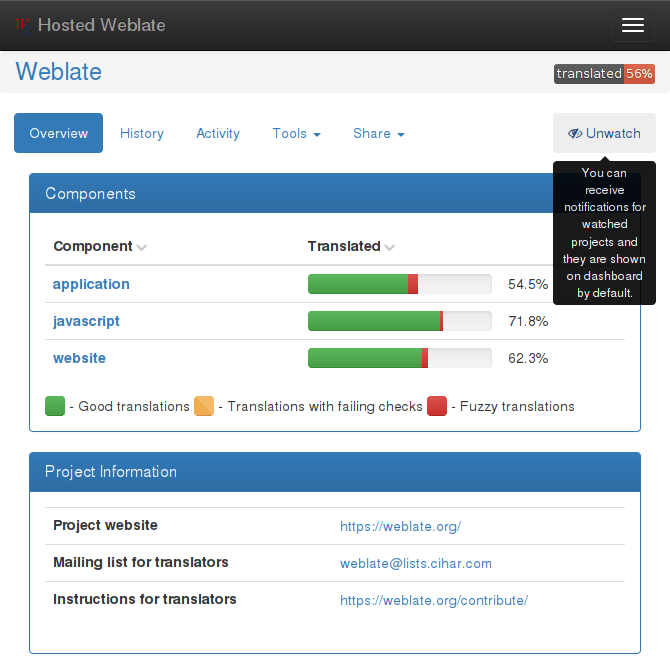
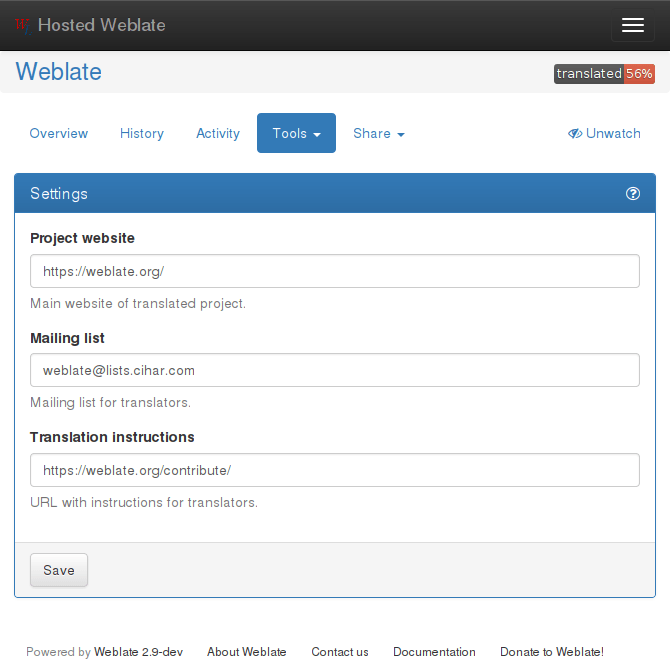
Today, new version has been deployed on Hosted Weblate. It brings many long requested features and enhancements. Adding project to watched got way simpler, you can now do it on the project page using watch button: Watch project Another feature which will be liked by project admins is that they can now change project metadata without contacting me. This works for both project and component level: Project settings And adding some fancy things, there is new badge showing status of translations into all languages. This is how it looks for Weblate itself: Translation status As you can see it can get pretty big for projects with many translations, but you get complete picture of the translation status in it. You can find all these features in upcoming Weblate 2.9 which should be released next week. Complete list of changes in Weblate 2.9 is described in our documentation.
Filed under: Debian English phpMyAdmin SUSE Weblate 0 comments

Jaldhar Vyas: Aaargh gcc 5.x You Suck

Aaargh gcc 5.x You Suck I had to write a quick program today which is going to be run many thousands of times a day so it has to run fast. I decided to do it in c++ instead of the usual perl or javascript because it seemed appropriate and I've been playing around a lot with c++ lately trying to update my knowledge of its' modern features. So 200 LOC later I was almost done so I ran the program through valgrind a good habit I've been trying to instill. That's when I got a reminder of why I avoid c++.

==37698== HEAP SUMMARY:
==37698==     in use at exit: 72,704 bytes in 1 blocks
==37698==   total heap usage: 5 allocs, 4 frees, 84,655 bytes allocated
==37698== 
==37698== LEAK SUMMARY:
==37698==    definitely lost: 0 bytes in 0 blocks
==37698==    indirectly lost: 0 bytes in 0 blocks
==37698==      possibly lost: 0 bytes in 0 blocks
==37698==    still reachable: 72,704 bytes in 1 blocks
==37698==         suppressed: 0 bytes in 0 blocks
One of things I've learnt which I've been trying to apply more rigorously is to avoid manual memory management (news/deletes.) as much as possible in favor of modern c++ features such as std::unique_ptr etc. By my estimation there should only be three places in my code where memory is allocated and none of them should leak. Where do the others come from? And why is there a missing free (or delete.) Now the good news is that valgrind is saying that the memory is not technically leaking. It is still reachable at exit but that's ok because the OS will reclaim it. But this program will run a lot and I think it could still lead to problems over time such as memory fragmentation so I wanted to understand what was going on. Not to mention the bad aesthetics of it. My first assumption (one which has served me well over the years) was to assume that I had screwed up somewhere. Or perhaps it could some behind the scenes compiler magic. It turned out to be the latter -- sort of as I found out only after two hours of jiggling code in different ways and googling for clues. That's when I found this Stack Overflow question which suggests that it is either a valgrind or compiler bug. The answer specifically mentions gcc 5.1. I was using Ubuntu LTS which has gcc 5.4 so I have just gone ahead and assumed all 5.x versions of gcc have this problem. Sure enough, compiling the same program on Debian stable which has gcc 4.9 gave this...

==6045== 
==6045== HEAP SUMMARY:
==6045==     in use at exit: 0 bytes in 0 blocks
==6045==   total heap usage: 3 allocs, 3 frees, 10,967 bytes allocated
==6045== 
==6045== All heap blocks were freed -- no leaks are possible
==6045== 
...Much better. The executable was substantially smaller too. The time was not a total loss however. I learned that valgrind is pronounced val-grinned (it's from Norse mythology.) not val-grind as I had thought. So I have that going for me which is nice.

Russ Allbery: Review: Lord of Emperors

Review: Lord of Emperors, by Guy Gavriel Kay
Series: Sarantine Mosaic #2
Publisher: Eos
Copyright: 2000
Printing: February 2001
ISBN: 0-06-102002-8
Format: Mass market
Pages: 560
Lord of Emperors is the second half of a work that began with Sailing to Sarantium and is best thought of as a single book split for publishing reasons. You want to read the two together and in order. As is typical for this sort of two-part work, it's difficult to review the second half without spoilers. I'll be more vague about the plot and the characters than normal, and will mark one bit that's arguably a bit of a spoiler (although I don't think it would affect the enjoyment of the book). At the end of Sailing to Sarantium, we left Crispin in the great city, oddly and surprisingly entangled with some frighteningly powerful people and some more mundane ones (insofar as anyone is mundane in a Guy Gavriel Kay novel, but more on that in a bit). The opening of Lord of Emperors takes a break from the city to introduce a new people, the Bassanids, and a new character, Rustem of Karakek. While Crispin is still the heart of this story, the thread that binds the entirety of the Sarantine Mosaic together, Rustem is the primary protagonist for much of this book. I had somehow forgotten him completely since my first read of this series many years ago. I have no idea how. I mentioned in my review of the previous book that one of the joys of reading this series is competence porn: watching the work of someone who is extremely good at what they do, and experiencing vicariously some of the passion and satisfaction they have for their work. Kay's handling of Crispin's mosaics is still the highlight of the series for me, but Rustem's medical practice (and Strumosus, and the chariot races) comes close. Rustem is a brilliant doctor by the standards of the time, utterly frustrated with the incompetence of the Sarantine doctors, but also weaving his own culture's belief in omens and portents into his actions. He's more reserved, more laconic than Crispin, but is another character with focused expertise and a deep internal sense of honor, swept unexpectedly into broader affairs and attempting to navigate them by doing the right thing in each moment. Kay fills this book with people like that, and it's compelling reading. Rustem's entrance into the city accidentally sets off a complex chain of events that draws together all of the major characters of Sailing to Sarantium and adds a few more. The stakes are no less than war and control of major empires, and here Kay departs firmly from recorded history into his own creation. I had mentioned in the previous review that Justinian and Theodora are the clear inspirations for this story; that remains true, and many other characters are easy to map, but don't expect history to go here the way that it did in our world. Kay's version diverges significantly, and dramatically. But one of the things I love the most about this book is its focus on the individual acts of courage, empathy, and ethics of each of the characters, even when those acts do not change the course of empires. The palace intrigue happens, and is important, but the individual acts of Kay's large cast get just as much epic narrative attention even if they would never appear in a history book. The most globally significant moment of the book is not the most stirring; that happens slightly earlier, in a chariot race destined to be forgotten by history. And the most touching moment of the book is a moment of connection between two people who would never appear in history, over the life of a third, that matters so much to the reader only because of the careful attention to individual lives and personalities Kay has shown over the course of a hundreds of pages. A minor spoiler follows in the next paragraph, although I don't think it affects the reading of the book. One brilliant part of Kay's fiction is that he doesn't have many villains, and goes to some lengths to humanize the actions of nearly everyone in the book. But sometimes the author's deep dislike of one particular character shows through, and here it's Pertennius (the clear analogue of Procopius). In a way, one could say the entirety of the Sarantine Mosaic is a rebuttal of the Secret History. But I think Kay's contrast between Crispin's art (and Scortius's, and Strumosus's) and Pertennius's history has a deeper thematic goal. I came away from this book feeling like the Sarantine Mosaic as a whole stands in contrast to a traditional history, stands against a reduction of people to dates and wars and buildings and governments. Crispin's greatest work attempts to capture emotion, awe, and an inner life. The endlessly complex human relationships shown in this book running beneath the political events occasionally surface in dramatic upheavals, but in Kay's telling the ones that stay below the surface are just as important. And while much of the other art shown in this book differs from Crispin's in being inherently ephemeral, it shares that quality of being the art of life, of complexity, of people in dynamic, changing, situational understanding of the world, exercising competence in some area that may or may not be remembered. Kay raises to the level of epic the bits of history that don't get recorded, and, in his grand and self-conscious fantasy epic style, encourages the reader to feel those just as deeply as the ones that will have later historical significance. The measure of people, their true inner selves, is often shown in moments that Pertennius would dismiss and consider unworthy of recording in his history. End minor spoiler. I think Lord of Emperors is the best part of the Sarantine Mosaic duology. It keeps the same deeply enjoyable view of people doing things they are extremely good at while correcting some of the structural issues in the previous book. Kay continues to use a large cast, and continues to cut between viewpoint characters to show each event from multiple angles, but he has a better grasp of timing and order here than in Sailing to Sarantium. I never got confused about the timeline, thanks in part to more frequent and more linear scene cuts. And Lord of Emperors passes, with flying colors, the hardest test of a novel with a huge number of viewpoint characters: when Kay cuts to a new viewpoint, my reaction is almost always "yes, I wanted to see what they were thinking!" and almost never "wait, no, go back!". My other main complaint about Sailing to Sarantium was the treatment of women, specifically the irresistibility of female sexual allure. Kay thankfully tones that down a lot here. His treatment of women is still a bit odd one notices that five women seem to all touch the lives of the same men, and little room is left for Platonic friendship between the genders but they're somewhat less persistently sexualized. And the women get a great deal of agency in this book, and a great deal of narrative respect. That said, Lord of Emperors is also emotionally brutal. It's beautifully done, and entirely appropriate to the story, and Kay does provide a denouement that takes away a bit of the sting. But it's still very hard to read in spots if you become as invested in the characters and in the world as I do. Kay is writing epic that borders on tragedy, and uses his full capabilities as a writer to make the reader feel it. I love it, but it's not a book that I want to read too often. As with nearly all Kay, the Sarantine Mosaic as a whole is intentional, deliberate epic writing, wearing its technique on its sleeve and making no apologies. There is constant foreshadowing, constant attempts to draw larger conclusions or reveal great principles of human nature, and a very open, repeated stress on the greatness and importance of events while they're being described. This works for me, but it doesn't work for everyone. If it doesn't work for you, the Sarantine Mosaic is unlikely to change your mind. But if you're in the mood for that type of story, I think this is one of Kay's best, and Lord of Emperors is the best half of the book. Rating: 10 out of 10

Gunnar Wolf: On the results of vote "gr_private2"

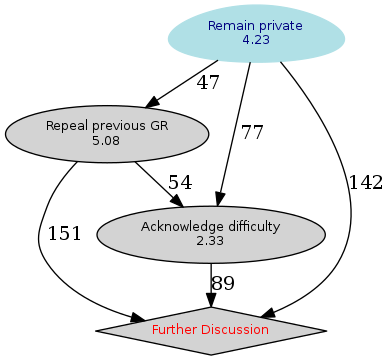
Given that I started the GR process, and that I called for discussion and votes, I feel somehow as my duty to also put a simple wrap-around to this process. Of course, I'll say many things already well-known to my fellow Debian people, but also non-debianers read this. So, for further context, if you need to, please read my previous blog post, where I was about to send a call for votes. It summarizes the situation and proposals; you will find we had a nice set of messages in debian-vote@lists.debian.org during September; I have to thank all the involved parties, much specially to Ian Jackson, who spent a lot of energy summing up the situation and clarifying the different bits to everyone involved. So, we held the vote; you can be interested in looking at the detailed vote statistics for the 235 correctly received votes, and most importantly, the results: Results for gr_private2 First of all, I'll say I'm actually surprised at the results, as I expected Ian's proposal (acknowledge difficulty; I actually voted this proposal as my top option) to win and mine (repeal previous GR) to be last; turns out, the winner option was Iain's (remain private). But all in all, I am happy with the results: As I said during the discussion, I was much disappointed with the results to the previous GR on this topic And, yes, it seems the breaking point was when many people thought the privacy status of posted messages was in jeopardy; we cannot really compare what I would have liked to have in said vote if we had followed the strategy of leaving the original resolution text instead of replacing it, but I believe it would have passed. In fact, one more surprise of this iteration was that I expected Further Discussion to be ranked higher, somewhere between the three explicit options. I am happy, of course, we got such an overwhelming clarity of what does the project as a whole prefer. And what was gained or lost with this whole excercise? Well, if nothing else, we gain to stop lying. For over ten years, we have had an accepted resolution binding us to release the messages sent to debian-private given such-and-such-conditions... But never got around to implement it. We now know that debian-private will remain private... But we should keep reminding ourselves to use the list as little as possible. For a project such as Debian, which is often seen as a beacon of doing the right thing no matter what, I feel being explicit about not lying to ourselves of great importance. Yes, we have the principle of not hiding our problems, but it has long been argued that the use of this list is not hiding or problems. Private communication can happen whenever you have humans involved, even if administratively we tried to avoid it. Any of the three running options could have won, and I'd be happy. My #1 didn't win, but my #2 did. And, I am sure, it's for the best of the project as a whole.
24 October 2016

Reproducible builds folks: Reproducible Builds: week 78 in Stretch cycle

What happened in the Reproducible Builds effort between Sunday October 16 and Saturday October 22 2016: Media coverage Upcoming events buildinfo.debian.net In order to build packages reproducibly, you not only need identical sources but also some external definition of the environment used for a particular build. This definition includes the inputs and the outputs and, in the Debian case, are available in a $package_$architecture_$version.buildinfo file. We anticipate the next dpkg upload to sid will create .buildinfo files by default. Whilst it's clear that we also need to teach dak to deal with them (#763822) its not actually clear how to handle .buildinfo files after dak has processed them and how to make them available to the world. To this end, Chris Lamb has started development on a proof-of-concept .buildinfo server to see what issues arise. Source Reproducible work in other projects Packages reviewed and fixed, and bugs filed Reviews of unreproducible packages 99 package reviews have been added, 3 have been updated and 6 have been removed in this week, adding to our knowledge about identified issues. 6 issue types have been added: Weekly QA work During of reproducibility testing, some FTBFS bugs have been detected and reported by: diffoscope development tests.reproducible-builds.org Misc. Our poll to find a good time for an IRC meeting is still running until Tuesday, October 25st; please reply as soon as possible. We need a logo! Some ideas and requirements for a Reproducible Builds logo have been documented in the wiki. Contributions very welcome, even if simply by forwarding this information. This week's edition was written by Chris Lamb & Holger Levsen and reviewed by a bunch of Reproducible Builds folks on IRC.

Russ Allbery: Review: The Design of Everyday Things

Review: The Design of Everyday Things, by Don Norman
Publisher: Basic Books
Copyright: 2013
ISBN: 0-465-05065-4
Format: Trade paperback
Pages: 298
There are several editions of this book (the first under a different title, The Psychology of Everyday Things). This review is for the Revised and Expanded Edition, first published in 2013 and quite significantly revised compared to the original. I probably read at least some of the original for a class in human-computer interaction around 1994, but that was long enough ago that I didn't remember any of the details. I'm not sure how much impact this book has had outside of the computer field, but The Design of Everyday Things is a foundational text of HCI (human-computer interaction) despite the fact that many of its examples and much of its analysis is not specific to computers. Norman's goal is clearly to write a book that's fundamental to the entire field of design; not having studied the field, I don't know if he succeeded, but the impact on computing was certainly immense. This is the sort of book that everyone ends up hearing about, if not necessarily reading, in college. I was looking forward to filling a gap in my general knowledge. Having now read it cover-to-cover, would I recommend others invest the time? Maybe. But probably not. There are several things this book does well. One of the most significant is that it builds a lexicon and a set of general principles that provide a way of talking about design issues. Lexicons are not the most compelling reading material (see also Design Patterns), but having a common language is useful. I still remember affordances from college (probably from this book or something else based on it). Norman also adds, and defines, signifiers, constraints, mappings, and feedback, and talks about the human process of building a conceptual model of the objects with which one is interacting. Even more useful, at least in my opinion, is the discussion of human task-oriented behavior. The seven stages of action is a great systematic way of analyzing how humans perform tasks, where those actions can fail, and how designers can help minimize failure. One thing I particularly like about Norman's presentation here is the emphasis on the feedback cycle after performing a task, or a step in a task. That feedback, and what makes good or poor feedback, is (I think) an underappreciated part of design and something that too often goes missing. I thought Norman was a bit too dismissive of simple beeps as feedback (he thinks they don't carry enough information; while that's not wrong, I think they're far superior to no feedback at all), but the emphasis on this point was much appreciated. Beyond these dry but useful intellectual frameworks, though, Norman seems to have a larger purpose in The Design of Everyday Things: making a passionate argument for the importance of design and for not tolerating poor design. This is where I think his book goes a bit off the rails. I can appreciate the boosterism of someone who feels an aspect of creating products is underappreciated and underfunded. But Norman hammers on the unacceptability of bad design to the point of tedium, and seems remarkably intolerant of, and unwilling to confront, the reasons why products may be released with poor designs for their eventual users. Norman clearly wishes that we would all boycott products with poor designs and prize usability above most (all?) other factors in our decisions. Equally clearly, this is not happening, and Norman knows it. He even describes some of the reasons why not, most notably (and most difficultly) the fact that the purchasers of many products are not the eventual users. Stoves are largely sold to builders, not kitchen cooks. Light switches are laid out for the convenience of the electrician; here too, the motive for the builder to spend additional money on better lighting controls is unclear. So much business software is purchased by people who will never use it directly, and may have little or no contact with the people who do. These layers of economic separation result in deep disconnects of incentive structure between product manufacturers and eventual consumers. Norman acknowledges this, writes about it at some length, and then seems to ignore the point entirely, returning to ranting about the deficiencies of obviously poor design and encouraging people to care more about design. This seems weirdly superficial in this foundational of a book. I came away half-convinced that these disconnects of incentive (and some related problems, such as the unwillingness to invest in proper field research or the elaborate, expensive, and lengthy design process Norman lays out as ideal) are the primary obstacle in the way of better-designed consumer goods. If that's the case, then this is one of the largest, if not the largest, obstacle in the way of doing good design, and I would have expected this foundational of a book to tackle it head-on and provide some guidance for how to fight back against this problem. But Norman largely doesn't. There is some mention of this in the introduction. Apparently much of the discussion of the practical constraints on product design in the business world was added in this revised edition, and perhaps what I'm seeing is the limitations of attempting to revise an existing text. But that also implies that the original took an even harder line against poor design. Throughout, Norman is remarkably high-handed in his dismissal of bad design, focusing more on condemnation than on an investigation of why bad design might happen and what we, as readers, can learn from that process to avoid repeating it. Norman does provide extensive analysis of the design process and the psychology of human interaction, but still left me with the impression that he believes most design failures stem from laziness and stupidity. The negativity and frustration got a bit tedious by the middle of the book. There's quite a lot here that someone working in design, particularly interface design, should be at least somewhat familiar with: affordances, signifiers, the importance of feedback, the psychological model of tasks and actions, and the classification of errors, just to name a few. However, I'm not sure this book is the best medium for learning those things. I found it a bit tedious, a bit too arrogant, and weirdly unconcerned with feasible solutions to the challenge of mismatched incentives. I also didn't learn that much from it; while the concepts here are quite important, most of them I'd picked up by osmosis from working in the computing field for twenty years. In that way, The Design of Everyday Things reminded me a great deal of the Gang of Four's Design Patterns, even though it's a more readable book and less of an exercise in academic classification. The concepts presented are useful and important, but I'm not sure I can recommend the book as a book. It may be better to pick up the same concepts as you go, with the help of Internet searches and shorter essays. Rating: 6 out of 10

Daniel Silverstone: Gitano - Approaching Release - Deprecated commands

As mentioned previously I am working toward getting Gitano into Stretch. Last time we spoke about lace, on which a colleague and friend of mine (Richard Maw) did a large pile of work. This time I'm going to discuss deprecation approaches and building more capability out of fewer features. First, a little background -- Gitano is written in Lua which is a deliberately small language whose authors spend more time thinking about what they can remove from the language spec than they do what they could add in. I first came to Lua in the 3.2 days, a little before 4.0 came out. (The authors provide a lovely timeline in case you're interested.) With each of the releases of Lua which came after 3.2, I was struck with how the authors looked to take a number of features which the language had, and collapse them into more generic, more powerful, smaller, fewer features. This approach to design stuck with me over the subsequent decade, and when I began Gitano I tried to have the smallest number of core features/behaviours, from which could grow the power and complexity I desired. Gitano is, at its core, a set of files in a single format (clod) stored in a consistent manner (Git) which mediate access to a resource (Git repositories). Some of those files result in emergent properties such as the concept of the 'owner' of a repository (though that can simply be considered the value of the project.owner property for the repository). Indeed the concept of the owner of a repository is a fiction generated by the ACL system with a very small amount of collusion from the core of Gitano. Yet until recently Gitano had a first class command set-owner which would alter that one configuration value.
[gitano]  set-description ---- Set the repo's short description (Takes a repo)
[gitano]         set-head ---- Set the repo's HEAD symbolic reference (Takes a repo)
[gitano]        set-owner ---- Sets the owner of a repository (Takes a repo)
Those of you with Gitano installations may see the above if you ask it for help. Yet you'll also likely see:
[gitano]           config ---- View and change configuration for a repository (Takes a repo)
The config command gives you access to the repository configuration file (which, yes, you could access over git instead, but the config command can be delegated in a more fine-grained fashion without having to write hooks). Given the config command has all the functionality of the three specific set-* commands shown above, it was time to remove the specific commands.

Migrating If you had automation which used the set-description, set-head, or set-owner commands then you will want to switch to the config command before you migrate your server to the current or any future version of Gitano. In brief, where you had:
ssh git@gitserver set-FOO repo something
You now need:
ssh git@gitserver config repo set project.FOO something
It looks a little more wordy but it is consistent with the other features that are keyed from the project configuration, such as:
ssh git@gitserver config repo set cgitrc.section Fooble Section Name
And, of course, you can see what configuration is present with:
ssh git@gitserver config repo show
Or look at a specific value with:
ssh git@gitserver config repo show specific.key
As always, you can get more detailed (if somewhat cryptic) help with:
ssh git@gitserver help config
Next time I'll try and touch on the new PGP/GPG integration support.

Francois Marier: Tweaking Referrers For Privacy in Firefox

The Referer header has been a part of the web for a long time. Websites rely on it for a few different purposes (e.g. analytics, ads, CSRF protection) but it can be quite problematic from a privacy perspective. Thankfully, there are now tools in Firefox to help users and developers mitigate some of these problems.

Description In a nutshell, the browser adds a Referer header to all outgoing HTTP requests, revealing to the server on the other end the URL of the page you were on when you placed the request. For example, it tells the server where you were when you followed a link to that site, or what page you were on when you requested an image or a script. There are, however, a few limitations to this simplified explanation. First of all, by default, browsers won't send a referrer if you place a request from an HTTPS page to an HTTP page. This would reveal potentially confidential information (such as the URL path and query string which could contain session tokens or other secret identifiers) from a secure page over an insecure HTTP channel. Firefox will however include a Referer header in HTTPS to HTTPS transitions unless network.http.sendSecureXSiteReferrer (removed in Firefox 52) is set to false in about:config. Secondly, using the new Referrer Policy specification web developers can override the default behaviour for their pages, including on a per-element basis. This can be used both to increase or reduce the amount of information present in the referrer.

Legitimate Uses Because the Referer header has been around for so long, a number of techniques rely on it. Armed with the Referer information, analytics tools can figure out:
  • where website traffic comes from, and
  • how users are navigating the site.
Another place where the Referer is useful is as a mitigation against cross-site request forgeries. In that case, a website receiving a form submission can reject that form submission if the request originated from a different website. It's worth pointing out that this CSRF mitigation might be better implemented via a separate header that could be restricted to particularly dangerous requests (i.e. POST and DELETE requests) and only include the information required for that security check (i.e. the origin).

Problems with the Referrer Unfortunately, this header also creates significant privacy and security concerns. The most obvious one is that it leaks part of your browsing history to sites you visit as well as all of the resources they pull in (e.g. ads and third-party scripts). It can be quite complicated to fix these leaks in a cross-browser way. These leaks can also lead to exposing private personally-identifiable information when they are part of the query string. One of the most high-profile example is the accidental leakage of user searches by healthcare.gov.

Solutions for Firefox Users While web developers can use the new mechanisms exposed through the Referrer Policy, Firefox users can also take steps to limit the amount of information they send to websites, advertisers and trackers. In addition to enabling Firefox's built-in tracking protection by setting privacy.trackingprotection.enabled to true in about:config, which will prevent all network connections to known trackers, users can control when the Referer header is sent by setting network.http.sendRefererHeader to:
  • 0 to never send the header
  • 1 to send the header only when clicking on links and similar elements
  • 2 (default) to send the header on all requests (e.g. images, links, etc.)
It's also possible to put a limit on the maximum amount of information that the header will contain by setting the network.http.referer.trimmingPolicy to:
  • 0 (default) to send the full URL
  • 1 to send the URL without its query string
  • 2 to only send the scheme, host and port
or using the network.http.referer.XOriginTrimmingPolicy option (added in Firefox 52) to only restrict the contents of referrers attached to cross-origin requests. Site owners can opt to share less information with other sites, but they can't share any more than what the user trimming policies allow. Another approach is to disable the Referer when doing cross-origin requests (from one site to another). The network.http.referer.XOriginPolicy preference can be set to:
  • 0 (default) to send the referrer in all cases
  • 1 to send a referrer only when the base domains are the same
  • 2 to send a referrer only when the full hostnames match

Breakage If you try to remove all referrers (i.e. network.http.sendRefererHeader = 0, you will most likely run into problems on a number of sites, for example: The first two have been worked-around successfully by setting network.http.referer.spoofSource to true, an advanced setting which always sends the destination URL as the referrer, thereby not leaking anything about the original page. Unfortunately, the last two are examples of the kind of breakage that can only be fixed through a whitelist (an approach supported by the smart referer add-on) or by temporarily using a different browser profile.

My Recommended Settings As with my cookie recommendations, I recommend strengthening your referrer settings but not disabling (or spoofing) it entirely. While spoofing does solve many the breakage problems mentioned above, it also effectively disables the anti-CSRF protections that some sites may rely on and that have tangible user benefits. A better approach is to limit the amount of information that leaks through cross-origin requests. If you are willing to live with some amount of breakage, you can simply restrict referrers to the same site by setting:
network.http.referer.XOriginPolicy = 2
or to sites which belong to the same organization (i.e. same ETLD/public suffix) using:
network.http.referer.XOriginPolicy = 1
This prevent leaks to third-parties while giving websites all of the information that they can already see in their own server logs. On the other hand, if you prefer a weaker but more compatible solution, you can trim cross-origin referrers down to just the scheme, hostname and port:
network.http.referer.XOriginTrimmingPolicy = 2
I have not yet found user-visible breakage using this last configuration. Let me know if you find any!

23 October 2016

Vincent Sanders: Rabbit of Caerbannog

Subsequent to my previous use of American Fuzzy Lop (AFL) on the NetSurf bitmap image library I applied it to the gif library which, after fixing the test runner, failed to produce any crashes but did result in a better test corpus improving coverage above 90%

I then turned my attention to the SVG processing library. This was different to the bitmap libraries in that it required parsing a much lower density text format and performing operations on the resulting tree representation.

The test program for the SVG library needed some improvement but is very basic in operation. It takes the test SVG, parses it using libsvgtiny and then uses the parsed output to write out an imagemagick mvg file.

The libsvg processing uses the NetSurf DOM library which in turn uses an expat binding to parse the SVG XML text. To process this with AFL required instrumenting not only the XVG library but the DOM library. I did not initially understand this and my first run resulted in a "map coverage" indicating an issue. Helpfully the AFL docs do cover this so it was straightforward to rectify.

Once the test program was written and environment set up an AFL run was started and left to run. The next day I was somewhat alarmed to discover the fuzzer had made almost no progress and was running very slowly. I asked for help on the AFL mailing list and got a polite and helpful response, basically I needed to RTFM.

I must thank the members of the AFL mailing list for being so helpful and tolerating someone who ought to know better asking dumb questions.

After reading the fine manual I understood I needed to ensure all my test cases were as small as possible and further that the fuzzer needed a dictionary as a hint to the file format because the text file was of such low data density compared to binary formats.

Rabbit of Caerbannog. Death awaits you with pointy teeth
I crafted an SVG dictionary based on the XML one, ensured all the seed SVG files were as small as possible and tried again. The immediate result was thousands of crashes, nothing like being savaged by a rabbit to cause a surprise.

Not being in possession of the appropriate holy hand grenade I resorted instead to GDB and electric fence. Unlike the bitmap library crashes memory bounds issues simply did not feature in the crashes.Instead they mainly centered around actual logic errors when constructing and traversing the data structures.

For example Daniel Silverstone fixed an interesting bug where the XML parser binding would try and go "above" the root node in the tree if the source closed more tags than it opened which resulted in wild pointers and NULL references.

I found and squashed several others including dealing with SVG which has no valid root element and division by zero errors when things like colour gradients have no points.

I find it interesting that the type and texture of the crashes completely changed between the SVG and binary formats. Perhaps it is just the nature of the textural formats that causes this although it might be due to the techniques used to parse the formats.

Once all the immediately reproducible crashes were dealt with I performed a longer run. I used my monster system as previously described and ran the fuzzer for a whole week.

Summary stats
=============

Fuzzers alive : 10
Total run time : 68 days, 7 hours
Total execs : 9268 million
Cumulative speed : 15698 execs/sec
Pending paths : 0 faves, 2501 total
Pending per fuzzer : 0 faves, 250 total (on average)
Crashes found : 9 locally unique

After burning almost seventy days of processor time AFL found me another nine crashes and possibly more importantly a test corpus that generates over 90% coverage.

A useful tool that AFL provides is afl-cmin. This reduces the number of test files in a corpus to only those that are required to exercise all the code paths reached by the test set. In this case it reduced the number of files from 8242 to 2612

afl-cmin -i queue_all/ -o queue_cmin -- test_decode_svg @@ 1.0 /dev/null
corpus minimization tool for afl-fuzz by

[+] OK, 1447 tuples recorded.
[*] Obtaining traces for input files in 'queue_all/'...
Processing file 8242/8242...
[*] Sorting trace sets (this may take a while)...
[+] Found 23812 unique tuples across 8242 files.
[*] Finding best candidates for each tuple...
Processing file 8242/8242...
[*] Sorting candidate list (be patient)...
[*] Processing candidates and writing output files...
Processing tuple 23812/23812...
[+] Narrowed down to 2612 files, saved in 'queue_cmin'.

Additionally the actual information within the test files can be minimised with the afl-tmin tool. This must be run on each file individually and can take a relatively long time. Fortunately with GNU parallel one can run many of these jobs simultaneously which merely required another three days of CPU time to process. The resulting test corpus weighs in at a svelte 15 Megabytes or so against the 25 Megabytes before minimisation.

The result is yet another NetSurf library significantly improved by the use of AFL both from finding and squashing crashing bugs and from having a greatly improved test corpus to allow future library changes with a high confidence there will not be any regressions.

Next.

Previous.