Search Results: "pm"

13 July 2010

DebConf team: Debian Day at DebConf10 (Posted by Michael Schultheiss)

Debian Day will take place on the first day of DebConf10, Sunday, August 1, 2010 from 10:00 AM to 6:40 PM at Columbia University, New York City, New York. We would love to see you join us at Debian Day. Registration is required but is free. If you are not already registered for DebConf10, please send an e-mail with your intent to attend to debianday@debconf.org. Debian Day and DebConf10 are going to be great. We re looking forward to seeing you in New York on August 1! More information on Debian Day is available at DebianDay.org. the DebConf team

12 July 2010

Ross Burton: Tasks 0.18 (and 0.17)

Whilst Tasks isn't exactly under active development, I'm still maintaining it because I actually use it (unlike certain other projects, ahem). So, Tasks 0.18 is released. Tarballs and more information as usual are available at the Pimlico Project web site. In related news, we're slowly migrating over to the GNOME infrastructure. We've migrated the source code, next up is the tarballs and bugzilla.

Matthew Garrett: Power management at Plumbers

I'm running a power management track at the Linux Plumbers Conference again this November. Unlike most conferences which focus on presenting completed work, Plumbers is an opportunity to focus on unsolved problems and throw around as many half-baked solutions as you want in order to try to find one that seems to stick. The suspend/resume problem in Linux is mostly solved[1], which means that it's time for us to focus on runtime power management and quality of service.

This has been an especially interesting year in the field. We've landed the infrastructure for generic runtime power management, glued that into PCI and started implementing that at the driver level. pm_qos is being reworked to improve performance and scalability as we start seeing more drivers that need to express their own constraints. And, of course, we had the wakelock/suspend blockers conversation that didn't end in a terribly satisfactory manner, although Rafael is now working on an implementation that presents equivalent functionality with a different userspace API. Runtime full-system suspend isn't solved yet either - the current cpuidle-based solution doesn't work well on multicore systems. And maybe we could be more aggressive still by looking at reclocking more system components on the fly even if the existing interfaces don't allow that. Do we have all the hooks we need to identify which system resources are being used? Are we doing the best we can in terms of avoiding trading off performance for power savings?

So if you'd like to talk about any of these things, or if there's any other problems that you don't think have been solved yet, head on over to the call for submissions and help make sure that we can make Linux the most power-efficient OS possible.

[1] Yes, some machines are broken, but those tend to be individual weird bugs which we're gradually tracking down rather than fundamental issues in our core code, so they're not really in the scope of Plumbers

Andreas Schuldei: Spotify on Linux

After several years of only having Windows and Mac clients, we at Spotify are really excited to release a qt-based Linux desktop client. The port was quite smooth after all the work we ve done for other platforms that we ve developed (iPhone, Android, several set-top boxes with Linux, Symbian, etc).

Being the Debian shop we are, we packaged it right away and are now happy to provide the client as a deb. It is regularly auto-built and tested by all our developers working on debian (and even ubuntu) whenever they want to listen to one or more of our 8*10^6 tracks. (One lonely fedora college prepared a rpm, too! Its not up yet, though.)

Add this to your sources.list files and aptitude install spotify-client-qt to check it out:

deb http://repository.spotify.com stable non-free

There is some additional infrastructure in the package spotify-client-gnome-support (same repository) so that you can click on links to open tracks, interact with Facebook and other, useful websites etc.

As we haven t found a reliable way to display ads yet, this version is only available to Spotify Premium subscribers.

Additional information about the archive key etc can be found here: http://www.spotify.com/se/download/previews/.

10 July 2010

John Goerzen: Radios

Those of you that follow me on twitter or identi.ca know that I ve been working on my amateur radio license. This started a few weeks ago when Jacob got excited about radios, and must have infected me too. I ve been studying and learning a bit. I had called a local ham (amateur radio operator) I know from church. He gave me one of his apparently newer radios, a 1981 2m Icom IC-22U 10W unit. That was great and got me all the more interested. Then last Friday, a couple of local hams came over to check out that radio and see what repeaters I could hit with it. They discovered a handheld 5W unit could hit at least one local repeater, and this 10W unit could too. One of them also had an HF rig in his pickup, and it was fun to stand out in the driveway and listen to conversations in Michigan and Utah. That evening erased any doubt in my mind about whether or not I would become a ham and it s a bit hard to believe it was only a week ago. I had been studying for the Technician-class amateur radio license, the lowest of three levels of licensing. One of the guys that came over Friday gave me a book to study for the General license, the intermediate level. It warned me to allow a month to prepare, and here I was planning to take the exams Tuesday. I picked it up Sunday, so really got 2 days of studying in. Tuesday I drove to Independence, KS, about 2.5 hours away for the exams. I went so far primarily because the Wichita exams weren t going to be offered until mid-August and I didn t want to wait that long. I found a fun group of people in Independence. I hadn t expected to have fun taking exams, but really, I did. We visited before the exams, and they wanted to know where I was from, of course. When it was time to take the exams, I guess I sort of surprised them by already having my FRN (FCC registration number) and photo copies of my IDs with me. One of them said, You re going to have no trouble with this, are you? I took the Technician exam, checked my work carefully, and turned it in to be graded. They checked it twice and had two people looking over it before they announced I passed with all 35 questions correct. I should note at this point that I was the only person taking the exams that night. Anyhow, on to the General exam. Same drill. It was harder, of course, and I turned it in to be graded. One of them looked at the test, looked at me, put on a grave face and said, Uh oh, not one right. I knew he was joking and they announced I passed THAT one with 100% correct as well. I hadn t expected that, and neither had they. That was what I planned to do, but they said that nobody had ever walked in, taken two tests, and had a score like that and pretty much insisted I try taking the Amateur Extra exam as well. I said I haven t studied for it at all and really doubt I could pass, but eventually went ahead and took that one too. I didn t pass, but I don t think they d have wanted to let me leave without trying. After the paperwork was done, they invited me to hang around and chat with their group that was meeting next door for a bit. I did, and drove home. Then was the frustrating part of the week: waiting for my license. I can t transmit until the FCC issues my license, even though I had passed the exam. My handheld radio arrived later in the week, and of course I still couldn t do much with it. Finally the FCC posted my license late yesterday so I was able to talk to people. It s been fun and I look forward to doing more. I was able to talk to people 55 miles away while driving, and with suitable equipment at home should be able to do much more than that. Several of the people I talked to were offering me tips. I ve never seen a group of people so eager to help out someone new. It s an amazing community and I think Jacob and Oliver will enjoy it one day too.

9 July 2010

Julian Andres Klode: Nokia/Intel/Google/Canonical openness and professionality in MeeGo, Android, Ubuntu

MeeGo (Nokia/Intel): Openness does not seem to be very important for Nokia and Intel. They develop their stuff behind closed doors and then do a large code drop (once dropped, stuff gets developed in the open). In terms of professionality, it does not look much better: If you look at the meego-dev mailing list, you feel like you are in some kind of a kindergarten for open source developers Things like HTML emails and top-posting appear to be completely normal for them, they don t even follow the basic rules for emails and they also appear to ignore any advice on this topic. Oh, and writing a platform in GTK+ while pushing Qt as the supported toolset is not a good idea. Android (Google): The situation with Android appears to be even worse. Google keeps an internal development tree and the only time the public sees changes is when a new release is coming and Google does a new code drop. Such a behavior is not acceptable. Ubuntu (Canonical): Canonical does an outstanding job on openness. Canonical employees develop their software completely in the open, and there are no big code drops. They basically have no competitive advantage and allow you to use their work for your own project before they use it themselves. Canonical employees basically behave like normal free software developers doing stuff in his free time, the only exception being that they are paid for it. Most Canonical employees also know how to behave on mailing lists and do not post HTML emails or do top-posting. There are of course also other people: The design process of the Ubuntu font on the other hand is a disaster, with the font being created using proprietary software running on Windows; for a free software company, that s not acceptable (such persons should probably not be hired at all). Furthermore, the quality of Ubuntu packages is often bad when compared to the quality of a Debian package (especially in terms of API documentation of Canonical-created software); a result of vastly different development cycles and different priorities. On a scale from 0 to 15 (15 being the best), Nokia/Intel receive 5 points ( D in U.S. grades), Google receives 3 points ( F in U.S. grades), and Canonical receives 12 points ( B in U.S. grades). Please note that those grades only apply for the named projects, the companies may behave better or worse in other projects. Final tips for the companies:
Filed under: General, Ubuntu

Francois Marier: Improving the performance of Request Tracker by reducing latency

Request Tracker is a really neat support tool, but one of the common complaints I heard from people using it during a previous project was that it was pretty slow.

There wasn't much we could do about the (overloaded) server it was running on, but I found that enabling mod_deflate really helped.

After watching this great video though, I was inspired to look into it a bit more, focussing this time on latency.

Description of tests
Also note that I was looking for the "best case" for each of the different configurations and so each screenshot was taken after reloading the homepage 10-20 times to maximize cache hits (thanks in large part to mod_expires).

(Is there a nice automated way of measuring average latency?)

Stock RT 3.6Using the default apache2-modperl2 config file (as supplied by RT), here's what the homepage (logged in as root) looked like before I changed anything:


The purple section here indicates the time spent waiting for the server. This shows that the server (running Mason inside mod_perl) is doing quite a bit of processing, including a lot more work than you'd expect while serving static files. It's quite impressive to see how fast the images are being served (directly by Apache) in comparison with the Javascript and the CSS files (which go through Mason).

The reason while Javascript and CSS files have to be served by mod_perl is that they are in fact templates. They contain a few Mason variables which must be substituted before being served.

Looking into it further though, all of these replacements have to do with variables defined in RT_SiteConfig.pm (mostly the install path). Here's an example:
var path = "" ? "" : "/";
which gets turned into:
var path = "/rt" ? "/rt" : "/";
So as long as these paths don't change, then there is no need to re-generate these files.

Static Javascript and CSSThis next diagram was produced after configuring Apache to serve all Javascript and CSS files directly from Apache:


The way I did that (without modifying any of the original files) was by saving the Javascript/CSS sent to the browser and using mod_rewrite rules to serve these files instead of the original templated ones:

# Serve static files directly
RewriteRule ^/usr/share/request-tracker3.6/html/NoAuth/js/ahah.js$ /var/www/rt/ahah.js
RewriteRule ^/usr/share/request-tracker3.6/html/NoAuth/js/cascaded.js$ /var/www/rt/cascaded.js
RewriteRule ^/usr/share/request-tracker3.6/html/NoAuth/js/class.js$ /var/www/rt/class.js
RewriteRule ^/usr/share/request-tracker3.6/html/NoAuth/js/combobox.js$ /var/www/rt/combobox.js
RewriteRule ^/usr/share/request-tracker3.6/html/NoAuth/js/list.js$ /var/www/rt/list.js
RewriteRule ^/usr/share/request-tracker3.6/html/NoAuth/js/titlebox-state.js$ /var/www/rt/titlebox-state.js
RewriteRule ^/usr/share/request-tracker3.6/html/NoAuth/js/util.js$ /var/www/rt/util.js
RewriteRule ^/usr/share/request-tracker3.6/html/NoAuth/css/3.5-default/main-squished.css$ /var/www/rt/main-squished.css
RewriteRule ^/usr/share/request-tracker3.6/html/NoAuth/css/print.css$ /var/www/rt/print.css
RewriteRule ^/usr/share/request-tracker3.6/html/NoAuth/webrtfm.css$ /var/www/rt/webrtfm.css

Removing unnecessary images

Finally, one thing I noticed from this last graph is that the rounded corners in the theme require a number of small images. While these don't take a whole lot of bandwidth, they do require quite a bit of back and forth between the browser and the server.

So I replaced all of the "rounded corner" images in the main-squished.css file with the following CSS attributes:

-moz-border-radius-topleft: 8px;
-moz-border-radius-topright: 8px;
-moz-border-radius-bottomleft: 8px;
-moz-border-radius-bottomright: 8px;
-webkit-border-top-left-radius: 8px;
-webkit-border-top-right-radius: 8px;
-webkit-border-bottom-left-radius: 8px;
-webkit-border-bottom-right-radius: 8px;

(yes, Internet Explorer users probably don't get the rounded corners... oh well)

This eliminated a number of roundtrips and shaved off a few more milliseconds:


Merging CSS and Javascript filesBy this stage, the pages are pretty snappy so there is not much to be gained anymore, but I figured I'd try to reduce the latency a bit more by combining all Javascript files into one (and doing the same for CSS files with the exception of print.css). This is what I got:


(Note that I also took the opportunity to minify both squished files to reduce the filesize.)

Not a huge improvement and I unfortunately had to copy quite a few Mason templates from /usr/share/request-tracker3.6/html/ to /usr/local/share/request-tracker3.6/html/ and then replace all of the script tags with a single one in html/Elements/Header.

Others things to look intoI've stopped here, but there might be ways to further reduce the processing time on the server (hence the latency) by tuning mod_perl/Mason or Postgres. The RT wiki also has a few pointers.

Replacing Apache with Nginx (which means moving to FastCGI) was something I considered, but after trying it out, it turned out that it would add about 100ms of extra latency.

Feel free to leave a comment if you've found something else that makes a big difference on your site.

8 July 2010

Michael Banck: 8 Jul 2010

Bug-Squashing-Party in Munich We are organizing another BSP in Munich on the weekend of 17th/18th July. Like the last BSP, it will take place in the LiMux office in the city center. See the coordination page for further information and directions and in order to sign up for it. Food and drinks for the event are partly sponsored by the City of Munich and this amount (100 ) has been again matched by credativ GmbH. Contributions by non-DDs are welcome as always; the BSP will be attended by several Debian Developers who will be able to upload fixes. Attending BSPs is a great way to get involved in the Debian community! We cannot guarantee crash space to people from outside Munich at this point, so if you want to attend please contact the Munich list (area-muc@teams.debian.net) beforehand or arrange your own accomodation. We probably start the BSP at some point after 6PM on Friday evening already, but the main action will be on Saturday and Sunday. As usual, people should bring their notebooks and possibly an ethernet cable. Wireless will be present as well, but a certain bandwidth cannot be guaranteed. Bug-Squashing Introduction I also plan to give an introduction to bug-squashing at this month's Garching Debian Stammtisch, which will take place next Wednesday, July 14th in the campus-cneipe (or its beergarden) as usual (the monthly Stammtisch is always on the second Wednesday of the month). If you study/work in Garching and would like to attend the BSP, come to the Stammtisch for a tutorial (and beer)! Debian Packaging Tutorial Some time ago, I gave a tutorial on Debian packaging in the TechTalk series of the Open-Source- School. The audience seemed to be pleased with the talk, and as more people requested to attend than there were seats in the room, we decided to reprise the event on September 7th. Attendence is free, but you have to register (see the event page). There are still some places left at this point.

Aigars Mahinovs: Phoning it in

Currently I own and use an iPhone 3G. I bought it almost two years ago, when the local phone provider LMT started offering the iPhone legally. I had a pretty good experience with it most of the time, but now it is showing its age: I will try to send my iPhone in for repair hoping to extend its usefulness, but frankly it looks that I might have to get a new phone at or before Debconf. So I am considering my options for a new phone and so far I have 3 main options each with some sub-options. The main options are: iPhone 4, MeeGo and Android. Each choice has its benefits and drawbacks and each also has several sub-options related either to specific phone models or to purchase methods. What I need is a phone with: calling function, contact information synchronised to Google, support for Google Mail/Contacts/Calendar simultaneously with one Exchange account also providing mail/contacts/calendars, music, audiobooks saving my place in the audio book and in the list of books, fully featured Twitter client with Twitpic and location support, encrypted password storage application (preferably open source), GPS with maps, ability to download maps for offline use, Geocaching support with offline cache info and logging, Skype client, ability to write in Latvian, English and Russian in all applications, reliable backup and restore of phones data including settings and data of installed apps. Optional features: last.fm streaming and reporting support, ebook applications with purchasable ebooks, high quality video and photo recording (for a phone), ability for me to write applications on the phone, ssh client, wireless data upload to the phone, ability to change the phones battery without loosing data in the phone (on the go), compass, physical keyboard, confidence in getting software upgrades and developer interest for the next 2 years. I ll try to describe all of the options here to organise my thoughts and maybe also help someone else make the choice. Option 1: iPhone 4 To get the iPhone 4 I have two options: LMT and unlocked. The official arrival of iPhone 4 to Latvia is expected in September and it will likely be sold by LMT for the same prices as iPhone 3GS is now. If I choose this scenario, I will need to survive with my semi-broken iPhone for 2-3 more months. Total price over 2 years (LVL): 131 (purchase price) + 24 * 8 (surcharge) = 323 LVL. Note: the surcharge is the extra cost of the iPhone call plan compared to a comparable regular plan (Vien dais 7 + Internets telefon 5). If I go and purchase an unlocked iPhone 4 in a country where such units are sold (UK is the most easily accessible choice, because a few of my workmates travel weekly to and from UK) then the total price over 2 years would be the purchase price: 499 GBP + 65 GBP (2 year warranty extension) = 505 LVL Now lets go over the general benefits and downsides of the iPhone 4, first the positives: Drawbacks: Option 2: Maemo/MeeGo Some of my colleagues at work (in the Riga office of Accenture) have N900 phones and I have been exposed to people with raw enthusiasm towards the Maemo platform ever since the Debconf in Helsinki, where we saw the first N700 devices in the hands of some lucky Debian/Nokia people using it as an Internet tablet. N900 has been a strong leap forward for the platform, before its head was teleported sideways by the whole MeeGo merger/debackle. Again I have two options here: Get a N900 either here in Latvia for 325 LVL (that would be the total cost over 2 years) or get it from USA during Debconf for 399 USD (+129 USD for 2 year warranty) = 317 LVL. And additional option would be to wait until October/November and then buy the new Nokia MeeGo device, rumoured to be N9-00 and likely to be around the same price as N900 was when it was introduced (around 500 LVL). Benefits: Drawbacks: Option 3 Android After looking trough the options for Android phones, I ve narrowed the selection to the ones that are either available from local carriers or can be easily gotten unlocked also the phones need to have announced plans to have at least Android 2.2 version. Currently the choice is limited to HTC Desire (from carrier or unlocked) and Samsung Galaxy S (unlocked). The prices over 2 years break down as follows: HTC Desire (locked to LMT): 69 + 9*24 = 285 LVL
HTC Desire (locked to Bite): 199 + 2*24 = 247 LVL (Note: only 500Mb of data per month available)
HTC Desire (locked to Tele2): 179 + 6*24 = 323 LVL
Note: all the above options would also require me to pay a 45 LVL early termination fee on my current iPhone contract if I choose to do this before September.
HTC Desire (unlocked): 311 LVL
Samsung Galaxy S (unlocked): 350 LVL (import from Germany) Benefits: Drawbacks: Please correct me if I am wrong with something!!! And also it would be cool if you expressed your own opinions in the comments. Currently I am very undecided about what I am going to do, but after completing this entry I am leaning towards an unlocked HTC Desire. Update:
Olivier Cr te shares a N900 vs. Nexus One experience Edit 01-07-2010: Handed my iPhone in for a warranty repair, got a dumbphone Nokia as a loaner during repairs. Very surprised about how long a battery can last on a low powered and cheap phone. In the mean time from all the comments here and elsewhere I am starting to see that I am too annoyed with the iPhone platform (mostly iTunes) to stay there and that I am also not convinced in the direction MeeGo is going (a lot of community developers are annoyed and are jumping ship), so N900 is also out. I will need to see 2-3 MeeGo smartphones and also see how Nokia will treat their smartphone users and developers on this platform, in the long term, before I ll be ready to trust them with my money. Therefore, my choice is becoming pretty clear look for the best Android phone (after my iPhone dies). We have this thing at Accenture, where we can get company phones at a discount and HTC Desire is on that list. If I can get that, it would slash 100 LVL (almost a third of the price!) off it, but to get there I either need to get a promotion (rather rare after just one year with the company) or prove the necessity of the phone for the needs of my project (kinda hard currently). Well, the situation will be a bit clearer next week when I get my iPhone back. (Apparently the Latvia s largest holiday Midsummer Festivities or J i/L go with tons of traditional outdoor activities, caused a lot of phones to become broken and there is a backlog of warranty service :) ) So at this point my plan is: get my iPhone repaired and get a promotion or a project where I can justify a company-paid HTC Desire and then hope that Nokia/Intel really get their stuff together and make MeeGo a great smartphone platform over the next year or two. Update: Got my iPhone 3G back from the warranty . It is in quotes because they just gave me a new iPhone 3G. The battery lasts for 3 days of minimal use and it has not crashed yet. The recovery process was a pain again caused by iTunes: iTunes refused to restore my backup onto the new phone, because my backup was made on a iOS 4.0, while the new phone I got from the warranty has 3.1.3 on it. So I had to set this phone as a new phone, initialise it, make a backup, upgrade to 4.0, restore from the (empty) backup, then reset the phone to factory settings again and only then I could start restoring data from my original (pre-warranty) backup and start copying my data on to the device. All in all it took nearly 3 hours if iTunes doing something and almost a dozen reboots of the phone. Almost half of that time was spent doing completely unnecessary steps to work around the fact that iTunes is braindead. I ll continue using my iPhone for now, keeping my eyes on the newest Android phones and also waiting for the long-promised first MeeGo phone from Nokia.

Michael Prokop: Report from FAI developer workshop 07/2010

Last weekend (2010-07-02 2010-07-04) nine people met at the FAI developer workshop at Linuxhotel in Essen/Germany. If you can t remember: FAI is a non-interactive system to install, customize and manage Linux systems and software configurations on computers as well as virtual machines and chroot environments, from small networks to large-scale infrastructures and clusters. The participants of the FAI meeting: picture of participants of the FAI developer workshop 2010 second row from left to right: Michael Goetze, Michael Prokop, Andreas Schuldei
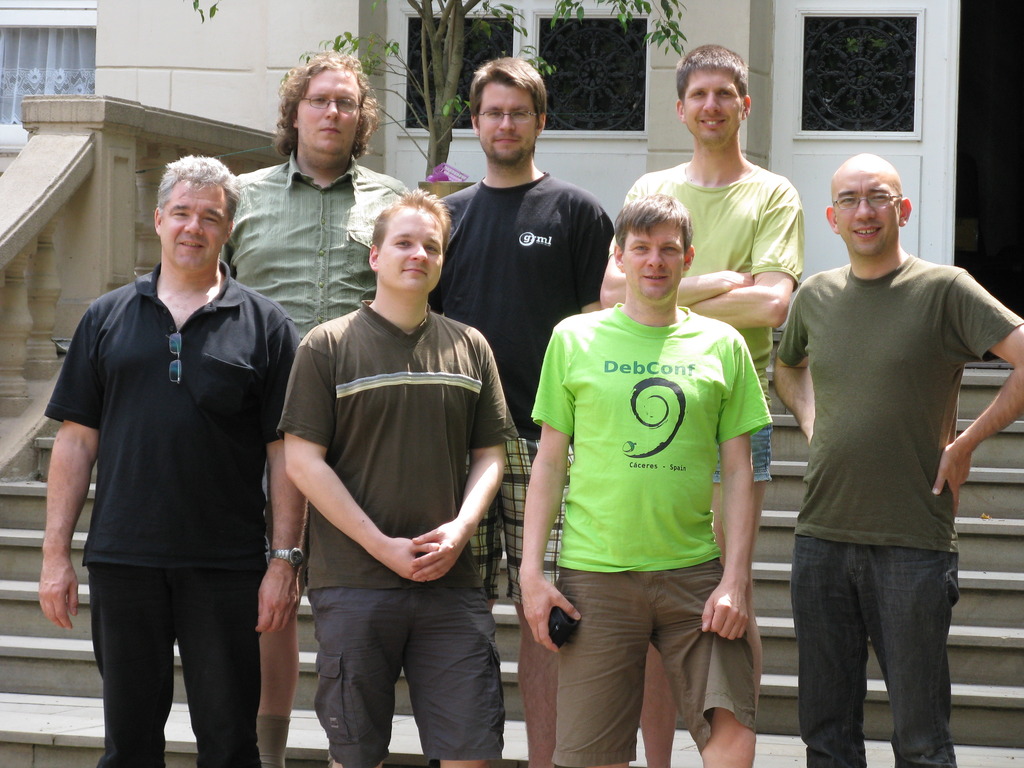
first row from left to right: Sebastian Hetze, Manuel Hachtkemper, Thomas Lange, Mattias Jansson
missing on the picture: Thomas Neumann (left on sunday midday) and Stephan Hermann (only part-time) Friday afternoon started with getting to know each other, continuing with discussions all around FAI. On saturday we started to hack on FAI. * Between the hack sessions and discussions the attending people presented their FAI usage and approaches. Some notes from the presentations:
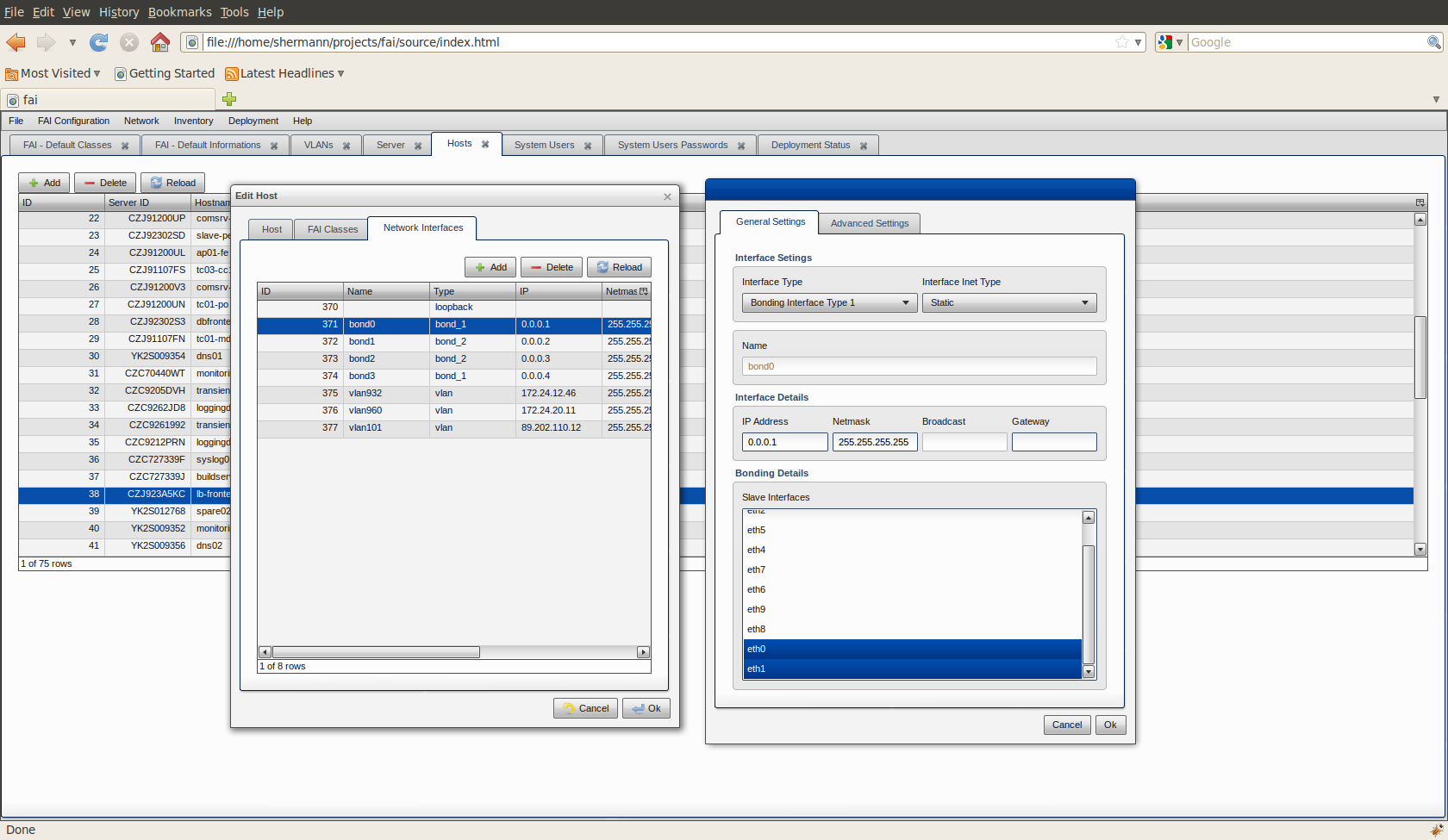
FAI Manager webfrontend / Stephan Hermann Stephan \sh Hermann presented his FAI web frontend which should be released under the GPL license in those days. The frontend uses qooxdoo whereas the backend is based on django, rpc4django and python-tftpy. Screenshot of FAI manager webfrontend A demo video is available at blip.tv. Currently Stephan is searching for a nice name for his FAI management tool please send suggestions either to him or to the linux-fai-devel mailinglist. Grml / Michael Prokop Grml is a Debian based Linux live system specially made for system administrators. Grml uses grml-live for building the ISOs, whereas grml-live itself uses FAI s dirinstall feature to build the live system. This provides the Grml team with a nice way to autobuild 18 ISOs per day, known as daily.grml.org. Mika also presented Grml s netscript bootoption and the ethdevice bootoption of live-initramfs which is useful for booting Grml/FAI via PXE. Host Europe / Michael Goetze Host Europe uses FAI for installing Debian and Ubuntu (32+64 bit) in the support center. They have ~20 FAI classes and use a Debian lenny NFSROOT as base for all deployed systems. Their main problems with FAI aren t related to FAI itself, but instead e.g. broadcom NICs with lack of support for it in Lenny s kernel. They are not using softupdate (yet) and currently use Kickstart for deploying CentOS but are working on deploying CentOS with FAI as well. LIS AG / Sebastian Hetze Linux Information Systems AG (LIS AG) are using FAI 3.2.17 and provide a luma and PyQt based GUI to their customers. They use DHCP, LDAP and DDNS for inventory, configuration and deployment. Mathematical Institute of the University of Bonn / Manuel Hachtkemper The Mathematical Institute of the University of Bonn uses FAI 3.1.8 and 3.3.5 for managing ~150 systems. They are automatically running softupdates every day, reporting how many hosts actually did run the softupdate and how many didn t run. The involved failogwatch tool supports two regex files, one for excluding specific hosts and the other one for grepping for known problems in the logs. Spotify / Andreas Schuldei + Mattias Jansson Spotify is a peer-to-peer music streaming service and the operating people at Spotify use FAI for deploying the systems. Currently they are using FAI 3.3.3 to deploy ~400 bare metal machines and ~150 virtualised machines. They have their class names in DNS using the txt/Text record entry. They are using a self written prepend_class script to manage dependencies between classes. University K ln / Thomas Lange Thomas uses FAI s trunk version (of course :) ), managing ~25 machines with less than 20 FAI classes. He s not using softupdates as Lenny s aptitude ignores the hold status of packages (this bug should be fixed for Squeeze). $COMPANY One of the big telecommunication providers in Germany uses FAI 3.3.3 for installing their bare-metal and virtual servers, providing Debian, Ubuntu and SLES. They are using Debian NFSROOT as a base for all systems as well and their main problems with FAI wasn t FAI itself but how to manage installation of virtual machines.
On Saturday evening we had a nice barbecue which included beer and K lsch *d&r*. ;) On Sunday we continued with discussions and development. Our work-log of the weekend: Important decisions made: We noticed that many FAI users implement their own way how to handle dependency management between classes, we will re-consider how we could provide such a mechanism through FAI s core. We also noted that it s important that any self-written scripts used within FAI are fully idempotent and users should be aware of this. Last but not least many thanks to the sponsors of the FAI developer workshop 07/2010! The workshop wouldn t have been possible without our generous sponsors, namely being:

7 July 2010

Clint Adams: Lack of proper shame

Some time ago, someone posted to a development mailing list about a piece of code, Cc:ing some people who had modified the code in recent past. Within hours, the original author replied to complain about not being Cc'd. Several thoughts went through my mind: This is Free Software, and people are motivated by all kinds of factors. Some bad reasons include Looking at it through an Open Source lens, all these bad reasons are good reasons. For whatever motives, people are getting work done and accomplishing things. Of course, there are always an irritating number of hangers-on, and people who do not actually achieve much but are filled with such self-importance that they believe they deserve to be highly influential through sheer force of will, and the majority of the Community will concede this influence to them due to a variety of flaws in the Human Condition, but I digress. It would be nice if everyone had motives that were pure and good, especially since at least 90% of problems in Free Software projects are due to ego issues, but when the world works, the world works. So I am happy to get code contributions for whatever reason (assuming there are no strings attached). The problem I have is when people insist that their bad reasons are legitimate and should be catered to and accommodated by others.

6 July 2010

Gregor Herrmann: I'm going to DebConf10

Im going to DebConf10

finally I bought my airplane tickets. at cheaptickets.com & for the first time in my life in USD :)


Leave Sunday, July 25, 2010

British Airways 951 Economy Airbus Industrie A320 (320) 2hr 5min 575 miles
Depart: 12:55pm Munich, Germany Munich Franz Josef Strauss (MUC)
Arrive: 2:00pm London, United Kingdom London Heathrow (LHR)

British Airways 189 Economy Boeing 777 (777) 7hr 45min 3458 miles
Depart: 3:35pm London, United Kingdom London Heathrow (LHR)
Arrive: 6:20pm Newark, NJ Newark Liberty Int'l (EWR)


Return Saturday, August 14, 2010

British Airways 186 Economy Boeing 767 Passenger (767) 7hr 15min 3458 miles
Depart: 10:55pm Newark, NJ Newark Liberty Int'l (EWR)
Arrive: 11:10am London, United Kingdom London Heathrow (LHR)

British Airways 952 Economy Airbus Industrie A319 (319) 1hr 55min 575 miles
Depart: 12:45pm London, United Kingdom London Heathrow (LHR)
Arrive: 3:40pm Munich, Germany Munich Franz Josef Strauss (MUC)

Matt Zimmerman: We ve packaged all of the free software what now?

Today, virtually all of the free software available can be found in packaged form in distributions like Debian and Ubuntu. Users of these distributions have access to a library of thousands of applications, ranging from trivial to highly sophisticated software systems. Developers can find a vast array of programming languages, tools and libraries for constructing new applications. This is possible because we have a mature system for turning free software components into standardized modules (packages). Some software is more difficult to package and maintain, and I m occasionally surprised to find something very useful which isn t packaged yet, but in general, the software I want is packaged and ready before I realize I need it. Even the long tail of niche software is generally packaged very effectively. Thanks to coherent standards, sophisticated management tools, and the principles of software freedom, these packages can be mixed and matched to create complete software stacks for a wide range of devices, from netbooks to supercomputing clusters. These stacks are tightly integrated, and can be tested, released, maintained and upgraded as a unit. The Debian system is unparalleled for this purpose, which is why Ubuntu is based on it. The vision, for a free software operating system which is highly modular and customizable, has been achieved. Rough edges This is a momentous achievement, and the Debian packaging system fulfills its intended purpose very well. However, there are a number of areas where it introduces friction, because the package model doesn t quite fit some new problems. Most of these are becoming more common over time as technology evolves and changes shape. Why are we stuck?
I suppose it is tempting, if the only tool you have is a hammer, to treat everything as if it were a nail.
Abraham Maslow
The packaging ecosystem is very strong. Not only do we have powerful tools for working with packages, we also benefit from packages being a well-understood concept, and having established processes for developing, exchanging and talking about them. Once something is packaged, we know what it is and how to work with it, and it fits into everything else. So, it is tempting to package everything in sight, as we already know how to make sense of packages. However, this may not always be the right tool for the job. Various attempts have been made to extend the packaging concept to make it more general, for example: Other package managers aim to solve a specific problem, such as providing lightweight package management for embedded systems, or lazy dependency installation, or fixing the filesystem hierarchy. There is a long list of package managers of various levels which solve different problems. Most of these systems suffer from an important fundamental tradeoff: they are designed to manage the entire system, from the kernel through applications, and so they must be used wholesale in order to reap their full benefit. In other words, in their world, everything is a package, and anything which is not a package is out of scope. Therefore, each of these systems requires a separate collection of packages, and each time we invent a new one, its adherents set about packaging everything in the new format. It takes a very long time to do this, and most of them lose momentum before a mature ecosystem can form around them. This lock-in effect makes it difficult for new packaging technologies to succeed. Divide and Conquer No single package management framework is flexible enough to accommodate all of the needs we have today. Even more importantly, a generic solution won t account for the needs we will have tomorrow. I propose that in order to move forward, we must make it possible to solve packaging problems separately, rather than attempting to solve them all within a single system. But I like things how they are! We don t have a choice. The world is changing around us, and distributions need to evolve with it. If we don t adapt, we will eventually give way to systems which do solve these problems. Take, for example, modern web browsers like Firefox and Chromium. Arguably the most vital application for users, the browser is coming under increasing pressure to keep up with the breakneck pace of innovation on the web. The next wave of real-time collaboration and multimedia applications relies on the rapid development of new capabilities in web browsers. Browser makers are responding by accelerating deployment in the field: both aggressively push new releases to their users. A report from Google found that Chrome upgrades 97% of their users within 21 days of a new release, and Firefox 85% (both impressive numbers). Mozilla recently changed their maintenance policies, discontinuing maintenance of stable releases and forcing Ubuntu to ship new upstream releases to users. These applications are just the leading edge of the curve, and the pressure will only increase. Equally powerful trends are pressing server applications, embedded systems, and data to adapt as well. The ideas I ve presented here are only one possible way forward, and I m sure there are more and better ideas brewing in distribution communities. I m sure that I m not the only one thinking about these problems. Whatever it looks like in the end, I have no doubt that change is ahead.

C.J. Adams-Collier: blog optimizations

Thanks to some recommendations from Jeremy, Pierre and Jeff, this blog should be running a lot less slowly. I ve installed memcached, set up wordpress plugins, tuned apache MPM parameters, tweaked iptables and tc rules and beaten on the blog with load testing scripts. It seems that it will now reliably handle around 10 concurrent requests and take less than 5 seconds to bring the page up. This is much better than the previous <2r/s 20s load time. I m no amazon.com (thank goodness), but I think this will meet the blog s needs quite well.

5 July 2010

Thorsten Glaser: LSM/RMLL; mksh R40, R41 plans

The current version of mksh had use of arc4random(3) removed, including set -o arc4random , to speed it up (on some architectures, a lot) this will break some existing scripts (such as /etc/rc *cough* on MirBSD ). Hence I decided to publish the next version of mksh(1) as R40 based upon current development, and defer plans for associative arrays (and multidimensional arrays) for mksh R41. There s also already the change to Build.sh arguments, so this suits me quite fine. (Read: if running MirBSD, don t upgrade mksh at the moment.) There will be a new MirBSD snapshot once this is fixed, maybe a few more changes to the shell for better POSuX compliance, and the recently mentioned patent on LFNs (long filename) in FAT will be taken into account with a patch to msdosfs. I ll travel to LSM/RMLL 2010, the Libre Software Meeting (Rencontres Mondiales du Logiciel Libre) tomorrow until the weekend, to hack some on FusionForge (this is worktime for me), visit XTaran, Uriel, and maybe a couple of other usual people . Thundersday, between 10:00 UTC and 12:00 UTC, eurynome will be shut down by gecko2@ due to power supply maintenance on the host system data centre. We have a new mirror in the Americas, thanks a lot to Mike 'Fuzzy' Partin! Benny will mention it on the webpages once it s working.

4 July 2010

Bernd Zeimetz: gimp-plugin-registry 3.5-1

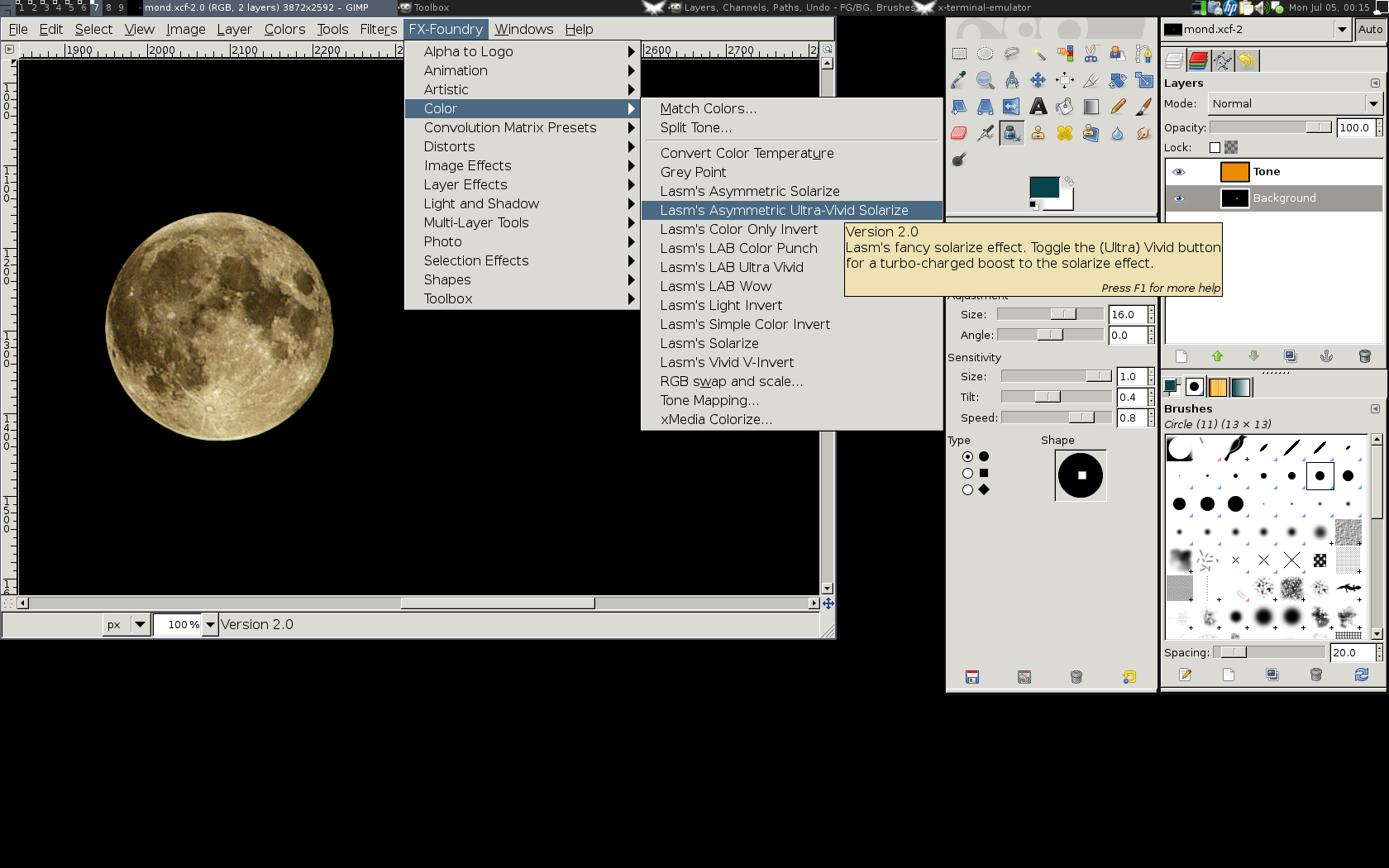
During the last three months and since my last blog-post about gimp-plugin-registry a lot happened: Mainly a large number of new plugins was added, but also various enhancements and bugfixes went into the package, together with updates for various already included plugins. The GIMP screenshot with open FX-Foundry menu For those who don't know gimp-plugin-registry yet, it is a collection of scripts and plugins for The GIMP. The name is based on the webpage GIMP Plugin Registry, where most (new) plugins and scripts are listed. So far the package ships with 170 scripts/plugins. Most of the scripts are written in TinyScheme, but there are also several plugins in C or Python. Probably most noticeable is the inclusion of the GIMP FX Foundry, which is an awesome collection of 124 scripts. Below follows a list of all scripts and plugins as shown in the long description of the Debian package. New plugins are marked with a bold fontface. If there is any interest from other distributions to include the package, I'd be happy to help out to make an integration as easy as possible. The few interesting parts could be ripped out of debian/rules and shipped as a normal Makefile, so they could be used easily. More complicated is the generation of the package description and copyright information, but I guess instead of writing debian/coyright and debian/control, it should be possible to integrate the information into a rpm spec file template or similar files. So in case you're interested to port the package to Fedora, OpenSuSE or some other distribution, don't hesitate to contact me! The sources are available via git, see git.recluse.de for details. For wishes, suggestions and bug reports either use the Debian BTS or Launchpad. While I prefer bugs via the BTS, it might be easier for non-Debian users to file bugs in the Ubuntu Launchpad.
3 July 2010

Petter Reinholdtsen: Lenny->Squeeze upgrades, apt vs aptitude with the Gnome desktop

Here is a short update on my my Debian Lenny->Squeeze upgrade testing. Here is a summary of the difference for Gnome when it is upgraded by apt-get and aptitude. I'm not reporting the status for KDE, because the upgrade crashes when aptitude try because of missing conflicts (#584861 and #585716). At the end of the upgrade test script, dpkg -l is executed to get a complete list of the installed packages. Based on this I see these differences when I did a test run today. As usual, I do not really know what the correct set of packages would be, but thought it best to publish the difference. Installed using apt-get, missing with aptitude
at-spi cpp-4.3 finger gnome-spell gstreamer0.10-gnomevfs libatspi1.0-0 libcupsys2 libeel2-data libgail-common libgdl-1-common libgnomeprint2.2-data libgnomeprintui2.2-common libgnomevfs2-bin libgtksourceview-common libpt-1.10.10-plugins-alsa libpt-1.10.10-plugins-v4l libservlet2.4-java libxalan2-java libxerces2-java openoffice.org-writer2latex openssl-blacklist p7zip python-4suite-xml python-eggtrayicon python-gtkhtml2 python-gtkmozembed svgalibg1 xserver-xephyr zip
Installed using apt-get, removed with aptitude
bluez-utils dhcdbd djvulibre-desktop epiphany-gecko gnome-app-install gnome-mount gnome-vfs-obexftp gnome-volume-manager libao2 libavahi-compat-libdnssd1 libavahi-core5 libbind9-50 libbluetooth2 libcamel1.2-11 libcdio7 libcucul0 libcurl3 libdirectfb-1.0-0 libdvdread3 libedata-cal1.2-6 libedataserver1.2-9 libeel2-2.20 libepc-1.0-1 libepc-ui-1.0-1 libexchange-storage1.2-3 libfaad0 libgd2-noxpm libgda3-3 libgda3-common libggz2 libggzcore9 libggzmod4 libgksu1.2-0 libgksuui1.0-1 libgmyth0 libgnome-desktop-2 libgnome-pilot2 libgnomecups1.0-1 libgnomeprint2.2-0 libgnomeprintui2.2-0 libgpod3 libgraphviz4 libgtkhtml2-0 libgtksourceview1.0-0 libgucharmap6 libhesiod0 libicu38 libisccc50 libisccfg50 libiw29 libkpathsea4 libltdl3 liblwres50 libmagick++10 libmagick10 libmalaga7 libmtp7 libmysqlclient15off libnautilus-burn4 libneon27 libnm-glib0 libnm-util0 libopal-2.2 libosp5 libparted1.8-10 libpisock9 libpisync1 libpoppler-glib3 libpoppler3 libpt-1.10.10 libraw1394-8 libsensors3 libsmbios2 libsoup2.2-8 libssh2-1 libsuitesparse-3.1.0 libswfdec-0.6-90 libtalloc1 libtotem-plparser10 libtrackerclient0 libvoikko1 libxalan2-java-gcj libxerces2-java-gcj libxklavier12 libxtrap6 libxxf86misc1 libzephyr3 mysql-common swfdec-gnome totem-gstreamer wodim
Installed using aptitude, missing with apt-get
gnome gnome-desktop-environment hamster-applet python-gnomeapplet python-gnomekeyring python-wnck rhythmbox-plugins xorg xserver-xorg-input-all xserver-xorg-input-evdev xserver-xorg-input-kbd xserver-xorg-input-mouse xserver-xorg-input-synaptics xserver-xorg-video-all xserver-xorg-video-apm xserver-xorg-video-ark xserver-xorg-video-ati xserver-xorg-video-chips xserver-xorg-video-cirrus xserver-xorg-video-dummy xserver-xorg-video-fbdev xserver-xorg-video-glint xserver-xorg-video-i128 xserver-xorg-video-i740 xserver-xorg-video-mach64 xserver-xorg-video-mga xserver-xorg-video-neomagic xserver-xorg-video-nouveau xserver-xorg-video-nv xserver-xorg-video-r128 xserver-xorg-video-radeon xserver-xorg-video-radeonhd xserver-xorg-video-rendition xserver-xorg-video-s3 xserver-xorg-video-s3virge xserver-xorg-video-savage xserver-xorg-video-siliconmotion xserver-xorg-video-sis xserver-xorg-video-sisusb xserver-xorg-video-tdfx xserver-xorg-video-tga xserver-xorg-video-trident xserver-xorg-video-tseng xserver-xorg-video-vesa xserver-xorg-video-vmware xserver-xorg-video-voodoo
Installed using aptitude, removed with apt-get
deskbar-applet xserver-xorg xserver-xorg-core xserver-xorg-input-wacom xserver-xorg-video-intel xserver-xorg-video-openchrome
I was told on IRC that the xorg-xserver package was changed in git today to try to get apt-get to not remove xorg completely. No idea when it hits Squeeze, but when it does I hope it will reduce the difference somewhat.

Peter Eisentraut: Increasing the priority of Debian experimental

Many people run Debian testing or unstable or some mix thereof. This works pretty well for a development system or a general desktop system if you know a bit about what you're doing (note: nonetheless officially not recommended). Sometimes you throw packages from experimental into the mix, if you want to get the latest stuff that isn't yet fully integrated into the rest of Debian.

The default APT priority of the Debian experimental release is 1, which ensures that it is never automatically installed or upgraded. This is not always ideal, in my experience. Of course, you don't want a package from experimental to take precedence over a package from stable, testing, or unstable by default. But I think when you have in the past installed a package from experimental, you probably want to pull in upgrades to that package from experimental as well. Otherwise, you will end up with completely unmaintained packages on your system. That is because in practice many packages in experimental are not actually experimental or broken or unmaintained, but just an advance branch of some software that is just for some reason not ready to go down the unstable-testing-stable road.

To make this work better, I have set the priority of experimental to 101 in my /etc/apt/preferences:
Package: *
Pin: release experimental
Pin-Priority: 101
Now the following will happen: If you just apt-get install a package, it will come from whatever "normal" release you have in your sources.list, say stable or testing. You can override that using -t experimental as usual. If you install a package from experimental and later an upgrade is available in experimental, apt-get upgrade will install that automatically. Also, if an upgrade in a "normal" release appears that has a higher version number, that version will be installed.

Of course, caveats apply. Some software in experimental is really experimental and should only be installed under close supervision. If a package is available only in experimental, this setup will install it when you ask for the package, even if you might not have actually wanted it if you had known that it was in experimental. Figure it out yourself. :)

Similar considerations apply to backports. I use
Package: *
Pin: release a=lenny-backports
Pin-Priority: 102
On the system I have in mind here, the standard distribution is stable, testing is 101, and backports is 102, taking precedence over testing. Because for some architecture-independent packages you don't need backports, so you can pull them directly from testing that way.

In general, the APT priority business is relatively powerful and often a good alternative to, say, manually downloading packages from various distributions, installing them manually, forgetting where they came from, and never upgrading them.

1 July 2010

Russell Coker: libcsoap/libnanohttp

Recently I have been doing a bit of work on libcsoap (the C library for making SOAP XML calls over http) and the libnanohttp library that it depends on. The most important part of my work on it was making it thread-safe with the technique I described in my post about finding thread unsafe code [1]. But I also did some work to make the code faster, reading data one byte at a time is very inefficient. There has been no upstream release of this software for years, email to one of the maintainers bounced and the other one indicated that they are no longer involved in the project. So I m thinking of taking over upstream development. The previous Debian maintainer for the packages in question has recently resigned so I ve taken over the packaging. But for this one I think I can do better work in an upstream capacity, so I d like to get a co-maintainer for the Debian package and possibly someone who will help with upstream work. I would appreciate any offers of assistance with these things.

Next.

Previous.