Edd Dumbill: My preview of the O'Reilly Emerging Technology Conference 2007
I was honoured to be on the ETech 07 programme committee. Alas, I can't get there this year due to the very enjoyable reason of recent parenthood. Nevertheless, here are some of the talks I'd earmarked to attend.
Creating Addictive User Experiences (Kathy Sierra)Is it possible to say too many good things about Kathy Sierra? Any project or product built with attention to her advice about empowering users gets a huge head start to popularity and success. I was fortunate enough to spend a day with Kathy last year on a training course, and it was great to see the passion and commitment from her writing runs through her as a person, even behind the scenes.Applied Web Heresies (Avi Bryant)I'd go to this one out of insatiable curiosity. I believe that web conventions enable rapid application design (c.f. REST in Rails) but here's an argument that not following them also reaps rewards. Attend this talk prepared for involvement. I've never met a Squeaker without attitude.
Making Offline Web Applications a Reality (Zimbra)A short product talk, but taking web apps offline is an area to watch. Even if you don't think offline is that important to you, many of the same principles apply to application mobility. Take that key app data off onto your phone, watch or memory stick.Collective Intelligence, Indeterminacy, and the Illusion of Control (Charles Armstrong)More user-facing stuff. How do you give a user of a large nondeterministic piece of social software the idea that they're in control? This is an important topic to me: note how many pieces of social software fall by the wayside right away. For some, it's lack of utility, but that's influenced too by the degree of engagement and control a user feels.
No Program Left Behind: Liberating TV from the Tyranny of the Ephemeral (Tom Loosemore)There is no good reason not to listen to Tom Loosemore. Especially when he feels strongly about something. The idea of this talk is a "vision of a cheap consumer device sitting under your TV that will capture, store, and share all TV, forever." The TV industry sure needs its visionaries.
Patterns: From Fabrics to Fabrication (Dale Dougherty)Dale was responsible for getting my XML career off the ground, and you can find him at work behind some of the smartest things O'Reilly's done over the years. Make magazine was one of those, and now he's moving on to Craft. Design patterns for, er, real designs.RFID Guardian: A Personal Platform for RFID Privacy Management (Melanie Rieback)
Jamming bad RFIDs. Having just taken delivery of an RFID-enabled passport, this is starting to come home to me.Super Ninja Privacy Techniques for Web App Developers (Marc Hedlund)Despite the cute title, lots of good stuff here. Expectnation is going to end up with a truck load of user registrations, and their privacy is important to me. I imagine there'll be some good debate in the Q&A session for this talk.JavaScript: It's Happening All Over Again! (James A. Duncan)I've recently got the JS bug, thanks to JQuery. It's actually a fun and malleable language to work in. I'd go to this talk looking for fellow travellers and hints, though I'm a bit skeptical about Zimki itself.
 Reviewers are pretty unanimous about this proposal, as 4.0 is the top grade in our scoring system. The lack of variance suggests that I ought to ensure that all the assigned reviewers put in their scores — this could be just one person voting.

 These next two are the pretty typical distribution for highly graded proposals: mostly top marks and a few average ones. Middle rankingSome of the more interesting trends show up when the scoring isn't biased to either the top or bottom ends of the scale.
 The reviewers are unanimous about this paper's soundness. It's not made anyone go "wow", but there's nothing to grumble about either.
 This proposal clearly polarises opinion, and is such stands a better chance than the unanimous 3.0 above. Perhaps the subject matter or approach is controversial or timely.
 Another proposal that divides the reviewers' opinions. It's also worth me checking here that I don't either have a pathologically strict reviewer, or at the other end, a reviewer with a wild passion for the cause this paper advocates. Low scoring The quality of submissions is usually so good that I don't give low graded proposals much attention, but the sparklines could alert me to potential oversights.
 This proposal seems to polarise opinion between "rubbish" and "ok", so it's interesting to me to check out the subject matter and see if I'm missing something with potential.

 These proposals were not received at all well.In summary, I'm delighted to find a solid practical application for sparklines. My thanks to Nat Torkington for the inspiration.
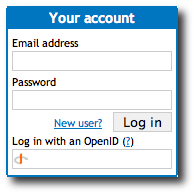 Users can now create their accounts using an OpenID, or associate an OpenID with an existing account. A single-sign on solution like OpenID solves an important problem for us, as most people tend to interact with our conference web sites in only one or two time periods each year. While we've gone to the trouble of making retrieving a password easy, there's still the mental burden on the user of setting up the account and noting it down somewhere. As a measure of the impact of this on me personally: I habitually save registration confirmation emails in a certain mail folder. Since 1997 I have collected no fewer than 572 of these, and I'm sure some have been missed! One other cool thing about OpenID is that finally I can get the identity I wish to have. No longer do I have to be a compulsive early adopter of every service just to get the name edd. (Well, as long as said service integrates OpenID of course!) Personal branding is an important attractive aspect of OpenID.ImplementationImplementing OpenID using the Ruby ruby-openid gem was quite straightforward, as was the logical integration into our user models. I've not been the only one following this path recently, as illustrated by
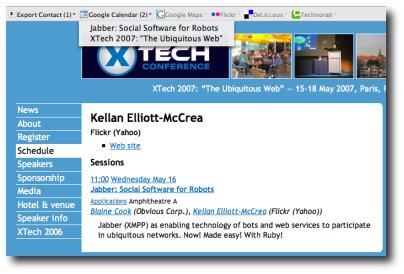 I'm personally a little late to the microformats party. Being a fan of pragmatic RDF, I didn't see much need for microformats right away. However, with tools like Operator I can honestly say that the use of microformats does enhance the XTech schedule.My impressions of microformats (in particular hCalendar and hCard) from using them are mixed. One the plus side, it was very easy to do. On the negative side, I found them restrictive in the sense that for the metadata to be present in the hCalendar object, it needs to be part of the HTML presentation.So, while microformats are meant to be about making human readable data useful for computers, they can have a tail-wagging effect on the human markup. Let me elaborate. In the conference schedule there is a grid overview. For readability here we want to keep the details down to a minimum in each box. There is definitely no need to repeat the date of each presentation when you can see there's a grid per day.But also we want to have microformats available in the page so users can use the grid to pick off talks to add to their calendar. The only details you currently get from the microformat are those you physically include inside the div marked as vevent. This means we can't embed the full details, such as the talk description. It also means I indulge in some dubious markup practices (an empty abbr element) in order to get the date and time into each hCalendar object.It seems to me that this could be ameliorated by more intelligent user agent behaviour. Each of my hCalendar events is given a URL. At the end of that URL is a full description of the event, using microformats. So, as long as I reference the URL in a summary page, the user agent can beetle off and pull down the full information, in much the same sort of way that

 The review phase Recruiting reviewers was done by Expectnation's request system. This lets me send a request to a large number of people simultaneously, and collect their responses via the web app. (Previously, this had involved email, spreadsheets and wasted time.) The chart you see to the right shows the breakdown of the response to this request. If a reviewer said 'yes', they added a note to say which types of proposal they would review, and signed up for an account in the system. I then passed through every paper assigning four or five appropriate reviewers. A quick search each time allowed me to look for the right reviewers, and ensure no one reviewer got overloaded with work. Once reviewers were assigned, I headed over to the Mailroom department. Expectnation has a large number of configurable mailing targets, one of which is "reviewers with work to do". I emailed each reviewer with details of how to get on with the reviewing. Every reviewer then logged into Expectnation, saw the proposals they needed to review, and used the interface to efficiently score the proposals. One big lesson here is that it needs to be very efficient if you want to get the best reviewers, who are often the busiest. Another wizzy graph enabled me to keep track of the reviews, and the mailroom let me send out a reminder to those reviewers who hadn't finished their work yet, when the time for the close of reviewing drew near. Picking the papers
 Expectnation lets me sort and filter proposals pretty flexibly, so I went through the papers for each track in turn, ordered by their review score. Anything scored 3 or higher (4 is best, 1 is worst) was almost certain to be shortlisted. I read all the reviews and the abstract, and moderated any score that was unusually low (for some reason, reviewers rarely overrate proposals!) The next step was to set up the empty grid, shown in the top half of the diagram to the right. Here I added the empty time slots to the rooms we had, and assigned putative tracks to each of the rooms (they can be swapped around later if needed.) After that, the scheduling can start, shown in the second half of the picture to the right. Each empty slot can be assigned a paper from the shortlist for the relevant topic. That way it's easy to "paint on" talks into each room and quickly get a sense for the overall flow of the conference. Once it was time to finalize matters, I mass-marked all the scheduled papers as accepted, which automatically sent a notification to the presenters, using the same request system as for reviewers. When a speaker confirms, their proposal status changes and they appear in the final