Search Results: "dom"

30 December 2008

Steve Kemp: When the light is green, the trap is clean.

Recently the Debian Administration website has been besieged by spammers submitting bogus comments. I also run a couple of blogs which are constantly having random gibberish submitted to them - although it is less of a problem there because I approve them manually due to the offline nature of my blog, and the blog compiler I use. Regardless I figured it was time to do something about it, in part because Chris Searle suggested that I should be able to query arbitrary text for spammyness due to my experience with fighting email spam. (As it turns out that is not so useful experience. Comments and emails are not the same. The same header-trickery you see in bogus email, false EHLOs, etc, are not useful concepts to carry accross.) Anyway we were saying, I was going to do something? So I did. My solution? An XML-RPC server which you submit your comments to. This will return either:
OKThe comment is clean.
SPAM:[reason]The comment is spam, and the optional reason explains further
The server itself is very simple, and it comes with a collection of simple plugins which do the job of testing different things. More plugins will almost certainly be added over time - so far I've seen the lotsaurls plugin capturing most of the SPAM, although the DNSRBL lookup is also working nicely having captured live spam without my touching it. Huzzah. & etc.. If there is any interest feel free to let me know, although as the server is open, and the client side usage is documented I imagine other people could run with it easily enough too - avoiding me becoming a single point of failure. For reference my initial change to hook this up live on the site was only a few lines of code - although later I did need to make some additional changes to make it cope with failures, & etc. ObFilm: Ghostbusters

28 December 2008

Theodore Ts'o: Debian, Philosophy, and People

Given the recent brouhaha in Debian, and General Resolution regarding Lenny s Release policy as it relates to Firmware and Debian s Social Contract, which has led to the resignation of Manoj Srivastava from the position of Secretary for the Debian Project, I m reminded of the following passage from Gordon Dickson s Tactics of Mistakes (part of Dickson s Childe Cycle, in which he tells the story of the rise of the Dorsai):
No, said Cletus. I m trying to explain to you why I d never make an Exotic. In your calmness in the face of possible torture and the need to kill yourself, you were showing a particular form of ruthlessness. It was ruthlessness toward yourself but that s only the back side of the coin. You Exotics are essentially ruthless toward all men, because you re philosophers, and by and large, philosophers are ruthless people. Cletus! Mondar shook his head. Do you realize what you re saying? Of course, said Cletus, quietly. And you realize it as well as I do. The immediate teaching of philosophers may be gentle, but the theory behind their teaching is without compunction and that s why so much bloodshed and misery has always attended the paths of their followers, who claim to live by those teachings. More blood s been spilled by the militant adherents of prophets of change than by any other group of people down through the history of man.
The conflict between idealism and pragmatism is a very old one in the Free and Open Source Software Movement. At one end of the spectrum stands Richard Stallman, who has never compromised on issues regarding his vision of Software Freedom. Standing at various distances from this idealistic pole are various members of the Open Source Community. For example, in the mid-1990 s, I used to give presentations about Linux using Microsoft Powerpoint. There were those in the audience that would give me grief about using a non-free program such as MS Powerpoint, but my response was that I saw no difference between driving a car which had non-free firmware and using a non-free slide presentation program. I would prefer to use free office suite, but at the time, nothing approached the usability of Powerpoint, and while dual-booting into Windows was a pain, I could do a better job using Powerpoint than other tools, and I refused to handcap myself just to salve the sensibilities of those who felt very strongly about Free Software and who viewed the use of all non-Free Software as an ultimate evil that must be stamped out at all costs. It is the notion of Free Software as a philosophy, with no compromises, which has been the source of many of the disputes inside Debian. Consider, if you will, the first clause of the Debian Social Contract:
Debian will remain 100% free We provide the guidelines that we use to determine if a work is free in the document entitled The Debian Free Software Guidelines. We promise that the Debian system and all its components will be free according to these guidelines. We will support people who create or use both free and non-free works on Debian. We will never make the system require the use of a non-free component.
This clause has in it no room for compromise. Note the use of words such as 100% free and never make the system require the use of a non-free component (emphasis mine). In addition, the Debian Social Contract tends to be interpreted by Computer Programmers, who view such imperatives as constraints that must never be violated, under any circumstances. Unfortunately, the real world is rarely so cut-and-dried. Even the most basic injunctions, such as Thou shalt not kill have exceptions. Few people might agree with claims made by the U.S. Republican Party that the war in Iraq qualified as a Just War as defined by Thomas Aquinas, but rather more people might agree that the July 20, 1944 plot to assassinate Hitler would be considered justifiable. And most people would probably agree most of the actions undertaken by the Allied Soldiers on World War II battlefields that involved killing other soldiers would be considered a valid exception to the moral (and for those in the Judeo-Christian tradition, biblical) injunction, Thou shalt not kill . As another example, consider the novel and musical Les Mis rables, by Victor Hugo. One of the key themes of this story is whether or not Thou shalt not steal is an absolute or not. Ultimately, the police inspector Javert, who lived his whole life asserting that law (untempered by mercy, or any other human considerations) was more important than all else, drowns himself in the Seine when he realizes that his life s fundamental organizing principle was at odds with what was ultimately the Right Thing To Do. So if even the sixth and eighth commandments admit to exceptions, why is it that some Debian developers approach the first clause of the Debian Social Contract with a take-no-prisoners, no-exceptions policy? Especially given the fourth clause of the Debian Social contract:
Our priorities are our users and free software We will be guided by the needs of our users and the free software community. We will place their interests first in our priorities. We will support the needs of our users for operation in many different kinds of computing environments. We will not object to non-free works that are intended to be used on Debian systems, or attempt to charge a fee to people who create or use such works. We will allow others to create distributions containing both the Debian system and other works, without any fee from us. In furtherance of these goals, we will provide an integrated system of high-quality materials with no legal restrictions that would prevent such uses of the system.
This clause does not have the same sort of absolutist words as the first clause, so many Debian Developers have held that the needs of the users is defined by 100% free software . Others have not agreed with this interpretation but regardless of how needs of the users should be interpreted, the fact of the matter is, injuctions such as Thou shalt not kill are just as absolute and yet in the real world, we recognize that there are exceptions to such absolutes, apparently unyielding claims on our behavior. I personally believe that 100% free software is a wonderful aspirational goal, but in particular with regards to standards documents and firmware, there are other considerations that should be taken into account. People of good will may disagree about what those exceptions should be, but I think one thing that we should consider as even higher priority and with a greater claim on how we behave is the needs of our users and fellow developers as people. For those who claim Christianity as their religious tradition, Jesus once stated,
Thou shalt love the Lord thy God with all thy heart, and with all thy soul, and with all thy mind. This is the first and great commandment. And the second is like unto it: Thou shalt love thy neighbour as thyself. On these two commandments hang all the law and the prophets.
Even for those who do not claim Christianity as their religious tradition, most moral and ethical frameworks have some variant on the Golden Rule: Do unto others as you would have them do unto you . I would consider, for example, that the Golden Rule is at least a high priority claim on my behavior as the notion of free speech, and in many cases, it would be a higher priority claim. The recent controversy surrounding Josselin Mouette was started precisely because Joss has taken a something which is a good thing, namely Free Speech, and relegated it to a principle more important than all else, and claiming that any restraint on such a notion was equivalent to censorship. I think the same thing is true for free software, although it is a subtler trap. Philosophical claims than 100% free software as most important consideration is dangerously close to treating Free Software as the Object of Ultimate Concern or in religious terms, idolotry. For those who are religious, it s clear why this is a bad thing; for those who aren t if you are unwilling to worship a supernatural being, you may want to very carefully consider whether you are willing to take a philosophical construct and raise it to a position of commanding your highest allegiance to all else, including how you treat other people. Ultimately, I consider people to be more important than computers, hardware or software. So over time, while I may have had some disagreements with how Mark Shuttleworth has run Canonical Software and Ubuntu (but hey, he s the multimillionaire, and I m not), I have to give him props for Ubuntu s Code of Conduct. If Debian Developer took the some kind of Code of Conduct at least as seriously as the Social Contract, I think interactions between Debian Developers would be far more efficient, and in the end the project would be far more successful. This may, however, require lessening the importance of philosophical constructs such as Free Speech and Free Software, and perhaps becoming more pragmatic and more considerate towards one another.


Russ Allbery: Lintian 2.1.3

Over the last couple of days, I've found some time to work on Lintian for the first time in quite a while. It's been a good feeling both for getting back to a project that I've done very little on for several months and finally feeling energized about a coding project. I think after a week of vacation, I'm starting to recover my energy. I uploaded Lintian 2.1.3 earlier today and am currently doing a fresh archive-wide run for lintian.debian.org. This version has several new checks for watch files from Raphael Geissert, several fixes for the lintian.d.o output, a few other random bug fixes, and an attempt to tackle unversioned shared libraries in a more comprehensive fashion. Shared libraries with an SONAME that doesn't contain a version number can't be represented in the shlibs system (but can in the symbols system), so Lintian always reports them as missing from shlibs when they're installed in public directories. That's not really the right tag, since they don't belong in shlibs. The more basic problem is that, except for a few special cases mostly coming from libc, they really don't belong in public directories. With no versioning in the SONAME, we can't handle changes to the ABI without completely changing the library name and can't use the shlibs system to manage them. Most of the libraries in this situation are actually private libraries for one particular application. As Policy already says, those libraries shouidn't be installed in public directories like /usr/lib; they should be installed in private subdirectories of /usr/lib for that application. The biggest group of offenders here currently seems to be KDE; for some reason, unless I'm missing something, this seems to be a semi-standard KDE way of doing things. This version of Lintian will hopefully handle this better. Such libraries won't be expected to be in shlibs files and won't get erroneous tags about not being listed there. We'll also do a better job of distinguishing between versioned shared libraries and shared library names that just contain a hyphen. Such unversioned libraries will get a separate tag pointing at the portion of Policy that says to put private libraries and plugins in a subdirectory instead of /usr/lib. Thanks as always to Frank Lichtenheld, Adam D. Barratt, and Jord Polo for all the hard work they've been putting into Lintian. It's gotten much better over the few months that I've not been able to work on it, which is making me more excited to get back to it and do more.

27 December 2008

MJ Ray: Looking Back: 2008 Part 2

This is a continuation from part 1 but can be enjoyed on its own too, like a good red wine. It s a bit early for me for red wine, though.
May
June
July
  • Standing for Election to SPI Board Again - my most popular page ever, by number of page views anyway. It was spammed to hell so often that comments are now switched off. I suspect the US Election had more to do the popularity of this article than my unsuccessful candidature for the Software in the Public Interest board.
  • Batting Against Three Strikes through the Back Door - I m a member and ambassador for ThePhoneCoop and TTLLP are agents/resellers for them, so this misguided EU law-making was worth some of my time. Writing about it here got me a response from Neil Parish MEP that I don t think I would have got otherwise. It s a terrible shame he never sent a reply from Malcolm Harbour.
  • LugRadio Live Event Review - a review of one of the most populist UK free software events by one of their most vociferous critics (back before they went all Creative Commons warm and fuzzy) was always going to be popular, which is partly why I wrote it, but not the whole reason: I m delighted that the event should return in the future. It s not perfect, but it s pretty damn fantastic. A tech conference crossed with a rocking gig by the strangest boyband ever, with a cheerleading racoon and some very cool people.
  • Good News on the Koha 3.0.0-final Approach - another surprisingly popular marginal comment. I ve currently broken/desynched/something my local git tree. I m going to repair it by New Year and then start writing up more Koha explorations and sending patches upstream.
August
More to follow in a couple of days

25 December 2008

Matthew Garrett

Christmas is a time to ignore such trifling details as nearly accidently burning the house down, and instead to focus on what's important in life - working out which hoops to jump through to make new hardware useful without installing less convenient operating systems. This year was more straightforward than some, and merely involved attempting to work out how to give people money in return for books that could then be read on my Sony reader thingy. Shockingly enough, the Sony Ebook Store requires a windows app, so not a good start. There's no shortage of sites that sell ebooks in a variety of formats without any platform dependent awkwardness, though - of course, most of them are inconveniently DRMed. And the only DRMed content the Sonys will read is either Sony's own or some encrypted PDFs[1].


Not to worry - the DRMed version of the Mobipocket format is based on a symmetric encryption algorithm from 1991, so finding a way around that isn't much of a problem[2]. The only real issue I had was generating the PID needed to buy one of the damn things in the first place. This 10 character string is generated when you install the Mobipocket reader software, but doing so would again involve Windows.

So here's a trivial C program that generates valid PIDs with working checksums. The PID on its own isn't a secret (given that you can get as many as you want by reinstalling the Windows software), so I can't see any awkward copyright law things going on. And, really, it's just a random string plus a checksum.

CRC code is from SSH, the checksum validation is a reimplementation of code from EBook::Tools::Mobipocket by Zed Pobre. My total creative input was generating a 7 character random string and sticking a dollar sign at the end. Go me.

[1] According to the blurb about the firmware update, though mine still seems to claim that it's not authorised to read DRMed content in the about screen. Possibly it needs keys generating, or something

[2] No, I'm not going to tell you how. The internet exists so you can work these things out without asking me

MJ Ray: Looking Back: 2008 Part 1

Over the next few days, I m looking at the most popular articles from this site and my previous news website during 2008. I ll be doing it in three parts. Popularity is measured by page views from local access logs, but some articles were actually more popular in the months after they were first posted, so it s not completely accurate, but let s be forgiving over the holidays, OK?
January
I must have been writing rubbish because nothing got that popular at the start of the year, but some of my older pages continued to be popular throughout 2008:-
February
  • SPI Meeting Wed 27 Feb 1900Z irc.oftc.net/#spi - I think this started my regular meeting announcements, which has been a surprisingly popular series and has expanded into a whole category of SPI articles here.
  • The Myth Of Deregulation - this was meant to be a marginal rant. Its popularity (and the subsequent comments - some of which were unpublishable or their authors requested removal) surprised me and so I started writing more about social enterprise, cooperatives-sw member businesses and how they interact with GNU/Linux software and web development.
March
April
  • UK mobile micropublishing choices? - for the trip that motivated that article, I used twitter, but I m actually updating identi.ca over XMPP from my mobile now.
  • Better Free Software Organisations? - I ve read the Yunus book mentioned in the comments on the Advogato repost of this article and I ve a review which will appear on this site later. It includes a bit of a flaming of the simplistic and IMO factually-incorrect dismissal of cooperative businesses, so I wonder if it will get a few responses from Yunus-fans.
  • Explaining web site improvements: what s important to you? It seems that April was a good time for asking questions: this is a third popular question-based article. The website discussed has now been approved and ordered from TTLLP, but the work is not yet scheduled.
That s the first few months of 2008 done. I ll post the next few months in a couple of days. Hope you re enjoying the holidays if you re having them. I m sure I am ;-)

24 December 2008

Amaya Rodrigo: Self-steem issues?

Peace for threeWhen a cat is on your lap or very close to you, it means there is no better place for him in the whole world. And cats are very smart. And demanding. They are absolutely free souls and natural born gourmets.

But where is the tip? Just around the corner, read on.

Listen to the world around you, the more related to nature the message is, the more important and meaningful is the wisdom coming with it.

David Bremner: So your topgit patch was merged upstream

Scenario You are maintaining a debian package with topgit. You have a topgit patch against version k and it is has been merged into upstream version m. You want to "disable" the topgit branch, so that patches are not auto-generated, but you are not brave enough to just

   tg delete feature/foo
You are brave enough to follow the instructions of a random blog post. Checking your patch has really been merged upstream This assumes that you tags upstream/j for version j.
git checkout feature/foo
git diff upstream/k
For each file foo.c modified in the output about, have a look at
git diff upstream/m foo.c
This kindof has to be a manual process, because upstream could easily have modified your patch (e.g. formatting). The semi-destructive way Suppose you really never want to see that topgit branch again.
git update-ref -d refs/topbases/feature/foo
git checkout master
git branch -M feature/foo merged/foo
The non-destructive way. After I worked out the above, I realized that all I had to do was make an explicit list of topgit branches that I wanted exported. One minor trick is that the setting seems to have to go before the include, like this
TG_BRANCHES=debian/bin-makefile debian/libtoolize-lib debian/test-makefile
-include /usr/share/topgit/tg2quilt.mk
Conclusions I'm not really sure which approach is best yet. I'm going to start with the non-destructive one and see how that goes. Updated Madduck points to a third, more sophisticated approach in Debian BTS.

23 December 2008

Patrick Schoenfeld: How to NOT improve relationships to your peer projects

I don't know if Aaron is an Ubuntu Developer. I hope not. And I hope that no one of the commenters is one. But this post and especially the comments to it (because the article may have some justification) is certainly not a way to improve the relationship between projects like Ubuntu and the projects its based on.

Yes, it is true, that we have a rough tone in our mailing lists and yes it is sad that every now and then topics pop up that need to be discussed till somebody is hurt and leaves (the project). I certainly hope that this can be improved over the time, but most likely this is not something which breaks the project. Who knows what its worth. We have a large community, very much different opinions and therefore conflicts. Possibly it enhances the quality of our distribution, because things that certainly would make our product worse (e.g. lowering quality standards) won't get done, because they'll get a strong opposition.

But whats the point with the innovations, Aaron? Is it the job of a distribution to serve with innovations? A distribution that serves as a base for more then 10 other distributions? A distribution that is known to care a lot about freedom and is known (and appreciated) for a high quality standard. I don't think we need to serve innovations. We served innovations back in a time where it was needed. Where things were missing. Like a good package management, like conf.d directories. Apart from this I think there were enough innovations in the past years. Possibly not that user-visible and trendy as a graphical virtualization frontend. What about xen-tools for example?
Now its all about reinventing the wheel or developing frontends. Launchpad for example is just reinventing the wheel. Savannah exists, GForge exists. Bazaar is just reinventing the wheel. Git exists. So does Mercurial.

But whats most sad about your posts and the comments is that you (and your commentors) seem to share the opinion that all Debian does is packaging software and nothing more. According to you Debian developers do not fix bugs, forward patches, file (important) wishlist bugs, encourage upstreams to remove horribly broken licensed software, improve their own software and tools (dpkg, aptitude, apt-get, the devscripts, ....), do integration work (alternatives, $EDITOR usage, ...), documentation work (writing manpages). The reality is that there are many small and greater things driven by Debian Developers that serve the whole community. Additional to the ground work that your favorite operating system is based on and without which it could not exist.
Its just not beeing doped like it is done by companies with their marketing departments that actually earn money with what they do. Take the projects you named. They all have one. They all have paid developers.

In any way such a ranting (with no real
constructiveness) will not serve the relationships between other projects and Debian.

21 December 2008

Kurt Roeckx: Debian and (non-free) firmware: where to put it?

One of the discussion that always seems to come back is what to do with firmware. It's mostly about freedom versus usability. I think the main question is where do we want to put non-free firmware in our archive. The opinion seems to range from that it should be in the non-free archive to that it should be in the main archive, with many opinions in between, and they all have good arguments. We have 3 options that are related to it in our current vote that seem to come down to: I don't see the point of that second option, and really have to wonder if there is any firmware under a license that would comply with the DFSG except that the source isn't available. The third option can make sense for some of the blobs in the kernel that are basically settings that are written to the device. You could write an editor for it, assuming there is documentation for it. But I doubt that they're all settings, and it just seems to ignore the problem. I find Theodore Ts'o' suggestion about creating a new section for firmware the best idea so far, specially if we can agree that our official CD/DVD images will have that section on it. It has the advantage that all software in our main archive can comply with the DFSG, that you don't need to add the non-free section just to be able to use hardware that requires firmware and that you can just take a CD/DVD that works.

Holger Levsen: Please show some respect while standing on the shoulders of giants

I unsubscribed from -devel and -vote the other day, as the pain/gain ratio was just not worth it anymore (and -project is very much pending). Sadly, I still could not escape from what I wanted to escape from, as some people bring up those discussions and "their style" on planet.

Please show some fscking respect to your peers! Debian is not about freedom (whether you like it or not, and no matter how you define freedom), it's not about freedom of speech or being open minded, it's just about creating the greatest free operating system. The free operating system, that's why we are here.

I for one, disagree with many debian contributors ideas and believes, whether (those ideas are) Debian related or not. To give one example, I think religion is hillarious and believing in (a) higher being(s) is a sure sign of an ill (or weak, or both, or whatever) mind. (Quite similar to smoking btw, and for those who don't know, I do smoke.) But I'm not shoving this down all the time to anybody who makes a religious reference in Debian (nor in real life). Quite the contrary, I do admire quite some people who take motivation out of their religious believes to do things they think are good. I belive this is quite common the other way round too, eg when religious and human-rights motivated groups work together to help immigrants. They dont share (all) the same beliefs, and in some they have huge disagreements (eg. I think religion is the root and a means^wcontributor to many of the worlds evils) but they choose to respectfully disagree on these views to be able to work together on the common goal they share: help immigrants.

And in the same way I (try to) (dis)agree with my fellow Debian peers about their insane or great ideas. I try to respectfully disagree (or respectfully agree). And I do acknowledge that I sometimes fail, eg the above words about religion might have hurt some peoples feelings. I do give a damn about having hurt those people (so I ment to say sorry with that in cheek damn joke), even though I dont give a damn about religion. And I think the last sentence might have been too sharp to be respectful while I belive the above paragraph is fine. I also think its fine to be disrespectful (in or outside Debian) once in a while, since we are all humans and make mistakes once in a while, but I dont think it's fine to have those people in Debian who fail all the time (or too often), be it because they are incompetent to treat fellow peers with respect or because they dont care (or because they think they do something good with their kindergarten rhetoric).

Contributing to Debian is not a human right (and suppressing some voices (and esp. noise) in Debian is not censorship, for fucks sake!). We are only here, because we are standing on the shoulders of giants (except for the very few giants among us) and because we want to create/improve a great operating system. And thats why I think it's perfectly acceptable and desirable to not allow those messages here, which are distracting and/or blocking of from reaching this goal. An occasional outburst (and be that a 2-4 weeks long or a single big outburst) doesnt qualify in my book for being kicked out, no matter how harsh or unreasonable it was. Constant disruption IMO is. Where to draw the line is tricky (and I'm convinced there can't be a single written "line" covering everything in Debian), but not to draw any lines will result in only the vocal and thick-skin minorities to stay.

And with nice, respectful communities (which have policies quite a lot like the DFSG) like fedora and ubuntu available, failing to be(come again) a respectfull community might really contribute a lot to the end or slow decline of Debian. Sure, "the end of Debian!11" is a somewhat constant meme, but it is (sadly) not like Debian is undestroyable. Debian is very certainly much easier to destroy than to rebuild.

We need to take measures to prevent some peoples ideas of freedom from harming or destroying the project. And I don't mean some peoples ideas of Debian police state or Debian teletubby county - I'm very confident those ideas will not win here. But sadly I can see the results of poisonous people, or rather, their behaviour win.

And undoubtfully I also can see many great people in Debian making sure this will not happen.

The future is unwritten and I wish we show our fellows the respect they deserve. Debian wasn't made by you, more than 99,99999% of it was made by other people. And if you have to, attack ideas, not people. And usually it's also unneeded to _attack_ an idea (merely challanging it is usually enough), because usually the Debian person proposing it is not so stupid not to take your criticism into consideration.

That's why I'm still in favor of a social committee, even though I see very much the dangers of power abuse and the cultural norms in a world wide project. But I see much more danger in not stopping unrespectful assholes from urinating into our living rooms and work benches, using the waiver of "free speech" and "we all have different standards of whats acceptable."

Simpler said: either you respect the community or this community shall not be yours.

That said, I wish you all a very merry xmas, whether you celebrate and believe, or one of the two, or none. Be happy and let it be. And may we have a great 2009, despite we'll release lenny that late! ;-)
P.S.: I'll post this to -project as well, so you can reply more easily.

René Mayorga: Hello planet Debian!

just saying hi, if you read this post my name is Ren Mayorga, I live in San Salvador the capitol city from El Salvador, that was my raw introduction. So, hello, this is my first post on planet Debian, there is nothing more to tell about me, I m just following the tradition to say hello here :) I m currently at the NM process, and I here at this planet just to try to get to you guys the point of view from a random guy at central america :)..

20 December 2008

Biella Coleman: What to make of the other half?

Many people ask me why there are such few female hackers. While I think this is an important/interesting question (that is also extraordinarily hard to answer), there is another one which has captivated me for much longer, which is the followingL why are there such few females represented in the academic/activist world of free software/free culture, etc.? It seems like every turn I take, there are books galore, talks galore, essays galore being written by men with females sprinkled on top, like some confectionery after thought. Take for example Joi Ito s recent photograph collection, Free Souls (women are represented in the beautiful array of photographs) but in the essays which reflect on freedom/free culture/the souls of freedom, there is (I think, correct me if I am wrong), not a single female voice, despite the fact that there were clearly females authors/activists that could have potentially contributed.
Essays 1. Lawrence Lessig
Foreword by Lawrence Lessig
2. Christopher Adams
Share this book
3. Joi Ito
Just another free soul
4. Howard Rheingold
Participative Pedagogy for a Literacy of Literacies
5. Lawrence Liang
Free as in Soul: The Anti-image Politics of Copyright
6. Cory Doctorow
You Can t Own Knowledge
7. Yochai Benkler
Complexity and Humanity
8. Isaac Mao
Sharism: A Mind Revolution
9. Marko Ahtisaari
Intelligent Travel
Now, am I overreacting here; or is this reason for worry?

Miriam Ruiz: Interesting proposals on how to make Debian a better world

I have been positively surprised to find out that some people are taking seriously the fact that some people are being put off from actively participating in Debian s discussions because doing so would lead to offensive behaviour and personal attacks, and to try to find a solution to the fact that a very vocal minority is dominating the silent majority. Of course, some people are happy with the statu quo and strongly opposes to changing anything in that direction, not very surprisingly. The part about I m really starting to think that this Project could do a lot better without some people is crystal clear and needs no comments. I m not really sure that the current social environment can be fixed just with technical measures. Another proposal talks about some mailing lists extracted from the official ones but with the offending comments filtered out. I must confess that I find this idea very interesting and that I might think about rejoining such a list. Of course, technical details on how to properly and effectively implement any of this methods, or even a mixed one, can be very tricky.

19 December 2008

Julian Andres Klode: Short Review: OpenSolaris 2008.11


The installation was fast and easy, comparable to the installation of Ubuntu. OpenSolaris seems to have big problems in terms of wireless LAN. I am using a WPA/WPA2 encrypted wireless LAN, and it asked to me to enter my passphrase. I entered it, and nothing happened. I was able to get wireless working via commandline, but this lead me to the problem that domain names were not resolved. I could solve this, too. But none of this was permanently, and it should work the graphical way or tell me it does not work. Maybe this whole thing happened because I have a space in the name of my Wi-Fi network. Another problem is suspend/resume, which is not yet working for most laptops; whereas recent Linux distributions support suspend/resume out-of-the-box. OpenSolaris ships non-free components, e.g. NVIDIA display drivers, or Java 6 Update 10. Hopefully, there will be an option in future to install it without this stuff. Talking about the desktop, there is GNOME 2.24 with a custom theme. In my opinion, the theme looks quite good, although I do not like the colours of the minimize,maximize,close buttons of the windows sometimes. One feature introduced with this release is Time Slider. Time slider worked very well, although for reasons I do not know, I do not really like it. The integration with nautilus is good, but I would still like to see an interface using a calender widget instead of this slider. I remember that the slider sometimes did not work as I expected, e.g. it jumped from left to right. The package management is interesting, but it is to hard to use in my opinion. Debian and derived distributions provide far better package managment in my opinion. Especially the graphical part needs a lot of work in order to compete with Debian. The overall speed was quiet good, and memory usage was 512MB. There is one problem with measuring memory consumption in gnome-system-monitor: I installed netbeans 6.5 and started it, and gnome-system-monitor showed a memory usage of around 20MB, while the program used more than 200MB (according to top). All in all, OpenSolaris gets closer to modern Linux distributions like Fedora 10 or Ubuntu 8.10, but it is not there yet. But with improvements in the area of Wi-Fi and Suspend/Resume, future releases of OpenSolaris might become a good alternative to Linux distributions, at least if you do not really care about the ideas of free software. Posted in General

16 December 2008

John Goerzen: Wiki Software

I used to run a website for traveling by rail in the United States. I let it falter, and eventually took it down. But I still have the domain, and am working to bring it back as a wiki. The first step in that process was selecting which wiki software to use. I have a few requirements for the site: I m frustrated that there is no wiki out there that does all of these. There are quite a few that do all but one, but which one they omit varies. My two finalists were MoinMoin and MediaWiki. MoinMoin MoinMoin will let you easily define arbitrary categories (by creating a wiki page following a certain name). The search screen automatically presents checkboxes for restricting searches to a particular category. Some reviews have complained about its anti-spam features, but they are all talking about older versions and they seem to have done some work on this lately. MoinMoin has tons of features and is easy to set up and maintain. But here s where it falls down: themes. Over at moinmo.in, there is a theme market for themes. Only most of the themes there haven t been compatible with the current MoinMoin release since about 2005. Most of the rest have one download, then a long discussion page full of mixed bug reports, diffs, and non-diff edit this to make it work comments. Most of these don t state what version of the theme they apply to. Most themes won t work with current browsers and Moin releases without them. UGH. After discussing on #moin, I ll probably go in there and at least organize the ThemeMarket page by release. MediaWiki Then there s MediaWiki. It s got a lot of features, and a lot of complexity. It has no current WYSIWYG feature, though apparently there is work on one. MediaWiki has an amazing category system. It can generate sorted lists of pages in a category, supports subcategories, etc. Surprisingly, though, you can t search in just one category. (Though it might be possible indirectly via some syntax; not sure.) Searching in MediaWiki overall is less capable that in MoinMoin. MediaWiki does offer namespaces, and namespaces are the sole way of searching just one part of a site. They re used well over at, say, uesp.net. But namespaces are heavy-handed. You have to edit config files to define them, and they bring with them other associated namespaces for discussion and whatnot. It s not as easy as creating a category in MoinMoin, and might not scale well to lots of future categories. MediaWiki does appear to have good spam prevention, and support recaptcha. Conclusions I eventually selected MoinMoin and have set up most of my content in it. But now that I am to the point of selecting themes, I m having some second thoughts. I also looked at DokuWiki. Its design makes me nervous. The user list is stored in a single file. You can t search by category. You can search by namespace, but there aren t checkboxes for it in the search screen; you have to know the syntax. WYSIWYG is a plugin. Categories are a plugin. So too many plugins to maintain, and no real features above MoinMoin.

Pablo Lorenzzoni: Lenny in the Asus EEE PC 901 - day 1

Following my previous post, today I began to turn my brand new Asus EEE PC 901 into a Debian Machine. At first I wanted to do all in one day, but since work is taking too much out of me (and everything seems to take more time than expected), I ll have to split this in different days So, first things first. I read Debian Wiki on the issue and began by doing the most important: backing it up. So I got a daily netinst iso, put it on a USB Pendrive and followed the tip on backup over the network using netcat. Easy and effective, and took only 8 minutes on the 901 (I think the 35 minutes described on the wiki were for models with slower NICs). From there, I had to decide which version of the installer I d use. I chose Standard, since I want an encrypted disk on my EEE. So I run the installer and, on the partition manager, I deleted /dev/sda1 (where Xandros was installed), turning it into a 300 MB /dev/sda5 (to use as /boot) and a 3 GB /dev/sda6 building a Logical Volume over an LVM Volume Group with it and /dev/sdb1 (where the user directory was), and enciphering it. This took a long time, since, I believe, random data were being written to the device to increase crypto strength. I left /dev/sda 2,3,4 as they were, since they can belong to the Asus EEE Recovering System (and they don t take too much space :-) ) Now base system is installed, and wired network works like a charm Next steps will have to wait until tomorrow.

Biella Coleman: Speaking of the Tactile/Tactical


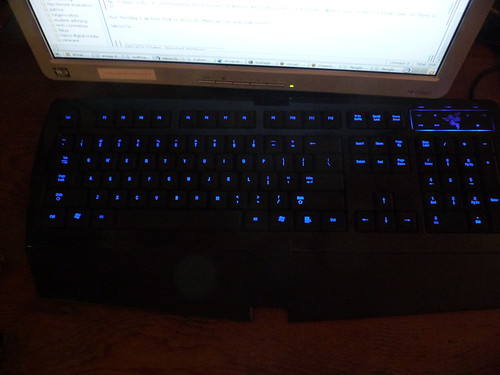
razer my new keyboard, which i LOVE, originally uploaded by the biella.
Speaking of the tactile and the tactical, after seeking some input, I settled on this keyboard a few months ago and I simply love it so much so, today I got another one for my office. I love the key strokes simply cuz they have just the right feel. It takes some, but not too much, pressure to type and it feels great on my finger tips. The fancy blue lighting is a plus but not a central feature. The overview/description on their website is pretty dramatic but I tend to agree it provides for some pretty hefty power, allowing me to launch my email assaults with perfection :

With an awesome host of features, the Razer Lycosa is on an unstoppable mission to destroy and dominate. Execute complex combat maneuvers with swift dexterity. Launch your assaults timed to perfection. Annihilate your enemies and reign supreme on the battlefield. You now have the tactical advantage on every terrain, and your enemies fates are in your hands.
<
I dare say I am fully content with the keyboard but I am still searching, however, for the perfect pen

John Goerzen: Administering Dozens of Debian Servers

At work, we have quite a few Debian servers. We have a few physical machines, then a number of virtual machines running under Xen. These servers are split up mainly along task-oriented lines: DNS server, LDAP server, file server, print server, mail server, several web app servers, ERP system, and the like. In the past, we had fewer virtual instances and combined more services into a single OS install. This led to some difficulties, especially with upgrades. If we wanted to upgrade the OS for, say, the file server, we d have to upgrade the web apps and test them along with it at the same time. This was not a terribly sustainable approach, hence the heavier reliance on smaller virtual environments. All these virtual environments have led to their own issues. One of them is getting security patches installed. At present, that s a mainly manual task. In the past, I used cron-apt a bit, but it seemed to be rather fragile. I m wondering what people are using to get security updates onto servers in an automated fashion these days. The other issue is managing the configuration of these things. We have some bits of configuration that are pretty similar between servers the mail system setup, for instance. Most of them are just simple SMTP clients that need to be able to send out cron reports and the like. We had tried using cfengine2 for this, but it didn t work out well. I don t know if it was our approach or not, but we found that hacking cfengine2 after making changes on systems was too time-consuming, and so that task slipped and eventually cfengine2 wasn t doing what it should anymore. And that even with taking advantage of it being able to do things like put the local hostname in the right places. I ve thought a bit about perhaps providing some locally-built packages that establish these config files, or load them up with our defaults. That approach has worked out well for me before, though it also means that pushing out changes isn t a simple hack of a config file somewhere anymore. It seems like a lot of the cfengine2/bcfg tools are designed for environments where servers are more homogenous than ours. bcfg2, in particular, goes down that road; it makes it difficult to be able to log on to a web server, apt-get install a few PHP modules that we need for a random app, and just proceed. Any suggestions?

Biella Coleman: Do Not Eat the Laundry


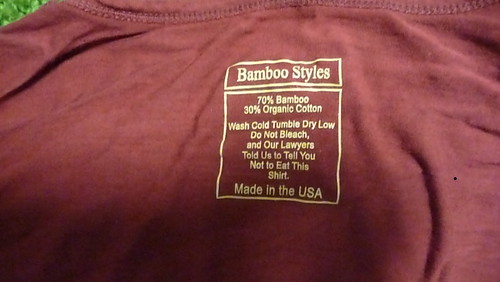
do-not-eat, originally uploaded by the biella.
America is a land brimming with paradoxes, one of them being our simultaneous obsession with freedom and rules. We purport to be the land of the free (and while this is and may not be true, we do hold steadfast to this idea). But we also love rules rules and rules, and wait there are more and more and more rules, too many rules, which often come in the form of the form of a sign, this one being one of my favorites. (shall not produce grease laden fumes?! yes, I think it was written by an academic). So I appreciate small reminders that poke fun of and holes in our love of rules and warnings, such as the one I found on my new bamboo-based shirt, pictured above. I have taken a huge liking for bamboo shirts as of late (I am obsessed with the tactile and can only stand soft cloth, which is why I love bamboo-based cloth) and I ordered a few shirts of the Internet. I only noticed the warning when I pulled the shirt out of the dryer late the other night and it was by far one of the only times I smiled from left to right at 1 am when doing laundry. More people should take the time to plant these easter-egg type jokes as they are, I am sure, much appreciated.

Next.

Previous.