Search Results: "ads"

12 November 2017

Lars Wirzenius: Unit and integration testing: an analogy with cars

A unit is a part of your program you can test in isolation. You write unit tests to test all aspects of it that you care about. If all your unit tests pass, you should know that your unit works well. Integration tests are for testing that when your various well-tested, high quality units are combined, integrated, they work together. Integration tests test the integration, not the individual units. You could think of building a car. Your units are the ball bearings, axles, wheels, brakes, etc. Your unit tests for the ball bearings might test, for example, that they can handle a billion rotations, at various temperatures, etc. Your integration test would assume the ball bearings work, and should instead test that the ball bearings are installed in the right way so that the car, as whole, can run a kilometers, and accelerate and brake every kilometer, uses only so much fuel, produces only so much pollution, and doesn't kill passengers in case of a crash.

Ben Armstrong: The Joy of Cat Intelligence

As a cat owner, being surprised by cat intelligence delights me. They re not exactly smart like a human, but they are smart in cattish ways. The more I watch them and try to sort out what they re thinking, the more it pleases me to discover they can solve problems and adapt in recognizably intelligent ways, sometimes unique to each individual cat. Each time that happens, it evokes in me affectionate wonder. Today, I had one of those joyful moments. First, you need to understand that some months ago, I thought I had my male cat all figured out with respect to mealtimes. I had been cleaning up after my oafish boy who made a watery mess on the floor from his mother s bowl each morning. I was slightly annoyed, but was mostly curious, and had a hunch. A quick search of the web confirmed it: my cat was left-handed. Not only that, but I learned this is typical for males, whereas females tend to be right-handed. Right away, I knew what I had to do: I adjusted the position of their water bowls relative to their food, swapping them from right to left; the messy morning feedings ceased. I congratulated myself for my cleverness. You see, after the swap, as he hooked the kibbles with his left paw out of the right-hand bowl, they would land immediately on the floor where he could give them chase. The swap caused the messes to cease because before, his left-handed scoops would land the kibbles in the water to the right; he would then have to scoop the kibble out onto the floor, sprinkling water everywhere! Furthermore, the sodden kibble tended to not skitter so much, decreasing his fun. Or so I thought. Clearly, I reasoned, having sated himself on the entire contents of his own bowl, he turned to pilfering his mother s leftovers for some exciting kittenish play. I had evidence to back it up, too: he and his mother both seem to enjoy this game, a regular fixture of their mealtime routines. She, too, is adept at hooking out the kibbles, though mysteriously, without making a mess in her water, whichever way the bowls are oriented. I chalked this up to his general clumsiness of movement vs. her daintiness and precision, something I had observed many times before. Come to think of it, lately, I ve been seeing more mess around his mother s bowl again. Hmm. I don t know why I didn t stop to consider why And then my cat surprised me again. This morning, with Shadow behind my back as I sat at my computer, finishing up his morning meal at his mother s bowl, I thought I heard something odd. Or rather, I didn t hear something. The familiar skitter-skitter sound of kibbles evading capture was missing. So I turned and looked. My dear, devious boy had squished his overgrown body behind his mother s bowls, nudging them ever so slightly askew to fit the small space. Now the bowl orientation was swapped back again. Stunned, I watched him carefully flip out a kibble with his left paw. Plop! Into the water on the right. Concentrating, he fished for it. A miss! He casually licked the water from his paw. Another try. Swoop! Plop, onto the floor. No chase now, just satisfied munching of his somewhat mushy kibble. And then it dawned on me that I had got it somewhat wrong. Yes, he enjoyed Chase the Kibble, like his mom, but I never recognized he had been indulging in a favourite pastime, peculiarly his own I had judged his mealtime messes as accidents, a very human way of thinking about my problem. Little did I know, it was deliberate! His private game was Bobbing for Kibbles. I don t know if it s the altered texture, or dabbling in the bowl, but whatever the reason, due to my meddling, he had been deprived of this pleasure. No worries, a thwarted cat will find a way. And that is the joy of cat intelligence.

10 November 2017

Wouter Verhelst: SReview 0.1

This morning I uploaded version 0.1 of SReview, my video review and transcoding system, to Debian experimental. There's still some work to be done before it'll be perfectly easy to use by anyone, but I do think I've reached the point by now where it should have basic usability by now. Quick HOWTO for how to use it: There's still some bits of the above list that I want to make easier to do, and there's still some things that shouldn't be strictly necessary, but all in all, I think SReview has now reached a certain level of maturity that means I felt confident doing its first upload to Debian. Did you try it out? Let me know what you think!

Guido G nther: git-buildpackage 0.9.2

After some time in the experimental distribution I've uploaded git-buildpackage 0.9.0 to sid a couple of weeks ago and were now at 0.9.2 as of today. This brought in two new commands: We moved to better supported tools: We added integration with pk4:
 mkdir -p ~/.config/pk4/hooks-enabled/unpack/
 ln -s /usr/share/pk4/hooks-available/unpack/gbp ~/.config/pk4/hooks-enabled/unpack/
so pk4 invokes gbp import-dsc on package import. There were lots of improvements all over the place like gbp pq now importing the patch queue on switch (if it's not already there) and gbp import-dsc and import-orig not creating pointless master branches if debian-branch != 'master'. And after being broken in the early 0.9.x cycle gbp buildpackage --git-overlay ... should be much better supported now that we have proper tests. All in all 26 bugs fixed. Thanks to everybody who contributed bug reports and fixes.

Norbert Preining: ScalaFX: dynamic update of context menu of table rows

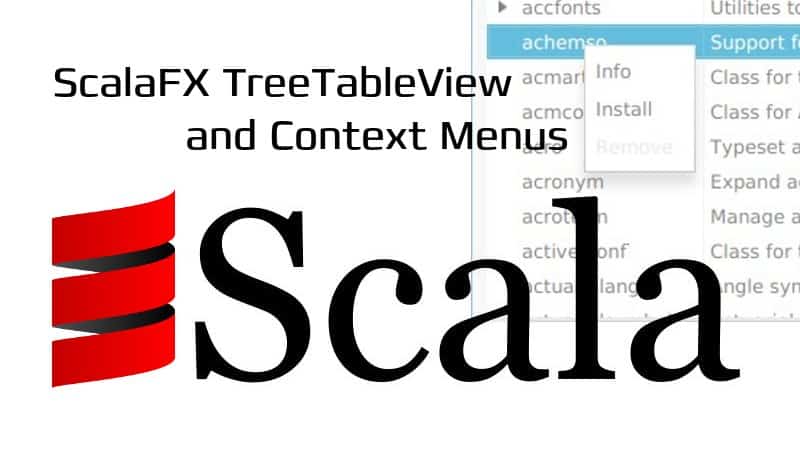
Context menus are useful to exhibit additional functionality. For my TLCockpit program I am listing the packages, updates, and available backups in a TreeTableView. The context for each row should be different depending on the status of the content displayed.
My first try, taken from searches on the web, was to add the context menu via the rowFactory of the TreeTableView:
table.rowFactory =   p =>
  val row = new TreeTableRow[SomeObject]  
  val infoMI = new MenuItem("Info")   onAction = /* use row.item.value */  
  val installMI = new MenuItem("Install")   onAction = /* use row.item.value */  
  val removeMI = new MenuItem("Remove")   onAction = /* use row.item.value */  
  val ctm = new ContextMenu(infoMI, installMI, removeMI)
  row.contextMenu = ctm
  row
 
This worked nicely until I tried to disable/enable some items based on the status of the displayed package:
  ...
  val pkg: SomeObject = row.item.value
  val isInstalled: Boolean = /* determine installation status of pkg */
  val installMI = new MenuItem("Install")   
    disable = isInstalled
    onAction = /* use row.item.value */
   
What I did here is just pull the shown package, get its installation status, and disable the Install context menu entry if it is already installed. All good and fine I thought, but somehow reality was different. First there where NullPointerExceptions (rare occurrence in Scala for me), and then somehow that didn t work out at all. The explanation is quite simple to be found by printing something in the rowFactory function. There are only as many rows made as fit into the current screen size (plus a bit), and their content is dynamically updated when one scrolls. But the enable/disable status of the context menu entries were not properly updated. To fix this one needs to add a callback on the displayed item, which is exposed in row.item. So the correct code is (assuming that a SomeObject has a BooleanProperty installed):
table.rowFactory =   p =>
  val row = new TreeTableRow[SomeObject]  
  val infoMI = new MenuItem("Info")   onAction = /* use row.item.value */  
  val installMI = new MenuItem("Install")   onAction = /* use row.item.value */   
  val removeMI = new MenuItem("Remove")   onAction = /* use row.item.value */  
  val ctm = new ContextMenu(infoMI, installMI, removeMI)
  row.item.onChange   (_,_,newContent) =>
    if (newContent != null)  
      val isInstalled: /* determine installation status from newContent */
      installMI.disable = is_installed
      removeMI.disable = !is_installed
     
   
  row.contextMenu = ctm
  row
 
The final output then gives me:
That s it, the context menus are now correctly adapted to the displayed content. If there is a simpler way, please let me know.

8 November 2017

Neil McGovern: Software Freedom Law Center and Conservancy

Before I start, I would like to make it clear that the below is entirely my personal view, and not necessarily that of the GNOME Foundation, the Debian Project, or anyone else. There s been quite a bit of interest recently about the petition by Software Freedom Law Center to cancel the Software Freedom Conservancy s trademark. A number of people have asked my views on it, so I thought I d write up a quick blog on my experience with SFLC and Conservancy both during my time as Debian Project Leader, and since. It s clear to me that for some time, there s been quite a bit of animosity between SFLC and Conservancy, which for me started to become apparent around the time of the large debate over ZFS on Linux. I talked about this in my DebConf 16 talk, which fortunately was recorded (ZFS bit from 8:05 to 17:30).
This culminated in SFLC publishing a statement, and Conservancy also publishing their statement, backed up by the FSF. These obviously came to different conclusions, and it seems bizarre to me that SFLC who were acting as Debian s legal counsel published a position that was contrary to the position taken by Debian. Additionally, Conservancy and FSF who were not acting as counsel mirrored the position of the project. Then, I hear of an even more confusing move that SFLC has filed legal action against Conservancy, despite being the organisation they helped set up. This happened on the 22nd September, the day after SFLC announced corporate and support services for Free Software projects. SFLC has also published a follow up, which they say that the act is not an attack, let alone a bizarre attack , and that the response from Conservancy, who view it as such was like reading a declaration of war issued in response to a parking ticket . Then, as SFLC somehow find the threat of your trademark being taken away as something other than an attack, they also state: Any project working with the Conservancy that feels in any way at risk should contact us. We will immediately work with them to put in place measures fully ensuring that they face no costs and no risks in this situation. which I read as a direct pitch to try and pull projects away from Conservancy and over to SFLC. Now, even if there is a valid claim here, despite the objections that were filed by a trademark lawyer who I have a great deal of respect for (disclosure: Pam also provides pro-bono trademark advice to my employer, the GNOME Foundation), the optics are pretty terrible. We have a case of one FOSS organisation taking another one to court, after many years of them being aware of the issue, and when wishing to promote a competing service. At best, this is a distraction from the supposed goals of Free Software organisations, and at worst is a direct attempt to interrupt the workings of an established and successful umbrella organisation which lots of projects rely on. I truly hope that this case is simply dropped, and if I was advising SFLC, that s exactly what I would suggest, along with an apology for the distress. Put it this way if SFLC win, then they re simply displaying what would be viewed as an aggressive move to hold the term software freedom exclusively to themselves. If they lose, then it shows that they re willing to do so to another 501(c)3 without actually having a case. Before I took on the DPL role, I was under the naive impression that although there were differences in approach, at least we were coming to try and work together to promote software freedoms for the end user. Unfortunately, since then, I ve now become a lot more jaded about exactly who, and which organisations hold our best interests at heart. (Featured image by Nick Youngson CC-BY-SA-3.0 http://nyphotographic.com/)

Dirk Eddelbuettel: R / Finance 2018 Call for Papers

The tenth (!!) annual annual R/Finance conference will take in Chicago on the UIC campus on June 1 and 2, 2018. Please see the call for papers below (or at the website) and consider submitting a paper. We are once again very excited about our conference, thrilled about who we hope may agree to be our anniversary keynotes, and hope that many R / Finance users will not only join us in Chicago in June -- and also submit an exciting proposal. So read on below, and see you in Chicago in June!

Call for Papers R/Finance 2018: Applied Finance with R
June 1 and 2, 2018
University of Illinois at Chicago, IL, USA The tenth annual R/Finance conference for applied finance using R will be held June 1 and 2, 2018 in Chicago, IL, USA at the University of Illinois at Chicago. The conference will cover topics including portfolio management, time series analysis, advanced risk tools, high-performance computing, market microstructure, and econometrics. All will be discussed within the context of using R as a primary tool for financial risk management, portfolio construction, and trading. Over the past nine years, R/Finance has includedattendeesfrom around the world. It has featured presentations from prominent academics and practitioners, and we anticipate another exciting line-up for 2018. We invite you to submit complete papers in pdf format for consideration. We will also consider one-page abstracts (in txt or pdf format) although more complete papers are preferred. We welcome submissions for both full talks and abbreviated "lightning talks." Both academic and practitioner proposals related to R are encouraged. All slides will be made publicly available at conference time. Presenters are strongly encouraged to provide working R code to accompany the slides. Data sets should also be made public for the purposes of reproducibility (though we realize this may be limited due to contracts with data vendors). Preference may be given to presenters who have released R packages. Please submit proposals online at http://go.uic.edu/rfinsubmit. Submissions will be reviewed and accepted on a rolling basis with a final submission deadline of February 2, 2018. Submitters will be notified via email by March 2, 2018 of acceptance, presentation length, and financial assistance (if requested). Financial assistance for travel and accommodation may be available to presenters. Requests for financial assistance do not affect acceptance decisions. Requests should be made at the time of submission. Requests made after submission are much less likely to be fulfilled. Assistance will be granted at the discretion of the conference committee. Additional details will be announced via the conference website at http://www.RinFinance.com/ as they become available. Information on previous years'presenters and their presentations are also at the conference website. We will make a separate announcement when registration opens. For the program committee:
Gib Bassett, Peter Carl, Dirk Eddelbuettel, Brian Peterson,
Dale Rosenthal, Jeffrey Ryan, Joshua Ulrich

Dirk Eddelbuettel: RQuantLib 0.4.4: Several smaller updates

A shiny new (mostly-but-not-completely maintenance) release of RQuantLib, now at version 0.4.4, arrived on CRAN overnight, and will get to Debian shortly. This is the first release in over a year, and it it contains (mostly) a small number of fixes throughout. It also includes the update to the new DateVector and DatetimeVector classes which become the default with the upcoming Rcpp 0.12.14 release (just like this week's RcppQuantuccia release). One piece of new code is due to Fran ois Cocquemas who added support for discrete dividends to both European and American options. See below for the complete set of changes reported in the NEWS file. As with release 0.4.3 a little over a year ago, we will not have new Windows binaries from CRAN as I apparently have insufficient powers of persuasion to get CRAN to update their QuantLib libraries. So we need a volunteer. If someone could please build a binary package for Windows from the 0.4.4 sources, I would be happy to once again host it on the GHRR drat repo. Please contact me directly if you can help. Changes are listed below:

Changes in RQuantLib version 0.4.4 (2017-11-07)
  • Changes in RQuantLib code:
    • Equity options can now be analyzed via discrete dividends through two vectors of dividend dates and values (Francois Cocquemas in #73 fixing #72)
    • Some package and dependency information was updated in files DESCRIPTION and NAMESPACE.
    • The new Date(time)Vector classes introduced with Rcpp 0.12.8 are now used when available.
    • Minor corrections were applied to BKTree, to vanilla options for the case of intraday time stamps, to the SabrSwaption documentation, and to bond utilities for the most recent QuantLib release.

Courtesy of CRANberries, there is also a diffstat report for the this release. As always, more detailed information is on the RQuantLib page. Questions, comments etc should go to the rquantlib-devel mailing list off the R-Forge page. Issue tickets can be filed at the GitHub repo.

This post by Dirk Eddelbuettel originated on his Thinking inside the box blog. Please report excessive re-aggregation in third-party for-profit settings.

Jonathan Dowland: Christmas

Every year, family members ask me to produce a list of gift suggestions for them to buy for me for Christmas. An enviable position for many, I'm sure, but combined with trying to come up with gift ideas for them, this can sometimes be a stressful situation, with a risk of either giving or receiving gifts that are really nothing more than tat, fluff or kipple. I've started to feel that this is detracting from the spirit of the season. I also don't really want much "stuff". When I am interested in something, it's not something that is convenient for others to buy, either because it's hard to describe, or has limited availability, or is only available at particular times of the year, etc. I'd rather focus on spending time with friends and family. Starting this year, I'm asking that people who wish to do so donate to a charity on my behalf instead. The charity I have chosen for this year is St. Oswald's Hospice.

7 November 2017

Don Armstrong: Autorandr: automatically adjust screen layout

Like many laptop users, I often plug my laptop into different monitor setups (multiple monitors at my desk, projector when presenting, etc.) Running xrandr commands or clicking through interfaces gets tedious, and writing scripts isn't much better. Recently, I ran across autorandr, which detects attached monitors using EDID (and other settings), saves xrandr configurations, and restores them. It can also run arbitrary scripts when a particular configuration is loaded. I've packed it, and it is currently waiting in NEW. If you can't wait, the deb is here and the git repo is here. To use it, simply install the package, and create your initial configuration (in my case, undocked):
 autorandr --save undocked
then, dock your laptop (or plug in your external monitor(s)), change the configuration using xrandr (or whatever you use), and save your new configuration (in my case, workstation):
autorandr --save workstation
repeat for any additional configurations you have (or as you find new configurations). Autorandr has udev, systemd, and pm-utils hooks, and autorandr --change should be run any time that new displays appear. You can also run autorandr --change or autorandr --load workstation manually too if you need to. You can also add your own ~/.config/autorandr/$PROFILE/postswitch script to run after a configuration is loaded. Since I run i3, my workstation configuration looks like this:
 #!/bin/bash
 xrandr --dpi 92
 xrandr --output DP2-2 --primary
 i3-msg '[workspace="^(1 4 6)"] move workspace to output DP2-2;'
 i3-msg '[workspace="^(2 5 9)"] move workspace to output DP2-3;'
 i3-msg '[workspace="^(3 8)"] move workspace to output DP2-1;'
which fixes the dpi appropriately, sets the primary screen (possibly not needed?), and moves the i3 workspaces about. You can also arrange for configurations to never be run by adding a block hook in the profile directory. Check it out if you change your monitor configuration regularly!

Rog rio Brito: Some activities of the day

Yesterday, I printed the first draft of the first chapter when my little boy was here and he was impressed with this strange object called a "printer". Before I printed what I needed, I fired up LibreOffice and chose the biggest font size that was available and let him type his first name by himself. He was quicker than I thought with a keyboard. After seeing me print his first name, he was jumping up and down with joy of having created something and even showed grandma and grandpa what he had done. He, then, wanted more and I taught him how to use that backspace key, what it meant and he wanted to type his full name. I let him and taught him that there is a key called space that he should type every time he wants to start a new word and, in the end, he typed his first two names. To my surprise, he memorized the icon with the printer (which I must say that I have to hunt every time, since it seems so similar to the adjacent ones!) and pressed this new key called "Enter". When he pressed, he wasn't expecting the printer on his right to start making noises and printing his name. He was so excited and it was so nice to see his reaction full of joy to get a job done! I am thinking of getting a spare computer, building it with him and for him, so that he can call it his computer every time he comes to see daddy. As a serendipitous situation, Packt Publishing offered yesterday their title "Python Projects for Kids". Unfortunately, he does not yet know how to read, but I guess that the right age is coming soon, which is a good thing to make him be educated "the right way" (that is, with the best support, teaching and patience that I can give him). Anyway, I printed the first draft of the first chapter and today I have to turn it in. As I write this, I am downloading a virtual machine from Microsoft to try to install Java on it. Let me see if it works. I have none of the virtualization options used, tough the closest seems to be virtualbox. Let me cross my fingers. In other news, I updated some of the tags of very old posts of this blog, and I am seriously thinking about switching from [ikiwiki][0] to another blog platform. It is slow, very slow on my system with the repositories that I have, especially on my armel system. Some non-interpreted system would be best, but I don't know if such a thing even exists. But the killer problem is that it doesn't support easily the typing of Mathematics (even though a 3rd party plugin for MathJax exists). On the other hand, I just received an answer on twitter from @telegram and it was nice:

Hello, Telegram supports bold and italic. You can type **bold** and __italic__. On mobile, you can also highlight text for this as well.
It is nice that this works with telegram-desktop too. Besides that, I filed some bugs on Debian's BTS, responded to some issues on my projects on GitHub (I'm slowly getting back on maintaining things) and file wishlist bugs on some other projects. Oh, and I grabbed a copy of "Wonder woman" ("Mulher Maravilha") and "Despicable Me 3" ("Meu Malvado Favorito 3") dubbed in Brazilian Portuguese for my son. I have to convert the audio from AAC-LC in 6 channels to AC3 or to stereo. Otherwise, my TVs have problem with the videos (one refuses to play the entire file and another plays the audio with sounds of hiccups). Edit: After converting the VirtualBox image taken from Microsoft, I could easily use qemu/kvm to create screenshots of the installation of Java. The command that I used (for future reference) is: qemu-system-x86_64 -enable-kvm -m 4096 -smp 2 -net nic,model=e1000 -net user -soundhw ac97 -drive index=0,media=disk,cache=unsafe,file=win7.qcow2 Edit: Fixed some typos.

Dirk Eddelbuettel: RcppQuantuccia 0.0.2

A first maintenance release of RcppQuantuccia got to CRAN earlier today. RcppQuantuccia brings the Quantuccia header-only subset / variant of QuantLib to R. At present it mostly offers calendaring, but Quantuccia just got a decent amount of new functions so hopefully we can offer more here too. This release was motivated by the upcoming Rcpp release which will deprecate the okd Date and Datetime vectors in favours of newer ones. So this release of RcppQuantuccia switches to the newer ones. Other changes are below:

Changes in version 0.0.2 (2017-11-06)
  • Added calendars for Canada, China, Germany, Japan and United Kingdom.
  • Added bespoke and joint calendars.
  • Using new date(time) vectors (#6).

Courtesy of CRANberries, there is also a diffstat report relative to the previous release. More information is on the RcppQuantuccia page. Issues and bugreports should go to the GitHub issue tracker.

This post by Dirk Eddelbuettel originated on his Thinking inside the box blog. Please report excessive re-aggregation in third-party for-profit settings.

6 November 2017

James Bromberger: Web Security 2017

I started web development around late 1994. Some of my earliest paid web work is still online (dated June 1995). Clearly, that was a simpler time for content! I went on to be Webmaster (yes, for those joining us in the last decade, that was a job title once) for UWA, and then for Hartley Poynton/JDV.com at time when security became important as commerce boomed online. At the dawn of the web era, the consideration of backwards compatibility with older web clients (browsers) was deemed to be important; content had to degrade nicely, even without any CSS being applied. As the years stretched out, the legacy became longer and longer. Until now. In mid-2018, the Payment Card Industry (PCI) Data Security Standard (DSS) 3.2 comes into effect, requiring card holder environments to use (at minimum) TLS 1.2 for the encrypted transfer of data. Of course, that s also the maximum version typically available today (TLS 1.3 is in draft 21 at this point in time of writing). This effort by the PCI is forcing people to adopt new browsers that can do the TLS 1.2 protocol (and the encryption ciphers that permits), typically by running modern/recent Chrome, Firefox, Safari or Edge browsers. And for the majority of people, Chrome is their choice, and the majority of those are all auto-updating on every release. Many are pushing to be compliant with the 2018 PCI DSS 3.2 as early as possible; your logging of negotiated protocols and ciphers will show if your client base is ready as well. I ve already worked with one government agency to demonstrate they were ready, and have already helped disable TLS 1.0 and 1.1 on their public facing web sites (and previously SSL v3). We ve removed RC4 ciphers, 3DES ciphers, and enabled ephemeral key ciphers to provide forward secrecy. Web developers (writing Javascript and using various frameworks) can rejoice the age of having to support legacy MS IE 6/7/8/9/10 is pretty much over. None of those browsers support TLS 1.2 out of the box (IE 10 can turn this on, but for some reason, it is off by default). This makes Javascript code smaller as it doesn t have to have conditional code to work with the quirks of those older clients. But as we find ourselves with modern clients, we can now ask those clients to be complicit in our attempts to secure the content we serve. They understand modern security constructs such as Content Security Policies and other HTTP security-related headers. There s two tools I am currently using to help in this battle to improve web security. One is SSLLabs.com, the work of Ivan Risti (and now owned/sponsored by Qualys). This tool gives a good view of the encryption in flight (protocols, ciphers), chain of trust (certificate), and a new addition of checking DNS records for CAA records (which I and others piled on a feature request for AWS Route53 to support). The second tool is Scott Helm s SecurityHeaders.io, which looks at the HTTP headers that web content uses to ask browsers to enforce security on the client side. There s a really important reason why these tools are good; they are maintained. As new recommendations on ciphers, protocols, signature algorithms or other actions become recommended, they re updated on these tools. And these tools are produced by very small, but agile teams like one person teams, without the bureaucracy (and lag) associated with large enterprise tools. But these shouldn t be used blindly. These services make suggestions, and you should research them yourselves. For some, not all the recommendations may meet your personal risk profile. Personally, I m uncomfortable with Public-Key-Pins, so that can wait for a while indeed, Chrome has now signalled they will drop this. So while PCI is hitting merchants with their DSS-compliance stick (and making it plainly obvious what they have to do), we re getting a side-effect of having a concrete reason for drawing a line under where our backward compatibility must stretch back to, and the ability to have the web client assist in ensure security of content.

Jonathan Dowland: Coil

Peter Christopherson and Jhonn Balance, from [Santa Sangre](https://santasangremagazine.wordpress.com/2014/11/16/the-angelic-conversation-in-remembrance-of-coil/) Peter Christopherson and Jhonn Balance, from Santa Sangre
A friend asked me to suggest five tracks by Coil that gave an introduction to their work. Trying to summarize Coil in 5 tracks is tough. I think it's probably impossible to fairly summarize Coil with any subset of their music, for two reasons. Firstly, their music was the output of their work but I don't think is really the whole of the work itself. There's a real mystique around them. They were deeply interested in arcania, old magic, Aleister Crowley, scatology; they were both openly and happily gay and their work sometimes explored their experiences in various related underground scenes and sub-cultures; they lost friends to HIV/AIDS and that had a profound impact on them. They had a big influence on some people who discovered them who were exploring their own sexualities at the time and might have felt excluded from mainstream society. They frequently explored drugs, meditation and other ways to try to expand and open their minds; occultism. They were also fiercely anti-commercial, their stuff was released in limited quantities across a multitude of different music labels, often under different names, and often paired with odd physical objects, runes, vials of blood, etc. Later fascinations included paganism and moon worship. I read somewhere that they literally cursed one of their albums. Secondly, part of their "signature" was the lack of any consistency in their work, or to put it another way, their style over time varied enormously. I'm also not necessarily well-versed in all their stuff, I'm part way on this journey myself... but these are tracks which stand out at least from the subset I've listened to. Both original/core members of Coil have passed away and the legal status of their catalogue is in a state of limbo. Some of these songs are available on currently-in-print releases, but all such releases are under dispute by some associate or other.

1. Heaven's Blade Like (probably) a lot of Coil songs, this one exists in multiple forms, with some dispute about which are canonical, which are officially sanctioned, etc. the video linked above actually contains 5 different versions, but I've linked to a time offset to the 4th: "Heaven's Blade (Backwards)". This version was the last to come to light with the recent release of "Backwards", an album originally prepared in the 90s at Trent Reznor's Nothing Studios in New Orleans, but not finished or released. The circumstances around its present-day release, as well as who did what to it and what manipulation may have been performed to the audio a long time after the two core members had passed, is a current topic in fan circles. Despite that, this is my preferred version. You can choose to investigate the others, or not, at your own discretion.

2. how to destroy angels (ritual music for the accumulation of male sexual energy) A few years ago, "guidopaparazzi", a user at the Echoing the Sound music message board attempted to listen to every Coil release ever made and document the process. He didn't do it chronologically, leaving the EPs until near the end, which is when he tackled this one (which was the first release by Coil, and was the inspiration behind the naming of Trent Reznor's one-time side project "How To Destroy Angels"). Guido seemed to think this was some kind of elaborate joke. Personally I think it's a serious piece and there's something to it but this just goes to show, different people can take things in entirely different ways. Here's Guido's review, and you can find the rest of his reviews linked from that one if you wish. https://archive.org/details/Coil-HowToDestroyAngels1984

3. Red Birds Will Fly Out Of The East And Destroy Paris In A Night Both "Musick To Play In The Dark" volumes (one and two) are generally regarded as amongst the most accessible entry points to the Coil discography. This is my choice of cut from volume 1. For some reason this reminds me a little of some of the background music from the game "Unreal Tournament". I haven't played that in at least 15 years. I should go back and see if I can figure out why it does. The whole EP is worth a listen, especially at night. https://archive.org/details/CoilMusickToPlayInTheDarkVol1/Coil+-+Musick+To+Play+In+The+Dark+Vol+1+-+2+Red+Birds+Will+Fly+Out+Of+The+East+And+Destroy+Paris+In+A+Night.flac

4. Things Happen It's tricky to pick a track from either "Love's Secret Domain" or "Horse Rotorvator"; there are other choices which I think are better known and loved than this one but it's one that haunted me after I first heard it for one reason or another, so here it is.

5. The Anal Staircase Track 1 from Horse Rotorvator. What the heck is a Horse Rotorvator anyway? I think it was supposed to have been a lucid nightmare experienced by the vocalist Jhonn Balance. So here they wrote a song about anal sex. No messing about, no allusion particularly, but why should there be? https://archive.org/details/CoilHorseRotorvator2001Remaster/Coil+-+Horse+Rotorvator+%5B2001+remaster%5D+-+01+The+Anal+Staircase.flac

Bonus 6th: 7-Methoxy-B-Carboline (Telepathine) From the drone album "Time Machines", which has just been re-issued by DIAS records, who describe it as "authorized". Each track is titled by the specific combination of compounds that inspired its composition, supposedly. Or, perhaps it's a "recommended dosing" for listening along. https://archive.org/details/TimeMachines-TimeMachines

Post-script If those piqued your interest, there's some decent words and a list of album suggestions in this Vinyl Factory article. Finally, if you can track them down, Stuart Maconie had two radio shows about Coil on his "Freak Zone" programme. The main show discusses the release of "Backwards", including an interview with collaborator Danny Hyde, who was the main person behind the recent re-issue. The shorter show is entitled John Doran uncoils Coil. Guest John Doran from The Quietus discusses the group and their history interspersed with Coil tracks and tracks from their contemporaries. Interestingly they chose a completely different set of 5 tracks to me.

5 November 2017

Thorsten Alteholz: My Debian Activities in October 2017

FTP assistant Again, this month almost the same numbers as last month appeared in the statistics. I accepted 214 packages and rejected 22 uploads. The overall number of packages that got accepted this month was only 339. Debian LTS This was my fortieth month that I did some work for the Debian LTS initiative, started by Raphael Hertzog at Freexian. This month my all in all workload has been 20.75h. During that time I did LTS uploads of: I also took care of radare2 twice and marked all four CVEs as not-affected for Wheezy and Jessie. As nobody else wanted to address the issues in wireshark yet, I now started to work on this package. Last but not least I did one week of frontdesk duties. Other stuff During October I took care of some bugs and at one go uploaded new upstream versions of hoel and duktape (this had to be done twice as I introduced an new bug with the first upload :-(). I only fixed bugs in glewlwyd and smstools. This month I also sponsored an upload of printrun. After about ten years of living without any power outage, some construction worker decided to cut a cable near my place. Unfortunately one of my computers used for recording TV shows did not boot after the cable had been repaired and I had to switch some timers to other boxes. All in all this was too much stress and I purchased some USVs from APC. As apcupsd was orphaned, I took the opportunity to adopt it as DOPOM for this month. My license pasting project now contains 31 license templates for your debian/copyright. The list of available texts can be obtained with:

curl http://licapi.debian.net/template

The license text itself is available under the given links, for example with

curl http://licapi.debian.net/template/Apache-2

Dirk Eddelbuettel: pinp 0.0.4: Small tweak

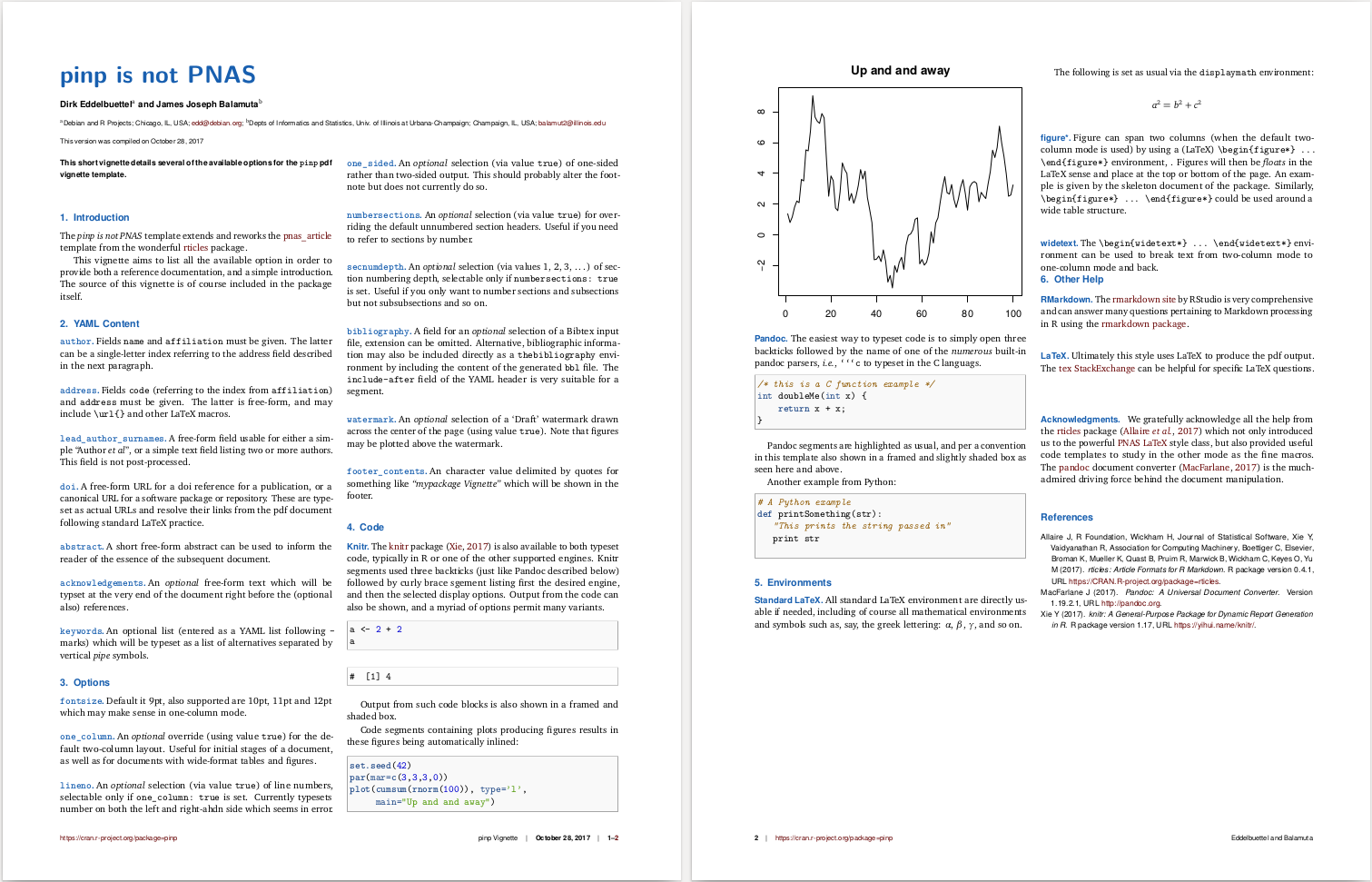
A maintenance release of our pinp package for snazzier one or two column vignettes is now on CRAN as of yesterday. In version 0.0.3, we disabled the default \pnasbreak command we inherit from the PNAS LaTeX style. That change turns out to have been too drastic. So we reverted yet added a new YAML front-matter option skip_final_break which, if set to TRUE, will skip this break. With a default value of FALSE we maintain prior behaviour. A screenshot of the package vignette can be seen below. Additional screenshots of are at the pinp page.
The NEWS entry for this release follows.

Changes in pinp version 0.0.4 (2017-11-04)
  • Correct NEWS headers from 'tint' to 'pinp' (#45).
  • New front-matter variables skip_final_break skips the \pnasbreak on final page which back as default (#47).

Courtesy of CRANberries, there is a comparison to the previous release. More information is on the tint page. For questions or comments use the issue tracker off the GitHub repo.

This post by Dirk Eddelbuettel originated on his Thinking inside the box blog. Please report excessive re-aggregation in third-party for-profit settings.

Junichi Uekawa: It's already November.

It's already November. Been reading up a bit on C++17 features and improvements. Nice.

4 November 2017

Alexander Wirt: debconf mailinglists moved to lists.debian.org

Today I had the pleasure to move the debconf mailinglists to lists.debian.org. That means that the following mailinglists: are now hosted on lists.debian.org. Please update any documentation or bookmarks you have. Next step would be to join debconf again ;).

Steinar H. Gunderson: Tr ndisk 2017 live stream

We're streaming live from Tr ndisk 2017, first round of the Norwegian ultimate frisbee series, today from 0945 CET and throughout the day/weekend. It's an interesting first for Nageru in that it's sports, where everything happens much faster and there are more demands for overlay graphics (I've made a bunch of CasparCG templates). I had hoped to get to use Narabu in this, but as the (unfinished) post series indicates, I simply had to prioritize other things. There's plenty of new things for us anyway, not the least that I'll be playing and not operating. :-) Feel free to tune in to the live stream, although we don't have international stream reflectors. It's a fun sport with many nice properties. :-) There will be YouTube not too long after the day is over, too. Edit: All games from Saturday and Sunday are now online; see this YouTube list. Most commentary is in Norwegian, although some games are in English. I was happy everything worked well, and the production crew did a great job (I was busy playing), but of course there's tons of small things we want to improve for next time.

Dirk Eddelbuettel: tint 0.0.4: Small enhancements

A maintenance release of the tint package arrived on CRAN earlier today. Its name expands from tint is not tufte as the package offers a fresher take on the Tufte-style for html and pdf presentations. A screenshot of the pdf variant is below.
This release brings some minor enhancements and polish, mostly learned from having done the related pinp (two-column vignette in the PNAS style) and linl (LaTeX letter) RMarkdown-wrapper packages; see below for details from the NEWS.Rd file.

Changes in tint version 0.0.4 (2017-11-02)
  • Skeleton files are also installed as vignettes (#20).
  • A reference to the Tufte source file now points to tint (Ben Marwick in #19, later extended to other Rmd files).
  • Several spelling and grammar errors were corrected too (#13 and #16 by R. Mark Sharp and Matthew Henderson)

Courtesy of CRANberries, there is a comparison to the previous release. More information is on the tint page. For questions or comments use the issue tracker off the GitHub repo.

This post by Dirk Eddelbuettel originated on his Thinking inside the box blog. Please report excessive re-aggregation in third-party for-profit settings.

Next.

Previous.