Search Results: "ms"

25 July 2017

Gunnar Wolf: Getting ready for DebConf17 in Montreal!


(image shamelessly copied from Noodles' Emptiness) This year I will only make it to DebConf, not to DebCamp. But, still, I am very very happy and excited as the travel date looms nearer! I have ordered some of the delicacies for the Cheese and Wine party, signed up for the public bicycle system of Montreal, and done a fair share of work with the Content Team; finally today we sent out the announcement for the schedule of talks. Of course, there are several issues yet to fix, and a lot of things to do before traveling... But, no doubt about this: It will be an intense week! Oh, one more thing while we are at it: The schedule as it was published today does not really look like we have organized stuff into tracks But we have! This will be soon fixed, adding some color-coding to make tracks clearer on the schedule. This year, I pushed for the Content Team to recover the notion of tracks as an organizative measure, and as something that delivers value to DebConf as a whole. Several months ago, I created a Wiki page for the DebConf tracks, asking interested people to sign up for them. We currently have the following tracks registered:
Blends
Andreas Tille
Debian Science
Michael Banck
Cloud and containers
Luca Filipozzi
Embedded
Pending
Systems administration, automation and orchestation
Pending
Security
Gunnar Wolf
We have two tracks still needing a track coordinator. Do note that most of the tasks mentioned by the Wiki have already been carried out; what a track coordinator will now do is to serve as some sort of moderator, maybe a recurring talkmeister, ensuring continuity and probably providing for some commentary, giving some unity to its sessions. So, the responsibilities for a track coordinator right now are quite similar to what is expected for video team volunteers but to a set of contiguous sessions. If you are interested in being the track coordinator/moderator for Embedded or for Systems administration, automation and orchestation or even to share the job with any of the other, registered, coordinators, please speak up! Mail content@debconf.org and update the table in the Wiki page. See you very soon in Montreal!

24 July 2017

Bits from Debian: DebConf17 Schedule Published!

The DebConf17 orga team is proud to announce that over 120 activities have been scheduled so far, including 45- and 20-minute talks, team meetings, and workshops, as well as a variety of other events. Most of the talks and BoFs will be streamed and recorded, thanks to our amazing video team! We'd like to remind you that Saturday August 5th is also our much anticipated Open Day! This means a program for a wider audience, including special activities for newcomers, such as an AMA session about Debian, a beginners workshop on packaging, a thoughtful talk about freedom with regard to today's popular gadgets and more. In addition to the published schedule, we'll provide rooms for ad-hoc sessions where attendees will be able to schedule activities at any time during the whole conference. The current schedule is available at https://debconf17.debconf.org/schedule/ This is also available through an XML feed. You can use ConfClerk in Debian to consume this, or Giggity on Android devices: https://debconf17.debconf.org/schedule/mobile/ We look forward to seeing you in Montreal! DebConf17 logo

Norbert Preining: Garmin fenix 5x broken by design

Some month ago I upgrade my (European) fenix3 to a (Japanese) fenix 5x, looking forward to the built-in maps as well as support for Japanese. I was about to write a great review, how content I have been with the fenix 3 and how much better the 5x is. Well, until I realized that Garmin s engineers seem to be brain-damaged and shipping broken by design devices: Just one word: Set an alarm on the watch, and wonder .. because you will never wake up the next day, since the alarm was deleted due to an unattended (so-called) sync operation. Happened to me, several times, worst was when I was with clients working as guide. So the problem is well known, see this link and this link and this link, and it is not restricted to the fenix. The origin of the problem is that Garmin is incapable of implementing a synchronization protocol. They have three sources of data: The Connect website, the Connect application on the smartphone, and the watch itself. And interestingly they only do pushes from Web to application to device, overwriting settings on the lower end. Which means, any alarm that I create on the watch will be overwritten, ie deleted, on every sync sorry, not sync, on every forced push from the mobile. It is a bit depressing, but I think the urgent solution is to exempt alarms from the synchronization completely, and remove them from both the connect web page and the application, until a better, a real, synchronization is implemented. I found a work-around in one of the threads on the Garmin forum, that is: create an alarm on the web or application, better alarms for each of the times you might need it. These will be synced to the device, and can be activated/deactivated on the device without problems. But to be honest this is not a solution I can really trust in when I need to get up in the morning. Besides this issue, which is unfortunately rather severe a restriction for me as mountaineer and mountain guide, I really love the watch and will write a more detailed review soon.

Jonathan McDowell: Learning to love Ansible

This post attempts to chart my journey towards getting usefully started with Ansible to manage my system configurations. It s a high level discussion of how I went about doing so and what I got out of it, rather than including any actual config snippets - there are plenty of great resources out there that handle the actual practicalities of getting started much better than I could. I ve been convinced about the merits of configuration management for machines for a while now; I remember conversations about producing an appropriate set of recipes to reproduce our haphazard development environment reliably over 4 years ago. That never really got dealt with before I left, and as managing systems hasn t been part of my day job since then I never got around to doing more than working my way through the Puppet Learning VM. I do, however, continue to run a number of different Linux machines - a few VMs, a hosted dedicated server and a few physical machines at home and my parents . In particular I have a VM which handles my parents email, and I thought that was a good candidate for trying to properly manage. It s backed up, but it would be nice to be able to redeploy that setup easily if I wanted to move provider, or do hosting for other domains in their own VMs. I picked Ansible, largely because I wanted something lightweight and the agentless design appealed to me. All I really need to do is ensure Python is on the host I want to manage and everything else I can bootstrap using Ansible itself. Plus it meant I could use the version from Debian testing on my laptop and not require backports on the stable machines I wanted to manage. My first attempt was to write a single Ansible YAML file which did all the appropriate things for the email VM; installed Exim/Apache/Roundcube, created users, made sure the appropriate SSH keys were in place, installed configuration files, etc, etc. This did the job, but I found myself thinking it was no better than writing a shell script to do the same things. Things got a lot better when instead of concentrating on a single host I looked at what commonality was shared between hosts. I started with simple things; Debian is my default distro so I created an Ansible role debian-system which configured up APT and ensured package updates were installed. Then I added a task to setup my own account and install my SSH keys. I was then able to deploy those 2 basic steps across a dozen different machine instances. At one point I got an ARM64 VM from Scaleway to play with, and it was great to be able to just add it to my Ansible hosts file and run the playbook against it to get my basic system setup. Adding email configuration got trickier. In addition to my parents email VM I have my own email hosted elsewhere (along with a whole bunch of other users) and the needs of both systems are different. Sitting down and trying to manage both configurations sensibly forced me to do some rationalisation of the systems, pulling out the commonality and then templating the differences. Additionally I ended up using the lineinfile module to edit the Debian supplied configurations, rather than rolling out my own config files. This helped ensure more common components between systems. There were also a bunch of differences that had grown out of the fact each system was maintained by hand - I had about 4 copies of each Let s Encrypt certificate rather than just putting one copy in /etc/ssl and pointing everything at that. They weren t even in the same places on different systems. I unified these sorts of things as I came across them. Throughout the process of this rationalisation I was able to easily test using containers. I wrote an Ansible role to create systemd-nspawn based containers, doing all of the LVM + debootstrap work required to produce a system which could then be managed by Ansible. I then pointed the same configuration as I was using for the email VM at this container, and could verify at each step along the way that the results were what I expected. It was still a little nerve-racking when I switched over the live email config to be managed by Ansible, but it went without a hitch as hoped. I still have a lot more configuration to switch to being managed by Ansible, especially on the machines which handle a greater number of services, but it s already proved extremely useful. To prepare for a jessie to stretch upgrade I fired up a stretch container and pointed the Ansible config at it. Most things just worked and the minor issues I was able to fix up in that instance leaving me confident that the live system could be upgraded smoothly. Or when I want to roll out a new SSH key I can just add it to the Ansible setup, and then kick off an update. No need to worry about whether I ve updated it everywhere, or correctly removed the old one. So I m a convert; things were a bit more difficult by starting with existing machines that I didn t want too much disruption on, but going forward I ll be using Ansible to roll out any new machines or services I need, and expect that I ll find that new deployment to be much easier now I have a firm grasp on the tools available.

Jonathan Carter: Plans for DebCamp17

In a few days, I ll be attending DebCamp17 in Montr al, Canada. Here are a few things I plan to pay attention to:

23 July 2017

Gregor Herrmann: RC bugs 2017/08-29

long time no blog post. & the stretch release happened without many RC bug fixes from me; in practice, the auto-removals are faster & more convenient. what I nevertheless did in the last months was to fix RC bugs in pkg-perl packages (it still surprises me how fast rotting & constantly moving code is); prepare RC bug fixes for jessie (also for pkg-perl packages); & in the last weeks provide patches & carry out NMUs for perl packages as part of the ongoing perl 5.26 transition.

Vincent Fourmond: Screen that hurts my eyes, take 2

Six month ago, I wrote a lengthy post about my new computer hurting my eyes. I haven't made any progress with that, but I've accidentally upgraded my work computer from Kernel 4.4 to 4.8 and the nvidia drivers from 340.96-4 to 375.66-2. Well, my work computer now hurts, I've switched back to the previous kernel and drivers, I hope it'll be back to normal.Any ideas of something specific that changed, either between 4.4 and 4.8 (kernel startup code, default framebuffer modes, etc ?), or between the 340.96 and the 375.66 drivers ? In any case, I'll try that specific combination of kernels/drivers home to see if I can get it to a useable state.Update, July 23rdI reverted to the earlier drivers/kernel, to no avail. But it seems in fact the problem with my work computer is linked to an allergy of some kind, since antihistamine drugs have an effect (there are construction works in my lab, perhaps they are the cause ?). No idea still for my home computer, for which the problem is definitely not solved.

22 July 2017

Sean Whitton: I'm going to DebCamp17, Montr al, Canada

Here s what I m planning to work on please get in touch if you want to get involved with any of these items. In rough order of priority/likelihood of completion:

Niels Thykier: Improving bulk performance in debhelper

Since debhelper/10.3, there has been a number of performance related changes. The vast majority primarily improves bulk performance or only have visible effects at larger input sizes. Most visible cases are: For debhelper, this mostly involved: How to take advantage of these improvements in tools that use Dh_Lib: Credits: I would like to thank the following for reporting performance issues, regressions or/and providing patches. The list is in no particular order: Should I have missed your contribution, please do not hesitate to let me know.
Filed under: Debhelper, Debian

21 July 2017

Michal Čihař: Making Weblate more secure and robust

Having publicly running web application always brings challenges in terms of security and in generally in handling untrusted data. Security wise Weblate has been always quite good (mostly thanks to using Django which comes with built in protection against many vulnerabilities), but there were always things to improve in input validation or possible information leaks. When Weblate has joined HackerOne (see our first month experience with it), I was hoping to get some security driven core review, but apparently most people there are focused on black box testing. I can certainly understand that - it's easier to conduct and you need much less knowledge of the tested website to perform this. One big area where reports against Weblate came in was authentication. Originally we were mostly fully relying on default authentication pipeline coming with Python Social Auth, but that showed some possible security implications and we ended up with having heavily customized authentication pipeline to avoid several risks. Some patches were submitted back, some issues reported, but still we've diverged quite a lot in this area. Second area where scanning was apparently performed, but almost none reports came, was input validation. Thanks to excellent XSS protection in Django nothing was really found. On the other side this has triggered several internal server errors on our side. At this point I was really happy to have Rollbar configured to track all errors happening in the production. Thanks to having all such errors properly recorded and grouped it was really easy to go through them and fix them in our codebase. Most of the related fixes have landed in Weblate 2.14 and 2.15, but obviously this is ongoing effort to make Weblate better with every release.

Filed under: Debian English SUSE Weblate

20 July 2017

Norbert Preining: The poison of academia.edu

All those working in academics or research have surely heard about academia.edu. It started out as a service for academics, in their own words:
Academia.edu is a platform for academics to share research papers. The company s mission is to accelerate the world s research.
But as with most of these platforms, they need to get money, and since some months now academia.edu is pressing users to pay into a premium account at the incredible rate of 8.25USD per month. This is about he same you pay for Netflix, or some other streaming service. If you remain on the free side, what remains for you to do is SNS-like stuff, and uploading your papers so that academia.edu can make money from it. What I am really surprised that they can pull this of at a .edu domain. The registry requirements state
For Institutions Within the United States. To obtain an Internet name in the .edu domain, your institution must be a postsecondary institution that is institutionally accredited by an agency on the U.S. Department of Education s list of Nationally Recognized Accrediting Agencies (see recognized accrediting bodies).
Educause web site
Seeing what they are doing I think it is high time to request removal of the domain name. So let us see what they are offering for their paid service: On the other hand, the free service is consisting of SNS elements where you can follow other researchers, see when they upload/input an event, and that is it more or less. They have lured a considerable amount of academics into this service, gathered lots of papers, and now they are showing their real face money. In contrast to LinkedIn, which also offers paid tier, but keeps the free tier reasonably usable, academia.edu has broken its promise to accelerate the world s research and even worse, it is NOT a platform for academics to share research papers . They are collecting papers and sell access to them, like the publisher paywalls. I consider this kind of service highly poisonous for the academic environment and researchers.

Benjamin Mako Hill: Testing Our Theories About Eternal September

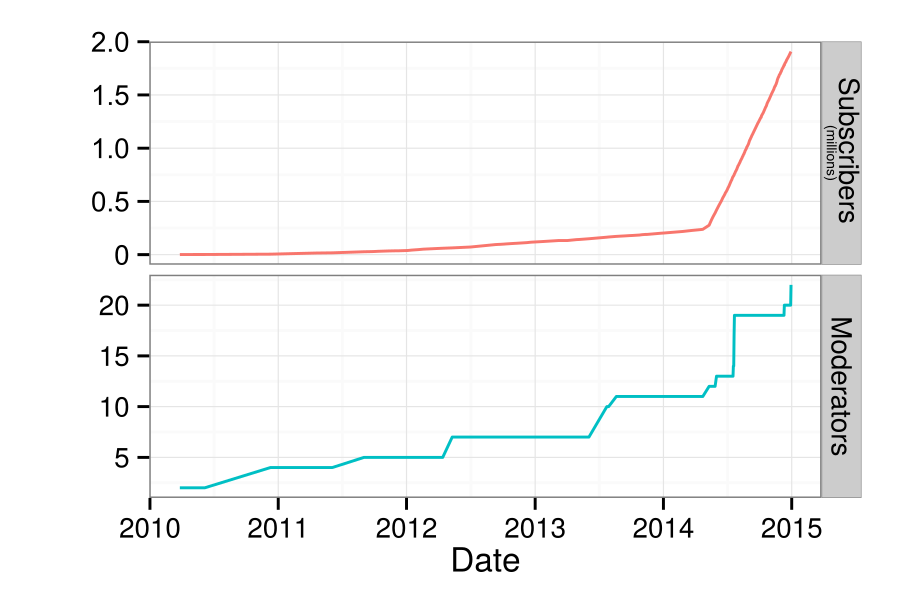
Graph of subscribers and moderators over time in /r/NoSleep. The image is taken from our 2016 CHI paper.
Last year at CHI 2016, my research group published a qualitative study examining the effects of a large influx of newcomers to the /r/nosleep online community in Reddit. Our study began with the observation that most research on sustained waves of newcomers focuses on the destructive effect of newcomers and frequently invokes Usenet s infamous Eternal September. Our qualitative study argued that the /r/nosleep community managed its surge of newcomers gracefully through strategic preparation by moderators, technological systems to reign in on norm violations, and a shared sense of protecting the community s immersive environment among participants. We are thrilled that, less a year after the publication of our study, Zhiyuan Jerry Lin and a group of researchers at Stanford have published a quantitative test of our study s findings! Lin analyzed 45 million comments and upvote patterns from 10 Reddit communities that a massive inundation of newcomers like the one we studied on /r/nosleep. Lin s group found that these communities retained their quality despite a slight dip in its initial growth period. Our team discussed doing a quantitative study like Lin s at some length and our paper ends with a lament that our findings merely reflected, propositions for testing in future work. Lin s study provides exactly such a test! Lin et al. s results suggest that our qualitative findings generalize and that sustained influx of newcomers need not doom a community to a descent into an Eternal September. Through strong moderation and the use of a voting system, the subreddits analyzed by Lin appear to retain their identities despite the surge of new users. There are always limits to research projects work quantitative and qualitative. We think the Lin s paper compliments ours beautifully, we are excited that Lin built on our work, and we re thrilled that our propositions seem to have held up! This blog post was written with Charlie Kiene. Our paper about /r/nosleep, written with Charlie Kiene and Andr s Monroy-Hern ndez, was published in the Proceedings of CHI 2016 and is released as open access. Lin s paper was published in the Proceedings of ICWSM 2017 and is also available online.

18 July 2017

Daniel Silverstone: Yay, finished my degree at last

A little while back, in June, I sat my last exam for what I hoped would be the last module in my degree. For seven years, I've been working on a degree with the Open University and have been taking advantage of the opportunity to have a somewhat self-directed course load by taking the 'Open' degree track. When asked why I bothered to do this, I guess my answer has been a little varied. In principle it's because I felt like I'd already done a year's worth of degree and didn't want it wasted, but it's also because I have been, in the dim and distant past, overlooked for jobs simply because I had no degree and thus was an easy "bin the CV". Fed up with this, I decided to commit to the Open University and thus began my journey toward 'qualification' in 2010. I started by transferring the level 1 credits from my stint at UCL back in 1998/1999 which were in a combination of basic programming in Java, some mathematics including things like RSA, and some psychology and AI courses which at the time were aiming at a degree called 'Computer Science with Cognitive Sciences'. Then I took level 2 courses, M263 (Building blocks of software), TA212 (The technology of music) and MS221 (Exploring mathematics). I really enjoyed the mathematics course and so... At level 3 I took MT365 (Graphs, networks and design), M362 (Developing concurrent distributed systems), TM351 (Data management and analysis - which I ended up hating), and finally finishing this June with TM355 (Communications technology). I received an email this evening telling me the module result for TM355 had been posted, and I logged in to find I had done well enough to be offered my degree. I could have claimed my degree 18+ months ago, but I persevered through another two courses in order to qualify for an honours degree which I have now been awarded. Since I don't particularly fancy any ceremonial awarding, I just went through the clicky clicky and accepted my qualification of 'Batchelor of Science (Honours) Open, Upper Second-class Honours (2.1)' which grants me the letters 'BSc (Hons) Open (Open)' which, knowing me, will likely never even make it onto my CV because I'm too lazy. It has been a significant effort, over the course of the past few years, to complete a degree without giving up too much of my personal commitments. In addition to earning the degree, I have worked, for six of the seven years it has taken, for Codethink doing interesting work in and around Linux systems and Trustable software. I have designed and built Git server software which is in use in some universities, and many companies, along with a good few of my F/LOSS colleagues. And I've still managed to find time to attend plays, watch films, read an average of 2 novel-length stories a week (some of which were even real books), and be a member of the Manchester Hackspace. Right now, I'm looking forward to a stress free couple of weeks, followed by an immense amount of fun at Debconf17 in Montr al!

Matthew Garrett: Avoiding TPM PCR fragility using Secure Boot

In measured boot, each component of the boot process is "measured" (ie, hashed and that hash recorded) in a register in the Trusted Platform Module (TPM) build into the system. The TPM has several different registers (Platform Configuration Registers, or PCRs) which are typically used for different purposes - for instance, PCR0 contains measurements of various system firmware components, PCR2 contains any option ROMs, PCR4 contains information about the partition table and the bootloader. The allocation of these is defined by the PC Client working group of the Trusted Computing Group. However, once the boot loader takes over, we're outside the spec[1].

One important thing to note here is that the TPM doesn't actually have any ability to directly interfere with the boot process. If you try to boot modified code on a system, the TPM will contain different measurements but boot will still succeed. What the TPM can do is refuse to hand over secrets unless the measurements are correct. This allows for configurations where your disk encryption key can be stored in the TPM and then handed over automatically if the measurements are unaltered. If anybody interferes with your boot process then the measurements will be different, the TPM will refuse to hand over the key, your disk will remain encrypted and whoever's trying to compromise your machine will be sad.

The problem here is that a lot of things can affect the measurements. Upgrading your bootloader or kernel will do so. At that point if you reboot your disk fails to unlock and you become unhappy. To get around this your update system needs to notice that a new component is about to be installed, generate the new expected hashes and re-seal the secret to the TPM using the new hashes. If there are several different points in the update where this can happen, this can quite easily go wrong. And if it goes wrong, you're back to being unhappy.

Is there a way to improve this? Surprisingly, the answer is "yes" and the people to thank are Microsoft. Appendix A of a basically entirely unrelated spec defines a mechanism for storing the UEFI Secure Boot policy and used keys in PCR 7 of the TPM. The idea here is that you trust your OS vendor (since otherwise they could just backdoor your system anyway), so anything signed by your OS vendor is acceptable. If someone tries to boot something signed by a different vendor then PCR 7 will be different. If someone disables secure boot, PCR 7 will be different. If you upgrade your bootloader or kernel, PCR 7 will be the same. This simplifies things significantly.

I've put together a (not well-tested) patchset for Shim that adds support for including Shim's measurements in PCR 7. In conjunction with appropriate firmware, it should then be straightforward to seal secrets to PCR 7 and not worry about things breaking over system updates. This makes tying things like disk encryption keys to the TPM much more reasonable.

However, there's still one pretty major problem, which is that the initramfs (ie, the component responsible for setting up the disk encryption in the first place) isn't signed and isn't included in PCR 7[2]. An attacker can simply modify it to stash any TPM-backed secrets or mount the encrypted filesystem and then drop to a root prompt. This, uh, reduces the utility of the entire exercise.

The simplest solution to this that I've come up with depends on how Linux implements initramfs files. In its simplest form, an initramfs is just a cpio archive. In its slightly more complicated form, it's a compressed cpio archive. And in its peak form of evolution, it's a series of compressed cpio archives concatenated together. As the kernel reads each one in turn, it extracts it over the previous ones. That means that any files in the final archive will overwrite files of the same name in previous archives.

My proposal is to generate a small initramfs whose sole job is to get secrets from the TPM and stash them in the kernel keyring, and then measure an additional value into PCR 7 in order to ensure that the secrets can't be obtained again. Later disk encryption setup will then be able to set up dm-crypt using the secret already stored within the kernel. This small initramfs will be built into the signed kernel image, and the bootloader will be responsible for appending it to the end of any user-provided initramfs. This means that the TPM will only grant access to the secrets while trustworthy code is running - once the secret is in the kernel it will only be available for in-kernel use, and once PCR 7 has been modified the TPM won't give it to anyone else. A similar approach for some kernel command-line arguments (the kernel, module-init-tools and systemd all interpret the kernel command line left-to-right, with later arguments overriding earlier ones) would make it possible to ensure that certain kernel configuration options (such as the iommu) weren't overridable by an attacker.

There's obviously a few things that have to be done here (standardise how to embed such an initramfs in the kernel image, ensure that luks knows how to use the kernel keyring, teach all relevant bootloaders how to handle these images), but overall this should make it practical to use PCR 7 as a mechanism for supporting TPM-backed disk encryption secrets on Linux without introducing a hug support burden in the process.

[1] The patchset I've posted to add measured boot support to Grub use PCRs 8 and 9 to measure various components during the boot process, but other bootloaders may have different policies.

[2] This is because most Linux systems generate the initramfs locally rather than shipping it pre-built. It may also get rebuilt on various userspace updates, even if the kernel hasn't changed. Including it in PCR 7 would entirely break the fragility guarantees and defeat the point of all of this.

comment count unavailable comments

17 July 2017

Jonathan McDowell: Just because you can, doesn't mean you should

There was a recent Cryptoparty Belfast event that was aimed at a wider audience than usual; rather than concentrating on how to protect ones self on the internet the 3 speakers concentrated more on why you might want to. As seems to be the way these days I was asked to say a few words about the intersection of technology and the law. I think people were most interested in all the gadgets on show at the end, but I hope they got something out of my talk. It was a very high level overview of some of the issues around the Investigatory Powers Act - if you re familiar with it then I m not adding anything new here, just trying to provide some sort of details about why it s a bad thing from both a technological and a legal perspective. Download

Steinar H. Gunderson: Solskogen 2017: Nageru all the things

Solskogen 2017 is over! What a blast that was; I especially enjoyed that so many old-timers came back to visit, it really made the party for me. This was the first year we were using Nageru for not only the stream but also for the bigscreen mix, and I was very relieved to see the lack of problems; I've had nightmares about crashes with 150+ people watching (plus 200-ish more on stream), but there were no crashes and hardly a dropped frame. The transition to a real mixing solution as well as from HDMI to SDI everywhere gave us a lot of new opportunities, which allowed a number of creative setups, some of them cobbled together on-the-spot: It's been a lot of fun, but also a lot of work. And work will continue for an even better show next year after some sleep. :-)

16 July 2017

Jose M. Calhariz: Crossgrading a complex Desktop and Debian Developer machine running Debian 9

This article is an experiment in progress, please recheck, while I am updating with the new information. I have a very old installation of Debian, possibly since v2, dot not remember, that I have upgraded since then both in software and hardware. Now the hardware is 64bits, runs a kernel of 64bits but the run-time is still 32bits. For 99% of tasks this is very good. Now that I have made many simulations I may have found a solution to do a crossgrade of my desktop. I write here the tentative procedure and I will update with more ideias on the problems that I may found. First you need to install a 64bits kernel and boot with it. See my previous post on how to do it. Second you need to do a bootstrap of crossgrading and the instalation of all the libs as amd64:
 apt-get update
 apt-get upgrade
 apt-get clean
 dpkg --list > original.dpkg
 apt-get --download-only install dpkg:amd64 tar:amd64 apt:amd64 bash:amd64 dash:amd64 init:amd64 mawk:amd64
 cd /var/cache/apt/archives/
 dpkg --install dpkg_*amd64.deb tar_*amd64.deb apt_*amd64.deb bash_*amd64.deb dash_*amd64.deb *.deb
 dpkg --configure --pending
 dpkg -i --skip-same-version dpkg_*_amd64.deb apt_*_amd64.deb bash_*_amd64.deb dash_*_amd64.deb mawk_*_amd64.deb *.deb
 
 for pack32 in $(grep i386 original.dpkg    egrep "^ii "   awk ' print $2 ' ) ; do 
   echo $pack32 ; 
   if dpkg --status $pack32   grep -q "Multi-Arch: same" ; then 
     apt-get --download-only install -y --allow-remove-essential $ pack32%:i386 :amd64 ; 
   fi ; 
 done
 dpkg --install /var/cache/apt/archives/*_amd64.deb
 dpkg --install /var/cache/apt/archives/*_amd64.deb
 dpkg --print-architecture
 dpkg --print-foreign-architectures
But this procedure does not prevent the "apt-get install" to have broken dependencies. So trying to install the core packages and the libraries using "dpkg -i".
apt-get update
apt-get upgrade
apt-get autoremove
apt-get clean
dpkg --list > original.dpkg
apt-get --download-only install dpkg:amd64 tar:amd64 apt:amd64 bash:amd64 dash:amd64 init:amd64 mawk:amd64
for pack32 in $(grep i386 original.dpkg   egrep "^ii "   awk ' print $2 ' ) ; do 
  echo $pack32 ; 
  if dpkg --status $pack32   grep -q "Multi-Arch: same" ; then 
    apt-get --download-only install -y --allow-remove-essential $ pack32%:i386 :amd64 ; 
  fi ; 
done
cd /var/cache/apt/archives/
dpkg --install dpkg_*amd64.deb tar_*amd64.deb apt_*amd64.deb bash_*amd64.deb dash_*amd64.deb *.deb
dpkg --configure --pending
dpkg --install --skip-same-version dpkg_*_amd64.deb apt_*_amd64.deb bash_*_amd64.deb dash_*_amd64.deb mawk_*_amd64.deb *.deb
dpkg --remove libcurl4-openssl-dev
dpkg -i libcurl4-openssl-dev_*_amd64.deb
Remove packages until all there is no brokens packages
dpkg --print-architecture
dpkg --print-foreign-architectures
apt-get --fix-broken --allow-remove-essential install
Still broken, because apt-get removed dpkg So instead of only installing the libs with dpkg -i, I am going to try to install all the packages with dpkg -i:
apt-get update
apt-get upgrade
apt-get autoremove
apt-get clean
dpkg --list > original.dpkg
apt-get --download-only install dpkg:amd64 tar:amd64 apt:amd64 bash:amd64 dash:amd64 init:amd64 mawk:amd64
for pack32 in $(grep i386 original.dpkg   egrep "^ii "   awk ' print $2 ' ) ; do 
  echo $pack32 ; 
  apt-get --download-only install -y --allow-remove-essential $ pack32%:i386 :amd64 ; 
done
cd /var/cache/apt/archives/
dpkg --install dpkg_*amd64.deb tar_*amd64.deb apt_*amd64.deb bash_*amd64.deb dash_*amd64.deb *.deb
dpkg --configure --pending
dpkg --install --skip-same-version dpkg_*_amd64.deb apt_*_amd64.deb bash_*_amd64.deb dash_*_amd64.deb mawk_*_amd64.deb *.deb
dpkg --configure --pending
Remove packages and reinstall selected packages until you fix all off them. Follow the trial for my machine:
dpkg --remove rkhunter
dpkg --remove libmarco-private1:i386 marco mate-control-center mate-desktop-environment-core mate-desktop-environment-core  mate-desktop-environment mate-desktop-environment-core mate-desktop-environment-extras
dpkg --remove libmate-menu2:i386 libmate-window-settings1:i386 mate-panel mate-screensaver python-mate-menu libmate-slab0:i386 mozo mate-menus
dpkg --remove libmate-menu2:i386 mate-panel python-mate-menu mate-applets mate-menus
dpkg -i libmate-menu2_1.16.0-2_amd64.deb
dpkg --remove  gir1.2-ibus-1.0:i386 gnome-shell gnome-shell-extensions gdm3 gnome-session
dpkg --remove  gir1.2-ibus-1.0:i386
dpkg --remove libmateweather1:i386
dpkg -i libmateweather1_1.16.1-2_amd64.deb
apt-get --fix-broken --download-only install
dpkg --skip-same-version --install dpkg_*amd64.deb tar_*amd64.deb apt_*amd64.deb bash_*amd64.deb dash_*amd64.deb *.deb
dpkg --configure --pending
dpkg -i python_2.7.13-2_amd64.deb
dpkg --configure --pending
dpkg -i perl_5.24.1-3+deb9u1_amd64.deb perl-base_5.24.1-3+deb9u1_amd64.deb
dpkg -i exim4-daemon-light_4.89-2+deb9u1_amd64.deb exim4-base_4.89-2+deb9u1_amd64.deb
dpkg -i libuuid-perl_0.27-1_amd64.deb
dpkg --configure --pending
dpkg --install gstreamer1.0-plugins-bad_1.10.4-1_amd64.deb libmpeg2encpp-2.1-0_1%3a2.1.0+debian-5_amd64.deb libmplex2-2.1-0_1%3a2.1.0+debian-5_amd64.deb
dpkg --configure --pending
dpkg --audit
Now fixing broken dependencies on apt-get. Found no other way than removing all the broken packages.
dpkg --remove $(apt-get --fix-broken install   cut -f 2 -d ' ' )
apt-get install $(grep -v ":i386" ~/original.dpkg   egrep "^ii"   grep -v "aiccu"   grep -v "acroread"   grep -v "flash-player-properties"   grep -v "flashplayer-mozilla"   egrep -v "tp-flash-marillat"   awk ' print $2 ')

15 July 2017

Dirk Eddelbuettel: Rcpp 0.12.12: Rounding some corners

The twelveth update in the 0.12.* series of Rcpp landed on CRAN this morning, following two days of testing at CRAN preceded by five full reverse-depends checks we did (and which are always logged in this GitHub repo). The Debian package has been built and uploaded; Windows and macOS binaries should follow at CRAN as usual. This 0.12.12 release follows the 0.12.0 release from late July, the 0.12.1 release in September, the 0.12.2 release in November, the 0.12.3 release in January, the 0.12.4 release in March, the 0.12.5 release in May, the 0.12.6 release in July, the 0.12.7 release in September, the 0.12.8 release in November, the 0.12.9 release in January, the 0.12.10.release in March, and the 0.12.11.release in May making it the sixteenth release at the steady and predictable bi-montly release frequency. Rcpp has become the most popular way of enhancing GNU R with C or C++ code. As of today, 1097 packages (and hence 71 more since the last release in May) on CRAN depend on Rcpp for making analytical code go faster and further, along with another 91 in BioConductor. This releases contain a fairly large number of fairly small and focused pull requests most of which either correct some corner cases or improve other aspects. JJ tirelessly improved the package registration added in the previous release and following R 3.4.0. Kirill tidied up a number of small issues allowing us to run compilation in even more verbose modes---usually a good thing. Jeroen, Elias Pipping and Yo Gong all contributed as well, and we thank everybody for their contributions. All changes are listed below in some detail.

Changes in Rcpp version 0.12.12 (2017-07-13)
  • Changes in Rcpp API:
    • The tinyformat.h header now ends in a newline (#701).
    • Fixed rare protection error that occurred when fetching stack traces during the construction of an Rcpp exception (Kirill M ller in #706).
    • Compilation is now also possibly on Haiku-OS (Yo Gong in #708 addressing #707).
    • Dimension attributes are explicitly cast to int (Kirill M ller in #715).
    • Unused arguments are no longer declared (Kirill M ller in #716).
    • Visibility of exported functions is now supported via the R macro atttribute_visible (Jeroen Ooms in #720).
    • The no_init() constructor accepts R_xlen_t (Kirill M ller in #730).
    • Loop unrolling used R_xlen_t (Kirill M ller in #731).
    • Two unused-variables warnings are now avoided (Jeff Pollock in #732).
  • Changes in Rcpp Attributes:
    • Execute tools::package_native_routine_registration_skeleton within package rather than current working directory (JJ in #697).
    • The R portion no longer uses dir.exists to no require R 3.2.0 or newer (Elias Pipping in #698).
    • Fix native registration for exports with name attribute (JJ in #703 addressing #702).
    • Automatically register init functions for Rcpp Modules (JJ in #705 addressing #704).
    • Add Shield around parameters in Rcpp::interfaces (JJ in #713 addressing #712).
    • Replace dot (".") with underscore ("_") in package names when generating native routine registrations (JJ in #722 addressing #721).
    • Generate C++ native routines with underscore ("_") prefix to avoid exporting when standard exportPattern is used in NAMESPACE (JJ in #725 addressing #723).

Thanks to CRANberries, you can also look at a diff to the previous release. As always, even fuller details are on the Rcpp Changelog page and the Rcpp page which also leads to the downloads page, the browseable doxygen docs and zip files of doxygen output for the standard formats. A local directory has source and documentation too. Questions, comments etc should go to the rcpp-devel mailing list off the R-Forge page.

This post by Dirk Eddelbuettel originated on his Thinking inside the box blog. Please report excessive re-aggregation in third-party for-profit settings.

Junichi Uekawa: revisiting libjson-spirit.

revisiting libjson-spirit. I tried compiling a program that uses libjson-spirit and noticed that it still is broken. New programs compiled against the header does not link with the provided static library. Trying to rebuild it fixes it, but it uses compat version 8, and that needs to be fixed (trivially). hmm... actually code doesn't build anymore and there's multiple new upstream versions. ... and then I noticed that it was a stale copy already removed from Debian repository. What's a good C++ json implementation these days?

Next.

Previous.