Search Results: "az"

14 October 2008

Kartik Mistry: See you in KDE 4.2!


* Since, We have done translation of kdebase > 75% for KDE. Gujarati will be include in KDE 4.2. We still have time to do more work. Thanks a lot to Pragnesh and Sweta for very hard work and hidden thanks to dear Pradeepto for encouraging me :P My .gu blog entry for this news.       

Sune Vuorela: Skolelinux/Debian-edu gathering infiltrated by Gnash people

Gathering
I spent this weekend at a Skolelinux/Debian-edu gathering in Oslo. 8.5 hours by bus each way. I got to meet some of the people shipping a customized Debian for schools. As it was a gathering related to educational software, looking at the KDE4 kdeedu packages seemed most appropriate. I’ve tested step packaging and hopefully it is going to end up on your local debian archive one day, along with some fixes to where kvtml files are packaged, much awaited by Annma and others. Apparantly, in Brazil, they have their own debian based kde distribution and 130 GB of free as in public domain free educational movies. Some people discussed an application to view, tag and search the movies. I quickly thought of a mixup of nepomuk and phonon in a nice userinterface. So if anyone feels like implementing that, you are more than welcome. Gnash
The gathering was together with a Gnash hackathon, and apart from gnash getting more and more usable, the gnash people are also thinking about integration with the desktop environments. For KDE 4 they have plans of a KPart easy embeddable anywhere, including in KHTML. (Maybe another use of the KPartLoader dfaure wrote recently). The gnash team are unfortunately quite short on KDE knowledge and they asked for help. I’m probably not myself the right one to help here, but maybe some of you out there feel like helping. There is already a patch set around that some people claims works, but others haven’t figured out to make it work. Feel free to comment here and I will forward to the Gnash people - or just contact them directly on the gnash-dev@gnu.org maillist. Trolls
I left the gathering a bit early to get to a Troll picnic in a Oslo park and got stuffed with p lse and lompar. (sausages and pancake like bread) I was by bus all night back home and then a shower and straight to work. After work, I slept for 14 hours or so.

Y Giridhar Appaji Nag: Proud to be an official part of Debian

I am proud to be officially a part of what is quite possibly the largest free software project on the planet. To all the people (few of you don't even use Debian - you know who you are) who have been motivating and helping me, and some that actually spent time working in past few days/weeks towards making this happen: hazaar thanks!

13 October 2008

Decklin Foster: What's sup?

After some weeks of final testing, I've just uploaded packages for sup-mail to NEW. I'm pretty excited about this. Sup is a console-based MUA, like mutt (which I have used for many years). A few things distinguish it from most mail readers targeted at geeks like us:
  • Sup has no folders, a la Gmail. After watching many friends and even fellow hackers switch to Gmail, I have to admit: this literal hierarchical organization thing doesn't scale. I was planning to totally redo my mail folder system Any Day Now for about six months prior to starting on this. It was never going to happen.
  • Sup uses a Ferret full-text index to make this approach plausible. Search is super fast and beats (for me) both any kind of "organization" I could have disciplined myself into and the fine-grained control of something like mutt's search. It's sort of like git: until you do it, you don't realize how much more productive you can be when previously-expensive operations become instantaneous.
  • Sup works with threads, not messages; this is another thing Gmail got right. I used to waste brain cells thinking about which messages in a thread were worthwhile enough to save or not. Given the absurdly cheap price of disk relative to what we can type out in plain text since, like, a decade ago, this is crazy. In the index, I only have to look at whether a thread has new chatter or not, not its size, shape, or where the new messages are relative to it. All that's in the thread-view buffer where I actually read content.
  • Sup is written in Ruby. Back in the dawn of time, I used Gnus, and while I wasn't very good at elisp, the hackability afforded by being written in a high-level language was very nice compared to programs mostly implemented in C (even if they had a tacked-on scripting language). Plus, I love Ruby right now.
Despite all of those wins, sup currently has many drawbacks, and I don't recommend it for everyone. (And I mean everyone who thinks that the above are good ideas and are interested in using it; plenty of people, I'm sure, already think everything about this is idiotic, not new, or inferior to their preferred MUA. That's fine! You can ignore it all.) Here's what's still problematic:
  • At version 0.6, sup is very much not-yet-1.0. While it handles insanely large amounts of email without breaking a sweat, I still keep an additional backup of everything. (If Ferret crashes, the original copies of mail will be untouched, but it never hurts to be paranoid.)
  • The flow of data from your physical mail store to the sup index is currently one-way only. Actually removing deleted/spam messages is a big hack (if it works at all), and labels/flags/etc live entirely in Ferret-land. If you want to manipulate an actual mailbox, mutt is still the tool for the job (and then, you need to re-sync sup). This is probably the deal-breaker for most of us. I jumped in anyway because I feel like it can be solved (or more likely, made irrelevant) later.
  • William (upstream) is currently re-designing the whole thing from scratch, replacing the index library with Sphinx, and decoupling the index from the console frontend. As a result, the previous item is pretty much a non-priority (and bugs in general are not going to get the same amount of love as usual). I am hoping that we end up dumping mail into the index directly, then writing more frontends to write to Maildir backup, serve as webmail/whatever, but this is a long way off. On the plus side, thanks to Thrift, they will not be limited to Ruby.
  • Ruby's ncurses library still doesn't handle Unicode correctly. It can be patched (still doesn't work totally right), but I'm trying to find a more permanent solution for Debian.
So, if you're interested enough that you want to deal with these warts for now, apt-get install sup-mail (as soon as it hits the archive) and join us! Hopefully being in Debian will increase the userbase and get things fixed faster. If you're unsure, stay tuned for the next-generation version later. (There are screenshots and a few introductory docs over at Rubyforge that illustrate and explain all this in more depth, which I recommend checking out if you're still saying, "...huh." Me, I'm a sucker for any piece of software with a manifesto.)

Jose Carlos Garcia Sogo: Compiz

Today my 5 years old laptop gave me some filesystem problem after running apt-get update, which resulted in some corrupted packages, among them libc6, with the result of my system becoming non-functional. So I needed a recovery CD to be able to mount read-only root partition. I had around an Ubuntu 8.04 Hardy Heron LTS, so I used it to run its included LiveCD and recover from there. At the same time I was curious about it, as I hadn’t had chance to test it before. One of the things that surprised me most was that Compiz was enabled by default. After a second thinking that this was going to be a problem, making the system unusable (remember, a 5 years old laptop, and I had checked myself compiz some time ago with a catastrophic result), I started to meve windoes, jump from one virtual desktop to other, and minimiza and maximize windows without a problem. The work that had been made amazed me! So, some fsck and apt-get commands after, I managed to reboot on my Debian system, and I installed compiz. The result: my system goes faster using compiz, with a bunch of effects enabled than running plain metacity window manager. I have a also installed some compiz fusion plugins, and they are running without a glitch and with an incredible speed. Obviously, I have not chosen full quality, but it is enough to show effects in an efficient way. I have improved my user experience and system speed at the same time… Once again Linux shows that it can get the best of old hardware. Good work, guys!

12 October 2008

Russell Coker: EC2 Security

One thing that concerns me about using any online service is the security. When that service is a virtual server running in another country the risks are greater than average. I’m currently investigating the Amazon EC2 service for some clients, and naturally I’m concerned about the security. Firstly they appear to have implemented a good range of Xen based security mechanisms, their documentation is worth reading by anyone who plans to run a Xen server for multiple users [1]. I think it would be a good thing if other providers would follow their example in documenting the ways that they protect their customers. Next they seem to have done a good job at securing the access to the service. You use public key encryption for all requests to the service and they generate the keypair. While later in this article I identify some areas that could be improved, I want to make it known that overall I think that EC2 is a good service and it seems generally better than average in every way. But it’s a high profile service which deserves a good deal of scrutiny and I’ve found some things that need to be improved. The first problem is when it comes to downloading anything of importance (kernel modules for use in a machine image, utility programs for managing AMIs, etc). All downloads are done via http (not https) and the files are not signed in any way. This is an obvious risk that anyone who controls a router could compromise EC2 instances by causing people to download hostile versions of the tools. The solution to this is to use https for the downloads AND to use GPG to sign the files, https is the most user-friendly way of authenticating the files (although it could be argued that anyone who lacks the skill needed to use GPG will never run a secure server anyway) and GPG allows end to end encryption and would allow me to verify files that a client is using if the signature was downloaded at the same time. More likely problems start when it comes to the machine images that they provide. They have images of Fedora Core 4, Fedora Core 6, and Fedora 8 available. Fedora releases are maintained until one month after the release of two subsequent versions [6], so Fedora 8 will end support one month after the release of Fedora 10 (which will be quite soon) and Fedora Core 6 and Fedora Core 4 have been out of support for a long time. I expect that someone who wanted to 0wn some servers that are well connected could get a list of exploits that work on FC4 or FC6 and try them out on machines running on EC2. While it is theoretically possible for Amazon staff to patch the FC4 images for all security holes that are discovered, it would be a lot of work, and it wouldn’t apply to all the repositories of FC4 software. So making FC4 usable as a secure base for an online service really isn’t a viable option. Amazon’s page on “Tips for Securing Your EC2 Instance” [3] mostly covers setting up ssh, I wonder whether anyone who needs advice on setting up ssh can ever hope to run a secure server on the net. It does have some useful information on managing the EC2 firewall that will be of general interest. One of the services that Amazon offers is to have “shared images” where any Amazon customer can share an image with the world. Amazon has a document about AMI security issues [4], but it seems to only be useful against clueless security mistakes by the person who creates an image not malice. If a hostile party creates a machine image you can expect that you won’t discover the problem by looking for open ports and checking for strange processes. The Amazon web page says “you should treat shared AMIs as you would any foreign code that you might consider deploying in your own data center and perform the appropriate due diligence“, the difference of course is that most foreign code that you might consider deploying comes from companies and is shipped in shrink-wrap packaging. I don’t count the high quality free software available in a typical Linux distribution in the same category as this “foreign code”. While some companies have accidentally shipped viruses on installation media in the past it has been quite rare. But I expect hostile AMIs on EC2 to be considerably more common. Amazon recommends that people know the source of the AMIs that they use. Of course there is a simple way of encouraging this, Amazon could refrain from providing a global directory of AMIs without descriptions (the output of “ec2dim -x all“) and instead force customers to subscribe to channels containing AMIs that have not been approved by Amazon staff (the images that purport to be from Oracle and Red Hat could easily have their sources verified and be listed as trusted images if they are what they appear to be). There seems to be no way of properly tracking the identity of the person who created a machine image within the Amazon service. The ec2dim command only gives an ID number for the creator (and there seems to be no API tool to get information on a user based on their ID). The web interface gives a name and an Amazon account name. The next issue is that of the kernel. Amazon notes that they include “vmsplice root exploit patch” in the 2.6.18 kernel image that they supply [2], however there have been a number of other Linux kernel security problems found since then and plenty of security issues for 2.6.18 were patched before the vmsplice bug was discovered - were they patched as well? The file date stamp on the kernel image and modules files of 20th Feb 2008 indicates that there are a few kernel security issues which are not patched in the Amazon kernel. To fix this the obvious solution is to use a modern distribution image. Of course without knowing what other patches they include (they mention a patch for better network performance) this is going to be difficult. It seems that we need some distribution packages of kernels designed for EC2, they would incorporate the Amazon patches and the Amazon configuration as well as all the latest security updates. I’ve started looking at the Amazon EC2 kernel image to see what I should incorporate from it to make a Debian kernel image. It would be good if we could get such a package included in an update to Debian/Lenny. Also Red Hat is partnering with Amazon to offer RHEL on EC2 [5], I’m sure that they provide good kernels as part of that service - but as the costs for RHEL on EC2 more than double the cost of the cheapest EC2 instance I expect that only the customers that need the the larger instances all the time will use it. The source for the RHEL kernels will of course be good for CentOS (binaries produced from such sources may be in CentOS already, I haven’t checked). This is not an exhaustive list of security issues related to EC2, I may end up writing a series of posts about this.

10 October 2008

Axel Beckert: water-proof mice

When I blogged about water-proof keyboards a few months ago I did not really expect that there will be water-proof mice (no IP classification though) so soon, too. (Found in an advertisment in the current issue of the German c’t magazine.) But the idea of water-proof mice in general doesn’t seem to be as new as I initially expected, at least the web design of http://www.waterproofmouse.co.uk/ is very nineties. ;-) RuggedTech even has washable, wireless, IP66 (protected against powerful water jets) mice with a scroll-wheel and completely silicone sealed IP68 mice (protected against immersion beyond 1m).

9 October 2008

Dirk Eddelbuettel: More running data visualization

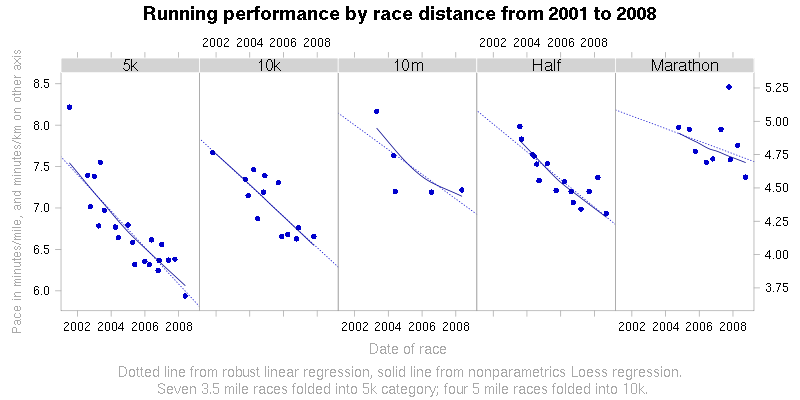
A few years into this running hobby, I realized that my times were getting better. But I had no feel for by how much, or whether that was a constant rate of improvement etc pp. Long story short, I started to plot some of the data. What seemed natural was to record the date, the distance in miles as well as in a qualitative variable, and finally the average pace. Additionally, I played with groupings into just three categories 'short', 'mid' and 'long'. This leads to a natural 'one-factor' model of pace as a function of race date grouped by race distance. And given how easy it is to do conditional plots in R, I quickly arrived at something that already resembled the following chart: (pace by date given group lattice chart) At first, some of the groups had too few data points to actually reliably construct regression lines, let alone non-parametric smoothers. But over time more and more data points were added as I kept running races. Including for example the somewhat disappointing result from last year's Chicago marathon in record heat that resulted in the outlier in the last panel. It actually made the smooth fit turn upwards! Luckily, the subsequent times in New York last fall, London in April, and of course in Berlin last month helped to dampen the effect of the one outlier, resulting in a more normal straight line for marathon performance that is comparable to the other four race lengths. All in all I am now quite happy with the chart. The combination of the non-parametric loess smoother and the robust linear regression (using lrm from the MASS package for R) shows that most groups exhibit very little non-linearity as both regression curves are very close to each other. The curvature in the '10m' group is probably mostly a small-sample effect. And I am obviously happy with the fact that three of the five panels show their respective last race as a PR :) The R script containing the data and code is available here but requires some familiarity with the lattice package for R (as the lattice book would provide).

Vincent Fourmond: pmount switching to git

I've been neglecting pmount for such a long time I feel ashamed about it. Thanks to tailor and a neat post, I've just switched it to a git repository at git://git.debian.org/git/pmount/pmount.git to get more work done (I don't like bzr too much in the end, don't flame me, it's just a matter of personal taste...). I hope that I'll be able to reduce the amazing number of bugs that have accumulated there...

Russell Coker: Updated EC2 API Tools package

I’ve updated my package of the Amazon EC2 API Tools for Debian [1]. Now it uses the Sun JDK. Kaffe doesn’t work due to not supporting annotations, I haven’t filed a bug because Kaffe is known to be incomplete. OpenJDK doesn’t work - apparently because it doesn’t include trusted root certificates (see Debian bug #501643) [2]. GCJ doesn’t work, not sure why so I filed Debian bug #501743 [3]. I don’t think that Java is an ideal language choice for utility programs. It seems that Perl might be a better option as it’s supported everywhere and has always been free (the Sun JVM has only just started to become free). The lack of freeness of Java results in a lower quality, and in this case several hours of my time wasted.

Russell Coker: I Won t Use Drizzle

A couple of days ago I attended a lecture about the Drizzle database server [1]. Drizzle is a re-write of MySQL for use in large web applications. It is only going to run on 64bit platforms because apparently everyone uses 64bit servers - except of course people who are Amazon EC2 customers as the $0.10 per hour instances in EC2 are all 32bit. It’s also designed to use large amounts of RAM for more aggressive caching, it’s being optimised for large RAM at the expense of performance on systems with small amounts of RAM. This is OK if you buy one (or many) new servers to dedicate to the task of running a database. But if a database is one of many tasks running on the machine, or if the machine is a Xen instance then this isn’t going to be good. There are currently no plans to support replication between MySQL and Drizzle databases (although it would not be impossible to write the support). The good news is that regular MySQL development will apparently continue in the same manner as before, so people who have small systems, run on Xen instances, or use EC2 can keep using that. Drizzle seems just aimed at people who want to run very large sharded databases. Now I just wish that they would introduce checksums on all data transfers and stores into MySQL. I consider that to be a really significant feature of Drizzle.

8 October 2008

Ingo Juergensmann: English vs German

No, it's not about football/soccer nor about rivalry, but simply about the two sections of my blog: the english speaking and the german speaking section.
Whereas the English section is being read by quite many people, because it's aggregated on planet.debian.org, the German section of my blog is not that well-known, as it seems. Or maybe not that interesting. Or maybe most Germans reading planet.debian.org just doesn't know about my other feeds?
So, dear lazyweb, if you like you can either leave a comment or - even better - subscribe to my all-in-one RSS feed.
Another possibility would be to rate my blog on blogoscoop.net.

5 October 2008

Christian Perrier: More boring stats: inhabitants per DD per country

Following my last blog post, Moritz Muehlenhoff sent me another statistical list in a desperate attempt to prove that there is no german cabal. As usual, when counting antyhing per inhabitant in IT, Finland wins:
   241890 Finland
   361500 Switzerland
   398766 Norway
   401033 Sweden
   426800 New Zealand
   489205 Austria
   492322 Germany
   612857 Australia
   713415 Netherlands
   795965 France
   814194 Belgium
   834800 Canada
   871071 United Kingdom
   912631 Denmark
  1102457 Spain
  1196289 Ireland
  1255125 Hungary
  1369233 United States
  1456400 Israel
  1484500 Croatia
  1737487 Czech Republic
  1738889 Uruguay
  1806645 Italy
  1910059 Bulgaria
  2270700 Latvia
  3369600 Lithuania
  3539191 Portugal
  3640956 Japan
  3811600 Poland
  4133884 Costa Rica
  5379455 Slovakia
  5608354 Greece
  6779558 Argentina
 10410773 Brazil
 11975000 South Africa
 14695666 Colombia
 12261197 Korea, Republic of
 16598074 Chile
 20042551 Madagascar
 20286976 Russian Federation
 22246862 Romania
 28199822 Venezuela
 28220764 Peru
 35293128 Turkey
 53341250 Mexico
 75360000 Egypt
226489200 India
330462972 China
Indeed, the best proof that there is no german cabal is that, IIRC, "they" never succeeded in having one of "theirs" elected a DPL. This is probably the best proof that there isn't ONE german cabal, but probably more... Beware of "them", "they" are everywhere.

Christian Perrier: Developers per country

A small discussion on IRC triggerred this (from Debian LDAP): Number of DDs per country:
United States : 348
Germany : 197
United Kingdom : 97
France : 96
Canada : 56
Australia : 56
Spain : 49
Japan : 41
Italy : 40
Netherlands : 38
Sweden : 34
Finland : 27
Austria : 22
Switzerland : 21
Brazil : 19
New Zealand : 14
Poland : 13
Norway : 13
Belgium : 13
Hungary : 12
South Africa : 8
Denmark : 8
China : 8
Russian Federation : 7
Ireland : 7
Argentina : 7
Korea, Republic of : 6
Israel : 6
Czech Republic : 6
India : 5
Portugal : 4
Bulgaria : 4
Croatia : 3
Greece : 3
Colombia : 3
Uruguay : 2
Turkey : 2
Romania : 2
Mexico : 2
Egypt : 2
Venezuela : 1
Thailand : 1
Slovakia : 1
Peru : 1
Madagascar : 1
Latvia : 1
Lithuania : 1
Costa Rica : 1
Chile : 1
Number of active DDs per country:
United States : 223
Germany : 167
France : 81
United Kingdom : 70
Spain : 41
Canada : 40
Japan : 35
Australia : 35
Italy : 33
Sweden : 23
Netherlands : 23
Finland : 22
Switzerland : 21
Brazil : 18
Austria : 17
Belgium : 13
Norway : 12
Poland : 10
New Zealand : 10
Hungary : 8
Russian Federation : 7
Denmark : 6
Czech Republic : 6
Argentina : 6
India : 5
Israel : 5
Ireland : 5
South Africa : 4
Korea, Republic of : 4
China : 4
Bulgaria : 4
Portugal : 3
Croatia : 3
Colombia : 3
Uruguay : 2
Turkey : 2
Mexico : 2
Greece : 2
Venezuela : 1
Slovakia : 1
Romania : 1
Peru : 1
Madagascar : 1
Latvia : 1
Lithuania : 1
Egypt : 1
Costa Rica : 1
Chile : 1

4 October 2008

Russell Coker: Getting Started with Amazon EC2

The first thing you need to do to get started using the Amazon Elastic Compute Cloud (EC2) [1] is to install the tools to manage the service. The service is run in a client-server manner. You install the client software on your PC to manage the EC2 services that you use. There are the AMI tools to manage the machine images [2] and the API tools to launch and manage instances [3]. The AMI tools come as both a ZIP file and an RPM package and contain Ruby code, while the API tools are written in Java and only come as a ZIP file. There are no clear license documents that I have seen for any of the software in question, I recall seeing one mention on one of the many confusing web pages of the code being “proprietary” but nothing else. While it seems most likely (but far from certain) that Amazon owns the copyright to the code in question, there is no information on how the software may be used - apart from an implied license that if you are a paying EC2 customer then you can use the tools (as there is no other way to use EC2). If anyone can find a proper license agreement for this software then please let me know. To get software working in the most desirable manner it needs to be packaged for the distribution on which it is going to be used, as I prefer to use Debian that means packaging it for Debian. Also when packaging the software you can fix some of the silly things that get included in software that is designed for non-packaged release (such as demanding that environment variables be set to specify where the software is installed). So I have built packages for Debian/Lenny for the benefit of myself and some friends and colleagues who use Debian and EC2. As I can’t be sure of what Amazon would permit me to do with their code I have to assume that they don’t want me to publish Debian packages for the benefit of all Debian and Ubuntu users who are (or might become) EC2 customers. So instead I have published the .diff.gz files from my Debian/Lenny packages [4] to allow other people to build identical packages after downloading the source from Amazon. At the moment the packages are a little rough, and as I haven’t actually got an EC2 service running with them yet they may have some really bad bugs. But getting the software to basically work took more time than expected. So even if there happen to be some bugs that make it unusable in it’s current state (the code for determining where it looks for PEM files at best needs a feature enhancement and at worst may be broken at the moment) then it would still save people some time to use my packages and fix whatever needs fixing.

3 October 2008

David Welton: Visitors

I use Google's Analytics system for several web sites I run, but find it a bit cumbersome for just getting a quick overview of what's happening. For years, I've used my friend Salvatore's visitors program to analyze web logs. It claims to be a "fast web log analyzer" and it is blazing fast - so fast that for all the sites I run, it only takes a few seconds to process a year or two's worth of log files. For instance:
3724130 lines processed in 68 seconds
55 invalid lines, 0 blacklisted referers
And that's not a particularly fast server that it's running on, and of course it's running with a high "nice" value. Visitors is probably not suited to huge sites, as that's its only mode of operation - it doesn't save data - but it's a great option for everything but the biggest of log files. Using it every day, there are a few things that I wanted to improve or tweak, so with Salvatore's permission, I went ahead and put the code under version control over at Google Code: http://code.google.com/p/visitors/

2 October 2008

Martin Michlmayr: Differences between paid and volunteer FOSS contributors

There's a lot of debate these days about the impact of the increasing number of paid developers in FOSS communities that started as volunteer efforts and still have significant numbers of volunteers. Evangelia Berdou's PhD thesis "Managing the Bazaar: Commercialization and peripheral participation in mature, community-led Free/Open source software projects" contains a contains a wealth of information and insights about this topic. Berdou conducted interviews with members of the GNOME and KDE projects. She found that paid developers are often identified with the core developer group which is responsible for key infrastructure and often make a large number of commits. Furthermore, she suggested that the groups may have different priorities: "whereas [paid] developers focus on technical excellence, peripheral contributors are more interested in access and practical use". Based on these interviews, she formulated the following hypotheses which she subsequently analyzed in more detail:
  1. Paid developers are more likely to contribute to critical parts of the code base.
  2. Paid developers are more likely to maintain critical parts of the code base.
  3. Volunteer contributors are more likely to participate in aspects of the project that are geared towards the end-user.
  4. Programmers and peripheral contributors are not likely to participate equally in major community events.
Berdou found all hypotheses to be true for GNOME but only hypothesis two and four were confirmed for KDE. In the case of GNOME, Berdou found that hired developers contribute to the most critical parts of the project, that they maintained most modules in core areas and that they maintained a larger number modules than volunteers. Two important differences were found in KDE: paid developers attend more conferences and they maintain more modules. Berdou's research contains a number of important insights: Personally, I'm also wondering why there are some significant differences between GNOME and KDE. For example, about 67% of contributors where paid to work on GNOME whereas only 38% were paid to work on KDE. Why do some projects attract more commercial involvement whereas other projects continue to be mostly volunteer based? (Originally published on FOSSBazaar)

David Pashley: Slaves *and* Caching

Dear Lazyweb, We have a web application that has quite a large database and reasonable usage. Back in the dim and distant past, we scaled the application by the age-old method of using several read-only slave databases to prevent reads on the master swamping writes. This worked well for several years, and then we introduced memcached into the mix to improve performance by reducing the number of reads from the database. This improved our database capacity even further. Now the question has arisen about reducing or even removing the code to read from the slaves. I'm trying to come up with some compelling reasons to keep the application reading from the slaves. The pros and cons I currently have for removing the code are:
Pros
  • Reduces code complexity
  • Removes consistency problems due to latency in the replication. This is less of a problem than it used to be after we solved a problem with our replication
Cons
  • Reduces our existing capacity
  • Cache flushes would cause huge spikes on our master server until the cache filled up again
  • Caches wouldn't help queries with unique critera
I would appreciate any additional reasons, pro or cons. We already have an existing non-live slave for backups and slow queries by developers. We would retain a slave for redundancy in the case of master failure. I'm only looking for issues that would affect the application.
Read Comments (0)

MJ Ray: Is Firsht Social Networking s Godfrey?

A case of a former friend impersonating someone on facebook was decided during the summer: Applause Store Productions Ltd. & Anor v Raphael [2008] EWHC 1781 (QB) (24 July 2008) . The victim was awarded thousands of pounds in damages. As I write this, there’s still no response on facebook’s news page, but I wonder whether Firsht will be to UK social networking what Godfrey was to UK Usenet. A bit of a wake-up - a reminder that the internet isn’t a consequence-free playpen. I know that more than most - my youthful indiscretions are plastered across the web, if you know where to look. Fortunately, cooperative associates seem to understand that people learn over time and don’t hold decade-old mistakes against me. Talking of not holding old mistakes against people, LinkedIn is profitting from an influx of bankers since the banks started going bust. That’s going to change the society behind their network - for better or worse? All of the big name networks seem to be having some growing pains, like the breakdown of the Facebook metaphor and I think the “walled gardens” are ripe for replacement. I’m still listed there at present, but I’m using my account on the cooperativemagazine NoseRub server to monitor it and most of the stuff posted to facebook is taken from my websites. I’d like to make NoseRub import and export more things in more formats, but will anyone pay for that work? Otherwise, it keeps falling down my priorities because it’s in PHP and I don’t find that much fun. Maybe I’ll replace it with something more amusing in Scheme or Perl. Aside: is there a good bot that produces an RSS feed of jabber/XMPP presence messages?

1 October 2008

Axel Beckert: NSLU2 in a Tux Case

It started harmless when Thomas asked on Linux User Group Switzerland mailing list if someone knows a tux-shaped alarm clock. But the topic of that thread quickly moved to two other things in tux shape: the Tux Droid, a device similar to the Nabaztag, but needs a Linux host with USB, and ACME Systems’ Tux-Server, a ETRAX CRIS based Foxboard inside a tux-shaped case. We found out that Telion, the Swiss importer for Foxboards, also imports ACME Systems’ Tux Case — although the Tux Case is not mentioned on their website. Even better: They had a few old Tux Cases in stock which don’t fit anymore on current Foxboards since the position of the power socket changed. (So only one hole in the case was missing.) And they wanted to get rid of them quite fast: They offered us the Tux Cases for 10 CHF (6€) each instead of 28 CHF each (17€) if we buy all of them. Of course we couldn’t reject this offer and bought all five remaining cases. Another part of the thread was about performance. Although ETRAX CRIS is used by its inventor AXIS in many of its products (they’re famous for the Linux based web-cams) many were not sure if the board’s performance would be sufficient for their ideas. Another disadvantage of the ETRAX CRIS architecture is that no mainstream Linux distribution supports it. Another point was the Foxboard’s price (169€, ca. 268 CHF). Bones just mentioned that an NSLU2 costs only about 100 CHF (60€). Probably on IRC someone (probably Bones, too) wondered if it’s possible to fit a NSLU2 into such a quite inexpensive Tux Case. We took Wikipedia’s picture of the NSLU2 board, compared the size of the USB ports on that picture, compared them with real-life USB ports and found out the size of the board that way. And when I got my Tux-Case I noticed that the NSLU2 board really could fit into the Tux-Case. Since I’m already building a bigger NAS-like home server, I have no use for another, much slower NAS. But since I more or less gave up the also ARM-based Thecus N4100, another ARM-based machine in my hardware collection wouldn’t be bad. So it didn’t took long and the idea was born to build the NSLU2 board into a Tux-Case and let the website tux.ethz.ch run on it. (I inherited its administration from Beat and it’s currently just a virtual host on one of our webservers.) Then it would be a server named Tux, serving Tuxes, looking like a Tux and running Tux’ operating system Linux. :-) I ordered an NSLU2 at Brack for 117.60 CHF (ca. 70€). Played around with the original firmware for a moment, but it’s horrible from a security point of view: You can’t even change the admin password (default: “admin”) if no USB harddisk is attached. And no, a USB stick doesn’t suffice. So I didn’t wait long and tried to install Debian’s “armel” (ARM, Little Endian) port on it. But the NSLU2 refused the “new firmware” with the error message “Upgrade: no enough free space.”. While this is not in the Debian specific NSLU2 FAQ, it is mentioned in the general troubleshooting FAQ. As described in there, first upgrading to the most recent firmware version and then uploading the Debian installer worked fine. After I had successfully installed Debian Lenny on a pqi 4 GB USB sticked into the NSLU2 and verified that everything is working fine, I opened the NSLU2 case and checked if it really would fit into a Tux Case. It does, but very, very close. You’ll have to drill some holes and the ethernet socket will stick out Tux’s shoulder, but everything else should fit perfectly after a few mounting parts inside the Tux Case have been removed. As a proof of concept I laid the NSLU2 board on the Tux Case’s back:
Pictures taken with my Nokia E51
So later the LEDs will be in Tux’ one shoulder while the network socket will be in his other shoulder. And the USB stick will be inside his paunch via a USB hub.

Next.

Previous.