Search Results: "agi"

1 February 2011

Cyril Brulebois: Debian XSF News #3

Time for a third Debian XSF News issue! Debian XSF News #3 It s been a year On a personal note, it s been a year to the day since I first looked into X. After having hacked on the Debian Installer to make it use X.Org instead of DirectFB, I did some heavy bug triaging, resulting in a drop in the xorg-server bug count in March. The same happened past week as written above, resulting in a second drop. In the meanwhile, the bug count remained more or less stable, since we try to reply quickly to new bugs, and since Julien Viard de Galbert does bug triaging on a weekly basis: BTS graph for xorg-server One might ask: what does maintaining X mean?

31 January 2011

Tiago Bortoletto Vaz: TXT2TAGS SAMPLE - Aurelio Jargas

Before you start reading: this post is only intended to test a plugin that I've just written to give PyBlosxom a txt2tags formatting support. The original txt2tag sample used here is available at txt2tag website. Mine with few changes is here.IntroductionWelcome to the txt2tags sample file.Here you have examples and a brief explanation of allmarks.The first 3 lines of the this file are used as headers,on the following format:
  line1: document title  line2: author name, email  line3: date, version
Lines with balanced equal signs = around are titles.Fonts and BeautifiersWe have two sets of fonts:The NORMAL type that can be improved with beautifiers.The TYPEWRITER type that uses monospaced font forpre-formatted text.We will now enter on a subtitle...BeautifiersThe text marks for beautifiers are simple, just as youtype on a plain text email message.We use double *, /, - and _ to represent bold,italic, strike and underline.The bold italic style is also supported as acombination.Pre-Formatted TextWe can put a code sample or other pre-formatted text:
    here    is     pre-formatted  //marks// are  **not**   interpreted 
And also, it's easy to put a one line pre-formattedtext:
  prompt$ ls /etc
Or use pre-formatted inside sentences.More CosmeticsSpecial entities like email (duh@somewhere.com) and URL (http://www.duh.com)are detected automagically, as long as the horizontal line:
^ thin or large v
You can also specify an explicit link with label.And remember,
A TAB in front of the line does a quotation.
More TABs, more depth (if allowed).
Nice.ListsA list of items is natural, just putting a dash ora plus at the beginning of the line.Plain ListThe dash is the default list identifier. For sublists,just add spaces at the beginning of the line. Morespaces, more sublists.The list ends with two consecutive blank lines.Numbered ListThe same rules as the plain list, just a differentidentifier (plus).
  1. one
  2. two
  3. three
    • mixed lists!
    • what a mess
      1. counting again
      2. ...
  4. four
Definition ListThe definition list identifier is a colon, followed bythe term. The term contents is placed on the next line.
orange
a yellow fruit
apple
a green or red fruit
other fruits
  • wee!
  • mixing lists
    1. again!
    2. and again!
TablesUse pipes to compose table rows and cells.Double pipe at the line beginning starts a heading row.Natural spaces specify each cell alignment.
heading 1heading 2heading 3
cell 1.1cell 1.2cell 1.3
cell 2.1cell 2.2cell 2.3
Without the last pipe, no border:
heading 1heading 2heading 3
cell 1.1cell 1.2cell 1.3
cell 2.1cell 2.2cell 2.3
Special EntitiesBecause things were too simple.ImagesThe image mark is as simple as it can be: [filename]. OtherThe handy %%date macro expands to the current date.So today is 20110206 on the ISO YYYYMMDD format.You can also specify the date format with the %? flags,as %%date(%m-%d-%Y) which gives: 02-06-2011.That's all for now.

Michael Banck: 31 Jan 2011

Debian Med Bioinformatics Sprint Last weekend, I was at the Debian Med Meeting in Travem nde near L beck, thanks to an invitation by Steffen M ller and Andreas Tille. It was a great opportunity to finally meet Steffen and some of the other bioinformatics people in Debian like Manuel Prinz face-to-face for the first time. Also, lots of upstream and related bioinformatics packagers from e.g. Biolinux were present as well, many of them from the UK. I discussed with and helped some people about Debian packaging. There is a big push to get Debian packages done and integrated in Debian and Ubuntu, but often enough people are not exactly sure what the requirements are and what needs to be done. Hopefully, the sprint was successful to clear things up and move forward. I also managed to finalize the initial Jmol packaging and uploaded it to Debian towards the end of the sprint. I plan to update the other bioinformatics related packages in debichem like pymol and openbabel as soon as squeeze is released. Overall, it was a great weekend, many thanks to NERC and Debian for making it possible, and to Steffen M ller for organizing it!

John Goerzen: Unix Password and Authority Management

One of the things that everyone seems to do different is managing passwords. We haven t looked at that in quite some time, despite growth both of the company and the IT department. As I look to us moving some things to the cloud, and shifting offsite backups from carrying tapes to a bank to backups via the Internet, I m aware that the potential for mischief whether intentional or not is magnified. With cloud hosting, a person could, with the press of a button, wipe out the equivalent of racks of machines in a few seconds. With disk-based local and Internet-based offsite backups, the potential for malicious behavior may be magnified; someone could pretty quickly wipe out local and remote backups. Add to that the mysterious fact that many enterprise-targeted services allow only a single username/password for an account, and make no provision for ACLs to delegate permissions to others. Even Rackspace Cloud has this problem, as do their JungleDisk backup product, and many, many other offsite backup products. Amazon AWS seems to be the only real exception to this rule, and their ACL support is more than a little complicated. So one of the questions we will have to address is the balance of who has these passwords. Too many people and the probability of trouble, intentional or not, rises. Too few and productivity is harmed, and potentially also the ability to restore. (If only one person has the password, and that person is unavailable, company data may be as well.) The company does have some storage locations, including locked vaults and safe deposit boxes, that no IT people have access to. I am thinking that putting a record of passwords in those locations may be a good first step, as putting the passwords in the control of those that can t use them seems a reasonable step. But we ve been thinking of this as it pertains to our local systems as well. We have, for a number of years now, assigned a unique root password to every server. These passwords are then stored in a password-management tool, encrypted with a master password, and stored on a shared filesystem. Everyone in the department therefore can access every password. Many places where I worked used this scheme, or some variant of it. The general idea was that if root on one machine was compromised and the attacker got root s password, it would prevent the person from being able to just try that password on the other servers on the network and achieve a greater level of intrusion. However, the drawback is that we now have more servers than anyone can really remember the passwords for. So many people are just leaving the password tool running. Moreover, while the attack described above is still possible, these days I worry more about automated intrusion attempts that most likely won t try that attack vector. A couple of ways we could go may include using a single root password everywhere, or a small set of root passwords. Another option may be to not log in to root accounts at all possibly even disabling their password and requiring the use of user accounts plus sudo. This hasn t been practical to date. We don t want to make a dependency on LDAP from a bunch of machines just to be able to use root, and we haven t been using a tool such as puppet or cfengine to manage this stuff. Using such a tool is on our roadmap and could let us manage that approach more easily. But this approach has risks too. One is that if user accounts can get to root on many machines, then we re not really more secure than a standard root password. Second is that it makes it more difficult to detect and enforce password expiration and systematic password changes. I m curious what approaches other people are taking on this.

30 January 2011

David Bremner: Yet another git+quilt Debian packaging workflow

As of version 0.17, gitpkg ships with a hook called quilt-patches-deb-export-hook. This can be used to export patches from git at the time of creating the source package. This is controlled by a file debian/source/git-patches. Each line contains a range suitable for passing to git-format-patch(1). The variables UPSTREAM_VERSION and DEB_VERSION are replaced with values taken from debian/changelog. Note that $UPSTREAM_VERSION is the first part of $DEB_VERSION An example is
 upstream/$UPSTREAM_VERSION..patches/$DEB_VERSION
 upstream/$UPSTREAM_VERSION..embedded-libs/$DEB_VERSION
This tells gitpkg to export the given two ranges of commits to debian/patches while generating the source package. Each commit becomes a patch in debian/patches, with names generated from the commit messages. In this example, we get 5 patches from the two ranges.
 0001-expand-pattern-in-no-java-rule.patch
 0002-fix-dd_free_global_constants.patch
 0003-Backported-patch-for-CPlusPlus-name-mangling-guesser.patch
 0004-Use-system-copy-of-nauty-in-apps-graph.patch
 0005-Comment-out-jreality-installation.patch
Thanks to the wonders of 3.0 (quilt) packages, these are applied when the source package is unpacked. Caveats.

Russell Coker: P2P Car Sharing Etc

Rachel Botsman gave an interesting TED talk about Collaborative Consumption, various ways of sharing and redistributing objects to save money and reduce their environmental impact [1]. It s a pity that there isn t something like swap.com in Australia.P2P Car RentalAmong other things she mentioned P2P car rentals. The first company she listed is Drive My Car (link to the Australian site) [2] which has a good range of vehicles. They charge 16.5% as an admin fee, the rest is paid to the owner. Strangely they have a web page to estimate what you can get for your vehicle, but the rates that are returned by that page seem to be a lot lower than what cars are actually advertised for (I guess that the owner can ignore the recommendation and charge whatever they want). They deal in daily rentals and the owner may specify a minimum period 4 days seems common. There are no changes needed to the car and the car owner only has to pay $25 per annum to be listed.Relay Rides operates in Boston and San Francisco [3], they operate on a per-hour basis and require some sort of RFID unlocking device to be added to each car. The normal setup fee for a car owner is $250 but they currently have a promotion that waives that fee.Get Around is a beta service that presumably operates only in the US (they seem US centric and don t specify locations) [4]. They appear to offer per-hour rentals and require hardware to unlock the car. It seems that to get most of the useful information (prices etc) you need to sign up which is a mistake on their part.Whip Car advertises their service on a supposed relationship between the car owner and the renter [5], I ve met the people who live in about 10 houses of the 50 in my street, so if a random person in my street offered a car for rent then there would be a 80% chance that I don t know them but I guess if one of my neighbors had a car to rent at a low price I might be more inclined to get to know them. The information page says that drivers must have a UK driving licence which implies that they only operate in the UK. Why don t these people state clearly on their web site the country that they service? Their business model seems interesting, I can imagine a few people who live near each other pooling funds to buy a vehicle and then using Whip Car to control reservations and manage sharing the costs.P2P Rental of Other ThingsA logical extension of the Whip Car concept is to have a service which only mediates sharing between trusted parties. It would have a web site that manages bookings including issues such as the minimum time between bookings, charges a flat fee per item that is managed, and then gives a summary to all parties of what the use was. Ideally it would allow for bidding for peak times. This could work for cars, computers, cameras, holiday homes, or anything else which can usefully be transferred between different users.

28 January 2011

Raphaël Hertzog: 3 ways to not clutter your Debian source package with autogenerated files

It s quite common that the upstream build system generates/updates some files but does not clean them up properly when you call make clean. In that case, when you rebuild the package a second time in the same tree, the generated Debian source package will contain those changes. You usually don t want those changes. They make your package harder to review because they contain unneeded modifications (either directly in the .diff.gz with the old source format, or in a new patch in debian/patches/debian-changes-<ver> with the 3.0 (quilt) source format). I ll show you 3 ways to avoid this problem. They are all workarounds, the proper fix would be to improve the upstream build system to really clean up the generated files. This is usually possible for files that are created , but it s much more cumbersome for files that are updated (you would have to keep a backup of the original file so that you can restore it). The traditional fix Instead of relying on the upstream build system to do the work, we modify the clean target in debian/rules to remove the files that are left-over. Since debian/rules clean is always called before a source package is built, those generated files are not included as changes compared to what upstream provided. A common work-around: always build from a clean state As you have noted, the problem only happens when you build (source and binaries) twice in a row in the same tree. Some VCS-helper tools always build the Debian package in a temporary tree which is exported from the VCS. This is the case of svn-buildpackage by default and of git-buildpackage if you use its --git-export-dir option. I don t like this solution because it solves the problem only for the maintainer. Anyone else who is working on top of the package without using the same VCS-helper tool would be affected by the problem. A new way to avoid the problem Since it s now possible to store dpkg-source options in the source package itself, we can conveniently have everybody use the --extend-diff-ignore option. It tells dpkg-source to ignore some files when checking whether we have made changes to upstream files. For example if you want to ignore changes made on the files config.sub , config.guess and Makefile you could put this in debian/source/options:
# Don't store changes on autogenerated files
extend-diff-ignore = "(^ /)(config\.sub config\.guess Makefile)$"
You need to know a bit about Perl regular expressions since that s what is used by dpkg-source to match the filenames to exclude. Note that this approach always works, even when you can t remove the file. So it saves you having to make a backup of the unmodified file just to be able to restore it before the next build.
Found it useful? Be sure to not miss other packaging tips (or lessons), click here to subscribe to my free newsletter and get new articles by email.

No comment Liked this article? Click here. My blog is Flattr-enabled.

Dominique Dumont: FOSDEM: see you there

I'm going to FOSDEM, the Free and Open Source Software Developers' European Meeting I ll make 2 presentations about Config::Model applications. One on configuration upgrades. The other one is more presenting ideas on sharing packaging work between distributions. Note that I ll make these presentations quite late Sunday and I ll have to leave about 30mns after the last presentation. So if you already have questions about Config::Model, it would be better to contact me before the presentations. See you there

27 January 2011

Rob Bradford: Work with us!

Are you graduating this year? Or recently graduated? Do you want to work in Open Source? Do you have the right to work in the UK? Do you want to work with some of the best minds in the field: Chris Lord, of Happy Wombats fame; Damien Lespiau, the Clutter GST mastermind; Emmanuele Bassi, our Clutter super-hero; Jussi Kukkonen, who puts the clue in Geoclue; Ross Burton, our EDS magician; Srini Ragavan, Evolution shiny-thing maker; Thomas Wood, of the MX and control-center massive; Tomas Frydrych, our Antarctic naming scheme generator and of course pippin. Interested? Take a look at our job entry. I should be around as FOSDEM so feel free to corner me to talk.

26 January 2011

Michal &#268;iha&#345;: Sending SMS on Symbian phone using Gammu

Third Hackweek 6 day went a bit differently than I planned, but there is still lot of progress. I've added some more calls to the Series60 remote protocol, so that some things now work much faster (eg. getting number of contacts, calendar entries). The applet now also has a function to toggle Bluetooth so it does not have to be done elsewhere in phone menus. On Gammu side I focused on messaging support, so now Gammu can list messages in the phone or send new message. Modification of calendar entries is left for tomorrow, hopefully I will get to it and the support will be more or less complete and I will have Friday for final cleanup. And as usual - all code is is available in our Git repository and check documentation for information how to set it up.

Filed under: English Gammu Suse 2 comments Flattr this!

25 January 2011

Paul van Tilburg: Also Giving up on Ruby Packaging

I have just sent a mail to the Debian/Ruby Extras mailing list stating that I will also give up most of my Ruby packaging efforts and reduce my involvement in the team. I am following Lucas Nussbaum in his decision. Although our reasons are slightly different, I subscribe most of what he says in his blog post. Besides that, I haven t done much Ruby programming in the past years, making me lose the motivation for the huge load of packages I am responsible for and thus subconsciously perceive that as a burden, as I feel guilty not having/making time to work on them. So, what does this mean? I will handover (co)maintainership of over 50 libraries. Many of which have dead upstream, unfortunately. Also will I be looking for someone to take over the administrative tasks of heading the team such as mailing list moderation and Alioth repository access. I will keep maintaining some programs that I still use, such as Camping, and am approachable for (mentor) uploads. Meanwhile I will continue my work on my PhD thesis, which is progressing well and should lead to my defence (hopefully) somewhere around September this year. That said, I will try to keep tinkering with Ruby and other F/OSS projects. Oh, and also to get more motivated and some inspiration

Benjamin Mako Hill: Annual Free Software Foundation Fundraiser

<script type="text/javascript"> var fsf_widget_text = "Help protect your freedom!"; var fsf_widget_d_btn = "Donate"; var fsf_widget_share = "Share this widget."; var fsf_widget_size = "normal"; var fsf_associate_id = "3427"; </script> <script src="http://gplv3.fsf.org/static/widget/widget.js" type="text/javascript"></script>
The Free Software Foundation is in the last week of its annual fundraiser and has still has a bit of ground to make up. The FSF needs members and donations to merely sustain its basic activity protecting free software and engaging in minimal outreach. So as I've done in the last couple years, I've written a fundraising appeal for the organization. That why today my face is plastered, Jimmy Wales style, all over the FSF website. (For the record, the last bit was not my idea and I find it a little embarrassing.) My appeal this year begins with my feeling that as our lives become increasingly mediated by technology, the question of who controls technology becomes another way of asking "Who controls us?" Read the appeal for more. That statement, like much of the FSF's work, is not going to get very far with most users today. Most people don't think of technology as the source of control, power, or autonomy. They don't understand why software should be free or even what that might mean. Making this argument widely is something the FSF works hard to do. But supporting this work is a bit of a chicken-egg problem. The users we most need to reach have never heard our message and it can take some time to turn even the most receptive into supporters. For those of us that do care about technology and the power it has over its users, it's hugely important that we take action to support software freedom and organizations like the FSF that play a key place in this struggle. If we don't, nobody else will. The pool of people who might support the FSF today is small -- there are currently about 3,000 members -- but the stakes are huge: A choice between a world of DRM, locked down mobile phones, and non-free network services on one hand, and the possibility of a world where there are free alternatives on the other. The FSF won't win this fight alone, but it plays a critical role in it. The FSF is a small, humble, and responsible non-profit and a little money can have a big impact. If you are not an FSF associate member, now would be a great time to join. Membership is $120 per year ($60 for students) and payable monthly. In preparing this appeal, I realized that my membership had lapsed a couple months ago and that my partner Mika was still donating at the reduced student price. We've personally fixed both these things and made an addition donation. If you are a member, you can check your status or make a donation. If you are not yet, Please consider joining us.

23 January 2011

Russell Coker: Autism, Food, etc

James Purser wrote Stop Using Autism to Push Your Own Brand of Lunacy about the organisations that use Autism for their own political agenda [1]. He references the ongoing vaccine issue (which didn t even stop when Andrew Wakefield was proven to have engaged in fraudulent research) and a campaign of PETA.PETA s ClaimsPETA claims that many autistic kids improve dramatically when put on a diet free of dairy foods [2]. They also speculate about the possibility of Autism being caused by dairy.One thing that confuses the issue is the impact of stress on people with Autism Spectrum Disorders (ASDs). Whatever you are trying to do you will probably do it less effectively if under an excessive amount of stress, and the background stress levels of people on the Autism Spectrum tend to be quite high at the best of times. So add in some extra stress from a food allergy and the ability to emulate an NT can decrease a lot.There are people who make credible claims about significant behavior improvements in Autistic children after changing their diet. Eliminate foods that trigger a minor allergic response and the behavior of NT kids will improve too.I m sure that there are some Autistic kids who have a minor intolerance to lactose or casein who s behavior would improve if they had no dairy products. There are probably just as many Autistic kids who have a minor allergy to peanuts who would get the same benefit from avoiding peanut butter. It s not inconceivable that some Autistic people may be allergic to soy or wheat and find that they can cope better if their consume more milk, cheese, and steak and less vegetables!Also some people on the Autism Spectrum have a better sense of smell than NTs, and it s fairly common to be more fussy about the appearance of food. Force children to eat food that smells bad and their behavior might deteriorate.The issues of diet and Autism are more difficult than those of vaccines because while people just imagine the vaccines to have a bad affect, there are people who are proven to get a bad affect from certain foods.Some Ideas for ResearchI think that the biggest problem with PETA s research in this regard is citing a study of only 20 individuals and only testing the removal of milk. A proper study would involve more subjects (maybe 100) and separate tests of removing milk, eggs, wheat, rice, seeds, nuts, soy, fish, spices, and food colorings and additives.It would also test various methods of reducing stress, having a more quiet environment etc.PETA do deserve some credit for leaving this URL in the comments [3], it s a study that disproves the link between milk and Autism. But it s still a small sample size of 14.Why They Target AutismIn spite of psychologists moving to define Asperger Syndrome and Autism as the same thing, the people who make such claims aren t talking about people like me. They want to make claims about people who can t refute them, such as people who fit the Rain Man stereotype. The Low Functioning Autistic (LFA) people have less ability to communicate and are easier to ignore, so if you want to make some stuff up about a group of people then they are an easy target.Parents of LFA kids are often desperate and will latch on to any idea that seems to help. They can imagine that things have improved in spite of a lack of evidence and also fail to realise that children can improve rapidly just due to their natural development, 1 month is not much time for an adult but for a 4yo it s 2% of their life!Also any supposed research that includes testimony of parents should be regarded as rubbish. If you talk to any child psychologist they will tell you about how difficult it is to convince parents that their child is on the Autism Spectrum, a Google search for autism + denial also brings up plenty of hits. Parental denial doesn t stop at refusing to accept a diagnosis, it includes wanting to reject it at any later time based on any shred of evidence that may be available. So when there is a diet change or some other supposed cause followed by some apparently better behavior they want to claim that Autism is cured.I ve written a document titled Some Suggestions for Parents of Aspies [4] which is largely based on the childhood memories and adult experiences of various Aspies. My document covers many issues and few kids on the Spectrum will benefit from all of them, but I think that there is something there that can benefit every child on the Spectrum and probably a lot of geeky NT kids too. It seems to me that when dealing with Autistic kids it s a lot better to seek advice from adults on the Autism Spectrum than from random Neuro-Typical people (NTs), particularly if those NTs happen to have an agenda to push. The sensible parents are the ones who seek advice from psychologists and people like me rather than from random unqualified NTs.

22 January 2011

Pau Garcia i Quiles: Request to Linux distributions

Do not waste my hard disk! I recently acquired an 2 TB hard disk drive, which I immediately formatted with ext4. Given that mkfs.ext4 defaults to 5% reserved blocks for too, that amounts to 100 GB of lost* space. Wow. 100 GB. On a desktop machine. For root. While mkfs belongs to e2fsprogs, I think this requires action on the distributions side. Let me explain. If you are installing a server, 5% makes perfect sense: there are a lot of logfiles, updates, potential break-ins and other disasters-to-happen for which root-reserved space will be preciously required. 5% is a good choice here. If 5% is too much (or too little), it will not matter: any decent sysadmin knows mkfs.ext4 -m and tune2fs -m (if you don t, Martin will teach you). On the other hand, if you are installing Ubuntu on your laptop, you probably don t know shit about mkfs, tune2fs, 5%, etc. You only know by removing Windows and installing Linux you ve magically lost 100GB of space. Vanished. So here is my request to Linux distributions: when installing a distribution in desktop profile (i. e. not Debian in server profile, RHEL, SLES, Ubuntu Server, etc), DO NOT RESERVE 5% to root. 100 or 200 MEGABYTES should be more than enough. * Yes, I know it s not really lost but just unusable by normal users but that technicality doesn t matter to 99% of the people out there.

Julien Viard de Galbert: Triage X Bugs of 2011 first Weeks (TXBW9-10-11)

I ve been lasy about the reporting lately, so this is a 3 weeks update at once ! The bug count according to udd is down to 818. I guess this is due to Kibi s triaging on input related bugs, but I helped to close a few one too ! I kept my week numbering as before, so now I know the first bugs I pinged are more that 11 weeks old. I guess if some submitter did not answer in that delay, they will probably never do it. I think the bug count will go down again ! ;) The X Strike Force (still) needs you ! You can have a look at the X Strike Force Bug Closing Procedure and check XSF unstable bugs sorted by date.

Jose Luis Rivas Contreras: WordPress: Paginating with query_posts()

I discovered, in not a very amusing way that if you use query_posts() then the variables for paginating with The Loop stop working. Fixing this is easy, just add to paged option on the array the variable $paged, in this way:
query_posts(
    'posts_per_page'    => 15,
    'paged'                 => $paged,
);
Or if you don t use it like this, then:
query_posts('posts_per_page=15&paged=' . $paged);
After this, using posts_nav_link() actually works.

21 January 2011

Rapha&#235;l Hertzog: People behind Debian: Michael Vogt, synaptic and APT developer

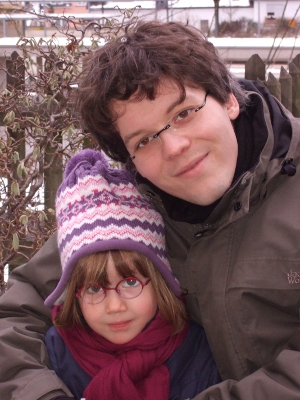
Michael and his daughter Marie

Michael has been around for more than 10 years and has always contributed to the APT software family. He s the author of the first real graphical interface to APT synaptic. Since then he created software-center as part of his work for Ubuntu. Being the most experienced APT developer, he s naturally the coordinator of the APT team. Check out what he has to say about APT s possible evolutions. My questions are in bold, the rest is by Michael. Who are you? My name is Michael Vogt, I m married and have two little daughters. We live in Germany (near to Trier) and I work for Canonical as a software developer. I joined Debian as a developer in early 2000 and started to contribute to Ubuntu in 2004. What s your biggest achievement within Debian or Ubuntu? I can not decide on a single one so I will just be a bit verbose. From the very beginning I was interested in improving the package manager experience and the UI on top for our users. I m proud of the work I did with synaptic. It was one of the earliest UIs on top of apt. Because of my work on synaptic I got into apt development as well and fixed bugs there and added new features. I still do most of the uploads here, but nowadays David Kalnischkies is the most active developer. I also wrote a bunch of tools like gdebi, update-notifier, update-manager, unattended-upgrade and software-properties to make the update/install situation for the user easier to deal with. Most of the tools are written in python so I added a lot of improvements to python-apt along the way, including the initial high level apt interface and a bunch of missing low-level apt_pkg features. Julian Andres Klode made a big push in this area recently and thanks to his effort the bindings are fully complete now and have good documentation. My most recent project is software-center. Its aim is to provide a UI strongly targeted for end-users. The goal of this project is to make finding and installing software easy and beautiful. We have a fantastic collection of software to offer and software-center tries to present it well (including screenshots, instant search results and soon ratings&reviews). This builds on great foundations like aptdaemon by Sebastian Heinlein, screenshots.debian.net by Christoph Haas, ddtp.debian.org by Michael Bramer, apt-xapian-index by Enrico Zini and many others (this is what I love about free software, it usually adds , rarely takes away ). What are your plans for Debian Wheezy? For apt I would love to see a more plugable architecture for the acquire system. It would be nice to be able to make apt-get update (and the frontends that use this from libapt) be able to download additional data (like debtags or additional index file that contains more end-user targeted information). I also want to add some scripts so that apt (optionally) creates btrfs snapshots on upgrade and provide some easy way to rollback in case of problems. There is also some interesting work going on around making the apt problem resolver a more plugable part. This way we should be able to do much faster development. software-center will get ratings&reviews in the upstream branch, I really hope we can get that into Wheezy. If you could spend all your time on Debian, what would you work on? In that case I would start with a refactor of apt to make it more robust about ABI breaks. It would be possible to move much faster once this problem is solved (its not even hard, it just need to be done). Then I would add a more complete testsuite. Another important problem to tackle is to make maintainer scripts more declarative. I triaged a lot of upgrade bug reports (mostly in ubuntu though) and a lot of them are caused by maintainer script failures. Worse is that depending on the error its really hard for the user to solve the problem. There is also a lot of code duplication. Having a central place that contains well tested code to do these jobs would be more robust. Triggers help us a lot here already, but I think there is still more room for improvement. What s the biggest problem of Debian? That s a hard question :) I mostly like Debian the way it is. What frustrated me in the past were flamewars that could have been avoided. To me being respectful to each other is important, I don t like flames and insults because I like solving problems and fighting like this rarely helps that. The other attitude I don t like is to blame people and complain instead of trying to help and be positive (the difference between it sucks because it does not support $foo instead of it would be so helpful if we had $foo because it enables me to let me do $bar ). For a long time, I had the feeling you were mostly alone working on APT and were just ensuring that it keeps working. Did you also had this feeling and are things better nowadays ? I felt a bit alone sometimes :) That being said, there were great people like Eugene V. Lyubimkin and Otavio Salvador during my time who did do a lot of good work (especially at release crunch times) and helped me with the maintenance (but got interested in other area than apt later). And now we have the unstoppable David Kalnischkies and Julian Andres Klode. Apt is too big for a single person, so I m very happy that especially David is doing superb work on the day-to-day tasks and fixes (plus big project like multiarch and the important but not very thankful testsuite work). We talk about apt stuff almost daily, doing code reviews and discuss bugs. This makes the development process much more fun and healthy. Julian Andres Klode is doing interesting work around making the resolver more plugable and Christian Perrier is as tireless as always when it comes to the translations merging. I did a quick grep over the bzr log output (including all branch merges) and count around ~4300 total commits (including all revisions of branches merged). Of that there ~950 commits from me plus an additional ~500 merges. It was more than just ensuring that it keeps working but I can see where this feeling comes from as I was never very verbose. Apt also was never my only project, I am involved in other upstream work like synaptic or update-manager or python-apt etc). This naturally reduced the time available to hack on apt and spend time doing the important day-to-day bug triage, response to mailing list messages etc. One the python-apt side Julian Andres Klode did great work to improve the code and the documentation. It s a really nice interface and if you need to do anything related to packages and love python I encourage you to try it. Its as simple as:
import apt
cache = apt.Cache()
cache["update-manager"].mark_install()
cache.commit()
Of course you can do much more with it (update-manager, software-center and lots of more tools use it). With pydoc apt you can get a good overview. The apt team always welcomes contributors. We have a mailing list and a irc channel and it s a great opportunity to solve real world problems. It does not matter if you want to help triage bugs or write documentation or write code, we welcome all contributors. You re also an Ubuntu developer employed by Canonical. Are you satisfied with the level of cooperation between both projects? What can we do to get Ubuntu to package new applications developed by Canonical directly in Debian? Again a tricky question :) When it comes to cooperation there is always room for improvement. I think (with my Canonical hat on) we do a lot better than we did in the past. And it s great to see the current DPL coming to Ubuntu events and talking about ways to improve the collaboration. One area that I feel that Debian would benefit is to be more positive about NMUs and shared source repositories (collab-maint and LowThresholdNmu are good steps here). The lower the cost is to push a patch/fix (e.g. via direct commit or upload) the more there will be. When it comes to getting packages into Debian I think the best solution is to have a person in Debian as a point of contact to help with that. Usually the amount of work is pretty small as the software will have a debian/* dir already with useful stuff in it. But it helps me a lot to have someone doing the Debian uploads, responding to the bugmail etc (even if the bugmail is just forwarded as upstream bugreports :) IMO it is a great opportunity especially for new packagers as they will not have to do a lot of packaging work to get those apps into Debian. This model works very well for me for e.g. gdebi (where Luca Falavigna is really helpful on the Debian side). Is there someone in Debian that you admire for his contributions? There are many people I admire. Probably too many to mention them all. I always find it hard to single out individual people because the project as a whole can be so proud of their achievements. The first name that comes to my mind is Jason Gunthorpe (the original apt author) who I ve never met. The next is Daniel Burrows who I met and was inspired by. David Kalnischkies is doing great work on apt. From contributing his first (small) patch to being able to virtually fix any problem and adding big features like multiarch support in about a year. Sebastian Heinlein for aptdaemon. Christian Perrier has always be one of my heroes because he cares so much about i18n. Christoph Haas for screenshots.debian.net, Michael Bramer for his work on debian translated package descriptions.
Thank you to Michael for the time spent answering my questions. I hope you enjoyed reading his answers as I did. Subscribe to my newsletter to get my monthly summary of the Debian/Ubuntu news and to not miss further interviews. You can also follow along on Identi.ca, Twitter and Facebook.

4 comments Liked this article? Click here. My blog is Flattr-enabled.

Cyril Brulebois: Debian XSF News #2

Time for a second Debian XSF News issue! I ll skip stuff related to the new katamari since I wrote about that already.

20 January 2011

Alexander Reichle-Schmehl: Myths and Facts about Firmwares and their non-removal from Debian

Debian's announcement to release Squeeze with a completely free Linux kernel caused quite some attention, which is actually a good thing. However, it also seems to have caused quite some uncertainty and was often partially misunderstood and miss quoted. I'll try to summarize and answer some of them in this blog post: So, one question remains: What is to bad about non-free firmware files? Aren't they just some tiny programs executed in the CPU of the device? Why care about them Good question! Let's take possible legal issues aside, and just look the practical side. The core problem is: Without source (and tool chain to use the source) firmware files are just some random numbers for us. We don't know what they are doing, we can't analyse and improve them. We can't change them, we can't support them. Maybe you already followed the link above to comment of the Fedora developer. I cite him here again, because I think he summarized the problem so well:
Updated qlogic 2400 and 2500 firmware to 5.03.13. What does 5.03.13 do? No one knows, except for QLogic, and they're not telling. I asked, and they told me that information was only available under NDA. So, I encourage you to imagine what this firmware does, and the bugs it fixes. While you're at it, imagine a world where vendors release source code for their firmware.
So, now that we established the fact, that we can't support firmware files, one could wonder, if we actually need to do so. What harm can a simple, tiny program in a peripheral device do to your computer? Well, scientist already managed to created trojaned firmwares for some network cards. So it is a problem, and can even under some circumstanced lead to security problems! So, to summarise: Yes, Debian changed something in the Kernels. No, it will continue to work as well as usual. Some users might need to enable the non-free repository in their sources list, but those who won't, don't have to. Firmware files needed during installation are also available, and can be loaded by the installation system. So, what's all the fuss about? BTW: Those of you, who can't remember links very well, but fear, they still might need the links to the non-free images and tarballs. just remember two things: wiki and Firmware, as you'll find all you need on the Firmware page of Debian's wiki.

19 January 2011

Russell Coker: Free Amazon EC2 Servers

Amazon is providing free EC2 access for new customers (who have never been customers before) for one year [1]. It is 750 hours per month (enough to run non-stop for an entire month) of access to a Linux micro instance which has 613M of RAM and the ability to burst to two ECUs of compute power. The main EC2 web page [2] describes an ECU as the equivalent CPU capacity of a 1.0-1.2 GHz 2007 Opteron or 2007 Xeon processor and they also describe a single core of a modern CPU as having 3.5 ECUs. So a micro instance could burst to half the CPU power of a single core. The DomU that runs my blog (as well as some web sites for friends) has been averaging less than 1% use of a CPU core over the last few months, so the CPU capacity of a micro instance should be more than adequate for most things that run on the net.The free offering only provides 15G of free data transmission and 15G of free data reception per month. For my blog server that would be more than adequate as it has sent 24.5G and received 14G over the last 75 days.The Cost of Disk IOThe offer requires that you sign up with a credit card so if you use more than the free capacity then you have to start paying. It seems that the main issue in this regard is disk IO.The only storage that is available for a micro instance is the Elastic Block Store (EBS) [3]. The main way that EC2 operates is that when you create a new virtual machine it copies the data from an existing image so you can easily create dozens or hundreds of virtual machines with local disk performance and the data is removed when the instance is shut down. EBS is essentially SAN based storage, it s persistent and operates like a regular disk.The pricing for EBS is $0.10 per allocated GB per month plus $0.10 per million IOs. Unfortunately they don t define what an IO is apart from mentioning that you can use IOSTAT to measure them. According to iostat the server running my blog is doing 0.99 tps, so that means in a 30 day month I would expect 30*24*3600*0.99 = 2.56M transactions. Iostat also tells me that my blog server has read 62075330 blocks and written 91683344 blocks over the last 75 days 16 hours of uptime, that means it would do about (62075330+91683344)/75.66*30 = 61M block transfers in a 30 day month. So if I was to run my blog server on EC2 I could be spending either $0.15 or $6.00 per month on disk IO depending on how they count it (or maybe something in between, something larger than a 512 byte block but smaller than a transaction as reported by iostat could be used). Given that the last time I checked the prices one could rent a DomU for less than $6 per month [4] the difference in possible ways of measuring IOs is very significant!The MySQL server that is the backend to my blog (as well as a few other things) seems to be averaging about 3 writes per second (and no reads during operation because the databases are small). So it might be another 5 million IOs per month for the database.It s unfortunate that Amazon haven t clearly specified what they mean when measuring IO for billing purposes. Some aspects of measurement such as whether the bills for bandwidth include Ethernet headers can be ignored as a 26 byte Ethernet header won t make much difference to the bill when the average packet size is around 400 bytes or more (from ifconfig output it seems that my blog server sends packets of an average size of 459 bytes and receives packets of an average size of 1250 bytes). But the methods of measuring disk IO could give a factor of 20 difference in the bill.Optimising for EC2If I was going to put my blog on EC2 then I would start by configuring Apache to log to a fifo and then write a daemon that stores the log data and allows my home server to poll it and get the log data. As the filesystem is already mounted with noatime it seems that writing logs is the cause of all the disk writes so if they were stored in RAM (which shouldn t be a problem with 4M of logs per day) then all those writes could be avoided. Another possible solution to this would be to make /var/log be a tmpfs and then rsync the files periodically to my home server. I don t really need to have all the logs remain on the server I just need them to remain somewhere.Amazon also offers 100,000 messages on their Simple Queue Service (SQS) for free [5]. The messages can be up to 8K in size and are stored for up to 4 days. So it seems possible to put Apache logs into SQS messages in bundles of less than 8K and then get them out later for transfer to a server outside EC2.If I was able to get my disk writes to almost zero then there s a good chance that I could get into the free zone for one year.ConclusionWould I use this service? If I was looking for new hosting for my blog then I would seriously consider it. EC2 is quite fast and well connected and depending on how they work out the billing for disk IO I could probably keep the cost close to zero.EC2 is a different way of running things so you can t just have a virtual server running and expect it to automatically restart if it goes down for any reason (a standard feature of virtual hosting companies). Amazon does have a range of tools for managing EC2 instances and they all seem to be available in the free trial. So after spending the time to learn those tools the result should be good.I think that there are two groups of people who could benefit from using this. One is hobbyists, this is a great way to learn some skills related to high-end server stuff and EC2 experience should look good on a CV. The other is companies who want to use EC2 anyway and who will just save some money that they would otherwise pay. I ve seen someone recommend the free offering from EC2 for a company that needed a small server, I think that isn t a good option as a company that only wants a single small server will be better off paying something between $5 and $20 per month for a DomU from one of the virtual hosting providers.After a year you have to pay regular prices. A micro instance costs $0.02 per hour which is $14.40 per month, SQS costs $0.10 per month for sending up to 1G of data in and at $0.01 per 10,000 SQS requests would costs $0.03 (the 4M of log data I generate per day would be 1000 requests to write and read it which would be 30,000 requests per month), the EBS for MySQL would cost $0.10 for 1G of storage and maybe $0.50 for IOs. That means $15.13 before counting bandwidth.My blog server averages just under 10G of transmitted data per month, the first Gig is free so that would cost $0.15 for each subsequent Gig which is $1.35 per month. It receives just under 6G per month which at $0.10 per gig would be $0.60. So including data transfer it would be about $17.08 per month.This is a lot more expensive than some of the cheaper virtual server offerings but admittedly the cheaper virtual offerings don t have as much RAM. Also with a blog instance running on EC2 I could easily configure it so that I could create some big instances that use the same MySQL database if a lot of extra traffic suddenly started arriving. A micro instance running MySQL on it s own could cope with a heap of load a lot more easily than the PHP code for my blog. So using bigger servers to run the PHP code while running MySQL on the same server would be a good option particularly if the bigger servers use caching.Finally if you want to run an EC2 instance for a year then you can get a reserved instance, you pay $54 per annum and the cost drops to $0.007 per hour instead of $0.02 per hour. Using a reserved instance for my blog would give a cost of $54+365*24*0.007+12*(0.10+0.03+0.10+0.50) or about $124.08 per annum. $10 per month isn t too bad. So if I migrated my blog to EC2 then I would probably keep it there after the free period expired. The ability to expand rapidly when necessary is worth paying extra. Of course I am making some assumptions such as that the performance of a micro instance doesn t totally suck as Amazon don t specify what bursting to 2ECU really means it could have some performance problems.Note that all prices in this post are in US Dollars.

Next.

Previous.