Search Results: "xam"

24 November 2011

Andrew McMillan: The Obligation to Vote

Could you not trust this man?Max and Fraser are very interested in this year's election. I guess political awareness starts at the first election after you turn 10, or so. They're both very curious about how mum and dad are voting, and while their mother will not tell (though we all have our suspicions :-) I don't see any reason not to discuss my political leanings with them.I've been what is commonly termed a 'floating' voter for most of my voting life. I imagine the politicians themselves might term people like me 'floaters', with an eye to the scatalogical implications. After all, their livelihoods are on the line!So, after reading this blog post I thought I might as well also share my personal voting plans with the world.

Could you not trust this man?

Max and Fraser are very interested in this year's election. I guess political awareness starts at the first election after you turn 10, or so. They're both very curious about how mum and dad are voting, and while their mother will not tell (though we all have our suspicions :-) I don't see any reason not to discuss my political leanings with them. I've been what is commonly termed a 'floating' voter for most of my voting life. I imagine the politicians themselves might term people like me 'floaters', with an eye to the scatalogical implications. After all, their livelihoods are on the line! So, after reading this blog post I thought I might as well also share my personal voting plans with the world. In the referendum I will be voting to retain MMP MMP is a straightforward system which gives a representation in parliament almost directly proportional to the proportion of votes for each party. It seems like a no-brainer to anyone aged five to twenty-five, and I figure it's important for their future that I vote this way. Some older folk seem shocked at the idea that a government might have to negotiate with representatives of large minorities in order to actually get legislation passed which would annoy one person in twenty. In voting for an alternative to MMP, should an insufficiency of fairness-loving voters visit the polls, I will be voting for STV. STV is a stupid alternative, because it's complicated and confusing, and so if we really end up going down to the wire against some less fair system than MMP it will be much easier to argue against STV, but I'm really hoping that doesn't happen. MMP has been a great enabler to produce a much more inclusive government for New Zealand since it's introduction. In the Mana Electorate I will be voting for Hekia Parata I've been disappointed with Kris Fa'afoi who seems to think that "communicating with the electorate" means "standing on street corners shouting into a megaphone", and I believe Hekia is much more aware of the issues, and a much more capable and experienced politician. My party vote will go to the Green Party It's pretty obvious that National don't need my party vote, and I've been disappointed with their performance on important environmental and economic issues in any case. In an ideal world they'd have to form a coalition with the Green Party in order to govern, but that seems unlikely unless every Labour and Green voter who can still draw breath turns up at the polling places while the National voters all sleep in and forget to vote. Unlikely. What I see from John Key seems increasingly like patronising gloss, and I can only imagine he has his hand behind his back with his fingers crossed. We're getting little real information in between the sound bites, for example the National Party has refused to answer the questions from Radio NZ. That can't be good. And what do the kids think? They tell me that they believe that these are good choices for the future. Fraser's fairly easily swayed by the opinions of those around him, but he's only 10 after all. Max does look at all the options, thinks about them and has interesting things to say. I don't think they're saying it just to please dad! Oh, and Max drew the politician for this post. I'll let you guess who he definitely doesn't trust...

23 November 2011

Russell Coker: Receiving Death Threats

On occasion I receive death threats in comments on my blog. This doesn t bother me, I had more than a few pathetic losers say similar things to me in high school but the difference is that a pathetic loser on the other side of the world can t do much about it. The latest one is on my post Is Asperger Syndrome a Good Thing? [1]. At 11:04AM my time (00:04 UTC) on the 23rd of November someone using IP address 82.14.50.190 (registered to NTL Infrastructure for Tesco Guildford ) and with the claimed email address of sharkbait @ tesco.net told me that I m on his to kill list . He was angry because my post apparently didn t satisfy his need to prove to people that they don t want AS . As it s not possible to choose your DNA there is really no point in trying to prove that one set of genes is better than another, unless of course you want to harass people who have different genes to you. Naturally he didn t read my post, in fact the differences between his comment and what I wrote made me suspect that it s something he was pasting in to lots of blogs, but it seems unlikely that he would use an iPhone for such a copy/paste job so he must just not read. For example he rhetorically asks did you even mention it was a form of autism in your negative points when I gave a link to the proposed DSM changes where Asperger Syndrome is being merged with Autistic Disorder and the word Autism appears 5 times in the post. He has one specific complaint about people he knows who are on the Autism Spectrum, he says Every time someone speaks to them they get angry and tell said person to back the fuck off. I ve been on the receiving end. Generally there are two possible reasons for being told to fuck off , one is that the person telling you is an asshole and the other is that you are being an asshole. If you are the type of person who sends death threats to bloggers then you really should consider the latter explanation. He also suggests that I watch Boston Legal presumably because that show has one character who is an Aspie. Now I have actually watched that show and it s the worst legal show I ve ever seen, when a legal show has such unrealistic portrayal of court scenes I don t think it should be relied on for information on any other topic. I watched a couple of episodes of Boston Legal and only saw one scene with the Aspie guy, so I can t even determine whether it s a realistic portrayal he s a minor character. In any case there are plenty of Aspie guys in the Free Software community who I interact with regularly, I read forums such as AspiesForFreedom.com, and I ve read some text books on the topic. So even if a TV show had a very accurate portrayal of an Aspie character I still doubt that I would learn anything by watching it. As a general tip for flamers, if you want to accuse someone of being a member of a NAZI or KKK type organisation then the word you are after is Aryan not ayrien . If you don t know a word then don t use it. Please note the conditions of sending me email [2], I reserve the right to publish all threats in any way that I wish. A Final Note Thanks sharkbait for adding me to your to kill list , I m sure that there are lots of nice people on it and I ve got good company. If I didn t get the occasional death threat I would worry that I m not writing well enough or failing to address important issues. I will write more about Autism in the future.

22 November 2011

Steve Kemp: Goodbye mysql ..

Yesterday evening I updated my server to remove MySQL:
steve:~# dpkg --purge mysql-client-5.1 \
                      mysql-common     \
                      mysql-server-5.1 \
                      mysql-server-core-5.1 \
                      python-mysqldb        \
                      libdbd-mysql-perl     \
                      libdatetime-format-mysql-perl
Until last month I had two database in use, one each for a pair of web-applications. As of now one is using redis - which I'm already using for my image hosting - and the other application is using SQLite. Until recently I had a high opinion of SQLite, although that has now been downgraded a little, it is still a thoroughly excellent piece of software. I was just surprised at little things it was missing, to the extent I had to rewrite my applications SQL. Still one less service is a good thing, and the migration wasn't so painful.. In more productive news I recently acquired a nice external flash - the Yongnuo YN-460 II is (very) cheap and cheerful, it can be fired remotely with my triggers so I've had a lot of fun with opportunistically taking pictures and experimenting with lighting. Most of the results are NSFW, but there are some other examples lurking around including the first time I managed to successfully capture a falling water-drop. (Not the best picture, not the most explicit effect, but fun regardless. I both can and will do better next time!)
Somebody recently asked me to write about "camera stuff under linux" and happily I declined. Why decline? Because there are so many good tools, applications, and utilities. (I use local tools for organisation and duplicate detection, rawtherapee for RAW conversion and GIMP for touchups). Having many available options is fantastic though, and something hard to appreciate for "newcomers" to Linux. (Yeah I waited 90 seconds - if I remembered to add -nojava - for Netscape Navigator to start, under X10, with 8Mb of RAM. Happier days are here. Sure DRM is bad, secure boot .. an open question, but damn we have it good compared to almost any previous point in time!)
ObQuote: "Yeah, obviously it is only a tactical party. I'm only having a party to eventually get sex." - Peep Show

Thorsten Glaser: Those small nice tools we all write

This is both a release announcement for the next installment of The MirBSD Korn Shell, mksh R40b, and a follow-up to Sune s article about small tools of various degrees of usefulness. I hope I don t need to say too much about the first part; mksh(1) is packaged in a gazillion of operating environments (dear Planet readers, that of course includes Debian, which occasionally gets a development snapshot; I ll wait uploading R40c until that two month fixed gcc bug will finally find its way into the packages for armel and armhf. Ah, we re getting Arch Linux (after years) to include mksh now. (Probably because they couldn t stand the teasing that Arch Hurd included it one day after having been told about its existence, wondering why it built without needing patches on Hurd ) MSYS is a supposedly supported target now, people are working on WinAPI and DJGPP in their spare time, and Cygwin and Debian packagers have deprecated pdksh in favour of mksh (thanks!). So, everything looking well on that front. I ve started a collection of shell snippets some time ago, where most of those small things of mine ends up. Even stuff I write at work we re an Open Source company and can generally publish under (currently) AGPLv3 or (if extending existing code) that code s licence. I chose git as SCM in that FusionForge instance so that people would hopefully use it and contribute to it without fear, as it s hosted on my current money source s servers. (Can just clone it.) Feel free to register and ask for membership, to extend it (only if your shell-fu is up to the task, KNOPPIX-style scripts would be a bad style(9) example as the primary goal of the project is to give good examples to people who learn shell coding by looking at other peoples code). Maybe you like my editor, too? At OpenRheinRuhr, the Atari people sure liked it as it uses WordStar like key combinations, standardised across a lot of platforms and vendors (DR DOS Editor, Turbo Pascal, Borland C++ for Windows, ) ObPromise: a posting to raise the level of ferrophility on the Planet aggregators this wlog reaches (got pix)

21 November 2011

Russell Coker: Galaxy S vs Xperia X10 and Android Network Access

Galaxy S Review I ve just been given an indefinite loan of a Samsung Galaxy S which is more useful than the Sony Ericsson Xperia X10 that I own. I think that the main benefit is that it runs Android 2.2 instead of Android 2.1 on the Xperia. 2.2 is what gives it USB tethering support without extra software (something I haven t tested yet but will use a lot if it works correctly) and Wifi AP support. Both phones are about the same size, the Galaxy S has slightly more RAM (reported as 304M vs 280M which doesn t really matter) and a lot more main storage (1.87G vs 465M usable after the OS is loaded). The main down-sides of the Galaxy S is that it lacks a flash . I m not aware of any phone camera having a proper flash, but the limited LED flash is useful for taking pictures at times and there are a variety of programs that can turn it on for use as a torch. Also I wonder whether the Samsung people actually test their phones in real use or whether they just build them to spec. When you read the specs it sounds nice to have a phone that s only 9.9mm thick (apart from the bulge at the bottom), but that makes it really difficult to hold. The Xperia X10 is 13mm thick and isn t as slick so you are much less likely to drop it. I sometimes wonder whether phone companies are designing their products to be broken so that they can sell replacements. Three Networking Sucks My parents use 3G broadband from Three as their only connection to the Internet, this is fast enough for viewing Youtube on occasion and generally works well for them. However whenever I try to transfer any data to their system which has integrity checks it turns out to be corrupted. About every megabyte of data transferred has a corrupt packet that has a matching checksum presumably it s a bug in Three s network. Because Three are desperate for customers they have given me a free 6 month subscription to a data SIM [1]. I ve been using that SIM with my Galaxy S and found the same data corruption problem and I ve reproduced it in many places around Melbourne so this isn t just one unreliable cell tower, it s something broken in the core of the Three network. The obvious solution to this is to use a VPN so the corrupt packets will be dropped. So I set up a PPTP VPN only to discover that it seems impossible to make the default route be via the VPN, there has been a bug report about this since 2009 the iPhone allows configuring whether Internet traffic should go via the VPN, it can t be that hard [2]. There is an option to use a proxy for web access, but when I tried that on Android 2.1 it only worked for the system web browser not for things like the Android Market. But there is no option for configuring a proxy for use when the VPN is active, so it doesn t seem likely that I could run a proxy on the VPN network and direct all traffic to it. Due to corruption on the Three network and the inability to get a VPN working correctly it seems that I can t use the Three SIM. Android isn t Really Free Software While Android implementations generally stick to the GPL and other free software licenses that are involved they seem to be a poor example of providing freedom to users. My Xperia X10 is running Android 2.1 because Sony-Ericsson has locked the boot loader so I can t install a newer kernel. They don t care enough to release a new version this is stupid of them because it means that I am much less likely to recommend their products. If Sony-Ericsson releases a newer Android release then it will be a total OS reinstall, unlike the way I can upgrade a Debian system an application at a time. I can t install new packages that replace system packages, so the Email and SMS programs that I ve installed sit along side the ones that came with the system. Periodically the unwanted SMS and Email programs show up. I can t make my Android phones perform basic networking tasks that I ve done on Linux systems since the early 90 s. Hiding the complexity from the newbies is OK, but they need to make the full capabilities of the system available to experts. It seems to me that Android effectively gives the majority of users no more freedom than the iPhone does. Even for the small minority of us who are technically capable of rooting phones and installing CyanogenMod etc it s often limited by technical measures and the amount of time required. Update: Philipp Kern pointed out that his Galaxy S has a front facing camera. I have checked my phone and discovered that it has one too. When I published this post I criticised the Galaxy S for not having a front facing camera for video-calls based on a misunderstanding of the Wikipedia page (which says that SOME models lack it) and not testing it. Thanks for the correction Philipp and sorry for publishing wrong data.

17 November 2011

Matthew Garrett: Attacks on secure boot

This is interesting. It's obviously lacking in details yet, but it does highlight one weakness of secure boot. The security for secure boot is all rooted in the firmware - there's no external measurement to validate that everything functioned as expected. That means that if you can cause any trusted component to execute arbitrary code then you've won. So, what reads arbitrary user data? The most obvious components are any driver that binds to user-controlled hardware, any filesystem driver that reads user-provided filesystems and any signed bootloader that reads user-configured data. A USB drive could potentially trigger a bug in the USB stack and run arbitrary code. A malformed FAT filesystem could potentially trigger a bug in the FAT driver and run arbitrary code. A malformed bootloader configuration file or kernel could potentially trigger a bug in the bootloader and run arbitrary code. It may even be possible to find bugs in the PE-COFF binary loader. And once you have the ability to run arbitrary code, you can replace all the EFI entry points and convince the OS that everything is fine anyway.

None of this should be surprising. Secure boot is predicated upon the firmware only executing trusted material until the OS handoff. If you can sidestep that restriction then the entire chain of trust falls down. We're talking about a large body of code that was written without the assumption that it would have to be resistant to sustained attack, and which has now been put in a context where people are actively trying to break it. Bugs are pretty inevitable. I'd expect a lot of work to be done on firmware implementations between now and Windows 8 ship date.

(Update: It's probably worth pointing out that although Ars talk about it defeating secure boot, the primary sources don't seem to mention secure boot at all. Windows 8 will boot without secure boot, so it's possible that this attack merely handles the non-secure boot case)

(Further update: It turns out to be a purely BIOS based attack. In other words, it's an example of the kind of thing that secure boot is intended to prevent, not any kind of compromise of a secure boot implementation)

comment count unavailable comments

Timo Jyrinki: On discussing free software mobile phones

Since I think I just summarized a few thoughts of mine well at LWN, I'll copy-paste it here:
I can grumble about Android from time to time, but I do not say that it sucks. Extreme views are what are annoying. Android is what it is and it's great as it is, even though it could be different as well.

When it comes to discussing about free software and mobile phones, I'm especially annoyed by two types of comments:

1. People essentially saying that there is no value in an open project, ie. free software code dumps should be enough for everybody. I'm interested in the long term viability of free software projects, and it is hard to have successful projects without there being all sorts of factors that make up a good project - like transparency, inclusion, meritocracy. Even though the mobile projects have had little resources and a hard road, it's not useful to forget about these goal in the longer term. For example Debian, Mer, SHR, KDE Plasma Active have some of these in the mobile sector. I hope the best for them (and participate).

2. People complaining about something being not 100% free software, while not themselves actually even interested in it for other sake than complaining. When I've been talking about free software mobile phones, from time to time there is someone complaining about eg. not open GSM stack, wlan firmwares etc.. and to put it sharply probably writing the message from iPhone, while I'm reading it on Neo FreeRunner. If the complainer would be Harald Welte, I'd probably listen and agree with him.

So there. For more civilized discussion.

14 November 2011

Vincent Bernat: A quick look at Typekit

Back in the dark ages of the web, before the introduction of CSS 3, browsers could only display fonts available on the client system. Thanks to the introduction of @font-face and its now widespread support, this is over. Now, Web designers have access to a large selection of fonts and most users will be able to appreciate them. Typekit provides a subscription-based library of hosted, high-quality fonts to use on websites. I expose here my own, mostly uneducated1 on the typographic side, look on this service.

Fonts embedding 101 There are several ways to embed fonts for the Web. Let s have a look at the most common ones.

Self-hosting and @font-face A first possibility is to host fonts yourself and provide a CSS file with the appropriate @font-face declarations. There are five important things to know:
  1. There is no common format. You will need to host different versions of the same font to support most browsers.
  2. Of course, Internet Explorer comes with its own quirks that you need to work around.
  3. Most browsers enforce a same origin policy. You need to serve your fonts from the same domain as the requesting page. You can circumvent such a limitation by enabling cross-origin resource sharing: add an Access-Control-Allow-Origin header when serving fonts.
  4. Fonts are unlikely to change. To leverage caching, configure an explicit expiration date far in the future. Something like 30 days.
  5. There is no MIME types registered for fonts. Don t bother setting one, even if Google Chrome likes to complain about them in the console.
One great resource is Font Squirrel which provides kits with fonts and the appropriate CSS declarations. You choose your font family (or upload one of your own), the formats that you want to use (check them all) and you will get a ZIP archive with all fonts and a CSS file. You may want to tweak it a bit to enable automatic use of the bold variant when needed and to use a local copy if available. For example, if you choose Crimson, an oldstyle typeface, you may want to declare the bold version with font-weight: bold and add local names:
@font-face  
    font-family: 'Crimson';
    src: url('Crimson-Bold-webfont.eot');
    src: local('Crimson Bold'), local('Crimson Text Bold'),
         url('Crimson-Bold-webfont.eot?#iefix') format('embedded-opentype'),
         url('Crimson-Bold-webfont.woff') format('woff'),
         url('Crimson-Bold-webfont.ttf') format('truetype'),
         url('Crimson-Bold-webfont.svg#CrimsonBold') format('svg');
    font-weight: bold;
    font-style: normal;
 

Google Web Fonts For open-source fonts, you can also use Google Web Fonts instead of hosting the files yourself. Build a collection of fonts and choose the variants that you want to use for each of them. You will then be provided with a code snippet to paste in the <head> element of your page. For example, for Crimson:
<link href='http://fonts.googleapis.com/css?family=Crimson+Text:400,700,400italic'
      rel='stylesheet' type='text/css'>
Why choose this solution over self-hosting?
  1. You don t use your own bandwith to serve fonts. This may be important if you pay for it.
  2. Google uses its own CDN to serve fonts. If you don t use a CDN yourself, this can be a major performance improvement.
  3. Caching is more efficient since many sites will use the same font.
  4. It s easier to do it right.
Unless you are concerned about Google tracking your users2, I think this is a better solution than self-hosting. Quick delivery of fonts is pretty important since content rendering can be delayed by them.

Typekit: the good parts So, why choose Typekit? First, there is the very large choice of fonts. The first paid plan comes with more than 500 fonts from about 80 foundries. There are about a hundred serif fonts and a couple hundred sans serif ones. Typekit provides a convenient interface to browse fonts. You can either search fonts by name or by characteristics. In the last case, you can filter on properties like the classification (serif, sans serif, decorative, etc.), weight, width, contrast, x-height, recommended use or language support. Once a font is selected and added to your kit, you can easily choose what variants you want. The kit total size is displayed. If you happen to meet any problem or have some questions, Typekit support is very responsive. I got clear and crisp answers in less than a few hours in the week-end.

and the bad ones Unfortunately, Typekit has also some shortcomings. One of the most commonly cited is that Javascript is mandatory. No Javascript, no fonts. If you want to display the appropriate fonts for users without Javascript, you should just not use Typekit.

Not free, nor free While Typekit offers some open-source fonts, most of them are not. Moreover, only a few of them are available in the free plan. While I would prefer to use open-source fonts, I don t consider this a strong requirement: if you are dissatisfied for some reason, switching back to open-source fonts (or another service) is fast and easy. I like serif fonts a lot and they get less attention from the FLOSS world: it is difficult to find one whose readability on screen is excellent. Droid Serif is a nice font but is a bit too black for me. Maybe Cardo would be a good match. You may disagree and in this case, Google Web Fonts or self-hosting seem the perfect match.

Difficulty to choose and test fonts While browsing fonts is easy and smooth, choosing and testing them is another matter. For example, Typekit is missing some interface to compare font rendering for whole paragraphs at a given size. It also misses a way to check how two fonts render together, one for headings and one for paragraphs. Here, Google Web Fonts is more versatile. Things become really difficult when you want to test your selected fonts for real. Except if you have invested into one of the expensive plans, you can only include a limited number of fonts in your kit. Each time you want to try another set of fonts, you need to modify your kit and wait for it to be distributed across Typekit network. You may have to wait five or ten minutes between each change! Another inconvenient thing is that once you publish your site, any change to the kit will affect the published version. Therefore, you need to use a second kit for development and play back and forth with those two kits. What would be convenient here is a special kit with all fonts from the library with restricted access to some IP to avoid abuse. This is something done by Fontdeck, a competitor.

Poor subset support Because you want to keep the font size small (about 30 kB for each variant), Typekit usually proposes two subsets: the default one contains only latin characters and the complete one with all glyphs. If some glyph is absent from the default subset, you need to use the complete one which is roughly two to four times the size of the default one. This is a bit huge for only one character. What would be nice is to have subsets for each language. In my case, I would take a French subset because I need the glyph which appears in French in words like c ur (heart or core) or il (eye). I don t want to select the complete subset just for this character. When a glyph is absent, the next font in the CSS stack is used. For example, if the selected font is FF Tisa Web Pro and the next font in the stack is Droid Serif, here is how the word c ur may be rendered. On the first line, FF Tisa Web Pro contains the appropriate glyph. On the second line, the glyph is absent and taken from Droid Serif. Since x-height and contrast are a bit different, the replaced glyph seems out of tone. At small sizes, the difference accounts for more than 10%. Various rendering of word "c ur" I have also added a third line where the ligature is built from o and e and the following style is applied to e :
.lf-ligature  
    margin-left: -0.172em;
    zoom: 1; /* Here to trigger hasLayout on IE7 */
 
As you can see, the result seems good. I have a piece of Javascript turning a ligature into the appropriate markup. It can be extended to handle more ligatures and could be adapted to handle other composed characters (like the ones in Anton n Dvo k ).

Defective caching Because a document can only be rendered after the fonts have been loaded3, it is pretty important to deliver fonts as fast as possible. Typekit uses Edgecast as a CDN and DynECT for DNS hosting. Two files are downloaded. Both of them are hosted on use.typekit.com. The first one is a script that will act as a loader. Based on the characteristics of your browser, it will choose how to download the requested fonts for best rendering. The second file is generally a big CSS file containing the fonts. Here are the headers returned for the first file:
HTTP/1.1 200 OK
Accept-Ranges: bytes
Cache-Control: max-age=300
Content-Encoding: gzip
Content-Type: text/javascript
Date: Tue, 08 Nov 2011 18:34:16 GMT
ETag: "388467610+gzip"
Expires: Tue, 08 Nov 2011 18:39:16 GMT
Last-Modified: Sat, 05 Nov 2011 09:31:57 GMT
Server: ECS (cdg/D624)
Vary: Accept-Encoding
X-Cache: HIT
Content-Length: 7440
First, notice that the content is served compressed. Good point. The next headers to look at are Cache-Control, Date, ETag and Expires: the server requests the content to be cached for 5 minutes. When the browser notices that its copy is out-of-date, it will issue a new request including a If-None-Match: 388467610+gzip header. Unless the kit has been modified, the server will answer with 304 Not Modified and no content. The copy of the browser will be valid for another 5 minutes. This means that after 5 minutes, at least 3 round-trips are needed to check if our fonts are up-to-date. Worse, sometimes, Typekit servers may be just slow. They can wait one second before answering, just to send a 304. Since the first file is a script embedded in <head>, the whole page is blocked until you get the answer. Here is an illustrative example with Chromium 14 where a page using Typekit is loaded while all static assets are in the navigator cache and things have gone wrong (which is pretty rare): Screenshot of Chromium Inspector Since fonts are needed, the rendering has been paused for 3.5 seconds until Typekit was fully loaded. If we look more closely, we may also notice we got a status 200 from the server instead of 304. Here is an excerpt of the browser request:
GET /tyt0atd.js HTTP/1.1
Host: use.typekit.com
Connection: keep-alive
Accept-Encoding: gzip,deflate,sdch
If-None-Match: "2200251225+gzip"
If-Modified-Since: Thu, 10 Nov 2011 11:38:11 GMT
And here is an excerpt of the answer headers:
HTTP/1.1 200 OK
Accept-Ranges: bytes
Cache-Control: max-age=300
Content-Type: text/javascript
Date: Fri, 11 Nov 2011 17:10:03 GMT
ETag: "2200251225"
Expires: Fri, 11 Nov 2011 17:15:03 GMT
Last-Modified: Thu, 10 Nov 2011 11:38:11 GMT
Server: EOS (lax001/54E5)
Content-Length: 25755
What happened? For some unknown reason, the server denied the access to the compressed version of the resource: there is no Content-Encoding: gzip while the browser did send Accept-Encoding: gzip. The tag provided by the browser (2200251225+gzip) came obviously from the compressed resource and therefore does not match. RFC 2616 requests If-Modified-Since header to be ignored if the tag does not match. Consequently, the server answers with 200 OK and resend the whole file. The same problem happened with the CSS file. Let me stress again how important the problem is: we had to download again the two files but we also downloaded the non-compressed version. Now, let s suppose that we did not run into this problem and the server answered with 304 Not Modified. The result is still not satisfactory: we would have waited 1.3 seconds to get both answers from the server. Keep in mind that most of the time, Typekit is pretty fast. Here is how I think this should have been done: each time you modify your font kit, you get a new URL to use (containing the version of the font kit for example). This resource and the associated fonts (whose URL is also versioned) are requested to be cached for several days. As a sidenote, this also enables to modify a kit for your development environment without modifying the kit for your production site. I suspect that Typekit did not go this way to track kit usage more accurately and enforce the appropriate pricing. Having multiple versions of the same kit would also allow us to use more fonts that we are paying for. UPDATED: Typekit support knows the problem and is working on it:
You ve identified a small bug in our CDN provider that we re working with them to fix. Hopefully I can give an explanation of what s happening. The CDN edge servers have a cache of recently served kits on them. Any request that is served from that cache will be correctly Gzipped and handle ETags. Unfortunately, if the content isn t already in cache and needs to be fetched from the master origin server then the request won t be gzipped correctly which has the side effect of breaking ETags. [ ] We are working to on getting this bug fixed, but any change to a globally distributed CDN will take some time. We re also working on having our content cached longer than 5 minutes whilst still allowing people to quickly update their site.

Conclusion I have mixed feelings about Typekit. While the difficulty to test fonts and the lack of language-related subsets are annoying, I have been able to work around them. However, the caching problem is more annoying. I am still considering going back to Google Web Fonts just because of this.

  1. While I have a high interest in typography, have my own copy of The Elements of Typographic Style by Robert Bringhurst and have throughly read The Elements of Typographic Style Applied to the Web , I am still fairly novice on this matter.
  2. Google serves fonts from a cookie-less domain. Technically, they could still do some kind of tracking but I believe they don t.
  3. In fact, browsers have different strategies on how to render before fonts availability. Paul Irish wrote a comprehensive article on FOUT. One common strategy is to render a blank space until downloaded fonts are available. If this takes too much time, fallback fonts may be used.

13 November 2011

Benjamin Mako Hill: Famous in Scratch

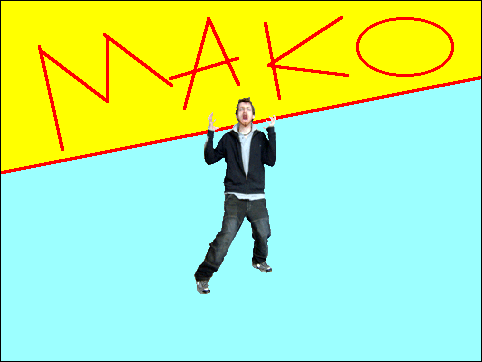
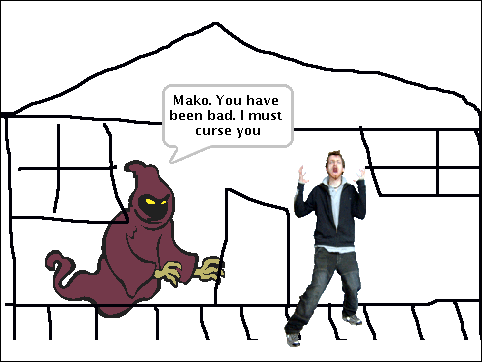
A few years ago, I ran into my friend Jay in the MIT Infinite Corridor. He was looking for volunteers to have their pictures taken and then added to the library of freely licensed and remixable media that would ship with every version of Scratch -- the graphical programming language built by Mitch Resnick's Lifelong Kindergarten group that is designed to let kids create animations and interactive games. Jay suggested I make some emotive faces and I posed for three images that made the final cut: /copyrighteous/images/scratchlib-mako-laughing.gif /copyrighteous/images/scratchlib-mako-screaming.gif /copyrighteous/images/scratchlib-mako-stop.gif But although I've spent quite a bit of time studying the Scratch community in the last few years as it is grown to include millions of participants and projects, I forgot about about Jay's photo shoot. A couple months ago, Acetarium resident Andres Lombana Bermudez pointed out that there was a mako tag on the Scratch website and that a whole bunch of users had been publishing projects using the pictures of me which, apparently, shipped in Scratch under my name. For example, in this project in which I dance in front of a enormous "MAKO" banner: /copyrighteous/images/scratchweb-dance.png That said, given the rather emotive nature of the pictures, I seem to usually end up being blown up shot, shrunk, set on fire by dragons, or meeting other similarly unfortunate ends. /copyrighteous/images/scratchweb-bad_mako.png /copyrighteous/images/scratchweb-looks_arent_everything.png There's quite many more entertaining examples under the tag and many more elsewhere on the Scratch website although they are a little trickier to track down. Jonathan Zittrain likes to say that the best technologies are generative in the sense that they encourage their users to make things with them that the designer never forsaw or anticipated. I feel generative.

Joachim Breitner: Running GNOME 3 and noone will notice

Two days ago, I finally brought my system up-to-date with regard to the GNOME packages that I use. I was very reluctant because I am using a heavily customized gnome-panel and I waited until all the applets that I use have been ported to gtk3 and the libgnome-applet library. I am the Debian maintainer of one of these applets, link-notification-daemon, and I have made the changes and tested them in a chroot before, but now that I am actually using it, I found and fixed more visual glitches. I think by now it is as usable as it was before on GNOME 2. I am still looking for someone to step up as the new upstream maintainer for it! I had some trouble with gnome-session and notification-daemon, thought I found the cause and reported it, but a day later I could not reproduce it anymore. Weird. Other problems, such as the busy cursor not disappearing after the session start, or evolution going into a freeze also have stopped occurring by themselves.
Other problems I found and fixed, for example the battery status applet was not visible until a major state change, or panel applets were not loaded due to a race condition, or tooltips not working (which called for a fix in gtk+ itself). I also added to the xmonad package the files required to allow the user to select GNOME with Xmonad in GDM, and found out how to have Galeon appear in the list of possible default browsers.
I don t really have to say much about GNOME3 itself. I disliked the default font, Cantarell, mostly because of the extra spacing that reduced the number of folders and mail I can see in evolution. (Also see what nekohayo has to say about that.) I also was under the impression that the font is much lighter, and I started to adjust the position of my laptop monitor to increase the contrast. So I switch back to DejaVu Sans.
I also disabled the sleep-on-lid-close feature I often run backups, or download stuff, or compile stuff, or calculate stuff, so I want better control over this. So, I guess, now that everything is almost as it was in GNOME2, I can say I like it...

Flattr this post

11 November 2011

Felipe Sateler: Finding packages not directly depended upon

Today I was removing KDE from my laptop, when I realized that kde-window-manager would not go away (even when it was automatically installed) since it provides x-window-manager, which is needed by gdm. I manually removed it, but that got me thinking that maybe I had other packages that were in this situation. So I picked aptitude and tried to build some search-fu. Here is the resulting query:
aptitude search '?for x:
?x:installed
?x:automatic
?x:provides(?virtual ?reverse-depends(?installed))
?not(?x:reverse-depends(?installed(?depends(?=x))))'


Now, lets go over the query. The first part ?for x: allows us to refer to the package currently being matched. See the documentation for details. We'll see later why we need this. Basically we are saying: give me all packages x that match the following pattern. The second and third parts are trivial: we only want automatically installed packages.
The fourth part, ?x:provides(?virtual ?reverse-depends(?installed)) was easy: find all packages that provide a virtual package that is depended upon by some other installed package.
The fifth and final part, ?not(?x:reverse-depends(?installed(?depends(?=x)))) is why we needed the bound variable x. We want to filter out (hence the ?not) the packages that have some reverse dependency that depends directly on the package x. That way, in my case, metacity won't show up since gnome-core directly depends on it and is installed.

Unfortunately, this query doesn't grok alternative dependencies. For example, if gnome-core depended on metacity x-window-manager then this query wouldn't show metacity, since it is depended upon by a package. If someone can make this query understand that so that it only eliminates packages directly depended upon with no alternatives dependencies, please let me know!Tags: aptitude, cleaning, tip, tips

10 November 2011

Michal &#268;iha&#345;: phpMyAdmin demo server updates

phpMyAdmin demo server got some updates recently. First of all I've updated MySQL and MariaDB version it uses (MySQL is now on 5.5.7 and MariaDB on 5.3.2). Later I've finally found time to make mentions of demo server less intrusive and fit more in existing interface. I've used jQuery to inject information about demo server to main page as one of standard boxes. It fits there nicely and puts information on main page where most users land anyway (you can see it for example here). With most important information on main page, the other pages could be reduced and now only mentions demo server and Git revision it is using. This brings user experience closer to real phpMyAdmin without intrusive information shown on top of every page. I hope you will like it :-).

Filed under: English Phpmyadmin 0 comments Flattr this!

7 November 2011

Wouter Verhelst: git-annex awesomeness

So a few days ago, there was this:
21:24 < wouter> hum.
21:24 < wouter> Anyone know of a tool to manage scanned documents?
21:25 < wouter> the idea being that I can tell this tool "here's a bunch of newly-scanned documents", and it will upload them to a server
21:25 < wouter> and it should allow me to easily find a specific file later on
21:25 < wouter> and I'd also like version control there
21:26 < wouter> and I do _not_ want to download the entire repository of scanned documents on my laptop (that's why I have a server)
21:26 < wouter> and perhaps I'd also like a pony to go with that.
21:29 < wouter> oh, yes, and I do _not_ want a webbrowser as the primary interface (that might be okay to look things up, but not to store stuff)
The answer, as it turned out, was git-annex: a tool to manage files with git, without checking them into git. What, I hear you say? Yes, that sounds a little weird, doesn't it? Perhaps it's easiest to explain with a little example.
$ git annex add 2011-11-07-belgacom.pdf
$ ls -l 2011-11-07-belgacom.pdf
lrwxrwxrwx 1 wouter wouter 191 nov  7 14:46 2011-11-07-belgacom.pdf ->
../.git/annex/objects/xx/3F/SHA256-s1537334--c44e1a057e247bfe7c196ac146c8a0ca32096c0b10df6c18fd3f1c2e99ecddbf/SHA256-s1537334--c44e1a057e247bfe7c196ac146c8a0ca32096c0b10df6c18fd3f1c2e99ecddbf
The file is now known to git-annex, and I can have it do all kinds of useful things with it now:
$ git annex drop 2011-11-07-belgacom.pdf
drop 2011-11-07-belgacom.pdf (unsafe)
  Could only verify the existence of 0 out of 1 necessary copies
  No other repository is known to contain the file.
  (Use --force to override this check, or adjust annex.numcopies.)
failed
git-annex: drop: 1 failed
Oops, we hadn't copied it to anywhere else yet. We don't want to lose our data!
$ git annex move --to server 2011-11-07-belgacom.pdf
move 2011-11-07-belgacom.pdf (checking server...) (to server...)
SHA256-s1537334--c44e1a057e247bfe7c196ac146c8a0ca32096c0b10df6c18fd3f1c2e99ecddbf
     1537334 100%    9.22MB/s    0:00:00 (xfer#1, to-check=0/1)
sent 30 bytes  received 1537668 bytes  1025132.00 bytes/sec
total size is 1537334  speedup is 1.00
ok
$
What just happened? git-annex copied the file to a git remote called "server", and then dropped it from my local copy. It's no longer here! The symlink in my local directory is now a dead link; I can not open it anymore. But, no worries! If we ever need it again, it's just a single command away.
$ git annex get 2011-11-07-belgacom.pdf
get 2011-11-07-belgacom.pdf (from server...) 
SHA256-s1537334--c44e1a057e247bfe7c196ac146c8a0ca32096c0b10df6c18fd3f1c2e99ecddbf
     1537334 100%    9.58MB/s    0:00:00 (xfer#1, to-check=0/1)
sent 30 bytes  received 1537668 bytes  3075396.00 bytes/sec
total size is 1537334  speedup is 1.00
ok
This allows me to save space on my local laptop while not having to care where the files are -- they're just there. And it gets more awesome if you know that git-annex can store multiple copies of each file (so you have automatic distributed backups, as with regular git), where you can enforce the minimum number of copies. Also, git-annex supports multiple backends -- you can store your data in Amazon S3, or on an encrypted USB drive, or whatever, and have git-annex manage it transparently for you. I said this already on IRC, but: Joey, I owe you beer.

Jo Shields: Bansheegeddon

It s seeming increasingly likely that reports regarding the future of Banshee, Tomboy, and the rest of the Mono stack in the default Ubuntu desktop install are accurate. Ubuntu 12.04 will likely be the first Ubuntu release since 5.10 not to ship with any Mono apps in the default install ending a run of 12 releases over 6 years. The decision seems to have come about during the default apps session at the Ubuntu Developer Summit just ended in Orlando, Florida. Prior to heavy vandalism, the only reasons cited for the change in the UDS session log are Banshee not well maintained and porting music store to GTK3 is blocked on banshee ported to GTK3 . Other reasons mentioned but not in the session logs are complaints that it doesn t work on ARM. I m using a lot of conjecture in this first paragraph because the news about the decision appeared on the blogosphere before anywhere else. The first many Banshee or Tomboy developers read about it was reading a flurry of activity on the Tweetosphere from the anti-Mono activists declaring victory. So first, a word on the cited reasoning. Banshee works fine on ARM, since Mono works fine on ARM. Xamarin, the company behind most upstream Mono work, earns their income almost entirely from ARM versions of Mono, running on the varied ARM implementations found in smartphones. Every major Banshee release is personally tested on my Genesi EfikaMX, an ARM system with a Freescale i.mx51 processor. I ve also demonstrated Banshee running in an Ubuntu chroot on my HP Touchpad, an ARM-based tablet. What is known is that Banshee has some problems running on Texas Instruments OMAP4 processors the target ARM platform for Canonical s ARM work. None of the Banshee upstream developers, Mono upstream developers, or Mono Ubuntu team has ever been able to reproduce the cited problems, since problems specific to an exact ARM chip are impossible to reproduce without the requisite hardware and none of us owns an ARM system matching Canonical s target. That Banshee is still a GTK+2 app is true. A port to GTK+3 is almost complete, but blocking on a single technical bug deep within GTK# s guts, which could be fixed by someone with sufficient knowledge of GTK+ semantics. Nobody with the required GTK+ knowledge has stepped forward with a fix at this point in time. As for the final point, that Banshee is not well maintained, this seems like a directed personal insult against the active and responsive Banshee maintainer, Chow Loong Jin, and upstream bug triager David Nielsen, in addition to the immeasurable hours contributed free of charge for the benefit of Ubuntu users by various other members of related Mono app and library teams, including myself. I need to stress at this point that my annoyance with this decision has nothing to do with the actual app changes. Keeping Tomboy and gbrainy, at a cost of about 25 meg of unsquashed disk space, is a hard argument to make compared with those two plus Banshee for 40 meg. Dropping gbrainy and Tomboy, and switching to Rhythmbox, will save about 30 meg of unsquashed space, all told.I m unconvinced that Rhythmbox is a technically superior app to Banshee several features which were gained by the first app swap will be lost again but that s another long tedious argument to be had. No, what has me deeply angered is the shambolic way the changes were made and announced. Significant accommodations were made by Banshee upstream in order to make life easier for Canonical to integrate Banshee into their OS. For one thing, that s why the Ubuntu One Music Store support is a core Banshee feature, not part of the third-party community extensions package. If Banshee was being considered for replacement due to unresolved technical issues, then perhaps it would have been polite to, I don t know, inform upstream that it was on the cards? Or, if Canonical felt that problems specific to their own itches required scratching, then is it completely beyond the realm of possibility to imagine they might have spent developer resources on bug fixing their OS and sending those fixes upstream? Or even and call me crazy providing access for upstream to specialized hardware such as a $174 Pandaboard to empower upstream to isolate and fix unreproducible bugs specific to Canonical s target hardware? And here s where it gets more astonishing for me Canonical paid money to ship one of the community-based packagers responsible for the stack, Iain Lane, to Orlando for UDS, and didn t think it was worth bothering to perhaps inform him hey, the stuff you work on is in danger of being axed from the default install, maybe you should go to this session . So I m not cross that the stuff I work on has been removed from the default install. I intend to continue working on it as I have for the last 4 years, through my work in Debian. No, why I m cross that I heard about it from fucking Boycott Novell. Regardless of your opinions regarding Banshee or its stack, if you read the above and don t see it as an abysmal failure of community engagement by a company whose community manager wrote a book on the damn topic, then there s something seriously wrong with your understanding of how community labour should be seen as a resource. Maybe someone at Canonical should try reading Jono s book. It s not a first-time offence, and this mail from a PiTiVi developer regarding changes in 11.10 makes for useful further reading. [edit] There is some worthwhile discussion going on on the ubuntu-desktop mailing list covering the technical issues surrounding the decision, I would suggest it s a good place for ongoing technical discussion.

6 November 2011

Lucas Nussbaum: dash as /bin/sh, and now ld as-needed. Pattern?

I must admit that I ve never been a big fan of the dash as /bin/sh change. I have three main problems with the switch: POSIX compliance as an argument Complying to standards is a really good thing. But when everybody is ignoring the standard because they want the comfort of newer features, maybe it s a sign that the standard should be updated to include those newer features. Most of the bashims used everywhere in scripts were signifiant improvements, like the ability to write:

cp short1/path1,short2/path2 /very/long/common/path/to/a/file
instead of:
cp short1/path1/very/long/common/path/to/a/file short2/path2/very/long/common/path/to/a/file The option to improve bash was not fully explored We started with the premise that bash is bloated, slow, and cannot be improved. Maybe you can help me with that, but I could only find a few simplistic benchmarks comparing dash and bash, and I could not find any analysis of why bash is slow, and why it cannot be improved.
One of the obvious problems is that bash is also an interactive shell, and is linked to ncurses and terminfo, which increases the startup time. But have we investigated the possibility to have a /bin/bash-non-interactive binary that would not be linked to ncurses? The change was brought to users While it is OK for Debian (or Ubuntu, in that case, since that change was done in Ubuntu first) to force its developers to use POSIX-compliant scripts, the switch could have been made only to Debian-created scripts (by switching them from a /bin/sh shebang to a /bin/dash shebang, for example). I have trouble justifying that this change was forced on users as well. Next: linker changes and we are doing it again. A set of linker changes (see also the Ubuntu page) was already done in Ubuntu, and is very likely to be done in Debian as well. This switch requires deep changes in some buildsystems (it requires ordering of libraries and forbids indirect dependencies), and is rather painful (it was reverted before the Ubuntu 11.04 release because it was not possible to fix all the packages during the natty release cycle, but is done in the 11.10 release). Of course, there are justifications for this change. But I m not sure that it s worth all the trouble created for users.

5 November 2011

Evgeni Golov: Desktop in a shell: mutt with multiple IMAP accounts

It s been a long time since my last post about my desktop in a shell , but today I stumbled over something absolutely awesome I want to share with you. A bit of background: I am using mutt with a single imap server (where everything is forwarded to), because I disliked the idea of having multiple mutt instances running and did not want to play the <change-folder>imaps://other.server.tld/<enter> game too much.
Now today I had to delete some mail from an account I don t use regularly (and where the webmail sucks), so I switched my screen to mutt and actually did the <change-folder> game and was like wow because the account showed up in my sidebar and I could just jump between the folders of both accounts. So I thought how to automate this, so I could actually use mutt with multiple accounts (without offline-imap and friends, which is what you find on the web). It s damn easy:
# muttrc
set imap_user=account1
set imap_pass=password
set folder="imaps://imap.one.example.com/INBOX"
set spoolfile="imaps://imap.one.example.com/INBOX"
...
push <change-folder>imaps://account2@imap.two.example.com/<enter>
Well, what does this do? It advises mutt to use imap.one.example.com, but then just jumps to imap.two.example.com at the end of the config, resulting in both accounts being loaded into the sidebar and usable. That s it, one line and it is awesome! Please note, the password to both accounts is the same, you will have to fiddle around and put it in the URL somehow if it differs.

4 November 2011

Michael Prokop: FAI: switch from Subversion to Git

Revision one in the Subversion repository of the FAI project dates back to the 27th of June 2000. Over the last few months we were discussing the switch to Git. At the last FAI meeting we decided to finally switch to Git and I volunteered to drive the migration. Today I officially did the migration. I ve been using git-svn to handle the FAI svn repository for at least as long as I m wearing the FAI stable release manager hat. But the tags, author information, inside my git-svn checkout weren t ready for official publishing yet There are at least two different well known and referenced svn2git implementations out there. I decided to give the one hosted on github a shot because it s mentioned at http://help.github.com/import-from-subversion/. It basically uses git-svn and just does the few annoying steps for you that I d had to do manually otherwise. For more complex repositories the other svn2git implementation might be worth a try, especially since it s supported by the svneverever tool. svneverever supports more flexible rules regarding the repository layout (it was used for switching Gentoo s Portage from Subversion to Git). Luckily we didn t need it in our situation and I had experience with git-svn on the FAI repository already, so Converting the repository was as simple as running:

% svn2git svn://svn.debian.org/svn/fai --authors ../fai-svnauthors
The ../fai-svnauthors file contains all the svnuser = Realname <mail@example.org> mappings to get the author information right. Some 41 minutes later svn2git finished its work. Finally I pushed the result to the FAI repository at github. If you re interested in the repository size of svn vs. git:

3 November 2011

Andrew Pollock: [life] Zoe at 18 months

Wow, a lot (of travel) has happened in the last three months. Zoe has been to Chicago, Langkawi, Brisbane, and is now back in Mountain View. I'm actually feeling really guilty about our carbon footprint for this year. She spent the last about 3.5 weeks in Brisbane with Sarah after the wedding in Langkawi, until I flew there last weekend for my sister's wedding. Losing and finding Smudge helped pass the time, as did having Liam stay with me while he was visiting from Zurich. I could have done without the former, but really appreciated the timing of the latter. There was quite a noticeable vocabulary difference when I finally saw Zoe again. I can't keep up with all the words she can say now, and she's starting to grasp concepts as well. For example, she opened a small cardboard box, and declared it "empty". Apparently we say "uh oh" a lot, as this is one of her favourite things to blurt out whenever anything happens, ranging from my sister's bridal train dragging on the ground at her wedding, to vomiting all over herself in the back of the car. She's definitely not going to be a girly girl. When the flight from Brisbane landed in Los Angeles she yelled out a big "WHOA!" and then "Again!" while furiously doing the baby sign language for "more". Fortunately we were able to oblige for the flight from LAX to San Jose, and she again enjoyed the landing (she got to sit in her own seat for this one) and did a loud "Wow!" and "Again!" I'm looking forward to taking her on her first roller coaster ride. Her canine teeth still haven't come through yet, but I think they've just started to make an appearance. We're still trying to de-jetlag her at the moment, so it's unclear if the wake-ups throughout the night are because of jetlag or teeth issues (or a combination of both). She handled all of the travel fairly well, although she's now too long for a aeroplane bassinet. She didn't get a lot of sleep on the 12.5 hour flight from Brisbane to Los Angeles (which meant we got none), but she was pretty well behaved for the bulk of it. She's good enough on her legs now that she can just tear up and down the aisles without incident, so we made countless laps of the plane to keep her occupied. The return flight was on Halloween, and the cabin crew had gotten into the spirit with temporary face tattoos, some cabin decorations and some "costumes". The trip back home was actually epic in that it was littered with minor annoyances, but I'll save that for a separate blog post. This Christmas should be a fun one, as she'll be old enough to be a bit more interactive about the whole thing. She may also freak out sitting on Santa's knee, so we may not get quite as nice a photo as we got last year.

Matthew Garrett: Understanding the current state of UEFI

This story has been floating around for a week or so. The summary is that someone bought a system that has UEFI and is having trouble installing Linux on it. In itself, not a problem. But various people have either conflated this with the secure boot issue or suggested that UEFI is a fundamentally anti-Linux technology.

Right now there are no machines shipping to the public with secure boot enabled. None at all. If you're having problems installing Linux on a machine with UEFI then it's not because of secure boot. So what is actually causing the problem?

UEFI is a complicated specification, with 2.3.1A being 2214 pages long. It's a large body of code. There's a lot of subtleties. It's very easy for people to get things wrong. For example, we've seen issues where calling SetVirtualAddressMap() resulted in the firmware referencing boot services code, a clear violation of the spec on the firmware authors' part. We've also found machines that failed to boot because grub wasn't aligning its stack properly, a clear violation of the spec on our part.

Software is difficult. People make mistakes. When something mysteriously fails to work the immediate assumption should be that you've found a bug, not a conspiracy. Over time we'll find those bugs and fix them, but until then just treat UEFI boot failures like any other bug - annoying, but not malicious.

comment count unavailable comments

2 November 2011

Benjamin Mako Hill: Slouching Toward Autonomy

I care a lot about free network services. Recently, I have been given lots of reasons to be happy with the progress the free software community has made in developing services that live up to my standards. I have personally switched from a few proprietary network services to alternative systems that respect my autonomy and have been very happy both with the freedom I have gained and with the no-longer-rudimentary feature sets that the free tools offer. Although there is plenty left to do, here are four tools I'm using now instead of the proprietary tools that many people use, or that I used to use myself: In trying to switch away from proprietary services, I have found that there still a lack of good information comparing the different systems out there and giving folks advice on who might be able to help with things like setup or hosting. I really value hearing from other people about what they use and what they find useful but finding this information online still seems to be a struggle. The autonomo.us wiki seems like the natural place to host or summarize this discussion and to collect and share information useful for those of us slouching (or running) toward autonomy in our use of network services. I invite folks to get involved in improving that already useful resource. For example, this week, I spent a few hours researching free social bookmarking tools and produced a major update to the (already useful) social bookmarking page on the autonomo.us wiki. Of course, I can imagine lots of ways to improve that page and to collect similar information on other classes of network services. Please join me in that effort!

Next.

Previous.