Search Results: "mak"

9 August 2016

John Goerzen: Easily Improving Linux Security with Two-Factor Authentication

2-Factor Authentication (2FA) is a simple way to help improve the security of your systems. It restricts the scope of damage if a machine is compromised. If, for instance, you have a security token or authenticator app on your phone that is required for ssh to a remote machine, then even if every laptop you use to connect to the remote is totally owned, an attacker cannot establish a new ssh session on their own. There are a lot of tutorials out there on the Internet that get you about halfway there, so here is some more detail. Background In this article, I will be focusing on authentication in the style of Google Authenticator, which is a special case of OATH HOTP or TOTP. You can use the Google Authenticator app, FreeOTP, or a hardware token like Yubikey to generate tokens with this. They are all 100% compatible with Google Authenticator and libpam-google-authenticator. The basic idea is that there is a pre-shared secret key. At each login, a different and unique token is required, which is generated based on the pre-shared secret key and some other information. With TOTP, the other information is the current time, implying that both machines must be reasably well in-sync time-wise. With HOTP, the other information is a count of the number of times the pre-shared key has been used. Both typically have a window on the server side that can let times within a certain number of seconds, or a certain number of login accesses, work. The beauty of this system is that after the initial setup, no Internet access is required on either end to validate the key (though TOTP requires both ends to be reasonably in sync time-wise). The basics: user account setup and ssh authentication You can start with the basics by reading one of these articles: one, two, three. Debian/Ubuntu users will find both the pam module and the user account setup binary in libpam-google-authenticator. For many, you can stop there. You re done. But if you want to kick it up a notch, read on: Enhancement 1: Requiring 2FA even when ssh public key auth is used Let s consider a scenario in which your system is completely compromised. Unless your ssh keys are also stored in something like a Yubikey Neo, they could wind up being compromised as well if someone can read your files and sniff your keyboard, your ssh private keys are at risk. So we can configure ssh and PAM so that a OTP token is required even for this scenario. First off, in /etc/ssh/sshd_config, we want to change or add these lines:
UsePAM yes
ChallengeResponseAuthentication yes
AuthenticationMethods publickey,keyboard-interactive
This forces all authentication to pass two verification methods in ssh: publickey and keyboard-interactive. All users will have to supply a public key and then also pass keyboard-interactive auth. Normally keyboard-interactive auth prompts for a password, but we can change /etc/pam.d/sshd on this. I added this line at the very top of /etc/pam.d/sshd:
auth [success=done new_authtok_reqd=done ignore=ignore default=bad] pam_google_authenticator.so
This basically makes Google Authenticator both necessary and sufficient for keyboard-interactive in ssh. That is, whenever the system wants to use keyboard-interactive, rather than prompt for a password, it instead prompts for a token. Note that any user that has not set up google-authenticator already will be completely unable to ssh into their account. Enhancement 1, variant 2: Allowing automated processes to root On many of my systems, I have ~root/.ssh/authorized_keys set up to permit certain systems to run locked-down commands for things like backups. These are automated commands, and the above configuration will break them because I m not going to be typing in codes at 3AM. If you are very restrictive about what you put in root s authorized_keys, you can exempt the root user from the 2FA requirement in ssh by adding this to sshd_config:
Match User root
  AuthenticationMethods publickey
This says that the only way to access the root account via ssh is to use the authorized_keys file, and no 2FA will be required in this scenario. Enhancement 1, variant 2: Allowing non-pubkey auth On some multiuser systems, some users may still want to use password auth rather than publickey auth. There are a few ways we can support that:
  1. Users without public keys will have to supply a OTP and a password, while users with public keys will have to supply public key, OTP, and a password
  2. Users without public keys will have to supply OTP or a password, while users with public keys will have to supply public key, OTP, or a password
  3. Users without public keys will have to supply OTP and a password, while users with public keys only need to supply the public key
The third option is covered in any number of third-party tutorials. To enable options 1 or 2, you ll need to put this in sshd_config:
AuthenticationMethods publickey,keyboard-interactive keyboard-interactive
This means that to authenticate, you need to pass either publickey and then keyboard-interactive auth, or just keyboard-interactive auth. Then in /etc/pam.d/sshd, you put this:
auth required pam_google_authenticator.so
As a sub-variant for option 1, you can add nullok to here to permit auth from people that do not have a Google Authenticator configuration. Or for option 2, change required to sufficient . You should not add nullok in combination with sufficient, because that could let people without a Google Authenticator config authenticate completely without a password at all. Enhancement 2: Configuring su A lot of other tutorials stop with ssh (and maybe gdm) but forget about the other ways we authenticate or change users on a system. su and sudo are the two most important ones. If your root password is compromised, you don t want anybody to be able to su to that account without having to supply a token. So you can set up google-authenticator for root. Then, edit /etc/pam.d/su and insert this line after the pam_rootok.so line:
auth       required     pam_google_authenticator.so nullok
The reason you put this after pam_rootok.so is because you want to be able to su from root to any account without having to input a token. We add nullok to the end of this, because you may want to su to accounts that don t have tokens. Just make sure to configure tokens for the root account first. Enhancement 3: Configuring sudo This one is similar to su, but a little different. This lets you, say, secure the root password for sudo. Normally, you might sudo from your user account to root (if so configured). You might have sudo configured to require you to enter in your own password (rather than root s), or to just permit you to do whatever you want as root without a password. Our first step, as always, is to configure PAM. What we do here depends on your desired behavior: do you want to require someone to supply both a password and a token, or just a token, or require a token? If you want to require a token, put this at the top of /etc/pam.d/sudo:
auth [success=done new_authtok_reqd=done ignore=ignore default=bad] pam_google_authenticator.so
If you want to require a token and a password, change the bracketed string to required , and if you want a token or a password, change it to sufficient . As before, if you want to permit people without a configured token to proceed, add nullok , but do not use that with sufficient or the bracketed example here. Now here comes the fun part. By default, if a user is required to supply a password to sudo, they are required to supply their own password. That does not help us here, because a user logged in to the system can read the ~/.google_authenticator file and easily then supply tokens for themselves. What you want to do is require them to supply root s password. Here s how I set that up in sudoers:
Defaults:jgoerzen rootpw
jgoerzen ALL=(ALL) ALL
So now, with the combination of this and the PAM configuration above, I can sudo to the root user without knowing its password but only if I can supply root s token. Pretty slick, eh? Further reading In addition to the basic tutorials referenced above, consider: Edit: additional comments Here are a few other things to try: First, the libpam-google-authenticator module supports putting the Google Authenticator files in different locations and having them owned by a certain user. You could use this to, for instance, lock down all secret keys to be readable only by the root user. This would prevent users from adding, changing, or removing their own auth tokens, but would also let you do things such as reusing your personal token for the root account without a problem. Also, the pam-oath module does much of the same things as the libpam-google-authenticator module, but without some of the help for setup. It uses a single monolithic root-owned password file for all accounts. There is an oathtool that can be used to generate authentication codes from the command line.

Reproducible builds folks: Finishing the final variations for reprotest

Author: ceridwen I've been working on getting the last of the variations working. With no responses on the mailing list from anyone outside Debian and with limited time remaining, with Lunar I've decided to deemphasize it.
  1. Build path is done.
  2. Host and domain name use domainname and hostname. This site is old, but it indicates that domainname was available on most OSes and hostname was available everywhere as of 2004. Prebuilder uses a Linux-specific utility (unshare --uts) to run this variation in a chroot, but I'm not doing this for reprotest: if you want this variation, use qemu.
  3. User/group will not be portable, because they'll rely on useradd/groupadd and su. useradd and groupadd work on many but not all OSes, notably not including FreeBSD or MacOS X. su was universal in 2004.
  4. Time is not done but will probably be portable to some systems, because it will rely on date -s. Unfortunately, I haven't been able to find any information on how common date -s is across Unix-like OSes, as the -s option is not part of the POSIX standard.
  5. At the moment, I have no idea how to implement changes for /bin/sh and the login shell that will even work across different distributions of Linux, much less different OSes. There are a couple of key problems, starting with the need to find two different shells to use, because there's no way to find out what shells are installed. This blog post explains why /etc/shells doesn't work well for finding what shells are available: not everything in /etc/shells is necessarily a shell (Ubuntu has /usr/bin/screen) and not all available shells are in /etc/shells. Also, there's no good way to find out what shell is the system default because /bin/sh can be an arbitrary binary, not a symlink,and no good way to identify what it is if it is a binary. I can hard-code shell choices, but which shells? bash is obvious for Linux, but what's the best second choice?
On other topics:
  1. reprotest fails to build properly on jessie: Lunar said, and I agree, that fixing this is not a priority. I need someone with more knowledge of Debian Python packaging to help me. If I'm going to support old versions, I also need some kind of CI server, because I don't have the time or ability to maintain old versions of Debian and Python myself.
  2. libc-bin: ldconfig segfaults when run using "setarch uname26": I don't have a good solution for this, but I don't want to hard-code and maintain an architecture-specific disable. Would changing the argument to setarch work around the segfault? Is there a way to test for the presence of the bug that won't cause a segfault or similar crash?
  3. Please put adt-virt-* binaries back onto PATH: reprotest is not affected by this change because I forked the autopkgtest code rather than depending on it, so that reprotest can be installed through PyPi. At the moment, reprotest doesn't make its versions of the programs in virt/ available on $PATH. This is primarily because of the problems with distributing command-line scripts with setuptools. The approach I'm currently using, including the virt/ programs as non-code data with include reprotest/virt/* in MANIFEST.in, doesn't install them to make them available for other programs. Using one of the other approaches potentially could, but it's difficult to make the imports work with those approaches. (I haven't found a way to do it.) I think the best solution to this approach is to split autopkgtest into the Debian-specific components and the general-purpose virtualization components, but I don't have the time to do this myself or to negotiate with Martin Pitt, if he'd even be receptive. I'm also unsure at this point if it wouldn't be better for reprotest to switch from autopkgtest to using something like Ansible to run the virtualization, because Ansible has some solved some of the portability problems already and is not tied to Debian.
My goal is to finish the variations (finally), though as this has always proved more difficult than I expected in the past, I don't make any guarantees. Beyond that, I want to start working on finishing docstrings in the reprotest-specific (i.e., not inherited from autopkgtest) code, improving the documentation in general, and improving the tests.

Reproducible builds folks: Reproducible builds: week 67 in Stretch cycle

What happened in the Reproducible Builds effort between Sunday July 31 and Saturday August 6 2016: Toolchain development and fixes Packages fixed and bugs filed The following 24 packages have become reproducible - in our current test setup - due to changes in their build-dependencies: alglib aspcud boomaga fcl flute haskell-hopenpgp indigo italc kst ktexteditor libgroove libjson-rpc-cpp libqes luminance-hdr openscenegraph palabos petri-foo pgagent sisl srm-ifce vera++ visp x42-plugins zbackup The following packages have become reproducible after being fixed: The following newly-uploaded packages appear to be reproducible now, for reasons we were not able to figure out. (Relevant changelogs did not mention reproducible builds.) Some uploads have addressed some reproducibility issues, but not all of them: Patches submitted that have not made their way to the archive yet: Package reviews and QA These are reviews of reproduciblity issues of Debian packages. 276 package reviews have been added, 172 have been updated and 44 have been removed in this week. 7 FTBFS bugs have been reported by Chris Lamb. Reproducibility tools Test infrastructure For testing the impact of allowing variations of the buildpath (which up until now we required to be identical for reproducible rebuilds), Reiner Herrmann contribed a patch which enabled build path variations on testing/i386. This is possible now since dpkg 1.18.10 enables the --fixdebugpath build flag feature by default, which should result in reproducible builds (for C code) even with varying paths. So far we haven't had many results due to disturbances in our build network in the last days, but it seems this would mean roughly between 5-15% additional unreproducible packages - compared to what we see now. We'll keep you updated on the numbers (and problems with compilers and common frameworks) as we find them. lynxis continued work to test LEDE and OpenWrt on two different hosts, to include date variation in the tests. Mattia and Holger worked on the (mass) deployment scripts, so that the - for space reasons - only jenkins.debian.net GIT clone resides in ~jenkins-adm/ and not anymore in Holger's homedir, so that soon Mattia (and possibly others!) will be able to fully maintain this setup, while Holger is doing siesta. Miscellaneous Chris, dkg, h01ger and Ximin attended a Core Infrastricture Initiative summit meeting in New York City, to discuss and promote this Reproducible Builds project. The CII was set up in the wake of the Heartbleed SSL vulnerability to support software projects that are critical to the functioning of the internet. This week's edition was written by Ximin Luo and Holger Levsen and reviewed by a bunch of Reproducible Builds folks on IRC.

Shirish Agarwal: Doha and the Supreme Court of DFSG Free

Hi, I am in two minds of what to write about Doha. My job has been vastly simplified by a friend when he shared with me https://www.youtube.com/watch?v=LdrAd-44LW0 . That video is more relevant and more closer to the truth than whatever I can share. As can be seen it is funny but more sad the way Qatarians are trying to figure out how things will be and as can be seen it seems to heading towards a real estate bubble . They would have to let go of the Sharia if they are thinking of wealthy westerners coming to stay put. I am just sad to know that many of my country-men are stuck there and although I hope the best for them, I dread it may turn out the way it has turned out for many people of Indians, and especially from Kerala in Saudi Arabia. I would touch about the Kerala situation probably in another blog post as this time is exclusively for legal aspects which were discussed in Debconf. A bit of backgrounder here, one part of my family is lawyers which means I have somewhat notion of law as practiced in our land. As probably everybody knows, India was ruled by the British for around 150 odd years. One of the things that they gave while leaving was/is the IPC (Indian Penal Code) and is practiced with the common law concept. The concept means precedence of any judgement goes quite some way in framing rulings and law of the land as time goes on besides the lobbying and the politics which happens in any democracy. Free software would not have been there without the GPL The General Public License. And the license is as much a legal document as it s something that the developers can work without becoming deranged, as it is one of the more simpler licenses to work with. My own understanding of the legal, ethical and moral issues around me were framed by two-three different TV shows, books (fiction and non-fiction alike) apart from what little news I heard in family. One was M*A*S*H* (with Alan Alda and his frailness, anarchism, humanism, civil rights), the Practise and Boston Legal which does lay bare the many grey areas that lawyers have to deal with ( The Practice also influenced a lot of civil rights understanding and First amendment, but as it is a TV show, how much of it is actually practiced for lawyers and how much moral dilemma they are can only be guessed at.) . In books it is artists like John Grisham, Michael Connelly as well as Perry Mason Agatha Christie. In non-fiction look at the treasures under bombayhighcourt e-books corner and series of Hamlyn Lectures. I would have to warn that all of the above are major time-sinks but rewarding in their own way. Also haven t read all of them as time and interests are constrained but do know they are good for understanding bit of our history. I do crave for a meetup kind of scenario when non-lawyers can read and discuss about facets of law . All that understanding was vastly amplified by Groklaw.net which made non-lawyers at the very least be able to decipher and understand what is going on in the free software world. After PJ (Pamela Jones) closed it in 2013 due to total surveillance by the Free World (i.e. the United States of America, NSA) we have been thirsty. We do get occasionally somewhat mildly interesting articles in lwn.net or arstechnica.net but nowhere the sheer brilliance of groklaw. So, it was a sheer stroke of luck that I met Mr. Bradley M. Kuhn who works with Karen Sandler on Software Conservancy. While I wanted to be there for his presentation, it was just one of those days which doesn t go as planned. However, as we met socially and over e-mail there were two basic questions which I asked him which also imbibes why we need to fight for software freedom in the court of law. Below is a re-wording of what he shared . Q1. why do people think that GPL still needs to be challenged in the court of law while there are gpl-violations which has been more or less successfully defended in the court of law ? Bradley Kuhn the GPL violations is basically a violation of one or more clauses of the GPL license and not the GPL license as a whole and my effort during my lifetime would be to make/have such precedents that the GPL is held as a valid license in the court of law. Q2. Let s say IF GPL is held to be valid in the court of law, would FSF benefit monetarily, at least to my mind it might be so, as more people and comapnies could be convinced to use strong copyleft licenses such as GPLv3 or AGPLv3 . Bradley Kuhn It may or may not. It is possible that even after winning, that people and especially companies may go for weak copyleft licenses if it suits them. The only benefit would probably would be to those people who are already using GPLv3 as the law could be used to protect them as well. Although we would want and welcome companies who would use strong copyleft license such as the GPL, the future is in future and hence uncertain. Both possibilities co-exist. While Bradley didn t say it, I would add further here it probably would mean also moving from being a more offensive mode (which GPL-violations is based upon where a violation occurs and somebody either from the victim s side or a by-stander notices the violation, brings it to the notice of the victim and the GPL-volations team.) to perhaps it being defended by the DMCA people themselves, once GPL is held as a valid license in the eyes of law. Although should you use the DMCA or not is a matter of choice, personal belief system as well as your legal recourses. I have to share that the FSF and the GPL-violations team are probably very discerning when they take up the fight as most of the work done by them is pro-bono (i.e. they don t make a single penny/paisa from the work done therein.) and hence in view of scarce resources, it makes sense to go only for the biggest violators in the hopes that you can either make them agree to compensate and agree to the terms of license of any software/hardware combination or sue them and take a bigger share of the reward/compensation awarded by the Court to help the defendant and maybe some of the proceeds donated by the defendant and people like you and me to make sure that Conservancy and the GPL-violations team is still around to help the next time something similar happens.
Bradley Kuhn presenting at #Debconf 16

Bradley Kuhn presenting at #Debconf 16

Now, as far as his presentation is concerned, whose video can be seen at http://meetings-archive.debian.net/pub/debian-meetings/2016/debconf16/The_Supreme_Court_of_DFSGFree.webm , I thought it was tame. While he talked about gaming the system in some sense, he was sharing that the system debian-legal works (most-of-the-time). The list actually works because many far more brilliant people than me take time to understand the intricacies of various licenses and how they should be interpreted through the excellently written Debian Free Software Guidelines and whether the license under discussion contravenes the DFSG or is part of it. I do agree with his point though that the ftp-master/s and the team may not be the right person to judge the license in adherence to the DFSG, or her/is not giving a reason for rejecting a package to not entering into the package archive. I actually asked the same question on debian-legal and while I had guessed, it seems there is enough review of the licenses per-se as answer from Paul Wise shows. Charles Pessley also shared an idea he has documented which probably didn t get much traction as involves more work on DD s without any benefit to show for it. All in all I hope it sheds some light on why there is need to be more aware of law in software freedom. Two Organizations which work on software freedom from legal standpoint are SFLC (Delhi) headed by the charming Mr. Eben Moglen and ALF (Bangalore). I do hope more people, especially developers take a bit more interest in some of the resources mentioned above.
Filed under: Miscellenous Tagged: #Alternative Law Forum, #bombayhighcourt e-library, #Common Law, #Debconf16, #Fiction, #Hewlyn lectures, #India, #Jurispudence, #legal fiction, #real estate bubble, #SFLC.in, #Software Freedom, #timesink, Doha, Law

8 August 2016

Michael Stapelberg: Debian Code Search: improving client-side latency

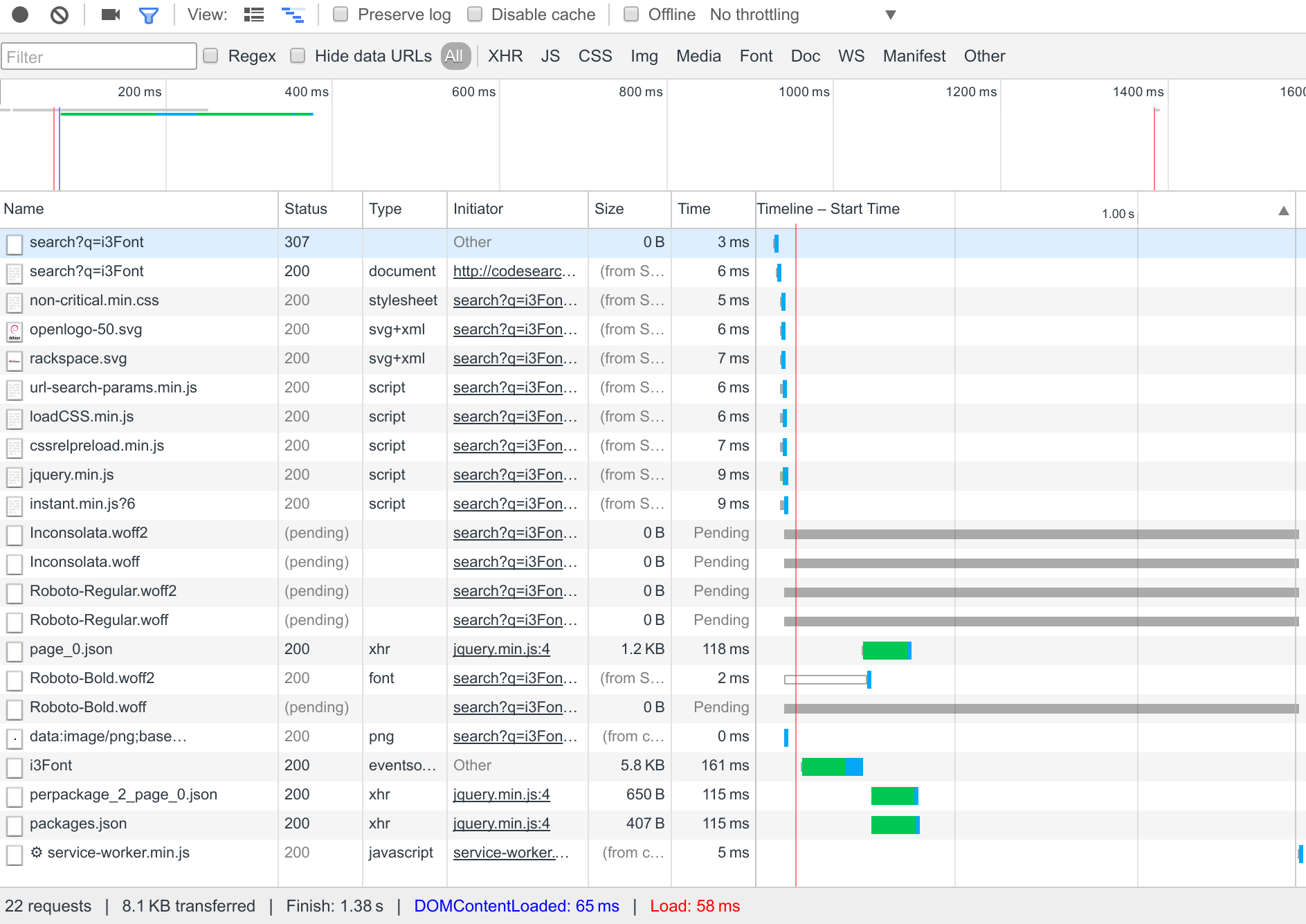
A while ago, it occurred to me that querying Debian Code Search seemed slow, which surprised me because I previously spent quite some effort on making it faster, see Debian Code Search Instant and Taming the latency tail for the most recent substantial architecture overhaul and related optimizations. Upon taking a closer look, I realized that while performing the search query on the server side was pretty fast, the perceived slowness was due to the client side being slow. By being slow , I mean that it took a long time until something was drawn on the screen (high latency) and that what was happening on the screen was janky (stuttering, not smooth). Part of that slowness was due to historical reasons: the client-side architecture was optimized for the use-case where users open Debian Code Search s index page and then submit a search query, but I was using Chrome s address bar to send a search query (type codesearch , then hit the TAB key). Further, we only added a non-JavaScript version after we launched the JavaScript version. Hence, the redirects and progressive enhancements we implemented are more of a kludge than a well thought out design. After this bit of original investigation, I opened GitHub issue #69 to track the work on making Debian Code Search faster. In that issue, I captured how Chrome s network inspector visualizes the work necessary to render the page: Chrome network inspector: before A couple of quick wins There are a couple of little fixes and improvements on which I m not going to spend too much time on, but which I list for completeness anyway just in case they come in handy for a similar project of yours: Bigger changes The URL pattern has changed. Previously, we had 2 areas of the website, one for JavaScript-compatible clients and one for the rest. When you hit the wrong one, you were redirected. In some areas, we couldn t tell which area is the correct one for you, so you would always incur a redirect: one example for this is the search bar. With the new URL pattern, we deliver both versions under the same URL: the elements only used by the JavaScript code are hidden using CSS by default, then made visible by JavaScript code. The elements only used by the non-JavaScript code are wrapped in a <noscript> tag. All CSS which is required for the initial page rendering is now inlined in the responses, allowing the browser to immediately render a response without requiring any additional round trips. All non-essential CSS has been moved into a separate CSS file which is loaded asynchronously. This is done using a pattern like <link rel="preload" href="foo.css" as="style" onload="this.rel='stylesheet'">, see also filamentgroup/loadCSS. We switched from WebSockets to the EventSource API because the former is not compatible with HTTP/2, whereas the latter is. This removes a round trip and some custom code for WebSocket reconnecting, because EventSource does that for you. The progress bar animation used to animate the background-position property. It turns out that browsers can only animate the position, scale, rotation and opacity properties smoothly, because such animations can be off-loaded to the GPU. Hence, we have re-implemented the progress bar animation using the position property. The biggest win for improving client-side latency from the Chrome address bar was introducing Service Workers (see commit 7f31aef402cb782056e290a797f224171f4af270). Our Service Worker caches static assets and a placeholder results page. The placeholder page is presented immediately when you start a search (e.g. from the address bar), making the first response immediate, i.e. rendered within 100ms. Having assets and the result page out of the way, the first round trip is used for actually doing the search, removing all unnecessary overhead. With all of these improvements in place, rendering latency goes down from half a second to well under 100 ms, and this is what the Chrome network inspector looks like: Chrome network inspector: after
6 August 2016

Sean Whitton: git-push-all

I maintain Debian packages for several projects which are hosted on GitHub. I have a master packaging branch containing both upstream s code, and my debian/ subdirectory containing the packaging control files. When upstream makes a new release, I simply merge their release tag into master: git merge 1.2.3 (after reviewing the diff!). Packaging things for Debian turns out to be a great way to find small bugs that need to be fixed, and I end up forwarding a lot of patches upstream. Since the projects are on GitHub, that means forking the repo and submitting pull requests. So I end up with three remotes:

origin
the Debian git server
upstream
upstream s GitHub repo from which I m getting the release tags
fork
my GitHub fork of upstream s repo, where I m pushing bugfix branches
I can easily push individual branches to particular remotes. For example, I might say git push -u fork fix-gcc-6. However, it is also useful to have a command that pushes everything to the places it should be: pushes bugfix branches to fork, my master packaging branch to origin, and definitely doesn t try to push anything to upstream (recently an upstream project gave me push access because I was sending so many patches, and then got a bit annoyed when I pushed a series of Debian release tags to their GitHub repo by mistake). I spent quite a lot of time reading git-config(1) and git-push(1), and came to the conclusion that there is no combination of git settings and a push command that do the right thing in all cases. Candidates, and why they re insufficient:
git push --all
I thought about using this with the remote.pushDefault and branch.*.pushRemote configuration options. The problem is that git push --all pushes to only one remote, and it selects it by looking at the current branch. If I ran this command for all remotes, it would push everything everywhere.
git push <remote> : for each remote
This is the matching push strategy . It will push all branches that already exist on the remote with the same name. So I thought about running this for each remote. The problem is that I typically have different master branchs on different remotes. The fork and upstream remotes have upstream s master branch, and the origin remote has my packaging branch.
I wrote a perl script implementing git push-all, which does the right thing. As you will see from the description at the top of the script, it uses remote.pushDefault and branch.*.pushRemote to determine where it should push, falling back to pushing to the remote the branch is tracking. If won t push something when all three of these are unspecified, and more generally, it won t create new remote branches except in the case where the branch-specific setting branch.*.pushRemote has been specified. Magit makes it easy to set remote.pushDefault and branch.*.pushRemote. I have this in my ~/.mrconfig:
git_push = git push-all
so that I can just run mr push to ensure that all of my work has been sent where it needs to be (see myrepos).
#!/usr/bin/perl
# git-push-all -- intelligently push most branches
# Copyright (C) 2016 Sean Whitton
#
# This program is free software: you can redistribute it and/or modify
# it under the terms of the GNU General Public License as published by
# the Free Software Foundation, either version 3 of the License, or (at
# your option) any later version.
#
# This program is distributed in the hope that it will be useful, but
# WITHOUT ANY WARRANTY; without even the implied warranty of
# MERCHANTABILITY or FITNESS FOR A PARTICULAR PURPOSE.  See the GNU
# General Public License for more details.
#
# You should have received a copy of the GNU General Public License
# along with this program.  If not, see <http://www.gnu.org/licenses/>.
# Prerequisites:
# The Git::Wrapper, Config::GitLike, and List::MoreUtils perl
# libraries.  On a Debian system,
#     apt-get install libgit-wrapper-perl libconfig-gitlike-perl \
#         liblist-moreutils-perl
# Description:
# This script will try to push all your branches to the places they
# should be pushed, with --follow-tags.  Specifically, for each branch,
#
# 1. If branch.pushRemote is set, push it there
#
# 2. Otherwise, if remote.pushDefault is set, push it there
#
# 3. Otherwise, if it is tracking a remote branch, push it there
#
# 4. Otherwise, exit non-zero.
#
# If a branch is tracking a remote that you cannot push to, be sure to
# set at least one of branch.pushRemote and remote.pushDefault.
use strict;
use warnings;
no warnings "experimental::smartmatch";
use Git::Wrapper;
use Config::GitLike;
use List::MoreUtils qw  uniq apply  ;
my $git = Git::Wrapper->new(".");
my $config = Config::GitLike->new( confname => 'config' );
$config->load_file('.git/config');
my @branches = apply   s/[ \*]//g   $git->branch;
my @allBranches = apply   s/[ \*]//g   $git->branch(  all => 1  );
my $pushDefault = $config->get( key => "remote.pushDefault" );
my %pushes;
foreach my $branch ( @branches )  
    my $pushRemote = $config->get( key => "branch.$branch.pushRemote" );
    my $tracking = $config->get( key => "branch.$branch.remote" );
    if ( defined $pushRemote )  
        print "I: pushing $branch to $pushRemote (its pushRemote)\n";
        push @  $pushes $pushRemote   , $branch;
    # don't push unless it already exists on the remote: this script
    # avoids creating branches
      elsif ( defined $pushDefault
              && "remotes/$pushDefault/$branch" ~~ @allBranches )  
        print "I: pushing $branch to $pushDefault (the remote.pushDefault)\n";
        push @  $pushes $pushDefault   , $branch;
      elsif ( !defined $pushDefault && defined $tracking )  
        print "I: pushing $branch to $tracking (probably to its tracking branch)\n";
        push @  $pushes $tracking   , $branch;
      else  
        die "E: couldn't find anywhere to push $branch";
     
 
foreach my $remote ( keys %pushes )  
    my @branches = @  $pushes $remote   ;
    system "git push --follow-tags $remote @branches";
    exit 1 if ( $? != 0 );
 

Mirco Bauer: Ethereum GPU Mining on Linux How-To

TL;DR Install/use Debian 8 or Ubuntu 16.0.4 then execute:
sudo apt-get install software-properties-common
sudo add-apt-repository ppa:ethereum/ethereum
sudo sed 's/jessie/vivid/' -i /etc/apt/sources.list.d/ethereum-ethereum-*.list
sudo apt-get update
sudo apt-get install ethereum ethminer
geth account new
# copy long character sequence within  , that is your <YOUR_WALLET_ADDRESS>
# if you lose the passphrase, you lose your coins!
sudo apt-get install linux-headers-amd64 build-essential
chmod +x NVIDIA-Linux-x86_64-367.35.run
sudo NVIDIA-Linux-x86_64-367.35.run
ethminer -G -F http://yolo.ethclassic.faith:9999/0x<YOUR_WALLET_ADDRESS> --farm-recheck 200
echo done
My Attention Span is > 60 seconds Ethereum is a crypto currency similar to Bitcoin as it is based on the blockchain technology. Ethereum is not yet another Bitcoin clone though, since it has an additional feature called Smart Contracts that makes it unique and very promising. I am not going into details how Ethereum works, you can get that into great detail on the Internet. This post is about Ethereum mining. Mining is how crypto coins are created. You need to spent computing time to get coins out. At the beginning CPU mining was sufficient, but as the Ethereum network difficulty has increased you need to use GPUs as they can calculate at a much higher hashrate than a general purpose CPU can do. About 2 months ago I bought a new gaming rig, with a Nvidia GTX 1070 so I can experience virtual-reality gaming with a HTC Vive at a great framerate. As it turns out modern graphics cards are very good at hashing so I gave it a spin. Initially I did this mining setup with Windows 10, as that is the operating system on my gaming rig. If you want to do Ethereum mining using your GPU, then you really want to use Linux. On Windows the GTX 1070 produced a hashrate of 6 MH/s (megahashes per second) while the same hardware does 25 MH/s on Linux. The hashrate multiplied by 4 by using Linux instead of Windows. Sounds good? Keep reading and follow this guide. You have to pick a Linux distro to use for mining. As I am a Debian developer, all my systems run Debian, which is what I am also using for this guide. The same procedure can be done for Ubuntu as it is similar enough. For other distros you have to substitute the steps yourself. So I assume you already have Debian 8 or Ubuntu 16.04 installed on your system.

Install Ethereum Software First we need the geth tool which is the main Ethereum "client". Ethereum is really a peer-to-peer network, that means each node is a server and client at the same time. A node that contains the complete blockchain history in a database is called a full node. For this guide you don't need to run a full node, as mining pools do this for you. We still need geth to create the private key of your Ethereum wallet. Somewhere we have to receive the coins we are mining ;) Add the Ethereum APT repository using these commands:
sudo apt-get install software-properties-common
sudo add-apt-repository ppa:ethereum/ethereum
sudo apt-get update
On Debian 8 (on Ubuntu you can skip this) you need to replace the repository name with this command:
sudo sed 's/jessie/vivid/' -i /etc/apt/sources.list.d/ethereum-ethereum-*.list
sudo apt-get update
Install ethereum, ethminer and geth:
sudo apt-get install ethereum ethminer geth

Create Ethereum Wallet A wallet is where coins are "stored". They are not really stored in the wallet because the wallet is just a private key that nobody has. The balance of that wallet is visible to everyone using the blockchain database. And this is what full nodes do, they contain and distribute the database to all other peers. So this this command to create your first private key for your wallet:
geth account new
Be aware, that this passphrase protects the private key of your wallet. Anyone who has access to that file and knows your passphrase will have full control over your coins. And also do not forget the passphrase, as if you do, you lost all your coins! The output of "geth account new" shows a long character/number sequence quoted in . This is your wallet address and you should write that number down, as if someone wants to send you money, then it is to that address. We will use that for the mining pool later.

Install (proprietary) nvidia driver For OpenCL to work with nvidia graphics cards, like my GTX 1070, you need to install this proprietary driver from nvidia. If you have an older card maybe the opensource drivers will work for you. For the nvidia pascal cards numbers 10xx you will need this driver package. After you have agreed the terms, download the NVIDIA-Linux-x86_64-367.35.run file. But before we can use that installer we need to install some dependencies that installer needs as it will have to compile a Linux kernel module for you. Install the dependencies using this command:
sudo apt-get install linux-headers-amd64 build-essential
Now we can make the installer executable and run it like this:
chmod +x NVIDIA-Linux-x86_64-367.35.run
sudo NVIDIA-Linux-x86_64-367.35.run
If that step completed without error, then we should be able to run the mining benchmark!
ethminer -M -G
The -M means "run benchmark" and the -G is for GPU mining. The first time you run it it will create a DAG file and that will takes a while. For me it took about 12 minutes on my GTX 1070. After that is should show a inner mean hashrate. If it says H/s that is hashes per second and KH is kilo (H/1000) and MH is megahashes per second (KH/1000). I had numbers around 25-30 MH/s, but for real mining you will see an average that is a balanced number and not a min/max range.

Pick Ethereum Network Now it gets serious, you need to decide 2 things. First which Ethereum network you want to mine for and the second is using which pool. Ethereum has 2 networks, one is called Ethereum One or Core, while the other is called Ethereum Classic. Ethereum has made a hardfork to undo the consequences of a software bug in the DAO. The DAO is a smart contract for a decentralized organization. Because of that bug, a blackhat could use that bug to obtain money from that DAO. The Ethereum developers made a poll and decided that the consequences will be undone. Not everyone agreed and the old network stayed alive and is now called Ethereum Classic short ETC. The hardfork kept its short name ETH. This is important to understand for mining, because the hashing difficulty has a huge difference between ETH and ETC. As of writing, the hashrate of ETC is at 20% compared to ETH. Thus you need less computing time to get ETC coins and more time to get ETH coins. Differently said, ETC mining is currently more profitable.

Pick a Pool Hmmmm, I want a swimming pool, thanks! Just kidding... You can mine without a pool, that is called solo mining, but you will get less reward. A mining pool are multiple computers that work on the same block to find a solution quicker than others. The pool has an aggregated hashrate that is higher than other solo miners. Each found block by anyone in this pool will be rewarded to everyone in the pool. The reward of 5 ether currently per block gets split in the same ratio of hashrate each member provides (minus the pool fee). So while you get less for a found block, you still have a steady lower income rate instead of higher with less chance of finding one (in time). Simply said: you have to find a new block faster than the others to receive the reward. If you want to mine Ethereum Classic (ETC) use one of the pools listed here (at the bottom of the page). If you want to mine Ethereum One / Core (ETH) use one of the pools listed here.

Run ethminer The instruction page of the pool website usually says how to start the miner program, but here is an example of the pool that I use (because pony!):
ethminer -G -F http://yolo.ethclassic.faith:9999/0x<YOUR_WALLET_ADDRESS> --farm-recheck 200

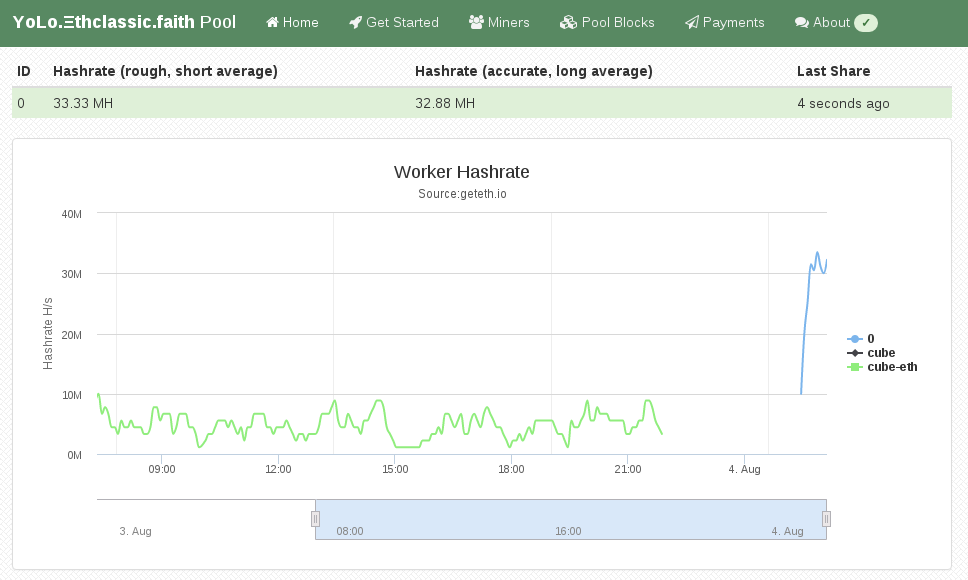
Profit If this guide was helpful for you, you can tip me at ethereum:0x9ec1220d2f2fadd3f0c96e3007daa827bc83fbd6 or simply run the ethminer using my wallet address for a day or two:
ethminer -G -F http://yolo.ethclassic.faith:9999/0x9ec1220d2f2fadd3f0c96e3007daa827bc83fbd6 --farm-recheck 200
Happy mining!

Norbert Preining: Debian/TeX Live 2016.20160805-1

TUG 2016 is over, and I have returned from a wonderful trip to Toronto and Maine. High time to release a new checkout of the TeX Live packages. After that I will probably need some time for another checkout, as there are a lot of plans on the table: upstream created a new collection, which means new package in Debian, which needs to go through NEW, and I am also planning to integrate tex4ht to give it an update. Help greatly appreciated here. texlive2016-debian This package also sees the (third) revision of how config files for pdftex and luatex are structured, since then we have settled down. Hopefully this will close some of the issues that have appeared. New packages biblatex-ijsra, biblatex-nottsclassic, binarytree, diffcoeff, ecgdraw, fvextra, gitfile-info, graphics-def, ijsra, mgltex, milog, navydocs, nodetree, oldstandardt1, pdflatexpicscale, randomlist, texosquery Updated packages 2up, acmart, acro, amsmath, animate, apa6, arabluatex, archaeologie, autobreak, beebe, biblatex-abnt, biblatex-gost, biblatex-ieee, biblatex-mla, biblatex-source-division, biblatex-trad, binarytree, bxjscls, changes, cloze, covington, cs, csplain, csquotes, csvsimple, datatool, datetime2, disser, dvipdfmx, dvips, emisa, epstopdf, esami, etex-pkg, factura, fancytabs, forest, genealogytree, ghsystem, glyphlist, gost, graphics, hyperref, hyperxmp, imakeidx, jadetex, japanese-otf, kpathsea, latex, lstbayes, luatexja, mandi, mcf2graph, mfirstuc, minted, oldstandard, optidef, parnotes, philosophersimprint, platex, protex, pst-pdf, ptex, pythontex, readarray, reledmac, sepfootnotes, sf298, skmath, skrapport, stackengine, sttools, tcolorbox, tetex, texinfo, texlive-docindex, texlive-es, texlive-scripts, thesis-ekf, tools, toptesi, tudscr, turabian-formatting, updmap-map, uplatex, uptex, velthuis, xassoccnt, ycbook. Enjoy.

5 August 2016

Petter Reinholdtsen: Sales number for the Free Culture translation, first half of 2016

As my regular readers probably remember, the last year I published a French and Norwegian translation of the classic Free Culture book by the founder of the Creative Commons movement, Lawrence Lessig. A bit less known is the fact that due to the way I created the translations, using docbook and po4a, I also recreated the English original. And because I already had created a new the PDF edition, I published it too. The revenue from the books are sent to the Creative Commons Corporation. In other words, I do not earn any money from this project, I just earn the warm fuzzy feeling that the text is available for a wider audience and more people can learn why the Creative Commons is needed. Today, just for fun, I had a look at the sales number over at Lulu.com, which take care of payment, printing and shipping. Much to my surprise, the English edition is selling better than both the French and Norwegian edition, despite the fact that it has been available in English since it was first published. In total, 24 paper books was sold for USD $19.99 between 2016-01-01 and 2016-07-31:
Title / languageQuantity
Culture Libre / French3
Fri kultur / Norwegian7
Free Culture / English14
The books are available both from Lulu.com and from large book stores like Amazon and Barnes&Noble. Most revenue, around $10 per book, is sent to the Creative Commons project when the book is sold directly by Lulu.com. The other channels give less revenue. The summary from Lulu tell me 10 books was sold via the Amazon channel, 10 via Ingram (what is this?) and 4 directly by Lulu. And Lulu.com tells me that the revenue sent so far this year is USD $101.42. No idea what kind of sales numbers to expect, so I do not know if that is a good amount of sales for a 10 year old book or not. But it make me happy that the buyers find the book, and I hope they enjoy reading it as much as I did. The ebook edition is available for free from Github. If you would like to translate and publish the book in your native language, I would be happy to help make it happen. Please get in touch.

Steve Kemp: Using the compiler to help you debug segfaults

Recently somebody reported that my console-based mail-client was segfaulting when opening an IMAP folder, and then when they tried with a local Maildir-hierarchy the same fault was observed. I couldn't reproduce the problem at all, as neither my development host (read "my personal desktop"), nor my mail-host had been crashing at all, both being in use to read my email for several months. Debugging crashes with no backtrace, or real hint of where to start, is a challenge. Even when downloading the same Maildir samples I couldn't see a problem. It was only when I decided to see if I could add some more diagnostics to my code that I came across a solution. My intention was to make it easier to receive a backtrace, by adding more compiler options:
  -fsanitize=address -fno-omit-frame-pointer
I added those options and my mail-client immediately started to segfault on my own machine(s), almost as soon as it started. Ultimately I found three pieces of code where I was allocating C++ objects and passing them to the Lua stack, a pretty fundamental part of the code, which were buggy. Once I'd tracked down the areas of code that were broken and fixed them the user was happy, and I was happy too. Its interesting that I've been running for over a year with these bogus things in place, which "just happened" to not crash for me or anybody else. In the future I'll be adding these options to more of my C-based projects, as there seems to be virtually no downside. In related news my console editor has now achieved almost everything I want it to, having gained: The only outstanding feature, which is a biggy, is support for Undo which I need to add. Happily no segfaults here, so far..

Joey Hess: keysafe

Have you ever thought about using a gpg key to encrypt something, but didn't due to worries that you'd eventually lose the secret key? Or maybe you did use a gpg key to encrypt something and lost the key. There are nice tools like paperkey to back up gpg keys, but they require things like printers, and a secure place to store the backups. I feel that simple backup and restore of gpg keys (and encryption keys generally) is keeping some users from using gpg. If there was a nice automated solution for that, distributions could come preconfigured to generate encryption keys and use them for backups etc. I know this is a missing peice in the git-annex assistant, which makes it easy to generate a gpg key to encrypt your data, but can't help you back up the secret key. So, I'm thinking about storing secret keys in the cloud. Which seems scary to me, since when I was a Debian Developer, my gpg key could have been used to compromise millions of systems. But this is not about developers, it's about users, and so trading off some security for some ease of use may be appropriate. Especially since the alternative is no security. I know that some folks back up their gpg keys in the cloud using DropBox.. We can do better. I've thought up a design for this, called keysafe. The synopsis of how it works is:
The secret key is split into three shards, and each is uploaded to a server run by a different entity. Any two of the shards are sufficient to recover the original key. So any one server can go down and you can still recover the key. A password is used to encrypt the key. For the servers to access your key, two of them need to collude together, and they then have to brute force the password. The design of keysafe makes brute forcing extra difficult by making it hard to know which shards belong to you. Indeed the more people that use keysafe, the harder it becomes to brute-force anyone's key!
I could really use some additional reviews and feedback on the design by experts.
This project is being sponsored by Purism and by my Patreon supporters. By the way, I'm 15% of the way to my Patreon goal after one day!

3 August 2016

Daniel Kahn Gillmor: Changes for GnuPG in Debian

The GNU Privacy Guard (GnuPG) upstream team maintains three branches of development: 1.4 ("classic"), 2.0 ("stable"), and 2.1 ("modern").They differ in various ways: software architecture, supported algorithms, network transport mechanisms, protocol versions, development activity, co-installability, etc.Debian currently ships two versions of GnuPG in every maintained suite -- in particular, /usr/bin/gpg has historically always been provided by the "classic" branch.That's going to change!Debian unstable will soon be moving to the "modern" branch for providing /usr/bin/gpg. This will give several advantages for Debian and its users in the future, but it will require a transition. Hopefully we can make it a smooth one.

What are the benefits?Compared to "classic", The "modern" branch has:
  • updated crypto (including elliptic curves)
  • componentized architecture (e.g. libraries, some daemonized processes)
  • improved key storage
  • better network access (including talking to keyservers over tor)
  • stronger defaults
  • more active upstream development
  • safer info representation (e.g. no more key IDs, fingerprints easier to copy-and-paste)
If you want to try this out, the changes are already made in experimental. Please experiment!

What does this mean for end users?If you're an end user and you don't use GnuPG directly, you shouldn't notice much of a change once the packages start to move through the rest of the archive.Even if you do use GnuPG regularly, you shouldn't notice too much of a difference. One of the main differences is that all access to your secret key will be handled through gpg-agent, which should be automatically launched as needed. This means that operations like signing and decryption will cause gpg-agent to prompt the the user to unlock any locked keys directly, rather than gpg itself prompting the user.If you have an existing keyring, you may also notice a difference based on a change of how your public keys are managed, though again this transition should ideally be smooth enough that you won't notice unless you care to investigate more deeply.If you use GnuPG regularly, you might want to read the NEWS file that ships with GnuPG and related packages for updates that should help you through the transition.If you use GnuPG in a language other than English, please install the gnupg-l10n package, which contains the localization/translation files. For versions where those files are split out of the main package, gnupg explicitly Recommends: gnupg-l10n already, so it should be brought in for new installations by default.If you have an archive of old data that depends on known-broken algorithms, PGP3 keys, or other deprecated material, you'll need to have "classic" GnuPG around to access it. That will be provided in the gnupg1 package

What does this mean for package maintainers?If you maintain a package that depends on gnupg: be aware that the gnupg package in debian is going through this transition.A few general thoughts:
  • If your package Depends: gnupg for signature verification only, you might prefer to have it Depends: gpgv instead. gpgv is a much simpler tool that the full-blown GnuPG suite, and should be easier to manage. I'm happy to help with such a transition (we've made it recently with apt already)
  • If your package Depends: gnupg and expects ~/.gnupg/ to be laid out in a certain way, that's almost certainly going to break at some point. ~/.gnupg/ is GnuPG's internal storage, and it's not recommended to rely on any specific data structures there, as they may change. gpg offers commands like --export, --import, and --delete for manipulating its persistent storage. please use them instead!
  • If your package depends on parsing or displaying gpg's output for the user, please make sure you use its special machine-readable form (--with-colons). Parsing the human-readable text is not advised and may change from version to version.
If you maintain a package that depends on gnupg2 and tries to use gpg2 instead of gpg, that should stay ok. However, at some point it'd be nice to get rid of /usr/bin/gpg2 and just have one expected binary (gpg). So you can help with that:
  • Look for places where your package expects gpg2 and make it try gpg instead. If you can make your code fall back cleanly
  • Change your dependencies to indicate gnupg (>= 2)
  • Patch lintian to encourage other people to make this switch ;)

What specifically needs to happen?The last major step for this transition was renaming the source package for "classic" GnuPG to be gnupg1. This transition is currently in the ftp-master's NEW queue. Once it makes it through that queue, and both gnupg1 and gnupg2 have been in experimental for a few days without reports of dangerous breakage, we'll upload both gnupg1 and gnupg2 to unstable.We'll also need to do some triage on the BTS, reassigning some reports which are really only relevant for the "classic" branch.Please report bugs via the BTS as usual! You're also welcome to ask questions and make suggestions on #debian-gnupg on irc.oftc.net, or to mail the Debian GnuPG packaging team at pkg-gnupg-maint@lists.alioth.debian.org.Happy hacking!Tags: gnupg

Joey Hess: Patreon

I've been funded for two years by the DataLad project to work on git-annex. This has been a super excellent gig; they provided funding and feedback on ways git-annex could be improved, and I had a large amount of flexability to decide what to work on in git-annex. Also plenty of spare time to work on new projects like propellor, concurrent-output, and scroll. It was an awesome way to spend the last two years of my twenty years of free software. That funding is running out. I'd like to continue this great streak of working on the free software projects that are important to me. I'd normally dip into my savings at this point and keep on going until some other source of funding turned up. But, my savings are about to be obliterated, since I'm buying the place where I've had so much success working distraction-free. So, I've started a Patreon page to fund my ongoing work. Please check it out and contribute if you want to. Some details about projects I want to work on this fall:

Elena 'valhalla' Grandi: The Cat Model of Package Ownership

The Cat Model of Package Ownership

Debian has been moving away from strong ownership of packages by package maintainers and towards encouraging group maintainership, for very good reasons: single maintainers have a bad bus factor and a number of other disadvantages.

When single maintainership is changed into maintainership by a small , open group of people who can easily communicate and sync with each other, everything is just better: there is an easy way to gradually replace people who want to leave, but there is also no duplication of efforts (because communication is easy), there are means to always have somebody available for emergency work and generally package quality can only gain from it.

Unfortunately, having such group of maintainers for every package would require more people than are available and willing to work on it, and while I think it's worth doing efforts to have big and important packages managed that way, it may not be so for the myriad of small ones that make up the long tail of a distribution.

Many of those packages may end up being maintained in a big team such as the language-based ones, which is probably better than remaining with a single maintainer, but can lead to some problems.

My experience with the old OpenEmbedded, back when it was still using monotone instead of git and everybody was maintaining everything, however, leads me to think that this model has a big danger of turning into nobody maintains anything, because when something needs to be done everybody is thinking that somebody else will do it.

As a way to prevent that, I have been thinking in the general direction of a Cat Model of Package Ownership, which may or may not be a way to prevent some risks of both personal maintainership and big teams.

The basic idea is that the my in my packages is not the my in my toys , but the my in my Cat, to whom I am a servant .

As in the case of a cat, if my package needs a visit to the vet, it's my duty to do so. Other people may point me to the need of such a visit, e.g. by telling me that they have seen the cat leaving unhealty stools, that there is a bug in the package, or even that upstream released a new version a week ago, did you notice?, but the actual putting the package in a cat carrier and bringing it to the vet falls on me.

Whether you're allowed to play with or pet the cat is her decision, not mine, and giving her food or doing changes to the package is usually fine, but please ask first: a few cats have medical issues that require a special diet.

And like cats, sometimes the cat may decide that I'm not doing a good enough job of serving her, and move away to another maintainer; just remember that there is a difference between a lost cat who wants to go back to her old home and a cat that is looking for a new one. When in doubt, packages usually wear a collar with contact informations, trying to ping those is probably a good idea.

This is mostly a summer afternoon idea and will probably require some refinement, but I think that the basic idea can have some value. Comments are appreciated on the federated social networks where this post is being published, via email (valid addresses are on my website http://www.trueelena.org/computers/articles/the_cat_model_of_package_ownership.html and on my GPG key http://www.trueelena.org/about/gpg.html) or with a post on a blog that appears on planet debian http://planet.debian.org/.

how small is small depends a lot on the size of the package, the amount of work it requires, how easy it is to parallelize it and how good are the people involved at communicating, so it would be quite hard to put a precise number here.

I've moved away from it because the boards I was using could run plain Debian, but I've heard that after the move to git there have been a number of workflow changes (of which I've seen the start) and everything now works much better.

1 August 2016

Shirish Agarwal: Doha and the past year in APT

A week has gone by and another small sharing about Doha and one package that quite a few of us use everyday but don t think much of them. Let s start with Doha with these two pictures which tells/shares a bit about what the Doha of today is like qatar-1 qatar-2 While I have more than a dozen snapshots of Doha, all of them show same thing, all are huge skyscrapers and overall Doha seems to be aping Dubai and is in a frenzy as World Cup 2022 is around the corner. We did see a few of the older places but these seemed to be more done for tourists rather than the real thing. We saw stuff like wooden_ship This was a picture taken by Ritesh Raj Saraff, a friend and a DD whom I met while I was going to Debconf. The place where this picture has been taken is known as a Souk or what we know as market-place. This was a place where you could get spices. Quite a few of the spices that we get and use in India were bought from Middle-East in the olden times. In fact, it has been argued that the whole Mughlai food that is part of Indian culture was imported from Middle-East when we were trading them before India or Akhand Bharat was invaded. What was interesting to both of us is that we could perceive that most of the buildings had a sort of fakeness to it, they tried to show that it had a lot of detailed work on the buildings but we could see it was all done recently so not that old as being led to believe. One of the other interesting bits that we came to know throughout our stay in Qatar that almost 80-90% of the staff we met inside Qatar airport as well as in the Souk were people from Asian sub-continent and more specifically from South India. I had few interesting conversations with some of the people who were managing the shops were that almost of them were just employees while the owners were Qataris . I could understand this as the distance and flight between Qatar and India is hardly 3 hours. It seemed very similar to how Mexicans look for work in United States. The most expensive thing there was water as it s desert other than housing and most workers seemed to have shared accommodation from anywhere between 5-15 people in one room. It s only the relative strength of the Qatari Rial which probably compels them to be there. The temperature was around 45 degrees with a bit of humidity as it s next to the Ocean. For all the money in the world, I wouldn t work there. It is true that you know your city s worth only when you go outside:) I do have some more stories about Qatar but that would have to wait for another day now. Also, I really don t want to talk much about this part as it s part depressing but probably would explore it a bit in a further blog-post. One of the more interesting topics that I attended was the apt talk . There are 3-4 tools in the Debian world i.e. apt, aptitude, apt-get, dpkg and dselect. More often than not people know aptitude and apt-get whereas the rest of the packages are not thought so much about. What I somewhat suspected about the history of apt was revealed to be true today, courtesy David K. julias-andreas-klose-year-in-apt You can see the talk/video about apt at http://meetings-archive.debian.net/pub/debian-meetings/2016/debconf16/The_past_year_in_APT.webm. I had been curious about apt,libapt,dpkg and the entire tool-chain which goes into updating packages and like. I had a couple of conversations here in India before on mail, in person and IRC as well as couple of conversations in South Africa as well before the APT talk where it was told that packages are not signed or it s not easy to figure out the integrity. Being a Debian fan-boy I could not believe this to be true. Hence I asked and to my dismay found it to be true . I also then asked the same with a bit more background on the mailing list as well and got to know that this has been a concern since 2005. As I do not have the requisite skills and the person would require probably knowledge of dpkg internals as well as have probably good social skills to have at least 1-2 DD s help her/im to work on it and have probably some server space where even some partial archive is re-built using debian packages which use dpkg-sig . I also had some concerns that even if somebody did do the work, it might come in the way of the reproducible builds concept where Neils shared ways in which it could be overcome. Having said the above, it is totally doable if somebody has the will, skills and the patience to do it. Just look at the amazing work done by the team which re-built almost all the archive using clang. See clang.debian.net for the amazing work that they have done. Now, one of the issues in India which comes in popularizing Debian or in fact any free software distribution in India is the bandwidth issue or rather the lack of it or how expensive it is. The situation for better lack of term is pathetic . While nothing can be done till the time the Govt. gives limited term oligopoly licenses to telecom operators and they have a cabal (cabal closed team where decisions and policies are made without any knowledge of and to other stakeholders.) we need to find ways to make the best of the situation. Anyways, while there are some ideas to tackle that but that s a long-term goal and I will share some aspects of it in probably another blog post. In the interim somethings can definitely be made better. Now one of the issues that is there for most people is getting the package updates. Before updating the packages, the package index needs to be updated. Now, both in home and work environments most people are cautious to update the package index. But many times, either due to bandwidth issues or some other issue which is outside your control, your package index is corrupted. I have put both the possible reasons of why and how the package index corruption takes place and a probable work-around of in the deity mail post. I do hope to put in a more coherent state by probably making smaller bug issues so they could be tackled or answered one by one. Any improvements would be better for stability of debian infrastructure only. If anybody does do the required work and need a guinea pig for testing, count me in. Just holler and share you will be working on this aspect and at least one of my workstations would definitely take part in seeing if its better or not. Even if you are able to just provide a way to make a copy of /var/lib/apt/lists after every successful update and do the comparison with time-stamp on next run and only change the copy when a successful update occurs, that will be a huge help in itself. Look forward to hearing form one and all.
Filed under: Miscellenous Tagged: #Debconf16, #feature-request, #Julian Andreas Klose, #shell-script ?, apt, aptitude

Bits from Debian: Debian and Tor Services available as Onion Services

We, the Debian project and the Tor project are enabling Tor onion services for several of our sites. These sites can now be reached without leaving the Tor network, providing a new option for securely connecting to resources provided by Debian and Tor. The freedom to use open source software may be compromised when access to that software is monitored, logged, limited, prevented, or prohibited. As a community, we acknowledge that users should not feel that their every action is trackable or observable by others. Consequently, we are pleased to announce that we have started making several of the various web services provided by both Debian and Tor available via onion services. While onion services can be used to conceal the network location of the machine providing the service, this is not the goal here. Instead, we employ onion services because they provide end-to-end integrity and confidentiality, and they authenticate the onion service end point. For instance, when users connect to the onion service running at http://sejnfjrq6szgca7v.onion/, using a Tor-enabled browser such as the TorBrowser, they can be certain that their connection to the Debian website cannot be read or modified by third parties, and that the website that they are visiting is indeed the Debian website. In a sense, this is similar to what using HTTPS provides. However, crucially, onion services do not rely on third-party certification authorities (CAs). Instead, the onion service name cryptographically authenticates its cryptographic key. In addition to the Tor and Debian websites, the Debian FTP and the Debian Security archives are available from .onion addresses, enabling Debian users to update their systems using only Tor connections. With the apt-transport-tor package installed, the following entries can replace the normal debian mirror entries in the apt configuration file (/etc/apt/sources.list):
  deb  tor+http://vwakviie2ienjx6t.onion/debian          jessie            main
  deb  tor+http://vwakviie2ienjx6t.onion/debian          jessie-updates    main
  deb  tor+http://sgvtcaew4bxjd7ln.onion/debian-security jessie/updates    main
Likewise, Tor's Debian package repository is available from an onion service :
  deb tor+http://sdscoq7snqtznauu.onion/torproject.org   jessie    main
Where appropriate, we provide services redundantly from several backend machines using OnionBalance. The Debian OnionBalance package is available from the Debian backports repository. Lists of several other new onion services offered by Debian and Tor are available from https://onion.debian.org and https://onion.torproject.org respectively. We expect to expand these lists in the near future to cover even more of Debian's and Tor's services.

Ben Armstrong: Retiring as a Debian developer

This is a repost and update of my retirement letter sent privately to Debian last month, July 10, 2016. At that time I received many notes of appreciation and good wishes which I treasure. Now, I d like to say goodbye to the broader Debian community and, as well, indicate which of the cleanup items have since been addressed in strikethrough style and with annotations. Also, I d like to stay in touch with many of you, so I have added some comments oriented towards those of you who are interested in doing that after the letter.
When in 1995, on a tip from a friend, I installed Debian on my 386 at work and was enthralled with the results, I could not have foreseen that two years later, friends I had made on channel #debian would nudge me to become a Debian developer. Nor when that happened did I have any idea that twenty years later, I d consider Debian to be like family, the greatest free software community in the world, and would still be promoting it and helping people with it whenever I could. Debian quietly, unexpectedly became a part of what defines me. My priorities in life have changed over that time, though. I have shifted my attention to things that are more important to me in life, such as my family, my health and well-being physically and spiritually, and bringing all I can to bear on the task of preserving our local wilderness areas and trails. In the latter area, I m now bringing all of what Debian has helped shaped me to be to the table, launching some ambitious projects I hope will bear fruit in the coming years, and make a measurable contribution to help us hang onto our precious natural preserves where I live. Unfortunately, as I ve poured more time and energy into these things, I ve increasingly not been giving my packages the care they need. Nor do I have any roles or goals now for any of the Debian projects I was previously involved in. So, after much careful deliberation, and as much as it pains me to say it, it s time to retire as a Debian developer. It has been a great privilege to work with you, and to meet many of you in New York at Debconf 10. I plan to be around online, and will continue to take an interest in Debian, lending a hand when I can. Thanks for all of the fun times, for all that I ve learned, and for the privilege to make awesome things with you. I ll treasure this forever. So much for the soppy bits.  Now, business. These things remain to clean up upon my departure, and I d appreciate help from QA, and anyone else who can lend a hand. My packages are effectively orphaned, but I haven t the time to do any of the cleanup myself, so please speak up if you can help.
  1. Debian Jr.
    • O: junior-doc. The junior-doc package has been awaiting an overhaul by whoever revives the project since I gave it up years ago. I m still listed as maintainer and that should be changed to Debian Junior Maintainers <debianjr-maintainers@lists.alioth.debian.org> if they want it. Otherwise, it is orphaned.
    • I should also be dropped from Uploaders from debian-junior, the metapackages source. Fixed in git.
  2. Tux Paint. This is a very special package that deserves to go to someone who will love it and care for it well. There are three source packages in all:
    • O: tuxpaint
    • O: tuxpaint-config
    • O: tuxpaint-stamps
  3. O: xletters. This is a cute little typing practice game and needs a new maintainer.
  4. XPilot is co-maintained by Phil Brooke <pjb@debian.org>, so he should replace me as Maintainer. Phil said he ll pick up xpilot-ng and will also look at xpilot-extra.
    • xpilot-ng
    • O: xpilot-extra (recently removed from testing due to my neglect, and not co-maintained by Phil; it s unclear if anyone really uses this anymore)
  5. GTypist is co-maintained by Daniel Leidert <dleidert@debian.org> and should replace me as Maintainer.
  6. My ruby packages. A group of packages that I brought into Debian as dependencies of taskwarrior-web, which I never completed. Maybe they ll be useful in and of themselves, and maybe not. In any case, they are maintained by pkg-ruby-extras-maintainers, but I m the sole developer in Uploaders and should be removed: Fixed in git.
    • ruby-blockenspiel
    • ruby-parseconfig
    • ruby-rack-flash3
    • ruby-simple-navigation
    • ruby-sinatra-simple-navigation
    • ruby-term-ansicolor
    • ruby-versionomy
  7. Debian Live stuff: I am listed in Uploaders for live-manual (fixed in git) and debian-installer-launcher (fixed in git) and need to be removed.
  8. O: eeepc-acpi-scripts. The defunct Debian EeePC project has just this one package. Recently, the mailing list was asked about its status, and it was recently NMU d. To my knowledge, nobody from the original team remains to take care of it, so it needs a new maintainer. I should be removed from Uploaders, and since the Debian Eee PC Team no longer exists, it should be removed as maintainer. It is effectively orphaned unless someone speaks up.
There are also some Alioth projects / lists that are defunct that I ll need to talk to the Alioth admins about cleaning up in the coming days. One of these is <debian-eeepc-devel@lists.alioth.debian.org> and since it is still listed as the maintainer of eeepc-acpi-scripts, that needs to be sorted out before the list can be closed. Thanks again, and see you around!
Ben

Stay in touch For those of you who would like to stay in touch, here are some ways to do that:
  • Follow my blog: http://syn.theti.ca
    If you already do that, great! If not, welcome to my blog! For the past couple of years you may have noticed a decrease in technical content and increase in local trails and conservation oriented posts. You can expect more of the latter.
  • Say hi to me on irc: SynrG (also SynrGy) on irc.oftc.net (irc.debian.org) or irc.freenode.net.
    I still intend to hang out and offer support when I can, just no longer as a developer. Channel #debian-offtopic on either network is a good place to catch up with me socially.
  • Follow me on Facebook: https://www.facebook.com/SynrG
    For better or worse, a lot of the trails and conservation folks hang out here, and many of you in the Debian community are already my Facebook friends.
  • Look for my Bluff Trail posts on their site: https://wrweo.ca
    Providing tech support to this organization is where much of my time and energy is going these days. I post here once in a while, but do most of my work behind the scenes as a volunteer and, newly this year, as a board member.
Facebooktwittergoogle_plusredditpinterestlinkedinmail

Petter Reinholdtsen: Techno TV broadcasting live across Norway and the Internet (#debconf16, #nuug) on @frikanalen

Did you know there is a TV channel broadcasting talks from DebConf 16 across an entire country? Or that there is a TV channel broadcasting talks by or about Linus Torvalds, Tor, OpenID, Common Lisp, Civic Tech, EFF founder John Barlow, how to make 3D printer electronics and many more fascinating topics? It works using only free software (all of it available from Github), and is administrated using a web browser and a web API. The TV channel is the Norwegian open channel Frikanalen, and I am involved via the NUUG member association in running and developing the software for the channel. The channel is organised as a member organisation where its members can upload and broadcast what they want (think of it as Youtube for national broadcasting television). Individuals can broadcast too. The time slots are handled on a first come, first serve basis. Because the channel have almost no viewers and very few active members, we can experiment with TV technology without too much flack when we make mistakes. And thanks to the few active members, most of the slots on the schedule are free. I see this as an opportunity to spread knowledge about technology and free software, and have a script I run regularly to fill up all the open slots the next few days with technology related video. The end result is a channel I like to describe as Techno TV - filled with interesting talks and presentations. It is available on channel 50 on the Norwegian national digital TV network (RiksTV). It is also available as a multicast stream on Uninett. And finally, it is available as a WebM unicast stream from Frikanalen and NUUG. Check it out. :)

Chris Lamb: Free software activities in July 2016

Here is my monthly update covering a large part of what I have been doing in the free software world (previously):


Debian
  • Created a proof-of-concept wrapper for pymysql to reduce the diff between Ubuntu and Debian's packaging of python-django. (tree)
  • Improved the NEW queue HTML report to display absolute timestamps when placing the cursor over relative times as well as to tidy the underlying HTML generation.
  • Tidied and pushed for the adoption of a patch against dak to also send mails to the signer of an uploaded package on security-master. (#796784)

LTS

This month I have been paid to work 14 hours on Debian Long Term Support (LTS). In that time I did the following:
  • "Frontdesk" duties, triaging CVEs, etc.
  • Improved the bin/lts-cve-triage.py script to ignore packages that have been marked as unsupported.
  • Improved the bin/contact-maintainers script to print a nicer error message if you mistype the package name.
  • Issued the following advisories:
    • DLA 541-1 for libvirt making the password policy consistent across the QEMU and VNC backends with respect to empty passwords.
    • DLA 574-1 for graphicsmagick fixing two denial-of-service vulnerabilities.
    • DLA 548-1 and DLA 550-1 for drupal7 fixing an open HTTP redirect vulnerability and a privilege escalation issue respectfully.
    • DLA 557-1 for dietlibc removing the current directory from the current path.
    • DLA 577-1 for redis preventing the redis-cli tool creating world-readable history files.

Uploads
  • redis:
    • 3.2.1-2 Avoiding race conditions in upstream test suite.
    • 3.2.1-3 Correcting world_readable ~/.rediscli_history files.
    • 3.2.1-4 Preventing a race condition in the previous upload's patch.
    • 3.2.2-1 New upstream release.
    • 3.2.1-4~bpo8+1 Backport to jessie-backports.
  • strip-nondeterminism:
    • 0.020-1 Improved the PNG handler to not blindly trust chunk sizes, rewriting most of the existing code.
    • 0.021-1 Correcting a regression in the PNG handler where it would leave temporary files in the generated binaries.
    • 0.022-1 Correcting a further regression in the PNG handler with respect to IEND chunk detection.
  • python-redis (2.10.5-1~bpo8+1) Backport to jessie-backports.
  • reprotest (0.2) Sponsored upload.

Patches contributed


I submitted patches to fix faulty initscripts in lm-sensors, rsync, sane-backends & vsftpd.

In addition, I submitted 7 patches to fix typos in debian/rules against cme:, gnugk: incorrect reference to dh_install_init, php-sql-formatter, python-django-crispy-forms, libhook-lexwrap-perl, mknbi & ruby-unf-ext.

I also submitted 6 patches to fix reproducible toolchain issues (ie. ensuring the output is reproducible rather than the package itself) against libextutils-parsexs-perl: Please make the output reproducible, perl, naturaldocs, python-docutils, ruby-ronn & txt2tags.

Lastly, I submitted 65 patches to fix specific reproducibility issues in amanda, boolector, borgbackup, cc1111, cfingerd, check-all-the-things, cobbler, ctop, cvs2svn, eb, eurephia, ezstream, feh, fonts-noto, fspy, ftplib, fvwm, gearmand, gngb, golang-github-miekg-pkcs11, gpick, gretl, hibernate, hmmer, hocr, idjc, ifmail, ironic, irsim, lacheck, libmemcached-libmemcached-perl, libmongoc, libwebsockets, minidlna, mknbi, nbc, neat, nfstrace, nmh, ntopng, pagekite, pavuk, proftpd-dfsg, pxlib, pysal, python-kinterbasdb, python-mkdocs, sa-exim, speech-tools, stressapptest, tcpflow, tcpreen, ui-auto, uisp, uswsusp, vtun, vtwm, why3, wit, wordgrinder, xloadimage, xmlcopyeditor, xorp, xserver-xorg-video-openchrome & yersinia.

RC bugs

I also filed 68 RC bugs for packages that access the internet during build against betamax, curl, django-localflavor, django-polymorphic, dnspython, docker-registry, elasticsearch-curator, elib.intl, elib.intl, elib.intl, fabulous, flask-restful, flask-restful, flask-restful, foolscap, gnucash-docs, golang-github-azure-go-autorest, golang-github-fluent-fluent-logger-golang, golang-github-franela-goreq, golang-github-mesos-mesos-go, golang-github-shopify-sarama, golang-github-unknwon-com, golang-github-xeipuuv-gojsonschema, htsjdk, lemonldap-ng, libanyevent-http-perl, libcommons-codec-java, libfurl-perl, libgravatar-url-perl, libgravatar-url-perl, libgravatar-url-perl, libgravatar-url-perl, libgravatar-url-perl, libhttp-async-perl, libhttp-oai-perl, libhttp-proxy-perl, libpoe-component-client-http-perl, libuv, libuv1, licenseutils, licenseutils, licenseutils, musicbrainzngs, node-oauth, node-redis, nodejs, pycurl, pytest, python-aiohttp, python-asyncssh, python-future, python-guacamole, python-latexcodec, python-pysnmp4, python-qtawesome, python-simpy, python-social-auth, python-structlog, python-sunlight, python-webob, python-werkzeug, python-ws4py, testpath, traitlets, urlgrabber, varnish-modules, webtest & zurl.


Finally, I filed 100 FTBFS bugs against abind, backup-manager, boot, bzr-git, cfengine3, chron, cloud-sptheme, cookiecutter, date, django-uwsgi, djangorestframework, docker-swarm, ekg2, evil-el, fasianoptions, fassets, fastinfoset, fest-assert, fimport, ftrading, gdnsd, ghc-testsuite, golang-github-magiconair-properties, golang-github-mattn-go-shellwords, golang-github-mitchellh-go-homedir, gplots, gregmisc, highlight.js, influxdb, jersey1, jflex, jhdf, kimwitu, libapache-htpasswd-perl, libconfig-model-itself-perl, libhtml-tidy-perl, liblinux-prctl-perl, libmoox-options-perl, libmousex-getopt-perl, libparanamer-java, librevenge, libvirt-python, license-reconcile, louie, mako, mate-indicator-applet, maven-compiler-plugin, mgt, mgt, mgt, misc3d, mnormt, nbd, ngetty, node-xmpp, nomad, perforate, pyoperators, pyqi, python-activipy, python-bioblend, python-cement, python-gevent, python-pydot-ng, python-requests-toolbelt, python-ruffus, python-scrapy, r-cran-digest, r-cran-getopt, r-cran-lpsolve, r-cran-rms, r-cran-timedate, resteasy, ruby-berkshelf-api-client, ruby-fog-libvirt, ruby-grape-msgpack, ruby-jquery-rails, ruby-kramdown-rfc2629, ruby-moneta, ruby-parser, ruby-puppet-forge, ruby-rbvmomi, ruby-redis-actionpack, ruby-unindent, ruby-web-console, scalapack-doc, scannotation, snow, sorl-thumbnail, svgwrite, systemd-docker, tiles-request, torcs, utf8proc, vagrant-libvirt, voms-api-java, wcwidth, xdffileio, xmlgraphics-commons & yorick.

FTP Team

As a Debian FTP assistant I ACCEPTed 114 packages: apertium-isl-eng, apertium-mk-bg, apertium-urd-hin, apprecommender, auto-apt-proxy, beast-mcmc, caffe, caffe-contrib, debian-edu, dh-make-perl, django-notification, dpkg-cross, elisp-slime-nav, evil-el, fig2dev, file, flightgear-phi, friendly-recovery, fwupd, gcc-5-cross, gdbm, gnustep-gui, golang-github-cznic-lldb, golang-github-dghubble-sling, golang-github-docker-leadership, golang-github-rogpeppe-fastuuid, golang-github-skarademir-naturalsort, golang-glide, gtk+2.0, gtranscribe, kdepim4, kitchen, lepton, libcgi-github-webhook-perl, libcypher-parser, libimporter-perl, liblist-someutils-perl, liblouis, liblouisutdml, libneo4j-client, libosinfo, libsys-cpuaffinity-perl, libtest2-suite-perl, linux, linux-grsec, lua-basexx, lua-compat53, lua-fifo, lua-http, lua-lpeg-patterns, lua-mmdb, lua-openssl, mash, mysql-5.7, node-quickselect, nsntrace, nvidia-graphics-drivers, nvidia-graphics-drivers-legacy-304xx, nvidia-graphics-drivers-legacy-340xx, openorienteering-mapper, oslo-sphinx, p4est, patator, petsc, php-mailparse, php-yaml, pykdtree, pypass, python-bioblend, python-cotyledon, python-jack-client, python-mido, python-openid-cla, python-os-api-ref, python-pydotplus, python-qtconsole, python-repoze.sphinx.autointerface, python-vispy, python-zenoss, r-cran-bbmle, r-cran-corpcor, r-cran-ellipse, r-cran-minpack.lm, r-cran-rglwidget, r-cran-rngtools, r-cran-scatterd3, r-cran-shinybs, r-cran-tibble, reproject, retext, ring, ruby-github-api, ruby-rails-assets-jquery-ui, ruby-swd, ruby-url-safe-base64, ruby-vmstat, ruby-webfinger, rustc, shadowsocks-libev, slepc, staticsite, steam, straight.plugin, svgwrite, tasksh, u-msgpack-python, ufo2otf, user-mode-linux, utf8proc, vizigrep, volk, wchartype, websockify & wireguard.

Reproducible builds folks: Reproducible builds: week 65 in Stretch cycle

What happened in the Reproducible Builds effort between Sunday July 17 and Saturday July 23 2016: GSoC and Outreachy updates Valerie Young wrote an update about her Outreachy progress on tests.reproducible.org. Packages reviewed and fixed, and bugs filed Patches have been submitted by: Package reviews 17 package reviews have been added and 4 have been updated. adding to our knowledge about identified issues. Some issues have been updated: Weekly QA work FTBFS bugs have been reported by: diffoscope development strip-nondeterminism development reprotest development tests.reproducible-builds.org Misc. This week's edition was written by Chris Lamb and reviewed by a bunch of Reproducible builds folks on IRC.

Next.

Previous.