Search Results: "edd"

21 April 2007

Dirk Eddelbuettel: Boston Marathon 2007

So this Monday was the 111th running, as they call it, of the venerable Boston Marathon, and my first time there. After the fairly serious storm warnings -- and the corresponding health warnings, delivered through two emails from the race organizers and a handout at registration, we got very, very lucky as the rain more or less stopped shortly after the start. And there was relatively little wind, and mostly laterally, rather than the 'in your face' gusts at the projected 30 to 50 mph.
There were actually six of us running from our little informal group in River Forest / Oak Park, and fellow rookie Russ and I decided to 'take it easy' and just 'go for a long run'. I ended up with a fairly even pace between 7:45 and 8:10, averaging 7:57 for a total of 3:28:24, or a few seconds faster than my very first marathon in Chicago. Which is quite pleasant, given the conditions, and the hillier course. The race went pretty well for all six us, which is nice too. Given how we trained together, it is neat how we all ended up within seven minutes of each other. The race itself is quite stunning. With the required qualifying time comes a 'seeding' system for the start, so one tends to run most of the course with runners of fairly similar speed. That made for nice cameraderie on the course -- and for beautiful sights of nothing but runners rolling through the hills of Massachusetts. I think I'll be back next year.
20 April 2007

Christian Perrier: Dropping the size of my server's mail queue

In my server's postfix main.cf file: bounce_queue_lifetime = 8h This, instead of the "5d" default, reduced the size of the mail queue on my server from 1200 mails to 130. In these days where spammers just spam randomized addresses on servers, that sounds to be a good idea. Dear Lazyweb, other suggestions? Or is this indedd a not so good idea?

19 April 2007

Lars Wirzenius: Rant: On projects targetting mobile environments

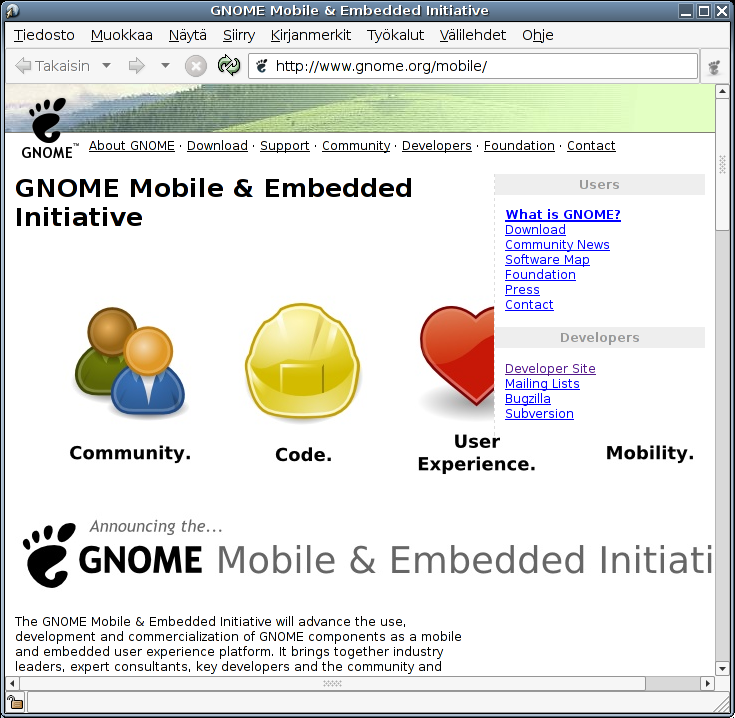
The GNOME project announced a GNOME Mobile & Embedded Initiative today. Here's a screenshot of the browser on my laptop of the web page:
screenshot
What's wrong with the above picture? The browser window is around 700 pixels wide, which about as wide as you'd get on, say, an N800 Internet tablet gadget. Significant parts of the web page are unreadable. I have to go to about a thousand pixels wide to get the whole page be visible. This is no way to design pages for a mobile environment. Other than that, it's obviously good. Not worth the hype, not worth keeping secret for months before the big revelation, but a good thing nevertheless.

Ross Burton: GNOME Mobile and Embedded Initiative

Well, it's finally public: the GNOME Mobile and Embedded Initiative (GMAE) is ready to rock and roll. OpenedHand has been a part of this from the very beginning, working on the platform before it was a platform, and helping to shape the platfom once the contributors with a common interest got together. It has been really exciting to see GMAE go from a twinkle in Jeff's eye to a real project, with real companies involved and real products using it. Hopefully this momentum will continue, and we'll achieve Complete World Domination in the embedded market by... well, 2010 sounds reasonable. NP: Remembranza, Murcof

18 April 2007

Eddy Petrișor: wiki.d.o theme

As Bastian has pointed out, wiki.debian.org has a butt-ugly theme. I agree.

Some of the people that were present in Extremadura in September know that I was working at the time to make a wiki theme more integrated with the www.debian.org theme.

The result is partially complete, but is better, IMHO, than the ugly default theme. Sceenshots and the source is available (in a darcs repo). If anyone cares to continue and close all the remaining points, I would be glad to see that theme changed.

Unless somebody does something about both issues.

Comments are welcome! Contributions are welcome, you just do:

darcs get http://users.alioth.debian.org/~eddyp-guest/darcs/wiki.debian.org_theme/

And hack on that modern-wiki.debian.org theme

16 April 2007

Alastair McKinstry: Measuring Power Consumption

Following a previous thread on Planet Debian (allowing for kids delaying projects, as usual), I borrowed a power meter to see what the consumption of various computers and electronics around the house was. An interesting and worthwhile exercise. Computers My main gateway system (hosting this blog, mail, etc. on a static IP) is a Pegasos PowerPC; it is on 24 x 7, and pulls approx. 60W. Other computers around the house include a Dell 2.5 GHz P4, which is my main development machine (with multiple disks, etc. onboard) pulling 72W. Downstairs, for family use we have an Intel MacMini pulling approx. 30W. Peripherals add up: on the Pegasos there is an ADSL router and a Linksys Wifi router, pulling approx. 5 W each continuously, and a UPS which consumes around 10W (I'm not sure if this is continuous, or high because its recharging a battery which was drained by pulling power plugs to measure the power usage ...). The LCD monitor upstairs (used by Pegasos and Dell) draws 20W. If I was purchasing again, I'd get a MacMini for the gateway. The current setup costs, I estimate, 7.50 Euro /month, which is probably worth it to have a 24x7 server (I'm not sure if moving to a hosting facility would be worth it, as it has advantages for running bittorrent, etc. that a remote server wouldn't, as well as being able to host content without the legal threat that a hosted server would have: with the current setup, if anyone challenges the content of stuff on my server, my ISP is not legally involved (as I host it), and hence won't (or shouldn't) pull the plug. This is worth something to me, even if I don't spend my days in court defending libel actions). One surprise was the CRT monitor used with the MacMini draws 10W when powered off, not on standby. Turn it off at the mains switch rather than the monitor button. Wall warts (chargers, etc.) draw around 1-2W due to eddies when nothing is connected. Conclusions: Swapping the Pegasos and MacMini are not an option as the family prefer the convenience of the fast start-up OS X. (This has made me think fast booting and suspend-to-disk are good priority goals for Debian.) I might however replace the Pegasos with an old pentium-class laptop, which would, at 25W, drop 40-50W as I would no longer need the UPS for 24x7 use. Put all peripherals, wall warts, etc. on a separate power strip that can be easily turned off together when not in use. TV We have a TV with the growing set of set-top-boxes: a DVD Player, Satellite unit and VCR, along with a SCART switch to connect them all together. Between them, they pull 86W. With the TV turned off, the boxes draw 20W. (TV pulls 10W on standby). I've been looking at getting an "Intelligent" mains lead, which cuts the power to the peripherals when the main item (e.g. the TV) is powered down, either totally or on standby. At nearly 40 Euro, however, it will take over a year to pay for itself. The alternative is just turning them off by hand, but of course as in most houses, the main switch is buried behind the TV cabinet out of reach. I'll swap the power strip with one with a single main switch that can be reached easily at the end of the evening instead. Other Big Users The house was designed with energy-efficiency in mind, and theres not much scope for savings elsewhere. The main users are underfloor electric heating, water heating, washing machine and dryer (condensor type). The water heating we hope to replace / augment with Solar over the summer; ditto the drier, with an outdoor shed /gazebo for drying clothes in the rainy Galway days. While the drier consumes a lot of electricity, at least the hot air is recycled via a heat-exchanger to heat the house in winter when its most used. Its worth keeping an eye on the drier and washing machine, though. We mostly use these at night, using cheaper Night-rate electricity, so while our usage patterns may not change, keep an eye on the energy consumption of these devices: as they grow old the bearings, motor, etc. begin to wear and energy consumption goes up. Look out for when to replace them. The other big niggle I have is a light fitting in the main living room. This is expensive, with 3 x 60 W spotlight bulbs in it. The kitchen, which is approx. half the size of the living room, gets lit by a single 20 W CFL. Swapping the spotlights with CFLs is not an option, and replacing it means replacing a ceiling mounted fitting: as the wires are embedded in the ceiling, moving it is not trivial. Any recommendations ?

13 April 2007

Daniel Burrows: coq's -ness-nesses

In response to Stefano's reply to my post about Coq:

toy-ness

Usually such pieces of software are more seen as academic toys, seeing it promoted as a geeky software is a joy to me.


I really hate to detract from your happiness -- but I definitely had the word "math" implicitly stuck before "geek toy". :) Most coders that I've met are, at best, indifferent to mathematics, outright hostile at worst, so I doubt that coq will get far outside of small niches where the benefits are irresistable (security software, maybe? -- and of course pure math). I read up on this stuff despite it being utterly useless for anything I'm likely to be paid to do (unless I return to academia) because I'm a hopeless weenie loser who likes math. :P

programming-language-ness

Coq is not really a programming language (even if the CoqArt book says so, to attract the developer community), it is mainly a proof assistant; i.e. a software in which you give definitions, state theorems and prove them.


Well, this all depends on how you define programming language, which is one of those never-ending definitional questions. But using my general conception of what a programming language is, I actually have noticed two programming languages inside Coq.


  1. The more interesting one (IMO) is the proof language they call "Gallina" and the "Vernacular", in which you construct proofs by reducing your goal to a tautology. The goal here seems to be to compute a well-typed term in Coq's core calculus, and you generally construct programs interactively: Coq shows you the current program state (expressed as one or more goals and a set of local hypotheses) and you manipulate it by (e.g.) applying lemmas to yield new known facts.

    I think this language is fairly weak viewed as a programming language. It's completely unreadable and the proofs generated don't correspond to the reasoning process one normally follows when working out a proof. I am less annoyed by it now that I've learned how to do forward reasoning :), but it seems like backwards reasoning is really pushed, and that just seems .. well .. backwards to me. There's also a strong tendency to use implicitly generated names for things and to just "know" what the state of the system after issuing a command will be; as far as I can tell, the only way to understand a Coq proof is to step through it in coqide.

    While it's nice to be able to "trust the kernel", it would also be nice to be able to "read a proof" directly. Among other things, their inscrutability makes me think that Coq proofs would be annoying to maintain over time. This is not necessary for stuff that's part of Principia Mathematica, but seems likely if you're developing a new theory -- in particular, I would shudder (theatrically) at the mere thought of including embedded Coq proofs in my programs.

    Some additional brief comments on this were written by Nick Benton and put on the Web under the title of Machine Obstructed Proof.

  2. The other sense is that Coq directly embeds a strongly normalizing variant of System F (I think? -- at least the simply typed LC with some type parametricity) with primitive recursion over inductive structures. This isn't Turing-complete (of course!), but I would certainly call it a real programming language.

    As you note, though, this is less interesting unless you want to prove facts about your programs.


OCaml-ness

Regarding the synergy of Coq with OCaml: yes, you can prove in Coq the correctness of OCaml program, but actually not more than you can do with programs written in other programming languages


I was specifically thinking about Concoqtion; I have no idea how other projects compare, and I apologize if I incorrectly summarized it!

Jaldhar Vyas: That LILUG Talk

As mentioned previously I was invited to talk about Debian at the Long Island Linux User Group. Much to my embarrassment I had forgotten I had actually spoken at this venue before way back in 2003. But the audience (which of course included many members who had joined since then) were receptive, and asked lots of questions which I like. I did my "Three Pillars of Debian" talk updated for Etch with snazzy new slides — feel free to use them in your own presentations if you like. I was supposed to speak for two hours and ended up speaking for three. So hopefully I managed to impart some useful information and maybe make some new recruits. I would like to publically thank John Teddy and all the people at LILUG for inviting me. Also, note for the future: I really ought to learn how to correctly pronounce Hocevar. Sam, you should put up an audio clip somewhere.

12 April 2007

Erich Schubert: System init - part #3

Today's post (previous parts) tries to show what benefits other init systems can offer.I'm picking 'minit' as an example; not because it's the ultimate solution or anything, but because I happen to know it quite well. I used to be the package maintainer for some time, and I've also used it on an embedded system (where it was a perfect match). However, it's not very distribution-friendly; it's great when you can invest some time into configuring it (such as when building an embedded system) but not when it should ideally work automatically out of the box. The Debian package is still there, but it's orphaned. Still it's well written, clean code; there shouldn't be any bigger bugs in there.The first thing to notice is that minit is tiny. It's statically linked, but only about 6.5 kb. Regular init is 86 kb plus some libraries (despite actually not doing much during init!). This makes it very well-suited for embedding.But now for the benefits of minit over regular init:1. Service monitoring. This is the biggest point: minit will keep an eye on the services and restart them when needed. (Another thing very useful in embedded situations, btw.)Minit doesn't use the start/stop paradigm of sysv/shell-style-init. Instead it has a "run" script for every service. If a service is flagged as 'respawn', it will automatically be restarted when the run script quits; therefore the applications should not background themselves. This offers some benefits, for example the init process will be notified by the kernel of a termination, and can immediately respawn the service; in contrast to other monitoring systems suchas monit it doesn't rely on 'busy polling'.2. Dependency handling. Minit handles startup dependencies. If a service lists another service as a dependency, it will bring that service up first.3. Parallel startup. Unless an ordering is given via dependencies, minit will start the services in parallel.4. Control apps. In minit, you don't start a service by running some random shell script. Instead you call "msvc -u servicename", which will signal minit to bring up the service (and it's dependencies). This would (there currently is no policy for minit) be especially useful in SELinux, but it also allows to e.g. give a user the permission of running "sudo msvc -u" without introducing a huge security hole, since this cannot be used to execute arbitrary scripts. "msvc" can also be used to check if a service is up. (Another benefit for embedded systems, since that removes the need for pid files, which then need a ram (writeable) filesystem)I'll also give an example for a minit service:A service is represented by a directory in /etc/minit which can contain various files. I'm going to look at getty/1 example; which will bring up a console login on the first terminal. There are three files: If the service would need it, there could also be a file called "depends" listing service dependencies.This allows minit to start the getty with no overhead. There is no shell script being executed or anything (note: sysvinit also does this for gettys, but it's not being used much for other services).Of course minit isn't perfect. I've already said that it isn't particularly distribution friendly. This is because it uses a lot of magic files (e.g. an empty file named 'respawn' to flag a service as needing to be respawned), and it's configuration files aren't easy to handle automatically. The often frowned-upon 'symlink farms' of sysv-shell-style init are much better here.Another thing that is missing from minit is an automatic rollback of dependencies. If we told minit to bring up service 'a', which lists dependencies 'b' and 'c', minit will bring these three up. If we tell it to shutdown 'a', it will however not shutdown 'b' or 'c'. And unfortunately, even if we shutdown 'b', it won't shutdown 'a'. If you want a more complex dependency handling (or things such as runlevels), you need to do this externally. (An example is my 'enitdir' app, it adds runlevel support to minit, and allows switching of runlevels by replacing a symlink; Services are added and removed from runlevels by adding a symlink to the service into the runlevels directory. By using dnotify, this also takes virtually no CPU time.)Minit also lacks a differentiation between a 'started' and a 'running' service. It has support for 'sync' services, such as e.g. mounting a filesystem. It will wait for this operation to complete before it starts services depending on it. However, there are services that will continue to run, while not being instantly available when the exec() was called. Sometimes it would be nice if a service could go into a 'started' state, then do some cleanup work, and then when actually running the real service signal minit that it's now 'running'.As a last malus, minit won't print progress messages to the console. A minit boot is pretty much silent, directing it's output to some logging processes. There are good reasons for this (since services are started in parallel!), but it makes debugging harder, and users might be wondering what their system is actually doing (though some users prefer to see a colored 'busy' bar)...I guess this concludes this series of blog posts. Maybe someone can follow up with some details on upstart (which seems to be the most promising init replacement)? I hope to have given an impression on where there is room for improvement in our current init to one or the other. Now we just need some people to actually work on a better support for other inits in Debian...

11 April 2007

Eddy Petrișor: finally, I can get rid of filelight!

The desktop enviroment is not a religious thing for me. IMHO, they all (3 of them) have missing parts which are present in the others. I never really used Xfce.

OTOH, I have been switching back and forth between GNOME and KDE during my time as a GNU/Linux user. Since I always found that one of the environments was missing things which were present in the other, I think I have switched at least 3 times both ways by now.

Now, with the release of GNOME 2.18, I will have one less reason to think to move away from GNOME, which is the current desktop environment. One of the apps I was missing in GNOME was a filelight-like application that would show usage in a very intuitive graphical way. Now it seems that baobab (commonly known as Disk Usage Utility) has a ring chart similar to filelight's. Yay!

Now, if somebody would take the task of rewriting granslator, I would be more than glad to drop kbabel...

Note: I was disapointed that GNOME Space Chart never made it to public... that disappointment lasted until now.

Edd Dumbill: James Clark joins Planet XMLhack

The news that James Clark has started blogging has been universally and justifiably well received. I've now added him to Planet XMLhack for your XML-focused viewing pleasure.I'll be following eagerly. Clark has a refreshingly clear and considered viewpoint, free from many of the tribalist undercurrents polluting today's technology blogging. 

8 April 2007

Uwe Hermann: Testing stuff with QEMU - Part 2: MenuetOS, a tiny OS written in 100% assembly language

Note: This article is part of my Testing stuff with QEMU series.
MenuetOS screenshot From Wikipedia:
MenuetOS is an operating system with a monolithic preemptive, real-time kernel, including video drivers, all written in FASM assembly language, for 64-bit and 32-bit x86 architecture computers, by Ville Mikael Turjanmaa. MenuetOS development has focused on fast, simple, efficient implementation. It has a graphical desktop, games, and networking abilities (TCP/IP stack), yet still fits on one 1.44MB floppy disk. It also facilitates easy, full-featured assembly language programming. This stands in marked contrast to the (as of 2007) widespread view that assembly languages are useful mainly for old and embedded systems.
Testing (the GPL'd) MenuetOS in QEMU is easy:

wget http://mesh.dl.sourceforge.net/sourceforge/menuet/M32-084.ZIP
unzip M32-084.ZIP
qemu -fda M32-084.IMG -m 384
There's also Menuet 64, written in 64-bit assembly, but that's not open source'd for some strange reason I don't understand. But you can try that one, too (the binary images, that is), using QEMU:

wget 'http://www.menuetos.be/download.php?CurrentMenuetOS'
unzip M64-059.ZIP\?3.1
qemu-system-x86_64 -fda M64-059.IMG

Neil Williams: Etch release!

First time I've had the chance to see a Debian release - I waited before blogging and all my boxes have upgraded smoothly. Some had already moved to testing from unstable a while ago and it's great that I can now move some to stable. One or two can even go directly from unstable to stable.

Well done to everyone involved!

Interesting point for me: 1,881 packages are going into testing tonight! Ouch!

(I've got a few updates for unstable but those will keep for a day or so until things settle down a bit.)

Hopefully, the NEW queue will start moving too - one reason to vote for Sam Hocevar was to speed up admission of packages that result from splitting an existing source package. pilot-qof introduces some new binary packages and it is frustrating that simply reorganising existing code causes the same delay as a completely new source package. Sam also expressed an interest in embedded work which is always a good sign.

Evan Prodromou: 18 Germinal CCXV

Huzzah! etch is released! Congratulations to the release managers, Debian-Installer developers, and all the DDs that make Debian a great operating system. tags:

Happy Easter We had a good Easter morning at our house today. I got up around 5AM and packed plastic Easter eggs with about half candy and half healthy fruit (grapes and kiwis) and hid them around the house. There's still snow on the ground outside, so I decided not to hide any out there. Amita on her Easter Egg hunt Amita noticed as soon as she got up ("EGGS!!"), and ran around the house picking up eggs, breaking them in half, and eating the grapes inside. She also got an improvised Easter "basket" -- they didn't have baskets at the store, so I got a little Easter gift-bag instead -- with apples, a chocolate bunny, and a stuffed duck. Pretty good haul. This afternoon we're going out to a cabane sucre -- a traditional "sugar shack", where maple syrup is made. We'll have a big dinner, go on a horse ride, and listen to some traditional Qu bec music. It's my first time going, and I'm pretty excited. tags:

Grindhouse Nicolas Ritoux, his girlfriend Karine, and I went to see Grindhouse on Friday night. It was a pretty fun film -- a double-feature by Robert Rodriguez and Quentin Tarantino, more-or-less modeled after early-'70s C-movie gore-fests. Rodriguez's half, "Planet Terror", was really good -- a campy gross-out with nods to horror-film clich s and T&A jiggle goofiness. The monsters were gross, the characters were dark, and stars Rose McGowan and Freddy Rodriguez put in great performances. Best of all were the computer-modified soundtrack and photography, which gave a great impression of cheap, skippety, second-run film stock. I wish I could say the same about Tarantino's half, "Death Proof". After a full-length "Planet Terror", it was too slow and boring -- I almost walked out. Tarantino has always done a great job with the patter between characters in their on-screen "down time": driving in cars, waiting in bars, making plans on the phone. But the first half of "Death Proof" was about watching people you don't like say stupid things to each other while waiting for other people you don't care about. The second half, on the other hand, was pretty great. But it was almost entirely an extended car chase in beefed-up 70s muscle cars, which, like, how could that not be awesome? A New Zealander beats up Kurt Russell with a 2-meter lead pipe, and Rosario Dawson does a pick-axe kick on his throat. Cool. All in all, worth the price of admission, but the first half of "Death Proof" dragged down what could have been an excellent film. tags:

St. Laurent Maj, AJ and I went furniture shopping yesterday afternoon. We need to find a new, big couch for our new house, as well as a few other minor pieces. We're ditching those pieces of cheap disposable Ikea furniture that we built up over the years and trying to put together a house that's built to last. Shopping for furniture in Montreal is made considerably easier by the fact that maybe 2 dozen furniture stores are crammed between Duluth and Mont Royal on av. St. Laurent. We visited around 10 stores, just walking up and down these few blocks. Amita June loved running around the stores, and we had to keep her from pulling down giant crystal ornaments on her head. We had lunch at Taqueria Mex (not bad, but not like home) then I went to meet Niko at La ka while Maj took the baby home for a nap. We hung out at La ka for most of the day, working and talking, and ended up sitting around with a hungover Boris and Michael for a while. It's La ka -- if you sit around long enough, everyone in Montreal's Internet scene is going to walk past at some point. tags:

Duluth is on fire So, a friend asked if I meant Duluth, Minnesota in the above entry. And that made me wonder: are rue Duluth in Montreal and Duluth, MI named after the same guy? Per Wikipedia, the city is named after Daniel Greysolon, Sieur du Lhut, a French explorer who died in Montreal. Surely it's the same fellow...? Does anyone know who Duluth street is named after? tags:

7 April 2007

Eddy Petrișor: Thanks...

The answer to my previous question is "to be". That happened thanks to a bunch of people, in no particular order:
Updates:

Eddy Petrișor: "To be or not to be on the first CD?"

That is the question. Well, not personally[0], the Romanian translation of the Release notes.

If you would have asked me yesterday, I would have said the plan is "to be".

Plan: make sure that a decent enough text is committed in CVS at all times.


What happened? Let me see...

(Time stamps are for EET - UTC+3 now - unless specified otherwise)

- pack in the morning
- take luggage to work
- buy train ticket before going to work
- ask on list to take action if I don't act by 03:00am EET (00:00 UTC)
- send the translation as is (25u), maybe the connection at my parents is broken
- leave from work directly to the station
- meet a pair of lovers in the train
- he is so into her
- she plays him like the fool he is
- translate on the train
- 5u and the battery is at 8%
- no "darcs rec", hdd consumes battery
- close lid instead of hibernating
- mini-panic, mini-panic[1]
- resume and hibernate - those percentages seem to change sooo slowly
- arrive home
- Internet connection works, good
- continue updates
- reach 100%
- send first complete draft of the translation for inclusion
- parallel review gathering up to 4 people on #debian-ro for review
- joke seriously about me not being able to send the translation
- ask again for action from the team, if needed
- 02:30 - translation seems to be mature, less an less problems are found, should be committed
- 02:40 forgot to ask activation, new mail
- ??? - turning point?
- send mail... error
- can't send mail with the request to activate Romanian
- provider's network seems to be isolated
- realize I don't know if the commit request reached its target
- frustration eased up by the already made requests to take action, if needed
- 04:30 - power goes out
- no ping from GW either
- 04:30:01 - decide to write a blog about this day
- start in zim
- write a first nice draft - with some exciting writing style
- zim looses my article when trying to remove a link-ified timestamp
- start gedit
- break the plug of the network cable[2]
- 09:09 not even the GW is reachable
- 05:10 sleep
- (expected) 06:30 wake up
- (expected) check the network connection
- translations committed ???
- thank to people / take action yourself ???
- 07:00 (04:00 UTC) Romanian translation and CD images status: ???
- sometime during the day - publish article


[0] pure unintentional rhyme
[1] I never lost files with a Linux FS, but I have the mandatory fear
[2] is not fixed in the socket

4 April 2007

Gustavo Franco: Simple-CDD more than experimental

I've uploaded simple-cdd 0.3.0 to experimental some time ago, but now us (Vagrant and I) initiated work on the new Simple-CDD that hopefully will be part of Lenny. We've been organizing the main code splitting it in smaller modules and removing dead code, like pkg-ltsp did with Ltsp during the last debconf, and as a side effect we will also burn the need of a big configuration file.

For now take a look at our experimental branches once simple-cdd 0.3.0 gets into sid and we establish the builds you will see a new upload to experimental with the goodies. Btw, create live-cd images with live-helper will be also a possibility anyime soon, now that we've tools/build instead embedded code with debian-cd related calls. You will be able to derivate from others Debian based distributions that don't use debian-cd to build their images too. Stay tuned!

Erich Schubert: More comments on AppArmor

Some more comments on AppArmor, since some people might see my previous post just as being disappointed by seeing it in Ubuntu, and not much work on SELinux. First of all, I should note that I don't have any SELinux systems I'm responsible for anymore. They still run SELinux in strict and are doing well, but I'm no longer responsible for them. So I'm actually pretty much out of SELinux development nowadays. I did some occasional policy merge to monitor policy development, and when I tried VMware, I even setup a SELinux system to check the current state. But I wouldn't call myself an active developer or even user. So I don't think I'm as biased as you might think I am. Some things why I don't trust the AppArmor people: Instead they should be honest about what AppArmor can, and what it can not do. I don't doubt that it can be used to make exploits with specially crafted PDF files in evince and such simple viewer applications a lot harder, but their security is not as thorough and complete as SELinux. They are potentially vulnerable to some attacks caused by their path name based approach, or that they cannot do MAC for files with unpredictable names such as most of /proc (e.g. /proc/1234/cmdline), any kind of sockets or when file descriptors are passed from one application to another. They should also admit that since SELinux initially assigns file labels by very similar pathname/filename patterns as AppArmor uses, it maybe isn't that much harder to setup in this aspect... In fact, it's much easier in SELinux to add an additional location for font files, since all the application policies don't need to be modified or reloaded, just the new font directory needs to be relabeled. In AppArmor, you'd need to modify an 'abstraction', then reload any policy that depends on this abstraction (you probably can only reload all at the same time, so that's not too hard). To anyone with a tiny bit of computer science knowledge, it should also be obvious that the performance of reconstructing the file path and matching it against a large set of filename globs (AppArmor) necessarily is slower than just using the security label in to the files attributes (SELinux, where this globbing was done once when doing the relabeling); any performance difference that shows that SELinux is slower than AppArmor is probably caused by SELinux doing a lot more security checks than AppArmor. So even AppArmor could benefit from using labeled security... I'm cool with saying that AppArmor is easier to get started with than SELinux, but they need to be honest about the differences to SELinux and the problems with AppArmor.

3 April 2007

Eddy Petrișor: quote of the day

"The list of features is a mile long but let me summarize them all down to this simple statement: everything just fucking works exactly as you would expect it to."

No, this is not about Debian Etch :-) (but I guess we could make that happen).

Here is the origin.
Sorry for indirectly advertising non-free software, I just liked the quote.


Update:

Martin, it seems (just at first glance) that Zimbra is licensed under a MPL license and is non-free:

"The Zimbra Collaboration Suite (ZCS) Server and Zimbra Ajax Toolkit are both licensed under the terms of the Mozilla Public License (MPL), and require that modifications made to existing files be given back to the Community."

Neil Williams: Cross-building and chroots

My brain hurts. Cross-building can get very confusing at times. I've been experimenting with debootstrap, trying to make a complete Emdebian cross-building environment that can be compressed to a base.tgz as with pbuilder. Changes to the chroot can be discarded, just as with pbuilder, allowing dependencies to be tested. The main benefit is that packages can be built without having to install long chains of cross dependencies via apt-cross or dpkg-cross on
the main system. To me, it's the only way to cross-build GUI suites like GPE against a background of changing dependencies.

The same code should also be able to create a native chroot so that the cross-built packages can be installed alongside each other for more testing. These chroots have already been tested and instructions exist in the Wiki.

Between that and the ongoing problems with empath: navigating a path from package_set A to package B via a changing set of build-dependencies . . .

Next.

Previous.