Search Results: "cas"

1 May 2014

Siri Reiter: Communication building blocks for MiniDebConf Barcelona 2014 (drafts)

Sustainable visual identity design is a design that recycles as many elements as possible with every new piece of communication. Not only is a brand strengthened every time the logo and any other identity forming visual element is used, a lot of work is also saved as well. Every logo variant is a weakening of the brand, not a strengthening. Of course design improvements can be made - always, all year 'round - preferably not right up to the next conference. I consider it a waste of time to create a sublogo for a minidebconf. The Debian logo is perfectly suitable as logo for a Debian conference. In the particular case of the Barcelona MiniDebConf 2014, I think the Debian Women logo is the proper logo to use, though, since it is a Debian Women project, contradictionary as it may sound. The same principle of recycling typography and grids. I'd like as much identity matter - and work - to be reused, as possible. There is no need to reinvent the wheel every time. A visual theme created with illustration and colour schemes is enough as identity indicator for smaller events like MiniDebConfs. In my opinion.

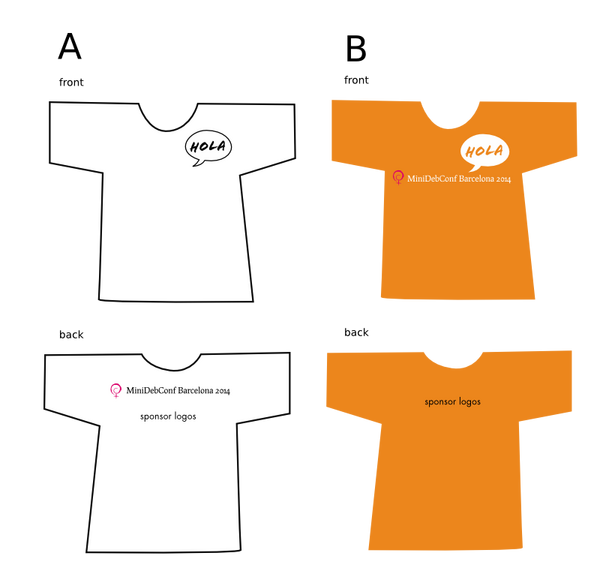
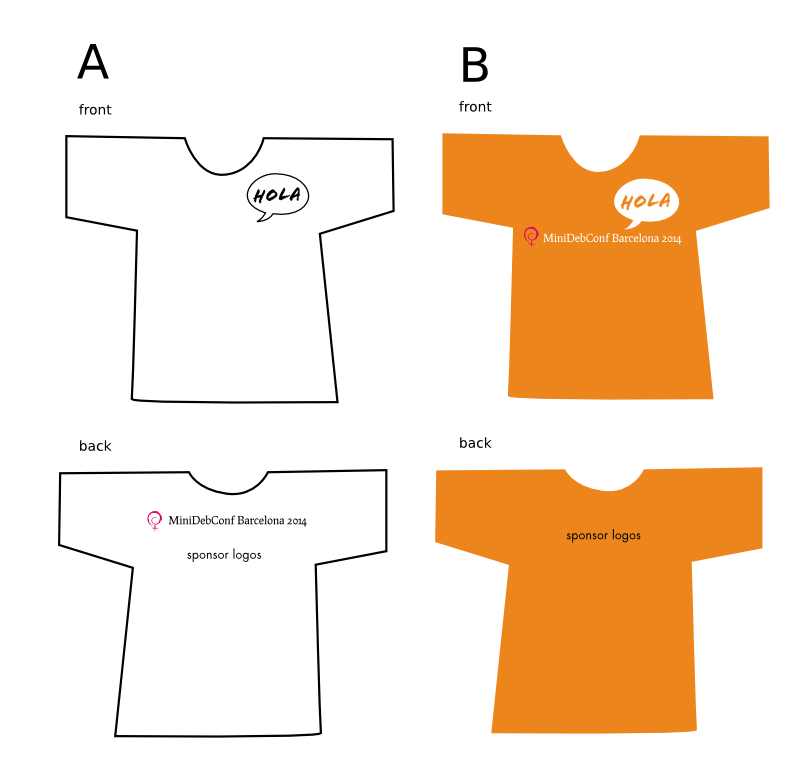
Logo and logotype The Debian Women logo. Event name set in the font Procipio, familiar to the Debian logo. The name is long and cannot be scaled down much. A version with the name set in two lines can be used in narrow space, like on a folder.

Theme The speech bubble is a part of the visual theme. Orange is a color I connect with Spain, sun and oranges. I suggest it used with red like the Debian logo red.

Poster The speech bubbles could be used in a varied form. I've stated a few important statements here. I'd like a shared list of statements. There must be other info on the poster as well. The white space at the bottom is for sponsor logos. The font I use in the speech bubbles in this draft is an Apple font called Flood. I'd like to find a free font with similar qualities.

T-shirt There are many possibilities. I like the idea of printing just a speech bubble in the front and give people the opportunity to write their personal statements with textile pens. Nametags could be badges to be filled out on the spot with a pen.

30 April 2014

Joey Hess: radio brazil

Live radio broadcast going on in the tent while I teach Mill to use ikiwiki.

29 April 2014

Russell Coker: Autism and the Treatment of Women Again

Background I ve previously written about the claim that people use Autism as an excuse for bad behavior [1]. In summary it doesn t and such claims instead lead to people not being assessed for Autism. I ve also previously written about empathy and Autism in the context of discussions about conference sexual harassment [2]. The main point is that anyone who s going to blame empathy disorders for the widespread mistreatment of women in society and divert the subject from the actions of average men to men in minority groups isn t demonstrating empathy. Discussions of the actions of average men are so often derailed to cover Autism that the Geek Feminism Wiki has a page about the issue of blaming Autism [3]. The Latest Issue Last year Shanley Kane wrote an informative article for Medium titled What Can Men Do about the treatment of women in the IT industry [4]. It s a good article, I recommend reading it. As an aside @shanley s twitter feed is worth reading [5]. In response to Shanley s article Jeff Atwood wrote an article of the same title this year which covered lots of other things [6]. He writes about Autism but doesn t seem to realise that officially Asperger Syndrome is now Autism according to DSM-V (they decided that separate diagnosis of Autism, Asperger Syndrome, and PDD-NOS were too difficult and merged them). Asperger Syndrome is now a term that refers to historic issues (IE research that was published before DSM-V) and slang use. Gender and the Autism Spectrum Jeff claims that autism skews heavily towards males at a 4:1 ratio and cites the Epidemiology of Autism Wikipedia page as a reference. Firstly that page isn t a great reference, I fixed one major error (which was obviously wrong to anyone who knows anything about Autism and also contradicted the cited reference) in the first section while writing this post. The Wikipedia page cites a PDF about the Epidemiology of Autism that claims the 4.3:1 ratio of boys to girls [7]. However that PDF is a summary of other articles and the one which originated the 4.3:1 claim is behind a paywall. One thing that is worth noting in the PDF is that the section containing the 4.3:1 claim also references claims about correlations between race and Autism and studies contradicting such claims it notes the possibility of ascertainment bias . I think that anyone who reads that section should immediately consider the possibility of ascertainment bias in regard to the gender ratio. Most people who are diagnosed with Autism are diagnosed as children. An Autism diagnosis of a child is quite subjective, an important part is an IQ test (where the psychologist interprets the intent of the child in the many cases where answers aren t clear) to compare social skills with IQ. So whether a child is diagnosed is determined by the psychologist s impression of the child s IQ vs the impression of their social skills. Whether a child is even taken for assessment depends on whether they act in a way that s considered to be obviously different. Any child who is suspected of being on the Autism Spectrum will be compared other children who have been diagnosed (IE mostly boys) and this will probably increase the probability that a boy will be assessed. So an Aspie girl might not be assessed because she acts like other Aspie girls not like the Aspie boys her parents and teachers have seen. The way kids act is not solely determined by neuro-type. Our society expects and encourages boys to be louder than girls and take longer and more frequent turns to speak, this is so widespread that I don t think it s possible for parents to avoid it if their kids are exposed to the outside world. Because of this boys who would be diagnosed with Asperger Syndrome by DSM-IV tend to act in ways that are obviously different from other kids. While the combination of Autism and the the social expectations on girls tends to result in girls who are quiet, shy, and apologetic. The fact that girls are less obviously different and that their differences cause fewer difficulties for parents and teachers makes them less likely to be assessed. Note that the differences in behavior of boys and girls who have been diagnosed is noted by the professionals (and was discussed at a conference on AsperGirls that my wife attended) while the idea that this affects assessment rates is my theory. Jeff also cites the book The Essential Difference: Male And Female Brains And The Truth About Autism by Professor Simon Baron-Cohen (who s (in)famous for his Extreme Male Brain theory). The first thing to note about the Extreme Male Brain theory are that it depends almost entirely on the 4.3:1 ratio of males to females on the Autism Spectrum (which is dubious as I noted above). The only other evidence in support of it is subjective studies of children which suffer from the same cultural issues this is why double blind tests should be used whenever possible. The book Delusions of Gender by Cordelia Fine [8] debunks Simon Baron-Cohen s work among other things. The look inside feature of the Amazon page for Delusions of Gender allows you to read about Simon Baron-Cohen s work [9]. Now even if the Extreme Male Brain theory had any merit it would be a really bad idea to cite it (or a book based on it) if you want to make things better for women in the IT industry. Cordelia s book debunks the science and also shows how such claims about supposed essential difference are taken as exclusionary. The Problem with Jeff Atwood Jeff suggests in his post that men should listen to women. Then he and his followers have a huge flame-war with many women over twitter during which which he tweeted Trying to diversify my follows by following any female voices that engaged me in a civil, constructive way recently . If you only listen to women who agree with you then that doesn t really count as listening to women. When you have a stated policy of only listening to women who agree then it seems to be more about limiting what women may feel free to say around you. The Geek Feminism wiki page about the Tone Argument [10] says the following: One way in which the tone argument frequently manifests itself is as a call for civility. A way to gauge whether a request for civility is sincere or not is to ask whether the person asking for civility has more power along whatever axes are contextually relevant (see Intersectionality) than the person being called incivil , less power, or equal power. Often, people who have the privilege of being listened to and taken seriously level accusations of incivility as a silencing tactic, and label as incivil any speech or behavior that questions their privilege. For example, some men label any feminist thought or speech as hostile or impolite; there is no way for anybody to question male power or privilege without being called rude or aggressive. Likewise, some white people label any critical discussion of race, particularly when initiated by people of color, as incivil. Writing about one topic is also a really good idea. A blog post titled What Can Men Do should be about things that men can do. Not about Autism, speculation about supposed inherent differences between men and women which are based on bad research, gender diversity in various occupations, etc. Following up a post on What Can Men Do with discussion (in blog comments and twitter) about what women should do before they are allowed to join the conversation is ridiculous. Jeff s blog post says that men should listen to women, excluding women based on the tone argument is gross hypocrisy. Swearing Jeff makes a big deal of the fact that Shanley uses some profane language in her tweets. This combines a couple of different ways of silencing women. It s quite common for women to be held to a high standard of ladylike behavior, while men get a free pass on doing the same thing. One example of this is the Geek Feminism article about the results of Sarah Sharp s request for civility in the Linux kernel community [11]. That s not an isolated incident, to the best of my recollection in 20+ years my local Linux Users Group has had only one debate about profanity on mailing lists in that case a woman (who is no longer active in the group) was criticised for using lesser profanity than men used both before and after with no comment (as an experiment I used some gratuitous profanity a couple of weeks later and no-one commented). There is also a common difference in interpretation of expressions of emotion, when a woman seems angry then she invariably has men tell her to change her approach (even when there are obvious reasons for her anger) while when a man is angry the possibility that other people shouldn t make him angry will usually be considered. The issues related to the treatment of women have had a large affect on Shanley s life and her friend s lives. It s quite understandable that she is angry about this. Her use of profanity in tweets seems appropriate to the situation. Other Links Newsweek s Gentlemen in Technology article has a section about Jeff [12], it s interesting to note his history of deleting tweets and editing his post. I presume he will change his post in response to mine and not make any note of the differences. Jacob Kaplan-Moss wrote a good rebuttal to Jeff s post [13]. It s a good article and has some other relevant links that are worth reading.

28 April 2014

Daniel Pocock: SMS logins: an illusion of security

The IT security world is still reeling from the impact of the OpenSSL Heartbleed bug. Thanks to the bug, many experts have been reviewing other technologies to try and find similar risks. While Heartbleed was hidden away in the depths of the OpenSSL code base, another major security risk has been hiding in plain sight: SMS authentication for web site logins. Remarkably, a number of firms have started giving customers the ability to receive single-use passwords over SMS for logging into their secure web sites. Some have even insisted that customers can no longer log in without it, denying customers the right to make an important choice about their own security preferences. Unfortunately, SMS is no substitute to the one-time-passwords generated using proper authentication tokens or the use of other strong authentication schemes such as cryptographic smart cards. Even telephone companies themselves advise that SMS should not be used to secure financial transactions. Ocean's 11 in real life: exploiting the weakest link in the chain To deliver single-use SMS passwords, the SMS must travel through various networks from the firm's headquarters, to a wholesale SMS gateway, international SMS network and finally down the line of the local phone company. In comparison, properly certified token devices generate a code inside the device in the palm of your hand. The code only travels from the screen to your eyes. In a litany of frauds coming in all shapes and sizes, telephone networks have been exploited over and over again because they are almost always the weakest link in the chain. Using the mobile SMS network for authentication is not building on solid ground - some experts even feel it is downright stupidity. One of the most serious examples was the theft of $150,000,000 from a pension fund deposited with JP Morgan: it was described as a real-life case of Ocean's 11. The authentication was meant to be a phone call rather than an SMS: a phone company employee who was in on the scam duly ensured the call never reached the correct place. The insecurity of traditional telephone networks has been on display for all the world to see in the ongoing trial of News Corporation executives for phone hacking. If journalists from a tabloid newspaper can allegedly hack a dozen phones before their first cigarette of the day, is it really wise to use an insecure technology like SMS as the cornerstone of a security system for authorizing transactions? A fraud recently played out on many credit card holders in the UK exploited a low-tech feature of the phone system to trick people to believe they were safe by "calling back" to their bank. A plethora of new attack vectors The staggering reality of the situation is that attackers don't even have to directly hack their victim's phones to access SMS messages. As the Android API documentation demonstrates, SMS reception is notified to all apps in real-time. Apps can process the messages even when the phone is sleeping and the message is not read by the user. Just consider all the apps on a phone that have requested permission to read incoming messages. There was an uproar recently when a new version of the Facebook app started demanding permissions to read incoming SMS. The app can't be installed if the user doesn't agree to these new permissions. WhatsApp, another popular app that has SMS access rights, was recently exposed in a major security scandal which revealed they use a phone's IMEI number as the password. When people install an app like Tinder (which does not yet request SMS access) is the security of their bank account likely to be at the front of their mind? Even if Facebook intends no harm, they have opened the floodgates by further de-sensitizing users to the risks of giving apps un-necessary access to their data. These companies are looking for every piece of data that could give them an edge in their customer profiling and marketing programs. Having real-time access to your SMS is a powerful way for them to understand your activities and feelings at every moment in the day. To facilitate these data analysis techniques, replicating and archiving your messages into their cloud databases (whether you can see them there or not) is par for the course. The cloud, of course, has become a virtual smorgasboard for cyber-criminals, including both hackers and occasionally insiders wanting to peek at private data or harvest it en-masse. Social networking and communication sites are built on a philosophy of sharing data to create interaction and excitement. Unfortunately, this is orthogonal to the needs of security. In this context, the telephone network itself may no longer be the weakest link in the chain. The diligent attacker only needs to look for the cloud operator with an unplugged security hole and use their system as a stepping stone to read any SMS they want, when they want. Would you notice a stray SMS? Maybe you feel that you would notice a stray SMS carrying a login code for your bank account. Would you always be able to react faster than the criminal however? Thanks to social networks, or location data inadvertently leaked by other apps the attacker can easily work out whether you are on holiday, at the gym, at a party or sleeping or in some other situation where you are not likely to check messages immediately. If you receive a flood of SMS spam messages (deliberately sent by an attacker) in the middle of the night and you put your phone into silent mode and ignore it, you may well miss one message that was a login to your bank account. SMS technology was never designed for secure activities. The inconvenience of SMS While security is a headline issue these days, it is also worth reflecting on the inconvenience of SMS in some situations. Travel is at the top of the list: SMS doesn't work universally when abroad. These are usually the times when the only way to access the bank is through the web site. After dealing with the irritations of the hotel or airport wifi registration, do you really need more stress from your bank's systems too? For some networks, SMS can be delayed by hours or days, sometimes never arriving at all. Many people swap their SIM cards when travelling to avoid the excessive roaming charges and there is extra inconvenience in swapping SIM cards back again just to log in to a bank account. Worst of all, if you are tethering with a SIM card from the country you are visiting, then it is impossible for you to receive the SMS message from the bank on your regular SIM card while simultaneously maintaining the SSL connection to their web site over your new SIM card. Other problems like a flat battery, water damage or PIN permanently blocked by children playing with the phone can also leave you without access to your bank account for varying lengths of time. Is there any up-side to SMS authentication? The only potential benefit to SMS authentication is that it weeds out some of the most amateur attempts to compromise your bank account, but this is a false sense of security and it opens up new attack vectors through the cloud as we have just demonstrated. For all other purposes, it smells like a new form of security theater. A more likely reason why it has become popular amongst some firms is that many lenders want to ensure they have mobile phone numbers to contact customers when loan or credit card payments are missed. Making the mobile phone number mandatory for login ensures they almost always have the correct phone number for almost 100% of customers. It is not clear that this benefit justifies the failure to provide proper security and the inconvenience when travelling though. Opting out Next time you log in to a web site, if the firm does try to enrol you in an SMS authentication scheme, it may be a good idea to click the "No thanks" option. If you have already been registered into an SMS authentication scheme, fill out the online complaint form and inform the firm that you will only accept a proper authentication token or cryptographic smart card. These solutions are tried and tested and they are the correct tool for the job.


27 April 2014

Vincent Bernat: Local corporate APT repositories

Distributing software efficiently accross your platform can be difficult. Every distribution comes with a package manager which is usually suited for this task. APT can be relied upon on when using Debian or a derivative. Unfortunately, the official repositories may not contain everything you need. When you require unpackaged software or more recent versions, it is possible to setup your own local repository. Most of what is presented here was setup for Dailymotion and was greatly inspired by the work done by Rapha l Pinson at Orange.

Setting up your repositories There are three kinds of repositories you may want to setup:
  1. A distribution mirror. Such a mirror will save bandwidth, provide faster downloads and permanent access, even when someone searches Google on Google.
  2. A local repository for your own packages with the ability to have a staging zone to test packages on some servers before putting them in production.
  3. Mirrors for unofficial repositories, like Ubuntu PPA. To avoid unexpected changes, such a repository will also get a staging and a production zone.
Before going further, it is quite important to understand what a repository is. Let s illustrate with the following line from my /etc/apt/sources.list:
deb http://ftp.debian.org/debian/ unstable main contrib non-free
In this example, http://ftp.debian.org/debian/ is the repository and unstable is the distribution. A distribution is subdivided into components. We have three components: main, contrib and non-free. To setup repositories, we will use reprepro. This is not the only solution but it has a good balance between versatility and simplicity. reprepro can only handle one repository. So, the first choice is about how you will split your packages in repositories, distributions and components. Here is what matters:
  • A repository cannot contain two identical packages (same name, same version, same architecture).
  • Inside a component, you can only have one version of a package.
  • Usually, a distribution is a subset of the versions while a component is a subset of the packages. For example, in Debian, with the distribution unstable, you choose to get the most recent versions while with the component main, you choose to get DFSG-free software only.
If you go for several repositories, you will have to handle several reprepro instances and won t be able to easily copy packages from one place to another. At Dailymotion, we put everything in the same repository but it would also be perfectly valid to have three repositories:
  • one to mirror the distribution,
  • one for your local packages, and
  • one to mirror unofficial repositories.
Here is our target setup: Local APT repository

Initial setup First, create a system user to work with the repositories:
$ adduser --system --disabled-password --disabled-login \
>         --home /srv/packages \
>         --group reprepro
All operations should be done with this user only. If you want to setup several repositories, create a directory for each of them. Each repository has those subdirectories:
  • conf/ contains the configuration files,
  • gpg/ contains the GPG stuff to sign the repository1,
  • logs/ contains the logs,
  • www/ contains the repository that should be exported by the web server.
Here is the content of conf/options:
outdir +b/www
logdir +b/logs
gnupghome +b/gpg
Then, you need to create the GPG key to sign the repository:
$ GNUPGHOME=gpg gpg --gen-key
Please select what kind of key you want:
   (1) RSA and RSA (default)
   (2) DSA and Elgamal
   (3) DSA (sign only)
   (4) RSA (sign only)
Your selection? 1
RSA keys may be between 1024 and 4096 bits long.
What keysize do you want? (2048) 4096
Requested keysize is 4096 bits
Please specify how long the key should be valid.
         0 = key does not expire
      <n>  = key expires in n days
      <n>w = key expires in n weeks
      <n>m = key expires in n months
      <n>y = key expires in n years
Key is valid for? (0) 10y
Key expires at mer. 08 nov. 2023 22:30:58 CET
Is this correct? (y/N) y
Real name: Dailymotion Archive Automatic Signing Key
Email address: the-it-operations@dailymotion.com
Comment: 
[...]
By setting an empty password, you allow reprepro to run unattended. You will have to distribute the public key of your new repository to let APT check the archive signature. An easy way is to ship it in some package.

Local mirror of an official distribution Let s start by mirroring a distribution. We want a local mirror of Ubuntu Precise. For this, we need to do two things:
  1. Setup a new distribution in conf/distributions.
  2. Configure the update sources in conf/updates.
Let s add this block to conf/distributions:
# Ubuntu Precise
Origin: Ubuntu
Label: Ubuntu
Suite: precise
Version: 12.04
Codename: precise
Architectures: i386 amd64
Components: main restricted universe multiverse
UDebComponents: main restricted universe multiverse
Description: Ubuntu Precise 12.04 (with updates and security)
Contents: .gz .bz2
UDebIndices: Packages Release . .gz
Tracking: minimal
Update: - ubuntu-precise ubuntu-precise-updates ubuntu-precise-security
SignWith: yes
This defines the precise distribution in our repository. It contains four components: main, restricted, universe and multiverse (like the regular distribution in official repositories). The Update line starts with a dash. This means reprepro will mark everything as deleted before updating with the provided sources. Old packages will not be kept when they are removed from Ubuntu. In conf/updates, we define the sources:
# Ubuntu Precise
Name: ubuntu-precise
Method: http://fr.archive.ubuntu.com/ubuntu
Fallback: http://de.archive.ubuntu.com/ubuntu
Suite: precise
Components: main main multiverse restricted universe
UDebComponents: main restricted universe multiverse
Architectures: amd64 i386
VerifyRelease: 437D05B5
GetInRelease: no
# Ubuntu Precise Updates
Name: ubuntu-precise-updates
Method: http://fr.archive.ubuntu.com/ubuntu
Fallback: http://de.archive.ubuntu.com/ubuntu
Suite: precise-updates
Components: main restricted universe multiverse
UDebComponents: main restricted universe multiverse
Architectures: amd64 i386
VerifyRelease: 437D05B5
GetInRelease: no
# Ubuntu Precise Security
Name: ubuntu-precise-security
Method: http://fr.archive.ubuntu.com/ubuntu
Fallback: http://de.archive.ubuntu.com/ubuntu
Suite: precise-security
Components: main restricted universe multiverse
UDebComponents: main restricted universe multiverse
Architectures: amd64 i386
VerifyRelease: 437D05B5
GetInRelease: no
The VerifyRelease lines are GPG key fingerprint to use to check the remote repository. The key needs to be imported in the local keyring:
$ gpg --keyring /usr/share/keyrings/ubuntu-archive-keyring.gpg \
>     --export 437D05B5   GNUPGHOME=gpg gpg --import
Another important point is that we merge three distributions (precise, precise-updates and precise-security) into a single distribution (precise) in our local repository. This may cause some difficulties with tools expecting the three distributions to be available (like the Debian Installer2). Next, you can run reprepro and ask it to update your local mirror:
$ reprepro update
This will take some time on the first run. You can execute this command every night. reprepro is not the fastest mirror solution but it is easy to setup, flexible and reliable.

Repository for local packages Let s configure the repository to accept local packages. For each official distribution (like precise), we will configure two distributions:
  • precise-staging contains packages that have not been fully tested and not ready to go to production.
  • precise-prod contains production packages copied from precise-staging.
In our workflow, packages are introduced in precise-staging where they can be tested and will be copied to precise-prod when we want them to be available for production. You can adopt a more complex workflow if you need. The reprepro part is quite easy. We add the following blocks into conf/distributions:
# Dailymotion Precise packages (staging)
Origin: Dailymotion #  
Label: dm-staging   #  
Suite: precise-staging
Codename: precise-staging
Architectures: i386 amd64 source
Components: main role/dns role/database role/web #  
Description: Dailymotion Precise staging repository
Contents: .gz .bz2
Tracking: keep
SignWith: yes
NotAutomatic: yes #  
Log: packages.dm-precise-staging.log
 --type=dsc email-changes
# Dailymotion Precise packages (prod)
Origin: Dailymotion #  
Label: dm-prod      #  
Suite: precise-prod
Codename: precise-prod
Architectures: i386 amd64 source
Components: main role/dns role/database role/web #  
Description: Dailymotion Precise prod repository
Contents: .gz .bz2
Tracking: keep
SignWith: yes
Log: packages.dm-precise-prod.log
First notice we use several components (in ):
  • main will contain packages that are not specific to a subset of the platform. If you put a package in main, it should work correctly on any host.
  • role/* are components dedicated to a subset of the platform. For example, in role/dns, we ship a custom version of BIND.
The staging distribution has the NotAutomatic flag (in ) which disallows the package manager to install those packages except if the user explicitely requests it. Just below, when a new dsc file is uploaded, the hook email-changes will be executed. It should be in the conf/ directory. The Origin and Label lines (in ) are quite important to be able to define an explicit policy of which packages should be installed. Let s say we use the following /etc/apt/sources.list file:
# Ubuntu packages
deb http://packages.dm.gg/dailymotion precise main restricted universe multiverse
# Dailymotion packages
deb http://packages.dm.gg/dailymotion precise-prod    main role/dns
deb http://packages.dm.gg/dailymotion precise-staging main role/dns
All servers have the precise-staging distribution. We must ensure we won t install those packages by mistake. The NotAutomatic flag is one possible safe-guard. We also use a tailored /etc/apt/preferences:
Explanation: Dailymotion packages of a specific component should be more preferred
Package: *
Pin: release o=Dailymotion, l=dm-prod, c=role/*
Pin-Priority: 950
Explanation: Dailymotion packages should be preferred
Package: *
Pin: release o=Dailymotion, l=dm-prod
Pin-Priority: 900
Explanation: staging should never be preferred
Package: *
Pin: release o=Dailymotion, l=dm-staging
Pin-Priority: -100
By default, packages will have a priority of 500. By setting a priority of -100 to the staging distribution, we ensure the packages cannot be installed at all. This is stronger than NotAutomatic which sets the priority to 1. When a package exists in Ubuntu and in our local repository, we ensure that, if this is a production package, we will use ours by using a priority of 900 (or 950 if we match a specific role component). Have a look at the How APT Interprets Priorities section of apt_preferences(5) manual page for additional information. Keep in mind that version matters only when the priority is the same. To check if everything works as you expect, use apt-cache policy:
$ apt-cache policy php5-memcache
  Installed: 3.0.8-1~precise2~dm1
  Candidate: 3.0.8-1~precise2~dm1
  Version table:
 *** 3.0.8-1~precise2~dm1 0
        950 http://packages.dm.gg/dailymotion/ precise-prod/role/web amd64 Packages
        100 /var/lib/dpkg/status
     3.0.8-1~precise1~dm4 0
        900 http://packages.dm.gg/dailymotion/ precise-prod/main amd64 Packages
       -100 http://packages.dm.gg/dailymotion/ precise-staging/main amd64 Packages
     3.0.6-1 0
        500 http://packages.dm.gg/dailymotion/ precise/universe amd64 Packages
If we want to install a package from the staging distribution, we can use apt-get with the -t precise-staging option to raise the priority of this distribution to 990. Once you have tested your package, you can copy it from the staging distribution to the production distribution:
$ reprepro -C main copysrc precise-prod precise-staging wackadoodle

Local mirror of third-party repositories Sometimes, you want a software published on some third-party repository without to repackage it yourself. A common example is the repositories edited by hardware vendors. Like for an Ubuntu mirror, there are two steps: defining the distribution and defining the source. We chose to put such mirrors into the same distributions as our local packages but with a dedicated component for each mirror. This way, those third-party packages will share the same workflow as our local packages: they will appear in the staging distribution, we validate them and copy them to the production distribution. The first step is to add the components and an appropriate Update line to conf/distributions:
Origin: Dailymotion
Label: dm-staging
Suite: precise-staging
Components: main role/dns role/database role/web vendor/hp
Update: hp
# [...]
Origin: Dailymotion
Label: dm-prod
Suite: precise-prod
Components: main role/dns role/database role/web vendor/hp
# [...]
We added the vendor/hp component to both the staging and the production distributions. However, only the staging distribution gets an Update line (remember, packages will be copied manually into the production distribution). We declare the source in conf/updates:
# HP repository
Name: hp
Method: http://downloads.linux.hp.com/SDR/downloads/ManagementComponentPack/
Suite: precise/current
Components: non-free>vendor/hp
Architectures: i386 amd64
VerifyRelease: 2689B887
GetInRelease: no
Don t forget to add the GPG key to your local keyring. Notice an interesting feature of reprepro: we copy the remote non-free component to our local vendor/hp component. Then, you can synchronize the mirror with reprepro update. Once the packages have been tested, you will have to copy them in the production distribution.

Building Debian packages Our reprepro setup seems complete, but how do we put packages into the staging distribution? You have several options to build Debian packages for your local repository. It really depends on how much time you want to invest in this activity:
  1. Build packages from source by adding a debian/ directory. This is the classic way of building Debian packages. You can start from scratch or use an existing package as a base. In the latest case, the package can be from the official archive but for a more recent distribution or a backport or from an unofficial repository.
  2. Use a tool that will create a binary package from a directory, like fpm. Such a tool will try to guess a lot of things to minimize your work. It can even download everything for you.
There is no universal solution. If you don t have the time budget for building packages from source, have a look at fpm. I would advise you to use the first approach when possible because you will get those perks for free:
  • You keep the sources in your repository. Whenever you need to rebuild something to fix an emergency bug, you won t have to hunt the sources which may be unavailable when you need them the most. Of course, this only works if you build packages that don t download stuff directly from the Internet.
  • You also keep the recipe3 to build the package in your repository. If someone enables some option and rebuild the package, you won t accidently drop this option on the next build. Those changes can be documented in debian/changelog. Moreover, you can use a version control software for the whole debian/ directory.
  • You can propose your package for inclusion into Debian. This will help many people once the package hits the archive.

Builders We chose pbuilder as a builder4. Its setup is quite straightforward. Here is our /etc/pbuilderrc:
DISTRIBUTION=$DIST
NAME="$DIST-$ARCH"
MIRRORSITE=http://packages.dm.gg/dailymotion
COMPONENTS=("main" "restricted" "universe" "multiverse")
OTHERMIRROR="deb http://packages.dm.gg/dailymotion $ DIST -staging main"
HOOKDIR=/etc/pbuilder/hooks.d
BASE=/var/cache/pbuilder/dailymotion
BASETGZ=$BASE/$NAME/base.tgz
BUILDRESULT=$BASE/$NAME/results/
APTCACHE=$BASE/$NAME/aptcache/
DEBBUILDOPTS="-sa"
KEYRING="/usr/share/keyrings/dailymotion-archive.keyring.gpg"
DEBOOTSTRAPOPTS=("--arch" "$ARCH" "--variant=buildd" "$ DEBOOTSTRAPOPTS[@] " "--keyring=$KEYRING")
APTKEYRINGS=("$KEYRING")
EXTRAPACKAGES=("dailymotion-archive-keyring")
pbuilder is expected to be invoked with DIST, ARCH and optionally ROLE environment variables. Building the initial bases can be done like this:
for ARCH in i386 amd64; do
  for DIST in precise; do
    export ARCH
    export DIST
    pbuilder --create
  done
done
We don t create a base for each role. Instead, we use a D hook to add the appropriate source:
#!/bin/bash
[ -z "$ROLE" ]    
  cat >> /etc/apt/sources.list <<EOF
deb http://packages.dm.gg/dailymotion $ DIST -staging role/$ ROLE 
EOF
 
apt-get update
We ensure packages from our staging distribution are preferred over other packages by adding an /etc/apt/preferences file in a E hook:
#!/bin/bash
cat > /etc/apt/preferences <<EOF
Explanation: Dailymotion packages are of higher priority
Package: *
Pin: release o=Dailymotion
Pin-Priority: 900
EOF
We also use a C hook to get a shell in case there is an error. This is convenient to debug a problem:
#!/bin/bash
apt-get install -y --force-yes vim less
cd /tmp/buildd/*/debian/..
/bin/bash < /dev/tty > /dev/tty 2> /dev/tty
A manual build can be run with:
$ ARCH=amd64 DIST=precise ROLE=web pbuilder \
>         --build somepackage.dsc

Version numbering To avoid to apply complex rules to chose a version number for a package, we chose to treat everything as a backport, even in-house software. We use the following scheme: X-Y~preciseZ+dmW.
  • X is the upstream version5.
  • Y is the Debian version. If there is no Debian version, use 0.
  • Z is the Ubuntu backport version. Again, if such a version doesn t exist, use 0.
  • W is our version of the package. We increment it when we make a change to the packaging. This is the only number we are allowed to control. All the others are set by an upstream entity, unless it doesn t exist and in this case, you use 0.
Let s suppose you need to backport wackadoodle. It is available in a more recent version of Ubuntu as 1.4-3. Your first backport will be 1.4-3~precise0+dm1. After a change to the packaging, the version will be 1.4-3~precise0+dm2. A new upstream version 1.5 is available and you need it. You will use 1.5-0~precise0+dm1. Later, this new upstream version will be available in some version of Ubuntu as 1.5-3ubuntu1. You will rebase your changes on this version and get 1.5-3ubuntu1~precise0+dm1. When using Debian instead of Ubuntu, a compatible convention could be : X-Y~bpo70+Z~dm+W.

Uploading To upload a package, a common setup is the following workflow:
  1. Upload the source package to an incoming directory.
  2. reprepro will notice the source package, check its correctness (signature, distribution) and put it in the archive.
  3. The builder will notice a new package needs to be built and build it.
  4. Once the package is built, the builder will upload the result to the incoming directory.
  5. reprepro will notice again the new binary package and integrate it in the archive.
This workflow has the disadvantage to have many moving pieces and to leave the user in the dark while the compilation is in progress. As an alternative, a simple script can be used to execute each step synchronously. The user can follow on their terminal that everything works as expected. Once we have the .changes file, the build script just issues the appropriate command to include the result in the archive:
$ reprepro -C main include precise-staging \
>      wackadoodle_1.4-3~precise0+dm4_amd64.changes
Happy hacking!

  1. The gpg/ directory could be shared by several repositories.
  2. We teached Debian Installer to work with our setup with an appropriate preseed file.
  3. fpm-cookery is a convenient tool to write recipes for fpm, similar to Homebrew or a BSD port tree. It could be used to achieve the same goal.
  4. sbuild is an alternative to pbuilder and is the official builder for both Debian and Ubuntu. Historically, pbuilder was more focused on developers needs.
  5. For a Git snapshot, we use something like 1.4-git20130905+1-ae42dc1 which is a snapshot made after version 1.4 (use 0.0 if no version has ever been released) at the given date. The following 1 is to be able to package different snapshots at the same date while the hash is here in case you need to retrieve the exact snapshot.

Keith Packard: Glamor performance

Current Glamor Performance I finally managed to get a Gigabyte Brix set up running Debian so that I could do some more reasonable performance characterization of Glamor in its current state. I wanted to use this particular machine because it has enough cooling to keep from thermally throttling the CPU/GPU package. This is running my glamor-server branch of the X server, which completes the core operation rework and then has some core X server performance improvements as well for filled and outlined arcs. Changes in X11perf First off, I did some analysis of what x11perf was doing and found that it wasn t quite measuring what we thought. I m not interested in competing on x11perf numbers absolutely, I m only interested in doing relative measurements of useful operations, so fixing the tool to measure what I want seems reasonable to me. When x11perf was first written, it drew 100x100 rectangles tight against one another without any gap. And, it filled the window with them, drawing a 6x6 grid of 100x100 rectangles in a 600x600 window. To better exercise the rectangle code and check edge conditions better, we added a one pixel gap between the rectangles. However, we didn t reduce the number of rectangles drawn, so we ended up drawing 11 of the 36 rectangles on top of the first set of 25. Simple region computations would allow the X server to draw only 25 most of the time, skipping the redundant rectangles. The vertical and horizontal line tests were added a while after the first set of tests, and were done without regard to how an X server might optimize for them. x11perf draws these lines packed tightly together, creating a single square of pixels for the result. EXA, UXA and SNA all take vertical and horizontal lines and convert them to rectangles, then take the rectangles and clip them against the window clip list by computing a region from them and intersecting that with the GC composite clip. It s a completely reasonable plan, however, when you take what x11perf was drawing and run it through this code, you end up with a single solid rectangle. Which is surprisingly fast, compared with drawing individual lines. I fixed the overlapping rectangle case by reducing the number of boxes drawn from 36 to 25, and I fixed the vertical and horizontal line case by spacing the lines a pixel apart. I ve pushed out these changes to my x11perf repository on freedesktop.org. What s Fast Things that match GL s capabilities are fast, things which don t are slow. No surprises there. What s interesting is precisely what matches GL Patterns For Free Because GL makes it easy to program fill patterns into the GPU, there are essentially no performance differences between solid and patterned operations. GL Lines Glamor uses GL lines, which can be programmed to match X semantics, to quite good effect. The only trick required was to deal with cap styles. GL never draws the final pixel in a line, while X does unless the cap style is CapNotLast. The solution was to draw an extra line segment containing a single pixel at the end of every joined set of lines for this case. The other implicit requirement is that all zero width lines look the same. Right now, I ve solved that for fill styles and raster ops as they re all drawn with the same GL operations. However, for plane masks, we re currently falling back to software, which may draw something different. Fixing that isn t impossible, it s just tedious. Text Pushing all of the work of drawing core text into glamor wasn t terribly difficult, and the results are pretty spectacular. What s Slow We ve still got room for improvement in Glamor, but there aren t any obvious show-stoppers to getting great performance for reasonable X applications anymore. Wide Lines and Arcs One of the speed-ups I ve made in my glamor branch is to merge all of drawing of multiple filled and zero-width arcs into a single giant GL request. That turned out to both improve performance and save a bit of code. Right now, drawing wide lines and wide arcs doesn t do this, and so we suffer from submitting many smaller requests to GL. It s hard to get excited about speeding any of this up as all of the wide primitives are essentially unused these days. Filled Polygons Because X only lets applications draw a single polygon in each request, Glamor can t really gain any efficiency from batching work unless we start looking ahead in the X protocol stream to see if the next request is another polygon. Alternatively, we could leave the span operation pending to see if more spans were coming before the X serve went idle. Neither of these is all that exciting though; X polygons just aren t that useful. Render Operations These are still not structured to best fit modern GL; some work here would help a bunch. We ve got a gsoc student ready to go at this though, so I expect we ll have much better numbers in a few months. Window Operations You wouldn t think that moving and resizing windows would be so limited by drawing performance, but x11perf tests these with tiny little windows, and each operation draws or copies only a couple of little rectangles, which makes GL quite expensive. Working on speeding up GL for small numbers of operations would help a bunch here. Unexpected Results Solid rectangles are actually running slower than patterned rectangles, and I really have no idea why. The CPU is close to idle during the 500x500 solid rectangle test (as you d expect, given the workload), the vertex and fragment shaders look correct out of the compiler, and yet solid rectangles run at only 0.80 of the performance of the patterned rectangles. GL semantics for copying data essentially preclude overlapping blts of any form. There s the NVtexturebarrier extension which at least lets us do blts within the same object, but even that doesn t define how overlapping blts work. So, we have to create a temporary copy for this operation to make it work right. I was worried that this would slow things down, but the Iris Pro 3D engine is enough faster than the 2D engine that even with the extra copy, large scrolls and copies within the same object are actually faster. Results Here s a giant image showing the ratio of Glamor to both UXA and SNA running on the same machine, with all of the same software; the only change between runs was to switch the configured acceleration architecture.

Russell Coker: Swap Breaking SSD

I ve seen many comments about swap space and SSD claiming that swap will inherently destroy SSD through using too many writes. The latest was in the comments of my post about swap space and SSD performance [1]. Note that I m not criticising the person who commented on my blog, everyone has heard lots of reports about possible problems that they avoid without analysing them in detail. The first thing to note is that the quality of flash memory varies a lot, the chips that are used in SSDs for workstation/server use are designed to last while those in USB-flash devices aren t. I ve documented my unsuccessful experiments with using USB-flash for the root filesystem of a gateway server [2] (and the flash device that wasn t used for swap died too). The real issue when determining whether swap will break your SSD is the amount of writes. While swapping can do a lot of writing quickly that usually doesn t happen unless something has gone wrong. The workstation that I m currently using has writes to the root fileystem outnumbering writes to swap by a factor of 130:1 (by volume of data written). On other days I ve seen it as low as 42:1, in either case it s writes to the root filesystem (which is BTRFS and includes /home etc) that will break the SSD if anything. For some other workstations I run I see ratios of 201:1 (that s with 8G of RAM), 57:1, and 23:1. In a quick search I couldn t find a single system I run where even 10% of disk writes were attributed to swap. This really isn t surprising given that adding RAM is a cheap way to improve the performance of most systems. If a SSD didn t do any write leveling (as is rumored to be the case with cheap USB flash devices) then swap use might still cause a problem because of the number of writes in a small area, but if that was the case then filesystem journals and other fixed data structures would be more likely to cause a problem and any swap based breakage would break swap not the root filesystem (although if swap was the first partition then it might also break the MBR). Of the workstations that are convenient to inspect the one with the most writes to the root filesystem and swap space (IE everything on /dev/sda) had 128G written per day for 1.2 days of uptime, but that involved running a filesystem balance and some torrent downloads (not the typical use). Among the two systems which had been running for more than 48 hours with typical use the most writes was 24G in a day. If a SSD can sustain 10,000 writes per block (which is smaller than quoted by most flash manufacturers nowadays) and has perfect wear leveling (which is unlikely) then the system with a 120G SSD and 128G written in a day could continue like that for almost 10,000 days or 27 years much longer than storage is expected to work or be useful. So for workstation use (where even 24G of writes per day probably counts as heavy use) a 120G SSD that can sustain 10,000 writes per block shouldn t be at great risk of wearing out. Conclusion I believe that swap is much less likely to break SSDs than regular file access on every system with a reasonable amount of RAM. For systems which don t have enough RAM you probably want the speed of SSD for swap space anyway in spite of the risks. If wear leveling works as designed and the 10,000+ writes per block claims are accurate then SSDs will massively outlast their useful life. Long before they wear out they should be too small, too slow, and probably not compatible. 26 years ago I had a 5.25 full height ST-506 disk in my desktop PC, it wouldn t physically fit in most systems I own now (unless I removed the DVD drive), there is no possibility of buying a controller (I don t own a system with an ISA bus), and that disk was too slow and small by today s standards. A 27yo SSD isn t going to be useful for anything, even for archive storage it s no good as no-one has tested long term storage and data could decay before then.

26 April 2014

Russell Coker: BTRFS Status April 2014

Since my blog post about BTRFS in March [1] not much has changed for me. Until yesterday I was using 2.13 kernels on all my systems and dealing with the occasional kmail index file corruption problem. Yesterday my main workstation ran out of disk space and went read-only. I started a BTRFS balance which didn t seem to be doing any good because most of the space was actually in use so I deleted a bunch of snapshots. Then my X session aborted (some problem with KDE or the X server I ll never know as logs couldn t be written to disk). I rebooted the system and had kernel threads go into infinite loops with repeated messages about a lack of response for 22 seconds (I should have photographed the screen). When it got into that state the ALT-Fn keys to change a virtual console sometimes worked but nothing else worked the terminal usually didn t respond to input. To try and stop the kernel from entering an infinite loop on every boot that I used rootflags=skip_balance on the kernel command line to stop it from continuing the balance which made the system usable for a little longer, unfortunately the skip_balance mount option doesn t permanently apply, the kernel will keep trying to balance the filesystem on every mount until a btrfs balance cancel operation succeeds. But my attempts to cancel the balance always failed. When I booted my system with skip_balance it would sometimes free some space from the deleted snapshots, after two good runs I got to 17G free. But after that every time I rebooted it would report another Gig or two free (according to btrfs filesystem df ) and then hang without committing the changes to disk. I solved this problem by upgrading my USB rescue image to kernel 3.14 from Debian/Experimental and mounting the filesystem from the rescue image. After letting kernel 3.14 work on the filesystem for a while it was in a stage where I could use it with kernel 3.13 and then boot the system normally to upgrade it to kernel 3.14. I had a minor extra complication due to the fact that I was running apt-get dist-upgrade at the time the filesystem went read-only do the dpkg records of which packages were installed were a bit messed up. But that was easy to fix by running a diff against /var/lib/dpkg/info on a recent snapshot. In retrospect I should have copied from an old snapshot of the root filesystem, but I fixed the problems faster than I could think of better ways to fix them. When running a balance the system had a peak IO rate of about 30MB/s reads and 30MB/s writes. That compares to the maximum contiguous file IO speed of 260MB/s for reads and 320MB/s for writes. During that time it had about 50% CPU time used for my Q8400 quad-core CPU. So far the only tasks that I do regularly which have CPU speed as a significant bottleneck are BTRFS filesystem balancing and recoding MP4 files. Compiling hasn t been an issue because recently I haven t been compiling many programs that are particularly big. Lessons Learned I should photograph the screen regularly when doing things that won t be logged, those kernel error messages might have been useful to me or someone else. The fact that the only kernel that runs BTRFS the way I need comes from the Experimental repository in Debian stands in contrast to the recent kernel patch that stops describing BTRFS as experimental. While I have a high opinion of the people who provide support for the kernel in commercial distributions and their ability to back-port fixes from newer kernels I m concerned about their decision to support BTRFS. I m also dubious about whether we can offer BTRFS support in Debian/Jessie (the next version of Debian) without a significant warning. OTOH if you find yourself with a BTRFS system that isn t working well you could always hire me to fix it. I accept payment via Paypal, bank transfer, or Bitcoin. If you want to pay me in Grange then I assure you I will never forget about it. ;) I thought that I wouldn t have CPU speed issues when I started using the AMD64 architecture, for most tasks that s been the case. But for systems for which storage is important I ll look at getting faster CPUs because of BTRFS. Using faster CPUs for storage isn t that uncommon (I used to work for SGI and dealt with some significant CPU power used for file serving), but needing a fast quad-core CPU to drive a single SSD is a little disappointing. While recovery from file system corner cases isn t going to be particularly common it s something that you want completed quickly, for personal systems you want to be doing something else and for work systems you don t want down-time. The BTRFS problems with running out of disk space are really serious. It seems that even workstations used at home can t survive without monitoring. For any other filesystem used at home you can just let it get full and then delete stuff. Include rootflags=skip_balance in the boot loader configuration for every system with a BTRFS root filesystem and in the /etc/fstab for every non-root BTRFS filesystem. I haven t yet encountered a single situation where continuing the balance did any good or when it didn t do any harm.

25 April 2014

Matthias Klumpp: AppStream 0.6.1 released a quick look at what you can do with the cli tool

Today I released AppStream and libappstream 0.6.1, which feature mostly bugfixes, so nothing incredibly exciting to see there (but this also means no API/ABI breaks). The release clarifies some paragraphs in the spec which people found confusing, and fixes a few issues (like one example in the docs not being valid AppStream metadata). As only spec extension, we introduce a priority property in distro metadata to allow metadata from one repository to override data shipped by another one. This is used (although with a similar syntax) in Fedora already to have placeholder data for non-free stuff, which gets overridden by the real metadata if a new application was added. In general, the property tag was added to make the answer to the question which data is preferred much less magic. The libappstream library got some new API to query component data in different ways, and I also brought back support for Vala (so if you missed the Vapi file: It s back now, although you have to manually enable this feature). The CLI tool also got some extensions to query AppStream data. Here is a brief introduction: First of all, we need to make sure the database is up-to-date, which should be the case already (it is rebuilt automatically):
$ sudo appstream-index --refresh
The database will only be rebuilt when necessary, if you want to force a rebuild anyway, use the force parameter. Now imagine we want to search for an app containing the word media (in description, keywords, summary, ):
$ appstream-index -s media
which will return:
Identifier: gnome-media-player.desktop [desktop-app]
Name: GNOME Media Player
Summary: A simple media player for GNOME
Package: gnome-media-player
----
Identifier: mediaplayer-app.desktop [desktop-app]
Name: Media Player
Summary: Media Player
Package: mediaplayer-app
----
Identifier: kde4__plasma-mediacenter.desktop [desktop-app]
Name: Plasma Media Center
Summary: A mediacenter user interface written with the Plasma framework
Package: plasma-mediacenter
----
etc.
If we already know the name if a .desktop-file or the ID of a component, we can have the tool print out information about the application, including which package it was installed from:
$ appstream-index --get lyx.desktop
If we want to see more details, including e.g. a screenshot URL and a longer description, we can pass details to the tool:
Identifier: lyx.desktop [desktop-app]
Name: LyX
Summary: An advanced document processor with the power of LaTeX.
Package: lyx-common
Homepage: http://www.lyx.org/
Icon: lyx.png
Description: LyX is a document processor that encourages an approach to writing
 based on the structure of your documents (WYSIWYM) and not simply
 their appearance (WYSIWYG).
 
 LyX combines the power and flexibility of TeX/LaTeX[...]
Sample Screenshot URL: http://alt.fedoraproject.org/pub/alt/screenshots/f21/source/lyx-ea535ddf18b5c7328c5e88d2cd2cbd8c.png
License: GPLv2+
(I truncated the results slightly ;-) ) Okay, so far so good. But now it gets really exciting (and this is a feature added with 0.6.1): We can now query a component by the items it provides. For example, I want to know which software provides the library libfoo.2:
appstream-index --what-provides -t lib -v libfoo.so.2
This also works with binaries, or Python modules:
appstream-index --what-provides -t bin -v apper
This stuff works distribution-agnostic, and as long as software ships upstream metadata with a valid <provides/> field, or the distributor adds it while generating AppStream distro metadata.
This means that software can as soon as we have sufficient metadata of this kind declare it s dependencies upstream in form of a simple text file, referencing the needed components to build and run it on any Linux distribution. Users can simply install missing stuff by passing that file to their package manager, which can look up the components->packaging mapping and versions and do the right thing in installing the dependencies. So basically, this allows things pip -r does for Python, but for any application (not only Python stuff), and based on the distributors package database. With the provides-items, we can also scan software to detect it s dependencies automatically (and have it in a distro-agnostic form directly). We can also easily search for missing mimetype-handlers, missing kernel-modules, missing firmware etc. to install it on-demand, making the system much smarter in handling it s dependencies. And users don t need to do search orgies to find the right component for a given task. Also on my todo list for the future, based on this feature: A small tool telling upstream authors which distribution has their application in which version, using just one command (and AppStream data from multiple distros). Also planned: A cross-distro information page showing which distros ship which library versions, Python modules and application versions (and also the support status of the distro), so developers know which library versions (or GCC versions etc.) they should at least support to make their application easily available on most distributions. As always, you can get the releases on Freedesktop, as well es the AppStream specification.

Daniel Pocock: Extra fuel charges when carrying passengers in your car?

Some people seem to be justifying the way mobile networks try to discriminate against tethering. One comment even suggests that multiple devices is a valid justification. Really? Isn't it just as simple as measuring the actual volume of megabytes used, regardless of how many devices are connected? Lets consider a couple of analogies:
  • A petrol station puts some fine print at the bottom of their sign in the street: cars with passengers pay an extra 0.05 per litre (or gallon). It is just a gimmick: the marketing man has worked out that he can put a lower price on his big sign this way and people with passengers may well be splitting the fuel bill between them. There is no technical reason for the charge however - the car actually uses more fuel carrying the extra weight anyway.
  • Or imagine this: the marketing man puts up small print that advises a higher charge of 0.05 per litre for fuelling an exotic car like a Ferrari. The only reason for this, of course, is that the Ferrari driver is probably busy (so he doesn't have time to shop around) and wealthy (so the extra charge won't deter him from making any purchase at all, because he has money to pay it).
Of course, these ideas sound a bit outlandish but the only difference between these crazy ideas and tethering charges is that mobile phone networks usually have the monopoly/duopoly to get away with it. Mobile networks actually dread the idea of becoming commodities like fuel. They thrive on price discrimination and they seem to have an endless number of tricks to get extra money out of people who may have it by deliberately crippling parts of the service for everybody else. This goes against the ideals of innovation and efficiency and in the most extreme cases their practices are widely recognised for the sham that they are. Revealing that you have connected a laptop to your phone may be like revealing you live in an affluent area or that you have an expensive car. Plenty of businesses try to exploit such knowledge when deciding how much they can charge you or other aspects of how they provide you with a service. This is why privacy is important in every feature of the technology we use. This rogue behaviour by "creative" marketing men also helps to understand just what would happen in the world of technology if it wasn't for the use of free licenses, open standards, accessible encryption and net neutrality.

24 April 2014

Joachim Breitner: gtk-vector-screenhot screencast

I recently installed piwik on my website, to get some idea about how it is being used. Piwik is a very nice and shiny tool, although it is slightly scary to watch people walk through your website, click for click. Anyways, I now know that I get around 50 visitors per day. But I also learn where they are coming from, and this way I noticed that Shnatsel did a very nice screencast of my gtk-vector-screenshot tool if I had not created it myself I would think it was fake.

Joachim Breitner: gtk-vector-screenshot screencast

I recently installed piwik on my website, to get some idea about how it is being used. Piwik is a very nice and shiny tool, although it is slightly scary to watch people walk through your website, click for click. Anyways, I now know that I get around 50 visitors per day. But I also learn where they are coming from, and this way I noticed that Shnatsel did a very nice screencast of my gtk-vector-screenshot tool if I had not created it myself I would think it was fake.

23 April 2014

Russ Allbery: On learning, growth, and trust

Here are two separate ideas about programming, Internet security, Internet architecture, and free software. Both of them are fundamental to everything those of us who work on free software are doing.
  1. Writing secure and reliable code is a highly complex and demanding task. It's something that one has to learn, like any other skilled profession. It's not something we're very good at teaching via any mechanism other than apprenticeship and experimentation. The field is changing quickly; if you took ten years off from writing security-critical code, you would expect to have to learn multiple new tools (static analysis, testing techniques, security features), possibly new programming languages, and not infrequently new ways of thinking about threat models and vulnerabilities.
  2. Nearly every computer user trusts tens of thousands of other programmers and millions of lines of code with their day-to-day computer security and reliability, without auditing that code themselves. Even if you have the skill required to audit the code (and very, very few people have the skill to audit all of the code that they use), you do not have the time. Therefore, our computer security is built on trust. We're trusting other programmers not to be malicious, which is obvious, but we're also trusting other programmers to be highly skilled, careful, cautious (but still fast and productive, since we quickly abandon software that isn't "actively developed"), and constantly adopting new techniques and treat models.
I think both of those principles are very widely understood and widely acknowledged. And, as we all know, both of those principles have failure modes, and those failures mean that our computers are nowhere near as secure as we would like them to be. There has been quite a lot of technical discussion about both of these principles in recent days and months, ranging from better code analysis and testing through the flaws in particular programming languages to serious questions about the trust model we use for verifying the code that we're running. I'm going to switch gears away from that discussion for a moment to talk about a social aspect. When a piece of code that one is using has a security vulnerability, it is not unusual to treat that as a trust failure. In other words, technical flaws are very quickly escalated to social flaws. This is less likely among practitioners, since we're all painfully aware of how many bugs we have in our own code, but it's still not unheard of, particularly if the authors of the code do not immediately and publicly show a socially-acceptable level of humility and contrition (in the middle of what is often a horrifically stressful experience). I think this reaction comes largely from fear. Anyone who has given it a moment's thought is painfully aware of just how much code they are running on trust, and just how many ways it could be compromised, accidentally or maliciously. And how frequently that code is compromised. The less control one has over a situation, the more terrifying it is, and the cold reality is that we have very little control over our computer security. There is a natural tendency, when afraid, to look for targets for that fear. Now, go back and think about the first principle. Anyone who has ever worked on or near free software is painfully aware that we have far more good ideas about how to improve computing and security than we have skilled resources to execute on those ideas. My own backlog of things that I've already thought about, know would be good ideas, and simply have to implement is probably longer than my remaining lifespan. I suspect that's the case for nearly all of us. In other words, we have a severe shortage of programmers who care and who have skill. We desperately need more skilled programmers who can write secure and reliable code. We may (and I think do) also need better tools, techniques, languages, protocols, and all the other machinery that we, as technical people, spend most of our time thinking about. But none of that changes the fact that we need more skilled people. In fact, it makes that need more acute: in addition to skilled people to write the code we use, we need skilled people to write the tools. Skilled people are not born. They're made. And in professions where training techniques are still in their infancy and where we don't have a good formal grasp on which techniques work, those skilled people are made primarily through apprenticeship, experimentation, and learning from failure. Worse, people who were skilled do not remain skilled without continually participating in that learning process. See the above point about a fast-changing field with evolving best practices. It's not enough to know how to write secure code to the best known practices today, or even enough to retrofit all of your existing code to current knowledge (which is often so large of an effort as to be practically impossible). You have to constantly, continually learn more, for which there is no reliable formal training. We have to try, fail, try again, and fail better. But failure that leads to a security vulnerability is treated as a loss of trust. We trusted that person to write secure code that we could use. They failed. Now we can't trust them. Based on the trust model of security, we should revoke their ability to try again and instead rely on people who have not failed, since that will make us more secure. Except now we just broke the learning process. And there's no such thing as a programmer who can stop learning. So what does that do to our resource pool? It's sadly ironic, but I believe the free software community writ large has a very serious collaboration problem: we do not tolerate each other's learning processes. This leads to a wide variety of social failures around hostile communities and the failures of meritocracy that other people have talked about at much greater length. But even if you set that all aside, it threatens our security. We need secure code, a lot of it, a lot more than we have right now. To get that code, we need people who can write it. We need to grow, encourage, and support those people and enable their learning processes. Code is written by people. If we rip people apart when they write bad, insecure code, we don't get better, secure code. We get fewer people writing security code. We get far fewer people writing security code in public, since some of the people who haven't been ripped apart will look at that experience and say, "No way am I going near that problem area. It's too scary. I don't want to end up like those programmers." Fewer people writing security code means fewer people learning how to write better security code. Fewer people capable of writing good, secure code is not a solution to any of our problems. If we do not tolerate, support, and encourage the learning process required to become a skilled programmer, or maintain one's skill in programming, we are destroying our future as a community. When you find code that is broken and badly written, you have found a problem that should be reported, analyzed, and corrected. You have also found a programmer who is about to have one of two very different types of experiences. Either they are about to learn how to become a better programmer, or they are about to be publicly shamed, humiliated, and treated as untrustworthy. Which branch they take is partly up to them, but it's also heavily influenced by how all of us react socially to the discovery of bad code. One of those branches leads to more good, secure code being written in the future. The other does not.

Andrew Pollock: [life] Day 85: Mostly a day off for me

Zoe slept solidly all night. She woke up a little before 6am, wanting a cuddle, but it was still dark, so she went back to sleep for another half an hour or so. It was actually nice to get that extra 30 minutes to have a leisurely wake up myself. Sarah wanted to pick up Zoe at 7:45am to get away and get a camp site, so when Zoe finally woke up for the day, we didn't muck around too much. She announced she wanted banana and oat pancakes, but we were out of bananas. I offered her the opportunity to scooter down to the Hawthorne Garage to get some if she went and got dressed. She decided that'd be good. I had a 10am appointment in the city with an intellectual property lawyer to talk about patents, so I had this grand plan of trying to squeeze in a run after Zoe was picked up and before I'd have to head into the city, so I got into my running gear, and we headed down to acquire some bananas. We whipped up the pancakes, and then after a couple of mouthfuls of hers, Zoe declared she didn't like it and wanted Cheerios instead. Oh well. It was nice to get out of the house early in the morning, and it helped get Zoe moving. Sarah ended up getting here closer to 8:30am, which made it a little too tight to go for a run, have a shower and get into the city, so I scrapped the run and pottered around at home instead for a bit, before driving into the city. My goodness casual parking in the city is exorbitant. It cost me $35 for under an hour. I got some good advice from the lawyer, so I know where to proceed from here. Next I headed down to the Valley to get my orientation at River City Labs, but had I read my email before leaving the city, I'd have discovered that the lady giving me the orientation had to leave early because her daughter was ill. It cost me $6 drive into the car park in the Valley, take the elevator down, read my email on my phone and pay my ticket and leave again. Lesson learned. I decided to do the grocery shopping that I hadn't done yesterday while I waited for Anshu to come over.

22 April 2014

Steve Kemp: I've not commented on security for a while

Unless you've been living under a rock, or in a tent (which would make me slightly jealous) you'll have heard about the recent heartbleed attack many times by now. The upshot of that attack is that lots of noise was made about hardening things, and there is now a new fork of openssl being developed. Many people have commented about "hardening Debian" in particular, as well as random musing on hardening software. One or two brave souls have even made noises about auditing code. Once upon a time I tried to setup a project to audit Debian software. You can still see the Debian Security Audit Project webpages if you look hard enough for them. What did I learn? There are tons of easy security bugs, but finding the hard ones is hard. (If you get bored some time just pick your favourite Editor, which will be emacs, and look how /tmp is abused during the build-process or in random libraries such as tramp [ tramp-uudecode].) These days I still poke at source code, and I still report bugs, but my enthusiasm has waned considerably. I tend to only commit to auditing a package if it is a new one I install in production, which limits my efforts considerably, but makes me feel like I'm not taking steps into the dark. It looks like I reported only three security isseus this year, and before that you have to go down to 2011 to find something I bothered to document. What would I do if I had copious free time? I wouldn't audit code. Instead I'd write test-cases for code. Many many large projects have rudimentary test-cases at best, and zero coverage at worse. I appreciate writing test-cases is hard, because lots of times it is hard to test things "for real". For example I once wrote a filesystem, using FUSE, there are some built-in unit-tests (I was pretty pleased with that, you could lauch the filesystem with a --test argument and it would invoke the unit-tests on itself. No separate steps, or source code required. If it was installed you could use it and you could test it in-situ). Beyond that I also put together a simple filesystem-stress script, which read/wrote/found random files, computes MD5 hashes of contents, etc. I've since seen similar random-filesystem-stresstest projects, and if they existed then I'd have used them. Testing filesystems is hard. I've written kernel modules that have only a single implicit test case: It compiles. (OK that's harsh, I'd usually ensure the kernel didn't die when they were inserted, and that a new node in /dev appeared ;) I've written a mail client, and beyond some trivial test-cases to prove my MIME-handling wasn't horrifically bad there are zero tests. How do you simulate all the mail that people will get, and the funky things they'll do with it? But that said I'd suggest if you're keen, if you're eager, if you want internet-points, writing test-cases/test-harnesses would be more useful than randomly auditing source code. Still what would I know, I don't even have a beard..

Ritesh Raj Sarraf: Basis B1

Starting yesterday, I am a happy user of the Basis B1 (Carbon Edition) Smart Watch The company recently announced being acquired by Intel. Overall I like the watch. The price is steep, but if you care of a watch like that, you may as well try Basis. In case you want to go through the details, there's a pretty comprehensive review here. Since I've been wearing it for just over 24hrs, there's not much data to showcase a trend. But the device was impressively precise in monitoring my sleep.

Pain points - For now, sync is the core of the pains. You need either a Mac or a Windows PC. I have a Windows 7 VM with USB Passthru, but that doesn't work. There's also an option to sync over mobile (iOS and Android). That again does not work for my Chinese Mobile Handset running MIUI.


AddThis:

Categories:

Keywords:

Erich Schubert: Kernel-density based outlier detection and the need for customization

Outlier detection (also: anomaly detection, change detection) is an unsupervised data mining task that tries to identify the unexpected.
Most outlier detection methods are based on some notion of density: in an appropriate data representation, "normal" data is expected to cluster, and outliers are expected to be further away from the normal data.
This intuition can be quantified in different ways. Common heuristics include kNN outlier detection and the Local Outlier Factor (which uses a density quotient). One of the directions in my dissertation was to understand (also from a statistical point of view) how the output and the formal structure of these methods can be best understood.
I will present two smaller results of this analysis at the SIAM Data Mining 2014 conference: instead of the very heuristic density estimation found in above methods, we design a method (using the same generalized pattern) that uses a best-practise from statistics: Kernel Density Estimation. We aren't the first to attempt this (c.f. LDF), but we actuall retain the properties of the kernel, whereas the authors of LDF tried to mimic the LOF method too closely, and this way damaged the kernel.
The other result presented in this work is the need to customize. When working with real data, using "library algorithms" will more often than not fail. The reason is that real data isn't as nicely behaved - it's dirty, it seldom is normal distributed. And the problem that we're trying to solve is often much narrower. For best results, we need to integrate our preexisting knowledge of the data into the algorithm. Sometimes we can do so by preprocessing and feature transformation. But sometimes, we can also customize the algorithm easily.
Outlier detection algorithms aren't black magic, or carefully adjusted. They follow a rather simple logic, and this means that we can easily take only parts of these methods, and adjust them as necessary for our problem at hand!
The article persented at SDM will demonstrate such a use case: analyzing 1.2 million traffic accidents in the UK (from data.gov.uk) we are not interested in "classic" density based outliers - this would be a rare traffic accident on a small road somewhere in Scotland. Instead, we're interested in unusual concentrations of traffic accidents, i.e. blackspots.
The generalized pattern can be easily customized for this task. While this data does not allow automatic evaluation, many outliers could be easily verified using Google Earth and search: often, historic imagery on Google Earth showed that the road layout was changed, or that there are many news reports about the dangerous road. The data can also be nicely visualized, and I'd like to share these examples with you. First, here is a screenshot from Google Earth for one of the hotspots (Cherry Lane Roundabout, North of Heathrow airport, which used to be a double cut-through roundabout - one of the cut-throughs was removed since):
Screenshot of Cherry Lane Roundabout hotspot
Google Earth is best for exploring this result, because you can hide and show the density overlay to see the crossroad below; and you can go back in time to access historic imagery. Unfortunately, KML does not allow easy interactions (at least it didn't last time I checked).
I have also put the KML file on Google Drive. It will automatically display it on Google Maps (nice feature of Drive, kudos to Google!), but it should also allow you to download it. I've also explored the data on an Android tablet (but I don't think you can hide elements there, or access historic imagery as in the desktop application).
With a classic outlier detection method, this analysis would not have been possible. However, it was easy to customize the method; and the results are actually more meaningful: instead of relying on some heuristic to choose kernel bandwidth, I opted for choosing the bandwidth by physical arguments: 50 meters is a reasonable bandwidth for a crossroad / roundabout, and for comparison a radius of 2 kilometers is used to model the typical accident density in this region (there should other crossroads within 2 km in Europe).
Since I advocate reproducible science, the source code of the basic method will be in the next ELKI release. For the customization case studies, I plan to share them as a how-to or tutorial type of document in the ELKI wiki; probably also detailing data preprocessing and visualization aspects. The code for the customizations is not really suited for direct inclusion in the ELKI framework, but can serve as an example for advanced usage.
Reference:
E. Schubert, A. Zimek, H.-P. Kriegel
Generalized Outlier Detection with Flexible Kernel Density Estimates
In Proceedings of the 14th SIAM International Conference on Data Mining (SDM), Philadelphia, PA, 2014.
So TLDR of the story: A) try to use more established statistics (such as KDE), and B) don't expect an off-the-shelf solution to do magic, but customize the method for your problem.
P.S. if you happen to know nice post-doc positions in academia:
I'm actively looking for a position to continue my research. I'm working on scaling these methods to larger data and to make them work with various real data that I can find. Open-source, modular and efficient implementations are very important to me, and one of the directions I'd like to investigate is porting these methods to a distributed setting, for example using Spark. In order to get closer to "real" data, I've started to make these approaches work e.g. on textual data, mixed type data, multimedia etc. And of course, I like teaching; which is why I would prefer a position in academia.

Bits from Debian: Debian welcomes its 2014 GSoC students!

We're excited to announce that 19 students have been selected to work with Debian during the Google Summer of Code this year! Here is the list of accepted students and projects: As always, you will be able to follow their progress on the SoC coordination mailing-list Congratulations to all the students and let's make sure we all have an amazing summer!

Mart&iacute;n Ferrari: DNSSEC, DANE, SSHFP, etc

While researching some security-related stuff for a post I am currently writing, I found some interesting bits here and there that I though I should share, as they were new to me, and probably for many others.

DNSSEC The first thing is DNSSEC. I knew about it, of course, but never bothered to dig much into it. While reading about many interesting applications of DNS for key distribution, and thinking of ways to use them, it is clear that DNSSEC is a precondition for any of that to work. In case you don't know about it, it is an extension for the DNS service to make it safer, for example, to avoid the bad guys having you think that google.com points to sniffer.nsa.gov. Apart from these ber-cool applications I was thinking about, avoiding DNS-based attacks becomes more and more relevant these days. And I think Debian and the rest of the Free Software world should work on making this available to all end-users as easily as possible. While adoption still looks pretty low, there are some good news. First, Google claims its public DNS supports DNSSEC. Of course, you need to trust Google servers, and the path between your machine and them. But if your resolver supports DNSSEC, you can use their servers and validate the answers. On the other side, I am not too sure about their implementation, as half of the time, it would return a valid answer to a query for an invalid record: dig +dnssec sigfail.verteiltesysteme.net @8.8.8.8). Also, they have not published DNSSEC records for google.com, which seems crazy. Some packages included in Debian already take advantage of DNSSEC, if available (more on that later), but more importantly, there are a couple of DNSSEC-enabled recursive servers, including bind, unbound, and the more commonly-used dnsmasq (there is a wiki page summarising Debian's status). Sadly, the default configuration for dnsmasq does not enable DNSSEC, and most people will not use it, even if it installed, because DHCP-provided servers are usually preferred. It seems to me that it would be wise to have a package that would install dnsmasq with DNSSEC enabled, and make it the only valid resolver for the system. If you want to check if your resolver is correctly validating DNSSEC, you can use this test web page. Another good news is that many top-level domains already support DNSSEC, and in my case, Gandi.net has support in place to set it up. So I am going to look into enabling it for my own domain.

SSHFP One useful and simple advantage of using DNSSEC, is that you can store information there, and then trust it to be correct. One new DNS RR (resource record) that is useful in this context is the SSHFP RR, which allows the sysadmin of a host to publish the host SSH key fingerprint in the DNS zone. The ssh client, when enabling the VerifyHostKeyDNS option, will use that information to trust unknown hosts. One downside to this, is that either if you set the option to ask, or if your resolver does not support DNSSEC, you get the same message, which does not warn you about the extra risk. To help you create your DNS records, you can just run this command:
$ ssh-keygen -r brie.tincho.org
brie.tincho.org IN SSHFP 1 1 6ac93c63379828b5b75847bc37d8ab2b48983343
brie.tincho.org IN SSHFP 2 1 cf0d11515367e3aa7eeb37056688f11b53c8ef23

DANE, S/MIME and GPG Recently, while at FOSDEM, I attended talks that mentioned DANE. This proposed IETF standard introduces a mechanism to use DNS as a secure key distribution system, which could completely override the CA oligopoly, a very attractive proposition for many people. In short, it is very similar to the SSHFP mechanism, but it is not restricted to SSH host keys: it can be used to distribute public key information for any TLS-enabled service. So, instead (or in addition to) of having a CA sign your certificate, and relying on the chain of trust by means of having a local copy of all root CA certificates, you use the chain of trust embedded in DNSSEC to make sure that the DNS RRs you publish are valid. Then, the client application can trust the fingerprint published for the relevant service to verify that it is talking to the right server. This is a very exciting development, and I hope it gets widespread adoption. It is already supported in Postfix, there seem to be some work going on in Mozilla, as well as in Prosody which is a great start. Another exciting development of this, is the generalisation of DANE for other entities, like email addresses. There are two draft RFCs being worked on right now to deploy S/MIME and OpenPGP key material using DNSSEC. This could also change completely the way we manage the Web of Trust.

Next.

Previous.