Evan Prodromou: 13 Frimaire CCXVI
 I'm organizing a micro-coworking session here in Montreal for 6 December (15 Frimaire). "Micro-coworking session" is just a fancy way of saying "hanging out together and working at a caf ". Folks will be meeting in the back of Caff ArtJava from about 9AM to about 5PM. More info on the subStation Coworking event page on Upcoming.
The event is for people interested/involved in (or supportive of) Station-C, the incipient Montreal coworking facility scheduled to open in February 2008. But everyone's welcome to come by -- heck, we'd have a hard time keeping you away.
tag: coworking montreal microcoworking upcoming:event=350901 substation station-c
Private and public life in the age of Facebook
One of the things I find interesting about life on the Internet is the distinction between public and private life. So much of our lives are on-line today; for many of us, the Web is where we make our living, make our friends, enjoy our social life, and plan our off-line activities.
But what about those personal activities that don't jibe with our intended professional image? If we have out-of-the-mainstream political or religious views, or unorthodox social activities, how do we keep them to ourselves? How do you talk about things on-line with friends that maybe you don't want your parents or other family to know about -- or vice versa? How do we preserve our reputation in more than one sphere, in situations where those spheres are very different? I think there are a number of strategies for doing this.
- Be discreet. In other words, just don't put personal stuff on the Web. Keep up your professional image at all times, and don't use Web sites or tools to make connections in more private ways. This is probably the safest strategy, and the one that most privacy groups and media recommend. But there are some downsides, too. You miss out on the Web's power to enhance your life as a well-rounded human being -- your personal life languishes for the benefit of your professional one. You give up on some important opportunities to connect with other human beings in a deep and meaningful way. Especially if your interests are shared by only a small percent of the human population, it's unlikely you'll run into other people who share them off-line. I also think there's something unhealthy about stifling your personal side for your professional life's benefit.
- Use pseudonyms. Another way of being "discrete" -- here, I mean separated into different parts. I think this is one of the most common ways to deal with the problem. Use your "real name" for activities, groups, and opinions that you feel safe presenting to the world at large, and use made-up names or handles for activities you might not feel like discussing at a job interview. This can be very successful, but also nerve-wracking. What parts of life require a "secret identity", and what parts don't? What if one part of your life leaks into another? It can also be tedious to set up, say, two or three different Flickr accounts, two or three Facebook accounts, umpteen blogs, etc. Or, you keep a LinkedIn account for work and a MySpace one for your partying set, and hope that Google doesn't make a link between the two. But you can get sick of managing them, and other people don't know which name or pseudonym to use and when to "out" you to their other friends.
- Integrate. By this I mean: let your personal and professional life grow together. Decide what parts of your personal life you're willing to make public, and bring them into your public persona. Parts of your life that you don't feel you can integrate, consider letting go of. I think this can be risky and difficult, but ultimately I think it's the most healthy psychologically for people who spend a lot of time on the Web. Most often, these people either work for themselves and don't have to answer to others, or they work in industries where offbeat or out-of-the-mainstream lifestyles are tolerated or encouraged (or the need for highly-skilled people makes those "quirks" easier to ignore). Or they just gamble that nobody at their work or in their family is really checking (quite often the case).
- Wait for better software. I think the main reason that this is a problem is that social software developers aren't very good sociologists. Or, rather, we focus on the software rather than on the social. It would be nice to see the next generation of Web services support the multiple facets of a person's life. I'm an Open Source fanatic, a Web developer, a wikitista, an entrepreneur, a father, a Burner, a Montrealer, a man, a prankster, a partier and a cook -- among many other things. How can social software, or a federation of services, let me reflect these different aspects of my personality to my friends, coworkers, colleagues, relatives and strangers? Could I define finer-grained relationships with others than just "friend", and choose what parts of my life to feature or downplay with each? It's a fascinating design and implementation question, and my hope is that someone will take on the challenge in the future.
I think this is a situation where our society and our software both need to evolve and change. It would be nice -- very nice -- if edgy politics or weirdo culture didn't hurt your chances of advancing in your chosen field. And if friends, family and colleagues could accept us all for who we are, in all our parts. But it will also be nice if software and software usage patterns on the Web let us find a way to adapt to that, too. People have lots of different parts and lots of different personae that they inhabit at different times and in different contexts -- it would be great to match our social software more to that reality.
tags: socialsoftware web privacy persona self
One-liners
Some other things to note:
- Montr al has had an insane amount of snow in the last few days. I dug out our car for about 90 minutes this morning, and drove for hours in snow-blind traffic. Not an easy time, but boy the city is lovely like this.
- I'm doing a talk on extending MediaWiki at the PHP Qu bec meeting this Thursday, Dec 6. Meeting info is here.
- Pictures from Montreal Santarchy are available on Grimmwire's Santarchy Montreal 2007 set. Great group, fun crowd, loooooong night. Oh boy.
- Speaking of SantaCon, Santarchy in Second Life sounds totally nutso.
- My server overload problems seem to be getting better. I moved Vinismo to its own server on Amazon Elastic Compute Cloud. I also moved SonaUiki and the Br leurs site to GoDaddy, where I have a ridiculous number of free Web hosting credits. It worked surprisingly well, and GoDaddy supports PmWiki out-of-the-box. Nice! Update: Apparently GoDaddy adds a whole bunch of ads in on their free Web hosting. I didn't notice; I have Adblock Plus installed. Gar. I'll have to move these sites back pronto.
- My light and convenient Toshiba Port g R200 has been throwing I/O errors. So I gotta get a new hard drive. Good news: the thing's still under warranty (yay!). Bad news: I gotta drive through this miserable weather to a place in St. L onard to get the HD replaced. Boo!
tags: montreal snow phpquebec mediawiki santarchy secondlife toshiba port g r200
- Montr al has had an insane amount of snow in the last few days. I dug out our car for about 90 minutes this morning, and drove for hours in snow-blind traffic. Not an easy time, but boy the city is lovely like this.
- I'm doing a talk on extending MediaWiki at the PHP Qu bec meeting this Thursday, Dec 6. Meeting info is here.
- Pictures from Montreal Santarchy are available on Grimmwire's Santarchy Montreal 2007 set. Great group, fun crowd, loooooong night. Oh boy.
- Speaking of SantaCon, Santarchy in Second Life sounds totally nutso.
- My server overload problems seem to be getting better. I moved Vinismo to its own server on Amazon Elastic Compute Cloud. I also moved SonaUiki and the Br leurs site to GoDaddy, where I have a ridiculous number of free Web hosting credits. It worked surprisingly well, and GoDaddy supports PmWiki out-of-the-box. Nice! Update: Apparently GoDaddy adds a whole bunch of ads in on their free Web hosting. I didn't notice; I have Adblock Plus installed. Gar. I'll have to move these sites back pronto.
- My light and convenient Toshiba Port g R200 has been throwing I/O errors. So I gotta get a new hard drive. Good news: the thing's still under warranty (yay!). Bad news: I gotta drive through this miserable weather to a place in St. L onard to get the HD replaced. Boo!

 rebuildd-job stats says that 20 % of the archive is now built in less than 24h, seems fast, cool.
Bad point is that I'm building and trashing logs into /dev/null because I've no QA idea to implement right now.
 We popped out and bought a MacBook Pro for Sarah today, as her PowerBook G4
is starting to really fall apart.
Despite Leopard being well and truly out now, it came with Tiger
preinstalled, but included a Leopard upgrade DVD. No big deal.
So we fired up the laptop, and went through the final install steps for
Tiger. I was trying to preempt any networking problems by adding the
MAC addresses to my DHCP server and wireless access point before it
went to try and connect to the network. I have a whitelist of allowed MAC
addresses in my access point, and DHCP server is only configured for static
reservations on that interface.
The onboard Ethernet MAC address was easily determined. It's printed inside
the battery cavity. Finding out the wireless Ethernet MAC address is another
story altogether. Basically I couldn't, so I gave up, hoping maybe the
access point would log the unauthorised MAC address, and I could then add it
where it was needed.
Well, the access point didn't appear to log anything useful. The Mac did
however pop up a dialog box saying something the effect of the laptop
needing to be added to the wireless access point's access control list. The
one piece of useful information to display at this point would be, you
guessed it, the very MAC address I need to be adding to the access control
list!
I ended up temporarily disabling MAC address restrictions in the access
point and then the DHCP server happily logged the MAC address that didn't
have a lease, and we were able to proceed.
Maybe preinstalled Leopard does it better. We'll never know.
Update
Aww crap. Seems I didn't study the box closely enough. There's a
sticker with all that pertinent information on it.


 Last weekend, Nadezhda and me went to the the
 an hour ago I received an email from my AM who considers my packages to be
in good shape; that means that the "Tasks and Skills Check" part
of my
 These are all just 'first-builds' so problems could well lie ahead but I have now built a set of cross built packages for Emdebian (ARM) that edos-debcheck says is installable for a basic GPE installation. Only one package remains as a problem - gpe-filemanager builds fine but the current dependencies of libgnomevfs mean that gconf is required which doesn't give an option to disable ldap which is something I would rather do without. Certainly, existing GPE installations do without ldap but that could just be because these tend to use older versions of the particular libraries.
 Apparently some people worry that Gforge may be abandoned, or on the
verge of being superseded with the proprietary "Gforge Advanced
Server" rewrite. Let it be known that I for one have no plans to
switch to Gforge AS, for all the reasons you'd expect from a free
software user and advocate: I don't have access to the source code
(it's made illegible by some sort of industrial PHP obfuscator), I
can't hack it because the license doesn't allow me to, I can't audit
it for security flaws, I can't adapt it to particular needs, etc.
Since a significant part of my income comes from maintaining Gforge
instances for clients, with local modifications for their particular
needs, it's an economical necessity that Gforge stays free. And
evolving.
Right. Having said that, I guess I have to show concrete evolutions
in addition to principles and ideals. So what changed recently?
 I am making a small project with
 I'm still in the middle of a quandry with regards to revision control.
90% of my open code is hosted via CVS at a
 A week or two ago, I went to the local


 * Once upon a time, I adopted ‘

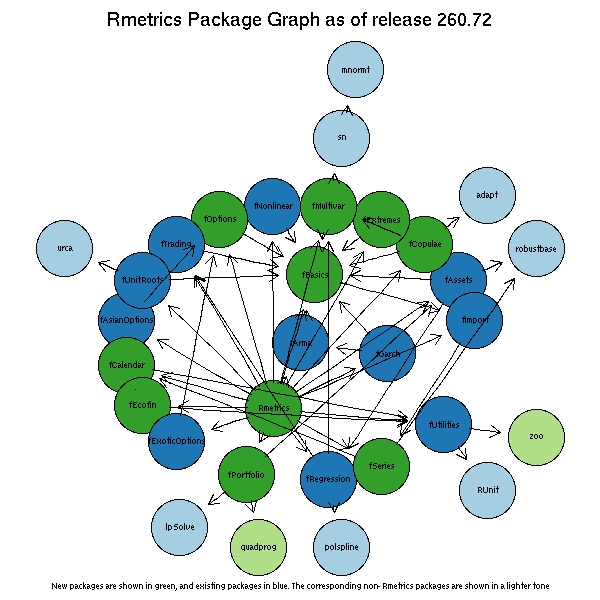 Rmetrics now comprosises over twenty individual packages. Eleven new
packages were added in the 260.72 release for R 2.6.0, and they required
eight other new packages from
 I had lost interest in the DM thing. Since August, when I asked for
advocacies, those were posted to the newmaint list, and then nothing happened.
Also, since a few days ago my NM process is running again, and there was the
questioning about people becoming DM when they're close to finishing NM.
Today, Gunnar sent a mail encouraging people in the Perl group to become DM,
and I answered with those arguments. To my surprise, Joey Hess contacted me to
tell me that my application ahd slipped under the radar for being too early and
that I could be added now to the keyring. So I gathered all the required data
and sent a bug report. A couple of hours later


