Search Results: "will"

3 December 2016

Ross Gammon: My Open Source Contributions June November 2016

So much for my monthly blogging! Here s what I have been up to in the Open Source world over the last 6 months. Debian Ubuntu Other Plan for December Debian Before the 5th January 2017 Debian Stretch soft freeze I hope to: Ubuntu Other

2 December 2016

Shirish Agarwal: Air Congestion and Politics

Confession time first I am not a frequent flyer at all. My first flight was in early late 2006. It was a 2 hour flight from Bombay (BOM) to Bengaluru (formerly Bangalore, BLG) . I still remember the trepidation, the nervousness and excitement the first time I took to air. I still remember the flight very vividly, It was a typical humid day for Bombay/Mumbai and we (me and a friend) had gone to Sahar (the domestic airport) to take the flight in the evening. Before starting the sky had turned golden-orange and I was wondering how I would feel once I would be in air.We started at around 20:00 hours in the evening and as it was a clear night were able to see the Queen s necklace (Marine Drive) in all her glory. The photographs on the wikipedia page don t really do justice to how beautiful the whole boulevard looks at night, especially how it looks from up there. While we were seeing, it seemed the pilot had actually banked at 45 degrees angle so we can have the best view of the necklace OR maybe the pilot wanted to take a photo OR ME being in overdrive (like Robin Williams, the Russian immigrant in Moscow on the Hudson experiences the first time he goes to the mall ;)) In either way, this would be an experience I would never forget till the rest of my life. I remember I didn t move an inch (even to go the loo) as I didn t want to let go of the whole experience. While I came back after 3-4 days, I still remember re-experiencing/re-imagining the flights for a whole month each time I went to sleep. While I can t say it has become routinised, but have been lucky to have the opportunity to fly domestic around the country primarily for work. After the initial romanticism wears off, you try and understand the various aspects of the flight which are happening around you. These experiences are what lead to file/share today s blog post. Yesterday, Ms. Mamata Banerjee, one of the leaders of the Opposition cried wolf because the Aircraft was circling the Airport. Because she is the Chief Minister she feels she should have got precedent or at least that seems to be the way the story unfolded on TV. I have been about 15-20 times on flight in the last decade for work or leisure. Almost all the flights I have been, it has been routine that the flights fly around the Airport for 15-20 minutes before landing. This is routine . I have seen Airlines being stacked (remember the scene from Die Hard 2 where Holly Mclane, John Mclane s wife looks at different aircraft at different altitudes from her window seat) this is what an Airport has to do when it doesn t have enough runaways. In fact just read few days back MIAL is going for an emergency expansion as they weren t expecting as many passengers as they did this year as well as last. In fact the same day there was a near-miss between two aircraft in Mumbai airport itself. Because of Ms. Mamata s belligerence, this story didn t even get a mention in the TV mainstream media. The point I wanna underscore is that this is a fact of life and not just in India, world-over it seems hubs are being busier than ever, for instance Heathrow has been also a busy bee and they will to rework air operations as per a recent article . In India, Kolkata is also one of the busier airports . If anything, I hope it teaches her the issues that plague most Indian airports and she works with the Government in Center so the Airport can expand more. They just got a new terminal three years back. It is for these issues that the Indian Government has come with the Regional Connectivity Scheme . Lastly, a bit of welcome news to people thinking to visit India, the Govt. of the day is facilitating easier visa norms to increase tourism and trade to India. Hope this is beneficial to all and any Debian Developers who wanna come visit India I do hope that we also do get reciprocity from those countries as well.
Filed under: Miscellenous Tagged: # Domestic Flights, #Air Congestion, #Airport Expansion, #Kolkata, #near-miss, #Visa for tourists

Raphaël Hertzog: My Free Software Activities in November 2016

My monthly report covers a large part of what I have been doing in the free software world. I write it for my donors (thanks to them!) but also for the wider Debian community because it can give ideas to newcomers and it s one of the best ways to find volunteers to work with me on projects that matter to me. Debian LTS In the 11 hours of (paid) work I had to do, I managed to release DLA-716-1 aka tiff 4.0.2-6+deb7u8 fixing CVE-2016-9273, CVE-2016-9297 and CVE-2016-9532. It looks like this package is currently getting new CVE every month. Then I spent quite some time to review all the entries in dla-needed.txt. I wanted to get rid of some misleading/no longer applicable comments and at the same time help Olaf who was doing LTS frontdesk work for the first time. I ended up tagging quite a few issues as no-dsa (meaning that we will do nothing for them as they are not serious enough) such as those affecting dwarfutils, dokuwiki, irssi. I dropped libass since the open CVE is disputed and was triaged as unimportant. While doing this, I fixed a bug in the bin/review-update-needed script that we use to identify entries that have not made any progress lately. Then I claimed libgc and and released DLA-721-1 aka libgc 1:7.1-9.1+deb7u1 fixing CVE-2016-9427. The patch was large and had to be manually backported as it was not applying cleanly. The last thing I did was to test a new imagemagick and review the update prepared by Roberto. pkg-security work The pkg-security team is continuing its good work: I sponsored patator to get rid of a useless dependency on pycryptopp which was going to be removed from testing due to #841581. After looking at that bug, it turns out the bug was fixed in libcrypto++ 5.6.4-3 and I thus closed it. I sponsored many uploads: polenum, acccheck, sucrack (minor updates), bbqsql (new package imported from Kali). A bit later I fixed some issues in the bbsql package that had been rejected from NEW. I managed a few RC bugs related to the openssl 1.1 transition: I adopted sslsniff in the team and fixed #828557 by build-depending on libssl1.0-dev after having opened the proper upstream ticket. I did the same for ncrack and #844303 (upstream ticket here). Someone else took care of samdump2 but I still adopted the package in the pkg-security team as it is a security relevant package. I also made an NMU for axel and #829452 (it s not pkg-security related but we still use it in Kali). Misc Debian work Django. I participated in the discussion about a change letting Django count the number of developers that use it. Such a change has privacy implications and the discussion sparked quite some interest both in Debian mailing lists and up to LWN. On a more technical level, I uploaded version 1.8.16-1~bpo8+1 to jessie-backports (security release) and I fixed RC bug #844139 by backporting two upstream commits. This led to the 1.10.3-2 upload. I ensured that this was fixed in the 1.10.x upstream branch too. dpkg and merged /usr. While reading debian-devel, I discovered dpkg bug #843073 that was threatening the merged-/usr feature. Since the bug was in code that I wrote a few years ago, and since Guillem was not interested in fixing it, I spent an hour to craft a relatively clean patch that Guillem could apply. Unfortunately, Guillem did not yet manage to pull out a new dpkg release with the patches applied. Hopefully it won t be too long until this happens. Debian Live. I closed #844332 which was a request to remove live-build from Debian. While it was marked as orphaned, I was always keeping an eye on it and have been pushing small fixes to git. This time I decided to officially adopt the package within the debian-live team and work a bit more on it. I reviewed all pending patches in the BTS and pushed many changes to git. I still have some pending changes to finish to prettify the Grub menu but I plan to upload a new version really soon now. Misc bugs filed. I filed two upstream tickets on uwsgi to help fix currently open RC bugs on the package. I filed #844583 on sbuild to support arbitrary version suffix for binary rebuild (binNMU). And I filed #845741 on xserver-xorg-video-qxl to get it fixed for the xorg 1.19 transition. Zim. While trying to fix #834405 and update the required dependencies, I discovered that I had to update pygtkspellcheck first. Unfortunately, its package maintainer was MIA (missing in action) so I adopted it first as part of the python-modules team. Distro Tracker. I fixed a small bug that resulted in an ugly traceback when we got queries with a non-ASCII HTTP_REFERER. Thanks See you next month for a new summary of my activities.

No comment Liked this article? Click here. My blog is Flattr-enabled.

1 December 2016

Thorsten Alteholz: My Debian Activities in November 2016

FTP assistant This month I marked 377 packages for accept and rejected 36 packages. I also sent 13 emails to maintainers asking questions. Debian LTS This was my twenty-ninth month that I did some work for the Debian LTS initiative, started by Raphael Hertzog at Freexian. This month my all in all workload has been 11h. During that time I did uploads of The upload of curl started as an embargoed one but the discussion about one fix took some time and the upload was a bit delayed. I also prepared a test package for jasper which takes care of nine CVEs and is available here. If you are interested in jasper, please download it and check whether everything is working in your environment. As upstream only takes care of CVEs/bugs at the moment, maybe we should not upload the old version with patches but the new version with all fixes. Any comments? Other stuff As it is again this time of the year, I would also like to draw some attention to the Debian Med Advent Calendar. Like the past years, the Debian Med team starts a bug squashing event from the December 1st to 24th. Every bug that is closed will be registered in the calendar. So instead of taking something from the calendar, this special one will be filled and at Christmas hopefully every Debian Med related bug is closed. Don t hestitate, start to squash :-). In November I also uploaded new versions of libmatthew-java, node-array-find-index, node-ejs, node-querystringify, node-require-dir, node-setimmediate, libkeepalive,
Further I added node-json5, node-emojis-list, node-big.js, node-eslint-plugin-flowtype to the NEW queue, sponsored an upload of node-lodash, adopted gnupg-pkcs11-scd, reverted the -fPIC-patch in libctl and fixed RC bugs in alljoyn-core-1504, alljoyn-core-1509, alljoyn-core-1604.

Daniel Pocock: Using a fully free OS for devices in the home

There are more and more devices around the home (and in many small offices) running a GNU/Linux-based firmware. Consider routers, entry-level NAS appliances, smart phones and home entertainment boxes. More and more people are coming to realize that there is a lack of security updates for these devices and a big risk that the proprietary parts of the code are either very badly engineered (if you don't plan to release your code, why code it properly?) or deliberately includes spyware that calls home to the vendor, ISP or other third parties. IoT botnet incidents, which are becoming more widely publicized, emphasize some of these risks. On top of this is the frustration of trying to become familiar with numerous different web interfaces (for your own devices and those of any friends and family members you give assistance to) and the fact that many of these devices have very limited feature sets. Many people hail OpenWRT as an example of a free alternative (for routers), but I recently discovered that OpenWRT's web interface won't let me enable both DHCP and DHCPv6 concurrently. The underlying OS and utilities fully support dual stack, but the UI designers haven't encountered that configuration before. Conclusion: move to a device running a full OS, probably Debian-based, but I would consider BSD-based solutions too. For many people, the benefit of this strategy is simple: use the same skills across all the different devices, at home and in a professional capacity. Get rapid access to security updates. Install extra packages or enable extra features if really necessary. For example, I already use Shorewall and strongSwan on various Debian boxes and I find it more convenient to configure firewall zones using Shorewall syntax rather than OpenWRT's UI. Which boxes to start with? There are various considerations when going down this path:
  • Start with existing hardware, or buy new devices that are easier to re-flash? Sometimes there are other reasons to buy new hardware, for example, when upgrading a broadband connection to Gigabit or when an older NAS gets a noisy fan or struggles with SSD performance and in these cases, the decision about what to buy can be limited to those devices that are optimal for replacing the OS.
  • How will the device be supported? Can other non-technical users do troubleshooting? If mixing and matching components, how will faults be identified? If buying a purpose-built NAS box and the CPU board fails, will the vendor provide next day replacement, or could it be gone for a month? Is it better to use generic components that you can replace yourself?
  • Is a completely silent/fanless solution necessary?
  • Is it possibly to completely avoid embedded microcode and firmware?
  • How many other free software developers are using the same box, or will you be first?
Discussing these options I recently started threads on the debian-user mailing list discussing options for routers and home NAS boxes. A range of interesting suggestions have already appeared, it would be great to see any other ideas that people have about these choices.

30 November 2016

Joey Hess: drought

Drought here since August. The small cistern ran dry a month ago, which has never happened before. The large cistern was down to some 900 gallons. I don't use anywhere near the national average of 400 gallons per day. More like 10 gallons. So could have managed for a few more months. Still, this was worrying, especially as the area moved from severe to extreme drought according to the US Drought Monitor. Two days of solid rain fixed it, yay! The small cistern has already refilled, and the large will probably be full by tomorrow. The winds preceeding that same rain storm fanned the flames that destroyed Gatlinburg. Earlier, fire got within 10 miles of here, although that may have been some kind of controlled burn. Climate change is leading to longer duration weather events in this area. What tended to be a couple of dry weeks in the fall, has become multiple months of drought and weeks of fire. What might have been a few days of winter weather and a few inches of snow before the front moved through has turned into multiple weeks of arctic air, with multiple 1 ft snowfalls. What might have been a few scorching summer days has become a week of 100-110 degree temperatures. I've seen all that over the past several years. After this, I'm adding "additional, larger cistern" to my todo list. Also "larger fire break around house".

Arturo Borrero Gonz lez: Creating a team for netfilter packages in debian

Debian - Netfilter There are about 15 Netfilter packages in Debian, and they are maintained by separate people. Yersterday, I contacted the maintainers of the main packages to propose the creation of a pkg-netfilter team to maintain all the packages together. The benefits of maintaining packages in a team is already known to all, and I would expect to rise the overall quality of the packages due to this movement. By now, the involved packages and maintainers are: We should probably ping Jochen Friedrich as well who maintains arptables and ebtables. Also, there are some other non-official Netfilter packages, like iptables-persistent. I m undecided to what to do with them, as my primary impulse is to only put in the team upstream packages. Given the release of Stretch is just some months ahead, the creation of this packaging team will happen after the release, so we don t have any hurry moving things now.

29 November 2016

Reproducible builds folks: Reproducible Builds: week 83 in Stretch cycle

What happened in the Reproducible Builds effort between Sunday November 20 and Saturday November 26 2016: Reproducible work in other projects Bugs filed Chris Lamb: Daniel Shahaf: Reiner Herrmann: Reviews of unreproducible packages 63 package reviews have been added, 73 have been updated and 41 have been removed in this week, adding to our knowledge about identified issues. 4 issue types have been added: Weekly QA work During our reproducibility testing, some FTBFS bugs have been detected and reported by: strip-nondeterminism development debrepatch development Continuous integration: tests.reproducible-builds.org Debian: Since the stretch freeze is getting closer, Holger made the following changes: Misc. This week's edition was written by Ximin Luo, Holger Levsen & Chris Lamb and reviewed by a bunch of Reproducible Builds folks on IRC.

28 November 2016

Michal Čihař: phpMyAdmin security issues

You might wonder why there is so high number of phpMyAdmin security announcements this year. This situations has two main reasons and I will comment a bit on those. First of all we've got quite a lot of attention of people doing security reviews this year. It has all started with Mozilla SOS Fund funded audit. It has discovered few minor issues which were fixed in the 4.6.2 release. However this was really just the beginning of the story and the announcement has attracted quite some attention to us. In upcoming weeks the security@phpmyadmin.net mailbox was full of reports and we really struggled to handle such amount. Handling that amount actually lead to creating more formalized approach to handling them as we clearly were no longer able to deal with them based on email only. Anyway most work here was done by Emanuel Bronshtein, who is really looking at every piece of our code and giving useful tips to harden our code base and infrastructure. Second thing which got changed is that we release security announcements for security hardening even when there might not be any practical attack possible. Typical example here might be PMASA-2016-61, where using hash_equals is definitely safer, but even if the timing attack would be doable here, the practical result of figuring out admin configured allow/deny rules is usually not critical. Many of the issues also cover quite rare setups (or server misconfigurations, which we've silently fixed in past) like PMASA-2016-54 being possibly caused by server executing shell scripts shipped together with phpMyAdmin. Overall phpMyAdmin indeed got safer this year. I don't think that there was any bug that would be really critical, on the other side we've made quite a lot of hardenings and we use current best practices when dealing with sensitive data. On the other side, I'm pretty sure our code was not in worse shape than any similarly sized projects with 18 years of history, we just become more visible thanks to security audit and people looked deeper into our code base. Besides security announcements this all lead to generic hardening of our code and infrastructure, what might be not that visible, but are important as well:

Filed under: Debian English phpMyAdmin SUSE 0 comments

Pau Garcia i Quiles: Desktops DevRoom @ FOSDEM 2017: you are still on time to submit a talk

FOSDEM 2016 is going to be great (again!) and you still have the chance to be one of the stars. Have you submitted your talk to the Desktops DevRoom yet? No? Remember: we will only accept proposals until December 5th. After that, the Organization Team will get busy and vote and choose the talks. Here is the full Call for Participation, in case you need to check the details on how to submit: FOSDEM Desktops DevRoom 2017 Call for Participation Topics include anything related to the Desktop: desktop environments, software development for desktop/cross-platform, applications, UI, etc

27 November 2016

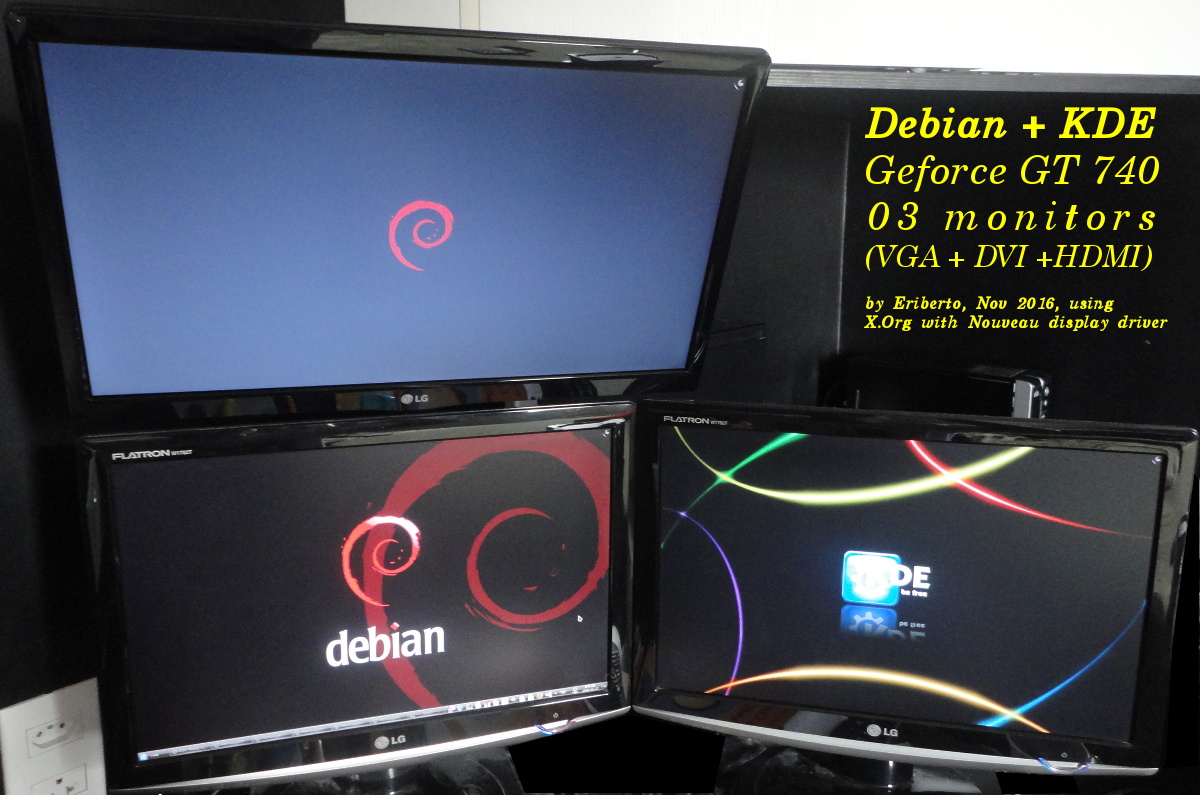
Eriberto Mota: Debian with three monitors under low cost graphics interface

Since 2008 I use two monitors in my desktop. Yesterday I bought a new graphics interface and a third monitor. Some time I was looking for a low cost graphics interface. Ok, I am using GeForce GT 740 which has three output ports: VGA, DVI and HDMI. In Brazil this interface card can be found around R$ 400 (US$ 117, but my card was US$ 87 in Brazilian Black Friday). In Amazon.com, it is between US$ 51 and US$ 109. The chosen manufacturer was Zotac, but all GT 740 and 750 will work fine (I tested the GT 750 too). The GeForce GT 740 was imediatelly recognised by Debian Jessie with kernel Linux 4.7.0 from Backports (it is my default, so I didn't test with original 3.16 kernel). The driver used was the default X.Org Nouveau. I use KDE and the management was easy. I hope this post can help people interested in use 3 monitors. Enjoy! 03-monitors

25 November 2016

Julian Andres Klode: Starting the faster, more secure APT 1.4 series

We just released the first beta of APT 1.4 to Debian unstable (beta here means that we don t know any other big stuff to add to it, but are still open to further extensions). This is the release series that will be released with Debian stretch, Ubuntu zesty, and possibly Ubuntu zesty+1 (if the Debian freeze takes a very long time, even zesty+2 is possible). It should reach the master archive in a few hours, and your mirrors shortly after that. Security changes APT 1.4 by default disables support for repositories signed with SHA1 keys. I announced back in January that it was my intention to do this during the summer for development releases, but I only remembered the Jan 1st deadline for stable releases supporting that (APT 1.2 and 1.3), so better late than never. Around January 1st, the same or a similar change will occur in the APT 1.2 and 1.3 series in Ubuntu 16.04 and 16.10 (subject to approval by Ubuntu s release team). This should mean that repository provides had about one year to fix their repositories, and more than 8 months since the release of 16.04. I believe that 8 months is a reasonable time frame to upgrade a repository signing key, and hope that providers who have not updated their repositories yet will do so as soon as possible. Performance work APT 1.4 provides a 10-20% performance increase in cache generation (and according to callgrind, we went from approx 6.8 billion to 5.3 billion instructions for my laptop s configuration, a reduction of more than 21%). The major improvements are: We switched the parsing of Deb822 files (such as Packages files) to my perfect hash function TrieHash. TrieHash which generates C code from a set of words is about equal or twice as fast as the previously used hash function (and two to three times faster than gperf), and we save an additional 50% of that time as we only have to hash once during parsing now, instead of during look up as well. APT 1.4 marks the first time TrieHash is used in any software. I hope that it will spread to dpkg and other software at a later point in time.vendors. Another important change was to drop normalization of Description-MD5 values, the fields mapping a description in a Packages files to a translated description. We used to parse the hex digits into a native binary stream, and then compared it back to hex digits for comparisons, which cost us about 5% of the run time performance. We also optimized one of our hash functions the VersionHash that hashes the important fields of a package to recognize packages with the same version, but different content to not normalize data to a temporary buffer anymore. This buffer has been the subject of some bugs (overflow, incompleteness) in the recent past, and also caused some slowdown due to the additional writes to the stack. Instead, we now pass the bytes we are interested in directly to our CRC code, one byte at a time. There were also some other micro-optimisations: For example, the hash tables in the cache used to be ordered by standard compare (alphabetical followed by shortest). It is now ordered by size first, meaning we can avoid data comparisons for strings of different lengths. We also got rid of a std::string that cannot use short string optimisation in a hot path of the code. Finally, we also converted our case-insensitive djb hashes to not use a normal tolower_ascii(), but introduced tolower_ascii_unsafe() which just sets the lowercase bit ( 0x20) in the character. Others For a more complete overview of all changes, consult the changelog.
Filed under: Debian, Ubuntu

Petter Reinholdtsen: Quicker Debian installations using eatmydata

Two years ago, I did some experiments with eatmydata and the Debian installation system, observing how using eatmydata could speed up the installation quite a bit. My testing measured speedup around 20-40 percent for Debian Edu, where we install around 1000 packages from within the installer. The eatmydata package provide a way to disable/delay file system flushing. This is a bit risky in the general case, as files that should be stored on disk will stay only in memory a bit longer than expected, causing problems if a machine crashes at an inconvenient time. But for an installation, if the machine crashes during installation the process is normally restarted, and avoiding disk operations as much as possible to speed up the process make perfect sense. I added code in the Debian Edu specific installation code to enable eatmydata, but did not have time to push it any further. But a few months ago I picked it up again and worked with the libeatmydata package maintainer Mattia Rizzolo to make it easier for everyone to get this installation speedup in Debian. Thanks to our cooperation There is now an eatmydata-udeb package in Debian testing and unstable, and simply enabling/installing it in debian-installer (d-i) is enough to get the quicker installations. It can be enabled using preseeding. The following untested kernel argument should do the trick:
preseed/early_command="anna-install eatmydata-udeb"
This should ask d-i to install the package inside the d-i environment early in the installation sequence. Having it installed in d-i in turn will make sure the relevant scripts are called just after debootstrap filled /target/ with the freshly installed Debian system to configure apt to run dpkg with eatmydata. This is enough to speed up the installation process. There is a proposal to extend the idea a bit further by using /etc/ld.so.preload instead of apt.conf, but I have not tested its impact.

Iain R. Learmonth: vmdebootstrap Sprint Report

This is now a little overdue, but here it is. On the 10th and 11th of November, the second vmdebootstrap sprint took place. Lars Wirzenius (liw), Ana Custura (ana_c) and myself were present. liw focussed on the core of vmdebootstrap, where he sketched out what the future of vmdebootstrap may look like. He documented this in a mailing list post and also presented (video). Ana and myself worked on live-wrapper, which uses vmdebootstrap internally for the squashfs generation. I worked on improving logging, using a better method for getting paths within the image, enabling generation of Packages and Release files for the image archive and also made the images installable (live-wrapper 0.5 onwards will include an installer by default). Ana worked on the inclusion of HDT and memtest86+ in the live images and enabled both ISOLINUX (for BIOS boot) and GRUB (for EFI boot) to boot the text-mode and graphical installers. live-wrapper 0.5 was released on the 16th November with these fixes included. You can find live-wrapper documentation at https://live-wrapper.readthedocs.io/en/latest/. (The documentation still needs some work, some options may be incorrectly described). Thanks to the sponsors that made this work possible. You re awesome. (:

24 November 2016

Ritesh Raj Sarraf: LIO -fb in Debian

LIO -fb is the new SCSI Target for Debian. Previously, we maintained the LIO tools from the pre-fork upstream branch. But, with good reasons, we've now moved to the newer -fb (Free Branch). As the maintainer for those pacakges, I have a local LIO setup. Overy the years, I've been tuning and using this setup with a bunch of SCSI clients. Now with the new -fb packages it was worrisome for me, on how to migrate (Note: migration is not supported by the Debian packages) my old setup to the new one. Thanks to Andy Grover for mentioning it, migrating your configuration is doable. With some minor intervention, I was able to switch my config from old LIO setup to the new LIO -fb pacakges. As you can see from the output below, both the outputs look the same, which is a good thing. LIO reads its configuration from /etc/target/ and passes it into the kernel. The kernel loads the config. The real time config is present in configfs, within the kernel. Users willing for such migration need to ensure that the loaded config data remains in configfs. And then, using the new -fb tools (targetctl), the configuration data needs to be read and written to a new format in /etc/.
/> ls
o- / ......................................................................................................................... [...]
  o- backstores .............................................................................................................. [...]
    o- fileio ................................................................................................... [0 Storage Object]
    o- iblock .................................................................................................. [4 Storage Objects]
      o- CENTOS ................................................................................................. [/dev/vdd, in use]
      o- SAN1 ................................................................................................... [/dev/vdb, in use]
      o- SAN2 ................................................................................................... [/dev/vdc, in use]
      o- SANROOT .............................................. [/dev/disk/by-id/scsi-0QEMU_QEMU_HARDDISK_drive-scsi0-0-0-0, in use]
    o- pscsi .................................................................................................... [0 Storage Object]
    o- rd_mcp ................................................................................................... [0 Storage Object]
  o- ib_srpt ........................................................................................................... [0 Targets]
  o- iscsi ............................................................................................................. [3 Targets]
    o- iqn.1994-05.com.redhat:23d8eb7fa1fc ................................................................................. [1 TPG]
      o- tpg1 ............................................................................................................ [enabled]
        o- acls ............................................................................................................ [1 ACL]
          o- iqn.1994-05.com.redhat:23d8eb7fa1fc .................................................................... [1 Mapped LUN]
            o- mapped_lun0 ............................................................................................. [lun0 (rw)]
        o- luns ............................................................................................................ [1 LUN]
          o- lun0 ....................................................................................... [iblock/CENTOS (/dev/vdd)]
        o- portals ..................................................................................................... [4 Portals]
          o- 172.16.20.40:3260 ................................................................................. [OK, iser disabled]
          o- 172.16.20.41:3260 ................................................................................. [OK, iser disabled]
          o- 172.16.20.42:3260 ................................................................................. [OK, iser disabled]
          o- 172.16.20.43:3260 ................................................................................. [OK, iser disabled]
    o- iqn.2003-01.org.linux-iscsi.debian.sanboot .......................................................................... [1 TPG]
      o- tpg1 ............................................................................................................ [enabled]
        o- acls ............................................................................................................ [1 ACL]
          o- iqn.2005-03.org.open-iscsi:fd2bc2f4652a-sanboot ........................................................ [1 Mapped LUN]
            o- mapped_lun0 ............................................................................................. [lun0 (rw)]
        o- luns ............................................................................................................ [1 LUN]
          o- lun0 .................................... [iblock/SANROOT (/dev/disk/by-id/scsi-0QEMU_QEMU_HARDDISK_drive-scsi0-0-0-0)]
        o- portals ..................................................................................................... [4 Portals]
          o- 172.16.20.40:3260 ................................................................................. [OK, iser disabled]
          o- 172.16.20.41:3260 ................................................................................. [OK, iser disabled]
          o- 172.16.20.42:3260 ................................................................................. [OK, iser disabled]
          o- 172.16.20.43:3260 ................................................................................. [OK, iser disabled]
    o- iqn.2003-01.org.linux-iscsi.debian.x8664 ............................................................................ [1 TPG]
      o- tpg1 ............................................................................................................ [enabled]
        o- acls ............................................................................................................ [1 ACL]
          o- iqn.1993-08.org.debian:01:2972f6b5fc7 ................................................................. [2 Mapped LUNs]
            o- mapped_lun0 ............................................................................................. [lun0 (rw)]
            o- mapped_lun1 ............................................................................................. [lun1 (rw)]
        o- luns ........................................................................................................... [2 LUNs]
          o- lun0 ......................................................................................... [iblock/SAN1 (/dev/vdb)]
          o- lun1 ......................................................................................... [iblock/SAN2 (/dev/vdc)]
        o- portals ..................................................................................................... [4 Portals]
          o- 172.16.20.40:3260 ................................................................................. [OK, iser disabled]
          o- 172.16.20.41:3260 ................................................................................. [OK, iser disabled]
          o- 172.16.20.42:3260 ................................................................................. [OK, iser disabled]
          o- 172.16.20.43:3260 ................................................................................. [OK, iser disabled]
  o- loopback .......................................................................................................... [0 Targets]
  o- qla2xxx ........................................................................................................... [0 Targets]
  o- tcm_fc ............................................................................................................ [0 Targets]
  o- vhost ............................................................................................................. [0 Targets]
/> 
/> ls
o- / ......................................................................................................................... [...]
  o- backstores .............................................................................................................. [...]
    o- block .................................................................................................. [Storage Objects: 4]
      o- CENTOS ........................................................................... [/dev/vdd (2.0GiB) write-thru activated]
      o- SAN1 ............................................................................. [/dev/vdb (1.0GiB) write-thru activated]
      o- SAN2 ............................................................................. [/dev/vdc (1.0GiB) write-thru activated]
      o- SANROOT ........................ [/dev/disk/by-id/scsi-0QEMU_QEMU_HARDDISK_drive-scsi0-0-0-0 (8.0GiB) write-thru activated]
    o- fileio ................................................................................................. [Storage Objects: 0]
    o- pscsi .................................................................................................. [Storage Objects: 0]
    o- ramdisk ................................................................................................ [Storage Objects: 0]
  o- iscsi ............................................................................................................ [Targets: 3]
    o- iqn.1994-05.com.redhat:23d8eb7fa1fc ............................................................................... [TPGs: 1]
      o- tpg1 ............................................................................................... [no-gen-acls, no-auth]
        o- acls .......................................................................................................... [ACLs: 1]
          o- iqn.1994-05.com.redhat:23d8eb7fa1fc .................................................................. [Mapped LUNs: 1]
            o- mapped_lun0 ................................................................................ [lun0 block/CENTOS (rw)]
        o- luns .......................................................................................................... [LUNs: 1]
          o- lun0 ........................................................................................ [block/CENTOS (/dev/vdd)]
        o- portals .................................................................................................... [Portals: 4]
          o- 172.16.20.40:3260 ................................................................................................ [OK]
          o- 172.16.20.41:3260 ................................................................................................ [OK]
          o- 172.16.20.42:3260 ................................................................................................ [OK]
          o- 172.16.20.43:3260 ................................................................................................ [OK]
    o- iqn.2003-01.org.linux-iscsi.debian.sanboot ........................................................................ [TPGs: 1]
      o- tpg1 ............................................................................................... [no-gen-acls, no-auth]
        o- acls .......................................................................................................... [ACLs: 1]
          o- iqn.2005-03.org.open-iscsi:fd2bc2f4652a-sanboot ...................................................... [Mapped LUNs: 1]
            o- mapped_lun0 ............................................................................... [lun0 block/SANROOT (rw)]
        o- luns .......................................................................................................... [LUNs: 1]
          o- lun0 ..................................... [block/SANROOT (/dev/disk/by-id/scsi-0QEMU_QEMU_HARDDISK_drive-scsi0-0-0-0)]
        o- portals .................................................................................................... [Portals: 4]
          o- 172.16.20.40:3260 ................................................................................................ [OK]
          o- 172.16.20.41:3260 ................................................................................................ [OK]
          o- 172.16.20.42:3260 ................................................................................................ [OK]
          o- 172.16.20.43:3260 ................................................................................................ [OK]
    o- iqn.2003-01.org.linux-iscsi.debian.x8664 .......................................................................... [TPGs: 1]
      o- tpg1 ............................................................................................... [no-gen-acls, no-auth]
        o- acls .......................................................................................................... [ACLs: 1]
          o- iqn.1993-08.org.debian:01:2972f6b5fc7 ................................................................ [Mapped LUNs: 2]
            o- mapped_lun0 .................................................................................. [lun0 block/SAN1 (rw)]
            o- mapped_lun1 .................................................................................. [lun1 block/SAN2 (rw)]
        o- luns .......................................................................................................... [LUNs: 2]
          o- lun0 .......................................................................................... [block/SAN1 (/dev/vdb)]
          o- lun1 .......................................................................................... [block/SAN2 (/dev/vdc)]
        o- portals .................................................................................................... [Portals: 4]
          o- 172.16.20.40:3260 ................................................................................................ [OK]
          o- 172.16.20.41:3260 ................................................................................................ [OK]
          o- 172.16.20.42:3260 ................................................................................................ [OK]
          o- 172.16.20.43:3260 ................................................................................................ [OK]
  o- loopback ......................................................................................................... [Targets: 0]
  o- vhost ............................................................................................................ [Targets: 0]
/> 

Categories:

Keywords:

Like:

Ritesh Raj Sarraf: SAN Updates for Debian Stretch

Now that we prepare for the next Debian Stable release (Stretch), it is time to provide some updates on what the current state of some of the (storage related) packages in Debian is. This is not an update on the complete list of packages related to storage, but it does cover some of them. REMOVALS
  • iscsitarget - The iscsitarget stood as a great SCSI target for the Linux kernel. It seems to have had a good user base not just in Linux but also with VMWare users. But this storage target was always out-of-tree. With LIO having gotten merged as the default in-kernel SCSI Target, development on iscsitarget seems to have stalled. In Debian, for Stretch, there will be no iscsitarget. The package is already removed from Debian Testing and Debian Unstable, and nobody has volunteered to take over it.
  • system-storage-manager - This tool intended to be a simple unified storage tool, through which one could work with various storage technologies like LVM, BTRFS, cryptsetup, SCSI etc. But the upstream development hasn't really been much lately. For Debian Stable, it shouldn't be part of it, given it has some bugs.
  • libstoragemgmt - libstoragemgmt is a universal storage client-side library to talk to remote Storage Arrays. The project is active upstream. For Debian, the package is out-of-date and, now, also needs a maintainer. Unless someone picks up this package, it will not be part of Debian Stretch.
UPDATES
  • open-iscsi - This is the default iSCSI Initiator for Linux distributions. After a long slow development, upstream recently did a new release. This new release accomplished an important milestone; Hardware Offloading for QLogic cards. A special thanks to Frank Fegert, who helped with many aspects of the new iscsiuio package. And thanks to Christian Seiler, who is now co-maintaining the package, it is in great shape. We have fixed some long outstanding bugs and open-iscsi now has much much better integration with the whole system. For Jessie too, we have the up-to-date open-iscsi pacakges (including the new iscsiuio package, with iSCSI Offload) available through jessie-packports
  • open-isns - iSNS is the Naming Service for Storage. This is a new package in Debian Stretch. For users on Debian Jessie, Christian's efforts have made the open-isns package available in jessie-backports too.
  • multipath-tools - After years of slow development, multipath-tools too saw some active development this year, thanks to Xose and Christophe. The Debian version is up-to-date with the latest upstream release. For Debian Stretch, multipath-tools should have good integration with systemd.
  • sg3-utils - sg3 provides simple tools to query, using SCSI commands. The package is up-to-date and in good shape for Debian Stretch.
  • LIO Target - This is going to be the big entry for Debian Stretch. LIO is the in-kernel SCSI Target for Linux. For various reasons, we did not have LIO in Jessie. For Stretch, thanks to Christian Seiler and Christophe Vu-Brugier, we now have the well maintained -fb fork into Debian, which will replace the initial packages from the pre-fork upstream. The -fb fork is maintained by Andy Grover, and now, seems to have users from many other distributions and the kernel community. And given that LIO -fb branch is also part of the RHEL product family, we hope to see a well maintained project and an active upstream. The older packages: targetcli, python-rtslib and python-configshell shall be removed from the archive soon.
Debian users and derivatives, using these storage tools, may want to test/report now. Because once Stretch is released, getting new fixes in may not be easy enough. So please, if you have reliance on these tools, please test and report bugs, now.

Categories:

Keywords:

Like:

Michael Stapelberg: Debian stretch on the Raspberry Pi 3

The last couple of days, I worked on getting Debian to run on the Raspberry Pi 3. Thanks to the work of many talented people, the Linux kernel in version 4.8 is _almost_ ready to run on the Raspberry Pi 3. The only missing thing is the bcm2835 MMC driver, which is required to read the root file system from the SD card. I ve asked our maintainers to include the patch for the time being. Aside from the kernel, one also needs a working bootloader, hence I used Ubuntu s linux-firmware-raspi2 package and uploaded the linux-firmware-raspi3 package to Debian. The package is currently in the NEW queue and needs to be accepted by ftp-master before entering Debian. The most popular method of providing a Linux distribution for the Raspberry Pi is to provide an image that can be written to an SD card. I made two little changes to vmdebootstrap (#845439, #845526) which make it easier to create such an image. The Debian wiki page https://wiki.debian.org/RaspberryPi3 describes the current state of affairs and should be updated, as this blog post will not be updated. As a preview version (i.e. unofficial, unsupported, etc.) until all the necessary bits and pieces are in place to build images in a proper place in Debian, I built and uploaded the resulting image. Find it at https://people.debian.org/~stapelberg/raspberrypi3/. To install the image, insert the SD card into your computer (I m assuming it s available as /dev/sdb) and copy the image onto it:
$ wget https://people.debian.org/~stapelberg/raspberrypi3/2016-11-24-raspberry-pi-3-stretch-PREVIEW.img
$ sudo dd if=2016-11-24-raspberry-pi-3-stretch-PREVIEW.img of=/dev/sdb bs=5M
I hope this initial work on getting Debian booted will motivate other people to contribute little improvements here and there. A list of current limitations and potential improvements can be found on the RaspberryPi3 Debian wiki page.

23 November 2016

Joachim Breitner: microG on Jolla

I am a incorrigibly in picking non-mainstream, open smartphones, and then struggling hard. Back then in 2008, I tried to use the OpenMoko FreeRunner, but eventually gave up because of hardware glitches and reverted to my good old Siemens S35. It was not that I would not be willing to put up with inconveniences, but as soon as it makes live more difficult for the people I communicate with, it becomes hard to sustain. Two years ago I tried again, and got myself a Jolla phone, running Sailfish OS. Things are much nicer now: The hardware is mature, battery live is good, and the Android compatibility layer enables me to run many important apps that are hard to replace, especially the Deutsche Bahn Navigator and various messengers, namely Telegram, Facebook Messenger, Threema and GroupMe. Some apps that require Google Play Services, which provides a bunch of common tasks and usually comes with the Google Play store would not run on my phone, as Google Play is not supported on Sailfish OS. So far, the most annoying ones of that sort were Uber and Lyft, making me pay for expensive taxis when others would ride cheaper, but I can live with that. I tried to install Google Play Services from shady sources, but it would regularly crash.

Signal on Jolla Now in Philadelphia, people urged me to use the Signal messenger, and I was convinced by its support for good end-to-end crypto, while still supporting offline messages and allowing me to switch from my phone to my desktop and back during a conversation. The official Signal app uses Google Cloud Messaging (GCM, part of Google Play Services) to get push updates about new posts, and while I do not oppose this use of Google services (it really is just a ping without any metadata), this is a problem on Sailfish OS. Luckily, the Signal client is open source, and someone created a LibreSignal edition that replaced the use of GCM with websockets, and indeed, this worked on my phone, and I could communicate. Things were not ideal, though: I would often have to restart the app to get newly received messages; messages that I send via Signal Desktop would often not show up on the phone and, most severe, basically after every three messages, sending more messages from Desktop would stop working for my correspondents, which freaked them out. (Strangely it continued working from their phone app, so we coped for a while.) So again, my choice of non-standard devices causes inconveniences to others. This, and the fact that the original authors of Signal and the maintainers of LibreSignal got into a fight that ended LibreSignal discontinued, meant that I have to change something about this situation. I was almost ready to give in and get myself a Samsung S7 or something boring of the sort, but then I decided to tackle this issue once more, following some of the more obscure instructions out there, trying to get vanilla Signal working on my phone. About a day later, I got it, and this is how I did it.

microG So I need Google Play Services somehow, but installing the real thing did not seem to be very promising (I tried, and regularly got pop-ups telling me that Play Services has crashed.) But I found some references to a project called microG , which is an independent re-implementation of (some of) of the play services, in particular including GCM. Installing microG itself was easy, as you can add their repository to F-Droid. I installed the core services, the services framework and the fake store apps. If this had been all that was to do, things would be easy!

Play Store detection work arounds But Signal would still complain about the lack of Google Play Services. It asks Android if an app with a certain name is installed, and would refuse to work if this app does not exist. For some reason, the microG apps cannot just have the names of the real Google apps. There seem to be two ways of working around this: Patching Signal, or enabling Signature Spoofing. The initially most promising instructions (which are in a README in a tarball on a fishy file hoster linked from an answer on the Jolla support forum ) suggested patching Signal, and actually came both with a version of an app called Lucky Patcher as well as a patched Android package, but both about two years old. I tried a recent version of the Lucky Patcher, but it failed to patch the current version of Signal.

Signature Spoofing So on to Signature Spoofing. This is a feature of some non-standard Android builds that allow apps (such as microG) to fake the existence of other apps (the Play Store), and is recommended by the microG project. Sailfish OS s Android compatibility layer Alien Dalvik does not support it out of the box, but there is a tool tingle that adds this feature to existing Android systems. One just has to get the /system/framework/framework.jar file, put it into the input folder of this project, run python main.py, select 2, and copy the framework.jar from output/ back. Great.

Deodexing Alien Dalvik Only that it only works on deodexed files. I did not know anything about odexed Android Java classes (and did not really want to know), but there was not way around. Following this explanation I gathered that one finds files foo.odex in the Android system folder, runs some tool on them to create a classes.dex file, and adds that to the corresponding foo.jar or foo.apk file, copies this back to the phone and deletes the foo.odex file. The annoying this is that one does not only have to do it for framework.jar in order to please tingle, because if one does it to one odex file, one has to do to all! It seems that for people using Windows, the Universal Deodexer V5 seems to be a convenient tool, but I had to go more manually. So I first fetched smali , compiled it using ./gradlew build. Then I fetched the folders /opt/alien/system/framework and /opt/alien/system/app from the phone (e.g. using scp). Keep a backup of these in case something breaks. Then I ran these commands (disclaimer: I fetched these from my bash history and slightly cleaned them up. This is not a fire-and-forget script! Use it when you know what it and you are doing):
cd framework
for file in *.odex
do
  java -jar ~/build/smali/baksmali/build/libs/baksmali.jar deodex $file -o out
  java -jar ~/build/smali/smali/build/libs/smali.jar a out -o classes.dex
  zip -u $(basename $file .odex).jar classes.dex
  rm -rf out classes.dex $file
done
cd ..
cd app
for file in *.odex
do
  java -jar ~/build/smali/baksmali/build/libs/baksmali.jar deodex -d ../framework $file -o out
  java -jar ~/build/smali/smali/build/libs/smali.jar a out -o classes.dex
  zip -u $(basename $file .odex).apk classes.dex
  rm -rf out classes.dex $file
done
cd ..
The resulting framework.jar can now be patched with tingle:
mv framework/framework.jar ~/build/tingle/input
cd ~/build/tingle
./main.py
# select 2
cd -
mv ~/build/tingle/output/framework.jar framework/framework.jar
Now I copy these framework and app folders back on my phone, and restart Dalvik:
devel-su systemctl restart aliendalvik.service
It might start a bit slower than usually, but eventually, all the Android apps should work as before. The final bit that was missing in my case was that I had to reinstall Signal: If it is installed before microG is installed, it does not get permission to use GCM, and when it tries (while registering: After generating the keys) it just crashes. I copied /data/data/org.thoughtcrime.secretsms/ before removing Signal and moved it back after (with cp -a to preserve permissions) so that I could keep my history. And now, it seems, vanilla Signal is working just fine on my Jolla phone!

What s missing Am I completely happy with Signal? No! An important feature that it is lacking is a way to get out all data (message history including media files) in a file format that can be read without Signal; e.g. YAML files or clean HTML code. I do want to be able to re-read some of the more interesting conversations when I am 74 or 75, and I doubt that there will be a Signal App, or even Android, then. I hope that this becomes available in time, maybe in the Desktop version. I would also hope that pidgin gets support to the Signal protocol, so that I conveniently use one program for all my messaging needs on the desktop. Finally it would be nice if my Signal identity was less tied to one phone number. I have a German and a US phone number, and would want to be reachable under both on all my clients. (If you want to contact me on Signal, use my US phone number.)

Alternatives Could I have avoided this hassle by simply convincing people to use something other than Signal? Tricky, at the moment. Telegram (which works super reliable for me, and has a pidgin plugin) has dubious crypto and does not support crypto while using multiple clients. Threema has no desktop client that I know of. OTR on top of Jabber does not support offline messages. So nothing great seems to exist right now. In the long run, the best bet seems to be OMEMO (which is, in essence, the Signal protocol) on top of Jabber. It is currently supported by one Android Jabber client (Conversations) and one Desktop application (gajim, via a plugin). I should keep an eye on pidgin support for OMEMO and other development around this.

Tanguy Ortolo: Generate man pages for awscli

No man pages, but almost The AWS Command Line Interface, which is available in Debian, provides no man page. Instead, that tool has an integrated help system, which allows you to run commands such as aws rds help, that, for what I have seen, generates some reStructuredText, then converts it to a man page in troff format, then calls troff to convert it to text with basic formatting, and eventually passes it to a pager. Since this is close to what man does, the result looks like a degraded man page, with some features missing such as the adaptation to the terminal width. Well, this is better than nothing, and better than what many under-documented tools can offer, but for several reasons, it still sucks: most importantly, it does not respect administrators' habits and it does not integrate with the system man database. You it does not allow you to use commands such as apropos, and you will get no man page name auto-completion from your shell since there is no man page.Generate the man pages Now, since the integrated help system does generate a man page internally, we can hack it to output it, and save it to a file:
Description: Enable a mode to generate troff man pages
 The awscli help system internally uses man pages, but only to convert
 them to text and show them with the pager. This patch enables a mode
 that prints the troff code so the user can save the man page.
 .
 To use that mode, run the help commands with an environment variable
 OUTPUT set to 'troff', for instance:
     OUTPUT='troff' aws rds help
Forwarded: no
Author: Tanguy Ortolo <tanguy+debian@ortolo.eu>
Last-Update: 2016-11-22
Index: /usr/lib/python3/dist-packages/awscli/help.py
===================================================================
--- /usr/lib/python3/dist-packages/awscli/help.py       2016-11-21 12:14:22.236254730 +0100
+++ /usr/lib/python3/dist-packages/awscli/help.py       2016-11-21 12:14:22.236254730 +0100
@@ -49,6 +49,8 @@
     Return the appropriate HelpRenderer implementation for the
     current platform.
     """
+    if 'OUTPUT' in os.environ and os.environ['OUTPUT'] == 'troff':
+        return TroffHelpRenderer()
     if platform.system() == 'Windows':
         return WindowsHelpRenderer()
     else:
@@ -97,6 +99,15 @@
         return contents
+class TroffHelpRenderer(object):
+    """
+    Render help content as troff code.
+    """
+
+    def render(self, contents):
+        sys.stdout.buffer.write(publish_string(contents, writer=manpage.Writer()))
+
+
 class PosixHelpRenderer(PagingHelpRenderer):
     """
     Render help content on a Posix-like system.  This includes
This patch must be applied from the root directory with patch -p0, otherwise GNU patch will not accept to work on files with absolute names. With that patch, you can run help commands with an environment variable OUTPUT='troff' to get the man page to use it as you like, for instance:
% OUTPUT='troff' aws rds help > aws_rds.1
% man -lt aws_rds.1   lp
Generate all the man pages Now that we are able to generate the man page of any aws command, all we need to generate all of them is a list of all the available commands. This is not that easy, because the commands are somehow derived from functions provided by a Python library named botocore, which are derived from a bunch of configuration files, and some of them are added, removed or renamed. Anyway, I have been able to write a Python script that does that, but it includes a static list of these modifications:
#! /usr/bin/python3
import subprocess
import awscli.clidriver
def write_manpage(command):
    manpage = open('%s.1' % '_'.join(command), 'w')
    command.append('help')
    process = subprocess.Popen(command,
            env= 'OUTPUT': 'troff' ,
            stdout=manpage)
    process.wait()
    manpage.close()
driver = awscli.clidriver.CLIDriver()
command_table = driver._get_command_table()
renamed_commands = \
     
        'config': 'configservice',
        'codedeploy': 'deploy',
        's3': 's3api'
     
added_commands = \
     
        's3': ['cp', 'ls', 'mb', 'mv', 'presign', 'rb', 'rm', 'sync',
               'website']
     
removed_subcommands = \
     
        'ses': ['delete-verified-email-address',
                'list-verified-email-addresses',
                'verify-email-address'],
        'ec2': ['import-instance', 'import-volume'],
        'emr': ['run-job-flow', 'describe-job-flows',
                'add-job-flow-steps', 'terminate-job-flows',
                'list-bootstrap-actions', 'list-instance-groups',
                'set-termination-protection',
                'set-visible-to-all-users'],
        'rds': ['modify-option-group']
     
added_subcommands = \
     
        'rds': ['add-option-to-option-group',
                'remove-option-from-option-group']
     
# Build a dictionary of real commands, including renames, additions and
# removals.
real_commands =  
for command in command_table:
    subcommands = []
    subcommand_table = command_table[command]._get_command_table()
    for subcommand in subcommand_table:
        # Skip removed subcommands
        if command in removed_subcommands \
                and subcommand in removed_subcommands[command]:
            continue
        subcommands.append(subcommand)
    # Add added subcommands
    if command in added_subcommands:
        for subcommand in added_subcommands[command]:
            subcommands.append(subcommand)
    # Directly add non-renamed commands
    if command not in renamed_commands:
        real_commands[command] = subcommands
    # Add renamed commands
    else:
        real_commands[renamed_commands[command]] = subcommands
# Add added commands
for command in added_commands:
    real_commands[command] = added_commands[command]
# For each real command and subcommand, generate a manpage
write_manpage(['aws'])
for command in real_commands:
    write_manpage(['aws', command])
    for subcommand in real_commands[command]:
        write_manpage(['aws', command, subcommand])
                         'sync', 'website'] 
This script will generate more than 2,000 man page files in the current directory; you will then be able to move them to /usr/local/share/man/man1. Since this is a lot of man pages, it may be appropriate to concatenate them by major command, for instance all the aws rds together

22 November 2016

Steve Langasek: A new chapter

I don't often write on this blog, and when I do, it's either tech related, or light life stuff. Over the next few weeks, it's going to get a lot more political. If you currently follow this blog for its technical content, you may be tempted to tune out. I would encourage you to stay and listen. I'm passionate about the technology that I work on; but the greatest problems facing our world today are not ones that will be solved with software. American democracy is in bad shape, and it's because of what we're doing to it. This is not a problem of the Right or of the Left; it is not a problem that began with the election of Donald Trump, and it's not a problem that will go away at the end of his term. It is partly a structural problem with the way our elections work, but more than that it's a problem of how we're splitting into separate tribes, isolating ourselves from those who don't agree with us. As Russ Allbery wrote the morning after the election, everything about how we organize ourselves online today - and how we let Facebook and Twitter organize us - leads us to surround ourselves with people who already think the same way we do. That leaves all of us with huge blind spots for other people in our country, and it stifles the free exchange of ideas that is so essential for a healthy democracy. We need leaders who will work to make America a better and more just place for all our neighbors, not just a two-party system that plays tug-of-war using two different sets of voters that feel shut out. And the way we organize ourselves today (online and off) does not let us recognize those leaders. There's a lot of talk now about Facebook changing how it decides what to show people; and maybe they can manage to help everyone's online experience be a little less of a bubble. But part of the change needs to come from us. We need to be willing to engage, civilly, with people whose perspective is different from ours, and make the effort to understand where the other is coming from. So for the next few weeks, I'm going to talk. And I'm going to listen. I have no unique qualifications to speak about the country's issues. But I do have a perspective of my own, which might be different enough from yours to be useful. I was born and raised in Iowa, and graduated from college there. This election cycle, I learned that Iowa holds the distinction of being the state with the lowest percentage of college-educated whites. I'm part of that statistic, because a few years after graduating I moved to Portland, Oregon - a place that's notoriously so far to the left of what we think of as the middle, that it actually has anarchists who would shamefully use a peaceful protest as cover to commit property crime. So I know a few things about the people in each state, that I think the other should hear. I'm also that rarest of creatures, a Portlander who goes to church (Catholic). But I still choose as my neighbors the weird, wonderful, and welcoming community that we have here, whatever Glenn Beck might think. I have a son, and I worry about what kind of world he'll grow up to live in. I work in software, which means I'm doing a lot better than a lot of people in the country right now; it also means that from where I sit, I see trends already in progress that will have an effect on the working class and the middle class that makes NAFTA look like a gnat's fart in comparison. And so I worry for what kind of world we will all live in, if we don't make some changes fast. Let's have a conversation. No comments enabled on this blog, but you can find me on G+ or on Facebook.

Next.

Previous.