Search Results: "tb"

29 June 2010

Russell Coker: Play Machine Online Again with Xen 4.0

My SE Linux Play Machine [1] has been offline for almost a month (it went offline late May 30 and has just gone online again). It s the sort of downtime that can happen when you use Debian/Unstable. For a while I ve been using a HP E-PC (a SFF desktop system with 256M of RAM and a P3-800 CPU) to run my SE Linux Play Machine. I run it under Xen to make it easier for me to watch what happens. I ve had some problems with increased memory use in the Xen Dom0 in Squeeze [2]. The latest installment of the memory problems is when I discovered that I can t run two copies of tcpdump (for tracing separate interfaces) at once on a Xen Dom0 that has ~110M of RAM this seems unreasonable, I m sure that back when a big server had 128M of RAM I could have done such things! So now I m using a Thinkpad T20 with 512M of RAM for my new SE Linux Play Machine, it uses less power than most systems (probably even less than the HP E-PC) and is very quiet. I was forced to install on a new system when I broke my GRUB configuration. GRUB-2 in Debian currently has no support for generating a configuration that will boot a Xen Dom0. You can manually edit the GRUB configuration to get this working, but if you get it wrong then you can make GRUB not even display a prompt and force a reinstall (as I did). As an aside it would be really handy if someone would create a CD or USB bootable image that does nothing but install GRUB. Such an image would ideally allow replacing the configuration of an existing GRUB, overwriting an existing GRUB installation (all files in /boot/grub get replaced), or formatting a spare partition (default swap space) and installing GRUB there. My current solution to the GRUB problems is to use the old version of GRUB in the grub-legacy package. The old version of GRUB has always done everything I want so I don t seem to be missing anything by not using the new version. I m happy to refrain from using Ext4 for /boot and have no desire to have /boot on an LVM volume. Most of the month of down-time for my Play Machine was caused by bugs in the SE Linux policy I m developing for Squeeze, while they weren t difficult bugs I haven t had much time to work on them consistently. I m still running the Play Machine on Lenny, but the Dom0 is running Unstable.

Russell Coker: New SE Linux Policy for Squeeze

I have just uploaded refpolicy version 0.2.20100524-1 to Unstable. This policy is not well tested (a SE Linux policy package ending in -1 is not something that tends to work well for all people) and in particular lacks testing for Desktop environments. But for servers it should work reasonably well. I expect to have a better version uploaded before this one gets out of Unstable. Note that the selinux-policy-default package in this release lacks support for roles, it s a targeted policy only. I plan to fix this soon.

28 June 2010

Russell Coker: Can you run SE Linux on a Xen Guest?

I was asked Can you run SELinux on a XEN guest without any problem? . In a generic sense the answer is of course YES, Xen allows you to run Linux kernels with all the usual range of features and SE Linux isn t a particularly difficult feature to enable. I do most of my SE Linux development and testing on virtual machines and until recently I didn t have any hardware suitable for running KVM, so in the last few years I ve done more SE Linux testing on Xen than on non-virtual machines. My SE Linux Play Machine [1] (which will be online again tomorrow) is one SE Linux system running under Xen. But the question was asked in the context of my blog post comparing the prices of virtual hosting providers [2], which changes things. Both Linode and Slicehost (the two virtual hosting providers that my clients use) provide kernels without SE Linux support, the command grep selinux /proc/filesystems (which is the easiest way to test for SE Linux support) gives no output. I am not aware of any other virtual hosting company that provides SE Linux support. If anyone knows of a virtual hosting company that runs Xen or KVM virtual machines with SE Linux support then please let me know, I ll write a blog post comparing such companies if there are some. For the people who work at ISPs: If your company supports SE Linux virtual machines then I would be happy to review your service, just give me a free DomU for a couple of weeks so I can test it out. If your company is considering offering such virtual machines then I would be happy to have a confidential discussion about the issues that you will face, while I am available for paid consulting work in this area I am more than happy to spend an hour or two helping a company that s going to help support my favorite free software project without expecting to be paid. But I have to note that if a dozen hosting companies happen to want advice I won t be able to provide two hours of free advice to each of them. I think that there is an unsatisfied market demand for SE Linux virtual machines. I don t expect all virtual hosting companies to support it in the near future, but this will make it more profitable for those that do. If for the sake of discussion we assume that 5% of sysadmins who are making purchasing decisions regarding virtual servers really want to have SE Linux support and if 5% of virtual hosting companies were to offer such support, then those hosting companies would almost double their market share as a result of supporting SE Linux. It s the usual economic factors relating to small companies that profit from providing good support for the needs of a minority of customers.

27 June 2010

Anand Kumria: L'arnac ur (The Heartbreaker)

The setup and premise is fantastic. Alex is a professional in the love game. He job is ensure that people do not end up with the wrong partner. He is good looking, charming, speaks a multitude of languages are swears by a moral code to Never break-up a happy couple. His mission is to break up the seemingly perfect couple Juliette (played by Vanessa Paradis who has a lovely Diastema) and Jonathan (Andrew Lincoln) before they marry in 10 days. Stylish and set in luxurious Monaco. It's damn French. It's damn funny. Plenty of high-tech. spy stuff, drama about loan sharks, lots of dancing and lots of fun, if you get the chance, see this. You'll enjoy it.

Christine Spang: Christine Spang: RC bug squashing

Inspired by various Planet Debian postings, I've spent some time recently looking into a few RC bugs to help with the Squeeze release. mpg123-el #581227 A previous commenter on this bug suggested a proposed fix, which I tested and uploaded. I think the bug's severity was inflated to begin with, so I downgraded the bug as well. doclifter #580246 This one had to do with the python2.6 transition. I pointed out a patch against Ubuntu's version of the package that fixes this problem, and someone else made an NMU based on that. (Seemed like a good idea to look in the PTS for Ubuntu patches since Ubuntu always transitions to newer Python before Debian proper.) gnuvd #580110 I checked upstream and a new version that's supposed to fix this bug was released today, so I updated the bug report to make note of this and give the maintainer a chance to look at it. libtommath #583820 This FTBFS bug was caused by a previous NMU that fixed a different FTBFS and also made some unrelated changes. I sent a message to the previous NMUer noting this fact and made a new upload fixing the new FTBFS. fceu #580820 Needs new upstream packaged to fix. The maintainer seems pseudo-MIA but has shown some signs of returning to activity; I sent an email inquiring as to whether he intends to fix the critical issue in this package. op-panel #582377 and #571427 These were not merged when I started out, so I merged them after noticing they were the same. I spent some poking at the bug itself and made a simple patch, only to find out that there was a pending patch in pkg-voip's subversion repo. I hopped onto #debian-voip to prod the person who'd prepared the patch in subversion about the importance of updating the BTS when working on bugs. These bugs are currently blocking on testing the patch. Most all of these bugs I've subscribed to in case of follow-up. (Geez, challenge-response subscription via email is kind of a pain.)

25 June 2010

Alexander Reichle-Schmehl: Release Critical Bug report for Week 25

The inofficial rc bug tracker currently knows about the following bugs:
In Total:523
Affecting Squeeze:419
Squeeze only:65
Remaining to be fixed in Squeeze:354
Of these 354 bugs, the following tags are set:
Pending in Squeeze:19
Patched in Squeeze:55
Duplicates in Squeeze:51
Contrib or non-free in Squeeze:26
Claimed in Squeeze:6
Delayed in Squeeze:7
Can fixed in a security Update:31
Otherwise fixed in Squeeze:38
Ignoring all the above (multiple tags possible), 170 bugs need to be fixed by Debian Contributers to get Debian 6.0 Squeeze released. However, the with the view of the Release Managers, 316 need to be dealt with for the release to happen. Please see my older post for an explanation of the different numbers.

Anand Kumria: Beginning Django Development

Oddly, I have had four different people ask me about the best way to begin a Django project or setup their system to make it easy to develop with Django. Since I've now given my response via email so many times, I figure I might as well broadcast it and hopefully this will help others as well My assumptions: What we will do is create a private binary directory and another Python modules. Then take a checkout of the two most important Django projects, and make them work. First: create your user
$ sudo adduser newbie
$ ssh localhost -l newbie
$ whoami
newbie
Then we want to create some local bin and lib directories. First the binary directory $ mkdir ~/bin # On Ubuntu/Debian, this will automatically be in your PATH the next time you login And now a local directory for our various libraries
$ mkdir -p ~/lib/python
$ echo "PYTHONPATH=~/lib/python:" >> ~/.bashrc
$ echo "export PYTHONPATH" >> ~/.bashrc
This will add that directory to our Python path. If you happen to also use another language you can put things into ~/lib/ruby, ~/lib/perl as appropriate
$ mkdir ~/Projects
$ cd ~/Projects
Here is where we will store copies of upstream software. What is the reason for using the repositories rather than packages? This allows us to checkout specific versions to match what our clients might be using. Or test things against newer versions of the upstream project. First, let's setup Django. I tend to use git by default, especially if the upstream is using Subversion. If they are using Mercurial or Bazaar, I use those directly.
$ git svn clone -s http://code.djangoproject.com/svn/django/
Initialized empty Git repository in /home/newbie/Projects/django/.git/
Using higher level of URL: http://code.djangoproject.com/svn/django => http://code.djangoproject.com/svn
r1 = 5cda37203ffa6ea83da2958a95c377984482877f (refs/remotes/trunk)
	A	django-docs/images/flatfiles_admin.png
	A	django-docs/images/users_changelist.png
	A	django-docs/model-api.txt
	A	django-docs/build.py
	A	django-docs/db-api.txt
	A	django-docs/writing-apps-guide-outline.txt
	A	django-docs/templates.txt
r2 = b8249ac45e2154933b9649fd8181d5769e31c9fc (refs/remotes/trunk)
	A	django/utils/feedgenerator.py
	A	django/utils/datastructures.py
[...]
r13399 = f3902c67a3b8788de2145899e435a394c512b455 (refs/remotes/releases)
	M	tests/regressiontests/m2m_through_regress/tests.py
r13400 = cd72207306a5a4eecdf07f65c109f37c8317ed81 (refs/remotes/trunk)
$
Now we have Django, push it into our python path
$ cd ~/lib/python
$ ln -s ~/Projects/django/django/
$ python
Python 2.6.5 (r265:79063, Apr 16 2010, 13:57:41) 
[GCC 4.4.3] on linux2
Type "help", "copyright", "credits" or "license" for more information.
>>> import django
>>> django.VERSION
(1, 2, 1, 'final', 0)
Now, let's do the same for South. South is a database migration helper for Django. These are the two things you want to have in any Django at a minimum. There are also plenty of other amazing things like haystack, piston, satchmo, etc. You can follow the same recipie for them too.
$ cd ~/Projects
$ hg clone http://bitbucket.org/andrewgodwin/south/
destination directory: south
requesting all changes
adding changesets
adding manifests
adding file changes
added 802 changesets with 1340 changes to 183 files (+1 heads)
updating to branch default
143 files updated, 0 files merged, 0 files removed, 0 files unresolved
$ cd ~/lib/python
$ ln -s ~/Projects/south/south
$ python 
Python 2.6.5 (r265:79063, Apr 16 2010, 13:57:41) 
[GCC 4.4.3] on linux2
Type "help", "copyright", "credits" or "license" for more information.
>>> import south
>>> south.__version__
'0.7.1'
Finally, we want to be able to create Django projects. There is a great helper called django-admin that will do this. Let's put it into our path
$ cd ~/bin
$ ln -s ~/Projects/django/django/bin/django-admin.py
$ hash -r
That last statment will cause your interpreter to re-read PATH and make anything new available for execution. Now, you should go ahead and create your projects. There are a variety of ways to do this. However what I like to do is keep Django applications separate from the Django project. That way, they can easily be re-used if required. So, for a project called 'foo', we might have
$ mkdir -p ~/Work/foo
$ cd ~/Work/foo
$ mkdir foo.example.com
$ mkdir templates
$ mkdir media
$ mkdir <individual apps>
For each individual app, put them into the Python library. And you then have your re-usability from within Django. For a application called 'bar', you would do:
$ cd ~/Work/foo
$ django-admin.py startapp bar
$ cd ~/lib/python
$ ln -s ~/Work/foo/bar
And now, in your Django foo.example.com setting.py's file you can put 'bar' as one the installed applications and things will Just Work Obviously there are many way to slice this particular mango, but I've found that this works pretty well for me. You can spruce it up by revision controlling each directory in your project (I do) and also take advantage of things like virtualenv and Fabric to make deploying just as easy as developing. But I'll leave those topics until a later date

22 June 2010

Martin Zobel-Helas: Preview of updated page layout for lists.d.o available!

First of all, THANKS Rhonda for pushing me to do that! I did plan to integrate the Debian menubar for a long time, but it never made it high enough on my todo lists up to now.

So, what am i talking about? For those of you who don't follow debian-www@l.d.o too closely, there was a recent thread about debian.org's page layout, where Rhonda pointed the initial poster to the layout proposals from Kalle S dermann. Rhonda was so kind and mainly documented in the recent blog post how to convert the gitweb theme to that layout.

I took that documentation and sat down Friday evening and converted the layout of my local instance of the DSA internal wiki to that new layout. While not everything looks perfect yet, it took me less than an hour. WOW, that was fast.

Now i became megalomaniac. After copying over the current list archive to an other machine (to not destroy the current archive while playing with mhonarc), I started playing with the same layout for lists.debian.org. The whole scripts for lists.debian.org were a bit more complex than the ikiwiki code we use for dsa.debian.org, but i managed to render usefull pages yesterday early morning.

Not everything was easyly convertable, and I still have some smaller issues to work on, but if you compare for example the following posting using the old and the new layout, i think we can use my work as basis for further improvements of the layout. Eg. i am aware that the new HTML code does not fullly validate using the w3c validator.

Many thanks also go to Kalle, who responded to my problems with the CSS immediatly.

Not all lists are converted to the new layout yet, as a full list archive rebuild seems to run about 24 hours. Also i adjusted some minor stuff in the templates while the rebuild was running, so you will see some smaller differences in the breadcrumbs. That will go away when I start the next rebuild.

So what is next? Rhonda, do we want to see if we can take over qa.d.o? ;-)

PS: if someone wants to generate new icons for the thread view arrows, i am happy to integrate them.

Russell Coker: Virtual Hosting Prices

Linode has just announced a significant increase in the amount of RAM in each of their plans [1]. The last time I compared virtual hosting prices in a serious manner was over two years ago [2], so it seems like a good time to compare the prices again. Now there are some differences between these providers that make things difficult to compare. Gandi used to not include the OS in the disk allocation presumably they did de-duplication, I m not sure if they still do that. OpenVZ/Virtuozzo and Xen can t be directly compared. OpenVZ is an Operating System Level Virtualisation that allows virtual machines to share resources to some extent which should allow better overall utilisation of the system but may allow someone to hog more resources than they deserve I prefer virtual machines so tend to avoid that. Virtuozzo is a technology I m not familiar with so with all things being equal I would choose Xen because I know it better. Years ago Vpsland deleted one of my DomUs without good notification and without keeping a backup and I m not about to forgive them. XenEurope and Gandi get good reviews, but I have no personal experience with them so in my personal ranking they are below Linode and Slicehost. RapidXen offers native IPv6 a very noteworthy feature. But they are quite expensive. Note that I have only included providers that advertise in English. I could use Google translation to place an order on a non-English web site but I am not going to risk a situation where Google translation is needed for technical support. In the price comparison tables I have used $US for price comparisons, where the price was advertised in another currency I put the $US price in brackets. For every provider that doesn t advertise prices in $US I used XE.com to get a spot price. Note that if you convert between currencies you will not get that rate, I used the spot rate because most of my readers don t use the $US as their native currency (either due to living in a country that uses it or having business interests based on the $US) converting from $AU to $US has about the same overhead for me as converting to the Euro or pound. The bandwidth is listed as either a number of Gigabytes per month that can be transferred or as a number of Megabits per second that the connection may use. I have tried to roughly order the offerings based on how good they seem to be. But as there are so many factors to consider it s quite obvious that no provider can be considered to be universally better than the others. The biggest surprise for me was how well Xen Europe compares to the others. Last time I did the comparison they were not nearly as competitive. Finally note that I am comparing the options for low-end servers. These are services that are useful for hobbyist use and low-end servers for commercial use. Some providers such as Xen Europe exclude themselves from consideration for serious commercial use by not offering big servers Xen Europe only supports up to 1GB of RAM. Prices of Xen virtual servers:
ISP RAM Disk Bandwidth Price
XenEurope 128M 10G 1TB E5 ($6.15)
XenEurope 512M 30G 1TB E17.50 ($21.52)
Linode 512M 16G 200GB $20
RackVM 128M 10G 100GB #4UK ($5.90)
RackVM 512M 30G 300GB #16UK ($23.62)
Slicehost 256M 10G 150GB $20
Slicehost 512M 20G 300GB $38
Gandi 256M 8G 5Mb/s $16
Gandi 512M 16G 10Mb/s $32
RapidXen 256M 20G 2Mb/s $20
RapidXen 512M 20G 2Mb/s $30
Rimuhosting 160M 4G 30GB $20
Rimuhosting 400M 8G 150GB $30
Prices of non-Xen virtualisation systems:
ISP Virtualisation RAM Disk Bandwidth Price
Quantact OpenVZ 256M 15G 300GB $15
Quantact OpenVZ 512M 35G 600GB $35
FreeVPS VMWare 256M 10G 100GB #10UK ($14.76)
FreeVPS VMWare 512M 20G 200GB #15UK ($22.14)
Vpsland Virtuozzo 512M 10G 250GB $20
Vpsland Virtuozzo 1024M 20G 500GB $35
Update: Added RackVM to the listing, and removed the ambiguous part about Gandi disk allocation.

21 June 2010

Matt Zimmerman: Finishing books

Having invested in some introspection into my reading habits, I made up my mind to dial down my consumption of bite-sized nuggets of online information, and finish a few books. That s where my bottleneck has been for the past year or so. Not in selecting books, not in acquiring books, and not in starting books either. I identify promising books, I buy them, I start reading them, and at some point, I put them down and never pick them back up again. Until now. Over the weekend, I finished two books. I started reading both in 2009, and they each required my sustained attention for a period measured in hours in order to finish them. Taking a tip from Dustin, I decided to try alternating between fiction and non-fiction. Jitterbug Perfume by Tom Robbins This was the first book I had read by Tom Robbins, and I am in no hurry to read any more. It certainly wasn t without merit: its themes were clever and artfully interwoven, and the prose elicited a silent chuckle now and again. It was mainly the characters which failed to earn my devotion. They spoke and behaved in ways I found awkward at best, and problematic at worst. Race, gender, sexuality and culture each endured some abuse on the wrong end of a pervasive white male heteronormative American gaze. I really wanted to like Priscilla, who showed early promise as a smart, self-reliant individual, whose haplessness was balanced by a strong will and sense of adventure. Unfortunately, by the later chapters, she was revealed as yet another vacant vessel yearning to be filled by a man. She s even the steward of a symbolic, nearly empty perfume bottle throughout the book. Yes, really. Managing Humans by Michael Lopp Of the books I ve read on management, this one is perhaps the most outrageously reductionist. Many management books are like this, to a degree. They take the impossibly complex problem domain of getting people to work together, break it down into manageable problems with tidy labels, and prescribe methods for solving them (which are hopefully appropriate for at least some of the reader s circumstances). Managing Humans takes this approach to a new level, drawing neat boxes around such gestalts as companies, roles, teams and people, and assigning them Proper Nouns. Many of these bear a similarity to concepts which have been defined, used and tested elsewhere, such as psychological types, but the text makes no effort to link them to his own. Despite being a self-described collection of tales , it s structured like a textbook, ostensibly imparting nuggets of managerial wisdom acquired through lessons learned in the Real World (so pay attention!). However, as far as I can tell, the author s experience is limited to a string of companies of a very specific type: Silicon Valley software startups in the dot com era. Lopp (also known as Rands) does have substantial insight into this problem domain, though, and does an entertaining job of illustrating the patterns which have worked for him. If you can disregard the oracular tone, grit your teeth through the gender stereotyping, and add an implicit preface that this is (sometimes highly) context-sensitive advice, this book can be appreciated for what it actually is: a coherent, witty and thorough exposition of how one particular manager does their job. I got some good ideas out of this book, and would recommend it to someone working in certain circumstances, but as with Robbins, I m not planning to track down further work by the same author.

20 June 2010

Gregor Herrmann: RC bugs 2010/22 - 2010/24

again, a short overview regarding my RC bug activities:

Stefano Zacchiroli: debian meeting guidelines RFC

How to have a (Debian) summit without turning into a secret cabal It seems rather uncontroversial that sponsoring various kinds of Debian meetings (conferences, sprints, BSPs, etc.) is a good way to spend, actually invest, Debian money. Historically, that has not always saved the Debian community from muttering about "cabal-ish" meetings in very few specific occasions. (No, there is no cabal, in case you wonder.) I've always believed in the good faith of people and I don't think that we have ever had "secret meetings" on purpose. Nevertheless the question of how to have meetings in a community-compatible way is a sound one. Answering properly to such a question is something that it's harder than what it might seem at first sight (at least for me). In particular, organizers have to carefully balance the high efficiency that meetings offer (e.g.: communication bandwidth is higher than when working remotely, people have less distractions, more enthusiasm, more fun!, etc.) with the risk of cutting out the rest of the community which cannot attend the meeting, for whatever reason. Note also that since Debian is not a company, we cannot just require that everybody who is interested attend the meeting. As DPL, I'm starting to get quite some requests for meeting sponsorship, and that's just wonderful: it means that we have thrilling groups of people that are eager to get together and hack to improve Debian! Still, in doing so, we should all try to minimize the above risk; that's why I've started to apply the following Debian meeting guidelines, as a kind of prerequisite for sponsoring.
  1. Before the meeting: the meeting should be announced to the most relevant public mailing list(s); ideally, the tentative agenda of the meeting should be included in the announcement.
    That will enable people interested in the meeting topics to provide their inputs and more generally to know what is going on.
  2. During the meeting (preparation): expenses should be minimized, as a form of respect for all people that donate to Debian. Since we value their contributions, we do our best not to waste them. (TTBOMK, we've always done that, but making it explicit won't hurt.)
  3. After the meeting: meeting minutes should be sent to the most relevant public mailing list(s), usually to d-d-a for meetings that cover topics of general development interest.
    As an obvious consequence, minutes should be taken during the meeting; it is a bit of extra burden, but the risk of leaving the rest of the community in the dark is just not acceptable a community as wide and diverse as ours.
  4. In general, think about communication, e.g.: (micro)blog about the meeting, contact press/-publicity to prepare a news item about it, enable others to attend virtually on IRC or other media, etc.
For now, the above is just a brain dump.
Now, what do you think? Are the above reasonable demands? What else should we ask for?
Feel free to leave a comment or mail me about that.

Neil Williams: World Cup QA

Turns out that the football is insufficiently engaging to distract me from picking up the laptop, but sufficiently noisy that I don't get time to think about more complex problems (leave those for weekday evenings), so weekends seem to offer a brief window to relax and do some QA/RC uploads.

As we're not yet in freeze, I'm not doing 0-day NMU's (although I am offering 7 day NMU's), but QA uploads can all be 0-day. Overall, it's proving to be quite useful and a lot easier than sponsoring NEW packages.

So far, RC uploads:


RC offers:


QA uploads:


Didn't think I'd get time to stuff like that with Squeeze.

19 June 2010

Torsten Werner: Results from the Debian Community Poll

I have announced the Debian Community Poll in my former blog post. I have closed the poll today and I will start publishing its results now.
What is the codename of the current stable release?This is the only compulsory question with the intention to block spammers. The correct codename is Lenny but I have accepted almost any answer that is somehow related to Debian. Version numbers, names from Sarge to Experimental, even well known codenames and version numbers from Ubuntu have been counted as correct. 22 partipants answered wrongly and their submissions got removed from the result set. A whopping number of 3258 submissions have been accepted and get analyzed now. Thanks to all participants!
How long have you been using Debian?

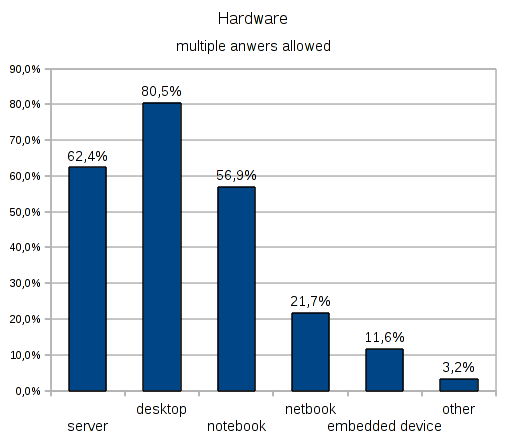
On what kind of hardware are you using Debian?
Multiple answers are allowed for this question and that is why the values do not sum up to 100%.
  • 80.5% are using Debian on the desktop
  • 62.4% on the server
  • 56.9% on the notebook
  • 21.7% on the netbook
  • 11.6% on embedded device(s)
  • 3.2% on other device(s)
The following other devices have been mentioned: smartphone, virtual machine, nettop, NAS, HTPC, workstation, pendrive, live cd, cluster, thin client, router, rocket flight computer, ibm mainframe, and automatic bar tender.

Do you contribute to Debian?
  • 50.0% choose answer #5: I don't contribute on a regular base.
  • 31.2% choose answer #4: I'm regularly helping other Debian users.
  • 8.0% choose other (see below) or simply did not answer
  • 4.9% choose answer #3: I'm regularly contributing to Debian packages without uploading them by myself.
  • 4.5% choose answer #1: I'm a Debian developer.
  • 1.4% choose answer #2: I'm a Debian maintainer.
The following other answers have been provided:
  • upstream developer or contributor
  • translator
  • bug reporter
  • advocator
  • former DD or DM
  • prospective DD or DM
  • mirror maintainer
  • package/installer tester
  • documentation writer
  • donator or debconf sponsor
  • debconf organizer or helper

How do you think about the Debian Free Software Guidelines (DFSG)?
  • 46.0% choose answer #2: I like the DFSG but it is not the most important reason for using Debian.
  • 36.6% choose answer #1: The DFSG is very important to me. I could live with many changes in Debian but I would be very upset if Debian would allow non-free software into its main component in the future.
  • 10.1% choose answer #3: I don't know.
  • 4.9% choose answer #4: I don't care.
  • 2.4% did not answer.

Are you using Debian derived distributions, too?
Multiple answers are allowed for this question and that is why the values do not sum up to 100%. There were a lot of different answers but the most frequent are:
  • 47.1%: Ubuntu (Kubuntu, Lubuntu, Xubuntu)
  • 40.8%: no answer; this was the only way to say that someone does not use a derived distribution
  • 11.0%: other (see below)
  • 7.0%: damn small linux
  • 4.8%: Sidux
  • 4.3%: grml (juxlala)
  • 2.2%: Knoppix
  • 1.6%: ELive
  • 1.4%: Maemo
The other answer includes the following distributions: 64studio, ALT Linux, arch linux, ArtistX, BackTrack, BRLix, Canaima GNU/Linux, catix, cdlinux.pl, CloneZilla, CrunchBang, Custom, ddwrt, debian arm userspace for zipit z2, DebXO (?), DreamLinux, Easy Peasy, eb4, eeebuntu, EMC2 Ubuntu (linuxcnc.org), Emdebian, Estrella Roja, Fedora, Finnix, Gentoo, gNewSense, Hackable:1, Kanotix, Kuliax, LFS and CLFS, LinEx, Linux Mint, live CDs, live-helper, Mepis antix, Musix, My own LiveCD, Mythbuntu, OpenInkpot, openwrt, paipix gnu, Parsix, Peppermint, personal debian derived, proxmox, Puppy, PureOS, qtopia, SHR, simplyMEPIS, Skolelinux, slackware, SymphonyOS, Toutou, Trisquel, tty GNU/Linux, UHU Linux, Univention Corporate Server, vinux, Voyage, Vyatta, whiite, Xandros, Xarnoppix. Not all of them are derived from Debian.

- to be continued -

18 June 2010

Alexander Reichle-Schmehl: Release Critical Bug report for Week 24

The inofficial rc bug tracker currently knows about the following bugs:
In Total:535
Affecting Squeeze:419
Squeeze only:58
Remaining to be fixed in Squeeze:361
Of these 361 bugs, the following tags are set:
Pending in Squeeze:18
Patched in Squeeze:55
Duplicates in Squeeze:50
Contrib or non-free in Squeeze:8
Claimed in Squeeze:2
Delayed in Squeeze:6
Can fixed in a security Update:31
Otherwise fixed in Squeeze:38
Ignoring all the above (multiple tags possible), 195 bugs need to be fixed by Debian Contributers to get Debian 6.0 Squeeze released. However, the with the view of the Release Managers, 337 need to be dealt with for the release to happen. Please see my older post for an explanation of the different numbers.

16 June 2010

Kartik Mistry: Bunch of good news..

1. Kavin is of 3 today. Can t forgot that awesome day :)
2. I ve joined Nexenta Systems since last month..
3. Nexenta is going to sponsor DebConf10! No. No DebConf for me this time. Wish me best luck for next time, please!

Russell Coker: Carpal Tunnel Getting Better

Three months ago I wrote about getting Carpal Tunnel Syndrome [1]. A few weeks after that I visited the specialist again and had my wrist brace adjusted to make it a little less uncomfortable. The specialist also gave me some quick ultra-sound treatment and then said that if it didn t get better in a month or two then I should just get a referral to a surgeon! I didn t have a bad case, some people have their hand muscles atrophy. My hand strength was measured as 50Kg in my left hand (the one with CTS) and 52Kg in my right hand. The greater strength in my right hand is probably more due to the lack of left-handed tools and sporting equipment than any muscle atrophy. This is slightly better than the physical standards for the Victoria Police (just over 50Kg average for both hands) [2] and a lot better than the Australian Federal Police physical standards of 45Kg for the dominant hand and 40Kg for the non-dominant [3]. Really my hand strength should have been recorded as 490Newton and 510Newton respectively, medicine is the science of healing, in all aspects of science the Newton is the measure of force. Over the past few months my hand seems to have recovered a lot while wearing the wrist-brace 24*7. I ve just started going without the wrist-brace during the day and it seems to be OK. I m currently planning to wear the wrist brace at night for a year or two as it s the only way to ensure that my hand doesn t end up on a bad angle when I m asleep. At this stage it seems that I ve made as close to a full recovery from CPS as is possible!

14 June 2010

Russell Coker: Should Passwords Expire?

It s widely regarded that passwords should be changed regularly. The Australian government declared last week the National Cyber Security Awareness Week [1] and has published a list of tips for online security which includes Get a stronger password and change it at least twice a year . Can a Password be Semi-Public? Generally I think of a password as being either secret or broken. If a password is known to someone other than the sysadmin and the user who is authorised to use the account in question then you have potentially already lost all your secret data. If a password is disclosed to an unauthorised person on one occasion then merely changing the password is not going to do any good unless the root cause is addressed, otherwise another anothorised person will probably get the password at some future time. Hitachi has published a good document covering many issues related to password management [2]. I think it does a reasonable job of making sysadmins aware of some of the issues but there are some things I disagree with. I think it should be used as a list of issues to consider rather than a list of answers. The Hitachi document lists a number of ways that passwords may be compromised and suggests changing them every 60 to 90 days to limit the use of stolen passwords. This seems to imply that a password is something that s value slowly degrades over time as it s increasingly exposed. I think that the right thing to do is to change a password if you suspect that it has been compromised. There s not much benefit in having a password if it s going to be known by unauthorised people for 89 days before being changed! Fundamentally a password is something that can have it s value rapidly drop to zero without warning. It doesn t wear out. Why are terms such as Three Months used for Maximum Password Ages? The Hitachi document gives some calculations on the probability of a brute-force attack succeeding against a random password with 90 days of attacking at a rate of 100 attempts per second [2]. I think that if a service is run by someone who wouldn t notice the load of 100 attempts per second then you have bigger security problems than the possibility of passwords being subject to brute-force attacks. Also it s not uncommon to have policies to lock accounts after as few as three failed login attempts. Rumor has it that in the early days of computing when the hashed password data was world readable someone calculated that more than 3 months of CPU time on a big computer would be needed to obtain a password by brute-force. But since then the power of individual CPUs has increased dramatically, computers have become cheap enough that anyone can easily gain legal access to dozens of systems and illegal access to a million systems, and it has become a design feature in every OS that hashed passwords are not readable by general users. So the limiting factor is to what degree the server restricts the frequency of password guesses. I don t think that specifying the minimum password length and maximum password age based on the fraction of the key space that could be subject to a brute-force attack makes sense. I don t think that any attempt to make an industry-wide standard for the frequency of password changes (as the government is trying to do) makes sense. Can there be a Delay between a Password being Compromised and being Used by an Attacker? Hypothetically speaking, if a password was likely to be compromised (EG by having the paper it was written on lost or stored insecurely) for some time before an attacker exploited it, then if the password was changed during that time period it could solve the problem. For example when a company moves office there is the possibility of notepaper with passwords to be lost. So if the sysadmin caused every user password to expire at the time of the move then a hostile party would be unable to gain access. Another possibility is the theft of backup tapes that contain the list of unencrypted passwords. If users change their passwords every three months then the theft of some four month old backup tapes will be less of a problem. Another possibility concerns the resale of old computers, phones, and other devices that may contain passwords. A reasonably intelligent user won t sell their old hardware as soon as the replacement device arrives, they will want to use the new device for some time to ensure that it works correctly. If passwords expire during this trial period with the new device then passwords stored in the old device won t have any value. The down-side to this idea is that people probably sell their old gear fairly quickly and making passwords expire every two weeks would not be accepted well by the users. It seems to me that having bulk password changes (all passwords for one user or for one company) based on circumstances that lead to potential insecurity would do more good than changing passwords at a fixed schedule. How are Passwords typically Compromised? Dinei Flor ncio and Cormac Herley of Microsoft Research and Baris Coskun of Brooklyn Polytechnic University wrote a paper titled Do Strong Web Passwords Accomplish Anything? [3] which discusses this issue. The first thing that they note is that nowadays passwords are most commonly compromised by phishing and keylogging. In those cases passwords are typically used shortly after they are stolen and the strength of a password never does any good. That paper suggests that banks should use stronger user-names rather than stronger passwords to combat the threat of bulk brute-force attacks. Can a Password Last Forever? If a password is entered in a secure manner, authenticated by a secure server, and all network links are encrypted or physically protected then there should never be a need to change it. Of course nothing is perfectly secure, so for some things with minimal short-term value or which can be used without anyone noticing there is a benefit in changing the password. But in the case of Internet banking if a hostile party gets your login details then you will probably know about it in a few days when the bank calls you about the unusual transactions from foreign countries long before a 90 day password change schedule would have done any good. Maybe one of the issues determining whether a password should be changed regularly is whether an attacker could use long-term read-only access to gain some benefit. Being able to read all the email someone received for a year could be a significant benefit if that person was a public figure, and there s usually no way for an ISP customer to know that someone else is downloading all their mail via POP or IMAP. Should a Password be the only Authentication Method? It is generally agreed that an authenitcation method should ideally involve something you have plus something you know. That means a password and a physical device such as a smart card, token with a changing sequential password, or a key such as a Yubikey [4]. If the physical device can t be cloned (through some combination of technical difficulty and physical access control) then it significantly improves security. When a physical device is used the purpose of the password is merely to stop someone who steals the physical device from being immediately exploit everything the password only has to be strong enough to keep the accounts secure until a new token can be issued. The combination of something you have and something you know is very strong. Having a physical token stored on the desk next to the PC that is used for logging in provides a significant benefit, then an attacker needs to break in to the house and can t sniff the password by compromising the PC remotely. Conclusion In all aspects of security you need to consider what threats you face. If an attacker is likely to launch an immediate noisy attack (such as transferring the maximum funds out of an Internet banking account) then changing the password regularly won t do any good. If a subtle long-term attack is expected then changing the password can do a lot of good but a physical token is the ideal if the account is valuable enough. But to put things in to perspective, it s technically possible to use a mobile phone camera at close range (or a SLR with a big lens at long range) to take a photo of keys that allow reproducing them. But this hasn t stopped people from carrying their house keys in an obvious manner that permits photography or leaving them on their desk at work. Also I ve never heard of anyone routinely changing the door locks in case a hostile party might have got a key although I m sure that such practices are common in highly secure locations. Few people even take their house keys off the key-ring when they have their car serviced! Related Posts Defense in Depth and Sudo when using sudo can increase security and when it can t.
Logging Shell Commands how to log what the sysadmin does and what benefits that provides you, it doesn t help if the sysadmin is hostile.
Logging in as Root should you login directly as root?

13 June 2010

Martin Michlmayr: Debian support for eSATA SheevaPlug available

The eSATA SheevaPlug is supported by the Debian installer and by Debian now. I've updated the install guide accordingly. If you're already running Debian on your eSATA SheevaPlug but you installed as a regular SheevaPlug to USB or SD and you'd like to use the eSATA, then make sure you're the latest kernel from Debian squeeze:
apt-get update
apt-get dist-upgrade
flash-kernel
Reboot and type this in u-boot:
setenv arcNumber 2678
saveenv
reset
Your machine will then be recognized as an eSATA SheevaPlug and eSATA will work. Thanks to John Holland for working on SheevaPlug eSATA support.

Craig Small: Does your program use gethostbyname() ?

There has been some discussion on the Debian IPv6 list about how the function gethostbyname() has changed. The manual page says this function is obsolete and with good reason.

A new feature of the function is that if a hostname has both IPv4 and IPv6 entries then the order of the return values is not predefined. In fact it used to be you'd get the IPv4 addresses first, then the IPv6. That has now changed and with the more recent glibc you will get an IPv6 address first. Quite often old code doesn't even check the address family or the size of address structure but just copies the relevant 4 bytes. You then get the first part of an 16-byte IPv6 address wedged into a 4-byte IPv4 address structure which basically means you get a mess.

The fix is pretty simple by changing the system call from gethostbyname() and using getaddrinfo() instead. If you only want the IPv4 addresses, perhaps because other parts of the code have not been checked or changed, then set the hints variable to return only IPv4 addresses.

If one of your packages is starting to play up and unable to connect to certain remote places and is instead trying to get to some "random" address, have a quick check for gethostbyname(). A quick grep across the source code may save a lot of debugging time.


<script defer="defer" src="http://static.zemanta.com/readside/loader.js" type="text/javascript"></script>

Next.

Previous.