Search Results: "spa"

21 November 2014

Gunnar Wolf: Status of the Debian OpenPGP keyring November update

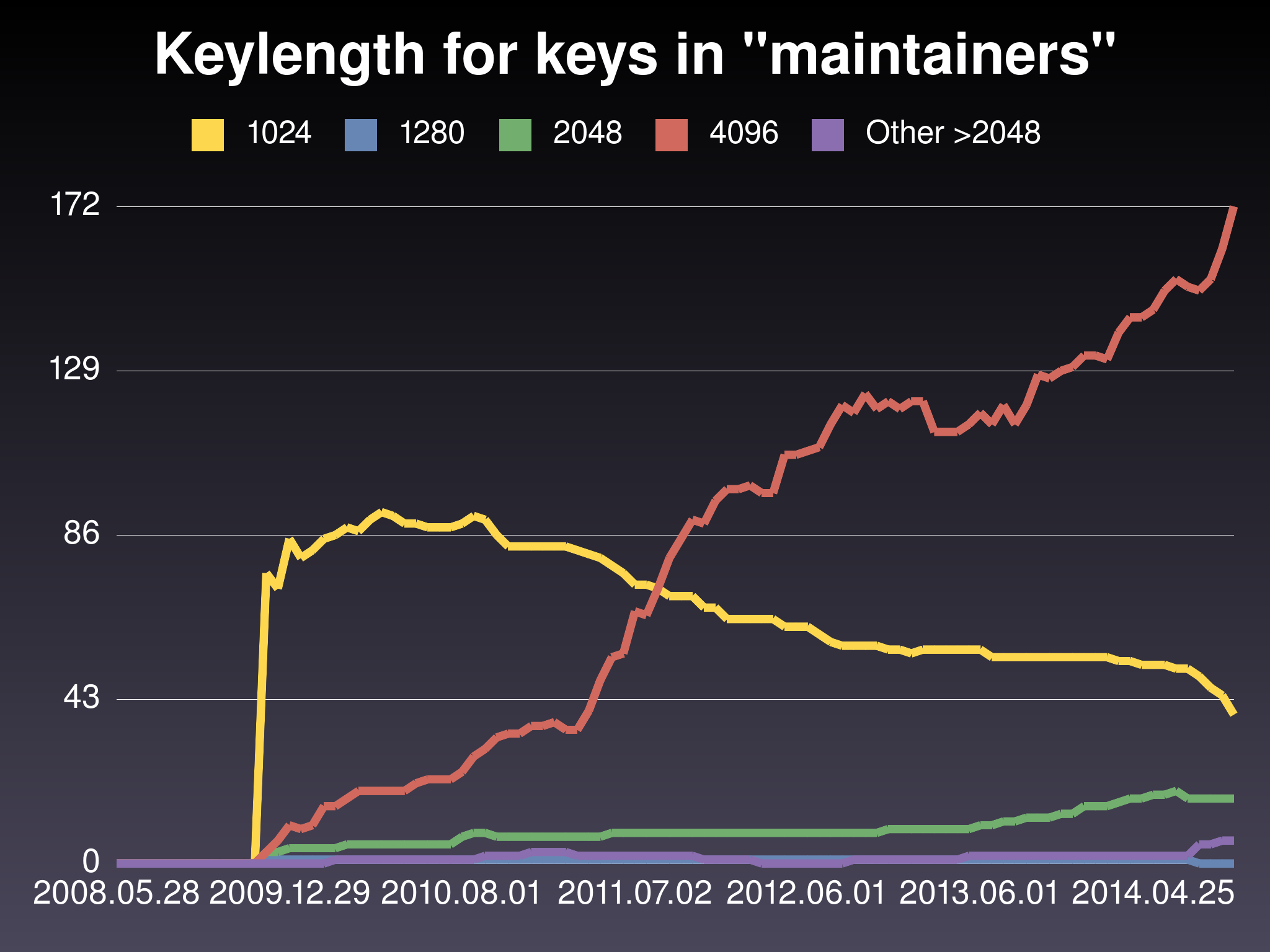
Almost two months ago I posted our keyring status graphs, showing the progress of the transition to >=2048-bit keys for the different active Debian keyrings. So, here are the new figures. First, the Non-uploading keyring: We were already 100% transitioned. You will only notice a numerical increase: That little bump at the right is our dear friend T ssia finally joining as a Debian Developer. Welcome! \o/ As for the Maintainers keyring: We can see a sharp increase in 4096-bit keys. Four 1024-bit DM keys were migrated to 4096R, but we did have eight new DMs coming in To them, also, welcome \o/. Sadly, we had to remove a 1024-bit key, as Peter Miller sadly passed away. So, in a 234-key universe, 12 new 4096R keys is a large bump! Finally, our current-greatest worry If for nothing else, for the size of the beast: The active Debian Developers keyring. We currently have 983 keys in this keyring, so it takes considerably more effort to change it. But we have managed to push it noticeably. This last upload saw a great deal of movement. We received only one new DD (but hey welcome nonetheless! \o/ ). 13 DD keys were retired; as one of the maintainers of the keyring, of course this makes me sad but then again, in most cases it's rather an acknowledgement of fact: Those keys' holders often state they had long not been really involved in the project, and the decision to retire was in fact timely. But the greatest bulk of movement was the key replacements: A massive 62 1024D keys were replaced with stronger ones. And, yes, the graph changed quite abruptly: We still have a bit over one month to go for our cutoff line, where we will retire all 1024D keys. It is important to say we will not retire the affected accounts, mark them as MIA, nor anything like that. If you are a DD and only have a 1024D key, you will still be a DD, but you will be technically unable to do work directly. You can still upload your packages or send announcements to regulated mailing lists via sponsor requests (although you will be unable to vote). Speaking of votes: We have often said that we believe the bulk of the short keys belong to people not really active in the project anymore. Not all of them, sure, but a big proportion. We just had a big, controversial GR vote with one of the highest voter turnouts in Debian's history. I checked the GR's tally sheet, and the results are interesting: Please excuse my ugly bash, but I'm posting this so you can play with similar runs on different votes and points in time using the public keyring Git repository:
  1. $ git checkout 2014.10.10
  2. $ for KEY in $( for i in $( grep '^V:' tally.txt
  3. awk ' print "<" $3 ">" ' )
  4. do
  5. grep $i keyids cut -f 1 -d ' '
  6. done )
  7. do
  8. if [ -f debian-keyring-gpg/$KEY -o -f debian-nonupload-gpg/$KEY ]
  9. then
  10. gpg --keyring /dev/null --keyring debian-keyring-gpg/$KEY \
  11. --keyring debian-nonupload-gpg/$KEY --with-colons \
  12. --list-key $KEY 2>/dev/null \
  13. head -2 tail -1 cut -f 3 -d :
  14. fi
  15. done sort uniq -c
  16. 95 1024
  17. 13 2048
  18. 1 3072
  19. 371 4096
  20. 2 8192
So, as of mid-October: 387 out of the 482 votes (80.3%) were cast by developers with >=2048-bit keys, and 95 (19.7%) were cast by short keys. If we were to run the same vote with the new active keyring, 417 votes would have been cast with >=2048-bit keys (87.2%), and 61 with short keys (12.8%). We would have four less votes, as they retired:
  1. 61 1024
  2. 14 2048
  3. 2 3072
  4. 399 4096
  5. 2 8192
So, lets hear it for November/December. How much can we push down that pesky yellow line? Disclaimer: Any inaccuracy due to bugs in my code is completely my fault!

20 November 2014

Matthew Palmer: Multi-level prefix delegation is not a myth! I've seen it!

Unless you ve been living under a firewalled rock, you know that IPv6 is coming. There s also a good chance that you ve heard that IPv6 doesn t have NAT. Or, if you pay close attention to the minutiae of IPv6 development, you ve heard that IPv6 does have NAT, but you don t have to (and shouldn t) use it. So let s say we ll skip NAT for IPv6. Fair enough. However, let s say you have this use case:
  1. A bunch of containers that need Internet access
  2. That are running in a VM
  3. On your laptop
  4. Behind your home router!
For IPv4, you d just layer on the NAT, right? While SIP and IPsec might have kittens trying to work through three layers of NAT, for most things it ll Just Work. In the Grand Future of IPv6, without NAT, how the hell do you make that happen? The answer is Prefix Delegation , which allows routers to delegate management of a chunk of address space to downstream routers, and allow those downstream routers to, in turn, delegate pieces of that chunk to downstream routers. In the case of our not-so-hypothetical containers-in-VM-on-laptop-at-home scenario, it would look like this:
  1. My border router (a DNS-323 running Debian) asks my ISP for a delegated prefix, using DHCPv6. The ISP delegates a /561. One /64 out of that is allocated to the network directly attached to the internal interface, and the rest goes into the pool , as /60 blocks (so I ve got 15 of them to delegate, if required).
  2. My laptop gets an address on the LAN between itself and the DNS-323 via stateless auto-addressing ( SLAAC ). It also uses DHCPv6 to request one of the /60 blocks from the DNS-323. The laptop puts one /64 from that block as the address space for the virtual LAN (actually a Linux bridge) that connects the laptop to all my VMs, and puts the other 15 /64 blocks into a pool for delegation.
  3. The VM that will be running the set of containers under test gets an address on the all VMs virtual LAN via SLAAC, and then requests a delegated /64 to use for the all containers virtual LAN (another bridge, this one running on the VM itself) that the containers will each connect to themselves.
Now, almost all of this Just Works. The current releases of ISC DHCP support prefix delegation just fine, and a bit of shell script plumbing between the client and server seals the deal the client needs to rewrite the server s config file to tell it the netblock from which it can delegate. Except for one teensy, tiny problem routing. When the DHCP server delegates a netblock to a particular machine, the routing table needs to get updated so that packets going to that netblock actually get sent to the machine the netblock was delegated to. Without that, traffic destined for the containers (or the VM) won t actually make it to its destination, and a one-way Internet connection isn t a whole lot of use. I cannot understand why this problem hasn t been tripped over before. It s absolutely fundamental to the correct operation of the delegation system. Some people advocate running a dynamic routing protocol, but that s a sledgehammer to crack a nut if ever I saw one. Actually, I know this problem has been tripped over before, by OpenWrt. Their solution, however, was to use a PHP script to scan logfiles and add routes. Suffice it to say, that wasn t an option I was keen on exploring. Instead, I decided to patch ISC DHCP so that the server can run an external script to add the necessary routes, and perhaps modify firewall rules and also to reverse the process when the delegation is released (or expired). If anyone else wants to play around with it, I ve put it up on Github. I don t make any promises that it s the right way to do it, necessarily, but it works, and the script I ve added in contrib/prefix-delegation-routing.rb shows how it can be used to good effect. By the way, if anyone knows how pull requests work over at ISC, drop me a line. From the look of their website, they don t appear to accept (or at least encourage) external contributions. So, that s one small patch for DHCP, one giant leap for my home network.
  1. The standard recommendation is for ISPs to delegate each end-user customer a /48 (giving 65,536 /64 networks); my ISP is being a little conservative in only giving me 256 /64s. It works fine for my purposes, but if you re an ISP getting set for deploying IPv6, make life easy on your customers and give them a /48.

19 November 2014

EvolvisForge blog: Valid UTF-8 but invalid XML

Another PSA: something surprising about XML. As you might all know, XML must be valid UTF-8 (or UTF-16 (or another encoding supported by the parser, but one which yields valid Unicode codepoints when read and converted)). Some characters, such as the ampersand & , must be escaped ( &#38; or &#x26; , although &amp; may also work, depending on the domain) or put into a CDATA section ( <![CDATA[&]]> ). A bit surprisingly, a literal backspace character (ASCII 08h, Unicode U+0008) is not allowed in the text. I filed a bugreport against libxml2, asking it to please encode these characters. A bit more research followed. Surprisingly, there are characters that are not valid in XML documents in any way, not even as entities or in CDATA sections. (xmlstarlet, by the way, errors out somewhat nicely for an unescaped literal or entity-escaped backspace, but behaves absolutely hilarious for a literal backspace in a CDATA section.) Basically, XML contains a whitelist for the following Unicode codepoints: Additionally, a certain number of codepoints is discouraged: U+007F U+0084 (IMHO wise), U+0086 U+009F (also wise, but why allow U+0085?), U+FDD0 U+FDEF (a bit surprisingly, but consistent with disallowing the backspace character), and the last two codepoints of every plane (U+FFFE and U+FFFF were already disallowed, but U-0001FFFE, U-0001FFFF, , U-0010FFFF weren t; this is extremely wise). The suggestion seems to be to just strip these characters silently from the XML document . I m a bit miffed about this, as I don t even use XML directly (I m extending a PHP webapplication that is a SOAP client and talks to a Java SOAP-WS) and would expect this to preserve my strings, but, oh my. I ve forwarded the suggestion to just strip them silently to the libxml2 maintainers in the aforementioned bug report, for now, and may even hack that myself (on customer-paid time). More robust than hacking the PHP thingy to strip them first, anyway I ve got no control over the XML after all. Sharing this so that more people know that not all UTF-8 is valid in XML. Maybe it saves someone else some time. (Now wondering whether to address this in my xhtml_escape shell function. Probably should. Meh.)

18 November 2014

Laura Arjona: Translating (reviewing) Debian package descriptions

Some days I feel super lazy but I still would like to go on contributing translations to Debian.
Then, I leave the web translations a bit, and change to translate or review Debian package descriptions. It s something that anybody can do without any knowledge of translation tools, since it is a very simple web interface, as you will see. First you need to create a login account, then, login into the system. And then, go to the page of your mother language (in my case, Spanish, es ). You will see some introductory text, and the list of pending translations:
ddtss_es1
At the end of the page, there is the list of translations pending to review:
ddtss_es2 We should begin with this, so the work that other people already made arrives quickly its destination. And it s the easiest part, as you will see. Let s pick one of them (libvformat1-dev): review1
You see the short description in the original English, and the current translation (if there were changes from a former version, they are coloured too). I didn t know what the package libvformat1-dev does, but here s a nice opportunity to learn aobut it a bit :) The short description looks ok for me. Let s go on to the long description: review2 It also looks correct for me. So I leave the text box as is, and go on until the bottom of the page:
review3
and click Accept as is . That s all!! The system brings you back to the page with pending translations and reviews. Let s pick another one: totem
review4
I found a typo and corrected some other words, so I updated the text in the translation box, left a message to the other translators in the comment box, and clicked Accept with changes . And iterate. When 3 translators agree in a translation, it becomes official, and its propagated to apt-cache, aptitude, synaptic, etc., and the website (packages.debian.org). This is the most difficult part (to get 3 reviews for each package description): many language teams are small, and their workforce is spread in many fronts: translations for the website, news and announcements, debconf templates (the messages that are shown to the user when a package is installed), the Debian installer, the documentation, the package descriptions So your help (even when you only review some translations from time to time) will be appreciated, for sure.
Filed under: Tools Tagged: Contributing to libre software, Debian, English, translations

Jaldhar Vyas: And The Papers Want To Know Whose Shirts You Wear

Bayeux Tapestry: Guy in sexist shirt sees a comet Today I was walking past the Courant Institute at NYU when I saw a man wearing a t-shirt with a picture of a cow diagramming all the various cuts of beef. Now I've lost all interest in science. Thanks a lot jerks.

17 November 2014

Niels Thykier: The first 12 days and 408 unblock requests into the Jessie freeze

The release team receives an extreme amount of unblock requests right now. For the past 22 days[1], we have been receiving no less than 408 unblock/ageing requests. That is an average of ~18.5/day. In the same period, the release team have closed 350 unblocks requests, averaging 15.9/day. This number does not account for number of unblocks, we add without a request, when we happen to spot when we look at the list of RC bugs[2]. Nor does it account for unblock requests currently tagged moreinfo , of which there are currently 25. All in all, it has been 3 intensive weeks for the release team. I am truly proud of my fellow team members for keeping up with this for so long! Also a thanks to the non-RT members, who help us by triaging and reviewing the unblock requests! It is much appreciated. :) Random bonus info: [1] We started receiving some in the 10 days before the freeze as people realised that their uploads would need an unblock to make it into Jessie. [2] Related topics: what is adsb? (the answer being: Our top hinter for Wheezy)

Daniel Leidert: Removal of debian.wgdd.de and cvs,svn,vcs .wgdd.de

If you've recently tried to browse to or apt-get from either cvs.wgdd.de, svn.wgdd.de, vcs.wgdd.de, debian.wgdd.de or ubuntu.wgdd.deyou've probably seen (and still are) an error (410, Gone) coming up and I'd like to give a short explanation why. cvs,svn,vcs .wgdd.deI've left my server provider and shut down the above services and only keep a small amount of services running. The domains cvs,svn,vcs .wgdd.de were used to provide (a) a subversion (SVN) server (via HTTPS and dav_svn) for some public and private work and (b) a CVS web-client to some old project works in CVS.Among the latter was e.g. old code to generate manual pages for the proprietary fglrx graphics driver, stuff that laid there untouched for many years. So I guess, it was about time to finally remove it :)The subversion web-client gave public access to some packaging work I do for the Debian GNU/Linux distribution, e.g. for the cvsweb, gtypist packages and some non-official packaging work. For the official packages I plan to move the files into the collab-maint web space and adjust the packages control files accordingly. Everything else will be hosted non-publicly in the future. I still intend to move stuff, that turns out to be useful for more people, to public places like github and Co. Update 17.11.2014: cvsweb, gurlchecker and gtypist have been moved to collab-maint. debian.wgdd.deI used this site to describe my usage of Debian GNU/Linux on the hardware I own ... laptop, servers etc. I wrote a few HOWTOs and provided a link collection with useful links. You can still find all of this using the archive.org service. I also had a repository up and working, especially to provide bluefish packages for users of Debian stable and Ubuntu. Half a year ago I dropped the Ubuntu build environments and packages and moved the Debian stable backports to official places. This effectively emptied the repository and left only the wgdd-archive-keyring package in place. So, there is no real need for a public repository anymore and the linklist probably got outdated too. All in all, I decided to stop this service (maybe I'll forward the site to here later :)).If you see an error regarding the debian.wgdd.de URL running apt-get or aptitude, then there is a reference to this site in /etc/apt/sources.list or /etc/apt/sources.list.d/*, which can be safely removed. Further you should get rid of the wgdd-archive-keyring package:
apt-get autoremove --purge wgdd-archive-keyring
... or the repository key:
apt-key del E394D996
What elseIn case you need any content from the mentioned services, just let me know.

Chris Lamb: Calculating the number of pedal turns on a bike ride

If you have a cadence sensor on your bike such as the Garmin GSC-10, you can approximate the number of pedal turns you made on the bike ride using the following script (requires GPSBabel):
#!/bin/sh
STYLE="$(mktemp)"
cat >$ STYLE  <<EOF
FIELD_DELIMITER COMMA
RECORD_DELIMITER NEWLINE
OFIELD CADENCE,"","%d"
EOF
exec gpsbabel -i garmin_fit -f "$ 1 " -o xcsv,style=$ STYLE  -F-  
    awk ' x += $1  END  print int(x / 60) '
... then call with:
$ sh cadence.sh ~/path/to/2014-11-16-14-46-05.fit
24344
Unfortunately the Garmin .fit format doesn't store the actual number of pedal turns, only the average for each particular second. However, it should be reasonably accurate given that one keeps a reasonably steady cadence. As a bonus, using a small amount of shell plumbing you can then sum an entire year's worth of riding like so:
$ for X in ~/path/to/2014-*.fit; do sh cadence.sh $ X ; done   awk ' x += $1  END   print x  '
749943

16 November 2014

Bernhard R. Link: Enabling Change

Big changes are always a complicated thing to get done and can be the harder the bigger or more diverse an organization is it is taking place in. Transparency Ideally every change is well communicated early and openly. Leaving people in the dark about what will change and when means people have much less time to feeling comfortable about it or arranging with it mentally. Especially bad can be extending the change later or or shortening transition periods. Letting people think they have some time to transition only to force them to rush later will remove any credibility you have and severely reduce their ability to believe you are not crossing them. Making a new way optional is a great way to create security (see below), but making that obligatory before the change even arrives as optional with them will not make them very willing to embrace change. Take responsibility Every transformation means costs. Even if some change did only improve and did not make anything worse once implemented (the ideal change you will never meet in reality), the deployment of the change still costs: processes have adapted to it, people have to relearn how to do things, how to detect if something goes wrong, how to fix it, documentation has to be adopted and and and. Even as the change causes more good than costs in the whole organization (let's hope it does, I hope you wouldn't try to do something if the total benefit is negative), the benefits and thus the benefit to cost ratio will differ for the different parts of your organization or the different people within it. It's hardly avoidable that for some people there will not be much benefit, much less perceived benefit compared to the costs they have to burden for it. Those are the people whose good will you want to fight for, not the people you want to fight against. They have to pay with their labor/resources and thus their good will for your benefit the overall benefit. This is much easier if you acknowledge that fact. If you blame them for having the costs, claim their situation does not even exist or even ridicule them for not embracing change you only prepare yourself for frustration. You might be able to persuade yourself that everyone that is not willing to invest in the change is just acting out of malevolent self-interest. But you will hardly be able to persuade people that it is evil to not help your cause if you treat them as enemies. And once you ignored or played down costs that later actually happen, your credibility in being able to see the big picture will simply cease to exist at all for the next change. Allow different metrics People have different opinions about priorities, about what is important, about how much something costs and even about what is a problem. If you want to persuade them, try to take that into account. If you do not understand why something is a reason, it might be because the given point is stupid. But it might also be that you miss something. And often there is simple a different valuation of what is important, what the costs are and what are problems. If you want to persuade people, it is worth to try to understand those. If all you want to do is persuade some leader or some majority then ridiculing their concerns might get you somewhere. But how do you want to win people over if you do not even appear to understand their problems. Why should people trust you that their costs will be worth the overall benefits if you tell them the costs that they clearly see do not exist? How credible is referring to the bigger picture if the part of the picture they can see does not match what you say the bigger picture looks like? Don't get trolled and don't troll There will always be people that might be unreasonable or even try to provoke you. Don't allow being provoked. Remember that for successful changes you need to win broad support. Feeling personally attacked or feeling presented a large amount of pointless arguments easily results in not bringing proper responses or actually looking at arguments. If someone is only trolling and purely malevolent, they will tease you best if they bring actual concerns of people in a way you likely degrade your yourself and your point in answering. Becoming impertinent with the troll is like attacking the annoying little goblin hiding next to the city guards with area damage. When not being able to persuade people, it is also far to easy to consider them in bad faith and/or attacking them personally. This can only escalate even more. Worst case you frustrate someone in good faith. In most cases you poison the discussion so much that people actually in good faith will no longer contribute the discussion. It might be rewarding short term because after some escalation only obviously unreasonable people will talk against you, but it makes it much harder to find solutions together that could benefit anyone and almost impossible to persuade those that simply left the discussion. Give security Last but not least, remember that humans are quite risk-averse. In general they might invest in (even small) chances to win, but go a long way to avoid risks. Thus an important part of enabling change is to reduce risks, real and perceived ones and give people a feeling of security. In the end, almost every measure boils down to that: You give people security by giving them the feeling that the whole picture is considered in decisions (by bringing them early into the process, by making sure their concerns are understood and part of the global profit/cost calculation and making sure their experiences with the change are part of the evaluation). You give people security by allowing them to predict and control things (by transparency about plans, how far the change will go and guaranteed transitions periods, by giving them enough time so they can actually plan and do the transition). You give people security by avoiding early points of no return (by having wide enough tests, rollback scenarios,...). You give people security by not letting them alone (by having good documentation, availability of training, ...). Especially side-by-side availability of old and new is an extremely powerful tool, as it fits all of the above: It allows people to actually test it (and not some little prototype mostly but not quite totally unrelated to reality) so their feedback can be heard. It makes it more predictable as all the new ways can be tried before the old ones no longer work. It is the ultimate role-back scenario (just switch off the new). And allows for learning the new before losing the old. Of course giving the people a feeling of security needs resources. But it is a very powerful way to get people to embrace the chance. Also in my experience people only fearing for themselves will usually mostly be passive by not pushing forward and trying to avoid or escape the changes. (After all, working against something costs energy, so purely egoistic behavior is quite limiting in that regard). Most people actively pushing back do it because they fear for something larger than only them. And any measure to making them fear less that you ruin the overall organization, not only avoids unnecessary hurdles rolling out the change but also has some small chance to actually avoid running into disaster with closed eyes.

Vincent Bernat: Staging a Netfilter ruleset in a network namespace

A common way to build a firewall ruleset is to run a shell script calling iptables and ip6tables. This is convenient since you get access to variables and loops. There are three major drawbacks with this method:
  1. While the script is running, the firewall is temporarily incomplete. Even if existing connections can be arranged to be left untouched, the new ones may not be allowed to be established (or unauthorized flows may be allowed). Also, essential NAT rules or mangling rules may be absent.
  2. If an error occurs, you are left with an half-working firewall. Therefore, you should ensure that some rules authorizing remote access are set very early. Or implement some kind of automatic rollback system.
  3. Building a large firewall can be slow. Each ip ,6 tables command will download the ruleset from the kernel, add the rule and upload the whole modified ruleset to the kernel.

Using iptables-restore A classic way to solve these problems is to build a rule file that will be read by iptables-restore and ip6tables-restore1. Those tools send the ruleset to the kernel in one pass. The kernel applies it atomically. Usually, such a file is built with ip ,6 tables-save but a script can fit the task. The ruleset syntax understood by ip ,6 tables-restore is similar to the syntax of ip ,6 tables but each table has its own block and chain declaration is different. See the following example:
$ iptables -P FORWARD DROP
$ iptables -t nat -A POSTROUTING -s 192.168.0.0/24 -j MASQUERADE
$ iptables -N SSH
$ iptables -A SSH -p tcp --dport ssh -j ACCEPT
$ iptables -A INPUT -i lo -j ACCEPT
$ iptables -A OUTPUT -o lo -j ACCEPT
$ iptables -A FORWARD -m state --state ESTABLISHED,RELATED -j ACCEPT
$ iptables -A FORWARD -j SSH
$ iptables-save
*nat
:PREROUTING ACCEPT [0:0]
:INPUT ACCEPT [0:0]
:OUTPUT ACCEPT [0:0]
:POSTROUTING ACCEPT [0:0]
-A POSTROUTING -s 192.168.0.0/24 -j MASQUERADE
COMMIT
*filter
:INPUT ACCEPT [0:0]
:FORWARD DROP [0:0]
:OUTPUT ACCEPT [0:0]
:SSH - [0:0]
-A INPUT -i lo -j ACCEPT
-A FORWARD -m state --state RELATED,ESTABLISHED -j ACCEPT
-A FORWARD -j SSH
-A OUTPUT -o lo -j ACCEPT
-A SSH -p tcp -m tcp --dport 22 -j ACCEPT
COMMIT
As you see, we have one block for the nat table and one block for the filter table. The user-defined chain SSH is declared at the top of the filter block with other builtin chains. Here is a script diverting ip ,6 tables commands to build such a file (heavily relying on some Zsh-fu2):
#!/bin/zsh
set -e
work=$(mktemp -d)
trap "rm -rf $work" EXIT
#   Redefine ip ,6 tables
iptables()  
    # Intercept -t
    local table="filter"
    [[ -n $ @[(r)-t]  ]] &&  
        # Which table?
        local index=$ (k)@[(r)-t] 
        table=$ @[(( index + 1 ))] 
        argv=( $argv[1,(( $index - 1 ))] $argv[(( $index + 2 )),$#] )
     
    [[ -n $ @[(r)-N]  ]] &&  
        # New user chain
        local index=$ (k)@[(r)-N] 
        local chain=$ @[(( index + 1 ))] 
        print ":$ chain  -" >> $ work /$ 0 -$ table -userchains
        return
     
    [[ -n $ @[(r)-P]  ]] &&  
        # Policy for a builtin chain
        local index=$ (k)@[(r)-P] 
        local chain=$ @[(( index + 1 ))] 
        local policy=$ @[(( index + 2 ))] 
        print ":$ chain  $ policy " >> $ work /$ 0 -$ table -policy
        return
     
    # iptables-restore only handle double quotes
    echo $ $ (q-)@ //\'/\"  >> $ work /$ 0 -$ table -rules #'
 
functions[ip6tables]=$ functions[iptables] 
#   Build the final ruleset that can be parsed by ip ,6 tables-restore
save()  
    for table ($ work /$ 1 -*-rules(:t:s/-rules//))  
        print "*$ $ table #$ 1 - "
        [ ! -f $ work /$ table -policy ]   cat $ work /$ table -policy
        [ ! -f $ work /$ table -userchains   cat $ work /$ table -userchains
        cat $ work /$ table -rules
        print "COMMIT"
     
 
#   Execute rule files
for rule in $(run-parts --list --regex '^[.a-zA-Z0-9_-]+$' $ 0%/* /rules); do
    . $rule
done
#   Execute rule files
ret=0
save iptables    iptables-restore    ret=$?
save ip6tables   ip6tables-restore   ret=$?
exit $ret
In , a new iptables() function is defined and will shadow the iptables command. It will try to locate the -t parameter to know which table should be used. If such a parameter exists, the table is remembered in the $table variable and removed from the list of arguments. Defining a new chain (with -N) is also handled as well as setting the policy (with -P). In , the save() function will output a ruleset that should be parseable by ip ,6 tables-restore. In , user rules are executed. Each ip ,6 tables command will call the previously defined function. When no error has occurred, in , ip ,6 tables-restore is invoked. The command will either succeed or fail. This method works just fine3. However, the second method is more elegant.

Using a network namespace An hybrid approach is to build the firewall rules with ip ,6 tables in a newly created network namespace, save it with ip ,6 tables-save and apply it in the main namespace with ip ,6 tables-restore. Here is the gist (still using Zsh syntax):
#!/bin/zsh
set -e
alias main='/bin/true  '
[ -n $iptables ]    
    #   Execute ourself in a dedicated network namespace
    iptables=1 unshare --net -- \
        $0 4> >(iptables-restore) 6> >(ip6tables-restore)
    #   In main namespace, disable iptables/ip6tables commands
    alias iptables=/bin/true
    alias ip6tables=/bin/true
    alias main='/bin/false  '
 
#   In both namespaces, execute rule files
for rule in $(run-parts --list --regex '^[.a-zA-Z0-9_-]+$' $ 0%/* /rules); do
    . $rule
done
#   In test namespace, save the rules
[ -z $iptables ]    
    iptables-save >&4
    ip6tables-save >&6
 
In , the current script is executed in a new network namespace. Such a namespace has its own ruleset that can be modified without altering the one in the main namespace. The $iptables environment variable tell in which namespace we are. In the new namespace, we execute all the rule files ( ). They contain classic ip ,6 tables commands. If an error occurs, we stop here and nothing happens, thanks to the use of set -e. Otherwise, in , the ruleset of the new namespace are saved using ip ,6 tables-save and sent to dedicated file descriptors. Now, the execution in the main namespace resumes in . The results of ip ,6 tables-save are feeded to ip ,6 tables-restore. At this point, the firewall is mostly operational. However, we will play again the rule files ( ) but the ip ,6 tables commands will be disabled ( ). Additional commands in the rule files, like enabling IP forwarding, will be executed. The new namespace does not provide the same environment as the main namespace. For example, there is no network interface in it, so we cannot get or set IP addresses. A command that must not be executed in the new namespace should be prefixed by main:
main ip addr add 192.168.15.1/24 dev lan-guest
You can look at a complete example on GitHub.

  1. Another nifty tool is iptables-apply which will apply a rule file and rollback after a given timeout unless the change is confirmed by the user.
  2. As you can see in the snippet, Zsh comes with some powerful features to handle arrays. Another big advantage of Zsh is it does not require quoting every variable to avoid field splitting. Hence, the script can handle values with spaces without a problem, making it far more robust.
  3. If I were nitpicking, there are three small flaws with it. First, when an error occurs, it can be difficult to match the appropriate location in your script since you get the position in the ruleset instead. Second, a table can be used before it is defined. So, it may be difficult to spot some copy/paste errors. Third, the IPv4 firewall may fail while the IPv6 firewall is applied, and vice-versa. Those flaws are not present in the next method.

Vincent Bernat: Intel Wireless 7260 as an access point

My home router acts as an access point with an Intel Dual-Band Wireless-AC 7260 wireless card. This card supports 802.11ac (on the 5 GHz band) and 802.11n (on both the 5 GHz and 2.4 GHz band). While this seems a very decent card to use in managed mode, this is not really a great choice for an access point.
$ lspci -k -nn -d 8086:08b1
03:00.0 Network controller [0280]: Intel Corporation Wireless 7260 [8086:08b1] (rev 73)
        Subsystem: Intel Corporation Dual Band Wireless-AC 7260 [8086:4070]
        Kernel driver in use: iwlwifi
TL;DR: Use an Atheros card instead.

Limitations First, the card is said dual-band but you can only uses one band at a time because there is only one radio. Almost all wireless cards have this limitation. If you want to use both the 2.4 GHz band and the less crowded 5 GHz band, two cards are usually needed.

5 GHz band There is no support to set an access point on the 5 GHz band. The firmware doesn t allow it. This can be checked with iw:
$ iw reg get
country CH: DFS-ETSI
        (2402 - 2482 @ 40), (N/A, 20), (N/A)
        (5170 - 5250 @ 80), (N/A, 20), (N/A)
        (5250 - 5330 @ 80), (N/A, 20), (0 ms), DFS
        (5490 - 5710 @ 80), (N/A, 27), (0 ms), DFS
        (57240 - 65880 @ 2160), (N/A, 40), (N/A), NO-OUTDOOR
$ iw list
Wiphy phy0
[...]
        Band 2:
                Capabilities: 0x11e2
                        HT20/HT40
                        Static SM Power Save
                        RX HT20 SGI
                        RX HT40 SGI
                        TX STBC
                        RX STBC 1-stream
                        Max AMSDU length: 3839 bytes
                        DSSS/CCK HT40
                Frequencies:
                        * 5180 MHz [36] (20.0 dBm) (no IR)
                        * 5200 MHz [40] (20.0 dBm) (no IR)
                        * 5220 MHz [44] (20.0 dBm) (no IR)
                        * 5240 MHz [48] (20.0 dBm) (no IR)
                        * 5260 MHz [52] (20.0 dBm) (no IR, radar detection)
                          DFS state: usable (for 192 sec)
                          DFS CAC time: 60000 ms
                        * 5280 MHz [56] (20.0 dBm) (no IR, radar detection)
                          DFS state: usable (for 192 sec)
                          DFS CAC time: 60000 ms
[...]
While the 5 GHz band is allowed by the CRDA, all frequencies are marked with no IR. Here is the explanation for this flag:
The no-ir flag exists to allow regulatory domain definitions to disallow a device from initiating radiation of any kind and that includes using beacons, so for example AP/IBSS/Mesh/GO interfaces would not be able to initiate communication on these channels unless the channel does not have this flag.

Multiple SSID This card can only advertise one SSID. Managing several of them is useful to setup distinct wireless networks, like a public access (routed to Tor), a guest access and a private access. iw can confirm this:
$ iw list
        valid interface combinations:
                 * #  managed   <= 1, #  AP, P2P-client, P2P-GO   <= 1, #  P2P-device   <= 1,
                   total <= 3, #channels <= 1
Here is the output of an Atheros card able to manage 8 SSID:
$ iw list
        valid interface combinations:
                 * #  managed, WDS, P2P-client   <= 2048, #  IBSS, AP, mesg point, P2P-GO   <= 8,
                   total <= 2048, #channels <= 1

Configuration as an access point Except for those two limitations, the card works fine as an access point. Here is the configuration that I use for hostapd:
interface=wlan-guest
driver=nl80211
# Radio
ssid=XXXXXXXXX
hw_mode=g
channel=11
# 802.11n
wmm_enabled=1
ieee80211n=1
ht_capab=[HT40-][SHORT-GI-20][SHORT-GI-40][DSSS_CCK-40][DSSS_CCK-40][DSSS_CCK-40]
# WPA
auth_algs=1
wpa=2
wpa_passphrase=XXXXXXXXXXXXXXX
wpa_key_mgmt=WPA-PSK
wpa_pairwise=TKIP
rsn_pairwise=CCMP
Because of the use of channel 11, only 802.11n HT40- rate can be enabled. Look at the Wikipedia page for 802.11n to check if you can use either HT40-, HT40+ or both.

Vincent Bernat: Replacing Swisscom router by a Linux box

I have recently moved to Lausanne, Switzerland. Broadband Internet access is not as cheap as in France. Free, a French ISP, is providing an FTTH access with a bandwith of 1 Gbps1 for about 38 (including TV and phone service), Swisscom is providing roughly the same service for about 200 2. Swisscom fiber access was available for my appartment and I chose the 40 Mbps contract without phone service for about 80 . Like many ISP, Swisscom provides an Internet box with an additional box for TV. I didn t unpack the TV box as I have no use for it. The Internet box comes with some nice features like the ability to setup firewall rules, a guest wireless access and some file sharing possibilities. No shell access! I have bought a small PC to act as router and replace the Internet box. I have loaded the upcoming Debian Jessie on it. You can find the whole software configuration in a GitHub repository. This blog post only covers the Swisscom-specific setup (and QoS). Have a look at those two blog posts for related topics:

Ethernet The Internet box is packed with a Siligence-branded 1000BX SFP3. This SFP receives and transmits data on the same fiber using a different wavelength for each direction. Instead of using a network card with an SFP port, I bought a Netgear GS110TP which comes with 8 gigabit copper ports and 2 fiber SFP ports. It is a cheap switch bundled with many interesting features like VLAN and LLDP. It works fine if you don t expect too much from it.

IPv4 IPv4 connectivity is provided over VLAN 10. A DHCP client is mandatory. Moreover, the DHCP vendor class identifier option (option 60) needs to be advertised. This can be done by adding the following line to /etc/dhcp/dhclient.conf when using the ISC DHCP client:
send vendor-class-identifier "100008,0001,,Debian";
The first two numbers are here to identify the service you are requesting. I suppose this can be read as requesting the Swisscom residential access service. You can put whatever you want after that. Once you get a lease, you need to use a browser to identify yourself to Swisscom on the first use.

IPv6 Swisscom provides IPv6 access through the 6rd protocol. This is a tunneling mechanism to facilitate IPv6 deployment accross an IPv4 infrastructure. This kind of tunnel is natively supported by Linux since kernel version 2.6.33. To setup IPv6, you need the base IPv6 prefix and the 6rd gateway. Some ISP are providing those values through DHCP (option 212) but this is not the case for Swisscom. The gateway is 6rd.swisscom.com and the prefix is 2a02:1200::/28. After appending the IPv4 address to the prefix, you still get 4 bits for internal subnets. Swisscom doesn t provide a fixed IPv4 address. Therefore, it is not possible to precompute the IPv6 prefix. When installed as a DHCP hook (in /etc/dhcp/dhclient-exit-hooks.d/6rd), the following script configures the tunnel:
sixrd_iface=internet6
sixrd_mtu=1472                  # This is 1500 - 20 - 8 (PPPoE header)
sixrd_ttl=64
sixrd_prefix=2a02:1200::/28     # No way to guess, just have to know it.
sixrd_br=193.5.29.1             # That's "6rd.swisscom.com"
sixrd_down()  
    ip tunnel del $ sixrd_iface    true
 
sixrd_up()  
    ipv4=$ new_ip_address:-$old_ip_address 
    sixrd_subnet=$(ruby <<EOF
require 'ipaddr'
prefix = IPAddr.new "$ sixrd_prefix ", Socket::AF_INET6
prefixlen = $ sixrd_prefix#*/ 
ipv4 = IPAddr.new "$ ipv4 ", Socket::AF_INET
ipv6 = IPAddr.new (prefix.to_i + (ipv4.to_i << (64 + 32 - prefixlen))), Socket::AF_INET6
puts ipv6
EOF
)
    # Let's configure the tunnel
    ip tunnel add $ sixrd_iface  mode sit local $ipv4 ttl $sixrd_ttl
    ip tunnel 6rd dev $ sixrd_iface  6rd-prefix $ sixrd_prefix 
    ip addr add $ sixrd_subnet 1/64 dev $ sixrd_iface 
    ip link set mtu $ sixrd_mtu  dev $ sixrd_iface 
    ip link set $ sixrd_iface  up
    ip route add default via ::$ sixrd_br  dev $ sixrd_iface 
 
case $reason in
    BOUND REBOOT)
        sixrd_down
        sixrd_up
        ;;
    RENEW REBIND)
        if [ "$new_ip_address" != "$old_ip_address" ]; then
            sixrd_down
            sixrd_up
        fi
        ;;
    STOP EXPIRE FAIL RELEASE)
        sixrd_down
        ;;
esac
The computation of the IPv6 prefix is offloaded to Ruby instead of trying to use the shell for that. Even if the ipaddr module is pretty basic , it suits the job. Swisscom is using the same MTU for all clients. Because some of them are using PPPoE, the MTU is 1472 instead of 1480. You can easily check your MTU with this handy online MTU test tool. It is not uncommon that PMTUD is broken on some parts of the Internet. While not ideal, setting up TCP MSS will alievate any problem you may run into with a MTU less than 1500:
ip6tables -t mangle -A POSTROUTING -o internet6 \
          -p tcp --tcp-flags SYN,RST SYN \
          -j TCPMSS --clamp-mss-to-pmtu

QoS UPDATED: Unfortunately, this section is incorrect, including its premise. Have a look at Dave Taht comment for more details. Once upon a time, QoS was a tacky subject. The Wonder Shaper was a common way to get a somewhat working setup. Nowadays, thanks to the work of the Bufferbloat project, there are two simple steps to get something quite good:
  1. Reduce the queue of your devices to something like 32 packets. This helps TCP to detect congestion and act accordingly while still being able to saturate a gigabit link.
    ip link set txqueuelen 32 dev lan
    ip link set txqueuelen 32 dev internet
    ip link set txqueuelen 32 dev wlan
    
  2. Change the root qdisc to fq_codel. A qdisc receives packets to be sent from the kernel and decide how packets are handled to the network card. Packets can be dropped, reordered or rate-limited. fq_codel is a queuing discipline combining fair queuing and controlled delay. Fair queuing means that all flows get an equal chance to be served. Another way to tell it is that a high-bandwidth flow won t starve the queue. Controlled delay means that the queue size will be limited to ensure the latency stays low. This is achieved by dropping packets more aggressively when the queue grows.
    tc qdisc replace dev lan root fq_codel
    tc qdisc replace dev internet root fq_codel
    tc qdisc replace dev wlan root fq_codel
    

  1. Maximum download speed is 1 Gbps, while maximum upload speed is 200 Mbps.
  2. This is the standard Vivo XL package rated at CHF 169. plus the 1 Gbps option at CHF 80. .
  3. There are two references on it: SGA 441SFP0-1Gb and OST-1000BX-S34-10DI. It transmits to the 1310 nm wave length and receives on the 1490 nm one.

Stefano Zacchiroli: Debsources Participation in FOSS Outreach Program

Jingjie Jiang selected as OPW intern for Debsources I'm glad to announce that Jingjie Jiang, AKA sophiejjj, has been selected as intern to work on Debsources as part of the FOSS Outreach Program (formerly known as Outreach Program for Women, or OPW). I'll co-mentor her work together with Matthieu Caneill. I've just added sophiejjj's blog to Planet Debian, so you will soon hear about her work in the Debian blogosphere. I've been impressed by the interest that the Debsources proposal in this round of OPW has spawned. Together with Matthieu I have interacted with more than a dozen OPW applicants. Many of them have contributed useful patches during the application period, and those patches have been in production at http://sources.debian.net since quite a while now (see the commit log for details). A special mention goes to Akshita Jha, who has shown a lot of determination in tackling both simple and complex issues affecting Debsources. I hope there will be other chances to work with her in the future. OPW internship will begin December 9th, fasten your seat belts for a boost in Debsources development!

13 November 2014

Tanguy Ortolo: Re: About choice

This is a reply to Josselin Mouette's blog article About choice, since his blog does not seem to accept comments . Please note that this is not meant to be systemd-bashing, just a criticism base one a counter-example refutation of Josselin's implication that there is no use case better covered by SysV init: this is false, as there is at least one. And yes, there are probably many cases better covered by systemd, I am making no claims about that.A use case better covered by SysV init: encrypted block devices So, waiting for a use case better covered by SysV init? Rejoice, you will not die waiting, here is one: encrypted block devices. That case works just fine with SysV init, without any specific configuration, whereas systemd just sucks at it. There exist a way to make it work , but: If you know any better, I would be glad to try it. Believe me, I like the basic principles of systemd and I would be glad to have it working correctly on my system. Notes
  1. Well, it does accept comments, but marks them as span and does not show them, which is roughly equivalent.
  2. Installing an additional piece of software, Plymouth, is supposed to make systemd work correctly with encrypted block devices. Yes, this is additional configuration, as that piece of software does not come when you install systemd, and it is not even suggested so a regular user cannot guess it.
  3. Though I must say I hate the way it is pushed into the GNU/Linux desktop systems.

12 November 2014

Rapha&#235;l Hertzog: Freexian s third report about Debian Long Term Support

Like last month, here comes a report about the work of paid contributors to Debian LTS. Individual reports In October 2014, we affected 13.75h works hours to 3 contributors: Obviously, only the hours done have been paid. Should the backlog grow further, we will seek for more paid contributors (to share the workload) and to make it easier to redispatch work hours once a contributor knows that he won t be able to handle the hours that were affected to him/her. Evolution of the situation Compared to last month, we gained two new sponsors (Daevel and FOSSter, thanks to them!) and we have now 45.5 hours of paid LTS work to spend each month. That s great but we are still far from our minimal goal of funding the equivalent of a half-time position. In terms of security updates waiting to be handled, the situation is a bit worse than last month: while the dla-needed.txt file only lists 33 packages awaiting an update (6 less than last month), the list of open vulnerabilities in Squeeze shows about 60 affected packages in total. This differences has two explanations: CVE triaging for squeeze has not been done in the last days, and the POODLE issue(s) with SSLv3 affects a very large number of packages where it s not always clear what the proper action is. In any case, it s never too late to join the growing list of sponsors and help us do a better job, please check with your company managers. If not possible for this year, consider including it in the budget for next year. Thanks to our sponsors Let me thank our main sponsors:

No comment Liked this article? Click here. My blog is Flattr-enabled.

10 November 2014

Neil Williams: On getting NEW packages into stable

There s a lot of discussion / moaning /arguing at this time, so I thought I d post something about how LAVA got into Debian Jessie, the work involved and the lessons I ve learnt. Hopefully, it will help someone avoid the disappointment of having their package missing the migration into a future stable release. This was going to be a talk at the Minidebconf-uk in Cambridge but I decided to put this out as a permanent blog entry in the hope that it will be a useful reference for the future, not just Jessie. Context LAVA relies on a number of dependencies which were at the time all this started NEW to Debian as well as many others already in Debian. I d been running LAVA using packages on my own system for a few months before the packages were ready for use on the main servers (I never actually installed LAVA using the old virtualenv method on my own systems, except in a VM). I did do quite a lot of this on my own but I also had a team supporting the effort and valuing the benefits of moving to a packaged system. At the time, LAVA was based on Ubuntu (12.04 LTS Precise Pangolin) and a new Ubuntu LTS was close (Trusty Tahr 14.04) but I started work on this in 2013. By the time my packages were ready for general usage, it was winter 2013 and much too close to get anything into Ubuntu in time for Trusty. So I started a local repo using space provided by Linaro. At the same time, I started uploading the dependencies to Debian. json-schema-validator, django-testscenarios and others arrived in April and May 2014. (Trusty was released in April). LAVA arrived in NEW in May, being accepted into unstable at the end of June. LAVA arrived in testing for the first time in July 2014. Upstream development continued apace and a regular monthly upload, with some hotfixes in between, continued until close to the freeze. At this point, note that although upstream is a medium sized team, the Debian packaging also has a team but all the uploads were made by me. I planned ahead. I knew that I would be going to Macau for Linaro Connect in February a critical stage in the finalisation of the packages and the migration of existing instances from the old methods. I knew that I would be on vacation from August through to the end of September 2014 including at least two weeks with absolutely no connectivity of any kind. Right at this time, Django1.7 arrived in experimental with the intent to go into unstable and hence into Jessie. This was a headache for me, I initially sought to delay the migration until after Jessie. However, we discussed it upstream, allocated time within the busy schedule and also sought help from within Debian with the RFH tag. Rapha l Hertzog contributed patches for django1.7 support and we worked on those patches upstream, once I was back from vacation. (The final week of my vacation was a work conference, so we had everyone together at one hacking table.) Still there was more to do, the django1.7 patches allowed the unit tests to complete but broke other parts of the lava-server package and needed subsequent tweaks and fixes. Even with all this, the auto-removal from testing for packages affected by RC bugs in their dependencies became very important to monitor (it still is). It would be useful if some packages had less complex dependency chains (I m looking at you, uwsgi) as the auto-removal also covers build-depends. This led to some more headaches with libmatheval. I m not good with functional programming languages, I did have some exposure to Scheme when working on Gnucash upstream but it wasn t pleasant. The thought of fixing a scheme problem in the test suite of libmatheval was daunting. Again though, asking for help, I found people in the upstream team who wanted to refresh their use of scheme and were able to help out. The fix migrated into testing in October. Just for added complications, lava-server gained a few RC bugs of it s own during that time too fixed upstream but awkward nonetheless. Achievement unlocked So that s how a complex package like lava-server gets into stable. With a lot of help. The main problem with top-level packages like this is the sheer weight of the dependency chain. Something seemingly unrelated (like libmatheval) can seriously derail the migrations. The package doesn t use the matheval support provided by uwsgi. The bug in matheval wasn t in the parts of matheval used by uwsgi. It wasn t in a language I am at all comfortable in fixing but it s my name on the changelog of the NMU. That happened because I asked for help. OK, when django1.7 was scheduled to arrive in Debian unstable and I knew that lava was not ready, I reacted out of fear and anxiety. However, I sought help, help was provided and that help was enough to get upstream to a point where the side-effects of the required changes could be fixed. Maintaining a top-level package in Debian is becoming more like maintaining a core package in Debian and that is a good thing. When your package has a lot of dependencies, those dependencies become part of the maintenance workload of your package. It doesn t matter if those are install time dependencies, build dependencies or reverse dependencies. It doesn t actually matter if the issues in those packages are in languages you would personally wish to be expunged from the archive. It becomes your problem but not yours alone. Debian has a lot of flames right now and Enrico encouraged us to look at what else is actually happening in Debian besides those arguments. Well, on top of all this with lava, I also did what I could to help the arm64 port along and I m very happy that this has been accepted into Jessie as an official release architecture. That s a much bigger story than LAVA yet LAVA was and remains instrumental in how arm64 gained the support in the kernel and various upstreams which allowed patches to be accepted and fixes to be incorporated into Debian packages. So a roll call of helpers who may otherwise not have been recognised via changelogs, in no particular order: Also general thanks to the Debian FTP and Release teams. Lessons learnt
  1. Allow time! None of the deadlines or timings involved in this entire process were hidden or unexpected. NEW always takes a finite but fairly lengthy amount of time but that was the only timeframe with any amount of uncertainty. That is actually a benefit it reminds you that this entire process is going to take a significant amount of time and the only loser if you try to rush it is going to be you and your package. Plan for the time and be sceptical about how much time is actually required.
  2. Ask for help! Everyone in Debian is a volunteer. Yes, the upstream for this project is a team of developers paid to work on this code (and largely only this code) but the upstream also has priorities, requirements, objectives and deadlines. It s no good expecting upstream to do everything. It s no good leaving upstream insufficient time to fit the required work into the existing upstream schedules. So ask for help within upstream and within Debian ask for help wherever you can. You don t know who may be able to help you until you ask. Be clear when asking for help how would someone test their proposed fix? Exactly what are you asking for help doing? (Hint: everything is not a good answer.)
  3. Keep on top of announcements and changes. The release team in Debian have made the timetable strict and have published regular updates, guidelines and status notes. As maintainer, it is your responsibility to keep up with those changes and make others in the upstream team aware of the changes and the implications. Upstream will rely on you to provide accurate information about these requirements. This is almost more important than actually providing the uploads or fixes. Without keeping people informed, even asking for help can turn out to be counter-productive. Communicate within Debian too talk to the teams, send status updates to bugs (even if the status is tag 123456 + help).
  4. Be realistic! Life happens around us, things change, personal timetables get torn up. Time for voluntary activity can appear and disappear (it tends to disappear far more often than extends, so take that into account too).
  5. Do not expect others to do the work for you asking for help is one thing, leaving the work to others is quite another. No complaining to the release team that they are blocking your work and avoid pleading or arguing when a decision is made. The policies and procedures within Debian are generally clear and there are quite enough arguments without adding more. Read the policies, read the guidelines, watch how other packages and other maintainers are handled and avoid those mistakes. Make it easy for others to help deliver what you want.
  6. Get to know your dependency chain follow the links on the packages.debian.org pages and get a handle on which packages are relevant to your package. Subscribe to the bug pages for some of the more high-risk packages. There are tools to help. rc-alert can help you spot problems with runtime dependencies (you do have your own package installed on a system running unstable if not, get that running NOW). Watching build-dependencies is more difficult, especially build-dependencies of a runtime dependency, so watch the RC bug lists for packages in your dependency chain.
Above all else, remember why you and upstream want the packages in Debian in the first place. Debian is a respected distribution and has an acknowledged reputation for stability and portability. The very qualities that you and your upstream desire from having your package in Debian have direct implications for the amount of work and the amount of time that will be required to get your packages into Debian and keep them there. Having your package in Debian will bring considerable benefits but you will be required to invest a considerable amount of time. It is this contribution which is valuable to Debian and it is this work which will deliver the benefits you seek. Being an expert in the one package is wildly inadequate. Debian is about the system, the whole distribution and sooner or later, you as the maintainer will be absolutely required to handle something which is so far out of your comfort zone it s untrue. The reality is that you are not expected to fix that problem you are expected to handle that problem and that includes seeking and acknowledging the help of others. The story isn t over until release day. Having your package in testing the day before the freeze is one step. It may be a large step, but it is only one. The status of that package still needs monitoring. That long dependency chain can still come back and bite. Don t wait for problems to surprise you. Finally One thing I do ask is that other upstream teams and maintainers think about the dependency chain they are creating. It may sound nice to have bindings for every interpreted language possible when releasing your compiled library but it does not help people using that library. Yes, it is more work releasing the bindings separately because a stable API is going to be needed to allow version 1.2.3 to work alongside 1.2.2 and 1.3.0 or the entire effort is pointless. Consider how your upstream package migrates. Consider how adding yet another build-dependency for an optional component makes things exponentially harder for those who need to rely on that upstream. If it is truly optional, release it separately and keep backwards compatibility on each side. It is more work but in reality, all that is happening is that the work is being transferred from the distribution (where it helps only that one distribution and causes duplication into other distributions) into the upstream (where it helps all distributions). Think carefully about what constitutes core functionality and release the rest separately. Combining bindings for php, ruby, python, java, lua and xslt into a single upstream release tarball is a complete nonsense. It simply means that the package gets blocked from new uploads by the constant churn of being involved in every transition that occurs in the distribution. There is a very real risk that the package will miss a stable release simply by having fingers in too many pies. That hurts not only this upstream but every upstream trying to use any part of your code. Every developer likes to think that people are using and benefiting from their effort. It s not nice to directly harm the interests of other developers trying to use your code. It is not enough for the binary packages to be discrete migrations happen by source package and the released tarball needs to not include the optional bindings. It must be this way because it is the source package which determines whether version 1.2.3 of plugin foo can work with version 1.2.0 of the library as well as with version 1.3.0. Maintainers regularly deal with these issues so talk to your upstream teams and explain why this is important to that particular team. Help other maintainers use your code and help make it easier to make a stable release of Debian. The quicker the freeze & release process becomes, the quicker new upstream versions can be uploaded and backported.

Matthias Klumpp: Introducing Limba a software installer experiment

As some of you already know, since the larger restructuring in PackageKit for the 1.0 release, I am rethinking Listaller, the 3rd-party application installer for Linux systems, as well. During the past weeks, I was playing around with a lot of different ideas and code, to make installations of 3rd-party software easily possible on Linux, but also working together with the distribution package manager. I now have come up with an experimental project, which might achieve this. Motivation Many of you know Lennart s famous blogpost on how we put together Linux distributions. And he makes a lot of good and valid points there (in fact, I agree with his reasoning there). The proposed solution, however, is not something which I am very excited about, at least not for the use-case of installing a simple application[1]. Leaving things like the exclusive dependency on technology like Btrfs aside, the solution outlined by Lennart basically bypasses the distribution itself, instead of working together with it. This results in a duplication of installed libraries, making it harder to overview which versions of which software component are actually running on the system. There is also a risk for security holes due to libraries not being updated. The security issues are worked around by a superior sandbox, which still needs to be implemented (but will definitively come soon, maybe next year). I wanted to explore a different approach of managing 3rd-party applications on Linux systems, which allows sharing as much code as possible between applications. Limba Glick2 and Listaller concepts mergedlimba-small In order to allow easy creation of software packages, as well as the ability to share software between different 3rd-party applications, I took heavy inspiration from Alexander Larssons Glick2 project, combining it with ideas from the application-directory based Listaller. The result is Limba (named after Limba tree, not the voodoo spirit I needed some name starting with li to keep the prefix used in Listaller, and for a tool like this the name didn t really matter ;-) ). Limba uses OverlayFS to combine an application with its dependencies before running it, as well as mount namespaces and shared subtrees. Except for OverlayFS, which just landed in the kernel recently, all other kernel features needed by Limba are available for years now (and many distributions ship with OverlayFS on older kernels as well). How does it work? In order to to achieve separation of software, each software component is located in a separate container (= package). A software component can be an application, like Kate or GEdit, but also be a single shared library (openssl) or even a full runtime (KDE Frameworks 5 parts, GNOME 3). Each of these software components can be identified via AppStream metadata, which is just a few bits of XML. A Limba package can declare a dependency on any other software component. In case that software is available in the distribution s repositories, the version found there can be used. Otherwise, another Limba package providing the software is required. Limba packages can be provided from software repositories (e.g. provided by the distributor), or be nested in other packages. For example, imagine the software Kate requires a version of the Qt5 libraries, >= 5.2. The downloadable package for Kate can be bundled with that dependency, by including the Qt5 5.2 Limba package in the Kate package. In case another software is installed later, which also requires the same version of Qt, the already installed version will be used. Since the software components are located in separate directories under /opt/software, an application will not automatically find its dependencies, or be able to locate its own files. Therefore, each application has to be run by a special tool, which merges the directory trees of the main application and it s dependencies together using OverlayFS. This has the nice sideeffect that the main application could override files from its dependencies, if necessary. The tool also sets up a new mount namespace, so if the application is compiled with a certain prefix, it does not need to be relocatable to find its data files. At installation time, to achieve better system integration, certain files (like e.g. the .desktop file) are split out of the installed directory tree, so the newly installed application achieves almost full system integration. AQNAY* Can I use Limba now? Limba is an experiment. I like it very much, but it might happen that I find some issues with it and kill it off again. So, if you feel adventurous, you can compile the source code and use the example Foobar application to play around with Limba. Before it can be used in production (if at all), some more time is needed. I will publish documentation on how to test the project soon. Doesn t OverlayFS have a maximum stacking depth? Oh yes it has! The How does it work explanation doesn t tell the whole truth in that regard (mainly to keep the section small). In fact, Limba will generate a runtime for the newly installed software, which is a directory with links to the actual individual software components the runtime consists of. The runtime is identified by an UUID. This runtime is then mounted together with the respective applications using OverlayFS. This works pretty great, and also results in no dependency-resolution to be done immediately before an application is started. Than dependency stuff gives me a headache Admittedly, allowing dependencies adds a whole lot of complexity. Other approaches, like the one outlined by Lennart work around that (and there are good reasons for doing that as well). In my opinion, the dependency-sharing and de-duplication of software components, as well as the ability to use the components which are packaged by your Linux distribution is worth the extra effort. Can you give an overview of future plans for Limba? Sure, so here is the stuff which currently works: These features are planned for the new future: Remember that Limba is an experiment, still ;-) XKCD 927 Technically, I am replacing one solution with another one here, so the situation does not change at all ;-). But indeed, some duplicate work is done due to more people working in this area now on similar questions. But I think this is a good thing, because the solutions worked on are fundamentally different approaches, and by exploring multiple ways of doing things, we will come up with something great in the end. (XKCD reference) Doesn t the use of OverlayFS have an impact on the performance of software running with Limba? I ran some synthetic benchmarks and didn t notice any problems even the startup speed of Limba applications is only a few milliseconds slower than the startup of the raw native application. However, I will still have to run further tests to give a definitive answer on this. How do you solve ABI compatibility issues? This approach requires software to keep their ABI stable. But since software can have strict dependencies on a specific version of a software (although I d discourage that), even people who are worried about this issue can be happy. We are getting much better at tracking unwanted ABI breaks, and larger projects offer stable API/ABI during a major release cycle. For smaller dependencies, there are, as explained above, stricter dependencies. In summary, I don t think ABI incompatibilities will be a problem with this approach at least not more than they have been in general. (The libuild facilities from Listaller to minimize dependencies will still be present im Limba, of course) You are wrong because of $X! Please leave a comment in this case! I d love to discuss new ideas and find the limits of the Limba concept that s why I am writing C code afterall, since what looks great on paper might not work in reality or have issues one hasn t thought about before. So any input is welcomed! Conclusion Last but not least I want to thank Alexander Larsson for writing Glick2, which Limba is heavily inspired from, and for his patient replies to my emails. If Limba turns out to be a good idea, you can expect a few more blog posts about it soon.
* Answered questions nobody asked yet [1]: Don t get me wrong, I would like to have these ideas implemented they offer great value. But I think for simple software deployment, the solution is an overkill.

8 November 2014

Gunnar Wolf: Collective pain

The following text is not mine. I'm copy-translating a text a dear friend of mine just wrote in Spanish, in Facebook. He writes far better than I do (much better than most people I have known). I am not also a great translator. If you can read Spanish, go read the original.
I hate my country. I want to get the hell out of here. This country stinks. Phrases that appear in talks between Mexicans since yesterday. On the network and outside of it. And to tell the truth, I would have put them between quotation marks if I had not thought them as well. At some point. Because that is the edtent of the pain. Enuogh to hate, to insult, to give up. But we talk and write without realizing that it might be the most terrible thing in all this mess. That the pain makes us give up and consent to play a role in the game that they, the executioners, would pleasedly look at from their tribunes, laughing at us while they hand each other the popcorn. That would be over the line. So lets not give them that joy. Because they surely don't realize we have the obligation to notice it from the very beginning and do something to avoid falling there: The root of the pain they caused us yesterday is because that's how the annihilation of hope feels like. The shout "Alive they were taken" they do not realize but we do is a shout of hope. A pronouncement for the possible goodness in the human being. A testimony of hope in the future. A bet for life. And with his cold address, the federal attorney yesterday wanted to finish the killing of our already aching hope. We cannot grant him that joy. They say it's the last thing that dies. I'd say it's the only thing that should not die. Ever. It finishes and everything finishes. There is no possible justice for the parents of the 43. Much less for the 43. Not even however much the official discourse wants to gets us dizzy with the propaganda saying "we will not rest until". Not even if the president quits that would bring back to their classrooms even one of those that by today are just ashes. And sadly, that's the excuse that man wields to not stop boarding his plane and travel wherever he pleases. The farthest from Mexico, the better. Lets not do the same. Lets remind the world this country is full of us, not of them. That the face of a persn is not the dirtyness on his forehead and cheeks, but the skin that's below, that feels and throbs. Lets show the world Mexico is more the verse than the blood, more the idea than the terror. And to them... Lets not give them the joy. To them, lets make them see that, however hard they try, there are things they will never take from us. Our love for this country, for example. The country, over all things.
- Antonio Malpica. After what appears to be the bitter and sadly expected end of a sad, terrible, unbelievable collective social rupture we have lived for ~50 days. And what comes next? How can it come? How can we expect it? I have no way to answer. We, the country's people, are broken.

Ingo Juergensmann: Bind9 vs. PowerDNS - part 2

AttachmentSize
dnssec.sh.txt3.55 KB
Two weeks ago I wrote about implementing DNSSEC with Bind9 or PowerDNS and asked for opinions, because Bind9 appeared to me to be too complex to set it up with regular key signing and such and PowerDNS seemed to me to be nice and easy, but some kind of black box where I don't now what's happening. I think I've now found the best and most suitable way for me to deal with DNSSEC. Or in short words: Bind9 won! It won because of its inline-signing config option that you can use in bind9.9, which happens to be in backports. Another tip I can give due to my findings on the web: if you plan to implement DNSSEC with Bind9, do NOT! search for "bind dnssec" on the web. This will only bring up old HowTos and manuals which leaves you with the burden of manually update your keys. Just add the magic word "inline-signing" to your search phrase and you'll find proper results like the one from Michael McNally on a subpage of ISC.org: In-line Signing With NSEC3 in BIND 9.9+ -- A Walk-through. It's a fairly good starting point, but still left me with several manual steps to do to get a DNSSEC-signed zone. I'm quite a lazy guy when it comes down to manual steps that needs to get executed repeatedly, as many others in IT as well, I think. So I wrote some sort of small wrapper script to do the necessary steps of creating the keys, adding the necessary config options to your named.conf.local, enabling nsec3params, add the DS records to your zone file and displaying the DNSKEY to you, so that you just need to upload it to your registrar. One problem was still open: when doing auto-signing/inline-signing with bind9, you are left with your plain text zone file whereas your signed zone file will keep to increase the serial with each key rollover. When changing your plain text zone file by adding, changing or removing RRs of that domain, you'll be left with the manual task of finding out was your actual serial is that is currently used, because it's not your serial +1 from your plain text zone file anymore. This is of course an awkward part I wanted to get rid off. And therefor my script includes an option to edit zone files with your favorite editor, increase the serial automatically by determing the currently highest number, either on disk or in DNS and raising this serial by 1. Finally the zone is automatically reloaded by rndc. That way I now have the same comfort as in PowerDNS with Bind9, but also know what's going on, because it's not a black box anymore. Me happy. :-) P.S.: I don't know whether this script is of interest to other users, because it relies heavily on my own setting, e.g. paths and such. But if there's interest, just ask... P.P.S.: Well, I think it's better when you can decide yourself if my script is of interest to you... please find it attached...
Kategorie:

7 November 2014

Martin-&#201;ric Racine: HEL has just frozen over. Wait. No. Debian did.

Noticing that Debian just entered its freeze, I went ahead and changed the APT sources on a spare host that is currently running stable. Then, it was time for this command to be executed:

sudo apt-get update && \
sudo apt-get install apt dpkg locales && \
sudo apt-get --purge dist-upgrade && \
sudo apt-get --fix-policy install && \
sudo apt-get --purge autoremove $(deborphan --guess-all)

I guess I'll be busy filing bug reports for the next few hours. Wish me (and each faulty package's maintainer) luck!

PS: Apparently, so many aspects of Debian have become dependent upon GPG features that merely upgrading APT, DPKG and libc6+locales is no longer enough. One must also upgrade gnupg and gnupg2. Thus, the second element of the above recipe has become:

sudo apt-get install apt dpkg gnupg gnupg2 locales && \

Hopefully, APT's dist-upgrade command already knows that these must be upgraded first...

PPS: Hosts running Network-Manager cannot be upgraded remotely, because Network-Manager insists upon killing the network connection and the SSH daemon with it, when its turn comes to get upgraded.

Next.

Previous.