Search Results: "bod"

14 October 2008

Patrick Schoenfeld: Extending Debian with customizable packages

In my previous post I drafted a rough idea how to add a feature to Debian that would bridge the gap between Debian as a Binary Distribution and any Source Distribution. The feature in question is giving users the chance to build customized Debian packages for specific feature sets. The possible use cases are simple:

Lets say Anthony User needs super-duper-tool with postgresql support. However this is a not so common use case and so the archive only has postgresql support. If he now wants to build a custom package, the process is "as simple" as:

apt-get source super-duper-tool
cd super-duper-tool-*
apt-get build-dep super-duper-tool OR sudo mk-build-deps -r -i
(possibly try out which ./configure options are supported by super-duper-tool)
vi debian/rules
edit debian/rules
dpkg-buildpackage -us -uc
sudo debi

That is, to be honest lot of work. And the biggest problem about it is that you need to know all this, which is not really user knowledge.

The basic idea is that Anthony can do something like
export DEB_BUILD_OPTIONS=nomysql,postgresql
deb-build-tool build super-duper-tool

and is done.
So the question is how could this be achieved?

  1. Define a set of common options (options should be consistent through all source packages, otherwise it makes not that much sense) that every package should support, if it is a supported feature by the package in question. This includes flags like mysql, postgresql, ldap and its no-equivalents (nomysql, nopostgresql) to negate it.
  2. Enable use of this common options in the package build process and that is really the hardest part. Defining a lot of ifneq..findstring constructs for 2-10 options per source package in any available source package is.... not.... a good approach. Luckily a lot of packages uses autoconf where enabling and disabling features is as easy as adding a --with-foo or --enable-foo option to the ./configure parameters. So we could write a wrapper that would handle these options. The debhelper scripts already have dh_auto_configure: Maybe this could get enhanced.
  3. If it does not exist: Write a tool to auto-build packages with DEB_BUILD_OPTIONS set by the user. Should automatically get the source, (optional: setup/update a pbuilder environment) and build it and optional install/upload it (to a user repository for example) .
Still, the idea is only a rough draft. There are still a lot of open questions/issues, for example:
Is anybody interested in pushing this idea forward? I'm happily interested in it and I know people who like the idea, too. But I can't push this forward on my own all alone. Certainly the work won't affect Lenny anymore, but considerable the time frame that is planned for Lenny+1 by the release team, this could be a feature for Lenny+1.

Martin Michlmayr: Conceptronic CH3SNAS and the D-Link DNS-323 revision B1

Conceptronic kindly sent me a CH3SNAS for my Debian porting efforts. The Conceptronic CH3SNAS is reported to be basically the same hardware as the D-Link DNS-323 but it costs slightly less. There were some reports that the CH3SNAS uses a 88F5182 chip whereas the D-Link DNS-323 uses a 88F5181 but nobody was able to confirm this for sure. As it turns out, there are two revisions of the DNS-323. Revision A1 uses a 88F5181 chip along with a separate SATA chip. Revision B2 on the other hand uses a 88F5182 which integrates SATA into the SoC itself. The CH3SNAS is equivalent to a D-Link DNS-323 revision B1. In fact, the mainboard of the CH3SNAS even says DNS-323 rev B1. The Linux kernel from mainline only works on the DNS-323 revision A1 at the moment. Adding support for revision B1 should be trivial since you basically just need to initialize the SATA chip on the SoC and possibly adapt some other values. Unfortunately, the DNS-323 uses a very small serial connector so none of my serial cables work. If I can find someone who will make a serial cable for me, I'll fix up the kernel.

13 October 2008

Julien Blache: We release when it s ready

Answer to anybody asking about the Lenny release.

7 October 2008

Lucas Nussbaum: Hype

It’s really funny to see how popular things can get, and then totally disappear. Some time ago, there was a TV show on the french TV called “Un an de +”, that talked about what was in the news one year before. It was really interesting to see how quickly everybody can forget stuff that looks so important now. For example, who remembers Second Life? Apparently, it has been on the decline for some time already, according to Google Trends:
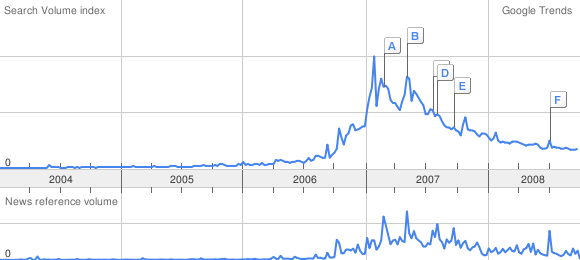
Will Facebook be the next Second Life?

3 October 2008

Adrian von Bidder: Desktop integration

Sune Vuorela raises a few interesting points about integration of various (meta)data storage frameworks on your KDE desktop (read the comments, too, as several of these issues have been or are being addressed.) A huge, somewhat related, itch to me is that the end user of a Linux desktop still has to care if an application uses KDE, GNOME, XFCE, GNUstep, old style X11 or whatever. As an end user, I don't care that GIMP is a GTK application. Somebody told me that I can use fish:/ URLs to open remote files and I've duly noted down the syntax because I have no idea what this does, but it does open this file the webdude has told me I should edit with kolourpaint, and now I want to use GIMP because it's much nicer to use ... Similar issues with settings (I did set the web proxy in the system settings, now why do half of the application not respect this?) and all kinds of other stuff. I believe it's issues like this that will hamper the Linux on the Desktop the most in future. Obviously, in a controlled (corporate) environment, this is not a big problem because it's a problem for the IT staff, but in the SOHO and home computer market, these are real, difficult problems, and since they don't know any of the technical problems behind it it's also very hard to explain why it's not easy for me to set up their system so it works like they feel it should (I already have problems explaining why there should be different Linux distributions at all ... ) Update: It occurs to me that this is the kind of stuff we (distribution developers) should be concentrating on, by putting pressure on upstream and doing some of the work. I guess we've concentrated too much on just packaging the stuff.

Russell Coker: DKIM and Mailing Lists

Currently we have a problem with the Debian list server and Gmail. Gmail signs all mail that it sends with both DKIM and DomainKeys (DomainKeys has been obsoleted by DKIM so most mail servers implement only one of the two standards although apart from space there is no reason not to use both). The Debian list servers change the message body without removing the signatures, and therefore send out mail with invalid signatures. DKIM has an option to specify the length of the body part that it signs. If that option is used then an intermediate system can append data to the body without breaking the signature. This could be bad if a hostile party could intercept messages and append something damaging, but has the advantage that mailing list footers will not affect the signature. Of course if the list server modifies the Subject to include the list name in brackets at the start of the subject line then it will still break the signature. However Gmail is configured to not use the length field, and a Gmail user has no option to change this (AFAIK - if anyone knows how to make Gmail use the DKIM length field for their own account then please let me know). I believe that the ideal functionality of a sending mail server would be to have the configuration of it’s DKIM milter allow specifying which addresses should have the length field used. For example I would like to have all mail sent to an address matching @lists\. have the length field used (as well as some other list servers that don’t match that naming scheme), and I would also like to be able to specify which recipient addresses should have no DKIM signatures (for example list servers that modify the subject line). I have filed Debian bug #500967 against the dkim-filter package requesting this feature [1]. For correct operation of a list server, the minimal functionality is implemented in the Mailman package in Lenny. That is to strip off DKIM and DomainKey signatures. The ideal functionality of a list server would be that for lists that are not configured to modify the Subject line it would leave a DKIM header that uses the length field and otherwise remove the DKIM header. I have filed Debian bug #500965 against lists.debian.org requesting that the configuration be changed to strip the headers in question in a similar manner [2] (the Debian list servers appear to use SmartList - I have not checked whether the latest version of SmartList does the right thing in this regard - if not it deserves another bug report). I have also filed Debian bug report #500966 requesting that the list servers sign all outbound mail with DKIM [3]. I believe that protecting the integrity of the Debian mail infrastructure is important, preventing forged mail is a good thing, and that the small amount of CPU time needed for this is worth the effort. Also the Debian project is in a position of leadership in the community. We should adopt new technologies that benefit society first to help encourage others to do the same and also to help find and fix bugs.

25 September 2008

Eddy Petrișor: Nokia and WPA2 PSK

Dear Nokia,

I really like your phones and I have been using them for about 10 years, but please understand that WPA2-PSK keys can be up to 64 hexdigits long, not 63.

Please fix this issue on the Nokia E51 phone and any other phones on which this might be the same.

Also, please, don't suggest that I should persuade all the admins that use 64 digits long keys to change them and change every client that already uses such a key, just to allow a phone to use the APs they admin.

P.S.: Could somebody confirm/inform that the same issue affects the Nokia E71?


Update: The bug was confirmed for E51, E65, E66, E71 devices. I sent a report to the support for Nokia about this.

24 September 2008

Matthew Garrett

Russell writes about the iphone. I think he's missing a few things.

The open nature of the PC wasn't inherently what brought it greater success. The open nature of the PC meant that it could spawn an ecosystem of third party hardware vendors, sure. It also meant that it could be cheaply cloned by other manufacturers, ensuring competition that drove down the price of hardware. The net result? x86 is ubiquitous, sufficiently so that even Apple use a basically standard[1] x86 platform these days. Low prices and the wide availability of software that people wanted to run bought the PC the marketplace, with Microsoft being the real winners. Apple hardware remained more expensive for years, and the compelling MacOS software was mostly limited to areas like DTP. Nobody else had any incentive to buy a Mac.

Now, let's look at the phone market. Third party hardware vendors? No real distinction between the iphone and anything else. Sure, anything remotely clever has to plug into the dock port, but developing something to work with that also gets you into the ludicrously huge ipod market. Other phone accessories are either batteries, chargers or headphones. That's really not going to be what determines market success.

Competitive cheapness? When you have a multivendor OS like Android or Windows Mobile, you might expect there to be more opportunity to compete to undercut each other, offering equivalent platforms for less cost. But that's missing something. In the same way that the home computer market has basically consolidated towards PCs, the phone market has already consolidated. Your smartphone has an ARM in, probably along with an off the shelf GSM chip and some 3D core (generally something from Imagination, though in Android's case Qualcomm seem to have come up with their own core - I haven't been able to find out if it's derived from something else). There's no realistic way to make a phone with equivalent hardware functionality and quality to the iphone and sell it for significantly less money. And if you figure out how to, Apple get to take advantage of the same price reductions in their next generation hardware. And, being Apple, they'll probably find some compelling wonderful design feature that costs them nothing extra but makes you want it more anyway. So hardware competition probably isn't going to be what determines market success.

Which leaves two things - advertising and applications. Apple are good at marketing. This is unfortunate, because I'd really rather live in a world where everyone running MacOS was running Linux instead, but we seem to suck in comparison. The good news is that Microsoft also seem to, so maybe we'll have our act together some time between now and Apple crushing us to death. So, assuming current trends continue, Apple's marketing probably isn't going to kill the iphone. Which leaves one thing: applications.

The obvious argument against the iphone's success is that, as a closed software distribution platform, it's less attractive to developers. I don't think that's true. If we look at the console market, the gp2x was hardly a PSP killer. Or a DS killer. You could possibly argue it was a Gizmondo killer, but only if you ignore the Finnish mafia. Being an open platform doesn't immediately result in you killing closed platforms. You need developers, and you need applications. Otherwise nobody's going to buy your hardware, even if it costs $10 less than an iphone and has a few extra bits of plastic. What attracts developers? An attractive development environment and a revenue stream. Android has one real thing going for it here - it's not tied to Objective C, and so there's probably a larger number of potential developers. But let's be realistic. If you're a competent developer, you can move from C++ or Java to Objective C without too much effort. And if you're an incompetent developer, you're not going to be deciding the future of a platform.

Apple have made it easy for people to write applications that share the iphone's delightful[2] UI. There's almost active encouragement to write beautiful programs that integrate well. Sure, the platform limitations bite you in weird ways (like the no background running thing), but Apple have come up with hacks to smooth most of those over. The iphone is a wonderful device to develop for. Sufficiently delightful that there was a huge developer base even before Apple had released the SDK. What does that tell you? Developers actively want to write for the iphone. In fact, they wanted to even before there was a real revenue model. Mindshare means a lot.

What are we going to see in response from Android? To begin with, uglier applications. I'm sure that'll get better over time, but right now the Android UI just isn't as well put together[3]. It's functional, even attractive. But it's not beautiful. And lowering the bar to developer involvement means the potential for more My First Phone Application. Windows Mobile and Symbian have huge numbers of applications. They're mostly dreadful lashups of functionality you'd never want and a UI that's ugly enough to make you want to stab out your eyes, coupled with a nag screen asking for a $10 donation to carry on using it assuming it hasn't crashed before it got that far. To be fair, a lot of iphone stuff isn't much better. But proportionately? Right now the Apple stuff has it. I never want to see another listing of Symbian freeware.

At the moment, Apple wins at providing compelling applications. They may be a gatekeeper between the developer and the user, but right now that's not causing too many problems. Well. It wasn't. The recent fuss about Apple dropping applications because of perceived competition with their own software is an issue. If a developer is going to spend a significant amount of time and money on an application, they want a reasonable reassurance that they're going to be able to ship it. And, right now, Apple's not giving that. It remains to be seen whether this has long term consequences, but there's some danger of Apple alienating their developer base. If those developers move to another platform, and if they create compelling software, Apple might stand some real competition. At the moment? Apple has the hardware, the OS and the applications. They have the potential to take over broad swathes of the market. But they also have the opportunity to throw it away. And that's what's going to decide the success of the iphone - a closed platform is not inherently a problem, but it gives the vendor the option of removing one of their key advantages. If Apple get through this with their developer popularity intact, I don't see the open/closed distinction as having any real-world importance at all.

The relevance to Linux? We're not going to succeed by being philosophically better. We have to be better in the real world as well. Ignoring that in favour of our social benefits doesn't result in us winning.

[1] It's slightly more legacy free than a "genuine" PC - there's no i8042, and things like the gate A20 hack aren't implemented. But it'll boot DOS (given enough effort), so hell, it's a PC

[2] And yes, I genuinely do think that the iphone's UI is better than anything else on the market. There's no reason someone else, including us, couldn't have got there first. But we didn't, and now everyone gets to play catch up. Shit happens

[3] I have no idea where Apple gets its UI engineers from, but someone needs to find the source and start waving huge piles of money to pick them up first.

23 September 2008

Russell Coker: OpenID Delegation

I’ve just installed Eran Sandler’s OpenID Delegation Plugin [1]. This means that I can now use my blog URL for OpenID authentication. I’ve also included the plugin in my Wordpress repository (which among other things has the latest version of Wordpress). One thing that I consider to be a bug in Eran’s plugin is the fact that it only adds the OpenID links to the main URL. This means that for example if I write a blog comment and want to refer to one of my own blog posts on the same topic (which is reasonably common - after more than two years of blogging and almost 700 posts I’ve probably written a post that is related to every topic I might want to comment on) then I can’t put the comment in the URL field. The problem here is that URLs in the body of a blog comment generally increase the spam-score (I use this term loosely to refer to a variety of anti-spam measures - I am not aware of anything like SpamAssassin being used on blog comments), and not having OpenID registration also does the same. So it seems that with the current functionality of Eran’s plugin I will potentially suffer in some way any time I want to enter a blog comment that refers to a particular post I wrote. deb http://www.coker.com.au etch wordpress My Wordpress Debian repository is currently available with the above APT repository. While it specifies etch it works with Lenny too (my blog currently runs on Lenny). I will eventually change it to use lenny in the name. For the OpenID server I am currently using the OpenID service provided by Yubico as part of the support for their Yubikey authentication token [2] (of which I will write more at a later date). I think that running their own OpenID server was a great idea, it doesn’t cost much to run such a service and it gives customers an immediate way of using their key. I expect that there are more than a few people who would be prepared to buy a Yubikey for the sole purpose of OpenID authentication and signing in to a blog server (which can also be via OpenID if you want to do it that way). I plan to use my Yubikey for logging in to my blog, but I still have to figure out the best way of doing it. One thing that has been discussed periodically over the years has been the topic of using smart-cards (or some similar devices) for accessing Debian servers and securing access to GPG keys used for Debian work by developers who are traveling. Based on recent events I would hazard a guess that such discussions are happening within the Fedora project and within Red Hat right now (if I worked for Red Hat I would be advocating such things). It seems that when such an idea is adopted a logical extension is to support services that users want such as OpenID at the same time, if nothing else it will make people more prone to use such devices. Disclaimer: Yubico gave me a free Yubikey for the purpose of review. Update: The OpenIDEnabled.com tool to test OpenID is useful when implementing such things [3].

22 September 2008

Axel Beckert: Can't resist this meme

Just stumbled over this meme at Adrian (the meme seems to be started by madduck involuntarily), and since I’m fascinated by how people choose hostnames since my early years at university, I can’t resist to add my two cents to this meme. To be exact, I have two schemes, one for servers out there somewhere (Hetzner, xencon, etc.) and they’re all wordplays on their domain name noone.org, e.g. symlink.to.noone.org (short name “sym” :-), gateway.to.noone.org (usually an alias for one of the machines below), virtually.noone.org (always a virtual machine, initially UML, soon a Xen DomU), etc. So nothing for a quiz here. My other scheme is for all my machines at home and my mobile machines. I’ll start this list with the not so obvious hostnames, so the earlier you guess the scheme, the better you are (or the better you know me ;-). One more hint in advance: “(*)” means this attribute or fact made me choose the name for the machine and therefore can be used as hint for the scheme. :-)
azam
My first PC at all, a 386 with 25 MHz and MS-DOS. (Got named retroactively(*). Hadn’t hostnames at that time.)
ak (pronounced as letters)
Got it from my brother after he didn’t need it anymore. It initially was identical to azam, but once was upgraded to a 486. Still have the 386 board, though.
azka
My first self-bought computer, a pure SCSI system with a AMD K5-PR133 and 32 MB RAM. Initially had SuSE 4.4 and Windows 95 on. Still my last machine which had a Windows installed! :-)
m35
Same case and same speed as azka. Used it for experimenting(*) with Sid years ago.
azu
Initially also an AMD K5-PR133, later replaced by a Pentium 90 and used as DSL router.
azl
An HP Vectra 386/25N book size mini desktop I saved from the scrapyard at Y_Plentyn before his (first) move to Munich. The cutest(*) 386 I ever saw.
ayce
A 386 with 387 co-processor(*) and solded 8 MB of RAM.
ayca
A 1992 Toshiba T6400C 486 laptop bought at VCFe 5.0.
bijou
My 1996 ThinkPad 760ED, which is still working and running Debian GNU/Linux 5.0 Lenny (I started with Debian 3.0 Woody on it and always dist-upgraded it! :-)
gsa (pronounced as letters)
My long-time desktop after azka. A Pentium II with 400 MHz and 578 MB of RAM at the end. Bought used at LinuxTag 2003, it worked until end of last year when it started to suddenly switch off more and more often and now refuses to boot at all. Hasn’t been replaced yet though. I mostly use my laptops at home since then.
gsx (pronounced as letters)
An AMD K6 with 500 MHz I got from maol and which was used as Symlink test server more than once. (It was the machine initially named symlink.to.noone.org because of that.)
hy
My 32 bit Sparc, a Hamilton Hamstation.
hz (pronounced as letters)
My 64 bit Sparc, an UltraSparc 5.
tub
An HP Apollo 9000 Series 400, model 400t from 1990.
tpv (pronounced as letters, too ;-)
My Zaurus SL-5500G.
tryane
A Unisys Acquanta CP mini desktop with a passively cooled(*) 200 MHz Pemtium MMX. Used as DSL router for while, but the power supply fan was too noisy.
lna (pronounced as letters)
A 233 MHz Alpha
loadrunner
An IBM ThinkPad A31 running Sid. I use it as beside terminal.
pony
A Compaq LTE5100 laptop with a Pentium 90 running Sid.
dagonet
A Sony Vaio laptop which ran Debian GNU/kFreeBSD until it broke.
Those who know me quite good should already have guessed the scheme, even if they can’t assign all the names. For all others, here’s one name which doesn’t exactly fit into the scheme, but still is related in someway, but you need to knowledge of the theme’s subject to know the relation:
colani
A big tower from the early 90s designed by Colani.
Ok, and now the more obvious hostnames:
rosalie
A very compact Toshiba T1000LE 8086 laptop running ELKS and FreeDOS.
amisuper
Also an old Symlink test server from maol. He named it “dual”. 2x(*) Pentium I with 166 MHz. Unfortunately doesn’t boot anymore.
visa
An IBM NetVista workstation running Debian GNU/kFreeBSD. My current IRC host.
nemo
My ASUS EeePC running Debian 5.0 Lenny.
pluriel
My current WLAN router running FreeWRT.
c1
My MicroClient JrSX, an embedded 486SX compatible machine with 300 Mhz for VESA mountings.
c2
My MicroClient Jr, an embedded Pentium MMX compatible machine with 200 Mhz for VESA mountings.
c-crosser
My Lenovo ThinkPad T61 running Debian 5.0 Lenny.
c-cactus and c-metisse
The KVM based virtual(*) machines on c-crosser running Sid and Debian GNU/kFreeBSD.
jumper
My NAS(*) at home, currently a TheCus N4100. Soon to be replaced by some Mini-ITX box.
Any one who hasn’t guessed the scheme yet? For those understanding German it’s explained at the end of my old hardware page. For all others I suggest either to look at the domain name in my e-mail address (no, it’s usually not noone.org). Still not clear? Well, feel free to ask me for all the gory details or mark the following white box to see the scheme as well as the explanations for nearly all hostnames hidden in there:
All the machines are named after Citroëns. Old machines after old Citroëns, current hardware after current Citroën models or prototypes. Those names starting with “A” are 2CV derivatives since the 2CV was Citroëns “A” model. “AZ” was the 2CV, AZU and AK were 2CV vans and everything starting with AY (e.g. AYA, AYA2, AYB – but those don’t sound that nice ;-) is Dyane based, but I currently only use Méhara names (AYCA is the normal Méhari, AYCE the 4x4 version). Interestingly not everything starting with AYC is a Méhari: AYCD was the Acadiane, the Dyane van. HY and HZ are variants of Citroëns “H van” (HX, HW and H1600 as well, but they don’t sound that nice), TUB was the pre-WWII “H van” prototype and later the nickname of the “H van” in France. TPV was the name of the pre-WWII 2CV prototype and an abbreviation for Toute Petite Voiture (French for “Very Small Car”), hence the Zaurus, my smallest Linux box, got that name. Rosalie was the nickname of a rear-wheel drive pre-WWII Citroën. M35 was a Wankel engine prototype of the Ami 8 and the Ami Super was the 4 cylinder version of the Ami 8. Bijou was a 2CV based coupé build by Citroën UK in the late 50s and early 60s. Visa and LNA were 2CV predecessors which were available with 2CV engines, but were stopped before the 2CV. GSA and GSX are GS late derivatives. C1, C2, (C3) Pluriel, C-Crosser, Jumper and Nemo are current Citroën models and C-Cactus and C-Métisse are recent Citroën prototypes and show cars. The 2CV Dagonet was an aerodynamically optimised 2CVs by Jean Dagonet in the 50s. The Tryane is an aerodynamic and fuel efficient, three wheeled car by Friend Wood based on the 2CV and with a body of wood. And Colani once dressed a 2CV so that it broke several efficiency world records. The Namco Pony was a 2CV based light utility truck (similar to the Méhari, but with steel body) built in Greece under license in many variants. And Loadrunner is the name of some CX six-wheeler conversions.
Some links about the naming items: Hope you had fun. I had. ;-)

Now playing: Willi Astor — Gwand Anham Ära

18 September 2008

Russell Coker: Installing DKIM and Postfix in Debian

I have just installed Domain Key Identified Mail (DKIM) [1] on my mail server. In summary the purpose is to allow public-key signing of all mail that goes out from your domain so that the recipient can verify it’s authenticity (and optionally reject forgeries). It also means that you can verify inbound mail. A weakness of DKIM is that it is based on the DNS system (which has many issues and will continue to have them until DNSSEC becomes widely adopted). But it’s better than nothing and it’s not overly difficult to install. The first thing to do before installing DKIM is to get a Gmail account. Gmail gives free accounts and does DKIM checks. If you use Iceweasel or another well supported browser then you can click on “Show Details” from the message view which then gives fields “mailed-by” and “signed-by” which indicate the DKIM status. If you use a less supported browser such as Konqueror then you have to click on the “Show Original” link to see the headers and inspect the DKIM status there (you want to see dkim=pass in the Authentication-Results header). Also Gmail signs outbound mail so it can be used to test verification of received mail. The next thing to do is to install the DKIM Milter. To make things exciting this is packaged for Debian under the name dkim-filter so that reasonable searches for such functionality (such as a search for milter or dkim-milter - the upstream project name) will fail. After installing the package you must generate a key, I used the command “dkim-genkey -d coker.com.au -s 2008” to generate a key for my domain. It seems that the domain is currently only used as a comment but I prefer to use all reasonable parameters for such things. The -s option is for a selector, which is a way of specifying multiple valid signing keys. It’s apparently fairly common to use a different key every year. But other options include having multiple mail servers for a domain and giving each one a selector. The dkim-genkey command produces two files, one is named 2008.txt and can be copied into a BIND zone file. The other is named 2008.private and is used by the DKIM signing server. Here is a sample of the most relevant parts of the config file /etc/dkim-filter.conf for signing mail for a single domain: Domain coker.com.au
KeyFile /etc/dkim/2008.private
Selector 2008 The file /etc/default/dkim-filter needs to be modified to specify how it will listen for connections from the MTA, I uncommented the line SOCKET=”local:/var/run/dkim-filter/dkim-filter.sock”. One issue is that the Unix domain socket file will by default not be accessible to Postfix, I devised a work-around for this and documented it in Debian bug report #499364 [2] (I’ve hacked a chgrp command into the init script, ideally the GID would be an option in a config file). A basic configuration of dkim-milter will sign mail for one domain. If you want to sign mail for more than one domain you have to comment out the configuration for a single domain in /etc/dkim-filter.conf and instead use the option KeyList file to specify a file with a list of domains (the dkim-filter.conf(5) man page documents this). The one confusing issue is that the selector is taken to be the basename of the file which contains the secret key (they really should have added an extra field). This means that if you have an obvious naming scheme for selectors (such as the current year) then you need a different directory for each domain to contain the key. As an example here is the line from the KeyList file for my domain:
*@coker.com.au:coker.com.au:/etc/dkim/coker.com.au/2008 Now one problem that we have is that list servers will usually append text to the body of a message and thus break the signature. The correct way of solving this is to have the list server sign the mail it sends out and have a header indicating the signature status of the original message. But there are a lot of list servers that won’t be updated for a long time. The work-around is to put the following line in /etc/dkim-filter.conf:
BodyLengths yes This means that the signature will cover a specified number of bytes of body data, and any extra which is appended will be ignored when it comes time to verify the message. This means of course that a hostile third party could append some bogus data without breaking the signature. In the case of plain text this isn’t so bad, but when the recipient defaults to having HTML email it could have some interesting possibilities. I wonder whether it would be prudent to configure my MUA to always send both HTML and plain-text versions of my mail so that an attacker can’t append hostile HTML. It’s a pity that Gmail (which appears to have the most popular implementation of DKIM) doesn’t allow setting that option. So far the only message I have received that failed DKIM checks was sent from a Gmail account to a Debian mailing list. Ideally it would be possible to have the messages sent to mailing lists not be signed or have the length field used. That would require a signing practice based on recipient which is functionality is not available in dkim-milter (but which possibly could be implemented as Postfix configuration although I don’t know how). Implementing this would not necessarily require knowing all the lists that mail might be sent to, it seems that a large portion of the world’s list traffic is sent to addresses that match the string “@lists.” which can be easily recognised. For a service such as Gmail it would be easy to recognise list traffic from the headers of received messages and then treat messages sent to those domains differently. As the signature status is based on the sending address it would be possible for me to use different addresses for sending to mailing lists to avoid the signatures (the number of email addresses in use in my domain is small enough that having a line for each address to sign will not be a great inconvenience). Most MUAs have some sort of functionality to automatically choose a sender address that is in some way based on the recipient address. I’ll probably do this eventually, but for the moment I’ll just use the BodyLengths option, while it does reduce the security a bit it’s still a lot better than having no DKIM checks.

17 September 2008

Decklin Foster: When mayonnaise goes bad

This is is a wonderful metaphor: "looking in the fridge every few minutes and hoping that something tasty will appear". I may be thick, but Planet does not appear to store any information about how often a feed ought to be polled (my blog seems to be hit every 20 minutes even when I'm AWOL). I use rawdog, which does. When adding a feed, I make a vague guess at how often I want to poll it, and then periodically adjust the time based on how often updates actually happened. This is done with a terrible, awful, ugly hack that reads the database[1] and spits out the config file with new-and-improved times. Pretty dumb, but good enough "for now" (apparently I haven't touched it in over a year). rawdog will also automatically update feed locations if given a 301. Since it already rewrites the config for that, I might try to merge time updating into the core someday, but no one has demanded such a feature AFAIK.
[1]And by "database", I mean "pickle", since Adam doesn't want any fancy dependencies. Despite how slow this ought to be, the combination of optimized (such as it is) feed-polling and ever-faster CPUs in my web servers have made it fast enough for me not to care.

16 September 2008

Christian Perrier: Ordinary racism in action

Today, the rampant racism slightly instilled by the beloved ultra-right zealots we have for a few years at the head of my country reached the limits of my nerves. While exiting my daily train in the Meudon Val Fleury station of C line, two police guys were standing at the exit, just as this happens at least once a week. And, of course, in the crowd that was exiting, they asked for his ID to the guy walking just before me who, surprise, was "looking" as a foreigner (he's French, for the record....we take the same bus every day...but he's of Tamil origin). I was probably in the mood of being schocked today so I couldn't supprot doing nothing and be a silent witness of this. So, I just stopped, grabbed my wallet and showed *my* ID to the two policemen, politely explaining them that I was puzzled of not being controlled myself and, therefore I was volunteering for being controlled. I also grabbed my passport which I still had with me. No more incident, indeed: they had nothing to annoy me and I was very polite, not even arguing with them. Just voluntarily showing my ID. Actually, they probably didn't even look at it..:-) Maybe, it just grabbed their attention enough for a few Arab-looking guys to pass without being "controlled". Half of the crowd in the Paris public transport meets the definition of "potential illegal immigrant" for the average French policeman. I wonder what would happen if everybody in the crowd does the same. That could be an interesting passive resistance action, indeed. Still, such rampant racism is more than a concern. Mostly because it looks innocent and noone even notices. So, think about it next time you see an "innocent" police control action. Just stop for two seconds and show your ID.

14 September 2008

Y Giridhar Appaji Nag: /whois appaji

Since the past few months I've been getting a lot of email at gmail.com not intended for me. Initially I thought it was spam but I realised that people have been inadvertently sending me mail thinking appaji is somebody else. So I get: Obviously, I also get mail that sometimes says "I did not get your response". I've often tried responding explaining to the senders that I am not who they think I am, but there is no use. There is a LOT of personal or otherwise important information like addresses, phone numbers, financial transactions, passwords to some web-service accounts, domain transfer authorisation keys etc. in these emails. This makes me very uncomfortable.

13 September 2008

Gunnar Wolf: A society coerced into fear

A common trait of virtually all of the media in Mexico -and, as far as I have been able to see, in Latin America- is the push for society to be afraid. The government and the media (which go hand-in-hand, mainly due to a series of favors owed to each other - currently stemming from the government's illegitimacy and lack of trust from the general population) wants us all to think the country is as violent and as dangerous as it has never been before.
And yes, I cannot and won't try to deny that there are many critical points that need attention - But the answer cannot be militarization, cannot be further restraining the civil liberties, cannot be criminalization.
The only way to prevent crime is to reduce poverty. And poverty is not reduced by giving foreign "investors" (bah, ask people living on cities that border the USA if the maquilas have brought any kind of investment or somehow bettered the living conditions of the population!) access to segments of the economy so far limited to the government - Poverty will only be reduced when the government starts reviewing the tax systems to remove the legal loopholes that make it possible for a large enterprise to get tax exemptions on most of their income, and make the lower income people pay zero taxes, even get social aid.
But back to the topic: Since the 1994 crisis (the "decembrine errors"), we are being constantly bombed about the raging insecurity in Mexico. Maybe we have been bombed with that same ideas for more time, but I was not very politically conscious before that. When things go a bit smoother on the political side, the media relaxes the "we are so fucked" mantram.
When our de facto president current ruler took power, on December 2006, he had so much opposition he could not for months attend a single public event. So far, he is still avoiding them; everywhere he goes, the place must be cleared and sanitized of anybody who might show he just does not agree with the imposition we had. What was his first government action? To decree that every branch of the government would get a 10% budget cut on the salaries - but the security forces (the army, the different police corporations) would have a 46% raise.
After almost two years of ineptitude, they keep chanting the old "oh, we are living such dangerous times" mantra. The security forces recently got yet another raise, and everybody in the media says this country cannot be lived in anymore.
And people buy that crap.
Up to a month or two ago, the general outcry is that the drug lords had taken over the country - And, yes, in several areas of Mexico, their presence is bigger than the official security, or the security agencies are completely coopted by them. But not even His Majesty Felipe Calder n I "El Ileg timo" can say with a straight face that "we are winning the war against the drug lords" (a war brought by himself, of course - Think of it as Mexico's Irak. Think of Calder n as Mexico's Bush.) - A new attention sink was needed.
Of course, this country is not safer than Finland. But crimes do happen there as they happen here. Here, we have got a tremendous movement because of one brutal kidnapping in August, and everybody now thinks that everybody is at risk of dying kidnapped.
So today, after over a month of bombarding us with fear about kidnaps, I am sick of reading stupid reactions. What made me post this was a request for ideas at a local Free Software-related portal about monitoring known potential criminals. Of course, such a proposal would violate the right to anonimity and to lead a personal life even a convicted criminal has. And, of course, the cries of people that think the society should castrate rapists and kill kidnappers, basically going back 4000 years in history. People, let me hand you a stone and a stick so you can club the whole society to death.
The first step towards getting out of this security nightmare perception we have is to be critical towards what the media tells us - and to understand (and _really_ understand. I won't buy your argument that "it's easier to rob somebody for MX$4000 than to work a full day for MX$100", as it's only easier on one level, but it is a tremendous cost on many others) what makes good people act against the society.

John Goerzen: Command-Line RSS Reader

So, does anybody know of a command-line RSS reader? I want something that will save state and output recent entries in a nicely parsable manner. Maybe URL\tTitle\tDecscription\n or somesuch.

So here's why I'm asking.

I got to thinking that it might be nice to automatically post to Twitter when I've got a new blog post up, rather than manually have to say "just wrote a blog post."

Then I also got to thinking that when I see an interesting URL that I'm going to Twitter about, I'm also almost always adding it as a bookmark to Delicious. Why not make a fortwitter tag on Delicious, and automatically post my comments about them to Twitter, saving me having to do it twice?

So I've got Twidge that can be nicely used in a shell script to do this stuff. I'm hoping to avoid having to write a shell script-friendly RSS aggregator. But I'm just prone to do it if nobody else has already, though I'd really like to avoid reinventing the wheel.

Bastian Blank: Smallest UTF32 to UTF8 converter

I found some weird opcodes in the s390 instruction set some time ago. I finally want to use it as I have access to such a machine. The result is rather slim:
.globl cu41
        .type   cu41, @function
cu41:
.L2:
        cu41    %r2,%r4
        ipm     %r1
        srl     %r1,28
        chi     %r1,3
        je      .L2
        ltr     %r1,%r1
        je      .L3
        lcr     %r1,%r1
        lgfr    %r3,%r1
.L3:
        lgr     %r2,%r3
        br      %r14
The cu41 opcode translates UTF32 to UTF8. Each "parameter" is a register pair [1], which describes address and length of the buffer. This opcode will return after a not specified number of translated characters. The rest is boiler plate code for condition code checking. The loop makes sure that anything is converted within the function unless another error occured.
[1]An even pair. gcc is not yet able to allocate such pairs on its own, so it is hardcoded.

12 September 2008

John Goerzen: I should stop watching Sarah Palin interviews.

I saw the interview on ABC last night and tonight. It surprised me that she quite clearly didn't understand what the Bush Doctrine is (Charlie Gibson had to explain it to her). She dodged and evaded too many questions to count. Every foreign policy question she turned into an oil question, citing Alaska, as if somehow Alaska has played a key part in international conflict in the last decade.

Charlie asked her about the budget deficit, the economy. He got her implied assent that Bush hadn't done well, and asked her to name three concrete ways she'd change. She dodged for a minute. He tried again. She cited lower taxes, better oversight, and I forget the third. Anyhow, it didn't sound very different to me -- and not very specific either. It's so general that everybody from Ron Paul to the green party can agree to it.

He asked her about the deficit, and what she and McCain would do to fix it. She stumbled for a minute, then said "I certainly wouldn't cut veterans benefits" and spent the next minute talking about how important veterans are. Which is a whole other topic. She never did say how they'd cut the deficit, just that in some magical way, they'd find inefficiencies. McCain's had over a year to name them, and I haven't seen the specifics yet.

I came away feeling more concerned about her than I expected. She reminds me of Bush in 2000. Cocky, self-confident, a shallow thinker on every topic, and utterly unprepared.

This process of getting to know McCain's unknown pick is not going so well, I think.

Enrico Zini: Logging on the Freerunner

Logging on the Freerunner By default, the FreeRunner comes without a system log daemon, and rightfully so, because you don't want a daemon filling up /var, and a nightly cron job to rotate logs, on a mobile phone. However, I do not want to give up logging. If there are bugs I want to investigate, I like to be able to look at the logs. The solution: remote logging. Configure the phone to send all log info via UDP to my laptop, and configure my laptop to listen for UDP syslog messages from the phone only. How to do it:
  1. apt-get install rsyslog (see below how other logging daemons fail)
  2. Add a /etc/hosts entry for the laptop on the phone: 192.168.0.200 base
  3. Add a /etc/hosts entry for the phone on the laptop: 192.168.0.202 openmoko
  4. Replace the phone's rsyslog rules to send everything to the laptop:
    ################
    ##### RULES ####
    ################
    # Everything goes to the main computer, via UDP, if available
    *.*     @base
    #
    # Emergencies are sent to everybody logged in.
    #
    *.emerg                         *
    
    
  5. Tell the laptop's rsyslog to accept UDP messages from the phone only:
    # provides UDP syslog reception
    $ModLoad imudp
    $UDPServerRun 514
    $UDPServerAddress 192.168.0.200
    
    
That is all. When the phone is not connected, the UDP packets from the logger will go nowhere. When it gets connected to the laptop, a script is triggered that creates the 192.168.0.200 interface, rsyslogd will listen on that interface and the UDP packets will be logged. This has the extra potential to be able to get error messages in case of bugs in the SD card driver, which I seem to hit from time to time. Why rsyslog sysklogd could receive the messages from the phone, but can only listen on all interfaces, and therefore requires me to set up firewall on my laptop in order to get packets from the phone only. syslog-ng can and can be told to listen on a given interface, but it will refuse to start if that interface isn't available. Since the phone is on an hotplugged interface that comes and goes, this is totally unacceptable. And finally, rsyslog is going to replace sysklogd both in Debian and in Fedora, so it's just as well a good excuse to switch.

Next.

Previous.




