Search Results: "az"

6 November 2008

Martin-Éric Racine: Available for a new job

A couple of years ago, I started what has probably been the best job I've held so far, as a Business Development Manager for Artec Group where I focused on marketing and selling the ThinCan LTSP client. During that time, I used a combination of Guerrilla Marketing techniques to spread the word about this cool Estonian embedded platform in its LTSP client configuration and defined an extremely tight market-oriented focus that saw this relatively obscure electronic design start-up rise to the forefront of the LTSP hardware market and also brought the company commendable notoriety in the Coreboot community, thanks to its Programmable LPC Dongle, a low-cost ROM emulator that can be used to bootstrap various embedded hardware and test firmware images. Looking back at close to 3 years with Artec (if we include the stint I did at Linutop), I most fondly remember how I managed to bring the Estonian and Turkish nations closer together in collaborating on Innovation. On my first visit to Turkey, I had noticed that very little is know about Estonia in Turkey, even though both countries have a collaboration that dates back to the 1920's, so my tactic was to introduce Estonia's achievements as a whole, to establish confidence in Artec's offering. It worked: Among other things, my idea to organize an Estonian ICT Conference during the visit of Estonian PM Andrus Ansip in Turkey created a lot of extremely positive buzz that resulted in Estonia being mentioned as a trendy country in a prime time Turkish TV series. During this time, I've also made a lot of contacts among the Estonian and Turkish business communities and, more surprisingly, among the Estonian diplomacy who, much to my amazement, welcomed my ideas for better promoting Estonian interests abroad with great enthusiasm. Come December 2008, my time at Artec will become a page in my employment history. While the Thincan remains one of Artec's key products, current marketing and sales resources are focused on new markets and new technologies that completely fall outside my core expertise, which is why the company decided to let me go. I thus welcome offers from interested parties in Coreboot or LTSP markets. Other refreshing offers from outside the box - such as in business diplomacy - are equally welcome, as I've been pondering a career change for a long time.

Eddy Petrișor: Coordinating localization via git

Note: this is quite long and might not be interesting for people not involved with /in either of: debian i18n, debian l10n, git, shell scripting.


For some time now I have been the de-facto coordinator of the Romanian localization team. During this time I was faced multiple times with problems related to motivation of the team members, setting goals for a release, coordination of the changes inside the team, integration of new translators in the team, loosing team members, my lack of time on some occasions and other problems.

I thought a lot about how to improve on those points and I was never satisfied with the answers I got. What I think was the worst problem in the team was the inability to set clear goals, especially during lenny's development cycle.

During sarge's and etch's development cycles we were in an infancy state and setting as the goal to have a fully translated installation process was really enough to keep people motivated. For sarge we missed by a small margin, but the translations were of poor quality, while for etch we worked more on improving the translations.


But during lenny it was bad, really bad. My free time had been shrinking for a while, starting with etch's release, and we were unable to set clear goal, since for etch we managed to have the installation process fully translated and a few other translations. There was no way for us to reach 100% translations during lenny's development cycle, so setting that as a goal was really unrealistic. Percents by themselves don't mean anything for people, and as long as there's no substance to those numbers, there's no motivation to reach for one arbitrary percent.

I tried to set as a goal translating the packages installed by default in a new installation, but that hit the eternal question How do we know easily which are those packages?. This remained sometimes unanswered or got an unsatisfying answer. Also, there was a goal to have correct diacritics for Romanian in lenny, to have aspell-ro that uses the correct diacritics.

I even got to a point that I, myself, lost my motivation and set myself a personal goal of overrunning the level the translations that the language just above Romanian had in the po-debconf l10n statistics (ranking between languages). This was nice way for me to keep myself motivated, but I had my reserves in making this motivation public out of fear of being misinterpreted, because, by a strange coincidence, that next language was Hungarian, and in Romania's history there was some friction between Hungaria and Romania, while there are still some tensions with the Hungarian minority in Romania, in areas where they represent the local majority.

I managed to reach my personal goal, but this wasn't addressing the big picture.


So, sometime around the start of this year I started thinking about ways to coordinate the Romanian localization team in order to have:
For short, a tool that would allow the team to work more efficiently while having the possibility to set clear goals in order to keep people motivated.


So after some pondering, I thought that creating a repository with the translations and the helper tools that would do the funky sync, checks, stats would be the best way to do that. So I started hacking on that somewhere around July-August and I published the result, but without much publicity, since it is still incomplete.

Some of the technical details are still in a haze, but I have a general idea and I got some basic functionality.


Today I decided that I should announce this semi-officially though my blog, maybe I get some input, ideas, or even contributions (I really should write a TODO).


I give you the Debian L10n Romanian coordination repository.

This is a git repository that has some tools to facilitate translation coordination and the translations that are current in the distro for the team.


Can be cloned with:

git clone git://git.debian.org/git/users/eddyp-guest/debian-ro-repo.git

or, if you're behind a restrictive firewall:

git clone http://git.debian.org/git/users/eddyp-guest/debian-ro-repo.git


Currently the work flow for updating a translation is as follows:
  1. source _bin/polibs (. _bin/polibs)
  2. cd foo
  3. po_refresh
  4. complete the translation
  5. po_rearrange "ro.po"
  6. git add "ro.po" && git commit -m "updated translation for foo"
  7. send the translation ("git format-patch origin" and send the patches by mail, or, alternatively, just "git push")


Features:
Planned features:

Problems:

I was hoping that the release notes for lenny would facilitate from this infrastructure, but unfortunately I was lately in a really inactive period wrt Debian.


Questions, suggestions, ideas are welcome.

Martin Michlmayr: European Commission publishes guidelines on the procurement of FOSS

The Open Source Repository and Observatory (OSOR), a new site sponsored by the European Commission to foster the exchange of FOSS related information and software among European public administrations, recently published guidelines on the procurement of open source software. Public administrations in Europe have to follow public tender procedures and the new guidelines give practical and legal advice on how open source software and related services can be incorporated into the procurement process. Rishab Ghosh, who presented the guidelines at the Open Source World Conference in Malaga, argued that the procurement guidelines were needed because of two reasons. First, they studied recent tenders and found that many explicitly mentioned proprietary applications. 16% of 3615 software tenders explicitly asked for products from top 10 software vendors, such as Microsoft, SAP and Oracle. This practice may be illegal because public tenders generally have to describe functional requirements in a general way instead of specifying specific products. Second, many public administrations don't have any experience with the procurement of FOSS. In fact, they often don't know whether or under which circumstances they are allowed to adopt and ask for FOSS solutions. The guidelines are specifically designed in order to clearly and simply explain how public administrations can acquire open source and they don't assume that a country has adopted a specific policy regarding open source. The guidelines include a long section about open standards, open source and how they relate. Both open standards and open source align very well with the needs of public administrations who have an "obligation to support interoperability, transparency and flexibility, as well as economical use of public funds". The guidelines argue that the exit cost, i.e. the cost incurred in moving to another IT system, is also an important consideration but one that is often neglected. The adoption of a proprietary solution without open standards may limit the future choice, thereby increasing the long-time costs and giving the proprietary vendor an unfair advantage in future tenders. The procurement guidelines describe two ways of acquiring FOSS: it is possible to go the usual route of publishing a tender for the supply of software (possibly with related services). However, in the case of FOSS, it is also possible to download the software directly from the Internet. This is possible because the software is not only free of charge but comes with no contractual obligations. If there were any obligations involved with the download (such as fees, the agreement to an EULA or the requirement to purchase services in the future), software download is not an allowed method. What I like about the guidelines is that they explicitly say that downloading software has to be part of the formal procurement process. You have to think about your requirements, look at various alternatives, and so on, and not just blindly download something from the Internet. When it comes to the procurement of FOSS, the guidelines don't suggest that tenders should explicitly ask for FOSS. Instead, they should describe the functional requirements of the software as well as certain properties. For example, a tender could specify that the public administration as well as third parties must have the right to study, distribute and modify the software. In a sense, the guidelines suggest that tenders should include the principles of the Free Software Definition along with justifications for these requirements. Personally, I think there is a great need for these procurement guidelines. There are many public administrations that don't know how to acquire FOSS and these guidelines offer clear advice. Furthermore, I find the guidelines very balanced. They don't recommend that you should always ask for FOSS but incorporate FOSS principles into tenders where it makes sense. It remains to be seen whether the procurement guidelines will have an impact on the FOSS adoption in Europe, but I surely hope so. (Originally published on FOSSBazaar)

Russell Coker: EC2 and IP Addresses

One of the exciting things about having a cloud computing service is how to talk to the rest of the world. It’s all very well to have a varying number of machines in various locations, but you need constant DNS names at least (and sometimes constant IP addresses) to do most useful things. I have previously described how to start an EC2 instance and login to it - which includes discovering it’s IP address [1]. It would not be difficult (in theory at least) to use nsupdate to change DNS records after an instance is started or terminated. One problem is that there is no way of knowing when an instance is undesirably terminated (IE killed by hardware failure) apart from polling ec2-describe-instances so it seems impossible to remove a DNS name before some other EC2 customer gets a dynamic IP address. So it seems that in most cases you will want a constant IP address (which Amazon calls an Elastic IP address) if you care about this possibility. For the case of an orderly shutdown you could have a script remove the DNS record, wait for the timeout period specified by the DNS server (so that all correctly operating DNS caches have purged the record) and then terminate the instance. One thing that interests me is the possibility of running front-end mail servers on EC2. Mail servers that receive mail from the net can take significant amounts of CPU time and RAM for spam and virus filters. Instead of having the expense of running enough MX servers to sustain the highest possible load even while one of the servers has experienced a hardware failure there is a possibility of running an extra EC2 instance at peak times with the possibility of running a large instance for a peak time when one of the dedicated servers has experienced a problem. The idea of having a mail server die and have someone else’s server take the IP address and receive the mail is too horrible to contemplate, so an Elastic IP address is required. It is quite OK to have a set of mail servers of which not all servers run all the time (this is why the MX record was introduced to the DNS) so having a server run periodically at periods of high load (one of the benefits of the EC2 service) will not require changes to the DNS. I think it’s reasonably important to minimise the amount of changes to the DNS due to the possibility of accidentally breaking it (which is a real catastrophe) and the possibility of servers caching DNS data for longer than they should. The alternative is to change the MX record to not point to the hostname of the server when the instance is terminated. I will be interested to read comments on this issue. The command ec2-allocate-address will allocate a public IP address for your use. Once the address is allocated it will cost $0.01 per hour whenever it is unused. There are also commands ec2-describe-addresses (to list all addresses allocated to you), ec2-release-address (to release an allocated address), ec2-associate-address to associate an IP address with a running instance, and ec2-disassociate-address to remove such an association. The command “ec2-associate-address -i INSTANCE ADDRESS” will associate an IP address with the specified instance (replace INSTANCE with the instance ID - a code starting with “i-” that is returned from ec2-describe-instances. The command “ec2-describe-instances grep ^INSTANCE cut -f2” will give you a list of all instance IDs in use - this is handy if your use of EC2 involves only one active instance at a time (all the EC2 API commands give output in tab-separated lists and can be easily manipulated with grep and cut). Associating an IP address with an instance is documented as taking several minutes, while Amazon provides no guarantees or precise figures as to how long the various operations take it seems that assigning an IP address is one of the slower operations. I expect that is due to the requirement for reconfiguring a firewall device (which services dozens or maybe hundreds of nodes) while creating or terminating an instance is an operation that is limited in scope to a single Xen host. One result that I didn’t expect was that associating an elastic address is that the original address that was assigned to the instance is removed. I had a ssh connection open to an instance when I assigned an elastic address and my connection was broken. It makes sense to remove addresses that aren’t needed (IPv4 addresses are a precious commodity) and further reading of the documentation revealed that this is the documented behavior. One thing I have not yet investigated is whether assigning an IP address from one instance to another is atomic. Taking a few minutes to assign an IP address is usually no big deal, but having an IP address be unusable for a few minutes while in the process of transitioning between servers would be quite inconvenient. It seems that a reasonably common desire would be to have a small instance running and to then transition the IP address to a large (or high-CPU) instance if the load gets high, having this happen without the users noticing would be a good thing.

Josselin Mouette: Security by incompetence

Hey Romain, you d be impressed by the number of upstreams whose knowledge of security measures is similarly close to the absolute zero. Since bad guys are always digging through commits for suspicious things, hiding the relevant commits is the best thing you can do to help them. Given things like this exist, It s likely that they have even automated tools to do this search for them. This way, distributors and security engineers have to do the same job, hoping to never miss a change that was actually a security fix. Unfortunately, two small scale projects that we happen to use have exactly the policy Romain described regarding security updates. I m amazed by the fantastic job the distributions security teams manage to achieve in these conditions.

4 November 2008

Russell Coker: Basics of EC2

I have previously written about my work packaging the tools to manage Amazon EC2 [1]. First you need to login and create a certificate (you can upload your own certificate - but this is probably only beneficial if you have two EC2 accounts and want to use the same certificate for both). Download the X509 private key file (named pk-X.pem) and the public key (named cert-X.pem). My Debian package of the EC2 API tools will look for the key files in the ~/.ec2 and /etc/ec2 directories and will take the first one it finds by default. To override the certificate (when using my Debian package) or to just have it work when using the code without my package you set the variables EC2_PRIVATE_KEY and EC2_CERT. This Amazon page describes some of the basics of setting up the client software and RSA keys [2]. I will describe some of the most important things now: The command “ec2-add-keypair gsg-keypair > id_rsa-gsg-keypair” creates a new keypair for logging in to an EC2 instance. The public key goes to amazon and the private key can be used by any ssh client to login as root when you creat an instance. To create an instance with that key you use the “-k gsg-keypair” option, so it seems a requirement to use the same working directory for creating all instances. Note that gsg-keypair could be replaced by any other string, if you are doing something really serious with EC2 you might use one account to create instances that are run by different people with different keys. But for most people I think that a single key is all that is required. Strangely they don’t provide a way of getting access to the public key, you have to create an instance and then copy the /root/.ssh/authorized_keys file for that. This Amazon page describes how to set up sample images [3]. The first thing it describes is the command ec2-describe-images -o self -o amazon which gives a list of all images owned by yourself and all public images owned by Amazon. It’s fairly clear that Amazon doesn’t expect you to use their images. The i386 OS images that they have available are Fedora Core 4 (four configurations with two versions of each) and Fedora 8 (a single configuration with two versions) as well as three other demo images that don’t indicate the version. The AMD64 OS images that they have available are Fedora Core 6 and Fedora Core 8. Obviously if they wanted customers to use their own images (which seems like a really good idea to me) they would provide images of CentOS (or one of the other recompiles of RHEL) and Debian. I have written about why I think that this is a bad idea for security [4], please make sure that you don’t use the ancient Amazon images for anything other than testing! To test choose an i386 image from Amazon’s list, i386 is best for testing because it allows the cheapest instances (currently $0.10 per hour). Before launching an instance allow ssh access to it with the command “ec2-authorize default -p 22“. Note that this command permits access for the entire world. There are options to limit access to certain IP address ranges, but at this stage it’s best to focus on getting something working. Of course you don’t want to actually use your first attempt at creating an instance, I think that setting up an instance to run in a secure and reliable manner would require many attempts and tests. As all the storage of the instance is wiped when it terminates (as we aren’t using S3 yet) and you won’t have any secret data online security doesn’t need to be the highest priority. A sample command to run an instance is “ec2-run-instances ami-2b5fba42 -k gsg-keypair” where ami-2b5fba42 is a public Fedora 8 image available at this moment. This will give output similar to the following: RESERVATION r-281fc441 999999999999 default
INSTANCE i-0c999999 ami-2b5fba42 pending gsg-keypair 0 m1.small 2008-11-04T06:03:09+0000 us-east-1c aki-a71cf9ce ari-a51cf9cc The parameter after the word INSTANCE is the serial number of the instance. The command “ec2-describe-instances i-0c999999” will provide information on the instance, once it is running (which may be a few minutes after you request it) you will see output such as the following: RESERVATION r-281fc441 999999999999 default
INSTANCE i-0c999999 ami-2b5fba42 ec2-10-11-12-13.compute-1.amazonaws.com domU-12-34-56-78-9a-bc.compute-1.internal running gsg-keypair 0 m1.small 2008-11-04T06:03:09+0000 us-east-1c aki-a71cf9ce ari-a51cf9cc The command “ssh -i id_rsa-gsg-keypair root@ec2-10-11-12-13.compute-1.amazonaws.com” will then grant you root access. The part of the name such as 10-11-12-13 is the public IP address. Naturally you won’t see 10.11.12.13, it will instead be public addresses in the Amazon range - I replaced the addresses to avoid driving bots to their site. The name domU-12-34-56-78-9a-bc.compute-1.internal is listed in Amazon’s internal DNS and returns the private IP address (in the 10.0.0.0/8 range) which is used for the instance. The instance has no public IP address, all connections (both inbound and outbound) run through some sort of NAT. This shouldn’t be a problem for HTTP, SMTP, and most protocols that are suitable for running on such a service. But for FTP or UDP based services it might be a problem. The part of the name such as12-34-56-78-9a-bc is the MAC address of the eth0 device. To halt a service you can run shutdown or halt as root in the instance, or run the ec2-terminate-instances command and give it the instance ID that you want to terminate. It seems to me that the best way of terminating an instance would be to run a script that produces a summary of whatver the instance did (you might not want to preserve all the log data, but some summary information would be useful), and give all operations that are in progress time to stop before running halt. A script could run on the management system to launch such an orderly shutdown script on the instance and then uses ec2-terminate-instances if the instance does not terminate quickly enough. In the near future I will document many aspects of using EC2. This will include dynamic configuration of the host, dynamic DNS, and S3 storage among other things.

3 November 2008

Eric Warmenhoven

Dear Lazyweb, what’s best dedicated server/virtual private server offering? My basic requirements are: Right now I have Dreamhost, which has been reasonable for what I pay, which is $16/mo. They run Debian and, aside from root, give me everything else that I want. However, I’m starting to get really annoyed at being on shared hosting. Also, they’re moving everyone over to new servers, and when they do, I won’t be able to use procmail filtering anymore. So I’m looking for alternatives. One of my friends had used ServerPronto, which meets all my requirements. However, his experience convinced me that I don’t want to be using ServerPronto. So, what should I use?

Enrico Zini: rc-buggy packages sorted by popularity

rc-buggy packages sorted by popularity After doing a round of tag reviews so that we release lenny with the latest tag contributions, I still had a bit of spare time. Since people are urging to fix the last bugs I thought I could contribute a list of RC-buggy packages sorted by popularity:
#!/usr/bin/python
import urllib2
import sys, re #, gzip
PKGRE = re.compile(r'<strong>Package: </strong><a href="[^"]+" name="([^"]+)">')
POPCONRE = re.compile(r'^(\d+)\s+(\S+)')
PKGMAPRE = re.compile(r'^([^(]+)\(([^)]+)')
COMMASPLIT = re.compile(r'\s*,\s*')
# Allow to download other package views
if len(sys.argv) > 1:
    url = sys.argv[1]
else:
    url = "http://bts.turmzimmer.net/details.php"
def read_packages(url):
    "Download the list of rc-buggy packages"
    fd = urllib2.urlopen(url)
    for line in fd:
        mo = PKGRE.search(line)
        if mo:
            yield mo.group(1)
# FIXME: this is a deprecated data source, but at the moment it is just what
#        is needed
def read_bintosrc(url = "http://qa.debian.org/data/ddpo/results/ddpo_packages"):
    "Download the binary to source package map"
    fd = urllib2.urlopen(url)
    for line in fd:
        mo = PKGMAPRE.search(line)
        if mo:
            src = mo.group(1)
            bin = COMMASPLIT.split(mo.group(2))
            for p in bin:   
                yield p, src
def read_popcon(url = "http://popcon.debian.org/by_inst"):
    "Download popcon information"
    fd = urllib2.urlopen(url)
    # It doesn't work on urllib2 objects because it wants tell()
    #fd = gzip.GzipFile(fileobj=fd, filename=url, mode="rb")
    for line in fd:
        mo = POPCONRE.match(line)
        if mo:
            yield mo.group(2), int(mo.group(1))
print "Reading mapping of binary packages to source packages..."
bin2src = dict(read_bintosrc())
print "Reading popcon scores..."
# We actually want the score of source packages, and for it we use the score of
# its binary package with the highest score
scores = dict()
for pkg, score in read_popcon():
    pkg = bin2src.get(pkg, pkg)
    if pkg not in scores:
        scores[pkg] = score
#scores = dict(read_popcon("http://popcon.debian.org/by_inst.gz"))
print "Reading list of rc-buggy packages..."
# The bug page has a mix of source and binary packages: convert all to source
# packages
packages = sorted(read_packages(url), key=lambda x:scores.get(bin2src.get(x,x), 0))
for p in packages:
    print scores.get(bin2src.get(p,p), 0), p
This can be run on people.debian.org as ~enrico/popzimmer (0 is the rank of packages that for some reason cannot be mapped to any rank):
$ ~enrico/popzimmer 
Reading mapping of binary packages to source packages...
Reading popcon scores...
Reading list of rc-buggy packages...
0 roxen-fonts-iso8859-2
2 dpkg
11 pam
61 glibc
61 libc6
123 initramfs-tools
149 bind9
150 grub
180 portmap
213 nfs-common
279 libgl1-mesa-dri
298 libsnmp-base
298 snmpd
309 avahi
397 mysql-dfsg-5.0
408 xserver-xorg-input-wacom
409 xserver-xorg-video-vesa
428 docbook-xml
499 openoffice.org-core
567 xine-lib
600 evolution-data-server
669 eog
671 xserver-xorg-video-intel
691 epiphany-browser
691 epiphany-gecko
695 kdelibs4c2a
698 uswsusp
754 guile-1.6
959 gpm
964 cups
990 kdebase
1002 ghostscript
1069 giflib
1076 xulrunner-1.9
1177 libapache2-mod-perl2
1217 vlc-nox
1229 kernel-package
1311 kdeutils-dev
1520 libparted1.8-10
1767 wireshark
1785 selinux-policy-default
1908 dia
1943 htop
1983 boost
2140 cantlr
2145 transmission
2159 emacs22
2312 swfdec-mozilla
2449 eclipse
2449 libswt3.2-gtk-java
2728 lilo
2898 libnss-ldap
3013 java-access-bridge
3051 blender
3099 libtemplate-perl
3499 fglrx-atieventsd
3602 virtualbox-ose
3619 jfsutils
3806 anjuta
3962 kbuild
4076 libgnustep-gui0.14
4222 libwebkit-1.0-1
4332 rosegarden
4412 matplotlib
4412 python-matplotlib
4950 mail-notification-evolution
5195 nut-cgi
5273 sbcl
5538 ruby1.9
5679 kmymoney2
6076 websvn
6147 miro
6264 gnat-4.1
6431 gallery2
6478 gnome-chess
6512 joystick
6862 istanbul
6937 wordpress
7476 luatex
7635 csound
7635 python-csoundac
8257 libpam-mount
8471 wmcpuload
8631 nbsmtp
8642 oxine
8774 axiom
8949 libengine-pkcs11-openssl
9052 clamav-getfiles
9221 open-iscsi
9262 ptex-bin
9701 egroupware-core
10012 debian-cd
10127 libjogl-java
10453 libjson-xs-perl
10698 gcjwebplugin
10736 request-tracker3.6
11294 python-extclass
11518 rkward
11600 alevt
12929 otrs2
13205 bindgraph
13956 icecc-monitor
14223 netmaze
14505 cdebconf
14526 mumble
14687 fnonlinear
14724 recite
14789 jbidwatcher
15766 libnss-ldapd
15812 glpi
15905 lustre-source
15982 win32-loader
16232 ampache
17168 libghc6-missingh-dev
17311 acl2
17830 apertium
18462 emacspeak
18469 glassfish
19257 isight-firmware-tools
19719 libnagios-object-perl
20144 libwx-perl
20465 dns2tcp
21614 python-kinterbasdb-dbg
21690 hf
21902 libcobra-java
22365 tomcat6
22573 libphp-snoopy
23501 coco-java
23926 boxbackup-server
24009 libghc6-wash-dev
26323 libdesktop-notify-perl
26439 opendb
28426 adolc
28795 xorp
29986 libgdata-java
31262 libjboss-serialization-java
31472 pixelpost
31658 cournol
32939 mediamate
34365 gforge-plugin-scmcvs
34659 libgearman-client-async-perl
42233 libhamcrest-java
48076 mahara
55303 mxallowd
85881 roxen-fonts-iso8859-1

So, if you don't know from what package to start fixing bugs, "Begin at the beginning,", the King said, very gravely, "and go on till you come to the end: then stop."

Russell Coker: Types of Cloud Computing

The term Cloud Computing seems to be poorly defined at the moment, as an example the Wikipedia page about it is rather incoherent [1]. The one area in which all definitions of the term agree is that a service is provided by a varying number of servers of which the details are unknown to the people who use the services - including the people who program them. There seem to be four main definitions of cloud computing. The first one is Distributed Computing [2] (multiple machines in different administrative domains being used to perform a single task or several tasks), this definition does not seem to be well accepted and will probably disappear. The next one is Software As A Service [3] which is usually based on the concept of outsourcing the ownership and management of some software and accessing it over the Internet. An example is the companies that offer outsourced management of mail servers that are compatible with MS Exchange (a notoriously difficult system to manage). For an annual fee per email address you can have someone else run an Exchange compatible mail server which can talk to Blackberries etc. The main benefit of SAAS is that it saves the risk and expense of managing the software, having the software deployed at a central location is merely a way of providing further cost reductions (some companies that offer SAAS services will also install the software on your servers at greater expense). The last two definitions are the ones that I consider the most interesting, that is virtual machines (also known as Cloud Infrastructure [4]) and virtual hosting of applications (also known as Cloud Platforms [5]). The Amazon EC2 (Elastic Cloud Computing) service [6] seems to be the leading virtual machine cloud service at the moment. Google App Engine [7] seems to be the leading cloud application hosting service at the moment. It is also claimed that “Cloud Storage” is part of cloud computing. It seems to me that storing data on servers all over the world is something that was done long before the term “Cloud Computing” was invented, so I don’t think it’s deserving of the term.

Alexander Reichle-Schmehl: Dear Lazyweb,

I use Icedove / Thunderbird for nearly all of my daily mail business. I use it to read blogs, too. However, since I work from different computers, on my mails, I'm slightly annoyed since it seems not possible to synchronize several important settings in an easy way. Is it somehow possible to synchronise: I rely heavily on the automatic completion of e-mail addresses and like, that Thunderbird automatically adds recipients of mails I send to an address book for later use. However it seems to be not possible to share these entries between several computers. Similar to subscribed blogs. I'm subscribed to some blogs on different computers. However I need to "synchronize" which posts I already read by hand. Last, not least: From time to time I find and install a new extension to Thunderbird, which I install on one computer. And later forget to install the very same extension on the other computers :( Yes, technically I could solve these problems myself. E.g. by using the rss2mail script to read blogs via my imap server, or by using some kind of version control for my Thunderbird settings. But that seems kind of ugly to me. Isn't there a better way?

2 November 2008

John Goerzen: What magazine to subscribe to?

A few years ago, I -- yes -- subscribed to a paper magazine (US News). I didn't continue my subscription because I stopped reading it. I stopped reading it because, frankly, there wasn't that much worth reading a week after I heard it on NPR.

I find I spend entirely too much time reading at a computer and far too little time reading elsewhere. I want to subscribe to a magazine that will actually be interesting. Thought-provoking. Challenging, even.

So here's what I'm considering, just looking at their websites:

The New Yorker

Seems to have articles with a lot of depth, some interesting fiction in each issue. I guess I'd call it literary. I like what they have to say and the intelligence behind it.

It seems I've got to love it for its use of diaeresis marks in print.

The others I'm looking at include The Atlantic Monthly, The New Republic, and The Nation. Of these, The Nation perhaps looks the most interesting. But I'm leaning towards The New Yorker right now.

Suggestions?

Decklin Foster: Tap that class

And now, something entirely impractical. I picked up Beginning Ruby by Peter Cooper the other day to look for some teaching material. Flipping through, I came across a basic feature that had heretofore escaped my notice: the Struct class. If you want to use a class for nothing more than bundling together a few values, you can create a Struct instead of writing out initialize and attr_accessor yourself. The idiom is like this:
class Server < Struct.new(:host, :port, :password)
  def to_s
    port == 6600 ? host : "# host :# port "
  end
end
That particular one's from Njiiri (which may clue you in that it took me several months to get around to writing this post). For educational purposes, it's nice: you can point out how we give a name to a class (I've also tried to explain assignment as "naming" rather than "storing"), that there's an unnamed class (classes are also objects!), and overriding a method (which uses the dynamically defined stuff), without any boilerplate to get in the way. So it's tempting to use this in a lesson. Unfortunately, Ruby is a little bit weird here, and you run into those distracting "practical" issues about the particular language you're working in. Your classes can't subclass Class, and thus you can't say Foo.new like you can Struct.new. Struct is actually implemented in C (or Java, or whatever's native). So you have to do some handwaving. This is because the "metaclasses" we have in Ruby are implemented, so to speak, as singleton classes of objects (including class objects). I do not mean this as a criticism of Matz at all, but they seem like more of a serendipitous thing than an intentional design -- "hey, if we implement classes in this particular way, we get this sort of metaclassing automatically [1]." (The clearest explanation of why this is that I've found is in the first chapter of Advanced Rails by Brad Ediger.) I wanted to be able to just subclass Class, rather than have all that fun power that we normally get to abuse in Ruby, only because I think this is the clearest way to explain the abstraction. Even I still have trouble describing singletons in plain English. Struct is intuitively a class of classes, and factors out similar/boring stuff -- a good practice. It could be an example of how to refactor some simple classes, if only we could follow it. I decided to give up on the idea for my tutorial, but it kept me up at night. Ruby metaclasses clearly can do anything that the sort of Struct-like metaclasses I have in my mind -- "parametric" classes, if you will -- can do, and I can dynamically define just about anything; why not make it happen? We can instantiate Class itself, but the tool we have to shape that class is singleton methods. This can certainly be abstracted away. So, I whipped something up. Before getting to it, though, let's visit a new construct in Ruby 1.9 and 1.8.7: Object#tap. Apart from the obvious debugging use described in its documentation, it makes it quite easy to factor out this pattern:
def gimme_a_thing
  thing = Thing.new
  thing.do_stuff_to_it
  thing
end
Into something closer to the style of functional or declarative programming:
def gimme_a_thing
  Thing.new.tap  thing 
    thing.do_stuff_to_it
  end
end
(Well, "do stuff" is obviously still procedural, but A for effort.) Which one is "better" could probably be the subject of much debate, but: I really prefer the second one; even though it has exactly the same effect, it looks like "what" rather than "how" (something else I try to beat into impressionable young heads. :-)), which is I think easier to write tests for. I'm going to use it here, because it's shorter. Now, Object#tap passes the object as an argument to the block; in our case, we are going to define a metaclass, so we want to work with self, instead. So we define a new version, class_tap -- by analogy with class_def, I suppose --- which class_evals the block rather than simply evaluating it:
class Class
  def class_tap(&blk)
    tap  _self  _self.class_eval &blk  
  end
end
And to do the following trickery, we make use of MetAid, written by why the lucky stiff -- it's very small, so we could always just incorporate the bits we want into the code here, but this short file provides a common vocabulary for talking about metaclass stuff which is quite valuable. Now, we can write a method to create our new classes on the fly. Here's what I came up with:
require 'metaid'
class << Class
  def meta(_super=Object, &blk)
    new.class_tap do                     # 1
      meta_def :new do  *args            # 2
        Class.new(_super).class_tap do   # 3
          class_exec *args, &blk         # 4
        end
      end
    end
  end
end
(Note the "class << Class", opening the singleton, rather than "class Class", opening Class itself. Also, the distinction between new and Class.new -- they are the same method, but from inside the meta_def we're no longer in the Class class.) The lines of meta itself mean:
  1. The value of this thing is a generated class, which we will describe thusly:
  2. Its singleton class has a new method, which gives you a value that is:
  3. Another generated class, which is defined by:
  4. the original block, which now gets run with new's arguments.
Nary an assignment in sight! The (embarrassing) caveat is that methods in the block that defines the new class instance cannot use def to create methods as normal. A def is evaluated in a totally fresh scope (I don't think I get the opinion behind this decision, to be honest), so we need to use class_def instead. This is, I must admit, rather hideous. Perhaps someday the language will change. But, first things first: now we can implement Struct in pure Ruby.
class MyStruct < Class.meta \
  do  *args 
    attr_accessor *args
    class_def :initialize do  *instance_args 
      args.zip(instance_args).each do  attr, val 
        instance_variable_set :"@# attr ", val
      end
    end
  end
end
The real Struct class does a few other nice things for you, but this is the heart of it; I can go back to that Njiiri example and just swap in MyStruct for Struct (Providing an instant performance gain of -200%... :-)). Here's a "shapes" example from my abandoned OO lesson:
class Polygon < Struct.new(:sides)
  def perimeter
    @sides.inject(&:+)
  end
end
class RegularPolygonClass < Class.meta(Polygon) \
  do  n_sides 
    class_def :initialize do  side_length 
      @sides = [side_length] * n_sides
    end
    class_def :area do
      @sides.size * @sides.first**2 / Math.tan(Math::PI / @sides.size) / 4
    end
  end
end
class Square < RegularPolygonClass.new(4); end
class Pentagon < RegularPolygonClass.new(5); end
(Note that area has no free variables and thus could actually be defined with def. It would just look funny.) You only have to change one number here to make new polygon classes, rather than accumulating parameter lint or explicitly subclassing and redefining something implicit just for the derived class [2]. In a way it the exact analogue of the imperative vs. tap style described above. There is quite a bit of aesthetics involved; one way is not "right". Apart from the syntactical wart, I like being able to do things this way. Ruby is, as they say, optimized for programmer happiness and the principle of least surprise. Still, I'm sure it is quite slow, and I don't particularly need it for any real-world application right now. For an intro to OO it's way too much complexity to have lurking unexplained beneath the surface and still requires getting bogged down in the language you happen to be using. But hey! It's neat.
[1]I basically try to do this whenever possible, anyway. Design decisions are like sex: they're better when they're free.
[2]Of course, if Ruby class variables were not leaked across the entire inheritance hierarchy, something as trivial as this one-variable example would be... trivial. At least, few people would actually miss metaprogramming features. Blub blub blub.

Russell Coker: Integrity and Mailing Lists

One significant dividing factor between mailing lists is the difference between summary lists (where the person who asks a question receives replies off-list and then sends a summary to the list) and the majority of mailing lists which are discussion lists (where every reply goes to the list by default). I have seen an argument put forward that trusting the answers on a mailing list that operates under the summary list model is inherently risky and that peer review is required. It could be argued that the process of sending a summary to the list is the peer review. I’m sure that if someone posts a summary which includes some outrageously bad idea then there will be some commentary in response. Of course the down-side to this is that it takes a few days for responses to the question to arrive and as it’s common that computer problems need to be solved in hours not days the problem will be solved (one way or another) before the summary message is written. But the idea of peer review in mailing lists seems to fall down in many other ways. The first problem with the idea of peer review is that the usual aim of mailing lists is that most people will first ask google and only ask the list if a reasonable google search fails (probably most mailing lists would fall apart under the load of repeated questions otherwise). Therefore I expect that the majority of such problems to be solved by reading a web page (with no peer review that is easily accessible). Some of those web pages contain bad advice and part of the skill involved in solving any problem relates to recognising which advice to follow. Also it’s not uncommon for a question on a discussion list to result in a discussion with two or more radically different points of view being strongly supported. I think that as a general rule there is little benefit in asking for advice if you lack any ability to determine whether the advice is any good, and which of the possible pieces of good advice actually apply to your situation. Sometimes you can recognise good advice by the people who offer it, in a small community such as a mailing list it’s easy to recognise the people who have a history of offering reasonable advice. It seems that the main disadvantage of asking google when compared to asking a mailing list is that the google results will in most cases contain links to web sites written by people who you don’t know. Sometimes the advice is easy to assess, for example if someone recommends a little-known and badly documented command-line option for a utility it’s easy to read the man page and not overly difficult to read the source to discover whether it is a useful solution. Even testing a suggested solution is usually a viable option. Also it’s often the case that doing a google search on a recommended solution will be very informative (sometimes you see web pages saying “here’s something I tried which failed”). Recommendations based on personal experience are less reliable due to statistical issues (consider the the regular disagreements about the reliability of hard disks where some people claim that RAID is not necessary due to not having seen failures while others claim that RAID-5 is inadequate because it has failed them). There are also issues of different requirements, trivial issues such as the amount of money that can be spent will often determine which (if any) of the pieces of good advice can be adopted. The fact that a large number of people (possibly the majority of Internet users) regularly forward as fact rumors that are debunked by Snopes.com (the main site for debunking urban legends) seems to indicate that it is always going to be impossible to increase the quality of advice beyond a certain level. A significant portion of the people on the net are either unwilling to spend a small amount of effort in determining the accuracy of information that they send around or are so gullible that they believe such things beyond the possibility of doubt. Consider that the next time you ask for advice on a technical issue, you may receive a response from someone who forwarded a rumor that was debunked by Snopes. Sometimes technical advice is just inherently dangerous because it is impossible to verify the integrity of some code that is being shared, or because it may be based on different versions of software. In a previous blog post I analyse some issues related to security of the Amazon EC2 service [1]. While the EC2 service is great in many ways (and implements a good well-documented set of security features on the servers) the unsigned code for managing it and the old versions of the images that they offer to customers raise some serious issues that provide avenues for attack. Getting the EC2 management tools to work correctly on Debian is not trivial, I have released patches but will not release packages for legal reasons. It seems most likely to me that someone will release packages based on my patches (either because they don’t care about the legal issues or they have legal advice suggesting that such things are OK - maybe due to residing in a different jurisdiction). Then people who download such packages will have to determine whether they trust the person who built them. They may also have the issue of Amazon offering a newer version of the software than that which is packaged for Debian (for all I know Amazon released a new version yesterday). The term integrity when applied to computers refers to either accidental or malicious damage to data [2]. In the context of mailing list discussions this means both poorly considered advice and acts of malice (which when you consider spam and undisclosed conflicts of interest are actually quite common). If you ask for advice in any forum (and I use the term in it’s broadest sense to cover web “forums”, IRC, twitter, etc) then getting a useful result will depend on having the majority of members of the forum possessing sufficient integrity and skill, being able to recognise the people whose advice should be followed, or being able to recognise good advice on it’s own. I can think of few examples of forums of which I have been involved where the level of skill was sufficient to provide quality answers (and refutations for bad answers) for all areas of discussion that were on topic. People whose advice should generally be followed will often offer advice on areas where their skills are less well developed, someone whose advice can be blindly followed in regard to topic A may not be a reliable source for advice on topic B - which can cause confusion if the topics in question are closely related. Finally a fundamental difference between “peer review” (as applied to conferences and academic journals) is that review for conferences and journals is conducted before the presentation. Not only does the work have to be good enough to pass the review, but the people doing it will never be sure what the threshold is (and will generally want to do more than a minimal effort) so the quality will be quite high. While peer review in mailing lists is mostly based around the presence or absence of flames. A message which doesn’t attract flames will either have some minimal quality or be related to a topic that is not well known (so no-one regards it as being obviously wrong). Update: The “peer review” process of publishing a post on my blog revealed that I had incorrectly used who’s instead of whose.

1 November 2008

Asheesh Laroia: Mouse cursors

John Goerzen was surprised by a mouse pointer change. His mouse changed from X.org's class black mouse pointer to the new GNOME translucent set. Upset, he wrote:
I noticed that my beloved standard X11 cursors had been replaced by some ugly antialiased white cursor theme. I felt as if XP had inched closer to taking over my machine.
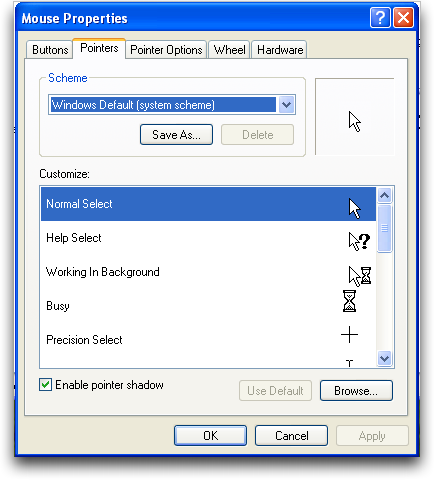
Windows users seem to place similar importance on that clicky thing. A recent PC Magazine article writes, "Few things are more important in Windows than the mouse pointers." Dave Taylor discussed mouse pointers once, showing this picture of Windows XP's mouse pointers: Windows XP's mouse pointer, then, doesn't look like the one John Goerzen got. They look like a bent version of the normal X11 pointers with inverted colors. Windows Vista's mouse cursors do look like GNOME's (via a BlogIsEverything post): For this reason, Windows Vista feels like a cheap knock-off of GNOME to me whenever I use it.

31 October 2008

Gunnar Wolf: How (and how not) to create cyclist awareness

Michael blogs about Critical Mass.
What is Critical Mass in case you are too lazy to go to Michael's or to the Wikipedia? A cyclist-awareness movement, showing how bikers are safer (i.e. more visible) when there are more of them. The (dis)organizational nature of this movement (at least according to Wikipedia's information) seems quite fun and interesting.
However, I have to oppose what Michael says is a strong point of CM in Austria - At least, given my country's culture.
People who don't bike often say we have the least bike-aware culture, and that this city must be like hell to cyclists. It is not - Mexicans tend to believe this is the worst place possible on many accounts, and I'm happy to prove the contrary. I do feel that bringing people out to the streets, as our local government's Mu vete en bici program pushes, is completely right: It shows people how fast they can move in real streets in the city, taking away the fear of being run over by a bus, and people will gradually understand we can all excercise the right to use the streets without polluting, and gives us a better idea on how to behave with traffic (even if the traffic is made of fellow bikers) around us. I know this program works - At least, because it worked on me. Whenever possible, I go everywhere in this (not small or friendly by any measure) city by bike.
Anyway - What criticism do I have for Michael's post? That he states they:
Bicycling ludicrously slowly for a good hour, we managed to claim some fairly busy streets while many people tried to get home by car.
IMHO, what we should be doing is to demand the drivers to respect us, not to make them want to run us over. They should not be driven into hating bikers because of the chaos they generate - It is terrible to sit in a car for two hours when you usually take 30 minutes. There is simply no justification for that.
When I took part of the World Naked Bike Ride, some people wanted to take all four lanes of Reforma. Fortunately, reason prevailed, and we took only the lane we were assigned. And we should keep that in mind! Whenever possible, we should protest and make ourselves heard, but without interfering, without damaging, other people's lives!
Oh, by the way: If anybody in Mexico wants to have some nice hours of healthy fun: I am still pondering whether to join, as it is a huge effort, but I am very inclined to do so. Next week, November 9, we will go by bike from Mexico City's Z calo to Pachuca. We face 95Km and close to four hours. The road to Pachuca is basically flat, and going in a large group is a great experience. Hope to see you there!

30 October 2008

Miriam Ruiz: Homophobic words of the Queen of Spain?

“I can understand, accept and respect that there are people with different sexual trends, but that they feel proud to be gay? That they go out on parades and demonstrations?” , Said the Queen of Spain to Pilar Urbano, the author of a biography about her (”La Reina muy de cerca“). “If these people want to live together, dress up for a wedding and to marry, they might have right to do so or not, according to their country’s laws: but they shouldn’t call that marriage, because it’s not. There are many possible names: social contract, union contract.“, she added. “Puedo comprender, aceptar y respetar que haya personas con otra tendencia sexual, pero que se sientan orgullosos por ser gays? Que se suban a una carroza y salgan en manifestaciones?“, dijo la Reina de Espa a a Pilar Urbano, autora de una biograf a sobre ella (”La Reina muy de cerca“). “Si esas personas quieren vivir juntas, vestirse de novios y casarse, pueden estar en su derecho, o no, seg n las leyes de su pa s: pero que a eso no le llamen matrimonio, porque no lo es. Hay muchos nombres posibles: contrato social, contrato de uni n.“, a adi . She has also spoken against abortion and euthanasia and in favor of forcing all the children to learn religion (catholic) at school. The Royal Family is supposed not to have a public political opinion, as they should theoretically represent every Spanish person. Fortunately many of us don’t believe in blue blood, kings, queens and all that stuff, so she definitely doesn’t represent us :) God shave the Queen!

Michael Banck: 30 Oct 2008

Systems Expo 2008 As the last years, Debian was offered a booth at last week's Systems expo here in Munich again. However, this year the Free Projects area was not organized by Rosa Riebl from C&L publishing, but by Wolfgang Drotschmann from LinuxTag e.V.. This made some things a bit more difficult, e.g. we did not know our exact booth number until a couple of days before the expo and the small conference programme was made up in an ad-hoc fashion after the expo started, but in the end most things worked out fine in some way or the other. While the booth (a demo-point, really) was as big (or rather small) as last year, there was much more space around the booth this year (something which seemed to apply to all of Systems), so things did not get too crowded even when a handful of visitors approached the booth at once. Also, the visibility was much improved as our demo point was visible by strolling visitors this year (last year, our demo point was just facing the wall). As nobody else stepped up, I had to organize the booth again. Fewer people than last year were around; only Robert Grimm, Arne Wichmann, Franziska Lichtblau, Johannes Wiedersich, Andreas Barth and I were able to commit to staffing the booth; other people were busy over the week or moved away from Munich since last year, like Robert Lemmen or Wolfgang Lonien. Luckily, we still had the computer the GNOME project donated to us last year, and I took a TFT, keyboard and mouse from the university along. This year, I decided to not show up for the booth build-up the day before Systems starts. On the one hand, I had made the experience that there is not much one can do then anyway, and would have to put the computer/TFT into the central locker room overnight anyway. On the other hand, there was as always a very low attendence in the first few hours of the expo so building up the booth in the morning turned out to be no problem. The Credativ people again provided us with merchandise (due to some miscommunication on my part the package had to arrive directly at the expo, but in the end I was glad about this as I had enough trouble carrying the computer and TFT to the expo). This year, thanks to Credativ, we were able to provide some t-shirts for the first time, something quite some visitors had requested over the years. Besides t-shirts, we had some swirl stickers and the popular Debian keychains provided by Joerg Jaspert through Credativ. In the end the booth mostly consisted of the computer (demonstrating Lenny most of the time) and some A4 sized Swirls I had printed out the day before. From Wednesday on we were able to provide Lenny Beta2 CDs as well thanks to Johannes Wiedersich who organized them. Initially, I asked ADR whether they would produce some CDs for us again as they did last year, but they did not bring the appropriate hardware this time. But thanks to Johannes we were still able to provide interested visitors with CDs through LSK. In the end, we ran out of most t-shirts at some point on Thursday and managed to sell the two remaining Lady shirts on Friday. All the other merchandise was gone by the end of the show as well so the way back was not that difficult, even more so as Andreas Barth helped me carry the computer to the subway and my car. The days I was at Systems (first and last day) the attendance was rather low, so not that many interesting discussions happened. Almost everybody who stepped by knew Debian already and the majority was using it themselves as well, at least on their servers. Those people were also really quite happy, we rarely heard much critizism, even after asking people for some. The most frequently asked question was undoubtly "when will Lenny release?", followed by "do you have that cool t-shirt in L or XL as well?". Overall it was a pretty good experience, albeit slightly stressful organizing it. In any case, this was probably the last time I had to do this as the Systems organizers announced they will rethink their concept and there will be no Systems 2009.

Clint Adams: Eight days of Mraz makes a harmed man fumble

  • Day One
The South American maid confesses that she doesn't clean much, because the Spaniards don't notice.
  • Day Two
People keep playing the same Jason Mraz song over and over again. It is awful. Does Jason Mraz have more than one song? If so, does he have any good songs? This makes Coldplay seem like good music.
  • Day Three
While dumpster-diving in Fulda, a large man wearing an archer's cap and peculiar shoes appeared, carrying one of the largest baskets I have ever seen. He showed me that it was full of bread, and attempted to sell me some. When I showed no interest in his wares, he recited the following gibberish:
 Ich glaab ich bin aus Staa
 unn hab' mehr Bauch wie Baa-
 unn doch bin ich en arme Tropp-
 denn ach, ich hab'e Loch im Kopp!
  • Day Four
More Jason Mraz. Ugh. Jos complains about people who will walk together without talking constantly. He repeats himself about fifty times without accidentally saying anything interesting. I am afraid that he will injure his voice and then his brain will have to start working. Luckily this does not occur.
  • Day Five
In Neu-Isenburg for a standoff with the Sky Chefs. Every time I enter Neu-Isenburg I get paranoid and start looking for UutiSaruman. It's creepy.
  • Day Six
A Hessian woman tells me I lead a sad life. I can tell that she's Hessian because she looks like a slender Austrian with teeth. I don't tell her this.
  • Day Seven
Razula asks if I remember what le k means in Slavic. I don't know why he thinks I knew in the first place. His friend starts spouting off a lecture on why Hungarians are superior to Germans because Hungarians lie, cheat, and steal, and Germans obey laws. I wonder if le k can help this situation. Probably not.
  • Day Eight
Now the South American maid is complaining that Spanish men are gay and don't realize it. Then she goes on at great length about the Great Flying Circus of North Korea. I think about asking her where it's from. I decide against it.

29 October 2008

David Welton: Nokia 6120

I finally got around to getting myself a new mobile phone, as it looks like the Android phones may take a while to arrive here in Europe, unlocked, and my old phone was fading. I ended up selecting a Nokia 6120 in order to get something that runs Symbian, which has a decent amount of apps above and beyond the Java ME stuff. So far, I'm fairly happy with the phone. Here are some notes:
  • It's small and light. Nice!
  • It runs Java ME (J2ME) applications surprisingly slowly. I'm non-plussed by this. And no, it's not just Hecl, even ShopList, which is quite simple and small (~ 6K), takes several seconds to start up. This is not appreciably faster than on my cheap phone from several years ago.
  • My old, cruddy phone was able to recharge (slowly) via USB. This one doesn't, as far as I can tell.
  • I bought it from Amazon.de, and the bozos who were the 'real' sellers sold me a phone intended for the polish market, meaning the dictionary languages installed are all eastern European - no Italian, which I need. Not the phone's fault though, and I guess it's probably possible to replace that stuff.
  • The camera has some weird issues where it leaves streaks. I realize that it's only a phone camera, but it ought to be able to do better. Here's an image from my recent trip to Oslo, by way of example:
Oslo Fjord
  • Creating videos wors pretty well though.
  • Playing video is just a bit jerky - it mostly keeps up, but not 100% of the time, when you lose a few frames.
  • Nokia ought to do a better job making sure that it's integrated with Linux (Ubuntu in my case). That said, things work quite well, by and large, and I was able to get things done with relatively little fiddling.
  • The amount of progress over a few years is very impressive. This phone completely blows my old phone out of the water. Sure, it's a bit pricier, but it's way more capable.
All in all, I'm happy with it, but I think that my next phone will be some kind of Android-based device, as that system is way more hackable than Java ME, and the people developing it seem to 'get it' a bit more. That said, I'm glad I got it - I needed something modern to play with Hecl on, and hopefully I will be able to work on using some of the fancier bits of the phone from Hecl. Oh, and by the way, I'm always on the lookout for phones to try Hecl with - even if they're old and worn out, the only thing that matters is that they are able to run Java ME applications. Contact me for shipping information:-)

David Welton: Nokia 6120

I finally got around to getting myself a new mobile phone, as it looks like the Android phones may take a while to arrive here in Europe, unlocked, and my old phone was fading. I ended up selecting a Nokia 6120 in order to get something that runs Symbian, which has a decent amount of apps above and beyond the Java ME stuff. So far, I'm fairly happy with the phone. Here are some notes: Oslo Fjord All in all, I'm happy with it, but I think that my next phone will be some kind of Android-based device, as that system is way more hackable than Java ME, and the people developing it seem to 'get it' a bit more. That said, I'm glad I got it - I needed something modern to play with Hecl on, and hopefully I will be able to work on using some of the fancier bits of the phone from Hecl. Oh, and by the way, I'm always on the lookout for phones to try Hecl with - even if they're old and worn out, the only thing that matters is that they are able to run Java ME applications. Contact me for shipping information:-)

Next.

Previous.