Search Results: "ag"

29 November 2021

Dima Kogan: GL_image_display

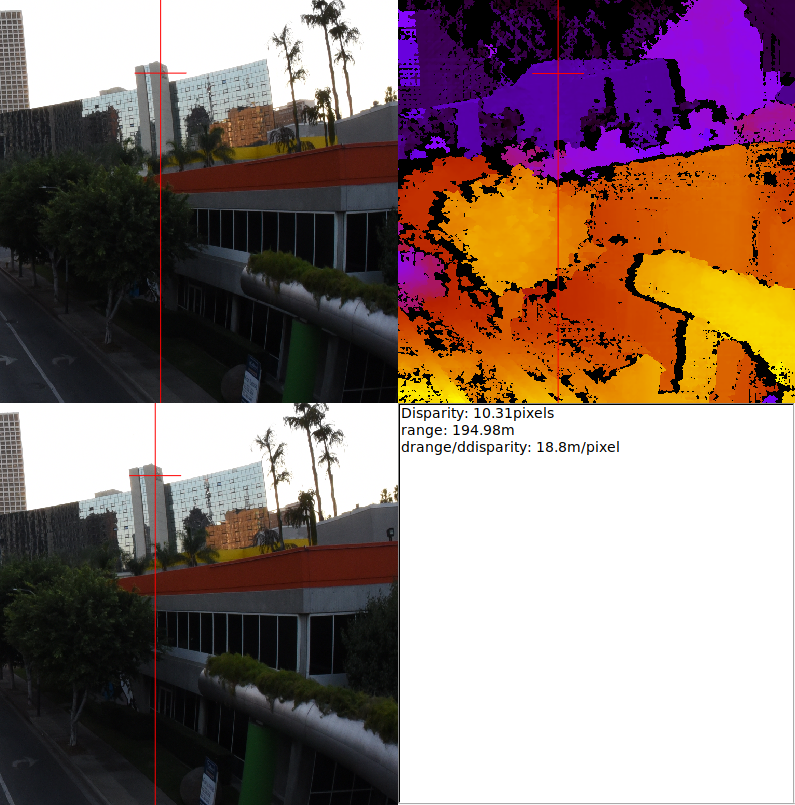
I just spent an unspeakable number of days typing to produce something that sounds very un-impressive: an FLTK widget that can display an image. The docs and code live here. The big difference from the usual image-drawing widget is that this one uses OpenGL internally, so after the initial image load, the common operations (drawing, redrawing, panning and zooming) are very fast. I have high-resolution images in my projects, and this will make my tools much nicer. Three separate interfaces are available: The FLTK widgets have built-in interactive panning/zooming, and the library can draw line overlays. So nice applications can be built quickly. I already added some early disabled-by-default support into the mrcal-stereo tool to visualize the rectification and report sensitivities:
widget.png
Nice!

Russ Allbery: Fall haul

It's been a while since I've posted one of these, and I also may have had a few moments of deciding to support authors by buying their books even if I'm not going to get a chance to read them soon. There's also a bit of work reading in here. Ryka Aoki Light from Uncommon Stars (sff)
Frederick R. Chromey To Measure the Sky (non-fiction)
Neil Gaiman, et al. Sandman: Overture (graphic novel)
Alix E. Harrow A Spindle Splintered (sff)
Jordan Ifueko Raybearer (sff)
Jordan Ifueko Redemptor (sff)
T. Kingfisher Paladin's Hope (sff)
TJ Klune Under the Whispering Door (sff)
Kiese Laymon How to Slowly Kill Yourself and Others in America (non-fiction)
Yuna Lee Fox You (romance)
Tim Mak Misfire (non-fiction)
Naomi Novik The Last Graduate (sff)
Shelley Parker-Chan She Who Became the Sun (sff)
Gareth L. Powell Embers of War (sff)
Justin Richer & Antonio Sanso OAuth 2 in Action (non-fiction)
Dean Spade Mutual Aid (non-fiction)
Lana Swartz New Money (non-fiction)
Adam Tooze Shutdown (non-fiction)
Bill Watterson The Essential Calvin and Hobbes (strip collection)
Bill Willingham, et al. Fables: Storybook Love (graphic novel)
David Wong Real-World Cryptography (non-fiction)
Neon Yang The Black Tides of Heaven (sff)
Neon Yang The Red Threads of Fortune (sff)
Neon Yang The Descent of Monsters (sff)
Neon Yang The Ascent to Godhood (sff)
Xiran Jay Zhao Iron Widow (sff)

28 November 2021

Wouter Verhelst: GR procedures and timelines

A vote has been proposed in Debian to change the formal procedure in Debian by which General Resolutions (our name for "votes") are proposed. The original proposal is based on a text by Russ Allberry, which changes a number of rules to be less ambiguous and, frankly, less weird. One thing Russ' proposal does, however, which I am absolutely not in agreement with, is to add a absolutly hard time limit after three weeks. That is, in the proposed procedure, the discussion time will be two weeks initially (unless the Debian Project Leader chooses to reduce it, which they can do by up to one week), and it will be extended if more options are added to the ballot; but after three weeks, no matter where the discussion stands, the discussion period ends and Russ' proposed procedure forces us to go to a vote, unless all proposers of ballot options agree to withdraw their option. I believe this is a big mistake. I think any procedure we come up with should allow for the possibility that we may end up with a situation where everyone agrees that extending the discussion time a short time is a good idea, without necessarily resetting the whole discussion time to another two weeks (modulo a decision by the DPL). At the same time, any procedure we come up with should try to avoid the possibility of process abuse by people who would rather delay a vote ad infinitum than to see it voted upon. A hard time limit certainly does that; but I believe it causes more problems than it solves. I think insted that it is necessary for any procedure to allow for the discussion time to be extended as long as a strong enough consensus exists that this would be beneficial. As such, I have proposed an amendment to Russ' proposal (a full version of my proposed constitution can be seen on salsa) that hopefully solves these issues in a novel way: it allows anyone to request an extension to the discussion time, which then needs to be sponsored according to the same rules as a new ballot option. If the time extension is successfully created, those who supported the extension can then also no longer propose any new ones. Additionally, after 4 weeks, the proposed procedure allows anyone to object, so that 4 weeks is probably the practical limit -- although the possibility exists if enough support exists to extend the discussion time (or not enough to end it). The full rules involve slightly more than that (I don't like to put too much formal language in a blog post), but they're not too complicated, I think. That proposal has received a number of seconds, but after a week it hasn't yet reached the constitutional requirement for the option to be on the ballot. So, I guess this is a public request for more support to my proposal. If you're a Debian Developer and you agree with me that my proposed procedure is better than the alternative, please step forward and let yourself be heard. Thanks!

Joachim Breitner: Zero-downtime upgrades of Internet Computer canisters

TL;DR: Zero-downtime upgrades are possible if you stick to the basic actor model.

Background DFINITY s Internet Computer provides a kind of serverless compute platform, where the services are WebAssemmbly programs called canisters . These services run without stopping (or at least that s what it feels like from the service s perspective; this is called orthogonal persistence ), and process one message after another. Messages not only come from the outside ( ingress calls), but are also exchanged between canisters. On top of these uni-directional messages, the system provides the concept of inter-canister calls , which associates a respondse message with the outgoing message, and guarantees that a response will come. This RPC-like interface allows canister developers to program in the popular async/await model, where these inter-canister calls look almost like normal function calls, and the subsequent code is suspended until the response comes back.

The problem This is all very well, until you try to upgrade your canister, i.e. install new code to fix a bug or add a feature. Because if you used the await pattern, there may still be suspended computations waiting for the response. If you swap out the program now, the code of that suspended computation will no longer be present, and the response cannot be handled! Worse, because of an infelicity with the current system s API, when the response comes back, it may actually corrupt your service s state. That is why upgrading a canister requires stopping it first, which means waiting for all outstanding calls to come back. During this time, your canister is not available for new calls (so there is downtime), and worse, the length of the downtime is at the whims of the canisters you called they could withhold the response ad infinitum, rendering your canister unupgradeable. Clearly, this is not acceptable for any serious application. In this post, I ll explore some of the ways to mitigate this problem, and how to create canisters that are safely instantanously (no downtime) upgradeable.

It s a spectrum Some canisters are trivially upgradeable, for others all hope is lost; it depends on what the canister does and how. As an overview, here is the spectrum:
  1. A canister that never performs inter-canister calls can always be upgraded without stopping.
  2. A canister that only does one-way calls, and does them in a particular way (see below), can always be upgraded without stopping.
  3. A canister that performs calls, and where it is acceptable to simply drop outstanding repsonses, can always be upgraded without stopping, once the System API has been improved and your Canister Development Kit (CDK; Motoko or Rust) has adapted.
  4. A canister that performs calls, but uses explicit continuations to handle, responses instead of the await-convenience, based on an eventually fixed System API, can be upgradeded without stopping, and will even handle responses afterwards.
  5. A canister that uses await to do inter-canister call cannot be upgraded without stopping.
In this post I will explain 2, which is possible now, in more detail. Variant 3 and 4 only become reality if and when the System API has improved.

One-way calls A one-way call is a call where you don t care about the response; neither the replied data, nor possible failure conditions. Since you don t care about the response, you can pass an invalid continuation to the system (technical detail: a Wasm table index of -1). Because it is invalid for any (realistic) Wasm module, it will stay invalid even after an upgrade, and the problem of silent corruption mentioned above is avoided. And otherwise it s fine for this to be invalid: it means the canister traps once the response comes back, which is harmeless (and possibly even cheaper than a do-nothing computation). This requires your CDK to support this kind of call. Mostly incidential, Motoko (and Candid) actually have the concept of one-way call in their type system, namely shared functions with return type () instead of async ... (Motoko is actually older than the system, and not every prediction about what the system will provide has proven successful). So, pending this PR to be released, Motoko will implement one-way calls in this way. On Rust, you have to use the System API directly or wait for cdk-rs to provide this ability (patches welcome, happy to advise). You might wonder: How are calls useful if I don t get to look at the response? Of course, this is a set-back calls with responses are useful, and await is convenient. And if you have to integrate with an existing service that only provides normal calls, you are out of luck. But if you get to design the canister and all called canisters together, it may be possible to use only one-way messages. You d be programming in the plain actor model now, with all its advantages (simple concurrency, easy to upgrade, general robustness). Consider for example a token ledger canister, not unlike the ICP ledger canister. For the most part, it doesn t have to do any outgoing calls (and thus be trivially upgradeble). But say we need to add notify functionality, where the ledger canister tells other canisters about a transaction. This is a good example for a one-way call: Maybe the ledger canister doesn t care if that notification was received? The ICP leder does care (once it comes back successful, this particular notification cannot be sent again), but maybe your ledger can do it differently: let the other canister confirm the receip via another one-way call, instead of via the reply; or simply charge for each notification and do not worry about repeated notifications. Maybe you want to add archiving functionality, where the ledger canister streams its data to an archive canister. There, again, instead of using successful responses to confirm receipt, the archive canister can ping the ledger canister with the latest received index directly. Yes, it changes the programming model a bit, and all involved parties have to play together, but the gain (zero-downtime upgrades) is quite valuable, and removes a fair number of other sources of issues.

And in the future? The above is possible with today s Internet Computer. If the System API gets improves the way I hope it will be, you have a possible middle ground: You still don t get to use await and instead have to write your response handler as separate functions, but this way you can call any canister again, and you get the system s assistance in mapping responses to calls. With this in place, any canister can be rewritten to a form that supports zero-downtime upgrades, without affecting its interface or what the canister can do.

Russ Allbery: Review: Soul Music

Review: Soul Music, by Terry Pratchett
Series: Discworld #16
Publisher: Harper
Copyright: January 1995
Printing: November 2013
ISBN: 0-06-223741-1
Format: Mass market
Pages: 420
Soul Music is the sixteenth Discworld novel and something of a plot sequel to Reaper Man (although more of a sequel to the earlier Mort). I would not start reading the Discworld books here. Susan is a student in the Quirm College for Young Ladies with an uncanny habit of turning invisible. Well, not invisible exactly; rather, people tend to forget that she's there, even when they're in the middle of talking to her. It's disconcerting for the teachers, but convenient when one is uninterested in Literature and would rather read a book.
She listened with half an ear to what the rest of the class was doing. It was a poem about daffodils. Apparently the poet had liked them very much. Susan was quite stoic about this. It was a free country. People could like daffodils if they wanted to. They just should not, in Susan's very definite opinion, be allowed to take up more than a page to say so. She got on with her education. In her opinion, school kept on trying to interfere with it. Around her, the poet's vision was being taken apart with inexpert tools.
Susan's determinedly practical education is interrupted by the Death of Rats, with the help of a talking raven and Binky the horse, and without a lot of help from Susan, who is decidedly uninterested in being the sort of girl who goes on adventures. Adventures have a different opinion, since Susan's grandfather is Death. And Death has wandered off again. Meanwhile, the bard Imp y Celyn, after an enormous row with his father, has gone to Ankh-Morpork. This is not going well; among other things, the Guild of Musicians and their monopoly and membership dues came as a surprise. But he does meet a dwarf and a troll in the waiting room of the Guild, and then buys an unusual music instrument in the sort of mysterious shop that everyone knows has been in that location forever, but which no one has seen before. I'm not sure there is such a thing as a bad Discworld novel, but there is such a thing as an average Discworld novel. At least for me, Soul Music is one of those. There are some humorous bits, a few good jokes, one great character, and some nice bits of philosophy, but I found the plot forgettable and occasionally annoying. Susan is great. Imp is... not, which is made worse by the fact the reader is eventually expected to believe Susan cares enough about Imp to drive the plot. Discworld has always been a mix of parody and Pratchett's own original creation, and I have always liked the original creation substantially more than the parody. Soul Music is a parody of rock music, complete with Cut-Me-Own-Throat Dibbler as an unethical music promoter. The troll Imp meets makes music by beating rocks together, so they decide to call their genre "music with rocks in it." The magical instrument Imp buys has twelve strings and a solid body. Imp y Celyn means "bud of the holly." You know, like Buddy Holly. Get it? Pratchett's reference density is often on the edge of overwhelming the book, but for some reason the parody references in this one felt unusually forced and obvious to me. I did laugh occasionally, but by the end of the story the rock music plot had worn out its welcome. This is not helped by the ending being a mostly incoherent muddle of another parody (admittedly featuring an excellent motorcycle scene). Unlike Moving Pictures, which is a similar parody of Hollywood, Pratchett didn't seem to have much insightful to say about music. Maybe this will be more your thing if you like constant Blues Brothers references. Susan, on the other hand, is wonderful, and for me is the reason to read this book. She is a delightfully atypical protagonist, and her interactions with the teachers and other students at the girl's school are thoroughly enjoyable. I would have happily read a whole book about her, and more broadly about Death and his family and new-found curiosity about the world. The Death of Rats was also fun, although more so in combination with the raven to translate. I wish this part of her story had a more coherent ending, but I'm looking forward to seeing her in future books. Despite my complaints, the parody part of this book wasn't bad. It just wasn't as good as the rest of the book. I wanted a better platform for Susan's introduction than a lot of music and band references. If you really like Pratchett's parodies, your mileage may vary. For me, this book was fun but forgettable. Followed, in publication order, by Interesting Times. The next Death book is Hogfather. Rating: 7 out of 10

27 November 2021

Russ Allbery: Review: A Psalm for the Wild-Built

Review: A Psalm for the Wild-Built, by Becky Chambers
Series: Monk & Robot #1
Publisher: Tordotcom
Copyright: July 2021
ISBN: 1-250-23622-3
Format: Kindle
Pages: 160
At the start of the story, Sibling Dex is a monk in a monastery in Panga's only City. They have spent their entire life there, love the buildings, know the hidden corners of the parks, and find the architecture beautiful. They're also heartily sick of it and desperate for the sound of crickets.
Sometimes, a person reaches a point in their life when it becomes absolutely essential to get the fuck out of the city.
Sibling Dex therefore decides to upend their life and travel the outlying villages doing tea service. And they do. They commission an ox-bike wagon, throw themselves into learning cultivation and herbs, experiment with different teas, and practice. It's a lot to learn, and they don't get it right from the start, but Sibling Dex is the sort of person who puts in the work to do something well. Before long, they have a new life as a traveling tea monk. It's better than living in the City. But it still isn't enough. We don't find out much about the moon of Panga in this story. Humans live there and it has a human-friendly biosphere with recognizable species, but it is clearly not Earth. The story does not reveal how humans came to live there. Dex's civilization is quite advanced and appears to be at least partly post-scarcity: people work and have professions, but money is rarely mentioned, poverty doesn't appear to be a problem, and Dex, despite being a monk with no obvious source of income, is able to commission the construction of a wagon home without any difficulty. They follow a religion that has no obvious Earth analogue. The most fascinating thing about Panga is an event in its history. It previously had an economy based on robot factories, but the robots became sentient. Since this is a Becky Chambers story, the humans reaction was to ask the robots what they wanted to do and respect their decision. The robots, not very happy about having their whole existence limited to human design, decided to leave, walking off into the wild. Humans respected their agreement, rebuilt their infrastructure without using robots or artificial intelligence, and left the robots alone. Nothing has been heard from them in centuries. As you might expect, Sibling Dex meets a robot. Its name is Mosscap, and it was selected to check in with humans. Their attempts to understand each other is much of the story. The rest is Dex's attempt to find what still seems to be missing from life, starting with an attempt to reach a ruined monastery out in the wild. As with Chambers's other books, A Psalm for the Wild-Built contains a lot of earnest and well-meaning people having thoughtful conversations. Unlike her other books, there is almost no plot apart from those conversations of self-discovery and a profile of Sibling Dex as a character. That plus the earnestness of two naturally introspective characters who want to put their thoughts into words gave this story an oddly didactic tone for me. There are moments that felt like the moral of a Saturday morning cartoon show (I am probably dating myself), although the morals are more sophisticated and conditional. Saying I disliked the tone would be going too far, but it didn't flow as well for me as Chambers's other novels. I liked the handling of religion, and I loved Sibling Dex's efforts to describe or act on an almost impossible to describe sense that their life isn't quite what they want. There are some lovely bits of description, including the abandoned monastery. The role of a tea monk in this imagined society is a neat, if small, bit of world-building: a bit like a counselor and a bit like a priest, but not truly like either because of the different focus on acceptance, listening, and a hot cup of tea. And Dex's interaction with Mosscap over offering and accepting food is a beautiful bit of characterization. That said, the story as a whole didn't entirely gel for me, partly because of the didactic tone and partly because I didn't find Mosscap or the described culture of the robots as interesting as I was hoping that I would. But I'm still invested enough that I would read the sequel. A Psalm for the Wild-Built feels like a prelude or character introduction more than a complete story. When we leave the characters, they're just getting started. You know more about the robots (and Sibling Dex) at the end than you did at the beginning, but don't expect much in the way of resolution. Followed by A Prayer for the Crown-Shy, scheduled for 2022. Rating: 7 out of 10

26 November 2021

Reproducible Builds (diffoscope): diffoscope 194 released

The diffoscope maintainers are pleased to announce the release of diffoscope version 194. This version includes the following changes:
[ Chris Lamb ]
* Don't traceback when comparing nested directories with non-directories.
  (Closes: reproducible-builds/diffoscope#288)
You find out more by visiting the project homepage.

25 November 2021

Mike Gabriel: Touching Firefox on Linux

More as a reminder to myself, but possibly also helpful to other people who want to use Firefox on a tablet running Debian... Without the below adjustment, finger gestures in Firefox running on a tablet result in image moving, text highlighting, etc. (operations related to copy+paste). Not the intuitively expected behaviour... If you use e.g. GNOME on Wayland for your tablet and want to enable touch functionalities in Firefox, then switch the whole browser to native Wayland rendering. This line in ~/.profile seems to help:
export MOZ_ENABLE_WAYLAND=1
If you use a desktop environment running on top of X.Org, then make sure you have added the following line to ~/.profile:
export MOZ_USE_XINPUT2=1
Logout/login again and Firefox should be scrollable with 2-finger movements up and down, zooming in and out also works then. light+love
Mike (aka sunweaver at debian.org)

24 November 2021

Dirk Eddelbuettel: nanotime 0.3.4 on CRAN: Maintenance Update

Another (minor) nanotime release, now at version 0.3.4, arrived at CRAN overnight. It exports some nanoperiod functionality via a C++ header, and Leonardo and I will use this in an upcoming package that we hope to talk about a little more in a few days. It also adds a few as.character.*() methods that had not been included before. nanotime relies on the RcppCCTZ package for (efficient) high(er) resolution time parsing and formatting up to nanosecond resolution, and the bit64 package for the actual integer64 arithmetic. Initially implemented using the S3 system, it has benefitted greatly from a rigorous refactoring by Leonardo who not only rejigged nanotime internals in S4 but also added new S4 types for periods, intervals and durations. The NEWS snippet adds more details.

Changes in version 0.3.4 (2021-11-24)
  • Added a few more as.character conversion function (Dirk)
  • Expose nanoperiod functionality via header file for use by other packages (Leonardo in #95 fixing #94).

Thanks to CRANberries there is also a diff to the previous version. More details and examples are at the nanotime page; code, issue tickets etc at the GitHub repository. If you like this or other open-source work I do, you can now sponsor me at GitHub.

This post by Dirk Eddelbuettel originated on his Thinking inside the box blog. Please report excessive re-aggregation in third-party for-profit settings.

23 November 2021

Enrico Zini: Really lossy compression of JPEG

Suppose you have a tool that archives images, or scientific data, and it has a test suite. It would be good to collect sample files for the test suite, but they are often so big one can't really bloat the repository with them. But does the test suite need everything that is in those files? Not necesarily. For example, if one's testing code that reads EXIF metadata, one doesn't care about what is in the image. That technique works extemely well. I can take GRIB files that are several megabytes in size, zero out their data payload, and get nice 1Kb samples for the test suite. I've started to collect and organise the little hacks I use for this into a tool I called mktestsample:
$ mktestsample -v samples1/*
2021-11-23 20:16:32 INFO common samples1/cosmo_2d+0.grib: size went from 335168b to 120b
2021-11-23 20:16:32 INFO common samples1/grib2_ifs.arkimet: size went from 4993448b to 39393b
2021-11-23 20:16:32 INFO common samples1/polenta.jpg: size went from 3191475b to 94517b
2021-11-23 20:16:32 INFO common samples1/test-ifs.grib: size went from 1986469b to 4860b
Those are massive savings, but I'm not satisfied about those almost 94Kb of JPEG:
$ ls -la samples1/polenta.jpg
-rw-r--r-- 1 enrico enrico 94517 Nov 23 20:16 samples1/polenta.jpg
$ gzip samples1/polenta.jpg
$ ls -la samples1/polenta.jpg.gz
-rw-r--r-- 1 enrico enrico 745 Nov 23 20:16 samples1/polenta.jpg.gz
I believe I did all I could: completely blank out image data, set quality to zero, maximize subsampling, and tweak quantization to throw everything away. Still, the result is a 94Kb file that can be gzipped down to 745 bytes. Is there something I'm missing? I suppose JPEG is better at storing an image than at storing the lack of an image. I cannot really complain :) I can still commit compressed samples of large images to a git repository, taking very little data indeed. That's really nice!

22 November 2021

Jonathan Wiltshire: Mischief managed

I m finally paying up a certain amount of household technical debt, including investigating some exciting mystery cabling and insulating the space it inhabits. This has meant pulling down large chunks of ceiling (eventually, most or all of it for the insulation) on a cable hunt. Turns out the best tool for this part of the job is a decent length of 4 by 2, some borrowed muscle, and a certain amount of bravery. Once a couple of holes have been cut the old-fashioned way to be sure there s nothing crucial above the ceiling (like the other side of the felt roof), the 4 2 really comes into its own: To use the 4 2, aim for a gap between two joists and imagine you re holding a caber. Launch it. The ceiling will come off far worse than the lump of wood you re holding. We found the mystery cable, but didn t really solve the mystery it creates and in the process uncovered another bizarre installation. The local lighting circuit is mostly a spur system in that white junction box by the RSJ. The overhead supplies dive under the RSJ through the junction box to the light switch including a full 3-core feed, not the usual loop-in system used in the rest of the house (I am not sure how prevalent loop-in systems are in other countries, they re sometimes called three-plate systems but they re very common in the UK). It does at least explain why I could never reverse-engineer the setup from the ceiling roses alone, which had only half the cores in the fitting than expected throughout the room (it wasn t even that the first fitting was looped in and being a supply for the others). On the other hand, normalising everything to a loop-in system and removing that awful rats nest of TPE should be straightforward. Neutral isn t required in that switch so that s one less problem. I couldn t resist labelling the switch in its relocated position:
Unfortunately, as valuable as that exercise was, I still have to get to the bottom of the original mystery cable which is at varying points 6mm2, 2.5mm2 and 1.5mm2 with apparently no current limiter or switch separation. Time for a bit more 4 by 2

Paul Tagliamonte: Be careful when using vxlan!

I ve spent a bit of time playing with vxlan - which is very neat, but also incredibly insecure by default.When using vxlan, be very careful to understand how the host is connected to the internet. The kernel will listen on all interfaces for packets, which means hosts accessable to VMs it s hosting (e.g., by bridged interface or a private LAN will accept packets from VMs and inject them into arbitrary VLANs, even ones it s not on.I reported this to the kernel mailing list to no reply with more technical details.The tl;dr is:
  $ ip link add vevx0a type veth peer name vevx0z
  $ ip addr add 169.254.0.2/31 dev vevx0a
  $ ip addr add 169.254.0.3/31 dev vevx0z
  $ ip link add vxlan0 type vxlan id 42 \
    local 169.254.0.2 dev vevx0a dstport 4789
  $ # Note the above 'dev' and 'local' ip are set here
  $ ip addr add 10.10.10.1/24 dev vxlan0
results in vxlan0 listening on all interfaces, not just vevx0z or vevx0a. To prove it to myself, I spun up a docker container (using a completely different network bridge with no connection to any of the interfaces above), and ran a Go program to send VXLAN UDP packets to my bridge host:
$ docker run -it --rm -v $(pwd):/mnt debian:unstable /mnt/spam 172.17.0.1:4789
$
which results in packets getting injected into my vxlan interface
$ sudo tcpdump -e -i vxlan0
tcpdump: verbose output suppressed, use -v[v]... for full protocol decode
listening on vxlan0, link-type EN10MB (Ethernet), snapshot length 262144 bytes
21:30:15.746754 de:ad:be:ef:00:01 (oui Unknown) > Broadcast, ethertype IPv4 (0x0800), length 64: truncated-ip - 27706 bytes missing! 33.0.0.0 > localhost: ip-proto-114
21:30:15.746773 de:ad:be:ef:00:01 (oui Unknown) > Broadcast, ethertype IPv4 (0x0800), length 64: truncated-ip - 27706 bytes missing! 33.0.0.0 > localhost: ip-proto-114
21:30:15.746787 de:ad:be:ef:00:01 (oui Unknown) > Broadcast, ethertype IPv4 (0x0800), length 64: truncated-ip - 27706 bytes missing! 33.0.0.0 > localhost: ip-proto-114
21:30:15.746801 de:ad:be:ef:00:01 (oui Unknown) > Broadcast, ethertype IPv4 (0x0800), length 64: truncated-ip - 27706 bytes missing! 33.0.0.0 > localhost: ip-proto-114
21:30:15.746815 de:ad:be:ef:00:01 (oui Unknown) > Broadcast, ethertype IPv4 (0x0800), length 64: truncated-ip - 27706 bytes missing! 33.0.0.0 > localhost: ip-proto-114
21:30:15.746827 de:ad:be:ef:00:01 (oui Unknown) > Broadcast, ethertype IPv4 (0x0800), length 64: truncated-ip - 27706 bytes missing! 33.0.0.0 > localhost: ip-proto-114
21:30:15.746870 de:ad:be:ef:00:01 (oui Unknown) > Broadcast, ethertype IPv4 (0x0800), length 64: truncated-ip - 27706 bytes missing! 33.0.0.0 > localhost: ip-proto-114
21:30:15.746885 de:ad:be:ef:00:01 (oui Unknown) > Broadcast, ethertype IPv4 (0x0800), length 64: truncated-ip - 27706 bytes missing! 33.0.0.0 > localhost: ip-proto-114
21:30:15.746899 de:ad:be:ef:00:01 (oui Unknown) > Broadcast, ethertype IPv4 (0x0800), length 64: truncated-ip - 27706 bytes missing! 33.0.0.0 > localhost: ip-proto-114
21:30:15.746913 de:ad:be:ef:00:01 (oui Unknown) > Broadcast, ethertype IPv4 (0x0800), length 64: truncated-ip - 27706 bytes missing! 33.0.0.0 > localhost: ip-proto-114
10 packets captured
10 packets received by filter
0 packets dropped by kernel
(the program in question is the following:)
  package main
  import (
      "net"
      "os"
      "github.com/mdlayher/ethernet"
      "github.com/mdlayher/vxlan"
  )
  func main()  
      conn, err := net.Dial("udp", os.Args[1])
      if err != nil   panic(err)  
      for i := 0; i < 10; i++  
          vxf := &vxlan.Frame 
              VNI: vxlan.VNI(42),
              Ethernet: &ethernet.Frame 
                  Source:      net.HardwareAddr 0xDE, 0xAD, 0xBE,
0xEF, 0x00, 0x01 ,
                  Destination: net.HardwareAddr 0xFF, 0xFF, 0xFF,
0xFF, 0xFF, 0xFF ,
                  EtherType:   ethernet.EtherTypeIPv4,
                  Payload:     []byte("Hello, World!"),
              ,
          
          frb, err := vxf.MarshalBinary()
          if err != nil   panic(err)  
          _, err = conn.Write(frb)
          if err != nil   panic(err)  
      
  
When using vxlan, be absolutely sure all hosts that can address any interface on the host are authorized to send arbitrary packets into any VLAN that box can send to, or there s very careful and specific controls and firewalling. Note this includes public interfaces (e.g., dual-homed private network / internet boxes), or any type of dual-homing (VPNs, etc).

21 November 2021

Julian Andres Klode: APT Z3 Solver Basics

Z3 is a theorem prover developed at Microsoft research and available as a dynamically linked C++ library in Debian-based distributions. While the library is a whopping 16 MB, and the solver is a tad slow, it s permissive licensing, and number of tactics offered give it a huge potential for use in solving dependencies in a wide variety of applications. Z3 does not need normalized formulas, but offers higher level abstractions like atmost and atleast and implies, that we will make use of together with boolean variables to translate the dependency problem to a form Z3 understands. In this post, we ll see how we can apply Z3 to the dependency resolution in APT. We ll only discuss the basics here, a future post will explore optimization criteria and recommends.

Translating the universe APT s package universe consists of 3 relevant things: packages (the tuple of name and architecture), versions (basically a .deb), and dependencies between versions. While we could translate our entire universe to Z3 problems, we instead will construct a root set from packages that were manually installed and versions marked for installation, and then build the transitive root set from it by translating all versions reachable from the root set. For each package P in the transitive root set, we create a boolean literal P. We then translate each version P1, P2, and so on. Translating a version means building a boolean literal for it, e.g. P1, and then translating the dependencies as shown below. We now need to create two more clauses to satisfy the basic requirements for debs:
  1. If a version is installed, the package is installed; and vice versa. We can encode this requirement for P above as P == atleast( P1,P2 , 1).
  2. There can only be one version installed. We add an additional constraint of the form atmost( P1,P2 , 1).
We also encode the requirements of the operation.
  1. For each package P that is manually installed, add a constraint P.
  2. For each version V that is marked for install, add a constraint V.
  3. For each package P that is marked for removal, add a constraint !P.

Dependencies Packages in APT have dependencies of two basic forms: Depends and Conflicts, as well as variations like Breaks (identical to Conflicts in solving terms), and Recommends (soft Depends) - we ll ignore those for now. We ll discuss Conflicts in the next section. Let s take a basic dependency list: A Depends: X Y, Z. To represent that dependency, we expand each name to a list of versions that can satisfy the dependency, for example X1 X2 Y1, Z1. Translating this dependency list to our Z3 solver, we create boolean variables X1,X2,Y1,Z1 and define two rules:
  1. A implies atleast( X1,X2,Y1 , 1)
  2. A implies atleast( Z1 , 1)
If there actually was nothing that satisfied the Z requirement, we d have added a rule not A. It would be possible to simply not tell Z3 about the version at all as an optimization, but that adds more complexity, and the not A constraint should not cause too many problems.

Conflicts Conflicts cannot have or in them. A dependency B Conflicts: X, Y means that only one of B, X, and Y can be installed. We can directly encode this in Z3 by using the constraint atmost( B,X,Y , 1). This is an optimized encoding of the constraint: We could have encoded each conflict in the form !B or !X, !B or !X, and so on. Usually this leads to worse performance as it introduces additional clauses.

Complete example Let s assume we start with an empty install and want to install the package a below.
Package: a
Version: 1
Depends: c   b
Package: b
Version: 1
Package: b
Version: 2
Conflicts: x
Package: d
Version: 1
Package: x
Version: 1
The translation in Z3 rules looks like this:
  1. Package rules for a:
    1. a == atleast( a1 , 1) - package is installed iff one version is
    2. atmost( a1 , 1) - only one version may be installed
    3. a a must be installed
  2. Dependency rules for a
    1. implies(a1, atleast( b2, b1 , 1)) the translated dependency above. note that c is gone, it s not reachable.
  3. Package rules for b:
    1. b == atleast( b1,b2 , 1) - package is installed iff one version is
    2. atmost( b1, b2 , 1) - only one version may be installed
  4. Dependencies for b (= 2):
    1. atmost( b2, x1 , 1) - the conflicts between x and b = 2 above
  5. Package rules for x:
    1. x == atleast( x1 , 1) - package is installed iff one version is
    2. atmost( x1 , 1) - only one version may be installed
The package d is not translated, as it is not reachable from the root set a1 , the transitive root set is a1,b1,b2,x1 .

Next iteration: Optimization We have now constructed the basic set of rules that allows us to solve solve our dependency problems (equivalent to SAT), however it might lead to suboptimal solutions where it removes automatically installed packages, or installs more packages than necessary, to name a few examples. In our next iteration, we have to look at introducing optimization; for example, have the minimum number of removals, the minimal number of changed packages, or satisfy as many recommends as possible. We will also look at the upgrade problem (upgrade as many packages as possible), the autoremove problem (remove as many automatically installed packages as possible).

Antoine Beaupr : mbsync vs OfflineIMAP

After recovering from my latest email crash (previously, previously), I had to figure out which tool I should be using. I had many options but I figured I would start with a popular one (mbsync). But I also evaluated OfflineIMAP which was resurrected from the Python 2 apocalypse, and because I had used it before, for a long time. Read on for the details.

Benchmark setup All programs were tested against a Dovecot 1:2.3.13+dfsg1-2 server, running Debian bullseye. The client is a Purism 13v4 laptop with a Samsung SSD 970 EVO 1TB NVMe drive. The server is a custom build with a AMD Ryzen 5 2600 CPU, and a RAID-1 array made of two NVMe drives (Intel SSDPEKNW010T8 and WDC WDS100T2B0C). The mail spool I am testing against has almost 400k messages and takes 13GB of disk space:
$ notmuch count --exclude=false
372758
$ du -sh --exclude xapian Maildir
13G Maildir
The baseline we are comparing against is SMD (syncmaildir) which performs the sync in about 7-8 seconds locally (3.5 seconds for each push/pull command) and about 10-12 seconds remotely. Anything close to that or better is good enough. I do not have recent numbers for a SMD full sync baseline, but the setup documentation mentions 20 minutes for a full sync. That was a few years ago, and the spool has obviously grown since then, so that is not a reliable baseline. A baseline for a full sync might be also set with rsync, which copies files at nearly 40MB/s, or 317Mb/s!
anarcat@angela:tmp(main)$ time rsync -a --info=progress2 --exclude xapian  shell.anarc.at:Maildir/ Maildir/
 12,647,814,731 100%   37.85MB/s    0:05:18 (xfr#394981, to-chk=0/395815)    
72.38user 106.10system 5:19.59elapsed 55%CPU (0avgtext+0avgdata 15988maxresident)k
8816inputs+26305112outputs (0major+50953minor)pagefaults 0swaps
That is 5 minutes to transfer the entire spool. Incremental syncs are obviously pretty fast too:
anarcat@angela:tmp(main)$ time rsync -a --info=progress2 --exclude xapian  shell.anarc.at:Maildir/ Maildir/
              0   0%    0.00kB/s    0:00:00 (xfr#0, to-chk=0/395815)    
1.42user 0.81system 0:03.31elapsed 67%CPU (0avgtext+0avgdata 14100maxresident)k
120inputs+0outputs (3major+12709minor)pagefaults 0swaps
As an extra curiosity, here's the performance with tar, pretty similar with rsync, minus incremental which I cannot be bothered to figure out right now:
anarcat@angela:tmp(main)$ time ssh shell.anarc.at tar --exclude xapian -cf - Maildir/   pv -s 13G   tar xf - 
56.68user 58.86system 5:17.08elapsed 36%CPU (0avgtext+0avgdata 8764maxresident)k
0inputs+0outputs (0major+7266minor)pagefaults 0swaps
12,1GiO 0:05:17 [39,0MiB/s] [===================================================================> ] 92%
Interesting that rsync manages to almost beat a plain tar on file transfer, I'm actually surprised by how well it performs here, considering there are many little files to transfer. (But then again, this maybe is exactly where rsync shines: while tar needs to glue all those little files together, rsync can just directly talk to the other side and tell it to do live changes. Something to look at in another article maybe?) Since both ends are NVMe drives, those should easily saturate a gigabit link. And in fact, a backup of the server mail spool achieves much faster transfer rate on disks:
anarcat@marcos:~$ tar fc - Maildir   pv -s 13G > Maildir.tar
15,0GiO 0:01:57 [ 131MiB/s] [===================================] 115%
That's 131Mibyyte per second, vastly faster than the gigabit link. The client has similar performance:
anarcat@angela:~(main)$ tar fc - Maildir   pv -s 17G > Maildir.tar
16,2GiO 0:02:22 [ 116MiB/s] [==================================] 95%
So those disks should be able to saturate a gigabit link, and they are not the bottleneck on fast links. Which begs the question of what is blocking performance of a similar transfer over the gigabit link, but that's another question altogether, because no sync program ever reaches the above performance anyways. Finally, note that when I migrated to SMD, I wrote a small performance comparison that could be interesting here. It show SMD to be faster than OfflineIMAP, but not as much as we see here. In fact, it looks like OfflineIMAP slowed down significantly since then (May 2018), but this could be due to my larger mail spool as well.

mbsync The isync (AKA mbsync) project is written in C and supports syncing Maildir and IMAP folders, with possibly multiple replicas. I haven't tested this but I suspect it might be possible to sync between two IMAP servers as well. It supports partial mirorrs, message flags, full folder support, and "trash" functionality.

Complex configuration file I started with this .mbsyncrc configuration file:
SyncState *
Sync New ReNew Flags
IMAPAccount anarcat
Host imap.anarc.at
User anarcat
PassCmd "pass imap.anarc.at"
SSLType IMAPS
CertificateFile /etc/ssl/certs/ca-certificates.crt
IMAPStore anarcat-remote
Account anarcat
MaildirStore anarcat-local
# Maildir/top/sub/sub
#SubFolders Verbatim
# Maildir/.top.sub.sub
SubFolders Maildir++
# Maildir/top/.sub/.sub
# SubFolders legacy
# The trailing "/" is important
#Path ~/Maildir-mbsync/
Inbox ~/Maildir-mbsync/
Channel anarcat
# AKA Far, convert when all clients are 1.4+
Master :anarcat-remote:
# AKA Near
Slave :anarcat-local:
# Exclude everything under the internal [Gmail] folder, except the interesting folders
#Patterns * ![Gmail]* "[Gmail]/Sent Mail" "[Gmail]/Starred" "[Gmail]/All Mail"
# Or include everything
Patterns *
# Automatically create missing mailboxes, both locally and on the server
#Create Both
Create slave
# Sync the movement of messages between folders and deletions, add after making sure the sync works
#Expunge Both
Long gone are the days where I would spend a long time reading a manual page to figure out the meaning of every option. If that's your thing, you might like this one. But I'm more of a "EXAMPLES section" kind of person now, and I somehow couldn't find a sample file on the website. I started from the Arch wiki one but it's actually not great because it's made for Gmail (which is not a usual Dovecot server). So a sample config file in the manpage would be a great addition. Thankfully, the Debian packages ships one in /usr/share/doc/isync/examples/mbsyncrc.sample but I only found that after I wrote my configuration. It was still useful and I recommend people take a look if they want to understand the syntax. Also, that syntax is a little overly complicated. For example, Far needs colons, like:
Far :anarcat-remote:
Why? That seems just too complicated. I also found that sections are not clearly identified: IMAPAccount and Channel mark section beginnings, for example, which is not at all obvious until you learn about mbsync's internals. There are also weird ordering issues: the SyncState option needs to be before IMAPAccount, presumably because it's global. Using a more standard format like .INI or TOML could improve that situation.

Stellar performance A transfer of the entire mail spool takes 56 minutes and 6 seconds, which is impressive. It's not quite "line rate": the resulting mail spool was 12GB (which is a problem, see below), which turns out to be about 29Mbit/s and therefore not maxing the gigabit link, and an order of magnitude slower than rsync. The incremental runs are roughly 2 seconds, which is even more impressive, as that's actually faster than rsync:
===> multitime results
1: mbsync -a
            Mean        Std.Dev.    Min         Median      Max
real        2.015       0.052       1.930       2.029       2.105       
user        0.660       0.040       0.592       0.661       0.722       
sys         0.338       0.033       0.268       0.341       0.387    
Those tests were performed with isync 1.3.0-2.2 on Debian bullseye. Tests with a newer isync release originally failed because of a corrupted message that triggered bug 999804 (see below). Running 1.4.3 under valgrind works around the bug, but adds a 50% performance cost, the full sync running in 1h35m. Once the upstream patch is applied, performance with 1.4.3 is fairly similar, considering that the new sync included the register folder with 4000 messages:
120.74user 213.19system 59:47.69elapsed 9%CPU (0avgtext+0avgdata 105420maxresident)k
29128inputs+28284376outputs (0major+45711minor)pagefaults 0swaps
That is ~13GB in ~60 minutes, which gives us 28.3Mbps. Incrementals are also pretty similar to 1.3.x, again considering the double-connect cost:
===> multitime results
1: mbsync -a
            Mean        Std.Dev.    Min         Median      Max
real        2.500       0.087       2.340       2.491       2.629       
user        0.718       0.037       0.679       0.711       0.793       
sys         0.322       0.024       0.284       0.320       0.365
Those tests were all done on a Gigabit link, but what happens on a slower link? My server uplink is slow: 25 Mbps down, 6 Mbps up. There mbsync is worse than the SMD baseline:
===> multitime results
1: mbsync -a
Mean        Std.Dev.    Min         Median      Max
real        31.531      0.724       30.764      31.271      33.100      
user        1.858       0.125       1.721       1.818       2.131       
sys         0.610       0.063       0.506       0.600       0.695       
That's 30 seconds for a sync, which is an order of magnitude slower than SMD.

Great user interface Compared to OfflineIMAP and (ahem) SMD, the mbsync UI is kind of neat:
anarcat@angela:~(main)$ mbsync -a
Notice: Master/Slave are deprecated; use Far/Near instead.
C: 1/2  B: 204/205  F: +0/0 *0/0 #0/0  N: +1/200 *0/0 #0/0
(Note that nice switch away from slavery-related terms too.) The display is minimal, and yet informative. It's not obvious what does mean at first glance, but the manpage is useful at least for clarifying that:
This represents the cumulative progress over channels, boxes, and messages affected on the far and near side, respectively. The message counts represent added messages, messages with updated flags, and trashed messages, respectively. No attempt is made to calculate the totals in advance, so they grow over time as more information is gathered. (Emphasis mine).
In other words:
  • C 2/2: channels done/total (2 done out of 2)
  • B 204/205: mailboxes done/total (204 out of 205)
  • F: changes on the far side
  • N: +10/200 *0/0 #0/0: changes on the "near" side:
    • +10/200: 10 out of 200 messages downloaded
    • *0/0: no flag changed
    • #0/0: no message deleted
You get used to it, in a good way. It does not, unfortunately, show up when you run it in systemd, which is a bit annoying as I like to see a summary mail traffic in the logs.

Interoperability issue In my notmuch setup, I have bound key S to "mark spam", which basically assigns the tag spam to the message and removes a bunch of others. Then I have a notmuch-purge script which moves that message to the spam folder, for training purposes. It basically does this:
notmuch search --output=files --format=text0 "$search_spam" \
      xargs -r -0 mv -t "$HOME/Maildir/$ PREFIX junk/cur/"
This method, which worked fine in SMD (and also OfflineIMAP) created this error on sync:
Maildir error: duplicate UID 37578.
And indeed, there are now two messages with that UID in the mailbox:
anarcat@angela:~(main)$ find Maildir/.junk/ -name '*U=37578*'
Maildir/.junk/cur/1637427889.134334_2.angela,U=37578:2,S
Maildir/.junk/cur/1637348602.2492889_221804.angela,U=37578:2,S
This is actually a known limitation or, as mbsync(1) calls it, a "RECOMMENDATION":
When using the more efficient default UID mapping scheme, it is important that the MUA renames files when moving them between Maildir fold ers. Mutt always does that, while mu4e needs to be configured to do it:
(setq mu4e-change-filenames-when-moving t)
So it seems I would need to fix my script. It's unclear how the paths should be renamed, which is unfortunate, because I would need to change my script to adapt to mbsync, but I can't tell how just from reading the above. (A manual fix is actually to rename the file to remove the U= field: mbsync will generate a new one and then sync correctly.) Fortunately, someone else already fixed that issue: afew, a notmuch tagging script (much puns, such hurt), has a move mode that can rename files correctly, specifically designed to deal with mbsync. I had already been told about afew, but it's one more reason to standardize my notmuch hooks on that project, it looks like. Update: I have tried to use afew and found it has significant performance issues. It also has a completely different paradigm to what I am used to: it assumes all incoming mail has a new and lays its own tags on top of that (inbox, sent, etc). It can only move files from one folder at a time (see this bug) which breaks my spam training workflow. In general, I sync my tags into folders (e.g. ham, spam, sent) and message flags (e.g. inbox is F, unread is "not S", etc), and afew is not well suited for this (although there are hacks that try to fix this). I have worked hard to make my tagging scripts idempotent, and it's something afew doesn't currently have. Still, it would be better to have that code in Python than bash, so maybe I should consider my options here.

Stability issues The newer release in Debian bookworm (currently at 1.4.3) has stability issues on full sync. I filed bug 999804 in Debian about this, which lead to a thread on the upstream mailing list. I have found at least three distinct crashes that could be double-free bugs "which might be exploitable in the worst case", not a reassuring prospect. The thing is: mbsync is really fast, but the downside of that is that it's written in C, and with that comes a whole set of security issues. The Debian security tracker has only three CVEs on isync, but the above issues show there could be many more. Reading the source code certainly did not make me very comfortable with trusting it with untrusted data. I considered sandboxing it with systemd (below) but having systemd run as a --user process makes that difficult. I also considered using an apparmor profile but that is not trivial because we need to allow SSH and only some parts of it... Thankfully, upstream has been diligent at addressing the issues I have found. They provided a patch within a few days which did fix the sync issues. Update: upstream actually took the issue very seriously. They not only got CVE-2021-44143 assigned for my bug report, they also audited the code and found several more issues collectively identified as CVE-2021-3657, which actually also affect 1.3 (ie. Debian 11/bullseye/stable). Somehow my corpus doesn't trigger that issue, but it was still considered serious enough to warrant a CVE. So one the one hand: excellent response from upstream; but on the other hand: how many more of those could there be in there?

Automation with systemd The Arch wiki has instructions on how to setup mbsync as a systemd service. It suggests using the --verbose (-V) flag which is a little intense here, as it outputs 1444 lines of messages. I have used the following .service file:
[Unit]
Description=Mailbox synchronization service
ConditionHost=!marcos
Wants=network-online.target
After=network-online.target
Before=notmuch-new.service
[Service]
Type=oneshot
ExecStart=/usr/bin/mbsync -a
Nice=10
IOSchedulingClass=idle
NoNewPrivileges=true
[Install]
WantedBy=default.target
And the following .timer:
[Unit]
Description=Mailbox synchronization timer
ConditionHost=!marcos
[Timer]
OnBootSec=2m
OnUnitActiveSec=5m
Unit=mbsync.service
[Install]
WantedBy=timers.target
Note that we trigger notmuch through systemd, with the Before and also by adding mbsync.service to the notmuch-new.service file:
[Unit]
Description=notmuch new
After=mbsync.service
[Service]
Type=oneshot
Nice=10
ExecStart=/usr/bin/notmuch new
[Install]
WantedBy=mbsync.service
An improvement over polling repeatedly with a .timer would be to wake up only on IMAP notify, but neither imapnotify nor goimapnotify seem to be packaged in Debian. It would also not cover for the "sent folder" use case, where we need to wake up on local changes.

Password-less setup The sample file suggests this should work:
IMAPStore remote
Tunnel "ssh -q host.remote.com /usr/sbin/imapd"
Add BatchMode, restrict to IdentitiesOnly, provide a password-less key just for this, add compression (-C), find the Dovecot imap binary, and you get this:
IMAPAccount anarcat-tunnel
Tunnel "ssh -o BatchMode=yes -o IdentitiesOnly=yes -i ~/.ssh/id_ed25519_mbsync -o HostKeyAlias=shell.anarc.at -C anarcat@imap.anarc.at /usr/lib/dovecot/imap"
And it actually seems to work:
$ mbsync -a
Notice: Master/Slave are deprecated; use Far/Near instead.
C: 0/2  B: 0/1  F: +0/0 *0/0 #0/0  N: +0/0 *0/0 #0/0imap(anarcat): Error: net_connect_unix(/run/dovecot/stats-writer) failed: Permission denied
C: 2/2  B: 205/205  F: +0/0 *0/0 #0/0  N: +1/1 *3/3 #0/0imap(anarcat)<1611280><90uUOuyElmEQlhgAFjQyWQ>: Info: Logged out in=10808 out=15396642 deleted=0 expunged=0 trashed=0 hdr_count=0 hdr_bytes=0 body_count=1 body_bytes=8087
It's a bit noisy, however. dovecot/imap doesn't have a "usage" to speak of, but even the source code doesn't hint at a way to disable that Error message, so that's unfortunate. That socket is owned by root:dovecot so presumably Dovecot runs the imap process as $user:dovecot, which we can't do here. Oh well? Interestingly, the SSH setup is not faster than IMAP. With IMAP:
===> multitime results
1: mbsync -a
            Mean        Std.Dev.    Min         Median      Max
real        2.367       0.065       2.220       2.376       2.458       
user        0.793       0.047       0.731       0.776       0.871       
sys         0.426       0.040       0.364       0.434       0.476
With SSH:
===> multitime results
1: mbsync -a
            Mean        Std.Dev.    Min         Median      Max
real        2.515       0.088       2.274       2.532       2.594       
user        0.753       0.043       0.645       0.766       0.804       
sys         0.328       0.045       0.212       0.340       0.393
Basically: 200ms slower. Tolerable.

Migrating from SMD The above was how I migrated to mbsync on my first workstation. The work on the second one was more streamlined, especially since the corruption on mailboxes was fixed:
  1. install isync, with the patch:
    dpkg -i isync_1.4.3-1.1~_amd64.deb
    
  2. copy all files over from previous workstation to avoid a full resync (optional):
    rsync -a --info=progress2 angela:Maildir/ Maildir-mbsync/
    
  3. rename all files to match new hostname (optional):
    find Maildir-mbsync/ -type f -name '*.angela,*' -print0    rename -0 's/\.angela,/\.curie,/'
    
  4. trash the notmuch database (optional):
    rm -rf Maildir-mbsync/.notmuch/xapian/
    
  5. disable all smd and notmuch services:
    systemctl --user --now disable smd-pull.service smd-pull.timer smd-push.service smd-push.timer notmuch-new.service notmuch-new.timer
    
  6. do one last sync with smd:
    smd-pull --show-tags ; smd-push --show-tags ; notmuch new ; notmuch-sync-flagged -v
    
  7. backup notmuch on the client and server:
    notmuch dump   pv > notmuch.dump
    
  8. backup the maildir on the client and server:
    cp -al Maildir Maildir-bak
    
  9. create the SSH key:
    ssh-keygen -t ed25519 -f .ssh/id_ed25519_mbsync
    cat .ssh/id_ed25519_mbsync.pub
    
  10. add to .ssh/authorized_keys on the server, like this: command="/usr/lib/dovecot/imap",restrict ssh-ed25519 AAAAC...
  11. move old files aside, if present:
    mv Maildir Maildir-smd
    
  12. move new files in place (CRITICAL SECTION BEGINS!):
    mv Maildir-mbsync Maildir
    
  13. run a test sync, only pulling changes: mbsync --create-near --remove-none --expunge-none --noop anarcat-register
  14. if that works well, try with all mailboxes: mbsync --create-near --remove-none --expunge-none --noop -a
  15. if that works well, try again with a full sync: mbsync register mbsync -a
  16. reindex and restore the notmuch database, this should take ~25 minutes:
    notmuch new
    pv notmuch.dump   notmuch restore
    
  17. enable the systemd services and retire the smd-* services: systemctl --user enable mbsync.timer notmuch-new.service systemctl --user start mbsync.timer rm ~/.config/systemd/user/smd* systemctl daemon-reload
During the migration, notmuch helpfully told me the full list of those lost messages:
[...]
Warning: cannot apply tags to missing message: CAN6gO7_QgCaiDFvpG3AXHi6fW12qaN286+2a7ERQ2CQtzjSEPw@mail.gmail.com
Warning: cannot apply tags to missing message: CAPTU9Wmp0yAmaxO+qo8CegzRQZhCP853TWQ_Ne-YF94MDUZ+Dw@mail.gmail.com
Warning: cannot apply tags to missing message: F5086003-2917-4659-B7D2-66C62FCD4128@gmail.com
[...]
Warning: cannot apply tags to missing message: mailman.2.1316793601.53477.sage-members@mailman.sage.org
Warning: cannot apply tags to missing message: mailman.7.1317646801.26891.outages-discussion@outages.org
Warning: cannot apply tags to missing message: notmuch-sha1-000458df6e48d4857187a000d643ac971deeef47
Warning: cannot apply tags to missing message: notmuch-sha1-0079d8e0c3340e6f88c66f4c49fca758ea71d06d
Warning: cannot apply tags to missing message: notmuch-sha1-0194baa4cfb6d39bc9e4d8c049adaccaa777467d
Warning: cannot apply tags to missing message: notmuch-sha1-02aede494fc3f9e9f060cfd7c044d6d724ad287c
Warning: cannot apply tags to missing message: notmuch-sha1-06606c625d3b3445420e737afd9a245ae66e5562
Warning: cannot apply tags to missing message: notmuch-sha1-0747b020f7551415b9bf5059c58e0a637ba53b13
[...]
As detailed in the crash report, all of those were actually innocuous and could be ignored. Also note that we completely trash the notmuch database because it's actually faster to reindex from scratch than let notmuch slowly figure out that all mails are new and all the old mails are gone. The fresh indexing took:
nov 19 15:08:54 angela notmuch[2521117]: Processed 384679 total files in 23m 41s (270 files/sec.).
nov 19 15:08:54 angela notmuch[2521117]: Added 372610 new messages to the database.
While a reindexing on top of an existing database was going twice as slow, at about 120 files/sec.

Current config file Putting it all together, I ended up with the following configuration file:
SyncState *
Sync All
# IMAP side, AKA "Far"
IMAPAccount anarcat-imap
Host imap.anarc.at
User anarcat
PassCmd "pass imap.anarc.at"
SSLType IMAPS
CertificateFile /etc/ssl/certs/ca-certificates.crt
IMAPAccount anarcat-tunnel
Tunnel "ssh -o BatchMode=yes -o IdentitiesOnly=yes -i ~/.ssh/id_ed25519_mbsync -o HostKeyAlias=shell.anarc.at -C anarcat@imap.anarc.at /usr/lib/dovecot/imap"
IMAPStore anarcat-remote
Account anarcat-tunnel
# Maildir side, AKA "Near"
MaildirStore anarcat-local
# Maildir/top/sub/sub
#SubFolders Verbatim
# Maildir/.top.sub.sub
SubFolders Maildir++
# Maildir/top/.sub/.sub
# SubFolders legacy
# The trailing "/" is important
#Path ~/Maildir-mbsync/
Inbox ~/Maildir/
# what binds Maildir and IMAP
Channel anarcat
Far :anarcat-remote:
Near :anarcat-local:
# Exclude everything under the internal [Gmail] folder, except the interesting folders
#Patterns * ![Gmail]* "[Gmail]/Sent Mail" "[Gmail]/Starred" "[Gmail]/All Mail"
# Or include everything
#Patterns *
Patterns * !register  !.register
# Automatically create missing mailboxes, both locally and on the server
Create Both
#Create Near
# Sync the movement of messages between folders and deletions, add after making sure the sync works
Expunge Both
# Propagate mailbox deletion
Remove both
IMAPAccount anarcat-register-imap
Host imap.anarc.at
User register
PassCmd "pass imap.anarc.at-register"
SSLType IMAPS
CertificateFile /etc/ssl/certs/ca-certificates.crt
IMAPAccount anarcat-register-tunnel
Tunnel "ssh -o BatchMode=yes -o IdentitiesOnly=yes -i ~/.ssh/id_ed25519_mbsync -o HostKeyAlias=shell.anarc.at -C register@imap.anarc.at /usr/lib/dovecot/imap"
IMAPStore anarcat-register-remote
Account anarcat-register-tunnel
MaildirStore anarcat-register-local
SubFolders Maildir++
Inbox ~/Maildir/.register/
Channel anarcat-register
Far :anarcat-register-remote:
Near :anarcat-register-local:
Create Both
Expunge Both
Remove both
Note that it may be out of sync with my live (and private) configuration file, as I do not publish my "dotfiles" repository publicly for security reasons.

OfflineIMAP I've used OfflineIMAP for a long time before switching to SMD. I don't exactly remember why or when I started using it, but I do remember it became painfully slow as I started using notmuch, and would sometimes crash mysteriously. It's been a while, so my memory is hazy on that. It also kind of died in a fire when Python 2 stop being maintained. The main author moved on to a different project, imapfw which could serve as a framework to build IMAP clients, but never seemed to implement all of the OfflineIMAP features and certainly not configuration file compatibility. Thankfully, a new team of volunteers ported OfflineIMAP to Python 3 and we can now test that new version to see if it is an improvement over mbsync.

Crash on full sync The first thing that happened on a full sync is this crash:
Copy message from RemoteAnarcat:junk:
 ERROR: Copying message 30624 [acc: Anarcat]
  decoding with 'X-EUC-TW' codec failed (AttributeError: 'memoryview' object has no attribute 'decode')
Thread 'Copy message from RemoteAnarcat:junk' terminated with exception:
Traceback (most recent call last):
  File "/usr/share/offlineimap3/offlineimap/imaputil.py", line 406, in utf7m_decode
    for c in binary.decode():
AttributeError: 'memoryview' object has no attribute 'decode'
The above exception was the direct cause of the following exception:
Traceback (most recent call last):
  File "/usr/share/offlineimap3/offlineimap/threadutil.py", line 146, in run
    Thread.run(self)
  File "/usr/lib/python3.9/threading.py", line 892, in run
    self._target(*self._args, **self._kwargs)
  File "/usr/share/offlineimap3/offlineimap/folder/Base.py", line 802, in copymessageto
    message = self.getmessage(uid)
  File "/usr/share/offlineimap3/offlineimap/folder/IMAP.py", line 342, in getmessage
    data = self._fetch_from_imap(str(uid), self.retrycount)
  File "/usr/share/offlineimap3/offlineimap/folder/IMAP.py", line 908, in _fetch_from_imap
    ndata1 = self.parser['8bit-RFC'].parsebytes(data[0][1])
  File "/usr/lib/python3.9/email/parser.py", line 123, in parsebytes
    return self.parser.parsestr(text, headersonly)
  File "/usr/lib/python3.9/email/parser.py", line 67, in parsestr
    return self.parse(StringIO(text), headersonly=headersonly)
  File "/usr/lib/python3.9/email/parser.py", line 56, in parse
    feedparser.feed(data)
  File "/usr/lib/python3.9/email/feedparser.py", line 176, in feed
    self._call_parse()
  File "/usr/lib/python3.9/email/feedparser.py", line 180, in _call_parse
    self._parse()
  File "/usr/lib/python3.9/email/feedparser.py", line 385, in _parsegen
    for retval in self._parsegen():
  File "/usr/lib/python3.9/email/feedparser.py", line 298, in _parsegen
    for retval in self._parsegen():
  File "/usr/lib/python3.9/email/feedparser.py", line 385, in _parsegen
    for retval in self._parsegen():
  File "/usr/lib/python3.9/email/feedparser.py", line 256, in _parsegen
    if self._cur.get_content_type() == 'message/delivery-status':
  File "/usr/lib/python3.9/email/message.py", line 578, in get_content_type
    value = self.get('content-type', missing)
  File "/usr/lib/python3.9/email/message.py", line 471, in get
    return self.policy.header_fetch_parse(k, v)
  File "/usr/lib/python3.9/email/policy.py", line 163, in header_fetch_parse
    return self.header_factory(name, value)
  File "/usr/lib/python3.9/email/headerregistry.py", line 601, in __call__
    return self[name](name, value)
  File "/usr/lib/python3.9/email/headerregistry.py", line 196, in __new__
    cls.parse(value, kwds)
  File "/usr/lib/python3.9/email/headerregistry.py", line 445, in parse
    kwds['parse_tree'] = parse_tree = cls.value_parser(value)
  File "/usr/lib/python3.9/email/_header_value_parser.py", line 2675, in parse_content_type_header
    ctype.append(parse_mime_parameters(value[1:]))
  File "/usr/lib/python3.9/email/_header_value_parser.py", line 2569, in parse_mime_parameters
    token, value = get_parameter(value)
  File "/usr/lib/python3.9/email/_header_value_parser.py", line 2492, in get_parameter
    token, value = get_value(value)
  File "/usr/lib/python3.9/email/_header_value_parser.py", line 2403, in get_value
    token, value = get_quoted_string(value)
  File "/usr/lib/python3.9/email/_header_value_parser.py", line 1294, in get_quoted_string
    token, value = get_bare_quoted_string(value)
  File "/usr/lib/python3.9/email/_header_value_parser.py", line 1223, in get_bare_quoted_string
    token, value = get_encoded_word(value)
  File "/usr/lib/python3.9/email/_header_value_parser.py", line 1064, in get_encoded_word
    text, charset, lang, defects = _ew.decode('=?' + tok + '?=')
  File "/usr/lib/python3.9/email/_encoded_words.py", line 181, in decode
    string = bstring.decode(charset)
AttributeError: decoding with 'X-EUC-TW' codec failed (AttributeError: 'memoryview' object has no attribute 'decode')
Last 1 debug messages logged for Copy message from RemoteAnarcat:junk prior to exception:
thread: Register new thread 'Copy message from RemoteAnarcat:junk' (account 'Anarcat')
ERROR: Exceptions occurred during the run!
ERROR: Copying message 30624 [acc: Anarcat]
  decoding with 'X-EUC-TW' codec failed (AttributeError: 'memoryview' object has no attribute 'decode')
Traceback:
  File "/usr/share/offlineimap3/offlineimap/folder/Base.py", line 802, in copymessageto
    message = self.getmessage(uid)
  File "/usr/share/offlineimap3/offlineimap/folder/IMAP.py", line 342, in getmessage
    data = self._fetch_from_imap(str(uid), self.retrycount)
  File "/usr/share/offlineimap3/offlineimap/folder/IMAP.py", line 908, in _fetch_from_imap
    ndata1 = self.parser['8bit-RFC'].parsebytes(data[0][1])
  File "/usr/lib/python3.9/email/parser.py", line 123, in parsebytes
    return self.parser.parsestr(text, headersonly)
  File "/usr/lib/python3.9/email/parser.py", line 67, in parsestr
    return self.parse(StringIO(text), headersonly=headersonly)
  File "/usr/lib/python3.9/email/parser.py", line 56, in parse
    feedparser.feed(data)
  File "/usr/lib/python3.9/email/feedparser.py", line 176, in feed
    self._call_parse()
  File "/usr/lib/python3.9/email/feedparser.py", line 180, in _call_parse
    self._parse()
  File "/usr/lib/python3.9/email/feedparser.py", line 385, in _parsegen
    for retval in self._parsegen():
  File "/usr/lib/python3.9/email/feedparser.py", line 298, in _parsegen
    for retval in self._parsegen():
  File "/usr/lib/python3.9/email/feedparser.py", line 385, in _parsegen
    for retval in self._parsegen():
  File "/usr/lib/python3.9/email/feedparser.py", line 256, in _parsegen
    if self._cur.get_content_type() == 'message/delivery-status':
  File "/usr/lib/python3.9/email/message.py", line 578, in get_content_type
    value = self.get('content-type', missing)
  File "/usr/lib/python3.9/email/message.py", line 471, in get
    return self.policy.header_fetch_parse(k, v)
  File "/usr/lib/python3.9/email/policy.py", line 163, in header_fetch_parse
    return self.header_factory(name, value)
  File "/usr/lib/python3.9/email/headerregistry.py", line 601, in __call__
    return self[name](name, value)
  File "/usr/lib/python3.9/email/headerregistry.py", line 196, in __new__
    cls.parse(value, kwds)
  File "/usr/lib/python3.9/email/headerregistry.py", line 445, in parse
    kwds['parse_tree'] = parse_tree = cls.value_parser(value)
  File "/usr/lib/python3.9/email/_header_value_parser.py", line 2675, in parse_content_type_header
    ctype.append(parse_mime_parameters(value[1:]))
  File "/usr/lib/python3.9/email/_header_value_parser.py", line 2569, in parse_mime_parameters
    token, value = get_parameter(value)
  File "/usr/lib/python3.9/email/_header_value_parser.py", line 2492, in get_parameter
    token, value = get_value(value)
  File "/usr/lib/python3.9/email/_header_value_parser.py", line 2403, in get_value
    token, value = get_quoted_string(value)
  File "/usr/lib/python3.9/email/_header_value_parser.py", line 1294, in get_quoted_string
    token, value = get_bare_quoted_string(value)
  File "/usr/lib/python3.9/email/_header_value_parser.py", line 1223, in get_bare_quoted_string
    token, value = get_encoded_word(value)
  File "/usr/lib/python3.9/email/_header_value_parser.py", line 1064, in get_encoded_word
    text, charset, lang, defects = _ew.decode('=?' + tok + '?=')
  File "/usr/lib/python3.9/email/_encoded_words.py", line 181, in decode
    string = bstring.decode(charset)
Folder junk [acc: Anarcat]:
 Copy message UID 30626 (29008/49310) RemoteAnarcat:junk -> LocalAnarcat:junk
Command exited with non-zero status 100
5252.91user 535.86system 3:21:00elapsed 47%CPU (0avgtext+0avgdata 846304maxresident)k
96344inputs+26563792outputs (1189major+2155815minor)pagefaults 0swaps
That only transferred about 8GB of mail, which gives us a transfer rate of 5.3Mbit/s, more than 5 times slower than mbsync. This bug is possibly limited to the bullseye version of offlineimap3 (the lovely 0.0~git20210225.1e7ef9e+dfsg-4), while the current sid version (the equally gorgeous 0.0~git20211018.e64c254+dfsg-1) seems unaffected.
Tolerable performance The new release still crashes, except it does so at the very end, which is an improvement, since the mails do get transferred:
 *** Finished account 'Anarcat' in 511:12
ERROR: Exceptions occurred during the run!
ERROR: Exception parsing message with ID (<20190619152034.BFB8810E07A@marcos.anarc.at>) from imaplib (response type: bytes).
 AttributeError: decoding with 'X-EUC-TW' codec failed (AttributeError: 'memoryview' object has no attribute 'decode')
Traceback:
  File "/usr/share/offlineimap3/offlineimap/folder/Base.py", line 810, in copymessageto
    message = self.getmessage(uid)
  File "/usr/share/offlineimap3/offlineimap/folder/IMAP.py", line 343, in getmessage
    data = self._fetch_from_imap(str(uid), self.retrycount)
  File "/usr/share/offlineimap3/offlineimap/folder/IMAP.py", line 910, in _fetch_from_imap
    raise OfflineImapError(
ERROR: Exception parsing message with ID (<40A270DB.9090609@alternatives.ca>) from imaplib (response type: bytes).
 AttributeError: decoding with 'x-mac-roman' codec failed (AttributeError: 'memoryview' object has no attribute 'decode')
Traceback:
  File "/usr/share/offlineimap3/offlineimap/folder/Base.py", line 810, in copymessageto
    message = self.getmessage(uid)
  File "/usr/share/offlineimap3/offlineimap/folder/IMAP.py", line 343, in getmessage
    data = self._fetch_from_imap(str(uid), self.retrycount)
  File "/usr/share/offlineimap3/offlineimap/folder/IMAP.py", line 910, in _fetch_from_imap
    raise OfflineImapError(
ERROR: IMAP server 'RemoteAnarcat' does not have a message with UID '32686'
Traceback:
  File "/usr/share/offlineimap3/offlineimap/folder/Base.py", line 810, in copymessageto
    message = self.getmessage(uid)
  File "/usr/share/offlineimap3/offlineimap/folder/IMAP.py", line 343, in getmessage
    data = self._fetch_from_imap(str(uid), self.retrycount)
  File "/usr/share/offlineimap3/offlineimap/folder/IMAP.py", line 889, in _fetch_from_imap
    raise OfflineImapError(reason, severity)
Command exited with non-zero status 1
8273.52user 983.80system 8:31:12elapsed 30%CPU (0avgtext+0avgdata 841936maxresident)k
56376inputs+43247608outputs (811major+4972914minor)pagefaults 0swaps
"offlineimap  -o " took 8 hours 31 mins 15 secs
This is 8h31m for transferring 12G, which is around 3.1Mbit/s. That is nine times slower than mbsync, almost an order of magnitude! Now that we have a full sync, we can test incremental synchronization. That is also much slower:
===> multitime results
1: sh -c "offlineimap -o   true"
            Mean        Std.Dev.    Min         Median      Max
real        24.639      0.513       23.946      24.526      25.708      
user        23.912      0.473       23.404      23.795      24.947      
sys         1.743       0.105       1.607       1.729       2.002
That is also an order of magnitude slower than mbsync, and significantly slower than what you'd expect from a sync process. ~30 seconds is long enough to make me impatient and distracted; 3 seconds, less so: I can wait and see the results almost immediately.

Integrity check That said: this is still on a gigabit link. It's technically possible that OfflineIMAP performs better than mbsync over a slow link, but I Haven't tested that theory. The OfflineIMAP mail spool is missing quite a few messages as well:
anarcat@angela:~(main)$ find Maildir-offlineimap -type f -type f -a \! -name '.*'   wc -l 
381463
anarcat@angela:~(main)$ find Maildir -type f -type f -a \! -name '.*'   wc -l 
385247
... although that's probably all either new messages or the register folder, so OfflineIMAP might actually be in a better position there. But digging in more, it seems like the actual per-folder diff is fairly similar to mbsync: a few messages missing here and there. Considering OfflineIMAP's instability and poor performance, I have not looked any deeper in those discrepancies.

Other projects to evaluate Those are all the options I have considered, in alphabetical order
  • doveadm-sync: requires dovecot on both ends, can tunnel over SSH, may have performance issues in incremental sync, written in C
  • fdm: fetchmail replacement, IMAP/POP3/stdin/Maildir/mbox,NNTP support, SOCKS support (for Tor), complex rules for delivering to specific mailboxes, adding headers, piping to commands, etc. discarded because no (real) support for keeping mail on the server, and written in C
  • getmail: fetchmail replacement, IMAP/POP3 support, supports incremental runs, classification rules, Python
  • interimap: syncs two IMAP servers, apparently faster than doveadm and offlineimap, but requires running an IMAP server locally, Perl
  • isync/mbsync: TLS client certs and SSH tunnels, fast, incremental, IMAP/POP/Maildir support, multiple mailbox, trash and recursion support, and generally has good words from multiple Debian and notmuch people (Arch tutorial), written in C, review above
  • mail-sync: notify support, happens over any piped transport (e.g. ssh), diff/patch system, requires binary on both ends, mentions UUCP in the manpage, mentions rsmtp which is a nice name for rsendmail. not evaluated because it seems awfully complex to setup, Haskell
  • nncp: treat the local spool as another mail server, not really compatible with my "multiple clients" setup, Golang
  • offlineimap3: requires IMAP, used the py2 version in the past, might just still work, first sync painful (IIRC), ways to tunnel over SSH, review above, Python
Most projects were not evaluated due to lack of time.

Conclusion I'm now using mbsync to sync my mail. I'm a little disappointed by the synchronisation times over the slow link, but I guess that's on par for the course if we use IMAP. We are bound by the network speed much more than with custom protocols. I'm also worried about the C implementation and the crashes I have witnessed, but I am encouraged by the fast upstream response. Time will tell if I will stick with that setup. I'm certainly curious about the promises of interimap and mail-sync, but I have ran out of time on this project.

Antoine Beaupr : The last syncmaildir crash

My syncmaildir (SMD) setup failed me one too many times (previously, previously). In an attempt to migrate to an alternative mail synchronization tool, I looked into using my IMAP server again, and found out my mail spool was in a pretty bad shape. I'm comparing mbsync and offlineimap in the next post but this post talks about how I recovered the mail spool so that tools like those could correctly synchronise the mail spool again.

The latest crash On Monday, SMD just started failing with this error:
nov 15 16:12:19 angela systemd[2305]: Starting pull emails with syncmaildir...
nov 15 16:12:22 angela systemd[2305]: smd-pull.service: Succeeded.
nov 15 16:12:22 angela systemd[2305]: Finished pull emails with syncmaildir.
nov 15 16:14:08 angela systemd[2305]: Starting pull emails with syncmaildir...
nov 15 16:14:11 angela systemd[2305]: smd-pull.service: Main process exited, code=exited, status=1/FAILURE
nov 15 16:14:11 angela systemd[2305]: smd-pull.service: Failed with result 'exit-code'.
nov 15 16:14:11 angela systemd[2305]: Failed to start pull emails with syncmaildir.
nov 15 16:16:14 angela systemd[2305]: Starting pull emails with syncmaildir...
nov 15 16:16:17 angela smd-pull[27178]: smd-client: ERROR: Network error.
nov 15 16:16:17 angela smd-pull[27178]: smd-client: ERROR: Unable to get any data from the other endpoint.
nov 15 16:16:17 angela smd-pull[27178]: smd-client: ERROR: This problem may be transient, please retry.
nov 15 16:16:17 angela smd-pull[27178]: smd-client: ERROR: Hint: did you correctly setup the SERVERNAME variable
nov 15 16:16:17 angela smd-pull[27178]: smd-client: ERROR: on your client? Did you add an entry for it in your ssh
nov 15 16:16:17 angela smd-pull[27178]: smd-client: ERROR: configuration file?
nov 15 16:16:17 angela smd-pull[27178]: smd-client: ERROR: Network error
nov 15 16:16:17 angela smd-pull[27188]: register: smd-client@localhost: TAGS: error::context(handshake) probable-cause(network) human-intervention(avoidable) suggested-actions(retry)
nov 15 16:16:17 angela systemd[2305]: smd-pull.service: Main process exited, code=exited, status=1/FAILURE
nov 15 16:16:17 angela systemd[2305]: smd-pull.service: Failed with result 'exit-code'.
nov 15 16:16:17 angela systemd[2305]: Failed to start pull emails with syncmaildir.
What is frustrating is that there's actually no network error here. Running the command by hand I did see a different message, but now I have lost it in my backlog. It had something to do with a filename being too long, and I gave up debugging after a while. This happened suddenly too, which added to the confusion. In a fit of rage I started this blog post and experimenting with alternatives, which led me down a lot of rabbit holes. Reviewing my previous mail crash documentation, it seems most solutions involve talking to an IMAP server, so I figured I would just do that. Wanting to try something new, i gave isync (AKA mbsync) a try. Oh dear, I did not expect how much trouble just talking to my IMAP server would be, which wasn't not isync's fault, for what that's worth. It was the primary tool I used to debug things, and served me well in that regard.

Mailbox corruption The first thing I found out is that certain messages in the IMAP spool were corrupted. mbsync would stop on a FETCH command and Dovecot would give me those errors on the server side.

"wrong W value"
nov 16 15:31:27 marcos dovecot[3621800]: imap(anarcat)<3630489><wAmSzO3QZtfAqAB1>: Error: Mailbox junk: Maildir filename has wrong W value, renamed the file from /home/anarcat/Maildir/.junk/cur/1454623938.M101164P22216.marcos,S=2495,W=2578:2,S to /home/anarcat/Maildir/.junk/cur/1454623938.M101164P22216.marcos,S=2495:2,S
nov 16 15:31:27 marcos dovecot[3621800]: imap(anarcat)<3630489><wAmSzO3QZtfAqAB1>: Error: Mailbox junk: Deleting corrupted cache record uid=1582: UID 1582: Broken virtual size in mailbox junk: read(/home/anarcat/Maildir/.junk/cur/1454623938.M101164P22216.marcos,S=2495,W=2578:2,S): FETCH BODY[] got too little data: 2540 vs 2578
At least this first error was automatically healed by Dovecot (by renaming the file without the W= flag). The problem is that the FETCH command fails and mbsync exits noisily. So you need to constantly restart mbsync with a silly command like:
while ! mbsync -a; do sleep 1; done

"cached message size larger than expected"
nov 16 13:53:08 marcos dovecot[3520770]: imap(anarcat)<3594402><M5JHb+zQ3NLAqAB1>: Error: Mailbox Sent: UID=19288: read(/home/anarcat/Maildir/.Sent/cur/1224790447.M898726P9811V000000000000FE06I00794FB1_0.marvin,S=2588:2,S) failed: Cached message size larger than expected (2588 > 2482, box=Sent, UID=19288) (read reason=mail stream)
nov 16 13:53:08 marcos dovecot[3520770]: imap(anarcat)<3594402><M5JHb+zQ3NLAqAB1>: Error: Mailbox Sent: Deleting corrupted cache record uid=19288: UID 19288: Broken physical size in mailbox Sent: read(/home/anarcat/Maildir/.Sent/cur/1224790447.M898726P9811V000000000000FE06I00794FB1_0.marvin,S=2588:2,S) failed: Cached message size larger than expected (2588 > 2482, box=Sent, UID=19288)
nov 16 13:53:08 marcos dovecot[3520770]: imap(anarcat)<3594402><M5JHb+zQ3NLAqAB1>: Error: Mailbox Sent: UID=19288: read(/home/anarcat/Maildir/.Sent/cur/1224790447.M898726P9811V000000000000FE06I00794FB1_0.marvin,S=2588:2,S) failed: Cached message size larger than expected (2588 > 2482, box=Sent, UID=19288) (read reason=)
nov 16 13:53:08 marcos dovecot[3520770]: imap-login: Panic: epoll_ctl(del, 7) failed: Bad file descriptor
This second problem is much harder to fix, because dovecot does not recover automatically. This is Dovecot complaining that the cached size (the S= field, but also present in Dovecot's metadata files) doesn't match the file size. I wonder if at least some of those messages were corrupted in the OfflineIMAP to syncmaildir migration because part of that procedure is to run the strip_header script to remove content from the emails. That could easily have broken things since the files do not also get renamed.

Workaround So I read a lot of the Dovecot documentation on the maildir format, and wrote an extensive fix script for those two errors. The script worked and mbsync was able to sync the entire mail spool. And no, rebuilding the index files didn't work. Also tried doveadm force-resync -u anarcat which didn't do anything. In the end I also had to do this, because the wrong cache values were also stored elsewhere.
service dovecot stop ; find -name 'dovecot*' -delete; service dovecot start
This would have totally broken any existing clients, but thankfully I'm starting from scratch (except maybe webmail, but I'm hoping it will self-heal as well, assuming it only has a cache and not a full replica of the mail spool).

Incoherence between Maildir and IMAP Unfortunately, the first mbsync was incomplete as it was missing about 15,000 mails:
anarcat@angela:~(main)$ find Maildir -type f -type f -a \! -name '.*'   wc -l 
384836
anarcat@angela:~(main)$ find Maildir-mbsync/ -type f -a \! -name '.*'   wc -l 
369221
As it turns out, mbsync was not at fault here either: this was yet more mail spool corruption. It's actually 26 folders (out of 205) with inconsistent sizes, which can be found with:
for folder in * .[^.]* ; do 
  printf "%s\t%d\n" $folder $(find "$folder" -type f -a \! -name '.*'   wc -l );
done
The special \! -name '.*' bit is to ignore the mbsync metadata, which creates .uidvalidity and .mbsyncstate in every folder. That ignores about 200 files but since they are spread around all folders, which was making it impossible to review where the problem was. Here is what the diff looks like:
--- Maildir-list    2021-11-17 20:42:36.504246752 -0500
+++ Maildir-mbsync-list 2021-11-17 20:18:07.731806601 -0500
@@ -6,16 +6,15 @@
[...]
 .Archives  1
 .Archives.2010 3553
-.Archives.2011 3583
-.Archives.2012 12593
+.Archives.2011 3582
+.Archives.2012 620
 .Archives.2013 8576
 .Archives.2014 11057
-.Archives.2015 8173
+.Archives.2015 8165
 .Archives.2016 54
 .band  34
 .bitbuck   1
@@ -38,13 +37,12 @@
 .couchsurfers  2
-cur    11285
+cur    11280
 .current   130
 .cv    2
 .debbug    262
-.debian    37544
-drafts 1
-.Drafts    4
+.debian    37533
+.Drafts    2
 .drone 241
 .drupal    188
 .drupal-devel  303
[...]

Misfiled messages It's a bit all over the place, but we can already notice some huge differences between mailboxes, for example in the Archives folders. As it turns out, at least 12,000 of those missing mails were actually misfiled: instead of being in the Maildir/.Archives.2012/cur/ folder, they were directly in Maildir/.Archives.2012/. This is something that doesn't matter for SMD (and possibly for notmuch? it does matter, notmuch suddenly found 12,000 new mails) but that definitely matters to Dovecot and therefore mbsync... After moving those files around, we still have 4,000 message missing:
anarcat@angela:~(main)$ find Maildir-mbsync/  -type f -a \! -name '.*'   wc -l 
381196
anarcat@angela:~(main)$ find Maildir/  -type f -a \! -name '.*'   wc -l 
385053
The problem is that those 4,000 missing mails are harder to track. Take, for example, .Archives.2011, which has a single message missing, out of 3,582. And the files are not identical: the checksums don't match after going through the IMAP transport, so we can't use a tool like hashdeep to compare the trees and find why any single file is missing.

"register" folder One big chunk of the 4,000, however, is a special folder called register in my spool, which I am syncing separately (see Securing registration email for details on that setup). That actually covers 3,700 of those messages, so I actually have a more modest 300 messages to figure out, after (easily!) configuring mbsync to sync that folder separately:
 @@ -30,9 +33,29 @@ Slave :anarcat-local:
  # Exclude everything under the internal [Gmail] folder, except the interesting folders
  #Patterns * ![Gmail]* "[Gmail]/Sent Mail" "[Gmail]/Starred" "[Gmail]/All Mail"
  # Or include everything
 -Patterns *
 +#Patterns *
 +Patterns * !register  !.register
  # Automatically create missing mailboxes, both locally and on the server
  #Create Both
  Create slave
  # Sync the movement of messages between folders and deletions, add after making sure the sync works
  #Expunge Both
 +
 +IMAPAccount anarcat-register
 +Host imap.anarc.at
 +User register
 +PassCmd "pass imap.anarc.at-register"
 +SSLType IMAPS
 +CertificateFile /etc/ssl/certs/ca-certificates.crt
 +
 +IMAPStore anarcat-register-remote
 +Account anarcat-register
 +
 +MaildirStore anarcat-register-local
 +SubFolders Maildir++
 +Inbox ~/Maildir-mbsync/.register/
 +
 +Channel anarcat-register
 +Master :anarcat-register-remote:
 +Slave :anarcat-register-local:
 +Create slave

"tmp" folders and empty messages After syncing the "register" messages, I end up with the measly little 160 emails out of sync:
anarcat@angela:~(main)$ find Maildir-mbsync/  -type f -a \! -name '.*'   wc -l 
384900
anarcat@angela:~(main)$ find Maildir/  -type f -a \! -name '.*'   wc -l 
385059
Argh. After more digging, I have found 131 mails in the tmp/ directories of the client's mail spool. Mysterious! On the server side, it's even more files, and not the same ones. Possible that those were mails that were left there during a failed delivery of some sort, during a power failure or some sort of crash? Who knows. It could be another race condition in SMD if it runs while mail is being delivered in tmp/... The first thing to do with those is to cleanup a bunch of empty files (21 on angela):
find .[^.]*/tmp -type f -empty -delete
As it turns out, they are all duplicates, in the sense that notmuch can easily find a copy of files with the same message ID in its database. In other words, this hairy command returns nothing
find .[^.]*/tmp -type f   while read path; do
  msgid=$(grep -m 1  -i ^message-id "$path"   sed 's/Message-ID: //i;s/[<>]//g');
  if notmuch count --exclude=false  "id:$msgid"   grep -q 0; then
    echo "$path <$msgid> not in notmuch" ;
  fi;
done
... which is good. Or, to put it another way, this is safe:
find .[^.]*/tmp -type f -delete
Poof! 314 mails cleaned on the server side. Interestingly, SMD doesn't pick up on those changes at all and still sees files in tmp/ directories on the client side, so we need to operate the same twisted logic there.

notmuch to the rescue again After cleaning that on the client, we get:
anarcat@angela:~(main)$ find Maildir/  -type f -a \! -name '.*'   wc -l 
384928
anarcat@angela:~(main)$ find Maildir-mbsync/  -type f -a \! -name '.*'   wc -l 
384901
Ha! 27 mails difference. Those are the really sticky, unclear ones. I was hoping a full sync might clear that up, but after deleting the entire directory and starting from scratch, I end up with:
anarcat@angela:~(main)$ find Maildir -type f -type f -a \! -name '.*'   wc -l 
385034
anarcat@angela:~(main)$ find Maildir-mbsync -type f -type f -a \! -name '.*'   wc -l 
384993
That is: even more messages missing (now 37). Sigh. Thankfully, this is something notmuch can help with: it can index all files by Message-ID (which I learned is case-insensitive, yay) and tell us which messages don't make it through. Considering the corruption I found in the mail spool, I wouldn't be the least surprised those messages are just skipped by the IMAP server. Unfortunately, there's nothing on the Dovecot server logs that would explain the discrepancy. Here again, notmuch comes to the rescue. We can list all message IDs to figure out that discrepancy:
notmuch search --exclude=false --output=messages '*'   pv -s 18M   sort > Maildir-msgids
notmuch --config=.notmuch-config-mbsync search --exclude=false --output=messages '*'   pv -s 18M   sort > Maildir-mbsync-msgids
And then we can see how many messages notmuch thinks are missing:
$ wc -l *msgids
372723 Maildir-mbsync-msgids
372752 Maildir-msgids
That's 29 messages. Oddly, it doesn't exactly match the find output:
anarcat@angela:~(main)$ find Maildir-mbsync -type f -type f -a \! -name '.*'   wc -l 
385204
anarcat@angela:~(main)$ find Maildir -type f -type f -a \! -name '.*'   wc -l 
385241
That is 10 more messages. Ugh. But actually, I know what those are: more misfiled messages (in a .folder/draft/ directory, bizarrely, so the totals actually match. In the notmuch output, there's a lot of stuff like this:
id:notmuch-sha1-fb880d673e24f5dae71b6b4d825d4a0d5d01cde4
Those are messages without a valid Message-ID. Notmuch (presumably) constructs one based on the file's checksum. Because the files differ between the IMAP server and the local mail spool (which is unfortunate, but possibly inevitable), those do not match. There are exactly the same number of those on both sides, so I'll go ahead and assume those are all accounted for. What remains is:
anarcat@angela:~(main)$ diff -u Maildir-mbsync-msgids Maildir-msgids    grep '^\-[^-]'   grep -v sha1   wc -l 
2
anarcat@angela:~(main)$ diff -u Maildir-mbsync-msgids Maildir-msgids    grep '^\+[^+]'   grep -v sha1   wc -l 
21
anarcat@angela:~(main)$ 
ie. 21 missing from mbsync, and, surprisingly, 2 missing from the original mail spool. Further inspection also showed they were all messages with some sort of "corruption": no body and only headers. I am not sure that is a legal email format in the first place. Since they were mostly spam or administrative emails ("You have been unsubscribed from mailing list..."), it seems fairly harmless to ignore those.

Conclusion As we'll see in the next article, SMD has stellar performance. But that comes at a huge cost: it accesses the mail storage directly. This can (and has) created significant problems on the mail server. It's unclear exactly why those things happen, but Dovecot expects a particular storage format on its file, and it seems unwise to bypass that. In the future, I'll try to remember to avoid that, especially since mechanisms like SMD require special server access (SSH) which, in the long term, I am not sure I want to maintain or expect. In other words, just talking with an IMAP server opens up a lot more possibilities of hosting than setting up a custom synchronisation protocol over SSH. It's also safer and more reliable, as we have seen. Thankfully, I've been able to recover from all the errors I could find, but it could have gone differently and it would have been possible for SMD to permanently corrupt significant part of my mail archives. In the end, however, the last drop was just another weird bug which, ironically, SMD mysteriously recovered from on its own while I was writing this documentation and migrating away from it. In any case, I recommend SMD users start looking for alternatives. The project has been archived upstream, and the Debian package has been orphaned. I have seen significant mail box corruption, including entire mail spool destruction, mostly due to incorrect locking code. I have filed a release-critical bug in Debian to make sure it doesn't ship with Debian bookworm. Alternatives like mbsync provide fast and reliable transport, including over SSH. See the next article for further discussion of the alternatives.

Junichi Uekawa: Tax related software.

Tax related software. Tax related work in Japan is defined to be exclusive for licensed Tax Accountants. I wondered what it means for Tax related software and I was uncomfortable what it means to make one, or even if was elibible for a fine. I've looked up and the national tax agency had a FAQ entry. 2 which stated that making and selling software for tax filing is allowed for non-Tax Accountants. So if they say so, maybe it's safe for me to write and distribute tax related software. One caveat is that tax related software is only applicable in individual countries but since it's something I care about and use every year, it's probably ok.

20 November 2021

Jonathan Dowland: hledger footguns

I wrote in budgeting tools that I was taking a look at Plain Text Accounting and in particular, hledger. My Jury's still out on the tools, but in the time I've been looking at them I've come across a couple of foot-guns I thought it was worth writing down. hledger's ledger format is derived from that of its predecessor ledger, and so some of the problems might be inherited. 1. significant white space delimiters The basic syntax for a transaction looks like this
2020-03-15 client payment
    assets:checking         $ 2000
    income:consulting       $-2000
There's some significant white space delimiters in play. The most subtle is what separates the account names from the values: it is two or more spaces. A single space, and the value is treated as part of the account name. For some reason I hit this frequently with trying to encode opening balances: the account name used as the source of the initial balances is something not otherwise generally referred to again (something like equity:opening balances) and the transaction amount is inferred where possible, so I ended up with a bunch of accounts named equity:opening balances 100 and similar. 2. flexible decimal delimiter The value of transactions can be interspersed with commas and periods to make it more readable: e.g. $2000 could be written as $2,000. Different locales have different conventions here: It seems some(/most/all?) of Europe use periods to separate out the units and a comma to delimit the fractional part, whereas the US and the UK do the opposite. There is no built-in association between the currency symbol you are using and the period/comma convention: it's quite possible to accidentally write a number which is interpreted differently to how you intended, and it doesn't matter if you are using $ or etc. 3. new syntax has unexpected results in old versions Finally, my favourite. hledger has a notion of rules that can be used to match transactions when importing from CSV. The format looks like this:
if (match rule)
& (another rule)
account1 some:account:from
account2 some:account:to
By default, multiple rules in sequence like above are OR'd: any of them can match. The & prefix switches the behaviour to AND. But, & is a relatively new addition: it's not supported in 1.18.1, the version in Debian stable, which upstream released in June 2020. In prior versions the & prefix is not a syntax error, or at least, not one that's reported: it's silently ignored; meaning, the line with the & does nothing, and any of the other rules in the set will match. This is easy to miss, and means imports could be incorrectly posted.

19 November 2021

Mike Hommey: Announcing git-cinnabar 0.5.8

Git-cinnabar is a git remote helper to interact with mercurial repositories. It allows to clone, pull and push from/to mercurial remote repositories, using git. Get it on github. These release notes are also available on the git-cinnabar wiki. What s new since 0.5.7?

Gunnar Wolf: For our millionth bug, bookworms eat raspberries alive

I guess you already heard, right? The Debian Bug Tracking System has hit a big milestone! We just passed our one millionth bug report! (and yes, that s a cause for celebration; bug reporting is probably the best way for the system to grow and improve) So, to celebrate, I want to announce I have nudged our unofficial Raspberry Pi images build scripts to now also build images for our upcoming Debian release, Debian 12 Bookworm (image above: A bookworm learns about raspberries in various stages of testing. Image sources: Transformers Wiki, CC BY-SA and Sam Saunders at Flickr, CC BY-SA) So Get em while they are fresh! https://raspi.debian.net/! And enjoy the following (non-book)worm-on-a-raspberry picture from Wikimedia Commons: Oh, FWIW The site still shows images for Buster. You will notice they are no longer being autobuilt (why spend CPU time in something that s no longer going to change significatively?). The Bookworm images are not yet tested; as soon as I can test them, I will drop the Buster ones.

Evgeni Golov: A String is not a String, and that's Groovy!

Halloween is over, but I still have some nightmares to share with you, so sit down, take some hot chocolate and enjoy :) When working with Jenkins, there is almost no way to avoid writing Groovy. Well, unless you only do old style jobs with shell scripts, but y'all know what I think about shell scripts Anyways, Eric have been rewriting the jobs responsible for building Debian packages for Foreman to pipelines (and thus Groovy). Our build process for pull requests is rather simple:
  1. Setup sources - get the orig tarball and adjust changelog to have an unique version for pull requests
  2. Call pbuilder
  3. Upload the built package to a staging archive for testing
For merges, it's identical, minus the changelog adjustment. And if there are multiple packages changed in one go, it runs each step in parallel for each package. Now I've been doing mass changes to our plugin packages, to move them to a shared postinst helper instead of having the same code over and over in every package. This required changes to many packages and sometimes I'd end up building multiple at once. That should be fine, right? Well, yeah, it did build fine, but the upload only happened for the last package. This felt super weird, especially as I was absolutely sure we did test this scenario (multiple packages in one PR) and it worked just fine So I went on a ride though the internals of the job, trying to understand why it didn't work. This requires a tad more information about the way we handle packages for Foreman:
  • the archive is handled by freight
  • it has suites like buster, focal and plugins (that one is a tad special)
  • each suite has components that match Foreman releases, so 2.5, 3.0, 3.1, nightly etc
  • core packages (Foreman etc) are built for all supported distributions (right now: buster and focal)
  • plugin packages are built only once and can be used on every distribution
As generating the package index isn't exactly fast in freight, we tried not not run it too often. The idea was that when we build two packages for the same target (suite/version combination), we upload both at once and run import only once for both. That means that when we build Foreman for buster and focal, this results in two parallel builds and then two parallel uploads (as they end up in different suites). But if we build Foreman and Foreman Installer, we have four parallel builds, but only two parallel uploads, as we can batch upload Foreman and Installer per suite. Well, or so was the theory. The Groovy code, that was supposed to do this looked roughly like this:
def packages_to_build = find_changed_packages()
def repos = [:]
packages_to_build.each   pkg ->
    suite = 'buster'
    component = '3.0'
    target = "$ suite -$ component "
    if (!repos.containsKey(target))  
        repos[target] = []
     
    repos[target].add(pkg)
 
do_the_build(packages_to_build)
do_the_upload(repos)
That's pretty straight forward, no? We create an empty Map, loop over a list of packages and add them to an entry in the map which we pre-create as empty if it doesn't exist. Well, no, the resulting map always ended with only having one element in each target list. And this is also why our original tests always worked: we tested with a PR containing changes to Foreman and a plugin, and plugins go to this special target we have So I started playing with the code (https://groovyide.com/playground is really great for that!), trying to understand why the heck it erases previous data. The first finding was that it just always ended up jumping into the "if map entry not found" branch, even though the map very clearly had the correct entry after the first package was added. The second one was weird. I was trying to minimize the reproducer code (IMHO always a good idea) and switched target = "$ suite -$ component " to target = "lol". Two entries in the list, only one jump into the "map entry not found" branch. What?! So this is clearly related to the fact that we're using String interpolation here. But hey, that's a totally normal thing to do, isn't it?! Admittedly, at this point, I was lost. I knew what breaks, but not why. Luckily, I knew exactly who to ask: Jens. After a brief "well, that's interesting", Jens quickly found the source of our griefs: Double-quoted strings are plain java.lang.String if there s no interpolated expression, but are groovy.lang.GString instances if interpolation is present.. And when we do repos[target] the GString target gets converted to a String, but when we use repos.containsKey() it remains a GString. This is because GStrings get converted to Strings, if the method wants one, but containsKey takes any Object while the repos[target] notation for some reason converts it. Maybe this is because using GString as Map keys should be avoided. We can reproduce this with simpler code:
def map = [:]
def something = "something"
def key = "$ something "
map[key] = 1
println key.getClass()
map.keySet().each  println it.getClass()  
map.keySet().each  println it.equals(key) 
map.keySet().each  println it.equals(key as String) 
Which results in the following output:
class org.codehaus.groovy.runtime.GStringImpl
class java.lang.String
false
true
With that knowledge, the fix was to just use the same repos[target] notation also for checking for existence Groovy helpfully returns null which is false-y when it can't find an entry in a Map absent. So yeah, a String is not always a String, and it'll bite you!

Next.

Previous.
