Search Results: "sf"

17 September 2009

Matthew Garrett: Portland

I'm off to Boston in under 16 hours, and I'll be getting into Portland around lunchtime on Monday. I'll be talking at Linuxcon about how we're broadening power management on Linux to be applicable from phones through netbooks up to supercomputers - that's 10:15 on Tuesday. At 10AM on Friday I'll be presenting at the Linux Plumbers conference on how userspace can express its requirements to the kernel more clearly, thereby allowing the kernel to be smarter about powering down hardware. And after a short hop down to SF for the weekend, I'll be back in Portland at the X developers conference talking about the role of X in providing relevant information to the kernel and using that to facilitate more aggressive power management.

Three talks in under 10 days. I'll even do my best to ensure that there's new jokes for each of them.

16 September 2009

Adrian von Bidder: Introducing Pony Express

Email on a desktop Unix system is apparently a hard topic. At least, so far nobody seems to have solved it to my satisfaction... That's where the Pony Express comes in: a sensible /usr/bin/sendmail implementation for desktop sysstems: Mercurial repository is available; Pony Express is written in Python 3. I'll not upload a Debian package right now since as far as I've seen Python 3 is not supported by the usual Python helper scripts. Status: Lots of missing features and probably lots of bugs, but I use it from kmail to deliver mail, and the commandline "mail" also works. But that's the extent of the testing it has received so far, and in addition it's also one of the first things I've ever done in Python, so consider yourself warned. Still, feedback and patches welcome. Update: Daniel, no, I can't. I missed msmtp when I looked for a solution after I saw that nullmailer and ssmtp wouldn't do what I wanted. Update: cate / simon: my apt-cache search skills obviously suck, I didn't find esmtp either. Oh, well... I wanted to learn Python anyway, and since Pony Express is basically a frontend to Python's smtp library, it was not that much work. lamson sounds interesting for other projects, I'll have to look at it. From the description it's not what I want here, though. Marius: kmail does its own queueing, so I usually use the send later option and send non-local email from the commandline only while connected. I'll have to think about a non-daemon, non-cron queue style that suits my need (event-triggered from if-up.d perhaps), but as soon as I start to accept mail that I can't immediately get out of the system complexity goes up quite a bit. Developing PX into a full MTA would still be a fun project and I've got a few other ideas that I could incorporate. Not tonight, though ;-)

Benjamin Mako Hill: San Francisco

This last week, I gave a couple talks at OSCON including a fun talk on Antifeatures I hope to give a few in some form a more times in the next year. After a weekend bike tour, the plan is to stick around San Francisco for another week. If you are around and want to get together to talk wikis, free software, or free culture, to have a keysigning, or to share a drink, please don't hesitate to get in contact.

Benjamin Mako Hill: Ubuntu Books

/copyrighteous/images/ubuntu_books_2009.png As I am attempting to focus on writing projects that are more scholarly and academic on the one hand (i.e., work for my day job at MIT) and more geared toward communicating free software principles toward wider audiences on the other (e.g., Revealing Errors), I have little choice but to back away from technical writing. However, this last month has seen the culmination of a bunch of work that I've done previously: two book projects that have been ongoing for the last couple years or more have finally hit the shelves! The first is the fourth edition (!) of the bestselling Official Ubuntu Book. Much to my happiness, the book continues to do extremely well and continues to receive solid reviews. This edition brings the book up to date for Jaunty/9.04 and adds a few pieces here and there. Although I was less active in this update than I have been in the past, Corey Burger continued his great work and Matthew Helmke of Ubuntu Forums fame stepped up to take a leading role. As I plan to retreat into a more purely advisory role for the next edition of this book, I'm thrilled to know that the project will remain in such capable hands. I'm also thrilled that this edition of the book, like all previous editions, is released as a free cultural work under CC BY-SA For years, I have heard people say that although they like the Official Ubuntu Book, it was a little too focused on desktops and on beginners for their tastes. The newly released Official Ubuntu Server Book is designed to address those concerns by providing an expanded guide to more "advanced" topics and is targeted at system administrators trying to get to know Ubuntu. Kyle Rankin planned and produced most of this book but I was thrilled to help poke it in places, chime in during the planning process, and to contribute a few chapters. Kyle is a knowledgeable sysadmin and has done wonderful job with the book. I only wish I could take more credit. The publisher has promised me that, at the very least, my chapters will be distributed under CC BY-SA. Many barriers to the adoption of free software are technical and a good book can, and often does, make a big difference. I enjoy being able to help address that problem. I also truly enjoy technical writing. I find it satisfying to share something I know well with others and it is great to know that I've helped someone with their problems. I'll assure I'll be able to do things here and there, I'll miss technical writing as I attempt "cut back."

Matthew Palmer: "Tx unit hang" in e1000 driver

In the "blogging it so I don't forget about it" category, and also to try and give Google some hints, here's one from the vault I recently came across again... Older e1000 chips (specifically the 82573(V/L/E)) have firmware which enables the (buggy) power management functionality in the chips. Although this shouldn't occur with hardware shipped in the last several years (the updated firmware was released ages ago), I just came across it recently in a supposedly-new server, so who knows what's going on there... The problem manifests itself as flaky or unstable network performance, combined with the kernel / log messages:
	Detected Tx Unit Hang
	NETDEV WATCHDOG: ethX: transmit timed out
The fix is as described in the "82573(V/L/E) TX Unit Hang Messages" section of the Intel Linux driver documentation for the e1000 driver. The reason I'm blogging about it is that the top Google results point to either the now-dead e1000.sf.net wiki (which used to have all the necessary info, but now doesn't), or else forum posts which point to the now-dead e1000.sf.net wiki. Either way, it's not trivial to find a working location for the fix, so... linky love time!

Jeroen van Wolffelaar: 40 minutes

Yesterday I had one of the more stressful and eventful 40 minutes of my life... events basicly initiated by the fact that I arrived at Schiphol airport 40 minutes before my plane was scheduled to take off. The first thing I noticed was that the queue for security extended beyond the check-in desks next to it, so just that bit would probably take more than fourty minutes. Oops. What are all those people doing flying out on friday noons? Second thing I couldn't help to notice is that the check-in desk was actually already closed, double-oops. Well, the lady that was sitting there anyone concluded after a phonecall that my bag was fine as hand luggage and so that I could still make it. She also queue-jumped me straight to the security X-ray machine and ordered me to run from there on. Well, not so fast, running through security isn't appreciated. Actually, since I planned to check-in this bag, I kind of violated this whole anti-liquor^Wliquid silliness with no less than 7 items. The guy that unpacked my luggage let me keep my lenses fluid, and forgot to notice 3 of the items, so damage was limited, and I proceeded with my explosives, I mean, toothpaste and such, to the gate. In my hurry to run to the gate, I put my boarding pass in my pocket... and upon arrival at the gate, I noticed my boarding pass was gone, so I went ask some lady at the desk there about it... and overheard the guy next to her, who was on the phone, mention my last name. "Someone found your passport". Turns out they also had my boarding pass, but I appreciated knowing where my passport was anyway, since obviously I didn't have it on me anymore either. So within a minute I was running off again to a different gate to pick up those two sort-of-important items. You'd say that after having once seen my plane taxi away from an empty gate upon returning there from picking up my boarding pass from lost&found for the second time that very morning would've taught me a lesson... But apparantly not. Back at the gate I was getting past the boarding pass checkpoint, and the person over there saw my pass, and said "Hey, so you're that guy that a bit ago lost this and that at the security checkpoint?" Since that happened at the other end of the airport, gossip must be going pretty fast at Schiphol... At least I've never showed up at the airport at the wrong date (unlike two of my friends I'm meeting over here managed to do each independently)... Yet.

15 September 2009

David Welton: Tcl and the Tk Toolkit, 2nd edition

<iframe frameborder="0" marginheight="0" marginwidth="0" scrolling="no" src="http://rcm.amazon.com/e/cm?lt1=_blank&amp;bc1=000000&amp;IS2=1&amp;bg1=FFFFFF&amp;fc1=000000&amp;lc1=0000FF&amp;t=dedasys-20&amp;o=1&amp;p=8&amp;l=as1&amp;m=amazon&amp;f=ifr&amp;md=10FE9736YVPPT7A0FBG2&amp;asins=032133633X" style="width:120px;height:240px; float: left; padding-bottom: 10px; padding-right: 10px;"></iframe> I'm not sure what I was expecting, but the news that "my" book is finally out is cause for excitement, anxiety, and relief. It's not actually "my" book at all; it was originally written by Dr. John Ousterhout, who created the Tcl programming language, and the Tk toolkit. And Ken Jones is listed as the co author of the 2nd edition, because he's the guy that pulled everything together and managed to actually bring the project to fruition. However, I did play a part a part in the project. About 5 years ago, I was doing a lot with Tcl, and then, as now, I thought it was a shame that the language was not promoted as well as it could be. It's not a perfect language, but at nearly 20 years old, it has stood the test of time, and it has a lot going for it. In any case, at the time, I had noticed that there was no good, publicly available tutorial. Tcl has always had an excellent set of man pages describing all of its various commands and subsystems, but did not ship with a tutorial that would help new users get started. I thought that that would be a good problem to solve in order to make the language more attractive to newcomers. However, writing a tutorial from scratch is no simple task, so I started looking around for material that might be adapted. One thing that sprung to mind was the first edition of "Tcl and the Tk Toolkit". At that point the book was nearly 10 years old, which in tech years is practically forever, and indeed, the material in the book, while good, was quite dated for some portions of Tcl. Figuring it couldn't hurt, I emailed Dr. Ousterhout to see what he thought of open sourcing the book, or at least the first part of it, with the idea of updating and utilizing that as a tutorial. He was actually ok with that idea, but the copyright belonged to the publisher rather than him, so he gave me a contact with the publisher, who I then sent my idea to. They weren't necessarily against the idea of releasing the material under an open license, but came back with another idea: why not update the book? That sounded like an interesting project in its own right. I don't recall all the details (this was in 2004), but the publisher ended up with Ken Jones as the guy to run the project, as he'd participated successfully in updating another popular Tcl book. In the end, there were several of us (Eric Foster-Johnson, Donal Fellows and Brian Griffin, in addition to Ken and myself), that worked on the project, divying things up by sections, with Ken coordinating. I am honored to have my name listed amongst such august company. Which brings me back to being nervous: the idea of having something I wrote "set in stone" is a source of some anxiety for someone like me used to working with such a malleable world as that of software. Also; I wrote most of my contribution (I focused on the C API) several years ago, and I hope it's still valid, and of course that there aren't any huge and glaring errors. For a while, the book seemed like it was in limbo - just when I thought it was dead, Ken would come back with an update. This was also a cause for concern, as I wanted the thing to either die a dignified death, and get on with my life, or appear in print. As for the tutorial, I did manage to make that happen as well. Clif Flynt, who authored a Tcl/Tk book of his own, was kind enough to donate some material from a tutorial of his own, which several of us hacked at to get it into shape. It's available here: http://www.tcl.tk/man/tcl/tutorial/tcltutorial.html In any case, I sincerely hope that the material I wrote manages to do justice to the years and years of work that have gone into the language and its implementation, and hope you find the book valuable if you pick up a copy.

13 September 2009

Brett Parker: Random Storage Idea...

So, I was reading some random mumblings on the interwebs, and the pigeon with USB stick being a quicker method of data transfer in SA than their intertubes... then there was a thread on a mailing list discussing this, and someone mentioned using stacks of microSD cards... so then my brain decided to launch itself orthogonally, as it often does. What we end up with is wondering just how much storage you could fit in to the space a 3.5" drive would normally take - not taking in to account any method of attaching it at this point. So, a 3.5" drive is approx 102mmx147mmx26mm, a microSD card is 11mmx15mmx1mm, so, assuming that we're just lying them side by side, and not optimising the way they're stored at all, you can fit (with space round the sides) 9*9*26 = 2106 microSD cards in the area of a 3.5" drive. Assuming that each of those is 16G that's just shy of 33.7TB of storage! So, that set me thinking a bit further... I reckon that in that space you could do a 6*6 grid of cards with room for connectors, and just about get it to 10 high...so, that's 360 microSD cards, and probably enough room for some control gear (haven't worked out quite what we'd use for that), I then went in to wondering if we could then create a small embedded system to talk to those 360 microSD cards, if we did that then you could potentially do RAID0 across the "platters" with RAID6 on each platter. Now, to my poor head that meant that there should be 340*16G of available storage, which is 5.44TB... of course, that involves somehow interfacing the 360 microSD cards... I'm thinking that it might be possible with some form of embedded system... Unfortunately, it appears that to actually build this with consumer components... and without including the interface gear which I haven't even begun to work out yet... we're talking around about 26 per microSD card, so, erm, 9360... but I still think it'd be a really neat project... now, if someone can arrange for me to win the lottery, have lots of spare time, and some more brain power... :) Oh dear... my brain appears to have ticked further through, and I've realised that with spacing between each microSD card, you could, in theory, easily fit 400 of them upended in the space available. Erm. Of course, this still doesn't answer the "how the hell do you then get them all to talk in any sane manner" question... but I'm sure that will work out in my head sometime...

12 September 2009

Frans Pop: debmirror II - Overview of new features

I've just uploaded version 2.2 of debmirror, which introduces yet another new feature: mirroring the i18n/Translation files that contain translations of package descriptions. Many thanks to Joerg Jaspert for his quick response to my request to include those files in the Release file. Joerg also implemented the change needed to use the diffs for Contents files but that requires a fairly big code restructuring in debmirror. The package has jumped from version 1.0 to 2.2 in just three weeks (closing 28 bug reports in the process), but I think the changes justify that. Here's an overview.
If you're currently using the Lenny version of debmirror and would like to use the new features: the package from unstable can be installed on Lenny without any problems. The changes have been well tested, but I would advice to do use --dry-run after the upgrade to check there are no unexpected problems. One area where you may experience problems is when using debmirror for other archives than the official Debian mirrors. If you do encounter issues then please file a bug report.
Note that debmirror is not intended to be used for official mirrors. There are different scripts available for that from the Debian mirror team.

11 September 2009

Sune Vuorela: Matthew Rosewarne

Over the last months, I have been asking people in KDE irc channels and in Debian KDE channels wether they have heard from Matthew Rosewarne, on irc known as Mukidohime. No one had. Very recently, I uploaded one of his packages with the following changelog entry:
* Switch Maintainer field to krap team and remove Matthew, he seems absent.
We hope he comes back.
Apparantly he was absent. Permanently. Elizabeth Krumbach writes some nice words in his memory. I remember Matthew for his work on several KDE related packages in Debian, always doing a job that was better than I expected. And I especially remember him at Akademy 2008 where he to much joy brought a black horse whip for the chairman of a talkroom. And he even brouht a spare pink horse whip for when the black one broke. Especially Adriaan had a good use of that. And at last, I will bring a image of Matthew showing off his equipment to Aaron Seigo.
Matthew Rosewarne

Matthew Rosewarne

Condolences to his family. Matthew will be missed.

MJ Ray: Tricky question for a worker co-op: @CooperativeWave

This isn t a problem which many companies have to deal with. It s simple for lots of them: ignore things like climate change except when laws or public relations (or employee relations?) require otherwise. As far as the company is concerned, the aim is to make money. Not so for the third sector. One of the cooperative principles is to work for the sustainable development of our communities through policies approved by our members (taken from Statement on the Co-operative Identity). I think climate change is real, a threat to sustainable development and can be minimised by human action. But have I got policies approved by TTLLP members about it? Nope. There s usually something more urgent to work on. Not so for the co-operative group. They re supporting The Wave in London on Saturday 5 December 2009 with subsidised transport and more. Will you be there? What do you think of it? If you re a young people , you can also make your views known at Play to Stop - Europe for Climate (the EU and MTV - together at last!).

10 September 2009

Chris Taylor: Hello Planet Debian

Hopefully this is my first successful post to Planet Debian. I am terrible at introducing myself, however I will give it a try. I have been actively using Debian for about the past 7-8 years, and have been contributing to it for about 3-4 years now. I currently maintain a few packages, varying from audio/video to network security and testing. I am on the last step of the NM process, and will hopefully have completed soon.

9 September 2009

Dann Frazier: Demuxing Personality Disorder (DPD)

I suffer from an in ability to successfully monitor multiple sources of information. For example, I rarely check on lists that I have procmailed out to their own folder. If its a list I need to stay on top of, I have to dump it to my primary inbox. For one list, I even dump messages to my inbox *and* keep a copy in a subfolder. That way I can keep on top of what's going on, but also keep a low-barrier-to-delete since I know I have an archival copy. I do think its important for me to check e-mail regularly, but there is some part of my brain that considers e-mail to be a time sink, and prevents me from going beyond what it considers the bare-minimum: Inbox messages. Another instance of this disorder struck me with RSS. There are web pages that I check every day, and not all of them have RSS feeds. I played with a few different RSS readers a while back, and decided that straw was my favorite. But I could not get myself in the habit of bringing up a second application. Later I started using Firefox, and I thought I'd have better luck with something like Sage. But even that was easy to avoid because it requires actually opening up the sage panel. I would either never check it or, in times of boredom, check it too often. Since then I've given up on RSS readers. These days I've stolen an idea from Alex Chiang and just keep a bookmark folder called "daily" and one called "monthly". Every morning I hit the "Open All in Tabs" item in the daily folder, and quickly ctrl-w through pages w/ no new content. My daily folder includes things like bug reports I'm monitoring for activity, gitweb views of files where I'm waiting for a fix, blogs, parcel tracking, comics, wiki watch lists, etc. Since a few of these pages are rather important, I always remember to do it and therefore force myself to browse the others as well. Most days I spend less than 10 minutes "wasting time" going through them. Its strange to both be aware of poor working habits, yet know from years of experience that I'll be more successful if I work around them rather than trying to retrain myself.

Matthew Palmer: Water Tanks, Reliability, and Redundancy

Water supply, in the developed world, is one of those things you just pretty much take for granted. You turn on the tap, and clean, cool, refreshing water comes out. Similarly, when I go to a fire in my shiny fire truck, no matter what time of the day or night, I expect to able to hook up to a hydrant and have a strong, steady supply of water available. This level of reliability is something that we in the IT industry can typically only dream of. Practically 100% reliability over a period of decades, without constant maintenance and tweaking? Not a hope. To even get close to that, we need clusters of fully-redundant servers, fancy database replication techniques, and probably something totally out of left-field like Erlang's ability to reload code on the fly. But how do the water utilities do it? Clusters of fully-redundant high-capacity pumps, fancy pipe re-routing techniques? Or something totally out of left-field like a big water tank and gravity? Where I live, we've got the latter. Thinking about how it probably operates and is managed, I'm blown away by the sheer simplicity and robustness of the whole design, and how it can handle all manner of failures. First off, consider how few components have to be working in order for the water supply to continue for a while after some sort of catastrophic failure. We need: Note that this list of elements doesn't include any moving parts, or even guaranteed continuous water supply from a dam or other huge supply store. You can lose your feed pump(s), supply lines, or anything else that's on the supply side of the water tank for some period of time and nobody on the consumption side will know or care. Need more resilience to supply-side failure? Just build a bigger tank. This blows my mind, it really does. Need to do pump maintenance? No problem, just make sure that the tank is large enough to service demand over the period of the "outage", and go for it. Can't find a pump supplier to give you a restoration SLA of less than a week? Just make sure you've got a water tank that'll provide for a week's consumption. Basically, any supply-side reliability problem can be solved with "build a bigger tank", and while there's a limit to how big we can make tanks, I'll bet we know a lot more about building huge water tanks to withstand some freaky failure conditions than we do about building pumps that won't fail for 100 years. If you do need more capacity than a single tank can provide, just parallelise -- horizontal scaling of the water supply. Woohoo! Your big water tank also provides cost savings in your other equipment. If you had to pressurise a water supply using pumps, not only would you need your redundant array of very expensive pumps (Hmm, RAVEP-5 sounds like a Doctor Who villain), but those pumps would need to be able to provide your peak consumption flow (toilet breaks during the Super Bowl, probably). I'd imagine that could get mighty expensive, and without providing much benefit for 99% of the time. I see this capacity problem at work all the time. Customers who have the occasional massive traffic spikes need to massively over-provision their average utilisation to successfully service that 1% of the time that they're doing heavy traffic. Yes, I know, cloud computing, horizontal scaling, capacity on demand, yadda yadda yadda. It's not a panacea, and the number of apps that are designed to properly scale horizontally over a large range of traffic volumes is miniscule. My general point, though, is that it when you've got a variable load, it costs a whole lot more to provision systems to supply peak demand than to provision systems that can deal with average demand. A suitably large water tank means you can easily deploy a much smaller capacity feed pump. All you have to do is make sure that when demand exceeds supply, you've got enough water in your tank to cover the difference between the demand and supply over that period. When your peak capacity increases, and is starting to strain your infrastructure, you've got a choice, too: you can upgrade the pump or increase your storage capacity, whichever is cheaper / easier / quicker / provides better kickbacks / whatever. This is all well and good, you say, but computer systems aren't water supplies. There's a lot more moving parts, inputs, and outputs, and those all have to be handled. This is quite true. Water-powered computers are not in high demand. However, I think we could produce some much more reliable systems if we looked for ways we could simplify capacity and redundancy issues, water supply style, instead of layering more and more cruft into our solutions.
Ironically, just after I started writing this post (and this gives you an idea of how long it's been sitting in my drafts folder), I saw an article in the RISKS digest about a water supply problem in Santa Cruz, caused by a power outage killing the refill pump for an extended period and resulting in the storage tank running dry. Hey, I never said that it was a foolproof system -- especially when you've got failures of imagination that result in the system that tells people that there's no power relying on the power source it's monitoring being up in order to be able to tell people that there's no power...

Brett Parker: LVM weirdness

I'm having some issues with LVM, basically it appears that I can't assign over a certain amount of my pv, where that certain amount is somewhere around 1.5TB... output from all the relevant chunks are:
ensenada:~# lvdisplay
  --- Logical volume ---
  LV Name                /dev/main/root
  VG Name                main
  LV UUID                ZR33WS-glE2-bUn6-adCX-n50C-37eX-Fc7Pde
  LV Write Access        read/write
  LV Status              available
  # open                 1
  LV Size                7.45 GB
  Current LE             1907
  Segments               1
  Allocation             inherit
  Read ahead sectors     auto
  - currently set to     256
  Block device           254:0
  --- Logical volume ---
  LV Name                /dev/main/voldemort
  VG Name                main
  LV UUID                DrT0co-THRw-6Zcy-Q3PT-OiQj-4KBz-xfV0Un
  LV Write Access        read/write
  LV Status              available
  # open                 1
  LV Size                1.37 TB
  Current LE             358400
  Segments               1
  Allocation             inherit
  Read ahead sectors     auto
  - currently set to     256
  Block device           254:1
ensenada:~# vgdisplay
  --- Volume group ---
  VG Name               main
  System ID
  Format                lvm2
  Metadata Areas        1
  Metadata Sequence No  56
  VG Access             read/write
  VG Status             resizable
  MAX LV                0
  Cur LV                2
  Open LV               2
  Max PV                0
  Cur PV                1
  Act PV                1
  VG Size               5.45 TB
  PE Size               4.00 MB
  Total PE              1428053
  Alloc PE / Size       360307 / 1.37 TB
  Free  PE / Size       1067746 / 4.07 TB
  VG UUID               ddVSIr-W9BU-XOWJ-gdSo-HZ4m-vw3M-S33Q3s
ensenada:~# pvdisplay
  --- Physical volume ---
  PV Name               /dev/sda3
  VG Name               main
  PV Size               5.45 TB / not usable 1.54 MB
  Allocatable           yes
  PE Size (KByte)       4096
  Total PE              1428053
  Free PE               1067746
  Allocated PE          360307
  PV UUID               sFxRYg-Ua60-zpMT-DMqo-tpD5-d24W-qfW31p
ensenada:~# lvcreate -n test -L 74G main
  Logical volume "test" created
ensenada:~# pvs
  PV         VG   Fmt  Attr PSize PFree
  /dev/sda3  main lvm2 a-   5.45T 4.00T
ensenada:~# lvs
  LV        VG   Attr   LSize  Origin Snap%  Move Log Copy%  Convert
  root      main -wi-ao  7.45G
  test      main -wi-a- 74.00G
  voldemort main -wi-ao  1.37T
ensenada:~# lvremove /dev/main/test
Do you really want to remove active logical volume "test"? [y/n]: y
  Logical volume "test" successfully removed
ensenada:~# lvcreate -n test -L 75G main
  device-mapper: reload ioctl failed: Invalid argument
  Aborting. Failed to activate new LV to wipe the start of it.
  LV main/test in use: not deactivating
  Unable to deactivate failed new LV. Manual intervention required.
ensenada:~# lvremove /dev/main/test
Do you really want to remove active logical volume "test"? [y/n]: y
  Logical volume "test" successfully removed
ensenada:~# lvcreate -n test -L 74G main
  Logical volume "test" created
ensenada:~# lvremove /dev/main/test
Do you really want to remove active logical volume "test"? [y/n]: y
  Logical volume "test" successfully removed
ensenada:~#
Please, someone, put me out of my misery - this is driving me nuts! Extra info:
ensenada:~# uname -a
Linux ensenada 2.6.26-2-amd64 #1 SMP Fri Aug 14 07:12:04 UTC 2009 x86_64 GNU/Linux
ensenada:~# dpkg -l lvm2
Desired=Unknown/Install/Remove/Purge/Hold
  Status=Not/Inst/Cfg-files/Unpacked/Failed-cfg/Half-inst/trig-aWait/Trig-pend
 / Err?=(none)/Hold/Reinst-required/X=both-problems (Status,Err: uppercase=bad)
 / Name                  Version               Description
+++-=====================-=====================-==========================================================
ii  lvm2                  2.02.39-7             The Linux Logical Volume Manager
ensenada:~#
ensenada:~# cat /etc/debian_version
5.0.1
(Erm, just remembered that I haven't got comments enabled at the mo, so if you've got fixes, please mail me! iDunno@sommitrealweird.co.uk - thanks!)

7 September 2009

Gunnar Wolf: Google having gender issues related to old-agers?

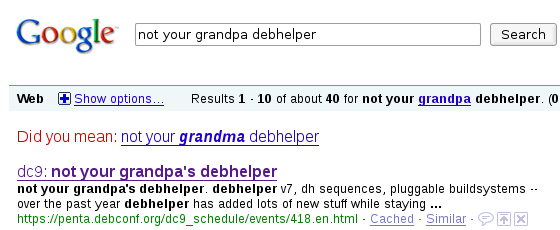
I am updating an old package's packaging style to take advantage of the new DebHelper 7 goodities. So far, I have been quite successful, but I hit a problem And before bugging on IRC, I decided to check with Joey Hess' presentation at DebConf9, Not your grandpa's debhelper. Of course, not remembering the URL, it was the most natural thing to ask Google: Did you mean... Not your grandma's Debhelper  WTF! Of course, putting this thingy aside, the right answer was the first hit. However, what is the first hit for the Grandma version? Quite dangerous: A post in Ubuntuforums for which the Google excrept reads: this tool can obviously eat your cat, poison your grandma, create an earthquake or do any other unexpected harm, so I don't provide any warranty whatsoever. I sincerely prefer joeyh's version.

6 September 2009

Uwe Hermann: identi.ca - a microblogging service based on Free Software, AGPL, and Creative Commons

identi.ca logo After a long time of ignoring (or at least not using) micro-blogging services such as Twitter, I recently tried the Free-Software based identi.ca service, and I'm beginning to like it. The choice of service was pretty obvious while Twitter uses proprietary software and has custom Terms of Service, identi.ca is based on software under the GNU Affero General Public License, and the contents are CC-BY 3.0 licensed. The code behind identi.ca is called Laconica (recently renamed to StatusNet) and is hosted at gitorious:
 $ git clone git://gitorious.org/laconica/mainline.git
My account details are available under http://identi.ca/uwehermann, where I'm posting smaller announcements and notes about random technical stuff I'm working on (slightly more regularly than in this blog). Sometimes I use the web interface for posting, but using the Jabber integration available at identi.ca is even more convenient. You can both be notified of new posts ("dents") in real time via Jabber, as well as post your own dents from within your Jabber client, which is nice. identi.ca seems to become more popular every day, which will hopefully make the proprietary Twitter pretty much irrelevant sooner or later.

3 September 2009

Erich Schubert: Embedding Flash: don't forget wmode="transparent"

If you are doing a complex web layout (such as my Swing and the City layout which features alpha-transparent fixed layers), and want to embed Flash (e.g. on the Was ist Swing? page - German: What is Swing), make sure you add the attribute wmode="transparent" to your embed tag, and <param name="wmode" value="transparent"></param> to your object. Otherwise, a layer - in particular popup menus - might end up below the flash.This includes you, YouTube. In HD view, the user popup menu only has the top 3.5 entries out of 5 accessible for me.The following XSLT stylesheet can be used to find such embeds in a bunch of XHTML files using the command line xsltproc findNoWmode.xslt $( find -iname '*.html' )
<?xml version="1.0"?>
<xsl:stylesheet version="1.0" xmlns:xsl="http://www.w3.org/1999/XSL/Transform"
 xmlns:html="http://www.w3.org/1999/xhtml">
<xsl:output omit-xml-declaration="yes" indent="no"/>
<xsl:template match="/">
  <xsl:call-template name="t"/>
</xsl:template>
<xsl:template name="t">
  <xsl:copy-of select="//html:embed[not(@wmode) and (count(param[@name='wmode']) = 0)]"/>
</xsl:template>
</xsl:stylesheet>
You can of course also write a XSLT stylesheet to insert the wmode statements whenever there is none, to make transparent your default.[Update: I've received comments that this comes at qutie a performance cost for Flash, and that this might be the reason why YouTube doesn't use it - in particular for the HD videos. Also it isn't supported by WebKit based Browsers so far (so Safari neither?) and nor does it seem to be working in Gnash, an opensource flash plugin. So you have to choose between multiple evils if you are using Flash...]

Andrew McMillan: Storing Secrets

Something that has been annoying me recently with my bank has been that their website tells me that they will never ask for my password over the phone. And then their call centre asks me for my password. Over the phone. Of course the call centre doesn't mean my website password - they mean the special 'ultra-secure 5ekr1t code phrase', but they don't have a good, universally understood word to use for that. Hopefully they'll work one out, but they appear to have got the message anyway. This got me to thinking about how these phrases are used, and how insecure they are in reality. After all when I store a website password I go to significant lengths to ensure that the same password is not represented by the same string of characters in my database. How vulnerable are our secrets in the databases of organisations we do business with?
<!--break--> Simple Password Storage Surprisingly often people do store passwords in databases in plain text, so that should their website get hacked someone would quite possibly be able to download the whole password database. Please feel free to name and shame these organisations in the comments below. My own pet hate in this regard is the 'Mailman' mailing list software: by default on 'mailman day' - the first day of each month - it sends me my password. In plain text. Of course many developers recognise this flaw, and work around it by using a one-way hash to obscure the password. Usually they choose md5 for their hashing algorithm though, and they often fail to use a 'salt' to randomise the plaintext prior to hashing. This means that even though a password might seem obscure like 'Supercalifragilisticexpialidocious!', and no doubt it will hash to something that seems obscure like 'a7290d426b6a1764af6fd7fba5db214e', but you can often find it straighforwardly by looking it up through one of the friendly reverse hash lookup websites. There's even a Digest::MD5::Reverse perl module on CPAN to interface to a bunch of these in a more automated way! Oh dear. One way to go beyond this is using a 1-way hashing algorithm, with a random salt included into the plaintext before the hashing, so that if (god forbid) two users had 'password' for their password I might see two rows in my database like:
davical=# select username, password from usr;
  username                       password                          
-------------+------------------------------------------------
 user1          SSHA qCctCH5dirYCf29uxJiE68LvmLRDdnBkbldiWlE=
 user2          SSHA y8yOzjoh9fSkVwLaXGoVtWdiIYxmU2FCb2dOZXc=
(2 rows)
When the user wants to log in I apply the same transformation to their incoming password (appending the same salt) and compare against my stored hash. If they match then it must be the same password they used previously. Storing passwords in this way secures them from casual, or even reasonably determined access, although naturally they can still be logged at the beginning and end of the communication - or even in the middle, if we didn't encrypt that bit! The PHP function I use to salt and hash the password is as follows:
/**
* Make a salted SHA1 string, given a string and (possibly) a salt.  PHP5 only (although it
* could be made to work on PHP4 (@see http://www.openldap.org/faq/data/cache/347.html). The
* algorithm used here is compatible with OpenLDAP so passwords generated through this
* function should be able to be migrated to OpenLDAP.
*
* If no salt is supplied we will generate a random one.
*
* @param string $instr The string to be salted and SHA1'd
* @param string $salt Some salt to sprinkle into the string to be SHA1'd so we don't
*                     get the same PW always hashing to the same value.
* @return string  SSHA  followed by a base64 encoded SHA1 of the salted string.
*/
function session_salted_sha1( $instr, $salt = "" )  
  if ( $salt == "" )  
    $salt = substr( base64_encode(sha1(rand(100000,9999999),true))), 2, 9);
   
  return ( sprintf(" SSHA %s", base64_encode(sha1($instr.$salt, true) . $salt)));
 
What about Secret Code Phrases? The problem with these secret code phrases, apart from all of the forgetability and guessability problems that have repeatedly been identified elsewhere, is that they are much less likely to be stored in a one-way hash. Are you going to ask your call-centre staff to type in the customer's secret code phrase? Didn't think so. And if you did it's going to add pronouncability issues to the whole mix. So this means that those organisations who have our secret code phrases in their database will, in all likelihood, have them stored directly as plain text, displaying them to the random call-centre staffer along with all of our other account details, and especially making them vulnerable to accidental disclosure. Disclosure of a sort that doesn't necessarily involve knowing they have been disclosed. Proliferation of Use These things provide the appearance of security - 'Security Theatre' as Bruce Schneier terms it - and because of that they're taken up in a kind of a cargo cult of security: "if the banks do it that way it must be a really good form of security". This makes the problem much worse, because now I have to remember a secret code phrases not only for banks, but for ISPs, phone companies, online auction websites, and so on. How many mother's maiden names, favourite teachers and friend's phone numbers do I have? I'm sure I'm at well up whatever curve it is that measures the number of passwords a person has, because five years ago I had so many I started to store them all in an encrypted database - protected by a yet another password, of course. Now in order to get my story straight I have to store my 'secret code phrases' in there too. If I didn't store my secret code phrases in that database, I'd obviously be re-using them everywhere, from a very small set - perhaps the same one that everyone around me overhears, every time I have to ring my bank to authorise another payment from my account. Because the proliferation of use is not just the breadth of wannabe thespians hoping to climb on the stage of this latest play, but the way they want to use it all the time, too. In fact the only conversation I've had recently with my bank where they didn't want it was when they rang me. Obviously I was the only person who could answer a phone in my house, right? It isn't just security theatre: I think we can see that this analogy belongs much deeper into the sub-genre of 'Security Farce'. Is there a solution? I don't have any easy answers - other than the ones to my security questions, of course - but some improvements are possible. Other banks have quizzed me about stuff like recent expenditure or credit card limits from time to time, but I've usually passed those tests by reading my last bank statement - or failed them by not having it to hand! I don't really think that the answers can lie in that direction because the information is only quite loosely tied to my identity. For some parts of the call-centre handling of secret code phrases there are changes that could make them more secure, but in the fairly short term these organisations need to find a different way to perform these out of band identity checks. For the actual storage of the code phrases it would be a marginal improvement if the database did not contain the actual phrase. Perhaps it could be encrypted with some application-known key, so that it can be unencrypted when it needs to be displayed, but never stored in the clear. Of course there's still the problem with that key... Verification of the secret code phrase could be done by someone not involved in the transaction, so that the call could be temporarily passed into a 'verification stream' where a different person performed the verification step without the context of the account details or enquiry. Though this sort of complexity seems unlikely with call centres seemingly being outsourced to the cheapest supplier. One thing does seem likely to become increasingly true: there is less and less private data in our lives, and every time we share one of these little nuggets with our bank, or our electricity company, or our on-line associates-we-call-friends, is one more chance that it escapes into the hands of the foaming-at-the-mouth-terrorist-cracker-communist-nazi-right-wing-religious-fruitcake hordes. The highest bar for personal verification which any of my banks currently sets for me is a random choice from a set of personally entered questions, with a set of personally entered answers, for which I have to enter two randomly selected characters using my mouse. That's not bad for safe verification, and I'd have to be really impressed with their security if that was stored in the database by a passphrase-protected encryption key. With that bank I don't know what they do over the phone - I assume they've concluded they can trust my logged on persona enough that I can do what I want online, consequently I haven't had to call them and share those secrets with everyone in earshot. Maybe paranoid freaks like me will go back to a chequebook and close down on-line access to their bank accounts entirely when they find themselves having to supply a skin scraping in order to authorise their next $500 payment. "Please insert your finger in the AccuYou(tm) BloodSucker(tm) to proceed with this payment" - well, I guess it might cut down my spending! In any case, biometrics need to be understood before they can be used effectively and appropriately - and remotely over the phone is probably not one of the ways that they can be trusted to work.

1 September 2009

Biella Coleman: Hello Ladies (aka learning from the lady geeks)

3692689082_dc8494bf13 Whenever I attend Debconf, the first day is always a bit disorienting due to the confluence of jet lag with the sea of male programmers swarming at the venue. I am not sure I should be admitting this but one of the first things that pops to mind is the very cheesy one hit wonder whose video is filled with many bikini clad men, Its raining men. So for a few hours, maybe a day, I sometimes feel out of place but this this first wave of discomfort usually gives way to comfort. This is not only because I connect with friends but because Debconf as well as many other hacker events and this sits in marked contrast to professional academic conferences are remarkably accepting of diversity and difference, at least that has been my personal experience. Most notably, people could care less about how you look, disabilities are consistently accommodated, and some things, like gender changing, which would raise serious eyebrows for instance in most academic conferences, is accepted with next to no gossip. I raise this because this is how I personally have experienced the world of Free Software: overwhelming male but overwhelming accepting of difference as well. So even while I think it is key to confront the problems of discrimination in this world, it is not a simple story, for again, it is an environment that is also accommodates difference and quirkiness to some notable degree. The question of gender in F/OSS is complicated one and here I am not going to ruminate on sources of gender bias except to say that I am sure there are some in operation (as there are in most domains) some of which are internal to Free Software and other s external to Free Software. But what I have been struck by, especially over the course of the summer, is the explosion of sites, blogs, and debates that have confronted gender in Free Software. It has been nothing short of astounding and a really positive turn. The most notable example is this AWEEEEEEEEEEESOME pair: a wiki and a blog that confront gender head on. These are notable because the wiki, for example, catalogs all sorts of controversial events, comments on them, leaving a very visible trace of debate, one that is necessary to change the gender make-up and dynamic within Free Software project. Along with these, the FSF is finally hosting a min-summit, which is great (less great is that participation seems invite only but perhaps they have some good reasons for doing so). And today I just learned of this diversity page coming out the Python project. These are perfect examples of the recursive public in action raised in Chris Kelty s work. And I have long been impressed with the dialogue that has followed from some controversial events in the world of Free Software, including those related to gender and this summer seems to be a watershed of sorts and I look forward to their developments over time. Indeed and this may be controversial as well, but I think my academic field of media, law, and culture has something to learn from these gender politics for there are some very real, though probably unintentional forms of discrimination that are not under that much active discussion. The most glaring problem is the underwhelming presence of female scholars during conferences (and as we know, conferences are exceedingly important for one s professional development and career). What I find most striking about this trend is the number of female scholars is significant. That is, when it comes to scholars and this seems different from the world of tech, there is a sizable community of women scholars and activists so when there is a 5% female participation , as for example, with this event, one has to wonder why is it raining men at these conferences? It also seems that while the debate exists, it is not as vibrant as with what is going on right now in F/OSS. Take for example, this recent mailing list post which unapologetically highlighted the lack of female presence in the up and coming Free Culture event at the Berkman Center. While the post generated a handful of thoughtful responses, including this supremely classic, biting, and quite clever response from Georgetown professor Julie Cohen, the debate did not linger on (however short, the posts and discussion were quite fruitful). What to do? Frankly, blame and finger pointing are pretty counterproductive, mostly because the discrimination is quite unintentional and I believe change can be brought about via more constructive paths. More important is we need to make the issue visible, identify some possible sources, and then create projects that can remedy the problem. Along with Elizabeth Stark, who has also been keen to note and change the gender problems, I am currently whipping together a wiki with a list of female scholars, leaders, and technologists as a resource for folks organizing conferences. We already have a base list (with a remarkably long list of folks) and will hopefully in the course of the next month throwing it up on the wiki. I don t think it will ever be as cool as the Geek Feminism Wiki but it will hopefully do some good!

Next.

Previous.