Search Results: "nate"

28 August 2012

Bdale Garbee: FreedomBox 0.1

FreedomBox 0.1 Ian Sullivan posted a release announcement today regarding the first FreedomBox public release, which we're calling 0.1. This release is, frankly, long overdue. Getting here has been harder and taken much longer than any of us intended. Fortunately, now that we've reached this milestone, I believe that making regular progress towards the vision we have for a "1.0" release will get easier. FreedomBox is far from the only thing that I'll be working on after my upcoming early retirement from HP, but hopefully I will succeed in putting far more time towards the project soon than I have been able to in the past.

27 August 2012

Andrew Cater: Ken Starks - immediate need for help is over for the moment - but

From Ken Starks, of Helios Project / Reglue

From the desk of just-so-you-know.....

Thomas Knight and I have agreed that the fund drive to aid in paying for necessary surgery for me should be halted. I will do a full blog about this entire effort this Monday but suffice it to say, you have donated more than enough to take care of my immediate needs and those down the road. Asking for anything more would be taking advantage of a loving and generous community. While it is far from adequate, the only thing I can offer you is my eternal thanks. It just seems so....small of a thing to give in return.

They will not stop the Indiegogo campaign until it reaches its time limit unfortunately so that will remain in effect for the next 30-some hours. Please do not donate anything further as I have more than enough to cover my expenses. I will explain more about that on my blog Monday.

If you helped spread the word about this campaign, please pass this posting along with the same intensity. I would deeply appreciate it.

See also now: update from Ken:

http://linuxlock.blogspot.co.uk/2012/08/of-roller-coasters-cancer-and-linux.html
==

Donations for Ken himself may be over: the work of Helios/Reglue still remains good, important and useful - the world benefits for investment in education. I would urge that this is still a worthwhile charity to contribute to as you get Linux into the hands of young people and the disadvantaged who can then USE it.

Christoph Berg: PostgreSQL in Debian Hackathon

Almost a year has passed since my talk at pgconf.eu 2011 in Amsterdam on Connecting the Debian and PostgreSQL worlds, and unfortunately little has happened on that front, mostly due to my limited spare time between family and job. pgapt.debian.net is up and running, but got few updates and is lagging behind on PostgreSQL releases. Luckily, we got the project moving. Dimitri Fontaine and Magnus Hagander suggested to do a face-to-face meeting, so we got together at my house for two days last week and discussed ideas, repository layouts, build scripts, and whatnot to get all of us aligned for pushing the project ahead. My employer sponsored my time off work for that. We almost finished moving the repository to postgresql.org infrastructure, barring some questions of how to hook the repository into the existing mirror infrastructure; this should get resolved this week. The build server running Jenkins is still located on my laptop, but moving this to a proper host will also happen really soon now. We are using Mika Prokop's jenkins-debian-glue scripts for driving the package build from Jenkins. The big plus point about Jenkins is that it makes executing jobs on different distributions and architectures in parallel much easier than a bunch of homemade shell scripts could get us with reasonable effort. Here's a list of random points we discussed: We really aim at using unmodified packages from Debian as much as possible, and in fact this project doesn't mean to replace Debian's PostgreSQL packaging work, but to extend it beyond the number of server versions (and Debian and Ubuntu versions covered) supported. The people behind the Debian and Ubuntu packages, and this repository are mostly the same, so we will claim that "our" packages will be the same quality as the "original" ones. Big thanks go to Martin Pitt for maintaining the postgresql-common testsuite that really covers every aspect of running PostgreSQL servers on Debian/Ubuntu systems. Stay tuned for updates! :)

26 August 2012

Andrew Cater: Helios - Ken Starks - appeal for (time-critical) help

For anybody that doesn't know - Ken Starks is the man behind the Helios Project - recycling computers, putting Linux on them, donating them to youngsters and the needy in Austin Texas.

He has a cancer diagnosis but his disability pension is enough to defeat his state provided insurance. Now he himself needs the help of the community.

More details here: http://linuxlock.blogspot.co.uk/2012/08/something-ive-been-putting-off-all-day.html and his partner's post above.

and here: Thomas A. Knight, who is setting up donations.

http://thomasaknight.com/blog.php?id=71

UPDATE:

There is now also a donate button at the Blog of Helios (linuxlock.blogspot.com).

Enough has been raised so far to buy Ken an appropriate monitor - because of the effects of radiotherapy, he's been unable to tolerate using a monitor with backlighting.

One donor has also stepped in to buy a month's drug treatment.

The initial target -US $5000 - has been met but The cost of an operating theatre session is at least US $50,000. All donations continue to be gratefully received.

Should efforts for raising funds for Ken himself be unsuccessful, all surplus funds raised will be ploughed back into the Helios Project (now known as Reglue following a recent merger with another local computer charity).

The Helios Project has been associated with Software in the Public Interest [SPI - also the umbrella organisation supporting Debian] for some years.

UPDATE2 - From Thomas A. Knight's blog referenced above:

By Thomas A. Knight on Sun 19 Aug 2012 07:33:49 am $11,000 so far, and still going strong. The outpouring of support for this is amazing. My most humble thanks to all contributors.

Even though we are still far from our goal, this has been far more successful than I ever thought possible. Thank you.

UPDATE3 - From Ken Starks, Sunday 26 August 2012

The amount of money needed has been raised. Donations to Helios Project/Reglue are welcome, as ever - but Ken's immediate needs are satisfactorily met and he himself doesn't wish to profit further from the community's goodwill. As he says, he can't thank us enough
More news at http://linuxlock.blogspot.com is due on 27/08/2012

22 August 2012

Thomas Goirand: MiniUPnP now fully in Debian

IT S FINALLY IN! With this last upload of the MiniUPnP daemon 1.7-3, I ve reached a first milestone: all of the MiniUPnP libraries, daemons and clients are finally in Debian, in a shape which I am not ashamed anymore. What is UPnP for? Back in the days (around Linux 2.0.3x), the only way to share a single Internet connection was to run a Linux box as your gateway. These days are far gone, and nearly every home connection is done through a mini home router, which also often provides a small switch and a WiFi access point. Every computer on the LAN gets its connectivity through the router thanks to NAT, and to be more accurate, masquerading. That works very well for outbound connections (browse the web, send a mail, etc.), but it is then a lot harder that something connects to a server located in the LAN. If you run a permanent server with a fixed LAN IP address, that s fine, you just configure your router to do some port forwarding, so that any inbound connection will be forwarded to the computer of your choice in the LAN. But if one application needs to listen on the public IP address just for a while (for example, IRC using DCC connection), so that something can connect to it, it becomes a way more tricky. That s when UPnP comes into play. UPnP stands for Universal Plug and Play. It s a protocol so that any application on the LAN can open ports on the public IP address of the gateway. Note that an UPnP router is also often referenced as UPnP IGD (Internet Gateway Device). Why using MiniUPnP, don t we have already linux-igd? Before my packaging work, the only UPnP server that was available in Debian was linux-igd, which has a dependency on libupnpX. That library is quite big for what it does (about 500KiB, on top of which you have to install the 200KiB daemon itself), while MiniUPnP is designed to be lightweight (only 158K, with dependencies on iptables, iproute, uuid-runtime and libc6 only). That seems ridiculous, but when you have only 8MiB of flash in your old router, saving few hundreds KiB is really important, and here, we re saving more than 500 KiB, with a full implementation of the UPnP protocol, and the Microsoft NATPmP implemented as well (yes, Microsoft decided that one protocol wasn t enough, and that they should implement their own (sic!)). Who is using MiniUPNP? Probably, you already have the libminiupnpc installed in your SID/wheezy desktop, because the transmission bittorent client which is installed with Gnome by default, depends on it, and minissdpd might be in your desktop too, if you installed the Recommends: packages as well. Which is why these are scoring quite high already in popcon. Previously, transmission was embedding its own version of the MiniUPnP client library, so it s nice to have it as a standalone shared library now. Also, because of its very light weight, and the fact that UPnP is often needed for gaming (both XBOX 360 and PSP need, and can use, the MiniUPnP daemon that runs on your IGD), many ISP who ship a router to their customer, install MiniUPnP in it. For example, at least, the 2nd and 3rd largest Internet access provider in France (Free Telecom and SFR) are shipping MiniUPnPd in their box (one of them using OpenWRT on their router). So probably as well, you are also using MiniUPnP daemon without knowing it. But isn t UPnP unsafe? To this question, I d answer that connecting to Internet is unsafe. It isn t less safe than connecting to Internet on a WiFi hotspot for example. So adding UPnP support on your gateway doesn t make it less safe, especially since MiniUPnP has some features to help with security (like an ACL with IP and port lists, or a secure mode were the router will only open ports to the client requesting it). Also, we are running a distribution where dependencies are easy to check, so it s easy for you to check if a client uses UPnP or not, and decide to trust it (or not). I personally have no issue trusting transmission, x-chat or warzone2010 (more exactly: I don t trust that incoming connectivity will make it less safe for these applications, there are so many other things that could go wrong). MiniUPnP consists of what? MiniUPnP is a set of 4 source packages to handle all of your UPnP needs: - The client library, libminiupnpc (and the corresponding -dev package), with its sidekick miniupnpc client program (you can use it to check the public IP of your gateway, or manually open ports). - The UPnP IGD daemon, miniupnpd, which just reached Debian Experimental. The latest version, 1.7-3, also includes debconf configuration so that you can choose the NIC and IP address to bind on. If you installed previous version, I strongly recommend upgrading to fix previous problems. - The libnatpmp client library (and the -dev package) for implementing the Microsoft protocol as a client (it also has a client package binary for your tests). - The minissdpd daemon to keep memory of all UPnP devices that announced themselves, and speed-up using the UPnP protocol (used by the MiniUPnP client library). A long process to have MiniUPnP in Debian All these 4 pieces of the puzzle were not as easy as it seems to be packaged in Debian. Especially, the IGD daemon, MiniUPnPd, used to depend on some header files that were not packaged in Debian. This was a decision of the iptables maintainers, which even after a long discussion, refused to add the necessary headers because it wasn t supposed to be a kernel API. While this might really be truth, the issue was that there was no public API available in the Linux kernel at all, and other distributions (Fedora, Gentoo, etc.) really did supply these needed files. As a consequence, during a very long time (years literally), shamefully, it was impossible to build the MiniUPnP daemon in Debian, while it was no problem on other distributions. Note that I do not want to start a troll discussion here, I m just stating facts, both parties have very strong and respectable arguments. Anyway, this needed API was finally embedded in MiniUPnPd itself thanks to a contributor to the project, and now it builds on both the Squeeze and the Wheezy (that is Linux 3.2) kernel without any issue. Call for testing Unfortunately, I don t have a Linux box as my Internet gateway. So I did the tests that I could: I installed MiniUPnPd on one computer on my LAN, and checked that I could open ports from another computer. So it seems to work, but I had no way to really test it live , with some real clients. So if you have an Debian SID box as your Internet gateway, feedback would be highly appreciated. What is remaining to do? A transition from libminiupnpc5 to libminiupnpc8 has to happen. Of course, this is too late for Wheezy, so this will happen right after the release. There s not so many reverse dependencies, so it should be ok, but I (yet) have zero experience with transitions. BTW, I had hard time to find out what this transition process was, and maybe some more effort for documenting it would help others (I m thinking about adding some text in the Debian wiki for that). Also, I have called for help on debian-devel, because I m currently the only one maintaining all these 4 source packages, and I m trying to have all my packages checked by others, and team maintained. So if you want to give a hand, or just declare yourself as a backup if I m busy, please raise your hand! Upstream is a friend of mine, and is very reactive to any requests (it very rarely took more than 48 hours to get a reply). Enjoy MiniUPnP and report bugs! Again, feedback would be appreciated. :)

21 August 2012

Alexander Pashaliyski: Google Summer of Code 2012 Clang support for build services in Debian Final Result

In the process of installing and configuring wanna-build, I had lots of problems. Because there was almost no documentation on the subject (and some of the existing was outdated), I had to figure out how everything works by reading the source code and asking people on IRC and mailing lists. I use the most recent version (from git) and since it s not stable, there were some problems and bugs. I fixed several bugs in order to set the system up. I also documented every step so now there s documentation on everything I have done. I uploaded the documentation on installing and configuring wanna-build [0]. I installed and configured reprepro on a local machine in order to use it with wanna-build. In the process I made step-by step setup instructions [1]. I installed and configured sbuild. The lastest version of sbuild contains filters but they don t work. Their purpose is to keep only the necessary variables in the environment, but apparenly the configuration file which should set them is never read. That leaves the filter list empty which causes the environment to be empty. I had to disable them to keep my work going. I installed buildd. I had some problems setting it up there was a bug in the scripts related to parsing the configuration file. I was pointed to a helpful bug report on the topic and with some additional changes I eventually got it working. In the process I had to read some of the source code of buildd. I made a patch that fixes a bug in the manual page of reprepro and got it approved. I contacted the Alioth admin team via the web site, requesting to use their server for my project Clang for build services . I got approved and I created a git repository where I m now uploading my work. The repository that I use to upload changes to sbuild and buildd is [2]. I add the name of the used compiler to the control file and to the name of the deb package. I wrote a function for parsing the debian/rules file looking for hard-coded compiler there. If there is such compiler, which is different from the one chosen as a default, the building proccess exits with a clear error. I made changes to wanna-build, dpkg, sbuild and buildd to fix bugs in them and make it possible to use a compiler different from gcc for the build process.
After my work a build compiler can be set easily. If a package can not be built with that compiler, the build process fails with a clear error. I also modified the pgstatus web interface to display build logs and create reports on user request. I wrote complete documentation about setting up wanna-build, reprepro and buildd ([0] and [1]). This makes a fully functional buildd infrastructure. Now we have a full step by step tutorial. Me and Sylvestre Ledru who was my great mentor, modified the buildd daemon so it will be possible to be run several instances of it for different architectures on a single physical server. I made a lot of changes to pgstatus this is a web interface to the wanna-build database. I had to add some features and fix several problems. In the process I read some of the code of pgstatus and buildd-tools. Now I have a better understanding of how they work. I added a new feature in pgstatus that allows the user to create a full report of the state of all builds. When a designated reports page is opened, a table with the current state of the builds is shown, together with a list of all the reports saved to files for the current distribution and architecture. The reports can be downloaded directly from the
interface. They are stored in JSON format. The log files were not accessible from pgstatus because of lack of implementation and bugs. I created a script that reads emails sent by wanna-build and extracts log files from them. I made changes to wanna-build so that it feeds the database with the necessary information about package history. I updated the wanna-build patch to include these changes. As a result the buildd logs can now be opened from the web interface of pgstatus. I applied a patch that fixes bug [3] so that config_schroot.sh (this script installs and sets the default compiler) starts with the necessary privileges. I added a new feature to sbuild that allows scripts to be run right after the dependencies are installed in the chroot and before the actual package starts building. Now anybody can configure sbuild to run such a script by modifying the appropriate configuration file. By adding the following lines: $external_commands =
chroot-pre-build-commands => [
['/root/purge-gcc.sh'],
],
; The script /root/purge-gcc.sh is run by sbuild in the chroot. This script can be necessary to set everything in the environment so that packages are built exactly as needed. Me and my mentor used this to replace gcc with a script that removes all gcc-specific packages so that we can be sure whether a package uses clang or not. I have a fully functional buildd infrastructure installed on my development system. In order to get it running, I made several patches: dpkg.patch The main patch with a lot of changes related to compiler support for building.
wanna_build.patch Fixes bugs and makes wanna-build feed the database with package history information.
sbuild.patch Fixes bugs and work-arounds the problem that some sbuild scripts are called without reading the configuration file of sbuild. Adds configuration option that allows scripts to be run right after the dependencies are installed in the chroot and before the actual package starts building.
pgstatus.patch Fixes bugs and adds reports page to pgstatus. Me and my mentor contacted the Debian wanna-build team to connect our new service with Debian. We explained what the current state of the project is and what we need from them. I thank my mentor Sylvestre Ledru for his presentation on DebConf 12 ([4], [5]). He showed our project and it was seen that people are interested in it. A nice resume of his talk has been made by Michael Larabel on Phoronix [6]. I tested everything thoroughly to make sure my changes don t break anything. I am happy to say that the project is now finished. ==== [0] http://wiki.debian.org/DebianWannaBuildInfrastructureOnOneServer
[1] http://wiki.debian.org/SetupBuildServiceForWanna-build
[2] http://anonscm.debian.org/gitweb/?p=pkg-llvm/clang-build.git;a=summary
[3] http://bugs.debian.org/cgi-bin/bugreport.cgi?bug=608840
[4] http://sylvestre.ledru.info/blog/media/5/rebuild-debian-presentation-clang-July-10.pdf
[5] http://meetings-archive.debian.net/pub/debian-meetings/2012/debconf12/high/884_Build_Debian_with_another_compiler.ogv
[6] http://www.phoronix.com/scan.php?page=news_item&px=MTEzODQ

Charles Plessy: Social networks and chain of trust.

It is rare that I use social networks, but usually I do not decline invitations to connect when they come from people I know. This said, I had doubts when accepting invitations from other Debian Developers, most of whom I never met in person: how can I be sure that the account really belongs to the person ? Luckily, we have a tool to solve that problem, our GPG key ring. I have signed the URLs of my pages on some networks, and from now I decided to only accept invitations to connect that are certified by this way or another, when they originate from somebody having a key. Paradoxically, although most social networks do not redistribute the source code of their systems, the only time I really used one was for Free software, by contacting a former developer whose email address was not available anymore, in order to clarify the license of one piece of code he wrote long time ago, that way saving one of my packages from being exiled in the non-free area.

14 August 2012

Matthew Garrett: Playing with Thunderbolt under Linux on Apple hardware

I've temporarily got hold of a Retina Macbook Pro. Fedora 17 boots fine on it with the following kernel arguments: nointremap drm_kms_helper.poll=0 video=eDP-1:2880x1800@45e, although you'll want an updated install image. The nointremap requirement is fixed by this patch, and the others are being tracked here. The gmux chip that controls the multiple graphics chipsets has changed - patches here. That just leaves Thunderbolt.

Thunderbolt is, to a first approximation, PCIe tunnelled over a Displayport connector. It's a high-bandwidth protocol for connecting external devices. Things are complicated by it also supporting Displayport over the same connection, which I'm sure will be hilarious when we get yet another incompatible display protocol. But anyway. I picked up a Thunderbolt ethernet adapter and started poking.

Booting with the device connected looked promising - an ethernet device appeared. Pulling it out resulted in the pcie hotplug driver noticing that it was missing and cleaning up, although the b44 ethernet driver sat around looking puzzled for a while. So far so good. Unfortunately plugging it in again didn't work, and rebooting without any Thunderbolt devices connected not only did nothing on hotplug, it also meant that the Thunderbolt controller didn't show up in lspci at all.

It turns out that there's several problems at play here. The first is the missing Thunderbolt controller. The problem here is the following code in Apple's ACPI tables:
        Method (RMCR, 0, Serialized)
         
            If (LNot (OSDW))
             
                If (LAnd (LEqual (\_SB.PCI0.PEG1.UPSB.DSB1.UPS0.AVND, 0xFFFF), 
                    LEqual (\_SB.PCI0.PEG1.UPSB.DSB2.UPS0.AVND, 0xFFFF)))
                 
                    Store ("RMCR: Disable Link and Power Off Cactus Ridge Chip",
                           Debug)
                    Store (0x01, \_SB.PCI0.PEG1.LDIS)
                    Sleep (0x07D0)
                    Store (0x00, GP23)


This checks if the system claims to be Darwin (the core of OS X). If not, it checks whether two PCIe bridges have been configured. If both are still in an unconfigured state, it cuts the PCIe link to the upstream PCIe link and then sets GP23 to 0. Looking further, GP23 turns out to be a GPIO line. Setting it to 0 appears to cut power to the Thunderbolt controller. In summary, unless your OS claims to be OS X, booting without an attached Thunderbolt device will result in the chipset being powered down so hard that it's entirely invisible to the OS.

Fixing that is as easy as adding Darwin to the list of operating systems Linux claims to be. So, now I could boot without a connected device and still see the controller. Since ACPI seemed to be important here, I started looking at the other ACPI methods associated with the device. The first one that drew attention was Name(_GPE, 0x14). The _GPE method (not to be confused with the _GPE object at the top of the global ACPI namespace) is defined as providing the ACPI general purpose event associated with the device. Unfortunately, it's only defined as doing this for embedded controllers - Apple's use of it on a PCI device is massively non-standard. But, still, easy enough to handle. Intel chipsets map GPE 0x10 to 0x1f to GPIO lines 0-15, so this GPE is associated with GPIO 4. Looking through the ACPI code showed a bunch of other references to GP04, and it turns out that if the chip is powered down (via setting GP23 to 0) then plugging a device in to the port will generate a GPE. This makes sense - a powered down controller isn't going to notice hotplug events itself, so you need some kind of out of band notification mechanism. There's also another ACPI method that flips the polarity of the GPIO line so it doesn't keep generating events for the entire time a device is connected. It didn't take long to come up with a stub driver that would power down the controller if nothing was connected at boot, and then wake it up again on a hotplug event.

Unfortunately that's as far as I've got. I'd been hoping that everything beyond this was just PCIe hotplug, but it seems not. Apple's Thunderbolt driver is rather too large to just be handling ACPI events, and this document on Apple's website makes it pretty clear that there's OS involvement in events and device configuration. Booting with a device connected means that the firmware does the setup, but if you want to support hotplug then the OS needs to know how to do that - and Linux doesn't.

Getting this far involved rather a lot of irritation at Apple for conspiring to do things in a range of non-standard ways, but it turns out that the real villains of the piece are Intel. The Thunderbolt controller in the Apples is an Intel part - the 82524EF, according to Apple. Given Intel's enthusiasm for Linux and their generally high levels of engagement with the Linux development community, it's disappointing[1] to discover that this controller has been shipping for over a year with (a) no Linux driver and (b) no documentation that would let anyone write such a driver. It's not even mentioned on Intel's website. So, thanks Intel. You're awful.

Anyway. This was my attempt to spend a few days doing something more relaxing than secure boot, and all I ended up with was eczema and liver pain. Lesson learned, hardware vendors hate you even more than firmware vendors do.

[1] By which I mean grotesquely infuriating

comment count unavailable comments

13 August 2012

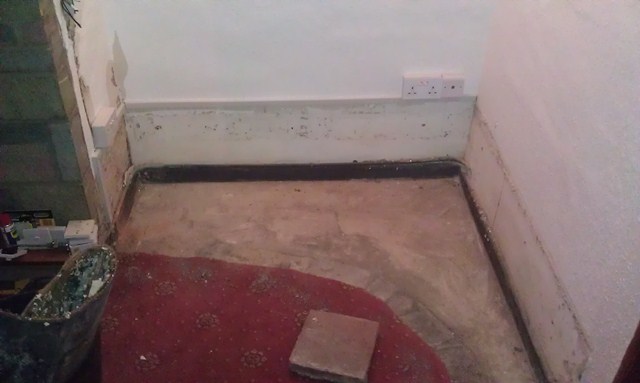
Jonathan Wiltshire: From building to demolishing

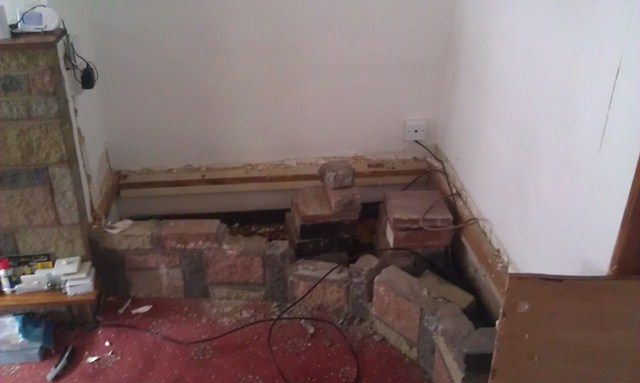
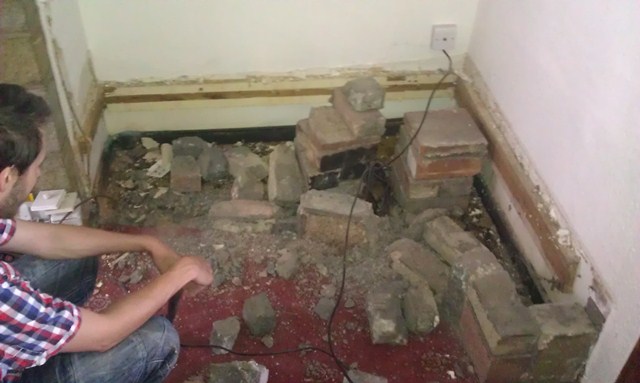
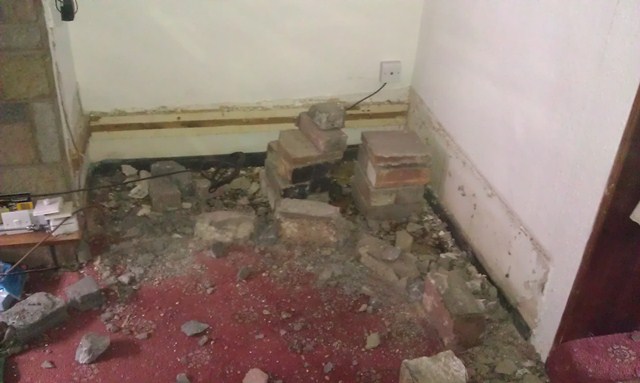
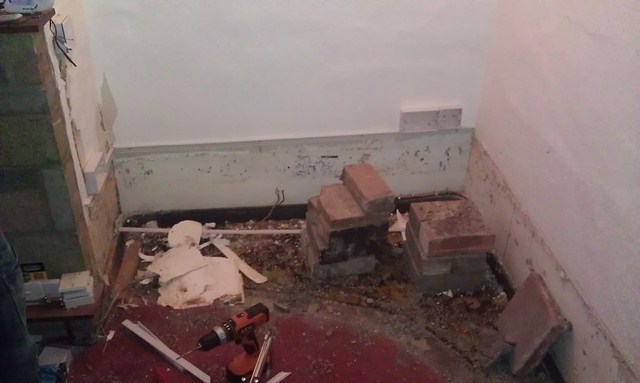
Building things is fun, but sometimes it s nice to have a little light relief with a sledgehammer. Saturday was one of those occasions; there is was a decorative wall in the corner of our lounge. It should have died about thirty years ago and I ve hated it ever since we moved in a year ago. First job was to remove the sockets and cable running up the side, which was a nice surprise in itself: Looks like whoever installed it believed that mastick and wallpaper is a suitable covering to stop drill bits. Hmm. Next we could take out the wall itself. In this case the wooden top was sealed down with more mastick and supported by piles of bricks, then the wall had been secured with concrete and not proper mortar. Fortunately a good sledgehammering soon took care of that: Those bricks truly were hideous, and they are all around the dodgy gas fire and another similar feature in the opposite corner of the room. Incidentally, the newly-revealed carpet in the void should also have died in the seventies (it went straight into the skip), but at least now we have some understanding of the mysterious wallpaper we found under the stairs. Finally we had enough room to work with surface trunking (a temporary housing until the gas pipe is removed and we can bury the cables properly): And the final result, with the sockets moved to a more sensible level and the cable properly protected, new LightwaveRF sockets in the corner and a shiny new aerial point ready for cabinets to go into the gap:
13/08: A couple of people pointed out that in the first photo, the offending cable is in a protected zone. This is true, but it wiggles half way round the room from the CU in a similar fashion first sometimes in trunking, sometimes clipped to the fireplace, and sometimes masticked and papered flush with the plaster surface.
From building to demolishing is a post from: jwiltshire.org.uk Flattr

Robert Collins: minimising downtime for schema changes with postgresql

Two years ago Launchpad did schema changes once a month. Everyone would cross their fingers and hope while the system administrators took all the application servers offline, patched the database with a months worth of work and brought up the servers again running the new QA d codebase. This had two problems:
  1. due to the complexity of the system something like 300 processes have to be stopped or inhibited to take everything offline the downtime duration was often about 90 minutes long irrespective of the schema patch duration. [Some of the processes don't like being interrupted at all].
  2. We simply could not deliver any change in less than 1 week, with the on average latency for something that jumped all the queues still being 2 weeks.
About a year ago we wanted to increase the rate at which schema changes could be carried out the efforts to speed Launchpad up had consumed most low hanging fruit and more and more schema patches were required. We didn t want to introduce additional 90 minute downtime windows though. Adopting incremental migrations the sort of change process described in various places on the internet seemed like a good way to make it possible to apply the schema changes without this slow shutdown-and-restart step, which was required because the pre-patch codebase couldn t speak to the new schema. We could optimise each patch to be very fast by avoiding anything that causes a full table scan or table rewrite (such as adding indices, adding columns with a non-NULL default value). That would let us avoid the 90 minutes of downtime caused by stopping and restarting everything. However, that wasn t sufficient the reason Launchpad ended up doing monthly downtime is that previous attempts to do more frequent schema changes had too high a failure rate. A key reason for patch deployment time blowing out when everything wasn t shut down was due to Launchpad being a very busy system with the use of Slony, schema changes require an exclusive lock on all tables. [More recent versions of Slony only lock some tables, but it still requires very widespread locks for most DDL operations]. We re doing nearly 10 thousand transactions per minute, at any point in time there are always locks open on some table in the system: it was highly improbably and effectively impossible for slonik to get an exclusive lock on all tables in a reasonable timeframe. Background tasks that take many minutes to complete exacerbate this we can t just block new transactions long enough to deliver all the in-flight web pages and let locks clear that way. PGBouncer turns out to be an ideal tool here. If you route all your connections through PGBouncer, you have a single point you can deliberately interrupt to clear all database locks in a second or so (it takes time for backends to all notice that their clients have gone). So we combined these things to get what we called Fast Down Time or FDT. We set the following rules for developers:
  1. Any schema patch had to complete in <= 15 seconds in our schema staging environment (which has a full copy of the production DB), or we d roll it back and redesign.
  2. Any patch could change either code or schema, never both. schema patches were to land on a separate branch and would be promoted to trunk only after deployment. That branch also receives automated merges from trunk after every commit to trunk, so its running the latest code.
This meant that we could be confident in QA: we would QA the new schema and the application process with the current live code (we deploy trunk multiple times a day). We published some documentation about how to write fast schema patches to help socialise the approach. Then we wrote an automated tool that would:
  1. Check for known fragile processes and abort if any were found.
  2. Check for very long transactions and abort if any were found.
  3. Shutdown pgbouncer, disconnecting all clients instantly.
  4. Use slonik to apply one or more schema patches.
  5. Start pgbouncer back up again.
The code for this (call it FDTv1) is in the Launchpad source code history its pretty entangled but its there for grabbing if you need it. Read on to see why its only available in the history :) The result was wonderful we immediately were able to deploy schema changes with <= 90 seconds of downtime, which was significantly less than the 5 minutes our stakeholders had agreed to as a benchmark if we were under 5 minutes, we could schedule downtime once a day rather than once a month. We had to fix some API client code to retry more reliably, and likewise fix a few minor bugs in the database connection handling logic in the appservers, but all in all it was a pretty smooth project. Along the way we spun off a small python helper to run and control pgbouncer, which let us write effective tests for the connection handling code paths. In This gave us the following workflow for making schema changes:
  1. Land and deploy an incremental schema change.
  2. Land and deploy any indices that need to be added these are deployed live using CREATE INDEX CONCURRENTLY.
  3. Land and deploy code changes to populate any additional fields/tables from both application servers, and from cron we do a bulk backfill that does many small transactions while walking over the entire dataset that needs to be updated / populated.
  4. Land and deploy code changes to drop references to the old schema, whatever it was.
  5. Land and deploy an incremental schema change to finalise the change such as making a new column NOT NULL once the backfill is complete.
This looks long and unwieldy but its worth noting that its actually just repeated applications of a smaller primitive:
  1. Make a schema change that is fast and compatible with existing code.
  2. Change code to take advantage of the changed schema
Pretty much any change that is desired can be done using this single primitive. We wanted to go further though the multiple stages required for complex migrations became a burden with one change a day. Fortunately PostgreSQL now includes its own replication engine, which replicates the WAL logs rather than installing triggers on all tables like Slony. Stuart, our intrepid DBA migrated Launchpad to PostreSQL 9.1, updated the FDT tool to work with native replication, and migrated Launchpad off of Slony. The result is again wonderful the overhead in doing a schema patch, with all the protection I described above, is now ~5 seconds. We can do incremental changes in less time than it takes your browser to figure out that a given server is offline. We re now negotiating with the Launchpad stakeholders to get multiple downtime windows each day, with this almost unnoticable, super reliable process in place. Reliability wise, FDT has been superb. We ve had 2 failures: one where we believe we encountered a bug in Slony when dropping two tables at once, and one where we landed a patch that worked on staging but led to lock contention in production so the patch applied, but the system was very unhealthy after that until we fixed it. Thats after doing approximately 60 patches over a 1 year period. We re partway through extracting the patching logic from Launchpad s code base into a reusable tool, but the basic principles will apply to any PostgreSQL environment.

11 August 2012

Julien Danjou: Sony Vaio Z Debian Linux support

I had to install Debian Wheezy on a brand new Sony Vaio Z laptop with the new Ivy Bridge architecture (SVZ1311C5E). I'll talk about this here, because it's always nice to know that new hardware works quite fine (or not) under Debian. Sony Vaio Z 2012 The laptop is delivered with Window 7, which I decided to remove entirely anyway, and replace with Debian. I've installed it with Linux 3.2 and then ran Linux 3.4, 3.5 and 3.6-rc1. USB booting Don't ask me why, nor an Ubuntu or Debian USB installation booted, blocked at SYSLINUX at best, or at a black screen. This does not work. I had to use PXE to install Debian. Storage The only thing that can be surprising, is that the 128 GB SSD storage is actually made of 2 64 GB Samsung SSD aggregated in a RAID 0 using Intel Rapid Storage Technology, previously known as Intel Matrix. This is supported by Linux using the dm-raid module. So this is a fake RAID, and you anyway can see the both drives as sda and sdb under Linux. Unfortunately, this kind of RAID is not supported correctly by GRUB, and I was unable to install it this way. Therefore, I decided to remove entirely this fake RAID (which is possible via the BIOS) and use a Linux software md RAID 0 instead, plus crypto on top of it. That I know well and I trust. :) Graphics The Intel HD Graphics 4000 works fine. I'm alsmo using the HDMI output, which works fine. There's some GPU hanging (as seen on screen and in kernel logs) in Linux up to 3.4, but with versions 3.5 and above, I didn't see any problem so far. Sound The Intel HDA sound card works pretty well, both for playing and recording. The main problem is that I hear a constant noise on the speakers, but tweaking the ALSA mixers ends it at some point. There's still probably a bug, not yet resolved in Linux 3.6-rc1. Keyboard The keyboard works fine, and the back-light too, via the sony-laptop kernel module. Wonderful. Touchpad Touchpad works fine. Fingerprint It does not work, and is not supported according to my research. Not that I care about, but don't count on it. It's an AuthenTec AES1660. Webcam It works perfectly. USB Well, USB 3.0 does not work. I had to disable XHCI in the BIOS and use the 2 ports as standard USB 2.0, otherwise I would just get errors from the kernel. Still not working with Linux 3.6-rc1, and I've no clue to debug, and do not use USB 3.0 yet, so WiFi The WiFi module (based on iwlwifi) works fine. The only problem with NetworkManager is that the sony-laptop offers a second rfkill switch and NM does not know how to handle it correctly. A bug isopened about this and I hope to be able to write a patch or something at some point. Also, there seems to be some quality issue with the iwlwifi driver and 802.11n at this point. I'm losing connection quite often when the signal drops below 40 %. Loading the module with 11n_disable=1 helps a lot. Ethernet The gigabit Realtek Ethernet controller works perfectly. Card reader Works perfectly.

10 August 2012

Benjamin Mako Hill: A Model of Free Software Success

Last week I helped organize the Open and User Innovation Conference at Harvard Business School. One of many interesting papers presented there was an essay on Institutional Change and Information Production by Fabio Landini from the University of Siena. At the core of the paper is an economic model of the relationship between rights protection and technologies that affects the way that cognitive labor can be divided and aggregated. Although that may sound very abstract (and it is in the paper), it is basically a theory that tries to explain the growth of free software. The old story about free software and free culture (at least among economists and many other academics) is that the movements surged to prominence over the last decade because improvements in communication technology made new forms of mass-collaboration -- like GNU/Linux and Wikipedia -- possible. "Possible", for these types of models, usually means profit-maximizing for rational, profit-seeking, actors like capitalist firms. You can basically think of these attempts as trying to explain why open source claims that free licensing leads to "better quality, higher reliability, more flexibility, lower cost" are correct: new technology makes possible an open development process which leads to collaboration which leads to higher quality work which leads to profit. Landini suggests there are problems with this story. One problem is that it treats technology as being taken for granted and technological changes as effectively being dropped in from outside (i.e., exogenous). Landini points out that software businesses build an enormous amount of technology to help organize their work and to help themselves succeed in what they see as their ideal property rights regime. The key feature of Landini's alternate model is that it considers this possibility. What comes out the other end of the model is a prediction for a multiple equilibrium system -- a situation where there are several strategies that can be stable and profitable. This can help explain why, although free software has succeeded in some areas, its success has hardly been total and usually has not led to change within existing proprietary software firms. After all, there are still plenty of companies selling proprietary software. In Landini's model, free is just one of several winning options. But Landini's model raises what might be an even bigger question. If free software can be as efficient as proprietary software, how would anybody ever find out? If all the successful software companies out there are doing proprietary software, which greedy capitalist is going to take the risk of seeing if they could also be successful by throwing exclusive rights out the window? In the early days, new paths are always unclear, unsure, and unproven. Landini suggests that ethically motivated free software hackers provide what he calls a "cultural subsidy." Essentially, a few hackers are motivated enough by the ethical principles behind free software that they are willing to contribute to it even when it isn't clearly better than proprietary alternatives. And in fact, historically speaking, many free software hackers were willing to contribute to free software even when they thought it was likely less profitable than the proprietary alternative models. As Landini suggests, this group was able to build technological platforms and find new social and business arrangements where the free model actually is competitive. I think that the idea of an "cultural subsidy" is a nice way to think about the important role that ethical arguments play in movements like free software and free culture. "Open source" style efficiency arguments persuade a lot of people. Especially when they are true. But those arguments are only ever true because a group of ethically motivated people fought to find a way to make them true. Free software didn't start out as competitive with proprietary software. It became so only because a bunch of ethically motivated hackers were willing to "subsidize" the movement with their with their failed, and successful, attempts at free software and free culture projects and businesses. Of course, the folks attracted by "open source" style superiority arguments can find the ethical motivated folks shrill, off-putting, and annoying. The ethically motivated folks often think the "efficiency" group is shortsighted and mercenary. But as awkward as this marriage might be, it has some huge upsides. In Landini's model, the ethical folks can build their better world without convincing everyone else that they are right and by relying, at least in part, on the self-interest of others who don't share their principles. Just as the free software movement has done. I think that Landini's paper is a good description of the critically important role that the free software movement, and the FSF in particular, can play. The influence and importance of individuals motivated by principles can go far beyond the groups of people who take an ethical stand. They can make involvement possible for large groups of people who do not think that taking a stand on a particular ethical issue is even a good idea.

9 August 2012

Don Armstrong: Migrating from Subversion to git with git-annex

Recently, I've started converting many of my subversion repositories to git, some of which contain fairly large files (2-3G). However, git can be slow to deal with repositories with large files, and it also isn't able to selectively discard unneeded files when disk space is pressing. Thankfully, git-annex resolves most of these problems with git, but the process required to use git-annex on a converted subversion repository is slightly complicated. Basic conversion of svn to git The basic conversion of svn to git is done using git-svn:
 git svn clone file:///srv/svn/foo --no-metadata -A authors.txt -T trunk foo
where /srv/svn/foo is the subversion repository, authors.txt is a list of login = Full Name <email@example.com> pairs matching each of the subversion commit authors, and foo is the git repository to create. git-svn has a ton of useful options, but the basic invocation above is all I'm concerned with. Migrating large files from git into git-annex In order to migrate from git to a git+git-annex setup, we'll have to walk the entire commit history, and edit each commit to instead store large files in git-annex, replacing the large file with a symlink, and finally eliminate all of the references to the old large objects, and do garbage collection. Because we may have the same file move around, we're going to use the git-annex SHA1 backend instead of the default WORM backend which is based on filename and size, and init git-annex.
  cd foo; echo '* annex.backend=SHA1' > .git/info/attributes
  git annex init
Then, we're going to filter out the large files using git filter-branch. To do that, we'll first, we'll create a little helper script git_annex_add.sh, which will remove the file from the git repository, add to git annex, and fix up the symlinks:
 #!/bin/bash
 f="$1";
 git rm --cached "$ f ";
 git annex add "$ f ";
 annexdest="$(/bin/readlink -v $ f )";
 ln -sf "$ annexdest#../../ " "$ f ";
 echo -n "Added: "
 ls -l "$ f ";
Then we will run filter-branch, and annex all files larger than 5 megabytes. [Tweak the find command if you want to do something different.]
 git filter-branch  --tag-name-filter cat --tree-filter \
'find . -ipath \*.git\* -prune -o -path \*.temp\* -prune -o -size +5M -type f -print0 xargs -0 -r -n1 ~/git_annex_add.sh;
 git reset HEAD .git-rewrite; :' -- master
This operation will take a while. [It would be better to do this during the initial svn git conversion, but since that requires more knowledge of git-svn, svn, git, and git-annex internals than I have, and I only have to do this once for each repository, it's not worth my time.] Now we have successfully switched everything to using git-annex, and we need to clean out the old references to the files:
 rm .git/svn -rf;
 rm -rf .git/refs/original .git/refs/remote/trunk .git/refs/remote/git-svn;
 git reflog expire --expire=now --all
 git gc --prune=now
 git gc --prune=now --aggressive
(I'm not sure if the last two commands need to be separate; I'm cargo culting a bit there.) Storing all git-annex files in a remote repository Because git-annex allows you to easily throw away files which are no longer referred to by the tip of any branch using git annex unneeded (and because I'd like all of the files on my central remote repository), I'm going to shove all of the git annex files into the remote bare repository. Normally, you would use git annex copy --to=remote; to do this, but because that only copies needed files, not everything, we'll have to do it manually. First, create the remote repository:
 git init --bare /srv/git/foo.git
 cd /srv/git/foo.git; git annex init foo.example.com
Add the remote to the local repository, push to the remote, and sync the objects and sync the annex:
 git remote add origin ssh://foo.example.com/srv/git/foo.git
 git push origin master
 rsync -avP .git/annex/objects ssh://foo.example.com/srv/git/foo.git/annex/.;
 git annex sync
Finally, on the remote, run git annex fsck to clean up the links to the imported objects:
 cd /srv/git/foo.git; git annex fsck;
Unresolved issues I don't know if the above works properly for branches. I suspect that it does not. I also have not exhaustively tested this methodology to verify that all of the history is present in every case. But hopefully this post (or some modification of it) will be helpful to you. Credit Many of the methodologies described here I originally found in tyger's git-annex forum post, the git gc stuff came from random google searches about shrinking git repositories, and the rsync suggestion came from joeyh (author of git-annex) and the other helpful denizens of #vcs-home on irc.oftc.net.

8 August 2012

Johannes Schauer: Bootstrappable Debian - How to help

TLDR: multiarch, multiarch, multiarch, cross buildability, staged build dependencies, wiki page, corrections/hints/requests to debian-bootstrap at lists.mister-muffin.de This summer (and this year's GSoC) is nearing its end and to make it easier for people to make use of the information my tools produced so far, I created a page in the Debian wiki. It lists not only the open issues I see but also statistics that I gathered using the output of my GSoC project. I want to use this blog post to make people aware of that page as well as to get some feedback on it and anything related to it. The biggest blocker my tools face, is that many packages are still missing multiarch information. As long as at least the basic packages do not have their cross build dependencies satisfied via multiarch for an existing foreign architecture, automated tools can not properly analyze the dependency situation in the bootstrapping case, when many packages of the new foreign architecture do not even exist yet. If Debian is supposed to be bootstrappable, then the first stage is to make a set of basic packages cross compile for an existing foreign architecture. Once this is possible, a tool of mine can analyze the cyclic build dependency situation that might occur when cross compiling for an architecture that does not exist yet. Then, staged cross builds can be used to cross compile a minimal foreign system. Due to missing multiarch classification, it is not known yet how big the cyclic build dependency situation is for the base packages. It is not only the conversion of packages to multiarch that is needed but also the adding of the :any (and rare cases :native) qualifier to build dependencies on M-A: allowed packages. Prominent build dependencies that should (but are not yet) be M-A: allowed are python and gettext. Both are needed as a build dependency by many packages of the base system. Unfortunately wanna-build does not understand qualifiers like :any and :native yet. Until it does, no package can be marked :any or :native and cross compilation of many base packages can not succeed. Once the point is reached, where a base system can be cross compiled from nothing, native compilation can start. Since native compilation doesnt depend on multiarch, the dependency situation when trying to natively compiling all of Debian from nothing is understood much better. Unfortunately, the cyclic build dependency situation is also much worse in the native case and there exists a big 1000 node strongly connected component of binary and source packages that all interdepend on each other. This dependency mess can be solved using three approaches: The wiki page gives many hints on how to find packages that each method can be applied to. Stage building is a tool that might be useful for cross building (we dont know for sure yet) but is definitely needed for native compilation. It is needed for native compilation because after all possible dependencies are moved to Build-Depends-Indep, the only other alternative to stage building for breaking dependency cycles is to cross build source packages. Since building a package without one of its build dependencies "staged" is often much easier than making the package in question cross compile, it is a preferred alternative. Once more packages have been made multiarch, it might be possible to prove that there is no alternative to introducing a notion of staged builds. Some people (wookey, Patrick McDermott, Guillem Jover, myself) decided that the following format to mark staged build dependencies would be preferred over others:
Build-Depends: huge (>= 1.0) [i386 arm] <!embedded !bootstrap>, tiny
The <> format was proposed by Guillem Jover in bug#661538. Patches for dpkg and dose3 are done. More people need to discuss about this format for a final decision on how to indicate staged build dependencies. For more information on the topic, have a look at the corresponding wiki page. Feel free to direct any comments/critique/hints to debian-bootstrap at lists.mister-muffin.de or directly to me.

6 August 2012

Mike Hommey: Building a Linux kernel module without the exact kernel headers

Imagine you have a Linux kernel image for an Android phone, but you don t have the corresponding source, nor do you have the corresponding kernel headers. Imagine that kernel has module support (fortunately), and that you d like to build a module for it to load. There are several good reasons why you can t just build a new kernel from source and be done with it (e.g. the resulting kernel lacks support for important hardware, like the LCD or touchscreen). With the ever-changing Linux kernel ABI, and the lack of source and headers, you d think you re pretty much in a dead-end. As a matter of fact, if you build a kernel module against different kernel headers, the module will fail to load with errors depending on how different they are. It can complain about bad signatures, bad version or other different things. But more on that later. Configuring a kernel The first thing is to find a kernel source for something close enough to the kernel image you have. That s probably the trickiest part with getting a proper configuration. Start from the version number you can read from /proc/version. If, like me, you re targeting an Android device, try Android kernels from Code Aurora, Linaro, Cyanogen or Android, whichever is closest to what is in your phone. In my case, it was msm-3.0 kernel. Note you don t necessarily need the exact same version. A minor version difference is still likely to work. I ve been using a 3.0.21 source, which the kernel image was 3.0.8. Don t however try e.g. using a 3.1 kernel source when the kernel you have is 3.0.x. If the kernel image you have is kind enough to provide a /proc/config.gz file, you can start from there, otherwise, you can try starting from the default configuration, but you need to be extra careful, then (although I won t detail using the default configuration because I was fortunate enough that I didn t have to, there will be some details further below as to why a proper configuration is important). Assuming arm-eabi-gcc is in your PATH, and that you have a shell opened in the kernel source directory, you need to start by configuring the kernel and install headers and scripts:
$ mkdir build
$ gunzip -c config.gz > build/.config # Or whatever you need to prepare a .config
$ make silentoldconfig prepare headers_install scripts ARCH=arm CROSS_COMPILE=arm-eabi- O=build KERNELRELEASE= adb shell uname -r 
The silentoldconfig target is likely to ask you some questions about whether you want to enable some things. You may want to opt for the default, but that may also not work properly. You may use something different for KERNELRELEASE, but it needs to match the exact kernel version you ll be loading the module from. A simple module To create a dummy module, you need to create two files: a source file, and a Makefile. Place the following content in a hello.c file, in some dedicated directory:
#include <linux/module.h>       /* Needed by all modules */
#include <linux/kernel.h>       /* Needed for KERN_INFO */
#include <linux/init.h>         /* Needed for the macros */
static int __init hello_start(void)
 
  printk(KERN_INFO "Hello world\n");
  return 0;
 
static void __exit hello_end(void)
 
  printk(KERN_INFO "Goodbye world\n");
 
module_init(hello_start);
module_exit(hello_end);
Place the following content in a Makefile under the same directory:
obj-m = hello.o
Building such a module is pretty straightforward, but at this point, it won t work yet. Let me enter some details first. The building of a module When you normally build the above module, the kernel build system creates a hello.mod.c file, which content can create several kind of problems:
MODULE_INFO(vermagic, VERMAGIC_STRING);
VERMAGIC_STRING is derived from the UTS_RELEASE macro defined in include/generated/utsrelease.h, generated by the kernel build system. By default, its value is derived from the actual kernel version, and git repository status. This is what setting KERNELRELEASE when configuring the kernel above modified. If VERMAGIC_STRING doesn t match the kernel version, loading the module will lead to the following kind of message in dmesg:
hello: version magic '3.0.21-perf-ge728813-00399-gd5fa0c9' should be '3.0.8-perf'
Then, there s the module definition.
struct module __this_module
__attribute__((section(".gnu.linkonce.this_module"))) =  
 .name = KBUILD_MODNAME,
 .init = init_module,
#ifdef CONFIG_MODULE_UNLOAD
 .exit = cleanup_module,
#endif
 .arch = MODULE_ARCH_INIT,
 ;
In itself, this looks benign, but the struct module, defined in include/linux/module.h comes with an unpleasant surprise:
struct module
 
        (...)
#ifdef CONFIG_UNUSED_SYMBOLS
        (...)
#endif
        (...)
        /* Startup function. */
        int (*init)(void);
        (...)
#ifdef CONFIG_GENERIC_BUG
        (...)
#endif
#ifdef CONFIG_KALLSYMS
        (...)
#endif
        (...)
(... plenty more ifdefs ...)
#ifdef CONFIG_MODULE_UNLOAD
        (...)
        /* Destruction function. */
        void (*exit)(void);
        (...)
#endif
        (...)
 
This means for the init pointer to be at the right place, CONFIG_UNUSED_SYMBOLS needs to be defined according to what the kernel image uses. And for the exit pointer, it s CONFIG_GENERIC_BUG, CONFIG_KALLSYMS, CONFIG_SMP, CONFIG_TRACEPOINTS, CONFIG_JUMP_LABEL, CONFIG_TRACING, CONFIG_EVENT_TRACING, CONFIG_FTRACE_MCOUNT_RECORD and CONFIG_MODULE_UNLOAD. Start to understand why you re supposed to use the exact kernel headers matching your kernel? Then, the symbol version definitions:
static const struct modversion_info ____versions[]
__used
__attribute__((section("__versions"))) =  
	  0xsomehex, "module_layout"  ,
	  0xsomehex, "__aeabi_unwind_cpp_pr0"  ,
	  0xsomehex, "printk"  ,
 ;
These come from the Module.symvers file you get with your kernel headers. Each entry represents a symbol the module requires, and what signature it is expected to have. The first symbol, module_layout, varies depending on what struct module looks like, i.e. depending on which of the config options mentioned above are enabled. The second, __aeabi_unwind_cpp_pr0, is an ARM ABI specific function, and the last, is for our printk function calls. The signature for each function symbol may vary depending on the kernel code for that function, and the compiler used to compile the kernel. This means that if you have a kernel you built from source, modules built for that kernel, and rebuild the kernel after modifying e.g. the printk function, even in a compatible way, the modules you built initially won t load with the new kernel. So, if we were to build a kernel from the hopefully close enough source code, with the hopefully close enough configuration, chances are we wouldn t get the same signatures as the binary kernel we have, and it would complain as follows, when loading our module:
hello: disagrees about version of symbol symbol_name
Which means we need a proper Module.symvers corresponding to the binary kernel, which, at the moment, we don t have. Inspecting the kernel Conveniently, since the kernel has to do these verifications when loading modules, it actually contains a list of the symbols it exports, and the corresponding signatures. When the kernel loads a module, it goes through all the symbols the module requires, in order to find them in its own symbol table (or other modules symbol table when the module uses symbols from other modules), and check the corresponding signature. The kernel uses the following function to search in its symbol table (in kernel/module.c):
bool each_symbol_section(bool (*fn)(const struct symsearch *arr,
                                    struct module *owner,
                                    void *data),
                         void *data)
 
        struct module *mod;
        static const struct symsearch arr[] =  
                  __start___ksymtab, __stop___ksymtab, __start___kcrctab,
                  NOT_GPL_ONLY, false  ,
                  __start___ksymtab_gpl, __stop___ksymtab_gpl,
                  __start___kcrctab_gpl,
                  GPL_ONLY, false  ,
                  __start___ksymtab_gpl_future, __stop___ksymtab_gpl_future,
                  __start___kcrctab_gpl_future,
                  WILL_BE_GPL_ONLY, false  ,
#ifdef CONFIG_UNUSED_SYMBOLS
                  __start___ksymtab_unused, __stop___ksymtab_unused,
                  __start___kcrctab_unused,
                  NOT_GPL_ONLY, true  ,
                  __start___ksymtab_unused_gpl, __stop___ksymtab_unused_gpl,
                  __start___kcrctab_unused_gpl,
                  GPL_ONLY, true  ,
#endif
         ;
        if (each_symbol_in_section(arr, ARRAY_SIZE(arr), NULL, fn, data))
                return true;
        (...)
The struct used in this function is defined in include/linux/module.h as follows:
struct symsearch  
        const struct kernel_symbol *start, *stop;
        const unsigned long *crcs;
        enum  
                NOT_GPL_ONLY,
                GPL_ONLY,
                WILL_BE_GPL_ONLY,
          licence;
        bool unused;
 ;
Note: this kernel code hasn t changed significantly in the past four years. What we have above is three (or five, when CONFIG_UNUSED_SYMBOLS is defined) entries, each of which contains the start of a symbol table, the end of that symbol table, the start of the corresponding signature table, and two flags. The data is static and constant, which means it will appear as is in the kernel binary. By scanning the kernel for three consecutive sequences of three pointers within the kernel address space followed by two integers with the values from the definitions in each_symbol_section, we can deduce the location of the symbol and signature tables, and regenerate a Module.symvers from the kernel binary. Unfortunately, most kernels these days are compressed (zImage), so a simple search is not possible. A compressed kernel is actually a small bootstrap binary followed by a compressed stream. It is possible to scan the kernel zImage to look for the compressed stream, and decompress it from there. I wrote a script to do decompression and extraction of the symbols info automatically. It should work on any recent kernel, provided it is not relocatable and you know the base address where it is loaded. It takes options for the number of bits and endianness of the architecture, but defaults to values suitable for ARM. The base address, however, always needs to be provided. It can be found, on ARM kernels, in dmesg:
$ adb shell dmesg   grep "\.init"
<5>[01-01 00:00:00.000] [0: swapper]      .init : 0xc0008000 - 0xc0037000   ( 188 kB)
The base address in the example above is 0xc0008000. If like me you re interested in loading the module on an Android device, then what you have as a binary kernel is probably a complete boot image. A boot image contains other things besides the kernel, so you can t use it directly with the script. Except if the kernel in that boot image is compressed, in which case the part of the script that looks for the compressed image will find it anyways. If the kernel is not compressed, you can use the unbootimg program as outlined in this old post of mine to get the kernel image out of your boot image. Once you have the kernel image, the script can be invoked as follows:
$ python extract-symvers.py -B 0xc0008000 kernel-filename > Module.symvers
Symbols and signature info could also be extracted from binary modules, but I was not interested in that information so the script doesn t handle that. Building our module Now that we have a proper Module.symvers for the kernel we want to load our module in, we can finally build the module: (again, assuming arm-eabi-gcc is in your PATH, and that you have a shell opened in the kernel source directory)
$ cp /path/to/Module.symvers build/
$ make M=/path/to/module/source ARCH=arm CROSS_COMPILE=arm-eabi- O=build modules
And that s it. You can now copy the resulting hello.ko onto the device and load it. and enjoy
$ adb shell
# insmod hello.ko
# dmesg   grep insmod
<6>[mm-dd hh:mm:ss.xxx] [id: insmod]Hello world
# lsmod
hello 586 0 - Live 0xbf008000 (P)
# rmmod hello
# dmesg   grep rmmod
<6>[mm-dd hh:mm:ss.xxx] [id: rmmod]Goodbye world

5 August 2012

Stefano Zacchiroli: bits from the DPL for July 2012

Monthly DPL bits, fresh from the oven.
Tip to feel good about the release #476: before reading this, grab and fix one of the RC bugs affecting Wheezy. Done? Now you're ready for a slightly less exciting report of DPL activities. Highlights Assets Logo & trademark Note that the actual logo relicensing should be done by SPI, via their board, upon request of mine (as Debian Project liaison). We won't make it for the next SPI board meeting, as it is on 4 days away. But we can aim for the subsequent meeting, on September 13th. If all goes well (big "if"), we will enjoy a DFSG-free logo after that date. Internal organization Recent flurry of re-organization in the tech-ctte --- which I somewhat triggered pushing for periodic meetings --- seems to be proceeding well. I'm very happy about it, as we all need to trust that tech-ctte decisions will be not only sound, but also prompt. If you're interested into this topic, some recent evidence of the ongoing reorganization and its result can be found in their DebConf12 BoF, minutes of the last meeting, a set of forthcoming GRs, and the recent great decision of posting decisions results to d-d-a (as it happened for node/nodejs). Kudos to tech-ctte members for the recent activism! I haven't worked on it myself directly, but I highlight Enrico's work on server side archival of NM conversations. It has the potential of enabling automatic detection of stuck NM processes. I'm a bit rusty as AM now, but I think missing that ability is one of the main remaining causes of frustration when joining Debian. So, if you are an AM, please opt-in and use this feature with your appicants. If you are not an AM why not? :-) Miscellanea Some misc legal stuff: and some misc "political" stuff: Happy RC bug squashing,
Cheers.
PS the boring day-to-day activity log for July 2012 is available at master:/srv/leader/news/bits-from-the-DPL.txt.201207

Craig Small: Context sensitive menus with GtkTreeView

A project I now maintain called GJay uses the GTK+ toolkit and has a GtkTreeView that shows the directories and the songs in them. I was wanting to add a context sensitive menu on that view so that you could do things to the item you have right-clicked on; generally file specific things like give me information about this song or queue it to play. My only problem was, how to do it? A few Google searches showed things that were almost, but not quite, what I was after. The main problem being either the documentation was incomplete or it assumed I was after the selected field (the row I may of left-clicked on) and not the one I right-clicked on to get this event. This GtkTreeView uses a store where NAME_COLUMN is defined at 0, meaning it is the first column. The program uses this column to store the filename of the song. So first I needed to create an event to kick things off, we need to connect the button-press-event to our tree_view, which calls a function in this case view_on_button_pressed.
 g_signal_connect(tree_view, "button-press-event", 
   G_CALLBACK(view_on_button_pressed), NULL);
gboolean view_on_button_pressed(GtkWidget *tree_view, 
                                GdkEventButton *event, 
                                gpointer user_data)  
  GtkTreeSelection *selection;
  GtkTreePath *tree_path;
  GtkTreeModel *tree_model;
  GtkTreeIter tree_iter;
  gchar *name;
 
  if (event-&gt;type == GDK_BUTTON_PRESS &amp;&amp; event-&gt;button == 3)  
    tree_model = gtk_tree_view_get_model(GTK_TREE_VIEW(tree_view));
    if (gtk_tree_view_get_path_at_pos(GTK_TREE_VIEW(tree_view),
          (int)event-&gt;x, (int)event-&gt;y,
          &amp;tree_path, NULL, NULL, NULL))  
      if (gtk_tree_model_get_iter(tree_model, &amp;tree_iter, tree_path))  
        gtk_tree_model_get(tree_model, &amp;tree_iter, NAME_COLUMN, &amp;name, -1);
        g_print("rc name is %s\n", name);


So a breakdown of what my callback is doing: The program, now that it knows the song title, can then go off and generate a menu for that song.

4 August 2012

Andreas Metzler: proofreading would have helped.

I have recently read ECB/2011/14 (GUIDELINE OF THE EUROPEAN CENTRAL BANK of 20 September 2011 on monetary policy instruments and procedures of the Eurosystem) and have stumbled upon the following gem.
An institution may access the Eurosystem's standing facilities and open market operations based on standard tenders only through the NCB of the Member State in which it is incorporated. If an institution has establishments (its head office or branches) in more than one Member State, each establishment has access to these operations through the NCB of the Member State in which it is established, notwithstanding the fact that the bids of an institution may only be submitted by one establishment (either the head office or a designated branch) in each Member State.
At first glance this fine, it is easily readable. (All abbreviations are explained at the start of document.) However a more attentive examination corrects this impression. Compare the two highlighted versions below:
An institution may access the Eurosystem's standing facilities and open market operations based on standard tenders only through the NCB of the Member State in which it is incorporated. If an institution has establishments (its head office or branches) in more than one Member State, each establishment has access to these operations through the NCB of the Member State in which it is established [...].
An institution may access the Eurosystem's standing facilities and open market operations based on standard tenders only through the NCB of the Member State in which it is incorporated. If an institution has establishments (its head office or branches) in more than one Member State, each establishment has access to these operations through the NCB of the Member State in which it is established [ ].
Perfect contradiction. Either only the "own" NCB works or any NCB where we have a establishments. Ex falsum quodlibet and Bob's your uncle. ;-)

1 August 2012

Russell Coker: Hetzner now Offers SSD

Hetzner is offering new servers with SSD, good news for people who want to run ZFS (for ZIL and/or L2ARC). See the EX server configuration list for more information [1]. Unfortunately they don t specify what brand of SSD, this is a concern for me as some of the reports about SSD haven t been that positive, getting whichever SSD is cheapest isn t appealing. A cheap SSD might be OK for L2ARC (read cache), but for ZIL (write cache) reliability is fairly important. If anyone has access to a Hetzner server with SSD then please paste the relevant output of lsscsi into a comment. The next issue is that they only officially offer it on the new EX 8S server. SSD will be of most interest to people who also want lots of RAM (the zfsonlinux.org code has given me kernel panics when running with a mere 4G of RAM even when I did the recommended tuning to reduce ARC size). Also people who want more capable storage options will tend to want more RAM if only for disk caching. But I m sure that there are plenty of people who would be happy to have SSD on a smaller and cheaper server. The biggest SSD offering of 240G is bigger than a lot of servers. I run a Hetzner server that has only 183G of disk space in use (and another 200G of backups). If the backups were on another site then the server in question could have just a RAID-1 of SSD for all it s storage. In this case it wouldn t be worth doing as the server doesn t have much disk IO load, but it would be nice to have the option the exact same server plus some more IO load would make SSD the ideal choice. The biggest problem is that the EX 8S server is really expensive. Hard drives which are included in the base price for cheaper options are now expensive additions. A server with 2*3TB disks and 2*240G SSD is E167 per month! That s more expensive than three smaller servers that have 2*3TB disks! The good news for someone who wants SSD is that the Hetzner server auction has some better deals [2]. As is always the case with auction sites the exact offers will change by the moment, but currently they offer a server with 2*120G SSD and 24G of RAM for E88 per month and a server with 2*120G SSD, 2*1.5T HDD, and 24G of RAM for E118. E88 is a great deal if your storage fits in 240G and E118 could be pretty good if you only have 1.5T of data that needs ZFS features. The main SSD offering is still a good option for some cases. A project that I did a couple of years ago would probably have worked really well on a E167/month server with 2*3TB and 2*240G SSD. It was designed around multiple database servers sharding the load which was largely writes, so SSD would have allowed a significant reduction in the number of servers. They also don t offer SSD on their storage servers which is a significant omission. I presume that they will fix that soon enough. 13 disks and 2 SSD will often be more useful than 15 disks. That s assuming the SSD doesn t suck of course. The reason this is newsworthy is that most hosted server offerings have very poor disk IO and no good options for expanding it. For servers that you host yourself it s not too difficult to buy extra trays of disks or even a single rack-mount server that has any number of internal disks in the range 2 to 24 and any choice as to how you populate them. But with rented servers it s typically 2 disks with no options to add SSD or other performance enhancements and no possibility of connecting a SAN. As an aside it would still be nice if someone ran a data center that supported NetApp devices and gave the option of connecting an arbitrary number of servers to a NetApp Filer (or a redundant pair of Filers). If anyone knows of a hosting company that provides options for good disk IO which are better than just providing SSD or cheaper than E167 per month then please provide the URL in a comment. Update: It seems that I can get SSD added to one of the cheaper servers. This is a good option as I have some servers that already have the flexi-pack due to a need for more IP addresses. Related posts:
  1. Servers vs Phones Hetzner have recently updated their offerings to include servers with...
  2. Hetzner Failover Konfiguration The Wiki documenting how to configure IP failover for Hetzner...
  3. Dedicated vs Virtual Servers A common question about hosting is whether to use a...

Steve Kemp: So I joined the bandwagon and bought a tablet

So this week I bought a cheap Android tablet, specifically to allow me to read books upon the move and listen to music at home. Currently my desktop PC has a bunch of music on it, and I listen to it locally only. In my living room I have an iPOD in a dock which has identical contents. In my bedroom? No music. This was something I wished to change. The music on my desktop is played via mpd, and I use the sonata client to play it. I figured I could use this for my tablet, as MPD is all about remote control and similar stuff. Unfortunately things didn't prove so easy. I found several android applications that would let me connect to my MPD server and control it, but despite several of them claiming to support streaming I couldn't make music appear upon my local tablet. (I rebuilt MPD with the lame encoder available, and used that too, to no avail). Still if you have music in a central location and you wish to control it then the setup is trivial. (Though there is one caveat with MPD and streaming, my understanding is that you can only stream what you're playing. You cannot configure MPD to stream music and not also play it locally..) So although it was neat to be able to control the music on my desktop host it wasn't what I wanted. Instead I had to install mediatomb to my desktop to serve the media, and use the 2player application to browse and play it. Once I'd configured mediatomb all my music was available to my tablet. Result. Unfortunately 2player didn't play my movies, for that purposes I needed to use bubbleupnp. But that was a trivial install too. So? End result. I have a toy tablet for < 100 which will stream my music to the bedroom. ObQuote: "How about this: I work for you; in exchange, you teach me how to clean. " - L on

Next.

Previous.