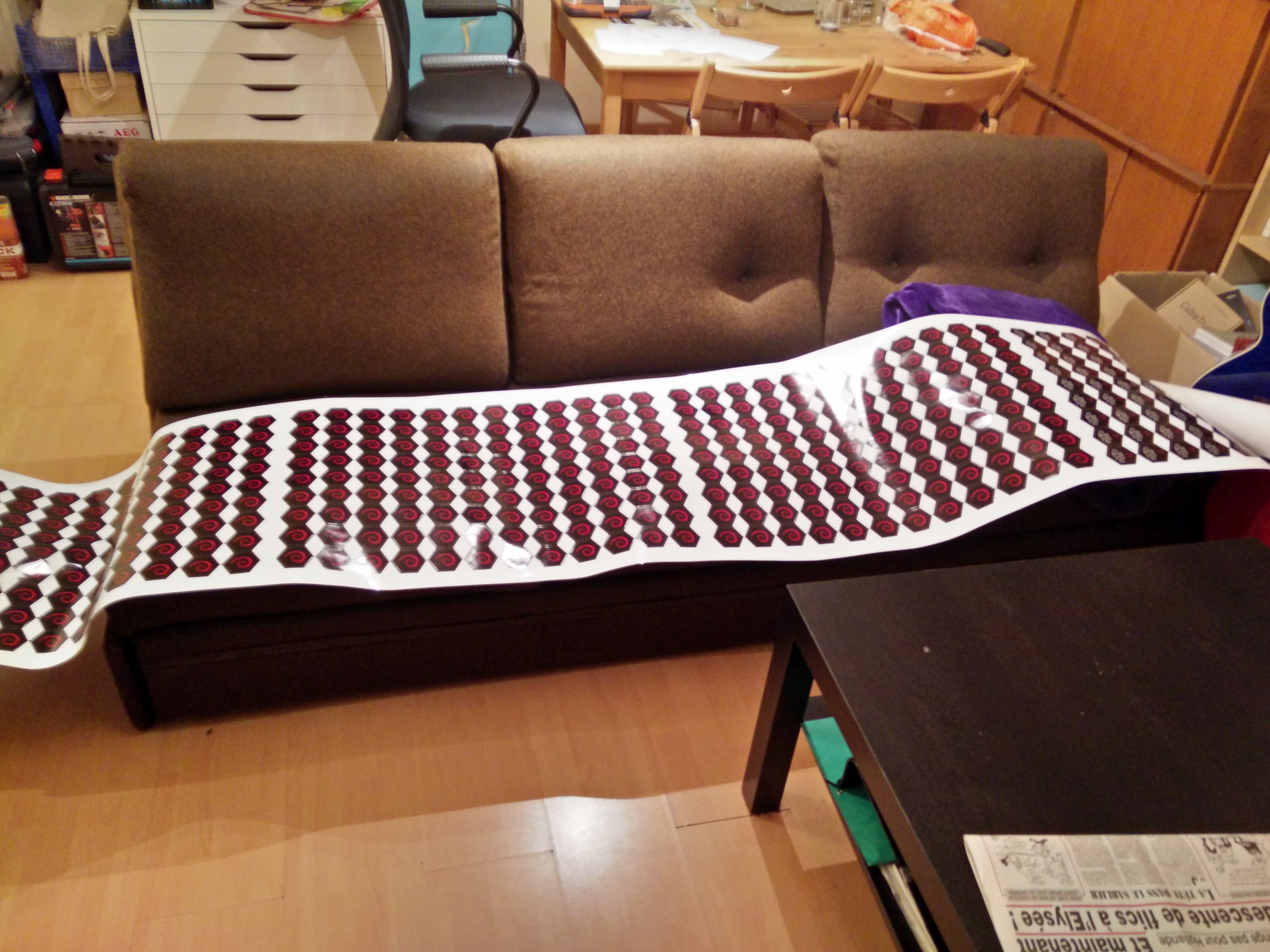
Sean Whitton: I went all the way to Montr al for DebConf17, and all I got was a new MUA

 |
|
SOURCE_DATE_EPOCH supportthe#debian-reproducible-changes IRC channel for unreproducible -> FTBFS transitions.squid.conf for all nodes to 5.2.23 (and fixup some).arm64 nodes as well.update_jdn.sh is updated.jenkins.debian.org, which affects tests.r-b.o as well.
 Update Some youtube links are not viewable or even seen on planet.debian.org. Seems p.d.o. tries its best to remove external links, sorry for the breakage.
Beware some youtube-links would be shared in this entry, sorry couldn t find a better/easier media platform to work with. If anyone knows any other platform or wants to suggest, feel free to either mail me or let me know in comments.
I want to start today s sharing with a picture of Ganesha I saw today. It is and was public art hence sharing it without an issue.
 This is starting of festivities time in India and Ganesha or Ganpati is looked up as a good omen in India.
The festival of Ganesh Chaturthi would be starting on the 25th of August and is a sight to behold. Just like Rio has its carnival, Ganesh Chaturthi is also a carnival. We also have parades where people come with Pandals (or temporary structures)
The mythology says he has a sweet tooth (hence lot of distribution of sweets, especially modak) and anything which might be troubling people, he creates solutions for them.
Here is one video of how people celebrate his immersion in India. This is from my home-town few years ago, every year the madness and the celebrations are becoming more and more. People from far off come to see how we celebrate and see how different people make their Pandals. While some are with music, others are with social messages. Usually people start going to see these structures after dusk and return home way after midnight or early morning. I hope to do this endeavour after many years. One is drunk from hearing all sorts of different kids of music, decoration, messages, a feast and a strain to all the senses.
Ganesha immersion celebrations https://www.youtube.com/watch?v=hjWfpGUryho
If one is interested one can find more info. at https://en.wikipedia.org/wiki/Ganesh_Chaturthi
After quite a bit of time, I wrote an article about various foss internships which I knew besides GSOC over the years. I finally penned them down at https://itsfoss.com/best-open-source-internships/
Interestingly, I was amazed to see that all FOSS U.S. projects (outside of GSOC) are for students who are either living or studying in U.S. and have a student work visa (which from private discussions I came to know is lot harder to get nowadays than before). Except for the National Science Foundation (NSF) which probably has U.S. defence relations and hence they might be sensitive, I fail to understand other institutes preferences for only getting people from the U.S. and hence having a lesser talent pool of people. This also affects the growth of the projects themselves. Just think how limited Debian would have been if it had decided to only have people from only any one community develop it. Dunno if this is due to the present President Trump or these policies had been there before. It would be nice and interesting if people in the know can share.
What has also been interesting to watch is Mr. Trump blaming low-cost manufacturing centres like India and China when as far as I recall, lot of manufacturing, specifically auto-mobiles manufacturing was shifted out of the U.S. to Ireland and other places years before which are relatively high-cost places (at least compared to India). I *believe* the change was as early as in 1980 s itself where India was insulated and had a limited market for everything (similar to Russian communism as shown in popular media but not so bad.)
Interestingly, it took almost a month for the perl 2.56 to make the transition smoothly. It took quite a bit of time for all the components to work together and be installable.
Also saw this few days back http://fortune.com/2017/04/12/auto-industry-decline/
While Tesla is expensive even by American standards the idea of lesser parts, lesser complexity and hence lower costs to use, maintain is good. I do hope that he and his team or any of the competitors do overcome the significant challenges. Any significant improvement in battery technology is bound to have huge impact in almost everything that is used in 21st century.
Two recent articles tell me the future may become present very quickly.
https://www.purdue.edu/newsroom/releases/2017/Q2/instantly-rechargeable-battery-could-change-the-future-of-electric-and-hybrid-automobiles.html
Toyota could finally start mass producing electric cars thanks to China
I do hope to see EV being prevalent before the next decade is over otherwise we don t have any hope due to climate change.
As for my health, I am much better than before. Just to share some stats, before my illness for lack of better word, I was 120 kgs. , when I was kept in the hospital for about 2-2.5 weeks I came down to 95 kgs. and now back upto 108 kgs. Do go for exercising every other day and trying to get back the strength, stamina and increasing a bit of both. Doctors have given me another 4-5 months after which a brain scan will reveal if there are any remaining blood clots in the brain or not.
Lastly, while it has become somewhat of a sensitive issue to love Muslims or to talk about their work in any field in the current political climate, there are 4-5 music pieces I listen whenever I can, especially before going to bed. While almost all the pieces have been sung and written by Muslims, sadly I don t know who the composers of these beautiful songs are.
While it is much easier to get the names of the singer and the lyricist, one of the more important roles in my view is the composer or/and music arranger. Without them, the songs would not have the same haunting quality that the songs have. While I have been lucky to find the names of the composer/music arranger for the pieces below but this is not the case if and when the songs comes on television. I do remember in old times at least on Radio they used to mention about who has given the music as well, dunno in modern times.
I am sharing the songs, and hopefully will also share the translations if I find on the web, please see the lyrics. The numbering is for convenience only and am torn in these 4-5 songs which is the best. Just to share these are all sufi love songs except the last one which I am sharing.
1.
Lyrical song https://www.youtube.com/watch?v=ehqN6oTpmb8
Translation with video of song http://www.bollynook.com/en/lyrics/6443/aaj-din-chadheya/
While there probably are stories with each song, I was lucky to find the story about this one. The lyrics of the song are actually a love lost Punjabi poet who writes in the memory of his beloved to which he could not marry and he pens those when standing in line for his liquor. The story goes on that he marries a girl later in life who bears a resemblance to his beloved whom he couldn t forget till his dying day.
2.
Lyrical song https://www.youtube.com/watch?v=uTC_2c83qn0
The same song has been sung by different people and I love them all the more for it.
Another video https://www.youtube.com/watch?v=3G7Qg4LJ7WE
Another video https://www.youtube.com/watch?v=kOsvNuR3m5Y
Translation http://www.bollynook.com/en/lyrics/10703/o-re-piya/
3.
Lyrical song https://www.youtube.com/watch?v=qG7Kms_YA5Q
The translation http://www.filmyquotes.com/songs/885
The translation of the song is a bit crude but then translations are supposed to be crude
 Anyways, the above song is what would be called a perfect Sufi song. I hope people enjoy the longing and the silence which follows this piece.
Another classic one
4.
Lyrical song https://www.youtube.com/watch?v=Ube5XhN_lpM
English translation http://www.ardhamy.com/song/aye-dil-e-naadan
While the song is from the movie Razia Sultana and was a flop as the movie was about Race and controversial then as it probably would be now. As seen in the other songs of the same genre, it has strands of longing, loneliness as seen of the above.
5.
Lyrical song https://www.youtube.com/watch?v=tv242qOnHJA
This one is not a sufi song but I love all the women and the girls and the way they enhanced the song. I dunno how much they must have practised as it s a very fast and peppy song and doesn t give time to the singer to breathe except for that one section which has a bit of Carnatic music.
At the very end I would like to share http://www.globalrhythm.net/ I have found some interesting sounds on the site. Hope the site enriches you as well. FWIW I have no links with the site except as somebody who likes to diversify his music listening.
Lastly, for a long period of time, I had been hearing the criticism, especially for FOSS games that they don t have AAA quality assets. Recently I came across a game called Starship Theory (sadly its only for MS-Windows)
Game video https://www.youtube.com/watch?v=imaL2pjNURg
You look at the game and see the number of videos the guy has made. What FOSS game developers can learn from this, you don t need high-end 2.5/3d models, clipart will do but need depth in gameplay which can make FOSS games be popular and also earn a pretty bundle. I do hope some FOSS game upstream developers take note and use that game s inspiration to bring more depth.
That doesn t mean games like 0ad are not liked by people but it takes huge amount of time and resources.
0ad video https://www.youtube.com/watch?v=DHx5XBtypcQ
Hope you have a good time with all the ideas, anecdotes and videos I shared above.


 The photo (click to enlarge) shows all four devices, together with a
Nokia N900, which was the
first Linux-based smartphone by Nokia, running Debian-based Maemo and
a completely unrelated
Gnuk cryptographic token,
which just sneaked into the setting.
If you like to participate, please
#debian-mobile IRC chatroom at irc.oftc.net.
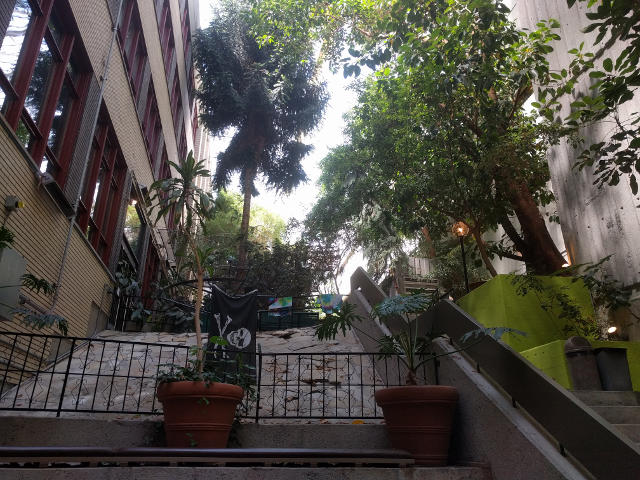 |
git-annex repository, with
some small edits to link to more source code:
A Debian maintainer's guide to Flatpak.
Source code for the slides
is also available from Collabora's git server.
The next step is to take my proof-of-concept for building
Flatpak runtimes and apps from Debian and SteamOS packages,
flatdeb, get it
a bit more production-ready, and perhaps start publishing some sample
runtimes from a cron job on a Debian or Collabora server. (By the way,
if you downloaded that source right after my talk, please update - I've
now pushed some late changes that were necessary to fix the 3D drivers
for my OpenArena demo.)
I don't think Debian will be going quite as far as
Endless any time soon: as
Cosimo outlined in the talk right before mine, they
deploy their Debian derivative as an immutable base OS with
libOSTree, with all the
user-installable modules above that coming from Flatpak. That model is
certainly an interesting thing to think about for Debian derivatives,
though: at Collabora we work on a lot of appliance-like embedded Debian
derivatives, with a lot of flexibility during development but very limited
state on deployed systems, and Endless' approach seems a perfect fit for
those situations.
[Edited 2017-08-16 to fix the link for the slides, and add links for the
video]



 If you also like graphics design, or design in general, have a look at
https://wiki.debian.org/Design and join
the team! Or you can visit the general list of Debian Teams
for many other opportunities to participate in Debian development.
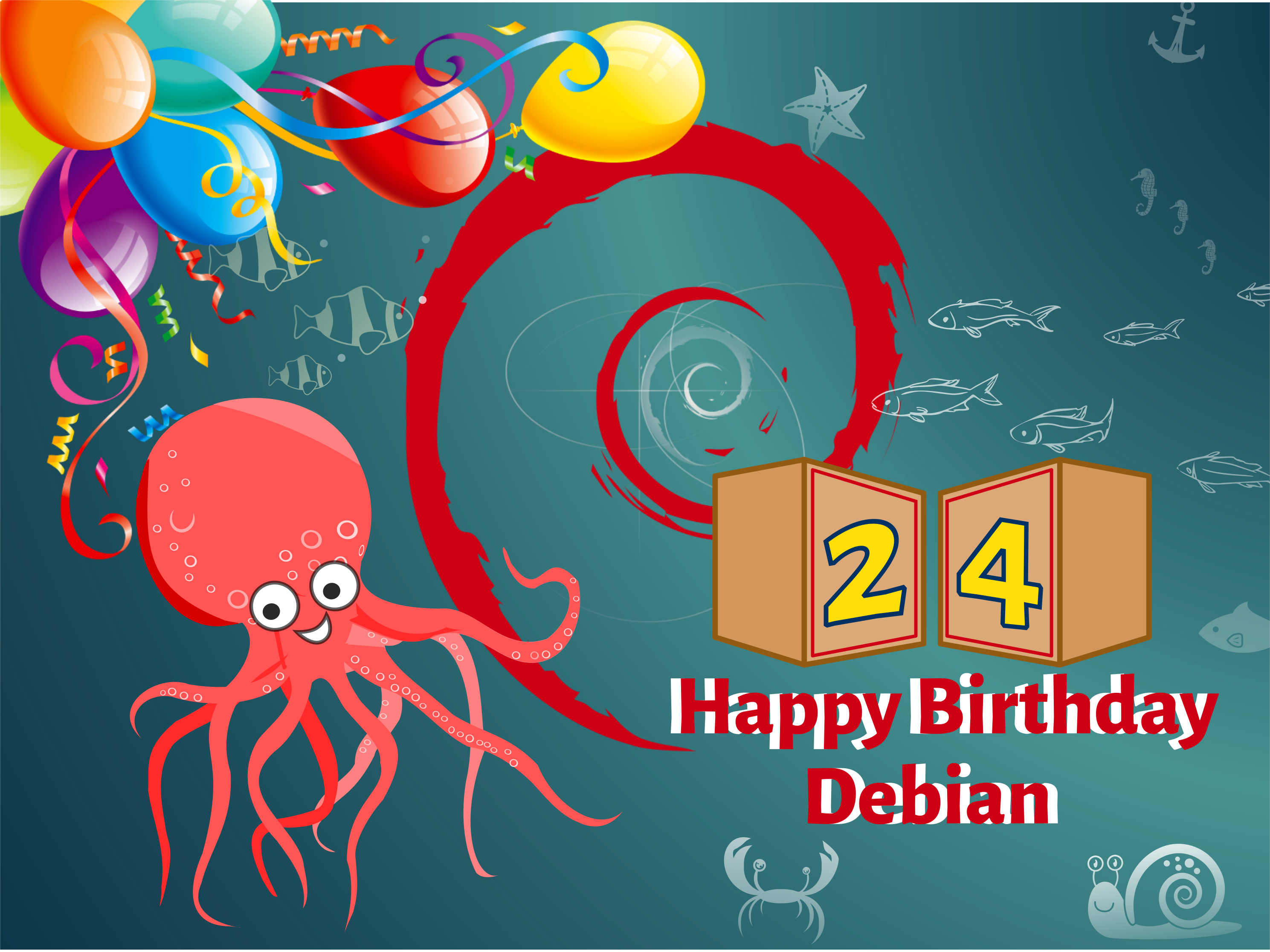
Thanks to everybody who has contributed to develop our beloved operating system
in these 24 years, and happy birthday Debian!
 Welcome to the nineth post in the recognisably rancid R randomness series, or R4 for short. Following on the heels of last week's post, we aim to look into the shared libraries created by R.
We love the R build process. It is robust, cross-platform, reliable and rather predicatable. It. Just. Works.
One minor issue, though, which has come up once or twice in the past is the (in)ability to fully control all compilation options. R will always recall
CFLAGS, CXXFLAGS, ... etc as used when it was compiled. Which often entails the -g flag for debugging which can seriously inflate the size of the generated object code. And once stored in $ RHOME /etc/Makeconf we cannot on the fly override these values.
But there is always a way. Sometimes even two.
The first is local and can be used via the (personal) ~/.R/Makevars file (about which I will have to say more in another post). But something I have been using quite a bite lately uses the flags for the shared library linker. Given that we can have different code flavours and compilation choices---between C, Fortran and the different C++ standards---one can end up with a few lines. I currently use this which uses -Wl, to pass an the -S (or --strip-debug) option to the linker (and also reiterates the desire for a shared library, presumably superfluous):
SHLIB_CXXLDFLAGS = -Wl,-S -shared
SHLIB_CXX11LDFLAGS = -Wl,-S -shared
SHLIB_CXX14LDFLAGS = -Wl,-S -shared
SHLIB_FCLDFLAGS = -Wl,-S -shared
SHLIB_LDFLAGS = -Wl,-S -sharededd@brad:~/git/rprotobuf(feature/fewer_warnings)$ ls -lh src/RProtoBuf.so
-rwxr-xr-x 1 edd edd 12M Aug 14 20:22 src/RProtoBuf.so
edd@brad:~/git/rprotobuf(feature/fewer_warnings)$ .R/Makevars, we end up with much less:
edd@brad:~/git/rprotobuf(feature/fewer_warnings)$ ls -lh src/RProtoBuf.so
-rwxr-xr-x 1 edd edd 626K Aug 14 20:29 src/RProtoBuf.so
edd@brad:~/git/rprotobuf(feature/fewer_warnings)$ file tool still shows the file as 'not stripped' as it still contains the symbols. Only debugging information was removed.
What reduction in size can one expect, generally speaking? I have seen substantial reductions for C++ code, particularly when using tenmplated code. More old-fashioned C code will be less affected. It seems a little difficult to tell---but this method is my new build default as I continually find rather substantial reductions in size (as I tend to work mostly with C++-based packages).
The second option only occured to me this evening, and complements the first which is after all only applicable locally via the ~/.R/Makevars file. What if we wanted it affect each installation of a package? The following addition to its src/Makevars should do:
strippedLib: $(SHLIB)
        if test -e "/usr/bin/strip"; then /usr/bin/strip --strip-debug $(SHLIB); fi
.phony: strippedLibMakefile target strippedLib. But making it dependent on $(SHLIB), we ensure the standard target of this Makefile is built. And by making the target .phony we ensure it will always be executed. And it simply tests for the strip tool, and invokes it on the library after it has been built. Needless to say we get the same reduction is size. And this scheme may even pass muster with CRAN, but I have not yet tried.
Lastly, and acknowledgement. Everything in this post has benefited from discussion with my former colleague Dan Dillon who went as far as setting up tooling in his r-stripper repository. What we have here may be simpler, but it would not have happened with what Dan had put together earlier.
This post by Dirk Eddelbuettel originated on his Thinking inside the box blog. Please report excessive re-aggregation in third-party for-profit settings.
 Hosted Weblate provides also free hosting for free software projects. The hosting requests queue was over one month long, so it's time to process it and include new project.
This time, the newly hosted projects include:
 This is a difficult announcement to write. The summary is if you use
Obnam you should switch to another backup program in the coming
months.
The first commit to Obnam's current code base is this:
commit 7eaf5a44534ffa7f9c0b9a4e9ee98d312f2fcb14
Author: Lars Wirzenius <liw@iki.fi>
Date:   Wed Sep 6 18:35:52 2006 +0300
    Initial commit.
Package: file
Version: 1:5.19-2
Severity: important
User: debian-edu@lists.debian.org
Usertags: debian-edu
In Canada "consent means the voluntary agreement of the complainant to engage in sexual activity" without abuse or exploitation of "trust, power or authority", coercion or threats.[7] Consent can also be revoked at any moment.[8] There are 3 pillars often included in the description of sexual consent, or "the way we let others know what we're up for, be it a good-night kiss or the moments leading up to sex." They are:Saying "I've decided I won't do laundry anymore" when the other partner is tired, or busy doing things. Is different than saying "I've decided I won't do laundry anymore" when the other partner has a chance to say "why? tell me more" and take part in negotiation. Resources: Relationships Debian is the Universal Operating System. Debian is made and maintained by people. The long term health of debian is a consequence of the long term health of the relationship between Debian contributors. Debian doesn't need to be technically perfect, it needs to be socially healthy. Technical problems can be fixed by a healty community.
- Knowing exactly what and how much I'm agreeing to
- Expressing my intent to participate
- Deciding freely and voluntarily to participate[20]
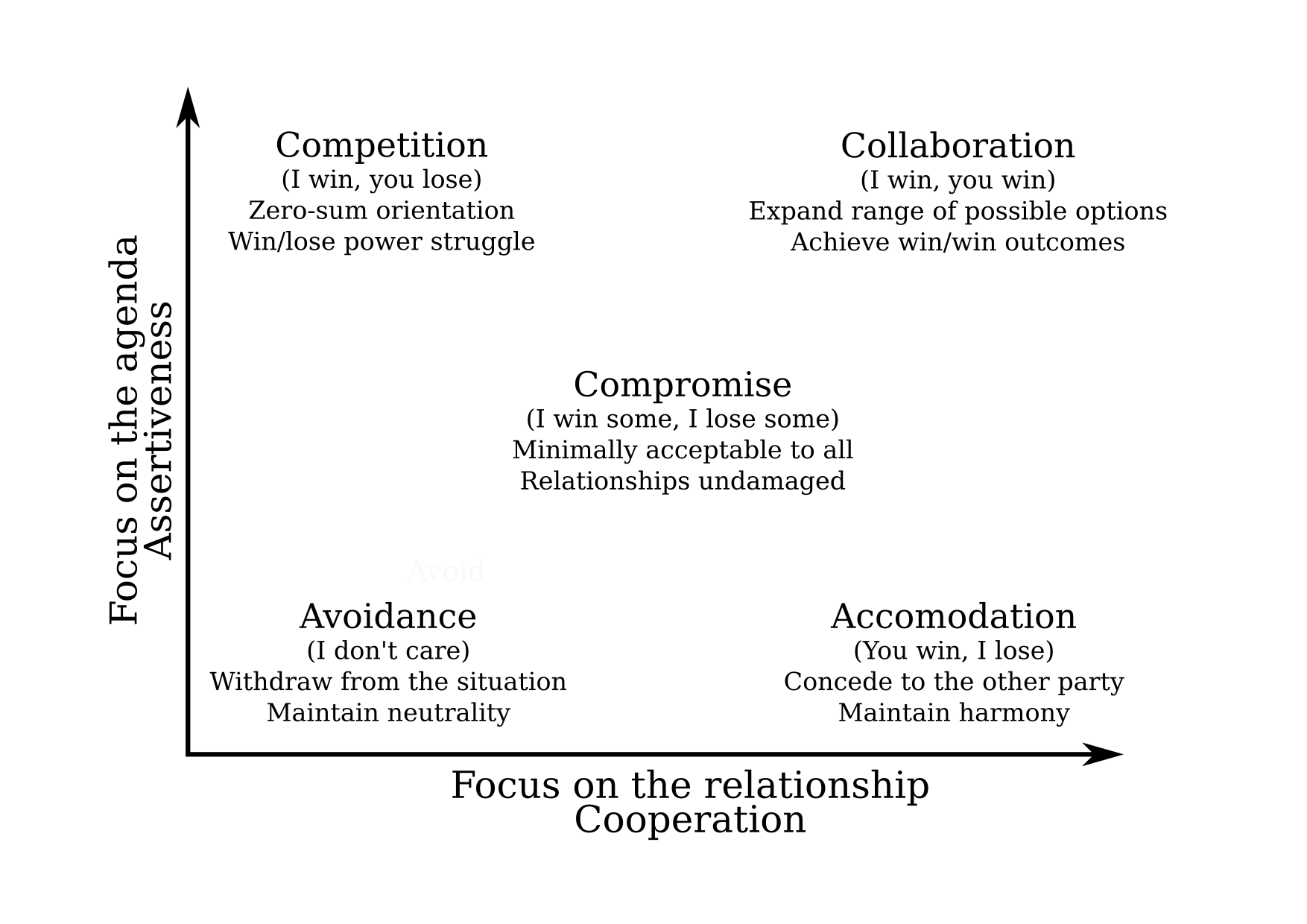
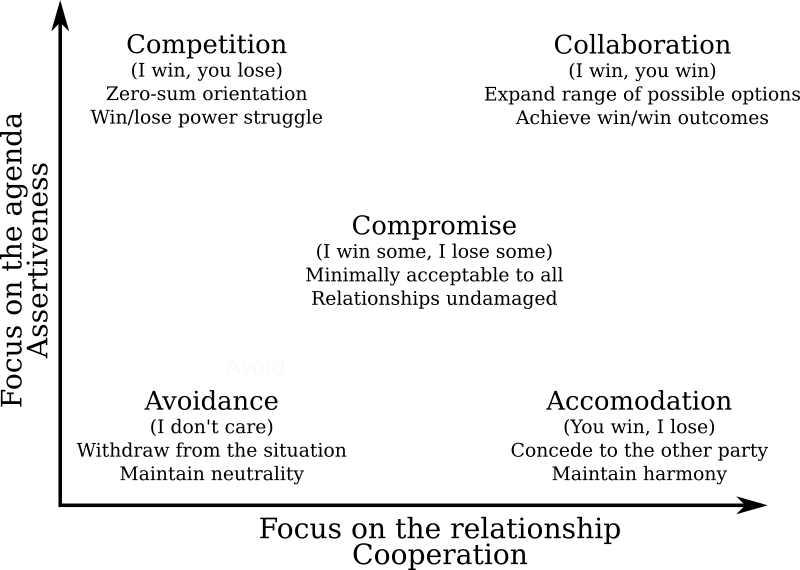 The Thomas-Kilmann Conflict Mode Instrument: source png.
Motivations
Quick poll:
"Spoons" are a visual representation used as a unit of measure used to quantify how much energy a person has throughout a given day. Each activity requires a given number of spoons, which will only be replaced as the person "recharges" through rest. A person who runs out of spoons has no choice but to rest until their spoons are replenished.
My software ate(inspired by a 1934 poem by William Carlos Williams) Don't be afraid to fail Don't be afraid to fail or drop the ball. I think that anything that has a label attached of "if you don't do it, nobody will", shouldn't fall on anybody's shoulders and should be shared no matter what. Shared or dropped. Share the responsibility for a healthy relationship Don't expect that the more experienced mates will take care of everything. In a project with active people counted by the thousand, it's unlikely that harassment isn't happening. Is anyone writing anti-harassment? Do we have stats? Is having an email address and a CoC giving us a false sense of security?
the files
that where in
your home directory and which
you were probably
needing
for work Forgive me
it was so quick to write
without tests
and it worked so well for me
When you get involved in a new community, such as Debian, find out early where, if that happens, you can find support, understanding, and help to make it stop. If you cannot find any, or if the only thing you can find is people who say "it never happens here", consider whether you really want to be in that community.(from http://www.enricozini.org/blog/2016/debian/you-ll-thank-me-later/)
There are some nice people in the world. I mean nice people, the sort I couldn t describe myself as. People who are friends with everyone, who are somehow never involved in any argument, who seem content to spend their time drawing pictures of bumblebees on flowers that make everyone happy. Those people are great to have around. You want to hold onto them as much as you can. But people only have so much tolerance for jerkiness, and really nice people often have less tolerance than the rest of us. The trouble with not ejecting a jerk whether their shenanigans are deliberate or incidental is that you allow the average jerkiness of the community to rise slightly. The higher it goes, the more likely it is that those really nice people will come around less often, or stop coming around at all. That, in turn, makes the average jerkiness rise even more, which teaches the original jerk that their behavior is acceptable and makes your community more appealing to other jerks. Meanwhile, more people at the nice end of the scale are drifting away.(from https://eev.ee/blog/2016/07/22/on-a-technicality/) Give people freedom If someone tries something in Debian, try to acknowledge and accept their work. You can give feedback on what they are doing, and try not to stand in their way, unless what they are doing is actually hurting you. In that case, try to collaborate, so that you all can get what you need. It's ok if you don't like everything that they are doing. I personally don't care if people tell me I'm good when I do something, I perceive it a bit like "good boy" or "good dog". I rather prefer if people show an interest, say "that looks useful" or "how does it work?" or "what do you need to deploy this?" Acknowledge that I've done something. I don't care if it's especially liked, give me the freedom to keep doing it. Don't give me rewards, give me space and dignity. Rather than feeding my ego, feed by freedom, and feed my possibility to create.
undistract-me package*.large types) you get 500Mbps,
for four cores (*.xlarge) you get 750Mbps and
for eight cores (*.2xlarge) you get 1000Mbps.
This is way below our estimate shown above and does not even raise linear with the number of cores.
But all of this does not really matter anyway, as the performance of AWS is the worst of the three providers.
Our second provider, Azure, seems to not publish any real information about network caps at all.
From my own knowledge it is 50MBps (500Mbps) per core for at least the smaller instances.
At least is scales linear with instance size, but is still way below our estimates.
Our third provider, GCP, documents a
simple rule for network caps:
2Gbps per core.
This matches what we estimated.
Now the most important question: does this estimate really work and can we actually fill it.
The answer is not easy.
A slightly synthetic test of a HTTP server with cached static content showed that it can easily reach 7Gbps on a 2GHz Intel Skylake core.
So yes, it gives a good estimate on what network troughput is needed for real world applications.
However we still could easily file pipe that is larger by a factor of three.
Weblate 2.16 has been released today while I'm at DebConf17. There are quite some performance improvements (and more of that is scheduled for 2.17), new file formats support and various other improvements.
Full list of changes:
demo account using demo password or register your own user. Weblate is also being used on https://hosted.weblate.org/ as official translating service for phpMyAdmin, OsmAnd, Turris, FreedomBox, Weblate itself and many other projects.
Should you be looking for hosting of translations for your project, I'm happy to host them for you or help with setting it up on your infrastructure.
Further development of Weblate would not be possible without people providing donations, thanks to everybody who have helped so far! The roadmap for next release is just being prepared, you can influence this by expressing support for individual issues either by comments or by providing bounty for them.
Welcome to the eight post in the ramblingly random R rants series, or R4 for short. We took a short break over the last few weeks due to some conferencing followed by some vacationing and general chill.
But we're back now, and this post gets us back to initial spirit of (hopefully) quick and useful posts. Perusing yesterday's batch of CRANberries posts, I noticed a peculiar new directory shown the in the diffstat output we use to compare two subsequent source tarballs. It was entitled .aspell/, in the top-level directory, and in two new packages by R Core member Kurt Hornik himself.
The context is, of course, the not infrequently-expressed desire to customize the spell checking done on CRAN incoming packages, see e.g. this r-package-devel thread.
And now we can as I verified with (the upcoming next release of) RcppArmadillo, along with a recent-enough (i.e. last few days) version of r-devel. Just copying what Kurt did, i.e. adding a file .aspell/defaults.R, and in it pointing to rds file (named as the package) containing a character vector with words added to the spell checker's universe is all it takes. For my package, see here for the peculiars.
Or see here:
edd@bud:~/git/rcpparmadillo/.aspell(master)$ cat defaults.R
Rd_files <- vignettes <- R_files <- description <-
    list(encoding = "UTF-8",
         language = "en",
         dictionaries = c("en_stats", "RcppArmadillo"))
edd@bud:~/git/rcpparmadillo/.aspell(master)$ r -p -e 'readRDS("RcppArmadillo.rds")'
[1] "MPL"            "Sanderson"      "Templated"
[4] "decompositions" "onwards"        "templated"
edd@bud:~/git/rcpparmadillo/.aspell(master)$ R(-devel) CMD check --as-cran ... is silent about spelling. Yay!
But take this with a grain of salt as this does not yet seem to be "announced" as e.g. yesterday's change in the CRAN Policy did not mention it. So things may well change -- but hey, it worked for me.
And this all is about aspell, here is something topical about a spell to close the post:
This post by Dirk Eddelbuettel originated on his Thinking inside the box blog. Please report excessive re-aggregation in third-party for-profit settings.
 This is a talk which I presented on August 10th, 2017 at Debconf 17 in
Montreal, Canada.
Next.