Antoine Beaupr : A report from Netconf: Day 2
This article covers the second day of the informal Netconf discussions,
held on on April 4, 2017. Topics discussed this day included the binding
of sockets in VRF, identification of eBPF programs, inconsistencies
between IPv4 and IPv6, changes to data-center hardware, and more. (See
this article for coverage from the first day of
discussions).
How to bind to specific sockets in VRF
One of the first presentations was from David Ahern of Cumulus, who
presented a few interesting questions for the audience. His first was
the problem of binding sockets to a given interface. Right now, there
are four different ways this can be done:
How to bind to specific sockets in VRF
One of the first presentations was from David Ahern of Cumulus, who
presented a few interesting questions for the audience. His first was
the problem of binding sockets to a given interface. Right now, there
are four different ways this can be done:
- the old
SO_BINDTODEVICE generic socket option (see
socket(7))
- the
IP_PKTINFO, IP-specific socket option (see
ip(7)), introduced in Linux 2.2
- the
IP_UNICAST_IF flag, introduced in Linux 3.3 for WINE
- the IPv6 scope ID suffix, part of the IPv6 addressing standard
So there's a problem of having too many ways of doing the same thing,
something that cannot really be fixed without breaking ABI
compatibility. But even worse, conflicts between those options are not
reported by the kernel so it's possible for a user to set up socket
flags in a way that certain flags override others and there are no
checks made or errors reported. It was agreed that the user should get
some notification of conflicting changes here, at least.
Furthermore, binding sockets to a specific VRF (Virtual Routing and
Forwarding)
device is not currently possible, so Ahern asked what the best way to do
this would be, considering the many options available. A use case
example is a UDP multicast socket that could be bound to a specific
interface within a VRF.
This is an old problem: Tom Herbert explained that there were previous
discussions about making the bind() system call more programmable so
that, for example, you could bind() a UDP socket to a discrete list of
IP addresses or a subnet. So he identified this issue as a broader
problem that should be addressed by making the interfaces more generic.
Ahern explained that it is currently possible to bind sockets to the
slave device of a VRF even though that should not be allowed. He also
raised the question of how the kernel should tell which socket should be
selected for incoming packets. Right now, there is a scoring mechanism
for UDP sockets, but that cannot be used directly in this more general
case.
David Miller said that there are already different ways of specifying
scope: there is the VRF layer and the namespace ("netns") layer. A long
time ago, Miller reluctantly accepted the addition of netns keys
everywhere, swallowing the performance cost to gain flexibility. He
argued that a new key should not be added and instead existing
infrastructure should be reused. Herbert argued this was exactly the
reason why this should be simplified: "if we don't answer the question,
people will keep on trying this". For example, one can use a VRF to
limit listening addresses, but it gets complicated if we need a device
for every address. It seems the consensus evolved towards using,
IP_UNICAST_IF, added back in 2012, which is accessible for non-root
users. It is currently limited to UDP and RAW sockets, but it could be
extended for TCP.
XDP and eBPF program identification
Ahern then turned to the problem of extracting BPF programs from the
kernel. He gave the example of a simple cBPF (classic BPF) filter that
checks for ARP packets. If the filter is read back from the kernel, the
user gets a blob of binary data, which is hard to interpret. There is an
kernel verifier that can show C-like output, but that is also difficult
to interpret. Ahern then added annotations to his slide that showed what
the original program actually does, which was a good demonstration of
why such a feature is needed.
Ahern explained that, at least for cBPF, it should be possible to
recover the original plaintext, or at least something close to the
original program. A first step would be to replace known constants (like
0x806 for ARP). Even with eBPF, it should be possible to improve the
output. Alexei Starovoitov, the BPF maintainer, explained that it might
make sense to start by returning information about the maps used by an
eBPF program. Then more complex data structures could be inspected once
we know their type.
The first priority is to get simple debugging tools working but, in the
long term, the goal is a full decompiler that can reconstruct
instructions into a human-readable program. The question that remains is
how to return this data. Ahern explained that right now the bpf()
system call copies the data to a different file descriptor, but it could
just fill in a buffer. Starovoitov argued for a file descriptor; that
would allow the kernel to stream everything through the same descriptor
instead of having many attach points. Netlink cannot be used for this
because of its asynchronous nature.
A similar issue regarding the way we identify express data
path (XDP) programs (which are
also written in BPF) was raised by Daniel Borkmann from Covalent. Miller
explained that users will want ways to figure out which XDP program was
installed, so XDP needs an introspection mechanism. We currently have
SHA-1 identifiers that can be internally used to tell which binary is
currently loaded but those are not exposed to user space. Starovoitov
mentioned it is now just a boolean that shows if a program is loaded or
not.
A use case for this, on top of just trying to figure out which BPF
program is loaded, is to actually fetch the source code of a BPF program
that was deployed in the field for which the source was lost. It is
still uncertain that it will be possible to extract an exact copy that
could then be recompiled into the same program. Starovoitov added that
he needed this in production to do proper reporting.
IPv4/IPv6 equivalency
The last issue or set of issues that Ahern brought up was the
question of inconsistencies between IPv4 and IPv6. It turns out that,
because both protocols were (naturally) implemented separately, there
are inconsistencies in how they are handled in the Linux kernel, which
affect, among other things, the VRF framework. The first example he gave
was the fact that IPv6 addresses added on the loopback interface
generate unreachable routes in the main routing table, yet this doesn't
happen with IPv4 addresses. Hannes Frederic Sowa explained this was part
of the IPv6 specification: there are stronger restrictions on loopback
interfaces in IPv6 than IPv4. Ahern explained that VRF loopback
interfaces do not implement these restrictions and wanted to know if
this was a problem.
Another issue is that anycast routes are added to the wrong interface.
This is apparently not specific to VRF: this was done "just because
Java", and has been there from day one. It seems that the Java Virtual
Machine builds its own routing table and assumes this behavior, so
changing this would break every JVM out there, which is obviously not
acceptable.
Finally, Martin Kafai Lau asked if work should be done to merge the IPv4
and IPv6 FIB (forwarding information base) trees. The FIB tree is the
data structure that represents routing tables in the Linux kernel.
Miller explained that the two trees are not semantically equivalent:
while IPv6 does source-address lookup and routing, IPv4 does not. We
can't remove the source lookups from IPv6, because "people probably use
that". According to Alexander Duyck, adding source tables to IPv4 would
degrade performance to the level of IPv6 performance, which was jokingly
referred to as an incentive to switch to IPv6.
More seriously, Sowa argued that using the same compressed tree IPv4
uses in IPv6 could make sense. People may want to have source routing in
IPv4 as well. Miller argued that the kernel is optimized for 32-bit
addresses in IPv4, and conceded that it could be scaled to 64-bit
subnets, but 128-bit addresses would be much harder. Sowa suggested that
they could be limited to 64 bits, as global routes that are announced
over BGP usually have such a limit, and more specific routes are usually
at discrete prefixes like /65, /127 (for interconnect links) or /128 for
(for point-to-point links). He expressed concerns over the reliability
of such an implementation so, at this point, it is unlikely that the
data structures could be merged. What is more likely is that the code
path could be merged and simplified, while keeping the data structures
separate.
Modules options substitutions
The next issue that was raised was from Ji P rko, who asked how to
pass configuration options to a driver before the driver is
initialized. Some chips require that some settings be sent before the
firmware is loaded, which leads to a weird situation where there is a
need to address a device before it's actually recognized by the kernel.
The question then can be summarized as to how to pass information to a
device that doesn't exist yet.
The answer seems to be that
devlink could
do this, as it has access to the full device tree and, therefore, to
devices that can be addressed by (say) PCI identifiers. Then a possible
devlink command could look something like:
devlink dev pci/0000:03:00.0 option set foo bar
This idea raised a bunch of extra questions: some devices don't have a
one-to-one mapping with the PCI bridge identifiers, for example, meaning
that those identifiers cannot be used to access such devices. Another
issue is that you may want to send multiple settings in a single
transaction, which doesn't fit well in the devlink model. Miller then
proposed to let the driver initialize itself to some state and wait for
configuration to be sent when necessary. Another way would be to
unregister the driver and re-register with the given configuration.
Shrijeet Mukherjee explained that right now, Cumulus is doing this using
horrible startup script magic by retrying and re-registering, but it
would be nice to have a more standard way to do this.
Control over UAPI patches
Another issue that came up was the problem of changes in the user-space
API (UAPI) which break backward compatibility. P rko said that "we have
to be more careful about those changes". The problem is that reviewers
are not always available to make detailed reviews of such changes and
may not notice API-breaking changes. P rko proposed creating a bot to
check if a given patch introduces UAPI changes, changes in structs, or
in netlink enums. Miller said he could block merges until discussions
happen and that patchwork, which Miller uses to process patches from the
mailing list, does some of this. He also pointed out there aren't enough
test cases in the first place.
Starovoitov argued UAPI isn't special, there are other ways of breaking
backward compatibility. He expressed concerns that such a bot could
create a false sense that everything is fine while a patch could break
compatibility and not be detected. Miller countered that UAPI is special
in that "we're stuck with it forever". He then went on to propose that,
since there's a maintainer (or more) for each module, he can make sure
that each maintainer explicitly approves changes to those modules.
Data-center hardware changes
Starovoitov brought up the issue of a new type of hardware that is
currently being deployed in data centers called a "multi-host NIC"
(network interface card). It's a single NIC that is connected to
multiple servers. Facebook, for example, uses this in its Yosemite
platform
that shoves twelve servers into a 2U rack mount, in three modules. Each
module is made of four servers connected to the traditional switch
fabric with a single NIC through PCI-Express. Mellanox and and Broadcom
also have similar devices.
One question is how to manage those devices. Since they are connected
through a PCI-Express bus, Linux will see them as a NIC, yet they are
also a little like switches, in that they interconnect multiple servers.
Furthermore, the kernel security model assumes that a NIC is trusted,
and gladly opens its own memory to NICs through DMA; this can become a
huge security issue when the NIC is under the control of another server.
This can especially become problematic if we consider that there could
be TLS hardware offloading in the future with the introduction of
in-kernel TLS stacks.
The other problem is the question of reliability: since those devices
are currently "dumb", they need to be managed just like a regular NIC.
If the host managing the card crashes, it could disable a whole set of
servers that rely on the same NIC. There could be an election process
among the servers, but that complicates significantly what used to be a
simple PCI connection.
Mukherjee pointed out that the model Cisco uses for this is that the
"smart NIC" is a "slave" of the main switch fabric. It's a daughter
card, which makes it easier to manage from a network perspective. It is
clear that Linux will need a way to represent those devices, probably
through the newly introduced switchdev or DSA (distributed switch
architecture), but it will be something to keep an eye on as density
increases in the data center.
There were many more discussions during Netconf, too many to cover here,
but in the end, Miller thanked everyone for all the interesting topics
as the participants dispersed for a day off to travel to Montreal to
attend the following Netdev conference.
The author would like to thank the Netconf and Netdev organizers for
travel to, and hosting assistance in, Toronto. Many thanks to Alexei
Starovoitov for his time taken for a technical review of this
article.
Note: this article first appeared in the
Linux Weekly News.
SO_BINDTODEVICE generic socket option (see
socket(7))IP_PKTINFO, IP-specific socket option (see
ip(7)), introduced in Linux 2.2IP_UNICAST_IF flag, introduced in Linux 3.3 for WINE0x806 for ARP). Even with eBPF, it should be possible to improve the
output. Alexei Starovoitov, the BPF maintainer, explained that it might
make sense to start by returning information about the maps used by an
eBPF program. Then more complex data structures could be inspected once
we know their type.
The first priority is to get simple debugging tools working but, in the
long term, the goal is a full decompiler that can reconstruct
instructions into a human-readable program. The question that remains is
how to return this data. Ahern explained that right now the bpf()
system call copies the data to a different file descriptor, but it could
just fill in a buffer. Starovoitov argued for a file descriptor; that
would allow the kernel to stream everything through the same descriptor
instead of having many attach points. Netlink cannot be used for this
because of its asynchronous nature.
A similar issue regarding the way we identify express data
path (XDP) programs (which are
also written in BPF) was raised by Daniel Borkmann from Covalent. Miller
explained that users will want ways to figure out which XDP program was
installed, so XDP needs an introspection mechanism. We currently have
SHA-1 identifiers that can be internally used to tell which binary is
currently loaded but those are not exposed to user space. Starovoitov
mentioned it is now just a boolean that shows if a program is loaded or
not.
A use case for this, on top of just trying to figure out which BPF
program is loaded, is to actually fetch the source code of a BPF program
that was deployed in the field for which the source was lost. It is
still uncertain that it will be possible to extract an exact copy that
could then be recompiled into the same program. Starovoitov added that
he needed this in production to do proper reporting.
IPv4/IPv6 equivalency
The last issue or set of issues that Ahern brought up was the
question of inconsistencies between IPv4 and IPv6. It turns out that,
because both protocols were (naturally) implemented separately, there
are inconsistencies in how they are handled in the Linux kernel, which
affect, among other things, the VRF framework. The first example he gave
was the fact that IPv6 addresses added on the loopback interface
generate unreachable routes in the main routing table, yet this doesn't
happen with IPv4 addresses. Hannes Frederic Sowa explained this was part
of the IPv6 specification: there are stronger restrictions on loopback
interfaces in IPv6 than IPv4. Ahern explained that VRF loopback
interfaces do not implement these restrictions and wanted to know if
this was a problem.
Another issue is that anycast routes are added to the wrong interface.
This is apparently not specific to VRF: this was done "just because
Java", and has been there from day one. It seems that the Java Virtual
Machine builds its own routing table and assumes this behavior, so
changing this would break every JVM out there, which is obviously not
acceptable.
Finally, Martin Kafai Lau asked if work should be done to merge the IPv4
and IPv6 FIB (forwarding information base) trees. The FIB tree is the
data structure that represents routing tables in the Linux kernel.
Miller explained that the two trees are not semantically equivalent:
while IPv6 does source-address lookup and routing, IPv4 does not. We
can't remove the source lookups from IPv6, because "people probably use
that". According to Alexander Duyck, adding source tables to IPv4 would
degrade performance to the level of IPv6 performance, which was jokingly
referred to as an incentive to switch to IPv6.
More seriously, Sowa argued that using the same compressed tree IPv4
uses in IPv6 could make sense. People may want to have source routing in
IPv4 as well. Miller argued that the kernel is optimized for 32-bit
addresses in IPv4, and conceded that it could be scaled to 64-bit
subnets, but 128-bit addresses would be much harder. Sowa suggested that
they could be limited to 64 bits, as global routes that are announced
over BGP usually have such a limit, and more specific routes are usually
at discrete prefixes like /65, /127 (for interconnect links) or /128 for
(for point-to-point links). He expressed concerns over the reliability
of such an implementation so, at this point, it is unlikely that the
data structures could be merged. What is more likely is that the code
path could be merged and simplified, while keeping the data structures
separate.
Modules options substitutions
The next issue that was raised was from Ji P rko, who asked how to
pass configuration options to a driver before the driver is
initialized. Some chips require that some settings be sent before the
firmware is loaded, which leads to a weird situation where there is a
need to address a device before it's actually recognized by the kernel.
The question then can be summarized as to how to pass information to a
device that doesn't exist yet.
The answer seems to be that
devlink could
do this, as it has access to the full device tree and, therefore, to
devices that can be addressed by (say) PCI identifiers. Then a possible
devlink command could look something like:
devlink dev pci/0000:03:00.0 option set foo bar
This idea raised a bunch of extra questions: some devices don't have a
one-to-one mapping with the PCI bridge identifiers, for example, meaning
that those identifiers cannot be used to access such devices. Another
issue is that you may want to send multiple settings in a single
transaction, which doesn't fit well in the devlink model. Miller then
proposed to let the driver initialize itself to some state and wait for
configuration to be sent when necessary. Another way would be to
unregister the driver and re-register with the given configuration.
Shrijeet Mukherjee explained that right now, Cumulus is doing this using
horrible startup script magic by retrying and re-registering, but it
would be nice to have a more standard way to do this.
Control over UAPI patches
Another issue that came up was the problem of changes in the user-space
API (UAPI) which break backward compatibility. P rko said that "we have
to be more careful about those changes". The problem is that reviewers
are not always available to make detailed reviews of such changes and
may not notice API-breaking changes. P rko proposed creating a bot to
check if a given patch introduces UAPI changes, changes in structs, or
in netlink enums. Miller said he could block merges until discussions
happen and that patchwork, which Miller uses to process patches from the
mailing list, does some of this. He also pointed out there aren't enough
test cases in the first place.
Starovoitov argued UAPI isn't special, there are other ways of breaking
backward compatibility. He expressed concerns that such a bot could
create a false sense that everything is fine while a patch could break
compatibility and not be detected. Miller countered that UAPI is special
in that "we're stuck with it forever". He then went on to propose that,
since there's a maintainer (or more) for each module, he can make sure
that each maintainer explicitly approves changes to those modules.
Data-center hardware changes
Starovoitov brought up the issue of a new type of hardware that is
currently being deployed in data centers called a "multi-host NIC"
(network interface card). It's a single NIC that is connected to
multiple servers. Facebook, for example, uses this in its Yosemite
platform
that shoves twelve servers into a 2U rack mount, in three modules. Each
module is made of four servers connected to the traditional switch
fabric with a single NIC through PCI-Express. Mellanox and and Broadcom
also have similar devices.
One question is how to manage those devices. Since they are connected
through a PCI-Express bus, Linux will see them as a NIC, yet they are
also a little like switches, in that they interconnect multiple servers.
Furthermore, the kernel security model assumes that a NIC is trusted,
and gladly opens its own memory to NICs through DMA; this can become a
huge security issue when the NIC is under the control of another server.
This can especially become problematic if we consider that there could
be TLS hardware offloading in the future with the introduction of
in-kernel TLS stacks.
The other problem is the question of reliability: since those devices
are currently "dumb", they need to be managed just like a regular NIC.
If the host managing the card crashes, it could disable a whole set of
servers that rely on the same NIC. There could be an election process
among the servers, but that complicates significantly what used to be a
simple PCI connection.
Mukherjee pointed out that the model Cisco uses for this is that the
"smart NIC" is a "slave" of the main switch fabric. It's a daughter
card, which makes it easier to manage from a network perspective. It is
clear that Linux will need a way to represent those devices, probably
through the newly introduced switchdev or DSA (distributed switch
architecture), but it will be something to keep an eye on as density
increases in the data center.
There were many more discussions during Netconf, too many to cover here,
but in the end, Miller thanked everyone for all the interesting topics
as the participants dispersed for a day off to travel to Montreal to
attend the following Netdev conference.
The author would like to thank the Netconf and Netdev organizers for
travel to, and hosting assistance in, Toronto. Many thanks to Alexei
Starovoitov for his time taken for a technical review of this
article.
Note: this article first appeared in the
Linux Weekly News.
devlink could
do this, as it has access to the full device tree and, therefore, to
devices that can be addressed by (say) PCI identifiers. Then a possible
devlink command could look something like:
devlink dev pci/0000:03:00.0 option set foo bar
devlink model. Miller then
proposed to let the driver initialize itself to some state and wait for
configuration to be sent when necessary. Another way would be to
unregister the driver and re-register with the given configuration.
Shrijeet Mukherjee explained that right now, Cumulus is doing this using
horrible startup script magic by retrying and re-registering, but it
would be nice to have a more standard way to do this.
Control over UAPI patches
Another issue that came up was the problem of changes in the user-space
API (UAPI) which break backward compatibility. P rko said that "we have
to be more careful about those changes". The problem is that reviewers
are not always available to make detailed reviews of such changes and
may not notice API-breaking changes. P rko proposed creating a bot to
check if a given patch introduces UAPI changes, changes in structs, or
in netlink enums. Miller said he could block merges until discussions
happen and that patchwork, which Miller uses to process patches from the
mailing list, does some of this. He also pointed out there aren't enough
test cases in the first place.
Starovoitov argued UAPI isn't special, there are other ways of breaking
backward compatibility. He expressed concerns that such a bot could
create a false sense that everything is fine while a patch could break
compatibility and not be detected. Miller countered that UAPI is special
in that "we're stuck with it forever". He then went on to propose that,
since there's a maintainer (or more) for each module, he can make sure
that each maintainer explicitly approves changes to those modules.
Data-center hardware changes
Starovoitov brought up the issue of a new type of hardware that is
currently being deployed in data centers called a "multi-host NIC"
(network interface card). It's a single NIC that is connected to
multiple servers. Facebook, for example, uses this in its Yosemite
platform
that shoves twelve servers into a 2U rack mount, in three modules. Each
module is made of four servers connected to the traditional switch
fabric with a single NIC through PCI-Express. Mellanox and and Broadcom
also have similar devices.
One question is how to manage those devices. Since they are connected
through a PCI-Express bus, Linux will see them as a NIC, yet they are
also a little like switches, in that they interconnect multiple servers.
Furthermore, the kernel security model assumes that a NIC is trusted,
and gladly opens its own memory to NICs through DMA; this can become a
huge security issue when the NIC is under the control of another server.
This can especially become problematic if we consider that there could
be TLS hardware offloading in the future with the introduction of
in-kernel TLS stacks.
The other problem is the question of reliability: since those devices
are currently "dumb", they need to be managed just like a regular NIC.
If the host managing the card crashes, it could disable a whole set of
servers that rely on the same NIC. There could be an election process
among the servers, but that complicates significantly what used to be a
simple PCI connection.
Mukherjee pointed out that the model Cisco uses for this is that the
"smart NIC" is a "slave" of the main switch fabric. It's a daughter
card, which makes it easier to manage from a network perspective. It is
clear that Linux will need a way to represent those devices, probably
through the newly introduced switchdev or DSA (distributed switch
architecture), but it will be something to keep an eye on as density
increases in the data center.
There were many more discussions during Netconf, too many to cover here,
but in the end, Miller thanked everyone for all the interesting topics
as the participants dispersed for a day off to travel to Montreal to
attend the following Netdev conference.
The author would like to thank the Netconf and Netdev organizers for
travel to, and hosting assistance in, Toronto. Many thanks to Alexei
Starovoitov for his time taken for a technical review of this
article.
Note: this article first appeared in the
Linux Weekly News.
The author would like to thank the Netconf and Netdev organizers for travel to, and hosting assistance in, Toronto. Many thanks to Alexei Starovoitov for his time taken for a technical review of this article. Note: this article first appeared in the Linux Weekly News.



 Many people have noticed that these latest UK Government posters portray foreigners, Muslims and basically anybody who is not white
 Do the people who create such propaganda appear to have any concern whatsoever for the people they hurt? How would Alan Turing have felt when he encountered propaganda like that from the Sunday Mirror? Do posters like these encourage us to judge people by their gifts in science, the arts or sporting prowess or do they encourage us to lump them all together based on their physical appearance?
It is a basic expectation of scientific methodology that when you repeat the same experiment, you should get the same result. What type of experiment are Theresa May and Nigel Farage conducting and what type of result would you expect?
Playing ping-pong with children
If anybody has any doubt that this evil comes from the top, take a moment to contemplate the 3,000 children who were baited with the promise of resettlement from the Calais "jungle" camp into the UK under the

 Welcome to the fourth post in the repulsively random R ramblings series, or
 Debian Stretch feels like an excellent release by the Debian project.
The final

 A book about being woman, mother in a modern but still traditional society. About happiness and fulfillment, love and sex, responsibility and dependency, about life:
 Written by a friend back from my old times in Vienna,
 This is now 10 years old but still top of the technique, even compared to the new
 White sharks are dangerous, we all know, but did you know that they can actually fly? Well, not actually fly, but they can jump as far as completely leaving the sea:
 The first episode finishes in the Okavango Delta with elephants bathing in the sea. Here is a young club dancing under water.
 Deeply impressed, deeply moved. In light of anti-environmental anti-climate-change anti-intelligence comedian at the White House, more of us should actually see these great pieces of journalism, let it influence our thinking, and hopefully vote differently when it is our turn again.
 I just released version 1.5.0 of
 About
GNOME 3 introduced an extensions framework that allows its users to extend the desktop shell by writing extensions using JavaScript and CSS. It works quite well and dozens of extensions have already been uploaded to the
 Speeds up shell animations. Animations can make the system more usable, but it can also be either distracting or cause some slight delays while waiting for the animation to complete. This gives you a sliding scale that lets you choose how much you d like to speed it up.

 Those who have ever played any game from the Myst series (Myst, Riven etc) know what you get: Several worlds/areas to explore, finding clues, solving riddles, lots of reading, leading to a finish where you have to decide between two fates.
The game leads you through a variety of surrounding, from open air with gorgeous views and lovely crafted details, caves with dark corners and hidden chambers, even diving excursions are included, till you reach the final showdown at a huge underground facility. The graphics of the game are extremely beautifully crafted which makes you want to book a trip to this island.


 Next to the mSATA HDD sits the additional board, which houses the Power, USB, Audio In, and the SD Card reader.
Opening that up, I got the small board. I barely use the SD Card reader, and given the annoyances I had to suffer because of it, there was no more mercy in killing that device.
So, next was to unsolder the SD Card reader completely.
 Once done, and fitted back into the machine, everything has been working awesomely great in the last 2 weeks. This entire fix costed me 0. So sometimes, fixing a bug is all that matters.
In the Hindi language, a nice phrase for such a scenario remnids me of the great

 The only thing that had to stop is leaving our users in the dark on what is happening.
Sorry for the long post, but there are some subjects which are worth writing more than 140 characters about
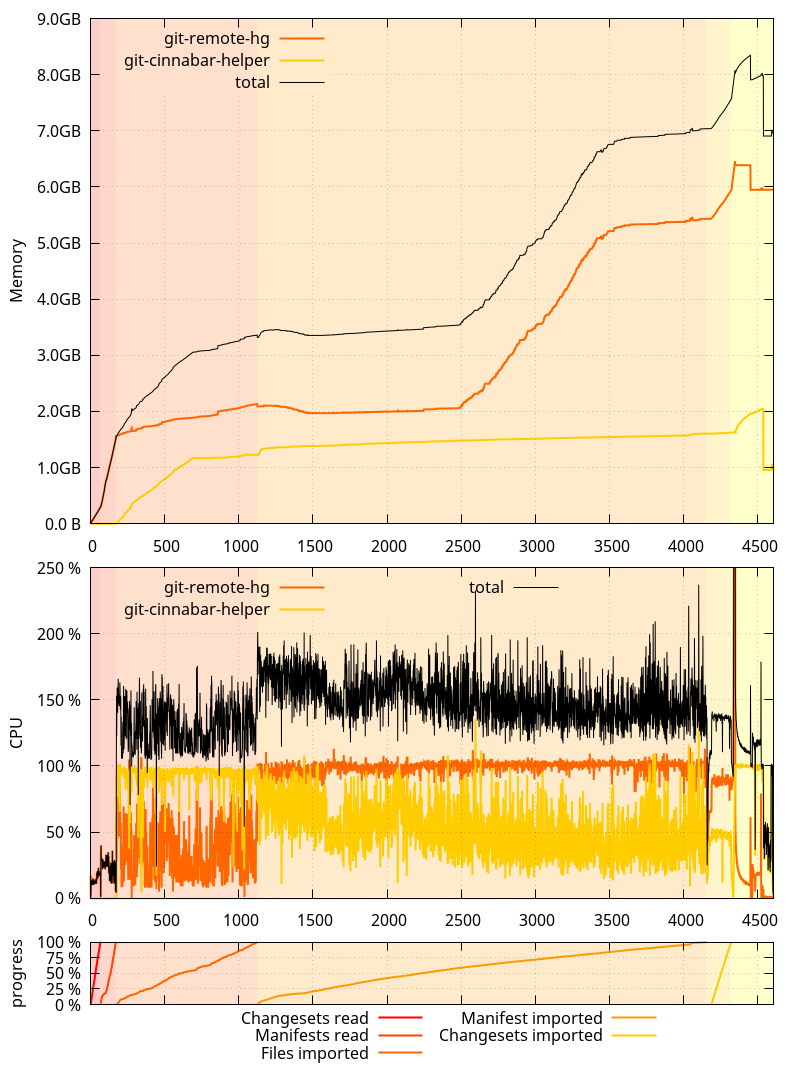 And on the master branch as of
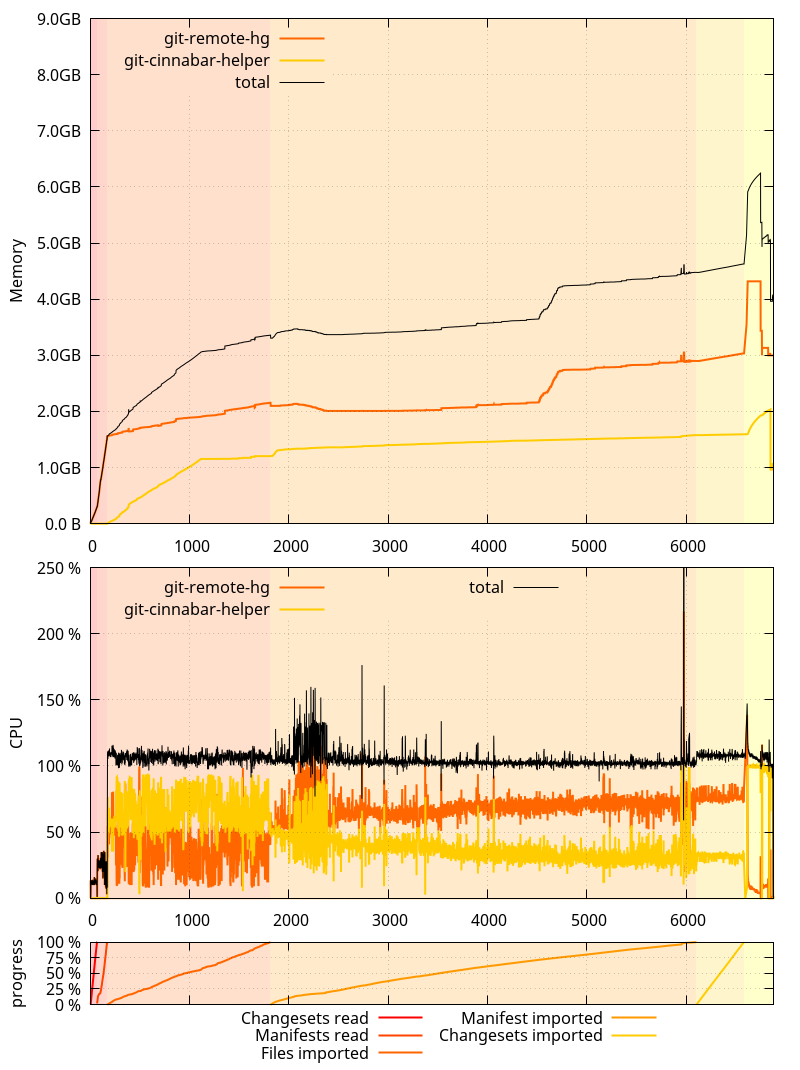 An interesting thing to note here is that the glibc allocator runaway memory use was, this time, more pronounced on 0.4.0 than on master. It was the opposite originally, but as I mentioned in the past ASLR is making it not happen exactly the same way each time.
While I m here, one thing I failed to mention in the previous posts is that all these measurements were done by cloning a local mercurial clone of
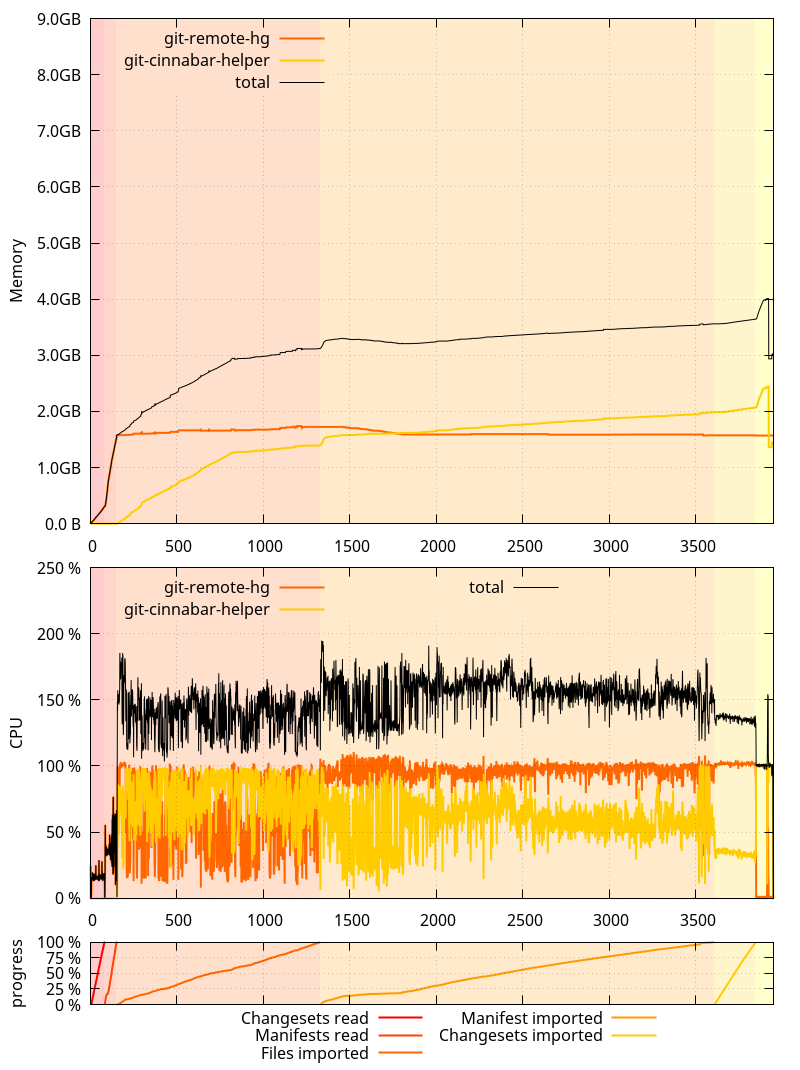 So where does that put us?
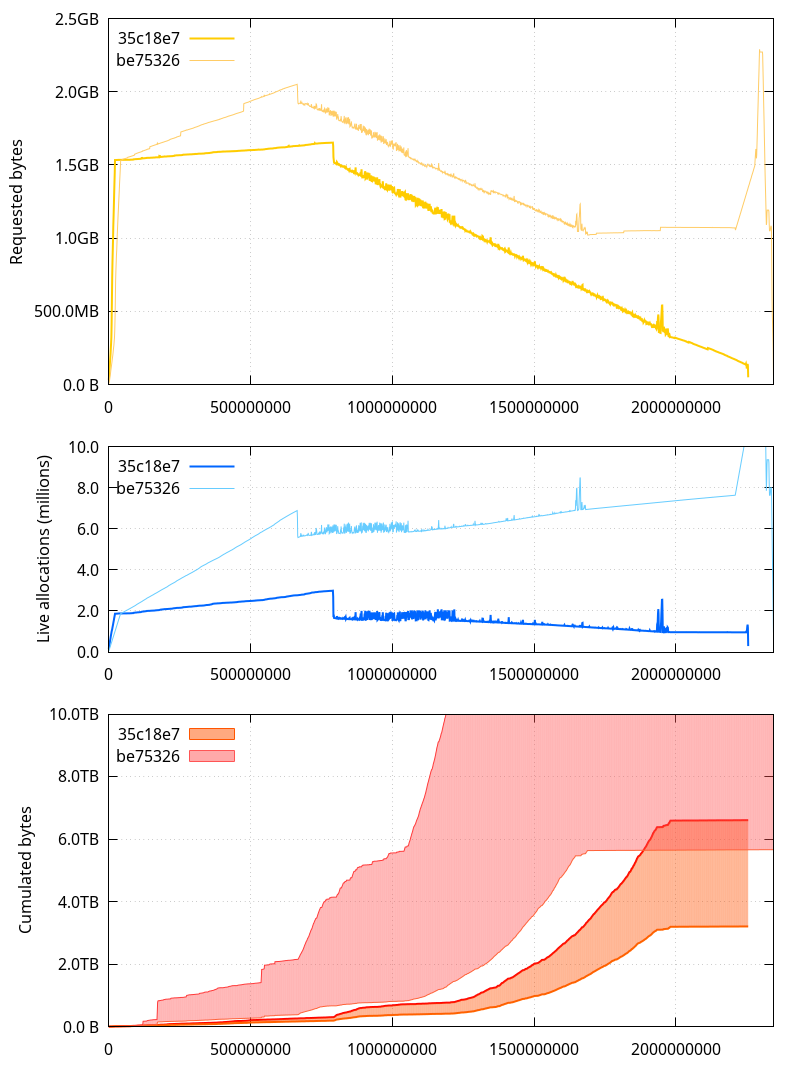 A few observations to make here:
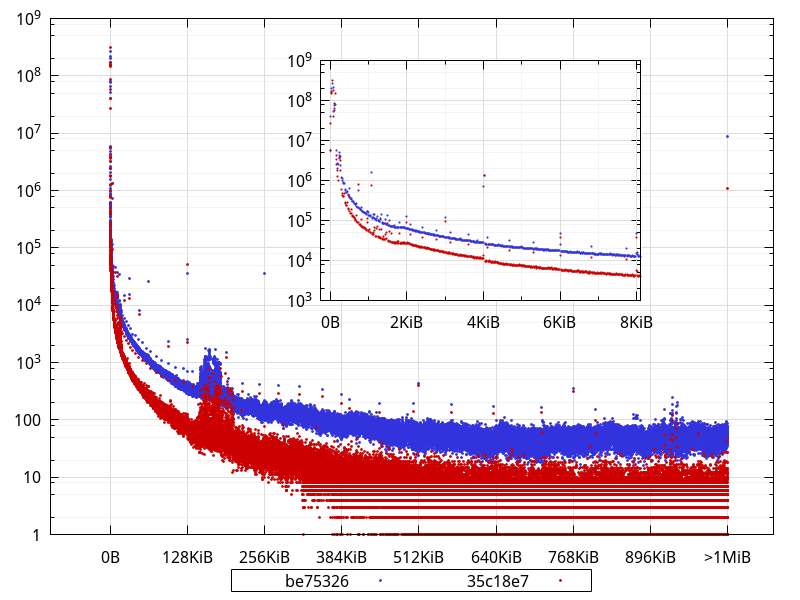 (Bucket size is 16 bytes)
What is not completely obvious from the logarithmic scale is that, in fact, 98.4% of the allocations are less than 512 bytes with the current master (35c18e7), and they were 95.5% with be75326. Interestingly, though, in absolute numbers, there are less allocations smaller than 512 bytes in current master than in be75326 (1,194,268,071 vs 1,214,784,494). This suggests the extra allocations that happen during some phases are larger than that.
There are clearly less allocations across the board (apart from very few exceptions), and close to an order of magnitude less allocations larger than 1MiB. In fact, widening the bucket size to 32KiB shows an order of magnitude difference (or close) for most buckets:
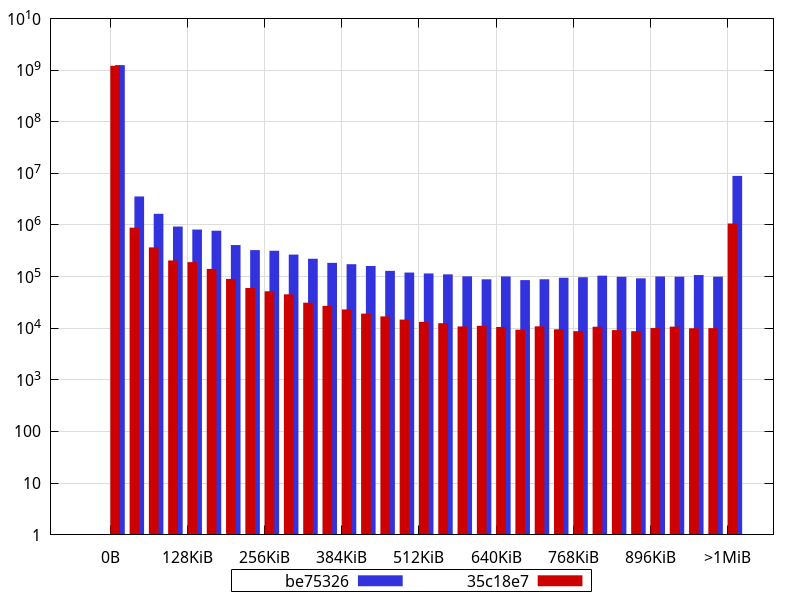 An interesting thing to note is how some sizes are largely overrepresented in the data with buckets of 16 bytes, like 768, 1104, 2048, 4128, with other smaller bumps for e.g. 2144, 2464, 2832, 3232, 3696, 4208, 4786, 5424, 6144, 6992, 7920 While some of those are powers of 2, most aren t, and some of them may actually represent objects sized with a power of 2, but that have an extra PyObject overhead.
While looking at allocation stats, I got to wonder what the lifetimes of those allocations looked like. So I scanned the allocator logs and measured the distance between when an allocation is made and when it is
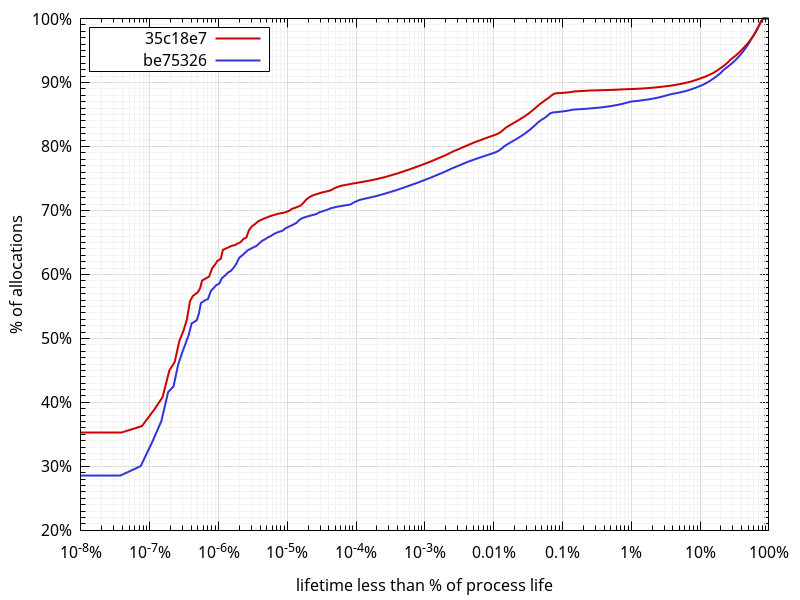 What comes out of this data:
 Here are the notes I took while manually expanding an non-LVM encrypted
RAID1 array on an Ubuntu machine.
My original setup consisted of a 1 TB drive along with a 2 TB drive, which
meant that the RAID1 array was 1 TB in size and the second drive had 1 TB of
unused capacity. This is how I replaced the old 1 TB drive with a new 3 TB
drive and expanded the RAID1 array to 2 TB (leaving 1 TB unused on the new 3
TB drive).